
Articles | Volume 22, issue 23
https://doi.org/10.5194/bg-22-7687-2025
© Author(s) 2025. This work is distributed under
the Creative Commons Attribution 4.0 License.
the Creative Commons Attribution 4.0 License.
https://doi.org/10.5194/bg-22-7687-2025
© Author(s) 2025. This work is distributed under
the Creative Commons Attribution 4.0 License.
the Creative Commons Attribution 4.0 License.
Research article
| 
08 Dec 2025
Research article |
| 08 Dec 2025
| 08 Dec 2025
Utilizing probability estimates from machine learning and pollen to understand the depositional influences on branched GDGT in wetlands, peatlands, and lakes
Amy Cromartie
CORRESPONDING AUTHOR

Université Côte d'Azur, CNRS, CEPAM, UMR 7264, 06300 Nice, France
Cindy De Jonge
Geological Institute, ETH Zürich, 8092 Zurich, Switzerland
Guillemette Ménot
ENS de Lyon, Université Lyon 1, CNRS, UMR 5276 LGL-TPE, 69364 Lyon, France
Mary Robles
Aix-Marseille Univ., CNRS, IRD, INRAE, Coll France, UMR 34 CEREGE, 13545 Aix-en-Provence, France
ISEM, Univ. Montpellier, CNRS, IRD, 34090 Montpellier, France
Lucas Dugerdil
ENS de Lyon, Université Lyon 1, CNRS, UMR 5276 LGL-TPE, 69364 Lyon, France
ISEM, Univ. Montpellier, CNRS, IRD, 34090 Montpellier, France
Odile Peyron
ISEM, Univ. Montpellier, CNRS, IRD, 34090 Montpellier, France
Marta Rodrigo-Gámiz
Department of Stratigraphy and Paleontology, University of Granada, 18071 Granada, Spain
Jon Camuera
Unit of Botany, Faculty of Pharmacy, Complutense University of Madrid, 28040 Madrid, Spain
Maria Jose Ramos-Roman
Instituto de Investigación en Cambio Global Universidad Rey Juan Carlos 28933, Madrid, Spain
Gonzalo Jiménez-Moreno
Department of Stratigraphy and Paleontology, University of Granada, 18071 Granada, Spain
Claude Colombié
Univ Lyon, UCBL, ENSL, UJM, CNRS, LGL-TPE, Villeurbanne, F-69622 France
Lilit Sahakyan
Institute of Geological Sciences, National Academy of Sciences of Republic of Armenia, Yerevan 0019, Armenia
Sébastien Joannin
ISEM, Univ. Montpellier, CNRS, IRD, 34090 Montpellier, France
Related authors
Lucas Dugerdil, Sébastien Joannin, Odile Peyron, Shafag Bayramova, Xiaozhong Huang, Fahu Chen, Dilfuza Egamberdieva, Jakhongir Alimov, Bazartseren Boldgiv, Amy Cromartie, Juzhi Hou, Lilit Sahakyan, Khachatur Meliksetian, Salomé Ansanay-Alex, Rafig Safarov, Imran Muradi, Shabnam Isayeva, Shehla Mirzayeva, Elshan Abdullayev, Sayyara Ibadullayeva, Parvana Garakhani, and Guillemette Ménot
Biogeosciences, 23, 1013–1042, https://doi.org/10.5194/bg-23-1013-2026, https://doi.org/10.5194/bg-23-1013-2026, 2026
Short summary
Short summary
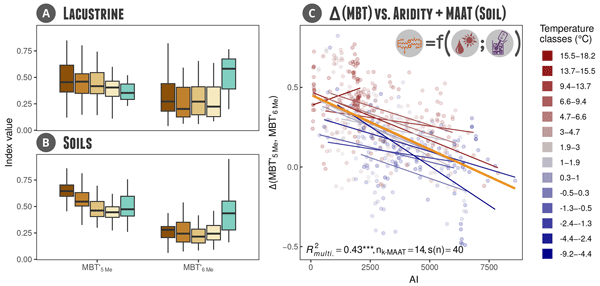
Branched glycerol dialkyl glycerol tetraethers (brGDGTs) are bacterial lipids preserved in soils and sediments, used as climate proxies. This study presents the Arid Central Asian brGDGT surface database to assess their reliability in drylands. Results show that salinity, sample type, pH, and aridity strongly influence brGDGT signals, limiting temperature reconstructions. Refined calibrations improve reconstruction accuracy, and methylation index differences may indicate aridity variations.
Mary Robles, Odile Peyron, Guillemette Ménot, Elisabetta Brugiapaglia, Sabine Wulf, Oona Appelt, Marion Blache, Boris Vannière, Lucas Dugerdil, Bruno Paura, Salomé Ansanay-Alex, Amy Cromartie, Laurent Charlet, Stephane Guédron, Jacques-Louis de Beaulieu, and Sébastien Joannin
Clim. Past, 19, 493–515, https://doi.org/10.5194/cp-19-493-2023, https://doi.org/10.5194/cp-19-493-2023, 2023
Short summary
Short summary
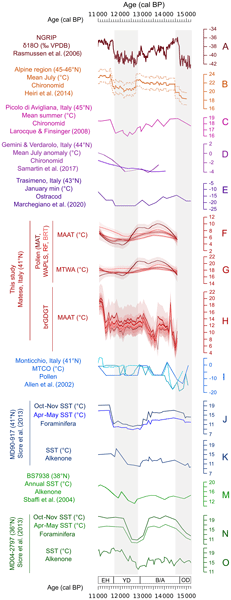
Quantitative climate reconstructions based on pollen and brGDGTs reveal, for the Late Glacial, a warm Bølling–Allerød and a marked cold Younger Dryas in Italy, showing no latitudinal differences in terms of temperatures across Italy. In terms of precipitation, no latitudinal differences are recorded during the Bølling–Allerød, whereas 40–42° N appears as a key junction point between wetter conditions in southern Italy and drier conditions in northern Italy during the Younger Dryas.
Maé Catrain, Séverine Fauquette, Odile Peyron, Nathalie Combourieu-Nebout, Vincent Lebreton, Morgane Fischer-Fries, Mary Robles, Viviane Bout-Roumazeilles, Patricia Richard, Marion Delattre, Lionel Dubost, Sébastien Joannin, Amandine Viala, Yul Altolaguirre, Jean-Pierre Suc, Jeanne Lepelletier, and Marie-Hélène Moncel
Clim. Past, 22, 1631–1653, https://doi.org/10.5194/cp-22-1631-2026, https://doi.org/10.5194/cp-22-1631-2026, 2026
Short summary
Short summary
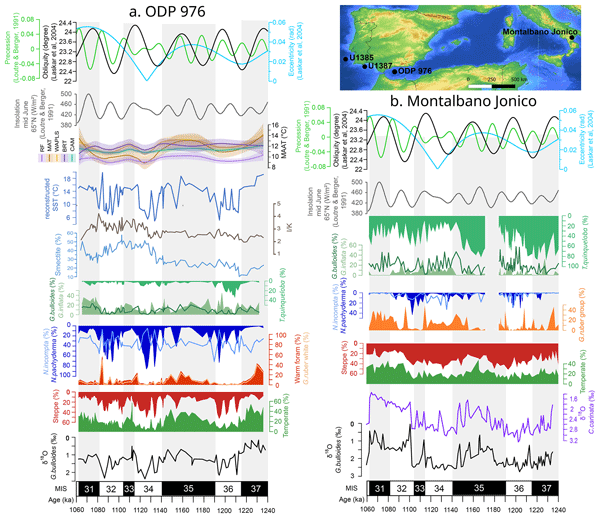
This multiproxy study investigates changes in climate cyclicity at Early-Middle Pleistocene Transition. Clay mineralogy analysis highlights a sudden change in oceanic and atmospheric circulation in the Alboran Basin around 1140 ka. Pollen, foraminifera and faunal data suggest that the climate and vegetation of this region are more likely to be influenced by variations in precipitation, hinting at major differences between the Iberian Peninsula and southern Italy.
Gabriel Fénisse, Manuel Chevalier, Odile Peyron, David Vincent Bekaert, and Pierre-Henri Blard
Clim. Past, 22, 1507–1536, https://doi.org/10.5194/cp-22-1507-2026, https://doi.org/10.5194/cp-22-1507-2026, 2026
Short summary
Short summary
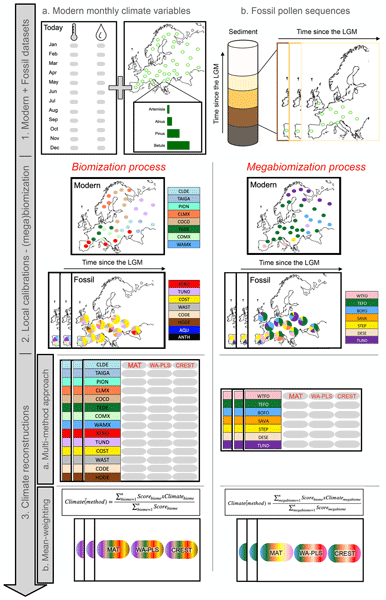
Fossil pollen offers insights into past climates, yet results differ depending on reconstruction methods. By comparing multiple approaches across Europe during the Last Glacial Maximum, we highlight how method choice influences outcomes. Our work introduces a new methodological framework that reduces biases and improves the reliability of climate reconstructions.
Emeline Bellet, Vincent Montade, Christine Piot, Guillemette Menot, Aimée Pellissier-Tanon, Ilham Bentaleb, Hermann Behling, Charline Giguet-Covex, Laurent Bremond, and Fabien Arnaud
EGUsphere, https://doi.org/10.5194/egusphere-2026-3726, https://doi.org/10.5194/egusphere-2026-3726, 2026
Short summary
Short summary
A lacustrine sediment record was used to evaluate the potential of two fire proxies: charcoal subfossil particles and Polycyclic Aromatic Hydrocarbons (PAHs). The PAH signal provides more regional information than the charcoal signal and exhibits a pattern similar to changes in local precipitation. We suggest that precipitation drives the transfer of PAHs from the atmosphere to lake sediments. These results challenge the direct interpretation of PAHs as indicators of fire events.
Liz Charton, Nathalie Combourieu-Nebout, Adele Bertini, Odile Peyron, Mary Robles, Vincent Lebreton, and Marie-Hélène Moncel
Clim. Past, 22, 747–781, https://doi.org/10.5194/cp-22-747-2026, https://doi.org/10.5194/cp-22-747-2026, 2026
Short summary
Short summary
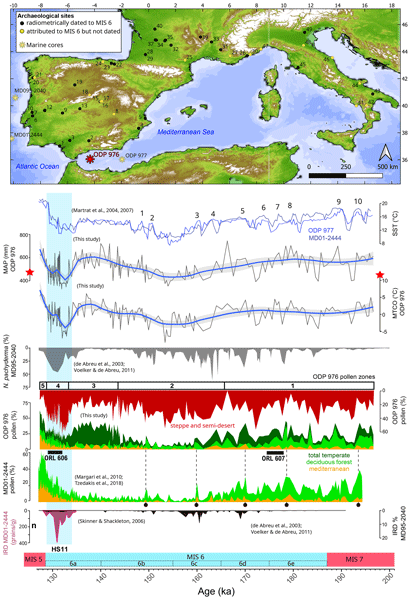
New high-resolution pollen data and pollen-inferred climatic reconstructions from the Alboran Sea reveal rapid climate oscillations during Marine Isotope Stage 6 (187–130 ka BP) in the southwestern Mediterranean. Three main phases show shifts from cool-humid to cold-arid and then wetter conditions, with Heinrich Stadial 11 marking severe cooling and steppe expansion. Neanderthals persisted regionally, though HS11 may have contributed to population decline and the end of the Lower Palaeolithic.
Lucas Dugerdil, Sébastien Joannin, Odile Peyron, Shafag Bayramova, Xiaozhong Huang, Fahu Chen, Dilfuza Egamberdieva, Jakhongir Alimov, Bazartseren Boldgiv, Amy Cromartie, Juzhi Hou, Lilit Sahakyan, Khachatur Meliksetian, Salomé Ansanay-Alex, Rafig Safarov, Imran Muradi, Shabnam Isayeva, Shehla Mirzayeva, Elshan Abdullayev, Sayyara Ibadullayeva, Parvana Garakhani, and Guillemette Ménot
Biogeosciences, 23, 1013–1042, https://doi.org/10.5194/bg-23-1013-2026, https://doi.org/10.5194/bg-23-1013-2026, 2026
Short summary
Short summary
Branched glycerol dialkyl glycerol tetraethers (brGDGTs) are bacterial lipids preserved in soils and sediments, used as climate proxies. This study presents the Arid Central Asian brGDGT surface database to assess their reliability in drylands. Results show that salinity, sample type, pH, and aridity strongly influence brGDGT signals, limiting temperature reconstructions. Refined calibrations improve reconstruction accuracy, and methylation index differences may indicate aridity variations.
Léa d'Oliveira, Sébastien Joannin, Guillemette Ménot, Nathalie Combourieu-Nebout, Lucas Dugerdil, Marion Blache, Mary Robles, Assunta Florenzano, Alessia Masi, Anna Maria Mercuri, Laura Sadori, Marie Balasse, and Odile Peyron
Clim. Past, 21, 2331–2359, https://doi.org/10.5194/cp-21-2331-2025, https://doi.org/10.5194/cp-21-2331-2025, 2025
Short summary
Short summary
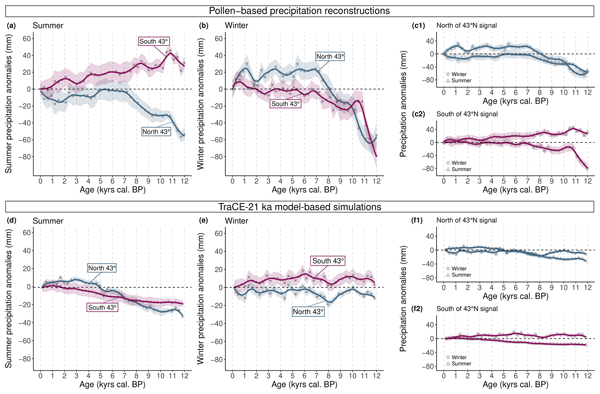
We studied climate change in the central Mediterranean during the Holocene by analysing 38 pollen records. Several methods were used to obtain reliable results on seasonal temperatures and precipitation. Our results show that, during the Holocene, summer temperatures were colder in the south and warmer in the north, with wetter winters and drier summers, especially in the south. Unlike winter conditions, summer ones did not follow variations in insolation, suggesting other factors.
Mary Robles, Valérie Andrieu, Pierre Rochette, Séverine Fauquette, François Demory, Oktay Parlak, Eliane Charrat, Belinda Gambin, and Mehmet Cihat Alçiçek
Clim. Past, 21, 2299–2329, https://doi.org/10.5194/cp-21-2299-2025, https://doi.org/10.5194/cp-21-2299-2025, 2025
Short summary
Short summary
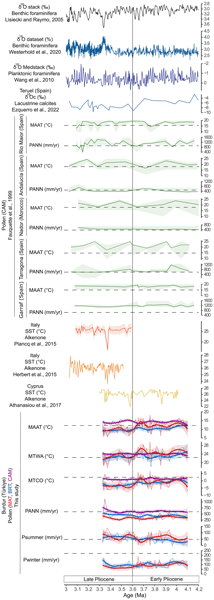
This study aims to characterize the vegetation and lake dynamics based on pollen and Non-Pollen Palynomorph (NPP) proxies, to quantitatively reconstruct climate changes using a multimethod approach and to morphologically characterize the large pollen grains of Poaceae (Cerealia-type).
Dael Sassoon, Nathalie Combourieu-Nebout, Odile Peyron, Adele Bertini, Francesco Toti, Vincent Lebreton, and Marie-Hélène Moncel
Clim. Past, 21, 489–515, https://doi.org/10.5194/cp-21-489-2025, https://doi.org/10.5194/cp-21-489-2025, 2025
Short summary
Short summary
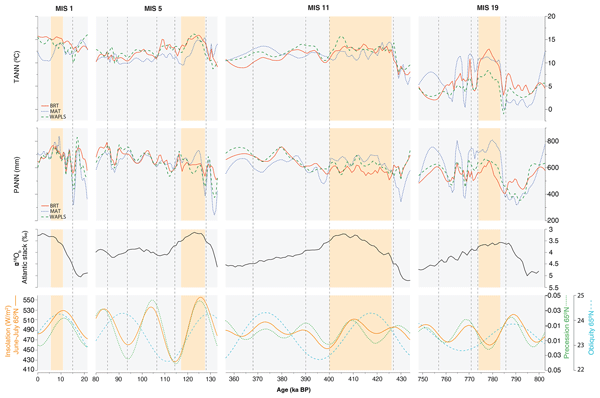
Climatic reconstructions of Marine Isotope Stages (MISs) 19, 11, and 5 and the current interglacial (MIS 1) based on pollen data from a marine core (Alboran Sea) show that, compared with MIS 1, MIS 19 was colder and highly variable, MIS 11 was longer and more stable, and MIS 5 was warmer. There is no real equivalent to the current interglacial, but past interglacials give insights into the sensitivity of the southwestern Mediterranean to global climatic changes in conditions similar to MIS 1.
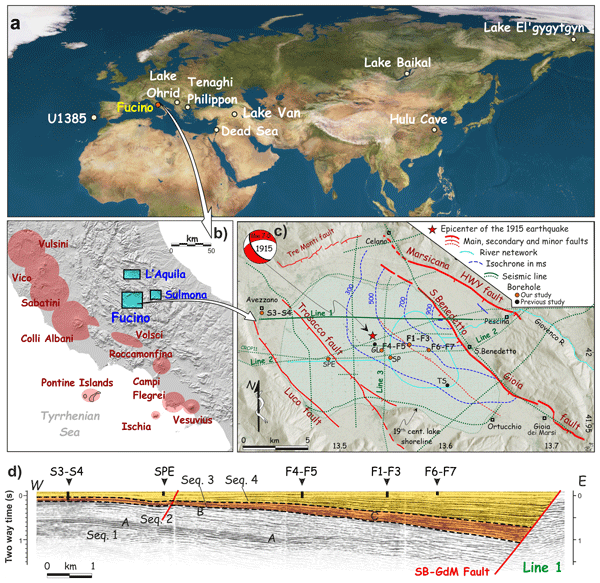
Biagio Giaccio, Bernd Wagner, Giovanni Zanchetta, Adele Bertini, Gian Paolo Cavinato, Roberto de Franco, Fabio Florindo, David A. Hodell, Thomas A. Neubauer, Sebastien Nomade, Alison Pereira, Laura Sadori, Sara Satolli, Polychronis C. Tzedakis, Paul Albert, Paolo Boncio, Cindy De Jonge, Alexander Francke, Christine Heim, Alessia Masi, Marta Marchegiano, Helen M. Roberts, Anders Noren, and the MEME team
Sci. Dril., 33, 249–266, https://doi.org/10.5194/sd-33-249-2024, https://doi.org/10.5194/sd-33-249-2024, 2024
Short summary
Short summary
A total of 42 Earth scientists from 14 countries met in Gioia dei Marsi, central Italy, on 23 to 27 October 2023 to explore the potential for deep drilling of the thick lake sediment sequence of the Fucino Basin. The aim was to reconstruct the history of climate, ecosystem, and biodiversity changes and of the explosive volcanism and tectonics in central Italy over the last 3.5 million years, constrained by a detailed radiometric chronology.
Fatemeh Ajallooeian, Nathalie Dubois, Sarah Nemiah Ladd, Mark Alexander Lever, Carsten Johnny Schubert, and Cindy De Jonge
EGUsphere, https://doi.org/10.5194/egusphere-2024-3052, https://doi.org/10.5194/egusphere-2024-3052, 2024
Preprint archived
Short summary
Short summary
We studied how temperature, pH, and oxygen levels affect bacterial lipids (brGDGTs) in lake water and sediment samples from Rotsee, a shallow freshwater lake. These lipids are used to reconstruct past climate conditions. Our findings show that stratification impacts brGDGT distribution in the lake surface, while chemistry influences distribution at the bottom, complicating their use as temperature indicators. This research provides new insights to improve climate reconstructions in lakes.
Léa d'Oliveira, Lucas Dugerdil, Guillemette Ménot, Allowen Evin, Serge D. Muller, Salomé Ansanay-Alex, Julien Azuara, Colline Bonnet, Laurent Bremond, Mehmet Shah, and Odile Peyron
Clim. Past, 19, 2127–2156, https://doi.org/10.5194/cp-19-2127-2023, https://doi.org/10.5194/cp-19-2127-2023, 2023
Short summary
Short summary
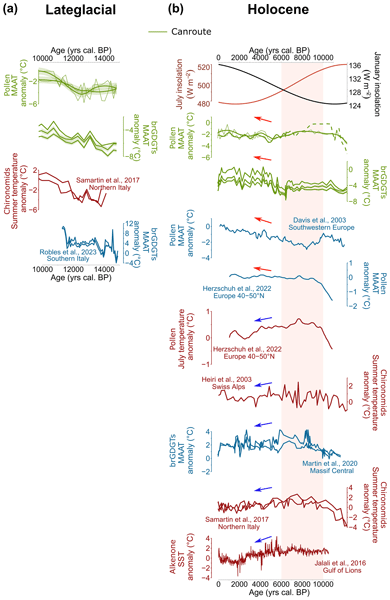
In southern Europe, Holocene climate variability is characterized by a strong heterogeneity whose patterns are still poorly understood. Here, a multi-proxy approach (pollen and biomarkers) is applied to the Canroute sequence to reconstruct the climatic variation over the last 15 000 years in southern Massif Central, France. Results reveal that reconstructions of regional climate trends notably differ depending on proxies and sites, notably concerning the presence of a Holocene thermal maximum.
Ulrike Herzschuh, Thomas Böhmer, Manuel Chevalier, Raphaël Hébert, Anne Dallmeyer, Chenzhi Li, Xianyong Cao, Odile Peyron, Larisa Nazarova, Elena Y. Novenko, Jungjae Park, Natalia A. Rudaya, Frank Schlütz, Lyudmila S. Shumilovskikh, Pavel E. Tarasov, Yongbo Wang, Ruilin Wen, Qinghai Xu, and Zhuo Zheng
Clim. Past, 19, 1481–1506, https://doi.org/10.5194/cp-19-1481-2023, https://doi.org/10.5194/cp-19-1481-2023, 2023
Short summary
Short summary
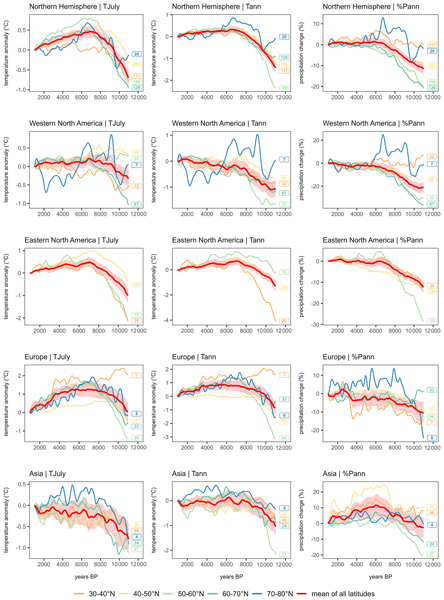
A mismatch between model- and proxy-based Holocene climate change may partially originate from the poor spatial coverage of climate reconstructions. Here we investigate quantitative reconstructions of mean annual temperature and annual precipitation from 1908 pollen records in the Northern Hemisphere. Trends show strong latitudinal patterns and differ between (sub-)continents. Our work contributes to a better understanding of the global mean.
Ulrike Herzschuh, Thomas Böhmer, Chenzhi Li, Manuel Chevalier, Raphaël Hébert, Anne Dallmeyer, Xianyong Cao, Nancy H. Bigelow, Larisa Nazarova, Elena Y. Novenko, Jungjae Park, Odile Peyron, Natalia A. Rudaya, Frank Schlütz, Lyudmila S. Shumilovskikh, Pavel E. Tarasov, Yongbo Wang, Ruilin Wen, Qinghai Xu, and Zhuo Zheng
Earth Syst. Sci. Data, 15, 2235–2258, https://doi.org/10.5194/essd-15-2235-2023, https://doi.org/10.5194/essd-15-2235-2023, 2023
Short summary
Short summary
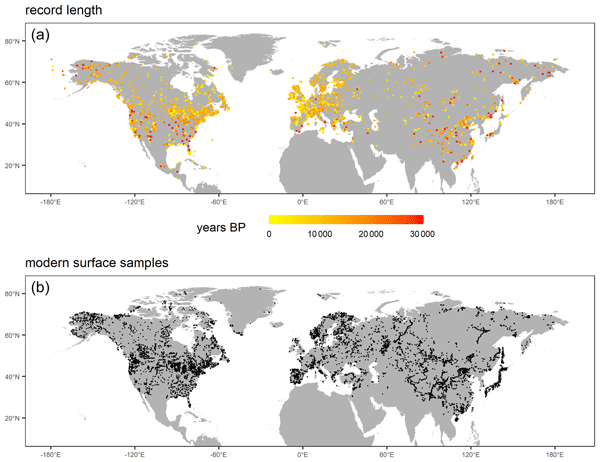
Climate reconstruction from proxy data can help evaluate climate models. We present pollen-based reconstructions of mean July temperature, mean annual temperature, and annual precipitation from 2594 pollen records from the Northern Hemisphere, using three reconstruction methods (WA-PLS, WA-PLS_tailored, and MAT). Since no global or hemispheric synthesis of quantitative precipitation changes are available for the Holocene so far, this dataset will be of great value to the geoscientific community.
Mary Robles, Odile Peyron, Guillemette Ménot, Elisabetta Brugiapaglia, Sabine Wulf, Oona Appelt, Marion Blache, Boris Vannière, Lucas Dugerdil, Bruno Paura, Salomé Ansanay-Alex, Amy Cromartie, Laurent Charlet, Stephane Guédron, Jacques-Louis de Beaulieu, and Sébastien Joannin
Clim. Past, 19, 493–515, https://doi.org/10.5194/cp-19-493-2023, https://doi.org/10.5194/cp-19-493-2023, 2023
Short summary
Short summary
Quantitative climate reconstructions based on pollen and brGDGTs reveal, for the Late Glacial, a warm Bølling–Allerød and a marked cold Younger Dryas in Italy, showing no latitudinal differences in terms of temperatures across Italy. In terms of precipitation, no latitudinal differences are recorded during the Bølling–Allerød, whereas 40–42° N appears as a key junction point between wetter conditions in southern Italy and drier conditions in northern Italy during the Younger Dryas.
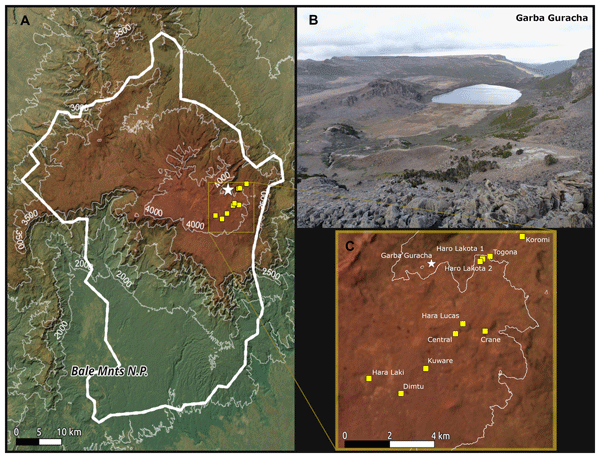
Lucas Bittner, Cindy De Jonge, Graciela Gil-Romera, Henry F. Lamb, James M. Russell, and Michael Zech
Biogeosciences, 19, 5357–5374, https://doi.org/10.5194/bg-19-5357-2022, https://doi.org/10.5194/bg-19-5357-2022, 2022
Short summary
Short summary
With regard to global warming, an understanding of past temperature changes is becoming increasingly important. Branched glycerol dialkyl glycerol tetraethers (brGDGTs) are membrane lipids used globally to reconstruct lake water temperatures. In the Bale Mountains lakes, we find a unique composition of brGDGT isomers. We present a modified local calibration and a new high-altitude temperature reconstruction from the Horn of Africa spanning the last 12.5 kyr.
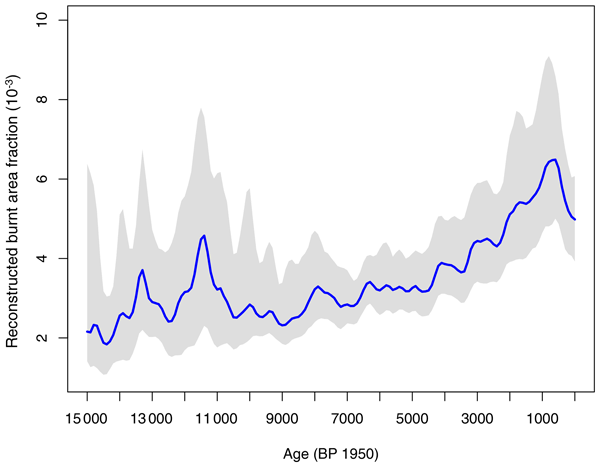
Yicheng Shen, Luke Sweeney, Mengmeng Liu, Jose Antonio Lopez Saez, Sebastián Pérez-Díaz, Reyes Luelmo-Lautenschlaeger, Graciela Gil-Romera, Dana Hoefer, Gonzalo Jiménez-Moreno, Heike Schneider, I. Colin Prentice, and Sandy P. Harrison
Clim. Past, 18, 1189–1201, https://doi.org/10.5194/cp-18-1189-2022, https://doi.org/10.5194/cp-18-1189-2022, 2022
Short summary
Short summary
We present a method to reconstruct burnt area using a relationship between pollen and charcoal abundances and the calibration of charcoal abundance using modern observations of burnt area. We use this method to reconstruct changes in burnt area over the past 12 000 years from sites in Iberia. We show that regional changes in burnt area reflect known changes in climate, with a high burnt area during warming intervals and low burnt area when the climate was cooler and/or wetter than today.
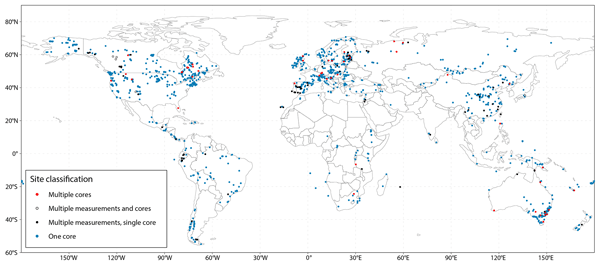
Sandy P. Harrison, Roberto Villegas-Diaz, Esmeralda Cruz-Silva, Daniel Gallagher, David Kesner, Paul Lincoln, Yicheng Shen, Luke Sweeney, Daniele Colombaroli, Adam Ali, Chéïma Barhoumi, Yves Bergeron, Tatiana Blyakharchuk, Přemysl Bobek, Richard Bradshaw, Jennifer L. Clear, Sambor Czerwiński, Anne-Laure Daniau, John Dodson, Kevin J. Edwards, Mary E. Edwards, Angelica Feurdean, David Foster, Konrad Gajewski, Mariusz Gałka, Michelle Garneau, Thomas Giesecke, Graciela Gil Romera, Martin P. Girardin, Dana Hoefer, Kangyou Huang, Jun Inoue, Eva Jamrichová, Nauris Jasiunas, Wenying Jiang, Gonzalo Jiménez-Moreno, Monika Karpińska-Kołaczek, Piotr Kołaczek, Niina Kuosmanen, Mariusz Lamentowicz, Martin Lavoie, Fang Li, Jianyong Li, Olga Lisitsyna, José Antonio López-Sáez, Reyes Luelmo-Lautenschlaeger, Gabriel Magnan, Eniko Katalin Magyari, Alekss Maksims, Katarzyna Marcisz, Elena Marinova, Jenn Marlon, Scott Mensing, Joanna Miroslaw-Grabowska, Wyatt Oswald, Sebastián Pérez-Díaz, Ramón Pérez-Obiol, Sanna Piilo, Anneli Poska, Xiaoguang Qin, Cécile C. Remy, Pierre J. H. Richard, Sakari Salonen, Naoko Sasaki, Hieke Schneider, William Shotyk, Migle Stancikaite, Dace Šteinberga, Normunds Stivrins, Hikaru Takahara, Zhihai Tan, Liva Trasune, Charles E. Umbanhowar, Minna Väliranta, Jüri Vassiljev, Xiayun Xiao, Qinghai Xu, Xin Xu, Edyta Zawisza, Yan Zhao, Zheng Zhou, and Jordan Paillard
Earth Syst. Sci. Data, 14, 1109–1124, https://doi.org/10.5194/essd-14-1109-2022, https://doi.org/10.5194/essd-14-1109-2022, 2022
Short summary
Short summary
We provide a new global data set of charcoal preserved in sediments that can be used to examine how fire regimes have changed during past millennia and to investigate what caused these changes. The individual records have been standardised, and new age models have been constructed to allow better comparison across sites. The data set contains 1681 records from 1477 sites worldwide.
Cited articles
Acharya, S., Zech, R., Strobel, P., Bliedtner, M., Prochnow, M., and De Jonge, C.: Environmental controls on the distribution of GDGT molecules in Lake Höglwörth, Southern Germany, Org. Geochem., 186, https://doi.org/10.1016/j.orggeochem.2023.104689, 2023.
Anaissi, A., Kennedy, P. J., Goyal, M., and Catchpoole, D. R.: A balanced iterative random forest for gene selection from microarray data, BMC Bioinform., 14, 104689, https://doi.org/10.1186/1471-2105-14-261, 2013.
Baker, A., Blyth, A. J., Jex, C. N., Mcdonald, J. A., Woltering, M., and Khan, S. J.: Glycerol dialkyl glycerol tetraethers (GDGT) distributions from soil to cave: Refining the speleothem paleothermometer, Org. Geochem., 136, 103890, https://doi.org/10.1016/j.orggeochem.2019.06.011, 2019.
Barhoumi, C., Ménot, G., Joannin, S., Ali, A. A., Ansanay-Alex, S., Golubeva, Y., Subetto, D., Kryshen, A., Drobyshev, I., and Peyron, O.: Temperature and fire controls on vegetation dynamics in Northern Ural (Russia) boreal forests during the Holocene based on brGDGT and pollen data, Quaternary Sci. Rev., 305, 108014, https://doi.org/10.1016/j.quascirev.2023.108, 2023.
Baxter, A. J., Hopmans, E. C., Russell, J. M., and Sinninghe Damsté, J. S.: Bacterial GMGTs in East African lake sediments: Their potential as palaeotemperature indicators, Geochim. Cosmochim. Acta, 259, 155–169, https://doi.org/10.1016/j.gca.2019.05.039, 2019.
Bell, J. F.: Tree-based methods, in: Machine Learning Methods for Ecological Applications, edited by: Fielding, A. H., Springer US, Boston, MA, 89–105, https://doi.org/10.1007/978-1-4615-5289-5_3, 1999.
Berk, R. A.: Support vector machines, Statistical Learning from a Regression Perspective, 1–28, ISBN 978-3-030-40188-7, https://doi.org/10.1007/978-3-030-40189-4, 2008.
Boozary, P., Sheykhan, S., GhorbanTanhaei, H., and Magazzino, C.: Enhancing customer retention with machine learning: A comparative analysis of ensemble models for accurate churn prediction, Int. J. Inf. Manage. Data Insights, 5, 100331, https://doi.org/10.1016/j.jjimei.2025.100331, 2025.
Buckles, L. K., Weijers, J. W. H., Tran, X.-M., Waldron, S., and Sinninghe Damsté, J. S.: Provenance of tetraether membrane lipids in a large temperate lake (Loch Lomond, UK): implications for glycerol dialkyl glycerol tetraether (GDGT)-based palaeothermometry, Biogeosciences, 11, 5539–5563, https://doi.org/10.5194/bg-11-5539-2014, 2014.
Bzdok, D., Altman, N., and Krzywinski, M.: Statistics versus machine learning, Nature Methods, 15, 233–234, https://doi.org/10.1038/nmeth.4642, 2018.
Camuera, J., Jiménez-Moreno, G., Ramos-Román, M. J., García-Alix, A., Toney, J. L., Anderson, R. S., Jiménez-Espejo, F., Kaufman, D., Bright, J., Webster, C., Yanes, Y., Carrión, J. S., Ohkouchi, N., Suga, H., Yamame, M., Yokoyama, Y., and Martínez-Ruiz, F.: Orbital-scale environmental and climatic changes recorded in a new
Camuera, J., Jiménez-Moreno, G., Ramos-Román, M. J., García-Alix, A., Toney, J. L., Anderson, R. S., Jiménez-Espejo, F., Bright, J., Webster, C., Yanes, Y., and Carrión, J. S.: Vegetation and climate changes during the last two glacial-interglacial cycles in the western Mediterranean: A new long pollen record from Padul (southern Iberian Peninsula), Quaternary Sci. Rev., 205, 86–105, https://doi.org/10.1016/j.quascirev.2018.12.013, 2019.
Cao, J., Rao, Z., Shi, F., and Jia, G.: Ice formation on lake surfaces in winter causes warm-season bias of lacustrine brGDGT temperature estimates, Biogeosciences, 17, 2521–2536, https://doi.org/10.5194/bg-17-2521-2020, 2020.
Cearns, M., Hahn, T., Clark, S., and Baune, B. T.: Machine learning probability calibration for high-risk clinical decision-making, Aust. New Zeal. J. Psychiat , 54, 123–126, 2020.
Chen, C., Bai, Y., Fang, X., Zhuang, G., Khodzhiev, A., Bai, X., and Murodov, A.: Evaluating the potential of soil bacterial tetraether proxies in westerlies dominating western Pamirs, Tajikistan and implications for paleoenvironmental reconstructions, Chem. Geol., 559, 119908, https://doi.org/10.1016/j.chemgeo.2020.119908, 2021.
Cromartie, A.: Data for: Utilizing Probability Estimates from Machine Learning and Pollen to Understand the Depositional Influences on Branched GDGT in Wetlands, Peatlands, and Lakes, Mendeley Data [data set], 1, https://doi.org/10.17632/tr8tppy9fz.1, 2025a.
Cromartie, A.: amycromartie/ProbbrGDGT: ProbbrGDGT (1.1.2), Zenodo [code], https://doi.org/10.5281/zenodo.17459703, 2025b.
Cromartie, A., Blanchet, C., Barhoumi, C., Messager, E., Peyron, O., Ollivier, V., Sabatier, P., Etienne, D., Karakhanyan, A., Khatchadourian, L., Smith, A. T., Badalyan, R., Perello, B., Lindsay, I., and Joannin, S.: The vegetation, climate, and fire history of a mountain steppe: A Holocene reconstruction from the South Caucasus, Shenkani, Armenia, Quaternary Sci. Rev., 246, 106485, https://doi.org/10.1016/j.quascirev.2020.106485, 2020.
Dang, X., Yang, H., Naafs, B. D. A., Pancost, R. D., and Xie, S.: Evidence of moisture control on the methylation of branched glycerol dialkyl glycerol tetraethers in semi-arid and arid soils, Geochim. Cosmochim. Ac., 189, 24–36, https://doi.org/10.1016/j.gca.2016.06.004, 2016.
Dang, X., Ding, W., Yang, H., Pancost, R. D., Naafs, B. D. A., Xue, J., Lin, X., Lu, J., and Xie, S.: Different temperature dependence of the bacterial brGDGT isomers in 35 Chinese lake sediments compared to that in soils, Org. Geochem., 119, 72–79, https://doi.org/10.1016/j.orggeochem.2018.02.008, 2018.
Dankowski, T. and Ziegler, A.: Calibrating random forests for probability estimation, Stat. Med., 35, 3949–3960, 2016.
Davtian, N., Bard, E., Ménot, G., and Fagault, Y.: The importance of mass accuracy in selected ion monitoring analysis of branched and isoprenoid tetraethers, Org. Geochem., 118, 58–62, https://doi.org/10.1016/j.orggeochem.2018.01.007, 2018.
Dawid, A. P.: Calibration-Based Empirical Probability, Ann. Stat., 13, 1251–1274, https://doi.org/10.1214/aos/1176349736, 1985.
Dearing Crampton-Flood, E.: Data for: BayMBT: A Bayesian calibration model for branched glycerol dialkyl glycerol tetraethers in soils and peats (V1), Mendeley Data [data set], https://doi.org/10.17632/tyv9pbv3jd.1, 2020.
Dearing Crampton-Flood, E., Tierney, J. E., Peterse, F., Kirkels, F. M. S. A., and Damsté, J. S. S.: BayMBT: A Bayesian calibration model for branched glycerol dialkyl glycerol tetraethers in soils and peats, Geochimica et Cosmochimica Acta, 268, 142–159, https://doi.org/10.1016/j.gca.2019.09.043, 2020.
De Jonge, C., Stadnitskaia, A., Hopmans, E. C., Cherkashov, G., Fedotov, A., and Sinninghe Damsté, J. S.: In situ produced branched glycerol dialkyl glycerol tetraethers in suspended particulate matter from the Yenisei River, Eastern Siberia, Geochim. Cosmochim. Ac., 125, 104706, https://doi.org/10.1016/j.gca.2013.10.031, 2014a.
De Jonge, C., Hopmans, E. C., Zell, C. I., Kim, J.-H., Schouten, S., and Damsté, J. S. S.: Occurrence and abundance of 6-methyl branched glycerol dialkyl glycerol tetraethers in soils: Implications for palaeoclimate reconstruction, Geochim. Cosmochim. Ac., 141, 97–112, 2014b.
De Jonge, C., Kuramae, E. E., Radujković, D., Weedon, J. T., Janssens, I. A., and Peterse, F.: The influence of soil chemistry on branched tetraether lipids in mid- and high latitude soils: Implications for brGDGT-based paleothermometry, Geochim. Cosmochim. Ac., 310, 95–112, https://doi.org/10.1016/j.gca.2021.06.037, 2021.
De Jonge, C., Guo, J., Hällberg, P., Griepentrog, M., Rifai, H., Richter, A., Ramirez, E., Zhang, X., Smittenberg, R. H., Peterse, F., Boeckx, P., and Dercon, G.: The impact of soil chemistry, moisture and temperature on branched and isoprenoid GDGTs in soils: A study using six globally distributed elevation transects, Org. Geochem., 187, 104706, https://doi.org/10.1016/j.orggeochem.2023.104706, 2024.
Dembla, G.: Intuition behind Log-loss score, Towards Data Science, https://towardsdatascience.com/intuition-behind-log-loss-score-4e0c9979680a/ (last access: October 2024), 2020.
Dillon, J. T., Lash, S., Zhao, J., Smith, K. P., van Dommelen, P., Scherer, A. K., and Huang, Y.: Bacterial tetraether lipids in ancient bones record past climate conditions at the time of disposal, J. Archaeolog. Sci., 96, 45–56, https://doi.org/10.1016/j.jas.2018.05.009, 2018.
Ding, S., Schwab, V. F., Ueberschaar, N., Roth, V.-N., Lange, M., Xu, Y., Gleixner, G., and Pohnert, G.: Identification of novel 7-methyl and cyclopentanyl branched glycerol dialkyl glycerol tetraethers in lake sediments, Org. Geochem., 102, 52–58, 2016.
Ding, S., Xu, Y., Wang, Y., He, Y., Hou, J., Chen, L., and He, J.-S.: Distribution of branched glycerol dialkyl glycerol tetraethers in surface soils of the Qinghai–Tibetan Plateau: implications of brGDGTs-based proxies in cold and dry regions, Biogeosciences, 12, 3141–3151, https://doi.org/10.5194/bg-12-3141-2015, 2015.
d'Oliveira, L., Dugerdil, L., Ménot, G., Evin, A., Muller, S. D., Ansanay-Alex, S., Azuara, J., Bonnet, C., Bremond, L., Shah, M., and Peyron, O.: Reconstructing 15 000 years of southern France temperatures from coupled pollen and molecular (branched glycerol dialkyl glycerol tetraether) markers (Canroute, Massif Central), Clim. Past, 19, 2127–2156, https://doi.org/10.5194/cp-19-2127-2023, 2023.
Dugerdil, L., Joannin, S., Peyron, O., Jouffroy-Bapicot, I., Vannière, B., Boldgiv, B., Unkelbach, J., Behling, H., and Ménot, G.: Climate reconstructions based on GDGT and pollen surface datasets from Mongolia and Baikal area: calibrations and applicability to extremely cold–dry environments over the Late Holocene, Clim. Past, 17, 1199–1226, https://doi.org/10.5194/cp-17-1199-2021, 2021a.
Dugerdil, L., Joannin, S., Peyron, O., Jouffroy-Bapicot, I., Vannière, B., Boldgiv, B., Behling, H., and Ménot, G.: New Mongolian-Siberian pollen and brGDGT surface dataset: local calibration for paleoclimate reconstructions, PANGEA [data set], https://doi.org/10.1594/PANGAEA.933664, 2021b.
Dugerdil, L., Ménot, G., Peyron, O., Jouffroy-Bapicot, I., Ansanay-Alex, S., Antheaume, I., Behling, H., Boldgiv, B., Develle, A. L., Grossi, V., Magail, J., Makou, M., Robles, M., Unkelbach, J., Vannière, B., and Joannin, S.: Late Holocene Mongolian climate and environment reconstructions from brGDGTs, NPPs and pollen transfer functions for Lake Ayrag: Paleoclimate implications for Arid Central Asia, Quaternary Sci. Rev., 273, 107235, https://doi.org/10.1016/j.quascirev.2021.107235, 2021c.
Erdman, C. and Emerson, J. W.: bcp: an R package for performing a Bayesian analysis of change point problems, Journal of statistical Software, 23, 1–13, https://doi.org/10.18637/jss.v023.i03, 2007.
Genuer, R., Poggi, J.-M.: Random forests with R, 1st ed., Springer Cham, X–98, https://doi.org/10.1007/978-3-030-56485-8_3, 2020.
Gill, J. L., Williams, J. W., Jackson, S. T., Lininger, K. B., and Robinson, G. S.: Pleistocene Megafaunal Collapse, Novel Plant Communities, and Enhanced Fire Regimes in North America, Science, 326, 1100–1103, https://doi.org/10.1126/science.1179504, 2009.
Grinsztajn, L., Oyallon, E., and Varoquaux, G.: Why do tree-based models still outperform deep learning on typical tabular data?, in: Advances in Neural Information Processing Systems 35 (NeurIPS 2022), vol. 35, edited by: Koyejo, S., Mohamed, S., Agarwal, A., Belgrave, D., Cho, K., and Oh, A., 507–520, ISBN 978-1-7138-7108-8, https://proceedings.neurips.cc/paper_files/paper/2022/file/0378c7692da36807bdec87ab043cdadc-Paper-Datasets_and_Benchmarks.pdf (last access: 14 March 2025), 2022.
Guo, J., Glendell, M., Meersmans, J., Kirkels, F., Middelburg, J. J., and Peterse, F.: Assessing branched tetraether lipids as tracers of soil organic carbon transport through the Carminowe Creek catchment (southwest England), Biogeosciences, 17, 3183–3201, https://doi.org/10.5194/bg-17-3183-2020, 2020a.
Guo, J., Glendell, M., Meersmans, J., Kirkels, F. M. S. A., Middelburg, J. J., and Peterse, F.: Branched tetraether lipids in Carminowe Creek catchment (southwest England), PANGEA [data set], https://doi.org/10.1594/PANGAEA.918523, 2020b.
Halffman, R., Lembrechts, J., Radujković, D., De Gruyter, J., Nijs, I., and De Jonge, C.: Soil chemistry, temperature and bacterial community composition drive brGDGT distributions along a subarctic elevation gradient, Org. Geochem., 163, 104346, https://doi.org/10.1016/j.orggeochem.2021.104346, 2022.
Hastie, T., Tibshirani, R., Friedman, J.: The Elements of Statistical Learning: Data Mining, Inference, and Prediction, Second., Springer, 744 pp., ISBN 978-0-387-84857-0, 2009.
He, H. and Garcia, E. A.: Learning from Imbalanced Data, IEEE Transactions on Knowledge and Data Engineering, 21, 1263–1284, https://doi.org/10.1109/TKDE.2008.239, 2009.
Hilbe, J. M.: Practical guide to logistic regression, CRC Press, ISBN 978-1-4987-0958-3, 2016.
Hopmans, E. C., Weijers, J. W. H., Schefuß, E., Herfort, L., Sinninghe Damsté, J. S., and Schouten, S.: A novel proxy for terrestrial organic matter in sediments based on branched and isoprenoid tetraether lipids, Earth Planet. Sc. Lett., 224, 107–116, https://doi.org/10.1016/j.epsl.2004.05.012, 2004.
Hopmans, E. C., Schouten, S., and Damsté, J. S. S.: The effect of improved chromatography on GDGT-based palaeoproxies, Org. Geochem., 93, 1–6, 2016.
Huang, K., Yang, H., King, I., and Lyu, M. R.: Local Learning vs. Global Learning: An Introduction to Maxi-Min Margin Machine, Springer Nature, https://doi.org/10.1007/10984697_5, 2005.
Huguet, C., Hopmans, E. C., Febo-Ayala, W., Thompson, D. H., Sinninghe Damsté, J. S., and Schouten, S.: An improved method to determine the absolute abundance of glycerol dibiphytanyl glycerol tetraether lipids, Org. Geochem., 37, 1036–1041, https://doi.org/10.1016/j.orggeochem.2006.05.008, 2006.
Hunter, J. D.: Matplotlib: A 2D graphics environment, Comput. Sci. Eng., 9, 90–95, https://doi.org/10.1109/MCSE.2007.55, 2007.
Jadhav, S. D. and Channe, H.: Comparative study of K-NN, naive Bayes and decision tree classification techniques, Int. J. Sci. Res., 5, 1842–1845, 2016.
Jaeschke, A., Rethemeyer, J., Lappé, M., Schouten, S., Boeckx, P., and Schefuß, E.: Influence of land use on distribution of soil n-alkane δD and brGDGTs along an altitudinal transect in Ethiopia: Implications for (paleo)environmental studies, Org. Geochem., 124, 77–87, https://doi.org/10.1016/j.orggeochem.2018.06.006, 2018.
Jaeschke, A.: Distribution of soil n-alkane δD and branched glycerol dialkyl glycerol tetraether lipids (brGDGT) along an altitudinal transect in Ethiopia, PANGAEA [data set], https://doi.org/10.1594/PANGAEA.895602, 2018.
Joannin, S., Ali, A. A., Ollivier, V., Roiron, P., Peyron, O., Chevaux, S., Nahapetyan, S., Tozalakyan, P., Karakhanyan, A., and Chataigner, C.: Vegetation, fire and climate history of the Lesser Caucasus: a new Holocene record from Zarishat fen (Armenia), J. Quaternary Sci., 29, 70–82, https://doi.org/10.1002/jqs.2679, 2014.
Jung, Y.: Multiple predicting K-fold cross-validation for model selection, J. Nonparam. Stat., 30, 197–215, https://doi.org/10.1080/10485252.2017.1404598, 2018.
Kalita, J.: Machine learning: Theory and practice, Chapman and Hall/CRC, ISBN 9781003002611, https://doi.org/10.1201/9781003002611, 2022.
Kirkels, F. M. S. A., Panton, C., Galy, V., West, A. J., Feakins, S. J., and Peterse, F.: From Andes to Amazon: Assessing Branched Tetraether Lipids as Tracers for Soil Organic Carbon in the Madre de Dios River System, JGR Biogeosciences, 125, e2019JG005270, https://doi.org/10.1029/2019JG005270, 2020.
Kou, Q., Zhu, L., Ju, J., Wang, J., Xu, T., Li, C., and Ma, Q.: Influence of salinity on glycerol dialkyl glycerol tetraether-based indicators in Tibetan Plateau lakes: Implications for paleotemperature and paleosalinity reconstructions, Palaeogeogr. Palaeoclimatol. Palaeoecol., 601, 111127, https://doi.org/10.1016/j.palaeo.2022.111127, 2022.
Kruppa, J., Liu, Y., Biau, G., Kohler, M., König, I. R., Malley, J. D., and Ziegler, A.: Probability estimation with machine learning methods for dichotomous and multicategory outcome: theory, Biometric. J., 56, 534–563, 2014.
Kull, M., Silva Filho, T., and Flach, P.: Beta calibration: a well-founded and easily implemented improvement on logistic calibration for binary classifiers, in: Artificial intelligence and statistics, 623–631, https://proceedings.mlr.press/v54/kull17a.html (last access: April 2025), 2017.
Leroyer, C., Joannin, S., Aoustin, D., Ali, A. A., Peyron, O., Ollivier, V., Tozalakyan, P., Karakhanyan, A., and Jude, F.: Mid Holocene vegetation reconstruction from Vanevan peat (south-eastern shore of Lake Sevan, Armenia), Quatern. Int., 395, 5–18, 2016.
Li, J., Naafs, B. D. A., Pancost, R. D., Yang, H., Liu, D., and Xie, S.: Distribution of branched tetraether lipids in ponds from Inner Mongolia, NE China: Insight into the source of brGDGTs, Org. Geochem., 112, 127–136, https://doi.org/10.1016/j.orggeochem.2017.07.005, 2017.
Li, J., Pancost, R. D., Naafs, B. D. A., Yang, H., Zhao, C., and Xie, S.: Distribution of glycerol dialkyl glycerol tetraether (GDGT) lipids in a hypersaline lake system, Org. Geochem., 99, 113–124, https://doi.org/10.1016/j.orggeochem.2016.06.007, 2016.
Liang, J., Russell, J. M., Xie, H., Lupien, R. L., Si, G., Wang, J., Hou, J., and Zhang, G.: Vegetation effects on temperature calibrations of branched glycerol dialkyl glycerol tetraether (brGDGTs) in soils, Org. Geochem., 127, 1–11, https://doi.org/10.1016/j.orggeochem.2018.10.010, 2019.
Liang, J., Richter, N., Xie, H., Zhao, B., Si, G., Wang, J., Hou, J., Zhang, G., and Russell, J. M.: Branched glycerol dialkyl glycerol tetraether (brGDGT) distributions influenced by bacterial community composition in various vegetation soils on the Tibetan Plateau, Palaeogeogr. Palaeocl. Palaeoecol., 611, 111358, https://doi.org/10.1016/j.palaeo.2022.111358, 2023.
Loomis, S. E., Russell, J. M., Ladd, B., Street-Perrott, F. A., and Sinninghe Damsté, J. S.: Calibration and application of the branched GDGT temperature proxy on East African lake sediments, Earth and Planetary Science Letters, 357–358, 277–288, https://doi.org/10.1016/j.epsl.2012.09.031, 2012.
Loomis, S. E., Russell, J. M., Eggermont, H., Verschuren, D., and Sinninghe Damsté, J. S.: Effects of temperature, pH and nutrient concentration on branched GDGT distributions in East African lakes: Implications for paleoenvironmental reconstruction, Organic Geochemistry, 66, 25–37, https://doi.org/10.1016/j.orggeochem.2013.10.012, 2014a.
Loomis, S. E., Russell, J. M., Heureux, A. M., D’Andrea, W. J., and Sinninghe Damsté, J. S.: Seasonal variability of branched glycerol dialkyl glycerol tetraethers (brGDGTs) in a temperate lake system, Geochimica et Cosmochimica Acta, 144, 173–187, https://doi.org/10.1016/j.gca.2014.08.027, 2014b.
Loomis, S. E., Russell, J. M., and Sinninghe Damsté, J. S.: Distributions of branched GDGTs in soils and lake sediments from western Uganda: Implications for a lacustrine paleothermometer, Org. Geochem., 42, 739–751, https://doi.org/10.1016/j.orggeochem.2011.06.004, 2011.
Malley, J. D., Kruppa, J., Dasgupta, A., Malley, K. G., and Ziegler, A.: Probability Machines: Consistent probability estimation using nonparametric learning machines, Meth. Inform. Med., 51, 74–81, https://doi.org/10.3414/ME00-01-0052, 2012.
Manzali, Y., Chahhou, M., and El Mohajir, M.: Impure decision trees for Auc and log loss optimization, in: Proceddings for: 2017 International Conference on Wireless Technologies, Embedded and Intelligent Systems (WITS), Fez, Morraco, 19–20 April 2017, 1–6, https://doi.org/10.1109/WITS.2017.7934675, 2017.
Martin, C., Ménot, G., Thouveny, N., Davtian, N., Andrieu-Ponel, V., Reille, M., and Bard, E.: Impact of human activities and vegetation changes on the tetraether sources in Lake St Front (Massif Central, France), Org. Geochem., 135, 38–52, https://doi.org/10.1016/j.orggeochem.2019.06.005, 2019.
Martin, C., Ménot, G., Thouveny, N., Peyron, O., Andrieu-Ponel, V., Montade, V., Davtian, N., Reille, M., and Bard, E.: Early Holocene Thermal Maximum recorded by branched tetraethers and pollen in Western Europe (Massif Central, France), Quaternary Sci. Rev., 228, 106109, https://doi.org/10.1016/j.quascirev.2019.106109, 2020.
Martínez-Sosa, P., Tierney, J. E., Stefanescu, I. C., Dearing Crampton-Flood, E., Shuman, B. N., and Routson, C.: A global Bayesian temperature calibration for lacustrine brGDGTs, Geochim. Cosmochim. Ac., 305, 87–105, https://doi.org/10.1016/j.gca.2021.04.038, 2021.
Martínez-Sosa, P., Tierney, J. E., Pérez-Angel, L. C., Stefanescu, I. C., Guo, J., Kirkels, F., Sepúlveda, J., Peterse, F., Shuman, B. N., and Reyes, A. V.: Development and Application of the Branched and Isoprenoid GDGT Machine Learning Classification Algorithm (BIGMaC) for Paleoenvironmental Reconstruction, Paleoceanogr. Paleoclimatol., 38, e2023PA004611, https://doi.org/10.1029/2023PA004611, 2023.
Menges, J., Huguet, C., Alcañiz, J. M., Fietz, S., Sachse, D., and Rosell-Melé, A.: Influence of water availability in the distributions of branched glycerol dialkyl glycerol tetraether in soils of the Iberian Peninsula, Biogeosciences, 11, 2571–2581, https://doi.org/10.5194/bg-11-2571-2014, 2014.
Mohammed, A. and Kora, R.: A comprehensive review on ensemble deep learning: Opportunities and challenges, J. King Saud Univers. – Comput. Inf. Sci., 35, 757–774, https://doi.org/10.1016/j.jksuci.2023.01.014, 2023.
Murphy, K. P.: Machine learning: a probabilistic perspective, MIT Press, ISBN 978-0-262-01802-9, 2012.
Naafs, B. D. A.: Global biomarker (GDGT) database for peatlands, PANGAEA [data set], https://doi.org/10.1594/PANGAEA.883765, 2017.
Naafs, B. D. A., Inglis, G. N., Zheng, Y., Amesbury, M. J., Biester, H., Bindler, R., Blewett, J., Burrows, M. A., del Castillo Torres, D., Chambers, F. M., Cohen, A. D., Evershed, R. P., Feakins, S. J., Gałka, M., Gallego-Sala, A., Gandois, L., Gray, D. M., Hatcher, P. G., Honorio Coronado, E. N., Hughes, P. D. M., Huguet, A., Könönen, M., Laggoun-Défarge, F., Lähteenoja, O., Lamentowicz, M., Marchant, R., McClymont, E., Pontevedra-Pombal, X., Ponton, C., Pourmand, A., Rizzuti, A. M., Rochefort, L., Schellekens, J., De Vleeschouwer, F., and Pancost, R. D.: Introducing global peat-specific temperature and pH calibrations based on brGDGT bacterial lipids, Geochim. Cosmochim. Ac., 208, 285–301, https://doi.org/10.1016/j.gca.2017.01.038, 2017a.
Naafs, B. D. A., Gallego-Sala, A. V., Inglis, G. N., and Pancost, R. D.: Refining the global branched glycerol dialkyl glycerol tetraether (brGDGT) soil temperature calibration, Org. Geochem., 106, 48–56, 2017b.
Nick, T. G. and Campbell, K. M.: Logistic regression, Topics in biostatistics, edited by: Ambrosius, W. T., Humana Press, Humana Totowa, NJ, XII-528, 273–301, ISBN 978-1-59745-530-5, 2007.
Niculescu-Mizil, A. and Caruana, R.: Predicting good probabilities with supervised learning, in: Proceedings of the 22nd international conference on Machine learning, Bonn, Germany, 7–11 August 2005, 625–632, https://doi.org/10.1145/1102351.1102430, 2005.
Ning, D., Zhang, E., Shulmeister, J., Chang, J., Sun, W., and Ni, Z.: Holocene mean annual air temperature (MAAT) reconstruction based on branched glycerol dialkyl glycerol tetraethers from Lake Ximenglongtan, southwestern China, Org. Geochem., 133, 65–76, https://doi.org/10.1016/j.orggeochem.2019.05.003, 2019.
Ofiti, N. O. E., Huguet, A., Hanson, P. J., and Wiesenberg, G. L. B.: Peatland warming influences the abundance and distribution of branched tetraether lipids: Implications for temperature reconstruction, Sci. Total Environ., 924, 171666, https://doi.org/10.1016/j.scitotenv.2024.171666, 2024.
Oksanen, J., Blanchet, F. G., Friendly, M., Kindt, R., Legendre, P., McGlinn, D., Minchin, P. R., O'Hara, R. B., Simpson, G. L., Solymos, P., Stevens, M. H. H., Szoecs, E., and Wagner, H.: vegan: Community Ecology Package, version 2.7-1, https://doi.org/10.32614/CRAN.package.vegan, 2019.
Parmar, A., Katariya, R., and Patel, V.: A Review on Random Forest: An Ensemble Classifier, in: Lecture Notes on Data Engineering and Communications Technologies, vol. 26, Springer Nature, https://doi.org/10.1007/978-3-030-03146-6_86, 2019.
Pedregosa, F., Varoquaux, G., Gramfort, A., Michel, V., Thirion, B., Grisel, O., Blondel, M., Prettenhofer, P., Weiss, R., Dubourg, V.,Vanderplas, J., Passos, A., and Cournapeau, D.: Scikit-learn: Machine learning in Python, J. Mach. Learn. Res, 12, 2825–2830, 2011.
Pérez-Angel, L. C., Sepúlveda, J., Molnar, P., Montes, C., Rajagopalan, B., Snell, K., Gonzalez-Arango, C., and Dildar, N.: Soil and air temperature calibrations using branched GDGTs for the Tropical Andes of Colombia: Toward a pan-tropical calibration, Geochem. Geophys. Geosystems, 21, e2020GC008941, https://doi.org/10.1029/2020GC008941, 2020.
Peterse, F., van der Meer, J., Schouten, S., Weijers, J. W. H., Fierer, N., Jackson, R. B., Kim, J.-H., and Damsté, J. S. S.: Revised calibration of the MBT–CBT paleotemperature proxy based on branched tetraether membrane lipids in surface soils, Geochim. Cosmochim. Ac., 96, 215–229, 2012.
Qian, S., Yang, H., Dong, C., Wang, Y., Wu, J., Pei, H., Dang, X., Lu, J., Zhao, S., and Xie, S.: Rapid response of fossil tetraether lipids in lake sediments to seasonal environmental variables in a shallow lake in central China: Implications for the use of tetraether-based proxies, Org. Geochem., 128, 108–121, https://doi.org/10.1016/j.orggeochem.2018.12.007, 2019.
Raberg, J. H., Harning, D. J., Crump, S. E., de Wet, G., Blumm, A., Kopf, S., Geirsdóttir, Á., Miller, G. H., and Sepúlveda, J.: Revised fractional abundances and warm-season temperatures substantially improve brGDGT calibrations in lake sediments, Biogeosciences, 18, 3579–3603, https://doi.org/10.5194/bg-18-3579-2021, 2021a.
Raberg, J. H., Harning, D. J., Crump, S. E., de Wet, G. A., Blumm, A., Kopf, S., Geirsdóttir, Á., Miller, G. H., and Sepúlveda, J.: brGDGT distributions and environmental parameters of lake sediments from the Eastern Canadian Arctic and Iceland, 2003–2019, PANGEA [data set], https://doi.org/10.1594/PANGAEA.931003, 2021b.
Raberg, J. H., Flores, E., Crump, S. E., de Wet, G., Dildar, N., Miller, G. H., Geirsdóttir, Á., and Sepúlveda, J.: Intact Polar brGDGTs in Arctic Lake Catchments: Implications for Lipid Sources and Paleoclimate Applications, J. Geophys. Res.-Biogeo., 127, e2022JG006969, https://doi.org/10.1029/2022JG006969, 2022a.
Raberg, J. H., Miller, G. H., Geirsdóttir, Á., and Sepúlveda, J.: Near-universal trends in brGDGT lipid distributions in nature, Sci. Adv., 8, eabm7625, https://doi.org/10.1126/sciadv.abm7625, 2022b.
Ramos-Román, M. J., Jiménez-Moreno, G., Camuera, J., García-Alix, A., Anderson, R. S., Jiménez-Espejo, F. J., and Carrión, J. S.: Holocene climate aridification trend and human impact interrupted by millennial- and centennial-scale climate fluctuations from a new sedimentary record from Padul (Sierra Nevada, southern Iberian Peninsula), Clim. Past, 14, 117–137, https://doi.org/10.5194/cp-14-117-2018, 2018.
Ramos-Román, M. J., De Jonge, C., Magyari, E., Veres, D., Ilvonen, L., Develle, A. L., and Seppä, H.: Lipid biomarker (brGDGT)- and pollen-based reconstruction of temperature change during the Middle to Late Holocene transition in the Carpathians, Global Planet. Change, 215, 103859, https://doi.org/10.1016/j.gloplacha.2022.103859, 2022.
Rao, Z., Haichun, G., Cao, J., Shi, F., Jia, G., Li, Y., and Chen, F.: Consistent long-term Holocene warming trend at different elevations in the Altai Mountains in arid central Asia, Journal of Quaternary Science, 35, 1036–1045, https://doi.org/10.1002/jqs.3254, 2020.
Rao, Z., Guo, H., Wei, S., Cao, J., and Jia, G.: Influence of water conditions on peat brGDGTs: A modern investigation and its paleoclimatic implications, Chem. Geol., 606, 120993, https://doi.org/10.1016/j.chemgeo.2022.120993, 2022.
Robles, M., Peyron, O., Brugiapaglia, E., Ménot, G., Dugerdil, L., Ollivier, V., Ansanay-Alex, S., Develle, A. L., Tozalakyan, P., Meliksetian, K., Sahakyan, K., Sahakyan, L., Perello, B., Badalyan, R., Colombié, C., and Joannin, S.: Impact of climate changes on vegetation and human societies during the Holocene in the South Caucasus (Vanevan, Armenia): A multiproxy approach including pollen, NPPs and brGDGTs, Quaternary Sci. Rev., 277, 107297, https://doi.org/10.1016/j.quascirev.2021.107297, 2022.
Robles, M., Peyron, O., Ménot, G., Brugiapaglia, E., Wulf, S., Appelt, O., Blache, M., Vannière, B., Dugerdil, L., Paura, B., Ansanay-Alex, S., Cromartie, A., Charlet, L., Guédron, S., de Beaulieu, J.-L., and Joannin, S.: Climate changes during the Late Glacial in southern Europe: new insights based on pollen and brGDGTs of Lake Matese in Italy, Clim. Past, 19, 493–515, https://doi.org/10.5194/cp-19-493-2023, 2023.
Rodrigo-Gámiz, M., García-Alix, A., Jiménez-Moreno, G., Ramos-Román, M. J., Camuera, J., Toney, J. L., Sachse, D., Anderson, R. S., and Sinninghe Damsté, J. S.: Paleoclimate reconstruction of the last 36 kyr based on branched glycerol dialkyl glycerol tetraethers in the Padul palaeolake record (Sierra Nevada, southern Iberian Peninsula), Quaternary Sci. Rev., 281, 107434, https://doi.org/10.1016/j.quascirev.2022.107434, 2022.
Russell, J. M., Hopmans, E. C., Loomis, S. E., Liang, J., and Sinninghe Damsté, J. S.: Distributions of 5- and 6-methyl branched glycerol dialkyl glycerol tetraethers (brGDGTs) in East African lake sediment: Effects of temperature, pH, and new lacustrine paleotemperature calibrations, Org. Geochem., 117, 56–69, https://doi.org/10.1016/j.orggeochem.2017.12.003, 2018.
Sendhilkumar, S. and Geetha, T. V.: Machine Learning: Concepts, Techniques and Applications, 1st ed., CRC Press, Boca Raton, FL, ISBN 978-1-032-26829-3, 2023.
Simpson, G. L.: Analogue methods in palaeoecology: using the analogue package, J. Stat. Softw., 22, 1–29, 2007.
Sinninghe Damste, J., Baxter, A. J., Hopmans, E., and Russell, J.: Data for: Bacterial GMGTs in East African lake sediments: Their potential as palaeotemperature indicators (V1), Mendeley Data [data set], https://doi.org/10.17632/npsyv38f6t.1, 2020.
Siriseriwan, W.: A collection of oversampling techniques for class imbalance problem based on SMOTE, https://cran.r-project.org/web/packages/smotefamily/smotefamily.pdf (last access: 24 October 2024), 2019.
Stefanescu, I. C., Shuman, B. N., and Tierney, J. E.: Dataset from manuscript “Temperature and water depth effects on brGDT distributions in sub-alpine lakes of mid-latitude North America” (V1), Mendeley Data [data set], https://doi.org/10.15786/20.500.11919/7164, 2020.
Stefanescu, I. C., Shuman, B. N., and Tierney, J. E.: Temperature and water depth effects on brGDGT distributions in sub-alpine lakes of mid-latitude North America, Organic Geochemistry, 152, 104174, https://doi.org/10.1016/j.orggeochem.2020.104174, 2021.
R Core Team: R: A Language and Environment for Statistical Computing, R Foundation for Statistical Computing, Vienna, Austria, https://www.R-project.org (last access: 24 October 2024), 2020.
Tierney, J. E. and Russell, J. M.: Distributions of branched GDGTs in a tropical lake system: Implications for lacustrine application of the MBT/CBT paleoproxy, Org. Geochem., 40, 1032–1036, https://doi.org/10.1016/j.orggeochem.2009.04.014, 2009.
Tierney, J. E., Russell, J. M., Eggermont, H., Hopmans, E. C., Verschuren, D., and Sinninghe Damsté, J. S.: Environmental controls on branched tetraether lipid distributions in tropical East African lake sediments, Geochimica et Cosmochimica Acta, 74, 4902–4918, https://doi.org/10.1016/j.gca.2010.06.002, 2010.
Tunno, I. and Mensing, S. A.: The value of non-pollen palynomorphs in interpreting paleoecological change in the Great Basin (Nevada, USA), Quatern. Res., 87, 529–543, https://doi.org/10.1017/qua.2017.8, 2017.
Vèquaud, P., Derenne, S., Thibault, A., Anquetil, C., Bonanomi, G., Collin, S., Contreras, S., Nottingham, A. T., Sabatier, P., Salinas, N., Scott, W. P., Werne, J. P., and Huguet, A.: Development of global temperature and pH calibrations based on bacterial 3-hydroxy fatty acids in soils, Biogeosciences, 18, 3937–3959, https://doi.org/10.5194/bg-18-3937-2021, 2021a.
Véquaud, P., Derenne, S., Anquetil, C., Collin, S., Poulenard, J., Sabatier, P., and Huguet, A.: Influence of environmental parameters on the distribution of bacterial lipids in soils from the French Alps: Implications for paleo-reconstructions, Org. Geochem., 153, 104194, https://doi.org/10.1016/j.orggeochem.2021.104194, 2021b.
Véquaud, P., Thibault, A., Derenne, S., Anquetil, C., Collin, S., Contreras, S., Nottingham, A. T., Sabatier, P., Werne, J. P., and Huguet, A.: FROG: A global machine-learning temperature calibration for branched GDGTs in soils and peats, Geochim. Cosmochim. Ac., 318, 468–494, https://doi.org/10.1016/j.gca.2021.12.007, 2022.
Wang, H., An, Z., Lu, H., Zhao, Z., and Liu, W.: Calibrating bacterial tetraether distributions towards in situ soil temperature and application to a loess-paleosol sequence, Quat. Sci. Rev., 231, 106172, https://doi.org/10.1016/j.quascirev.2020.106172, 2020a.
Wang, H. and Liu, W.: Soil temperature and brGDGTs along an elevation gradient on the northeastern Tibetan Plateau: A test of soil brGDGTs as a proxy for paleoelevation, Chem. Geol., 566, 120079, https://doi.org/10.1016/j.chemgeo.2021.120079, 2021.
Wang, H., Liu, W., He, Y., Zhou, A., Zhao, H., Liu, H., Cao, Y., Hu, J., Meng, B., Jiang, J., Kolpakova, M., Krivonogov, S., and Liu, Z.: Salinity-controlled isomerization of lacustrine brGDGTs impacts the associated MBT5ME' terrestrial temperature index, Geochim. Cosmochim. Ac., 305, 33-48, https://doi.org/10.1016/j.gca.2021.05.004, 2021.
Wang, H., Liu, W., and Lu, H.: Appraisal of branched glycerol dialkyl glycerol tetraether-based indices for North China, Org. Geochem., 98, 118–130, https://doi.org/10.1016/j.orggeochem.2016.05.013, 2016.
Wang, M., Yang, H., Zheng, Z., and Tian, L.: Altitudinal climatic index changes in subtropical China indicated from branched glycerol dialkyl glycerol tetraethers proxies, Chem. Geol., 541, 119579, https://doi.org/10.1016/j.chemgeo.2020.119579, 2020b.
Wang, M., Zong, Y., Zheng, Z., Man, M., Hu, J., and Tian, L.: Utility of brGDGTs as temperature and precipitation proxies in subtropical China, Sci. Rep., 8, 194, https://doi.org/10.1038/s41598-017-17964-0, 2018.
Wang, X., Zhang, H. H., and Wu, Y.: Multiclass Probability Estimation With Support Vector Machines, J. Comput. Graph. Stat., 28, 117947, https://doi.org/10.1080/10618600.2019.1585260, 2019.
Warden, L., Kim, J.-H., Zell, C., Vis, G.-J., de Stigter, H., Bonnin, J., and Sinninghe Damsté, J. S.: Examining the provenance of branched GDGTs in the Tagus River drainage basin and its outflow into the Atlantic Ocean over the Holocene to determine their usefulness for paleoclimate applications, Biogeosciences, 13, 5719–5738, https://doi.org/10.5194/bg-13-5719-2016, 2016.
Watson, B. I., Williams, J. W., Russell, J. M., Jackson, S. T., Shane, L., and Lowell, T. V.: Temperature variations in the southern Great Lakes during the last deglaciation: Comparison between pollen and GDGT proxies, Quaternary Sci. Rev., 182, 586–595, https://doi.org/10.1016/j.quascirev.2017.12.011, 2018.
Weber, Y., De Jonge, C., Rijpstra, W. I. C., Hopmans, E. C., Stadnitskaia, A., Schubert, C. J., Lehmann, M. F., Sinninghe Damsté, J. S., and Niemann, H.: Identification and carbon isotope composition of a novel branched GDGT isomer in lake sediments: Evidence for lacustrine branched GDGT production, Geochim. Cosmochim. Ac., 154, 118–129, https://doi.org/10.1016/j.gca.2015.01.032, 2015.
Weber, Y., Damsté, J. S. S., Zopfi, J., De Jonge, C., Gilli, A., Schubert, C. J., Lepori, F., Lehmann, M. F., and Niemann, H.: Redox-dependent niche differentiation provides evidence for multiple bacterial sources of glycerol tetraether lipids in lakes, P. Natl. Acad. Sci. USA, 115, 10926–10931, https://doi.org/10.1073/pnas.1805186115, 2018.
Weijers, J. W. H., Schouten, S., Hopmans, E. C., Geenevasen, J. A. J., David, O. R. P., Coleman, J. M., Pancost, R. D., and Sinninghe Damsté, J. S.: Membrane lipids of mesophilic anaerobic bacteria thriving in peats have typical archaeal traits, Environ. Microbiol., 8, 648–657, 2006.
Weijers, J. W. H., Schouten, S., van den Donker, J. C., Hopmans, E. C., and Damsté, J. S. S.: Environmental controls on bacterial tetraether membrane lipid distribution in soils, Geochim. Cosmochim. Ac., 71, 703–713, 2007.
Wickham, H.: ggplot2: Elegant Graphics for Data Analysis, Springer-Verlag New York, https://doi.org/10.32614/RJ-2017-023, 2016.
Wu, J., Yang, H., Pancost, R. D., Naafs, B. D. A., Qian, S., Dang, X., Sun, H., Pei, H., Wang, R., Zhao, S., and Xie, S.: Variations in dissolved O2 in a Chinese lake drive changes in microbial communities and impact sedimentary GDGT distributions, Chem. Geol., 579, 120348, https://doi.org/10.1016/j.chemgeo.2021.120348, 2021.
Xiao, W., Wang, Y., Zhou, S., Hu, L., Yang, H., and Xu, Y.: Ubiquitous production of branched glycerol dialkyl glycerol tetraethers (brGDGTs) in global marine environments: a new source indicator for brGDGTs, Biogeosciences, 13, 5883–5894, https://doi.org/10.5194/bg-13-5883-2016, 2016.
Xiao, W., Xu, Y., Ding, S., Wang, Y., Zhang, X., Yang, H., Wang, G., and Hou, J.: Global calibration of a novel, branched GDGT-based soil pH proxy, Org. Geochem., 89–90, 56–60, https://doi.org/10.1016/j.orggeochem.2015.10.005, 2015.
Yang, H., Lü, X., Ding, W., Lei, Y., Dang, X., and Xie, S.: The 6-methyl branched tetraethers significantly affect the performance of the methylation index (MBT′) in soils from an altitudinal transect at Mount Shennongjia, Org. Geochem., 82, 42–53, https://doi.org/10.1016/j.orggeochem.2015.02.003, 2015.
Yang, H.: Data for: Rapid response of fossil tetraether lipids in lake sediments to seasonal environmental variables in a shallow lake in central China: Implications for the use of tetraether-based proxies (1), Mendeley data [data set], https://doi.org/10.17632/bv8wd6yh2f.1, 2020.
Yao, Y., Zhao, J., Vachula, R. S., Werne, J. P., Wu, J., Song, X., and Huang, Y.: Correlation between the ratio of 5-methyl hexamethylated to pentamethylated branched GDGTs (HP5) and water depth reflects redox variations in stratified lakes, Org. Geochem., 147, 104076, https://doi.org/10.1016/j.orggeochem.2020.104076, 2020.
Yu, X., Ascencio, J., and French, R.: Open-Source Climate Classification Package: kgcPy, in: 2024 IEEE 52nd Photovoltaic Specialist Conference (PVSC), 1085–1085, 9–14 June 2024, Settle, WA, https://doi.org/10.1109/PVSC57443.2024.10749138, 2024.
Zink, K.-G., Vandergoes, M. J., Mangelsdorf, K., Dieffenbacher-Krall, A. C., and Schwark, L.: Application of bacterial glycerol dialkyl glycerol tetraethers (GDGTs) to develop modern and past temperature estimates from New Zealand lakes, Org. Geochem., 41, 1060–1066, https://doi.org/10.1016/j.orggeochem.2010.03.004, 2010.
Short summary
BrGDGT (branched glycerol dialkyl glycerol tetraethers) are a molecular biomarker utilized for paleotemperature reconstructions. One issue, however, with utilizing brGDGTs is that the distribution differs in relation to sediment environments (i.e., peat, lake, soil). We utilize the probability estimate outputs from five machine learning algorithms and a new modern brGDGT database to track provenance change and apply these models to two downcore records utilizing pollen, non-pollen polymorphs, and XRF (X-ray fluorescence) to confirm the models’ accuracy.
BrGDGT (branched glycerol dialkyl glycerol tetraethers) are a molecular biomarker utilized for...


Altmetrics
Final-revised paper
Preprint