Articles | Volume 23, issue 5
https://doi.org/10.5194/bg-23-1949-2026
© Author(s) 2026. This work is distributed under
the Creative Commons Attribution 4.0 License.
https://doi.org/10.5194/bg-23-1949-2026
© Author(s) 2026. This work is distributed under
the Creative Commons Attribution 4.0 License.
Litter vs. Lens: Evaluating LAI from Litter Traps and Hemispherical Photos Across View Zenith Angles and Leaf Fall Phases

Chair of Sensor-based Geoinformatics, University of Freiburg, Freiburg, Germany
Teja Kattenborn
Chair of Sensor-based Geoinformatics, University of Freiburg, Freiburg, Germany
Julian Frey
Chair of Sensor-based Geoinformatics, University of Freiburg, Freiburg, Germany
Chair of Forest Growth and Dendroecology, University of Freiburg, Freiburg, Germany
Salim Soltani
Chair of Sensor-based Geoinformatics, University of Freiburg, Freiburg, Germany
Anna Göritz
Chair of Sensor-based Geoinformatics, University of Freiburg, Freiburg, Germany
Tom Jaksztat
Chair of Sensor-based Geoinformatics, University of Freiburg, Freiburg, Germany
Negin Katal
Chair of Sensor-based Geoinformatics, University of Freiburg, Freiburg, Germany
Related authors
No articles found.
Hojin Lee, Tim Stippich, Jan Petersen, David Meine, Julian Brzozon, Markus Sulzer, Lea Dedden, Andreas Christen, Teja Kattenborn, Christiane Werner, and Jürgen Kreuzwieser
EGUsphere, https://doi.org/10.5194/egusphere-2025-5426, https://doi.org/10.5194/egusphere-2025-5426, 2025
Short summary
Short summary
We studied the effect of waterlogging on volatile organic compounds exchange between forest floor and atmosphere. Waterlogging strongly increased emissions of toluene and p-cymene. Studies on soil cores under controlled conditions demonstrated that anoxia leads to emission of these compounds. Our results suggest that anoxic hotspots of high toluene emission can influence atmospheric mixing ratios of toluene in forest air despite large areas of the forest floor act as a sink of this compound.
Luis Kremer, Jan Pisek, Ronny Richter, Julian Frey, Daniel Lusk, Christiane Werner, Christian Wirth, and Teja Kattenborn
EGUsphere, https://doi.org/10.1101/2025.09.17.676742, https://doi.org/10.1101/2025.09.17.676742, 2025
Short summary
Short summary
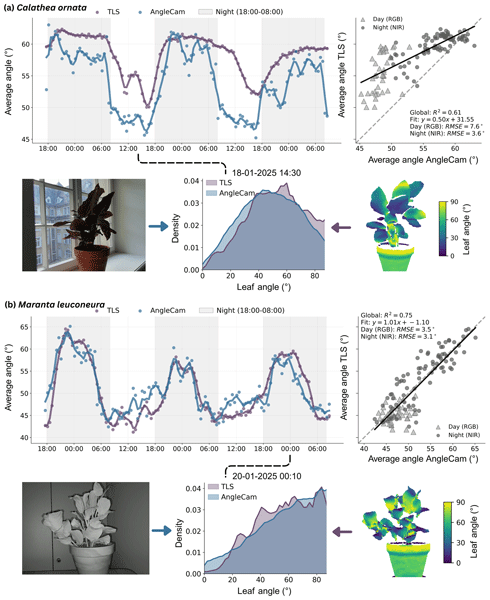
To adapt to changing environmental conditions, plants can adjust their leaf angles. We developed AngleCam V2, an AI method that estimates leaf inclination angles from photos taken during both day and night. Trained on thousands of images from about 200 species, it monitors daily changes in leaf angle, aligns with laser-scanning data, and detects systematic shifts under water limitation. AngleCam V2 provides an open-source tool for monitoring leaf angle dynamics over time, taxa, and environments.
Salim Soltani, Lauren E. Gillespie, Moises Exposito-Alonso, Olga Ferlian, Nico Eisenhauer, Hannes Feilhauer, and Teja Kattenborn
Biogeosciences, 22, 6545–6561, https://doi.org/10.5194/bg-22-6545-2025, https://doi.org/10.5194/bg-22-6545-2025, 2025
Short summary
Short summary
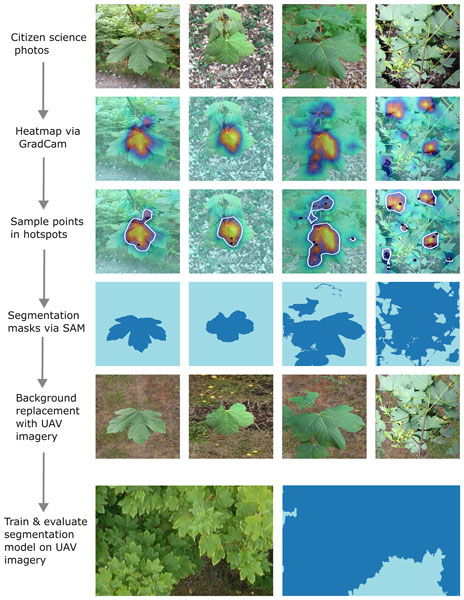
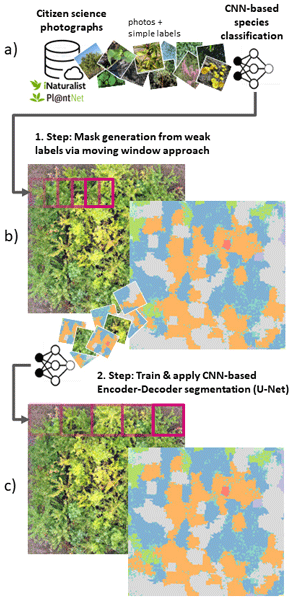
We introduce an automated approach for generating segmentation masks for citizen science plant photos, making them applicable to computer vision models. This framework effectively transforms citizen science data into a data treasure for segmentation models for plant species identification in aerial imagery. Using automatically labeled photos, we train segmentation models for mapping tree species in drone imagery, showcasing their potential for forestry, agriculture, and biodiversity monitoring.
Jasmin Tesch, Kathrin Kühnhammer, Delon Wagner, Andreas Christen, Carsten Dormann, Julian Frey, Rüdiger Grote, Teja Kattenborn, Markus Sulzer, Ulrike Wallrabe, Markus Weiler, Christiane Werner, Samaneh Baghbani, Julian Brzozon, Laura Maria Comella, Lea Dedden, Stefanie Dumberger, Yasmina Frey, Matthias Gassilloud, Timo Gerach, Anna Göritz, Simon Haberstroh, Johannes Klüppel, Luis Kremer, Jürgen Kreuzwieser, Hojin Lee, Joachim Maack, Julian Müller, Oswald Prucker, Sanam Kumari Rajak, Jürgen Rühe, Stefan J. Rupitsch, Helmer Schack-Kirchner, Christian Scharinger, Uttunga Shinde, Till Steinmann, Clara Stock, and Josef Strack
EGUsphere, https://doi.org/10.5194/egusphere-2025-4979, https://doi.org/10.5194/egusphere-2025-4979, 2025
This preprint is open for discussion and under review for Geoscientific Instrumentation, Methods and Data Systems (GI).
Short summary
Short summary
In the ECOSENSE forest, we developed a robust infrastructure for distributed forest sensing. Reliable power supply, stable network connection, and smart data collection systems enable the operation of hundreds of sensors under challenging conditions. By detailing the infrastructure design and implementation, we provide a transferable blueprint for building complex monitoring sites that support high-resolution, long-term ecosystem observations.
Eya Cherif, Teja Kattenborn, Luke A. Brown, Michael Ewald, Katja Berger, Phuong D. Dao, Tobias B. Hank, Etienne Laliberté, Bing Lu, and Hannes Feilhauer
EGUsphere, https://doi.org/10.5194/egusphere-2025-1284, https://doi.org/10.5194/egusphere-2025-1284, 2025
Short summary
Short summary
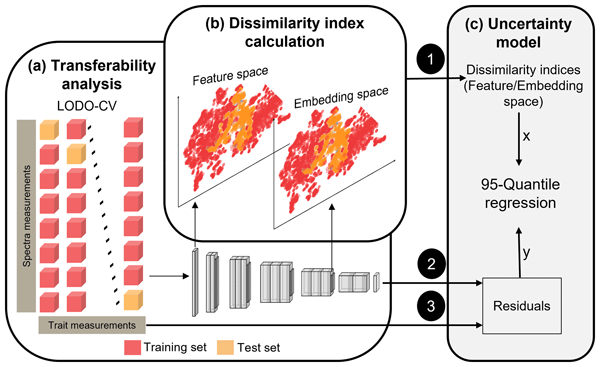
Hyperspectral imagery combined with machine learning enables accurate large-scale mapping of plant traits but struggles with uncertainty when facing unfamiliar environmental conditions. This study introduces a distance-based method that measures dissimilarities between new and training data to reliably quantify uncertainty. Results show it effectively identifies uncertain predictions, greatly improving the reliability of global vegetation monitoring compared to traditional methods.
Simon Scheiter, Sophie Wolf, and Teja Kattenborn
Biogeosciences, 21, 4909–4926, https://doi.org/10.5194/bg-21-4909-2024, https://doi.org/10.5194/bg-21-4909-2024, 2024
Short summary
Short summary
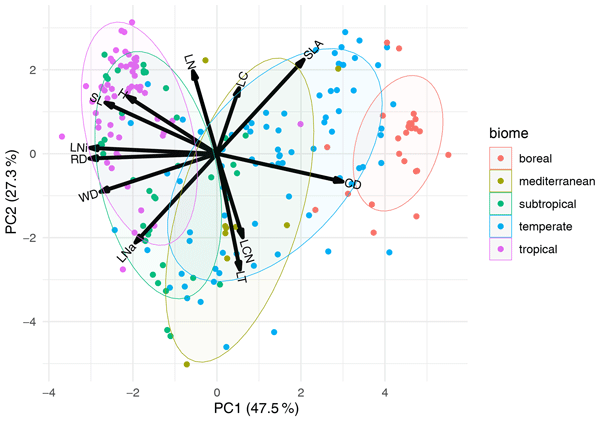
Biomes are widely used to map vegetation patterns at large spatial scales and to assess impacts of climate change, yet there is no consensus on a generally valid biome classification scheme. We used crowd-sourced species distribution data and trait data to assess whether trait information is suitable for delimiting biomes. Although the trait data were heterogeneous and had large gaps with respect to the spatial distribution, we found that a global trait-based biome classification was possible.
Salim Soltani, Olga Ferlian, Nico Eisenhauer, Hannes Feilhauer, and Teja Kattenborn
Biogeosciences, 21, 2909–2935, https://doi.org/10.5194/bg-21-2909-2024, https://doi.org/10.5194/bg-21-2909-2024, 2024
Short summary
Short summary
In this research, we developed a novel method using citizen science data as alternative training data for computer vision models to map plant species in unoccupied aerial vehicle (UAV) images. We use citizen science plant photographs to train models and apply them to UAV images. We tested our approach on UAV images of a test site with 10 different tree species, yielding accurate results. This research shows the potential of citizen science data to advance our ability to monitor plant species.
Cited articles
Badea, O.: Further development and implementation of an EU-level forest monitoring system, 126, 3–10, ISSN 2067-1962 1583-7890, 2011. a
Baret, F., de Solan, B., Lopez-Lozano, R., Ma, K., and Weiss, M.: GAI estimates of row crops from downward looking digital photos taken perpendicular to rows at 57.5 zenith angle: Theoretical considerations based on 3D architecture models and application to wheat crops, Agricultural and Forest Meteorology, 150, 1393–1401, 2010. a
Bates, D., Mächler, M., Bolker, B., and Walker, S.: Fitting linear mixed-effects models using lme4, Journal of Statistical Software, 67, 1–48, 2015. a
Bonan, G. B.: Forests and climate change: forcings, feedbacks, and the climate benefits of forests, Science, 320, 1444–1449, 2008. a
Breiman, L.: Random Forests, Machine Learning, 45, 5–32, https://doi.org/10.1023/A:1010933404324, 2001. a, b
Brown, L. A., Ogutu, B. O., and Dash, J.: Tracking forest biophysical properties with automated digital repeat photography: A fisheye perspective using digital hemispherical photography from below the canopy, Agricultural and Forest Meteorology, 287, 107944, https://doi.org/10.1016/j.agrformet.2020.107944, 2020. a
Černỳ, J., Pokornỳ, R., Haninec, P., and Bednář, P.: Leaf area index estimation using three distinct methods in pure deciduous stands, Journal of Visualized Experiments, 150, e59757, https://doi.org/10.3791/59757, 2019. a, b
Chen, J. M., Rich, P. M., Gower, S. T., Norman, J. M., and Plummer, S.: Leaf area index of boreal forests: Theory, techniques, and measurements, Journal of Geophysical Research: Atmospheres, 102, 29429–29443, 1997. a
Chianucci, F.: An overview of in situ digital canopy photography in forestry, Canadian Journal of Forest Research, 50, 227–242, 2020. a
Chianucci, F., Macfarlane, C., Pisek, J., Cutini, A., and Casa, R.: Estimation of foliage clumping from the LAI-2000 Plant Canopy Analyzer: effect of view caps, Trees, 29, 355–366, 2015. a
Das, P., Rahimzadeh-Bajgiran, P., Livingston, W., McIntire, C. D., and Bergdahl, A.: Modeling forest canopy structure and developing a stand health index using satellite remote sensing, Ecological Informatics, 84, 102864, https://doi.org/10.1016/j.ecoinf.2024.102864, 2024. a
de Mattos, E. M., Binkley, D., Campoe, O. C., Alvares, C. A., and Stape, J. L.: Variation in canopy structure, leaf area, light interception and light use efficiency among Eucalyptus clones, Forest Ecology and Management, 463, 118038, https://doi.org/10.1016/j.foreco.2020.118038, 2020. a
Fang, H.: Canopy clumping index (CI): A review of methods, characteristics, and applications, Agricultural and Forest Meteorology, 303, 108374, https://doi.org/10.1016/j.agrformet.2021.108374, 2021. a, b
Fang, H., Baret, F., Plummer, S., and Schaepman-Strub, G.: An overview of global leaf area index (LAI): Methods, products, validation, and applications, Reviews of Geophysics, 57, 739–799, 2019. a
Flynn, W. R. M., Owen, H. J. F., Grieve, S. W. D., and Lines, E. R.: Quantifying vegetation indices using terrestrial laser scanning: methodological complexities and ecological insights from a Mediterranean forest, Biogeosciences, 20, 2769–2784, https://doi.org/10.5194/bg-20-2769-2023, 2023. a
Geng, J., Yuan, G., Chen, J. M., Lyu, C., Tu, L., Fan, W., Tian, Q., Wu, Z., Tao, T., Yu, M., Zhu, Y., Huang, J., Xu, K., Li, J., and Wang, S.: Error analysis of LAI measurements with LAI-2000 due to discrete view angular range angles for continuous canopies, Remote Sensing, 13, 1405, https://doi.org/10.3390/rs13071405, 2021. a, b
Ghazal, M., Mahmoud, A., Shalaby, A., and El-Baz, A.: Automated Framework for Accurate Segmentation of Leaf Images for Plant Health Assessment, Environ. Monit. Assess., 191, 491, https://doi.org/10.1007/s10661-019-7615-9, 2019. a
Gower, S. T., Kucharik, C. J., and Norman, J. M.: Direct and indirect estimation of leaf area index, fPAR, and net primary production of terrestrial ecosystems, Remote Sensing of Environment, 70, 29–51, https://doi.org/10.1016/S0034-4257(99)00056-5, 1999. a, b
Grotti, M., Calders, K., Origo, N., Puletti, N., Alivernini, A., Ferrara, C., and Chianucci, F.: An Intensity, Image-Based Method to Estimate Gap Fraction, Canopy Openness and Effective Leaf Area Index from Phase-Shift Terrestrial Laser Scanning, Agr. Forest Meteorol., 280, 107766, https://doi.org/10.1016/j.agrformet.2019.107766, 2020. a, b
Jonckheere, I., Fleck, S., Nackaerts, K., Muys, B., Coppin, P., Weiss, M., and Baret, F.: Review of Methods for in Situ Leaf Area Index Determination, Agr. Forest Meteorol., 121, 19–35, https://doi.org/10.1016/j.agrformet.2003.08.027, 2004. a, b, c
Lee, J., Cha, S., Lim, J., Chun, J., and Jang, K.: Practical LAI Estimation with DHP Images in Complex Forest Structure with Rugged Terrain, Forests, 14, 2047, https://doi.org/10.3390/f14102047, 2023. a, b, c
Liaw, A. and Wiener, M.: Classification and Regression by randomForest, R News, 2, 18–22, https://CRAN.R-project.org/doc/Rnews/ (last access: 25 February 2026), 2002. a
Liu, J., Li, L., Akerblom, M., Wang, T., Skidmore, A., Zhu, X., and Heurich, M.: Comparative Evaluation of Algorithms for Leaf Area Index Estimation from Digital Hemispherical Photography through Virtual Forests, Remote Sens., 13, 3325, https://doi.org/10.3390/rs13163325, 2021. a
Liu, Z., Wang, C., Chen, J. M., Wang, X., and Jin, G.: Empirical models for tracing seasonal changes in leaf area index in deciduous broadleaf forests by digital hemispherical photography, Forest Ecology and Management, 351, 67–77, 2015a. a
Liu, Z., Wang, C., Chen, J. M., Wang, X., and Jin, G.: Empirical Models for Tracing Seasonal Changes in Leaf Area Index in Deciduous Broadleaf Forests by Digital Hemispherical Photography, Forest Ecol. Manag., 351, 67–77, https://doi.org/10.1016/j.foreco.2015.05.005, 2015b. a, b
Liu, Z., Wang, X., Chen, J. M., Wang, C., and Jin, G.: On Improving the Accuracy of Digital Hemispherical Photography Measurements of Seasonal Leaf Area Index Variation in Deciduous Broadleaf Forests, Can. J. Forest Res., 45, 721–731, https://doi.org/10.1139/cjfr-2014-0351, 2015c. a, b, c
Lotz, S., Soltani, S., Jaksztat, T., and Kattenborn, T.: Data and scripts for manuscript Litter vs. Lens: Evaluating LAI from Litter Traps and Hemispherical Photos Across View Zenith Angles and Leaf Fall Phases, Zenodo [data set and code], https://doi.org/10.5281/zenodo.18785222, 2026. a
Muggeo, V. M. R.: Segmented: An R Package to Fit Regression Models with Broken-Line Relationships, R news, 8, 20–25, 2008. a
Mussche, S., Samson, R., Nachtergale, L., Schrijver, A. d., Lemeur, R., and Lust, N.: A comparison of optical and direct methods for monitoring the seasonal dynamics of leaf area index in deciduous forests, Finnish Society of Forest Science, ISSN (Print): 0037-5330, ISSN (Electronic): 2242-4075, 2001. a
Myneni, R., Hoffman, S., Knyazikhin, Y., Privette, J., Glassy, J., Tian, Y., Wang, Y., Song, X., Zhang, Y., Smith, G., Lotsch, A., Friedl, M., Morisette, J., Votava, P., Nemani, R., and Running, S.: Global Products of Vegetation Leaf Area and Fraction Absorbed PAR from Year One of MODIS Data, Remote Sens. Environ., 83, 214–231, https://doi.org/10.1016/S0034-4257(02)00074-3, 2002. a
Otsu, N. et al.: A threshold selection method from gray-level histograms, Automatica, 11, 23–27, 1975. a
Pisek, J., Sonnentag, O., Richardson, A. D., and Mõttus, M.: Is the Spherical Leaf Inclination Angle Distribution a Valid Assumption for Temperate and Boreal Broadleaf Tree Species?, Agr. Forest Meteorol., 169, 186–194, https://doi.org/10.1016/j.agrformet.2012.10.011, 2013. a
Pueschel, P., Buddenbaum, H., and Hill, J.: An Efficient Approach to Standardizing the Processing of Hemispherical Images for the Estimation of Forest Structural Attributes, Agr. Forest Meteorol., 160, 1–13, https://doi.org/10.1016/j.agrformet.2012.02.007, 2012. a
R Core Team: R: A Language and Environment for Statistical Computing, R Foundation for Statistical Computing, Vienna, Austria, https://www.R-project.org/ (last access: 25 February 2026), 2022. a
Saitoh, T. M., Nagai, S., Noda, H. M., Muraoka, H., and Nasahara, K. N.: Examination of the Extinction Coefficient in the Beer–Lambert Law for an Accurate Estimation of the Forest Canopy Leaf Area Index, Forest Sci. Technol., 8, 67–76, https://doi.org/10.1080/21580103.2012.673744, 2012. a
Schaefer, M., Farmer, E., Soto-Berelov, M., Woodgate, W., and Jones, S.: Overview of ground based techniques for estimating LAI, in: AusCover Good Practice Guidelines: A technical handbook supporting calibration and validation activities of remotely sensed data products, TERN AusCover, 88–118, ISBN 978-0-646-94137-0, 2015. a, b, c
Tesch, J., Kühnhammer, K., Wagner, D., Christen, A., Dormann, C., Frey, J., Grote, R., Kattenborn, T., Sulzer, M., Wallrabe, U., Weiler, M., Werner, C., Baghbani, S., Brzozon, J., Comella, L. M., Dedden, L., Dumberger, S., Frey, Y., Gassilloud, M., Gerach, T., Göritz, A., Haberstroh, S., Klüppel, J., Kremer, L., Kreuzwieser, J., Lee, H., Maack, J., Müller, J., Prucker, O., Rajak, S. K., Rühe, J., Rupitsch, S. J., Schack-Kirchner, H., Scharinger, C., Shinde, U., Steinmann, T., Stock, C., and Strack, J.: The ECOSENSE forest: A distributed sensor and data management system for real-time monitoring of ecosystem processes and stresses, EGUsphere [preprint], https://doi.org/10.5194/egusphere-2025-4979, 2025. a
Tian, J., Liu, X., Zheng, Y., Xu, L., Huang, Q., and Hu, X.: Improving Otsu Method Parameters for Accurate and Efficient in LAI Measurement Using Fisheye Lens, Forests, 15, 1121, https://doi.org/10.3390/f15071121, 2024. a
Utsugi, H., Araki, M., Kawasaki, T., and Ishizuka, M.: Vertical Distributions of Leaf Area and Inclination Angle, and Their Relationship in a 46-Year-Old Chamaecyparis Obtusa Stand, Forest Ecol. Manag., 225, 104–112, https://doi.org/10.1016/j.foreco.2005.12.028, 2006. a
Verger, A., Filella, I., Baret, F., and Peñuelas, J.: Vegetation Baseline Phenology from Kilometric Global LAI Satellite Products, Remote Sens. Environ., 178, 1–14, https://doi.org/10.1016/j.rse.2016.02.057, 2016. a
Weiss, M., Baret, F., Smith, G., Jonckheere, I., and Coppin, P.: Review of Methods for in Situ Leaf Area Index (LAI) Determination, Agr. Forest Meteorol., 121, 37–53, https://doi.org/10.1016/j.agrformet.2003.08.001, 2004. a
Werner, C., Wallrabe, U., Christen, A., Comella, L., Dormann, C., Göritz, A., Grote, R., Haberstroh, S., Jouda, M., Kiese, R., Koch, B., Korvink, J., Kreuzwieser, J., Lang, F., Müller, J., Prucker, O., Reiterer, A., Rühe, J., Rupitsch, S., Schack-Kirchner, H., Schmitt, K., Stobbe, N., Weiler, M., Woias, P., and Wöllenstein, J.: ECOSENSE - Multi-scale Quantification and Modelling of Spatio-Temporal Dynamics of Ecosystem Processes by Smart Autonomous Sensor Networks, Research Ideas and Outcomes, 10, e129357, https://doi.org/10.3897/rio.10.e129357, 2024. a
Wilson, J. W.: Estimation of foliage denseness and foliage angle by inclined point quadrats, Australian Journal of Botany, 11, 95–105, 1963. a
Yao, W., Kelbe, D., Leeuwen, M., Romanczyk, P., and Aardt, J.: Towards an Improved LAI Collection Protocol via Simulated and Field-Based PAR Sensing, Sensors, 16, 1092, https://doi.org/10.3390/s16071092, 2016. a
Zhang, Y., Chen, J. M., and Miller, J. R.: Determining digital hemispherical photograph exposure for leaf area index estimation, Agricultural and Forest Meteorology, 133, 166–181, 2005. a
Zhu, X., Skidmore, A. K., Wang, T., Liu, J., Darvishzadeh, R., Shi, Y., Premier, J., and Heurich, M.: Improving Leaf Area Index (LAI) Estimation by Correcting for Clumping and Woody Effects Using Terrestrial Laser Scanning, Agr. Forest Meteorol., 263, 276–286, https://doi.org/10.1016/j.agrformet.2018.08.026, 2018. a, b, c
Zou, J., Hou, W., Chen, L., Wang, Q., Zhong, P., Zuo, Y., Luo, S., and Leng, P.: Evaluating the impact of sampling schemes on leaf area index measurements from digital hemispherical photography in Larix principis-rupprechtii forest plots, Forest Ecosystems, 7, 52, https://doi.org/10.1186/s40663-020-00262-z, 2020. a
Short summary
Digital hemispherical photography(DHP) is a valuable tool for monitoring leaf area index(LAI), a key factor in ecosystem productivity and climate interactions. We compared DHP with litter traps in a temperate forest and found that at a view zenith angle around 20°, both methods aligned best. We applied a calibration model to assess site variability which significantly improved accuracy. Our findings enhance the reliability of ground-based LAI monitoring, supporting better ecosystem assessments.
Digital hemispherical photography(DHP) is a valuable tool for monitoring leaf area index(LAI), a...
Altmetrics
Final-revised paper
Preprint