
Articles | Volume 23, issue 9
https://doi.org/10.5194/bg-23-3159-2026
© Author(s) 2026. This work is distributed under
the Creative Commons Attribution 4.0 License.
the Creative Commons Attribution 4.0 License.
Special issue:
https://doi.org/10.5194/bg-23-3159-2026
© Author(s) 2026. This work is distributed under
the Creative Commons Attribution 4.0 License.
the Creative Commons Attribution 4.0 License.
Research article
| 
08 May 2026
Research article |
| 08 May 2026
| 08 May 2026
Linking surface coverage with surfactant activity to refine the role of surfactants for air-sea gas exchange
Falko Asmussen-Schäfer
Institute of Physical Chemistry, Kiel University, Kiel, Germany
Mariana Ribas-Ribas
Institute for Chemistry and Biology of the Marine Environment (ICBM), Carl von Ossietzky University of Oldenburg, Oldenburg, Germany
Oliver Wurl
Institute for Chemistry and Biology of the Marine Environment (ICBM), Carl von Ossietzky University of Oldenburg, Oldenburg, Germany
Gernot Friedrichs
CORRESPONDING AUTHOR

Institute of Physical Chemistry, Kiel University, Kiel, Germany
KMS Kiel Marine Science-Centre for Interdisciplinary Marine Science, Kiel University, Kiel, Germany
Related authors
Riaz Bibi, Mariana Ribas-Ribas, Leonie Jaeger, Carola Lehners, Lisa Gassen, Edgar Fernando Cortés-Espinoza, Jochen Wollschläger, Claudia Thölen, Hannelore Waska, Jasper Zöbelein, Thorsten Brinkhoff, Isha Athale, Rüdiger Röttgers, Michael Novak, Anja Engel, Theresa Barthelmeß, Josefine Karnatz, Thomas Reinthaler, Dmytro Spriahailo, Gernot Friedrichs, Falko Asmussen Schäfer, and Oliver Wurl
Biogeosciences, 22, 7563–7589, https://doi.org/10.5194/bg-22-7563-2025, https://doi.org/10.5194/bg-22-7563-2025, 2025
Short summary
Short summary
A multidisciplinary mesocosm study was conducted to investigate biogeochemical processes and their relationships in the sea-surface microlayer and underlying water during an induced phytoplankton bloom. Phytoplankton-derived organic matter, fuelled microbial activity and biofilm formation, supporting high bacterial abundance. Distinct temporal patterns in biogeochemical parameters and greater variability in the sea-surface microlayer highlight its influence on air–sea interactions.
Jasper Zöbelein, Shubham Sawle, Gernot Friedrichs, Mariana Ribas-Ribas, Carola Lehners, Katharina Paetz, Maximilian Pflaum, and Hannelore Waska
Biogeosciences, 23, 5961–5982, https://doi.org/10.5194/bg-23-5961-2026, https://doi.org/10.5194/bg-23-5961-2026, 2026
Short summary
Short summary
The ocean is glazed with a one-millimetre biofilm that controls the flow of gases and energy from the atmosphere. To investigate how this film forms, we cultivated microscopic algae in a tank under controlled, windless conditions. Our results show that carbohydrates released by these algae rise to the surface, forming "carbo-slicks" that create a gel-like layer. This demonstrates that biological production is a key driver of the sea surface, which is crucial for understanding carbon exchange.
Samuel Mintah Ayim and Oliver Wurl
EGUsphere, https://doi.org/10.5194/egusphere-2026-4866, https://doi.org/10.5194/egusphere-2026-4866, 2026
This preprint is open for discussion and under review for Ocean Science (OS).
Short summary
Short summary
We investigated whether small-scale changes in seawater properties at the ocean surface reflect those below. An autonomous surface vehicle measured water density at the ultra-thin skin layer and one meter deep in the German Bight. Skin density patterns frequently differed from the underlying water and were driven more by salinity than temperature. This suggests that satellite observations of the ocean skin may not accurately represent underlying water dynamics in complex coastal waters.
Michelle Albinus, Thomas H. Badewien, Lisa Gassen, Oliver Wurl, and Jens Meyerjürgens
Ocean Sci., 22, 2143–2160, https://doi.org/10.5194/os-22-2143-2026, https://doi.org/10.5194/os-22-2143-2026, 2026
Short summary
Short summary
This study reveals the structure and alteration of a narrow freshwater-driven ocean low-density filament and its evolution through tidal modulationa an dlocale filament kinematics. Using multi-platform in situ observations, it is shown that these submesoscale features can rapidly being altered and reshape in near-surface waters, influencing how energy and heat alter just below the ocean-atmosphere interface.
Anja Engel, Gernot Friedrichs, Kerstin E. Krall, and Bernd Jähne
Biogeosciences, 23, 2101–2117, https://doi.org/10.5194/bg-23-2101-2026, https://doi.org/10.5194/bg-23-2101-2026, 2026
Short summary
Short summary
We investigated how organic molecules in the ocean's surface layer accumulate and respond to wind. Using a large wind-wave tank filled with seawater, we found that natural molecules produced by marine microbes gather at the surface under light winds, slowing the exchange of gases such as carbon dioxide. When winds increase, this layer rapidly breaks down. These findings suggest that marine life can influence how the ocean and atmosphere interact, particularly in calm conditions.

Amavi Silva, Surandokht Nikzad, Theresa Barthelmeß, Anja Engel, Hartmut Herrmann, Manuela van Pinxteren, Kai Wirtz, Oliver Wurl, and Markus Schartau
Biogeosciences, 23, 1697–1718, https://doi.org/10.5194/bg-23-1697-2026, https://doi.org/10.5194/bg-23-1697-2026, 2026
Short summary
Short summary
We conducted the first meta-analysis combining marine and freshwater studies to understand organic matter enrichment in the surface microlayer. Nitrogen-rich, particulate compounds are often enriched, with patterns varying by multiple factors. We recommend tracking both absolute concentrations and normalized enrichment patterns to better assess ecological conditions. Our study also introduces improved statistical methods for analyzing and comparing surface microlayer data.

Carsten Rauch, Lisa Deyle, Leonie Jaeger, Edgar Fernando Cortés-Espinoza, Mariana Ribas-Ribas, Josefine Karnatz, Anja Engel, and Oliver Wurl
Ocean Sci., 22, 403–426, https://doi.org/10.5194/os-22-403-2026, https://doi.org/10.5194/os-22-403-2026, 2026
Short summary
Short summary
Microsensors measuring oxygen and temperature were used to gain high-resolution profiles across the surface of a water basin, in which an algal bloom was induced. These novel data show that the oxygen at the sea surface is highly influenced by algal blooms, while the temperature is only indirectly affected by them. Since algal blooms occur globally, this has considerable implications for calculating global air-sea exchanges of gases or heat, especially under low-wind conditions.
Lina A. Holthusen, Hermann W. Bange, Thomas H. Badewien, Julia C. Muchowski, Tina Santl-Temkiv, Jennie Spicker Schmidt, Oliver Wurl, and Damian L. Arévalo-Martínez
The Cryosphere, 20, 535–550, https://doi.org/10.5194/tc-20-535-2026, https://doi.org/10.5194/tc-20-535-2026, 2026
Short summary
Short summary
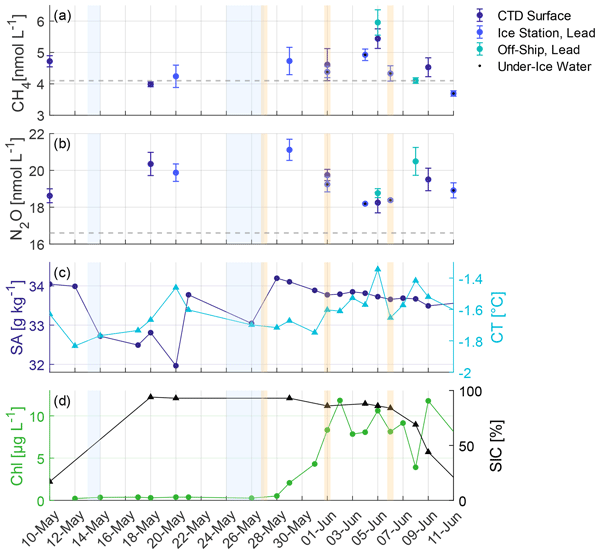
In spring 2023, in the Fram Strait, we investigated the near-surface distribution of the greenhouse gases methane and nitrous oxide in open leads and under sea ice to address the lack of observations in the Arctic Ocean. The study area acted as a source for both gases, and the onset of sea ice melt affected their concentrations and emissions. Surface-active substances accumulated in the sea-surface microlayer of open leads during an algal bloom, potentially attenuating greenhouse gas emissions.
Ander López-Puertas, Oliver Wurl, Sanja Frka, and Mariana Ribas-Ribas
Ocean Sci., 21, 3471–3485, https://doi.org/10.5194/os-21-3471-2025, https://doi.org/10.5194/os-21-3471-2025, 2025
Short summary
Short summary
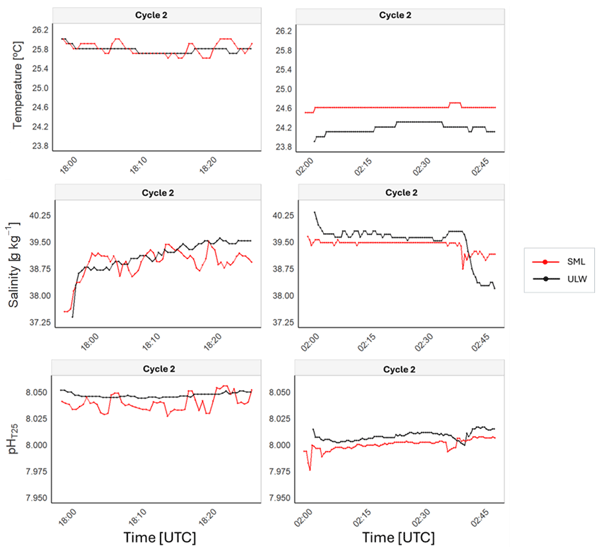
We studied how daily cycles affect inorganic carbon variables in the ocean's surface microlayer. Using data from three full days and nights off the Croatian coast, we found that thermohaline properties and key indicators like pH and pCO₂ change significantly from day to night. Ignoring nighttime conditions may lead to global carbon budget errors and highlights the need for continuous ocean observations.
Riaz Bibi, Mariana Ribas-Ribas, Leonie Jaeger, Carola Lehners, Lisa Gassen, Edgar Fernando Cortés-Espinoza, Jochen Wollschläger, Claudia Thölen, Hannelore Waska, Jasper Zöbelein, Thorsten Brinkhoff, Isha Athale, Rüdiger Röttgers, Michael Novak, Anja Engel, Theresa Barthelmeß, Josefine Karnatz, Thomas Reinthaler, Dmytro Spriahailo, Gernot Friedrichs, Falko Asmussen Schäfer, and Oliver Wurl
Biogeosciences, 22, 7563–7589, https://doi.org/10.5194/bg-22-7563-2025, https://doi.org/10.5194/bg-22-7563-2025, 2025
Short summary
Short summary
A multidisciplinary mesocosm study was conducted to investigate biogeochemical processes and their relationships in the sea-surface microlayer and underlying water during an induced phytoplankton bloom. Phytoplankton-derived organic matter, fuelled microbial activity and biofilm formation, supporting high bacterial abundance. Distinct temporal patterns in biogeochemical parameters and greater variability in the sea-surface microlayer highlight its influence on air–sea interactions.
Edgar Fernando Cortés-Espinoza, Alisa Wüst, Ander Lopéz-Puertas, Oliver Wurl, José Martín Hernández-Ayón, Hannelore Waska, and Mariana Ribas-Ribas
EGUsphere, https://doi.org/10.5194/egusphere-2025-5265, https://doi.org/10.5194/egusphere-2025-5265, 2025
Short summary
Short summary
In a mesocosm experiment, we measured carbon system variables to examine how organic matter accumulation increases organic alkalinity and alters seawater pH in the sea-surface microlayer and underlying water during an induced phytoplankton bloom. Organic alkalinity was consistently higher in the sea-surface microlayer, and during bloom peak its pH effect extended into the underlying water, reducing and sometimes reversing surface–subsurface pH differences.
Lisa Gassen, Samuel M. Ayim, Leonie Jaeger, Jens Meyerjürgens, Mariana Ribas-Ribas, and Oliver Wurl
Ocean Sci., 21, 2787–2804, https://doi.org/10.5194/os-21-2787-2025, https://doi.org/10.5194/os-21-2787-2025, 2025
Short summary
Short summary
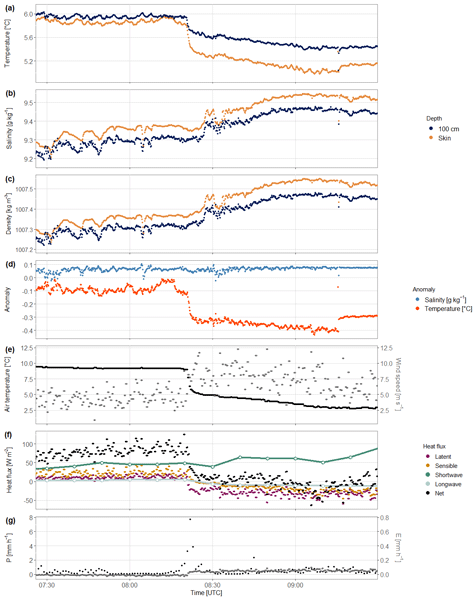
This study investigates how abrupt weather changes, such as shifts in air temperature, wind speed and precipitation, impact temperature and salinity in the ocean’s skin layer (upper first millimetre). Two events in the harbour of Bremerhaven and one event in the North Sea revealed that the skin layer reacts instantly, with greater temperature changes than those at a depth of 100 cm, underscoring its key role in air-sea interactions and climate dynamics.
Lisa Deyle, Thomas H. Badewien, Oliver Wurl, and Jens Meyerjürgens
Earth Syst. Sci. Data, 16, 2099–2112, https://doi.org/10.5194/essd-16-2099-2024, https://doi.org/10.5194/essd-16-2099-2024, 2024
Short summary
Short summary
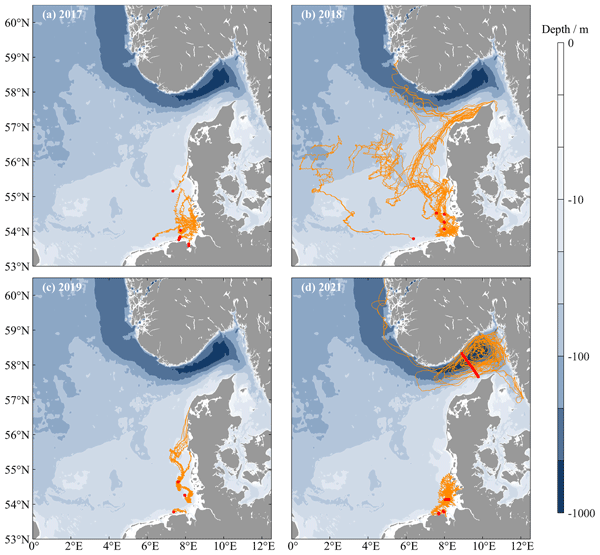
A dataset from the North Sea of 85 surface drifters from 2017–2021 is presented. Surface drifters enable the analysis of ocean currents by determining the velocities of surface currents and tidal effects. The entire North Sea has not been studied using drifters before, but the analysis of ocean currents is essential, e.g., to understand the pathways of plastic. The results show that there are strong tidal effects in the shallow North Sea area and strong surface currents in the deep areas.
Manuela van Pinxteren, Tiera-Brandy Robinson, Sebastian Zeppenfeld, Xianda Gong, Enno Bahlmann, Khanneh Wadinga Fomba, Nadja Triesch, Frank Stratmann, Oliver Wurl, Anja Engel, Heike Wex, and Hartmut Herrmann
Atmos. Chem. Phys., 22, 5725–5742, https://doi.org/10.5194/acp-22-5725-2022, https://doi.org/10.5194/acp-22-5725-2022, 2022
Short summary
Short summary
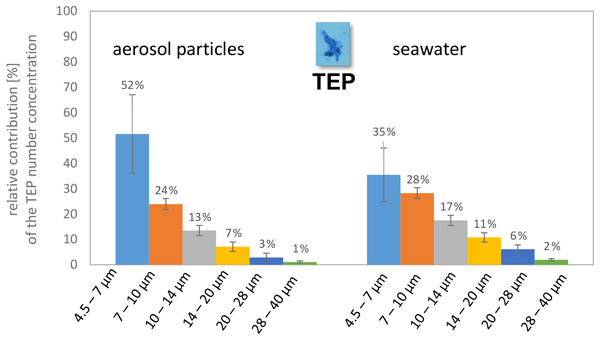
A class of marine particles (transparent exopolymer particles, TEPs) that is ubiquitously found in the world oceans was measured for the first time in ambient marine aerosol particles and marine cloud waters in the tropical Atlantic Ocean. TEPs are likely to have good properties for influencing clouds. We show that TEPs are transferred from the ocean to the marine atmosphere via sea-spray formation and our results suggest that they can also form directly in aerosol particles and in cloud water.
Cited articles
Adamson, A. W. and Gast, A. P.: Physical Chemistry of Surfaces, John Wiley and Sons, Nashville, TN, 6th edn., ISBN 978-0-471-14873-9, 1997. a
Adenaya, A., Haack, M., Stolle, C., Wurl, O., and Ribas-Ribas, M.: Effects of natural and artificial surfactants on diffusive boundary dynamics and oxygen exchanges across the air–water interface, Oceans, 2, 752–771, https://doi.org/10.3390/oceans2040043, 2021. a
Asher, W.: The sea-surface microlayer and its effect on global air-sea gas transfer, in: Sea Surface and Global Change, edited by: Liss, P. S. and Duce, R. A., Cambridge Univ. Press, New York, https://doi.org/10.1017/CBO9780511525025.009, 1997. a
Asher, W. E.: The Role of Surfactants in Air-Sea Exchange, Elsevier, https://doi.org/10.1016/b978-0-12-409548-9.10883-8, 49–58, 2019. a, b
Barthelmeß, T. and Engel, A.: How biogenic polymers control surfactant dynamics in the surface microlayer: insights from a coastal Baltic Sea study, Biogeosciences, 19, 4965–4992, https://doi.org/10.5194/bg-19-4965-2022, 2022. a, b, c
Barthelmeß, T., Schütte, F., and Engel, A.: Variability of the sea surface microlayer across a filament's edge and potential influences on gas exchange, Frontiers in Marine Science, 8, https://doi.org/10.3389/fmars.2021.718384, 2021. a
Behrenfeld, M. J. and Falkowski, P. G.: A consumer's guide to phytoplankton primary productivity models, Limnol. Oceanogr., 42, 1479–1491, https://doi.org/10.4319/lo.1997.42.7.1479, 1997. a
Bell, G. R., Bain, C. D., and Ward, R. N.: Sum-frequency vibrational spectroscopy of soluble surfactants at the air/water interface, J. Chem. Soc. Faraday T., 92, 515–523, https://doi.org/10.1039/FT9969200515, 1996. a
Bibi, R., Ribas-Ribas, M., Jaeger, L., Lehners, C., Gassen, L., Cortés, E. F., Wollschläger, J., Thölen, C., Waska, H., Zöbelein, J., Brinkhoff, T., Athale, I., Röttgers, R., Novak, M., Engel, A., Barthelmeß, T., Karnatz, J., Reinthaler, T., Spriahailo, D., Friedrichs, G., Schäfer, F., and Wurl, O.: Physical, chemical, and biogeochemical parameters from a mesocosm experiment at the Sea Surface Facility (SURF), Wilhelmshaven, Germany, spring 2023, PANGAEA [data set], https://doi.org/10.1594/PANGAEA.984101, 2025a. a, b, c
Bibi, R., Ribas-Ribas, M., Jaeger, L., Lehners, C., Gassen, L., Cortés-Espinoza, E. F., Wollschläger, J., Thölen, C., Waska, H., Zöbelein, J., Brinkhoff, T., Athale, I., Röttgers, R., Novak, M., Engel, A., Barthelmeß, T., Karnatz, J., Reinthaler, T., Spriahailo, D., Friedrichs, G., Schäfer, F. A., and Wurl, O.: Biogeochemical dynamics of the sea-surface microlayer in a multidisciplinary mesocosm study, Biogeosciences, 22, 7563–7589, https://doi.org/10.5194/bg-22-7563-2025, 2025b. a, b, c, d, e, f, g, h
Bock, E. J., Hara, T., Frew, N. M., and McGillis, W. R.: Relationship between air sea gas transfer and short wind waves, J. Geophys. Res.-Oceans, 104, 25821–25831, https://doi.org/10.1029/1999jc900200, 1999. a
Booge, D.: FS Alkor Cruise Reports: AL510 and AL 516, Tech. rep., GEOMAR Helmholtz-Zentrum für Ozeanforschung, Kiel, https://doi.org/10.3289/CR_AL510, 2018. a
Broecker, H.-C., Petermann, J., and Siems, W.: The influence of wind on CO2-exchange in a wind-wave tunnel, including the effects of monolayers, J. Mar. Res., 36, 595–610, 1978. a
Brüggemann, M., Hayeck, N., and George, C. E.: Interfacial photochemistry at the ocean surface is a global source of organic vapors and aerosols, Nat. Commun., 9, 2101, https://doi.org/10.1038/s41467-018-04528-7, 2018. a, b
Buck, M. and Himmelhaus, M.: Vibrational spectroscopy of interfaces by infrared–visible sum frequency generation, J. Vac. Sci. Technol. A, 2717–2736, https://doi.org/10.1116/1.1414120, 2001. a, b
Burrows, S. M., Gobrogge, E., Fu, L., Link, K., Elliott, S. M., Wang, H., and Walker, R.: OCEANFILMS 2: representing coadsorption of saccharides in marine films and potential impacts on modeled marine aerosol chemistry, Geophys. Res. Lett., 43, 8306–8313, https://doi.org/10.1002/2016gl069070, 2016. a, b, c
Ciglenečki, I., Vilibić, I., Dautović, J., Vojvodić, V., Ćosović, B., Zemunik, P., Dunić, N., and Mihanović, H.: Dissolved organic carbon and surface active substances in the northern Adriatic Sea: long-term trends, variability and drivers, Sci. Total Environ., 730, 139104/1–14, https://doi.org/10.1016/j.scitotenv.2020.139104, 2020. a
Copernicus Marine Service: Global Ocean Colour (Copernicus-GlobColour), Bio-Geo-Chemical, L4 (monthly and interpolated) from Satellite Observations (1997-ongoing), Tech. rep., https://doi.org/10.48670/moi-00281, 2024a. a
Copernicus Marine Service: Product User Manual For Ocean Colour Products: Global Ocean Colour (Copernicus-GlobColour), Bio-Geo-Chemical, L4 (monthly and interpolated) from Satellite Observations (1997-ongoing), Tech. rep., https://doi.org/10.48670/moi-00281, 2024b. a
Copernicus Marine Service: Global Ocean Monthly Mean Sea Surface Wind and Stress from Scatterometer and Model, Tech. rep., https://doi.org/10.48670/moi-00181, 2024c. a
Ćosović, B. and Vojvodić, V.: The application of ac polarography to the determination of surface-active substances in seawater, Limnol. Oceanogr., 27, 361–369, https://doi.org/10.4319/lo.1982.27.2.0361, 1982. a, b
Ćosović, B. and Vojvodic, V.: Direct determination of surface active substances in natural waters, Mar. Chem., 22, 363–373, https://doi.org/10.1016/0304-4203(87)90020-x, 1987. a
Ćosović, B. and Vojvodić, V.: Voltammetric analysis of surface active substances in natural seawater, Electroanalysis, 10, 429–434, https://doi.org/10.1002/(SICI)1521-4109(199805)10:6<429::AID-ELAN429>3.0.CO;2-7, 1998. a, b
Cunliffe, M. and Wurl, O.: Guide to best practices to study the ocean's surface, Occasional Publications of the Marine Biological Association of the United Kingdom, Plymouth, UK, https://doi.org/10.25607/OBP-1512, 2014. a
Cunliffe, M., Engel, A., Frka, S., Gašparović, B., Guitart, C., Murrell, J. C., Salter, M., Stolle, C., Upstill-Goddard, R., and Wurl, O.: Sea surface microlayers: a unified physicochemical and biological perspective of the air–ocean interface, Prog. Oceanogr., 109, 104–116, https://doi.org/10.1016/j.pocean.2012.08.004, 2013. a
Donaldson, D. J. and George, C.: Sea-surface chemistry and its impact on the marine boundary layer, Environ. Sci. Technol., 46, 10385–10389, https://doi.org/10.1021/es301651m, 2012. a
Ebben, C. J., Ault, A. P., Ruppel, M. J., Ryder, O. S., Bertram, T. H., Grassian, V. H., Prather, K. A., and Geiger, F. M.: Size-resolved sea spray aerosol particles studied by vibrational sum frequency generation, J. Phys. Chem. A, 117, 6589–6601, https://doi.org/10.1021/jp401957k, 2013. a
Elliott, S., Burrows, S., Cameron-Smith, P., Hoffman, F., Hunke, E., Jeffery, N., Liu, Y., Maltrud, M., Menzo, Z., Ogunro, O., Van Roekel, L., Wang, S., Brunke, M., Jin, M., Letscher, R., Meskhidze, N., Russell, L., Simpson, I., Stokes, D., and Wingenter, O.: Does marine surface tension have global biogeography? Addition for the OCEANFILMS package, Atmosphere-Basel, 9, 216, https://doi.org/10.3390/atmos9060216, 2018. a, b, c, d
Engel, A. and Galgani, L.: The organic sea-surface microlayer in the upwelling region off the coast of Peru and potential implications for air–sea exchange processes, Biogeosciences, 13, 989–1007, https://doi.org/10.5194/bg-13-989-2016, 2016. a
Engel, A., Bange, H. W., Cunliffe, M., Burrows, S. M., Friedrichs, G., Galgani, L., Herrmann, H., Hertkorn, N., Johnson, M., Liss, P. S., Quinn, P. K., Schartau, M., Soloviev, A., Stolle, C., Upstill-Goddard, R. C., van Pinxteren, M., and Zäncker, B.: The ocean's vital skin: toward an integrated understanding of the sea surface microlayer, Frontiers in Marine Science, 4, https://doi.org/10.3389/fmars.2017.00165, 2017. a, b, c, d
Engel, A., Sperling, M., Sun, C., Grosse, J., and Friedrichs, G.: Organic matter in the surface microlayer: insights from a wind wave channel experiment, Frontiers in Marine Science, 5, https://doi.org/10.3389/fmars.2018.00182, 2018. a, b, c
Fainerman, V., Lylyk, S., Aksenenko, E., Makievski, A., Petkov, J., Yorke, J., and Miller, R.: Adsorption layer characteristics of Triton surfactants, Colloids Surface A, 334, 1–7, https://doi.org/10.1016/j.colsurfa.2008.09.015, 2009. a
Feng, R.-J., Li, X., Zhang, Z., Lu, Z., and Guo, Y.: Spectral assignment and orientational analysis in a vibrational sum frequency generation study of DPPC monolayers at the air/water interface, J. Chem. Phys., 145, 244707, https://doi.org/10.1063/1.4972564, 2016. a, b
Frew, N. M.: The role of organic films in air–sea exchange, in: Sea Surface and Global Change, edited by: Liss, P. S. and Duce, R. A., Cambridge Univ. Press, New York, https://doi.org/10.1017/CBO9780511525025.006, 121–172, 1997. a
Frew, N. M., Bock, E. J., McGillis, W. R., Karachintsev, A. V., Hara, T., Münsterer, T., and Jähne, B.: Variation of air–water gas transfer with wind stress and surface viscoelasticity. 3rd Intern. Symp. on Air-Water Gas Transfer, Heidelberg, Germany, https://doi.org/10.5281/zenodo.10405, 1995. a, b, c
Garbe, C. S., Rutgersson, A., Boutin, J., de Leeuw, G., Delille, B., Fairall, C. W., Gruber, N., Hare, J., Ho, D. T., Johnson, M. T., Nightingale, P. D., Pettersson, H., Piskozub, J., Sahlée, E., Tsai, W.-t., Ward, B., Woolf, D. K., and Zappa, C. J.: Transfer Across the Air-Sea Interface, Springer Berlin Heidelberg, Berlin, Heidelberg, https://doi.org/10.1007/978-3-642-25643-1_2, 55–112, 2014. a
Gašparović, B. and Ćosović, B.: Surface-active properties of organic matter in the North Adriatic Sea, Estuar. Coast. Shelf S., 58, 555–566, https://doi.org/10.1016/S0272-7714(03)00133-1, 2003. a
Geiger, F. M.: Second harmonic generation, sum frequency generation, and χ(3): dissecting environmental interfaces with a nonlinear optical Swiss army knife, Annu. Rev. Phys. Chem., 60, 61–83, https://doi.org/10.1146/annurev.physchem.59.032607.093651, 2009. a, b
Hosseinpour, S., Roeters, S. J., Bonn, M., Peukert, W., Woutersen, S., and Weidner, T.: Structure and dynamics of interfacial peptides and proteins from vibrational sum-frequency generation spectroscopy, Chem. Rev., 120, 3420–3465, https://doi.org/10.1021/acs.chemrev.9b00410, 2020. a, b
Janczuk, B., Bruque, J. M., Gonzalez-Martin, M. L., and Dorado-Calasanz, C.: The adsorption of Triton X-100 at the air-aqueous solution interface, Langmuir, 11, 4515–4518, https://doi.org/10.1021/la00011a055, 1995. a
Jessup, A. T., Asher, W. E., Atmane, M., Phadnis, K., Zappa, C. J., and Loewen, M. R.: Evidence for complete and partial surface renewal at an air-water interface, Geophys. Res. Lett., 36, https://doi.org/10.1029/2009GL038986, 2009. a
Jibaja Valderrama, O., Scheres Firak, D., Schaefer, T., van Pinxteren, M., Fomba, K. W., and Herrmann, H.: Photochemistry of the sea-surface microlayer (SML) influenced by a phytoplankton bloom: a mesocosm study, Biogeosciences, 23, 1965–1985, https://doi.org/10.5194/bg-23-1965-2026, 2026. a, b
Jubb, A. M., Hua, W., and Allen, H. C.: Environmental chemistry at vapor/water interfaces: insights from vibrational sum frequency generation spectroscopy, Annu. Rev. Phys. Chem., 63, 107–130, https://doi.org/10.1146/annurev-physchem-032511-143811, 2012. a, b, c
Jähne, B. and Haußecker, H.: Air-water gas exchange, Annu. Rev. Fluid Mech., 30, 443–468, https://doi.org/10.1146/annurev.fluid.30.1.443, 1998. a
Kleber, J., Laß, K., and Friedrichs, G.: Quantitative time-resolved vibrational sum frequency generation spectroscopy as a tool for thin film kinetic studies: new insights into oleic acid monolayer oxidation, J. Phys. Chem. A, 117, 7863–7875, https://doi.org/10.1021/jp404087s, 2013. a
Kurata, N., Vella, K., Hamilton, B., Shivji, M., Soloviev, A., Matt, S., Tartar, A., and Perrie, W.: Surfactant-associated bacteria in the near-surface layer of the ocean, Sci. Rep.-UK, 6, https://doi.org/10.1038/srep19123, 2016. a
Lambert, A. G., Davies, P. B., and and, D. J. N.: Implementing the theory of sum frequency generation vibrational spectroscopy: a tutorial review, Appl. Spectrosc. Rev., 40, 103–145, https://doi.org/10.1081/ASR-200038326, 2005. a, b, c
Lange, F.-D.: Investigation of Sea Surface Nanolayer Properties and Photochemistry Using Modern Laser Spectroscopic and Surface Analytical Techniques, PhD thesis, Kiel University, Kiel, Germany, https://nbn-resolving.org/urn:nbn:de:gbv:8:3-2021-00564-5 (last acccess: 20 April 2026), 2021. a
Laß, K. and Friedrichs, G.: Revealing structural properties of the marine nanolayer from vibrational sum frequency generation spectra, J. Geophys. Res.-Oceans, 116, C08042/1–15, https://doi.org/10.1029/2010JC006609, 2011. a, b, c, d
Laß, K., Kleber, J., and Friedrichs, G.: Vibrational sum-frequency generation as a probe for composition, chemical reactivity, and film formation dynamics of the sea surface nanolayer, Limnol. Oceanogr.-Meth., 8, 216–228, https://doi.org/10.4319/lom.2010.8.216, 2010. a, b, c, d
Laß, K., Bange, H. W., and Friedrichs, G.: Seasonal signatures in SFG vibrational spectra of the sea surface nanolayer at Boknis Eck Time Series Station (SW Baltic Sea), Biogeosciences, 10, 5325–5334, https://doi.org/10.5194/bg-10-5325-2013, 2013. a, b, c, d
Laxague, N. J. M., Zappa, C. J., Soumya, S., and Wurl, O.: The suppression of ocean waves by biogenic slicks, J. R. Soc. Interface, 21, 20240385, https://doi.org/10.1098/rsif.2024.0385, 2024. a, b, c
Lin, S., McKeigue, K., and Maldarelli, C.: Diffusion controlled surfactant adsorption studied by pendant drop digitization, AIChE J., 36, 1785–1795, https://doi.org/10.1002/aic.690361202, 1990. a, b
Ma, G. and Allen, H. C.: DPPC Langmuir monolayer at the air-water interface: probing the tail and head groups by vibrational sum frequency generation spectroscopy, Langmuir, 22, 5341–5349, https://doi.org/10.1021/la0535227, 2006. a, b, c, d
Mesarchaki, E., Kräuter, C., Krall, K. E., Bopp, M., Helleis, F., Williams, J., and Jähne, B.: Measuring air–sea gas-exchange velocities in a large-scale annular wind–wave tank, Ocean Sci., 11, 121–138, https://doi.org/10.5194/os-11-121-2015, 2015. a, b
Mustaffa, N. I. H., Ribas-Ribas, M., Banko-Kubis, H. M., and Wurl, O.: Global reduction of in situ CO2 transfer velocity by natural surfactants in the sea-surface microlayer, P. Roy. Soc. A-Math. Phy., 476, 20190763, https://doi.org/10.1098/rspa.2019.0763, 2020. a, b, c, d
Novak, G. A. and Bertram, T. H.: Reactive VOC production from photochemical and heterogeneous reactions occurring at the air–ocean interface, Acc. Chem. Res., 53, 1014–1023, https://doi.org/10.1021/acs.accounts.0c00095, 2020. a
Parra, J. G., Iza, P., Dominguez, H., Schott, E., and Zarate, X.: Effect of Triton X-100 surfactant on the interfacial activity of ionic surfactants SDS, CTAB and SDBS at the air/water interface: a study using molecular dynamic simulations, Colloids Surface A, 603, 125284, https://doi.org/10.1016/j.colsurfa.2020.125284, 2020. a
Penezić, A., Drozdowska, V., Novak, T., and Gašparović, B.: Distribution and characterization of organic matter within the sea surface microlayer in the Gulf of Gdańsk, Oceanologia, 64, 631–650, https://doi.org/10.1016/j.oceano.2022.05.003, 2022. a
Rauch, C., Deyle, L., Jaeger, L., Cortés-Espinoza, E. F., Ribas-Ribas, M., Karnatz, J., Engel, A., and Wurl, O.: Phytoplankton blooms affect microscale differences of oxygen and temperature across the sea surface microlayer, Ocean Sci., 22, 403–426, https://doi.org/10.5194/os-22-403-2026, 2026. a
Ribas-Ribas, M., Helleis, F., Rahlff, J., and Wurl, O.: Air-sea CO2-exchange in a large annular wind-wave tank and the effects of surfactants, Frontiers in Marine Science, 5, 457/1–16, https://doi.org/10.3389/fmars.2018.00457, 2018. a, b, c
Rickard, P. C., Uher, G., Upstill-Goddard, R. C., Frka, S., Mustaffa, N. I. H., Banko-Kubis, H. M., Cvitešić Kušan, A., Gašparović, B., Stolle, C., Wurl, O., and Ribas-Ribas, M.: Reconsideration of seawater surfactant activity analysis based on an inter-laboratory comparison study, Mar. Chem., 208, 103–111, https://doi.org/10.1016/j.marchem.2018.11.012, 2019. a
Saak, C.-M. and Backus, E. H. G.: The role of sum-frequency generation spectroscopy in understanding on-surface reactions and dynamics in atmospheric model-systems, J. Phys. Chem. Lett., 15, 4546–4559, https://doi.org/10.1021/acs.jpclett.4c00392, 2024. a
Sabbaghzadeh, B., Upstill-Goddard, R. C., Beale, R., Pereira, R., and Nightingale, P. D.: The Atlantic Ocean surface microlayer from 50°N to 50°S is ubiquitously enriched in surfactants at wind speeds up to 13 m/s, Geophys. Res. Lett., 44, 2852–2858, https://doi.org/10.1002/2017GL072988, 2017. a, b, c, d
Salter, M. E., Upstill-Goddard, R. C., Nightingale, P. D., Archer, S. D., Blomquist, B., Ho, D. T., Huebert, B., Schlosser, P., and Yang, M.: Impact of an artificial surfactant release on air-sea gas fluxes during Deep Ocean Gas Exchange Experiment II, J. Geophys. Res.-Oceans, 116, C11016/1–9, https://doi.org/10.1029/2011JC007023, 2011. a
Silva, A., Nikzad, S., Barthelmeß, T., Engel, A., Herrmann, H., van Pinxteren, M., Wirtz, K., Wurl, O., and Schartau, M.: Meta-analytical insights into organic matter enrichment in the surface microlayer, Biogeosciences, 23, 1697–1718, https://doi.org/10.5194/bg-23-1697-2026, 2026. a
Thölen, C., Wollschläger, J., Novak, M. G., Röttgers, R., and Zielinski, O.: Colored and Fluorescent DOM in the Sea-Surface Microlayer: Response to a Phytoplankton Bloom and Photodegradation in a Mesocosm Study, EGUsphere [preprint], https://doi.org/10.5194/egusphere-2025-5350, 2026. a
Wang, H.-F., Gan, W., Lu, R., Rao, Y., and Wu, B.-H.: Quantitative spectral and orientational analysis in surface sum frequency generation vibrational spectroscopy (SFG-VS), Int. Rev. Phys. Chem., 24, 191–256, https://doi.org/10.1080/01442350500225894, 2005. a, b
Wanninkhof, R., Asher, W. E., Ho, D. T., Sweeney, C., and McGillis, W. R.: Advances in quantifying air-sea gas exchange and environmental forcing, Annu. Rev. Mar. Sci., 1, 213–244, https://doi.org/10.1146/annurev.marine.010908.163742, 2009. a
Wurl, O., Stolle, C., Van Thuoc, C., The Thu, P., and Mari, X.: Biofilm-like properties of the sea surface and predicted effects on air–sea CO2 exchange, Prog. Oceanogr., 144, 15–24, https://doi.org/10.1016/j.pocean.2016.03.002, 2016. a
Wurl, O., Ekau, W., Landing, W. M., and Zappa, C. J.: Sea surface microlayer in a changing ocean – a perspective, Elementa: Science of the Anthropocene, 5, 31, https://doi.org/10.1525/elementa.228, 2017. a
Wurl, O., Gassen, L., Badewien, T. H., Braun, A., Emig, S., Holthusen, L. A., Lehners, C., Meyerjürgens, J., and Ribas, M. R.: HALOBATES: an autonomous surface vehicle for high-resolution mapping of the sea surface microlayer and near-surface layer on essential climate variables, J. Atmos. Ocean. Tech., 41, 1197–1211, https://doi.org/10.1175/JTECH-D-24-0021.1, 2024. a
Zöbelein, J., Sawle, S., Friedrichs, G., Ribas-Ribas, M., Lehners, C., Paetz, K., Pflaum, M., and Waska, H.: Buoyancy and polarity driven accumulation of dissolved organic matter in the sea surface microlayer during a phytoplankton bloom, EGUsphere [preprint], https://doi.org/10.5194/egusphere-2025-6563, 2026. a
Zuo, Y. Y., Chen, R., Wang, X., Yang, J., Policova, Z., and Neumann, A. W.: Phase transitions in dipalmitoylphosphatidylcholine monolayers, Langmuir, 32, 8501–8506, https://doi.org/10.1021/acs.langmuir.6b01482, 2016. a
Ẑutić, V., Ćosović, B., Marčenko, E., Bihari, N., and Kršinić, F.: Surfactant production by marine phytoplankton, Mar. Chem., 10, 505–520, https://doi.org/10.1016/0304-4203(81)90004-9, 1981. a
Short summary
We developed an approach to quantify how molecules accumulate at the ocean surface on a nanometer scale. By combining laser spectroscopy with an electrochemical technique, we determined how densely these molecular films cover the water surface. Such single-molecule-thick layers can strongly affect gas transfer between the ocean and the atmosphere. Comparing our measurements with existing datasets allowed us to generate an initial global estimate of surfactant surface coverage potential.
We developed an approach to quantify how molecules accumulate at the ocean surface on a...


Special issue
Altmetrics
Final-revised paper
Preprint