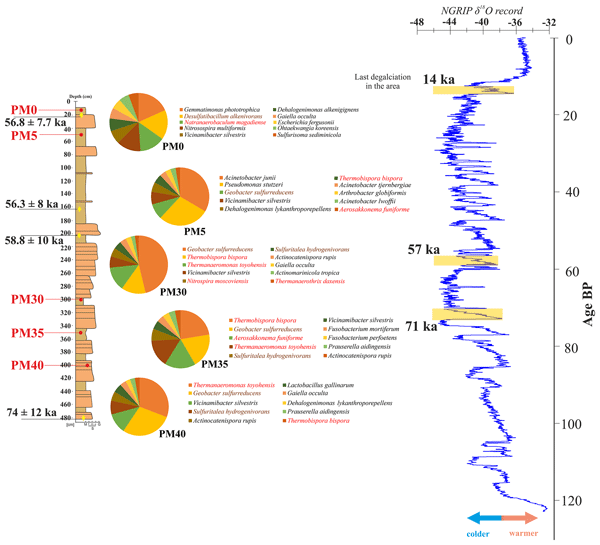
Battler, M. M., Osinski, G. R., and Banerjee, N. R.: Mineralogy of saline perennial cold springs on Axel Heiberg Island, Nunavut, Canada and implications for spring deposits on Mars, Icarus, 224, 364–381, https://doi.org/10.1016/j.icarus.2012.08.031, 2013.
Bazylinski, D. A., Frankel, R. B., and Konhauser, K. O.: Modes of biomineralization of magnetite by microbes, Geomicrobio. J., 24, 465–475, https://doi.org/10.1080/01490450701572259, 2007.
Callahan, B. J., McMurdie, P. J., Rosen, M. J., Han, A. W., Johnson, A. J. A., and Holmes, S. P.: DADA2: high-resolution sample inference from Illumina amplicon data, Nat. Methods, 13, 581–583, 2016a.
Callahan, B. J., Sankaran, K., Fukuyama, J. A., McMurdie, P. J., and Holmes, S. P.: Bioconductor workflow for microbiome data analysis: from raw reads to community analyses, F1000Research, 5, 1492, https://doi.org/10.12688/f1000research.8986.2, 2016b.
Canaveras, J. C., Cuezva, S., Sanchez-Moral, S., Lario, J., Laiz, L., Gonzalez, J. M., and Saiz-Jimenez, C.: On the origin of fiber calcite crystals in moonmilk deposits, Naturwissenschaften, 93, 27–32, 2006.
Cheng, X., Xiang, X., Yun, Y., Wang, W., Wang, H., and Bodelier, P. L. E.: Archaea and their interactions with bacteria in a karst ecosystem, Front. Microbiol., 14, 1068595, https://doi.org/10.3389/fmicb.2023.1068595, 2023.
De Mandal, S., Panda, A. K., Bisht, S. S., and Kumar, N. S.: Microbial ecology in the era of next generation sequencing, Next Generat. Sequenc. Appl., https://doi.org/10.4172/2469-9853.s1-001, 2015.
Dhami, N. K., Mukherjee, A., and Watkin, E. L.: Characterisation of mineralogical-mechanical-microbial properties of calcitic speleothems and the in vivo biomineralization potential of associated microbial communities, Front. Microbiol., 9, 40, https://doi.org/10.3389/fmicb.2018.00040, 2018.
Garrity, G. M.: Bergey's Manual of Systematic Bacteriology, Volume 2: The Proteobacteria, Part B: The Gammaproteobacteria, Springer, New York, https://doi.org/10.1007/0-387-28022-7, 2005.
Gill, K. K., Jagniecki, E. A., Benison, K. C., and Gibson, M. E.: A Mars-analog sulfate mineral, mirabilite, preserves biosignatures, Geology, 51, 818–822, https://doi.org/10.1130/G51256.1, 2023.
Haidău, C., Năstase-Bucur, R., Bulzu, P., Levei, E., Cadar, O., Mirea, I. C., Faur, L., Fruth, V., Atkinson, I., Constantin, S., and Moldovan, O. T.: A 16S rRNA Gene-Based Metabarcoding of Phosphate-Rich Deposits in Muierilor Cave, South-Western Carpathians, Front. Microbiol., 13, https://doi.org/10.3389/fmicb.2022.877481, 2022.
Herlemann, D. P., Labrenz, M., Jürgens, K., Bertilsson, S., Waniek, J. J., and Andersson, A. F.: Transitions in bacterial communities along the 2000 km salinity gradient of the Baltic Sea, ISME J., 5, 1571–1579, 2011.
Hershey, O. S. and Barton, H. A.: The microbial diversity of caves, in: Cave ecology, edited by: Moldovan, O. T., Kovác, L., and Hals, S., Cham: Springer Nature Switzerland, https://doi.org/10.1007/978-3-319-98852-8_5, 2018.
Hill, J. C.: Johann Glauber's discovery of sodium sulfate – Sal Mirabile Glauberi, J. Chem. Edu., 56, 593, https://doi.org/10.1021/ed056p593, 1979.
Hoffmann, T. D., Reeksting, B. J., and Gebhard, S.: Bacteria-induced mineral precipitation: a mechanistic review, Microbiol. (Reading), 167, 001049, https://doi.org/10.1099/mic.0.001049, 2021.
Howarth, F. G. and Moldovan, O. T.: Where Cave Animals Live, in: Cave Ecology, edited by: Moldovan, O. T., Kovac, L., and Halse, S., Springer International Publishing, ISBN 978-3-319-98852-8, 2018.
Konhauser, K. and Alessi, D.: Geomicrobiology: Present Approaches and Future Directions, in: Geomicrobiology: Natural and Anthropogenic Settings, edited by: Staicu, L. C. and Barton, L. L. Springer, Cham, https://doi.org/10.1007/978-3-031-54306-7_1, 2024.
Koning, K., McFarlane, R., Gosse, J. T., Lawrence, S., Carr, L., Horne, D., Van Wagoner, N., Boddy, C. N., and Cheeptham, N.: Biomineralization in Cave Bacteria-Popcorn and Soda Straw Crystal Formations, Morphologies, and Potential Metabolic Pathways, Front. Microbiol., 13, 933388, https://doi.org/10.3389/fmicb.2022.933388, 2022.
Kräutner, H. G., Kräutner, F. L., Szász, L., and Seghedi, I: Geologic map of Romania, Rebra Sheet (20c). Scale 1:50.000, Inst Geol Geofiz, Bucureşti, 1989.
Lange-Enyedi, N. T., Németh, P., Borsodi, A. K., Spötl., C., and Makk, J.: Calcium carbonate precipitating extremophilic bacteria in an Alpine ice cave, Sci. Rep., 14, 2710, https://doi.org/10.1038/s41598-024-53131-y, 2024.
Marliacy, P., Solimando, R., Bouroukba, M., and Schuffenecker, L.: Thermodynamics of crystallization of sodium sulfate decahydrate in H
2O–NaCl–Na
2SO
4: application to Na
2SO
4⋅10H
2O-based latent heat storage materials, Thermochim. Acta, 344, 85–94, https://doi.org/10.1016/S0040-6031(99)00331-7, 2000.
Martin, M.: Cutadapt removes adapter sequences from high-throughput sequencing reads, EMBnet.journal, 17, 10–12, 2011.
McMurdie, P. J. and Holmes, S.: Phyloseq: An R Package for Reproducible Interactive Analysis and Graphics of Microbiome Census Data, PLoS ONE, 8, e61217, https://doi.org/10.1371/journal.pone.0061217, 2013.
Meka, A. F., Bekele, G. K., Abas, M. K., and Gemeda, M. T.: Exploring microbial diversity and functional gene dynamics associated with the microbiome of Sof Umer cave, Ethiopia, Discov. Appl. Sci., 6, 400, https://doi.org/10.1007/s42452-024-06110-x, 2024.
Mulder, S. J., van Ruitenbeek, F. J. A., Foing, B. H., and Sánchez-Román, M.: Multitechnique characterization of secondary minerals near HI-SEAS, Hawaii, as Martian subsurface analogues, Sci. Rep., 13, 22603, https://doi.org/10.1038/s41598-023-48923-7, 2023.
Nicol, G. W., Hink, L., Gubry-Rangin, C., Prosser, J. I., and Lehtovirta-Morley, L. E.: Genome Sequence of ”Candidatus
Nitrosocosmicus franklandus” C13, a Terrestrial Ammonia-Oxidizing Archaeon, Microbiol. Resour. Announ., 8, e00435-19, https://doi.org/10.1128/MRA.00435-19, 2019.
Onac, B. P., Drăgușin, V., Papiu, F., and Theodorescu, C. T.: Rodna Mountains: Izvorul Tăusoarelor Cave (Pestera de la Izvorul Tăusoarelor), in: Cave and Karst Systems of Romania. Cave and Karst Systems of the World, edited by: Ponta, G. and Onac, B., Springer, Cham, https://doi.org/10.1007/978-3-319-90747-5_7, 2019.
Pruesse, E., Quast, C., Knittel, K., Fuchs, B. M., Ludwig, W., Peplies, J., and Glöckner, F. O.: SILVA: a comprehensive online resource for quality checked and aligned ribosomal RNA sequence data compatible with ARB, Nucleic Acids Res. Spec. Publ., 35, 7188–7196, 2007.
Puławska, A., Kalinowska, J., Rachubik, M., Drzewiecka, D., Albuquerque, L., Egas, C., Krawczyk, K., Manecki, M., Locht, C., and Kowalewicz-Kulbat, M.: Halophilic and Non-Halophilic Microbial Communities in Relation to Physico-Chemical Characteristics of Salt Mine Air, Environ, Microbiol. Rep., 17, e70095, https://doi.org/10.1111/1758-2229.70095, 2025.
Samanta, B., Sharma, S., and Budhwar, R.: Metagenome analysis of speleothem microbiome from Subterranean Cave reveals insight into community structure, metabolic potential, and BGCs diversity, Curr, Microbiol., 80, 317, https://doi.org/10.1007/s00284-023-03431-9, 2023.
Sauder, L., Albertsen, M., Engel, K., Schwarz, J., Nielsen, P. H., Wagner, M., and Neufeld, J. D.: Cultivation and characterization of Candidatus Nitrosocosmicus exaquare, an ammonia-oxidizing archaeon from a municipal wastewater treatment system, ISME J., 11, 1142–1157, https://doi.org/10.1038/ismej.2016.192, 2017.
Scott, S., Hilton, M. E., Coppin, C. W., Russell, R. J., Oakeshott, J. G., and Sutherland, T. D.: A global response to sulfur starvation in Pseudomonas putida and its relationship to the expression of low-sulfur-content proteins, FEMS Microbiol. Lett., 267, 184–193, https://doi.org/10.1111/j.1574-6968.2006.00575.x, 2007.
Shen, J., Smith, A. C., Barnett, M. J., Morgan, A., and Wynn, P. M.: Distinct microbial communities in the soils, waters, and speleothems of a hyperalkaline cave system, J. Geophys. Res.-Biogeo., 127, e2022JG006866, https://doi.org/10.1029/2022jg006866, 2022.
Silvestru, E.: On the genesis and evolution of mirabilite in the cave of Izvorul Tăușoarelor (Romania), Trav. Inst. Speol. “E. Racovitza”, 29, 79–83, 1990.
Silvestru, E. and Viehmann, I.: Étude de microtectonique comparée dans le Karst des Monts Rodna (Roumanie), Trav. Inst. Speol. “E. Racovitza”, 21, 63–67, 1982.
Tao, L., Fu, J., Wang, F., Song, Y., Li, Y., Zhang, J., and Wang, Z.: The application of mirabilite in traditional Chinese medicine and its chemical constituents, processing methods, pharmacology, toxicology and clinical research, Front. Pharmacol., 14, 1293097, https://doi.org/10.3389/fphar.2023.1293097, 2024.
Theodorescu, M., Bucur, R., Bulzu, P. A., Faur, L., Levei, E. A., Mirea, I. C, Cadar, O., Ferreira, R., Souza-Silva, M., and Moldovan, O. T.: Environmental Drivers of the Moonmilk Microbiome Diversity in Some Temperate and Tropical Caves, Microb. Ecol., 86, 2847–2857, 2023.
White, W. B.: Secondary minerals in volcanic caves: data from Hawai'i, J. Cave Karst Stud., 72, 75–85, 2010.
White, W. B.: Mineralogy of Mammoth Cave, in: Mammoth Cave: A Human and Natural History. Cave and Karst Systems of the World, edited by: Hobbs III, H. H., Olson, R. A., Winkler, E. G., and Culver, D. C., Cham, Switzerland: Springer International Publishing, https://doi.org/10.1007/978-3-319-53718-4_9, 2017.
White, W. B.: Chapter 59 – Gypsum flowers and related speleothems, in: Encyclopedia of Caves (Third Edition), edited by: White, W. B., Culver, D. C., and Pipan, T., Academic Press, https://doi.org/10.1016/C2017-0-01162-X, 2019.
Wurster, C. M., Munksgaard, N., Zwart, C., and Bird, M.: The biogeochemistry of insectivorous cave guano: A case study from insular Southeast Asia, Biogeochem., 124, 163–175, https://doi.org/10.1371/journal.pone.0230865, 2015.
Xu, X. J., Chen, C., Guo, H.-l., Wang, A.-j., Ren, N.-Q., and Lee, D.-J.: Characterization of a newly isolated strain
Pseudomonas sp. C27 for sulfide oxidation: Reaction kinetics and stoichiometry, Sci. Rep., 6, 21032, https://doi.org/10.1038/srep21032, 2016.
Zhu, H. Z., Jiang, C. Y., and Liu, S. J.: Microbial roles in cave biogeochemical cycling, Front. Microbiol., 13, 950005, https://doi.org/10.3389/fmicb.2022.950005, 2022.
Zhu, H. Z., Zhang, Z. F., Zhou, N., Jiang, C., Wang, B., Cai, L., Wang, H., and Liu, S.: Bacteria and metabolic potential in Karst Caves revealed by intensive bacterial cultivation and genome assembly, Appl. Environ. Microbiol., 87, https://doi.org/10.1128/aem.02440-20, 2021.