
Articles | Volume 23, issue 18
https://doi.org/10.5194/bg-23-6639-2026
© Author(s) 2026. This work is distributed under
the Creative Commons Attribution 4.0 License.
the Creative Commons Attribution 4.0 License.
https://doi.org/10.5194/bg-23-6639-2026
© Author(s) 2026. This work is distributed under
the Creative Commons Attribution 4.0 License.
the Creative Commons Attribution 4.0 License.
Research article
| 
21 Sep 2026
Research article |
| 21 Sep 2026
| 21 Sep 2026
Plant belowground traits indicate increased plant-mediated methane transport along a peatland permafrost thaw gradient

Department of Geography, Faculty of Science, University of Zürich, Winterthurerstrasse 190, 8057 Zürich, Switzerland
now at: Climate System Research, Finnish Meteorological Institute, Erik Palménin aukio 1, 00560 Helsinki, Finland
Samantha H. Bosman
Department of Oceanography, Dalhousie University, Halifax, NS, Canada
Jeffrey P. Chanton
Department of Earth Ocean and Atmospheric Sciences, Florida State University, Tallahassee, Fl 32306, USA
Patrick Crill
Department of Geological Sciences and Bolin Centre for Climate Research, Stockholm University, 106 91 Stockholm, Sweden
Suzanne B. Hodgkins
Department of Microbiology, The Ohio State University, Columbus, OH, USA
Jalisha Theanutti Kallingal
Department of Physical Geography and Ecosystem Science, Lund University, 223 62 Lund, Sweden
Rachel M. Wilson
Department of Earth Ocean and Atmospheric Sciences, Florida State University, Tallahassee, Fl 32306, USA
Ruth Varner
Department of Geological Sciences and Bolin Centre for Climate Research, Stockholm University, 106 91 Stockholm, Sweden
Department of Earth Sciences and Institute for the Study of Earth, Oceans and Space, University of New Hampshire, Durham, NH, USA
Avni Malhotra
Department of Geography, Faculty of Science, University of Zürich, Winterthurerstrasse 190, 8057 Zürich, Switzerland
Biological Sciences Division, Pacific Northwest National Laboratory, 902 Battelle Boulevard, Richland, WA, USA
Related authors
Tiia Määttä, Ankur R. Desai, Masahito Ueyama, Rodrigo Vargas, Eric J. Ward, Zhen Zhang, Gil Bohrer, Kyle Delwiche, Etienne Fluet-Chouinard, Järvi Järveoja, Sara H. Knox, Lulie Melling, Mats B. Nilsson, Matthias Peichl, Angela Che Ing Tang, Eeva-Stiina Tuittila, Jinsong Wang, Sheel Bansal, Sarah Feron, Manuel Helbig, Aino Korrensalo, Ken W. Krauss, Gavin McNicol, Shuli Niu, Zutao Ouyang, Kathleen Savage, Oliver Sonnentag, Robert Jackson, and Avni Malhotra
Biogeosciences, 23, 4379–4445, https://doi.org/10.5194/bg-23-4379-2026, https://doi.org/10.5194/bg-23-4379-2026, 2026
Short summary
Short summary
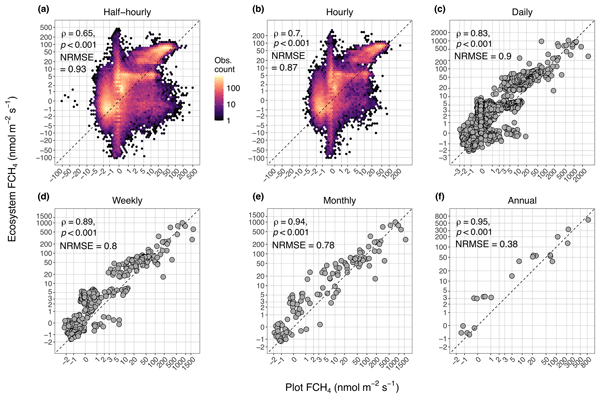
We compared ecosystem- and plot-scale methane fluxes across wetland and upland sites. Ecosystem-scale fluxes were higher than at plot scale, but differences were small. Vapor pressure deficit, atmospheric pressure, turbulence, and wind direction affected the differences. Both scales could be combined for improved methane flux estimates at coarser temporal scales.

Mika Korkiakoski, Tiia Määttä, Krista Peltoniemi, Timo Penttilä, and Annalea Lohila
Biogeosciences, 19, 2025–2041, https://doi.org/10.5194/bg-19-2025-2022, https://doi.org/10.5194/bg-19-2025-2022, 2022
Short summary
Short summary
We measured CH4 fluxes and production and oxidation potentials from irrigated and non-irrigated podzolic soil in a boreal forest. CH4 sink was smaller at the irrigated site but did not cause CH4 emission, with one exception. We also showed that under laboratory conditions, not only wet conditions, but also fresh carbon, are needed to make podzolic soil into a CH4 source. Our study provides important data for improving the process models describing the upland soil CH4 dynamics.
Maxime Thomas, Thomas Moenaert, Julien Radoux, Baptiste Delhez, Eléonore du Bois d'Aische, Maëlle Villani, Catherine Hirst, Erik Lundin, François Jonard, Sébastien Lambot, Kristof Van Oost, Veerle Vanacker, Matthias B. Siewert, Carl-Magnus Mörth, Michael W. Palace, Ruth K. Varner, Franklin B. Sullivan, Christina Herrick, and Sophie Opfergelt
The Cryosphere, 20, 5271–5301, https://doi.org/10.5194/tc-20-5271-2026, https://doi.org/10.5194/tc-20-5271-2026, 2026
Short summary
Short summary
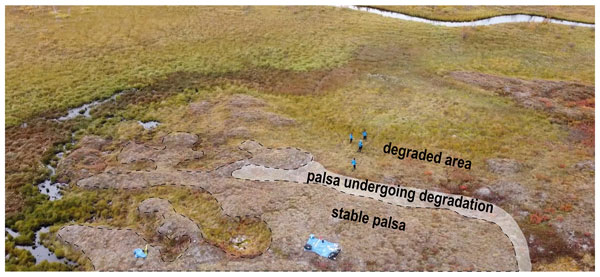
This study examines the rate of permafrost degradation, in the form of the transition from intact well-drained palsa to fully thawed and inundated fen at the Stordalen mire, Abisko, Sweden. Across the 14 hectares of the palsa mire, we demonstrate a 10-fold acceleration of the degradation in 2019–2021 compared to previous periods (1970–2014) which might lead to a pool of 12 × 10³ kg of organic carbon exposed annually for the topsoil (23 cm depth).
Anna-Maria Virkkala, Isabel Wargowsky, Judith Vogt, McKenzie A. Kuhn, Simran Madaan, Tiffany Windholz, Kyle A. Arndt, Gerard Rocher-Ros, Mathias Göckede, David Olefeldt, Edward A. G. Schuur, David Bastviken, Richard O'Keefe, Brendan M. Rogers, Jennifer D. Watts, Kelcy Kent, Kristoffer Aalstad, Kelly Aho, Joonatan Ala-Könni, Haley Alcock, Inge Althuizen, Christopher D. Arp, Jun Asanuma, Mika Aurela, Sivakiruthika Balathandayuthabani, Katrin Attermeyer, Alan Barr, Maialen Barret, Ochirbat Batkhishig, Christina Biasi, Mats P. Björkman, Andrew Black, Elena Blanc-Betes, Pascal Bodmer, Julia Boike, Abdullah Bolek, Frédéric Bouchard, Ingeborg Bussmann, Lea Cabrol, Eleonora Canfora, Sean Carey, Karel Castro-Morales, Namyi Chae, Andreas Christen, Torben R. Christensen, Casper T. Christiansen, Housen Chu, Graham Clark, Francois Clayer, Patrick Crill, Christopher Cunada, Scott J. Davidson, Joshua F. Dean, Sigrid Dengel, Matteo Detto, Catherine Dieleman, Florent Domine, Egor Dyukarev, Colin Edgar, Bo Elberling, Craig A. Emmerton, Eugenie Euskirchen, Grant Falvo, Thomas Friborg, Michelle Garneau, Mariasilvia Giamberini, Mikhail V. Glagolev, Miquel A. Gonzalez-Meler, Gustaf Granath, Jón Guðmundsson, Konsta Happonen, Yoshinobu Harazono, Lorna Harris, Josh Hashemi, Nicholas Hasson, Janna Heerah, Liam Heffernan, Manuel Helbig, Warren Helgason, Michal Heliasz, Greg Henry, Geert Hensgens, Tetsuya Hiyama, Beth Holmes, Macall Hock, David Holl, Jutta Holst, Thomas Holst, Gabriel Hould-Gosselin, Elyn Humphreys, Jacqueline Hung, Jussi Huotari, Hiroki Ikawa, Danil V. Ilyasov, Mamoru Ishikawa, Go Iwahana, Hiroki Iwata, Marcin Antoni Jackowicz-Korczynski, Joachim Jansen, Järvi Järveoja, Vincent E. J. Jassey, Rasmus Jensen, Katharina Jentzsch, Robert G. Jespersen, Carl-Fredrik Johannesson, Cheristy P. Jones, Anders Jonsson, Ji Young Jung, Sari Juutinen, Evan Kane, Jan Karlsson, Sergey Karsanaev, Kuno Kasak, Julia Kelly, Kasha Kempton, Marcus Klaus, George W. Kling, Natascha Kljun, Jacqueline Knutson, Hideki Kobayashi, John Kochendorfer, Kukka-Maaria Kohonen, Pasi Kolari, Mika Korkiakoski, Aino Korrensalo, Pirkko Kortelainen, Egle Koster, Kajar Koster, Ayumi Kotani, Praveena Krishnan, Juliya Kurbatova, Lars Kutzbach, Min Jung Kwon, Ethan D. Kyzivat, Jessica Lagroix, Theodore Langhorst, Elena Lapshina, Tuula Larmola, Klaus S. Larsen, Isabelle Laurion, Justin Ledman, Hanna Lee, A. Joshua Leffler, Lance Lesack, Anders Lindroth, David Lipson, Annalea Lohila, Efrén López-Blanco, Vincent L. St. Louis, Erik Lundin, Miska Luoto, Takashi Machimura, Marta Magnani, Avni Malhotra, Marja Maljanen, Ivan Mammarella, Elisa Männistö, Luca Belelli Marchesini, Phil Marsh, Pertti J. Martikainen, Maija E. Marushchak, Mikhail Mastepanov, Alex Mavrovic, Trofim Maximov, Christina Minions, Daniel F. Nadeau, Marco Montemayor, Tomoaki Morishita, Patrick Murphy, Erin Nicholls, Mats B. Nilsson, Anastasia Niyazova, Jenni Nordén, Koffi Dodji Noumonvi, Hannu Nykänen, Walter Oechel, Anne Ojala, Tomohiro Okadera, Sujan Pal, Alexey V. Panov, Tim Papakyriakou, Dario Papale, Sang-Jong Park, Frans-Jan W. Parmentier, Gilberto Pastorello, Mike Peacock, Matthias Peichl, Roman Petrov, Kyra St. Pierre, Norbert Pirk, Jessica Plein, Vilmantas Preskienis, Anatoly Prokushkin, Jukka Pumpanen, Hilary A. Rains, Niklas Rakos, Aleksi Räsänen, Helena Rautakoski, Riikka Rinnan, Janne Rinne, Adrian Rocha, Nigel Roulet, Alexandre Roy, Anna Rutgersson, Aleksandr F. Sabrekov, Torsten Sachs, Erik Sahlée, Alejandro Salazar, Henrique Oliveira Sawakuchi, Christopher Schulze, Roger Seco, Armando Sepulveda-Jauregui, Svetlana Serikova, Abbey Serrone, Hanna M. Silvennoinen, Sofie Sjogersten, June Skeeter, Jo Snöälv, Sebastian Sobek, Oliver Sonnentag, Emily H. Stanley, Maria Strack, Lena Strom, Patrick Sullivan, Ryan Sullivan, Anna Sytiuk, Torbern Tagesson, Pierre Taillardat, Julie Talbot, Suzanne E. Tank, Mario Tenuta, Irina Terenteva, Frederic Thalasso, Antoine Thiboult, Halldor Thorgeirsson, Fenix Garcia Tigreros, Margaret Torn, Amy Townsend-Small, Claire Treat, Alain Tremblay, Carlo Trotta, Eeva-Stiina Tuittila, Merritt Turetsky, Masahito Ueyama, Muhammad Umair, Aki Vähä, Lona van Delden, Maarten van Hardenbroek, Andrej Varlagin, Ruth K. Varner, Tarmo Virtanen, Elena Veretennikova, Timo Vesala, Carolina Voigt, Jorien E. Vonk, Robert Wagner, Katey Walter Anthony, Qinxue Wang, Masataka Watanabe, Hailey Webb, Jeffrey M. Welker, Andreas Westergaard-Nielsen, Sebastian Westermann, Jeffrey R. White, Christian Wille, Scott N. Williamson, Scott Zolkos, Donatella Zona, and Susan M. Natali
Earth Syst. Sci. Data, 18, 6357–6409, https://doi.org/10.5194/essd-18-6357-2026, https://doi.org/10.5194/essd-18-6357-2026, 2026
Short summary
Short summary
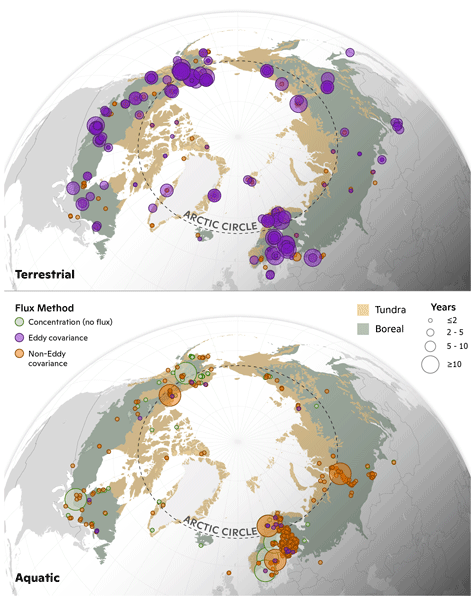
This dataset includes monthly measurements of carbon dioxide and methane exchange between land, water, and the atmosphere from over 1000 sites in Arctic and boreal regions. It combines measurements from a variety of ecosystems, including wetlands, forests, tundra, lakes, and rivers, gathered by over 260 researchers from 1984–2024. This dataset can be used to improve and reduce uncertainty in carbon budgets in order to strengthen our understanding of climate feedbacks in a warming world.
Sophie F. von Fromm, R. Scott Winton, Derrick R. Vaughn, Jennifer C. Bowen, Susan Trumbore, Kateřina Jandová, Julie Shahan, Olga Vindušková, Shane W. Stoner, Maedeh Chitsaz, Avni Malhotra, Adrian A. Wackett, Alison M. Hoyt, Katherine Heckman, Katerina Georgiou, Daniel Wasner, Luisa Isabell Minich, Katherine E. Grant, Caitlin E. Hicks Pries, Karis J. McFarlane, Anna Abramova, Corey Lawrence, and Jeffrey Beem-Miller
Earth Syst. Sci. Data, 18, 5793–5815, https://doi.org/10.5194/essd-18-5793-2026, https://doi.org/10.5194/essd-18-5793-2026, 2026
Short summary
Short summary
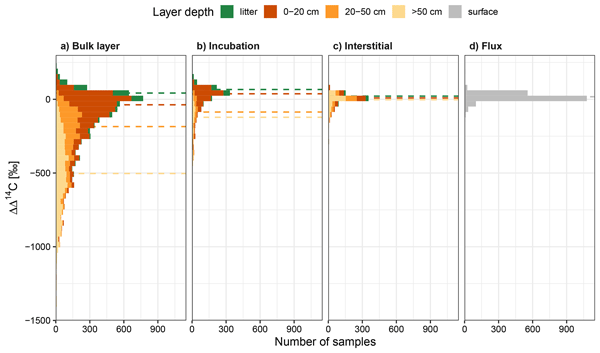
Here we present the updated International Soil Radiocarbon Database version 2, which compiles radiocarbon data from over 500 studies at 1700 locations worldwide. The database provides various soil radiocarbon measurements to improve our understanding of factors that influence the age distributions of carbon in soils. While we have made progress expanding the database and improving its structure, important gaps remain in tropical regions, deep soils, and certain measurement types.
Amy E. Goldman, James C. Stegen, Elizabeth T. Borer, Robert Hensley, Allison Myers-Pigg, Mikayla A. Borton, Paytsar Muradyan, Nicholas D. Ward, Jean M. Andino, Andrew D. Richardson, Alexandro B. Leverkus, Christopher S. Lowry, Nate G. McDowell, Kaizad F. Patel, Scott J. Davidson, Brieanne Forbes, Martha R. Downs, W. Robert Bolton, Timothy D. Scheibe, and Avni Malhotra
EGUsphere, https://doi.org/10.5194/egusphere-2026-3537, https://doi.org/10.5194/egusphere-2026-3537, 2026
Short summary
Short summary
Distributed data generation, or data collected from multiple sources and locations using standardized approaches and coordination among researchers, is powerful for scalable environmental knowledge. This paper helps readers understand options for distributed data generation, offers practical guidance for outreach, operations, and sharing outcomes, and explores how artificial intelligence can help address longstanding challenges.
Tiia Määttä, Ankur R. Desai, Masahito Ueyama, Rodrigo Vargas, Eric J. Ward, Zhen Zhang, Gil Bohrer, Kyle Delwiche, Etienne Fluet-Chouinard, Järvi Järveoja, Sara H. Knox, Lulie Melling, Mats B. Nilsson, Matthias Peichl, Angela Che Ing Tang, Eeva-Stiina Tuittila, Jinsong Wang, Sheel Bansal, Sarah Feron, Manuel Helbig, Aino Korrensalo, Ken W. Krauss, Gavin McNicol, Shuli Niu, Zutao Ouyang, Kathleen Savage, Oliver Sonnentag, Robert Jackson, and Avni Malhotra
Biogeosciences, 23, 4379–4445, https://doi.org/10.5194/bg-23-4379-2026, https://doi.org/10.5194/bg-23-4379-2026, 2026
Short summary
Short summary
We compared ecosystem- and plot-scale methane fluxes across wetland and upland sites. Ecosystem-scale fluxes were higher than at plot scale, but differences were small. Vapor pressure deficit, atmospheric pressure, turbulence, and wind direction affected the differences. Both scales could be combined for improved methane flux estimates at coarser temporal scales.
Mengze Li, Robert B. Jackson, Marielle Saunois, Philippe Ciais, Ben Poulter, Josep G. Canadell, Prabir K. Patra, Hanqin Tian, Zhen Zhang, Etienne Fluet-Chouinard, Zutao Ouyang, Ting Zhang, David J. Beerling, Dmitry A. Belikov, Philippe Bousquet, Danilo Custodio, Naveen Chandra, Xinyu Dou, Nicola Gedney, Peter O. Hopcroft, Alison M. Hoyt, Kazuhito Ichii, Akihito Ito, Atul K. Jain, Katherine Jensen, Fortunat Joos, Thomas Kleinen, Masayuki Kondo, Fa Li, Tingting Li, Xiangyu Liu, Shamil Maksyutov, Avni Malhotra, Adrien Martinez, Kyle McDonald, Joe R. Melton, Jurek Müller, Yosuke Niwa, Shufen Pan, Shushi Peng, Changhui Peng, Zhangcai Qin, Peter Raymond, William Riley, Arjo Segers, Rona L. Thompson, Aki Tsuruta, Yi Xi, Kunxiaojia Yuan, Wenxin Zhang, Bo Zheng, Qing Zhu, Qiuan Zhu, and Qianlai Zhuang
Earth Syst. Sci. Data, 18, 3507–3524, https://doi.org/10.5194/essd-18-3507-2026, https://doi.org/10.5194/essd-18-3507-2026, 2026
Short summary
Short summary
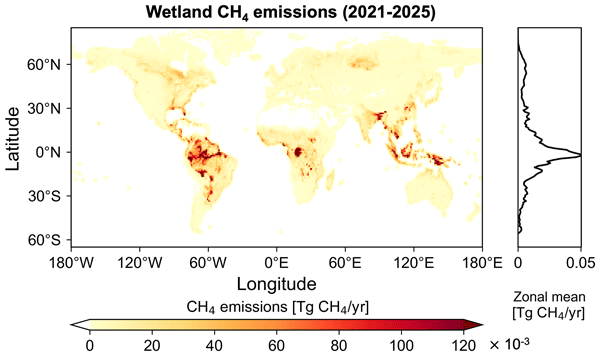
We proposed a framework that combines machine-learning and climate data to predict global natural vegetated wetland methane emissions for 2000–2025. We found that although total global emissions remained stable in the post-2020s, Northern Hemisphere emissions surged whilst tropical emissions fell. This approach allows us to rapidly monitor emissions and provides early warnings for climate impacts.
Jeffrey Beem-Miller, William J. Riley, Peter B. Reich, Michael W. I. Schmidt, Yuxuan Bai, Raimundo Bermudez Villanueva, Zach Brown, Abad Chabbi, Susan E. Crow, Wenxu Dong, Serita D. Frey, Paul J. Hanson, Kai Jensen, Melissa A. Knorr, Emma Lathrop, Avni Malhotra, Patrick Megonigal, Adrienne Nicotra, Andrew Nottingham, Genevieve L. Noyce, Roy L. Rich, Heidi Rodenhizer, Agustín Sarquis, Andreas Schindlbacher, Edward A. G. Schuur, Zheng Shi, Artur Stefanski, Viktoria Unger, Tana E. Wood, Yuanhe Yang, Zhijie Yang, Jizhong Zhou, Biao Zhu, and Margaret S. Torn
Earth Syst. Sci. Data Discuss., https://doi.org/10.5194/essd-2026-23, https://doi.org/10.5194/essd-2026-23, 2026
Revised manuscript accepted for ESSD
Short summary
Short summary
The Soil Warming to Depth Data Integration Effort (SWEDDIE) synthesizes data from deep soil warming experiments around the world (n = 23), offering new insight into warming responses of both surface and subsoils. We demonstrate that variation in soil warming with depth is driven largely by warming methodology, while soil moisture changes due to warming differ by ecosystem. This work serves a foundation for future syntheses with SWEDDIE.
Amy D. Holt, Jason B. Fellman, Anne M. Kellerman, Eran Hood, Samantha H. Bosman, Amy M. McKenna, Jeffery P. Chanton, and Robert G. M. Spencer
The Cryosphere, 19, 2769–2777, https://doi.org/10.5194/tc-19-2769-2025, https://doi.org/10.5194/tc-19-2769-2025, 2025
Short summary
Short summary
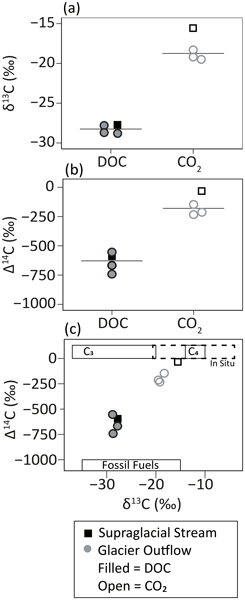
Glacier runoff is a source of old bioavailable dissolved organic carbon (DOC) to downstream ecosystems. The DOC pool is composed of material of various origins, chemical compositions, ages, and levels of bioavailability. Using bioincubation experiments, we show that glacier DOC respiration is driven by a young source, rather than by ancient material which comprises the majority of the glacier carbon pool. This young bioavailable fraction could currently be a critical carbon subsidy for recipient food webs.
Amey Tilak, Alina Premrov, Ruchita Ingle, Nigel Roulet, Benjamin R. K. Runkle, Matthew Saunders, Avni Malhotra, and Kenneth Byrne
EGUsphere, https://doi.org/10.5194/egusphere-2024-3852, https://doi.org/10.5194/egusphere-2024-3852, 2024
Preprint archived
Short summary
Short summary
For the future model users, 16 peatland and wetland models reviewed to identify individual model operational scale (spatial and temporal), stabilization timeframes of different carbon pools, model specific advantages and limitations, common and specific model driving inputs, critical inputs of individual models impacting CH4 plant mediated, CH4 diffusion and CH4 ebullition. Finally, we qualitatively ranked the process representations in each model for CH4 production, oxidation and transport.
Katherine E. O. Todd-Brown, Rose Z. Abramoff, Jeffrey Beem-Miller, Hava K. Blair, Stevan Earl, Kristen J. Frederick, Daniel R. Fuka, Mario Guevara Santamaria, Jennifer W. Harden, Katherine Heckman, Lillian J. Heran, James R. Holmquist, Alison M. Hoyt, David H. Klinges, David S. LeBauer, Avni Malhotra, Shelby C. McClelland, Lucas E. Nave, Katherine S. Rocci, Sean M. Schaeffer, Shane Stoner, Natasja van Gestel, Sophie F. von Fromm, and Marisa L. Younger
Biogeosciences, 19, 3505–3522, https://doi.org/10.5194/bg-19-3505-2022, https://doi.org/10.5194/bg-19-3505-2022, 2022
Short summary
Short summary
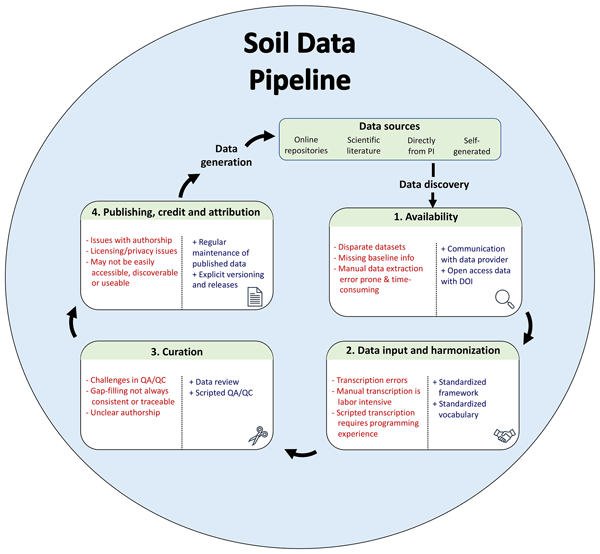
Research data are becoming increasingly available online with tantalizing possibilities for reanalysis. However harmonizing data from different sources remains challenging. Using the soils community as an example, we walked through the various strategies that researchers currently use to integrate datasets for reanalysis. We find that manual data transcription is still extremely common and that there is a critical need for community-supported informatics tools like vocabularies and ontologies.
Sparkle L. Malone, Youmi Oh, Kyle A. Arndt, George Burba, Roisin Commane, Alexandra R. Contosta, Jordan P. Goodrich, Henry W. Loescher, Gregory Starr, and Ruth K. Varner
Biogeosciences, 19, 2507–2522, https://doi.org/10.5194/bg-19-2507-2022, https://doi.org/10.5194/bg-19-2507-2022, 2022
Short summary
Short summary
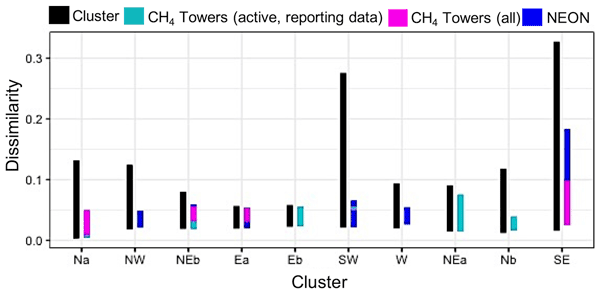
To understand the CH4 flux potential of natural ecosystems and agricultural lands in the United States of America, a multi-scale CH4 observation network focused on CH4 flux rates, processes, and scaling methods is required. This can be achieved with a network of ground-based observations that are distributed based on climatic regions and land cover.
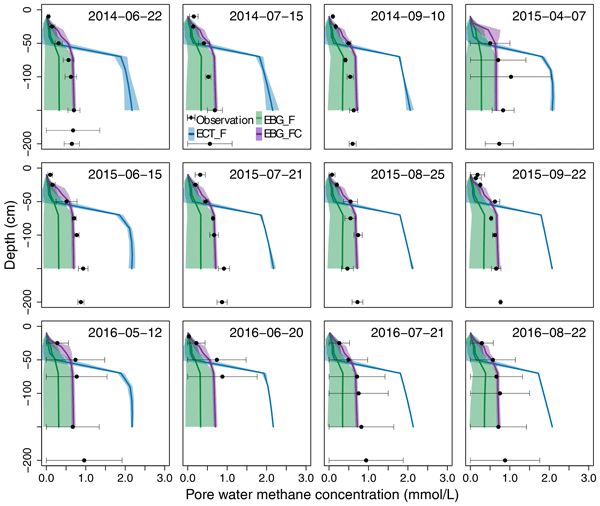
Shuang Ma, Lifen Jiang, Rachel M. Wilson, Jeff P. Chanton, Scott Bridgham, Shuli Niu, Colleen M. Iversen, Avni Malhotra, Jiang Jiang, Xingjie Lu, Yuanyuan Huang, Jason Keller, Xiaofeng Xu, Daniel M. Ricciuto, Paul J. Hanson, and Yiqi Luo
Biogeosciences, 19, 2245–2262, https://doi.org/10.5194/bg-19-2245-2022, https://doi.org/10.5194/bg-19-2245-2022, 2022
Short summary
Short summary
The relative ratio of wetland methane (CH4) emission pathways determines how much CH4 is oxidized before leaving the soil. We found an ebullition modeling approach that has a better performance in deep layer pore water CH4 concentration. We suggest using this approach in land surface models to accurately represent CH4 emission dynamics and response to climate change. Our results also highlight that both CH4 flux and belowground concentration data are important to constrain model parameters.
Mika Korkiakoski, Tiia Määttä, Krista Peltoniemi, Timo Penttilä, and Annalea Lohila
Biogeosciences, 19, 2025–2041, https://doi.org/10.5194/bg-19-2025-2022, https://doi.org/10.5194/bg-19-2025-2022, 2022
Short summary
Short summary
We measured CH4 fluxes and production and oxidation potentials from irrigated and non-irrigated podzolic soil in a boreal forest. CH4 sink was smaller at the irrigated site but did not cause CH4 emission, with one exception. We also showed that under laboratory conditions, not only wet conditions, but also fresh carbon, are needed to make podzolic soil into a CH4 source. Our study provides important data for improving the process models describing the upland soil CH4 dynamics.
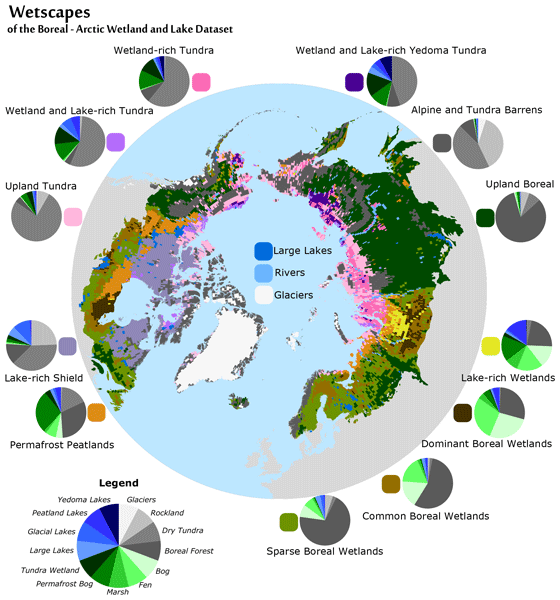
David Olefeldt, Mikael Hovemyr, McKenzie A. Kuhn, David Bastviken, Theodore J. Bohn, John Connolly, Patrick Crill, Eugénie S. Euskirchen, Sarah A. Finkelstein, Hélène Genet, Guido Grosse, Lorna I. Harris, Liam Heffernan, Manuel Helbig, Gustaf Hugelius, Ryan Hutchins, Sari Juutinen, Mark J. Lara, Avni Malhotra, Kristen Manies, A. David McGuire, Susan M. Natali, Jonathan A. O'Donnell, Frans-Jan W. Parmentier, Aleksi Räsänen, Christina Schädel, Oliver Sonnentag, Maria Strack, Suzanne E. Tank, Claire Treat, Ruth K. Varner, Tarmo Virtanen, Rebecca K. Warren, and Jennifer D. Watts
Earth Syst. Sci. Data, 13, 5127–5149, https://doi.org/10.5194/essd-13-5127-2021, https://doi.org/10.5194/essd-13-5127-2021, 2021
Short summary
Short summary
Wetlands, lakes, and rivers are important sources of the greenhouse gas methane to the atmosphere. To understand current and future methane emissions from northern regions, we need maps that show the extent and distribution of specific types of wetlands, lakes, and rivers. The Boreal–Arctic Wetland and Lake Dataset (BAWLD) provides maps of five wetland types, seven lake types, and three river types for northern regions and will improve our ability to predict future methane emissions.
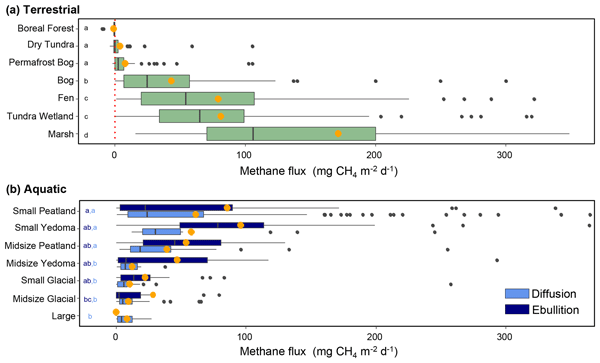
McKenzie A. Kuhn, Ruth K. Varner, David Bastviken, Patrick Crill, Sally MacIntyre, Merritt Turetsky, Katey Walter Anthony, Anthony D. McGuire, and David Olefeldt
Earth Syst. Sci. Data, 13, 5151–5189, https://doi.org/10.5194/essd-13-5151-2021, https://doi.org/10.5194/essd-13-5151-2021, 2021
Short summary
Short summary
Methane (CH4) emissions from the boreal–Arctic region are globally significant, but the current magnitude of annual emissions is not well defined. Here we present a dataset of surface CH4 fluxes from northern wetlands, lakes, and uplands that was built alongside a compatible land cover dataset, sharing the same classifications. We show CH4 fluxes can be split by broad land cover characteristics. The dataset is useful for comparison against new field data and model parameterization or validation.
Cited articles
Armstrong, W., Justin, S. H. F. W., Beckett, P. M., and Lythe, S.: Root adaptation to soil waterlogging, Aquat. Bot., 39, 57–73, https://doi.org/10.1016/0304-3770(91)90022-w, 1991.
Bardgett, R. D., Mommer, L., and De Vries, F. T.: Going underground: root traits as drivers of ecosystem processes, Trends Ecol. Evol., 29, 692–699, https://doi.org/10.1016/j.tree.2014.10.006, 2014.
Bäckstrand, K., Crill, P. M., Mastepanov, M., Christensen, T. R., and Bastviken, D.: Non-methane volatile organic compound flux from a subarctic mire in Northern Sweden, Tellus B, 60, 226, https://doi.org/10.1111/j.1600-0889.2007.00331.x, 2008.
Bergmann, J., Weigelt, A., van der Plas, F., Laughlin, D. C., Kuyper, T. W., Guerrero-Ramirez, N., Valverde-Barrantes, O. J., Bruelheide, H., Freschet, G. T., Iversen, C. M., Kattge, J., McCormack, M. L., Meier, I. C., Rillig, M. C., Roumet, C., Semchenko, M., Sweeney, C. J., van Ruijven, J., York, L. M., and Mommer, L.: The fungal collaboration gradient dominates the root economics space in plants, Sci. Adv., 6, https://doi.org/10.1126/sciadv.aba3756, 2020.
Bhullar, G. S., Edwards, P. J., and Olde Venterink, H.: Variation in the plant-mediated methane transport and its importance for methane emission from intact wetland peat mesocosms, J. Plant Ecol., 6, 298–304, https://doi.org/10.1093/jpe/rts045, 2013.
Biasi, C., Kou, D., Määttä, T., Malhotra, A., and Marushchak, M. E.: Daily peat moisture data associated with automated chamber CH4 flux measurements at the Stordalen mire 2024–2025, Zenodo [data set], https://doi.org/10.5281/zenodo.22091373, 2026.
Billings, W. D., Peterson, K. M., and Shaver, G. R.: Growth, turnover, and respiration rates of roots and tillers in tundra graminoids, in: Ecological Studies, Springer New York, New York, NY, 415–434, https://doi.org/10.1007/978-1-4612-6307-4_18, 1978.
Blume-Werry, G., Wilson, S. D., Kreyling, J., and Milbau, A.: The hidden season: growing season is 50 % longer below than above ground along an arctic elevation gradient, New Phytol., 209, 978–986, https://doi.org/10.1111/nph.13655, 2016.
Blume-Werry, G., Milbau, A., Teuber, L. M., Johansson, M., and Dorrepaal, E.: Dwelling in the deep – strongly increased root growth and rooting depth enhance plant interactions with thawing permafrost soil, New Phytol., 223, 1328–1339, https://doi.org/10.1111/nph.15903, 2019.
Bolduc, B., Hodgkins, S. B., Varner, R. K., Crill, P. M., McCalley, C. K., Chanton, J. P., Tyson, G. W., Riley, W. J., Palace, M., Duhaime, M. B., Hough, M. A., Saleska, S. R., Sullivan, M. B., Rich, V. I., and IsoGenie Project Coordinators, IsoGenie Project Team, A2A Project Team: The IsoGenie database: an interdisciplinary data management solution for ecosystems biology and environmental research, PeerJ, 8, e9467, https://doi.org/10.7717/peerj.9467, 2020.
Bouchard, V., Frey, S. D., Gilbert, J. M., and Reed, S. E.: Effects of macrophyte functional group richness on emergent freshwater wetland functions, Ecology, 88, 2903–2914, https://doi.org/10.1890/06-1144.1, 2007.
Bubier, J., Crill, P., Mosedale, A., Frolking, S., and Linder, E.: Peatland responses to varying interannual moisture conditions as measured by automatic CO2 chambers, Global Biogeochem. Cy., 17, https://doi.org/10.1029/2002gb001946, 2003.
Chanton, J. P.: The effect of gas transport on the isotope signature of methane in wetlands, Org. Geochem., 36, 753–768, https://doi.org/10.1016/j.orggeochem.2004.10.007, 2005.
Chanton, J. P. and Dacey, J. W. H.: Effects of vegetation on methane flux, reservoirs, and carbon isotopic composition, in: Trace Gas Emissions by Plants, Elsevier, 65–92, https://doi.org/10.1016/b978-0-12-639010-0.50008-x, 1991.
Christensen, T. R., Johansson, T., Åkerman, H. J., Mastepanov, M., Malmer, N., Friborg, T., Crill, P., and Svensson, B. H.: Thawing sub-arctic permafrost: Effects on vegetation and methane emissions, Geophys. Res. Lett., 31, https://doi.org/10.1029/2003gl018680, 2004.
Crill, P., McCalley, C., and Crew, A. F.: Manual active layer and and water table depth measurements from the autochamber sites at Stordalen Mire, northern Sweden (2003–2017), https://doi.org/10.5281/zenodo.10420396, 2023.
Delwiche, K. B., Knox, S. H., Malhotra, A., Fluet-Chouinard, E., McNicol, G., Feron, S., Ouyang, Z., Papale, D., Trotta, C., Canfora, E., Cheah, Y.-W., Christianson, D., Alberto, Ma. C. R., Alekseychik, P., Aurela, M., Baldocchi, D., Bansal, S., Billesbach, D. P., Bohrer, G., Bracho, R., Buchmann, N., Campbell, D. I., Celis, G., Chen, J., Chen, W., Chu, H., Dalmagro, H. J., Dengel, S., Desai, A. R., Detto, M., Dolman, H., Eichelmann, E., Euskirchen, E., Famulari, D., Fuchs, K., Goeckede, M., Gogo, S., Gondwe, M. J., Goodrich, J. P., Gottschalk, P., Graham, S. L., Heimann, M., Helbig, M., Helfter, C., Hemes, K. S., Hirano, T., Hollinger, D., Hörtnagl, L., Iwata, H., Jacotot, A., Jurasinski, G., Kang, M., Kasak, K., King, J., Klatt, J., Koebsch, F., Krauss, K. W., Lai, D. Y. F., Lohila, A., Mammarella, I., Belelli Marchesini, L., Manca, G., Matthes, J. H., Maximov, T., Merbold, L., Mitra, B., Morin, T. H., Nemitz, E., Nilsson, M. B., Niu, S., Oechel, W. C., Oikawa, P. Y., Ono, K., Peichl, M., Peltola, O., Reba, M. L., Richardson, A. D., Riley, W., Runkle, B. R. K., Ryu, Y., Sachs, T., Sakabe, A., Sanchez, C. R., Schuur, E. A., Schäfer, K. V. R., Sonnentag, O., Sparks, J. P., Stuart-Haëntjens, E., Sturtevant, C., Sullivan, R. C., Szutu, D. J., Thom, J. E., Torn, M. S., Tuittila, E.-S., Turner, J., Ueyama, M., Valach, A. C., Vargas, R., Varlagin, A., Vazquez-Lule, A., Verfaillie, J. G., Vesala, T., Vourlitis, G. L., Ward, E. J., Wille, C., Wohlfahrt, G., Wong, G. X., Zhang, Z., Zona, D., Windham-Myers, L., Poulter, B., and Jackson, R. B.: FLUXNET-CH4: a global, multi-ecosystem dataset and analysis of methane seasonality from freshwater wetlands , Earth Syst. Sci. Data, 13, 3607–3689, https://doi.org/10.5194/essd-13-3607-2021, 2021.
Dong, N., Prentice, I. C., Wright, I. J., Evans, B. J., Togashi, H. F., Caddy-Retalic, S., McInerney, F. A., Sparrow, B., Leitch, E., and Lowe, A. J.: Components of leaf-trait variation along environmental gradients, New Phytol., 228, 82–94, https://doi.org/10.1111/nph.16558, 2020.
Eissenstat, D. M., Wells, C. E., Yanai, R. D., and Whitbeck, J. L.: Building roots in a changing environment: implications for root longevity, New Phytol., 147, 33–42, https://doi.org/10.1046/j.1469-8137.2000.00686.x, 2000.
Eklundh, L. and Jönsson, P.: TIMESAT: A software package for time-series processing and assessment of vegetation dynamics, in: Remote Sensing Time Series, Springer International Publishing, Cham, 141–158, https://doi.org/10.1007/978-3-319-15967-6_7, 2015.
Freschet, G. T., Pagès, L., Iversen, C. M., Comas, L. H., Rewald, B., Roumet, C., Klimešová, J., Zadworny, M., Poorter, H., Postma, J. A., Adams, T. S., Bagniewska-Zadworna, A., Bengough, A. G., Blancaflor, E. B., Brunner, I., Cornelissen, J. H. C., Garnier, E., Gessler, A., Hobbie, S. E., Meier, I. C., Mommer, L., Picon-Cochard, C., Rose, L., Ryser, P., Scherer-Lorenzen, M., Soudzilovskaia, N. A., Stokes, A., Sun, T., Valverde-Barrantes, O. J., Weemstra, M., Weigelt, A., Wurzburger, N., York, L. M., Batterman, S. A., Gomes de Moraes, M., Janeček, Š., Lambers, H., Salmon, V., Tharayil, N., and McCormack, M. L.: A starting guide to root ecology: strengthening ecological concepts and standardising root classification, sampling, processing and trait measurements, New Phytol., 232, 973–1122, https://doi.org/10.1111/nph.17572, 2021a.
Freschet, G. T., Roumet, C., Comas, L. H., Weemstra, M., Bengough, A. G., Rewald, B., Bardgett, R. D., De Deyn, G. B., Johnson, D., Klimešová, J., Lukac, M., McCormack, M. L., Meier, I. C., Pagès, L., Poorter, H., Prieto, I., Wurzburger, N., Zadworny, M., Bagniewska-Zadworna, A., Blancaflor, E. B., Brunner, I., Gessler, A., Hobbie, S. E., Iversen, C. M., Mommer, L., Picon-Cochard, C., Postma, J. A., Rose, L., Ryser, P., Scherer-Lorenzen, M., Soudzilovskaia, N. A., Sun, T., Valverde-Barrantes, O. J., Weigelt, A., York, L. M., and Stokes, A.: Root traits as drivers of plant and ecosystem functioning: current understanding, pitfalls and future research needs, New Phytol., 232, 1123–1158, https://doi.org/10.1111/nph.17072, 2021b.
Fritz, C., Pancotto, V. A., Elzenga, J. T. M., Visser, E. J. W., Grootjans, A. P., Pol, A., Iturraspe, R., Roelofs, J. G. M., and Smolders, A. J. P.: Zero methane emission bogs: extreme rhizosphere oxygenation by cushion plants in Patagonia, New Phytol., 190, 398–408, https://doi.org/10.1111/j.1469-8137.2010.03604.x, 2011.
Gao, Y., Wang, H., Yang, F., Dai, X., Meng, S., Hu, M., Kou, L., and Fu, X.: Relationships between root exudation and root morphological and architectural traits vary with growing season, Tree Physiol., 44, 118, https://doi.org/10.1093/treephys/tpad118, 2024.
Ge, M., Korrensalo, A., Putkinen, A., Laiho, R., Kohl, L., Pihlatie, M., Lohila, A., Mäkiranta, P., Siljanen, H., Tuittila, E.-S., Wang, J., and Koskinen, M.: CH4 transport in wetland plants under controlled environmental conditions – separating the impacts of phenology from environmental variables, Plant Soil, 507, 671–691, https://doi.org/10.1007/s11104-024-06756-x, 2025.
Gorham, E.: Northern peatlands: Role in the carbon cycle and probable responses to climatic warming, Ecol. Appl., 1, 182–195, https://doi.org/10.2307/1941811, 1991.
Gray, A., Levy, P. E., Cooper, M. D. A., Jones, T., Gaiawyn, J., Leeson, S. R., Ward, S. E., Dinsmore, K. J., Drewer, J., Sheppard, L. J., Ostle, N. J., Evans, C. D., Burden, A., and Zieliński, P.: Methane indicator values for peatlands: a comparison of species and functional groups, Glob. Change Biol., 19, 1141–1150, https://doi.org/10.1111/gcb.12120, 2013.
Greenup, A., Bradford, M., Mcnamara, N., Ineson, P., and Lee, J.: The role of Eriophorum vaginatum in CH4 flux from an ombrotrophic peatland, Plant Soil, 227, 265–272, 2000.
Guyonnet, J. P., Cantarel, A. A. M., Simon, L., and Haichar, F. E. Z.: Root exudation rate as functional trait involved in plant nutrient-use strategy classification, Ecol. Evol., 8, 8573–8581, https://doi.org/10.1002/ece3.4383, 2018.
Hackney, C. T. and De La Cruz, A. A.: In situ decomposition of roots and rhizomes of two tidal marsh plants, Ecology, 61, 226–231, https://doi.org/10.2307/1935178, 1980.
Henneberg, A., Brix, H., and Sorrell, B. K.: The interactive effect of Juncus effusus and water table position on mesocosm methanogenesis and methane emissions, Plant Soil, 400, 45–54, https://doi.org/10.1007/s11104-015-2707-y, 2016.
Hewitt, R. E., Taylor, D. L., Genet, H., McGuire, A. D., and Mack, M. C.: Below-ground plant traits influence tundra plant acquisition of newly thawed permafrost nitrogen, J. Ecol., 107, 950–962, https://doi.org/10.1111/1365-2745.13062, 2019.
Hodgkins, S. B., Tfaily, M. M., McCalley, C. K., Logan, T. A., Crill, P. M., Saleska, S. R., Rich, V. I., and Chanton, J. P.: Changes in peat chemistry associated with permafrost thaw increase greenhouse gas production, P. Natl. Acad. Sci. USA, 111, 5819–5824, https://doi.org/10.1073/pnas.1314641111, 2014.
Hogg, E. H.: Decay potential of hummock and hollow sphagnum peats at different depths in a Swedish raised bog, Oikos, 66, 269, https://doi.org/10.2307/3544814, 1993.
Holmes, M. E., Crill, P. M., Burnett, W. C., McCalley, C. K., Wilson, R. M., Frolking, S., Chang, K.-Y., Riley, W. J., Varner, R. K., Hodgkins, S. B., McNichol, A. P., Saleska, S. R., Rich, V. I., Chanton, J. P., IsoGenie Project Coordinators, and IsoGenie Field Team: Carbon accumulation, flux, and fate in stordalen mire, a permafrost peatland in transition, Global Biogeochem. Cy., 36, https://doi.org/10.1029/2021gb007113, 2022.
Hough, M., McCabe, S., Vining, S. R., Pickering Pedersen, E., Wilson, R. M., Lawrence, R., Chang, K.-Y., Bohrer, G., IsoGenie Coordinators, Riley, W. J., Crill, P. M., Varner, R. K., Blazewicz, S. J., Dorrepaal, E., Tfaily, M. M., Saleska, S. R., and Rich, V. I.: Coupling plant litter quantity to a novel metric for litter quality explains C storage changes in a thawing permafrost peatland, Glob. Change Biol., 28, 950–968, https://doi.org/10.1111/gcb.15970, 2022.
Husby, C.: Biology and functional ecology of Equisetum with emphasis on the giant horsetails, Bot. Rev., 79, 147–177, https://doi.org/10.1007/s12229-012-9113-4, 2013.
Hyvönen, T., Ojala, A., Kankaala, P., and Martikainen, P. J.: Methane release from stands of water horsetail (Equisetum fluviatile) in a boreal lake, Freshwater Biol., 40, 275–284, https://doi.org/10.1046/j.1365-2427.1998.00351.x, 1998.
Iversen, C. M., Murphy, M. T., Allen, M. F., Childs, J., Eissenstat, D. M., Lilleskov, E. A., Sarjala, T. M., Sloan, V. L., and Sullivan, P. F.: Advancing the use of minirhizotrons in wetlands, Plant Soil, 352, 23–39, https://doi.org/10.1007/s11104-011-0953-1, 2012.
Iversen, C. M., Sloan, V. L., Sullivan, P. F., Euskirchen, E. S., McGuire, A. D., Norby, R. J., Walker, A. P., Warren, J. M., and Wullschleger, S. D.: The unseen iceberg: plant roots in arctic tundra, New Phytol., 205, 34–58, https://doi.org/10.1111/nph.13003, 2015.
Jackson, M. and Armstrong, W.: Formation of aerenchyma and the processes of plant ventilation in relation to soil flooding and submergence, Plant Biol.-Stuttg., 1, 274–287, https://doi.org/10.1055/s-2007-978516, 1999.
Joabsson, A. and Christensen, T. R.: Methane emissions from wetlands and their relationship with vascular plants: an Arctic example: METHANE EMISSION and VASCULAR PLANTS, Glob. Change Biol., 7, 919–932, https://doi.org/10.1046/j.1354-1013.2001.00044.x, 2001.
Johansson, T., Malmer, N., Crill, P. M., Friborg, T., Åkerman, J. H., Mastepanov, M., and Christensen, T. R.: Decadal vegetation changes in a northern peatland, greenhouse gas fluxes and net radiative forcing, Glob. Change Biol., 12, 2352–2369, https://doi.org/10.1111/j.1365-2486.2006.01267.x, 2006.
Johnston, C. E., Ewing, S. A., Harden, J. W., Varner, R. K., Wickland, K. P., Koch, J. C., Fuller, C. C., Manies, K., and Jorgenson, M. T.: Effect of permafrost thaw on CO2 and CH4 exchange in a western Alaska peatland chronosequence, Environ. Res. Lett., 9, 085004, https://doi.org/10.1088/1748-9326/9/8/085004, 2014.
Jönsson, P. and Eklundh, L.: Seasonality extraction by function fitting to time-series of satellite sensor data, IEEE T. Geosci. Remote, 40, 1824–1832, https://doi.org/10.1109/tgrs.2002.802519, 2002.
Kankaala, P. and Bergström, I.: Emission and oxidation of methane in Equisetum fluviatile stands growing on organic sediment and sand bottoms, Biogeochemistry, 67, 21–37, https://doi.org/10.1023/b:biog.0000015277.17288.7a, 2004.
Keuper, F., Dorrepaal, E., van Bodegom, P. M., van Logtestijn, R., Venhuizen, G., van Hal, J., and Aerts, R.: Experimentally increased nutrient availability at the permafrost thaw front selectively enhances biomass production of deep-rooting subarctic peatland species, Glob. Change Biol., 23, 4257–4266, https://doi.org/10.1111/gcb.13804, 2017.
Kichenin, E., Wardle, D. A., Peltzer, D. A., Morse, C. W., and Freschet, G. T.: Contrasting effects of plant inter- and intraspecific variation on community-level trait measures along an environmental gradient, Funct. Ecol., 27, 1254–1261, https://doi.org/10.1111/1365-2435.12116, 2013.
Knoblauch, C., Beer, C., Liebner, S., Grigoriev, M. N., and Pfeiffer, E.-M.: Methane production as key to the greenhouse gas budget of thawing permafrost, Nat. Clim. Change, 8, 309–312, https://doi.org/10.1038/s41558-018-0095-z, 2018.
Knox, S. H., Bansal, S., McNicol, G., Schafer, K., Sturtevant, C., Ueyama, M., Valach, A. C., Baldocchi, D., Delwiche, K., Desai, A. R., Euskirchen, E., Liu, J., Lohila, A., Malhotra, A., Melling, L., Riley, W., Runkle, B. R. K., Turner, J., Vargas, R., Zhu, Q., Alto, T., Fluet-Chouinard, E., Goeckede, M., Melton, J. R., Sonnentag, O., Vesala, T., Ward, E., Zhang, Z., Feron, S., Ouyang, Z., Alekseychik, P., Aurela, M., Bohrer, G., Campbell, D. I., Chen, J., Chu, H., Dalmagro, H. J., Goodrich, J. P., Gottschalk, P., Hirano, T., Iwata, H., Jurasinski, G., Kang, M., Koebsch, F., Mammarella, I., Nilsson, M. B., Ono, K., Peichl, M., Peltola, O., Ryu, Y., Sachs, T., Sakabe, A., Sparks, J. P., Tuittila, E.-S., Vourlitis, G. L., Wong, G. X., Windham-Myers, L., Poulter, B., and Jackson, R. B.: Identifying dominant environmental predictors of freshwater wetland methane fluxes across diurnal to seasonal time scales, Glob. Change Biol., 27, 3582–3604, https://doi.org/10.1111/gcb.15661, 2021.
Koelbener, A., Ström, L., Edwards, P. J., and Olde Venterink, H.: Plant species from mesotrophic wetlands cause relatively high methane emissions from peat soil, Plant Soil, 326, 147–158, https://doi.org/10.1007/s11104-009-9989-x, 2010.
Končalová, H.: Anatomical adaptations to waterlogging in roots of wetland graminoids: limitations and drawbacks, Aquat. Bot., 38, 127–134, https://doi.org/10.1016/0304-3770(90)90102-q, 1990.
Körner, C., Möhl, P., and Hiltbrunner, E.: Four ways to define the growing season, Ecol. Lett., 26, 1277–1292, https://doi.org/10.1111/ele.14260, 2023.
Kummerow, J. and Russell, M.: Seasonal root growth in the arctic tussock tundra, Oecologia, 47, 196–199, https://doi.org/10.1007/BF00346820, 1980.
Laanbroek, H. J.: Methane emission from natural wetlands: interplay between emergent macrophytes and soil microbial processes. A mini-review, Ann. Bot., 105, 141–153, https://doi.org/10.1093/aob/mcp201, 2010.
Laine, A. M., Korrensalo, A., and Tuittila, E.-S.: Plant functional traits play the second fiddle to plant functional types in explaining peatland CO2 and CH4 gas exchange, Sci. Total Environ., 834, 155352, https://doi.org/10.1016/j.scitotenv.2022.155352, 2022.
Łakomiec, P., Holst, J., Friborg, T., Crill, P., Rakos, N., Kljun, N., Olsson, P.-O., Eklundh, L., Persson, A., and Rinne, J.: Field-scale CH4 emission at a subarctic mire with heterogeneous permafrost thaw status, Biogeosciences, 18, 5811–5830, https://doi.org/10.5194/bg-18-5811-2021, 2021.
Larmola, T., Tuittila, E.-S., Tiirola, M., Nykänen, H., Martikainen, P. J., Yrjälä, K., Tuomivirta, T., and Fritze, H.: The role of Sphagnum mosses in the methane cycling of a boreal mire, Ecology, 91, 2356–2365, https://doi.org/10.1890/09-1343.1, 2010.
Lawrence, D. M., Slater, A. G., Romanovsky, V. E., and Nicolsky, D. J.: Sensitivity of a model projection of near-surface permafrost degradation to soil column depth and representation of soil organic matter, J. Geophys. Res., 113, https://doi.org/10.1029/2007jf000883, 2008.
Lê, S., Josse, J., and Husson, F.: FactoMineR: AnRPackage for Multivariate Analysis, J. Stat. Softw., 25, https://doi.org/10.18637/jss.v025.i01, 2008.
Lundin, E., Crill, P., Grudd, H., Holst, J., Kristoffersson, A., Meire, A., Mölder, M., and Rakos, N.: ETC L2 Fluxnet (half-hourly) from Abisko-Stordalen Palsa Bog, 2021-12-31–2023-08-31, ICOS RI [data set], https://hdl.handle.net/11676/JFtuqWbso4iTRa0UFYalE-4X (last access: 15 November 2025), 2023
Luoto, M., Heikkinen, R. K., and Carter, T. R.: Loss of palsa mires in Europe and biological consequences, Environ. Conserv., 31, 30–37, https://doi.org/10.1017/s0376892904001018, 2004.
Määttä, T.: Code for Increased plant mediated methane transport along a peatland permafrost thaw gradient, version v1, Zenodo [code], https://doi.org/10.5281/zenodo.20718440, 2026.
Määttä, T. and Malhotra, A.: The hidden roots of wetland methane emissions, Glob. Change Biol., 30, e17127, https://doi.org/10.1111/gcb.17127, 2024.
Määttä, T. and Malhotra, A.: Plant belowground trait and vegetation survey data from the Stordalen mire 2023, Zenodo [data set], https://doi.org/10.5281/zenodo.18269229, 2026.
Malhotra, A. and Roulet, N. T.: Environmental correlates of peatland carbon fluxes in a thawing landscape: do transitional thaw stages matter?, Biogeosciences, 12, 3119–3130, https://doi.org/10.5194/bg-12-3119-2015, 2015.
Man, M., Kalčík, V., Macek, M., Brůna, J., Hederová, L., Wild, J., and Kopecký, M.: myClim: Microclimate data handling and standardised analyses in R, Methods Ecol. Evol., 14, 2308–2320, 2023.
McCalley, C. K., Woodcroft, B. J., Hodgkins, S. B., Wehr, R. A., Kim, E.-H., Mondav, R., Crill, P. M., Chanton, J. P., Rich, V. I., Tyson, G. W., and Saleska, S. R.: Methane dynamics regulated by microbial community response to permafrost thaw, Nature, 514, 478–481, https://doi.org/10.1038/nature13798, 2014.
McCormack, M. L., Dickie, I. A., Eissenstat, D. M., Fahey, T. J., Fernandez, C. W., Guo, D., Helmisaari, H.-S., Hobbie, E. A., Iversen, C. M., Jackson, R. B., Leppälammi-Kujansuu, J., Norby, R. J., Phillips, R. P., Pregitzer, K. S., Pritchard, S. G., Rewald, B., and Zadworny, M.: Redefining fine roots improves understanding of below-ground contributions to terrestrial biosphere processes, New Phytol., 207, 505–518, https://doi.org/10.1111/nph.13363, 2015.
McGuire, A. D., Anderson, L. G., Christensen, T. R., Dallimore, S., Guo, L., Hayes, D. J., Heimann, M., Lorenson, T. D., Macdonald, R. W., and Roulet, N.: Sensitivity of the carbon cycle in the Arctic to climate change, Ecol. Monogr., 79, 523–555, https://doi.org/10.1890/08-2025.1, 2009.
Merritt, D. A., Hayes, J. M., and Des Marais, D. J.: Carbon isotopic analysis of atmospheric methane by isotope-ratio-monitoring gas chromatography-mass spectrometry, J. Geophys. Res., 100, 1317–1326, https://doi.org/10.1029/94jd02689, 1995.
Metsävainio, K.: Untersuchungen über das Wurzelsystem der Moorpflanzen, Annales Botanici Societatis Zoologicae-Botanicae Fennicae Vanamo, 1, 1–422, 1931.
Mollenkopf, M., Lenge, K., Drabesch, S., Monteux, S., van Grinsven, S., Joshi, P., Dorrepaal, E., Wild, B., Kappler, A., and Muehe, E. M.: Graminoids increase greenhouse gas emissions from thawed permafrost at the end of the growing season, Glob. Change Biol., 32, e70783, https://doi.org/10.1111/gcb.70783, 2026.
Mondav, R., Woodcroft, B. J., Kim, E.-H., McCalley, C. K., Hodgkins, S. B., Crill, P. M., Chanton, J., Hurst, G. B., VerBerkmoes, N. C., Saleska, S. R., Hugenholtz, P., Rich, V. I., and Tyson, G. W.: Discovery of a novel methanogen prevalent in thawing permafrost, Nat. Commun., 5, 3212, https://doi.org/10.1038/ncomms4212, 2014.
Moor, H., Rydin, H., Hylander, K., Nilsson, M. B., Lindborg, R., and Norberg, J.: Towards a trait-based ecology of wetland vegetation, J. Ecol., 105, 1623–1635, https://doi.org/10.1111/1365-2745.12734, 2017.
Noyce, G. L., Varner, R. K., Bubier, J. L., and Frolking, S.: Effect ofCarex rostrataon seasonal and interannual variability in peatland methane emissions, J. Geophys. Res.-Biogeo., 119, 24–34, https://doi.org/10.1002/2013jg002474, 2014.
Noyce, G. L., Smith, A. J., Kirwan, M. L., Rich, R. L., and Megonigal, J. P.: Oxygen priming induced by elevated CO2 reduces carbon accumulation and methane emissions in coastal wetlands, Nat. Geosci., 16, 63–68, https://doi.org/10.1038/s41561-022-01070-6, 2023.
Oksanen, J., Simpson, G. L., Blanchet, F. G., Kindt, R., Legendre, P., Minchin, P. R., O'Hara, R. B., Solymos, P., Stevens, M. H. H., Szoecs, E., Wagner, H., Barbour, M., Bedward, M., Bolker, B., Borcard, D., Carvalho, G., Chirico, M., De Caceres, M., Durand, S., Evangelista, H., FitzJohn, R., Friendly, M., Furneaux, B., Hannigan, G., Heida, I., Hill, M. O., Lahti, L., Martino, C., McGlinn, D., Ouellette, M.-H., Ribeiro Cunha, E., Smith, T., Stier, A., Ter Braak, C. J. F., and Weedon, J.: vegan: Community Ecology Package, R package version 2.7-2, CRAN [code], https://doi.org/10.32614/CRAN.package.vegan, 2025.
Olefeldt, D., Turetsky, M. R., Crill, P. M., and McGuire, A. D.: Environmental and physical controls on northern terrestrial methane emissions across permafrost zones, Glob. Change Biol., 19, 589–603, https://doi.org/10.1111/gcb.12071, 2013.
Olvmo, M., Holmer, B., Thorsson, S., Reese, H., and Lindberg, F.: Sub-arctic palsa degradation and the role of climatic drivers in the largest coherent palsa mire complex in Sweden (Vissátvuopmi), 1955–2016, Sci. Rep., 10, 8937, https://doi.org/10.1038/s41598-020-65719-1, 2020.
Öquist, M. G. and Svensson, B. H.: Vascular plants as regulators of methane emissions from a subarctic mire ecosystem, J. Geophys. Res.-Atmos., 107, ACL 10-1–ACL 10-10, https://doi.org/10.1029/2001JD001030, 2002.
Ouyang, W., Mueller, F., Hjelmare, M., Lundberg, E., and Zimmer, C.: ImJoy: an open-source computational platform for the deep learning era, Nat. Methods, 16, 1199–1200, https://doi.org/10.1038/s41592-019-0627-0, 2019.
Palace, M., Herrick, C., DelGreco, J., Finnell, D., Garnello, A. J., McCalley, C., McArthur, K., Sullivan, F., and Varner, R. K.: Determining subarctic peatland vegetation using an unmanned aerial system (UAS), Remote Sens.-Basel, 10, 1498, https://doi.org/10.3390/rs10091498, 2018.
Palace, M., Varner, R., Crill, P. M., Frolking, S., McCalley, C. K., Burke, S. A., Chanton, J. P., and Holmes, M. E.: Isogenie Project Coordinators, and Saleska, S.: Stordalen Mire ground cover classifications, based on 2014 WorldView-2 satellite imagery (version 0.0.0), EMERGE Biology Integration Institute, Ohio State University [data set], https://emerge-db.asc.ohio-state.edu/datasources/0145_Wv2-2014_GroundCoverClassifications (last access: 9 July 2025), 2022.
Pan, Y., Cieraad, E., and van Bodegom, P. M.: Are ecophysiological adaptive traits decoupled from leaf economics traits in wetlands?, Funct. Ecol., 33, 1202–1210, https://doi.org/10.1111/1365-2435.13329, 2019.
Perryman, C. R., McCalley, C. K., Malhotra, A., Fahnestock, M. F., Kashi, N. N., Bryce, J. G., Giesler, R., and Varner, R. K.: Thaw transitions and redox conditions drive methane oxidation in a permafrost peatland, J. Geophys. Res.-Biogeo., 125, https://doi.org/10.1029/2019jg005526, 2020.
Phillips, R. P., Erlitz, Y., Bier, R., and Bernhardt, E. S.: New approach for capturing soluble root exudates in forest soils, Funct. Ecol., 22, 990–999, https://doi.org/10.1111/j.1365-2435.2008.01495.x, 2008.
Picon-Cochard, C., Pilon, R., Tarroux, E., Pagès, L., Robertson, J., and Dawson, L.: Effect of species, root branching order and season on the root traits of 13 perennial grass species, Plant Soil, 353, 47–57, https://doi.org/10.1007/s11104-011-1007-4, 2012.
Pinheiro, J. and Bates, D. M.: Mixed-effects models in S and S-PLUS, 1st edn., Springer, New York, NY, 528 pp., https://doi.org/10.1007/b98882, 2000.
Pinheiro, J., Bates, D., and R Core Team: nlme: Linear and Nonlinear Mixed Effects Models, CRAN [code], https://doi.org/10.32614/CRAN.package.nlme, 2023.
Polarforskningssekretariatet and SMHI: Abisko Aut (ID 188790) Lufttemperatur (dygn) 1985–2025, SMHI Öppna data: meteorologiska observationer, SMHI, Sveriges meteorologiska och hydrologiska institut [data set], https://www.smhi.se/data/hitta-data-for-en-plats/ladda-ner-vaderobservationer/airtemperatureMean24h/188790 (last access: 9 July 2025), 2025a.
Polarforskningssekretariatet and SMHI: Abisko Aut (ID 188790) Nederbördsmängd (dygn) 1985–2025, SMHI Öppna data: meteorologiska observationer, SMHI, Sveriges meteorologiska och hydrologiska institut [data set], https://www.smhi.se/data/hitta-data-for-en-plats/ladda-ner-vaderobservationer/precipitation24HourSum/188790 (last access: 9 July 2025), 2025b.
Putkinen, A., Larmola, T., Tuomivirta, T., Siljanen, H. M., Bodrossy, L., Tuittila, E.-S., and Fritze, H.: Peatland succession induces a shift in the community composition of Sphagnum-associated active methanotrophs, FEMS Microbiol. Ecol., 88, 596–611, https://doi.org/10.1111/1574-6941.12327, 2014.
Raivonen, M., Smolander, S., Backman, L., Susiluoto, J., Aalto, T., Markkanen, T., Mäkelä, J., Rinne, J., Peltola, O., Aurela, M., Lohila, A., Tomasic, M., Li, X., Larmola, T., Juutinen, S., Tuittila, E.-S., Heimann, M., Sevanto, S., Kleinen, T., Brovkin, V., and Vesala, T.: HIMMELI v1.0: HelsinkI Model of MEthane buiLd-up and emIssion for peatlands, Geosci. Model Dev., 10, 4665–4691, https://doi.org/10.5194/gmd-10-4665-2017, 2017.
R Core Team: R: A Language and Environment for Statistical Computing, R Foundation for Statistical Computing, Vienna, Austria, https://www.R-project.org (last access: 15 May 2026), 2025.
Rose, L.: Pitfalls in root trait calculations: How ignoring diameter heterogeneity can lead to overestimation of functional traits, Front. Plant Sci., 8, 898, https://doi.org/10.3389/fpls.2017.00898, 2017.
Saarnio, S., Wittenmayer, L., and Merbach, W.: Rhizospheric exudation of Eriophorum vaginatum L. – Potential link to methanogenesis, Plant Soil, 267, 343–355, https://doi.org/10.1007/s11104-005-0140-3, 2004.
Schaefer, K., Lantuit, H., Romanovsky, V. E., Schuur, E. A. G., and Witt, R.: The impact of the permafrost carbon feedback on global climate, Environ. Res. Lett., 9, 085003, https://doi.org/10.1088/1748-9326/9/8/085003, 2014.
Scheffer, R. A. and Aerts, R.: Root decomposition and soil nutrient and carbon cycling in two temperate fen ecosystems, Oikos, 91, 541–549, https://doi.org/10.1034/j.1600-0706.2000.910316.x, 2000.
Schimel, J. P.: Plant transport and methane production as controls on methane flux from arctic wet meadow tundra, Biogeochemistry, 28, 183–200, https://doi.org/10.1007/BF02186458, 1995.
Schneider, C. A., Rasband, W. S., and Eliceiri, K. W.: NIH Image to ImageJ: 25 years of image analysis, Nat. Methods, 9, 671–675, https://doi.org/10.1038/nmeth.2089, 2012.
Schuur, E. A. G., Bockheim, J., Canadell, J. G., Euskirchen, E., Field, C. B., Goryachkin, S. V., Hagemann, S., Kuhry, P., Lafleur, P. M., Lee, H., Mazhitova, G., Nelson, F. E., Rinke, A., Romanovsky, V. E., Shiklomanov, N., Tarnocai, C., Venevsky, S., Vogel, J. G., and Zimov, S. A.: Vulnerability of permafrost carbon to climate change: Implications for the global carbon cycle, Bioscience, 58, 701–714, https://doi.org/10.1641/b580807, 2008.
Shaver, G. R.: Ecology of roots and rhizomes in graminoid plants of the Alaskan coastal tundra, PhD thesis, Duke University, Durham, NC, USA, https://www.proquest.com/openview/ad750e00eb95eeb7721530f62152090f/1?cbl=18750&diss=y (last access: 20 January 2026), 1976.
Shaver, G. R. and Billings, W. D.: Root production and root turnover in a wet tundra ecosystem, barrow, Alaska, Ecology, 56, 401–409, https://doi.org/10.2307/1934970, 1975.
Shaver, G. R. and Billings, W. D.: Effects of daylength and temperature on root elongation in tundra graminoids, Oecologia, 28, 57–65, https://doi.org/10.1007/BF00346836, 1977.
Singleton, C. M., McCalley, C. K., Woodcroft, B. J., Boyd, J. A., Evans, P. N., Hodgkins, S. B., Chanton, J. P., Frolking, S., Crill, P. M., Saleska, S. R., Rich, V. I., and Tyson, G. W.: Methanotrophy across a natural permafrost thaw environment, ISME J., 12, 2544–2558, https://doi.org/10.1038/s41396-018-0065-5, 2018.
Smith, B., Prentice, C., and Sykes, M. T.: Representation of vegetation dynamics in the modelling of terrestrial ecosystems: comparing two contrasting approaches within European climate space, Global Ecol. Biogeogr., 10, 621–637, https://doi.org/10.1046/j.1466-822X.2001.t01-1-00256.x, 2001.
Smith, B., Wårlind, D., Arneth, A., Hickler, T., Leadley, P., Siltberg, J., and Zaehle, S.: Implications of incorporating N cycling and N limitations on primary production in an individual-based dynamic vegetation model, Biogeosciences, 11, 2027–2054, https://doi.org/10.5194/bg-11-2027-2014, 2014.
Snedecor, G. W. and Cochran, W. G.: Statistical Methods, 8th Edn., Iowa State University Press, Ames, ISBN 0-8138-1561-4, 1989.
Ström, L. and Christensen, T. R.: Below ground carbon turnover and greenhouse gas exchanges in a sub-arctic wetland, Soil Biol. Biochem., 39, 1689–1698, https://doi.org/10.1016/j.soilbio.2007.01.019, 2007.
Ström, L., Ekberg, A., Mastepanov, M., and Røjle Christensen, T.: The effect of vascular plants on carbon turnover and methane emissions from a tundra wetland, Glob. Change Biol., 9, 1185–1192, https://doi.org/10.1046/j.1365-2486.2003.00655.x, 2003.
Ström, L., Mastepanov, M., and Christensen, T. R.: Species-specific Effects of Vascular Plants on Carbon Turnover and Methane Emissions from Wetlands, Biogeochemistry, 75, 65–82, https://doi.org/10.1007/s10533-004-6124-1, 2005.
Ström, L., Tagesson, T., Mastepanov, M., and Christensen, T. R.: Presence of Eriophorum scheuchzeri enhances substrate availability and methane emission in an Arctic wetland, Soil Biol. Biochem., 45, 61–70, https://doi.org/10.1016/j.soilbio.2011.09.005, 2012.
Turetsky, M. R., Kotowska, A., Bubier, J., Dise, N. B., Crill, P., Hornibrook, E. R. C., Minkkinen, K., Moore, T. R., Myers-Smith, I. H., Nykänen, H., Olefeldt, D., Rinne, J., Saarnio, S., Shurpali, N., Tuittila, E.-S., Waddington, J. M., White, J. R., Wickland, K. P., and Wilmking, M.: A synthesis of methane emissions from 71 northern, temperate, and subtropical wetlands, Glob. Change Biol., 20, 2183–2197, https://doi.org/10.1111/gcb.12580, 2014.
van den Berg, M., van den Elzen, E., Ingwersen, J., Kosten, S., Lamers, L. P. M., and Streck, T.: Contribution of plant-induced pressurized flow to CH4 emission from a Phragmites fen, Sci. Rep., 10, 12304, https://doi.org/10.1038/s41598-020-69034-7, 2020.
Varner, R. K., Crill, P. M., Frolking, S., McCalley, C. K., Burke, S. A., Chanton, J. P., Holmes, M. E., Isogenie Project Coordinators, Saleska, S., and Palace, M. W.: Permafrost thaw driven changes in hydrology and vegetation cover increase trace gas emissions and climate forcing in Stordalen Mire from 1970 to 2014, Philos. T. R. Soc. A, 380, 20210022, https://doi.org/10.1098/rsta.2021.0022, 2022.
Varner, R., Perry, A., and Crill, P.: Daily CH4 fluxes (from LGR at autochamber sites) and associated peat temperatures at 5 cm, during the productive period of 2023 (2023-05-19 to 2023-08-30), Zenodo [data set], https://doi.org/10.5281/zenodo.22086216, 2026.
Violle, C., Reich, P. B., Pacala, S. W., Enquist, B. J., and Kattge, J.: The emergence and promise of functional biogeography, P. Natl. Acad. Sci. USA, 111, 13690–13696, https://doi.org/10.1073/pnas.1415442111, 2014.
Visser, E. J. W., Bögemann, G. M., van de Steeg, H. M., Pierik, R., and Blom, C. W. P. M.: Flooding tolerance of Carex species in relation to field distribution and aerenchyma formation: RESEARCH Flooding tolerance of Carex species, New Phytol., 148, 93–103, https://doi.org/10.1046/j.1469-8137.2000.00742.x, 2000.
Vroom, R. J. E., van den Berg, M., Pangala, S. R., van der Scheer, O. E., and Sorrell, B. K.: Physiological processes affecting methane transport by wetland vegetation – A review, Aquat. Bot., 182, 103547, https://doi.org/10.1016/j.aquabot.2022.103547, 2022.
Waldo, N. B., Hunt, B. K., Fadely, E. C., Moran, J. J., and Neumann, R. B.: Plant root exudates increase methane emissions through direct and indirect pathways, Biogeochemistry, 145, 213–234, https://doi.org/10.1007/s10533-019-00600-6, 2019.
Wallén, B.: Above and below ground dry mass of the three main vascular plants on hummocks on a subarctic peat bog, Oikos, 46, 51, https://doi.org/10.2307/3565379, 1986.
Wang, P., Mommer, L., van Ruijven, J., Berendse, F., Maximov, T. C., and Heijmans, M. M. P. D.: Seasonal changes and vertical distribution of root standing biomass of graminoids and shrubs at a Siberian tundra site, Plant Soil, 407, 55–65, https://doi.org/10.1007/s11104-016-2858-5, 2016.
Wen, Z., White, P. J., Shen, J., and Lambers, H.: Linking root exudation to belowground economic traits for resource acquisition, New Phytol., 233, 1620–1635, https://doi.org/10.1111/nph.17854, 2022.
Whiticar, M. J.: Carbon and hydrogen isotope systematics of bacterial formation and oxidation of methane, Chem. Geol., 161, 291–314, 1999.
Wild, J., Kopecký, M., Macek, M., Šanda, M., Jankovec, J., and Haase, T.: Climate at ecologically relevant scales: A new temperature and soil moisture logger for long-term microclimate measurement, Agr. Forest Meteorol., 268, 40–47, 2019.
Wilson, D., Alm, J., Riutta, T., Laine, J., Byrne, K. A., Farrell, E. P., and Tuittila, E.-S.: A high resolution green area index for modelling the seasonal dynamics of CO2 exchange in peatland vascular plant communities, Plant Ecol., 190, 37–51, https://doi.org/10.1007/s11258-006-9189-1, 2007.
Wilson, R., Bosman, S., and Chanton, J.: CH? and DIC concentrations and δ13C from porewater at Stordalen Mire, July 2023, Zenodo, https://doi.org/10.5281/zenodo.18363867, 2026.
Wilson, R. M., Hough, M. A., Verbeke, B. A., Hodgkins, S. B., IsoGenie Coordinators, Chanton, J. P., Saleska, S. D., Rich, V. I., and Tfaily, M. M.: Plant organic matter inputs exert a strong control on soil organic matter decomposition in a thawing permafrost peatland, Sci. Total Environ., 820, 152757, https://doi.org/10.1016/j.scitotenv.2021.152757, 2022.
Wood, S. N.: Fast stable restricted maximum likelihood and marginal likelihood estimation of semiparametric generalized linear models, J. R. Stat. Soc. B, 73, 3–36, https://doi.org/10.1111/j.1467-9868.2010.00749.x, 2011.
Wood, S. N.: Generalized additive models: An introduction with R, Chapman and Hall/CRC, https://doi.org/10.1201/9781315370279, 2017.
Ye, Z. and Ryser, P.: Root porosity contributes to root trait space of wetland monocotyledons independently of economics traits, Plant Soil, 471, 301–314, https://doi.org/10.1007/s11104-021-05186-3, 2022.
Zhuang, Q., Melillo, J. M., Kicklighter, D. W., Prinn, R. G., McGuire, A. D., Steudler, P. A., Felzer, B. S., and Hu, S.: Methane fluxes between terrestrial ecosystems and the atmosphere at northern high latitudes during the past century: A retrospective analysis with a process-based biogeochemistry model, Global Biogeochem. Cy., 18, https://doi.org/10.1029/2004gb002239, 2004.
Short summary
Permafrost thaw can lead to vegetation shifts and higher methane (CH4) emissions in peatlands. However, plant belowground controls of these emissions are uncertain. We investigated how plant roots and rhizomes contribute to CH4 emissions along a peatland permafrost thaw gradient. We found that low herbaceous plant root tissue density and high rhizome surface area were associated with higher CH4 emissions. This indicated increased plant-mediated CH4 transport with thaw.
Permafrost thaw can lead to vegetation shifts and higher methane (CH4) emissions in peatlands....


Altmetrics
Final-revised paper
Preprint