
the Creative Commons Attribution 4.0 License.
the Creative Commons Attribution 4.0 License.
 | 26 Oct 2026
Warming vs. browning: a dual mechanism behind net ecosystem production of shallow brown aquatic systems
Aleksey Paltsev

Northern lakes are warming and browning due to increased cDOM inputs, altering water column ratios and temperatures that regulate microbial production. Yet the relative importance of warming versus browning, and their combined effects on nutrient stoichiometry and microbial dynamics remain unclear. We experimentally manipulated boreal ponds along a cDOM gradient under ambient and +2 °C warming to quantify impacts on nutrient conditions and microbial production. Browning shifted stoichiometry in both total and dissolved pools, with increased C:N and C:P ratios in the total nutrient pools, while reducing inorganic nutrient availability. Despite declining N:P ratios, both pools were strongly carbon-rich and depleted in both N and P. Nutrient-addition assays confirmed NP co-limitation. Browning increased bacterial production, while browning and warming combined reduced primary production, lowering PP:BP ratios. We show that browning -not warming- drives boreal freshwaters toward carbon-rich, N- and P- colimited conditions, while warming and browning together modulate microbial production by amplifying cDOM-driven heterotrophy and suppressing photoautotrophic production. Our study reveals a dual mechanism behind the shifting of brown systems toward heterotrophy. As browning and warming are pervasive trends across Northern lakes, these findings have wide applicability and advance general understanding of how freshwaters respond to ongoing environmental change.
- Article
(4561 KB) - Full-text XML
- BibTeX
- EndNote


Widespread browning of lakes and rivers due to increased mobilization of terrestrial dissolved organic matter and carbon (cDOM and DOC) from forest soils, wetlands, and thawing permafrost is transforming northern freshwaters. This terrestrially derived cDOM is typically humic, highly colored, and often released together with associated substances including iron (Kritzberg and Ekström, 2012; Weyhenmeyer et al., 2014) and nutrients (Evans et al., 2005; Jones, 1992; Stetler et al., 2021). These co-mobilized constituents further darken the water and modify the availability and stoichiometry (“ratios”) of carbon, nitrogen, and phosphorus (“”; Berggren et al., 2014; Isles et al., 2018, 2020), thereby shaping microbial activity and altering biogeochemical functioning in lakes (Creed et al., 2018; Solomon et al., 2015).
Browning interacts strongly with warming. High cDOM and associated DOC concentrations frequently occur in warmer, lower-latitude boreal regions, and the shallow morphology typical of boreal lakes makes them prone to strong and long thermal stratification (Houser, 2006; Pilla et al., 2018). Shallow lakes can experience strong and prolonged thermal stratification when high concentrations of dissolved organic matter increase light attenuation, causing heat to be absorbed near the surface, and disproportionally increasing surface water temperatures (Puts et al., 2023a). This creates a stable density gradient that suppresses wind-driven mixing despite the lakes' shallow depth (Fee et al., 1996). The surface water (epilimnion) of stratified boreal lakes is mainly influenced by external inputs of elements from catchments. Hence in addition to disproportional warming, intensified and prolonged stratification during summer can increase cDOM and nutrient concentrations in surface waters (Bergström and Jansson, 2000; Puts et al., 2025), compounding the effects of browning on metabolic balance and resource availability especially in surface layers.
Both browning and warming influence microbial production, yet their effects differ between photoautotrophic and bacterial phytoplankton. Moderately increased cDOM (approx. ) can stimulate algal production through nutrient supplementation, whereas high cDOM () suppresses algal growth via light limitation (Hanson et al., 2003; Jones and Lennon, 2015). Warming may enhance algal growth rates but can also reduce standing biomass when cells compensate for thermal stress (Filiz et al., 2020; Liu et al., 2022). Indeed, phytoplankton shows complex responses to browning and warming over large scales (Paltsev et al., 2024). In contrast, bacterial production typically continues to increase along the cDOM gradient, as well as with higher temperatures (Berggren et al., 2010b, a; Del Giorgio and Cole, 1998), resulting in a trend toward greater heterotrophy at higher levels of browning and warming. Growing evidence therefore points to interactive effects of cDOM and warming that together may shift lake ecosystems from algal-dominated to bacterial-dominated production regimes, with implications for CO2 dynamics and lake metabolism (Ask et al., 2012; Bogard and del Giorgio, 2016; Duarte and Prairie, 2005; Jonsson et al., 2003; Lapierre et al., 2013).
Despite these advances, the mechanistic links connecting browning and warming to water-column stoichiometry () and how these stoichiometric shifts regulate primary production (PP) and bacterial production (BP) remain poorly resolved. Stoichiometric constraints are expected to be particularly important during the ice-off period, when nutrient availability and microbial demand change rapidly (Hampton et al., 2017). Moreover, in organic-rich systems that are abundant at northern latitudes, high concentrations of organic nutrients are also expected, which bioavailability may depend on the composition of cDOM (Berggren et al., 2014, 2025; Rulli et al., 2022). Yet this pool cannot be measured directly, and the bioavailability therefore remains largely unquantified. Indeed, although water stoichiometry gives insights into patterns across systems, it is not a powerful predictor for phytoplankton nutritional constraints (Ptacnik et al., 2010). Therefore, to understand true phytoplankton nutritional constraints, classic nutrient limitation assays (Harpole et al., 2011), where inorganic nutrients are added to brown waters, may provide a better understanding of true resource limitation in these systems than assessing water stoichiometry and microbial production alone.
Here, we experimentally test how browning and warming shape water stoichiometry and microbial production during the ice-off season. We manipulated a natural cDOM gradient in boreal ponds under ambient and +2 °C warming to quantify effects on (1) total and dissolved inorganic stoichiometry of the water, (2) phytoplankton responses in inorganic nutrient-addition assays and (3) net ecosystem production by measuring PP, BP, and their ratio (PP:BP) with a lower ratio indicating increased heterotrophy. Our approach allows us to disentangle the individual and combined effects of browning and 2 °C warming on early-season microbial dynamics (photoautotrophic versus heterotrophic production) in boreal freshwaters.
2.1 Warming versus browning: nutrient stoichiometry
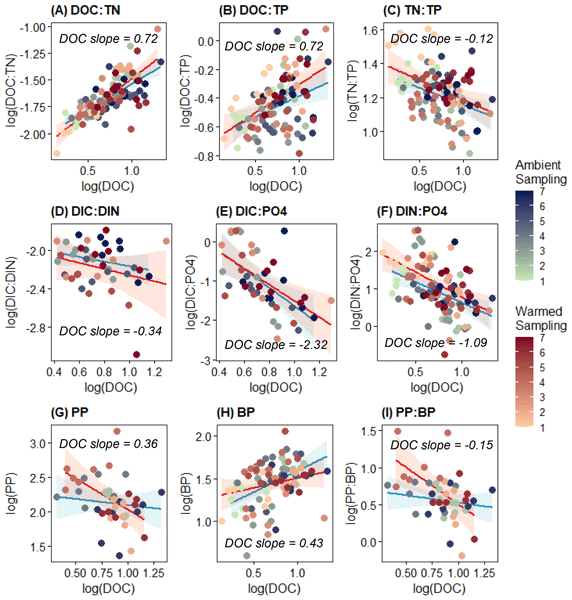
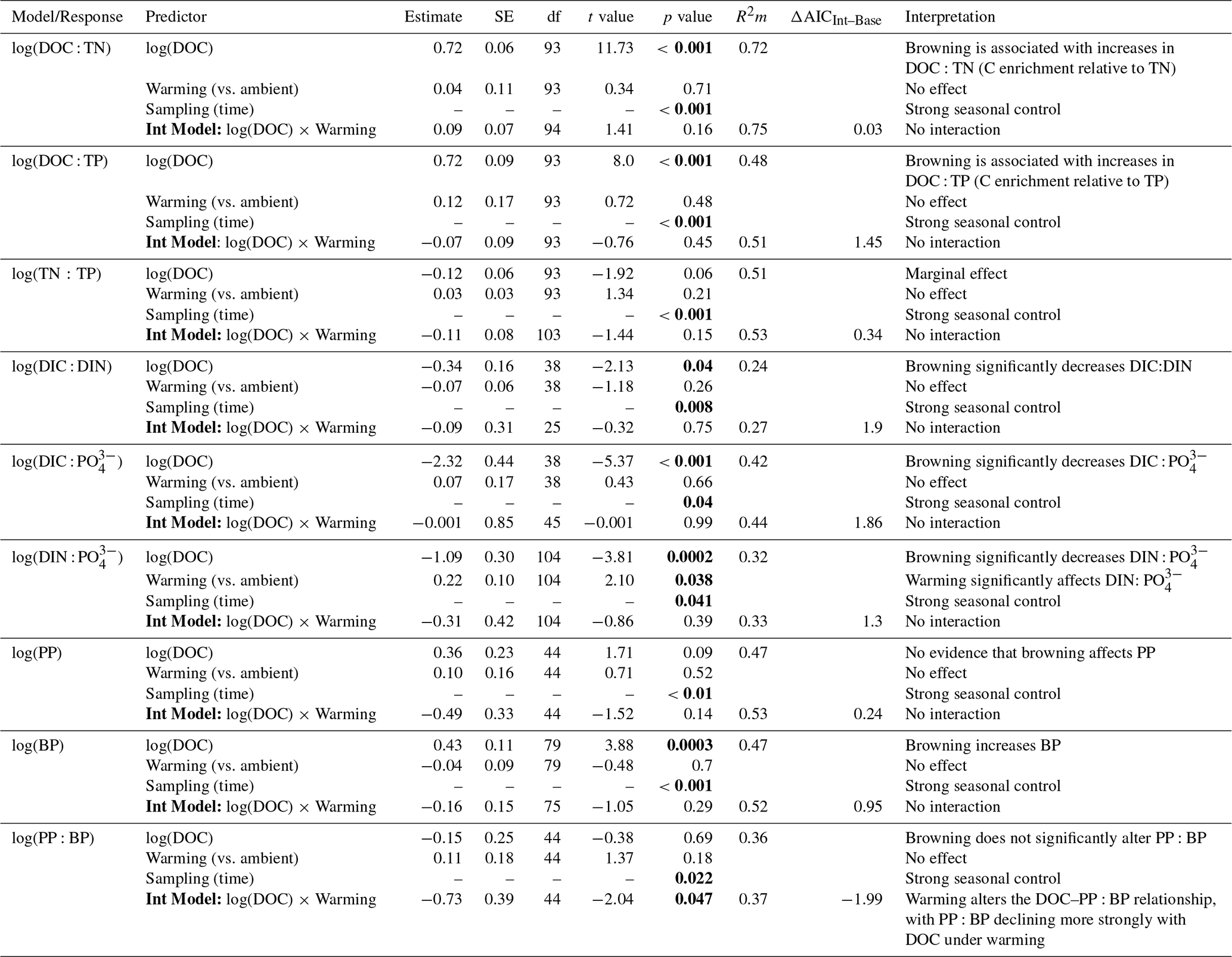
Browning (DOC concentration) was a strong predictor of the stoichiometry of the total nutrient pools across all sampling dates, and warming did not alter these relationships along the DOC gradient (Fig. 1; Table 1). In linear mixed-effects models, the estimate (Est.) indicates the direction and magnitude of the relationship, i.e., the expected change in the response for a one-unit increase in the predictor. While increased cDOM and DOC concentrations increase the absolute amount of nutrients (open data), DOC strongly increased DOC:TN (Est.=0.72, p<0.001) and DOC:TP (Est.=0.72, p<0.001), indicating progressive carbon enrichment relative to N and P with browning (Fig. 1A and B). This pattern is uniform across browning systems across the northern hemisphere (Creed et al., 2018; Isles et al., 2020). Although declines in TN:TP along the DOC gradient suggested increasing nutrient imbalance and stronger N limitation, this relationship was weak (, p=0.06; Fig. 1C). Nonetheless, this effect may be underestimated, as DIN:TP are shown to be better estimators for phytoplankton nutrient limitation (Bergström, 2010).
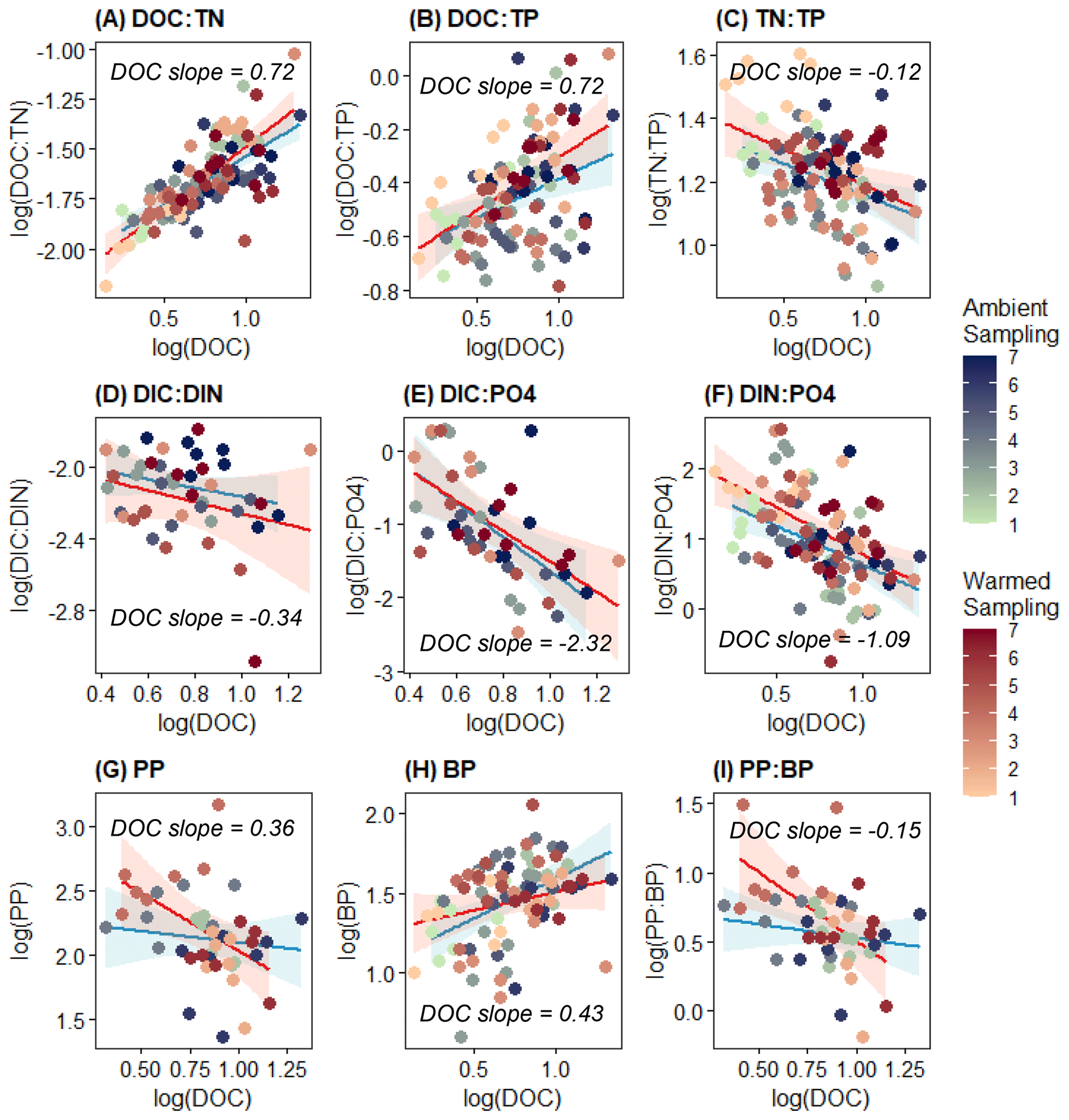
Figure 1Relationships between dissolved organic carbon (DOC) and (A–C) stoichiometry of total nutrients pools, (D–F) stoichiometry of dissolved nutrient pools and (G–I) production metrics, derived from linear mixed-effects models. Panels show responses of (A) DOC:TN, (B) DOC:TP, (C) TN:TP, (D) DIC:DIN, (E) DIC: , (F) DIN: , (G) primary production (PP), (H) bacterial production (BP), and (I) PP:BP to DOC (all variables log-transformed on both axes). The sampling occasion is indicated with color intensity for the warmed (red) versus ambient (blue) ponds. The colored lines are fitted trends from the mixed model (not raw regressions through all points) for the ambient (blue) versus warmed (red) ponds. The slopes (“Est.” in text) show average proportional response to browning, e.g., a 1 % increase in DOC corresponds to a ∼0.43 % increase in BP after accounting for warming, sampling date and pond identity (random effect). Note that DOC concentrations in the calculated ratios are given on a molar basis, whereas the x-axis presents DOC in mg L−1.
In the dissolved nutrient pools, DOC was also an important predictor of stoichiometry (Table 1). DOC marginally decreased DIC:DIN (, p=0.04), strongly decreased (, ) and (, p=0.0002), indicating decreasing inorganic carbon enrichment relative to dissolved nutrients along the DOC gradient (Fig. 1D–F). The increasing importance of carbon in the total nutrient pools (DOC:TN and DOC:TP), but decreasing importance of carbon in the inorganic pools (DIC:DIN and ), reflects the increasing importance of organic nutrients along the DOC gradient (Andersen et al., 2025; Corman et al., 2018; Stetler et al., 2021). The ternary plots with Redfield normalized ratios, confirm that ponds are consistently carbon-rich, and therefore N and P-poor relative to Redfield proportions in both dissolved (DIC–DIN–) and total (DOC–TN–TP) nutrient pools throughout the sampling season (Fig. 2B and C; Fig. B1 in Appendix B). Most observations fell within the P-depleted and co N&P-depleted, and occasionally N-depleted regions of conceptual stoichiometric space (Fig. 2A). Stoichiometric imbalances were strongest in the dissolved fraction, which showed greater carbon dominance and more pronounced seasonal variability than total pools. Most importantly, browning increased the C:N and C:P ratios in the dissolved carbon and total nutrient pools, indicating lower TN and TP relative to DOC, while decreasing these ratios in the dissolved fractions, indicating lower DIC relative to DIN and (Fig. 1A–B, D–E). This contrasting pattern suggests that browning enhances the availability of carbon substrates for heterotrophs while reducing the relative carbon resources available to photoautotrophs.
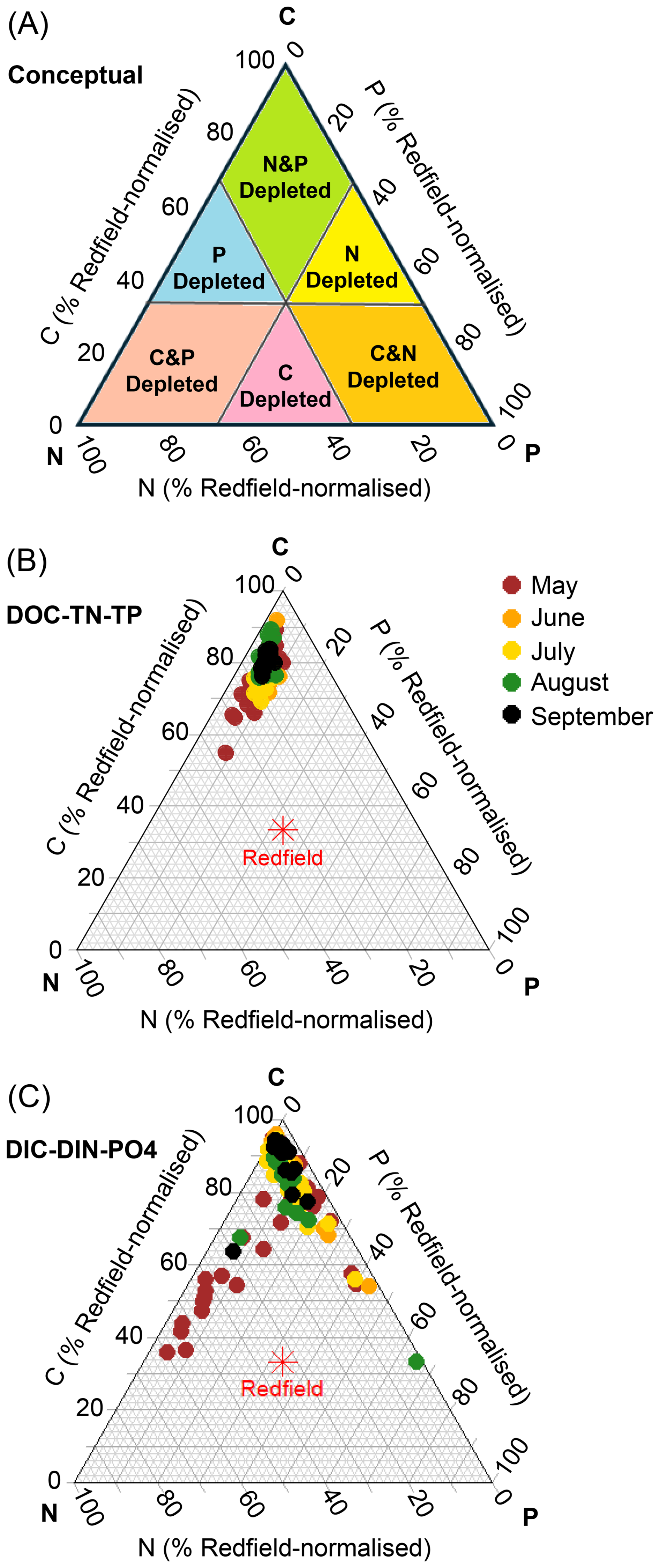
Figure 2Ternary diagrams illustrating carbon (C), nitrogen (N), and phosphorus (P) depletion relative to the Redfield ratio across treatments. (A) Conceptual diagram showing regions characterized by relative depletion of C, N, and P (generated ourselves, but following (Andersen et al., 2025)). (B, C) Redfield-normalized ratios for total (unfiltered) nutrients (B) and dissolved nutrients (C), with points colored by sampling month.
Table 1Results of linear mixed-effects models relating DOC concentration to response variables, with warming treatment and sampling period included as fixed effects and pond identity as a random intercept. Models are: DOC+Temperature base models (i.e., and interaction models (i.e., . Significant (p<0.05) results are in bold. For Sampling, p-values refer to the overall Type III test of the categorical factor rather than a single slope estimate. ΔAICInt–Base was calculated as AICinteraction model−AICbase model; negative values indicate improved fit of the interaction model. R2m is marginal R2 (i.e., variance explained by fixed effects: DOC, warming, sampling) for base model and interaction model.
As the ponds are consistently enriched in carbon relative to N and P (Fig. 2), it is particularly interesting to assess the N and P pools. The stoichiometric optimum that approximates the Redfield ratio (N:P = 16:1, molar) corresponds to a log 10-transformed value of 1.2 (10log (16:1)) for our molar concentrations (Fig. 1). Ratios around this value indicate likely nitrogen–phosphorus co-limitation, whereas higher values suggest increasing P limitation and lower values indicate N limitation (Redfield, 1958). In our experiment, N:P ratios spanned this critical range, from just below 1.0 to >1.5, thereby capturing conditions from N limitation to P limitation. Moreover, DOC quality is held constant as all ponds are treated with the same DOC source, but in natural systems DOC composition varies and strongly shapes its bioavailability and the resulting nutrient limitation of microbial production (Berggren et al., 2014, 2025; Soares et al., 2017). The mixed-effects model results indicate that in our experiment the stoichiometric optimum of 1.2 occurs at a DOC concentration of 7.2 mg L−1 for total pools, and a DOC concentration of 2.5 mg L−1 for dissolved pools (not accounting for the temperature treatments). These values are way below the proposed turning point of DOC, below which primary producers are primarily nutrient-limited and above which light limitation becomes more important (Hanson et al., 2003; Jones and Lennon, 2015). Accordingly, the magnitude of the algal production peaks near this transition ( DOC) is additionally driven by N:P nutrient stoichiometry (Kelly et al., 2018; Puts et al., 2023a). In our ponds, the optimal N:P ratio occurs well below 11 mg L−1 DOC, indicating that algal production is constrained by suboptimal nutrient ratios rather than by light availability. This explains the observed decline in PP, as light limitation in our system is unlikely (Sect. 2.4).
2.2 The effect of 2 °C warming and seasonality on nutrient stoichiometry
For both total and dissolved nutrient pools, browning clearly dominated over warming, and warming did not modify the DOC effect (Table 1). Interaction models provided no evidence that warming altered DOC effects on total nutrient stoichiometry (with ΔAICInt–Base ranging from +0.03 to +1.45; Table 1). A notable exception was , which was significantly affected by warming (Est.=0.22, p=0.038). Seasonal effects were similarly strong in both total and dissolved nutrient pools, with all pools showing pronounced temporal variation. This strong seasonal signal across both pools suggests that stoichiometric dynamics is not solely driven by the DOC loading within a waterbody but are also regulated by seasonal (moth-to-month) biogeochemical cycling (Kolzau et al., 2014). The ternary plots (Fig. 2) indicate P limitation early in the season, with N becoming relatively more limiting later. Seasonal differences in stoichiometry were limited in total pools, whereas dissolved pools showed greater variability, particularly in May when the relative contribution of N was higher than later in the season. Seasonal variability likely reflects synchronized changes in biological uptake, microbial processing, and hydrological inputs (e.g., spring run-off), which jointly restructure both total and dissolved nutrient pools.
Together, these results suggest that organic carbon enrichment was the primary driver of stoichiometric shifts in both pools, and 2 °C warming did not modify these effects except for . However, seasonal effects, where temperature is compounded, are observed. The observed effect of warming on suggests that temperature mainly influences fast-cycling nitrogen processes. Other stoichiometric ratios from both the total and dissolved pools did not respond to warming because they may be buffered by slower turnover of total nutrient pools (Sinsabaugh and Follstad Shah, 2012) or influenced by variation in microbial and phytoplankton community composition that can dampen the direct effects of temperature on nutrient cycling.
2.3 Phytoplankton nutrient limitation assays
The nutrient limitation assay shows consistent N–P co-limitation across all DOC treatments, with chl a responses strongest when N and P were added together (Fig. 3A). Responses to P in the highest DOC treatment increased significantly compared to the control with low DOC. Responses to N and P alone were low to moderate, with slight increases at higher DOC concentrations. Our results are in line with large spatial studies across Sweden showing phytoplankton in southern lakes are co-limited by N and P, while phytoplankton in carbon-poor northern lakes were mainly N-limited (Bergström, 2010; Bergström et al., 2008). DOC enrichment (browning) therefore shifts the system toward stronger nutrient stress for phytoplanktonic algal (chl a) production, confirming that browning leads to less favorable nutritional requirements for algal production (Sect. 2.1).
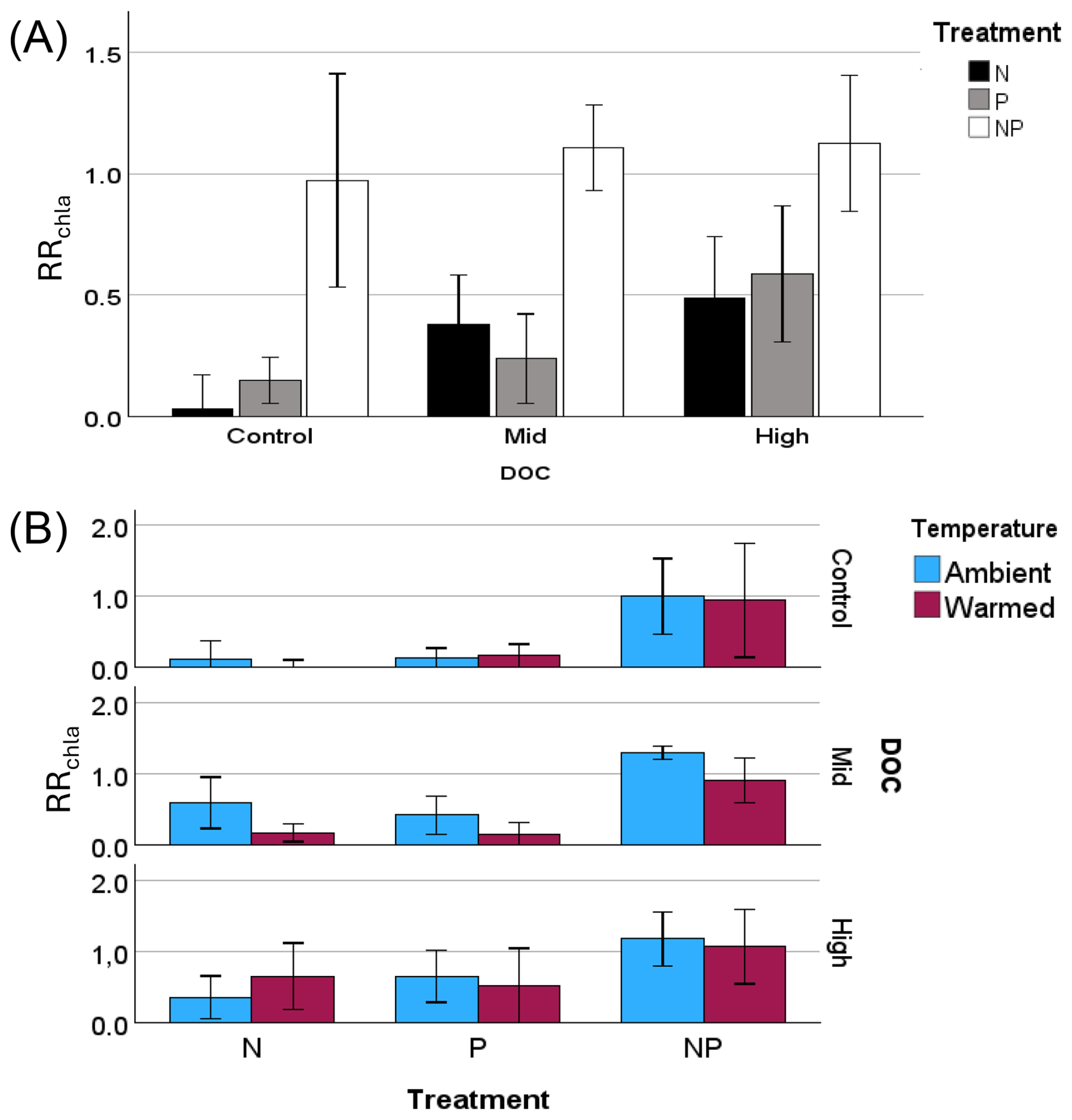
Figure 3(A) Mean seasonal chlorophyll a (chl a) response ratios (RRchl a) to nutrient-addition assays (N, P, or NP) per DOC treatment, pooled across temperature treatments. (B) Mean seasonal RRchl a per added nutrient, and DOC treatment (panel), per temperature treatment.
Temperature had a minimal and insignificant effect (Fig. 3B). Nonetheless, the highest RRchl a values were observed under Ambient temperature conditions, and warming generally reduced response, particularly in Mid and High DOC treatments, although this response was not significant. Overall, higher DOC enhanced nutrient-driven responses, particularly under NP additions, while warming tended to dampen these effects, consistent with patterns observed for PP (Sect. 2.4), although these effects were not statistically significant.
2.4 Microbial production under browning and warming
Microbial production responded differently to browning and warming. Both BP and PP (p<0.001 and p<0.01, respectively), as well as PP:BP (p=0.022) varied significantly across sampling times, indicating strong seasonal influence on microbial responses. BP increased strongly with DOC (Est.=0.43, p=0.0003; Fig. 1H) and was unaffected by warming or DOC-warming interactions (Fig. 1H; Table 1). In contrast to primary producers, bacterial (heterotrophic) producers are well known to assimilate organic carbon efficiently, have a more flexible stoichiometry (Cotner et al., 2010) and are a substantial part of carbon cycling and the microbial food web via the “microbial loop” (Fenchel, 2008). Browning increased C:N and C:P ratios in the DOC versus total nutrient pools, but decreased them in the dissolved fractions (Fig. 1A–B, D–E), suggesting greater carbon availability for heterotrophs and reduced carbon availability for photoautotrophs. This pattern is consistent with increasing BP and unaffected (though a trend of declining) PP and along the cDOM gradient (Fig. 1E and G).
Indeed, while PP showed no significant response to DOC or warming (in the linear mixed-effects models), it showed a trend (linear regression) of higher values at low DOC that declined more sharply with DOC under warming, resulting in lower PP at high DOC in warmed treatments (Table 1; Fig. 1G). Accordingly, warming amplified DOC-related declines in the PP:BP ratio (interaction: , p=0.047) indicating that the ponds shifted toward stronger heterotrophic dominance, although net heterotrophy () was not reached. Net heterotrophy was likely not reached because measurements were taken at a single, well-lit depth (0.6 m) rather than integrated over the full water column (Klaus et al., 2022), and because shallow lakes and ponds (≤4 m) typically exhibit high rates of both primary and heterotrophic production and large variability in net ecosystem production (Rabaey et al., 2024).
This pattern, indicating interactive effects of DOC and warming on metabolic balance (PP:BP), can only be disentangled in an experimental setting, as in natural lakes temperature variations are confounded by other factors that govern microbial production, such as nutrients, light, variability in DOC quality and quantity. Our finding of inhibited PP due to warming contrasts with observations from Swedish Arctic lakes, where PP is typically temperature-limited (Bergström et al., 2013; Faithfull et al., 2011; Puts et al., 2023a). Instead, our results controlled the confounded factors, and show that browning promotes net heterotrophy, but that this shift is not driven solely by increased BP, it can also arise from warming-induced declines in PP, so-called “thermal compensation” (Liu et al., 2022). Indeed, temperatures during this experiment were unusually high (see Appendix Sect. A1), meaning the additional +2 °C warming may have pushed the system beyond the thermal optimum of primary producers, whose growth declines sharply at temperatures higher than their thermal optimum (Kontopoulos et al., 2020). Moreover, we showed that along the DOC gradient inorganic nutrient availability declines (Sect. 2.1), which would impact production negatively. In less warm years, where primary producers are not passing optimal growth temperatures, the effect of temperature may not be negative, still, our results show that with browning PP will decrease. Our results indicate that BP is thriving under 2 °C warming and browning, whereas primary producers struggle, likely due to (1) thermal compensation (2) reduced inorganic nutrients, and (3) suboptimal stoichiometry.
With the increasing occurrence of heatwaves (Perkins-Kirkpatrick and Lewis, 2020) and intensified browning and warming of surface waters (Pilla et al., 2018; Puts et al., 2023a), the conditions observed in our ponds are likely to become more common. Altogether, our results indicate that in ponds and natural lakes, net ecosystem respiration and heterotrophy would be likely under browning and warming, particularly as warming intensifies epilimnetic temperatures (Bogard and del Giorgio, 2016; Duarte and Prairie, 2005; Sobek et al., 2007).
2.5 Limitations of this study
As with the majority of ecosystem-scale experiments, our study simplifies natural shallow water systems. Although the EXEF ponds contain sediments, microbial communities, primary producers, consumers, and a natural shoreline, natural lakes have more variation in size and their catchments. Moreover, natural lakes have varying cDOM sources, with varying quality (Berggren et al., 2018). Thus, the experiment was designed to isolate the effects of browning and warming rather than replicate the full complexity of freshwater ecosystems. While DOC quality was constant across treatments (not seasons), natural lakes vary in cDOM composition, nutrient inputs, catchment influences, and mixing regimes, all of which can affect water physico-chemistry and productivity. Nevertheless, the observed patterns are consistent with large-scale studies of browning lakes. Our study does not capture the full spectrum of DOC concentrations found in lakes: the control lake had relatively high DOC values already, and thus pristine mountain lakes are not captured in this gradient. Nonetheless, because our conclusions are still based on responses across a broader DOC gradient, we expect the direction of the responses to be robust, although their magnitude may vary among lake types and climatic conditions. The unusually warm summer during our study may also have amplified temperature effects. Accordingly, our findings should be viewed as evidence for the mechanisms underlying browning-warming interactions rather than as quantitative predictions for all boreal lakes.
Our study demonstrates that browning (increasing DOC concentrations) is the dominant driver determining nutrient stoichiometry, phytoplankton responses, and ecosystem metabolism (ratio between primary production and bacterial production: PP:BP). Moderate warming (+2 °C) only affected , while combined with warming also PP:BP. Across all sampling periods, increasing DOC consistently altered ratios both total and dissolved pools, leading to progressively stronger carbon enrichment in total nutrient pools, but decreasing dissolved inorganic nutrients. Although N:P ratios in both total and dissolved pools decreased with DOC indicating stronger N-limitation, both pools remained strongly carbon-rich and relatively depleted in both nitrogen and phosphorus.
Phytoplankton nutrient limitation assays confirmed widespread N–P co-limitation across the DOC gradient, with the strongest responses occurring under combined (N+P) additions. Higher DOC amplified these nutrient-driven responses, indicating that browning intensifies stoichiometric constraints on algal production, although warming did not affect algal nutrient limitation. Browning promoted a shift toward greater heterotrophic dominance by strongly stimulating bacterial production, while primary production showed no significant effect but tended to decline with increasing DOC, particularly under warming conditions. Although 2 °C warming alone had no significant effects, we found interactive effects with DOC that significantly reduced the balance between autotrophy and heterotrophy (PP:BP), indicating a shift toward increased reliance on heterotrophic pathways. However, full net heterotrophy was not reached, likely due to shallow, well-lit conditions and high overall productivity.
Our results are novel in that they show that 2 °C warming and browning alone, and combined, impact primary production differentially than bacterial production. When combined, it leads to a reduction of PP:BP. This identifies an additional mechanistic pathway contributing to the widespread occurrence of net ecosystem respiration in northern lakes. Given the widespread intensification of browning and warming events across northern lakes, our findings suggest that primary producers may become increasingly constrained, while heterotrophic bacterial production is maintained or enhanced, particularly under episodic heatwaves.
A1 Experimental approach and setup
We experimentally established a cDOM gradient under ambient and +2 °C warmed conditions. We monitored effects on water chemistry (dissolved and total nutrients, and dissolved organic carbon (DOC)) in seven samplings. We additionally monitored BP, PP, dissolved inorganic carbon (DIC), as well as phytoplankton responses to nutrient amendments (nitrogen (N), phosphorus (P), N + P) in three sampling events. The experimental treatments began in autumn 2017, and monitoring ran from 7 May 2018–3 September 2018, which was an exceptionally warm summer (Blunden and Arndt, 2019). The experiment was conducted at the Experimental Ecosystem Facility (EXEF) in Umeå (Sweden) using 16 treatment ponds and 4 buffer ponds to separate temperature treatments. We aimed for a 4×2 factorial design, with 4 DOC treatments in duplicate (DOC categories “Control”, “Low”, “Mid” and “High”) and 2 temperature treatments. We interpret actual DOC concentrations rather than categorical DOC treatments.
The EXEF ponds (11.5 m×6.7 m and ∼1.5 m deep) are naturally functioning ecosystems with soft sediments, primary producers, and invertebrate consumers and a natural shoreline. The cDOM gradient was created by continuously mixing cDOM-rich water from the nearby Hörneån river with low-cDOM municipal tap water. The seasonal average DOC concentrations ranged from 1.4–21.3 mg L−1. DOC served as an effective proxy for cDOM, and the warming treatment was successfully established with an average temperature difference of 1.8 °C between warmed and ambient ponds (Puts et al., 2023b). Ponds were fish-free until 11 May 2018, when 43 sticklebacks were added to each pond, and zooplankton biomass was low while periphytic biomass was relatively high compared to phytoplankton production. One ambient control pond was excluded due to turbidity caused by a muskrat. Specifics about the experimental water used, and management of the experimental treatments are available in Capo et al. (2021); Koizumi et al. (2023); Puts et al. (2023b).
A2 Water physico-chemistry
We collected water just below the surface using a 0.6 m long sampler and stored the samples in 1 L bottles with minimal headspace. Samples were kept dark and processed immediately in the laboratory on the same day. We monitored total and dissolved N and P (TN, TP, DIN (), and ), DOC, and pH every three weeks starting 7 May during seven samplings, and dissolved inorganic carbon (DIC) in three samplings (concerted with PP). Water for DOC, DIN, and was filtered (0.45 µm, Sarstedt Filtropur) and DOC samples were acidified to 12 mM HCl and refrigerated, and TN, TP, DIN, and frozen. DOC was analyzed through high-temperature combustion using a Formacs HT-I analyzer (Skalar), and nutrients on a segmented flow analyzer (QuAAtro, SEAL Analytical GmbH, Norderstedt, Germany). DIC samples (used for PP measurements) were prepared by injecting 4 mL air-free water into N2-flushed, tightly sealed 18 mL glass vials containing 0.1 mL 1.2 M HCl, and analyzed on a Clarus 500 gas chromatograph (Perkin Elmer) using N2 as carrier gas.
A3 Bacterial and primary production, and nutrient amendment assays
Pelagic primary- and bacterial production (PP and BP) were measured using isotopic tracers from water acquired in the same way as water for physico-chemistry. The BP was measured every sampling (in total seven samplings) by incubating the water in triplicates with an isotopically labeled tracer (3H, leucine) in the laboratory as soon as possible after the water sample was acquired. The water was incubated for approximately 1 h at in situ temperature in the dark, according to Smith (1992). We measured PP during 3 sampling events, using a 14C isotopic tracer as described by (Schindler et al., 1972). We filled transparent glass bottles in triplicate, and one dark bottle, with pond water. Bottles were incubated in-situ at 0.5 m for 4 h during midday, and the production was corrected for light factor which was calculated using continuous PAR measurements. Reported values represent the average of the three light incubations minus the dark incubation.
We tested the responses of chlorophyll a (chl a) to nutrient additions in assays where we added 500 mL pond water to transparent polyethylene bottles, with control (no added nutrients), +N, +P, and +NP treatments, each with triplicate incubations. Nitrogen and phosphorus were added as NH4NO3 and KH2PO4 in amounts that increased bottle concentrations by 10 µg P L−1 and 100 µg N L−1, respectively. We did these assays only in the control, mid, and high DOC treatment ponds for each temperature treatment (no duplicate ponds: specifically, pond ID 15, 19 ,16; vs. 3, 2 ,7, for the ambient vs. warmed treatments, and control, mid, high DOC treatments). Bottles were incubated for approximately 72 h at 0.6 m depth. We did not filter water for zooplankton, but the biomass was very low due to high predation pressure (Koizumi et al., 2023). We measured chl a as endpoint, by filtering 100 mL on GF/F Whatman filters and storing them in the freezer before further analyses. We extracted chl a in 95 % ethanol for 24 h and measured on a LS-55 luminescence spectrophotometer with excitation and emission wavelengths set to 433 and 673 nm, respectively.
A4 Data analysis
We assessed whether the browning and temperature treatments independently (“base model”) or additively (“interaction model”) explained variation in nutrient stoichiometry and production. We fitted linear mixed-effects regression models that accounted for the hierarchical structure of the experiment, including repeated measurements from the same experimental ponds. Response variables included primary and bacterial production and their ratio (PP, BP, and PP:BP, respectively), and nutrient stoichiometric ratios of total nutrient pools (DOC:TP, DOC:TN and TN:TP) and dissolved inorganic pools (, , and DIC:DIN). For each response variable, we fitted two models: (1) a base model assessing whether the browning and warming independently better explained variation in nutrient stoichiometry and production (warming + browning), and (2) an interaction model including a term where browning and warming exert independent, additive effects on predictors (warming + browning + warming × browning). Pond identity was included as a random intercept to account for repeated observations and among-pond variability. To assess seasonality, sampling occasion (Sampling) was included as a categorical fixed effect in all models, allowing responses to vary among sampling periods without assuming a linear temporal trend. All response variables were log-transformed (10log) prior to analysis (Isles, 2020). Models were fitted using the lme4 package in R (Bates et al., 2015). Statistical significance of fixed effects was assessed using Satterthwaite's approximation for degrees of freedom as implemented in the lmerTest package (Kuznetsova et al., 2017).
We compared Akaike Information Criterion (AIC) to evaluate the relative explanatory importance of the base versus interaction model (ΔAICInt–Base). This approach does not test whether either driver is statistically significant, but instead evaluates which driver explains more variation in the response variable. To facilitate comparison of the relative roles of browning and temperature treatments alone and their combined impacts across response variables, we visualized each relationship as scatter plots of the response variable against DOC.
We then evaluated if water stoichiometry met algal nutritional requirements in a ternary diagram, which shows the relative proportions of indexed by the algal nutrient requirement ratio (Redfield ratio). We used molar concentrations of DIC, DIN, , as well as DOC, TN, and TP, which we normalized relative to the Redfield ratio using the equations as in Andersen et al. (2025). DOC and DIC represent different carbon pools that affect different ecological processes. When ecosystem metabolism is considered, DIC is particularly relevant for PP because it is directly assimilated by photoautotrophs during photosynthesis. In contrast, DOC is generally unavailable to primary producers and is mostly utilized in heterotrophic metabolism, hence more closely linked to BP. The same goes for the dissolved inorganic nutrient pools versus total pools: the dissolved inorganic pool is directly available to phytoplankton (which could be autotrophic or heterotrophic), whereas the total nutrient pools include organic fractions, which would need (enzymatic) preprocessing, and which can have varying bioavailability (Berggren et al., 2025; Rulli et al., 2022, 2026; Soares et al., 2017). Both pools are therefore informative, but different. This is confirmed in our brown ponds; expressing the dissolved inorganic nutrient pools relative to DOC rather than DIC yields an average Redfield-normalized carbon value of 95±11 %, compared with 80±16 % (average ±SD) when normalized to DIC (Fig. B1). DIC was measured during only three sampling events. Across these samplings, the standard deviation of DIC was low (15 % across all ponds), indicating limited variability. We therefore used the overall mean DIC when calculating Redfield-normalized values for the ternary diagram. As we found that browning (not warming) is the most dominant driver of total and dissolved ratios, we do not distinguish between the temperature treatments when evaluating water stoichiometry in the ternary diagrams that were generated using the R package Ternary (Smith et al., 2025).
For the nutrient-amendment assays, we calculated the natural logarithmic response ratio (RRx) for each triplicate per treatment (Control, N, P, or +NP) by dividing the chl a concentration in each replicate per treatment (chl areplicate, treatment) by the average chl a concentration of the control of each treatment (chl acontrol average, treatment): so that ).
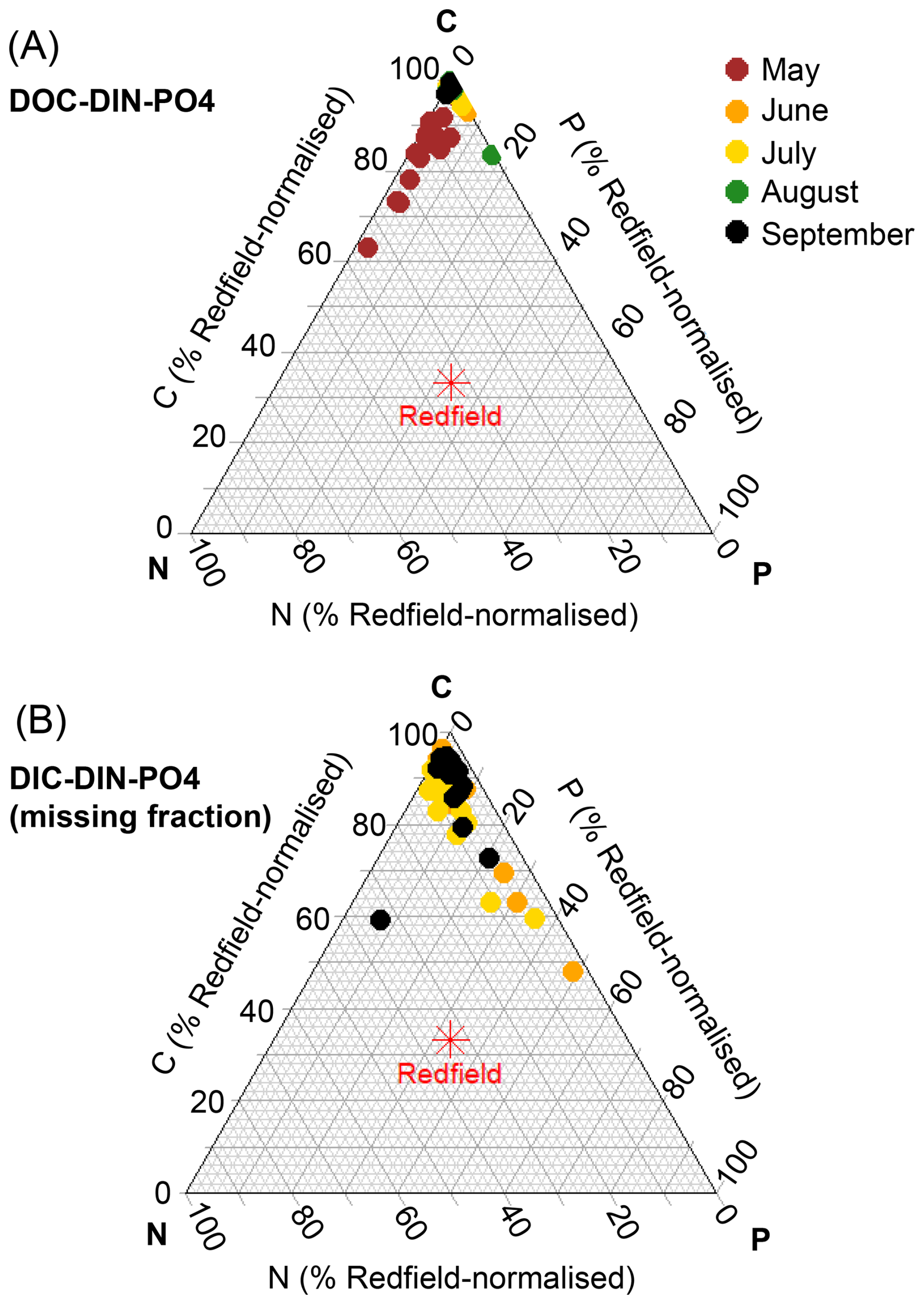
Figure B1Redfield-normalized ratios for dissolved nutrients and DOC (A) and dissolved nutrients and in situ DIC with data available for June, July and September (B), with points colored by sampling month.
The raw and processed data used for statistical analysis and the preparation of figures in the study are available at https://doi.org/10.5281/zenodo.20498522 (Paltsev and Puts, 2026) (open access).
AP and ICP contributed equally to data interpretation, and manuscript preparation. ICP was responsible for the development of the study design and conducting field sampling and laboratory analyses.
The contact author has declared that neither of the authors has any competing interests.
Publisher's note: Copernicus Publications remains neutral with regard to jurisdictional claims made in the text, published maps, institutional affiliations, or any other geographical representation in this paper. The authors bear the ultimate responsibility for providing appropriate place names. Views expressed in the text are those of the authors and do not necessarily reflect the views of the publisher.
We thank Ann-Kristin Bergström with supporting with materials and extend our gratitude for her valuable career guidance. We are grateful to Pelle Byström and Erik Geibrink for access and maintenance to the experimental ecosystems facility (EXEF), and Anders Jonsson and BAF for analyzing the water chemistry. AI was used to optimize the modelling workflow, but no parts of the manuscript were generated.
This study was financed by Swedish Research Council FORMAS, and partly by a Kungliga vetenskapsakademien (KVA) grant for Biosciences.
The publication of this article was funded by the Swedish Research Council, Forte, Formas, and Vinnova.
This paper was edited by Sebastian Naeher and Paul Stoy and reviewed by two anonymous referees.
Andersen, I. M., Taylor, J. M., Graeber, D., Kelly, P. T., Hoke, A. K., Robbins, C. J., and Scott, J. T.: Redfield revisited: Insights into freshwater seston carbon : nitrogen : phosphorus stoichiometry, Limnol. Oceanogr., https://doi.org/10.1002/lno.70133, 2025.
Ask, J., Karlsson, J., and Jansson, M.: Net ecosystem production in clear-water and brown-water lakes, Global Biogeochem. Cy., 26, https://doi.org/10.1029/2010GB003951, 2012.
Bates, D., Mächler, M., Bolker, B., and Walker, S.: Fitting Linear Mixed-Effects Models Using lme4, J. Stat. Softw., 67, https://doi.org/10.18637/jss.v067.i01, 2015.
Berggren, M., Laudon, H., Haei, M., Ström, L., and Jansson, M.: Efficient aquatic bacterial metabolism of dissolved low-molecular-weight compounds from terrestrial sources, ISME J., 4, 408–416, https://doi.org/10.1038/ismej.2009.120, 2010a.
Berggren, M., Laudon, H., Jonsson, A., and Jansson, M.: Nutrient constraints on metabolism affect the temperature regulation of aquatic bacterial growth efficiency, Microb. Ecol., 60, 894–902, https://doi.org/10.1007/s00248-010-9751-1, 2010b.
Berggren, M., Sponseller, R. A., Alves Soares, A. R., and Bergström, A. K.: Toward an ecologically meaningful view of resource stoichiometry in DOM-dominated aquatic systems, J. Plankton Res., 37, 489–499, https://doi.org/10.1093/plankt/fbv018, 2014.
Berggren, M., Klaus, M., Selvam, B. P., Ström, L., Laudon, H., Jansson, M., and Karlsson, J.: Quality transformation of dissolved organic carbon during water transit through lakes: contrasting controls by photochemical and biological processes, Biogeosciences, 15, 457–470, https://doi.org/10.5194/bg-15-457-2018, 2018.
Berggren, M., Rulli, M. P. D., Bergström, A. K., Sponseller, R. A., and Hensgens, G.: Does Dissolved Organic Matter Composition Help Explain the Concentrations of Bioavailable Macronutrients in Organic Matter-Rich Freshwaters?, Freshwater Biol., 70, https://doi.org/10.1111/fwb.70141, 2025.
Bergström, A. K.: The use of TN:TP and DIN:TP ratios as indicators for phytoplankton nutrient limitation in oligotrophic lakes affected by N deposition, Aquat. Sci., 72, 277–281, https://doi.org/10.1007/s00027-010-0132-0, 2010.
Bergström, A. K. and Jansson, M.: Bacterioplankton production in humic Lake Ortrasket in relation to input of bacterial cells and input of allochthonous organic carbon, Microb. Ecol., 39, 101–115, https://doi.org/10.1007/s002480000007, 2000.
Bergström, A. K., Jonsson, A., and Jansson, M.: Phytoplankton responses to nitrogen and phosphorus enrichment in unproductive Swedish lakes along a gradient of atmospheric nitrogen deposition, Aquat. Biol., 4, 55–64, https://doi.org/10.3354/ab00099, 2008.
Bergström, A. K., Faithfull, C., Karlsson, D., and Karlsson, J.: Nitrogen deposition and warming – effects on phytoplankton nutrient limitation in subarctic lakes, Glob. Change Biol., 19, 2557–2568, https://doi.org/10.1111/gcb.12234, 2013.
Blunden, J. and Arndt, D. S.: Takeaway points from the state of the climate supplement, B. Am. Meteorol. Soc., 100, 1625–1636, https://doi.org/10.1175/BAMS-D-19-0193.1, 2019.
Bogard, M. J. and del Giorgio, P. A.: The role of metabolism in modulating CO2 fluxes in boreal lakes, Global Biogeochem. Cy., 30, 1509–1525, https://doi.org/10.1002/2016GB005463, 2016.
Capo, E., Spong, G., Koizumi, S., Puts, I., Olajos, F., Königsson, H., Karlsson, J., and Byström, P.: Droplet digital PCR applied to environmental DNA, a promising method to estimate fish population abundance from humic-rich aquatic ecosystems, Environmental DNA, 3, 343–352, https://doi.org/10.1002/edn3.115, 2021.
Corman, J. R., Bertolet, B. L., Casson, N. J., Sebestyen, S. D., Kolka, R. K., and Stanley, E. H.: Nitrogen and Phosphorus Loads to Temperate Seepage Lakes Associated With Allochthonous Dissolved Organic Carbon Loads, Geophys. Res. Lett., 45, 5481–5490, https://doi.org/10.1029/2018GL077219, 2018.
Cotner, J. B., Hall, E. K., Scott, J. T., and Heldal, M.: Freshwater Bacteria are Stoichiometrically Flexible with a Nutrient Composition Similar to Seston, Front. Microbiol., 1, https://doi.org/10.3389/fmicb.2010.00132, 2010.
Creed, I. F., Bergström, A. K., Trick, C. G., Grimm, N. B., Hessen, D. O., Karlsson, J., Kidd, K. A., Kritzberg, E., McKnight, D. M., Freeman, E. C., Senar, O. E., Andersson, A., Ask, J., Berggren, M., Cherif, M., Giesler, R., Hotchkiss, E. R., Kortelainen, P., Palta, M. M., Vrede, T., and Weyhenmeyer, G. A.: Global change-driven effects on dissolved organic matter composition: Implications for food webs of northern lakes, Glob. Change Biol., 24, 3692–3714, https://doi.org/10.1111/gcb.14129, 2018.
Duarte, C. M. and Prairie, Y. T.: Prevalence of heterotrophy and thin the text, please add or delete it from the atmospheric CO2 emissions from aquatic ecosystems, Ecosystems, 8, 862–870, https://doi.org/10.1007/s10021-005-0177-4, 2005.
Evans, C. D., Monteith, D. T., and Cooper, D. M.: Long-term increases in surface water dissolved organic carbon: Observations, possible causes and environmental impacts, Environ. Pollut., 137, 55–71, https://doi.org/10.1016/j.envpol.2004.12.031, 2005.
Faithfull, C. L., Bergström, A. K., and Vrede, T.: Effects of nutrients and physical lake characteristics on bacterial and phytoplankton production: A meta-analysis, Limnol. Oceanogr., 56, 1703–1713, https://doi.org/10.4319/lo.2011.56.5.1703, 2011.
Fee, E. J., Hecky, R. E., Kasian, S. E. M., and Cruikshank, D. R.: Effects of lake size, water clarity, and climatic variability on mixing depths in Canadian Shield lakes, Limnol. Oceanogr., 41, 912–920, https://doi.org/10.4319/lo.1996.41.5.0912, 1996.
Fenchel, T.: The microbial loop – 25 years later, J. Exp. Mar. Biol. Ecol., 366, 99–103, https://doi.org/10.1016/j.jembe.2008.07.013, 2008.
Filiz, N., Işkın, U., Beklioğlu, M., Öğlü, B., Cao, Y., Davidson, T. A., Søndergaard, M., Lauridsen, T. L., and Jeppesen, E.: Phytoplankton community response to nutrients, temperatures, and a heat wave in shallow lakes: An experimental approach, Water-Switzerland, 12, https://doi.org/10.3390/w12123394, 2020.
Del Giorgio, P. A. and Cole, J. J.: Bacterial Growth Efficiency in Natural Aquatic Systems, Ann. Rev. Ecol. Syst., 29, 503–541, 1998.
Hampton, S. E., Galloway, A. W. E., Powers, S. M., Ozersky, T., Woo, K. H., Batt, R. D., Labou, S. G., O'Reilly, C. M., Sharma, S., Lottig, N. R., Stanley, E. H., North, R. L., Stockwell, J. D., Adrian, R., Weyhenmeyer, G. A., Arvola, L., Baulch, H. M., Bertani, I., Bowman, L. L., Carey, C. C., Catalan, J., Colom-Montero, W., Domine, L. M., Felip, M., Granados, I., Gries, C., Grossart, H. P., Haberman, J., Haldna, M., Hayden, B., Higgins, S. N., Jolley, J. C., Kahilainen, K. K., Kaup, E., Kehoe, M. J., MacIntyre, S., Mackay, A. W., Mariash, H. L., McKay, R. M., Nixdorf, B., Nõges, P., Nõges, T., Palmer, M., Pierson, D. C., Post, D. M., Pruett, M. J., Rautio, M., Read, J. S., Roberts, S. L., Rücker, J., Sadro, S., Silow, E. A., Smith, D. E., Sterner, R. W., Swann, G. E. A., Timofeyev, M. A., Toro, M., Twiss, M. R., Vogt, R. J., Watson, S. B., Whiteford, E. J., and Xenopoulos, M. A.: Ecology under lake ice, Ecol. Lett., 20, 98–111, https://doi.org/10.1111/ele.12699, 2017.
Hanson, P. C., Bade, D. L., Carpenter, S. R., and Kratz, T. K.: Lake metabolism: Relationships with dissolved organic carbon and phosphorus, Limnol. Oceanogr, 48, 1112–1119, 2003.
Harpole, W. S., Ngai, J. T., Cleland, E. E., Seabloom, E. W., Borer, E. T., Bracken, M. E. S., Elser, J. J., Gruner, D. S., Hillebrand, H., Shurin, J. B., and Smith, J. E.: Nutrient co-limitation of primary producer communities, Ecol. Lett., 14, 852–862, https://doi.org/10.1111/j.1461-0248.2011.01651.x, 2011.
Houser, J. N.: Water color affects the stratification, surface temperature, heat content, and mean epilimnetic irradiance of small lakes, Can. J. Fish. Aquat. Sci., 63, 2447–2455, https://doi.org/10.1139/F06-131, 2006.
Isles, P. D. F.: The misuse of ratios in ecological stoichiometry, Ecology, 101, e03153, https://doi.org/10.1002/ecy.3153, 2020.
Isles, P. D. F., Creed, I. F., and Bergström, A. K.: Recent Synchronous Declines in DIN:TP in Swedish Lakes, Global Biogeochem. Cy., 32, 208–225, https://doi.org/10.1002/2017GB005722, 2018.
Isles, P. D. F., Jonsson, A., Creed, I. F., and Bergström, A. K.: Does browning affect the identity of limiting nutrients in lakes?, Aquat. Sci., 82, https://doi.org/10.1007/s00027-020-00718-y, 2020.
Jones, R. I.: Dissolved Organic Matter in Lacustrine Ecosystems: Energy Source and System Regulator, Hydrobiologia, 229, 77–91, 1992.
Jones, S. E. and Lennon, J. T.: A test of the subsidy-stability hypothesis: the effects of terrestrial carbon in aquatic ecosystems, Ecology, 96, 1557–1567, 2015.
Jonsson, A., Karlsson, J., and Jansson, M.: Sources of carbon dioxide supersaturation in clearwater and humic lakes in northern Sweden, Ecosystems, 6, 224–235, https://doi.org/10.1007/s10021-002-0200-y, 2003.
Kelly, P. T., Solomon, C. T., Zwart, J. A., and Jones, S. E.: A Framework for Understanding Variation in Pelagic Gross Primary Production of Lake Ecosystems, Ecosystems, 21, 1364–1376, https://doi.org/10.1007/s10021-018-0226-4, 2018.
Klaus, M., Verheijen, H. A., Karlsson, J., and Seekell, D. A.: Depth and basin shape constrain ecosystem metabolism in lakes dominated by benthic primary producers, Limnol. Oceanogr., 67, 2763–2778, https://doi.org/10.2307/27362734, 2022.
Koizumi, S., Hamdan, M., Puts, I. C., Bergström, A. K., Karlsson, J., and Byström, P.: Experimental warming and browning influence autumnal pelagic and benthic invertebrate biomass and community structure, Freshwater Biol., 68, 1224–1237, https://doi.org/10.1111/fwb.14099, 2023.
Kolzau, S., Wiedner, C., Rücker, J., Köhler, J., Köhler, A., and Dolman, A. M.: Seasonal Patterns of Nitrogen and Phosphorus Limitation in Four German Lakes and the Predictability of Limitation Status from Ambient Nutrient Concentrations, PLoS One, 9, e96065, https://doi.org/10.1371/journal.pone.0096065, 2014.
Kontopoulos, D. G., van Sebille, E., Lange, M., Yvon-Durocher, G., Barraclough, T. G., and Pawar, S.: Phytoplankton thermal responses adapt in the absence of hard thermodynamic constraints, Evolution (NY), 74, 775–790, https://doi.org/10.1111/evo.13946, 2020.
Kritzberg, E. S. and Ekström, S. M.: Increasing iron concentrations in surface waters – a factor behind brownification?, Biogeosciences, 9, 1465–1478, https://doi.org/10.5194/bg-9-1465-2012, 2012.
Kuznetsova, A., Brockhoff, P. B., and Christensen, R. H. B.: lmerTest Package: Tests in Linear Mixed Effects Models, J. Stat. Softw., 82, https://doi.org/10.18637/jss.v082.i13, 2017.
Lapierre, J. F., Guillemette, F., Berggren, M., and Del Giorgio, P. A.: Increases in terrestrially derived carbon stimulate organic carbon processing and CO2 emissions in boreal aquatic ecosystems, Nat. Commun., 4, https://doi.org/10.1038/ncomms3972, 2013.
Liu, K., Chen, B., and Liu, H.: Evidence of partial thermal compensation in natural phytoplankton assemblages, Limnol. Oceanogr. Lett., 7, 122–130, https://doi.org/10.1002/lol2.10227, 2022.
Paltsev, A. and Puts, I. C.: Warming vs. browning: a dual mechanism behind net ecosystem production of shallow brown aquatic systems, Zenodo [data set], https://doi.org/10.5281/zenodo.20498522, 2026.
Paltsev, A., Bergström, A. K., Vuorio, K., Creed, I. F., Hessen, D. O., Kortelainen, P., Vuorenmaa, J., de Wit, H. A., Lau, D. C. P., Vrede, T., Isles, P. D. F., Jonsson, A., Geibrink, E., Kahilainen, K. K., and Drakare, S.: Phytoplankton biomass in northern lakes reveals a complex response to global change, Sci. Total Environ., 940, https://doi.org/10.1016/j.scitotenv.2024.173570, 2024.
Perkins-Kirkpatrick, S. E. and Lewis, S. C.: Increasing trends in regional heatwaves, Nat. Commun., 11, 3357, https://doi.org/10.1038/s41467-020-16970-7, 2020.
Pilla, R. M., Williamson, C. E., Zhang, J., Smyth, R. L., Lenters, J. D., Brentrup, J. A., Knoll, L. B., and Fisher, T. J.: Browning-Related Decreases in Water Transparency Lead to Long-Term Increases in Surface Water Temperature and Thermal Stratification in Two Small Lakes, J. Geophys. Res.-Biogeo., 123, 1651–1665, https://doi.org/10.1029/2017JG004321, 2018.
Ptacnik, R., Andersen, T., and Tamminen, T.: Performance of the Redfield Ratio and a Family of Nutrient Limitation Indicators as Thresholds for Phytoplankton N vs. P Limitation, Ecosystems, 13, 1201–1214, https://doi.org/10.1007/s10021-010-9380-z, 2010.
Puts, I. C., Ask, J., Deininger, A., Jonsson, A., Karlsson, J., and Bergström, A. K.: Browning affects pelagic productivity in northern lakes by surface water warming and carbon fertilization, Glob. Change Biol., 29, 375–390, https://doi.org/10.1111/gcb.16469, 2023a.
Puts, I. C., Ask, J., Myrstener, M., and Bergström, A. K.: Contrasting impacts of warming and browning on periphyton, Limnol. Oceanogr. Lett., 8, 628–638, https://doi.org/10.1002/lol2.10317, 2023b.
Puts, I. C., Koizumi, S., Sarneel, J. M., Jonsson, A., Verheijen, H. A., Karlsson, J., Seekell, D., Byström, P., and Bergström, A. K.: Impacts of hypoxia on boreal lake biogeochemistry and productivity: a 4 year whole-ecosystem BACI experiment, Biogeochemistry, 168, https://doi.org/10.1007/s10533-025-01262-3, 2025.
Rabaey, J. S., Holgerson, M. A., Richardson, D. C., Andersen, M. R., Bansal, S., Bortolotti, L. E., Cotner, J. B., Hornbach, D. J., Martinsen, K. T., Moody, E. K., and Schloegel, O. F.: Freshwater Biogeochemical Hotspots: High Primary Production and Ecosystem Respiration in Shallow Waterbodies, Geophys. Res. Lett., 51, https://doi.org/10.1029/2023GL106689, 2024.
Redfield, A. C.: The biological control of chemical factors in the environment, Am. Sci., 46, 205–221, 1958.
Rulli, M. P. D., Bergström, A. K., Sponseller, R. A., and Berggren, M.: Seasonal patterns in nutrient bioavailability in boreal headwater streams, Limnol. Oceanogr., 67, 1169–1183, https://doi.org/10.1002/lno.12064, 2022.
Rulli, M. P. D., Salis, R. K., Bergström, A. K., Sponseller, R. A., and Berggren, M.: Coupling of nutrient bioavailability and nutrient ratios to microbial community structure and functional potential in lakes, ISME Commun., 6, https://doi.org/10.1093/ismeco/ycag150, 2026.
Schindler, D. W., Schmidt, R. V., and Reid, R. A.: Acidification and Bubbling as an Alternative to Filtration in Determining Phytoplankton Production by the 14C Method, J. Fish. Res. Board Can., 29, 1627–1631, https://doi.org/10.1139/f72-250, 1972.
Sinsabaugh, R. L. and Follstad Shah, J. J.: Ecoenzymatic Stoichiometry and Ecological Theory, Annu. Rev. Ecol. Evol. S., 43, 313–343, https://doi.org/10.1146/annurev-ecolsys-071112-124414, 2012.
Smith, D.: A simple, economical method for measuring bacterial protein synthesis rates in seawater using 3H-leucine, https://cir.nii.ac.jp/crid/1370016862533849986.bib?lang=en (last access: 16 August 2024), 1992.
Smith, M. R., actions-user, Sanselme, L., and Badger, T. G.: ms609/Ternary: v2.3.5, Zenodo [code], https://doi.org/10.5281/zenodo.17045191, 2025.
Soares, A. R. A., Bergström, A.-K., Sponseller, R. A., Moberg, J. M., Giesler, R., Kritzberg, E. S., Jansson, M., and Berggren, M.: New insights on resource stoichiometry: assessing availability of carbon, nitrogen, and phosphorus to bacterioplankton, Biogeosciences, 14, 1527–1539, https://doi.org/10.5194/bg-14-1527-2017, 2017.
Sobek, S., Tranvik, L. J., Prairie, Y. T., Kortelainen, P., and Cole, J. J.: Patterns and regulation of dissolved organic carbon: An analysis of 7500 widely distributed lakes, Limnol. Oceanogr., 52, 1208–1219, https://doi.org/10.4319/lo.2007.52.3.1208, 2007.
Solomon, C. T., Jones, S. E., Weidel, B. C., Buffam, I., Fork, M. L., Karlsson, J., Larsen, S., Lennon, J. T., Read, J. S., Sadro, S., and Saros, J. E.: Ecosystem Consequences of Changing Inputs of Terrestrial Dissolved Organic Matter to Lakes: Current Knowledge and Future Challenges, Ecosystems, 18, 376–389, https://doi.org/10.1007/s10021-015-9848-y, 2015.
Stetler, J. T., Knoll, L. B., Driscoll, C. T., and Rose, K. C.: Lake browning generates a spatiotemporal mismatch between dissolved organic carbon and limiting nutrients, Limnol. Oceanogr. Lett., 6, 182–191, https://doi.org/10.1002/lol2.10194, 2021.
Weyhenmeyer, G. A., Prairie, Y. T., and Tranvik, L. J.: Browning of boreal freshwaters coupled to carbon-iron interactions along the aquatic continuum, PLoS One, 9, https://doi.org/10.1371/journal.pone.0088104, 2014.