
Articles | Volume 18, issue 18
https://doi.org/10.5194/bg-18-5085-2021
© Author(s) 2021. This work is distributed under
the Creative Commons Attribution 4.0 License.
the Creative Commons Attribution 4.0 License.
https://doi.org/10.5194/bg-18-5085-2021
© Author(s) 2021. This work is distributed under
the Creative Commons Attribution 4.0 License.
the Creative Commons Attribution 4.0 License.
Research article
| Highlight paper
| 
16 Sep 2021
Research article | Highlight paper |
| 16 Sep 2021
| 16 Sep 2021
Soil greenhouse gas fluxes from tropical coastal wetlands and alternative agricultural land uses
Australian Rivers Institute, Griffith University, Nathan, QLD, 4111, Australia
Emad Kavehei
Australian Rivers Institute, Griffith University, Nathan, QLD, 4111, Australia
Damien T. Maher
School of Environment, Science and Engineering, Southern Cross University, Lismore, NSW, 2480, Australia
Stuart E. Bunn
Australian Rivers Institute, Griffith University, Nathan, QLD, 4111, Australia
Mehran Rezaei Rashti
Australian Rivers Institute, Griffith University, Nathan, QLD, 4111, Australia
Bahareh Shahrabi Farahani
Australian Rivers Institute, Griffith University, Nathan, QLD, 4111, Australia
Maria Fernanda Adame
Australian Rivers Institute, Griffith University, Nathan, QLD, 4111, Australia
Related authors
Naima Iram, Kiah Eng Lim, Muhammad Ariq Khalingga, Pierre Taillardat, Sheryl Chan Si Ern, Lian Pin Koh, and Daniel A. Friess
EGUsphere, https://doi.org/10.5194/egusphere-2025-6519, https://doi.org/10.5194/egusphere-2025-6519, 2026
Short summary
Short summary
We studied how blue carbon stocks and CO2 and CH4 fluxes vary at the landscape scale in tropical seagrass meadows. By testing six seagrass meadows across Singapore, we found that carbon stock variability is shaped by geomorphic settings, but flux variability is not evident, at least at the intermediate landscape scale. Our results support the inclusion of greenhouse gas fluxes in carbon accounting schemes
Maria Fernanda Adame, Alex Pearse, Jack W. Hill, Swade Cristopherson, Jonathan Nadji, Jasmine Malua Hall, Jessa Thurman, Valerie Hagger, and Catherine E. Lovelock
Biogeosciences, 23, 5781–5793, https://doi.org/10.5194/bg-23-5781-2026, https://doi.org/10.5194/bg-23-5781-2026, 2026
Short summary
Short summary
Invasive feral pigs are globally widespread and cause massive damage to wetlands by trampling, grubbing, and digging the soil. We investigated whether these impacts would lead to increased greenhouse gas emissions. Emissions of methane and nitrous oxide, two potent greenhouse gases, were higher in sites disturbed by pigs compared to undisturbed sites. Thus, managing feral pigs could reduce soil greenhouse gas emissions.
Johannes Dittmann, Damien T. Maher, Scott G. Johnston, Douglas R. Tait, Paula Gomez-Alvarez, Alistair Grinham, Katrin Sturm, and Luke C. Jeffrey
Biogeosciences, 23, 4893–4910, https://doi.org/10.5194/bg-23-4893-2026, https://doi.org/10.5194/bg-23-4893-2026, 2026
Short summary
Short summary
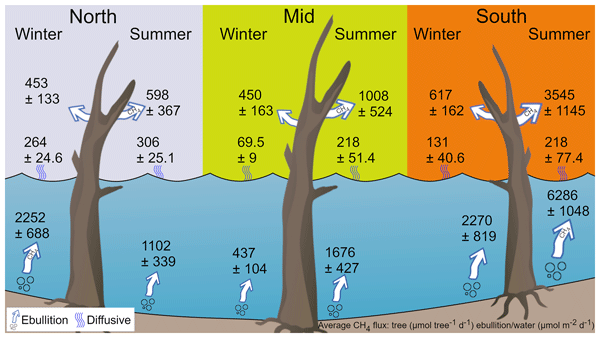
Reservoir dead trees (‘ghost forests’) are an overlooked methane (CH4) source in standing freshwaters. We measured CH4 fluxes from 34 trees at multiple stem heights, alongside aquatic CH4 fluxes and physicochemistry, across two field campaigns. Ghost forest CH4 fluxes were highest near reservoir inflows, with tree CH4 contributing extra emissions of 14–15 % on top of the commonly quantified pathways of ebullition and diffusion.
Naima Iram, Kiah Eng Lim, Muhammad Ariq Khalingga, Pierre Taillardat, Sheryl Chan Si Ern, Lian Pin Koh, and Daniel A. Friess
EGUsphere, https://doi.org/10.5194/egusphere-2025-6519, https://doi.org/10.5194/egusphere-2025-6519, 2026
Short summary
Short summary
We studied how blue carbon stocks and CO2 and CH4 fluxes vary at the landscape scale in tropical seagrass meadows. By testing six seagrass meadows across Singapore, we found that carbon stock variability is shaped by geomorphic settings, but flux variability is not evident, at least at the intermediate landscape scale. Our results support the inclusion of greenhouse gas fluxes in carbon accounting schemes
Cited articles
Al-Haj, A. N. and Fulweiler, R. W.: A synthesis of methane emissions from shallow vegetated coastal ecosystems, Glob. Change Biol., 26, 2988–3005, https://doi.org/10.1111/gcb.15046, 2020.
Akinyede, R., Taubert, M., Schrumpf, M., Trumbore, S., and Küsel, K.: Rates of dark CO2 fixation are driven by microbial biomass in a temperate forest soil, Soil Biol. Biochem., 150, 107950, https://doi.org/10.1016/J.SOILBIO.2020.107950, 2020.
Allen, D., Dalal, R. C., Rennenberg, H., and Schmidt, S.: Seasonal variation in nitrous oxide and methane emissions from subtropical estuary and coastal mangrove sediments, Australia, Plant Biol., 13, 126–133, https://doi.org/10.1111/j.1438-8677.2010.00331.x, 2011.
Angle, J. C., Morin, T. H., Solden, L. M., Narrowe, A. B., Smith, G. J., Borton, M. A., Rey-Sanchez, C., Daly, R. A., Mirfenderesgi, G., Hoyt, D. W., Riley, W. J., Miller, C. S., Bohrer, G., and Wrighton, K. C.: Methanogenesis in oxygenated soils is a substantial fraction of wetland methane emissions, Nat. Commun., 8, 1567, https://doi.org/10.1038/s41467-017-01753-4, 2017.
Australian Bureau of Meteorology, ABM: Monthly Climate Statistics for “LUCINDA POINT” [032141], available at: http://www.bom.gov.au/jsp/ncc/cdio/cvg/av (last access: 5 May 2021), 2020.
Australian Government Clean Energy Regulator: Quarterly Carbon Market report, March 2021, available at: http://www.cleanenergyregulator.gov.au/DocumentAssets/Documents/Quarterly%20Carbon%20Market%20Report%20-%20March%20Quarter%202021.pdf , last access: 11 August 2021.
Baldock, J. A., Wheeler, I., McKenzie, N., and McBrateny, A.:, Crop Pasture Sci., 63, 269–283, https://doi.org/10.1071/CP11170, 2012.
Barnes, J., Ramesh, R., Purvaja, R., Rajkumar, A. N.,
Kumar, B. S., Krithika, K., Ravichandran, K., Uher, G., and
Upstill-Goddard, R.: Tidal dynamics and rainfall control N2O and CH4
emissions from a pristine mangrove creek, Geophys. Res. Lett., 33,
L15405, https://doi.org/10.1029/2006GL026829, 2006.
Bauza, J. F., Morell, J. M., and Corredor, J. E.: Biogeochemistry of nitrous oxide production in the red mangrove (Rhizophora mangle) forest sediments, Estuar. Coast. Shelf S., 55, 697–704, https://doi.org/10.1006/ecss.2001.0913, 2002.
Bell-James, J. and Lovelock, C. E.: Legal barriers and enablers for reintroducing tides: An Australian case study in reconverting ponded pasture for climate change mitigation, Land use policy, 88, 104192, https://doi.org/10.1016/J.LANDUSEPOL.2019.104192, 2019.
Biswas, H., Mukhopadhyay, S. K., Sen, S., and Jana, T. K.: Spatial and temporal patterns of methane dynamics in the tropical mangrove dominated estuary, NE coast of Bay of Bengal, India, J. Marine Syst., 68, 55–64, https://doi.org/10.1016/j.jmarsys.2006.11.001, 2007.
Cabezas, A., Mitsch, W. J., MacDonnell, C., Zhang, L., Bydałek, F., and Lasso, A.: Methane emissions from mangrove soils in hydrologically disturbed and reference mangrove tidal creeks in southwest Florida, Ecol. Eng., 114, 57–65, https://doi.org/10.1016/j.ecoleng.2017.08.041, 2018.
Cameron, C., Hutley, L. B., Munksgaard, N. C., Phan, S., Aung, T., Thinn, T., Aye, W. M., and Lovelock, C. E.: Impact of an extreme monsoon on CO2 and CH4 fluxes from mangrove soils of the Ayeyarwady Delta, Myanmar, Sci. Total Environ., 760, 143422, https://doi.org/10.1016/J.SCITOTENV.2020.143422, 2021.
Chen, G. C., Tam, N. F. Y., and Ye, Y.: Spatial and seasonal variations of atmospheric N2O and CO2 fluxes from a subtropical mangrove swamp and their relationships with soil characteristics, Soil Biol. Biochem., 48, 175–181, https://doi.org/10.1016/j.soilbio.2012.01.029, 2012.
Conrad, R.: The global methane cycle: recent advances in understanding the microbial processes involved, Env. Microbiol. Rep., 1, 285–292, https://doi.org/10.1111/j.1758-2229.2009.00038.x, 2009.
Deemer, B. R., Harrison, J. A., Li, S., Beaulieu, J. J.,
Delsontro, T., Barros, N., Bezerra-Neto, J. F., Powers, S. M., Dos
Santos, M. A., and Vonk, J. A.: Greenhouse Gas Emissions from
Reservoir Water Surfaces: A New Global Synthesis, Bioscience, 66,
949–964,
https://doi.org/10.1093/biosci/biw117, 2016.
Department of Environment and Science, Queensland: Herbert drainage basin – facts and maps, WetlandInfo website, available at: https://wetlandinfo.des.qld.gov.au/wetlands/facts-maps/basin-herbert/ (last access: 13 January 2021), 2013.
Department of Environment and Science, Queensland: State of the environment report, Total greenhouse gas emissions,
available at: https://www.stateoftheenvironment.des.qld.gov.au/pollution/greenhouse-gas-emissions/total-annual-greenhouse-gas-emissions (last access: 5 April 2021), 2016.
Ding, W. X., Cai, Z. C., and Tsuruta, H.: Cultivation, nitrogen fertilization, and set-aside effects on methane uptake in a drained marsh soil in Northeast China, Glob. Change Biol., 10, 1801–1809, https://doi.org/10.1111/j.1365-2486.2004.00843.x, 2004.
Drenovsky, R. E., Steenwerth, K. L., Jackson, L. E., and Scow, K. M.: Land use and climatic factors structure regional patterns in soil microbial communities, Global Ecol. Biogeogr., 19, 27–39, https://doi.org/10.1111/j.1466-8238.2009.00486.x, 2010.
Drexler, J. Z., de Fontaine, C. S., and Deverel, S. J.: The legacy of wetland drainage on the remaining peat in the Sacramento–San Joaquin Delta, California, USA, Wetlands, 29, 372–386, 2009.
Duarte, C. M., Losada, I. J., Hendriks, I. E., Mazarrasa, I., and Marbà, N.: The role of coastal plant communities for climate change mitigation and adaptation, Nat. Clim. Chang., 3, 961–968, https://doi.org/10.1038/nclimate1970, 2013.
Fernandez-Bou, A. S., Dierick, D., Allen, M. F., and Harmon, T. C.: Precipitation-drainage cycles lead to hot moments in soil carbon dioxide dynamics in a Neotropical wet forest, Glob. Change Biol., 26, 5303–5319, https://doi.org/10.1111/gcb.15194, 2020.
Griggs, P. D.: Too much water: drainage schemes and landscape change in the sugar-producing areas of Queensland, 1920–90, Aust. Geogr., 49, 81–105, https://doi.org/10.1080/00049182.2017.1336965, 2018.
Grinham, A., Albert, S., Deering, N., Dunbabin, M., Bastviken, D., Sherman, B., Lovelock, C. E., and Evans, C. D.: The importance of small artificial water bodies as sources of methane emissions in Queensland, Australia, Hydrol. Earth Syst. Sci., 22, 5281–5298, https://doi.org/10.5194/hess-22-5281-2018, 2018.
Hirano, T., Segah, H., Kusin, K., Limin, S., Takahashi, H., and Osaki, M.: Effects of disturbances on the carbon balance of tropical peat swamp forests, Glob. Change Biol., 18, 3410–3422, https://doi.org/10.1111/j.1365-2486.2012.02793.x, 2012.
Hooijer, A., Page, S., Jauhiainen, J., Lee, W. A., Lu, X. X., Idris, A., and Anshari, G.: Subsidence and carbon loss in drained tropical peatlands, Biogeosciences, 9, 1053–1071, https://doi.org/10.5194/bg-9-1053-2012, 2012.
Hutchinson, G. L. and Mosier, A. R.: Improved Soil Cover Method for Field Measurement of Nitrous Oxide Fluxes, Soil Sci. Soc. Am. J., 45, 311–316, https://doi.org/10.2136/sssaj1981.03615995004500020017x, 1981.
IPCC: Supplement to the 2006 IPCC Guidelines for National Greenhouse Gas Inventories: Wetlands, edited by: Hiraishi, T, Krug, T., Tanabe, K., Srivastava, N., Baasansuren, J., Fukuda, M., and Troxler, T. G., Intergovernmental Panel on Climate Change, Geneva, 2013.
Jeffrey, L. C., Maher, D. T., Chiri, E., Leung, P. M., Nauer, P. A., Arndt, S. K., Tait, D. R., Greening, C., and Johnston, S. G.: Bark-dwelling methanotrophic bacteria decrease methane emissions from trees, Nat. Commun., 12, 2127, https://doi.org/10.1038/s41467-021-22333-7, 2021.
Johnson, A. K. L., Ebert, S. P., and Murray, A. E.: Distribution of coastal freshwater wetlands and riparian forests in the Herbert River catchment and implications for management of catchments adjacent the Great Barrier Reef Marine Park, Environ. Conserv., 26, 229–235, https://doi.org/10.1017/S0376892999000314, 1999.
Kauffman, J. B., Adame, M. F., Arifanti, V. B.,
Schile-Beers, L. M., Bernardino, A. F., Bhomia, R. K., Donato,
D. C., Feller, I. C., Ferreira, T. O., Jesus Garcia, M. del C.,
MacKenzie, R. A., Megonigal, J. P., Murdiyarso, D., Simpson, L., and
Hernández Trejo, H.: Total ecosystem carbon stocks of mangroves
across broad global environmental and physical gradients,
Ecol. Monogr., 90, e01405, https://doi.org/10.1002/ecm.1405, 2020.
Kavehei, E., Iram, N., Rezaei Rashti, M., Jenkins, G. A., Lemckert, C., and Adame, M. F.: Greenhouse gas emissions from stormwater bioretention basins, Ecol. Eng., 159, 106120, https://doi.org/10.1016/j.ecoleng.2020.106120, 2021.
Kettler, T. A., Doran, J. W., and Gilbert, T. L.: Simplified Method for Soil Particle-Size Determination to Accompany Soil-Quality Analyses, Soil Sci. Soc. Am. J., 65, 849–852, https://doi.org/10.2136/sssaj2001.653849x, 2001.
Kiese, R. and Butterbach-Bahl, K.: N2O and CO2 emissions from three different tropical forest sites in the wet tropics of Queensland, Australia, Soil Biol. Biochem., 34, 975–987, 2002.
Kirschke, S., Bousquet, P., Ciais, P., Saunois, M., Canadell, J. G., Dlugokencky, E. J., Bergamaschi, P., Bergmann, D., Blake, D. R., Bruhwiler, L., Cameron-Smith, P., Castaldi, S., Chevallier, F., Feng, L., Fraser, A., Heimann, M., Hodson, E. L., Houweling, S., Josse, B., Fraser, P. J., Krummel, P. B., Lamarque, J. F., Langenfelds, R. L., Le Quéré, C., Naik, V., O'Doherty, S., Palmer, P. I., Pison, I., Plummer, D., Poulter, B., Prinn, R. G., Rigby, M., Ringeval, B., Santini, M., Schmidt, M., Shindell, D. T., Simpson, I. J., Spahni, R., Steele, L. P., Strode, S. A., Sudo, K., Szopa, S., Van Der Werf, G. R., Voulgarakis, A., Van Weele, M., Weiss, R. F., Williams, J. E., and Zeng, G.: Three decades of global methane sources and sinks, Nat. Geosci., 6, 813–823, https://doi.org/10.1038/ngeo1955, 2013.
Knox, S. H., Sturtevant, C., Matthes, J. H., Koteen, L., Verfaillie, J., and Baldocchi, D.: Agricultural peatland restoration: Effects of land-use change on greenhouse gas (CO2 and CH4) fluxes in the Sacramento-San Joaquin Delta, Glob. Change Biol., 21, 750–765, https://doi.org/10.1111/gcb.12745, 2015.
Kögel-Knabner, I., Amelung, W., Cao, Z., Fiedler, S., Frenzel, P., Jahn, R., Kalbitz, K., Kölbl, A., and Schloter, M.: Biogeochemistry of paddy soils, Geoderma, 157, 1–14, https://doi.org/10.1016/J.GEODERMA.2010.03.009, 2010.
Kreuzwieser, J., Buchholz, J., and Rennenberg, H.: Emission of Methane and Nitrous Oxide by Australian Mangrove Ecosystems, Plant Biol., 5, 423–431, https://doi.org/10.1055/s-2003-42712, 2003.
Kristensen, E., Flindt, M. R., Ulomi, S., Borges, A. V., Abril, G., and Bouillon, S.: Emission of CO2 and CH4 to the atmosphere by sediments and open waters in two Tanzanian mangrove forests, Mar. Ecol. Prog. Ser., 370, 53–67, https://doi.org/10.3354/meps07642, 2008.
Krithika, K., Purvaja, R., and Ramesh, R.: Fluxes of methane and nitrous oxide from an Indian mangrove, Curr. Sci., 94, 218–224, 2008.
Kroeger, K. D., Crooks, S., Moseman-Valtierra, S., and Tang, J.: Restoring tides to reduce methane emissions in impounded wetlands: A new and potent Blue Carbon climate change intervention, Sci. Rep., 7, 11914, https://doi.org/10.1038/s41598-017-12138-4, 2017.
Lehner, B. and Döll, P.: Development and validation of a global database of lakes, reservoirs and wetlands, J. Hydrol., 296, 1–22, https://doi.org/10.1016/j.jhydrol.2004.03.028, 2004.
Lenhart, K., Behrendt, T., Greiner, S., Steinkamp, J., Well, R., Giesemann, A., and Keppler, F.: Nitrous oxide effluxes from plants as a potentially important source to the atmosphere, New Phytol., 221, 1398–1408, https://doi.org/10.1111/nph.15455, 2019.
Li, X. and Mitsch, W. J.: Methane emissions from created and restored freshwater and brackish marshes in southwest Florida, USA, Ecol. Eng., 91, 529–536, https://doi.org/10.1016/j.ecoleng.2016.01.001, 2016.
Liu, J. and Lai, D. Y. F.: Subtropical mangrove wetland is a stronger carbon dioxide sink in the dry than wet seasons, Agr. Forest Meteorol., 278, 107644, https://doi.org/10.1016/J.AGRFORMET.2019.107644, 2019.
Maher, D. T., Sippo, J. Z., Tait, D. R., Holloway, C.,
and Santos, I. R.: Pristine mangrove creek waters are a sink of
nitrous oxide OPEN, Nat. Publ. Gr., 6, 25701, https://doi.org/10.1038/srep25701, 2016.
Maietta, C. E., Hondula, K. L., Jones, C. N., and Palmer, M. A.: Hydrological Conditions Influence Soil and Methane-Cycling Microbial Populations in Seasonally Saturated Wetlands, Front. Environ. Sci., 8, 593942, https://doi.org/10.3389/fenvs.2020.593942, 2020.
Mar Lynn, T., Ge, T., Yuan, H., Wei, X., Wu, X., Xiao, K., Kumaresan, D., San Yu, S., Wu, J., and Whiteley, A. S.: Soil Carbon-Fixation Rates and Associated Bacterial Diversity and Abundance in Three Natural Ecosystems, 73, 645–657, https://doi.org/10.1007/s00248-016-0890-x, 2017.
Martiny, J. B. H., Bohannan, B. J. M., Brown, J. H., Colwell, R. K., Fuhrman, J. A., Green, J. L., Horner-Devine, M. C., Kane, M., Krumins, J. A., Kuske, C. R., Morin, P. J., Naeem, S., Øvreås, L., Reysenbach, A. L., Smith, V. H., and Staley, J. T.: Microbial biogeography: Putting microorganisms on the map, Nat. Rev. Microbiol., 4, 102–112, https://doi.org/10.1038/nrmicro1341, 2006.
McGinn, S. M., Turner, D., Tomkins, N., Charmley, E., Bishop-Hurley, G., and Chen, D.: Methane Emissions from Grazing Cattle Using Point-Source Dispersion, J. Environ. Qual., 40, 22–27, https://doi.org/10.2134/jeq2010.0239, 2011.
Melling, L., Goh, K. J., Kloni, A., and Hatano, R.: Is water table the most important factor influencing soil C flux in tropical peatlands, in: Peatlands in Balance, Proceedings of the 14th International Peat Congress, 2012.
Mitsch, W. J., Bernal, B., Nahlik, A. M., Mander, Ü., Zhang, L., Anderson, C. J., Jørgensen, S. E., and Brix, H.: Wetlands, carbon, and climate change, Landsc. Ecol., 28, 583–597, https://doi.org/10.1007/s10980-012-9758-8, 2013.
Morse, J. L. and Marcelo Ardón, E. S. B.: Greenhouse gas fluxes in southeastern U . S . coastal plain wetlands under contrasting land uses, Ecol. Appl., 22, 264–280, 2012.
Musenze, R. S., Werner, U., Grinham, A., Udy, J., and Yuan, Z.: Methane and nitrous oxide emissions from a subtropical estuary (the Brisbane River estuary, Australia), Sci. Total Environ., 472, 719–729, https://doi.org/10.1016/j.scitotenv.2013.11.085, 2014.
National Greenhouse Accounts Factors, Australian Government Department of Industry, Science, Energy and Resources: National Greenhouse Accounts Factors, available at: https://www.industry.gov.au/sites/default/files/2020-10/national-greenhouse-accounts-factors-2020.pdf (last access: 9 August 2021), 2020.
Neubauer, S. C. Global Warming Potential Is Not an Ecosystem Property, Ecosystems, 1–11, https://doi.org/10.1007/s10021-021-00631-x, 2021.
Nieveen, J. P., Campell, D. I., Schipper, L. A., and Blair, I. J.: Carbon exchange of grazed pasture on drained peat soil, Glob. Change Biol., 11, 607–618, https://doi.org/10.1111/j.1365-2486.2005.00929.x, 2005.
Oertel, C., Matschullat, J., Zurba, K., Zimmermann, F., and Erasmi, S.: Greenhouse gas emissions from soils – A review, Chem. Erde, 76, 327–352, https://doi.org/10.1016/j.chemer.2016.04.002, 2016.
Ollivier, Q. R., Maher, D. T., Pitfield, C., and Macreadie, P. I.: Punching above their weight: Large release of greenhouse gases from small agricultural dams, Glob. Change Biol., 25, 721–732, https://doi.org/10.1111/gcb.14477, 2019.
Pangala, S. R., Moore, S., Hornibrook, E. R. C., and Gauci, V.: Trees are major conduits for methane egress from tropical forested wetlands, New Phytol., 197, 524–531, https://doi.org/10.1111/nph.12031, 2013.
Peacock, M., Audet, J., Bastviken, D., Futter, M. N., Gauci, V., Grinham, A., Harrison, J. A., Kent, M. S., Kosten, S., Lovelock, C. E., Veraart, A. J., and Evans, C. D.: Global importance of methane emissions from drainage ditches and canals, Environ. Res. Lett., 16, 044010, https://doi.org/10.1088/1748-9326/abeb36, 2021.
Pinheiro, P. L., Recous, S., Dietrich, G., Weiler, D. A., Schu, A. L., Bazzo, H. L. S., and Giacomini, S. J.: N2O emission increases with mulch mass in a fertilized sugarcane cropping system, Biol. Fert. Soils, 55, 511–523, https://doi.org/10.1007/s00374-019-01366-7, 2019.
Purvaja, R. and Ramesh, R.: Human impacts on methane
emission from mangrove ecosystems in India, Reg. Environ. Change, 1, 86–97, 2000.
Purvaja, R., Ramesh, R., and Frenzel, P.: Plant-mediated methane emission from an Indian mangrove, Glob. Change Biol., 10, 1825–1834, https://doi.org/10.1111/j.1365-2486.2004.00834.x, 2004.
Reeves, S., Wang, W., Salter, B., and Halpin, N.: Quantifying nitrous oxide emissions from sugarcane cropping systems: Optimum sampling time and frequency, Atmos. Environ., 136, 123–133, https://doi.org/10.1016/j.atmosenv.2016.04.008, 2016.
Rezaei Rashti, M., Wang, W. J., Harper, S. M., Moody, P. W., Chen, C. R., Ghadiri, H., and Reeves, S. H.: Strategies to mitigate greenhouse gas emissions in intensively managed vegetable cropping systems in subtropical Australia, Soil Res., 53, 475–484, https://doi.org/10.1071/SR14355, 2015.
Rezaei Rashti, M., Wang, W. J., Reeves, S. H., Harper, S. M., Moody, P. W., and Chen, C. R.: Linking chemical and biochemical composition of plant materials to their effects on N2O emissions from a vegetable soil, Soil Biol. Biochem., 103, 502–511, https://doi.org/10.1016/j.soilbio.2016.09.019, 2016.
Rosentreter, J. A., Al-Haj, A. N., Fulweiler, R. W., and Williamson, P.: Methane and Nitrous Oxide Emissions Complicate Coastal Blue Carbon Assessments, Global Biogeochem. Cy., 35, e2020GB006858, https://doi.org/10.1029/2020GB006858, 2021.
Sahrawat, K. L.: Terminal electron acceptors for controlling methane emissions from submerged rice soils, Commun. Soil Sci. Plan., 35, 1401–1413, https://doi.org/10.1081/CSS-120037554, 2004.
Schindlbacher, A., Zechmeister-Boltenstern, S., and Butterbach-Bahl, K.: Effects of soil moisture and temperature on NO, NO2, and N2O emissions from European forest soils, J. Geophys. Res, 109, 17302, https://doi.org/10.1029/2004JD004590, 2004.
Shaaban, M., Peng, Q., Hu, R., Wu, Y., Lin, S., and Zhao, J.: Dolomite application to acidic soils: a promising option for mitigating N2O emissions, Environ. Sci. Pollut. R., 22, 19961–19970, https://doi.org/10.1007/s11356-015-5238-4, 2015.
Solomon, S.: Climate Change: The Physical science
Basis, Clim. Chang. Phys. Sci. Basis, available at: http://ci.nii.ac.jp/naid/20001628955/en/ (last access: 13 August 2021), 2007.
Sotomayor, D., Corredor, J. E., and Morell, J. M.: Methane flux from mangrove sediments along the southwestern coast of Puerto Rico, Estuaries, 17, 140–147, 1994.
Timilsina, A., Bizimana, F., Pandey, B., Kailash, R., Yadav, P., Dong, W., and Hu, C.: plants Nitrous Oxide Emissions from Paddies: Understanding the Role of Rice Plants, Plants, 9, 180, https://doi.org/10.3390/plants9020180, 2020.
Ussiri, D. and Lal, R.: Soil emission of nitrous oxide and its mitigation. Springer Science & Business Media, Germany, 378, ISBN 978-94-007-5364-8, 2012.
Veenendaal, E. M., Kolle, O., Leffelaar, P. A., Schrier-Uijl, A. P., Van Huissteden, J., Van Walsem, J., Möller, F., and Berendse, F.: CO2 exchange and carbon balance in two grassland sites on eutrophic drained peat soils, Biogeosciences, 4, 1027–1040, https://doi.org/10.5194/bg-4-1027-2007, 2007.
Whalen, S.: Biogeochemistry of methane exchange between natural wetlands and the atmosphere, Environ. Eng. Sci., 22, 73–94, https://doi.org/10.1089/ees.2005.22.73, 2005.
Whiting, G. J. and Chanton, J. P.: Greenhouse carbon balance of wetlands: Methane emission versus carbon sequestration, Tellus B, 53, 521–528, https://doi.org/10.3402/tellusb.v53i5.16628, 2001.
Xu, C., Han, X., Ru, S., Cardenas, L., Rees, R. M., Wu, D., Wu, W., and Meng, F.: Crop straw incorporation interacts with N fertilizer on N2O emissions in an intensively cropped farmland, Geoderma, 341, 129–137, https://doi.org/10.1016/J.GEODERMA.2019.01.014, 2019.
Yvon-Durocher, G., Montoya, J. M., Woodward, G., Jones, J. I., and Trimmer, M.: Warming increases the proportion of primary production emitted as methane from freshwater mesocosms, Glob. Change Biol., 17, 1225–1234, https://doi.org/10.1111/j.1365-2486.2010.02289.x, 2011.
Zaehle, S. and Dalmonech, D.: Carbon-nitrogen interactions on land at global scales: Current understanding in modelling climate biosphere feedbacks, Curr. Opin. Env. Sust., 3, 311–320, https://doi.org/10.1016/j.cosust.2011.08.008, 2011.
Short summary
Greenhouse gas emissions were measured and compared from natural coastal wetlands and their converted agricultural lands across annual seasonal cycles in tropical Australia. Ponded pastures emitted ~ 200-fold-higher methane than any other tested land use type, suggesting the highest greenhouse gas mitigation potential and financial incentives by the restoration of ponded pastures to natural coastal wetlands.
Greenhouse gas emissions were measured and compared from natural coastal wetlands and their...


Altmetrics
Final-revised paper
Preprint