
the Creative Commons Attribution 4.0 License.
the Creative Commons Attribution 4.0 License.
 | 05 Dec 2025
The influence of irradiance and interspecific differences on δ11B, δ13C and elemental ratios in four coralline algae complexes from Aotearoa, New Zealand
Maxence Guillermic
Erik C. Krieger
Joyce Goh
Christopher E. Cornwall
Coralline algae are a cosmopolitan group of important foundational species. The calcium carbonate they produce is increasingly being used as paleoenvironmental archives, as well as used to trace physiological responses of these important macroalgae to environmental change. In this context, evaluating the effect of oceanic change and photo-physiological parameters on geochemical proxies is critical, as such gaps may lead to erroneous paleoenvironmental reconstructions, misattributed drivers of calcification responses, and ultimately compromise conservation strategies. Here we address the impact of light (irradiance) on four species complexes of coralline red algae including two morphologies; geniculate (branching) and non-geniculate (encrusting). The four complexes up-regulated their δ11B derived pHCF relative to seawater by 0.6 to 0.8 pH unit. δ11B was not measurably affected by varying irradiance despite evidence of increasing photosynthesis. All complexes were able to maintain and elevate their pHCF relative to seawater for all treatments. Non-geniculate and geniculate complexes had distinct geochemical signatures of δ11B, and trace elements. These differences in geochemical signatures indicate a variety of calcification mechanisms exist within coralline algae. We propose that different sources of dissolved inorganic carbon (DIC) are necessary to explain the observed . As geniculate species have higher photosynthetic activity (i.e. gross photosynthesis), the DIC sources allocated to calcification might be limited due to greater CO2 drawdown. This is supported by and ratios suggesting modulation of carbonate chemistry and especially lower DICCF in geniculate relative to non-geniculate complexes. DIC sources might come from direct CO2 diffusion or better recycling of metabolic CO2 which would explain the depleted . This strategy likely arises from the different energy needs of the organisms, with non-geniculate using relatively more energy to support calcification. We suggest the different calcification mechanisms between morphologies are linked to different interactions between photosynthesis and carbon allocation. While photosynthesis can provide energy to geniculate complexes to maintain their metabolic needs, their calcification may be limited by DIC. In contrast, non-geniculate forms may benefit from more limited DIC drawdown due to lower photosynthetic activity, therefore maintaining higher internal DIC concentrations ultimately supporting faster calcification.
- Article
(3674 KB) - Full-text XML
-
Supplement
(2026 KB) - BibTeX
- EndNote


Coralline algae are widespread foundational species found around the globe, and in some locations their calcium carbonate forms maerl or rhodolith beds which are the dominant benthic substrate of the area (Steneck, 1986). In other cases they can form ecologically and structurally significant contributions to other benthic environments, for example in tropical coral reefs (Cornwall et al., 2023) and within kelp forests (Connell, 2003; Irving et al., 2004). Coralline red algae show two main morpho-functional groups, geniculate and non-geniculate. Geniculate corallines have non calcified joints that connect the calcified intergenicula to allow for higher thallus flexibility, distinct morphological traits allow them to grow in various habitats and to cope with a wide range of environments (Noisette et al., 2013; McCoy and Kamenos, 2015). As with other marine calcifiers, they are potentially threatened by ocean warming and acidification, evidence suggests they have plasticity and resilience to some of these climate change stressors (Anthony et al., 2008; Martin et al., 2013b; Cornwall et al., 2019).
Coralline algae are important in the field of paleoenvironmental reconstruction, particularly as they may grow in cooler regions such as the Arctic, where other commonly used archives such as mounding corals or foraminifera are not available (e.g., Halfar et al., 2000; Kamenos et al., 2008; Anagnostou et al., 2019). To increase the reliability of coralline algae for paleoclimate reconstruction, a better understanding of biomineralization mechanisms and how those mechanisms are impacted by environmental drivers is needed. This is critical as erroneous interpretation of proxies can undermine confidence in long-term environmental records, drivers of calcification and compromise forecasts that inform marine policy and conservation strategies.
Boron isotopes have been developed in carbonate as a proxy of pH in the fluid that it is precipitated within. The sensitivity of the δ11B proxy to pH is based on the predominant incorporation of borate ion in the carbonate structure (Hemming and Hanson, 1992). Carbonate skeletal δ11B has been used to explore pH of the calcifying fluid (pHCF) and carbonate chemistry regulation in coralline algae in response to environmental change such as ocean acidification (Cornwall et al., 2017, 2018, 2020; Donald et al., 2017; Sutton et al., 2018; Liu et al., 2020), with evidence suggesting that the calcifying environment of coralline algae have pH elevated with respect to seawater (Cornwall et al., 2017; Donald et al., 2017; Sutton et al., 2018; Liu et al., 2020) as has been observed in scleractinian corals (McCulloch et al., 2017; Eagle et al., 2022).
The most significant body of work on geochemical tracers of internal pH and carbonate chemistry regulation has primarily focused on symbiont bearing surface corals indicating that the photophysiology of the symbiont may influence the chemical regulation of calcification. For example, regulation of the pH of the calcifying medium within the calicoblastic epithelium is known to show day-night cycles (Al-Horani et al., 2003; Guillermic et al., 2021; Cameron et al., 2022). Corals that lose symbionts during temperature stress, may also exhibit a deregulation of the calcification fluid chemistry and anomalous skeletal geochemical signatures (e.g., D'Olivio and McCulloch, 2017; Guillermic et al., 2021; Cameron et al., 2022). Conversely, heat resilient corals may not undergo this process (Eagle et al., 2022). Varying light levels can also influence coral skeletal geochemistry in controlled culture experiments (Dissard et al., 2012; Juillet-Leclerc et al., 2014). Limited research has been carried out on coralline algae, and although irradiance can impact pHCF of coralline algae (Comeau et al., 2019), much more research is required.
Carbon isotopes of the mineral () and the tissues () can reflect photosynthesis and respiration (McConnaughey et al., 1997), where direct uptake from seawater enriches δ13C while recycling of respired CO2 can decrease δ13C of the DIC pool. Additionally, increased uptake of diffusive CO2 (from seawater or metabolic) can result in depletion in 13C. Ultimately, the reflects the relative abundance of photosynthetic uptake relative to respiration processes or passive CO2 diffusion from seawater. The represents the source of DIC and kinetic fractionation by RUBISCO during photosynthesis, RUBISCO enzyme preferentially fixing 12C leading to being depleted relative to .
Coralline algae are photosynthetic organisms that inhabit various habitats where light fluctuates greatly. Increasing irradiance generally enhances calcification of coralline red algae (Goreau, 1963; Borowitzka, 1981; Borowitzka and Larkum, 1987; Martin et al., 2013b; Korbee et al., 2014; Egilsdottir et al., 2016; Krieger et al., 2023). Increasing irradiance on low-light adapted species can result in photoinhibition (Kain, 1987; Sagert et al., 1997; Kühl et al., 2001; Roberts et al., 2002; Martin et al., 2013a). In contrast, coralline algae in polar regions can continue calcifying at reduced rates even under prolonged low-light conditions associated with seasonal cycles or sea ice cover (Williams et al., 2018; Gould et al., 2022). These latitudinal (e.g. tropical, temperate or polar environments) and climate-driven differences in light adaptation and calcification mechanisms can contribute to the variability reported across studies. Although light clearly affects calcification, the mechanistic links between irradiance, photophysiology, and calcification is not fully understood.
A direct link between photosynthesis and the calcification space is hypothesised, as calcification is active in the meristematic region where there is a high concentration of chloroplasts. Photosynthesis has multiple ways in which it could promote calcification: (1) increase pH within the diffusive boundary layer surrounding the cells during the day via CO2 removal, (2) provide the cell wall polysaccharides and proteins, and (3) provide energy to the cell formation and calcifying medium carbonate chemistry regulation (McCoy et al., 2023). Environmental parameters influencing irradiance in natural settings can change population communities and functionality of the ecosystem thus a good understanding of the mechanisms influencing calcification (including light) is needed to foresee changes due to future environmental challenges.
Krieger et al. (2023) explored the physiology and photophysiology of low-light coralline algae complexes Phymatolithopsis repanda, Pneophyllum spp. Corallina spp., and Arthrocardia spp. cultured under different irradiances and proposed that light-enhanced calcification is the result of an elevated diffusion boundary layer pH which raises calcifying fluid pHCF and that [Ca]CF could be the limiting parameters for fast growing species as also observed in Comeau et al. (2019). To further test Krieger et al.'s and Comeau et al.'s hypothesis we investigated calcification differences between faster and slower growing coralline algae complexes using geochemical tracers. Here we explore the underlying mechanisms behind interspecific differences and the effect of changing irradiance on coralline red algae complex calcification using geochemical tracers, namely the boron, carbon and oxygen isotopic compositions (δ11B, δ13C) as well as minor elemental compositions (, , , , ).
2.1 Specimens and culture experiment
Culturing experiments on non-geniculate coralline algae of different morphology (“thick” = Phymatolithopsis repanda; “smooth” = Pneophyllum spp.) as well as two groups of geniculate corallines (“fine” = Corallina spp.; and “robust” = Arthrocardia spp.) were described in a previous study (Krieger et al., 2023) an shown in Fig. 1. To briefly summarize this work, specimens were collected by scuba divers at depths between 1 and 2 m from two field sites located in Te Moana-o-Raukawa Cook Strait, Te Whanganui a Tara Wellington, Aotearoa New Zealand. Taxonomic and DNA-based identifications are described in Krieger et al. (2023). Samples can form a complex containing multiple species with a dominant presence of one species (Krieger et al., 2023). Those complexes present characteristic physiological and geochemical responses. For clarity, non-geniculate complexes will be referred to as Phymatolithopsis complex, Pneophyllum complex while geniculate complexes will be referred to as Corallina/Arthrocardia fine, Corallina/Arthrocardia robust. Specifically, Phymatolithopsis complex consists of Phymatolithopsis repanda (Hapalidiales ZT 75 % and Hapalidiales sp. D 25 %). Pneophyllum complex consists of 75 % Pneophyllum sp. F and 25 % Corallinales sp. E. Corallina/Arthrocardia morphologies fine and robust consists of 75 % Corallina sp. and 25 % Arthrocardia sp.

Figure 1Pictures of the four coralline red algae complexes used in this study (already presented in Krieger et al., 2023) and showing the different morphologies: non-geniculate (e.g. crustose) and geniculate (e.g. branching). Geniculate complexes: Corallina/Arthrocardia “robust” and Corallina/Arthrocardia “fine”, non-geniculate complexes: Pneophyllum complex and Phymatolithopsis complex.
The original culture experiment was conducted over the 2019 summer and autumn (17 February to 19 May) in the facilities of the Victoria University of Wellington Coastal Ecology Laboratory. A detailed description of the original tank experiment can be found in Krieger et al. (2023) but we will briefly outline the most important information relevant for the present study here. The study organisms were exposed for 85 d to four different light levels (daily doses 0.6, 1.2, 1.8, 2.3 ; noon peak irradiance 20, 40, 60, 80 ) that represent naturally occurring subcanopy irradiances at the collection sites. The chosen values approximate minimum summer irradiances, which are ecologically relevant as such low-light conditions often dominate under the canopy. Each irradiance level (i.e., treatment) was replicated twelve times on the tank level. The twelve tanks from each treatment were distributed over eight water baths with each bath housing between one to two tanks from each treatment. Eight header tanks each supplied six different experimental tanks which were equally distributed between two neighboring water baths with 150 mL min−1 of fresh filtered (10 µm) seawater each. Water bath and header tank identity of each experimental tank was later used during the statistical analysis to remove sample interdependence. Light was provided by LED panels which simulated a natural diel light cycle and mimicked a typical temperate coastal underwater light spectrum. Temperature control was achieved by using submersible heaters and aquarium chillers with the difference in mean treatment temperature between treatments was not higher than 0.1 °C (highest 16.45 ± 0.1 SE and lowest 16.36 ± 0.1 SE). Seawater carbonate chemistry was monitored frequently through the measurement of tank pHT and total alkalinity. Mean treatment total alkalinity was within 4 µmol kg−1 (highest 2279.77 ± 3.41 SE and lowest 2275.11 ± 4.88 SE) while pHT was within 0.1 units (highest 8.02 ± 0.01 SE and lowest 8.01 ± 0.01 SE). Samples were stained with alizarin red and only material above the stain line was sampled to ensure sampling the new growth.
2.2 Specimens and culture experiment
Photosynthetic (Chl a content, Fv/Fm, ETRmax, gross photosynthesis) and physiological (net calcification) parameters as well as tissue δ13C were originally published in Krieger et al. (2023) and are also presented in Table S1 in the Supplement. Physiological data against irradiance are also presented in Fig. 2.

Figure 2Averages of photophysiological parameters of the four complexes from Krieger et al. (2023) against irradiances. (a) Net calcification (), (b) Gross photosynthesis (), (c) Maximum electron transport rate, ETRmax, (d) Photosynthetic efficiency measured by the “variable fluorescence” normalized to maximum fluorescence, Fv/Fm, (e) Chlorophyll a, Chl a (mg g−1). Averages are calculated from the full dataset from Krieger et al. (2023), error bars are based on 2 SD. Regressions are shown in Fig. S2.
2.3 Carbonate geochemistry
Methods used in this study were previously described in Guillermic et al. (2020, 2021, 2022) and Eagle et al. (2022). Briefly, powdered calcium carbonate samples were organically cleaned using a solution of 0.2 % hydrogen peroxide. Samples were dissolved in 1 N HCl and purified for boron isotopes through microdistillation (Gaillardet et al., 2001; Wang et al., 2008). Boron isotopic measurements were carried out on a Thermo Scientific® Neptune MC-ICP-MS at the Pôle Spectrométrie Océan (PSO), Plouzané and at the Dornsife PLASMA Facility of the University of Southern California, Los Angeles.
Elemental ratios were measured on a Thermo Fisher Scientific Element XR HR-ICP-MS at the PSO, Ifremer (Plouzané, France) after [Ca] analyses on an ICP-AES Ultima 2 HORIBA at the PSO (Plouzané, France). Data quality and external reproducibility were monitored by repeated measurement of JCp-1 (Gutjahr et al., 2021), NIST RM 8301 (Stewart et al., 2020) and filtered seawater for both boron isotopes measurements and trace elements. δ11B measured for NIST 8301 coral was 24.26 ‰ ± 0.22 ‰, 2 SE, n=19 (published value is 24.17 ‰ ± 0.07 ‰, 2 SE, n=7, Stewart et al., 2020), δ11B of JCp-1 was 24.51 ‰ ± 0.14 ‰, 2 SE, n=12 (published value is 24.36 ‰ ± 0.14 ‰, 2 SE, n=10, Gutjahr et al., 2021) and δ11B measured for a filtered seawater was 39.53 ‰ ± 0.12 ‰, 2 SE, n=2 (published value is 39.61 ‰ ± 0.04 ‰, 2 SE, n=28, Foster et al., 2010).
Analyses of carbonate skeletal δ13C and δ18O were carried out on a Matt 253 (Kiel IV carbonates, dual Inlet) mass spectrometer at the stable isotope facility of Pôle spectrométrie Océan (PSO, Plouzané, France). Results were calibrated to the Vienna Pee Dee Belemnite (V-PDB) scale and referenced to the international standard NBS19.
Geochemical data analyzed in this study are presented in Table S1 and Fig. 3.

Figure 3Averages of geochemical data measured in this study against irradiances. (a) Net calcification (), (b) boron isotopes of the mineral, δ11B (‰), (c) carbon isotopes of the mineral (‰), (d) carbon isotopes of the tissue (‰) from Krieger et al. (2023), (e) of the mineral (µmol mol−1) and (f) of the mineral (mmol mol−1). Error bars are based on 2 SD. Regressions are shown in Fig. S1.
2.4 pHCF calculations
The pHCF was calculated from measurements of coral skeletal δ11B following Hemming and Hanson (1992) and equation from Zeebe and Wolf-Gladrow (2001):
with pK representing the dissociation constant, temperature of 16.4 °C and salinity of 35 psu. is representing the boron isotopic composition of seawater (Foster et al., 2010), representing the boron isotopic composition of the mineral (e.g. high-Mg calcite of coralline red algae), and α representing the fractionation factor and ε representing the boron isotopic fractionation between boric acid and borate ion (27.2 ‰, Klochko et al., 2006).
2.5 Statistical analyses
Linear and quadratic models were compared using Akaike information criterion (AIC) to determine which model best described the data (Figs. S1, S2 and Tables S2, S3 in the Supplement). Only significant lines were plotted for the regressions that had a significant p value (for linear fit) or R2 (for quadratic fit) (Figs. S1 and S2). Statistical tests were performed between the geochemical data and matching photophysiological data from Krieger et al. (2023).
Normality of the data was assessed and data transformed using R Core Team (2021) to normalize the entire dataset (by variable) using Box-Cox transformation and then subsequently tested the normality of the data set using the Shapiro Normality Test and Q-Q plot.
ANOVA tests in R were used to evaluate the effect of irradiance and test differences between species. ANOVA tests that had a significant p value were then further analyzed using the TukeyHSD Multiple Comparisons of Means test at a family-wise confidence level of 95 %. Results are presented in Tables S4–S7 in the Supplement.
Correlation matrices are a statistical method that evaluates the correlation between multiple parameters and allows representation of complex datasets. Correlation matrices were performed using R for each complex and are presented in Figs. S4 and S5 in the Supplement. These correlation matrices were used to visually present the data and support interpretation from regression models and other statistical methods used in this paper.
Principal component analysis (PCA) was made using GraphPad Prism (2024) for all trace elements and physiological parameters. Relevant physiological parameters were selected, ETRmax and given the reduced amount of data (Fig. 4).

Figure 4Principal component analysis (PCA) of the geochemical and photo physiological data used in this study (a) loadings and (b) biplot. Vectors present a positive relationship between ETRmax and irradiance, a negative relationship between net calcification and δ11B, positive relationships between net calcification and and between δ11B and Fv/Fm. Geniculate and non-geniculate species cluster together. Non-geniculate complexes (Pneophyllum complex and Phymatolithopsis complex) show higher net calcification, higher and lower δ11B. Geniculate complexes Corallina/Arthrocardia robust and Corallina/Arthrocardia fine on the contrary show lower net calcification, lower and higher δ11B.
The averages of photophysiological parameters presented in Figs. 2, 4, and 6 are derived from the full dataset provided in the supplemental information of Krieger et al. (2023). Regression analyses and other statistical tests were conducted on a subset of photophysiological samples for which geochemical analyses were available (Table S1). Individual paired data and averages are shown in the cross-plots in Figs. 5 and 7 in order to display maximum information on the data.

Figure 5Multi-panel plots showing crossplots of (‰) and δ11B (‰). Averages are calculated based on this study for geochemical parameters and from the full dataset in Krieger et al. (2023). Individual paired data are also shown to maximize the information displayed, color scheme corresponds to the different irradiances. (a) Crossplot of (‰) and δ13Ctissue (‰), linear significant relationships are shown with black lines, (b) δ11B (‰) and (‰), (c) (‰) and Net Calcification (), (d) δ11B (‰) and Net Calcification (), (e) (‰) and gross photosynthesis () and (f) δ11B (‰) and gross photosynthesis ().

Figure 6pHCF calculated from δ11B against irradiance for the four complexes, (a) Corallina/Arthrocardia robust, (b) Corallina/Arthrocardia fine, (c) Pneophyllum complex, (d) Phymatolithopsis complex. Average values per treatment are presented with 2 SD error bars. Individual datapoints are also presented to assess variability within treatment.

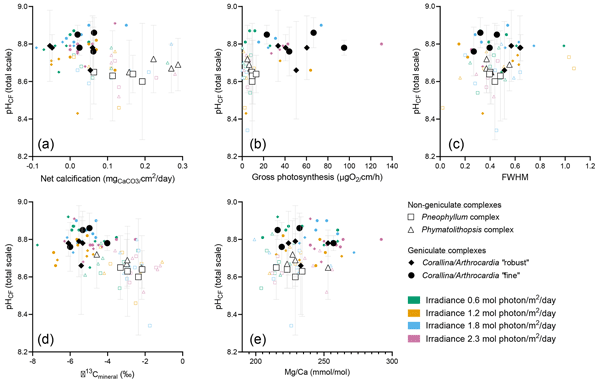
Figure 7Multi-panel plots showing crossplots of pHCF, (a) net calcification (), (b) gross photosynthesis (), (c) residual full-width-half-maximum, FWHM, (d) (‰) and (e) (mmol mol−1). Large symbols show averages derived from full dataset from Krieger et al. (2023) while small colored symbols show individual paired data and irradiance level to display maximum information. Error bars are shown as 2 SD.
3.1 Net calcification and changing irradiance
No significant relationship was observed between net calcification and irradiance (p>0.05, ANOVA) in our subset of data. Differences in net calcification were only significant between complexes (p<0.05, ANOVA for irradiance 0.6, 1.8, 2.3). However, Krieger et al. (2023) presented two significant relationships, one non-linear for Corallina and one non-linear for Spongites when the full dataset was taken into account.
3.2 and
The geniculate and non-geniculate complexes present different absolute values of and responses with increasing irradiance. Relatively lower values ( ‰) are observed for geniculate Corallina/Arthrocardia fine and Corallina/Arthrocardia robust; non-geniculate Phymatolithopsis complex and Pneophyllum complex have relatively enriched signatures ( ‰). Significant differences in between species were observed for all irradiances (Table S6).
ANOVA results indicate a significant effect of irradiance on of the non-geniculate species (Phymatolithopsis complex and Pneophyllum complex) (p=0.01 and p=0.009, Table S4). These two complexes exhibit a significant linear increase in with increasing irradiance levels (p=0.010 and p=0.003, respectively, Table S2). The geniculate Corallina/Arthrocardia fine is showing a non-linear (R2=0.45) significant increase in while Corallina/Arthrocardia robust is having a relatively stable signature for the different treatments (p=0.948).
data were already presented in Krieger et al. (2023). In our subset of samples, ANOVA supports a significant effect of irradiances for non-geniculate Phymatolithopsis complex and Pneophyllum complex (p=0.009, p=0.011). Values of are linearly increasing with higher irradiances for Phymatolithopsis complex (p=0.001), and a significant non-linear relationship is observed for Pneophyllum complex (R2=0.58). ANOVA also supports significant differences between species (Table S6).
are enriched in comparison to by 9 ‰–22 ‰. Significant positive linear relationships between and were observed for the non-geniculate Pneophyllum complex and Phymatolithopsis complex (p=0.025, p=0.003), but not for the geniculate Corallina/Arthrocardia fine and Corallina/Arthrocardia robust, Fig. 5a.
There is an increase in with increasing net calcification across all complexes (p<0.001; Fig. 5c). Some differences to note are that the geniculate Corallina/Arthrocardia robust and Corallina/Arthrocardia fine have the lightest in line with observed lower net calcification. The non-geniculate complexes have higher net calcification and higher , implying different sensitivities of net calcification to irradiance between complexes and difference between non-geniculate and geniculate complexes.
3.3 δ11B
Enriched δ11B values are observed for the geniculate Corallina/Arthrocardia robust (∼26.4 ‰) and Corallina/Arthrocardia fine (∼27.4 ‰), compared to the non-geniculate Pneophyllum complex (∼24.5 ‰) and Phymatolithopsis complex (∼25.4 ‰). The differences between complexes are significant at irradiance 0.6, 1.8 and 2.3 (ANOVA p=0.008, p=0.001, p=0.006, respectively, Table S6).
No significant linear or non-linear regression was observed between δ11B and irradiance (Tables S3 and S4). δ11B differences were observed between species (ANOVA significant for most irradiances, Tables S3 and S4). T tests show no significant differences between Corallina/Arthrocardia fine and Corallina/Arthrocardia robust (geniculate) or Phymatolithopsis complex and Pneophyllum complex (non-geniculate) but do show significant differences between geniculate and non-geniculate species.
The crossplot of and δ11B does show significant negative linear relationships across all complexes (p<0.0001), not significant at the complex level (Fig. 5b). There is a clear distinction between non-geniculate and geniculate species. Corallina/Arthrocardia robust and Corallina/Arthrocardia fine show depleted δ13C and high δ11B while Pneophyllum complex show enriched δ13C and lower δ11B (significant ANOVA).
δ13C and δ11B compared to net calcification and gross photosynthesis (Fig. 5c–f) do not present any significant relationships. We note that higher δ11B and lower coincides with higher gross photosynthesis and lower net calcification in the geniculate species while the opposite is true for non-geniculate species (Fig. 5).
3.4 Trace elements
, , , , , were analyzed in this study. was the most impacted by irradiance between complexes, while was significantly impacted in Pneophyllum complex (p<0.001, ANOVA, Table S4) and in Corallina/Arthrocardia robust (p<0.04, ANOVA). Most elements presented significant differences between complexes, including , , , (ANOVA, Table S6).
observed are significantly different between species at irradiance 0.6, 1.8 and 2.4 (p=0.047, p=0.03 and p<0.001, ANOVA). Significant quadratic relationships between and irradiance are observed for Pneophyllum complex and Phymatolithopsis complex (R2=0.51, R2=0.48) while a positive linear relationship is observed for Corallina/Arthrocardia fine (p=0.002) are best fit according to AIC analyses (Table S2 and Fig. S1). There is a significant impact of irradiance on for Corallina, Pneophyllum complex and Phymatolithopsis complex (p=0.03, p=0.003 and p=0.04, ANOVA, Fig. S1 and Tables S2, S4).
Significant positive relationships are observed between and irradiance, quadratic for Pneophyllum complex and linear for Phymatolithopsis complex (R2=0.40, p=0.02 respectively) but not for other complexes. Based on TukeyHSD Multiple Comparisons of Means (see method section) was significantly different for the species for the three irradiance treatments, 0.6, 1.2 and 1.8 (p=0.006, p=0.02 and p=0.0003 respectively, Fig. S1 and Tables S2, S6).
3.5 Other physiological parameters
Maximum electron transport rate (ETR max) is an important photophysiological parameter indicative of photosynthetic capacity. ETR max is directly correlated to gross photosynthesis () making it a key parameter to study the impact of changing irradiance in coralline red algae. In our subset of samples ETR max had significant positive linear relationships with irradiance for Corallina/Arthrocardia robust, Corallina/Arthrocardia fine and Pneophyllum complex (p=0.035, p=0.0023, p=0.0238 respectively), Table S3 and Fig. S2. Chl a, ETRmax and Fv/Fm were significantly different between species at different irradiance levels based on ANOVA (Table S6).
Significant differences between non-geniculate and geniculate complexes were observed in the photophysiological parameters. Net calcification was lower in geniculate complexes than in non-geniculate complexes (t test, p<0.001). Gross photosynthesis was higher in geniculate complexes than in the non-geniculate ones (t test, p<0.001).
3.6 Principal component analysis (PCA) and correlation matrices
Principal component analysis (PCA) was performed for the geochemical and physiological data. The isotopic and trace element measurements were dissociated for better clarity of the figures. Vectors present a positive relationship between ETRmax and irradiance, a negative relationship between net calcification and δ11B, positive relationships between net calcification and and between δ11B and Fv/Fm. (Figs. 4 and S3 in the Supplement).
In both cases, geniculate and non-geniculate species cluster together. Non-geniculate complexes (Pneophyllum complex and Phymatolithopsis complex) show higher net calcification, higher and lower δ11B. Geniculate complexes Corallina/Arthrocardia robust and Corallina/Arthrocardia fine on the contrary show lower net calcification, lower and higher δ11B. The clustering is also observed with the trace elements. Geniculate complexes showing higher , , and ratios than non-geniculate complexes (Fig. S3).
Complex-specific relationships between geochemical and physiological parameters are presented in the correlation matrices in Fig. 4.
4.1 Impact of irradiance is observed on and
The positive relationships between and irradiance in three out of four complexes and the significant effect of irradiance on (i.e. Corallina/Arthrocardia fine and Phymatolithopsis complex) and (i.e. Pneophyllum complex and Phymatolithopsis complex) (p<0.05, ANOVA), highlights: (1) that irradiance impacts the geochemical signatures of the mineral, (2) photosynthetically driven isotope fractionation increases with increasing irradiance based on . Those results are in line with photophysiological parameters measured (i.e. gross photosynthesis, ETRmax) showing increased photosynthesis with irradiance at the complex level and supported by previous study that indicate δ13C changes with photosynthesis and respiration (McConnaughey et al., 1997).
Difference in sensitivities between and irradiance is observed between Pneophyllum complex and Phymatolithopsis complex indicating complex-specific responses to light. In the range of irradiances tested in this study, geniculate complexes are less sensitive to changes in irradiance (p=0.975) than the non-geniculate ones (p=0.0001), Fig. 5a.
There are clear differences in signatures between non-geniculate and geniculate complexes. Non-geniculate complexes Pneophyllum complex and Phymatolithopsis complex are fast calcifiers that have enriched and a strong response to increased irradiance. Geniculate complexes Corallina/Arthrocardia fine and Corallina/Arthrocardia robust present lower net calcification and lower . Photosynthesis can increase the δ13C of the DIC pool available for calcification, the differences observed between morphotypes in and net calcification are then in line with a positive effect of photosynthesis on net calcification (Fig. 5c).
The geniculate complexes have higher gross photosynthesis here than the non-geniculate complexes, they also have lower (Fig. 5e). The higher photosynthesis rate in geniculate versus non-geniculate has also been observed in the field (Nguyen et al., 2022). The discrepancy with (e.g. high photosynthesis/low c ) could be that the source of DIC used by geniculate species is depleted in 13C. i.e., a greater use of recycled respiratory CO2 and/or use of CO2 via diffusion. The morphology of the geniculate algae represents a higher surface area-to-volume ratio and a thinner wall thickness; this might lead to greater passive transport of DIC to the site of calcification. On the contrary, the thick crust, and lower surface area to volume ratio of the non-geniculate species could lead to less passive diffusion as a source of DIC. Mao et al. (2024) established a carbon budget based on radiogenic-isotopes and highlighted that up to 40 % of the carbon released during calcification was recycled internally. While carbon fixed during photosynthesis is not directly recycled into calcification, CO2 released during respiration may contribute to calcification, potentially lowering . Because respiratory inputs are derived from photosynthetically fixed carbon, δ13C of the DIC pool available for calcification could be indirectly influenced by photosynthesis. We anticipate that this recycling will vary depending on morphologies and taxa and then impact δ13C. DIC uptake strategies can vary by coralline taxa (Bergstrom et al., 2020), especially CO2 diffusion being more prevalent in basal taxa which highlight the diversity of carbon concentrating mechanisms in coralline algae. Our results show that the geochemical signatures of the mineral are impacted by changing irradiances thereby enabling the investigation of potential changes in pHCF constrained by boron isotopes.
4.2 Boron isotopes (δ11B)
There were significant differences between the δ11B of our four species. The range of δ11B seems consistent with sole incorporation of and realistic physiological modulation of pHCF. However, we note that NMR study from Cusack et al. (2015) observed the presence of trigonal boron (BO3) accounting for up to 30 % of the total boron in Lithothamnion glaciale. The presence of BO3 can also be due to the recoordination of BO4 during the incorporation of boron within the crystal lattice (Klochko et al., 2009; Branson et al., 2015) which in that case would not impact the δ11B proxy. NMR studies on other species of coralline red algae along with boron isotopic measurements are lacking to affirm that BO3 does not contribute to a part of the signal measured. For example, more extreme δ11B data for Neogoniolithon were reported at (31–40) ‰ (Donald et al., 2017; Liu et al., 2020), even if BO3 incorporation might not be the dominant driver, it could still contribute to the high values in that particular species/experiment (Donald et al., 2017; Liu et al., 2020). In our study, the range of δ11B reported (26 ‰ ± 3 ‰, 2 SD, n=76, Fig. 3b) is consistent with the pH at the site of calcification (pHCF) and without further evidence of BO3 incorporation and impact on the δ11B, the δ11B will be interpreted as a physiological signal in the following discussion.
4.3 pHCF is up-regulated relative to seawater
The primary calcification happens in the interfilament space in coralline red algae, secondary calcification occurs within the cell walls (McCoy et al., 2023). It is thought that coralline red algae elevate their internal pH and modulate carbonate chemistry to promote calcification (Cornwall et al., 2017). δ11B is thought to record the pH at the site of calcification (pHCF). Boron based studies suggest that pHCF is upregulated relative to seawater supporting favorable saturation state and calcium carbonate precipitation, as observed in corals (McCulloch et al., 2017; Cornwall et al., 2017; Anagnostou et al., 2019; Comeau et al., 2019) and other marine organisms (Sutton et al., 2018; Liu et al., 2020). The capacity of coralline algae to maintain its pHCF has also been shown to be impacted by ocean acidification, as recorded by the boron isotope proxy of pH at the site of calcification (Cornwall et al., 2017; Comeau et al., 2019) and indirectly seawater pH (Anagnostou et al., 2019).
Upregulation of pHCF relative to seawater occurred here in the four complexes studied here with average values for Corallina/Arthrocardia robust and Corallina/Arthrocardia fine of 8.75 ± 0.21 (2 SD, n=19) and 8.81 ± 0.12 (2 SD, n=20), respectively and for Pneophyllum complex and Phymatolithopsis complex of 8.63 ± 0.20 (2 SD, n=18) and 8.68 ± 0.15 (2 SD, n=19), respectively (Fig. 6). The seawater pH (total scale) during the experiment was maintained to 8.02, meaning that internal pH for the four complexes was elevated relative to seawater by 0.6 to 0.8 pH unit. Complex-specific pHCF dynamics are observed: the geniculate species (Arthrocardia/Corallina fine and robust) show higher pHCF in comparison to the non-geniculate complexes (Pneophyllum complex and Phymatolithopsis complex). All pHCF values are in the range to sustain the saturation state based on boron-based study in other marine organisms (McCulloch et al., 2017; Sutton et al., 2018; Comeau et al., 2019; Liu et al., 2020; Guillermic et al., 2021, and others).
4.4 pHCF is not affected by changing irradiance at the complex level
There was no effect of irradiance on pHCF for any of our species across all levels of irradiance. All complexes presented pH homeostasis responses at different irradiance levels and despite evidence of increased photosynthetic rates (Fig. 6). These results highlight complex-specific pHCF, the species are able to maintain an optimal pHCF demonstrating a good acclimation in the range of irradiance tested (0.6 to 2.3 ). This is also in line with the complexes not showing significant changes in calcification with changing irradiances in our subset of samples (Table S3 and Figs. 2, S2). For comparison, those δ11B-derived pHCF are higher than those measured via microelectrode in the light (8.15–8.30) in Arctic corallines (Hofmann et al., 2018). This lack of response to changing irradiance may also result from photosynthesis-independent mechanisms (de Beer and Larkum, 2001; Hofmann et al., 2016, 2018) helping to maintain favorable proton gradients.
4.5 Calcification space chemistry under changing irradiance
The relationship between calcification to photosynthesis is not fully understood in coralline red algae. While some studies report a positive effect of photosynthesis on calcification (Goreau, 1963; Pentecost, 1978; Comeau et al., 2014) others show non-linear responses to increase irradiance (Martin et al., 2013a; Egilsdottir et al., 2016) or photoinhibition that may affect calcification (Kain, 1987; Sagert et al., 1997; Kühl et al., 2001; Roberts et al., 2002; Martin et al., 2013a). The subset of data we used for this study did not show significant changes in net calcification which could result from a decoupling between photosynthesis and net calcification at specific irradiance conditions. Net calcification was maintained over the different treatments despite evidence of increasing photosynthesis. In other words, this suggests photosynthetic activity was sufficient even at the lowest irradiance to (1) provide a substantial provision of energy to the organism that can be allocated to active transports of ions and subsequent modulation of the calcification space chemistry, (2) sustain a proton gradient between the calcifying space and seawater. This gradient is maintained from elevation of pH surrounding the cells as result of photosynthetic rate and CO2 drawdown (Hofmann et al., 2016; Cornwall et al., 2013, 2014, 2017) and by the presence of light-mediated proton pump that is independent from photosynthesis (Hofmann et al., 2016, 2018).
Increasing photosynthesis, however, can have other positive effects on the organism and calcification. For example photosynthesis may sustain calcification by providing the key constituents of organic molecules needed for cell wall formation which act as a template for mineral precipitation. Those organic molecules (like polysaccharides) can also have affinities with Ca which can increase locally the saturation state and promote precipitation of CaCO3. Overall, all complexes in this study acclimatized well to the different levels of irradiance, calcification was maintained but not improved. This can also result from other limiting parameters involved in the modulation of the saturation state at the site of calcification like DIC concentrating mechanisms and [Ca]CF.
Krieger et al. (2023) presented the full-width-half-maximum (FWHM) parameter which has been calibrated in aragonite as a proxy for saturation state (DeCarlo et al., 2017), no quantitative but qualitative analyses can be done when applied to calcite, which is the case here, in our subset of data there was no significant change in FWHM in either of the complexes with increasing irradiances again highlighting a relatively stable saturation state across treatments, in line with pHCF and calcification data.
has been used as a proxy for []CF, however this proxy has only been derived for aragonite so no quantitative estimate can be made here but can be used as a potential indication of changes in the carbonate parameters in the calcification space (McCulloch et al., 2017; DeCarlo et al., 2018). No relationship is observed for the geniculate complexes of with irradiance. Nevertheless, non-geniculate complexes present significant increase in with increasing irradiances (parabolic for Pneophyllum complex, positive for Phymatolithopsis complex), which could highlight changes in the DIC pool (i.e., decreasing []CF with increasing irradiance). Differences within the non-geniculate complexes are also observed with (i.e., ). In a similar way, in mineral is dependent on solution [] (DeCarlo et al., 2015), no significant change is observed with irradiance but significant changes are observed between morphologies, implying different modulation of , . This overall highlights a lower DICCF in geniculate relative to the non-geniculate complexes, as for similar DICCF, higher pHCF should increase []CF but this is not observed here. If pHCF is maintained but DICCF is modulated then compensatory mechanisms would be needed to sustain a stable saturation state in those two complexes at the complex level and with changing irradiances, this could be achieved through [Ca]CF modulations.
is another parameter that could be used to infer the [Ca]CF following the approach of Krieger et al. (2023) with their %Mg. The rationale is that the ratio of the mineral reflects the ratio of the precipitating fluid, and that only [Ca] modulates this ratio due to its incorporation within the mineral. However, the presence of organics also influences [Ca] and [Mg], and there are additional controls on Mg incorporation like temperature (Williams et al., 2014) or change in precipitation rate (Gabitov et al., 2014) so a direct translation of to [Ca]CF can be too simplistic. Nevertheless, a significant effect of irradiance on is observed in three out of the four complexes. Different responses can be observed, positive for Corallina/Arthrocardia fine, parabolic for Pneophyllum complex and threshold positive for Phymatolithopsis complex. Those responses are similar to the responses for the non-geniculate complexes. This implies that when [Ca]CF decreases (i.e., increases), []CF also decreases ( increases) and that there is no compensation of changes in [Ca]CF by changing []CF. The fact that variations have similar responses can also highlight the changes in [Ca]CF (i.e., driving changes in both and ratios).
4.6 Differences of calcification space chemistry between geniculate and non-geniculate complexes
It is clear that the two morphologies have characteristic geochemical parameters and physiological responses (PCA and box plots, Figs. 4 and 8). We have shown that non-geniculate complexes have higher calcification (Krieger et al., 2023), higher , lower gross photosynthesis and lower pHCF compared to geniculate species. From those results, differences between morphologies can be highlighted, (1) there is a decoupling between net calcification and gross photosynthesis, higher gross photosynthesis in the geniculate complexes does not translate in higher calcification relative to the non-geniculate complexes, (2) reflects different DIC source between the two morphologies, is not positively correlated with gross photosynthesis when comparing between morphotypes but it is at the complex level across experimental treatments, (3) despite a lack of relationships between pHCF and changing irradiance at the complex level, non-geniculate and geniculate complexes have two different photosynthetic regimes that could correlate with the pHCF observed, higher pHCF is observed along higher gross photosynthesis in geniculate complexes (Figs. 7 and 8), (4) there is a decoupling between pHCF and net calcification, higher pHCF does not translate to higher net calcification (Figs. 7 and 8). Net calcification reflects gross calcification and gross dissolution, so it is not abnormal to see net calcification decoupled from physiological or geochemical data. However, from our data it seems that pHCF is not the limiting parameter of calcification.

Figure 8Box plots comparing geniculate complexes (blue) and non-geniculate (green). Box plots show the median,10, 90 percentiles as well as the individual data points.
If the ratio reflects the [Ca]CF, then the higher ratio observed in the geniculate complexes suggests a lower [Ca]CF. Then this lower calcium concentration appears to be compensated by an increase in the pHCF of the calcification fluid (Fig. 8). In contrast, the non-geniculate forms show lower ratios, implying a higher [Ca]CF and, correspondingly, a lower pHCF. This could imply a coupling between [Ca]CF and pHCF, potentially through proton exchangers like Ca2+-ATPase or other Ca concentrating mechanisms.
Building on previous studies on , we interpret the changes in to reflect changes in the source of DIC (Bergstrom et al., 2020). We suggest that higher photosynthetic activity (i.e. gross photosynthesis) observed for the geniculate species implies higher need for DIC to support both photosynthesis and calcification. To compensate for the higher CO2 drawdown of photosynthesis and support calcification other sources of DIC like CO2 diffusion or a better recycling of metabolic CO2 may be involved. Those sources would explain the lower in geniculate complexes compared to non-geniculate. Higher photosynthetic activity in the geniculate complexes would supply energy to the metabolism, the trade off potentially being DIC limited calcification.
On the other hand, non-geniculate complexes are relying on fast calcification, the lower photosynthesis activity might limit CO2 drawdown which will allow higher internal DIC availability and sustain higher calcification. The other argument for DIC being the limiting parameter is the non-variation of pHCF with changing irradiance. While higher pHCF can be achieved for the geniculate through higher photosynthesis activity, the pHCF of non-geniculate complexes are also elevated relative to seawater despite lower photosynthesis activity.
Future research will benefit from indirect (e.g., proxies) and direct constraint (e.g., microelectrode) on DICCF to test those hypotheses. The geochemical differences between morphologies we observed during this study reflect different photosynthetic strategies and metabolic needs of the organisms. Here we tried to draw some mechanistic explanation to the observed changes in calcification based on the geochemical differences between non-geniculate and geniculate complexes. We show that DICCF is a limiting parameter to calcification, we hypothesized that geniculate species have greater passive CO2 diffusion/recycling, while DIC is not as limiting for the non-geniculate due to better carbon concentration mechanisms and lower photosynthetic CO2 drawdown which supports higher rates of calcification. The coralline red algae do present a certain plasticity in their carbon sources for DIC (Bergstrom et al., 2020) and regulation of pHCF, which can provide some resilience to changing environmental conditions. Additional studies on how coralline algae modulate DICCF and pHCF would be helpful to capture the limits of plasticity of photosynthesis and calcification modulation under stressors such as ocean acidification or warming temperature. This understanding will be critical for assessing the impact of global changes on those foundational species.
4.7 Does light impact proxies for paleoreconstruction?
Carbonate structures produced by coralline algae (e.g., rhodoliths, crusts) can be used as archives for paleoreconstruction (MacDonald et al., 2024). The main geochemical differences in our study are observed between the different morphologies of coralline red algae. Nevertheless, non-geniculate (i.e., encrusting) species are much more commonly used for paleoenvironmental reconstructions, we will then focus on the non-geniculate complexes for the rest of this section.
As we observed, δ11B-derived pHCF is not impacted by light at the complex levels which does not produce additional complexity for the use of the proxy. Anagnostou et al. (2019) presented a robust calibration of the δ11B proxy based on culture experiments on a high-latitude crustose coralline red algae Clathromorphum compactum. As the carbonate archives usually are produced by a mix of species, a complex-specific response to ocean acidification and the strong control they exert on their calcification fluid could be a limitation of the proxy, but our findings suggest δ11B should be at least insensitive to light levels. This is especially true because encrusting species being anchored to the substrate should be less impacted by differential light exposure. Nevertheless, with the increasing availability in species-specific geochemical data, a rigorous approach may involve using DNA-based identification to calibrate geochemical records.
Despite significant relationships for (Pneophyllum complex and Phymatolithopsis complex) and (Pneophyllum complex), ratios did not show any significant effect of changing irradiance, which does not impair the applicability of the temperature proxy for both species. Also, no significant differences were observed for the of the two non-geniculate species. Our results on mid-latitude low-light adapted species show that light does not impair the application of the δ11B and proxies.
Coralline red algae species are adapted to environments where light availability can vary (e.g. latitude, depth). While the results of this study may be applicable to mid-latitude species, it might not be transferable to coralline algae from other latitudes, for example, it has been shown that Arctic species rely on stored photosynthates to support winter calcification (Adey et al., 2019; Gould et al., 2022) which could influence the geochemical parameters.
The geochemistry (δ11B, and trace elements) of four low-light adapted complexes of coralline red algae cultured under different irradiances was investigated in this study following prior work by Krieger et al. (2023). Two morphologies were investigated: geniculate (branching) complexes, Corallina/Arthrocardia robust and Corallina/Arthrocardia fine and non-geniculate (encrusting/mounding) complexes, Pneophyllum complex and Phymatolithopsis complex.
The first purpose of this study was to investigate the effect of light (changing irradiance) on the pH of calcification for the different complexes. Based on photophysiological parameters (i.e. gross photosynthesis, ETR max) and , we show that at the complex levels photosynthesis activity has an impact on the geochemical signature of the mineral. However, despite increasing photosynthetic activity with irradiance, δ11B or pHCF was maintained constant for all treatments. pHCF was upregulated relative to seawater in all complexes with complex-specific pHCF. No significant effect of light was observed at the complex level in the range of irradiance (0.6–2.3) .
The main differences in physiological and geochemical parameters are observed between morphologies. Those results demonstrate two calcification regimes. We show that non-geniculate complexes have higher net calcification, higher , lower gross photosynthesis, lower pHCF, lower while geniculate have lower net calcification, lower , higher gross photosynthesis, higher pHCF, higher .
We highlight that pHCF can be positively influenced via photosynthetic regimes inherent to morphologies. We show that net calcification is decoupled from pHCF and that based on , changes in pHCF are compensated by changes in [Ca]CF. The main differences between calcification modes is likely due to DIC and carbon concentrating mechanisms reflected in our data by . The lower of geniculate species can indicate a relatively more important contribution of passive CO2 diffusion and/or higher recycling of CO2 to the DIC pool.
Higher calcification in non-geniculate complexes is supported by higher DICCF due to lower CO2 drawdown from photosynthesis and efficient carbon-concentrating mechanisms. Additionally, despite lower photosynthetic activity compared to geniculate complexes, photosynthesis-independent processes may help maintain elevated pHCF reducing the energetic cost of pH regulation. In contrast, geniculate complexes experience greater CO2 drawdown limiting DICCF use for calcification. Although CO2 recycling or passive diffusion may partly offset this limitation, the energy obtained from photosynthesis in geniculate complexes is likely prioritized to other metabolic needs at the expense of calcification. These differences could be explained by the competition experienced by non-geniculate species to not be overgrown (e.g. turf algae) which must also rely on fast calcification while geniculate species must compensate for a more dynamic environment and prioritize other needs (e.g. grazing, repairs) (Stenneck et al., 1986; Connell, 2003; Edwards and Connell, 2012).
No effect of irradiance is observed on the temperature proxy for the different complexes in the range of irradiances tested in this study. Light should not add additional complexity to the interpretation of the and δ11B proxies when applied to paleoreconstruction studies from rhodolith beds.
Development of proxies to derive a second carbonate parameter in high Mg calcite such as the []CF proxies (e.g. , ) developed in the aragonitic corals as well as direct microelectrode measurements of the calcifying parameters (e.g. pHCF, DICCF) will be relevant to study the dynamics of the calcification space in coralline red algae.
This study demonstrates variability in responses of coralline algae under irradiance and highlights distinct biomineralization mechanisms between branching (geniculate) and encrusting (non-geniculate) mid-latitude low-light adapted complexes. Photosynthesis impacts the availability and source of DICCF which has implications on calcification. In the perspective of calcification, plasticity on DIC sources is determinant for acclimation of coralline red algae. Further research should be done on coralline algal species that experience different irradiance regimes and environments (e.g. latitude, depth). Additional study on the joint effect of ocean acidification and changing irradiance might provide some interesting dynamics and will be needed to understand the full implications of future global changes and associated perturbations on the coralline algae communities and dependent ecosystems.
All calculations and methods are described within the text, all data are available in the supplemental materials or in Krieger et al. (2023).
Data set is available in the Supplement.
The supplement related to this article is available online at https://doi.org/10.5194/bg-22-7669-2025-supplement.
CEC and RAE conceived the project. CEC and RAE directed the research. ECK and CEC performed culturing experiments, specimen characterization. MG performed isotope and trace element analyses at USC and IUEM. MG and JG performed statistical analyses and figures. MG, RAE, CEC, and ECK interpreted the geochemical data. MG wrote the manuscript with input from RAE, CEC and ECK. All authors read and edited the manuscript.
The contact author has declared that none of the authors has any competing interests.
Publisher's note: Copernicus Publications remains neutral with regard to jurisdictional claims made in the text, published maps, institutional affiliations, or any other geographical representation in this paper. While Copernicus Publications makes every effort to include appropriate place names, the final responsibility lies with the authors. Views expressed in the text are those of the authors and do not necessarily reflect the views of the publisher.
We want to thank the the editor and the reviewers for their constructive comments on this manuscript. We thank Seth John, Josh West, Shun-Chun Yang for technical support and use of the Neptune at the Dornsife Plasma facility at University of Southern California. We thank Céline Liorzou, Marie-Laure Rouget, Bleuenn Guéguen, Oanez Lebeau, Fabien Dewilde for technical support and use of the instruments at the Pôle Spectrométrie Océan at the Institut Européen de la Mer (Plouzané, France). We also want to thank Simon Davy, Sarah Bury and Wendy Nelson.
This work was funded by a grant from the David and Lucile Packard Foundation (grant no. 85180), National Science Foundation (grant no. NSF-RISE-2024426), the Rutherford Discovery Fellowship (grant no. VUW1701), and Oceankind and Dalio Philanthropies. The Center for Diverse Leadership in Science is also supported by grant no. NSF-RISE-2228198, the Waverley Street Foundation, and the Sloan Foundation.
This paper was edited by Niels de Winter and reviewed by Minoli Dias and one anonymous referee.
Adey, H. W., Halfar, J., and Williams, B.: The Coralline Genus Clathromorphum Foslie emend. Adey, Biological, Physiological, and Ecological Factors Controlling Carbonate Production in an Arctic-Subarctic Climate Archive, Smithsonian Institution Scholarly Press, 2019.
Al-Horani, F. A., Al-Moghrabi, S. M., and De Beer, D.: The mechanism of calcification and its relation to photosynthesis and respiration in the scleractinian coral Galaxea fascicularis, Mar. Biol., 142, 419–426, https://doi.org/10.1007/s00227-002-0981-8, 2003.
Anagnostou, E., Williams, B., Westfield, I., Foster, G. L., and Ries, J. B.: Calibration of the pH-δ11B and temperature-Mg/Li proxies in the long-lived high-latitude crustose coralline red alga Clathromorphum compactum via controlled laboratory experiments, Geochim. Cosmochim. Acta, 254, 142–155, https://doi.org/10.1016/j.gca.2019.03.015, 2019.
Anthony, K. R., Kline, D. I., Diaz-Pulido, G., Dove, S., and Hoegh-Guldberg, O.: Ocean acidification causes bleaching and productivity loss in coral reef builders, Proceedings of the National Academy of Sciences, 105, 17442–17446, https://doi.org/10.1073/pnas.0804478105, 2008.
Bergstrom, E., Ordoñez, A., Ho, M., Hurd, C., Fry, B., and Diaz-Pulido, G.: Inorganic carbon uptake strategies in coralline algae: Plasticity across evolutionary lineages under ocean acidification and warming, Mar. Environ. Res., 161, https://doi.org/10.1016/j.marenvres.2020.105107, 2020.
Borowitzka, M. A. and Larkum, A. W. D.: Calcification in algae: Mechanisms and the role of metabolism, Critical Reviews in Plant Sciences, 6, 1–45, https://doi.org/10.1080/07352688709382246, 1987.
Borowitzka, M. A.: Photosynthesis and calcification in the articulated coralline red algae Amphiroa anceps and A. foliacea, Mar. Biol., 62, 17–23, https://doi.org/10.1007/BF00396947, 1981.
Branson, O., Kaczmarek, K., Redfern, S. A. T., Misra, S., Langer, G., Tyliszczak, T., Bijma, J., and Elderfield, H.: The coordination and distribution of B in foraminiferal calcite, Earth and Planetary Science Letters, 416, 67–72, https://doi.org/10.1016/j.epsl.2015.02.006, 2015.
Cameron, L. P., Reymond, C. E., Bijma, J., Büscher, J. V., De Beer, D., Guillermic, M., Eagle, R. A., Gunnell, J., Müller-Lundin, F., Schmidt-Grieb, G. M., Westfield, I., Westphal, H., and Ries, J. B.: Impacts of Warming and Acidification on Coral Calcification Linked to Photosymbiont Loss and Deregulation of Calcifying Fluid pH, J. Mar. Sci. Eng., 10, https://doi.org/10.3390/jmse10081106, 2022.
Comeau, S., Carpenter, R. C., and Edmunds, P. J.: Effects of irradiance on the response of the coral Acropora pulchra and the calcifying alga Hydrolithon reinboldii to temperature elevation and ocean acidification, J. Exp. Mar. Biol. Ecol., 453, 28–35, https://doi.org/10.1016/j.jembe.2013.12.013, 2014.
Comeau, S., Cornwall, C. E., Pupier, C. A., DeCarlo, T. M., Alessi, C., Trehern, R., and McCulloch, M. T.: Flow-driven micro-scale pH variability affects the physiology of corals and coralline algae under ocean acidification, Sci. Rep., 9, https://doi.org/10.1038/s41598-019-49044-w, 2019.
Connell, S. D.: The monopolization of understorey habitat by subtidal encrusting coralline algae: A test of the combined effects of canopy-mediated light and sedimentation, Mar. Biol., 142, 1065–1071, https://doi.org/10.1007/s00227-003-1021-z, 2003.
Cornwall, C. E., Hepburn, C. D., Pilditch, C. A., and Hurd, C. L.: Concentration boundary layers around complex assemblages of macroalgae: Implications for the effects of ocean acidification on understory coralline algae, Limnol. Oceanogr., 58, 121–130, https://doi.org/10.4319/lo.2013.58.1.0121, 2013.
Cornwall, C. E., Boyd, P. W., McGraw, C. M., Hepburn, C. D., Pilditch, C. A., Morris, J. N., Smith, A. M., and Hurd, C. L.: Diffusion boundary layers ameliorate the negative effects of ocean acidification on the temperate coralline macroalga Arthrocardia corymbosa, PLoS One, 9, https://doi.org/10.1371/journal.pone.0097235, 2014.
Cornwall, C. E., Comeau, S., and McCulloch, M. T.: Coralline algae elevate pH at the site of calcification under ocean acidification, Glob. Chang. Biol., 23, 4245–4256, https://doi.org/10.1111/gcb.13673, 2017.
Cornwall, C. E., Comeau, S., DeCarlo, T. M., Moore, B., D'Alexis, Q., and McCulloch, M. T.: Resistance of corals and coralline algae to ocean acidification: Physiological control of calcification under natural pH variability, Proceedings of the Royal Society B, 285, https://doi.org/10.1098/rspb.2018.1168, 2018.
Cornwall, C. E., Diaz-Pulido, G., and Comeau, S.: Impacts of ocean warming on coralline algal calcification: Meta-analysis, knowledge gaps, and key recommendations for future research, Front. Mar. Sci., 6, https://doi.org/10.3389/fmars.2019.00186, 2019.
Cornwall, C. E., Comeau, S., DeCarlo, T. M., Larcombe, E., Moore, B., Giltrow, K., Puerzer, F., D’Alexis, Q., and McCulloch, M. T.: A coralline alga gains tolerance to ocean acidification over multiple generations of exposure. In Nature Climate Change, Nature Research, 10, 143–146, https://doi.org/10.1038/s41558-019-0681-8, 2020.
Cornwall, C. E., Carlot, J., Branson, O., Courtney, T. A., Harvey, B. P., Perry, C. T., Andersson, A. J., Diaz-Pulido, G., Johnson, M. D., Kennedy, E., Krieger, E. C., Mallela, J., McCoy, S. J., Nugues, M. M., Quinter, E., Ross, C. L., Ryan, E., Saderne, V., and Comeau, S.: Crustose coralline algae can contribute more than corals to coral reef carbonate production, Commun. Earth Environ., 4, https://doi.org/10.1038/s43247-023-00766-w, 2023.
Cusack, M., Kamenos, N. A., Rollion-Bard, C., and Tricot, G.: Red coralline algae assessed as marine pH proxies using 11B MAS NMR, Scientific Reports, 5, https://doi.org/10.1038/srep08175, 2015.
DeCarlo, T. M., Gaetani, G. A., Holcomb, M., and Cohen, A. L.: Experimental determination of factors controlling U/Ca of aragonite precipitated from seawater: Implications for interpreting coral skeleton, Geochimica et Cosmochimica Acta, 162, 151–165, https://doi.org/10.1016/j.gca.2015.04.016, 2015.
DeCarlo, T. M., D’Olivo, J. P., Foster, T., Holcomb, M., Becker, T., and McCulloch, M. T.: Coral calcifying fluid aragonite saturation states derived from Raman spectroscopy, Biogeosciences, 14, 5253–5269, https://doi.org/10.5194/bg-14-5253-2017, 2017.
DeCarlo, T. M., Holcomb, M., and McCulloch, M. T.: Reviews and syntheses: Revisiting the boron systematics of aragonite and their application to coral calcification, Biogeosciences, 15, 2819–2834, https://doi.org/10.5194/bg-15-2819-2018, 2018.
de Beer, D., and Larkum, A. W. D.: Photosynthesis and calcification in the calcifying algae Halimeda discoidea studied with microsensors. Plant, Cell and Environment, 24, 1209–1217, https://doi.org/10.1046/j.1365-3040.2001.00772.x, 2001.
Dissard, D., Douville, E., Reynaud, S., Juillet-Leclerc, A., Montagna, P., Louvat, P., and McCulloch, M.: Light and temperature effects on δ11B and B / Ca ratios of the zooxanthellate coral Acropora sp.: results from culturing experiments, Biogeosciences, 9, 4589–4605, https://doi.org/10.5194/bg-9-4589-2012, 2012
D'Olivo, J. P. and McCulloch, M. T.: Response of coral calcification and calcifying fluid composition to thermally induced bleaching stress, Sci. Rep., 7, https://doi.org/10.1038/s41598-017-02306-x, 2017.
Donald, H. K., Ries, J. B., Stewart, J. A., Fowell, S. E., and Foster, G. L.: Boron isotope sensitivity to seawater pH change in a species of Neogoniolithon coralline red alga, Geochim. Cosmochim. Acta, 217, 240–253, https://doi.org/10.1016/j.gca.2017.08.021, 2017.
Eagle, R. A., Guillermic, M., De Corte, I., Alvarez Caraveo, B., Bove, C. B., Misra, S., Cameron, L. P., Castillo, K. D., and Ries, J. B.: Physicochemical Control of Caribbean Coral Calcification Linked to Host and Symbiont Responses to Varying pCO2 and Temperature, J. Mar. Sci. Eng., 10, https://doi.org/10.3390/jmse10081075, 2022.
Edwards, M. S. and Connell, S. D.: Competition, a Major Factor Structuring Seaweed Communities, in: Seaweed Biology. Ecological Studies, vol. 219, edited by: Wiencke, C. and Bischof, K., Springer, Berlin, Heidelberg, https://doi.org/10.1007/978-3-642-28451-9_7, 2012.
Egilsdottir, H., Olafsson, J., and Martin, S.: Photosynthesis and calcification in the articulated coralline alga Ellisolandia elongata (Corallinales, Rhodophyta) from intertidal rock pools, Eur. J. Phycol., 51, 59–70, https://doi.org/10.1080/09670262.2015.1101165, 2016.
Foster, G. L., Pogge Von Strandmann, P. A. E., and Rae, J. W. B.: Boron and magnesium isotopic composition of seawater. Geochemistry, Geophysics, Geosystems, 11, https://doi.org/10.1029/2010GC0032010, 2010.
Gabitov, R. I., Sadekov, A., and Leinweber, A.: Crystal growth rate effect on and partitioning between calcite and fluid: An in situ approach, Chemical Geology, 367, 70–82, 2014.
Gaillardet, J., Lemarchand, D., Göpel, C., and Manhès, G.: Evaporation and Sublimation of Boric Acid: Application for Boron Purification from Organic Rich Solutions, The Journal of Geostandards and Geoanalysis, https://doi.org/10.1111/j.1751-908X.2001.tb00788.x, 2001.
Goreau, T. F.: Calcium carbonate deposition by coralline algae and corals in relation to their roles as reef-builders, Annals New York Academy of Sciences, 109, 127–167, 1963.
Gould, J., Halfar, J., Adey, W., and Ries, J. B.: Growth as a function of sea ice cover, light and temperature in the arctic/subarctic coralline C. compactum: A year-long in situ experiment in the high arctic, Frontiers in Marine Science, 9, https://doi.org/10.3389/fmars.2022.900033, 2022.
GraphPad Prism: GraphPad Prism version 10.2.3 for Windows, GraphPad Software, Boston, Massachusetts USA, https://www.graphpad.com (last access: October 2025), 2024.
Guillermic, M., Misra, S., Eagle, R., Villa, A., Chang, F., and Tripati, A.: Seawater pH reconstruction using boron isotopes in multiple planktonic foraminifera species with different depth habitats and their potential to constrain pH and pCO2 gradients, Biogeosciences, 17, 3487–3510, https://doi.org/10.5194/bg-17-3487-2020, 2020.
Guillermic, M., Cameron, L. P., De Corte, I., Misra, S., Bijma, J., De Beer, D., Reymond, C. E., Westphal, H., Ries, J. B., and Eagle, R. A.: Thermal stress reduces pocilloporid coral resilience to ocean acidification by impairing control over calcifying fluid chemistry, Sci. Adv., https://doi.org/10.1126/sciadv.aba995, 2021.
Guillermic, M., Misra, S., Eagle, R., and Tripati, A.: Atmospheric CO2 estimates for the Miocene to Pleistocene based on foraminiferal δ11B at Ocean Drilling Program Sites 806 and 807 in the Western Equatorial Pacific, Clim. Past, 18, 183–207, https://doi.org/10.5194/cp-18-183-2022, 2022.
Gutjahr, M., Bordier, L., Douville, E., Farmer, J., Foster, G. L., Hathorne, E. C., Hönisch, B., Lemarchand, D., Louvat, P., McCulloch, M., Noireaux, J., Pallavicini, N., Rae, J. W. B., Rodushkin, I., Roux, P., Stewart, J. A., Thil, F., and You, C. F.: Sub-Permil Interlaboratory Consistency for Solution-Based Boron Isotope Analyses on Marine Carbonates, Geostand. Geoanal. Res., 45, 59–75, https://doi.org/10.1111/ggr.12364, 2021.
Halfar, J., Zack, T., Kronz, A., and Zachos, J. C.: Growth and high-resolution paleoenvironmental signals of rhodoliths (coralline red algae): A new biogenic archive, J. Geophys. Res.-Oceans, 105, 22107–22116, https://doi.org/10.1029/1999jc000128, 2000.
Hemming, N. G. and Hanson, G. N.: Boron isotopic composition and concentration in modern marine carbonates, Geochimica et Cosmochimica Acta, 537–543, https://doi.org/10.1016/0016-7037(92)90151-8, 1992.
Hofmann, L. C., Koch, M., and De Beer, D.: Biotic control of surface pH and evidence of light-induced H+ pumping and Ca2+-H+ exchange in a tropical crustose coralline alga, PLoS One, 11, https://doi.org/10.1371/journal.pone.0159057, 2016.
Hofmann, L. C., Schoenrock, K., and de Beer, D.: Arctic coralline algae elevate surface pH and carbonate in the dark, Front. Plant Sci., 9, https://doi.org/10.3389/fpls.2018.01416, 2018.
Irving, A. D., Connell, S. D., and Elsdon, T. S.: Effects of kelp canopies on bleaching and photosynthetic activity of encrusting coralline algae, J. Exp. Mar. Biol. Ecol., 310, 1–12, https://doi.org/10.1016/j.jembe.2004.03.020, 2004.
Juillet-Leclerc, A., Reynaud, S., Dissard, D., Tisserand, G., and Ferrier-Pagès, C.: Light is an active contributor to the vital effects of coral skeleton proxies, Geochim. Cosmochim. Acta, 140, 671–690, https://doi.org/10.1016/j.gca.2014.05.042, 2014.
Kain, J. M.: Seasonal growth and photoinhibition in Plocamium cartilagineum (Rhodophyta) off the Isle of Man, Phycologia, 26, 88–99, https://doi.org/10.2216/i0031-8884-26-1-88.1, 1987.
Kamenos, N. A., Cusack, M., and Moore, P. G.: Coralline algae are global palaeothermometers with bi-weekly resolution, Geochim. Cosmochim. Acta, 72, 771–779, https://doi.org/10.1016/j.gca.2007.11.019, 2008.
Klochko, K., Cody, G. D., Tossell, J. A., Dera, P., and Kaufman, A. J.: Re-evaluating boron speciation in biogenic calcite and aragonite using 11B MAS NMR, Geochim. Cosmochim. Acta, 73, 1890–1900, https://doi.org/10.1016/j.gca.2009.01.002, 2009.
Klochko, K., Kaufman, A. J., Yao, W., Byrne, R. H., and Tossell, J. A.: Experimental measurement of boron isotope fractionation in seawater, Earth Planet. Sci. Lett., 248, 261–270, https://doi.org/10.1016/j.epsl.2006.05.034, 2006.
Korbee, N., Navarro, N. P., García-Sánchez, M., Celis-Plá, P. S., Quintano, E., Copertino, M. S., Pedersen, A., Mariath, R., Mangaiyarkarasi, N., Pérez-Ruzafa, Figueroa, F. L., and Martínez, B.: A novel in situ system to evaluate the effect of high CO2 on photosynthesis and biochemistry of seaweeds, Aquat. Biol., 22, 245–259, https://doi.org/10.3354/ab00594, 2014.
Krieger, E. C., Nelson, W. A., Grand, J., Le Ru, E. C., Bury, S. J., Cossais, A., Davy, S. K., and Cornwall, C. E.: The role of irradiance in controlling coralline algal calcification, Limnol. Oceanogr., 68, 1269–1284, https://doi.org/10.1002/lno.12345, 2023.
Kühl, M., Glud, R. N., Borum, J., Roberts, R., and Rysgaard, S.: Photosynthetic performance of surface-associated algae below sea ice as measured with a pulse amplitude-modulated (PAM) fluorometer and O2 microsensors, Marine ecology progress series, 223, 1–14, https://doi.org/10.3354/meps223001, 2001.
Liu, Y.-W., Sutton, J. N., Ries, J. B., and Eagle, R. A.: Regulation of calcification site pH is a polyphyletic but not always governing response to ocean acidification, Sci. Adv., 6, https://doi.org/10.1126/sciadv.aax1314, 2020.
MacDonald, E., Foster, G. L., Standish, C. D., Trend, J., Page, T. M., and Kamenos, N. A.: Historic ocean acidification of Loch Sween revealed by correlative geochemical imaging and high-resolution boron isotope analysis of Boreolithothamniom cf. soriferum, Earth Planet. Sc. Lett., 646, https://doi.org/10.1016/j.epsl.2024.118976, 2024.
Mao, J., Burdett, H. L., and Kamenos, N. A.: Efficient carbon recycling between calcification and photosynthesis in red coralline algae, Biol. Lett., 20, https://doi.org/10.1098/rsbl.2023.0598, 2024.
Martin, S., Charnoz, A., and Gattuso, J. P.: Photosynthesis, respiration and calcification in the Mediterranean crustose coralline alga Lithophyllum cabiochae (Corallinales, Rhodophyta), Eur. J. Phycol., 48, 163–172, https://doi.org/10.1080/09670262.2013.786790, 2013a.
Martin, S., Cohu, S., Vignot, C., Zimmerman, G., and Gattuso, J. P.: One-year experiment on the physiological response of the Mediterranean crustose coralline alga, Lithophyllum cabiochae, to elevated pCO2 and temperature, Ecol. Evol., 3, 676–693, https://doi.org/10.1002/ece3.475, 2013b.
McConnaughey, T. A., Burdett, J., Whelan, J. F., and Paull, C. K.: Carbon isotopes in biological carbonates: Respiration and photosynthesis, Geochimica et Cosmochimica Acta, https://doi.org/10.1016/S0016-7037(96)00361-4, 1997.
McCoy, S. J. and Kamenos, N. A.: Coralline algae (Rhodophyta) in a changing world: Integrating ecological, physiological, and geochemical responses to global change, Journal of Phycology, 51, 6–24, https://doi.org/10.1111/jpy.12262, 2015.
McCoy, S. J., Pueschel, C. M., Cornwall, C. E., Comeau, S., Kranz, S. A., Spindel, N. B., and Borowitzka, M. A.: Calcification in the coralline red algae: a synthesis, Phycologia, 62, 648–666, https://doi.org/10.1080/00318884.2023.2285673, 2023.
McCulloch, M. T., D'Olivo, J. P., Falter, J., Holcomb, M., and Trotter, J. A.: Coral calcification in a changing World and the interactive dynamics of pH and DIC upregulation, Nat. Commun., 8, https://doi.org/10.1038/ncomms15686, 2017.
Nguyen, H. T. T., Pritchard, D. W., Desmond, M. J., and Hepburn, C. D.: Coralline photosynthetic physiology across a steep light gradient, Photosynth. Res., 153, 43–57, https://doi.org/10.1007/s11120-022-00899-7, 2022.
Noisette, F., Egilsdottir, H., Davoult, D., and Martin, S.: Physiological responses of three temperate coralline algae from contrasting habitats to near-future ocean acidification, Journal of Experimental Marine Biology and Ecology, 448, 179–187, https://doi.org/10.1016/j.jembe.2013.07.006, 2013.
Pentecost, A.: Calcification and photosynthesis in corallina officinalis l. Using the 14CO2 method, British Phycological Journal, 13, 383–390, https://doi.org/10.1080/00071617800650431, 1978.
R Core Team: R: A language and environment for statistical computing, R Foundation for Statistical Computing, Vienna, Austria, https://www.R-project.org/ (last access: June 2025), 2021.
Roberts, R. D., Kühl, M., Glud, R. N., and Rysgaard, S.: Primary production of crustose coralline red algae in a high arctic Fjord, Journal of Phycology, 38, 273–283, https://doi.org/10.1046/j.1529-8817.2002.01104.x, 2002.
Sagert, S., Forster, R. M., Feuerpfeil, P., and Schubert, H.: Daily course of photosynthesis and photoinhibition in chondrus crispus (rhodophyta) from different shore levels, Eur. J. Phycol., 32, 363–371, https://doi.org/10.1080/09670269710001737299, 1997.
Steneck, R. S.: The Ecology of Coralline Algal Crusts: Convergent Patterns and Adaptative Strategies, Annual Review of Ecology and Systematics, 17, 273–303, 1986.
Stewart, J. A., Christopher, S. J., Kucklick, J. R., Bordier, L., Chalk, T. B., Dapoigny, A., Douville, E., Foster, G. L., Gray, W. R., Greenop, R., Gutjahr, M., Hemsing, F., Henehan, M. J., Holdship, P., Hsieh, Y.-T., Kolevica, A., Lin, Y. P., Mawbey, E. M., Rae, J. W. B., Robinson, L. F., Shuttleworth, R., You, C. F., Zhang, S., and Day, R. D.: NIST RM 8301 Boron Isotopes in Marine Carbonate (Simulated Coral and Foraminifera Solutions): Inter-laboratory δ11B and Trace Element Ratio Value Assignment, Geostand. Geoanal. Res., 45, 77–96, https://doi.org/10.1111/ggr.12363, 2020.
Sutton, J. N., Liu, Y.-W., Ries, J. B., Guillermic, M., Ponzevera, E., and Eagle, R. A.: δ11B as monitor of calcification site pH in divergent marine calcifying organisms, Biogeosciences, 15, 1447–1467, https://doi.org/10.5194/bg-15-1447-2018, 2018.
Wang, G., Cao, W., Yang, D., and Xu, D.: Variation in downwelling diffuse attenuation coefficient in the northern South China Sea, Chinese Journal of Oceanology and Limnology, 26, 323–333, https://doi.org/10.1007/s00343-008-0323-x, 2008.
Williams, B., Halfar, J., DeLong, K. L., Hetzinger, S., Steneck, R. S., and Jacob, D. E.: Multi-specimen and multi-site calibration of Aleutian coralline algal to sea surface temperature, Geochimica et Cosmochimica Acta, 139, 190–204, 2014.
Williams, S., Halfar, J., Zack, T., Hetzinger, S., Blicher, M., and Juul-Pedersen, T.: Comparison of climate signals obtained from encrusting and free-living rhodolith coralline algae, Chemical Geology, 476, 418–428, https://doi.org/10.1016/j.chemgeo.2017.11.038, 2018.
Zeebe, R. E. and Wolf-Gladrow, D.: CO2 in Seawater: Equilibrium, Kinetics, Isotopes Elsevier Oceanography Series, No. 65, Gulf Profe., 2001.