
Articles | Volume 23, issue 4
https://doi.org/10.5194/bg-23-1327-2026
© Author(s) 2026. This work is distributed under
the Creative Commons Attribution 4.0 License.
the Creative Commons Attribution 4.0 License.
https://doi.org/10.5194/bg-23-1327-2026
© Author(s) 2026. This work is distributed under
the Creative Commons Attribution 4.0 License.
the Creative Commons Attribution 4.0 License.
Research article
| 
19 Feb 2026
Research article |
| 19 Feb 2026
| 19 Feb 2026
Carbon storage in coastal reed ecosystems
Margaret F. Williamson
CORRESPONDING AUTHOR

Tvärminne Zoological Station, University of Helsinki, Hanko, 10900, Finland
Tom Jilbert
Department of Geosciences and Geography, University of Helsinki, 00014, Helsinki, Finland
Alf Norkko
Tvärminne Zoological Station, University of Helsinki, Hanko, 10900, Finland
Camilla Gustafsson
Tvärminne Zoological Station, University of Helsinki, Hanko, 10900, Finland
Related authors
No articles found.
Max Gräfnings, Yuanyuan Luo, Jian Zhao, Claudia L. Cara-Ortega, Kirsten N. Fossum, Frans Graeffe, Lu Lei, Dagmar B. Stengel, Roseline C. Thakur, Jurgita Ovadnevaite, Mikael Ehn, and Camilla Gustafsson
Biogeosciences, 23, 7183–7201, https://doi.org/10.5194/bg-23-7183-2026, https://doi.org/10.5194/bg-23-7183-2026, 2026
Short summary
Short summary
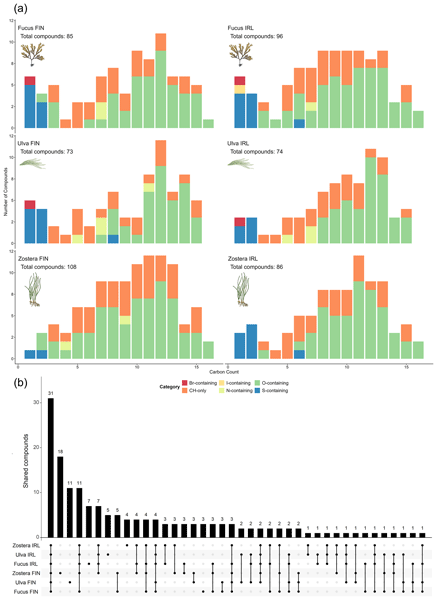
Biogenic volatile organic compounds (BVOCs) emitted by Earth’s ecosystems have profound climate impacts, but emissions from marine benthic sources are poorly quantified. We quantified BVOC emission rates from three macrophytes across two contrasting marine regions and found highly diverse emission profiles with high intra‑ and interspecific variability. Our results underscore the need for more high-quality data, so that macrophyte emissions can eventually be integrated into marine BVOC budgets.
Nishant Nishant, Janina Pykäri, Roel Lammerant, Anna Villnäs, Camilla Gustafsson, Alf Norkko, Gregory Cowie, and Tom Jilbert
EGUsphere, https://doi.org/10.5194/egusphere-2026-4456, https://doi.org/10.5194/egusphere-2026-4456, 2026
This preprint is open for discussion and under review for Biogeosciences (BG).
Short summary
Short summary
Carbon storage in shallow coastal sediments varies strongly with wave exposure and local environmental conditions. Across 20 shallow brackish-water coastal sites in Southern Finland, sheltered sediments held much more carbon than wave-exposed sediments. The carbon-rich sediments further showed more active ongoing carbon breakdown. Our approach highlights the diversity of shallow coastal seafloor environments in terms of sediment carbon storage and recycling.
Max Oliver Aleksi Kankainen, Ana Lúcia Lindroth Dauner, Tuomas Junna, Asko Simojoki, Karoliina Koho, and Tom Jilbert
EGUsphere, https://doi.org/10.5194/egusphere-2026-3899, https://doi.org/10.5194/egusphere-2026-3899, 2026
Short summary
Short summary
Lakes are important for the global carbon cycle, yet the variability in carbon burial and degradation, especially in vegetated shorelines, is not well understood. We found that vegetated shorelines can accumulate sediment carbon over long periods with low degradation or over short periods with high degradation, depending on hydrodynamic energy. In contrast, open water sediments accumulate less carbon but do so more reliably over time, with degradation influenced by the source of organic matter.
Aki Vähä, Joachim Jansen, Kurt Spence, Joanna Norkko, Alf Norkko, and Ivan Mammarella
EGUsphere, https://doi.org/10.5194/egusphere-2026-3945, https://doi.org/10.5194/egusphere-2026-3945, 2026
Short summary
Short summary
Coasts are globally identified as sinks of carbon. We found that a coastal site in northern Baltic Sea acted as a small source of carbon dioxide into the atmosphere during 2022–2024. There was a seasonal pattern of carbon dioxide exchange: a sink during spring, a variable sink and source during summer, and a source during autumn and winter. Our gap-filling model identified wind speed and sea salinity as the most important environmental co-variates of the carbon dioxide exchange.
Jan-Victor Björkqvist, Mari Savela, Heidi Pettersson, Victor Alari, and Alf Norkko
Ocean Sci., 22, 2123–2141, https://doi.org/10.5194/os-22-2123-2026, https://doi.org/10.5194/os-22-2123-2026, 2026
Short summary
Short summary
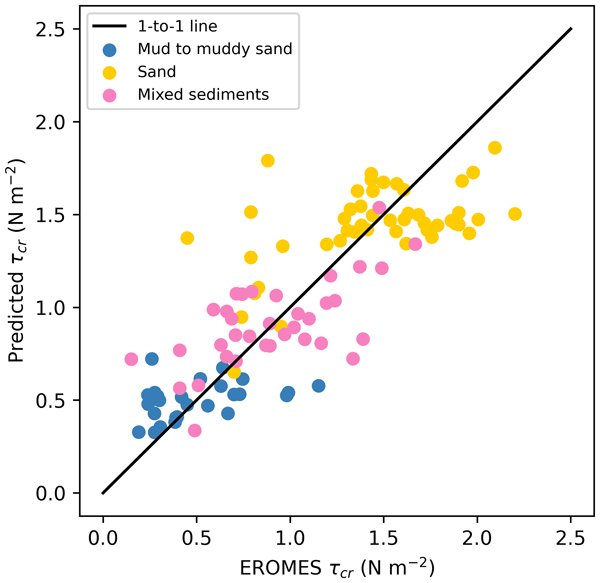
Strong motions caused by surface waves can set the material at the bottom in motion. How strong the wave motions need to be depends on the bottom type, for example mud or sand. We estimated how often waves can lift particles from the bottom by comparing wave model results to sea floor samples in the laboratory. We included the effect of seasonal biological activity, which was found to be significant.
Felix Strobel, Gregor Hillers, Tom Jilbert, John Loehr, Christian Stranne, Tahvo Oksanen, Jonathan Vänskä, Roméo Courbis, Annukka Rintamäki, Amir Sadeghi-Bagherabadi, Lasse Weißgräber, Yinshuai Ding, Marc de Langenhagen, Eduardo Valero Cano, Kwabena Atobra, Vicent Doñate Felip, Valtteri Hopiavuori, Max Kankainen, Mohammad Alem Khodadadi, Kauri Kolehmainen, Emma Makkonen, Liisa Nygrén, Eero Purhonen, Niklas Rolleberg, Jasmiina Tuomiranta, Tommi Vuorinen, Aurélien Mordret, Cédric Schmelzbach, Ludovic Moreau, Olivier Coutant, and Céline Hadziioannou
EGUsphere, https://doi.org/10.5194/egusphere-2026-2106, https://doi.org/10.5194/egusphere-2026-2106, 2026
Short summary
Short summary
We describe an experiment to investigate variations of lake ice properties. We put a large number of seismic instruments on a frozen lake to record the ambient ice vibrations and make a range of supporting measurements. The initial results show that environmental effects can be resolved from the vibrations. This includes meteorological changes but also the trapping of methane or other gas bubbles during ice formation, which can help quantify the release of greenhouse gases from lakes.
Ana Lúcia Lindroth Dauner, Max O. A. Kankainen, Sakari Väkevä, Eero Asmala, Marko Järvinen, Karoliina Koho, and Tom Jilbert
Biogeosciences, 23, 3637–3653, https://doi.org/10.5194/bg-23-3637-2026, https://doi.org/10.5194/bg-23-3637-2026, 2026
Short summary
Short summary
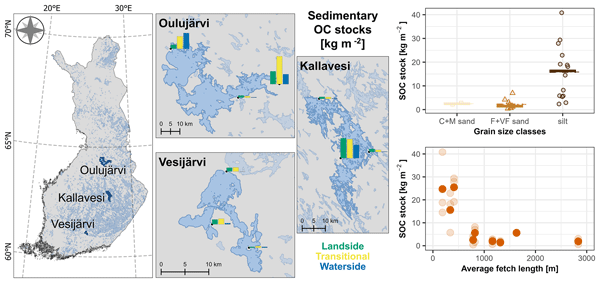
Aquatic vegetated ecosystems are important for global carbon storage, but freshwater shorelines remain understudied. We found that the sedimentary organic carbon (SOC) stocks ranged from 0 to 40.8 kg m−2, with a large spatial variability. Large SOC stocks were found in sheltered areas, with the predominance of fine-grained sediments. In exposed areas, vegetation might also impact SOC accumulation. Accounting for shoreline exposure is crucial for improving regional carbon budget estimates.
Marie Korppoo, Inese Huttunen, Markus Huttunen, Maiju Narikka, Jari Silander, Tom Jilbert, Martin Forsius, Pirkko Kortelainen, Niina Kotamäki, Cintia Uvo, and Anna-Kaisa Ronkanen
Hydrol. Earth Syst. Sci., 30, 3095–3119, https://doi.org/10.5194/hess-30-3095-2026, https://doi.org/10.5194/hess-30-3095-2026, 2026
Short summary
Short summary
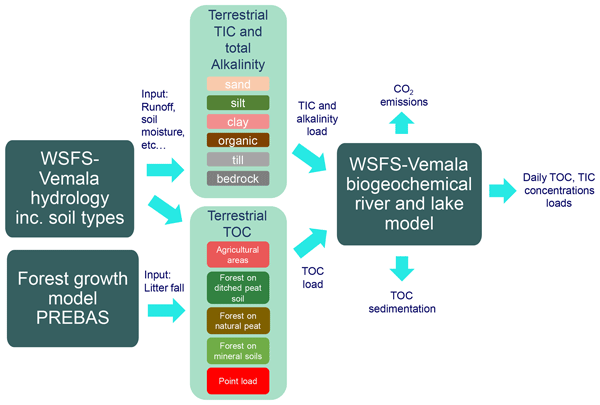
The development of carbon processes in the water quality model WSFS (Watershed Simulation and Forecasting System)-Vemala presents a significant advancement in simulating both total organic and inorganic carbon dynamics, burial and emissions through a river/lake network. The addition of organic acids to the total alkalinity definition improved pH simulations and thus the simulation of CO2 emissions in the acidic and organic rich waters of Finland. The new Vemala model provides a robust foundation to support water management in the future.

Nicolas-Xavier Geilfus, Bruno Delille, Anna Villnäs, and Alf Norkko
Biogeosciences, 23, 1931–1948, https://doi.org/10.5194/bg-23-1931-2026, https://doi.org/10.5194/bg-23-1931-2026, 2026
Short summary
Short summary
Coastal ecosystems strongly influence the global carbon cycle but remain poorly quantified. We measured surface pCO₂, CH₄, and N₂O concentrations in southwest Finland across an estuarine ecosystem. Greenhouse gases concentrations varied with salinity and habitat type. Riverine inputs and mixing with seawater, and primary production shaped greenhouse gases dynamics, emphasizing benthic control as a key yet uncertain driver of coastal carbon fluxes.
Dana Hellemann, Xiaole Sun, Tom Jilbert, Eva Ehrnsten, Lora Harris, Bo Gustafsson, Christoph Humborg, and Alf Norkko
EGUsphere, https://doi.org/10.5194/egusphere-2026-959, https://doi.org/10.5194/egusphere-2026-959, 2026
Short summary
Short summary
Using model-simulations and field data, we assess the effect of past eutrophication on present and future ammonium dynamics in coastal sediments of the Baltic Sea and their impact on the coastal ecosystem. Our results indicate a clear eutrophication legacy effect on the persistence of ammonium being released from the sediment to the water column, particularly under oxygen deficiency, with long-lasting effects into the far future and thus important implications for ecosystem recovery measures.
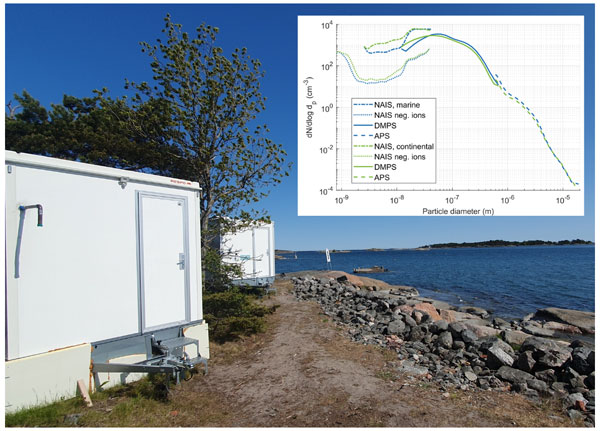
Maija Peltola, Roseline Thakur, Kurt Spence, Janne Lampilahti, Ronja Mäkelä, Sasu Karttunen, Ekaterina Ezhova, Sami Haapanala, Aki Vähä, Juha Kangasluoma, Tommy Chan, Pauli Paasonen, Joanna Norkko, Alf Norkko, Markku Kulmala, and Mikael Ehn
Atmos. Chem. Phys., 26, 489–513, https://doi.org/10.5194/acp-26-489-2026, https://doi.org/10.5194/acp-26-489-2026, 2026
Short summary
Short summary
Here, we report aerosol properties from a new atmospheric observatory established at the Finnish Baltic Sea Coast. Aerosol formation was observed when air masses crossed over the continent whereas less newly formed particles were observed when the winds were from the sea. Aerosol formation was favoured by low condensation sink and sunny dry conditions.
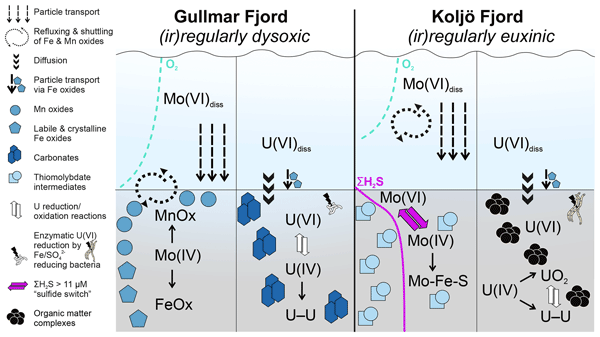
K. Mareike Paul, Martijn Hermans, Sami A. Jokinen, Inda Brinkmann, Helena L. Filipsson, and Tom Jilbert
Biogeosciences, 20, 5003–5028, https://doi.org/10.5194/bg-20-5003-2023, https://doi.org/10.5194/bg-20-5003-2023, 2023
Short summary
Short summary
Seawater naturally contains trace metals such as Mo and U, which accumulate under low oxygen conditions on the seafloor. Previous studies have used sediment Mo and U contents as an archive of changing oxygen concentrations in coastal waters. Here we show that in fjords the use of Mo and U for this purpose may be impaired by additional processes. Our findings have implications for the reliable use of Mo and U to reconstruct oxygen changes in fjords.
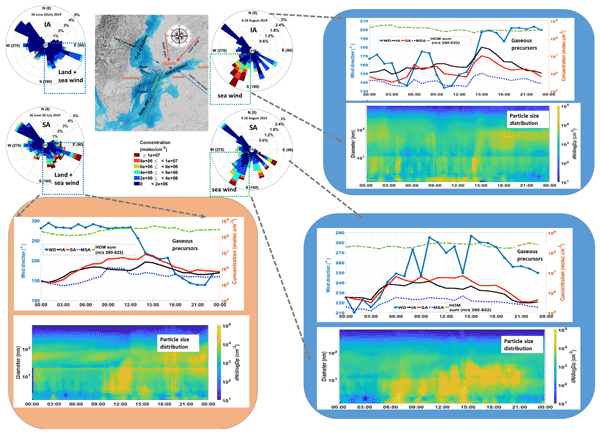
Roseline C. Thakur, Lubna Dada, Lisa J. Beck, Lauriane L. J. Quéléver, Tommy Chan, Marjan Marbouti, Xu-Cheng He, Carlton Xavier, Juha Sulo, Janne Lampilahti, Markus Lampimäki, Yee Jun Tham, Nina Sarnela, Katrianne Lehtipalo, Alf Norkko, Markku Kulmala, Mikko Sipilä, and Tuija Jokinen
Atmos. Chem. Phys., 22, 6365–6391, https://doi.org/10.5194/acp-22-6365-2022, https://doi.org/10.5194/acp-22-6365-2022, 2022
Short summary
Short summary
Every year intense cyanobacterial and macroalgal blooms occur in the Baltic Sea and in the coastal areas surrounding Helsinki, yet no studies have addressed the impact of biogenic emissions from these blooms on gas vapor concentrations, which in turn could influence new particle formation. This is the first study of its kind to address the chemistry driving new particle formation (NPF) during a bloom period in this region, highlighting the role of biogenic sulfuric acid and iodic acid.
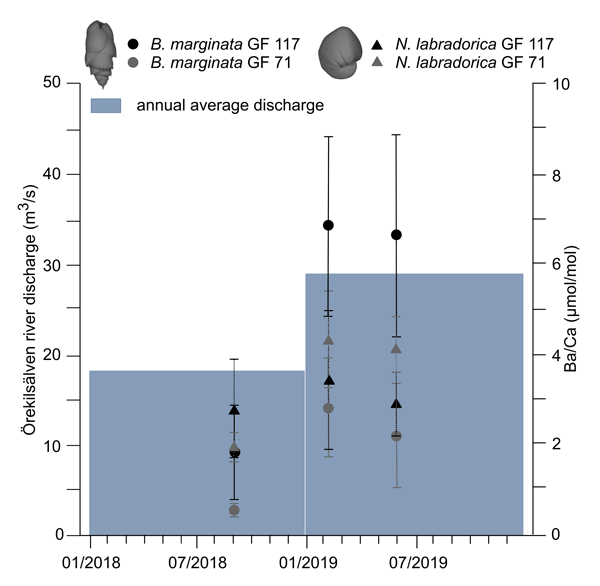
Inda Brinkmann, Christine Barras, Tom Jilbert, Tomas Næraa, K. Mareike Paul, Magali Schweizer, and Helena L. Filipsson
Biogeosciences, 19, 2523–2535, https://doi.org/10.5194/bg-19-2523-2022, https://doi.org/10.5194/bg-19-2523-2022, 2022
Short summary
Short summary
The concentration of the trace metal barium (Ba) in coastal seawater is a function of continental input, such as riverine discharge. Our geochemical records of the severely hot and dry year 2018, and following wet year 2019, reveal that prolonged drought imprints with exceptionally low Ba concentrations in benthic foraminiferal calcium carbonates of coastal sediments. This highlights the potential of benthic Ba / Ca to trace past climate extremes and variability in coastal marine records.
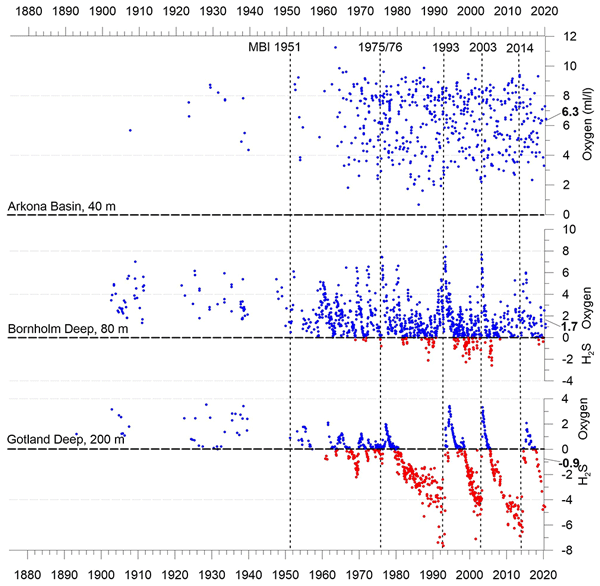
Karol Kuliński, Gregor Rehder, Eero Asmala, Alena Bartosova, Jacob Carstensen, Bo Gustafsson, Per O. J. Hall, Christoph Humborg, Tom Jilbert, Klaus Jürgens, H. E. Markus Meier, Bärbel Müller-Karulis, Michael Naumann, Jørgen E. Olesen, Oleg Savchuk, Andreas Schramm, Caroline P. Slomp, Mikhail Sofiev, Anna Sobek, Beata Szymczycha, and Emma Undeman
Earth Syst. Dynam., 13, 633–685, https://doi.org/10.5194/esd-13-633-2022, https://doi.org/10.5194/esd-13-633-2022, 2022
Short summary
Short summary
The paper covers the aspects related to changes in carbon, nitrogen, and phosphorus (C, N, P) external loads; their transformations in the coastal zone; changes in organic matter production (eutrophication) and remineralization (oxygen availability); and the role of sediments in burial and turnover of C, N, and P. Furthermore, this paper also focuses on changes in the marine CO2 system, the structure of the microbial community, and the role of contaminants for biogeochemical processes.
Cited articles
Adams, J. and Bate, G.: Growth and photosynthetic performance of Phragmites australis in estuarine waters: A field and experimental evaluation, Aquatic Botany, 64, 359–367, 1999.
Altartouri, A., Nurminen, L., and Jolma, A.: Modeling the role of the close-range effect and environmental variables in the occurrence and spread of Phragmites australis in four sites on the Finnish coast of the Gulf of Finland and the Archipelago Sea, Ecology and Evolution, 4, 987–1005, 2014.
Asaeda, T., Manatunge, J., Fujino, T., and Sovira, D.: Effects of salinity and cutting on the development of Phragmites australis, Wetlands Ecology and Management, 11, 127–140, 2003.
BioRender.com: Figure 2, Reed bed zone cross section, created in BioRender by Williamson, M., https://app.biorender.com/illustrations/6899d3f5aa7b2163ca71671f (last access: 16 February 2026), 2025.
Buczko, U., Jurasinski, G., Glatzel, S., and Karstens, S.: Blue Carbon in Coastal Phragmites Wetlands Along the Southern Baltic Sea, Estuaries and Coasts, 45, 2274–2282, 2022.
Caplan, J. S., Hager, R. N., Megonigal, J. P., and Mozdzer, T. J.: Global change accelerates carbon assimilation by a wetland ecosystem engineer, Environ. Res. Lett., 10, 115006, https://doi.org/10.1088/1748-9326/10/11/115006, 2015.
Cleophas, F., Moktar, N., Zahari, N. Z., Adnan, F. A. F., Tair, R., Budin, K., Musta, B., and Bidin, K.: Field evaluation of a simple infiltration test and its relationship with soil physical properties of three different types of land uses, Science, Engineering and Health Studies, 2630-0087, https://doi.org/10.69598/sehs.18.24020008, 2024.
Cui, Q., Yang, H., Wang, G., Ma, J., Feng, L., and Jingtao, L.: Response of soil carbon fractions and enzyme activities to mowing management on in a coastal wetland of the yellow river delta, Frontiers in Marine Science, 9, https://doi.org/10.3389/fmars.2022.993181, 2022.
Dong, W., Shu, J., He, P., Ma, G., and Dong, M.: Study on the Carbon Storage and Fixation of Phramites autralis in Baiyangdian Demonstration Area. Procedia Environmental Sciences, 13, 324–330, 2012.
Duarte, C. M., Losada, I. J., Hendriks, I. E., Mazarrasa, I., and Marbà, N.: The role of coastal plant communities for climate change mitigation and adaptation, Nat. Clim. Change, 3, 961–968, 2013.
Duke, S. T., Francoeur, S. N., and Judd, K. E.: Effects of Phragmites australis Invasion on Carbon Dynamics in a Freshwater Marsh, Wetlands, 35, 311–321, 2015.
Fiala, K.: Underground organs of Phragmites communis, their growth, biomass and net production, Folia Geobotanica et Phytotaxonomica, 11, 225–259, 1976.
Furman, E., Pihlajamäki, M., Välipakka, P., and Myrberg, K.: The Baltic Sea: Environment and Ecology, Finish Environment Institute (SYKE), Helsinki, 69 pp., 2014.
Gilby, B., Weinstein, M. P., Baker, R., Cebrian, J., Alford, S. B., Chelsky, A., Colombano, D., Connolly, R. M., Currin, C. A., Feller, I. C., Frank, A., Goeke, J. A., Goodridge Gaines, L. A., Hardcastle, F. E., Henderson, C. J., Martin, C. W., McDonald, A. E., Morrison, B. H., Olds, A. D., Rehage, J. S., Waltham, N. J., and Ziegler, S. L.: Human Actions Alter Tidal Marsh Seascapes and the Provision of Ecosystem Services, Estuar. Coast., 44, https://doi.org/10.1007/s12237-020-00830-0, 2020.
Güsewell, S.: Management of Phragmites australis in Swiss fen meadows by mowing in early summer, Wetlands Ecology and Management, 11, 433–445, 2003.
Heiri, O., Lotter, A. F., and Lemcke, G.: Loss on ignition as a method for estimating organic and carbonate content in sediments: reproducibility and comparability of results, Journal of Paleolimnology, 25, 101–110, 2001.
Hillmann, E. R., Rivera-Monroy, V. H., Nyman, J. A., and La Peyre, M. K.: Estuarine submerged aquatic vegetation habitat provides organic carbon storage across a shifting landscape, Science of the Total Environment, 717, https://doi.org/10.1016/j.scitotenv.2020.137217 0048-9697, 2020.
Horppila, J., Kaitaranta, J., Joensuu, L., and Nurminen, L.: Influence of emergent macrophyte (Phragmites australis) density on water turbulence and erosion of organic-rich sediment, Journal of Hydrodynamics, 25, 288–293, 2013.
Howard, J., Hoyt, S., Isensee, K., Pidgeon, E., and Telszewski, M.: Coastal Blue Carbon: Methods for Assessing Carbon Stocks and Emissions Factors in Mangroves, Tidal Salt Marshes, and Seagrasses. Conservation International, Intergovernmental Oceanographic Commission of UNESCO, International Union for Conservation of Nature, Arlington, Virginia, USA, https://unesdoc.unesco.org/ark:/48223/pf0000372868 (last access: 16 February 2026), 2014.
Huhta, A.: To cut or not to cut? The relationship between Common Reed, mowing and water quality. Read up on Reed, Turku University of Applied Sciences, ISBN: 978-952-11-2781-6, 2007.
Huhta, A.: Decorative or Outrageous – The significance of the Common Reed (Phragmites australis) on water quality. Comments from Turku University of Applied Sciences, 48, Turku University of Applied Sciences, ISBN: 978-952-216-085-0, 2009.
Iaeus, M. and Rygg, B.: Wave Exposure Calculations for the Finnish Coast. Oslo, Norway: NIVA, Norwegian Institute for Water Research, ISBN: 82-577-4780-7, 2005.
Jingtai, L., Yan, D., Yao, X., Liu, Y., Xie, S., Sheng, Y., and Luan, Z.: Dynamics of Carbon Storage in Saltmarshes Across China's Eastern Coastal Wetlands From 1987 to 2020., Frontiers in Marine Science, 9, https://doi.org/10.3389/fmars.2022.915727, 2022.
Kang, B., Chen, X., Du, Z., Meng, W., and Li, H.: Species-based Mapping of Carbon Stocks in Salt Marsh: Tianjin Coastal zone as a Case Study, Ecosystem Health and Sustainability, 9, https://doi.org/10.34133/ehs.0052, 2023.
Macreadie, P. I., Anton, A., Raven, J. A., Beaumont, N., Connolly, R. M., Friess, D. A., Kelleway, J. J., Kennedy, H., Kuwae, T., Lavery, P. S., Lovelock, C. E., Smale, D. A., Apostolaki, E. T., Atwood, T. B., Baldock, J., Bianchi, T. S., Chmura, G. L., Eyre, B. D., Fourqurean, J. W., Hall-Spencer, J. M., Huxham, M., Hendriks, I. E., Krause-Jensen, D., Laffoley, D., Luisetti, T., Marbà, N., Masque, P., McGlathery, K. J., Megonigal, J. P., Murdiyarso, D., Russell, B. D., Santos, R., Serrano, O., Silliman, B. R., Watanabe, K., and Duarte, C. M.: The Future of Blue Carbon Science, Nature Communications, 10, https://doi.org/10.1038/s41467-019-11693-w, 2019.
Macreadie, P. I., Costa, M. D. P., Atwood, T. B., Friess, D. A., Kelleway, J. J., Kennedy, H., Lovelock, C. E., Serrano, O., and Duarte, C. M.: Blue carbon as a natural climate solution, Nat. Rev. Earth Environ., 2, 826–839, 2021.
Mazarrasa, I., Neto, J. M., Bouma, T. J., Grandjean, T., Garcia-Orellana, J., Masqué, P., Recio, M., Serrano, O., Puente, A., and Juanes, J. A.: Drivers of variability in Blue Carbon stocks and burial rates across European estuarine habitats, Science of the Total Environment, 886, https://doi.org/10.1016/j.scitotenv.2023.163957, 2023.
Meriste, M., Kirsimäe, K., and Freiberg, L.: Relative Sea-Level Changes at Shallow Coasts Inferred from Reed Bed Distribution over the Last 50 Years in Matsalu Bay, the Baltic Sea, Journal of Coastal Research, 28, 1–10, 2012.
Moore, G., Burdick, D., Peter, C., and Keirstead, D.: Belowground Biomass of Phragmites australis in Coastal Marshes, Northeastern Naturalist, 19, 611–626, 2012.
Mozdzer, T. J. and Zieman, J. C.: Ecophysiological differences between genetic lineages facilitate the invasion of non-native Phragmites australis in North American Atlantic coast wetlands, Journal of Ecology, 98, 451–458, 2010.
Müller, D., Liu, B., Geibert, W., Holtappels, M., Sander, L., Miramontes, E., Taubner, H., Henkel, S., Hinrichs, K., Bethke, D., Dohrmann, I., and Kasten, S.: Depositional controls and budget of organic carbon burial in fine-grained sediments of the North Sea- the Helgoland Mud Areas as a natural laboratory. Biogeosciences 22, 2541–2567, https://doi.org/10.5194/bg-22-2541-2025, 2025.
Newton, A., Icely, J., Cristina, S., Perillo, G. M. E., Turner, R. E., Ashan, D., Cragg, S., Luo, Y., Tu, C., Li, Y., Zhang, H., Ramesh, R., Forbes, D. L., Solidoro, C., Béjaoui, B., Gao, S., Pastres, R., Kelsey, H., Taillie, D., Nhan, N., Brito, A.C., de Lima, R., and Kuenzer, C.: Anthropogenic, Direct Pressures on Coastal Wetlands, Frontiers in Ecology and Evolution, 8, https://doi.org/10.3389/fevo.2020.00144, 2020.
Niemi, N., Hansen, J. P., Eklöf, J. S., Eriksson, B. K., Andersson, H. C., Bergström, U., and Östman, Ö.: Influence of reed beds (Phragmites australis) and submerged vegetation on pike (Esox lucius), Fisheries Research, 261, 106621, https://doi.org/10.1016/j.fishres.2023.106621, 2023.
Oksanen, J., Guillaume Blanchet, F., Friendly, M., Kindt, R., Legendre, P., McGlinn, D., Minchin, P. R., O'Hara, R. B., Simpson, G. L., Solymos, P., Stevens, H., Szoecs, E., and Wagner, H.: Vegan: Community ecology package. R package version 2.5-6, 2019, The Comprehensive R Archive Network (CRAN), https://doi.org/10.32614/CRAN.package.vegan, 2020.
Pawlak, J. F., Laamanen, M., and Andersen, J. H.: HELCOM, Eutrophication in the Baltic Sea: An integrated thematic assessment of the effects of nutrient enrichment in the Baltic Sea region, Baltic Sea Environment Protection Commission Proceedings No. 115B, Helsinki Commission, Helsinki, Finland, Baltic Sea Environment Protection Commission (HELCOM), https://doi.org/10.13140/RG.2.1.2758.0564, 2009.
Pendleton, L., Donato, D. C., Murray, B. C., Crooks, S., Jenkins, W. A., Sifleet, S., Craft, C., Fourqurean, J. W., Kauffman, J. B., Marba, N., Megonigal, P., Pidgeon E., Herr, D., Gordon, D., and Baldera, A.: Estimating global blue carbon emissions from conversion and degradation of vegetated coastal ecosystems, PLoS ONE, 7, e43542, https://doi.org/10.1371/journal.pone.0043542, 2012.
Pitkänen, T.: Where does the reed grow? Järviruokoalueidan satelliittikartoitus Etelä-Suomessa ja Viron Väinänmeren rannikoilla. Turuun ammattikorkeakoulun puheenvuoroja 29, Turku University of Applied Sciences, http://julkaisut.turkuamk.fi/isbn9525596664.pdf (last access: 16 February 2026), 2006.
Pitkänen, T., Meriste, M., Kikas, T., and Kask, U.: Reed resource mapping in Finland and Estonia, Read up on Reed, Turku University of Applied Sciences, ISBN: 978-952-11-2781-6, 2007.
R Core Team: R: A language and environment for statistical computing, R Foundation for Statistical Computing, Vienna, Austria, https://www.R-project.org/ (last access: 16 February 2026), 2024.
Rietl, A. J., Nyman, J. A., Lindau, C. W., and Jackson, C. R.: Wetland methane emissions altered by vegetation disturbance: An interaction between stem clipping and nutrient enrichment, Aquatic Botany, 136, 205–211, 2017.
Röhr, M. E., Boström, C., Canal-Vergés, P., and Holmer, M.: Blue carbon stocks in Baltic Sea eelgrass (Zostera marina) meadows, Biogeosciences, 13, 6139–6153, https://doi.org/10.5194/bg-13-6139-2016, 2016.
Serrano, O., Lovelock, C. E., Atwood, T. B., Macreadie, P. I., Canot, R., Phinn, S., Arias-Ortiz, A., Bai, L., Baldock, J., Bedulli, C., Carnell, P., Connolly, R. M., Donaldson, P., Esteban, A., Ewers Lewis, C. J., Eyre, B. D., Hayes, M. A., Horwitz, P., Hutley, L. B., Kavazos, C. R. J., Kelleway, J. J., Kendrick, G. A., Kilminster, K., Lafratta, A., Lee, S., Lavery, P. S., Maher, D. T., Marba, N., Masque, P., Mateo, M. A., Mount, R., Ralph, P. J., Roelfsema, C., Rozaimi, M., Ruhon, R., Salinas, C., Samper-Villarreal, J., Sanderman, J., Sanders, C. J., Santos, I., Sharples, C., Steven, A. D. L., Cannard, T., Trevathan-Tackett, S. M., and Duarte, C. M.: Australian vegetated coastal ecosystems as global hotspots for climate change mitigation, Nature Communications, 10, https://doi.org/10.1038/s41467-019-12176-8, 2019.
Silan, G., Buosi, A., Bertolini, C., and Sfriso, A.: Dynamics and drivers of carbon sequestration and storage capacity in Phragmites australis-dominated wetlands. Estuarine, Coastal and Shelf Science, 298, 108640, https://doi.org/10.1016/j.ecss.2024.108640, 2024.
van der Meijs, F. and Isaeus, M.: Wave exposure calculations for the Gulf of Finland, Aqua. Biot. Rep., 13, ISBN: 978-91-89085-22-0, 2020.
Warrence, N. J., Pearson, K. E., and Bauder, J. W.: Basics of salinity and sodicity effects on soil physical properties. Department of Land Resources and Environmental Sciences, Montana State University-Bozeman, https://waterquality.montana.edu/energy/cbm/background/soil-prop.html (last access: 16 February 2026), 2003.
Williamson, M. F.: Carbon Stocks in Coastal Reed Beds, Zenodo [data set], https://doi.org/10.5281/zenodo.18537690, 2026.
Xiong, J., Shao, X., Yuan, H., Liu, E., and Wu, M.: Carbon, Nitrogen, and Phosphorus Stoichiometry and Plant Growth Strategy as Related to Land-Use in Hangzhou Bay Coastal Wetland, China, Front. Plant Sci., 13, 946949, https://doi.org/10.3389/fpls.2022.946949, 2022.
Yost, J. L. and Hartemink, A. E.: How deep is the soil studied-an analysis of four soil science journals, Plant and Soil, 452, 5–18, 2020.
Zuur, A. F., Ieno, E. N., and Elphick, C. S.: A protocol for data exploration to avoid common statistical problems, Methods in Ecology and Evolution, 1, 3–14, 2010.
Short summary
Reed bed carbon (C) storage is a topic of interest due to increased global distribution of reeds. C budgets to combat climate change often catalog reed beds as saltmarshes. Our findings show that reed beds are unique from saltmarshes, C storage is highest in reed bed sediments, and that reed bed zones may impact C storage. Further research into reed bed C is needed to better combat climate change and to ensure reeds are managed in a way that does not release excess C.
Reed bed carbon (C) storage is a topic of interest due to increased global distribution of...


Altmetrics
Final-revised paper
Preprint