
Articles | Volume 23, issue 5
https://doi.org/10.5194/bg-23-1881-2026
© Author(s) 2026. This work is distributed under
the Creative Commons Attribution 4.0 License.
the Creative Commons Attribution 4.0 License.
https://doi.org/10.5194/bg-23-1881-2026
© Author(s) 2026. This work is distributed under
the Creative Commons Attribution 4.0 License.
the Creative Commons Attribution 4.0 License.
Technical note
| 
11 Mar 2026
Technical note |
| 11 Mar 2026
| 11 Mar 2026
Technical note: Further adjustments to the Rock-Eval® thermal analysis for soil organic and inorganic carbon quantification to avoid post-hoc corrections
Joséphine Hazera
CORRESPONDING AUTHOR
Institut des Sciences de la Terre de Paris ISTeP – UMR 7193, Sorbonne Université, CNRS, CY Univ, Paris, 75005, France
Direction Sciences de la Terre et Technologies de l'Environnement, IFP Énergies Nouvelles, Rueil-Malmaison, 92852, France
Eco&Sols, University of Montpellier, CIRAD, Institut Agro Montpellier, INRAE, IRD, Montpellier, 34060, France
David Sebag
Direction Sciences de la Terre et Technologies de l'Environnement, IFP Énergies Nouvelles, Rueil-Malmaison, 92852, France
Isabelle Kowalewski
Direction Sciences de la Terre et Technologies de l'Environnement, IFP Énergies Nouvelles, Rueil-Malmaison, 92852, France
Herman Ravelojaona
Direction Sciences de la Terre et Technologies de l'Environnement, IFP Énergies Nouvelles, Rueil-Malmaison, 92852, France
Eric Verrecchia
Institute of Earth Surface Dynamics, University of Lausanne, Lausanne, 1015, Switzerland
Gergely Jakab
HUN-REN Research Centre for Astronomy and Earth Sciences, Geographical Institute, Budapest, 1121, Hungary
Dóra Zacháry
HUN-REN Research Centre for Astronomy and Earth Sciences, Geographical Institute, Budapest, 1121, Hungary
Florian Schneider
Institute of Climate-Smart Agriculture, Thünen, 38116 Braunschweig, Germany
Luca Trombino
Earth Science Department, University of Milan, Milan, 20133, Italy
Raphaël J. Manlay
Eco&Sols, University of Montpellier, CIRAD, Institut Agro Montpellier, INRAE, IRD, Montpellier, 34060, France
AgroParisTech, Palaiseau, 91120, France
Julien Fouché
Lisah, University of Montpellier, Institut Agro Montpellier, INRAE, IRD, Montpellier, 34060, France
Tiphaine Chevallier
Eco&Sols, University of Montpellier, CIRAD, Institut Agro Montpellier, INRAE, IRD, Montpellier, 34060, France
Related authors
Joséphine Hazera, David Sebag, Isabelle Kowalewski, Eric Verrecchia, Herman Ravelojaona, and Tiphaine Chevallier
Biogeosciences, 20, 5229–5242, https://doi.org/10.5194/bg-20-5229-2023, https://doi.org/10.5194/bg-20-5229-2023, 2023
Short summary
Short summary
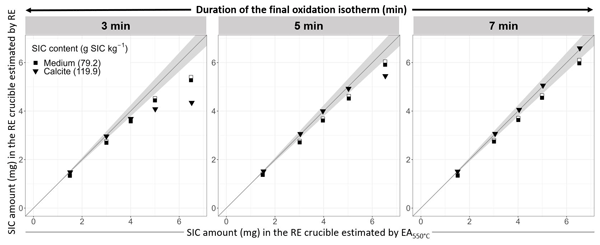
This study adapts the Rock-Eval® protocol to quantify soil organic carbon (SOC) and soil inorganic carbon (SIC) on a non-pretreated soil aliquot. The standard protocol properly estimates SOC contents once the TOC parameter is corrected. However, it cannot complete the thermal breakdown of SIC amounts > 4 mg, leading to an underestimation of high SIC contents by the MinC parameter, even after correcting for this. Thus, the final oxidation isotherm is extended to 7 min to quantify any SIC amount.
Maxime Thomas, Julien Fouché, Hugues Titeux, Charlotte Morelle, Nathan Bemelmans, Melissa J. Lafrenière, Joanne K. Heslop, and Sophie Opfergelt
SOIL, 12, 633–664, https://doi.org/10.5194/soil-12-633-2026, https://doi.org/10.5194/soil-12-633-2026, 2026
Short summary
Short summary
This study examines organic carbon (OC)–mineral interactions in permafrost soils undergoing thermokarst degradation in Cape Bounty (Melville Island, Canada). Chemically stabilized OC accounts for 13 ± 5 % as organo-metallic complexes and 6 ± 2 % as associations with iron oxides. Including physical protection, up to 64 ± 10 % of OC is mineral-protected. Deeper layers show a sharp decline in mineral-bound OC, suggesting increased vulnerability to degradation when exposed by deep thaw features.
Camille Rieder, Eric P. Verrecchia, Saskia Bindschedler, Guillaume Cailleau, Aviram Rozin, Munisamy Anbarashan, Shubhendu Dasgupta, Thomas Junier, Nicolas Roeschli, Pascal Vittoz, and Mike C. Rowley
Biogeosciences, 22, 6979–6999, https://doi.org/10.5194/bg-22-6979-2025, https://doi.org/10.5194/bg-22-6979-2025, 2025
Short summary
Short summary
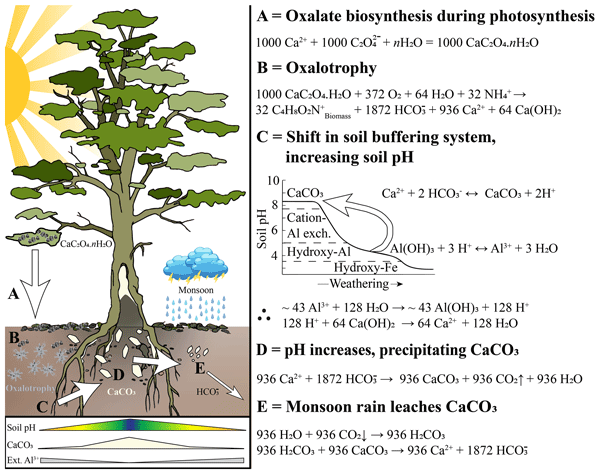
The oxalate-carbonate pathway, where trees and microbes store inorganic carbon as minerals, was studied on four tree species of the threatened tropical dry evergreen forest Indian forest. We used high-throughput sequencing of a gene to detect oxalate-degrading microbes. For all tree species, produced oxalate led to carbonate formation in soils and on wood. This carbon may be leached into water, suggesting a hidden source of inorganic carbon with implications for climate and conservation.
Alexandre Lhosmot, Gabriel Hould Gosselin, Manuel Helbig, Julien Fouché, Youngryel Ryu, Matteo Detto, Ryan Connon, William Quinton, Tim Moore, and Oliver Sonnentag
Hydrol. Earth Syst. Sci., 29, 4871–4892, https://doi.org/10.5194/hess-29-4871-2025, https://doi.org/10.5194/hess-29-4871-2025, 2025
Short summary
Short summary
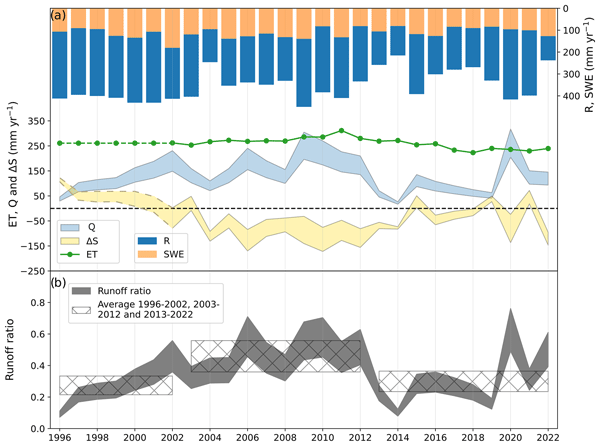
Thawing permafrost changes how water is stored and moves across landscapes. We measured water inputs and outputs in a basin with thawing peatland complexes and three sub-basins. In addition to yearly changes in precipitation and evapotranspiration, we found that hydrological responses are shaped by thaw-driven landscape connectivity. These findings highlight the need for long-term monitoring of ecosystem service shifts.
Xuemeng Tian, Davide Consoli, Martijn Witjes, Florian Schneider, Leandro Parente, Murat Şahin, Yu-Feng Ho, Robert Minařík, and Tomislav Hengl
Earth Syst. Sci. Data, 17, 741–772, https://doi.org/10.5194/essd-17-741-2025, https://doi.org/10.5194/essd-17-741-2025, 2025
Short summary
Short summary
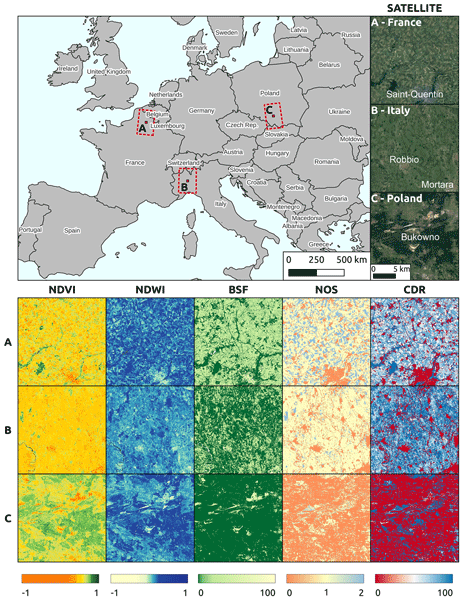
Our study introduces a Landsat-based data cube simplifying access to detailed environmental data across Europe from 2000 to 2022, covering vegetation, water, soil, and crops. Our experiments demonstrate its effectiveness in developing environmental models and maps. Tailored feature selection is crucial for its effective use in environmental modeling. It aims to support comprehensive environmental monitoring and analysis, helping researchers and policy-makers in managing environmental resources.
Joséphine Hazera, David Sebag, Isabelle Kowalewski, Eric Verrecchia, Herman Ravelojaona, and Tiphaine Chevallier
Biogeosciences, 20, 5229–5242, https://doi.org/10.5194/bg-20-5229-2023, https://doi.org/10.5194/bg-20-5229-2023, 2023
Short summary
Short summary
This study adapts the Rock-Eval® protocol to quantify soil organic carbon (SOC) and soil inorganic carbon (SIC) on a non-pretreated soil aliquot. The standard protocol properly estimates SOC contents once the TOC parameter is corrected. However, it cannot complete the thermal breakdown of SIC amounts > 4 mg, leading to an underestimation of high SIC contents by the MinC parameter, even after correcting for this. Thus, the final oxidation isotherm is extended to 7 min to quantify any SIC amount.
Kenji Fujisaki, Tiphaine Chevallier, Antonio Bispo, Jean-Baptiste Laurent, François Thevenin, Lydie Chapuis-Lardy, Rémi Cardinael, Christine Le Bas, Vincent Freycon, Fabrice Bénédet, Vincent Blanfort, Michel Brossard, Marie Tella, and Julien Demenois
SOIL, 9, 89–100, https://doi.org/10.5194/soil-9-89-2023, https://doi.org/10.5194/soil-9-89-2023, 2023
Short summary
Short summary
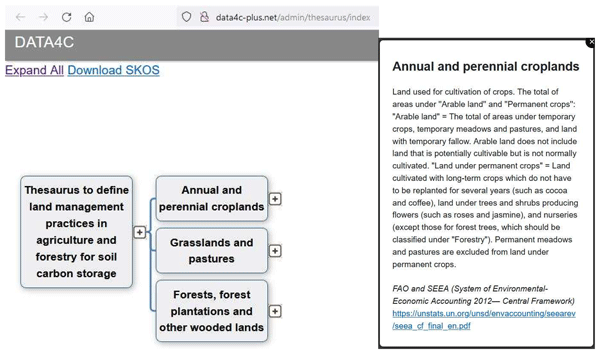
This paper presents a first comprehensive thesaurus for management practices driving soil organic carbon (SOC) storage. So far, a comprehensive thesaurus of management practices in agriculture and forestry has been lacking. It will help to merge datasets, a promising way to evaluate the impacts of management practices in agriculture and forestry on SOC. Identifying the drivers of SOC stock changes is of utmost importance to contribute to global challenges (climate change, food security).

Dóra Hidy, Zoltán Barcza, Roland Hollós, Laura Dobor, Tamás Ács, Dóra Zacháry, Tibor Filep, László Pásztor, Dóra Incze, Márton Dencső, Eszter Tóth, Katarína Merganičová, Peter Thornton, Steven Running, and Nándor Fodor
Geosci. Model Dev., 15, 2157–2181, https://doi.org/10.5194/gmd-15-2157-2022, https://doi.org/10.5194/gmd-15-2157-2022, 2022
Short summary
Short summary
Biogeochemical models used by the scientific community can support society in the quantification of the expected environmental impacts caused by global climate change. The Biome-BGCMuSo v6.2 biogeochemical model has been created by implementing a lot of developments related to soil hydrology as well as the soil carbon and nitrogen cycle and by integrating crop model components. Detailed descriptions of developments with case studies are presented in this paper.
Cited articles
Apesteguia, M., Plante, A. F., and Virto, I.: Methods assessment for organic and inorganic carbon quantification in calcareous soils of the Mediterranean region, Geoderma Regional, 12, 39–48, https://doi.org/10.1016/j.geodrs.2017.12.001, 2018.
Barré, P., Plante, A. F., Cécillon, L., Lutfalla, S., Baudin, F., Bernard, S., Christensen, B. T., Eglin, T., Fernandez, J. M., Houot, S., Kätterer, T., Le Guillou, C., Macdonald, A., Van Oort, F., and Chenu, C.: The energetic and chemical signatures of persistent soil organic matter, Biogeochemistry, 130, 1–12, https://doi.org/10.1007/s10533-016-0246-0, 2016.
Behar, F., Beaumont, V., and De B. Penteado, H. L.: Rock-Eval 6 Technology: Performances and Developments, Oil and Gas Science and Technology – Rev. IFP, 56, 111–134, https://doi.org/10.2516/ogst:2001013, 2001.
Bertrand, I., Delfosse, O., and Mary, B.: Carbon and nitrogen mineralization in acidic, limed and calcareous agricultural soils: Apparent and actual effects, Soil Biology and Biochemistry, 39, 276–288, https://doi.org/10.1016/j.soilbio.2006.07.016, 2007.
Bispo, A., Andersen, L., Angers, D. A., Bernoux, M., Brossard, M., Cécillon, L., Comans, R. N. J., Harmsen, J., Jonassen, K., Lamé, F., Lhuillery, C., Maly, S., Martin, E., Mcelnea, A. E., Sakai, H., Watabe, Y., and Eglin, T. K.: Accounting for Carbon Stocks in Soils and Measuring GHGs Emission Fluxes from Soils: Do We Have the Necessary Standards?, Front. Environ. Sci., 5, 41, https://doi.org/10.3389/fenvs.2017.00041, 2017.
Bughio, M. A., Wang, P., Meng, F., Qing, C., Kuzyakov, Y., Wang, X., and Junejo, S. A.: Neoformation of pedogenic carbonates by irrigation and fertilization and their contribution to carbon sequestration in soil, Geoderma, 262, 12–19, https://doi.org/10.1016/j.geoderma.2015.08.003, 2016.
Cailleau, G., Braissant, O., and Verrecchia, E. P.: Turning sunlight into stone: the oxalate-carbonate pathway in a tropical tree ecosystem, Biogeosciences, 8, 1755–1767, https://doi.org/10.5194/bg-8-1755-2011, 2011.
Carrie, J., Sanei, H., and Stern, G.: Standardisation of Rock–Eval pyrolysis for the analysis of recent sediments and soils, Organic Geochemistry, 46, 38–53, https://doi.org/10.1016/j.orggeochem.2012.01.011, 2012.
Cécillon, L., Baudin, F., Chenu, C., Houot, S., Jolivet, R., Kätterer, T., Lutfalla, S., Macdonald, A., Van Oort, F., Plante, A. F., Savignac, F., Soucémarianadin, L. N., and Barré, P.: A model based on Rock-Eval thermal analysis to quantify the size of the centennially persistent organic carbon pool in temperate soils, Biogeosciences, 15, 2835–2849, https://doi.org/10.5194/bg-15-2835-2018, 2018.
Cécillon, L., Baudin, F., Chenu, C., Christensen, B. T., Franko, U., Houot, S., Kanari, E., Kätterer, T., Merbach, I., Van Oort, F., Poeplau, C., Quezada, J. C., Savignac, F., Soucémarianadin, L. N., and Barré, P.: Partitioning soil organic carbon into its centennially stable and active fractions with machine-learning models based on Rock-Eval® thermal analysis (PARTYSOC v2.0 and PARTYSOC v2.0EU), Geosci. Model Dev., 14, 3879–3898, https://doi.org/10.5194/gmd-14-3879-2021, 2021.
Chassé, M., Lutfalla, S., Cécillon, L., Baudin, F., Abiven, S., Chenu, C., and Barré, P.: Long-term bare-fallow soil fractions reveal thermo-chemical properties controlling soil organic carbon dynamics, Biogeosciences, 18, 1703–1718, https://doi.org/10.5194/bg-18-1703-2021, 2021.
Chevallier, T., Cournac, L., Hamdi, S., Gallali, T., and Bernoux, M.: Temperature dependence of CO2 emissions rates and isotopic signature from a calcareous soil, Journal of Arid Environments, 135, 132–139, https://doi.org/10.1016/j.jaridenv.2016.08.002, 2016.
Delahaie, A. A., Barré, P., Baudin, F., Arrouays, D., Bispo, A., Boulonne, L., Chenu, C., Jolivet, C., Martin, M. P., Ratié, C., Saby, N. P. A., Savignac, F., and Cécillon, L.: Elemental stoichiometry and Rock-Eval® thermal stability of organic matter in French topsoils, SOIL, 9, 209–229, https://doi.org/10.5194/soil-9-209-2023, 2023.
Delahaie, A. A., Cécillon, L., Stojanova, M., Abiven, S., Arbelet, P., Arrouays, D., Baudin, F., Bispo, A., Boulonne, L., Chenu, C., Heinonsalo, J., Jolivet, C., Karhu, K., Martin, M., Pacini, L., Poeplau, C., Ratié, C., Roudier, P., Saby, N. P. A., Savignac, F., and Barré, P.: Investigating the complementarity of thermal and physical soil organic carbon fractions, SOIL, 10, 795–812, https://doi.org/10.5194/soil-10-795-2024, 2024.
Delarue, F., Disnar, J.-R., Copard, Y., Gogo, S., Jacob, J., and Laggoun-Défarge, F.: Can Rock-Eval pyrolysis assess the biogeochemical composition of organic matter during peatification?, Organic Geochemistry, 61, 66–72, https://doi.org/10.1016/j.orggeochem.2013.06.004, 2013.
Deluz, C., Sebag, D., Verrecchia, E., and Boivin, P.: Soil organic matter thermal pools as influenced by depth, tillage, and soil texture – A Rock-Eval® analysis study on the cropland soils of the Swiss Plateau, Geoderma, 445, 116871, https://doi.org/10.1016/j.geoderma.2024.116871, 2024.
Dina Ebouel, F. J., Betsi, T. B., and Eze, P. N.: Soil inorganic carbon: A review of global research trends, analytical techniques, ecosystem functions and critical knowledge gaps, CATENA, 242, 108112, https://doi.org/10.1016/j.catena.2024.108112, 2024.
Disnar, J. R., Guillet, B., Keravis, D., Di-Giovanni, C., and Sebag, D.: Soil organic matter (SOM) characterization by Rock-Eval pyrolysis: scope and limitations, Organic Geochemistry, 34, 327–343, https://doi.org/10.1016/S0146-6380(02)00239-5, 2003.
Emmerich, W. E.: Carbon dioxide fluxes in a semiarid environment with high carbonate soils, Agricultural and Forest Meteorology, 116, 91–102, https://doi.org/10.1016/S0168-1923(02)00231-9, 2003.
Entry, J. A., Sojka, R. E., and Shewmaker, G. E.: Irrigation Increases Inorganic Carbon in Agricultural Soils, Environmental Management, 33, 309–317, https://doi.org/10.1007/s00267-003-9140-3, 2004.
Ferro, K. I.: The impact of oxalogenic plants on soil carbon dynamics: formation of a millennium carbon storage as calcium carbonate, Université de Neuchâtel, https://doi.org/10.35662/unine-thesis-2347, 2012.
Gao, Y., Tian, J., Pang, Y., and Liu, J.: Soil Inorganic Carbon Sequestration Following Afforestation Is Probably Induced by Pedogenic Carbonate Formation in Northwest China, Front. Plant Sci., 8, 1282, https://doi.org/10.3389/fpls.2017.01282, 2017.
Gatz-Miller, H. S., Gérard, F., Verrecchia, E. P., Su, D., and Mayer, K. U.: Reactive transport modelling the oxalate-carbonate pathway of the Iroko tree; Investigation of calcium and carbon sinks and sources, Geoderma, 410, 115665, https://doi.org/10.1016/j.geoderma.2021.115665, 2022.
Guo, Y., Wang, X., Li, X., Xu, M., Li, Y., Zheng, H., Luo, Y., and Smith, P.: Impacts of land use and salinization on soil inorganic and organic carbon in the middle-lower Yellow River Delta, Pedosphere, 31, 839–848, https://doi.org/10.1016/S1002-0160(21)60018-8, 2021.
Hazera, J., Sebag, D., Kowalewski, I., Verrecchia, E., Ravelojaona, H., and Chevallier, T.: Adjustments to the Rock-Eval® thermal analysis for soil organic and inorganic carbon quantification, Biogeosciences, 20, 5229–5242, https://doi.org/10.5194/bg-20-5229-2023, 2023.
Hazera, J., Sebag, D., Kowalewski, I., Ravelojaona, H., Jakab, G., Zachary, D., Schneider, F., Ellert, B., Yanni, S. F., Hannam, K., Brahim, N., Trombino, L., Manlay, R. J., Fouche, J., Kohler, E., Crozet, N., and Chevallier, T.: Organic and Inorganic carbon calcareous soil data – EJP-Soil, SIC-SOC-DYN project, Recherche Data Gouv [data set], https://doi.org/10.57745/AL3NVT, 2026.
He, S., Yang, H., and Cui, X.: Technical note: assessing pretreatment approaches for serial pyrolysis-oxidation analysis of sedimentary organic carbon, Biogeosciences, 22, 6243–6253, https://doi.org/10.5194/bg-22-6243-2025, 2025.
ISO: Dosage du carbone organique et du carbone total après combustion sèche (analyse élémentaire), https://www.iso.org/fr/standard/18782.html (last access: 4 March 2026), 1995.
Kanari, E., Cécillon, L., Baudin, F., Clivot, H., Ferchaud, F., Houot, S., Levavasseur, F., Mary, B., Soucémarianadin, L., Chenu, C., and Barré, P.: A robust initialization method for accurate soil organic carbon simulations, Biogeosciences, 19, 375–387, https://doi.org/10.5194/bg-19-375-2022, 2022.
Khalidy, R., Arnaud, E., and Santos, R. M.: Natural and Human-Induced Factors on the Accumulation and Migration of Pedogenic Carbonate in Soil: A Review, Land, 11, 1448, https://doi.org/10.3390/land11091448, 2022.
Koorneef, G. J., De Goede, R. G., Pulleman, M. M., Van Leeuwen, A. G., Barré, P., Baudin, F., and Comans, R. N.: Quantifying organic carbon in particulate and mineral-associated fractions of calcareous soils – A method comparison, Geoderma, 436, 116558, https://doi.org/10.1016/j.geoderma.2023.116558, 2023.
Lafargue, E., Marquis, F., and Pillot, D.: Rock-Eval 6 Applications in Hydrocarbon Exploration, Production, and Soil Contamination Studies, Rev. Inst. Fr. Pét., 53, 421–437, https://doi.org/10.2516/ogst:1998036, 1998.
Liu, E., Zhou, J., Yang, X., Jin, T., Zhao, B., Li, L., Wen, Y., Soldatova, E., Zamanian, K., Gopalakrishnan, S., Mei, X., and Kuzyakov, Y.: Long-term organic fertilizer-induced carbonate neoformation increases carbon sequestration in soil, Environ Chem Lett, 21, 663–671, https://doi.org/10.1007/s10311-023-01568-4, 2023.
Liu, Z., Zhang, Y., Fa, K., Zhao, H., Qin, S., Yan, R., and Wu, B.: Desert soil bacteria deposit atmospheric carbon dioxide in carbonate precipitates, CATENA, 170, 64–72, https://doi.org/10.1016/j.catena.2018.06.001, 2018.
Malou, O. P., Sebag, D., Moulin, P., Chevallier, T., Badiane-Ndour, N. Y., Thiam, A., and Chapuis-Lardy, L.: The Rock-Eval® signature of soil organic carbon in arenosols of the Senegalese groundnut basin. How do agricultural practices matter?, Agriculture, Ecosystems and Environment, 301, 107030, https://doi.org/10.1016/j.agee.2020.107030, 2020.
Manning, D. A. C.: Biological enhancement of soil carbonate precipitation: passive removal of atmospheric CO2, Mineral. mag., 72, 639–649, https://doi.org/10.1180/minmag.2008.072.2.639, 2008.
Nayak, A. K., Rahman, M. M., Naidu, R., Dhal, B., Swain, C. K., Nayak, A. D., Tripathi, R., Shahid, M., Islam, M. R., and Pathak, H.: Current and emerging methodologies for estimating carbon sequestration in agricultural soils: A review, Science of The Total Environment, 665, 890–912, https://doi.org/10.1016/j.scitotenv.2019.02.125, 2019.
Pacini, L., Adatte, T., Barré, P., Boussafir, M., Bouton, N., Cécillon, L., Lamoureux-Var, V., Sebag, D., Verrecchia, E., Wattripont, A., and Baudin, F.: Reproducibility of Rock-Eval® thermal analysis for soil organic matter characterization, Organic Geochemistry, 186, 104687, https://doi.org/10.1016/j.orggeochem.2023.104687, 2023.
Qafoku, O., Battu, A. K., Varga, T., Marcus, M. A., O'Callahan, B., Zhao, Q., Mergelsberg, S. T., Kew, W. R., Loring, J. S., Qafoku, N. P., and Leichty, S. I.: Chemical composition, coordination, and stability of Ca–organic associations in the presence of dissolving calcite, Environ. Sci.: Nano, 10, 1504–1517, https://doi.org/10.1039/D2EN01143C, 2023.
R Core Team: R: A Language and Environment for Statistical Computing, R-project.org [code], https://www.r-project.org/ (last access: 4 March 2026), 2024.
Raheb, A., Heidari, A., and Mahmoodi, S.: Organic and inorganic carbon storage in soils along an arid to dry sub-humid climosequence in northwest of Iran, CATENA, 153, 66–74, https://doi.org/10.1016/j.catena.2017.01.035, 2017.
Raza, S., Zamanian, K., Ullah, S., Kuzyakov, Y., Virto, I., and Zhou, J.: Inorganic carbon losses by soil acidification jeopardize global efforts on carbon sequestration and climate change mitigation, Journal of Cleaner Production, 315, 128036, https://doi.org/10.1016/j.jclepro.2021.128036, 2021.
Raza, S., Irshad, A., Margenot, A., Zamanian, K., Li, N., Ullah, S., Mehmood, K., Ajmal Khan, M., Siddique, N., Zhou, J., Mooney, S. J., Kurganova, I., Zhao, X., and Kuzyakov, Y.: Inorganic carbon is overlooked in global soil carbon research: A bibliometric analysis, Geoderma, 443, 116831, https://doi.org/10.1016/j.geoderma.2024.116831, 2024.
Rowley, M. C., Grand, S., and Verrecchia, É. P.: Calcium-mediated stabilisation of soil organic carbon, Biogeochemistry, 137, 27–49, https://doi.org/10.1007/s10533-017-0410-1, 2018.
Schlacher, T. A. and Connolly, R. M.: Effects of acid treatment on carbon and nitrogen stable isotope ratios in ecological samples: a review and synthesis, Methods Ecol. Evol, 5., 541–550, https://doi.org/10.1111/2041-210X.12183, 2014.
Sebag, D., Verrecchia, E. P., Cécillon, L., Adatte, T., Albrecht, R., Aubert, M., Bureau, F., Cailleau, G., Copard, Y., Decaens, T., Disnar, J.-R., Hetényi, M., Nyilas, T., and Trombino, L.: Dynamics of soil organic matter based on new Rock-Eval indices, Geoderma, 284, 185–203, https://doi.org/10.1016/j.geoderma.2016.08.025, 2016.
Sebag, D., Garcin, Y., Adatte, T., Deschamps, P., Ménot, G., and Verrecchia, E. P.: Correction for the siderite effect on Rock-Eval parameters: Application to the sediments of Lake Barombi (southwest Cameroon), Organic Geochemistry, 123, 126–135, https://doi.org/10.1016/j.orggeochem.2018.05.010, 2018.
Sebag, D., Lamoureux-Var, V., Kowalewski, I., Pillot, D., and Ravelojoana, H.: Procédé pour la quantification et la caractérisation du carbone dans les sols, IFP Energies Nouvelles, Patent no. FR3121224B1, 2022a.
Sebag, D., Verrecchia, E. P., Adatte, T., Aubert, M., Cailleau, G., Decaëns, T., Kowalewski, I., Trap, J., Bureau, F., and Hedde, M.: Size fractions of organic matter pools influence their stability: Application of the Rock-Eval® analysis to beech forest soils, Pedosphere, 32, 565–575, https://doi.org/10.1016/S1002-0160(21)60050-4, 2022b.
Shabtai, I. A., Wilhelm, R. C., Schweizer, S. A., Höschen, C., Buckley, D. H., and Lehmann, J.: Calcium promotes persistent soil organic matter by altering microbial transformation of plant litter, Nat. Commun., 14, 6609, https://doi.org/10.1038/s41467-023-42291-6, 2023.
Shamrikova, E. V., Vanchikova, E. V., Lu-Lyan-Min, E. I., Kubik, O. S., and Zhangurov, E. V.: Which method to choose for measurement of organic and inorganic carbon content in carbonate-rich soils? Advantages and disadvantages of dry and wet chemistry, CATENA, 228, 107151, https://doi.org/10.1016/j.catena.2023.107151, 2023.
Shamrikova, E. V., Vanchikova, E. V., Kyzyurova, E. V., and Zhangurov, E. V.: Methods for Measuring Organic Carbon Content in Carbonate-Containing Soils: A Review, Eurasian Soil Sc., 57, 380–394, https://doi.org/10.1134/S1064229323603104, 2024.
Sharififar, A., Minasny, B., Arrouays, D., Boulonne, L., Chevallier, T., Van Deventer, P., Field, D. J., Gomez, C., Jang, H.-J., Jeon, S.-H., Koch, J., McBratney, A. B., Malone, B. P., Marchant, B. P., Martin, M. P., Monger, C., Munera-Echeverri, J.-L., Padarian, J., Pfeiffer, M., Richer-de-Forges, A. C., Saby, N. P. A., Singh, K., Song, X.-D., Zamanian, K., Zhang, G.-L., and Van Zijl, G.: Soil inorganic carbon, the other and equally important soil carbon pool: Distribution, controlling factors, and the impact of climate change, Advances in Agronomy, 178, 165–231, https://doi.org/10.1016/bs.agron.2022.11.005, 2023.
Stojanova, M., Arbelet, P., Baudin, F., Bouton, N., Caria, G., Pacini, L., Proix, N., Quibel, E., Thin, A., and Barré, P.: Technical note: A validated correction method to quantify organic and inorganic carbon in soils using Rock-Eval® thermal analysis, Biogeosciences, 21, 4229–4237, https://doi.org/10.5194/bg-21-4229-2024, 2024.
Vuong, T. X., Heitkamp, F., Jungkunst, H. F., Reimer, A., and Gerold, G.: Simultaneous measurement of soil organic and inorganic carbon: evaluation of a thermal gradient analysis, J. Soils Sediments, 13, 1133–1140, https://doi.org/10.1007/s11368-013-0715-1, 2013.
Vuong, X. T., Prietzel, J., and Heitkamp, F.: Measurement of organic and inorganic carbon in dolomite-containing samples, Soil Use and Management, 32, 53–59, https://doi.org/10.1111/sum.12233, 2015.
Wang, X., Wang, J., Xu, M., Zhang, W., Fan, T., and Zhang, J.: Carbon accumulation in arid croplands of northwest China: pedogenic carbonate exceeding organic carbon, Sci. Rep., 5, 11439, https://doi.org/10.1038/srep11439, 2015.
Zamanian, K., Pustovoytov, K., and Kuzyakov, Y.: Pedogenic carbonates: Forms and formation processes, Earth-Science Reviews, 157, 1–17, https://doi.org/10.1016/j.earscirev.2016.03.003, 2016.
Zamanian, K., Zhou, J., and Kuzyakov, Y.: Soil carbonates: The unaccounted, irrecoverable carbon source, Geoderma, 384, 114817, https://doi.org/10.1016/j.geoderma.2020.114817, 2021.
Zhao, Y., Reichel, R., Herbst, M., Sun, Y., Brüggemann, N., Mörchen, R., Welp, G., Meng, F., and Bol, R.: Declining total carbon stocks in carbonate-containing agricultural soils over a 62-year recultivation chronosequence under humid conditions, Geoderma, 425, https://doi.org/10.1016/j.geoderma.2022.116060, 2022.
Short summary
Adjusting Rock-Eval® cycle is needed to avoid the need for post-hoc corrections to estimate soil organic (SOC) and inorganic (SIC) carbon. PYRO520 is a cycle with a pyrolysis ending at 520°C instead of 650°C to avoid SIC decomposition while preserving the SOC characterization during pyrolysis. This cycle corrects the misallocation of the end-of-pyrolysis signals and thus repeatably and accurately estimates SOC and SIC contents without using corrections, while preserving the SOC characterization.
Adjusting Rock-Eval® cycle is needed to avoid the need for post-hoc corrections to estimate soil...


Altmetrics
Final-revised paper
Preprint