
Articles | Volume 23, issue 13
https://doi.org/10.5194/bg-23-4667-2026
© Author(s) 2026. This work is distributed under
the Creative Commons Attribution 4.0 License.
the Creative Commons Attribution 4.0 License.
https://doi.org/10.5194/bg-23-4667-2026
© Author(s) 2026. This work is distributed under
the Creative Commons Attribution 4.0 License.
the Creative Commons Attribution 4.0 License.
Research article
| 
08 Jul 2026
Research article |
| 08 Jul 2026
| 08 Jul 2026
Modelling the impacts of marine heatwaves on plankton in the Salish Sea
Karyn D. Suchy
CORRESPONDING AUTHOR

Department of Earth, Ocean and Atmospheric Sciences, University of British Columbia, Vancouver, BC, V6T 1Z4, Canada
Susan E. Allen
Department of Earth, Ocean and Atmospheric Sciences, University of British Columbia, Vancouver, BC, V6T 1Z4, Canada
Akash R. Sastri
Institute of Ocean Sciences, Fisheries and Oceans Canada, Sidney, BC, V8L 5T5, Canada
Department of Biology, University of Victoria, Victoria, BC, V8W 3N5, Canada
Kelly V. Young
Institute of Ocean Sciences, Fisheries and Oceans Canada, Sidney, BC, V8L 5T5, Canada
Related authors
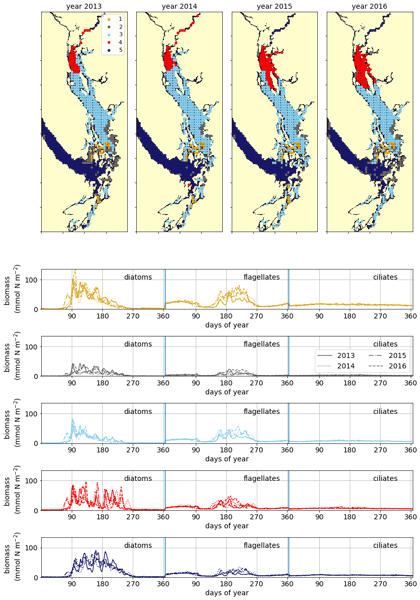
Tereza Jarníková, Elise M. Olson, Susan E. Allen, Debby Ianson, and Karyn D. Suchy
Ocean Sci., 18, 1451–1475, https://doi.org/10.5194/os-18-1451-2022, https://doi.org/10.5194/os-18-1451-2022, 2022
Short summary
Short summary
Understanding drivers of phytoplankton biomass in dynamic coastal regions is key to predicting present and future ecosystem functioning. Using a clustering-based method, we objectively determined biophysical provinces in a complex estuarine sea. The Salish Sea contains three major distinct provinces where phytoplankton dynamics are controlled by diverse stratification regimes. Our method is simple to implement and broadly applicable for identifying structure in large model-derived datasets.
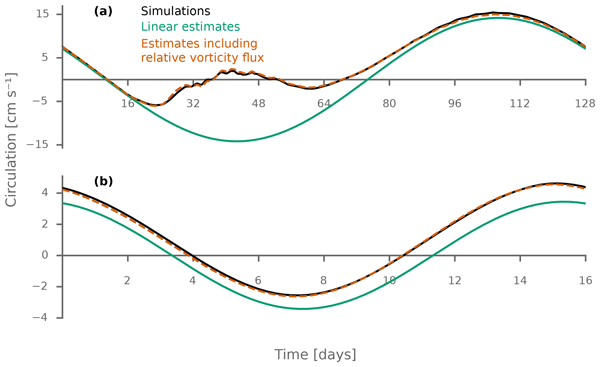
Anna Lina Petruseviciute Sjur, Pål Erik Isachsen, Johan Nilsson, and Susan Elizabeth Allen
Ocean Sci., 22, 3055–3078, https://doi.org/10.5194/os-22-3055-2026, https://doi.org/10.5194/os-22-3055-2026, 2026
Short summary
Short summary
Ocean currents along continental slopes do not respond linearly to changing winds. Nonlinearities arises from interactions between the flow and seafloor bumps. Using simplified simulations and theory, we investigate the dynamics of these nonlinear effects. Such effects are likely missed in coarse-grained climate models, with implications for representing ocean flow in areas such as the Arctic.
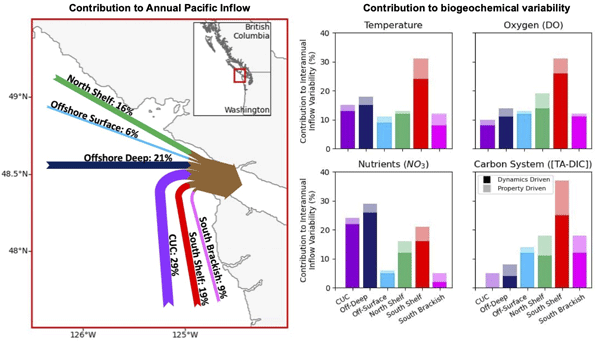
Becca Beutel, Susan E. Allen, Jilian Xiong, Jay T. Cullen, and Tia Anderlini
Biogeosciences, 22, 7309–7336, https://doi.org/10.5194/bg-22-7309-2025, https://doi.org/10.5194/bg-22-7309-2025, 2025
Short summary
Short summary
This study examines how variability in Pacific source waters influences the biogeochemistry of the Salish Sea. Using model simulations and observations, we traced the origins and properties of inflowing water and quantified the roles of circulation and property variability in shaping fluxes of oxygen, nutrients, and carbonate system tracers. These findings highlight key drivers of interannual change and their relevance under a changing climate.
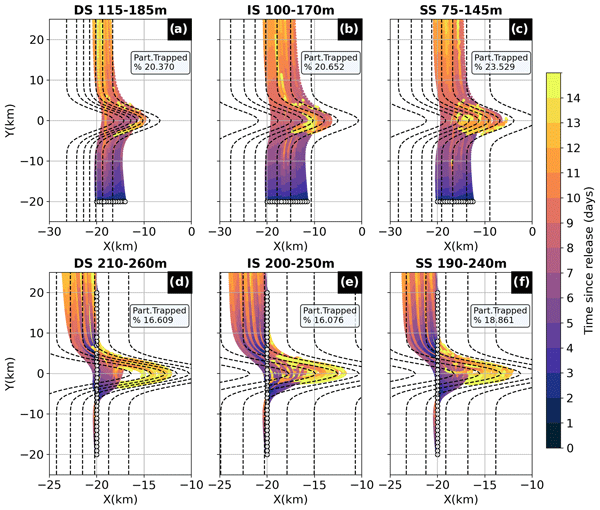
Pedro A. Figueroa, Gonzalo S. Saldías, and Susan E. Allen
Ocean Sci., 21, 643–659, https://doi.org/10.5194/os-21-643-2025, https://doi.org/10.5194/os-21-643-2025, 2025
Short summary
Short summary
Submarine canyons are topographic features found along the continental slope worldwide. Here we use numerical simulations to study how a submarine canyon influences the circulation near the coast when winds moving poleward influence the region. Our results show that submarine canyons modify the circulation near the coast, causing strong velocities perpendicular to the coast. These changes can trap particles inside the canyon, an important mechanism to explain its role as a biological hotspot.
Laura Bianucci, Jennifer M. Jackson, Susan E. Allen, Maxim V. Krassovski, Ian J. W. Giesbrecht, and Wendy C. Callendar
Ocean Sci., 20, 293–306, https://doi.org/10.5194/os-20-293-2024, https://doi.org/10.5194/os-20-293-2024, 2024
Short summary
Short summary
While the deeper waters in the coastal ocean show signs of climate-change-induced warming and deoxygenation, some fjords can keep cool and oxygenated waters in the subsurface. We use a model to investigate how these subsurface waters created during winter can linger all summer in Bute Inlet, Canada. We found two main mechanisms that make this fjord retentive: the typical slow subsurface circulation in such a deep, long fjord and the further speed reduction when the cold waters are present.
Tereza Jarníková, Elise M. Olson, Susan E. Allen, Debby Ianson, and Karyn D. Suchy
Ocean Sci., 18, 1451–1475, https://doi.org/10.5194/os-18-1451-2022, https://doi.org/10.5194/os-18-1451-2022, 2022
Short summary
Short summary
Understanding drivers of phytoplankton biomass in dynamic coastal regions is key to predicting present and future ecosystem functioning. Using a clustering-based method, we objectively determined biophysical provinces in a complex estuarine sea. The Salish Sea contains three major distinct provinces where phytoplankton dynamics are controlled by diverse stratification regimes. Our method is simple to implement and broadly applicable for identifying structure in large model-derived datasets.
Ben Moore-Maley and Susan E. Allen
Ocean Sci., 18, 143–167, https://doi.org/10.5194/os-18-143-2022, https://doi.org/10.5194/os-18-143-2022, 2022
Short summary
Short summary
Inland seas are critical habitats for globally important fisheries, and the local food webs that support these fisheries are often limited by surface nutrient availability. In the Strait of Georgia, which supports several key northern Pacific fisheries, we identify wind-driven upwelling as a dominant source of summer surface nutrients using a high-resolution coupled ecosystem model. This newly identified underlying mechanism will inform interpretations of ecosystem variability in the region.
Cited articles
Allen, S. E., Soontiens, N. K., Dunphy, M., Olson, E. M., and Latornell, D. J.: Controls on exchange through a tidal mixing hotspot at an estuary constriction, J. Phys. Oceanogr., 55, 415–433, https://doi.org/10.1175/JPO-D-24-0001.1, 2025.
Amaya, D. J., Miller, A. J., Xie, S. P., and Kosaka, Y.: Physical drivers of the summer 2019 North Pacific marine heatwave, Nat. Commun., 11, 1903, https://doi.org/10.1038/s41467-020-15820-w, 2020.
Barth, A., Walter, R. K., Robbins, I., and Pasulka, A.: Seasonal and interannual variability of phytoplankton abundance and community composition on the Central Coast of California, Mar. Ecol. Prog. Ser., 637, 29–43, https://doi.org/10.3354/meps13245, 2020.
Beutel, B. and Allen, S. E.: Seasonal and interannual Salish Sea inflow origins using Lagrangian tracking, J. Geophys. Res.-Oceans, 129, https://doi.org/10.1029/2023JC020106, 2024.
Beutel, B., Allen, S. E., Xiong, J., Cullen, J. T., and Anderlini, T.: Water property variability into a semi-enclosed sea dominated by dynamics, modulated by properties, Biogeosciences, 22, 7309–7336, https://doi.org/10.5194/bg-22-7309-2025, 2025.
Bond, N. A., Cronin, M. F., Freeland, H., and Mantua, N.: Causes and impacts of the 2014 warm anomaly in the NE Pacific. Geophys. Res. Lett., 42, 3414–3420, https://doi.org/10.1002/2015GL063306, 2015.
Chandler, P. C., King, S. A., and Bolt, J. (Eds.): State of the physical, biological and selected fishery resources of Pacific Canadian marine ecosystems in 2016, Can. Tech. Rep. Fish. Aquat. Sci., 3225, 243 pp., https://www.dfo-mpo.gc.ca/oceans/publications/soto-rceo/2016/pac-technical-report-rapport-technique-eng.html (last access: 2 July 2026), 2017.
Chen, H. H., Wang, Y., Xiu, P., Yu, Y., Ma, W., and Chai, F.: Combined oceanic and atmospheric forcing of the 2013/14 marine heatwave in the northeast Pacific, npj Clim. Atmos. Sci., 6, 3, https://doi.org/10.1038/s41612-023-00327-0, 2023.
Chen, Z., Shi, J., Liu, Q., Chen, H., and Li, C.: A persistent and intense marine heatwave in the Northeast Pacific during 2019–2020, Geophys. Res. Lett., 48, https://doi.org/10.1029/2021GL093239, 2021.
Davis, K. A., Banas, N. S., Giddings, S. N., Siedlecki, S. A., MacCready, P., Lessard, E. J., Kudela, R. M., and Hickey, B. M.: Estuary-enhanced upwelling of marine nutrients fuels coastal productivity in the U.S. Pacific Northwest, J. Geophys. Res.-Oceans, 119, 8778–8799, https://doi.org/10.1002/2014JC010248, 2014.
Di Lorenzo, E. and Mantua, N.: Multi-year persistence of the 2014/15 North Pacific marine heatwave, Nature Clim. Change, 6, 1042–1047, https://doi.org/10.1038/nclimate3082, 2016.
Di Lorenzo, E., Schneider, N., Cobb, K. M., Franks, P. J. S., Chhak, K., Miller, A. J., McWilliams, J. C., Bograd, S. J., Arango, H., Curchitser, E., Powell, T. M., and Rivière, P.: North Pacific Gyre Oscillation links ocean climate and ecosystem change, Geophys. Res. Lett., 35, https://doi.org/10.1029/2007GL032838, 2008.
Dosser, H. V., Waterman, S., Jackson, J. M., Hannah, C. G., Evans, W., and Hunt, B. P. V.: Stark physical and biogeochemical differences and implications for ecosystem stressors in the Northeast Pacific coastal ocean, J. Geophys. Res.-Oceans, 126, https://doi.org/10.1029/2020JC017033, 2021.
Fischer, A. D., Hayashi, K., McGaraghan, A., and Kudela, R. M.: Return of the “age of dinoflagellates” in Monterey Bay: Drivers of dinoflagellate dominance examined using automated imaging flow cytometry and long-term time series analysis, Limnol. Oceanogr., 65, 2125–2141, https://doi.org/10.1002/lno.11443, 2020.
Fisher, J., Kimmel, D., Ross, T., Batten, S., Bjorkstedt, E., Galbraith, M., Jacobson, K., Keister, J., Sastri, A., Suchy, K., and Zeman, S.: Copepod responses to, and recovery from, the recent marine heatwave in the Northeast Pacific, PICES Sci., 2019, Notes Sci. Board Chair, 28, 65, https://meetings.pices.int/publications/pices-press/volume28/PPJan2020.pdf (last access: 2 July 2026), 2020.
Frölicher T. L., Fischer E. M., and Gruber N.: Marine heatwaves under global warming, Nature, 560, 360–64, https://doi.org/10.1038/s41586-018-0383-9, 2018.
Harris, S. L., Varela, D. E., Whitney, F. W., and Harrison, P. J.: Nutrient and phytoplankton dynamics off the west coast of Vancouver Island during the 1997/98 ENSO event, Deep-Sea Res. PT. II, 56, 2487–2502, https://doi.org/10.1016/j.dsr2.2009.02.009, 2009.
Hayashida, H., Matear, R. J., and Strutton, P. G.: Background nutrient concentration determines phytoplankton bloom response to marine heatwaves, Glob. Chang. Biol., 26, 4800–4811, https://doi.org/10.1111/gcb.15255, 2020.
Hobday, A. J., Alexander, L. V., Perkins, S. E., Smale, D. A., Straub, S. C., Oliver, E. C., Benthuysen, J. A., Burrows, M. T., Donat, M. G., Feng, M. Holbrook, N. J., Moore, P. J., Scannell, H. A., Sen Gupta, A., and Wernberg, T.: A hierarchical approach to defining marine heatwaves, Prog. Oceanogr., 141, 227–238, https://doi.org/10.1016/j.pocean.2015.12.014, 2016.
Holbrook, N. J., Scannell, H. A., Sen Gupta, A., Benthuysen, J. A., Feng, M., Oliver, E. C., Alexander, L. V., Burrows, M. T., Donat, M. G., Hobday, A. J., Moore, P. J., Perkins-Kirkpatrick, S. E., Smale, D. A., Straub, S. C., and Wernberg, T.: A global assessment of marine heatwaves and their drivers, Nat. Commun., 10, 2624, https://doi.org/10.1038/s41467-019-10206-z, 2019.
Ianson, D., Allen, S. E., Moore-Maley, B. L., Johannessen, S. C., and Macdonald, A. R. W.: Vulnerability of a semienclosed estuarine sea to ocean acidification in contrast with hypoxia, Geophys. Res. Lett., 43, 5793–5801, https://doi.org/10.1002/2016GL068996, 2016.
Jackson, J. M., Johnson, G. C., Dosser, H. V., and Ross, T.: Warming from recent marine heatwave lingers in deep British Columbia fjord, Geophys. Res. Lett., 45, 9757–9764, https://doi.org/10.1029/2018GL078971, 2018.
Jacox, M. G., Fiechter, J., Moore, A. M., and Edwards, C. A.: ENSO and the California Current coastal upwelling response, J. Geophys. Res.-Oceans, 120, 1691–1702, https://doi.org/10.1002/2014JC010650, 2015.
Jarníková, T., Olson, E. M., Allen, S. E., Ianson, D., and Suchy, K. D.: A clustering approach to determine biophysical provinces and physical drivers of productivity dynamics in a complex coastal sea, Ocean Sci., 18, 1451–1475, https://doi.org/10.5194/os-18-1451-2022, 2022.
Khangaonkar, T., Sackmann, B., Long, W., Mohamedali, T., and Roberts, M.: Simulation of annual biogeochemical cycles of nutrient balance, phytoplankton bloom(s), and DO in Puget Sound using an unstructured grid model, Ocean Dyn., 62, 1353–1379, https://doi.org/10.1007/s10236-012-0562-4, 2012.
Khangaonkar, T., Nugraha, A., Yun, S. K., Premathilake, L., Keister, J. E., and Bos, J.: Propagation of the 2014–2016 Northeast Pacific marine heatwave through the Salish Sea, Front. Mar. Sci., 8, 787604, https://doi.org/10.3389/fmars.2021.787604, 2021.
Li, L., Mackas, D., Hunt, B., Schweigert, J., Pakhomov, E., Perry, R. I., Galbraith, M., and Pitcher, T. J.: Zooplankton communities in the Strait of Georgia, British Columbia, track large-scale climate forcing over the Pacific Ocean, Prog. Oceanogr., 115, 90–102, https://doi.org/10.1016/j.pocean.2013.05.025, 2013.
Lu, Y., Li, J., Lei, J., and Hannah, C.: Impacts of model resolution on simulation of meso-scale eddies in the Northeast Pacific Ocean, Satell. Oceanogr. Meteorol., 2, 328, https://doi.org/10.18063/som.v2i2.328, 2017.
MacCready, P., McCabe, R. M., Siedlecki, S. A., Lorenz, M., Giddings, S. N., Bos, J., Albertson, S., Banas, N. S., and Garnier, S.: Estuarine circulation, mixing, and residence times in the Salish Sea, J. Geophys. Res.-Oceans, 126, https://doi.org/10.1029/2020JC016738, 2021.
Mackas, D. L. and Harrison, P. J.: Nitrogenous nutrient sources and sinks in the Juan de Fuca Strait/Strait of Georgia/Puget Sound estuarine system: assessing the potential for eutrophication, Estuar., Coast. Shelf Sci., 44, 1–21, https://doi.org/10.1006/ecss.1996.0110, 1997.
Madec, G., Bourdallé-Badie, R., Bouttier, P.-A., Bricaud, C., Bruciaferri, D., Calvert, D., Chanut, J., Clementi, E., Coward, A., Delrosso, D., Ethé, C., Flavoni, S., Graham, T., Harle, J., Iovino, D., Lea, D., Lévy, C., Lovato, T., Martin, N., Masson, S., Mocavero, S., Paul, J., Rousset, C., Storkey, D., Storto, A., and Vancoppenolle, M.: NEMO ocean engine, Notes du pole modélisation Linstitut Pierre-simon Laplace (IPSL), Revis. 8625 from SVN Repos, Zenodo, https://doi.org/10.5281/zenodo.19206664, 2017.
Masson, D. and Cummins, P. F.: Temperature trends and interannual variability in the Strait of Georgia, British Columbia, Cont. Shelf Res., 27, 634–649, https://doi.org/10.1016/j.csr.2006.10.009, 2007.
McCabe, R. M., Hickey, B. M., Kudela, R. M., Lefebvre, K. A., Adams, N. G., Bill, B. D., Gulland, F. M. D., Thomson, R. E., Cochlan, W. P., and Trainer, V. L.: An unprecedented coastwide toxic algal bloom linked to anomalous ocean conditions, Geophys. Res. Lett., 43, 10–366, https://doi.org/10.1002/2016GL070023, 2016.
Milbrandt, J. A., Bélair, S., Faucher, M., Vallée, M., Carrera, M. L., and Glazer, A.: The pan-Canadian high resolution (2.5 km) deterministic prediction system, Weather Forecast., 31, 1791–1816, https://doi.org/10.1175/WAF-D-16-0035.1, 2016.
Moore-Maley, B. and Allen, S. E.: Wind-driven upwelling and surface nutrient delivery in a semi-enclosed coastal sea, Ocean Sci., 18, 143–167, https://doi.org/10.5194/os-18-143-2022, 2022.
Nemcek, N., Hennekes, M., Sastri, A., and Perry, R. I.: Seasonal and spatial dynamics of the phytoplankton community in the Salish Sea, 2015–2019, Prog. Oceanogr., 103108, https://doi.org/10.1016/j.pocean.2023.103108, 2023.
Oliver, E. C. J., Donat, M. G., Burrows, M. T., Moore, P. J., Smale, D. A., Alexander, L. V., Benthuysen, J. A., Feng, M., Sen Gupta, A., Hobday, A. J. Holbrook, N. J., Perkins-Kirkpatrick, S. E., Scannell, H. A., Straub, S. C., and Wernberg, T.: Longer and more frequent marine heatwaves over the past century, Nat. Commun., 9, 1324, https://doi.org/10.1038/s41467-018-03732-9, 2018.
Oliver, E. C., Benthuysen, J. A., Darmaraki, S., Donat, M. G., Hobday, A. J., Holbrook, N. J., Schlegel, R. W., and Sen Gupta, A.: Marine heatwaves, Annu. Rev. Mar. Sci., 13, 313–342, https://doi.org/10.1146/annurev-marine-032720-095144, 2021.
Olson, E. M., Allen, S. E., Do, V., Dunphy, M., and Ianson, D.: Assessment of nutrient supply by a tidal jet in the northern Strait of Georgia based on a biogeochemical model, J. Geophys. Res.-Oceans, 125, 1–25, https://doi.org/10.1029/2019JC015766, 2020.
Pawlowicz, R., Riche, O., and Halverson, M.: The circulation and residence time of the Strait of Georgia using a simple mixing-box approach, Atmos.-Ocean, 45, 173–193, https://doi.org/10.3137/ao.450401, 2007.
Pearce, A., Lenanton, R., Jackson, G., Moore, J., Feng, M., and Gaughan, D.: The “marine heat wave” off Western Australia during the summer of 2010/11 (Fisheries research report No. 222.), Department of Fisheries, Western Australia, https://library.dpird.wa.gov.au/fr_rr/15/ (last access: 2 July 2026), 2011.
Peña, M. A., Nemcek, N., and Robert, M.: Phytoplankton responses to the 2014–2016 warming anomaly in the northeast subarctic Pacific Ocean, Limnol. Oceanogr., 64, 515–525, https://doi.org/10.1002/lno.11056, 2019.
Perry, R. I. and Masson, D.: An integrated analysis of the marine social–ecological system of the Strait of Georgia, Canada, over the past four decades, and development of a regime shift index, Prog. Oceanogr. 115, 14–27, https://doi.org/10.1016/j.pocean.2013.05.021, 2013.
Perry, R. I., Young, K., Galbraith, M., Chandler, P., Velez-Espino, A., and Baillie, S.: Zooplankton variability in the Strait of Georgia, Canada, and relationships with the marine survivals of Chinook and Coho salmon, PLoS One, 16, https://doi.org/10.1371/journal.pone.0245941, 2021.
Peterson, W. T., Fisher, J. L., Strub, P. T., Du, X., Risien, C., Peterson, J., and Shaw, C. T.: The pelagic ecosystem in the Northern California Current off Oregon during the 2014–2016 warm anomalies within the context of the past 20 years, J. Geophys. Res.-Oceans, 122, 7267–7290, https://doi.org/10.1002/2017JC012952, 2017.
Piatt, J. F., Parrish, J. K., Renner, H. M., Schoen, S. K., Jones, T. T., Arimitsu, M. L., Kuletz, K. J., Bodenstein, B., García-Reyes, M., Duerr, R. S. Corcoran, R. M., Kaler, R. S. A., McChesney, G. J., Golightly, R. T., Coletti, H. A., Suryan, R. M., Burgess, H. K., Lindsey, J., Lindquist, K., Warzybok, P. M., Jahncke, J., Roletto, J., and Sydeman, W. J.: Extreme mortality and reproductive failure of common murres resulting from the northeast Pacific marine heatwave of 2014–2016, PLoS One, 15, https://doi.org/10.1371/journal.pone.0226087, 2020.
Robinson, C. L., Bertram, D. F., Shannon, H., von Biela, V. R., Greentree, W., Duguid, W., and Arimitsu, M. L.: Reduction in overwinter body condition and size of Pacific sand lance has implications for piscivorous predators during marine heatwaves, Mar. Ecol. Prog. Ser., 737, 89–99, https://doi.org/10.3354/meps14257, 2023.
Scannell, H. A., Pershing, A. J., Alexander, M. A., Thomas, A. C., and Mills, K. E.: Frequency of marine heatwaves in the North Atlantic and North Pacific since 1950, Geophys. Res. Lett., 43, 2069–2076, https://doi.org/10.1002/2015GL067308, 2016.
Siedlecki, S. A., Banas, N. S., Davis, K. A., Giddings, S., Hickey, B. M., MacCready, P., Connolly, T., and Geier, S.: Seasonal and interannual oxygen variability on the Washington and Oregon continental shelves, J. Geophys. Res.-Oceans, 120, 608–633, https://doi.org/10.1002/2014JC010254, 2015.
Soontiens, N. and Allen, S. E.: Modelling sensitivities to mixing and advection in a sill-basin estuarine system, Ocean Model., 112, 17–32, https://doi.org/10.1016/j.ocemod.2017.02.008, 2017.
Soontiens, N., Allen, S. E., Latornell, D., Le Souëf, K., Machuca, I., Paquin, J. P., Lu, Y., Thompson, K., and Korabel, V.: Storm surges in the Strait of Georgia simulated with a regional model, Atmos.-Oceans, 54, 1–21, https://doi.org/10.1080/07055900.2015.1108899, 2016
St. John, M. A., Marinone, S. G., Stronach, J., Harrison, P. J., Fyfe, J., and Beamish, R. J.: A horizontally resolving physical–biological model of nitrate concentration and primary productivity in the Strait of Georgia, Can. J. Fish. Aquat. Sci., 50, 1456–1466, https://doi.org/10.1139/f93-166, 1993.
Stang, C. and Allen, S. E.: Seasonably variable estuarine exchange through interconnected channels in the Salish Sea, J. Geophys. Res.-Oceans, 130, https://doi.org/10.1029/2024JC022003, 2025.
Suchy, K. D., Le Baron, N., Hilborn, A., Perry, R. I., and Costa, M.: Influence of environmental drivers on spatio-temporal dynamics of satellite-derived chlorophyll a in the Strait of Georgia, Prog. Oceanogr., 176, 102134, https://doi.org/10.1016/j.pocean.2019.102134, 2019.
Suchy, K. D., Young, K., Galbraith, M. D., Perry, R. I., and Costa, M.: Match/mismatch between phytoplankton and crustacean zooplankton phenology in the Strait of Georgia, Canada, Front. Mar. Sci., 759, https://doi.org/10.3389/fmars.2022.832684, 2022.
Suchy, K. D., Olson, E., Allen, S. E., Galbraith, M., Herrmann, B., Keister, J. E., Perry, R. I., Sastri, A. R., and Young, K: Seasonal and regional variability of model-based zooplankton biomass in the Salish Sea and evaluation against observations, Prog. Oceanogr., 219, 103171, https://doi.org/10.1016/j.pocean.2023.103171, 2023.
Suchy, K. D., Allen, S. E., and Olson, E. M. B.: Mechanistic links between climatic forcing and model-based plankton dynamics in the Strait of Georgia, Canada, J. Geophys. Res.-Oceans, 130, https://doi.org/10.1029/2024JC021036, 2025a.
Suchy, K. D., Allen, S. E., Sastri, A. R., and Young, K.: SalishSeaCast/Suchyetal_MHWpaper: Source code for: Modelling the impacts of marine heatwaves on plankton in the Salish Sea (v2026.03.11), Zenodo [code], https://doi.org/10.5281/zenodo.18964405, 2025b.
Sutton, J. N., Johannessen, S. C., and Macdonald, R. W.: A nitrogen budget for the Strait of Georgia, British Columbia, with emphasis on particulate nitrogen and dissolved inorganic nitrogen, Biogeosciences, 10, 7179–7194, https://doi.org/10.5194/bg-10-7179-2013, 2013.
Thomson, R. E.: Oceanography of the British Columbia Coast, Canadian Special Publication of Fisheries and Aquatic Sciences, 56, 291 pp., ISBN 0-660-10978-6, 1981
Thomson, R. E., Mihály, S. F., and Kulikov, E. A.: Estuarine versus transient flow regimes in Juan de Fuca Strait, J. Geophys. Res.-Oceans, 112, https://doi.org/10.1029/2006JC003925, 2007.
Wallace, J. M., Rasmusson, E. M., Mitchell, T. P., Kousky, V. E., Sarachik, E. S., and Von Storch, H.: On the structure and evolution of ENSO-related climate variability in the tropical Pacific: Lessons from TOGA, J. Geophys. Res.-Oceans, 103, 14241–14259, https://doi.org/10.1029/97JC02905, 1998.
Whitney, F. A., Wong, C. S., and Boyd, P. W.: Interannual variability in nitrate supply to surface waters of the Northeast Pacific Ocean, Mar. Ecol. Prog. Ser., 170, 15–23, https://doi.org/10.3354/meps170015, 1998.
Winans, A. K., Herrmann, B., and Keister, J. E.: Spatio-temporal variation in zooplankton community composition in the southern Salish Sea: Changes during the 2015–2016 Pacific marine heatwave, Prog. Oceanogr., 214, 103022, https://doi.org/10.1016/j.pocean.2023.103022, 2023.
Yang, B., Emerson, S. R., and Peña, M. A.: The effect of the 2013–2016 high temperature anomaly in the subarctic Northeast Pacific (the “Blob”) on net community production, Biogeosciences, 15, 6747–6759, https://doi.org/10.5194/bg-15-6747-2018, 2018.
Zaba, K. D. and Rudnick, D. L.: The 2014–2015 warming anomaly in the Southern California Current System observed by underwater gliders, Geophys. Res. Lett., 43, 1241–1248, https://doi.org/10.1002/2015GL067550, 2016.
Short summary
We used a biophysical model to examine the impacts of the 2014–2017 Northeast Pacific Marine Heatwave on plankton in the Salish Sea. Warming was strongest in the Juan de Fuca Strait, increasing phytoplankton growth. The Strait of Georgia showed stronger links to the North Pacific Gyre Oscillation with warming beyond 2017 and a reduction in large phytoplankton. Results highlight that multiple marine heatwaves can overlap within one waterbody, each with distinct effects on the local food web.
We used a biophysical model to examine the impacts of the 2014–2017 Northeast Pacific Marine...


Altmetrics
Final-revised paper
Preprint