
Articles | Volume 23, issue 15
https://doi.org/10.5194/bg-23-5607-2026
© Author(s) 2026. This work is distributed under
the Creative Commons Attribution 4.0 License.
the Creative Commons Attribution 4.0 License.
https://doi.org/10.5194/bg-23-5607-2026
© Author(s) 2026. This work is distributed under
the Creative Commons Attribution 4.0 License.
the Creative Commons Attribution 4.0 License.
Research article
| Highlight paper
| 
14 Aug 2026
Research article | Highlight paper |
| 14 Aug 2026
| 14 Aug 2026
AngleCam V2: Predicting leaf inclination angles across taxa from daytime and nighttime photos
Luis Kremer
CORRESPONDING AUTHOR

Chair of Sensor-based Geoinformatics (geosense), University of Freiburg, Freiburg, Germany
Jan Pisek
Tartu Observatory, University of Tartu, Tõravere, Estonia
Ronny Richter
German Centre for Integrative Biodiversity Research (iDiv), Halle-Jena-Leipzig, Leipzig, Germany
Systematic Botany and Functional Biodiversity, Institute of Biology, Leipzig University, Leipzig, Germany
Julian Frey
Chair of Forest Growth and Dendroecology, University of Freiburg, Freiburg, Germany
Daniel Lusk
Chair of Sensor-based Geoinformatics (geosense), University of Freiburg, Freiburg, Germany
Christiane Werner
Chair of Ecosystem Physiology, University of Freiburg, Freiburg, Germany
Christian Wirth
German Centre for Integrative Biodiversity Research (iDiv), Halle-Jena-Leipzig, Leipzig, Germany
Systematic Botany and Functional Biodiversity, Institute of Biology, Leipzig University, Leipzig, Germany
Teja Kattenborn
Chair of Sensor-based Geoinformatics (geosense), University of Freiburg, Freiburg, Germany
Related authors
Jasmin Tesch, Kathrin Kühnhammer, Delon Wagner, Andreas Christen, Carsten Dormann, Julian Frey, Rüdiger Grote, Teja Kattenborn, Markus Sulzer, Ulrike Wallrabe, Markus Weiler, Christiane Werner, Samaneh Baghbani, Julian Brzozon, Laura Maria Comella, Lea Dedden, Stefanie Dumberger, Yasmina Frey, Matthias Gassilloud, Timo Gerach, Anna Göritz, Simon Haberstroh, Johannes Klüppel, Luis Kremer, Jürgen Kreuzwieser, Hojin Lee, Joachim Maack, Julian Müller, Oswald Prucker, Sanam K. Rajak, Jürgen Rühe, Stefan J. Rupitsch, Helmer Schack-Kirchner, Christian Scharinger, Uttunga Shinde, Till Steinmann, Clara Stock, and Josef Strack
Geosci. Instrum. Method. Data Syst., 15, 253–272, https://doi.org/10.5194/gi-15-253-2026, https://doi.org/10.5194/gi-15-253-2026, 2026
Short summary
Short summary
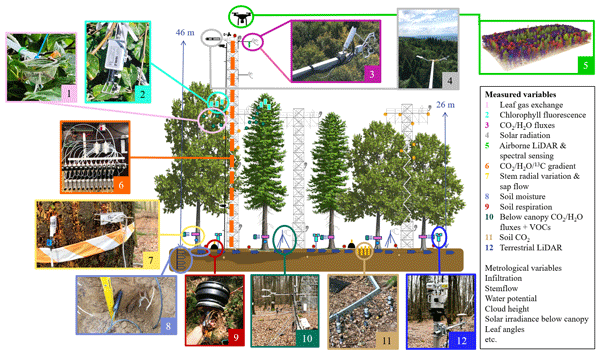
In the ECOSENSE forest, we developed a robust infrastructure for distributed forest sensing. Reliable power supply, stable network connection, and smart data collection systems enable the operation of hundreds of sensors under challenging conditions. By detailing the infrastructure design and implementation, we provide a transferable blueprint for building complex monitoring sites that support high-resolution, long-term ecosystem observations.
Jasmin Tesch, Kathrin Kühnhammer, Delon Wagner, Andreas Christen, Carsten Dormann, Julian Frey, Rüdiger Grote, Teja Kattenborn, Markus Sulzer, Ulrike Wallrabe, Markus Weiler, Christiane Werner, Samaneh Baghbani, Julian Brzozon, Laura Maria Comella, Lea Dedden, Stefanie Dumberger, Yasmina Frey, Matthias Gassilloud, Timo Gerach, Anna Göritz, Simon Haberstroh, Johannes Klüppel, Luis Kremer, Jürgen Kreuzwieser, Hojin Lee, Joachim Maack, Julian Müller, Oswald Prucker, Sanam K. Rajak, Jürgen Rühe, Stefan J. Rupitsch, Helmer Schack-Kirchner, Christian Scharinger, Uttunga Shinde, Till Steinmann, Clara Stock, and Josef Strack
Geosci. Instrum. Method. Data Syst., 15, 253–272, https://doi.org/10.5194/gi-15-253-2026, https://doi.org/10.5194/gi-15-253-2026, 2026
Short summary
Short summary
In the ECOSENSE forest, we developed a robust infrastructure for distributed forest sensing. Reliable power supply, stable network connection, and smart data collection systems enable the operation of hundreds of sensors under challenging conditions. By detailing the infrastructure design and implementation, we provide a transferable blueprint for building complex monitoring sites that support high-resolution, long-term ecosystem observations.
Ettore Fedele, Christina M. Müller, Volker Wissemann, Birgit Gemeinholzer, Christian Wirth, and Beatriz Sánchez-Parra
Biogeosciences, 23, 6931–6945, https://doi.org/10.5194/bg-23-6931-2026, https://doi.org/10.5194/bg-23-6931-2026, 2026
Short summary
Short summary
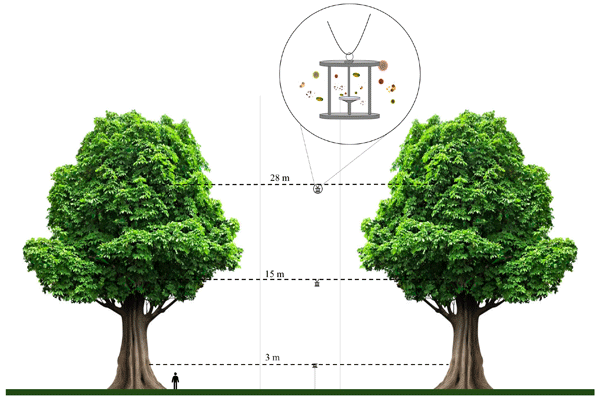
Fungi are key component of the air we breathe. They travel short and long distances, influencing ecosystems, agriculture and human health worldwide. Using advanced DNA techniques, we monitored airborne fungi in a European floodplain forest and linked their presence to climatic conditions. We found that temperature can shape airborne fungal communities, including the presence of allergenic and pathogenic fungi. This highlights the importance of long-term monitoring under climate change scenarios.
Arathi Biju, Oleksandr Borysenko, Holger Virro, Jean-Baptiste Féret, Jan Pisek, and Evelyn Uuemaa
Int. Arch. Photogramm. Remote Sens. Spatial Inf. Sci., L-4-W1-2026, 3–10, https://doi.org/10.5194/isprs-archives-L-4-W1-2026-3-2026, https://doi.org/10.5194/isprs-archives-L-4-W1-2026-3-2026, 2026
Eya Cherif, Teja Kattenborn, Luke A. Brown, Michael Ewald, Katja Berger, Phuong D. Dao, Tobias B. Hank, Etienne Laliberté, Bing Lu, and Hannes Feilhauer
Biogeosciences, 23, 2235–2259, https://doi.org/10.5194/bg-23-2235-2026, https://doi.org/10.5194/bg-23-2235-2026, 2026
Short summary
Short summary
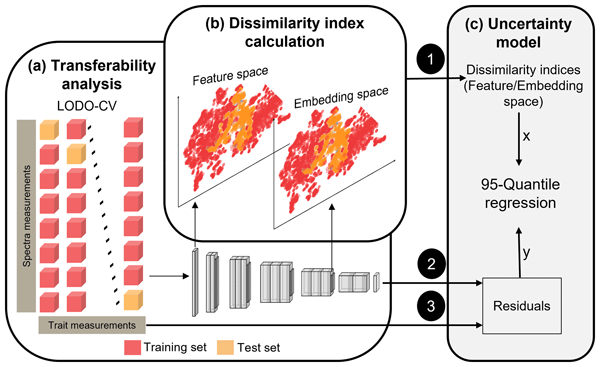
Hyperspectral imagery combined with machine learning enables accurate large-scale mapping of plant traits but struggles with uncertainty when facing unfamiliar environmental conditions. This study introduces a distance-based method that measures dissimilarities between new and training data to reliably quantify uncertainty. Results show it effectively identifies uncertain predictions, greatly improving the reliability of global vegetation monitoring compared to traditional methods.

Simon Lotz, Teja Kattenborn, Julian Frey, Salim Soltani, Anna Göritz, Tom Jaksztat, and Negin Katal
Biogeosciences, 23, 1949–1963, https://doi.org/10.5194/bg-23-1949-2026, https://doi.org/10.5194/bg-23-1949-2026, 2026
Short summary
Short summary
Digital hemispherical photography(DHP) is a valuable tool for monitoring leaf area index(LAI), a key factor in ecosystem productivity and climate interactions. We compared DHP with litter traps in a temperate forest and found that at a view zenith angle around 20°, both methods aligned best. We applied a calibration model to assess site variability which significantly improved accuracy. Our findings enhance the reliability of ground-based LAI monitoring, supporting better ecosystem assessments.
Hojin Lee, Tim Stippich, Jan Petersen, David Meine, Julian Brzozon, Markus Sulzer, Lea Dedden, Andreas Christen, Teja Kattenborn, Christiane Werner, and Jürgen Kreuzwieser
EGUsphere, https://doi.org/10.5194/egusphere-2025-5426, https://doi.org/10.5194/egusphere-2025-5426, 2025
Short summary
Short summary
We studied the effect of waterlogging on volatile organic compounds exchange between forest floor and atmosphere. Waterlogging strongly increased emissions of toluene and p-cymene. Studies on soil cores under controlled conditions demonstrated that anoxia leads to emission of these compounds. Our results suggest that anoxic hotspots of high toluene emission can influence atmospheric mixing ratios of toluene in forest air despite large areas of the forest floor act as a sink of this compound.
Salim Soltani, Lauren E. Gillespie, Moises Exposito-Alonso, Olga Ferlian, Nico Eisenhauer, Hannes Feilhauer, and Teja Kattenborn
Biogeosciences, 22, 6545–6561, https://doi.org/10.5194/bg-22-6545-2025, https://doi.org/10.5194/bg-22-6545-2025, 2025
Short summary
Short summary
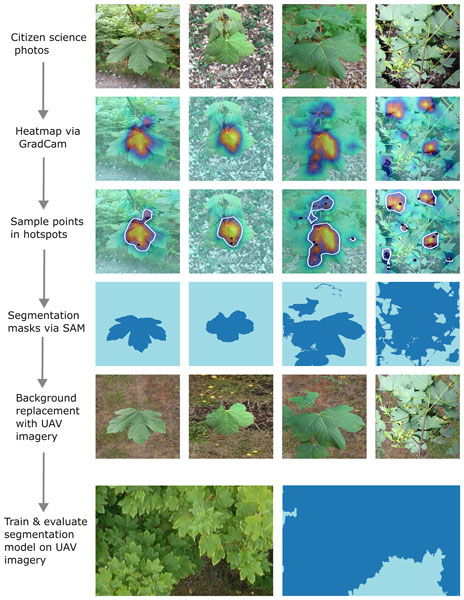
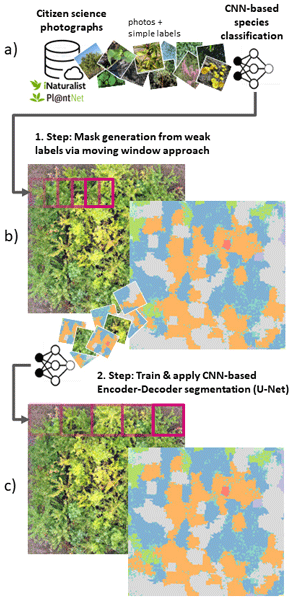
We introduce an automated approach for generating segmentation masks for citizen science plant photos, making them applicable to computer vision models. This framework effectively transforms citizen science data into a data treasure for segmentation models for plant species identification in aerial imagery. Using automatically labeled photos, we train segmentation models for mapping tree species in drone imagery, showcasing their potential for forestry, agriculture, and biodiversity monitoring.
Simon Scheiter, Sophie Wolf, and Teja Kattenborn
Biogeosciences, 21, 4909–4926, https://doi.org/10.5194/bg-21-4909-2024, https://doi.org/10.5194/bg-21-4909-2024, 2024
Short summary
Short summary
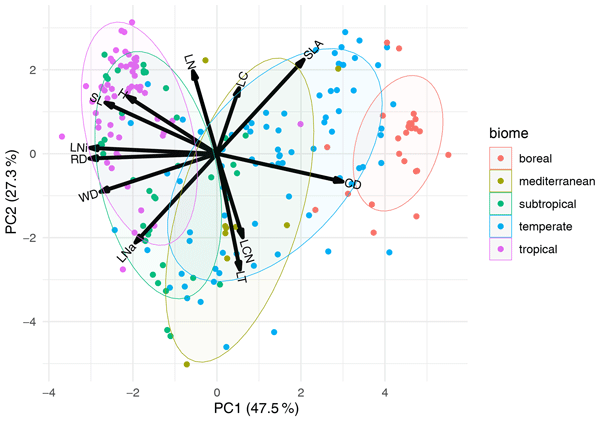
Biomes are widely used to map vegetation patterns at large spatial scales and to assess impacts of climate change, yet there is no consensus on a generally valid biome classification scheme. We used crowd-sourced species distribution data and trait data to assess whether trait information is suitable for delimiting biomes. Although the trait data were heterogeneous and had large gaps with respect to the spatial distribution, we found that a global trait-based biome classification was possible.
Salim Soltani, Olga Ferlian, Nico Eisenhauer, Hannes Feilhauer, and Teja Kattenborn
Biogeosciences, 21, 2909–2935, https://doi.org/10.5194/bg-21-2909-2024, https://doi.org/10.5194/bg-21-2909-2024, 2024
Short summary
Short summary
In this research, we developed a novel method using citizen science data as alternative training data for computer vision models to map plant species in unoccupied aerial vehicle (UAV) images. We use citizen science plant photographs to train models and apply them to UAV images. We tested our approach on UAV images of a test site with 10 different tree species, yielding accurate results. This research shows the potential of citizen science data to advance our ability to monitor plant species.
Samuel Kwakye, Heike Kalesse-Los, Maximilian Maahn, Patric Seifert, Roel van Klink, Christian Wirth, and Johannes Quaas
Atmos. Meas. Tech. Discuss., https://doi.org/10.5194/amt-2023-69, https://doi.org/10.5194/amt-2023-69, 2023
Publication in AMT not foreseen
Short summary
Short summary
Insect numbers in the atmosphere can be calculated using polarimetric weather radar but they have to be identified and separated from other echoes, especially weather phenomena. Here, the separation is demonstrated using three machine-learning algorithms and insect count data from suction traps and the nature of radar measurements of different radar echoes is revealed. Random forest is the best separating algorithm and insect echoes radar measurements are distinct.
J. Pacheco-Labrador, U. Weber, X. Ma, M. D. Mahecha, N. Carvalhais, C. Wirth, A. Huth, F. J. Bohn, G. Kraemer, U. Heiden, FunDivEUROPE members, and M. Migliavacca
Int. Arch. Photogramm. Remote Sens. Spatial Inf. Sci., XLVI-1-W1-2021, 49–55, https://doi.org/10.5194/isprs-archives-XLVI-1-W1-2021-49-2022, https://doi.org/10.5194/isprs-archives-XLVI-1-W1-2021-49-2022, 2022
Cited articles
Apelt, F., Breuer, D., Olas, J. J., Annunziata, M. G., Flis, A., Nikoloski, Z., Kragler, F., and Stitt, M.: Circadian, carbon, and light control of expansion growth and leaf movement, Plant Physiol., 174, 1949–1968, https://doi.org/10.1104/pp.17.00503, 2017. a
Bailey, B. N. and Mahaffee, W. F.: Rapid measurement of the three-dimensional distribution of leaf orientation and the leaf angle probability density function using terrestrial LiDAR scanning, Remote Sens. Environ., 194, 63–76, https://doi.org/10.1016/j.rse.2017.03.011, 2017. a
Baldocchi, D. D.: How eddy covariance flux measurements have contributed to our understanding of Global Change Biology, Glob. Change Biol., 26, 242–260, https://doi.org/10.1111/gcb.14807, 2020. a
Barnett, A. G., Van Der Pols, J. C., and Dobson, A. J.: Regression to the mean: what it is and how to deal with it, Int. J. Epidemiol., 34, 215–220, https://doi.org/10.1093/ije/dyh299, 2005. a, b
Belkin, M., Hsu, D., Ma, S., and Mandal, S.: Reconciling modern machine-learning practice and the classical bias–variance trade-off, P. Natl. Acad. Sci. USA, 116, 15849–15854, https://doi.org/10.1073/pnas.1903070116, 2019. a
Bernotas, G., Scorza, L. C., Hansen, M. F., Hales, I. J., Halliday, K. J., Smith, L. N., Smith, M. L., and McCormick, A. J.: A photometric stereo-based 3D imaging system using computer vision and deep learning for tracking plant growth, GigaScience, 8, giz056, https://doi.org/10.1093/gigascience/giz056, 2019. a
Biskup, B., Scharr, H., Schurr, U., and Rascher, U.: A stereo imaging system for measuring structural parameters of plant canopies, Plant Cell Environ., 30, 1299–1308, https://doi.org/10.1111/j.1365-3040.2007.01702.x, 2007. a
Braghiere, R. K., Wang, Y., Doughty, R., Sousa, D., Magney, T., Widlowski, J.-L., Longo, M., Bloom, A. A., Worden, J., Gentine, P., and Frankenberg, C.: Accounting for canopy structure improves hyperspectral radiative transfer and sun-induced chlorophyll fluorescence representations in a new generation Earth System model, Remote Sens. Environ., 261, 112497, https://doi.org/10.1016/j.rse.2021.112497, 2021. a
Brown, T. B., Hultine, K. R., Steltzer, H., Denny, E. G., Denslow, M. W., Granados, J., Henderson, S., Moore, D., Nagai, S., SanClements, M., Sánchez Azofeifa, A., Sonnentag, O., Tazik, D., and Richardson, A. D.: Using phenocams to monitor our changing Earth: toward a global phenocam network, Front. Ecol. Environ, 14, 84–93, https://doi.org/10.1002/fee.1222, 2016. a
Cabon, Y., Murray, N., and Humenberger, M.: Virtual kitti 2, arXiv [preprint], https://doi.org/10.48550/arXiv.2001.10773, 2020. a
Darwin, C. and Darwin, F.: The Power of Movement in Plants, D. Appleton and Company, New York, https://doi.org/10.5962/bhl.title.17709, 1881. a
Dechant, B., Ryu, Y., Badgley, G., Zeng, Y., Berry, J. A., Zhang, Y., Goulas, Y., Li, Z., Zhang, Q., Kang, M., Li, J., and Moya, I.: Canopy structure explains the relationship between photosynthesis and sun-induced chlorophyll fluorescence in crops, Remote Sens. Environ., 241, 111733, https://doi.org/10.1016/j.rse.2020.111733, 2020. a
Dosovitskiy, A., Beyer, L., Kolesnikov, A., Weissenborn, D., Zhai, X., Unterthiner, T., Dehghani, M., Minderer, M., Heigold, G., Gelly, S., Uszkoreit, J., and Houlsby, N.: An image is worth 16x16 words: Transformers for image recognition at scale, arXiv [preprint], https://doi.org/10.48550/arXiv.2010.11929, 2020. a
Ehleringer, J. and Forseth, I.: Solar tracking by plants, Science, 210, 1094–1098, https://doi.org/10.1126/science.210.4474.1094, 1980. a
Ehleringer, J. R. and Comstock, J.: Leaf absorptance and leaf angle: mechanisms for stress avoidance, in: Plant Response to Stress: Functional Analysis in Mediterranean Ecosystems, edited by: Tenhunen, J. D., Catarino, F. M., Lange, O. L., and Oechel, W. C., Springer, Berlin, Heidelberg, https://doi.org/10.1007/978-3-642-70868-8_3, 1987. a
Ferlian, O., Cesarz, S., Craven, D., Hines, J., Barry, K. E., Bruelheide, H., Buscot, F., Haider, S., Heklau, H., Herrmann, S., Kühn, P., Pruschitzki, U., Schädler, M., Wagg, C., Weigelt, A., Wubet, T., and Eisenhauer, N.: Mycorrhiza in tree diversity–ecosystem function relationships: conceptual framework and experimental implementation, Ecosphere, 9, e02226, https://doi.org/10.1002/ecs2.2226, 2018. a, b, c
Garcin, C., Joly, A., Bonnet, P., Lombardo, J.-C., Affouard, A., Chouet, M., Servajean, M., Lorieul, T., and Salmon, J.: Pl@ntNet-300K: a plant image dataset with high label ambiguity and a long-tailed distribution, in: NeurIPS 2021-35th Conference on Neural Information Processing Systems, https://datasets-benchmarks-proceedings.neurips.cc/paper/2021/hash/7e7757b1e12abcb736ab9a754ffb617a-Abstract-round2.html (last access: 30 July 2026) 2021. a
Geldhof, B., Pattyn, J., Eyland, D., Carpentier, S., and Van de Poel, B.: A digital sensor to measure real-time leaf movements and detect abiotic stress in plants, Plant Physiol., 187, 1131–1148, https://doi.org/10.1093/plphys/kiab407, 2021. a, b
Geman, S., Bienenstock, E., and Doursat, R.: Neural networks and the bias/variance dilemma, Neural Comput., 4, 1–58, https://doi.org/10.1162/neco.1992.4.1.1, 1992. a
Gittleman, J. L. and Kot, M.: Adaptation: statistics and a null model for estimating phylogenetic effects, Syst. Zool., 39, 227–241, https://doi.org/10.2307/2992183, 1990. a
Goel, N. S. and Strebel, D. E.: Simple beta distribution representation of leaf orientation in vegetation canopies 1, Agron. J., 76, 800–802, https://doi.org/10.2134/agronj1984.00021962007600050021x, 1984. a
Hase, N., Doktor, D., Rebmann, C., Dechant, B., Mollenhauer, H., and Cuntz, M.: Identifying the main drivers of the seasonal decline of near-infrared reflectance of a temperate deciduous forest, Agr. Forest Meteorol., 313, 108746, https://doi.org/10.1016/j.agrformet.2021.108746, 2022. a, b, c
Hawkins, B. A.: Eight (and a half) deadly sins of spatial analysis, J. Biogeogr., 39, 1–9, https://doi.org/10.1111/j.1365-2699.2011.02637.x, 2012. a
Hendrycks, D. and Gimpel, K.: Gaussian error linear units (gelus), arXiv [preprint], https://doi.org/10.48550/arXiv.1606.08415, 2016. a
Hikosaka, K. and Hirose, T.: Leaf angle as a strategy for light competition: optimal and evolutionarily stable light-extinction coefficient within a leaf canopy, Ecoscience, 4, 501–507, https://doi.org/10.1080/11956860.1997.11682429, 1997. a
Jablonski, A. D., Li, R., Kim, J., Lerdau, M., Petras, C., and Yang, X.: Spatial patterns of leaf angle distribution covary with canopy fluorescence yield, reflectance indices, and leaf chlorophyll content, in a mixed temperate forest, Remote Sens. Environ., 330, 114996, https://doi.org/10.1016/j.rse.2025.114996, 2025. a, b, c
Jiang, H., Hu, R., Yan, G., Cheng, S., Li, F., Qi, J., Li, L., Xie, D., and Mu, X.: Influencing factors in estimation of leaf angle distribution of an individual tree from terrestrial laser scanning data, Remote Sens.-Basel, 13, 1159, https://doi.org/10.3390/rs13061159, 2021. a
Jolliffe, I. T.: Principal Component Analysis, Springer Series in Statistics, Springer-Verlag, New York, 2nd edn., https://doi.org/10.1007/b98835, 2002. a
Kamilar, J. M. and Cooper, N.: Phylogenetic signal in primate behaviour, ecology and life history, Philos. T. Roy. Soc. B, 368, 20120341, https://doi.org/10.1098/rstb.2012.0341, 2013. a
Kao, W.-Y. and Forseth, I.: Dirunal leaf movement, chlorophyll fluorescence and carbon assimilation in soybean grown under different nitrogen and water availabilities, Plant Cell Environ., 15, 703–710, https://doi.org/10.1111/j.1365-3040.1992.tb01012.x, 1992. a
Kattenborn, T., Fassnacht, F. E., and Schmidtlein, S.: Differentiating plant functional types using reflectance: which traits make the difference?, Remote Sensing in Ecology and Conservation, 5, 5–19, https://doi.org/10.1002/rse2.86, 2019. a
Kattenborn, T., Richter, R., Guimarães-Steinicke, C., Feilhauer, H., and Wirth, C.: AngleCam: predicting the temporal variation of leaf angle distributions from image series with deep learning, Methods Ecol. Evol., 13, 2531–2545, https://doi.org/10.1111/2041-210x.13968, 2022. a, b, c, d, e, f, g, h, i, j, k
Kattenborn, T., Wieneke, S., Montero, D., Mahecha, M. D., Richter, R., Guimarães-Steinicke, C., Wirth, C., Ferlian, O., Feilhauer, H., Sachsenmaier, L., Eisenhauer, N., and Dechant, B.: Temporal dynamics in vertical leaf angles can confound vegetation indices widely used in Earth observations, Communications Earth & Environment, 5, 550, https://doi.org/10.1038/s43247-024-01712-0, 2024. a, b, c, d, e, f, g
Kattenborn, T., Kremer, L., Pisek, J., and Richter, R.: Data for the manuscript “AngleCam V2: Predicting leaf inclination angles across taxa from daytime and nighttime photos”, Zenodo [data set], https://doi.org/10.5281/zenodo.17086253, 2025. a
Kremer, L. and Kattenborn, T.: AngleCam V2 pretrained model, Zenodo [code], https://doi.org/10.5281/zenodo.17101166, 2025. a
Kremer, L. and Kattenborn, T.: AngleCam V2 source code, Zenodo [code], https://doi.org/10.5281/zenodo.21700815, 2026. a
Kretz, L., Schnabel, F., Richter, R., Raabgrund, A., Kattge, J., Andraczek, K., Kahl, A., Kuenne, T., and Wirth, C.: Functional traits explain growth response to successive hotter droughts across a wide set of common and future tree species in Europe, Plant Biol., https://doi.org/10.1111/plb.70024, 2025. a
Leuzinger, S. and Körner, C.: Tree species diversity affects canopy leaf temperatures in a mature temperate forest, Agr. Forest Meteorol., 146, 29–37, https://doi.org/10.1016/j.agrformet.2007.05.007, 2007. a
Li, S. and Fang, H.: Mapping global leaf inclination angle (LIA) based on field measurement data, Earth Syst. Sci. Data, 17, 1347–1366, https://doi.org/10.5194/essd-17-1347-2025, 2025. a
Liu, J., Skidmore, A. K., Wang, T., Zhu, X., Premier, J., Heurich, M., Beudert, B., and Jones, S.: Variation of leaf angle distribution quantified by terrestrial LiDAR in natural European beech forest, ISPRS J. Photogramm., 148, 208–220, https://doi.org/10.1016/j.isprsjprs.2019.01.005, 2019. a
Loshchilov, I. and Hutter, F.: Decoupled weight decay regularization, arXiv [preprint], https://doi.org/10.48550/arXiv.1711.05101, 2017. a, b
Mason, B. M., Mesaglio, T., Barratt Heitmann, J., Chandler, M., Chowdhury, S., Gorta, S. B. Z., Grattarola, F., Groom, Q., Hitchcock, C., Hoskins, L., Lowe, S. K., Marquis, M., Pernat, N., Shirey, V., Baasanmunkh, S., and Callaghan, C. T.: iNaturalist accelerates biodiversity research, BioScience, biaf104, https://doi.org/10.1093/biosci/biaf104, 2025. a
Mora, K., Rzanny, M., Wäldchen, J., Feilhauer, H., Kattenborn, T., Kraemer, G., Mäder, P., Svidzinska, D., Wolf, S., and Mahecha, M. D.: Macrophenological dynamics from citizen science plant occurrence data, Methods Ecol. Evol., 15, 1422–1437, https://doi.org/10.1111/2041-210x.14365, 2024. a
Morales-Castilla, I., Davies, T. J., Legault, G., Buonaiuto, D. M., Chamberlain, C. J., Ettinger, A. K., Garner, M., Jones, F. A. M., Loughnan, D., Pearse, W. D., Sodhi, D. S., and Wolkovich, E. M.: Phylogenetic estimates of species-level phenology improve ecological forecasting, Nat. Clim. Change, 14, 989–995, https://doi.org/10.1038/s41558-024-02102-2, 2024. a
Moran, P. A.: Notes on continuous stochastic phenomena, Biometrika, 37, 17–23, https://doi.org/10.2307/2332142, 1950. a
Mullen, J. L., Weinig, C., and Hangarter, R. P.: Shade avoidance and the regulation of leaf inclination in Arabidopsis, Plant Cell Environ., 29, 1099–1106, https://doi.org/10.1111/j.1365-3040.2005.01484.x, 2006. a
Müller-Linow, M., Pinto-Espinosa, F., Scharr, H., and Rascher, U.: The leaf angle distribution of natural plant populations: assessing the canopy with a novel software tool, Plant Methods, 11, 1–16, https://doi.org/10.1186/s13007-015-0052-z, 2015. a
Murithi, C. M., Pisek, J., Schraik, D., Bailey, B. N., Liu, J., Stovall, A. E., Vicari, M. B., Zheng, G., and Skidmore, A.: Intercomparison of methods for estimating leaf inclination angle distribution with terrestrial lidar for broadleaf tree species, New Phytol., https://doi.org/10.1111/nph.70379, 2025. a, b
Niinemets, Ü.: A review of light interception in plant stands from leaf to canopy in different plant functional types and in species with varying shade tolerance, Ecol. Res., 25, 693–714, https://doi.org/10.1007/s11284-010-0712-4, 2010. a, b, c
Oquab, M., Darcet, T., Moutakanni, T., Vo, H., Szafraniec, M., Khalidov, V., Fernandez, P., Haziza, D., Massa, F., El-Nouby, A., Assran, M., Ballas, N., Galuba, W., Howes, R., Huang, P.-Y., Li, S.-W., Misra, I., Rabbat, M., Sharma, V., Synnaeve, G., Xu, H., Jegou, H., Mairal, J., Labatut, P., Joulin, A., and Bojanowski, P.: Dinov2: Learning robust visual features without supervision, arXiv [preprint], https://doi.org/10.48550/arXiv.2304.07193, 2023. a
Pagel, M.: Inferring the historical patterns of biological evolution, Nature, 401, 877–884, https://doi.org/10.1038/44766, 1999. a
Pharr, M., Jakob, W., and Humphreys, G.: Physically Based Rendering: From Theory to Implementation, MIT Press, ISBN 978-0-262-04802-6, 2023. a
Pisek, J., Ryu, Y., and Alikas, K.: Estimating leaf inclination and G-function from leveled digital camera photography in broadleaf canopies, Trees, 25, 919–924, https://doi.org/10.1007/s00468-011-0566-6, 2011. a, b
Pisek, J., Diaz-Pines, E., Matteucci, G., Noe, S., and Rebmann, C.: On the leaf inclination angle distribution as a plant trait for the most abundant broadleaf tree species in Europe, Agr. Forest Meteorol., 323, 109030, https://doi.org/10.1016/j.agrformet.2022.109030, 2022. a
PlantNet: PlantNet Plant Identification, https://identify.plantnet.org/de, last access: 18 February 2025. a
Puglielli, G., Redondo-Gómez, S., Gratani, L., and Mateos-Naranjo, E.: Highlighting the differential role of leaf paraheliotropism in two Mediterranean Cistus species under drought stress and well-watered conditions, J. Plant Physiol., 213, 199–208, https://doi.org/10.1016/j.jplph.2017.02.015, 2017. a
Puglielli, G., Bricca, A., Chelli, S., Petruzzellis, F., Acosta, A. T. R., Bacaro, G., Beccari, E., Bernardo, L., Bonari, G., Bolpagni, R., Boscutti, F., Calvia, G., Campetella, G., Cancellieri, L., Canullo, R., Carbognani, M., Carboni, M., Carranza, M. L., Castellani, M. B., Ciccarelli, D., Coppi, A., Cutini, M., Dalla Vecchia, A., Dalle Fratte, M., de Francesco, M. C., De Frenne, P., De Sanctis, M., de Simone, L., Di Cecco, V., Fanelli, G., Farris, E., Ferrara, A., Fenu, G., Filibeck, G., Gasperini, C., Gargano, D., Kindermann, E., La Bella, G., Lastrucci, L., Lazzaro, L., Maccherini, S., Marignani, M., Mugnai, M., Naselli-Flores, L., Passalacqua, N. G., Pavanetto, N., Petraglia, A., Rota, F., Santoianni, L. A., Schettino, A., Selvi, F., Stanisci, A., Trotta, G., Vangansbeke, P., Varricchione, M., Vuerich, M., Wellstein, C., and Tordoni, E.: Intraspecific variability of leaf form and function across habitat types, Ecol. Lett., 27, e14396, https://doi.org/10.1111/ele.14396, 2024. a
Qi, J., Xie, D., Li, L., Zhang, W., Mu, X., and Yan, G.: Estimating leaf angle distribution from smartphone photographs, IEEE Geosci. Remote S., 16, 1190–1194, https://doi.org/10.1109/lgrs.2019.2895321, 2019. a
Richardson, A. D., Hufkens, K., Milliman, T., Aubrecht, D. M., Chen, M., Gray, J. M., Johnston, M. R., Keenan, T. F., Klosterman, S. T., Kosmala, M., Melaas, E. K., Friedl, M. A., and Frolking, S.: Tracking vegetation phenology across diverse North American biomes using PhenoCam imagery, Scientific Data, 5, 1–24, https://doi.org/10.1038/sdata.2018.28, 2018. a
Richter, R., Hutengs, C., Wirth, C., Bannehr, L., and Vohland, M.: Detecting tree species effects on forest canopy temperatures with thermal remote sensing: the role of spatial resolution, Remote Sens.-Basel, 13, 135, https://doi.org/10.3390/rs13010135, 2021. a
Richter, R., Ballasus, H., Engelmann, R. A., Zielhofer, C., Sanaei, A., and Wirth, C.: Tree species matter for forest microclimate regulation during the drought year 2018: disentangling environmental drivers and biotic drivers, Sci. Rep.-UK, 12, 17559, https://doi.org/10.1038/s41598-022-22582-6, 2022. a
Roberts, D. R., Bahn, V., Ciuti, S., Boyce, M. S., Elith, J., Guillera Arroita, G., Hauenstein, S., Lahoz Monfort, J. J., Schröder, B., Thuiller, W., Warton, D. I., Wintle, B. A., Hartig, F., and Dormann, C. F.: Cross-validation strategies for data with temporal, spatial, hierarchical, or phylogenetic structure, Ecography, 40, 913–929, https://doi.org/10.1111/ecog.02881, 2017. a
Rolnick, D., Veit, A., Belongie, S., and Shavit, N.: Deep learning is robust to massive label noise, arXiv [preprint], https://doi.org/10.48550/arXiv.1705.10694, 2017. a, b
Rusu, R. B., Blodow, N., Marton, Z. C., and Beetz, M.: Aligning point cloud views using persistent feature histograms, in: 2008 IEEE/RSJ International Conference on Intelligent Robots and Systems, IEEE, https://doi.org/10.1109/iros.2008.4650967, 3384–3391, 2008. a
Ryu, Y., Nilson, T., Kobayashi, H., Sonnentag, O., Law, B. E., and Baldocchi, D. D.: On the correct estimation of effective leaf area index: does it reveal information on clumping effects?, Agr. Forest Meteorol., 150, 463–472, https://doi.org/10.1016/j.agrformet.2010.01.009, 2010. a
Sastry, A., Guha, A., and Barua, D.: Leaf thermotolerance in dry tropical forest tree species: relationships with leaf traits and effects of drought, AoB Plants, 10, plx070, https://doi.org/10.1093/aobpla/plx070, 2018. a
Schiller, C., Schmidtlein, S., Boonman, C., Moreno-Martinez, A., and Kattenborn, T.: Deep learning and citizen science enable automated plant trait predictions from photographs, Sci. Rep.-UK, 11, 16395, https://doi.org/10.1038/s41598-021-95616-0, 2021. a
Soltani, S., Ferlian, O., Eisenhauer, N., Feilhauer, H., and Kattenborn, T.: From simple labels to semantic image segmentation: leveraging citizen science plant photographs for tree species mapping in drone imagery, Biogeosciences, 21, 2909–2935, https://doi.org/10.5194/bg-21-2909-2024, 2024. a
Stovall, A. E., Masters, B., Fatoyinbo, L., and Yang, X.: TLSLeAF: automatic leaf angle estimates from single-scan terrestrial laser scanning, New Phytol., 232, 1876–1892, https://doi.org/10.1111/nph.17548, 2021. a
Sun, Q., Zhou, W.-X., and Fan, J.: Adaptive huber regression, J. Am. Stat. Assoc., 115, 254–265, https://doi.org/10.1080/01621459.2018.1543124, 2020. a, b
Sun, Q., Wang, X., Yan, C., and Zhang, X.: VQ-InfraTrans: a unified framework for RGB-IR translation with hybrid transformer, Remote Sens.-Basel, 15, 5661, https://doi.org/10.3390/rs15245661, 2023. a
Tolan, J., Yang, H.-I., Nosarzewski, B., Couairon, G., Vo, H. V., Brandt, J., Spore, J., Majumdar, S., Haziza, D., Vamaraju, J., Moutakanni, T., Bojanowski, P., Johns, T., White, B., Tiecke, T., and Couprie, C.: Very high resolution canopy height maps from RGB imagery using self-supervised vision transformer and convolutional decoder trained on aerial lidar, Remote Sens. Environ., 300, 113888, https://doi.org/10.1016/j.rse.2023.113888, 2024. a
Van Zanten, M., Pons, T., Janssen, J., Voesenek, L., and Peeters, A.: On the relevance and control of leaf angle, Crit. Rev. Plant Sci., 29, 300–316, https://doi.org/10.1080/07352689.2010.502086, 2010. a
Werner, C., Ryel, R. J., Correia, O., and Beyschlag, W.: Structural and functional variability within the canopyand its relevance for carbon gain and stress avoidance, Acta Oecol., 22, 129–138, https://doi.org/10.1016/s1146-609x(01)01106-7, 2001. a
Werner, C., Wallrabe, U., Christen, A., Comella, L., Dormann, C., Göritz, A., Grote, R., Haberstroh, S., Jouda, M., Kiese, R., Koch, B., Korvink, J., Kreuzwieser, J., Lang, F., Müller, J., Prucker, O., Reiterer, A., Rühe, J., Rupitsch, S., Schack-Kirchner, H., Schmitt, K., Stobbe, N., Weiler, M., Woias, P., and Wöllenstein, J.: ECOSENSE-Multi-scale quantification and modelling of spatio-temporal dynamics of ecosystem processes by smart autonomous sensor networks, Research Ideas and Outcomes, 10, e129357, https://doi.org/10.3897/rio.10.e129357, 2024. a
Wolf, S., Mahecha, M. D., Sabatini, F. M., Wirth, C., Bruelheide, H., Kattge, J., Moreno Martínez, Á., Mora, K., and Kattenborn, T.: Citizen science plant observations encode global trait patterns, Nature Ecology & Evolution, 6, 1850–1859, https://doi.org/10.1038/s41559-022-01904-x, 2022. a
Yang, L., Kang, B., Huang, Z., Zhao, Z., Xu, X., Feng, J., and Zhao, H.: Depth Anything V2, Adv. Neur. In., 37, 21875–21911, https://doi.org/10.52202/079017-0688, 2024. a
Yang, X., Li, R., Jablonski, A., Stovall, A., Kim, J., Yi, K., Ma, Y., Beverly, D., Phillips, R., Novick, K., Xu, X., and Lerdau, M.: Leaf angle as a leaf and canopy trait: rejuvenating its role in ecology with new technology, Ecol. Lett., 26, 1005–1020, https://doi.org/10.1111/ele.14215, 2023. a, b, c
Zhang, G., Wang, C., Xu, B., and Grosse, R.: Three mechanisms of weight decay regularization, arXiv [preprint], https://doi.org/10.48550/arXiv.1810.12281, 2018. a
Zheng, G. and Moskal, L. M.: Leaf orientation retrieval from terrestrial laser scanning (TLS) data, IEEE T. Geosci. Remote, 50, 3970–3979, https://doi.org/10.1109/tgrs.2012.2188533, 2012. a
Zou, X., Mõttus, M., Tammeorg, P., Torres, C. L., Takala, T., Pisek, J., Mäkelä, P., Stoddard, F., and Pellikka, P.: Photographic measurement of leaf angles in field crops, Agr. Forest Meteorol., 184, 137–146, https://doi.org/10.1016/j.agrformet.2013.09.010, 2014. a
Editorial statement
Leaf inclination angle distribution is a key parameter for radiative transfer modeling and for proximal and remote sensing applications, and is an often-overlooked response of plants to stress in the short term (diurnal dynamics). Traditionally, measuring leaf inclination angles is labor-intensive. AngleCamV2 provides a continuous, low-cost system to assess leaf angle distributions that can be used to better constrain the retrieval of plant traits from radiative transfer model inversions, interpret signals such as sun-induced fluorescence that is highly dependent on the canopy architecture, and understand leaf inclination dynamics under water stress.
Leaf inclination angle distribution is a key parameter for radiative transfer modeling and for...
Short summary
To adapt to changing environmental conditions, plants can adjust their leaf angles. We developed AngleCam V2, an AI method that estimates leaf inclination angles from photos taken during day and night. Trained on thousands of images from about 200 species, it monitors daily changes in leaf angle, aligns with laser-scanning data, and detects systematic shifts under water limitation. AngleCam V2 provides an open-source tool for monitoring leaf angle dynamics over time, taxa, and environments.
To adapt to changing environmental conditions, plants can adjust their leaf angles. We developed...


Altmetrics
Final-revised paper
Preprint