
the Creative Commons Attribution 4.0 License.
the Creative Commons Attribution 4.0 License.
 | 02 Oct 2026
Roles of planktonic metabolism in CO2 fluxes along the river-estuary continuum in a rapidly uplifting catchment of eastern Taiwan
Jhen-Nien Chen
Pei-En Chen
Yu-Shiang Yen
Tzu-Hsuan Tu
Lu-Yu Wang
Wan-Yin Lien
Yueh-Ting Lin

The contribution of river metabolism to carbon cycling remains poorly examined in catchments susceptible to the modulation of active tectonics. In these high-energy mountainous systems, chronically high turbidity and frequent sediment mobility create an unstable fluid regime that may impact planktonic metabolism and its contribution to aquatic carbon transformation. Using the Beinan River in southeastern Taiwan as a model system, this study aimed to quantify the potential rates of planktonic autotrophy and heterotrophy, and to identify the potential community members involved in these processes. To address this, river water samples were collected across wet and dry seasons for incubations with 13C-labeled dissolved inorganic carbon and amino acids. Our results revealed that metabolic rates were consistently higher in the wet season than in the dry season, with heterotrophic catabolic rates exceeding autotrophic carbon fixation by one to two orders of magnitude, indicating strong net heterotrophy. The obtained rates were further scaled up, resulting in a catchment-scale CO2 evasion of 7.89×10⁷ mol yr−1, which constitutes about 3.8 % of the CO2 flux derived from pyrite-induced carbonate weathering, oxidation of petrogenic carbon, and the river-air exchange. The microbial community structures varied seasonally at upstream sites, with more abundant lithoautotrophic sulfur- and ammonia/nitrite-oxidizing taxa in the wet season, as opposed to more abundant phototrophs or heterotrophs in the dry season. This study highlights that even in oligotrophic, physically dynamic mountainous systems prone to rapid uplift and erosion, planktonic metabolisms constitute a measurable and vital component of the riverine carbon cycle.
- Article
(8957 KB) - Full-text XML
-
Supplement
(10221 KB) - BibTeX
- EndNote


Inland freshwater systems release CO2 to the atmosphere at a flux (0.65–2.1 Pg C yr−1) comparable with that of ocean CO2 uptake (2.2 Pg C yr−1) (Horgby et al., 2019; Lauerwald et al., 2015; Takahashi et al., 2009). The magnitude is enormous given their limited global land-surface coverage (0.3 %–0.56 %) (Allen and Pavelsky, 2018; Aufdenkampe et al., 2011). Among a variety of inland sub-systems, mountainous catchments, which comprise 27 % of the Earth’s land surface (Ives et al., 1997) and drain more than 30 % of the global runoff, receive far less attention when compared with low-altitude catchments in temperate regions (Bandyopadhyay et al., 1997; Meybeck et al., 2001; Viviroli and Weingartner, 2004). While the accessibility to sampling or measuring in such high-relief catchments is often limited, a few previous studies have projected that CO2 evasion declines substantially by orders of magnitude as a function of distance from the headwater (Raymond et al., 2013; Schelker et al., 2016; Chiriboga and Borges, 2023). Such a change in flux is intrinsically tied to the summed effect of pCO2 (CO2 partial pressure) and the exchange coefficient. Even fewer studies have further demonstrated that mountainous rivers draining catchments composed of crystalline rocks are characterized by pCO2 slightly exceeding those in equilibrium with the atmospheric CO2 (Horgby et al., 2019). Therefore, the enhanced CO2 evasion in the upstream region could be largely attributed to the steep topography, where turbulent flow and a rough riverbed enable rapid CO2 exchange between air and water. As the river slope decreases toward the downstream region, the degree of topographically controlled CO2 evasion gradually diminishes. The pattern highlights the role but also points out the deficiency in data coverage for mountainous catchments in configuring the global carbon inventory.
A number of factors have been suggested to contribute to the overall pattern of CO2 evasion along the river corridor. Among these factors, groundwater input and in situ microbial processes are often considered the most important source mechanisms (Brunke and Gonser, 1997; Cole et al., 2007; Marx et al., 2017). Measurements mostly using dissolved oxygen sensors have shown that aquatic metabolisms contributed to a sum of 28 % of the CO2 evasion for streams and rivers across the US continent (Butman and Raymond, 2011; Hotchkiss et al., 2015). A few other studies have further demonstrated that benthic and hyporheic compartments contribute significantly to the whole stream metabolism in many upland systems, particularly when water clarity permits light to reach coarse streambed sediments (Hall et al., 2015; Battin et al., 2023; Bernhardt et al., 2022; Roche et al., 2025). For mountainous catchments, most studies intuitively assume that groundwater input would dominate over in situ aquatic microbial processes in a way that the catchments are composed of exposed bedrock rather than thick soils accumulated over a prolonged period of weathering and that the residence time of substrates is perhaps too short to be made available for microbial degradation (Marx et al., 2017; Duvert et al., 2018). Therefore, the quantities of the products derived from soil degradation (presumably attributed to dissolved organic carbon) would be scarce, thereby rendering the limited availability of substrates for microbial respiration. While the terrestrially derived fluxes (equivalent to lateral transport of groundwater) may dominate the CO2 evasion in small streams, the percentage of aquatic metabolic flux to the overall evasion is postulated to increase with stream size (Hotchkiss et al., 2015). The exact fraction of metabolic flux to the overall evasion in mountainous rivers remains largely unconstrained.
The observations of diurnal variation in dissolved oxygen represent the net outcome combining primary production and ecosystem respiration. Therefore, the contribution of individual categories of metabolism and further extrapolation to the CO2 variation could only be deconvoluted with the computational scheme inherited with assumptions (Appling et al., 2018; Saccardi and Winnick, 2021). Furthermore, whether observations based on the cratonic continent or large river systems could be applicable to other catchments around the world remains less constrained. In particular, small island catchments susceptible to active tectonics are constantly impacted by torrential precipitation associated with monsoons and typhoons, mass wasting processes, and structurally controlled transport of groundwater (McMillan and Srinivasan, 2015). The event-based hydrological and geological impacts would have led to a pattern of nutrient and substrate availability (e.g., turbid river water during high water) and transport of microbial populations fundamentally distinct from the major river systems. As frequent sediment mobility, bed scouring, and episodic turbidity pulses may impact planktonic processes across the full range of hydrological conditions, dissecting the relative contributions of individual planktonic metabolic pathways (phototrophy, chemoautotrophy, and heterotrophy) provides a necessary first step toward resolving the role of the planktonic compartment within the broader river carbon-cycling network.
In this study, we aimed to quantify planktonic metabolic rates and characterize microbial community dynamics along the Beinan River. As a representative of high-standing island catchments, the Beinan River is characterized by high sediment exports and weathering rates that rank among the greatest in Taiwan (Dadson et al., 2003) and exceed the global average by orders of magnitude (Hilton and West, 2020). To quantify metabolic activity, we performed short-term incubations supplemented with 13C-labeled dissolved inorganic carbon (DIC) and amino acids (leucine and glycine) to constrain assimilation and respiration rates of different metabolic pathways, and complemented these with 16S rRNA gene amplicon sequencing to characterize microbial community composition. We tested three interrelated hypotheses: (i) the seasonal transition to the wet season (characterized by higher temperatures, elevated nutrient availability, and increased particulate organic matter loading) would broadly shift planktonic metabolic activities; (ii) these seasonal hydrological changes would be reflected in shifts in microbial community composition; and (iii) in this physically unstable, chronically turbid catchment, frequent sediment mobility would drive temporal variability in planktonic metabolic rates and their relative contribution to the riverine CO2 evasion. By testing these hypotheses with direct 13C-based rate measurements and community composition data, this study seeks to provide a mechanistic framework for understanding how physical disturbance, seasonal hydrology, and microbial structure interact to shape carbon cycling in tectonically active mountainous rivers.
2.1 Field background
Taiwan was formed through dual subduction and interactions between the Eurasian and Philippine Sea Plates (Teng, 1990). The northwestward impingement of the Luzon arc on the Eurasian continent since 5 Ma has created steep topographic changes with the unroofing of metamorphic complexes in the backbone range, from which major rivers originate (Chen et al., 2019). Across the island (particularly central and southern Taiwan), rapid uplift (up to several centimeters per year), river incision, event-based torrential precipitation, and frequent earthquakes have generated numerous landslides, with sediments transported along with flow or temporarily deposited in the riverbank/bed and subsequently remobilized during the high-water period (Dadson et al., 2003; Kao and Milliman, 2008). The Beinan River, being one of the largest rivers in Taiwan in terms of discharge and suspended sediment load (Dadson et al., 2003; Kao and Milliman, 2008; annual report of the Water Resource Agency, MOEA), flows eastward across the central mountain and drains southward along the Longitudinal Valley prior to reaching the ocean. The catchment covers an area of ∼1600 km2 and is primarily composed of schist and slate, with minor amounts of marble and meta-sandstone (Stanley et al., 1981). Soil development is limited and hindered by high erosion rates. Therefore, detrital materials that are susceptible to pulverization and abrasion are primarily composed of rock fragments. Land cover in the catchment is dominated by natural and semi-natural vegetation. Evergreen broadleaf and mixed montane forests cover the majority of the upper and middle catchment, with exposed bedrock, landslide scars, and riverbed gravel deposits accounting for a non-trivial fraction consistent with the high denudation regime of the region. Human activity and land use are limited and concentrated in the lower Longitudinal Valley and the coastal alluvial plain near the estuary. Population density in the catchment is lower than in western Taiwan, and no large impoundment exists on the main stem. A land-use and land-cover overview of the lower catchment is shown in Fig. 1b.
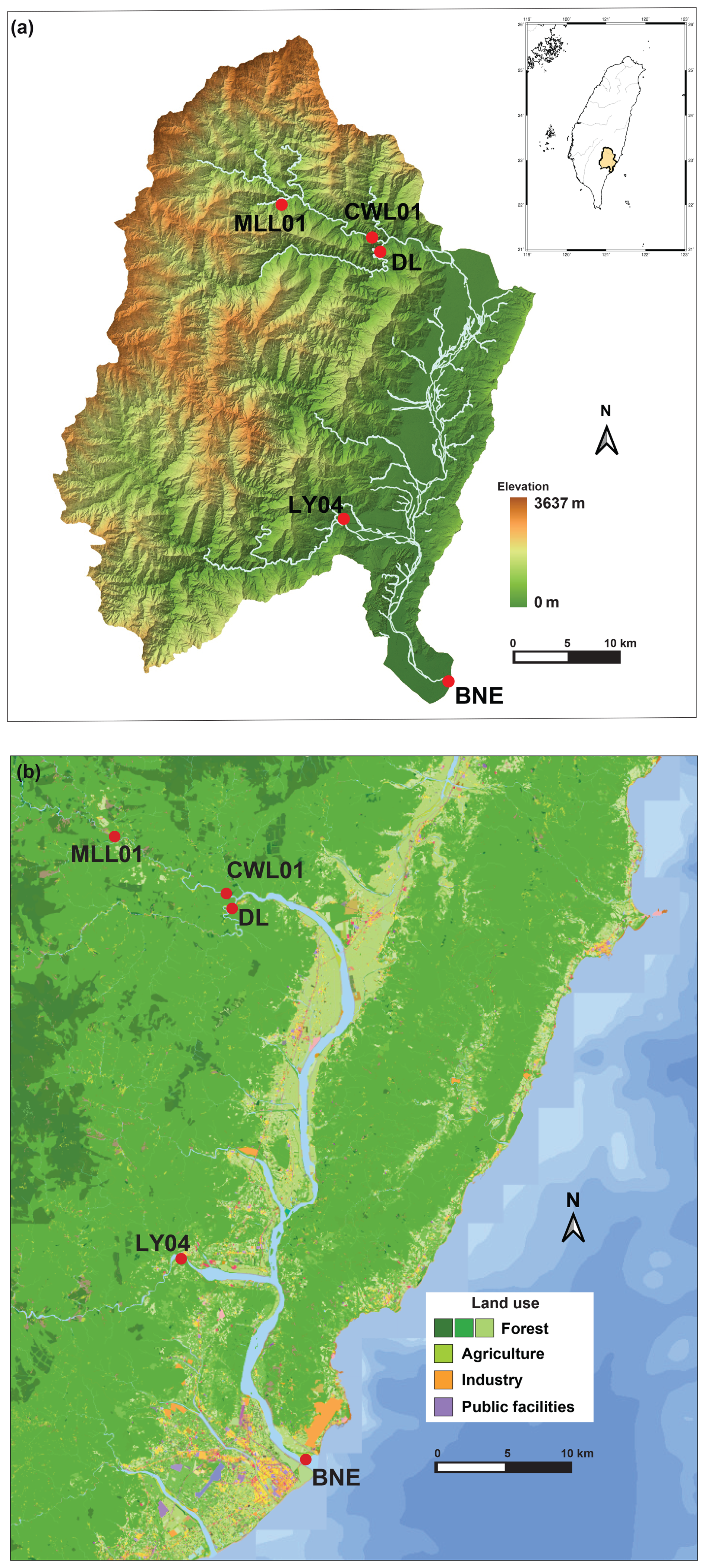
Figure 1(a) Topographic map of the Beinan River catchment (eastern Taiwan) with sampling sites marked in red. (b) Land use and land cover of the lower Beinan catchment, adopted from the National Land Use Investigation dataset (National Land Surveying and Mapping Center, Ministry of the Interior, Taiwan).
Sampling sites were selected to represent individual sub-basins of the Beinan catchment and to span the elevation gradient and landscape transition from metamorphic headwater tributaries to the estuary (Figs. 1a and S1a in the Supplement). Among these sites, MLL01 is located in an upper tributary in the forested headwaters and is characterized by a steep, boulder- and cobble-dominated channel within a valley. CWL01 is on the upper main stem of the Beinan River, and DL is on an adjacent mid-catchment tributary that merges with the main stem near CWL01; both sites are characterized by coarse-grained beds and extensive exposure of gravel/sand bars during low flow. LY04 is on a lower tributary, where the channel broadens into a wider, cobble-bed reach. BNE is on the Beinan main stem at the river mouth. Field photographs of all five sites are provided in Fig. S2 in the Supplement. In situ surface flow velocities measured during seven sampling campaigns ranged from 0.3 to 2.5 m s−1 (Table S1 in the Supplement), reflecting the high-energy characteristics of the catchment. At BNE, in situ salinity remained below 0.6 ppt in every campaign, and dissolved Cl− and Na+ concentration (0.22–0.28 mM and 0.65–0.77 mM, respectively; Table S1) were several orders of magnitude lower than seawater values (∼550 mM Cl− and ∼470 mM Na+) and comparable to those at upstream freshwater sites, indicating that seawater intrusion was negligible during the sampled conditions and that BNE should be interpreted as the freshwater end of the river-estuary continuum rather than a fully mixed estuary.
Previous studies based on carbon isotopic compositions, radiocarbon contents, and Raman spectroscopic characteristics have inferred limited alteration of the source rocks and low contributions of soil to organic matter in suspended particulates (Hilton et al., 2008; Lien et al., 2025). Although substantial contributions of soil carbon have been reported (Lin et al., 2020), the analyzed samples were collected from the bank, which represents a mixture of sediments deposited over time. The isotopic and spectroscopic characteristics, combined with the rapid transit of river water, suggest that, during most periods, suspended particulates are primarily sourced from the lithogenic compartment and remain relatively recalcitrant to biological utilization. Monsoon combined with typhoons from summer to autumn contributes the majority of precipitation (generally >3000 mm) and runoff in the upstream region. For this study, the wet season was defined as the period between June and November 2020, during which precipitation accumulated substantially (Fig. S1). Notably, samples collected in May were referred to as the dry season, considering that the field campaign in May of 2020 was conducted prior to the significant increase in precipitation in late May (Fig. S1). It is also worth noting that the sampling period represents the driest year (with an annual precipitation of 1856 mm) over the last 20 years.
2.2 Sampling and field experiments
Seven field campaigns were conducted in March, May, July, August (twice), October 2020, and January 2021 (Table S1). This frequency was chosen to provide a systematic baseline that spans the full hydrologic cycle, encompassing the distinct dry (January–May) and wet (July–August) seasonal characteristics of southeastern Taiwan (Fig. S1). The intervals also enable consistent comparisons of metabolic rates across seasonal transitions, providing a framework to assess the long-term metabolic stability of these dynamic turbid systems. While in situ environmental parameters were characterized in all campaigns, metabolic rates were measured in March and May 2020 (for phototrophy and autotrophy only) and in August 2020 and January 2021 (for the full suite of tested metabolisms). At each site, in situ physicochemical characteristics (temperature, pH, conductivity, and river flow rate) were measured using the portable probes and meters (Hanna Instruments, HI-98130, RI, USA; Pro II SVR, Stalker, TX, USA). Samples were collected in different forms with different preservatives and preparations (Wang et al., 2024). In brief, river water was filtered using a sterilized 0.22 µm pore-size polyethersulfone (PES) membrane (Supor®) and collected for analyses of dissolved inorganic carbon (DIC), major cations and anions, dissolved organic carbon (DOC), and dissolved inorganic nutrients. To minimize carbon and trace-element contamination, all syringes and high-density polyethylene (HDPE) bottles for DOC and cation samples were pre-washed through a rigorous cleaning protocol consisting of an acid wash with concentrated nitric acid followed by triple-rinsing with both Milli-Q water and filtered river water before final collection. Cation samples were acidified with volume of 20 % nitric acid (Baseline grade, Seastar, BC, Canada). Samples were stored at room temperature (for DIC and inorganic solutes) or −20 °C (for DOC and nutrients). Particulate samples were collected on 0.3 µm pore-size glass fiber membranes pre-combusted at 500 °C for 6 h to remove any potential organic contaminants. The total volume of filtrate for individual particulate samples was 1 L. The collected membranes were frozen at either −20 °C for analyses of chlorophyll a (Chl a) and abundances and isotopic compositions of particulate organic carbon (POC), or −80 °C for molecular analyses.
For metabolic rate measurements, river water was collected into a water bag pre-washed with river water several times, and supplemented with 13C-labeled bicarbonate or individual amino acids ([1-13C]glycine or [1-13C]L-leucine; 13C labeled at the C-1 [carboxyl] position) at a final concentration of 50 µM to constrain the rates of autotrophy/phototrophy (using DIC) or heterotrophy/respiration (using amino acids). DOC-based heterotrophy was given particular focus because DOC represents the substrate pool directly available to planktonic microorganisms, and particulate organic matter is considered recalcitrant for further degradation during river transit (Hilton et al., 2008; Lien et al., 2025). The supplemented substrates with 13C purity >99 % were mixed with deionized water to prepare a 1 mM stock. The amino acid stock was acidified by titrating with HCl to pH<4 to remove the potential DIC associated with the dissolution of the amino acid powder. The stock of either DIC or amino acid was filter-sterilized and stored at 4 °C until further use in the field.
Six liters of river water were collected for each substrate type. All the incubation experiments were conducted in the field accommodation. The supplemented river water was dispensed into 1 L HDPE bottles, filled to capacity to eliminate headspace, and incubated for 4 to 6 h. For 13C-DIC autotrophy, three transparent (light) bottles and one opaque (dark) bottle were used per site per campaign. The light bottles were incubated under constant illumination (∼18 000 lux, monitored by HOBO, Pendant MX) and placed in a flowing tap-water bath, by which heat from the lighting unit was dissipated to keep the bottles at near-ambient temperatures (ranging from 19.3 to 27.2 °C). The dark bottle was incubated alongside. Heterotrophic incubations with 13C-amino acids (glycine and leucine, three replicate bottles each) were conducted in opaque bottles at ambient temperature. The incubated samples were filtered through 0.3 µm pore-size glass fiber membranes to collect particulates comprising mineral/rock fragments and microorganisms. The membranes were rinsed with 2 N HCl immediately after filtration to remove carbonate minerals, then washed with sterilized saline solution. The collected membrane was stored at −80 °C for further isotopic and molecular analyses. Part of the filtrates from the amino acid incubations was preserved at room temperature for isotopic analyses of DIC. A conceptual diagram describing the experimental setup is shown in Fig. 2.
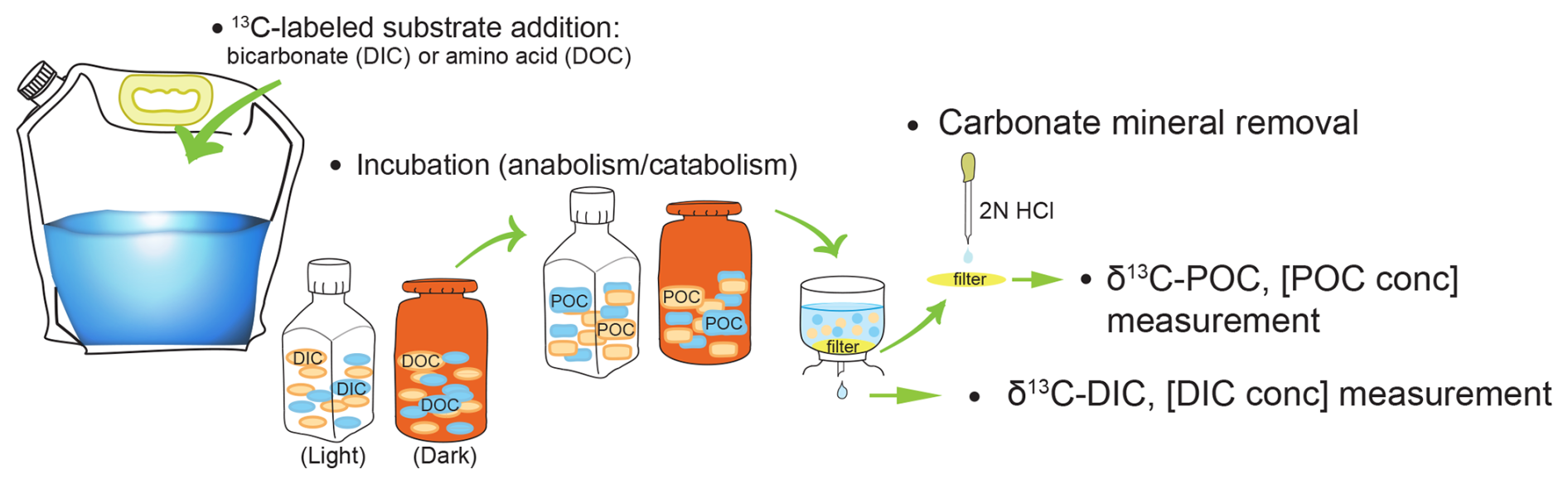
Figure 2Conceptual diagram for the incubation setup in fields and following laboratory measurements.
2.3 Geochemical analyses
Anions were measured using an ICS-3000 ion chromatography (Thermo Fisher Scientific, USA). Major cations were analyzed using an inductively coupled plasma linked with a quadrupole mass spectrometry (ICP-MS; 7800, Agilent, Taiwan). Synthetic and river water standards (SLRS-5 from the National Research Council of Canada) were used to calibrate a range of cation concentrations. Concentrations of orthophosphate and ammonium were measured using molybdenum blue generated from the reductive reaction between phosphate complex and ascorbic acid (APHA Method 4500-P, 2005), and indophenol generated from the reaction between ammonium and thymol (APHA Method 4500-NH3, 2005), respectively. The intensity of the color complex was quantified using a spectrophotometer (V-500, Jasco, MD, USA). Nitrite/nitrate concentrations were quantified using a commercial fluorometric assay (Cayman, MI, USA), which reacts with nitrite (original form or reduced from nitrate) with 2,3-diaminonaphthalene for the generation of 1(H)-naphthotriazole (Miles et al., 1995). Chlorophyll a (Chl a) was extracted from membranes with acetone under dark conditions and quantified using a fluorometer (10-AU, Turner Designs, CA, USA). DOC concentration was measured using a Shimadzu TOC-L CPH/CPN system with high-temperature catalytic oxidation pre-calibrated with known concentrations of KHP (potassium hydrogen phthalate). The analytical uncertainty for these methods is less than 2 %. Concentrations and carbon isotopic compositions of DIC for river water and incubated samples were analyzed by acidifying samples with concentrated phosphoric acid (85 %) and purging the produced CO2 into a total carbon analyzer (Aurora 1030, OI Analytical, USA) and an isotope ratio mass spectrometer (IRMS; MAT253, Thermo Fisher Scientific, USA) connected with a GC-IsoLink (Thermo Fisher Scientific, USA), respectively. Concentrations and carbon isotopic compositions of particulate organic carbon (POC) for river water and incubated samples were analyzed on freeze-dried, acid-rinsed membranes using an elemental analyzer (EA; MICRO cube, Elementar, Germany) and an IRMS (Delta V) coupled to a Flash EA (Thermo Fisher Scientific, USA), respectively. Carbon isotopic compositions were expressed as the delta notation:
where R is the ratio of 13C to 12C, and the standard is Vienna Pee Dee Belemnite (VPDB). The uncertainties for DIC and POC concentrations and δ13C values were less than 2 % and 0.2 ‰, respectively.
Metabolic rates were calculated using the following equations:
where ρDIC_uptake is the rate of DIC assimilated into biomass (Eq. 2), ρAA_uptake is the rate of amino acid assimilated into biomass (Eq. 3), and ρAA_catabolic is the rate of amino acid respired to DIC (Eq. 4). F13C represents the fraction of 13C in POC, DIC, or DOC; ΔF13 is the change in F13C of POC or DIC during the incubation (post-incubation value minus the T0 reference value); [POC] and [DIC] are the measured POC and DIC concentrations, respectively; and t is the duration of incubation. The isotopic fractionation associated with the target metabolic reaction is assumed to be negligible. In this regard, the in Eq. (2) and in Eqs. (3) and (4) represent the sum of the 13C fractions of added substrate and original forms (DIC or DOC). The δ13C values of in situ DOC were not available and, therefore, were assumed to be −27 ‰, considering that the isotopic compositions of soil organic matter are in a similar range (Wang et al., 2024; Lien et al., 2025). The rate for the incubation with DIC under light is considered to represent the summed rate of phototrophy and lithoautotrophy, and could be greater than the rate for the dark incubation. The difference is generally attributed to the phototrophic rate, assuming that the true lithoautotrophy is not affected by light illumination. For incubations with labeled DIC, the chosen concentration constituted a minor fraction of the environmental DIC pool (<5 % of the environmental DIC; Wang et al., 2024). For incubations with labeled amino acid, the 50 µM addition represents a potential enrichment relative to ambient dissolved free amino acid concentration in oligotrophic systems (typically <0.1 µM; Jørgensen and Søndergaard, 1984; Raymond and Spencer, 2015) and is comparable to the total ambient DOC concentration (20–80 µM). In this context, the measured autotrophic and phototrophic rates based on DIC labeling are considered representative of in situ rates, whereas the measured amino acid assimilation and respiration rates represent potential heterotrophic activity.
Seasonal differences in environmental parameters were assessed using linear mixed-effects models (R packages lme4 and lmerTest), with season as a fixed effect and site as a random intercept to account for repeated sampling. Strongly skewed variables (TSM, POC, Chl a, ) were log 10-transformed prior to analysis to satisfy the normality assumption on residuals. Among-site differences in metabolic rates were assessed using Kruskal–Wallis tests followed by Dunn's post-hoc tests. Within-site seasonal variations were evaluated using Kruskal–Wallis tests (multiple time points) or Mann–Whitney U tests (pairwise comparisons). Relationships between rates and environmental variables were examined using Pearson correlations. All the statistical analyses were performed using R version 4.4.1.
2.4 Molecular analyses of community compositions
Crude DNA was extracted and purified using the DNeasy PowerSoil kit (Qiagen, USA) following the manufacturer’s protocol, and stored at −80 °C for further analyses. Polymerase chain reaction (PCR) amplification was conducted on all extracts using the primers 515F (GTG CCA GCM GCC GCG GTA A) and 806R (CCC GTC AAT TCM TTT RAG T), which target the V4 region of the 16S rRNA gene (Kozich et al., 2013). The amplicons were purified, pooled, barcoded, and sequenced using the Illumina MiSeq platform (Illumina, USA). The detailed methodology and reagents employed for PCR have been described in Tu et al. (2017, 2022). Due to the insufficient quantity of DNA (<50 ng in total), extracts from incubated samples were not further processed for stable isotope probing analysis, which targets the population members actively assimilating the fed 13C-labeled substrate.
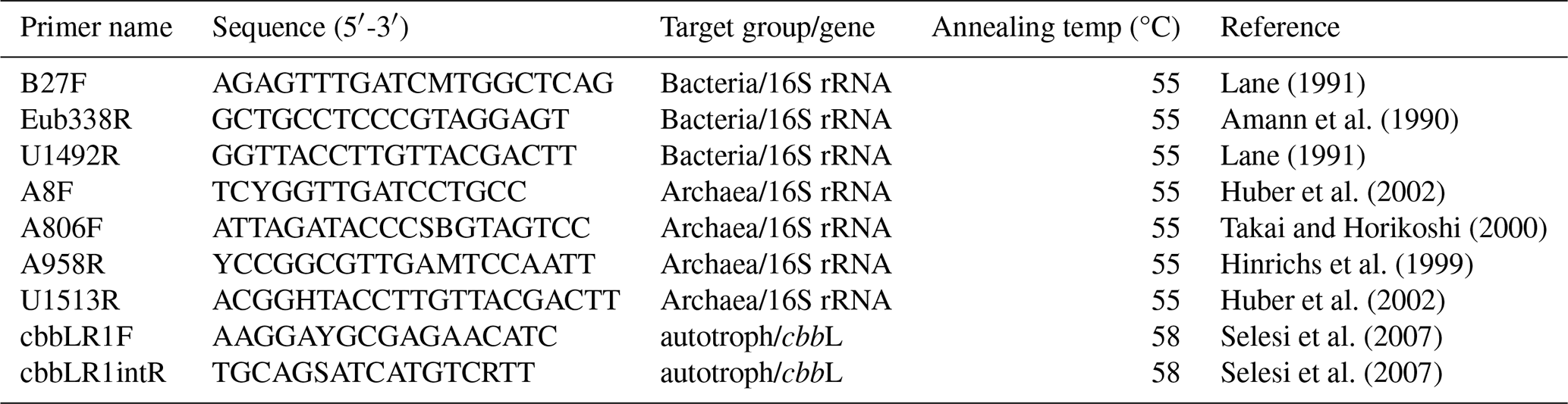
Quantitative PCR (qPCR) was performed to determine the copy numbers of bacterial and archaeal 16S rRNA genes and genes encoding ribulose-1,5-bisphosphate carboxylase/oxygenase form I (cbbL) (Alfreider et al., 2003) using the QuantStudio™ 3 Real-Time PCR System (Applied Biosystems, ABI, USA). The standard preparations and PCR conditions were as described in Tu et al. (2017) and Wang et al. (2014). The primers and annealing temperatures for the different genes are summarized in Table 1. The copy number was calculated using threshold cycles calibrated against standards with known concentrations of gene amplicons, assuming 650 g mol−1 for one base pair of DNA.
Raw sequences of 16S rRNA gene amplicons were processed using Mothur ver. 1.48.0 (Schloss et al., 2009) and QIIME2 (Bolyen et al., 2019). The individual reads were quality-filtered, denoised, merged, and dechimerized to generate Amplicon Sequence Variants (ASVs). Taxonomic classification was performed using the SILVA database (version 138) (Quast et al., 2012). Sequence reads were rarefied to a depth of 100 rounds of random resampling (without replacement) to account for differences in sequencing depth. Alpha diversity indices, including observed ASVs and Chao1 for richness (Chao, 1987) and the Shannon index for evenness (Shannon and Weaver, 1949), were calculated. Differences in alpha diversity among sites and between seasons (wet and dry) were tested by the Kruskal–Wallis test. For beta diversity, the entire ASV table was normalized, and Bray–Curtis dissimilarities were computed. Differences among sites and seasons were tested by permutational multivariate analysis of variance (PERMANOVA; adonis2 in package vegan, 999 permutations). Relationships between microbial community composition and environmental variables were examined by canonical correspondence analysis (CCA) (González et al., 2008), with the significance of each environmental vector assessed by envfit (vegan, 9999 permutations; p<0.05). All statistical analyses were performed using R version 4.4.1 with the vegan, ggplot2, and phyloseq packages. The obtained sequences were deposited in GenBank (BioProject ID: PRJNA1270665).
2.5 Computation for catchment-scale CO2 fluxes
To scale planktonic metabolic rates to the catchment level, the five sampling sites were treated as the outlets of five sub-catchments, with boundaries and areas adopted from the Water Resources Agency (WRA) hydrological atlas of the Beinan basin (Table S6 in the Supplement). Measured rates were multiplied by the average water depth of each investigated reach (50 cm for tributaries, 70 cm for main stem) to obtain areal fluxes. These depth estimates reflect typical conditions observed during field campaigns, excluding flash flood periods. DIC uptake rates under light and dark conditions were assumed to represent daytime and nighttime rates, respectively, with total daily DIC uptake calculated as the sum of equal contributions from each. Using leucine incorporation rates as a conservative estimate of heterotrophic activity, net CO2 production for each sub-catchment was calculated by multiplying the per-site area flux with the sub-catchment river surface area, taken as 0.47 % of its sub-catchment area (Raymond et al., 2013). The total catchment yield was obtained as the sum of the five sub-catchment yields.
To compare the metabolic fluxes with the CO2 evasion, CO2 exchange fluxes between river water and the atmosphere were calculated for each sub-catchment using the following equation:
where is the gas exchange velocity, and C represents the partial pressure of CO2 either from measurement or in equilibrium with the atmospheric CO2 concentration (assumed to be 410 ppm). Cmeasured was derived from the DIC concentration, pH, salinity, temperature, and total atmospheric pressure measured in the same field campaign using co2sys (Lewis and Wallace, 1998). was computed using the relationships reported by Ulseth et al. (2019), where k600 values vary positively with eD (energy dissipation rate and is equal to the product of g [gravitational acceleration], v [flow velocity], and s [slope of the reach]). Depending on whether the gas exchange is controlled by turbulence or bubbles, the relationships between k600 and eD are different (Ulseth et al., 2019):
The flow velocity was adopted from the measured ones obtained in the field, which represented the maximum velocity on the river surface. Because friction would be substantial near the channel bed, the measured surface velocity would be higher than the average channel velocity integrated over the channel cross section. However, considering the water depth is generally small, the measured flow velocity may not substantially deviate from the true one. Nevertheless, the calculated eD values would represent an overestimate. Slope was calculated for the investigated reach (∼1000 m in length) using the DEM (digital elevation model) available to the public (http://data.gov.tw, last access: 25 July 2024). All the parameters used for calculation were summarized in Table S7 in the Supplement. The obtained k600 value was further converted to using the following equation (Wanninkhof, 2014):
where Sc is the Schmidt number of CO2 at the in situ temperature and n is assumed to be 0.5 for turbulent water (Jähne et al., 1987).
The catchment-scale CO2 evasion for target metabolisms or the air-river exchange was susceptible to the uncertainty in both the assumed river surface area and the measured metabolic or flux rates at each site. River surface area fluctuates substantially between events or seasons, and the surface area of low-order reaches may be partly shaded by the trees or too narrow (<1 m) to be resolved by satellite imaging. It becomes technically challenging to fully recover the variations in surface area across the investigated tributaries at different temporal and spatial scales. Therefore, we arbitrarily assigned a conservative uncertainty of ±50 % to river surface area. For each site, this area uncertainty was combined with the measured variability in the corresponding rate or flux (Tables S6 and S7). Site-level uncertainties were then similarly propagated to the catchment scale.
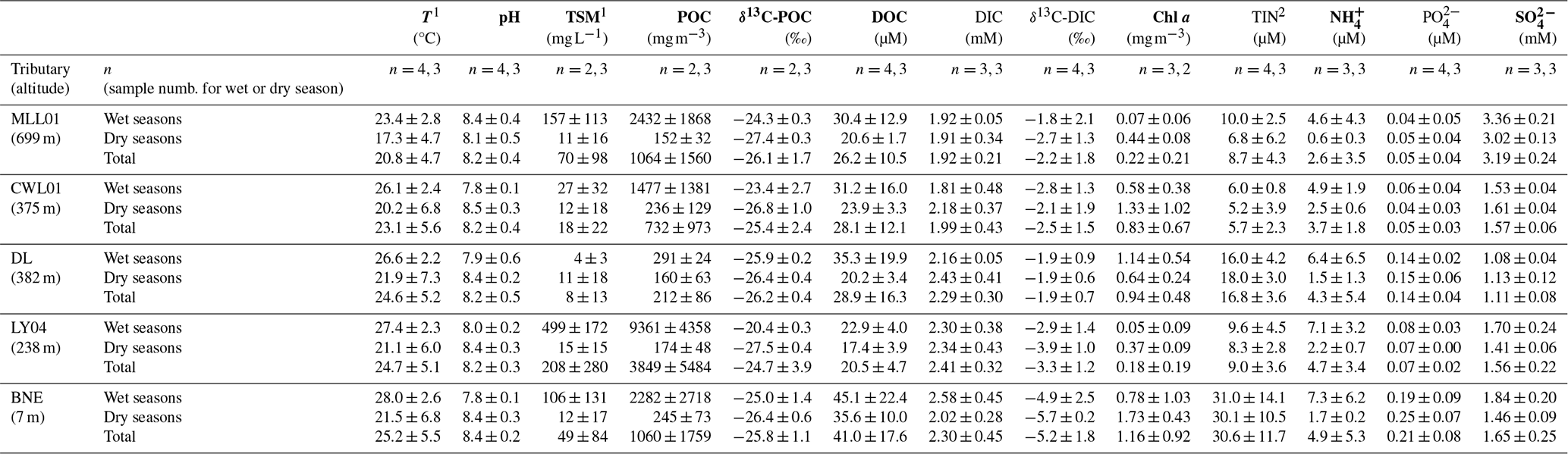
Physicochemical characteristics for each field campaign were categorized into the wet and dry seasons in accordance with the precipitation records (Tables 2 and S1; Fig. S1). Water temperatures varied between 12 and 30 °C, with consistently higher values in the wet than dry seasons (mean wet-dry difference °C, p<0.001; Table S2 in the Supplement). pH was lower in the wet than dry seasons (p=0.003). TSM contents ranged from several to hundreds of mg L−1 and were higher in the wet than dry seasons, with an average ∼11-fold increase in the wet season (p=0.002). The values ranged from −28 ‰ to −20 ‰ and were more negative in the dry than in the wet season (p<0.001). Ammonium concentrations ranged between 0.3 and 16.5 µM and were higher in the wet than in the dry season (p<0.001). In contrast, nitrate/nitrite and phosphate concentrations ranged from 1.7 to 48.3 µM and 0.01 to 0.31 µM, respectively, and neither of them differed significantly between seasons (p=0.690 and p=0.504, respectively; Table S2). Chl a concentrations ranged from below the detection limit to 2.1 mg m−3 and were higher in the dry season than in the wet season (except for DL; p=0.007). DIC concentrations and their δ13C values varied between 1.26 and 2.88 mM and between −6.8 ‰ and +0.6 ‰, respectively, with no significant difference between seasons (p=0.852 and p=0.421, respectively). Sulfate concentrations ranged between 1.03 and 2.06 mM for most sites (except for MLL01 at 2.92–3.59 mM) and were higher in the wet than dry seasons (p=0.004). Sodium and calcium concentrations were lower in the wet than dry seasons (p=0.005 and p<0.001, respectively).
Table 2Physicochemical characteristics among sites and seasons. Parameters shown in bold are significantly different between two seasons (Wilcoxon test, p < 0.05); detailed data are provided in Table S1.
1 T: water temperature; TSM: total suspended matter.
2 TIN includes nitrate and nitrite (nitrite was below the detection limit).
ρDIC_uptake under light conditions varied from 0.03 to 1.98 (Fig. 3a; Table S3 in the Supplement). The rates measured in August were either significantly higher than (for MLL01, LY04, and BNE) or comparable (for CWL01 and DL) with those in other months (Fig. 3a). Within-site temporal variation was significant for all five sites (Kruskal–Wallis: MLL01, H=9.97, p=0.019; CWL01, H=9.97, p=0.019; DL, H=7.2, p=0.027; LY04, H=9.15, p=0.027; BNE, H=9.46, p=0.024). The rates were also higher for BNE than for MLL01, CWL01, and DL (Kruskal–Wallis, H=25.07, p<0.0001; Dunn’s post-hoc, p<0.05; Fig. 3a). In contrast, incubations with 13C-labeled DIC under dark conditions exhibited a drastically different pattern (Fig. 3b). Most rates were either below the detection limit or less than 0.05 . Exceptions occurred for sites MLL01 (0.7 ), LY04 (1.6 ), and BNE (0.19 ) in August.
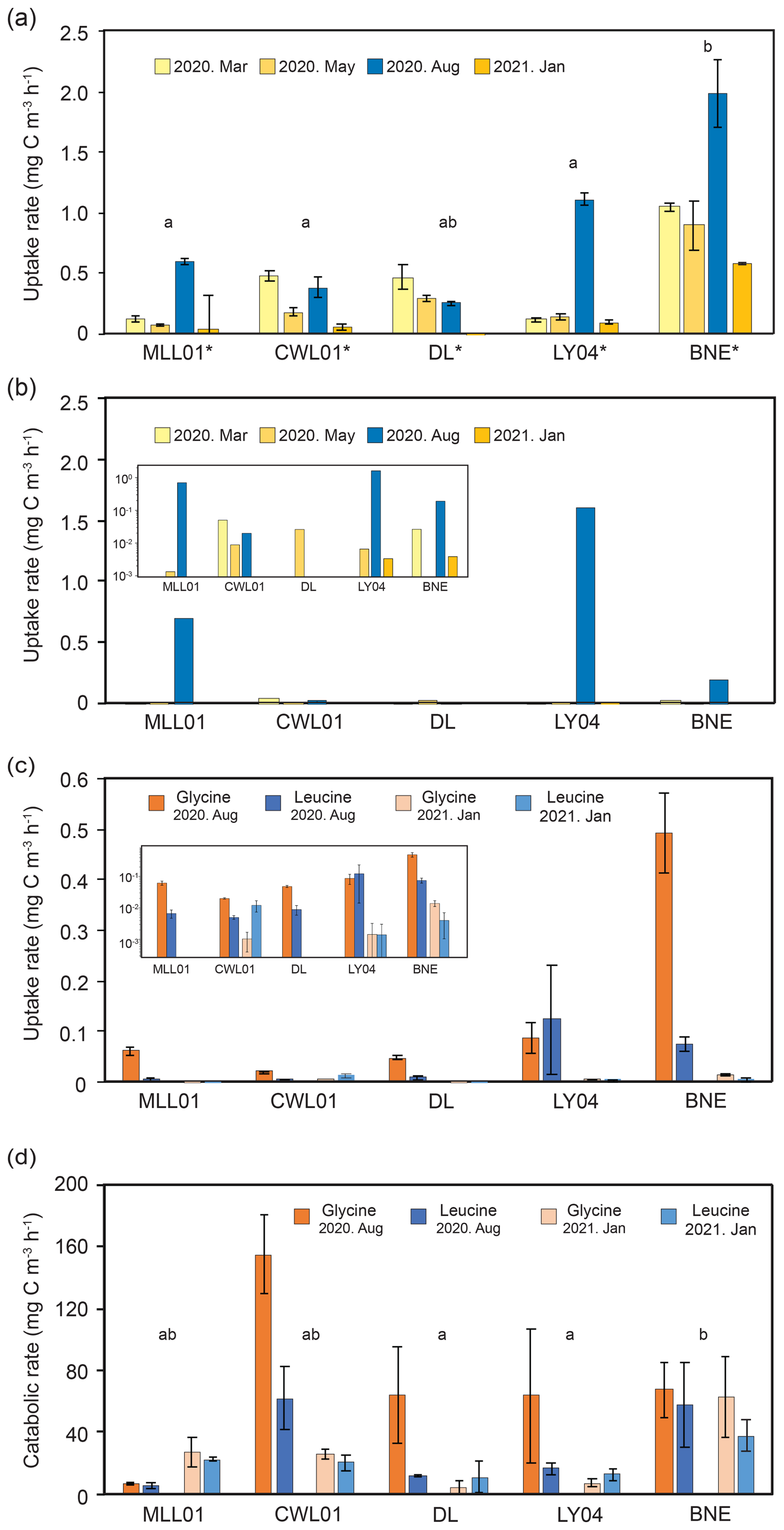
Figure 3Carbon transformation rates along the Beinan River. DIC uptake rates under (a) light and (b) dark incubation conditions across four sampling dates. The inset in panel (b) shows the same data on a logarithmic scale. (c) Amino acid uptake rates and (d) catabolic rates for glycine and leucine across four sampling dates. The inset in panel (c) shows the same data on a logarithmic scale. Error bars represent the standard deviation of triplicate measurements (n=3) for the light DIC, glycine, and leucine treatments. The dark DIC incubation was performed on a single set (n=1) and is shown without error bars. No bar is shown for replicates that yielded negative rates, which were excluded from analysis. Letters above bars indicate statistically significant differences among sites based on the Kruskal–Wallis test followed by Dunn’s pairwise post-hoc test (panel a: H=25.07, p<0.0001; panel d: H=15.47, p=0.004). No significant among-site differences were detected for amino acid uptake rates in panel (c) (H=5.680, p=0.224). Asterisks following site names in panel (a) indicate significant within-site temporal variation (Kruskal–Wallis, p<0.05).
ρAA_uptake ranged from below the detection limit to 0.49 (Fig. 3c; Table S3). These rates were generally higher in August than in January at all sites. Uptake rates with glycine were generally higher than those with leucine (except at LY04 in August) (Fig. 3c). No significant differences were detected among sites for amino acid uptake rates (Kruskal–Wallis, H=5.68, p=0.224). For comparison, catabolic rates ranged from 4.5 to 154.4 and varied spatially and temporally (Fig. 3d; Table S3). ρAA_catabolic with glycine were also higher than those with leucine across most incubations (except for DL and LY04 in January) (Fig. 3d). The catabolic rates appeared to be higher in August than in January for sites CWL01, DL, and LY04, but were comparable between the two months for site BNE. Significant among-site differences in catabolic rates were detected (Kruskal–Wallis, H = 15.47, p = 0.004), with BNE significantly higher than DL and LY04 (Dunn's post-hoc, p < 0.05). Within-site differences between two time points were not tested, because a two-sample rank test with only three replicates per group (n=3) cannot yield a statistically significant result. By contrast, the catabolic rates for MLL01 were higher in January than in August. Most of the added amino acids were utilized for respiration (as the product of total CO2; >99 %) rather than biosynthesis.
To identify the environmental drivers of the metabolic rates, Pearson correlation analyses were performed between the rates and the measured environmental parameters (Fig. S4 in the Supplement). DIC uptake rates under light conditions were positively correlated (p<0.01) with multiple parameters, including DOC, POC, δ13C-POC, nitrate/nitrite, phosphate, TSM, water temperature, and . The phototrophic rates, defined as the difference between rates under light and dark, were positively correlated with DOC, nitrate/nitrite, and phosphate. In contrast, DIC uptake rates under dark conditions were most strongly positively correlated with sediment-associated parameters (TSM, POC, δ13C-POC, and ). Glycine uptake rates were positively correlated with DOC, nitrate/nitrite, and phosphate, whereas leucine uptake was positively correlated with TSM, POC, δ13C-POC, and . Glycine catabolic rates showed a strong negative correlation with DOC concentration, while leucine catabolic rates showed no significant correlation with any environmental parameter.
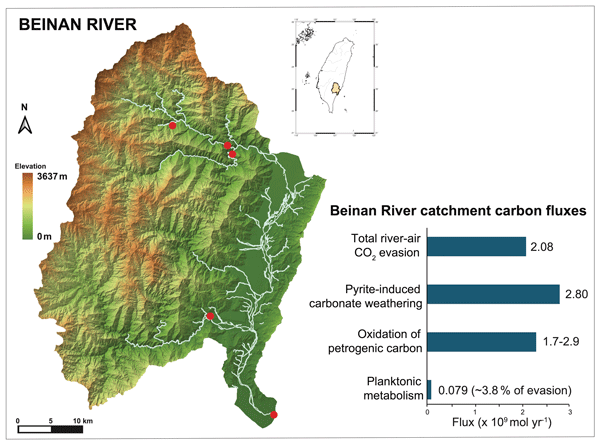
Scaling measured rates to the catchment level yielded net metabolic CO2 production fluxes of 5.16 for MLL01, 21.11 for CWL01, 4.22 for DL, 5.35 for LY04, and 24.44 for BNE (Table S6). The total yield of planktonic metabolic CO2 for individual sites ranged from 105 to 107 mol yr−1, with a catchment-wise total of 7.89×10⁷ mol yr−1 (4.56×10⁷–1.14×10⁸ mol yr−1). For comparison, CO2 evasion fluxes through the river-air exchange ranged from 0.20–1.76 for CWL01, 0.76–17.3 for MLL01, 0.27–0.73 for DL, 0.39–1.56 for LY04, and 0.20–0.90 for BNE (Table S7). Summing exchange rates across the catchment yielded a total annual emission of 2.08×10⁹ (0.96–3.2×10⁹ mol yr−1). Planktonic microbial processes contributed approximately 3.8 % of the total annual CO2 evasion rate (Tables S6 and S7).
Bacterial and archaeal 16S rRNA gene abundances for river water ranged from 2.3×10³ to 3.9×10⁷ copies L−1 and from 5.6×10⁴ to 5.5×10⁶ copies L−1, respectively (Fig. S3 in the Supplement). The abundances of cbbL ranged from 1.8×10³ to 7.2×10⁵ copies L−1. All the gene abundances were generally higher in January than those in other months (mostly by more than one order of magnitude, except for BNE). The variation in gene abundance between January and August was most pronounced at LY04, where bacterial 16S rRNA gene copy numbers were ∼2 orders of magnitude smaller in August than in January (Fig. S3). By comparison, archaeal 16S rRNA gene abundances at BNE were relatively stable across the four sampling months. Statistical analyses by season were not conducted due to insufficient biological replication in the gene abundance measurements.
A total of 532 787 reads of 16S rRNA gene amplicons were obtained and classified into 13 005 ASVs. The observed ASVs and Chao1 estimates based on the rarefied dataset (n=5220) ranged from 200 to 1600 and from 150 to 2300, respectively (Table S3). The Shannon index ranged from 4.4 to 6.9. Alpha diversity varied among sites and sampling intervals (Fig. 4a). Kruskal–Wallis tests did not detect statistically significant differences among sites (Observed ASVs: H=6.99, p=0.14; Chao1: H=6.35, p=0.17; Shannon: H=8.36, p=0.08) or between seasons (all p>0.72). Nonetheless, Shannon diversity tended to be highest at the upstream tributary CWL01 (mean=6.4) and lowest at the river mouth BNE (mean=5.0). At MLL01 and LY04, observed ASVs and Chao1 dropped markedly during the early wet season (July), whereas CWL01, DL, and BNE showed more stable values across the study period.
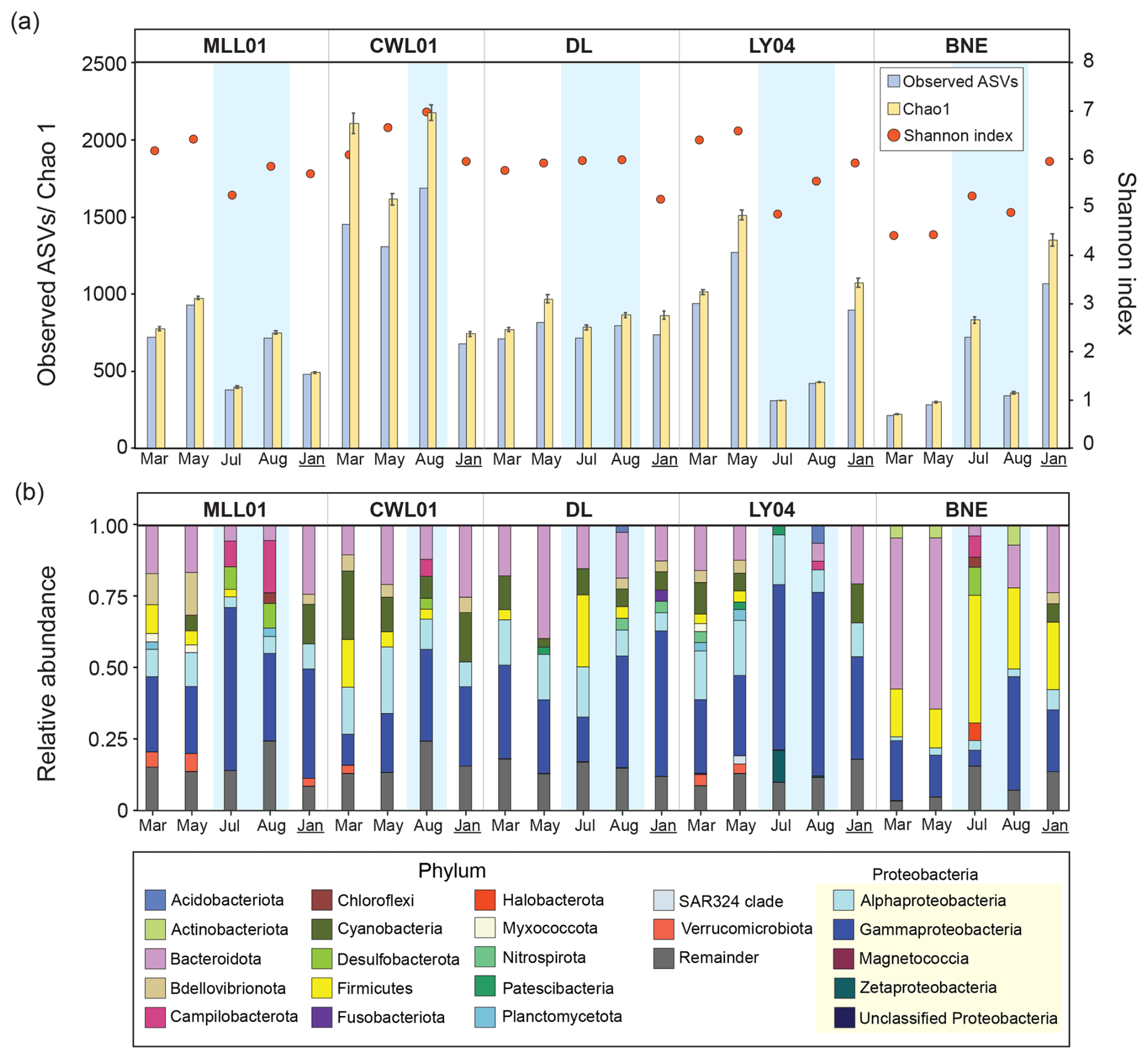
Figure 4(a) Alpha diversity indices (observed ASVs, Chao1, Shannon index) and (b) community compositions at the phylum level, with Proteobacteria resolved at the class level. Error bars on Chao1 represent ±1 SE estimated from rarefaction. Time intervals with blue background represent the wet season.
Community compositions varied temporally and spatially to different degrees, with the major phyla including Bacteroidota, Cyanobacteria, Firmicutes, Campilobacterota, Desulfobacterota, and Proteobacteria (Alpha and Gamma divisions) (2 %–20 %; Fig. 4b). Gamma-Proteobacteria appeared to be more abundant in most time intervals and at most sites (except for BNE). Cyanobacteria was more abundant in the dry season than in the wet season, and vice versa for Campilobacterota and Desulfobacterota (Fig. 4b). For BNE, Bacteroidota constituted the major phylum for two out of three dry season samples. Firmicutes combined with Gamma-Proteobacteria outnumbered (>54 %) the others during the wet season and January. Among all detected ASVs, ASVs with sequences related to Thiotrichaceae, Erysipelotrichaceae, and Phormidiaceae represented the most abundant ones. However, their abundances varied dramatically among sites (Table S8 in the Supplement).
Beta diversity analyses showed that community composition was structured primarily by site (PERMANOVA: , R2=0.30, p=0.001), while the seasonal effect was marginal (, R2=0.06, p=0.087). The joint site-and-season model explained 35 % of the variance (p=0.001). In the CCA ordination (Fig. 5), BNE samples deviated from the cluster formed by the other sites and were associated with elevated DOC. For the remaining sites, dry-season samples clustered, whereas wet-season samples were more dispersed and showed positive correlations with TSM, POC, and 13C-POC. All four environmental vectors were significant (envfit, p<0.05; r2=0.62–0.96; Fig. 5).
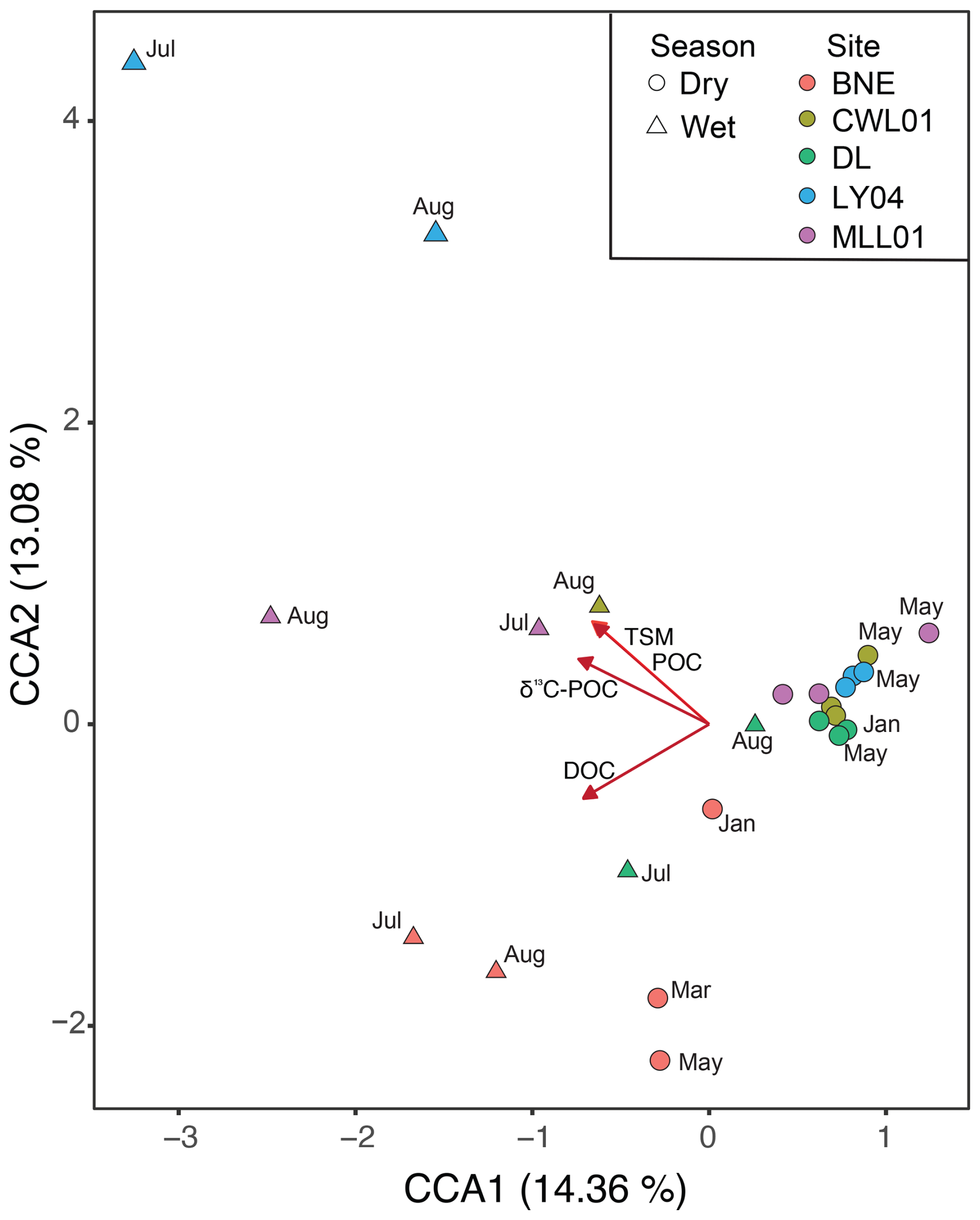
Figure 5Canonical correspondence analysis (CCA) ordination of microbial community composition of 16S rRNA gene amplicons (ASV proportion). Significant environmental vectors (envfit, 9999 permutations, p<0.05) are shown as solid arrows: TSM (r2=0.94, p=0.006), POC (r2=0.96, p=0.007), DOC (r2=0.62, p=0.011), and δ13C-POC (r2=0.65, p=0.035). Symbols indicate site (color) and season (circle = dry, triangle = wet).
4.1 Solute and nutrient status, and river metabolism
The general physicochemical characteristics of river water (pH, major ions, TOC, TSM, and 13C-DIC) were comparable to those reported previously (Wang et al., 2024). These solute characteristics are mostly derived from carbonate dissolution (>80 % of the total solute load) driven by sulfuric acid produced by microbially mediated pyrite oxidation (Wang et al., 2024). Considering that a great portion of discharge is attributed to monsoons or typhoons, solute yields from carbonate dissolution during these extreme events dominate over the quiescent period and could be translated into a significant flux of CO2 emissions that constitutes a disproportionally large fraction of global flux (∼1 % from 0.002 % of three major catchments in Taiwan). The high contribution pattern of carbonate weathering to the solute budget has also been observed for other active orogens (e.g., New Zealand and the Himalayas) (Emberson et al., 2016; Kemeny et al., 2021). Furthermore, a high-water regime during summer monsoon or typhoons drains erodible materials (sediments accumulated in banks or hillslopes) into channels. As a result, TSM concentrations increased to a range of hundreds of mg L−1, up to a factor of 40 (at LY04) between the wet and dry seasons (Table 2). This magnitude is far less than previous observations during the extreme events (up to 10 g L−1; Dadson et al., 2003; Kao and Milliman, 2008; Wang et al., 2024), given that the annual precipitation during the sampling period was much less than previous years (1856 mm for this study period versus ten-year average of 3402 mm for the most upstream Siangyang weather station; CWB annual report), but could still be sufficient to influence the expression of investigated metabolisms (see the next section). Similar increases in POC concentrations were also observed (Table 2). For comparison, dissolved cation concentrations were characterized by varying degrees of dilution attributable to increased discharge (linear mixed-effects model, p<0.05; Tables S1 and S2). In contrast, sulfate is significantly more abundant in the wet than dry seasons (linear mixed-effects model, p=0.004), a pattern consistent with enhanced pyrite oxidation during sediment mobilization in this catchment (Wang et al., 2024) and the elevated wet-season abundance of sulfur-oxidizing taxa (e.g., Thiobacillus and Sulfuricurvum) (Sect. 4.6).
While nitrate/nitrite and phosphate concentrations did not differ significantly between seasons, Chl a concentrations were significantly higher in the dry season, and ammonium concentrations were significantly higher in the wet season (linear mixed-effects model, both p<0.05; Table S2). As ammonium is the degradative product of organic particulates, the higher ammonium concentrations in the wet season suggest either greater organic degradation during river transit or more extensive purging of soil porewater during the high-water regime (Calmels et al., 2011). It is also worth noting that the comparable nitrate/nitrite and phosphate concentrations between seasons, or higher ammonium concentrations in the wet season, could translate into higher yields of these nutrients given much higher discharge. Part of the ammonium production may even have been channeled from the degradation of amino acids, which can also be sourced from the degradation of suspended organic particulates. As indicated by our incubation results, amino acid mineralization occurred across all investigated sites distributed from the upstream to the estuary. Their rates were also higher in the wet than in the dry season, coinciding with the increased input of TSM. Alternatively, soil development is limited in the investigated catchment. High erosion and heavy precipitation associated with extreme hydrologic events could have rapidly drained stagnant soil porewater along with soil particulates and groundwater residing in the fracture network into the river. As these water bodies retain the degradative products of organic matter and their transport is slow (Alley et al., 2002; Calmels et al., 2011), these nutrient constituents would accumulate to high levels during the quiescent period and be rapidly purged only when erosion and high hydraulic head are imposed. As ammonium concentrations tended to increase from the upstream headwater (MLL01: 2.6 µM) toward the river mouth (BNE: 4.9 µM) (3.7–4.7 µM; Table 2), the concentration gradient was even more pronounced during the wet season than the dry season. The data pattern seems consistent with progressive accumulation of soil-derived inputs along the catchment under high flow conditions, and may be accounted for by the increasing agricultural land use in the lower catchment near the estuary (Fig. 1b). Finally, water temperatures during the wet season were systematically ∼6 °C higher than during the dry season (Table 2). Enhanced microbial degradation of suspended or soil organic matter driven by this temperature increase may have contributed to increased ammonium release. Overall, current data do not allow us to identify the primary cause driving enhanced ammonium concentrations in the wet season. High-frequency monitoring of river water and groundwater across the event period is warranted to gauge the mechanism of nutrient release from the soil. Such a data pattern is also comparable to the nutrient-deprived oligotrophic state commonly observed in the open ocean (Overholt et al., 2022).
Chl a concentrations were significantly higher during the dry season than during the wet season (linear mixed-effects model, p=0.007), by a factor of at least 2.2 (except for site DL). Pearson correlation analysis revealed a significant negative correlation between Chl a and TSM (, p<0.05) and no significant correlation between Chl a and POC (, p=0.06) (Table S5 in the Supplement). Chl a concentrations at sites MLL01 and LY04 during the wet season were barely detectable. While nutrient concentrations (nitrate/nitrite and phosphate) do not vary considerably between MLL01 and LY04, nutrients do not appear to be a deterministic factor in controlling phototrophic activity. Instead, the load of suspended sediment can affect the expression of phototrophy even at a scale of hundreds of mg L−1, a level that is not particularly unusual for mountainous rivers. Potential mechanisms inhibiting phototrophic activity include the shading created by dense sediments, grain pulverization, and abrasion (Stanley et al., 2010). The results are consistent with O’Donnell and Hotchkiss (2022), who found that high flow events drove gross primary production (GPP) and ecosystem respiration (ER) to deviate from baseline metabolism. Their results also indicate that both GPP and ER rates were reduced by flash flow, with GPP rates varying at a greater magnitude than ER (Blaszczak et al., 2019; Hall et al., 2015).
4.2 Autotrophic carbon fixation: rates and controlling factors
DIC uptake rates were significantly correlated with TSM, POC, δ13C-POC, and regardless of light availability (Fig. S4). Under light conditions, DIC uptake rates were also correlated with temperature, DOC, and nutrients. DIC rates for the wet season could be qualitatively categorized into two patterns. The first category is represented by sites CWL01, DL, and BNE, where rates with light were higher than those without light (Fig. 3a and b). The largest difference at 43 was observed at the most downstream site, BNE (Table S3). The second category is represented by sites MLL01 and LY04, where rates with light were either comparable to or slightly less than those without light. For incubations with DIC for the dry season, rates with light were generally much larger than those without light. In fact, rates without light were below the detection limit for sites MLL01, DL, and BNE. The only exception occurs for site CWL01, where DIC uptake rates with light were slightly higher than those without light. The results in part corroborate the Chl a pattern but offer an additional dimension for constraining river metabolism.
The contrast pattern described above is apparently consistent with light limitation imposed by suspended sediment, which was far higher at MLL01 and LY04 (wet-season TSM ∼157 and ∼499 mg L−1) than at CWL01, DL, and BNE (∼4–106 mg L−1). Furthermore, differences in rates with and without light could be interpreted as the phototrophic rates, assuming that lithoautotrophic rates (obtained from dark conditions) are constant regardless of whether light is available. In this regard, phototrophic rates for sites MLL01 and LY04 were lower in the wet season and were even completely inhibited with the replacement of lithoautotrophy. In contrast, phototrophic rates were greater in the wet season than in the dry season for the other three sites, even though lithoautotrophy was substantially reduced during the dry season. Additionally, the significantly positive correlations between DIC rates under light conditions and TSM, POC, and δ13C-POC contradict the expression of phototrophy. This pattern could be largely accounted for by the fact that a large fraction of the DIC rates with light (115 %–145 %) were attributed to the lithoautotrophic rates during the wet season (Table S3). Therefore, the significant correlation for light conditions resembles that for dark conditions. By comparison, the significant correlation between the difference in DIC rates and nutrient concentration is compatible with the fact that primary production is highly dependent on nutrient availability in aquatic environments (Cloern, 1999; Domingues et al., 2005). As the nutrients generated from the degradation of organic matter accumulate along the river flow, BNE was characterized by the highest concentrations of nutrients and phototrophic rates in the wet season (Fig. 3). Taken together, these patterns suggest that phototrophic rates were primarily limited by light availability at MLL01 and LY04, whereas nutrient availability was the more relevant limiting factor at CWL01, DL, and BNE. Notably, the Chl a concentration did not show a significant correlation with the phototrophic rate (Fig. S4).
4.3 Particulate-mediated lithoautotrophy in the wet season
The incubation with DIC under dark conditions yielded DIC uptake rates spanning from below the detection limit to 1.6 (Fig. 3; Table S3). These rates constitute only a small fraction (<5 %) of the rates under light conditions but become generally high and even comparable with the rates under light conditions for samples collected during the period of high sediment load (LY04 and MLL01 in August). As these two sub-catchments are susceptible to high erosion of slate formations, such a spatial pattern of dark DIC uptake is consistent with geological control rather than the upstream-downstream position along the catchment. The rate pattern is intriguing and suggests intimate relationships with the potential substrates supplied from the suspended particulates or reduced ions from the groundwater influx.
For particulate matter, potential substrates include reduced sulfur or iron-bearing minerals (e.g., pyrite) and ammonium encapsulated within the interlayer of clay minerals (Petit et al., 2006). Pyrite is prevalently distributed in metasedimentary rocks of the catchment and has been identified as the main solute and CO2 contributor of weathering (Blattmann et al., 2019; Bufe et al., 2021). A previous study conducted on the same catchment has shown a highly positive correlation of the yields between riverine sulfate, suspended sediment, and sulfur oxidizers (mainly composed of Thiobacillus and Sulfuricurvum members) (Wang et al., 2024). The data pattern suggests that sulfate/sulfuric acid is primarily generated by the microbially mediated oxidation of pyrite in erodible materials in riparian zones or hillslopes. As the torrential precipitation continues, these materials, along with the sulfur oxidizers, are drained into the river channels and recovered by sampling and analysis. The data corroborate that the erosion of bedrocks and subsequent pulverization on hillslopes or in river channels facilitate the exposure of pyrite to the atmosphere or to air-infiltrated pore space, thereby rendering the oxidative reaction that produces sulfuric acid for dissolution of carbonate or other minerals (Hilton and West, 2020). Furthermore, particulate pulverization and abrasion can also disrupt the cleavage or interlayer structure of clay minerals, thereby releasing ammonium into the surrounding water (Yu et al., 2023). While river water is presumably saturated with atmospheric oxygen, pyrite and ammonium associated with suspended particulates are readily available for lithoautotrophic microbial exploitation and colonization.
For groundwater influx into rivers, potential substrates for lithoautotrophy include ferrous iron, ammonium, and sulfide, all of which could be produced by either microbial reduction of oxidants (e.g., iron oxyhydroxide, nitrate, and sulfate) or degradation of organic matter (for the release of ammonium). Considering that sulfate minerals have not been identified or recovered from the catchment to date, ferrous iron and ammonium produced in subsurface aquifers could be drained and discharged into rivers. Indeed, ammonium concentrations were significantly higher in the wet than in the dry seasons (Table 2). Our current analyses also revealed that potential sulfur oxidizers related to these two genera (Thiobacillus and Sulfuricurvum members) and others (e.g., Sulfurovum, Sulfurifustis) and ammonium oxidizers related to Nitrosomonas and Nitrosopumilus constituted a significant proportion of communities (>10 %) in the wet season as compared to 5 % in the dry season. A detailed experimental design is required to pinpoint the exact substrate involved in the aquatic lithoautotrophy.
4.4 Heterotrophic amino acid metabolism and controlling factors
In contrast to autotrophic carbon fixation, heterotrophic metabolism showed distinct seasonal patterns and substrate preferences. Glycine and leucine uptake rates were correlated with nutrients and particulate characteristics (concentration and isotopic composition), respectively (Fig. S4). As the nutrients represent the degradative products of organic particulates, these relationships seem to suggest that the direct uptake of amino acids by riverine community members is linked to the metabolites generated by particulate degradation (for glycine) or particulate-associated populations (for leucine). For the former scenario, metabolites or nutrients released from the particulate degradation accumulated along the flow, peaking at the estuary site (BNE) when compared with upstream sites. Therefore, the correlation relationships suggest that enhanced nutrient abundances facilitate the boosting of activity in a riverine population, preferentially for glycine uptake. Such a relationship is also analogous to the priming effect on soil microbiota, where the addition of exogenous substrate or substance promotes further degradation of organic matter (Blagodatskaya and Kuzyakov, 2008; Chen et al., 2014). On the other hand, the latter scenario suggests that leucine uptake is linked to the size of the population attached to particulate organic matter. With a larger influx of TSM in the wet season, the size of the attached population could have been correspondingly enhanced, providing a larger population of microorganisms with functional preferences for leucine uptake. The inference also suggests a divergent modulation of physiological preferences for glycine and leucine uptake mediated by two distinct populations. The inference may be better constrained by expanding the incubations to various concentrations of particulates and simultaneous analyses of stable isotope probing of cellular components (proteins, lipids, or nucleic acids) to identify the plausible populations actively incorporating either of these amino acids. Despite these substrate-specific correlations with site-varying parameters, amino acid uptake rates did not differ significantly among sites (Kruskal–Wallis, H=5.68, p=0.224), suggesting that the correlative patterns described above reflect catchment-scale trends rather than localized among-site contrasts.
The exploitability of organic substrates for heterotrophy is worth noting. Glycine uptake rates were generally higher than leucine uptake rates for the wet season (except for LY04, where both rates were comparable) (Fig. 3c). In the dry season, these two uptake rates were comparable but noticeably much lower than those in the wet season. For comparison, glycine catabolic rates were higher than leucine catabolic rates for CWL01, DL, and LY04 in the wet season. Both rates were comparable to each other at other sites (Fig. 3d). Overall, the selectivity of glycine over leucine for the wet season was prevalent (at four out of five sites for uptake and three out of five sites for catabolism). The cause of substrate selectivity may be attributed to the preferential utilization of simply structured substrates by specific community members or enzymatic expression (Geisseler and Horwath, 2014; Palenik and Morel, 1990). The selectivity for glycine likely reflects higher metabolic efficiency of glycine-centered pathways. The reductive glycine pathway (rGlyP) and glycine cleavage system (GCS) offer highly ATP-efficient routes for both biosynthesis and energy generation (Dronsella et al., 2025; Kikuchi et al., 2008), providing a more consistent mechanistic basis for glycine metabolism across seasons. In contrast, leucine catabolism requires a complex multi-step pathway involving at least six enzymatic reactions to yield acetyl-CoA and acetoacetate (Brosnan and Brosnan, 2006; Massey et al., 1976), making respiratory oxidation costly. Therefore, microorganisms would preferentially incorporate leucine into proteins (Kirchman, 2001; Kirchman et al., 1985), such that leucine-derived rates provide a conservative estimate for heterotrophic activity. As both amino acids are required for biosynthesis, further experiments are needed to clarify the expression of specific metabolic pathways.
The results for heterotrophic incubations in this study revealed that catabolic rates exceeded assimilation rates by at least two orders of magnitude (Fig. S5 in the Supplement). The great rate contrast was partially accounted for by the fact that 13C was labeled at the carboxyl position of amino acids in our incubations. The carboxyl carbon in amino acids would be primarily cleaved and converted into CO2, whereas all the other unlabeled carbon would be assimilated and partially converted into CO2 at the cost of energy expenditure (Hill et al., 2013; Suttle et al., 1991). Therefore, carbon uptake would be primarily sourced from non-carboxyl carbon, with limited contribution from carboxyl carbon. Other than the site preference associated with the labeled position, which would result in underestimation of both rates, the ratios of catabolic to uptake rates remain related to community activity and composition modulated by environmental parameters. Except for January incubation with leucine for CWL01, all the other incubations with amino acids yielded a ratio of catabolic to uptake rates for January greater than for August. The ratios even reached an infinite level (uptake rate below the detection limit) for MLL01 and DL in January. The overwhelmingly large ratios were primarily controlled by heterotrophic assimilation at extremely low levels during the dry season when sediment supply was low. Although the incubations were provided with readily available amino acids, the slow assimilation suggests that the communities in the dry season may be customized to a deprived supply of nutrients and small organic molecules generated from the degradation of particulate organic matter. Therefore, any solid or soluble substrate available for microbial utilization would be initially diverted to catabolism for energy generation to sustain certain maintenance activities (McInerney et al., 2010). Thus, even when the amino acids were provided during incubations, their assimilation was not immediately enhanced under such energy-limited conditions for heterotrophs. Conversely, communities in the wet season had access to an abundant supply of particulate organic matter to catalyze metabolism for energy generation or assimilation, which resulted in a relatively larger fraction of the fed amino acids being diverted to assimilation or biosynthesis (Table S3, Fig. S5). Nevertheless, the heterotrophy in such oligotrophic mountainous rivers yields excessive CO2 that is susceptible to net emission through the air-water exchange.
4.5 Implications for river heterotrophy and carbon cycling
The rate comparison between autotrophy and heterotrophy (assimilation plus catabolism) indicates that the planktonic compartment of the Beinan River is net heterotrophic, producing excess CO2 through planktonic microbial processes. As the incubations were performed over a short period of time (4–6 h), the physiological status of community members likely resembles in situ conditions. For DIC-based measurements provided with 13C at a concentration less than 5 % of the ambient DIC pool, the derived rates were considered to bracket the range of true rates. For amino acid-based measurements, the 50 µM addition of amino acid exceeds the ambient concentration and half-saturation constants (Km) for oligotrophic systems (11–79 nM in Boysen et al., 2022; 1.41 µM in Brailsford et al., 2019). Therefore, our experimental setup may represent the possible stimulation of uptake and respiration for our river systems. Furthermore, part of the unlabeled carbon in amino acids that was assimilated and eventually respired was not quantified in our experiments; the rates obtained were mostly derived from the carboxyl 13C in amended amino acids. Therefore, our measurements represent an underestimate of respiration under the experimental setup. To provide a first-order and conservative quantification of possible heterotrophic CO2 production, the leucine catabolic rates were arbitrarily chosen to estimate the carbon export at the catchment scale.
We further note that the experimental design captures only part of metabolisms on dissolved organic substrates and does not directly probe the decomposition of pre-existing suspended POC. It is also worth noting that the current estimates constrain only the planktonic compartment of river metabolisms. The benthic and hyporheic zones, which are connected to the river water and contribute to the cycling of organic carbon, were not measured in this study. In addition, this catchment-scale estimate is sensitive to the assumed river surface area fraction (0.47 % of sub-catchment area; Raymond et al., 2013), derived from a global average reported for a range of 0.30 %–0.56 %. Given the challenge of independently constraining this fraction for the present catchment, we arbitrarily adopted a conservative ±50 % uncertainty for river surface area, and combined this with the measured variability in rate or flux for each site (Sect. 2.5). This approach yields a catchment-wise planktonic CO2 production estimate of 7.99×10⁷ mol yr−1 (4.56×10⁷–1.14×10⁸ mol yr−1), and a total river-air CO2 evasion flux of 2.08×10⁹ (0.96–3.20×10⁹ mol yr−1).
Our planktonic metabolic CO2 production (7.89×10⁷ mol yr−1) accounts for less than 5 % of river-atmosphere CO2 exchange flux ( mol yr−1) and CO2 production from chemical weathering (2.8×10⁹ mol yr−1; Wang et al., 2024) and petrogenic carbon oxidation (1.7–2.9×10⁹ mol yr−1; Lien et al., 2025). This pattern indicates that net CO2 emissions through the river-air interface are overwhelmingly driven by the weathering of minerals and petrogenic carbon. While benthic and hyporheic contributions may have been reduced during the high-water period (Battin et al., 2023; Hall et al., 2015), they are likely substantial during dry-season low-TSM conditions when the water column is clear, and light can reach the stream bed. To place the planktonic contribution in the broader context of stream metabolism, our rates were compared with rates reported for morphologically comparable upland streams. Our measured DIC uptake rates (0.03–1.98 ) were transformed into a flux of to assuming an average water depth of 0.5 or 0.7 m (Table S6). By comparison, benthic gross primary production fluxes for clear upland streams typically range from to several (Hall et al., 2015; Bernhardt et al., 2022). Furthermore, Rovelli et al. (2017) isolated water-column metabolism from benthic metabolism in UK headwater streams and reported that water-column metabolism contributed 25 % to annual ecosystem respiration and primary production, with peak rates of 2.5–3.5 . Therefore, planktonic autotrophic fluxes for the Beinan River are one to two orders of magnitude lower than benthic primary production fluxes reported elsewhere. In contrast, planktonic heterotrophic catabolic fluxes (0.055–1.85 ) for the Beinan catchment fall within the typical range of total ecosystem respiration fluxes reported for upland streams (∼0.5 to several ; Battin et al., 2008; Hall et al., 2015; Rovelli et al., 2017; Bernhardt et al., 2022). Because ecosystem respiration in most of these studies encompasses planktonic, benthic, and hyporheic contributions rather than separating them, our planktonic-only rates suggest that the planktonic compartment can be a significant fraction of total stream respiration. Overall, these comparisons indicate that the low fractional contribution of planktonic metabolism to total CO2 evasion in the present study reflects the dominance of weathering-derived CO2 in this catchment, rather than anomalously low planktonic metabolic rates. More detailed measurements are warranted to validate whether different compartments of the Beinan river systems contribute to the net carbon export in a pattern resembling other similar catchments.
Previous studies based on dissolved oxygen data demonstrate that both fluxes of net ecosystem production (NEP) and CO2 emissions derived from the river-air exchange vary over several orders of magnitude as the discharge or stream order increases for the catchments distributed over contiguous US and European boreal regions (Dodds et al., 2013; Cory et al., 2014; Hotchkiss et al., 2015; Rasilo et al., 2017; Lupon et al., 2019; Bernal et al., 2022). Using a discharge-weighted regression, Hotchkiss et al. (2015) found that NEP fluxes varied much less. Such a regional data pattern also suggests that the contribution fraction of NEP to the total emission increases from ∼15 % to ∼50 % as the discharge increases to hundreds of cms (cubic meter per second). Only limited data simultaneously covering NEP, CO2 emissions, and discharge are available for individual catchments. These studies show that the fractions range from 17 % to 75 % for rivers in Canada (Rasilo et al., 2017), from 17 % to 51 % in Sweden (Lupon et al., 2019), ∼22 % in southeastern US (Dodds et al., 2013), and from 51 % to 57 % in northeastern Spain (Bernal et al., 2022). Recent modeling for catchments in contiguous US suggests that the NEP accounts for ∼7 % of the total evasion (Maavara et al., 2025). The net planktonic CO2exchange fractions (<5 %) reported herein are even smaller than or comparable to any fraction obtained in previous studies. Such a low range of net planktonic CO2 exchange fluxes is in great contrast to most of the examples obtained elsewhere, even for the site (BNE) located nearest to the shoreline or with the greatest stream order (SO=5). The pattern suggests that steep topography and rapid erosion associated with active mountain building limit the development of soils and enable a scarce supply of nutrients and rapid transit of river water, all of which apparently restrain the expression of planktonic metabolisms. In contrast, voluminous amounts of metamorphic rocks are fractured and eroded, providing unlimited materials readily for the oxidation of pyrite and petrogenic carbon mediated by microbial processes in the subsurface and riverbanks (Wang et al., 2024; Lien et al., 2025). Consequently, CO2 generated by these weathering reactions is drained into the river along with groundwater flow and dominates over the contribution from other sources.
4.6 Seasonal and spatial dynamics of microbial communities
Variations in community diversity and composition were evident across different sites and sampling periods. Beta diversity analysis indicated that microbial community compositions generally varied over time across most sites (Fig. 5). Samples collected during the dry season were generally clustered (with the exception of BNE), and moderately deviated from those collected during the wet season. Based on these ordination patterns and a detailed taxonomic analysis, the sites can be categorized into three distinct groups: those exhibiting clear seasonal patterns (MLL01, CWL01, LY04), site with complex temporal dynamics that do not strictly follow seasonal variation (DL), and the most downstream site (BNE) where communities for different months are scattered to a great extent.
MLL01 and LY04 exhibited the most pronounced seasonal trends in community diversity and composition (Figs. 4 and 5). Community diversity was lower during the wet season than the dry season, except for the one in January at MLL01 (Fig. 4a). During the dry season, communities at both sites were predominantly composed of lithoautotrophs (Table S8). More specifically, MLL01 and LY04 were dominated by iron-oxidizing Sideroxydans, and sulfur-oxidizing Thiothrix, respectively. Both genera utilize the Calvin-Benson-Bassham cycle for carbon fixation (Emerson et al., 2010, 2013; Grabovich et al., 2023; Ravin et al., 2021). As dark DIC uptake rates were low at these sites during the dry season (Fig. 3b; Sect. 4.3), the abundant lithoautotrophic taxa suggest weak expression of their functions. Major members in communities appeared to shift towards different compositions in the wet season, such as autotrophic Sulfuricurvum and Thiobacillus (sulfur-oxidizing) at MLL01 and a combination of autotrophic and heterotrophic taxa at LY04 (Thiobacillus, Arenimonas, and Coxiellaceae). The wet-season shifts coincided with the highest dark DIC uptake rates measured in this study (Sect. 4.3), indicating that the wet-season lithoautotrophic communities were both abundant and functionally active. The presence of heterotrophic Coxiellaceae during the wet season coincided with increased TSM and POC levels, suggesting their introduction through terrestrial runoff rather than in situ growth and the impact of hydrological changes on community compositions.
CWL01 was characterized by high community diversity during the sampling period (except in January, Fig. 4a), and showed a distinct seasonal pattern in a way that lithoautotrophic genera (Sulfuricurvum and Thiobacillus) became more abundant in August, and Cyanobacteria dominated throughout the dry season (Fig. 4b). This interpretation partially aligns with the low dark DIC uptake rates (Fig. 3). The patterns also suggest that abundances of lithoautotrophic and photosynthetic communities are complementary across different seasons, demonstrating significant metabolic versatility within the community.
DL was characterized by an intricate temporal pattern that did not follow the distinct dry-wet seasonal variations. Community diversity remained relatively stable across the seasons (Fig. 4). The communities during the dry season (January, March, and May) clustered more tightly than the others (Fig. 5) and were predominantly composed of Cyanobacteria and Thiothrix, along with various heterotrophs (e.g., Comamonadaceae and Microscillaceae). The community in August also resembled those in the dry season and was dominated by Thiothrix and Nitrospira, highlighting the importance of sulfur and nitrogen metabolisms. However, the community in July deviated from this cluster and was dominated by the heterotrophic Bacillus. The temporal variability was correlated with DOC concentration, suggesting that organic matter availability and hydrological circulation rather than season per se drive community turnover at this site.
The most downstream site, BNE, was notably distinct from all other mountainous sites. It was characterized by relatively low community diversity throughout the sampling period (except for January) (Fig. 4) and high community variation between campaigns. (Fig. 5). The communities for March and May were dominated by Fluviicola, a genus specializing in degrading complex organic compounds (Woyke et al., 2011). For July and August, the community compositions shifted to the predominance of Turicibacter and Polynucleobacter, both of which are capable of decomposing dissolved organic matter (Bosshard et al., 2002; Watanabe et al., 2012). The prevalence of heterotrophic taxa throughout all seasons was consistent with a high glycine catabolic rate (Fig. 3) and a significant correlation between community variation and DOC concentration (Fig. 5). The pattern also reflects its downstream role, where organic matter accumulated along the drainage path facilitates heterotrophic respiration.
The variation in community composition likely reflects the combined influence of catchment position and hydrological seasonality on substrate and energy availability. The upstream sites (MLL01, CWL01, LY04) are underlain predominantly by metamorphic rocks that can supply reduced iron and sulfur species. The substrate availability is consistent with the detection of abundant lithoautotrophic taxa. At these sites, dominant lithoautotrophic taxa also shifted between dry and wet periods (e.g., iron-oxidizing Sideroxydans and sulfur-oxidizing Thiothrix in the dry season at MLL01 and LY04 versus Sulfuricurvum and Thiobacillus in the wet season), suggesting that hydrological seasonality reorganizes the availability or accessibility of specific taxa rather than simply favoring or disfavoring lithoautotrophy as a whole. At DL, community composition instead tracked variation in DOC concentration rather than season directly, pointing to hydrological transport of dissolved organic matter as the more relevant driver at this site. At the most downstream site, BNE, communities were consistently dominated by heterotrophic taxa (Fluviicola, Turicibacter and Polynucleobacter) and were highly variable between campaigns regardless of season – a pattern consistent with the nature of this site, which integrates organic matter and nutrients accumulated from the entire upstream catchment. This downstream transition from rock-driven to organic-matter-driven metabolism is broadly consistent with longitudinal patterns of substrate processing described for river networks elsewhere (e.g., the River Continuum Concept, Vannote et al., 1980). Together, these patterns suggest that hydrological seasonality shapes microbial communities through several site-dependent drivers, including substrate and redox turnover, transport and production of organic matter and nutrients, and integration of upstream inputs, rather than a single mechanism operating uniformly across the catchment. We also noted that abundance and activity were not always tightly coupled across the catchment. For example, lithoautotrophs were numerically abundant at MLL01 and LY04 during the dry season, yet dark DIC uptake rates were low at these sites in dry months. The pattern suggests that the most abundant taxa were not always the most metabolically active. This decoupling underscores that 16S rRNA gene-based abundance is a static metric and does not directly resolve activity. Further studies based on RNA are warranted to identify actively metabolizing community members.
This study elucidates the dynamic nature of planktonic river metabolisms in the Beinan River system. By supplementing 13C-labelled substrates, our incubations showed that all categories of metabolic rates were consistently higher during the wet season than the dry season, and that heterotrophic rates were higher than autotrophic rates. The deduced net planktonic metabolic CO2 rates account for less than 5 % of CO2 exchange at the air-water interface, pyrite-induced weathering, and petrogenic carbon oxidation. Microbial community composition shifted from lithoautotrophic sulfur- and ammonia/nitrite-oxidizing taxa in the wet season to a mixture of phototrophs and heterotrophs in the dry season, reflecting the dynamic response of biological processes to variations in river hydrology and particle loading. Although the study is inherited with several methodological limitations, future work should pursue high-frequency event-driven monitoring, kinetic experiments for in situ substrate uptake, RNA-based approaches for actively metabolizing community members, and parallel benthic and hyporheic measurements. Nevertheless, characterization of the water-column compartment remains essential for tracking upstream microbial and geochemical signals and for predicting downstream fluxes to estuarine environments. Our findings highlight the complexity and dynamics of planktonic river metabolisms and microbial communities in tectonically active mountainous catchments prone to intense hydrological events and rapid landscape changes.
The 16S rRNA gene sequence data have been deposited at NCBI under the BioProject PRJNA1270665 (https://www.ncbi.nlm.nih.gov/bioproject/?term=PRJNA1270665, last access: 1 June 2025).
The supplement related to this article is available online at https://doi.org/10.5194/bg-23-6781-2026-supplement.
JNC: conceptualization; formal analysis; investigation; methodology; writing – original draft. PEC: conceptualization; methodology; formal analysis; writing – original draft; YSY: methodology; formal analysis; investigation. THT: conceptualization; methodology; writing – review and editing. LYW: conceptualization; methodology; data curation. WYL: conceptualization; formal analysis; writing – review and editing. YTL: conceptualization; data curation; writing – review and editing. PLW: Conceptualization; funding acquisition; investigation; methodology; project administration; resources; supervision; validation; writing – review and editing.
The contact author has declared that none of the authors has any competing interests.
Publisher's note: Copernicus Publications remains neutral with regard to jurisdictional claims made in the text, published maps, institutional affiliations, or any other geographical representation in this paper. The authors bear the ultimate responsibility for providing appropriate place names. Views expressed in the text are those of the authors and do not necessarily reflect the views of the publisher.
We are grateful to the reviewers and editor for their constructive and critical comments. We also acknowledge the logistical support and comments provided by Li-Hung Lin and the assistance in sampling and geochemical analyses by Ya-Fang Cheng, Tzu-Jung Cheng, Yun-Hsuan Lee, Rui-Fen Tsai, Bo-Yu Chen, Jing-Yi Tseng, and Ling-Wen Liu.
This research has been supported by Taiwanese Ministry of Education (grant no. 115L895503) and National Science and Technology Council, Taiwan (grant nos. 114-2116-M-002-026, 115-2116-M-002-003, and 115KKT2502).
This paper was edited by Lishan Ran and reviewed by Lishan Ran and three anonymous referees.
Alfreider, A., Vogt, C., Hoffmann, D., and Babel, W.: Diversity of Ribulose-1,5-Bisphosphate Carboxylase/Oxygenase Large-Subunit Genes from Groundwater and Aquifer Microorganisms, Microb. Ecol., 45, 317–328, https://doi.org/10.1007/s00248-003-2004-9, 2003.
Allen, G. H. and Pavelsky, T. M.: Global extent of rivers and streams, Science, 361, 585–588, https://doi.org/10.1126/science.aat0636, 2018.
Alley, W. M., Healy, R. W., LaBaugh, J. W., and Reilly, T. E.: Flow and Storage in Groundwater Systems, Science, 296, 1985–1990, https://doi.org/10.1126/science.1067123, 2002.
Amann, R. I., Binder, B. J., Olson, R. J., Chisholm, S. W., Devereux, R., and Stahl, D. A.: Combination of 16S rRNA-targeted oligonucleotide probes with flow cytometry for analyzing mixed microbial populations, Appl. Environ. Microb., 56, 1919–1925, https://doi.org/10.1128/aem.56.6.1919-1925.1990, 1990.
Appling, A. P., Hall, R. O., Yackulic, C. B., and Arroita, M.: Overcoming Equifinality: Leveraging Long Time Series for Stream Metabolism Estimation, J. Geophys. Res.-Biogeo., 123, 624–645, https://doi.org/10.1002/2017JG004140, 2018.
Aufdenkampe, A. K., Mayorga, E., Raymond, P. A., Melack, J. M., Doney, S. C., Alin, S. R., Aalto, R. E., and Yoo, K.: Riverine coupling of biogeochemical cycles between land, oceans, and atmosphere, Front. Ecol. Environ., 9, 53–60, https://doi.org/10.1890/100014, 2011.
Bandyopadhyay, J., Kraemer, D., Kattelmann, R., and Kundzewicz, Z. W.: Highland waters: A resource of global significance, in Mountains of the World: A Global Priority, edited by: Messerli, B. and Ives, J., Parthenon, New York, 131–155, ISBN 978-1-85070-781-3, 1997.
Battin, T. J., Kaplan, L. A., Findlay, S., Hopkinson, C. S., Marti, E., Packman, A. I., Newbold, J. D., and Sabater, F.: Biophysical controls on organic carbon fluxes in fluvial networks, Nat. Geosci., 1, 95–100, 2008.
Battin, T. J., Lauerwald, R., Bernhardt, E. S., Bertuzzo, E., Gener, L. G., Hall, R. O., Hotchkiss, E. R., Maavara, T., Pavelsky, T. M., Ran, L., Raymond, P., Rosentreter, J. A., and Regnier, P.: River ecosystem metabolism and carbon biogeochemistry in a changing world, Nature, 613, 449–459, https://doi.org/10.1038/s41586-022-05500-8, 2023.
Bernal, S., Cohen, M. J., Ledesma, J. L. J., Kirk, L., Martí, E., and Lupon, A.: Stream metabolism sources a large fraction of carbon dioxide to the atmosphere in two hydrologically contrasting headwater streams, Limnol. Oceanogr., 67, 2621–2634, https://doi.org/10.1002/lno.12226, 2022.
Bernhardt, E. S., Savoy, P., Vlah, M. J., Appling, A. P., Koenig, L. E., Hall, R. O., Arroita, M., Blaszczak, J. R., Carter, A. M., Cohen, M., Harvey, J. W., Heffernan, J. B., Helton, A. M., Hosen, J. D., Kirk, L., McDowell, W. H., Stanley, E. H., Yackulic, C. B., and Grimm, N. B.: Light and flow regimes regulate the metabolism of rivers, P. Natl. Acad. Sci. USA, 119, e2121976119, https://doi.org/10.1073/pnas.2121976119, 2022.
Blagodatskaya, E. and Kuzyakov, Y.: Mechanisms of real and apparent priming effects and their dependence on soil microbial biomass and community structure: critical review, Biol. Fert. Soils, 45, 115–131, https://doi.org/10.1007/s00374-008-0334-y, 2008.
Blaszczak, J. R., Delesantro, J. M., Urban, D. L., Doyle, M. W., and Bernhardt, E. S.: Scoured or suffocated: Urban stream ecosystems oscillate between hydrologic and dissolved oxygen extremes, Limnol. Oceanogr., 64, 877–894, https://doi.org/10.1002/lno.11081, 2019.
Blattmann, T. M., Wang, S.-L., Lupker, M., Märki, L., Haghipour, N., Wacker, L., Chung, L.-H., Bernasconi, S. M., Plötze, M., and Eglinton, T. I.: Sulphuric acid-mediated weathering on Taiwan buffers geological atmospheric carbon sinks, Sci. Rep.-UK, 9, 2945, https://doi.org/10.1038/s41598-019-39272-5, 2019.
Bolyen, E., Rideout, J. R., Dillon, M. R., Bokulich, N. A., Abnet, C. C., Al-Ghalith, G. A., Alexander, H., Alm, E. J., Arumugam, M., Asnicar, F., Bai, Y., Bisanz, J. E., Bittinger, K., Brejnrod, A., Brislawn, C. J., Brown, C. T., Callahan, B. J., Caraballo-Rodríguez, A. M., Chase, J., Cope, E. K., Da Silva, R., Diener, C., Dorrestein, P. C., Douglas, G. M., Durall, D. M., Duvallet, C., Edwardson, C. F., Ernst, M., Estaki, M., Fouquier, J., Gauglitz, J. M., Gibbons, S. M., Gibson, D. L., Gonzalez, A., Gorlick, K., Guo, J., Hillmann, B., Holmes, S., Holste, H., Huttenhower, C., Huttley, G. A., Janssen, S., Jarmusch, A. K., Jiang, L., Kaehler, B. D., Kang, K. B., Keefe, C. R., Keim, P., Kelley, S. T., Knights, D., Koester, I., Kosciolek, T., Kreps, J., Langille, M. G. I., Lee, J., Ley, R., Liu, Y.-X., Loftfield, E., Lozupone, C., Maher, M., Marotz, C., Martin, B. D., McDonald, D., McIver, L. J., Melnik, A. V., Metcalf, J. L., Morgan, S. C., Morton, J. T., Naimey, A. T., Navas-Molina, J. A., Nothias, L. F., Orchanian, S. B., Pearson, T., Peoples, S. L., Petras, D., Preuss, M. L., Pruesse, E., Rasmussen, L. B., Rivers, A., Robeson, M. S., Rosenthal, P., Segata, N., Shaffer, M., Shiffer, A., Sinha, R., Song, S. J., Spear, J. R., Swafford, A. D., Thompson, L. R., Torres, P. J., Trinh, P., Tripathi, A., Turnbaugh, P. J., Ul-Hasan, S., van der Hooft, J. J. J., Vargas, F., Vázquez-Baeza, Y., Vogtmann, E., von Hippel, M., Walters, W., Wan, Y., Wang, M., Warren, J., Weber, K. C., Williamson, C. H. D., Willis, A. D., Xu, Z. Z., Zaneveld, J. R., Zhang, Y., Zhu, Q., Knight, R., and Caporaso, J. G.: Reproducible, interactive, scalable and extensible microbiome data science using QIIME 2, Nat. Biotechnol., 37, 852–857, https://doi.org/10.1038/s41587-019-0209-9, 2019.
Bosshard, P. P., Zbinden, R., and Altwegg, M.: Turicibacter sanguinis gen. nov., sp. nov., a novel anaerobic, Gram-positive bacterium, Int. J. Syst. Evol. Micr., 52, 1263–1266, https://doi.org/10.1099/00207713-52-4-1263, 2002.
Boysen, A. K., Durham, B. P., Kumler, W., Key, R. S., Heal, K. R., Carlson, L. T., Groussman, R. D., Armbrust, E. V., and Ingalls, A. E.: Glycine betaine uptake and metabolism in marine microbial communities, Environ. Microbiol., 24, 2380–2403, https://doi.org/10.1111/1462-2920.16020, 2022.
Brailsford, F. L., Glanville, H. C., Golyshin, P. N., Johnes, P. J., Yates, C. A., and Jones, D. L.: Microbial uptake kinetics of dissolved organic carbon (DOC) compound groups from river water and sediments, Sci. Rep.-UK, 9, 11229, https://doi.org/10.1038/s41598-019-47749-6, 2019.
Brosnan, J. T. and Brosnan, M. E.: Branched-Chain Amino Acids: Enzyme and Substrate Regulation, J. Nutr., 136, 207S–211S, https://doi.org/10.1093/jn/136.1.207S, 2006.
Brunke, M. and Gonser, T.: The ecological significance of exchange processes between rivers and groundwater, Freshwater Biol., 37, 1–33, https://doi.org/10.1046/j.1365-2427.1997.00143.x, 1997.
Bufe, A., Hovius, N., Emberson, R., Rugenstein, J. K. C., Galy, A., Hassenruck-Gudipati, H. J., and Chang, J.-M.: Co-variation of silicate, carbonate and sulfide weathering drives CO2 release with erosion, Nat. Geosci., 14, 211–216, https://doi.org/10.1038/s41561-021-00714-3, 2021.
Butman, D. and Raymond, P. A.: Significant efflux of carbon dioxide from streams and rivers in the United States, Nat. Geosci., 4, 839–842, https://doi.org/10.1038/ngeo1294, 2011.
Calmels, D., Galy, A., Hovius, N., Bickle, M., West, A. J., Chen, M.-C., and Chapman, H.: Contribution of deep groundwater to the weathering budget in a rapidly eroding mountain belt, Taiwan, Earth Planet. Sc. Lett., 303, 48–58, https://doi.org/10.1016/j.epsl.2010.12.032, 2011.
Chao, A.: Estimating the Population Size for Capture-Recapture Data with Unequal Catchability, Biometrics, 43, 783–791, https://doi.org/10.2307/2531532, 1987.
Chen, R., Senbayram, M., Blagodatsky, S., Myachina, O., Dittert, K., Lin, X., Blagodatskaya, E., and Kuzyakov, Y.: Soil C and N availability determine the priming effect: microbial N mining and stoichiometric decomposition theories, Glob. Change Biol., 20, 2356–2367, https://doi.org/10.1111/gcb.12475, 2014.
Chen, W.-S., Yeh, J.-J., and Syu, S.-J.: Late Cenozoic exhumation and erosion of the Taiwan orogenic belt: New insights from petrographic analysis of foreland basin sediments and thermochronological dating on the metamorphic orogenic wedge, Tectonophysics, 750, 56–69, https://doi.org/10.1016/j.tecto.2018.09.003, 2019.
Chiriboga, G. and Borges, A. V.: Andean headwater and piedmont streams are hot spots of carbon dioxide and methane emissions in the Amazon basin, Commun. Earth Environ., 4, 76, https://doi.org/10.1038/s43247-023-00745-1, 2023.
Cloern, J. E.: The relative importance of light and nutrient limitation of phytoplankton growth: a simple index of coastal ecosystem sensitivity to nutrient enrichment, Aquat. Ecol., 33, 3–16, 1999.
Cole, J. J., Prairie, Y. T., Caraco, N. F., McDowell, W. H., Tranvik, L. J., Striegl, R. G., Duarte, C. M., Kortelainen, P., Downing, J. A., Middelburg, J. J., and Melack, J.: Plumbing the Global Carbon Cycle: Integrating Inland Waters into the Terrestrial Carbon Budget, Ecosystems, 10, 172–185, https://doi.org/10.1007/s10021-006-9013-8, 2007.
Cory, R. M., Ward, C. P., Crump, B. C., and Kling, G. W.: Sunlight controls water column processing of carbon in arctic fresh waters, Science, 345, 925–928, https://doi.org/10.1126/science.1253119, 2014.
Dadson, S. J., Hovius, N., Chen, H., Dade, W. B., Hsieh, M.-L., Willett, S. D., Hu, J.-C., Horng, M.-J., Chen, M.-C., Stark, C. P., Lague, D., and Lin, J.-C.: Links between erosion, runoff variability and seismicity in the Taiwan orogen, Nature, 426, 648–651, https://doi.org/10.1038/nature02150, 2003.
Dodds, W. K., Veach, A. M., Ruffing, C. M., Larson, D. M., Fischer, J. L., and Costigan, K. H.: Abiotic controls and temporal variability of river metabolism: multiyear analyses of Mississippi and Chattahoochee River data, Freshw. Sci., 32, 1073–1087, https://doi.org/10.1899/13-018.1, 2013.
Domingues, R. B., Barbosa, A., and Galvão, H.: Nutrients, light and phytoplankton succession in a temperate estuary (the Guadiana, south-western Iberia), Estuar. Coast. Shelf S., 64, 249–260, https://doi.org/10.1016/j.ecss.2005.02.017, 2005.
Dronsella, B., Orsi, E., Schulz-Mirbach, H., Benito-Vaquerizo, S., Yilmaz, S., Glatter, T., Bar-Even, A., Erb, T. J., and Claassens, N. J.: One-carbon fixation via the synthetic reductive glycine pathway exceeds yield of the Calvin cycle, Nat. Microbiol., 10, 646–653, https://doi.org/10.1038/s41564-025-01941-9, 2025.
Duvert, C., Butman, D. E., Marx, A., Ribolzi, O., and Hutley, L. B.: CO2 evasion along streams driven by groundwater inputs and geomorphic controls, Nat. Geosci., 11, 813–818, https://doi.org/10.1038/s41561-018-0245-y, 2018.
Emberson, R., Hovius, N., Galy, A., and Marc, O.: Chemical weathering in active mountain belts controlled by stochastic bedrock landsliding, Nat. Geosci., 9, 42–45, https://doi.org/10.1038/ngeo2600, 2016.
Emerson, D., Fleming, E. J., and McBeth, J. M.: Iron-Oxidizing Bacteria: An Environmental and Genomic Perspective, Annu. Rev. Microbiol., 64, 561–583, https://doi.org/10.1146/annurev.micro.112408.134208, 2010.
Emerson, D., Field, E. K., Chertkov, O., Davenport, K. W., Goodwin, L., Munk, C., Nolan, M., and Woyke, T.: Comparative genomics of freshwater Fe-oxidizing bacteria: implications for physiology, ecology, and systematics, Front. Microbiol., 4, https://doi.org/10.3389/fmicb.2013.00254, 2013.
Geisseler, D. and Horwath, W. R.: Investigating amino acid utilization by soil microorganisms using compound specific stable isotope analysis, Soil Biol. Biochem., 74, 100–105, https://doi.org/10.1016/j.soilbio.2014.02.024, 2014.
González, I., Déjean, S., Martin, P., and Baccini, A.: CCA: An R Package to Extend Canonical Correlation Analysis, J. Stat. Softw., 23, https://doi.org/10.18637/jss.v023.i12, 2008.
Grabovich, M. Yu., Ravin, N. V., and Boden, R.: Thiothrix, in: Bergey’s Manual of Systematics of Archaea and Bacteria, edited by: Whitman, W. B., Wiley, 1–21, https://doi.org/10.1002/9781118960608.gbm01229.pub2, 2023.
Hall, R. O., Yackulic, C. B., Kennedy, T. A., Yard, M. D., Rosi-Marshall, E. J., Voichick, N., and Behn, K. E.: Turbidity, light, temperature, and hydropeaking control primary productivity in the Colorado River, Grand Canyon: Semimechanistic modeling of daily GPP, Limnol. Oceanogr., 60, 512–526, https://doi.org/10.1002/lno.10031, 2015.
Hill, P. G., Warwick, P. E., and Zubkov, M. V.: Low microbial respiration of leucine at ambient oceanic concentration in the mixed layer of the central Atlantic Ocean, Limnol. Oceanogr., 58, 1597–1604, https://doi.org/10.4319/lo.2013.58.5.1597, 2013.
Hilton, R. G. and West, A. J.: Mountains, erosion and the carbon cycle, Nat. Rev. Earth Environ., 1, 284–299, https://doi.org/10.1038/s43017-020-0058-6, 2020.
Hilton, R. G., Galy, A., Hovius, N., Chen, M.-C., Horng, M.-J., and Chen, H.: Tropical-cyclone-driven erosion of the terrestrial biosphere from mountains, Nat. Geosci., 1, 759–762, https://doi.org/10.1038/ngeo333, 2008.
Hinrichs, K.-U., Hayes, J. M., Sylva, S. P., Brewer, P. G., and DeLong, E. F.: Methane-consuming archaebacteria in marine sediments, Nature, 398, 802–805, https://doi.org/10.1038/19751, 1999.
Horgby, Å., Segatto, P. L., Bertuzzo, E., Lauerwald, R., Lehner, B., Ulseth, A. J., Vennemann, T. W., and Battin, T. J.: Unexpected large evasion fluxes of carbon dioxide from turbulent streams draining the world’s mountains, Nat. Commun., 10, 4888, https://doi.org/10.1038/s41467-019-12905-z, 2019.
Hotchkiss, E. R., Hall Jr., R. O., Sponseller, R. A., Butman, D., Klaminder, J., Laudon, H., Rosvall, M., and Karlsson, J.: Sources of and processes controlling CO2 emissions change with the size of streams and rivers, Nat. Geosci., 8, 696–699, https://doi.org/10.1038/ngeo2507, 2015.
Huber, H., Hohn, M. J., Rachel, R., Fuchs, T., Wimmer, V. C., and Stetter, K. O.: A new phylum of Archaea represented by a nanosized hyperthermophilic symbiont, Nature, 417, 63–67, https://doi.org/10.1038/417063a, 2002.
Ives, J. D., Messerli, B., and Spiess, E.: Introduction, in: Mountains of the World: A Global Priority, edited by: Messerli, B. and Ives, J. D., Parthenon, New York and London, 115, ISBN 978-1-85070-781-3, 1997.
Jähne, B., Heinz, G., and Dietrich, W.: Measurement of the diffusion coefficients of sparingly soluble gases in water, J. Geophys. Res.-Oceans, 92, 10767–10776, https://doi.org/10.1029/JC092iC10p10767, 1987.
Jørgensen, N. O. G. and Søndergaard, M.: Are dissolved free amino acids free?, Microb. Ecol., 10, 301–316, https://doi.org/10.1007/BF02015556, 1984.
Kao, S. J. and Milliman, J. D.: Water and Sediment Discharge from Small Mountainous Rivers, Taiwan: The Roles of Lithology, Episodic Events, and Human Activities, J. Geol., 116, 431–448, https://doi.org/10.1086/590921, 2008.
Kemeny, P. C., Lopez, G. I., Dalleska, N. F., Torres, M., Burke, A., Bhatt, M. P., West, A. J., Hartmann, J., and Adkins, J. F.: Sulfate sulfur isotopes and major ion chemistry reveal that pyrite oxidation counteracts CO2 drawdown from silicate weathering in the Langtang-Trisuli-Narayani River system, Nepal Himalaya, Geochim. Cosmochim. Ac., 294, 43–69, https://doi.org/10.1016/j.gca.2020.11.009, 2021.
Kikuchi, G., Motokawa, Y., Yoshida, T., and Hiraga, K.: Glycine cleavage system: reaction mechanism, physiological significance, and hyperglycinemia, P. Jpn. Acad. B-Phys., 84, 246–263, https://doi.org/10.2183/pjab.84.246, 2008.
Kirchman, D.: Measuring bacterial biomass production and growth rates from leucine incorporation in natural aquatic environments, in: Methods in Microbiology, vol. 30, Elsevier, 227–237, https://doi.org/10.1016/S0580-9517(01)30047-8, 2001.
Kirchman, D., K’nees, E., and Hodson, R.: Leucine incorporation and its potential as a measure of protein synthesis by bacteria in natural aquatic systems, Appl. Environ. Microb., 49, 599–607, https://doi.org/10.1128/aem.49.3.599-607.1985, 1985.
Kozich, J. J., Westcott, S. L., Baxter, N. T., Highlander, S. K., and Schloss, P. D.: Development of a Dual-Index Sequencing Strategy and Curation Pipeline for Analyzing Amplicon Sequence Data on the MiSeq Illumina Sequencing Platform, Appl. Environ. Microb., 79, 5112–5120, https://doi.org/10.1128/AEM.01043-13, 2013.
Lane, D. J.: 16S/23S rRNA sequencing. Nucleic acid techniques in bacterial systematics, edited by: Stackebrandt, E. and Goodfellow, M., John Wiley and Sons, New York, NY, 115–175, ISBN 978-0-471-92906-2, 1991.
Lauerwald, R., Laruelle, G. G., Hartmann, J., Ciais, P., and Regnier, P. A. G.: Spatial patterns in CO2 evasion from the global river network, Global Biogeochem. Cy., 29, 534–554, https://doi.org/10.1002/2014GB004941, 2015.
Lewis, E. and Wallace, D.: Program developed for CO2 system calculations, Oak Ridge National Laboratory, Oak Ridge, Tennessee, ORNL/CDIAC-105, 1–21, https://doi.org/10.15485/1464255, 1998.
Lien, W.-Y., Chen, C.-T., Lee, Y.-H., Su, C.-C., Wang, P.-L., and Lin, L.-H.: Two-stage oxidation of petrogenic organic carbon in a rapidly exhuming small mountainous catchment, Commun. Earth Environ., 6, 45, https://doi.org/10.1038/s43247-025-02015-8, 2025.
Lin, B., Liu, Z., Eglinton, T. I., Kandasamy, S., Blattmann, T. M., Haghipour, N., Huang, K.-F., and You, C.-F.: Island-wide variation in provenance of riverine sedimentary organic carbon: A case study from Taiwan, Earth Planet. Sc. Lett., 539, 116238, https://doi.org/10.1016/j.epsl.2020.116238, 2020.
Lupon, A., Denfeld, B. A., Laudon, H., Leach, J., Karlsson, J., and Sponseller, R. A.: Groundwater inflows control patterns and sources of greenhouse gas emissions from streams, Limnol. Oceanogr., 64, 1545–1557, https://doi.org/10.1002/lno.11134, 2019.
Maavara, T., Yuan, Z., Johnson, A. M., Zhang, S., Aho, K. S., Brinkerhoff, C. B., Logozzo, L. A., and Raymond, P.: River metabolism in the contiguous United States: A West of extremes, Science, 390, 622–627, 2025.
Marx, A., Dusek, J., Jankovec, J., Sanda, M., Vogel, T., Van Geldern, R., Hartmann, J., and Barth, J. A. C.: A review of CO2 and associated carbon dynamics in headwater streams: A global perspective, Rev. Geophys., 55, 560–585, https://doi.org/10.1002/2016RG000547, 2017.
Massey, L. K., Sokatch, J. R., and Conrad, R. S.: Branched-Chain Amino Acid Catabolism in Bacteria, Bacteriol. Rev., 40, https://doi.org/10.1128/br.40.1.42-54.1976, 1976.
McInerney, M. J., Hoehler, T., Gunsalus, R. P., and Schink, B.: Introduction to Microbial Hydrocarbon Production: Bioenergetics, in: Handbook of Hydrocarbon and Lipid Microbiology, edited by: Timmis, K. N., Springer Berlin Heidelberg, Berlin, Heidelberg, 319–335, https://doi.org/10.1007/978-3-540-77587-4_21, 2010.
McMillan, H. K. and Srinivasan, M. S.: Characteristics and controls of variability in soil moisture and groundwater in a headwater catchment, Hydrol. Earth Syst. Sci., 19, 1767–1786, https://doi.org/10.5194/hess-19-1767-2015, 2015.
Meybeck, M., Green, P., and Vörösmarty, C.: A New Typology for Mountains and Other Relief Classes: An Application to Global Continental Water Resources and Population Distribution, Mt. Res. Dev., 21, 34–45, https://doi.org/10.1659/0276-4741(2001)021[0034:ANTFMA]2.0.CO;2, 2001.
Miles, A. M., Chen, Y., Owens, M. W., and Grisham, M. B.: Fluorometric determination of nitric oxide, Methods, 7, 40–47, https://doi.org/10.1006/meth.1995.1006, 1995.
O'Donnell, B. and Hotchkiss, E. R.: Resistance and resilience of stream metabolism to high flow disturbances, Biogeosciences, 19, 1111–1134, https://doi.org/10.5194/bg-19-1111-2022, 2022.
Overholt, W. A., Trumbore, S., Xu, X., Bornemann, T. L. V., Probst, A. J., Krüger, M., Herrmann, M., Thamdrup, B., Bristow, L. A., Taubert, M., Schwab, V. F., Hölzer, M., Marz, M., and Küsel, K.: Carbon fixation rates in groundwater similar to those in oligotrophic marine systems, Nat. Geosci., 15, 561–567, https://doi.org/10.1038/s41561-022-00968-5, 2022.
Palenik, B. and Morel, F.: Comparison of cell-surface L-amino acid oxidases from several marine phytoplankton, Mar. Ecol. Prog. Ser., 59, 195–201, https://doi.org/10.3354/meps059195, 1990.
Petit, S., Righi, D., and Madejová, J.: Infrared spectroscopy of -bearing and saturated clay minerals: A review of the study of layer charge, Appl. Clay Sci., 34, 22–30, https://doi.org/10.1016/j.clay.2006.02.007, 2006.
Quast, C., Pruesse, E., Yilmaz, P., Gerken, J., Schweer, T., Yarza, P., Peplies, J., and Glöckner, F. O.: The SILVA ribosomal RNA gene database project: improved data processing and web-based tools, Nucleic Acids Res., 41, D590–D596, https://doi.org/10.1093/nar/gks1219, 2012.
Rasilo, T., Hutchins, R. H. S., Ruiz-González, C., and Del Giorgio, P. A.: Transport and transformation of soil-derived CO2, CH4 and DOC sustain CO2 supersaturation in small boreal streams, Sci. Total Environ., 579, 902–912, https://doi.org/10.1016/j.scitotenv.2016.10.187, 2017.
Ravin, N. V., Rudenko, T. S., Smolyakov, D. D., Beletsky, A. V., Rakitin, A. L., Markov, N. D., Fomenkov, A., Sun, L., Roberts, R. J., Novikov, A. A., Karnachuk, O. V., and Grabovich, M. Y.: Comparative Genome Analysis of the Genus Thiothrix Involving Three Novel Species, Thiothrix subterranea sp. nov. Ku-5, Thiothrix litoralis sp. nov. AS and “Candidatus Thiothrix anitrata” sp. nov. A52, Revealed the Conservation of the Pathways of Dissimilatory Sulfur Metabolism and Variations in the Genetic Inventory for Nitrogen Metabolism and Autotrophic Carbon Fixation, Front. Microbiol., 12, 760289, https://doi.org/10.3389/fmicb.2021.760289, 2021.
Raymond, P. A. and Spencer, R. G. M.: Riverine DOM, in: Biogeochemistry of Marine Dissolved Organic Matter, Elsevier, 509–533, https://doi.org/10.1016/B978-0-12-405940-5.00011-X, 2015.
Raymond, P. A., Hartmann, J., Lauerwald, R., Sobek, S., McDonald, C., Hoover, M., Butman, D., Striegl, R., Mayorga, E., Humborg, C., Kortelainen, P., Dürr, H., Meybeck, M., Ciais, P., and Guth, P.: Global carbon dioxide emissions from inland waters, Nature, 503, 355–359, https://doi.org/10.1038/nature12760, 2013.
Roche, K., Dentz, M., Samolis, R., Hixson, J. L., González-Pinzón, R., Herzog, S. P., Kim, J., Ward, A. S., and Bolster, D.: Quantifying benthic biolayer contributions to whole-stream reactivity by unifying surface and subsurface observations: field evidence and theory, Water Resour. Res., 61, https://doi.org/10.1029/2024WR039373, 2025.
Rovelli, L., Attard, K. M., Binley, A., Heppell, C. M., Stahl, H., Trimmer, M., and Glud, R. N.: Reach-scale river metabolism across contrasting sub-catchment geologies: Effect of light and hydrology, Limnol. Oceanogr., 62, https://doi.org/10.1002/lno.10619, 2017.
Saccardi, B. and Winnick, M.: Improving Predictions of Stream CO2 Concentrations and Fluxes Using a Stream Network Model: A Case Study in the East River Watershed, CO, USA, Global Biogeochem. Cy., 35, e2021GB006972, https://doi.org/10.1029/2021GB006972, 2021.
Schelker, J., Singer, G. A., Ulseth, A. J., Hengsberger, S., and Battin, T. J.: CO2 evasion from a steep, high gradient stream network: importance of seasonal and diurnal variation in aquatic pCO2 and gas transfer: CO2 evasion from a steep, high gradient stream network, Limnol. Oceanogr., 61, 1826–1838, https://doi.org/10.1002/lno.10339, 2016.
Schloss, P. D., Westcott, S. L., Ryabin, T., Hall, J. R., Hartmann, M., Hollister, E. B., Lesniewski, R. A., Oakley, B. B., Parks, D. H., Robinson, C. J., Sahl, J. W., Stres, B., Thallinger, G. G., Van Horn, D. J., and Weber, C. F.: Introducing mothur: Open-Source, Platform-Independent, Community-Supported Software for Describing and Comparing Microbial Communities, Appl. Environ. Microb., 75, 7537–7541, https://doi.org/10.1128/AEM.01541-09, 2009.
Selesi, D., Pattis, I., Schmid, M., Kandeler, E., and Hartmann, A.: Quantification of bacterial RubisCO genes in soils by cbbL targeted real-time PCR, J. Microbiol. Meth., 69, 497–503, https://doi.org/10.1016/j.mimet.2007.03.002, 2007.
Shannon, C. E. and Weaver, W.: The mathematical theory of communication, University of Illinois Press, ISBN 978-0-252-72546-3, 1949.
Stanley, E. H., Powers, S. M., and Lottig, N. R.: The evolving legacy of disturbance in stream ecology: concepts, contributions, and coming challenges, J. N. Am. Benthol. Soc., 29, 67–83, https://doi.org/10.1899/08-027.1, 2010.
Stanley, R. S., Hill, L. B., Chang, H. C., and Hu, H. N.: A transect through the metamorphic core of the Central Mountains, southern Taiwan, Memoir of the Geological Society of China (Taiwan), 4, 443–473, 1981.
Suttle, C. A., Chan, A. M., and Fuhrman, J. A.: Dissolved free amino acids in the Sargasso Sea: uptake and respiration rates, turnover times, and concentrations, Mar. Ecol. Prog. Ser., 70, 189–199, https://doi.org/10.3354/meps070189, 1991.
Takahashi, T., Sutherland, S. C., Wanninkhof, R., Sweeney, C., Feely, R. A., Chipman, D. W., Hales, B., Friederich, G., Chavez, F., Sabine, C., Watson, A., Bakker, D. C. E., Schuster, U., Metzl, N., Yoshikawa-Inoue, H., Ishii, M., Midorikawa, T., Nojiri, Y., Körtzinger, A., Steinhoff, T., Hoppema, M., Olafsson, J., Arnarson, T. S., Tilbrook, B., Johannessen, T., Olsen, A., Bellerby, R., Wong, C. S., Delille, B., Bates, N. R., and De Baar, H. J. W.: Climatological mean and decadal change in surface ocean pCO2, and net sea–air CO2 flux over the global oceans, Deep-Sea Res. Pt. II, 56, 554–577, https://doi.org/10.1016/j.dsr2.2008.12.009, 2009.
Takai, K. and Horikoshi, K.: Rapid Detection and Quantification of Members of the Archaeal Community by Quantitative PCR Using Fluorogenic Probes, Appl. Environ. Microb., 66, 5066–5072, https://doi.org/10.1128/AEM.66.11.5066-5072.2000, 2000.
Teng, L. S.: Geotectonic evolution of late Cenozoic arc-continent collision in Taiwan, Tectonophysics, 183, 57–76, https://doi.org/10.1016/0040-1951(90)90188-E, 1990.
Tu, T.-H., Wu, L.-W., Lin, Y.-S., Imachi, H., Lin, L.-H., and Wang, P.-L.: Microbial Community Composition and Functional Capacity in a Terrestrial Ferruginous, Sulfate-Depleted Mud Volcano, Front. Microbiol., 8, 2137, https://doi.org/10.3389/fmicb.2017.02137, 2017.
Tu, T.-H., Chen, L.-L., Chiu, Y.-P., Lin, L.-H., Wu, L.-W., Italiano, F., Shyu, J. B. H., Raisossadat, S. N., and Wang, P.-L.: The biogeographic pattern of microbial communities inhabiting terrestrial mud volcanoes across the Eurasian continent, Biogeosciences, 19, 831–843, https://doi.org/10.5194/bg-19-831-2022, 2022.
Ulseth, A. J., Hall, R. O., Boix Canadell, M., Madinger, H. L., Niayifar, A., and Battin, T. J.: Distinct air–water gas exchange regimes in low- and high-energy streams, Nat. Geosci., 12, 259–263, https://doi.org/10.1038/s41561-019-0324-8, 2019.
Vannote, R. L., Minshall, G. W., Cummins, K. W., Sedell, J. R., and Cushing, C. E.: The River Continuum Concept, Can. J. Fish. Aquat. Sci., 37, 130–137, https://doi.org/10.1139/f80-017, 1980.
Viviroli, D. and Weingartner, R.: The hydrological significance of mountains: from regional to global scale, Hydrol. Earth Syst. Sci., 8, 1017–1030, https://doi.org/10.5194/hess-8-1017-2004, 2004.
Wang, P.-L., Tu, T.-H., Lin, L.-H., Chou, H.-L., Wang, Y.-J., Chen, J.-N., Wang, L.-Y., Chang, J.-M., Chu, M.-F., Hsu, Y.-C., Chang, C.-P., Wu, Y.-M., Lin, Y.-T., and Ke, C.-C.: Microbial communities modulate chemical weathering and carbon dioxide cycling in an active orogen in Taiwan, Commun. Earth Environ., 5, 174, https://doi.org/10.1038/s43247-024-01345-3, 2024.
Wang, Y., Tian, R. M., Gao, Z. M., Bougouffa, S., and Qian, P. Y.: Optimal eukaryotic 18S and universal 16S/18S ribosomal RNA primers and their application in a study of symbiosis, PLoS ONE, 9, https://doi.org/10.1371/journal.pone.0090053, 2014.
Wanninkhof, R.: Relationship between wind speed and gas exchange over the ocean revisited, Limnol. Oceanogr.-Meth., 12, 351–362, https://doi.org/10.4319/lom.2014.12.351, 2014.
Watanabe, K., Komatsu, N., Kitamura, T., Ishii, Y., Park, H., Miyata, R., Noda, N., Sekiguchi, Y., Satou, T., Watanabe, M., Yamamura, S., Imai, A., and Hayashi, S.: Ecological niche separation in the Polynucleobacter subclusters linked to quality of dissolved organic matter: a demonstration using a high sensitivity cultivation-based approach, Environ. Microbiol., 14, 2511–2525, https://doi.org/10.1111/j.1462-2920.2012.02815.x, 2012.
Woyke, T., Chertkov, O., Lapidus, A., Nolan, M., Lucas, S., Del Rio, T. G., Tice, H., Cheng, J.-F., Tapia, R., Han, C., Goodwin, L., Pitluck, S., Liolios, K., Pagani, I., Ivanova, N., Huntemann, M., Mavromatis, K., Mikhailova, N., Pati, A., Chen, A., Palaniappan, K., Land, M., Hauser, L., Brambilla, E.-M., Rohde, M., Mwirichia, R., Sikorski, J., Tindall, B. J., Göker, M., Bristow, J., Eisen, J. A., Markowitz, V., Hugenholtz, P., Klenk, H.-P., and Kyrpides, N. C.: Complete genome sequence of the gliding freshwater bacterium Fluviicola taffensis type strain (RW262T), Stand. Genomic Sci., 5, 21–29, https://doi.org/10.4056/sigs.2124912, 2011.
Yu, A. J., Lin, X., Zhu, J., He, H., and Li, L.: Environmental effects on ammonium adsorption onto clay minerals: Experimental constraints and applications, Appl. Clay Sci., 246, 107165, https://doi.org/10.1016/j.clay.2023.107165, 2023.