
the Creative Commons Attribution 4.0 License.
the Creative Commons Attribution 4.0 License.
 | 05 Oct 2026
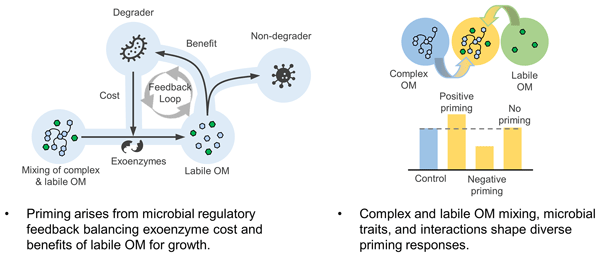
Modeling microbial regulatory feedback in organic matter decomposition identifies copiotrophic traits as key drivers of positive priming
Firnaaz Ahamed

Emily B. Graham
Timothy D. Scheibe
Hyun-Seob Song
Microbial decomposition of complex soil organic matter (OM) is often regulated by labile organic carbon inputs, a phenomenon known as priming, which plays a critical role in belowground biogeochemical cycling. However, the strength and direction of microbial priming of soil OM pools varies significantly across ecosystems. A generalizable mechanistic framework explaining the factors that lead to accelerated (positive priming) or impeded (negative priming) rates of OM decomposition is still lacking. In this work, we conceptualize priming as a microbial feedback loop that optimizes the costs and benefits of maximizing growth rate, specifically, the cost of exoenzyme synthesis for decomposing complex OM versus the benefit of energy acquisition from labile OM. We examined the impacts of microbial functional traits and interactions on priming by employing a cybernetic modelling approach, which predicts complex microbial growth patterns by accounting for dynamic metabolic regulations. We simulated microbial priming across ecological community configurations composed of degraders and non-degraders with either oligotrophic or copiotrophic traits, resulting in seven combinations that included both single functional groups (degraders with either trophic trait) and binary functional groups (combinations of degraders and non-degraders, or degraders only, with differing or common trophic traits). Configurations with only non-degraders were excluded, as they are irrelevant for studying priming in OM decomposition. Monte Carlo simulations for these scenarios revealed: (1) positive priming is prevalent, while negative priming occurs sporadically under specific parameter settings; (2) positive priming is more frequently observed in microbial systems with copiotrophic degraders than those with oligotrophic degraders; (3) the presence of copiotrophic non-degraders suppresses positive priming, whereas the presence of oligotrophic non-degraders promotes it; and (4) the temporal dynamics of priming is also influenced by microbial functional traits and interactions. These findings highlight the driving role of microbial functional traits and interactions in priming. Notably, copiotrophic degraders inducing strong positive priming is consistent with microbial energy mining through enhanced degradation of complex OM, whereas suppression of positive priming under copiotrophic non-degraders suggests reduced use of labile OM for co-metabolism and complex OM-degrading enzyme production. Most strikingly, our simulations predicted a dramatic positive priming effect triggered by the addition of a small amount of labile OM (i.e., specifically less than 10 % of the total OM in the complex and labile OM mixture in this study), with no notable changes observed beyond this point. This indicates that microbial regulatory feedback operates nonlinearly, possibly reflecting saturation of microbial demand for energy. As we used a generalized microbial model, we hypothesize that our findings may reflect common features of OM priming across diverse microbial systems and environments. Overall, this work, combining new theories and models, significantly enhances our understanding of priming by providing model-generated and empirically testable hypotheses on the mechanisms governing it.
- Article
(1519 KB) - Full-text XML
-
Supplement
(1066 KB) - BibTeX
- EndNote


Priming is a phenomenon in which the introduction of chemically labile organic matter (OM) into an environment significantly influences microbial activity, leading to either accelerated (positive) or suppressed (negative) decomposition of more recalcitrant OM (i.e., chemically complex and/or stabilized) and other biogeochemical pools (e.g., minerals, nutrients) (Bingeman et al., 1953; Kuzyakov et al., 2000). Priming has been widely observed across diverse ecosystems, and its significant implications remain actively discussed. For example, labile OM in the form of plant litter leachate and root exudates accelerate microbial decomposition of soil OM, which facilitates nutrient and energy exchange between soil microbial communities and plants in the rhizosphere (Fontaine et al., 2003; Soong et al., 2020). Priming equally manifests in other ecological domains, such as sediments in hyporheic zones of rivers and deep ocean seabed, which influence nutrient and energy cycles (Arrieta et al., 2015; Graham et al., 2017; Stegen et al., 2018). However, positive priming can also have adverse implications, as it stimulates increased microbial respiration, leading to heightened carbon dioxide emissions from the decomposition of soil OM rich in carbon (King, 2011; Nottingham et al., 2009). Conversely, negative priming aids carbon sequestration efforts by preserving soil carbon from mineralization (Guenet et al., 2018; Liang et al., 2023).
Despite its potential to exert long-term effects on ecosystem dynamics (King, 2011), our understanding of the fundamental mechanisms and key factors governing priming remains limited, posing challenges in accurately predicting biogeochemical dynamics. Priming can be influenced by biotic and abiotic factors, including microbial traits (Fontaine et al., 2011; Nottingham et al., 2009), environmental constraints such as carbon limitations (Graham et al., 2017; Soong et al., 2020), nutrient limitations (Feng et al., 2021; Fontaine et al., 2011; Hicks et al., 2019), or combinations thereof. Although experimental evidence suggests that microbial traits and interactions can play pivotal roles in priming (Brant et al., 2006; Garcia-Pausas and Paterson, 2011; Hicks et al., 2019; Yu et al., 2018), extensive microbial diversity in natural ecosystems poses obstacles to completely resolving their effects on OM decomposition (Trivedi et al., 2013).
We hypothesize that a key mechanism driving priming lies in the responses of microbial growth to the availability of labile OM. When new labile substrates are introduced, microbes face metabolic decisions that affect the allocation of cellular resources toward growth and exoenzyme production for degradation of complex OM. Microbes can either channel labile OM into the production of exoenzymes to degrade complex OM and generate additional labile OM or utilize labile OM directly for growth. This regulatory response directly determines the balance between energy acquisition from labile OM and the investment in decomposing complex OM, ultimately influencing whether positive or negative priming is observed. Importantly, such resource allocation strategies are governed by microbial demand for energy and nutrients and fundamental microbial traits that, at a coarse-grained level, can be categorized into two broad groups: copiotrophs (fast-growing microbes adapted to nutrient-rich environments) and oligotrophs (slow-growing microbes specialized for nutrient-poor conditions). Framing microbial priming through the lens of these trophic strategies of OM degraders provides a tractable approach to predict priming responses across diverse systems.
In addition to degraders, non-degrading microbes that exploit labile OM produced through exoenzyme-mediated breakdown without contributing to enzyme production can further alter substrate dynamics and priming outcomes. These non-degraders can outcompete degraders for labile substrates, reducing the incentive for exoenzyme investment and potentially suppressing OM decomposition. Therefore, microbial interactions involving degraders and non-degraders are likely critical components of priming dynamics (Momeni et al., 2013; Song et al., 2014; Trivedi et al., 2013), yet remain underexplored in existing studies.
Given that microbial regulation is inherently dynamic and context-dependent, it is also important to understand how priming patterns evolve over time and whether there are discernible temporal patterns or phases that reveal the underlying factors. Indeed, priming effects are time-sensitive phenomena that depend on the period over which they are evaluated (Zhang et al., 2017), influencing both their magnitude and direction. Therefore, exploring the time dependency of priming is of critical importance in quantifying priming effects across systems with different timescales.
To achieve a mechanistic understanding of priming, it is crucial to simultaneously consider microbial functional traits, microbial interactions, dynamic regulated synthesis of exoenzymes, and the role of non-degraders (Brant et al., 2006; Di Lonardo et al., 2017; Fontaine et al., 2003; Garcia-Pausas and Paterson, 2011; Hicks et al., 2019; Yu et al., 2018). The limited consideration of these microbial processes in most studies hinders the elucidation of priming mechanisms (Fontaine et al., 2011; Nottingham et al., 2009; Trivedi et al., 2013). Moreover, experimental approaches quantifying priming effects through changes in respiration rates as proxies for OM decomposition also face limitations due to the associated complexities with distinguishing real priming from apparent changes (e.g., microbial biomass turnover). In essence, there are currently no generalizable theories that fully explain the diverse patterns of priming effects, highlighting the need for mechanistic models capable of predicting both positive and negative priming within a unified framework.
In this regard, cybernetic modeling is of particular interest due to its unique capability of predicting complex microbial growth patterns in dynamically varying environments by accounting for metabolic regulation (Ramkrishna and Song, 2018). Instead of accounting for all molecular details of microbial regulation that are generally unknown, cybernetic models provide rational descriptions of regulation based on cybernetic laws derived from an optimal control theory. As microbial metabolic functions are mediated by enzymes that require energy for synthesis, cybernetic models can be formulated to represent regulatory allocation among competing phenotypic functions by defining these functions as dependent on specific enzyme levels. As a result, the induction and suppression of enzyme synthesis can dynamically mimic microbial metabolic regulation. For example, in the context of microbial degradation of complex OM, we can broadly define two enzyme pools, i.e., endoenzymes that mediate labile OM uptake and exoenzymes that regulate the degradation of complex OM. Cybernetic control laws then dictate which enzymes microbes synthesize and activate to maximize their growth rates under given environmental conditions (Young and Ramkrishna, 2007), balancing the cost of enzyme synthesis for complex OM decomposition against the energy gained from labile OM, following an economic return-on-investment concept. Therefore, cybernetic modeling can serve as an ideal tool for understanding priming because it accounts for microbial regulation through a feedback loop comprising three key processes: enzyme synthesis, complex OM decomposition, and microbial growth on labile OM.
In this work, we propose a novel theoretical framework that employs cybernetic modeling to predict microbial responses to the addition of labile OM and their impacts on the decomposition rates of chemically complex OM. Towards identifying key factors governing priming effects, we evaluate several questions: (1) how functional traits of microorganisms degrading complex OM drive positive and negative priming, (2) how the presence of non-degraders affect priming through interactions with degraders, (3) how the temporal patterns of priming are affected by these factors, and (4) whether there are any common features of priming predicted by theoretical models across different combinations of microbial functional traits. We modeled a targeted set of microbial group combinations needed to evaluate these questions. We examined combinations of degraders and non-degraders, characterized by either copiotrophic or oligotrophic traits, arranged as single or binary communities. Grounded in a unified framework, we explored how microbial functional traits and interactions influence priming rates. To draw unbiased conclusions, we conducted Monte Carlo simulations by assigning random parameter values to each model, rather than calibrating parameters with specific values that might be relevant to one system but not to others. The comprehensive simulations generated by this method provided new insights into each of the key questions, revealing several critical aspects of priming.
2.1 Development of a general theoretical model to elucidate the impact of microbial functional traits and interactions on priming effects
Our modeling framework considers the mixing of relative amounts of complex and labile OM (Fig. 1A) as the chemical parameter governing the occurrence of positive or negative priming, whereas the biological parameter is represented by three fundamental microbial processes: synthesis of extracellular enzymes (i.e., exoenzymes), decomposition of complex OM, and microbial growth on labile OM (Fig. 1B). These processes interact with each other through a closed feedback loop (Ahamed et al., 2021). Microorganisms synthesize exoenzymes to break down complex OM, producing labile OM that can be readily assimilated to support cell growth. In unprimed conditions, this feedback loop is inactive or slow, but when perturbed by the addition of exogenous labile OM, microorganisms gain additional energy to support growth and synthesize further exoenzymes, potentially facilitating positive priming by accelerating the decomposition of complex OM. The feedback loop can be suppressed if the energy return from degrading complex OM is not favorable to support cell growth, potentially leading to zero or even negative priming. However, variation in energy return arises solely from microbial regulation and trophic strategies, as complex OM chemistry and degradability are held constant (further explained in Sect. 2.3) in this study to isolate the effects of microbial functional traits and interactions on priming outcomes. The framework further expounds the possibility that the combined microbial cost-benefit regulations and interactions between microbial groups with distinct functional traits lead to various patterns of priming effects. The following microbial group combinations are the primary focus of this study, as the subset of possible combinations that most directly address our stated science questions: single functional groups (Fig. 1C) consisting of (1) a degrader with copiotrophic traits (CDG), and (2) a degrader with oligotrophic traits (ODG); binary consortia (Fig. 1D) consisting of (3) a pair of CDG and oligotrophic non-degrader (OND), and (4) a pair of copiotrophic non-degrader (CND) and ODG.
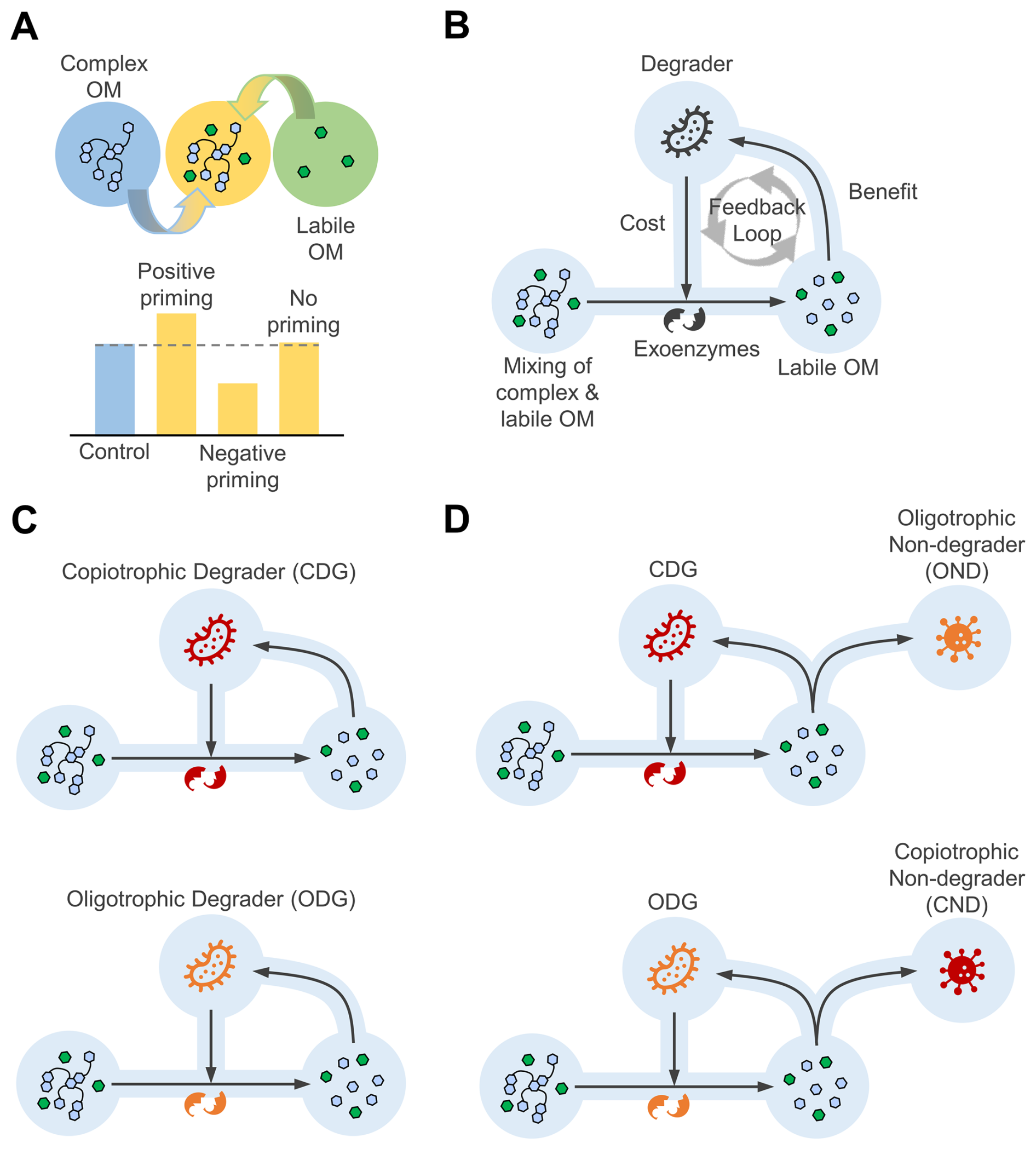
Figure 1An illustration of a conceptual model developed to simulate priming effects driven by (A) chemical factors, specifically the mixing of complex and labile OM, which results in varied levels of complex OM decomposition rates, leading to positive, negative, or no priming. This process is governed by (B) microbial factors, i.e., dynamic cellular regulation through a closed feedback loop, which manages resources to balance the costs of exoenzyme synthesis for degrading complex OM and the benefits of assimilating produced labile OM for cell growth. Considering the influence of distinct microbial functional traits (oligotrophs/copiotrophs and degrader/non-degrader) and their interactions on priming, four major priming models are obtained depending on how copiotrophic and oligotrophic traits are assigned in (C) single functional groups with degraders alone, and (D) binary consortia with degraders and non-degraders.
In this study, we adopt the classical microbial ecology definition of copiotrophs and oligotrophs as fast-growing microbes adapted to resource-rich conditions and slow-growing microbes adapted to resource-poor conditions, respectively (Koch, 2001). In our model, this distinction is represented by assigning copiotrophs higher maximum labile OM uptake rates and saturation constants, and oligotrophs lower values (Norris et al., 2021). This parameterization allows copiotrophs to uptake labile OM more rapidly at high labile OM concentrations, while oligotrophs are more efficient at low labile OM levels. While this setting captures the contrasting responses of the two microbial trophic strategies across all observable levels of labile OM in our simulations (Fig. S1A in the Supplement), it should be noted that this model representation differs from classical ecological understanding in several ways: (1) we represent microbial groups as discrete categories, whereas microbial traits likely exist along a continuum (Couso et al., 2023; Stone et al., 2023); (2) trophic strategy is treated as an intrinsic and fixed trait independent of environmental conditions and nutrient stoichiometry, unlike in nature (Couso et al., 2023); and (3) degraders and non-degraders are represented as distinct groups, whereas many microbes in nature can produce low baseline levels of degrading enzymes, or can shift strategies depending on environmental conditions (Chen et al., 2021). Nevertheless, these simplifications are necessary for our study to allow us to isolate how regulatory feedback and interactions among idealized functional traits (trophic strategies and degradation ability) influence priming, while recognizing that real microbial communities exhibit continuous trait variation and substantial metabolic flexibility (Chen et al., 2021; Stone et al., 2023).
2.2 Model equations
For generality, we provide the model equations only for a binary consortium composed of microbial species i and j representing mixed functional traits because the single functional group models are readily derivable from the consortium model by removing one of the species. The growth of species i in the consortium in a uniformly mixed batch environment is represented as:
where the subscript i denotes the ith species, Xi, YX,i, and rS,i represent biomass concentration, biomass yield, and specific growth rate, respectively. The mass balance of the labile OM (S) is given by:
where YS is the yield of labile OM from the degradation of complex OM, rZ,i is the rate of degradation of complex OM by species i, and rS,i is the specific uptake rate of labile OM in species i. Accordingly, the degradation of complex OM (Z) is given as:
The degradation of complex OM and the assimilation of labile OM is regulated by exoenzymes (Ei) and endoenzymes (ei), respectively:
Here, αE,i and αe,i are the constitutive (basal) enzyme synthesis rates, YE,i and Ye,i are the enzyme yields, and βE,i and βe,i are the enzyme decay rates. Then, the specific uptake rate of labile OM and the degradation rate of complex OM are given in the form of Michaelis-Menten kinetics:
Here, kS,i and kZ are the maximum rates of labile OM uptake and complex OM decomposition, respectively, and KS,i, KZ, Ke,i and KE,i are their associated saturation constants.
In single functional group models, we consider that microorganisms can degrade complex OM (i.e., degraders). In binary consortium models, we consider one species to be a degrader and the other species to be a non-degrader.
2.3 Parameter assignment and simulation settings
Variability in model parameter values leads to drastically different priming outcomes. Therefore, predicting priming effects is challenging even with known microbial functional traits and environmental conditions. To address this, we generate model results using Monte Carlo simulations by assigning random values to model parameters across different environmental conditions except the kinetic parameters associated with microbial trophic strategies. That is, to reduce the complexity of analysis, we fixed the labile OM uptake kinetic parameters (kS,i, KS,i) to distinguish the trophic strategies between oligotrophs and copiotrophs (see the Supplement and Fig. S1). Similarly, we fixed the exoenzyme synthesis kinetics to differentiate between degraders () and non-degraders () based on their ability to synthesize exoenzymes. Combination of the role of microorganisms (as degraders or non-degraders) with copiotrophic and oligotrophic traits based on this pre-chosen parameter setting generates the four major microbial groups considered in the simulations: copiotrophic degrader (CDG), copiotrophic non-degrader (CND), oligotrophic degrader (ODG), and oligotrophic non-degrader (OND). To ensure a fair comparison between different test cases, the initial microbial population densities are made equal between the two microbial groups in the binary consortia. The same population densities are also used in the single functional group models, meaning the total initial biomass in these models is half that of the consortium models.
Importantly, the complex OM degradation kinetic parameters (kZ, KZ, YS) were also fixed to ensure that this study focuses solely on the variability in the functional traits of the microbes affecting the priming outcome, rather than the variability in complex OM properties. To represent the degradation of complex OM and the production of labile OM, YS must be greater than 1 (synonymous with the degradation of long-chain polymers into shorter oligomers or monomers) but using different values would only adjust the magnitude of priming without altering the qualitative trends. In other words, only the exoenzyme and endoenzyme synthesis kinetic parameters, along with biomass yield, are randomized in the Monte Carlo simulations. By stochastically assigning values to these model parameters within prescribed ranges using a uniform distribution, we investigated the combined effects of microbial cost-benefit regulations and interactions between microbial groups with distinct functional traits on priming outcomes. In all cases, the Monte Carlo simulation results were based on no less than 200 runs for each mixture. The values of all model parameters, including those that were fixed and the bounds for randomized parameters, are provided in Table S1.
To vary the environmental conditions to manifest different priming patterns, we varied the mixing fraction of labile OM with complex OM from 0 to 1, representing a continuum from pure complex OM to pure labile OM, respectively. In our model, complex OM represents the completely degradable OM pool rather than total soil organic carbon in natural ecosystems and soil priming experiments, where a substantial fraction is not readily bioavailable. Accordingly, the labile OM fractions used in this study are likely substantially higher than typical values reported relative to total soil organic carbon (Lu and Xu, 2014; Wu et al., 2023). Moreover, in this hypothesis-driven modeling study, we examine the full range of labile and complex OM mixing fractions to explore the full parameter space, including extreme conditions, to identify system behaviour beyond ranges typically captured by natural observations or experiments.
2.4 Representation of microbial regulation using cybernetic modeling
The cost-benefit regulation of exoenzyme synthesis, and energy acquisition from microbial growth achieved from the assimilation of labile OM through the synthesis of exo- and endoenzymes in Eqs. (4) and (5), are governed by cybernetic variables uE,i and ue,i, respectively, where . We employ generalized cybernetic laws based on optimal control systems, enabling the representation of microorganisms' evolutionary strategy to regulate their metabolism in the interest of future returns over a finite time horizon (Young and Ramkrishna, 2007). This modeling capability is particularly crucial in complex substrate environments, where the investment of invaluable cellular resources for synthesizing complex OM-degrading exoenzymes does not yield immediate returns in terms of cell growth but is necessary for future growth when degraded products (labile OM) become available for assimilation. The detailed formulation of optimal control-based generalized cybernetic regulation is given in Young and Ramkrishna (2007), but briefly:
Here, f is the system of ordinary differential equations in Eqs. (1)–(5), x is the state vector of the system, is the vector of cybernetic variables, A is the state transition matrix, B is control input matrix, and q is the vector representing the metabolic objective of the system, which in this work is the cell growth rate of the respective microbial groups, given by Eq. (1). The future finite time horizon across which the returns are evaluated is computed based on the minimum time scale of the system, i.e.,
where μ(A) is the maximum eigenvalue of A. This ensures a balance between adequately capturing future returns and limiting the influence of other disturbances on control decisions (Young and Ramkrishna, 2007). In the context of microbial priming, priming outcomes are highly sensitive to Δt, where a non-zero future time horizon is essential to observe priming effects. Setting Δt=0 prevents the anticipation of future benefits and restricts microbial control decisions to instantaneous returns, which are practically absent for complex OM degradation. This further highlights the need for optimal control over a finite future time horizon in modelling microbial priming as implemented in our framework. Subsequently, the cybernetic variables are evaluated using matching law over the return-on-investment () of finite cellular resources:
2.5 Metrics for quantifying model-estimated priming effects
Priming effects refer to the change in the decomposition rate of complex OM when labile OM is added to the system. Experimental studies of priming effects often face limitations as they rely on changes in microbial respiration rates as a proxy for OM decomposition, which may not be ideal. However, in our modeling framework, we can directly quantify the overall relative priming effects (Prel) by comparing the amounts of degraded complex OM in perturbed and unperturbed systems over a specified period:
Here, ΔZa and ΔZc denote the amounts of complex OM degraded in the amended (treated with exogenous labile OM) and control conditions evaluated at a time t, respectively. For clarity, this refers exclusively to the mineralization of complex OM naturally present in the ecosystem and should not be conflated with the mineralization of exogenously added labile OM or the mineralization of labile OM arising from complex OM degradation. Here, the overall relative priming effect is normalized such that the maximum positive priming () is realized when ΔZa≫ΔZc, maximum negative priming () is attained when no amended complex OM is degraded (ΔZa=0), and no priming effect (Prel=0) is observed when ΔZa=ΔZc. For special cases where , we assign no priming effect, i.e., Prel=0. To compare the priming effects consistently across test cases with different complex OM decomposition dynamics and timescales following the stochastic modeling, we define t∞ as the moment when the complex OM is depleted to within a fixed tolerance:
The threshold above is low enough that priming becomes negligible in the system unless external disturbances are re-introduced. Subsequently, the instantaneous relative priming effects (Pins) are represented as:
where the overall relative priming effects and the instantaneous relative priming effects are associated such that:
The system of ODEs in Eqs. (1)–(5) is solved using MATLAB® ode15s, with outputs evaluated on a discrete time grid of one-hour intervals corresponding to the time points in Eqs. (13) and (14).
Using the microbial priming model described in the previous section, we simulated seven cases representing distinct functional traits of degraders and non-degraders. To maintain clarity, we focus in the following sections on four major configurations, including CDG, ODG, CDG-OND, and ODG-CND, illustrated in Fig. 1C and D. Additional microbial group combinations, including ODG-OND, CDG-CND, and CDG-ODG, were also analyzed to encompass all possible pairwise configurations (see the Supplement and Fig. S2). A summary of priming outcomes across all test cases is provided in Table S2.
3.1 Copiotrophic strategy shows modestly stronger positive priming than oligotrophic strategy
We examined how priming is affected by the trophic strategy of degraders, i.e., copiotrophs and oligotrophs, using the single functional group models illustrated in Fig. 1C. We compared the levels of overall relative priming (Prel) and biomass concentrations (X) as a function of mixing fractions of labile OM (ν) with complex OM, between the CDG and ODG models in Fig. 2. Positive and negative values of Prel represent the occurrence of positive and negative priming, respectively.
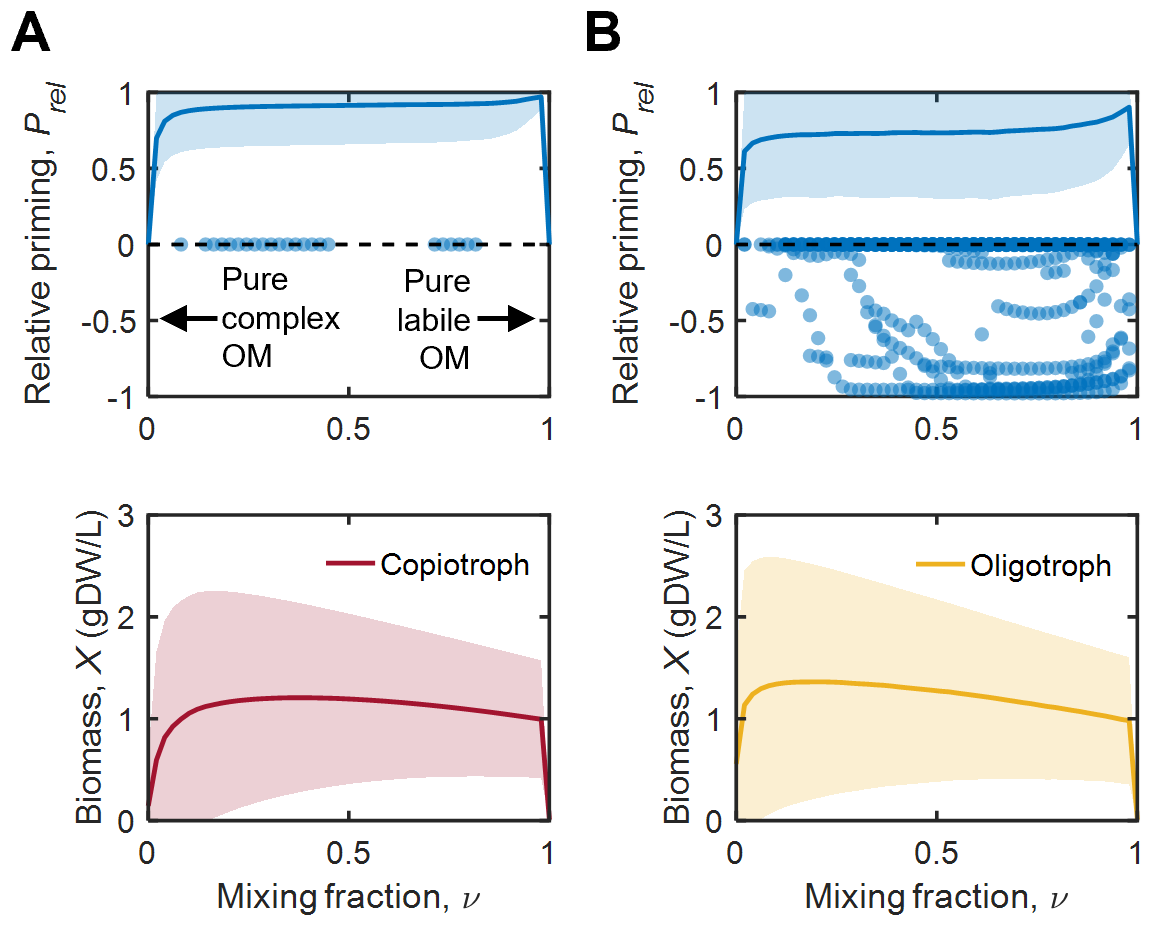
Figure 2Overall relative priming effects and microbial population levels at various mixing compositions of complex and exogenous labile OM, evaluated for single functional group models of (A) copiotrophic degraders, and (B) oligotrophic degraders. The lines and shaded regions are averaged results and standard deviations of Monte Carlo simulations, respectively, while the markers denote all individual runs with negative overall relative priming effects at the corresponding mixing fractions. The markers in the top-left panel correspond to very weak overall negative priming effects, with magnitudes close to zero.
Both models (top panels of Fig. 2) predicted that the average Prel values were zero at unmixed conditions as expected, i.e., ν=0 with pure complex OM or ν=1 with pure labile OM. The values drastically increased around ν≈0.1, and then remained almost constant until reaching a maximum around ν≈0.97. The CDG model predicted the prevalence of positive priming, while also showing instances where Prel values were zero, depending on the parameter sets randomly assigned in individual Monte Carlo simulations (top panel of Fig. 2A). The ODG model also predicted the dominance of positive priming but showed many instances where individual Prel values were negative, resulting in lower average Prel values compared to the CDG model (top panel of Fig. 2B). Together, these results indicate that positive priming can commonly occur with degraders exhibiting both copiotrophic and oligotrophic traits, though it is more facilitated by the former.
Meanwhile, CDG and ODG exhibited almost comparable growth over the entire range of the mixing fractions (bottom panels of Fig. 2). Owing to their inherent trophic traits, oligotrophs exhibit higher labile OM uptake rates than copiotrophs under low labile OM conditions, such as at pure complex OM (ν=0), enabling ODG to sustain a higher population than CDG. However, at pure labile OM (ν=1), their population levels are comparable because, in the absence of complex OM to mine for additional labile OM, only the addition of exogenous labile OM remains for growth. Similar to the trend of the average Prel, the population levels of CDG and ODG significantly increased around ν≈0.10, plateaued between ν≈0.10 and 0.97, and showed no appreciable growth as ν approaches 1. Despite these general similarities, the average Prel values and population densities showed major differences in the shapes of their profiles. In contrast with the average Prel profiles showing a slight increase in the plateau, biomass concentration profiles showed a slight decline. This resulted in different optimal mixing fractions for maximizing the average Prel and biomass concentrations, i.e., the former peaked around ν≈0.97, while the latter reached its maximum around ν≈0.1.
3.2 The impact of microbial interactions on priming is dependent on trophic strategies
We extended our analysis to the CDG-OND and ODG-CND mixed consortia (Fig. 1D) to examine how trait interactions affect priming. We hypothesized that non-degraders would suppress positive priming by weakening positive feedback loops and limiting the growth of degraders. Our results provide evidence that is only partially consistent with this hypothesis. We observed the opposite of what we expected in the CDG-OND consortium, whereby positive priming was promoted by OND microbes. This is indicated by the higher average Prel values (top panel of Fig. 3A) compared to the CDG model (top panel of Fig. 2A). In contrast, and consistent with our hypothesis, we observed the frequent occurrence of negative priming in the ODG-CND consortium, resulting in lower average Prel values (top panel of Fig. 3B), compared to the ODG model (top panel of Fig. 2B).
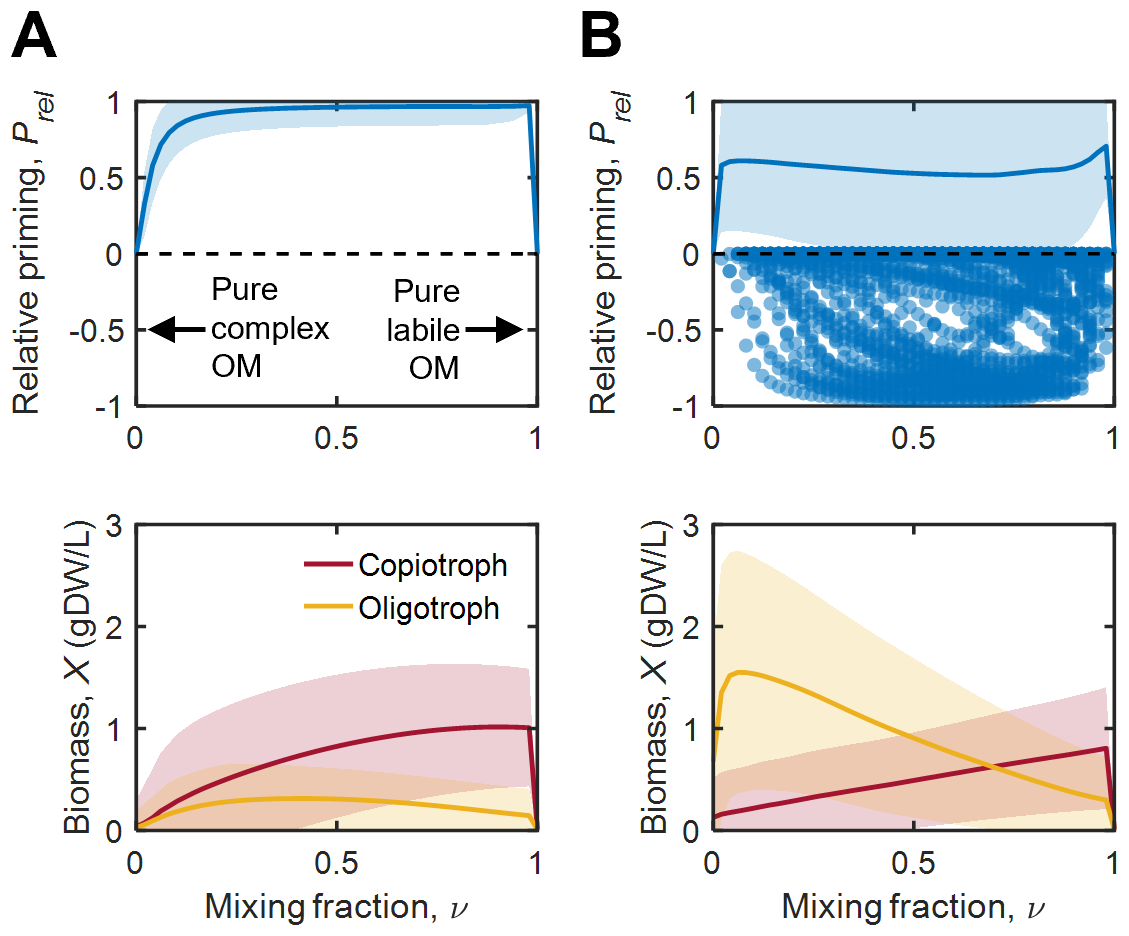
Figure 3Overall relative priming effects and microbial population levels at various mixing compositions of complex and exogenous labile OM, evaluated for binary consortia of (A) copiotrophic degrader and oligotrophic non-degrader, and (B) oligotrophic degrader and copiotrophic non-degrader. The lines and shaded regions are averaged results and standard deviations of Monte Carlo simulations, respectively, while the markers denote all individual runs with an overall negative priming effect at the corresponding mixing fractions.
In the CDG-OND consortium, the population level of degraders was consistently higher than that of non-degraders across the entire range of ν (bottom panel of Fig. 3A). This difference became more prominent at higher mixing fractions, conditions under which CDG can have growth advantages over OND. In contrast, the population densities of degraders and non-degraders showed opposing trends in the ODG-CND consortium along the mixing fraction (bottom panel of Fig. 3B). While ODG grew more effectively than CND at low values of mixing fractions, the dominance of degraders did not lead to increased priming due to the intrinsic nature of ODG, which is less effective at promoting positive priming. Moreover, the level of positive priming was nearly the same at both higher and lower values of ν, where CND grows more effectively than ODG in the former.
3.3 Temporal dynamics of priming effects are shaped by microbial functional traits and interactions
In the previous two sections, we quantified overall relative priming over a specified reaction period, determined by an end time point, t∞ (see Methods). The overall relative priming represents the cumulative sum of instantaneous priming effects at each time point over the given period. To understand how priming evolves over time, we also examined the temporal dynamics of instantaneous relative priming (Pins) among the four focal priming models: CDG only (Fig. 4A), ODG only (Fig. 4B), CDG-OND consortium (Fig. 4C), and ODG-CND consortium (Fig. 4D), with three mixing fractions (ν=0.1, 0.5, and 0.9). In all cases, the average Pins exhibits a unimodal trend, i.e., gradually increasing and then decreasing. Furthermore, the occurrences of negative average Pins were more prevalent when the proportion of exogenous labile OM in the mix was high, especially during the later phases when positive priming weakened.
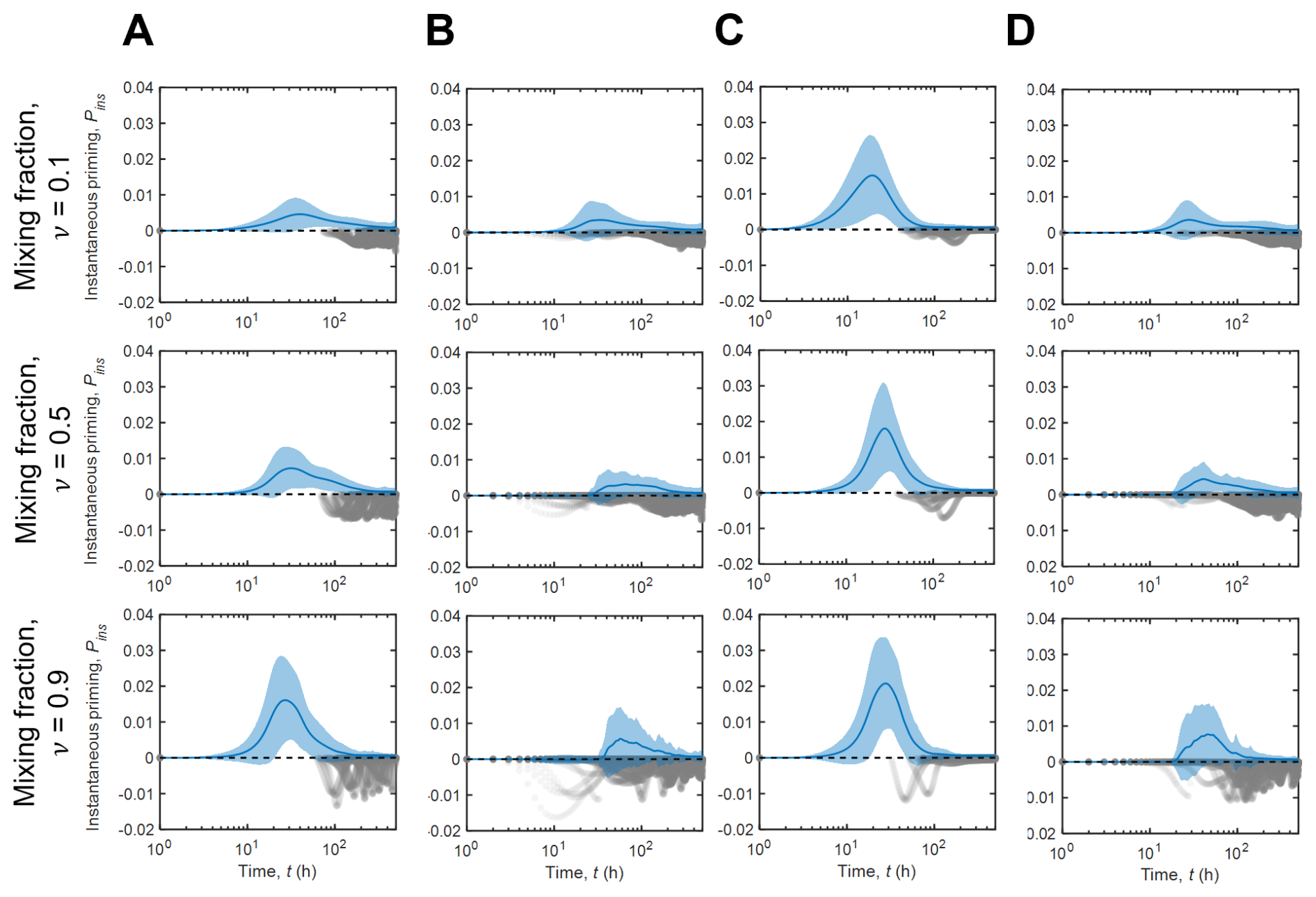
Figure 4Instantaneous relative priming effects at low (ν=0.1), medium (ν=0.5), and high (ν=0.9) mixing compositions of exogenous labile OM with complex OM, evaluated for single functional group models of (A) copiotrophic degraders, (B) oligotrophic degraders, as well as binary consortia of (C) copiotrophic degrader and oligotrophic non-degrader, and (D) oligotrophic degrader and copiotrophic non-degrader. The lines and blue-shaded regions are averaged results and standard deviations of Monte Carlo simulations, respectively, while the gray-shaded markers indicate data points over time with negative instantaneous relative priming effects in individual runs.
Dynamics of priming were primarily dependent on the trophic traits of degraders involved in the process. For example, the timing of maximum positive priming was consistent across mixing fractions in the CDG and CDG-OND models, where degraders exhibit copiotrophic traits (Fig. 4A and C). Positive priming increased at around 10 h, peaked at approximately 30 h, and was suppressed beyond 100 h, where the dynamic trend remained consistent across labile OM fractions of , indicating a robust microbial response pattern. In contrast, in the ODG and ODG-CND models, where degraders have oligotrophic traits, the peak times of positive priming substantially shifted to later times with higher mixing fractions (Fig. 4B and D). At the higher labile OM fraction of v=0.9, the positive priming only increased at around 40 h, peaked at about 50 h, and was suppressed well beyond 200 h, indicating a substantial shift in microbial response and regulatory strategy. In contrast, ODGs exhibit slower dynamics under the same conditions, necessitating greater modulation of their regulatory responses. Positive priming was more prominent when CDG was co-growing with OND (Fig. 4C), compared to the case with CDG alone (Fig. 4A). However, those synergies between degraders and non-degraders were not observed from the systems with ODG (Fig. 4B vs. D), in line with our observations of the overall relative priming effects in Fig. 3. Sporadic occurrences of negative priming were predominantly observed at later times across all microbial group combinations and labile OM fractions, except for ODG alone, where substantial negative priming occurred at earlier times (Fig. 4B), particularly at high labile OM fractions.
Despite extensive research, the key mechanisms and factors governing priming remain elusive due to several challenges and complexities, including (1) the influence of numerous interacting biotic and abiotic factors, (2) difficulties in modeling the dynamics of microbial communities composed of multiple microbial functional groups with distinct functional traits, and (3) uncertain governing factors associated with microbial OM decomposition. A new modeling framework developed in this work enables systematic investigation in a large parameter space to reveal processes governing priming. With a focus on the impacts of key chemical and biological parameters (such as mixing fractions of complex and labile OM, microbial functional traits and interactions), we developed dynamic models of OM decomposition involving single functional microbial groups and consortia with distinct trophic strategies (copiotrophs and oligotrophs). We theorized the feedback loops of OM decomposition regulated by microorganisms to be a fundamental mechanism controlling the priming effects, which were incorporated into models using a cybernetic approach. This new microbial and OM decomposition model revealed several aspects of priming as detailed in the following sections.
4.1 Prevalence of positive priming and sporadic negative priming effects
Our modeling study shows that positive priming is prevalent in all test cases, and a small addition of exogenous labile OM (less than 10 % of total OM in complex and labile OM mixture) is sufficient to cause significant positive priming effects (top panels of Figs. 2 and 3). This is because a small amount of labile OM elicits notable microbial responses that lead to positive priming. This can be intuitively explained using the cybernetic perspective, as the microbial regulatory feedback loop shown in Fig. 1B is readily activated by degraders with either copiotrophic or oligotrophic traits by the addition of more bioavailable labile OM. The degraders gain a quick increase of energy from the assimilation of exogenous labile OM, allowing them to rapidly synthesize exoenzymes that degrade complex OM. This process produces more labile OM and perpetuates the feedback loop. This positive loop continues until the benefits of exoenzyme synthesis no longer outweigh the costs due to the significant depletion of complex OM. From an alternative perspective, investing in OM decomposition can be beneficial to degraders even in the absence of exogenous labile OM, as future growth may be supported by labile products generated during degradation. However, there may be insufficient available energy to initially synthesize the exoenzymes required for this process. The presence of exogenous labile OM removes this energy limitation, which is the fundamental working principle of positive priming. The foregoing explanation of the microbial regulatory response underlying complex OM degradation dynamics is illustrated in Fig. S3.
On the other hand, negative priming is sporadic and therefore not observed in averaged results, but it is observed in individual runs of Monte Carlo simulations (top panels of Figs. 2 and 3, and Fig. 4). The conditions for negative priming often require more complex and less common scenarios such as when microbes preferentially use labile OM to immediately support cell growth rather than synthesizing exoenzymes to degrade complex OM to produce more labile OM for future growth. As we operate on the basis that degraders regulate their metabolism with a focus on returns over a finite future time horizon achieved using cybernetic modeling based on optimal control systems (see Methods), microbes can anticipate future returns (Young and Ramkrishna, 2007), especially when complex substrates are involved. Therefore, from the cybernetic perspective, negative priming can only manifest when the cost of exoenzyme synthesis to degrade complex OM outweighs the future returns in terms of cell growth from the assimilation of labile OM from degraded complex OM. As previously mentioned, the addition of labile OM almost always removes the energy limitation for exoenzyme synthesis, making negative priming less common than positive priming. In negative priming, degraders lack the incentive to degrade complex OM and instead focus on consuming the available labile OM to build biomass.
Similar to our model findings, Xu et al. (2024) report that positive priming predominates across most global ecosystems. More notably, Zhao et al. (2022) highlight that factors regulating microbial decomposition genes involved in the degradation of complex carbon compounds are key drivers of positive priming, consistent with our model framework in which priming arises from microbial regulation of complex OM degradation dynamics. Moreover, priming responses are ecosystem-dependent, and negative priming can be observed in systems with high complex OM content (Bastida et al., 2019). The sporadic negative priming in our model output, while consistent with its relative rarity compared to positive priming in natural ecosystems and from a microbial regulatory perspective, should be interpreted cautiously given that the model does not explicitly account for OM stoichiometry or nitrogen availability, which could potentially lead to more frequent occurrences of negative priming due to their significant influence in modulating the direction of priming between positive and negative (Chen et al., 2014; Fu et al., 2022). Nevertheless, negative microbial priming, while relatively uncommon, can play a vital role in preserving soil carbon stocks and promoting carbon sequestration (Guenet et al., 2018; Liang et al., 2023). While positive priming enhances energy and nutrient exchange between microbial communities and the plant rhizosphere, excessive positive priming can contribute to the long-term depletion of soil carbon (Liang et al., 2017). Microbial priming, whether positive or negative, has significant implications for the global carbon cycle (Liang et al., 2017), and our study suggests that microbial regulatory factors must be considered in any efforts to predict or control future soil carbon stocks.
4.2 Prevalence of negative priming in temporal dynamics
Instantaneous relative priming effects exhibit highly non-linear dynamics over time and are more likely to cross into negative priming compared to the overall relative priming measure (Fig. 4). Temporal patterns of priming were unimodal because degraders immediately gain energy from labile OM, which accelerates degradation of complex OM, resulting in a peak of positive priming. This leads to the accumulation of labile OM. Microbes then allocate more energy towards consuming this labile OM in later phases, leading to a decrease in positive priming and the observed negative priming effect. If the test cases in this study are evaluated over longer timeframes, more negative priming may be observed. This highlights a need for greater focus on the temporal dynamics of priming because initial positive priming can evolve into negative priming.
Our model results also partially support the idea that priming may depend on the pattern of labile OM input over time, where systems receiving a newly increased input of labile OM may exhibit stronger positive priming than systems under continuous labile OM supply. The temporal dynamics in our simulations show that positive priming tends to dominate early after labile OM addition and then weaken or even transition toward negative priming at later stages as the system adjusts and complex OM becomes depleted. In that sense, soils that are newly colonized by plants or soils experiencing the onset of seasonal plant activity (i.e., where labile OM input arises from plant exudation) could be more likely to display pronounced positive priming than soils under sustained exudation. However, we note that this interpretation should be viewed as a hypothesis generated by the model rather than a direct prediction, because our current framework does not explicitly represent continuous labile OM input but instead simulates a single pulse addition at the beginning of the simulation, and the interpretation above stems the observation of sustained dynamic instantaneous relative priming effects. As this interpretation may have important ecological implications, future modeling work should explore how temporal patterns of labile OM input shape priming under more realistic field conditions.
Several studies provide further support for a stronger emphasis on temporal dynamics of priming. For example, Zhou et al. (2021) showed that priming responses are highly sensitive to dynamic changes in environmental conditions, which significantly influenced priming variability. Here, larger amounts of labile OM added at low frequency tend to elicit a microbial response that preferentially consumes labile OM over complex OM degradation, whereas frequent addition of smaller amounts of labile OM promotes microbial degradation of complex OM as a means of nutrient mining (Zhou et al., 2021). Conversely, Schiedung et al. (2023) reported that the addition of fresh labile carbon induced strong but temporary positive priming, which attenuated as the soil adapted to high carbon inputs, eventually leading to no priming in the long term, while simultaneously increasing the sensitivity of the system to labile carbon inputs over time. These findings are consistent with our earlier interpretation regarding the importance of a detailed exploration of the effects of temporal patterns of labile OM input on priming. Further, Zhang et al. (2017) demonstrated that the priming effect is modulated by incubation time, with distinct temporal phases observed, such as brief instances of initial negative priming followed by positive priming, and a stabilized phase later on. Several studies have reported that initial negative priming could result from OM consumption being dominated by the labile fraction, as microorganisms preferentially consume labile OM over complex OM (Guenet et al., 2010; Khan et al., 2007; Kuzyakov and Bol, 2006). As alluded to earlier, this behavior potentially reflects conditions in which microbes allocate labile OM directly to biomass production rather than investing in exoenzyme synthesis to degrade complex OM, particularly when the cost of exoenzyme synthesis outweighs the returns from complex OM degradation. Conversely, other studies have shown that the fast growth of copiotrophs that consume labile OM was observed to cause a rapid increase in mineralization of complex soil OM (Fu et al., 2022; Nicolardot et al., 2007; Pascault et al., 2013), potentially resulting in heightened positive priming. Mineralization of less complex OM by oligotrophs has also been reported (Blagodatskaya et al., 2009; Fang et al., 2018), which may lead to reduced positive priming. These observed patterns resemble outcomes from our Monte Carlo simulation runs and are consistent with the unimodal dynamics observed in Fig. 4. These reports also support our model results showing that the peak in positive priming occurs later with ODGs than with CDGs, which peak earlier. In line with the reasoning above, Soong et al. (2020) emphasized the need to account for temporal variability in environmental conditions to better capture how organisms utilize soil carbon and nutrients, ultimately leading to more representative ecosystem models.
4.3 The impacts of microbial functional traits on positive and negative priming
Despite their distinct trophic strategies, CDG and ODG both use labile OM for energy, enabling them to produce exoenzymes that degrade complex OM into labile OM for further energy gains. However, due to the preference for resource-rich conditions, the positive regulatory feedback loop is strongly activated when CDG are present. This results in CDG causing more positive priming than ODG (top panels of Figs. 2 and 3).
Conversely, ODG led to more negative priming when alone or paired with CND, especially at higher labile OM loading (top panels of Figs. 2B and 3B). Oligotrophs are adapted to thriving in resource-poor conditions, so when confronted with high amounts of labile OM, they encounter more than they can consume. In this scenario, it is not beneficial for them to generate additional labile OM through the costly process of synthesizing exoenzymes. Instead, they focus on consuming the available labile OM for growth rather than secreting exoenzymes for complex OM degradation. When ODG are paired with CND, the extent and frequency of negative priming significantly increased (top panel of Fig. 3B). This occurs because CND rapidly consumes labile OM, leaving insufficient energy for ODG to continue degrading complex OM.
On the contrary, the presence of OND enhanced the extent of positive priming by CDG (top panel of Fig. 3A). This is also similarly observed in instantaneous relative priming effects (Fig. 4C). The presence of OND alongside CDG marginally reduces labile OM levels in the system (unlike the stronger effect of CND in the ODG-CND system), while CDG retain greater access to the labile OM. Consequently, the addition of labile OM represents a larger perturbation in the binary CDG-OND system than in the single CDG system, thereby producing a stronger positive priming response in the former. This can be interpreted in the context of R∗ theory, where differences in resource uptake and competitive ability determine the equilibrium resource concentration (Couso et al., 2023). In this case, OND do not substantially lower labile OM below levels critical for CDG exoenzyme activity due to their inability to effectively capitalize on the available labile OM, but they reduce it just enough to make the priming response stronger than the single CDG system.
Despite the results presented in Figs. 2 and 3 suggesting that negative priming is almost non-existent in cases involving CDG, we infer that CDG does not inherently or absolutely prevent negative priming. Rather, the occurrence of negative priming is context-dependent on specific microbial interactions and environmental conditions, as instances of negative priming are clearly observed in CDG-ODG and CDG-CND microbial group combinations in Fig. S2A and B, respectively, which are further explained in the Supplementary Text.
In agreement with our findings, Yang et al. (2023) inferred that soil basal respiration rates are largely driven from copiotrophs through the utilization of labile carbon sources, explaining the strong positive priming effects in our models involving CDGs. On the other hand, Fu et al. (2022) correlated copiotrophs with negative priming effects, implying that they mainly consume labile OM, thereby hindering the degradation of native complex soil OM, which could be explained by our models with CNDs. Furthermore, Fu et al. (2022) also reinforced our model findings, showing that the microbial community composition clearly exhibits distinct successions during OM decomposition, leading to distinct priming patterns. However, while the studies above associate the variability in priming with the trophic strategies of microbial groups, they do not distinguish between degraders and non-degraders or consider the interactions between microbial groups. Our model does examine these factors, highlighting its value in providing insights across complex scenarios.
As alluded to in Sect. 2.1, real microbial communities exhibit continuous trait variation (Couso et al., 2023; Stone et al., 2023), condition-dependent shifts in trophic behavior (Chen et al., 2021), and even variation in degradation ability. In contrast, we intentionally fixed kS,i and KS,i to represent distinct copiotrophic and oligotrophic strategies, allowing us to isolate the effects of contrasting trophic strategies on priming. Indeed, these settings are highly sensitive in modulating priming outcomes, as evidenced by the starkly different responses between test cases involving copiotrophs and oligotrophs under otherwise identical environmental conditions. To examine whether variations in these kinetic parameters alter the qualitative priming responses (especially if the variation leads to overlap between the two trophic strategies), we performed a local sensitivity analysis following the method of Brun et al. (2001). The results are presented in Fig. S4. Briefly, the sensitivity analysis shows that the kinetic parameters have a significant influence on the priming response. However, for the single functional group models (CDG and ODG), the relative sensitivities remain largely consistent across all labile-complex OM mixing fractions (i.e., they do not substantially switch between positive and negative values), indicating that parameter perturbations primarily amplify or diminish the priming response without altering its qualitative trends. In contrast, the binary consortia models of CDG-OND and ODG-CND, particularly the former, exhibit greater variation in relative sensitivities. This is likely because parameter perturbations increase the overlap between the trophic strategies of the two microbial groups, resulting in more pronounced changes in the qualitative priming response. Therefore, extending the model to allow overlapping or environment-dependent trophic traits would be a valuable direction for future work.
In addition to the kinetic parameters above, we also included the yield parameter YS (which was arbitrarily fixed to represent general polymer degradation) in the sensitivity analysis. The analysis reveals that this parameter has no effect on model outputs in the binary consortia models (CDG-OND and ODG-CND). In the single functional group model of ODG, varying YS produces a consistently positive effect on the priming response from 0 % to about 70 % mixing fraction, whereas in CDG the effect is negligible from 0 % to approximately 40 % mixing fraction. Overall, these results indicate that in single functional group models, the parameter primarily affects the magnitude of priming without altering directional patterns or other qualitative trends. That said, explicitly accounting for polymer structure and associated degradation kinetics is a valuable extension of this work for a more mechanistic representation of priming effects.
4.4 Microbial population dynamics and emergent priming responses
With regards to microbial population levels, CDG and ODG exhibit almost comparable growth when considered independently (bottom panels of Fig. 2). Conversely, in binary consortia, oligotrophs attain higher population levels than copiotrophs at low mixing fractions, and vice versa at high mixing fractions, as expected based on their trophic strategies (bottom panel of Fig. 3B). The only exception is when CDG is paired with OND, where the former dominates across all mixing fractions (bottom panel of Fig. 3A). This dominance occurs because the uptake of rich labile OM in OND is slower, preventing it from effectively capitalizing on the efforts of copiotrophic degraders in producing labile OM. Moreover, the population of OND stabilizes and ODG declines with increasing levels of exogenous labile OM (bottom panels of Figs. 2B and 3A). This is because ODG is at a greater disadvantage in a labile OM-rich environment compared to OND. Although both are unable to competitively utilize the surplus labile OM, ODG must continue synthesizing exoenzymes to maintain the labile OM level in the environment, incurring additional metabolic costs.
We also found that the priming magnitudes and population levels of microbial groups were not synchronized. This indicates that although one of the major factors driving microbial priming is biomass concentration, there are other influential factors. As degraders must expend significant resources to degrade complex OM to induce maximum positive priming, this leaves relatively less energy available for growth, resulting in lower population levels. This suggests that the microbial group exerting the strongest influence on priming (i.e., degraders) does not have to be the most abundant within the community. Because priming is a shared and robust feature across diverse microbial systems and environments, distinct community compositions can produce comparable net priming effects. Thus, priming patterns are better understood as emerging from community-level interactions rather than being tied to a single microbial group.
4.5 A small addition of exogenous labile OM triggers significant positive priming
One of the common features of priming that we identified in our work, consistent across all test cases, is that significant positive priming was triggered by the addition of small amounts of labile OM (less than about 10 % of total OM in the complex and labile OM mixture), beyond which no further significant changes were observed. The variation in priming levels with increasing exogenous labile OM, along with the presence of a maximum positive priming level, indicates a threshold effect. When the addition of exogenous labile OM exceeds a certain threshold, there is more labile OM than degraders can consume. As a result, the system reaches a saturation point where degraders cannot further increase the exoenzyme synthesis rate, leading to no additional improvement in positive priming, even with more labile OM. Although this threshold may vary slightly between copiotrophs and oligotrophs, it is generally less than around 10 % labile OM out of total OM in the complex and labile OM mixture, depending on the fixed model parameters in this study. Priming was evident even at the lowest labile OM fractions examined and increased approximately linearly with increasing labile OM. Beyond this threshold, however, additional labile OM produced little further enhancement, as the response became nonlinear and approached saturation. In addition, beyond the threshold where there is a surplus of labile OM, the motivation to further increase OM decomposition diminishes. As a result, microbes maintain their existing course of action, using the available labile OM to sustain exoenzyme synthesis and maintain the level of labile OM in the system through the degradation process. As alluded to in Sect. 2.3, it is important to note here that the total OM pool in our model represents fully bioavailable substrates for microbial utilization, unlike in natural ecosystems where a substantial portion of the complex soil organic carbon pool remains inaccessible to microbes. Therefore, a 10 % labile OM fraction relative to the total OM pool in our model does not necessarily represent an equivalent proportion relative to the entire soil organic carbon pool in natural systems or soil experiments. Nevertheless, while the threshold magnitude may vary under different environmental settings not examined in this study, the emergence of a threshold at relatively low labile OM additions highlights nonlinear microbial regulatory feedback and saturation of microbial energy demand.
Similar findings were reported by Stegen et al. (2018), where the addition of up to only 10 % groundwater containing low concentrations of labile OM to river water containing mostly complex OM at higher concentrations resulted in a significant increase in overall OM oxidation in the mixture. However, no further increases in oxidation rate were observed beyond this 10 % groundwater threshold. The increase in OM oxidation was also not significant well below 10 % groundwater because the concentration of OM was so low that the energy acquired from the assimilation of labile OM was insufficient to offset the energetic costs required to oxidize it (Arrieta et al., 2015). Similarly, Guenet et al. (2010) suggested that the priming effect in soil does not vary linearly with the addition of labile OM, instead, the amount of labile OM only partially controls priming, which functions as a saturating response. This closely resembles the observation in our study, where significant positive priming plateaus beyond a certain threshold. Likewise, Zhou et al. (2021) observed that frequently adding smaller amounts of labile OM resulted in a greater priming response in soil than adding larger amounts less frequently. Lastly, one of the established mechanisms of positive priming is the acceleration of internal microbial metabolism by trace amounts of substrates, which leads to an immediate increase in microbial respiratory activity in soil (Bernard et al., 2022; Blagodatsky et al., 2010), consistent with our findings.
One of the major distinctions that should be noted between our model and priming observed in natural ecosystems is that the latter often involves transport-limited systems such as soils, hyporheic zones, and the rhizosphere, whereas our model assumes a well-mixed batch system. In particular, reactive transport processes and the spatial arrangement of microbial groups with distinct functional traits can give rise to substantially different priming responses and may significantly alter the threshold discussed above, which warrants future exploration by coupling our priming modeling approach with a reactive transport model. However, we expect the common features of priming identified in this work, including the qualitative priming saturation behavior, underlying mechanisms, and directional patterns of priming, to remain robust even in transport-limited systems.
Priming effects can be complex due to the combined influence of numerous chemical and biological factors. To account for these complexities, we developed a modeling framework to systematically investigate the effects of mixing complex and labile OM. The framework further evaluates how microbial functional traits and interactions influence priming through regulatory mechanisms that govern complex OM decomposition. As a result, our study offers a mechanistic foundation for understanding microbial priming effects in natural ecosystems. Our results in combination with previous studies suggest that although the priming effect may occur in diverse environments such as hyporheic zones, soils, or other ecological contexts, some of its core features remain transferable across systems because the process is ultimately driven by microbial behavior that operates under common regulatory principles. Notably, the identification of a critical threshold, where a minimal addition of labile organic matter can trigger significant positive priming, highlights the sensitivity of microbial communities to environmental changes and the potential for small perturbations to have significant impacts on biogeochemical cycles. Moreover, microbial functional traits and interactions further influence the magnitude and direction of priming in multiple ways. For instance, our study revealed that copiotrophic degraders are generally associated with significant positive priming, while oligotrophic degraders and/or copiotrophic non-degraders are linked to sporadic occurrences of negative priming. These insights have broad implications for ecological modeling, biogeochemical research, and environmental management.
Some of our findings may be limited to the model conditions used in this study (e.g., fixed complex OM properties and degradation kinetics, lack of consideration of OM chemistry, constraints for randomized parameters). There is potential for other significant observations to emerge when the model conditions are expanded to encompass a broader range of settings. For example, we held the potential energy return from complex OM constant by fixing the degradation parameters (kZ, KZ, YS) to isolate how microbial functional traits and interactions alone shape priming outcomes, without explicitly varying complex OM “quality”. Instead, variation in realized energy return emerged from microbial regulation, enzyme synthesis kinetics and trophic strategy. Degraders adjusted exoenzyme production to drive labile OM toward optimal concentration for growth, leading to trait-dependent capture of a fixed potential yield, rather than from differences in the intrinsic degradability or chemistry of the complex OM itself. Extending the framework to vary kZ, KZ, and YS, or accounting for the full distribution of polymeric properties (e.g., degree of polymerization, with the use of population balance model), and OM chemistry will allow future work to examine how explicit OM quality interacts with microbial traits to shape priming. Moreover, we have also not considered the effects of steric hindrances of OM protected within the soil or mineral aggregates (Lavallee et al., 2020; Marschner and Kalbitz, 2003; Schmidt et al., 2011), or the mass transport of OM under non-uniform conditions. It is also important to consider the impact of OM stoichiometry and thermodynamic favorability on microbial processes and their implications for priming effects (Graham and Hofmockel, 2022). Existing literature highlights how variations in OM composition, especially C N ratios, can profoundly influence microbial activity (Ahamed et al., 2023) and the dynamics of priming (Abramoff et al., 2017; Fontaine et al., 2011; Hicks et al., 2019). Furthermore, the availability or limitation of nutrients, such as nitrogen, can also influence priming responses (Chen et al., 2014; Fu et al., 2022).
Future research should focus on integrating theoretical models with empirical data to test the hypotheses generated from this work, while also incorporating other major governing factors highlighted above. Doing so will further refine our understanding of priming mechanisms and improve predictions of ecosystem responses to environmental perturbations. We expect that the key concepts proposed in our framework will contribute significantly to the advancement of predictive ecological models aimed at understanding elemental cycling in natural ecosystems.
The codes and data used in this study are openly available through Environmental Systems Science Data Infrastructure for a Virtual Ecosystem (ESS-DIVE; https://data.ess-dive.lbl.gov, last access: 21 September 2026), under doi: https://doi.org/10.15485/3029573 (Ahamed et al., 2026).
The supplement related to this article is available online at https://doi.org/10.5194/bg-23-6817-2026-supplement.
All authors contributed to the design of the research. FA and H-SS developed the computational framework for exploring priming effects and drafted the article. FA developed numerical codes and performed computational simulations. The manuscript was reviewed, edited, and approved by all authors.
The contact author has declared that none of the authors has any competing interests.
Publisher's note: Copernicus Publications remains neutral with regard to jurisdictional claims made in the text, published maps, institutional affiliations, or any other geographical representation in this paper. The authors bear the ultimate responsibility for providing appropriate place names. Views expressed in the text are those of the authors and do not necessarily reflect the views of the publisher.
JCS, EBG, and TDS were supported by the US Department of Energy, Office of Science, Office of Biological and Environmental Research, Environmental System Science (ESS) Program (grant no. 54737). This contribution originates from the River Corridor Scientific Focus Area (SFA) project at Pacific Northwest National Laboratory (PNNL). PNNL is operated by Battelle Memorial Institute for the US Department of Energy under contract no. DE-AC05-76RL01830. FA and H-SS were supported by the same project through a subcontract from PNNL's River Corridor SFA.
This paper was edited by Yakov Kuzyakov and reviewed by two anonymous referees.
Abramoff, R. Z., Davidson, E. A., and Finzi, A. C.: A parsimonious modular approach to building a mechanistic belowground carbon and nitrogen model, J. Geophys. Res. Biogeosci., 122, 2418–2434, https://doi.org/10.1002/2017JG003796, 2017.
Ahamed, F., Song, H., and Ho, Y. K.: Modeling coordinated enzymatic control of saccharification and fermentation by Clostridium thermocellum during consolidated bioprocessing of cellulose, Biotechnol. Bioeng., 118, 1898–1912, https://doi.org/10.1002/bit.27705, 2021.
Ahamed, F., You, Y., Burgin, A., Stegen, J. C., Scheibe, T. D., and Song, H.: Exploring the determinants of organic matter bioavailability through substrate-explicit thermodynamic modeling, Front. Water, 5, https://doi.org/10.3389/frwa.2023.1169701, 2023.
Ahamed, F., Stegen, J. C., Graham, E. B., Scheibe, T. D., Forbes, B., and Song, H.-S.: Data and scripts associated with a manuscript modeling microbial regulation of priming effects, River Corridor Hydro-biogeochemistry from Molecular to Multi-Basin Scales SFA, Environmental Systems Science Data Infrastructure for a Virtual Ecosystem (ESS-DIVE) [data set], https://doi.org/10.15485/3029573, 2026.
Arrieta, J. M., Mayol, E., Hansman, R. L., Herndl, G. J., Dittmar, T., and Duarte, C. M.: Dilution limits dissolved organic carbon utilization in the deep ocean, Science, 348, 331–333, https://doi.org/10.1126/science.1258955, 2015.
Bastida, F., García, C., Fierer, N., Eldridge, D. J., Bowker, M. A., Abades, S., Alfaro, F. D., Asefaw Berhe, A., Cutler, N. A., Gallardo, A., García-Velázquez, L., Hart, S. C., Hayes, P. E., Hernández, T., Hseu, Z.-Y., Jehmlich, N., Kirchmair, M., Lambers, H., Neuhauser, S., Peña-Ramírez, V. M., Pérez, C. A., Reed, S. C., Santos, F., Siebe, C., Sullivan, B. W., Trivedi, P., Vera, A., Williams, M. A., Luis Moreno, J., and Delgado-Baquerizo, M.: Global ecological predictors of the soil priming effect, Nat. Commun., 10, 1–9, https://doi.org/10.1038/s41467-019-11472-7, 2019.
Bernard, L., Basile-Doelsch, I., Derrien, D., Fanin, N., Fontaine, S., Guenet, B., Karimi, B., Marsden, C., and Maron, P. A.: Advancing the mechanistic understanding of the priming effect on soil organic matter mineralisation, Funct. Ecol., 36, 1355–1377, https://doi.org/10.1111/1365-2435.14038, 2022.
Bingeman, C. W., Varner, J. E., and Martin, W. P.: The Effect of the Addition of Organic Materials on the Decomposition of an Organic Soil, Soil Sci. Soc. Am. J., 17, 34–38, https://doi.org/10.2136/sssaj1953.03615995001700010008x, 1953.
Blagodatskaya, E. V., Blagodatsky, S. A., Anderson, T.-H., and Kuzyakov, Y.: Contrasting effects of glucose, living roots and maize straw on microbial growth kinetics and substrate availability in soil, Eur. J. Soil Sci., 60, 186–197, https://doi.org/10.1111/j.1365-2389.2008.01103.x, 2009.
Blagodatsky, S., Blagodatskaya, E., Yuyukina, T., and Kuzyakov, Y.: Model of apparent and real priming effects: Linking microbial activity with soil organic matter decomposition, Soil Biol. Biochem., 42, 1275–1283, https://doi.org/10.1016/j.soilbio.2010.04.005, 2010.
Brant, J. B., Sulzman, E. W., and Myrold, D. D.: Microbial community utilization of added carbon substrates in response to long-term carbon input manipulation, Soil Biol. Biochem., 38, 2219–2232, https://doi.org/10.1016/j.soilbio.2006.01.022, 2006.
Brun, R., Reichert, P., and Künsch, H. R.: Practical identifiability analysis of large environmental simulation models, Water Resour. Res., 37, 1015–1030, https://doi.org/10.1029/2000WR900350, 2001.
Chen, R., Senbayram, M., Blagodatsky, S., Myachina, O., Dittert, K., Lin, X., Blagodatskaya, E., and Kuzyakov, Y.: Soil C and N availability determine the priming effect: microbial N mining and stoichiometric decomposition theories, Glob. Change Biol., 20, 2356–2367, https://doi.org/10.1111/gcb.12475, 2014.
Chen, Y.-J., Leung, P. M., Wood, J. L., Bay, S. K., Hugenholtz, P., Kessler, A. J., Shelley, G., Waite, D. W., Franks, A. E., Cook, P. L. M., and Greening, C.: Metabolic flexibility allows bacterial habitat generalists to become dominant in a frequently disturbed ecosystem, ISME J., 15, 2986–3004, https://doi.org/10.1038/s41396-021-00988-w, 2021.
Couso, L. L., Soler‐Bistué, A., Aptekmann, A. A., and Sánchez, I. E.: Ecology theory disentangles microbial dichotomies, Environ. Microbiol., 25, 3052–3063, https://doi.org/10.1111/1462-2920.16495, 2023.
Di Lonardo, D. P., De Boer, W., Klein Gunnewiek, P. J. A., Hannula, S. E., and Van der Wal, A.: Priming of soil organic matter: Chemical structure of added compounds is more important than the energy content, Soil Biol. Biochem., 108, 41–54, https://doi.org/10.1016/j.soilbio.2017.01.017, 2017.
Fang, Y., Nazaries, L., Singh, B. K., and Singh, B. P.: Microbial mechanisms of carbon priming effects revealed during the interaction of crop residue and nutrient inputs in contrasting soils, Glob. Change Biol., 24, 2775–2790, https://doi.org/10.1111/gcb.14154, 2018.
Feng, J., Tang, M., and Zhu, B.: Soil priming effect and its responses to nutrient addition along a tropical forest elevation gradient, Glob. Change Biol., 1–14, https://doi.org/10.1111/gcb.15587, 2021.
Fontaine, S., Mariotti, A., and Abbadie, L.: The priming effect of organic matter: A question of microbial competition?, Soil Biol. Biochem., 35, 837–843, https://doi.org/10.1016/S0038-0717(03)00123-8, 2003.
Fontaine, S., Henault, C., Aamor, A., Bdioui, N., Bloor, J. M. G., Maire, V., Mary, B., Revaillot, S., and Maron, P. A.: Fungi mediate long term sequestration of carbon and nitrogen in soil through their priming effect, Soil Biol. Biochem., 43, 86–96, https://doi.org/10.1016/j.soilbio.2010.09.017, 2011.
Fu, X., Song, Q., Li, S., Shen, Y., and Yue, S.: Dynamic changes in bacterial community structure are associated with distinct priming effect patterns, Soil Biol. Biochem., 169, 108671, https://doi.org/10.1016/j.soilbio.2022.108671, 2022.
Garcia-Pausas, J. and Paterson, E.: Microbial community abundance and structure are determinants of soil organic matter mineralisation in the presence of labile carbon, Soil Biol. Biochem., 43, 1705–1713, https://doi.org/10.1016/j.soilbio.2011.04.016, 2011.
Graham, E. B., Tfaily, M. M., Crump, A. R., Goldman, A. E., Bramer, L. M., Arntzen, E., Romero, E., Resch, C. T., Kennedy, D. W., and Stegen, J. C.: Carbon Inputs From Riparian Vegetation Limit Oxidation of Physically Bound Organic Carbon Via Biochemical and Thermodynamic Processes, J. Geophys. Res. Biogeosciences, 122, 3188–3205, https://doi.org/10.1002/2017JG003967, 2017.
Graham, E. B. and Hofmockel, K. S.: Ecological stoichiometry as a foundation for omics-enabled biogeochemical models of soil organic matter decomposition, Biogeochemistry, 157, 31–50, https://doi.org/10.1007/s10533-021-00851-2, 2022.
Guenet, B., Neill, C., Bardoux, G., and Abbadie, L.: Is there a linear relationship between priming effect intensity and the amount of organic matter input?, Appl. Soil Ecol., 46, 436–442, 2010.
Guenet, B., Camino-Serrano, M., Ciais, P., Tifafi, M., Maignan, F., Soong, J. L., and Janssens, I. A.: Impact of priming on global soil carbon stocks, Glob. Change Biol., 24, 1873–1883, https://doi.org/10.1111/gcb.14069, 2018.
Hicks, L. C., Meir, P., Nottingham, A. T., Reay, D. S., Stott, A. W., Salinas, N., and Whitaker, J.: Carbon and nitrogen inputs differentially affect priming of soil organic matter in tropical lowland and montane soils, Soil Biol. Biochem., 129, 212–222, https://doi.org/10.1016/j.soilbio.2018.10.015, 2019.
Khan, S. A., Mulvaney, R. L., Ellsworth, T. R., and Boast, C. W.: The Myth of Nitrogen Fertilization for Soil Carbon Sequestration, J. Environ. Qual., 36, 1821–1832, https://doi.org/10.2134/jeq2007.0099, 2007.
King, G. M.: Enhancing soil carbon storage for carbon remediation: Potential contributions and constraints by microbes, Trends Microbiol., 19, 75–84, https://doi.org/10.1016/j.tim.2010.11.006, 2011.
Koch, A. L.: Oligotrophs versus copiotrophs, BioEssays, 23, 657–661, https://doi.org/10.1002/bies.1091, 2001.
Kuzyakov, Y. and Bol, R.: Sources and mechanisms of priming effect induced in two grassland soils amended with slurry and sugar, Soil Biol. Biochem., 38, 747–758, https://doi.org/10.1016/j.soilbio.2005.06.025, 2006.
Kuzyakov, Y., Friedel, J. K., and Stahr, K.: Review of mechanisms and quantification of priming effects, Soil Biol. Biochem., 32, 1485–1498, https://doi.org/10.1016/S0038-0717(00)00084-5, 2000.
Lavallee, J. M., Soong, J. L., and Cotrufo, M. F.: Conceptualizing soil organic matter into particulate and mineral-associated forms to address global change in the 21st century, Glob. Change Biol., 26, 261–273, https://doi.org/10.1111/gcb.14859, 2020.
Liang, C., Schimel, J. P., and Jastrow, J. D.: The importance of anabolism in microbial control over soil carbon storage, Nat. Microbiol., 2, 17105, https://doi.org/10.1038/nmicrobiol.2017.105, 2017.
Liang, Z., Rasmussen, J., Poeplau, C., and Elsgaard, L.: Priming effects decrease with the quantity of cover crop residues – Potential implications for soil carbon sequestration, Soil Biol. Biochem., 184, 109110, https://doi.org/10.1016/j.soilbio.2023.109110, 2023.
Lu, Y. and Xu, H.: Distribution Characteristic of Soil Organic Carbon Fraction in Different Types of Wetland in Hongze Lake of China, Sci. World J., 2014, 487961, https://doi.org/10.1155/2014/487961, 2014.
Marschner, B. and Kalbitz, K.: Controls of bioavailability and biodegradability of dissolved organic matter in soils, Geoderma, 113, 211–235, https://doi.org/10.1016/S0016-7061(02)00362-2, 2003.
Momeni, B., Brileya, K. A., Fields, M. W., and Shou, W.: Strong inter-population cooperation leads to partner intermixing in microbial communities, eLife, 2, e00230, https://doi.org/10.7554/eLife.00230, 2013.
Nicolardot, B., Bouziri, L., Bastian, F., and Ranjard, L.: A microcosm experiment to evaluate the influence of location and quality of plant residues on residue decomposition and genetic structure of soil microbial communities, Soil Biol. Biochem., 39, 1631–1644, https://doi.org/10.1016/j.soilbio.2007.01.012, 2007.
Norris, N., Levine, N. M., Fernandez, V. I., and Stocker, R.: Mechanistic model of nutrient uptake explains dichotomy between marine oligotrophic and copiotrophic bacteria, PLoS Comput. Biol., 17, 1–21, https://doi.org/10.1371/journal.pcbi.1009023, 2021.
Nottingham, A. T., Griffiths, H., Chamberlain, P. M., Stott, A. W., and Tanner, E. V. J.: Soil priming by sugar and leaf-litter substrates: A link to microbial groups, Appl. Soil Ecol., 42, 183–190, https://doi.org/10.1016/j.apsoil.2009.03.003, 2009.
Pascault, N., Ranjard, L., Kaisermann, A., Bachar, D., Christen, R., Terrat, S., Mathieu, O., Lévêque, J., Mougel, C., Henault, C., Lemanceau, P., Péan, M., Boiry, S., Fontaine, S., and Maron, P.-A.: Stimulation of Different Functional Groups of Bacteria by Various Plant Residues as a Driver of Soil Priming Effect, Ecosystems, 16, 810–822, https://doi.org/10.1007/s10021-013-9650-7, 2013.
Ramkrishna, D. and Song, H.-S.: Cybernetic Modeling for Bioreaction Engineering, Cambridge University Press, Cambridge, https://doi.org/10.1017/9780511731969, ISBN 9780511731969, 2018.
Schiedung, M., Don, A., Beare, M. H., and Abiven, S.: Soil carbon losses due to priming moderated by adaptation and legacy effects, Nat. Geosci., 16, 909–914, https://doi.org/10.1038/s41561-023-01275-3, 2023.
Schmidt, M. W. I., Torn, M. S., Abiven, S., Dittmar, T., Guggenberger, G., Janssens, I. A., Kleber, M., Kögel-Knabner, I., Lehmann, J., Manning, D. A. C., Nannipieri, P., Rasse, D. P., Weiner, S., and Trumbore, S. E.: Persistence of soil organic matter as an ecosystem property, Nature, 478, 49–56, https://doi.org/10.1038/nature10386, 2011.
Song, H.-S., Cannon, W. R., Beliaev, A. S., and Konopka, A.: Mathematical Modeling of Microbial Community Dynamics: A Methodological Review, Processes, 2, 711–752, https://doi.org/10.3390/pr2040711, 2014.
Soong, J. L., Fuchslueger, L., Marañon-Jimenez, S., Torn, M. S., Janssens, I. A., Penuelas, J., and Richter, A.: Microbial carbon limitation: The need for integrating microorganisms into our understanding of ecosystem carbon cycling, Glob. Change Biol., 26, 1953–1961, https://doi.org/10.1111/gcb.14962, 2020.
Stegen, J. C., Johnson, T., Fredrickson, J. K., Wilkins, M. J., Konopka, A. E., Nelson, W. C., Arntzen, E. V., Chrisler, W. B., Chu, R. K., Fansler, S. J., Graham, E. B., Kennedy, D. W., Resch, C. T., Tfaily, M., and Zachara, J.: Influences of organic carbon speciation on hyporheic corridor biogeochemistry and microbial ecology, Nat. Commun., 9, 1–11, https://doi.org/10.1038/s41467-018-02922-9, 2018.
Stone, B. W. G., Dijkstra, P., Finley, B. K., Fitzpatrick, R., Foley, M. M., Hayer, M., Hofmockel, K. S., Koch, B. J., Li, J., Liu, X. J. A., Martinez, A., Mau, R. L., Marks, J., Monsaint-Queeney, V., Morrissey, E. M., Propster, J., Pett-Ridge, J., Purcell, A. M., Schwartz, E., and Hungate, B. A.: Life history strategies among soil bacteria – dichotomy for few, continuum for many, ISME J., 17, 611–619, https://doi.org/10.1038/s41396-022-01354-0, 2023.
Trivedi, P., Anderson, I. C., and Singh, B. K.: Microbial modulators of soil carbon storage: Integrating genomic and metabolic knowledge for global prediction, Trends Microbiol., 21, 641–651, https://doi.org/10.1016/j.tim.2013.09.005, 2013.
Wu, L., Wang, J., Xu, H., Xu, X., Gao, H., Xu, M., and Zhang, W.: Soil organic carbon priming co-regulated by labile carbon input level and long-term fertilization history, Sci. Total Environ., 902, 166175, https://doi.org/10.1016/j.scitotenv.2023.166175, 2023.
Xu, S., Delgado-Baquerizo, M., Kuzyakov, Y., Wu, Y., Liu, L., Yang, Y., Li, Y., Yu, Y., Zhu, B., and Yao, H.: Positive soil priming effects are the rule at a global scale, Glob. Change Biol., 30, e17502, https://doi.org/10.1111/gcb.17502, 2024.
Yang, Y., Cheng, S., Fang, H., Guo, Y., Li, Y., and Zhou, Y.: Interactions between soil organic matter chemical structure and microbial communities determine the spatial variation of soil basal respiration in boreal forests, Appl. Soil Ecol., 183, 104743, https://doi.org/10.1016/j.apsoil.2022.104743, 2023.
Young, J. D. and Ramkrishna, D.: On the matching and proportional laws of cybernetic models, Biotechnol. Prog., 23, 83–99, https://doi.org/10.1021/bp060176q, 2007.
Yu, Z., Chen, L., Pan, S., Li, Y., Kuzyakov, Y., Xu, J., Brookes, P. C., and Luo, Y.: Feedstock determines biochar-induced soil priming effects by stimulating the activity of specific microorganisms, Eur. J. Soil Sci., 69, 521–534, https://doi.org/10.1111/ejss.12542, 2018.
Zhang, X., Han, X., Yu, W., Wang, P., and Cheng, W.: Priming effects on labile and stable soil organic carbon decomposition: Pulse dynamics over two years, PLoS ONE, 12, 1–19, https://doi.org/10.1371/journal.pone.0184978, 2017.
Zhao, F., Wang, J., Li, Y., Xu, X., He, L., Wang, J., Ren, C., and Guo, Y.: Microbial functional genes driving the positive priming effect in forest soils along an elevation gradient, Soil Biol. Biochem., 165, 108498, https://doi.org/10.1016/j.soilbio.2021.108498, 2022.
Zhou, J., Wen, Y., Shi, L., Marshall, M. R., Kuzyakov, Y., Blagodatskaya, E., and Zang, H.: Strong priming of soil organic matter induced by frequent input of labile carbon, Soil Biol. Biochem., 152, 108069, https://doi.org/10.1016/j.soilbio.2020.108069, 2021.