
the Creative Commons Attribution 4.0 License.
the Creative Commons Attribution 4.0 License.
 | 06 Oct 2026
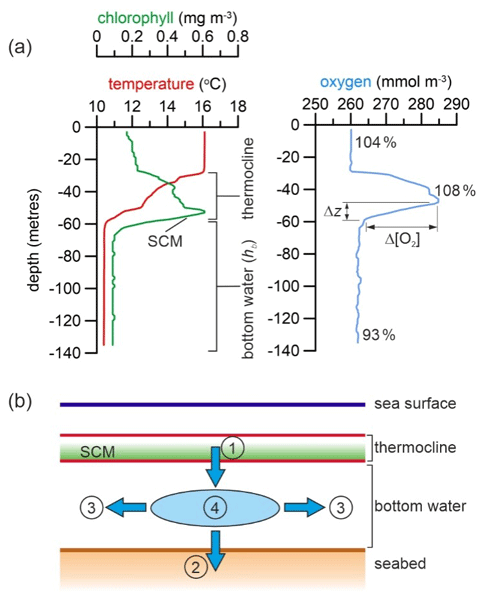
Summer oxygen dynamics in the bottom waters of a wide, temperate shelf sea
Xin Meng
Claire Mahaffey
Juliane Wihsgott
Jonathan Sharples

Seasonal depletion of dissolved oxygen (DO) in stratified shelf seas has important consequences for benthic and pelagic ecosystems and biogeochemical cycling. There is a need to understand the importance of different processes contributing to the bottom water oxygen budget, and how those processes might change in a warmer ocean. Using CTD observations from the UK Shelf Sea Biogeochemistry programme, we construct a summer DO budget for the bottom waters of the Celtic Sea and use the budget to assess how bottom water DO might change in a warmer climate. Across the shelf, bottom water DO concentration declined during summer stratification, with greater losses in shallow northern waters and slower depletion in deeper southern regions. At a well-sampled site in the central Celtic Sea, the bottom water shows a consistent net DO loss of −44 ± 4 mmol m−2 d−1. Respiration and remineralisation dominate this decline (−54 ± 19 mmol m−2 d−1), while vertical turbulent fluxes from the subsurface chlorophyll maximum (SCM) form an important DO source (30 ± 18 mmol m−2 d−1). Episodic wind events enhance DO supply from the SCM, helping to offset some of the DO consumption in the bottom water. Benthic oxygen demand and horizontal transports make minor contributions to the DO budget. A +2 °C “business as usual” climate warming will reduce oxygen solubility and lead to a 12 mmol m−3 drop in DO concentration in the bottom water over the summer stratified period. However, we find that increased microbial respiration rates in the warmer bottom water could be more important for changes in bottom water DO concentrations, potentially driving a decrease in DO concentration of about 21–51 mmol m−3 if there is sufficient labile organic material available. Combined, these effects will lead to increased oxygen deficiency in the central and northern Celtic Sea. Our results demonstrate the importance of respiration responses to a warmer ocean, but also the need to better understand changes in winds and wind-driven mixing across the seasonal thermocline.
- Article
(4268 KB) - Full-text XML
- BibTeX
- EndNote


Dissolved oxygen (DO) concentrations in the bottom mixed layer of seasonally stratified shelf seas are a sensitive indicator of ecosystem health, biogeochemical cycling, and climate variability (Greenwood et al., 2010). Sustained oxygen depletion can degrade habitat quality, reduce biodiversity and promote the development of hypoxia (Levin et al., 2009). Periods of even modest DO loss, < 190 µM compared to saturation concentrations of 250–300 µM, can be deficient for high DO demand organisms such as pelagic and demersal fish (Breitburg, 2002; Diaz and Rosenberg, 2008).
During summer, thermal stratification inhibits vertical mixing, isolating bottom waters from surface DO inputs and atmospheric exchange (Sarma et al., 2016; Rovelli et al., 2016; Sharples et al., 2020). Thus, DO dynamics below the seasonal thermocline are predominantly governed by internal biogeochemical processes and fluxes across the thermocline and benthic boundary layer, though horizontal advection can also play an important role in some shelf sea systems (Sharples et al., 2020; Hull et al., 2020; Rovelli et al., 2016).
Seasonal oxygen depletion has been widely reported in coastal and shelf seas worldwide (Kemp et al., 1992; Breitburg et al., 2018). On the narrow, open shelf off central Oregon, hypoxia arises during upwelling when DO-poor, nutrient-rich waters fuel intense microbial respiration (Adams et al., 2013). In seasonally stratified waters of the semi-enclosed North Sea, bottom water DO saturation commonly drops to 75 %–80 % during summer, reflecting organic matter degradation associated with high surface productivity and weak vertical exchange between bottom waters and the sea surface, whereas well-mixed waters of the southern North Sea remain close to 100 % saturation (Queste et al., 2013). There is increasing concern that these natural seasonal cycles in bottom water DO are superimposed on a pervasive warming-induced decrease in oxygen solubility, increases in nutrient loading, changes in ocean source waters, and increases in rates of respiration and organic matter degradation (Diaz and Rosenberg, 2008; Schmidtko et al., 2017; Barth et al., 2024; Oschlies et al., 2018).
On the wide, temperate northwest European shelf, the Celtic Sea undergoes strong seasonal stratification from late spring to late autumn. Previous studies have quantified regional DO depletion and identified dominant drivers during the stratified period using moorings and gliders (Hull et al., 2020; Williams et al., 2022). However, a process-based bottom water DO budget spanning the full stratified period remains lacking for the Celtic Sea, and there is a need to better understand how the DO budget might change in a warmer climate. This study assesses the spring-autumn DO environment across the entire Celtic Sea. We construct a detailed DO budget for the bottom waters in the central Celtic Sea and identify the key terms and uncertainties, including wind- and internal wave-modulated mixing between the surface and bottom waters. We also consider how the DO budget in sub-thermocline waters may change in the future as the Celtic Sea warms, altering oxygen solubility, wind-driven mixing and respiration rates, with implications for benthic and pelagic ecosystems.
2.1 The Celtic Sea and data availability
The Celtic Sea is a semi-enclosed region of the northwest European shelf (Fig. 1). Stratification begins in spring (April) when net surface heating exceeds mixing by wind and tides (Wihsgott et al., 2019), triggering the spring phytoplankton bloom across the entire region (Seguro et al., 2019; Hopkins et al., 2021). During the stratified period, typically from spring to late autumn, the bottom mixed layer (BML) is separated from surface waters by a thermocline. The seasonal thermocline supports the subsurface chlorophyll maximum (SCM) (Sharples et al., 2001) – a site of active photosynthesis and DO production (Rippeth et al., 2024). This seasonal thermocline plays a central role in controlling DO dynamics by isolating deeper waters from atmospheric inputs. Stratification weakens towards the edge of the shelf because of vigorous internal tide mixing (Sharples et al., 2007).
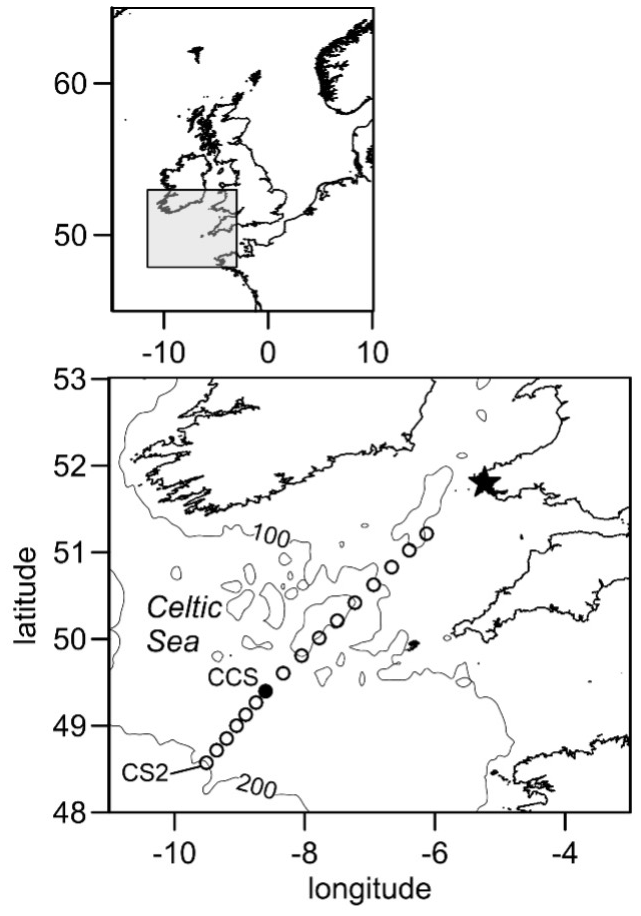
Figure 1Location of the Celtic Sea study area. Open circles are CTD stations. The filled circle is the central Celtic Sea (CCS) site used for the DO budget; site CS2 is at the edge of the continental shelf. The filled star is the 0 km reference point for transect plots, consistent with Ruiz-Castillo et al. (2019). The 100 and 200 m isobaths are shown: the shelf edge is marked by the 200 m isobath.
We use CTD profiles from a transect across the Celtic Sea (Fig. 1), carried out during the UK Shelf Sea Biogeochemistry research programme over a series of research voyages between March 2014 and August 2015 (Sharples et al., 2019), to provide cross-shelf gradients in the seasonality of bottom water DO concentrations. The number of CTD stations sampled along the transect in Fig. 1 varied, depending on cruise timing and weather conditions. The locations and timing of the CTD sampled stations are reported in Results by posting the datapoints in the figures.
CTD DO was measured using CTD-mounted Sea-Bird SBE 43 sensors. Oxygen data were corrected for sensor response and alignment. Calibration samples were collected from Niskin bottles on all CTD casts and analysed by Winkler titration. Typically, each cruise generated 100–200 bottle samples for DO across the full range of salinities and temperatures observed. Cruise-specific regressions between bottle and processed sensor oxygen concentrations were applied to CTD oxygen profiles, with suspect or outlying samples excluded where identified during cruise-specific quality control. Over all cruises the root-mean-square deviation of the oxygen data about the calibration regressions was no worse than ±3 µM.
CTD chlorophyll fluorescence was measured with a CTD-mounted Chelsea Instruments Aquatracka MKIII fluorometer. Niskin-bottle samples, typically 60–120 per cruise, were analysed for discrete chlorophyll-a fluorometrically following extraction in 90 % acetone. As with DO, cruise-specific regressions between bottle samples and CTD sensor values were used to calibrate all CTD chlorophyll profiles. The worst-case root-mean-square deviation about the calibration regressions was 0.05 mg m−3.
2.2 DO budget
One station in the central Celtic Sea (CCS, Fig. 1) was visited during every research voyage, allowing a budget of bottom water DO dynamics to be constructed for this site. A typical CTD profile at CCS (Fig. 2a) illustrates the vertical structure of the water column during summer stratified conditions. A warm surface layer is separated from deeper, cold water by a thermocline. The thermocline was identified as the layer of strong temperature gradient between the much more homogeneous surface and bottom waters (Fig. 2a). The base of the thermocline was identified manually from each CTD temperature profile as the transition from the strong vertical temperature gradient within the thermocline to the relatively homogeneous bottom water. For concentration-based analyses, bottom water DO was defined as the mean concentration over the lower 40 m of the water column; for inventory-based budget calculations, DO was integrated from the base of the seasonal thermocline to the seabed (see Fig. 2a). The SCM is a persistent feature of the thermocline. DO in the surface waters is close to saturation, but at a lower concentration than colder, deeper waters due to the temperature dependence of solubility. DO in the SCM shows a marked peak because of photosynthesis in the SCM combined with weak diapycnal mixing inside the thermocline, which allows the DO to accumulate.
Here, we focus on the factors that control the DO concentration in the bottom water. The terms considered in the summer bottom water DO budget are illustrated in Fig. 2b.
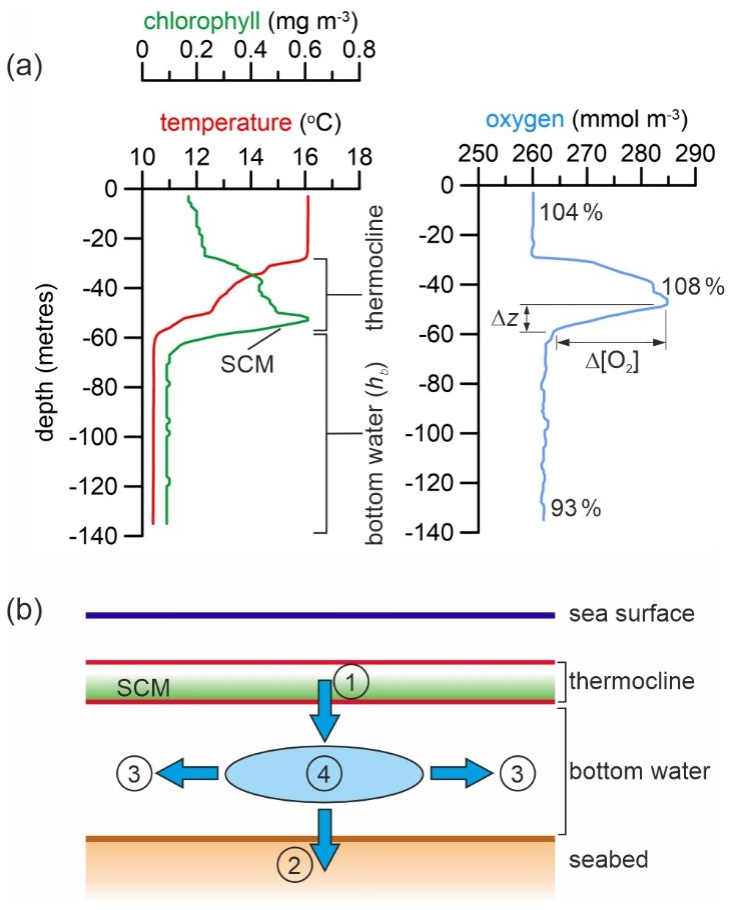
Figure 2(a) Typical summer profiles of temperature (°C), chlorophyll (mg m−3) and DO (mmol m−3) at the CCS site indicating the thermocline, bottom water and subsurface chlorophyll maximum (SCM) [14 July 2015, cruise DY033, CTD 08]. On the DO profile, percentages indicate DO saturation relative to water at the in situ temperature and salinity. Δz denotes the vertical distance across the thermocline used for the DO gradient and Δ[O2] the corresponding difference in DO concentration. (b) Key terms in the DO budget: ① diapycnal mixing of DO out of the SCM; ② benthic DO demand; ③ horizontal transports; ④ DO consumption by respiration and organic matter remineralisation.
2.3 Diapycnal DO flux from the SCM
The diapycnal flux of DO across the thermocline, Fdia [mmol m−2 s−1] can be calculated from:
where Kz (m2 s−1) is the vertical turbulent diffusivity. The vertical gradient of DO across the thermocline, (mmol m−4), is calculated as the difference between the peak DO concentration at the SCM and the DO concentration at the base of the thermocline (Fig. 2a).
Typical values of thermocline turbulent diffusivity in the seasonally stratified Celtic Sea range from 4 × 10⁻⁵ to 2 × 10⁻⁴ m2 s−1, reflecting mixing during average summer wind speeds of 5 to 10 m s−1 and away from energetic internal waves set up by steep seabed topography (Palmer et al., 2008; Tweddle et al., 2013). For this study we use a representative value of Kz = 8 × 10⁻⁵ m2 s−1 to compute mean summer DO fluxes, consistent with background diffusivity measurements in the Celtic Sea away from topographic mixing hotspots and strong wind events. Because the diapycnal DO flux scales linearly with Kz, the choice of diffusivity is an important source of uncertainty in the budget and therefore in the residual respiration estimate. We performed a sensitivity analysis using Kz values spanning the reported background range of 4 × 10⁻⁵ to 2 × 10⁻⁴ m2 s−1, while holding the other budget terms constant.
We include an estimate of the impacts of episodic strong wind mixing events which can significantly augment turbulent diffusivity. Observations by Williams et al. (2013) have shown that sharp pulses of thermocline mixing occur in response to increased winds. Daily mean nitrate fluxes into the base of the SCM increased by a factor of 17 to 22 as winds increased to > 12 m s−1. Most of this increase was due to changes in Kz and so this wind-driven increased mixing will also transfer DO from the SCM into the bottom water (Rippeth et al., 2024). Wind events need to be strong enough and sustained for long enough to set up the large-scale inertial motions of the surface layer that are responsible for shear-generated mixing in the thermocline (Burchard and Rippeth, 2009; Lincoln et al., 2016). Based on the observations of Williams et al. (2013), we set a threshold wind speed of 12 m s−1 sustained for at least 12 h. When a wind event exceeds this threshold, we increase the thermocline Kz by a factor of 20, the average increase observed by Williams et al. (2013) and incorporate this into the mean diffusivity over the stratified period. We use hourly wind speed data from the European Centre for Medium Range Weather Forecasts (ECMWF) ERA5 reanalysis (Hersbach et al., 2023) over the stratified periods of 2014 and 2015 at the location of CCS. If the total number of days of stratification between spring and winter is Ns, and the number of days experiencing strong wind events over this period is Nw, then the mean Kz over the stratified period is calculated using:
2.4 Benthic DO demand
Benthic DO consumption, Fben, was represented using measurements collected during May (post-spring bloom) and August at muddy and sandy sediment sites in the Celtic Sea, with sediment characteristics comparable to those at CCS (Hicks et al., 2017). Mean DO consumption rates in sandy sediments (site G) were −5.9 ± 2.5 mmol m−2 d−1 (May: −6.3 ± 1.4 mmol m−2 d−1; August: −5.4 ± 3.7 mmol m−2 d−1, Hicks et al., 2017). In muddy sand sediments (site H), mean DO consumption rates were −9.1 ± 3.3 mmol m−2 d−1 (May: −9.1 ± 4.0 mmol m−2 d−1; August: −9.1 ± 3.3 mmol m−2 d−1). Using this data set, we have applied a mean of −7 ± 3 mmol m−2 d−1.
2.5 Horizontal transport and dispersion
Horizontal transport integrated over the thickness of the bottom water, FH, was represented as the combined effect of advection and horizontal diffusion operating on cross-shelf gradients in bottom water DO concentration:
The horizontal advective flux, Fadv, was calculated from:
where y is the cross-shelf direction which is aligned with key physical and biogeochemical gradients (Ruiz-Castillo et al., 2019) and the thickness of the bottom layer is hb (Fig. 2a). And the cross-shelf mean bottom water velocity at CCS in summer was typically 0.6 to 0.8 km d−1 directed from the shelf edge (Ruiz-Castillo et al., 2019). The horizontal DO gradient was estimated directly from the observed bottom water DO concentrations along the CTD transect between CCS and CTD locations towards the shelf edge.
The horizontal diffusive flux Fdiff was calculated using
where KH is the horizontal diffusion coefficient. The calculation used KH = 20–100 m2 s−1 (Okubo, 1971). The bottom water oxygen concentration at CCS in summer showed a persistent local high concentration compared to waters on either side of CCS. We discuss the possible reasons for this in Sect. 3.1. To estimate the rate of horizontal dispersion of oxygen from CCS, we represented the oxygen distribution by a Gaussian peak centred at CCS, with a concentration 10 mmol m−3 above a background value of 250 mmol m−3 and a Gaussian width parameter of 25 km, chosen to resemble the observed cross-shelf DO pattern around CCS. A simple model integrating Eq. (5) was used to calculate the oxygen loss rate.
2.6 Total respiration demand for DO
Our estimate of the bottom water total respiration demand for DO during the summer, , is calculated as the residual DO change after diapycnal mixing, benthic DO demand, and horizontal transports have been accounted for in the observed total DO reduction, Ftotal:
We interpret as the oxygen consumed by phytoplankton and bacterial respiration, but it may also include any errors in the budgeted processes and any oxygen consumption by processes we have not considered. However, in our budget calculations below we attempt to quantify process uncertainties, so these should be reflected in the overall uncertainty in . Our budget accounts for the major processes affecting oxygen in a temperate shelf sea; other processes (e.g. ice-limited oxygen exchange or oxidation of reduced compounds) are either irrelevant to the study region or minor relative to the budget terms.
The seasonal budget assumes that DO inventory changes approximately linearly over each fitted stratified-period interval, consistent with the trends shown in Fig. 6. The formulation neglects an explicit term associated with temporal changes in bottom-layer thickness (). Mooring observations indicate that bottom-layer thickness changes only weakly through most of the stratified period, until approximately mid-October, so this term is assumed to be small relative to the other budget terms over the period used for the main analysis. This assumption breaks down during rapid autumnal deepening of the surface layer, particularly for the late-November 2014 observation, but most of the oxygen removal has taken place before this rapid mixed layer deepening takes place.
3.1 Cross-shelf patterns in DO
The cross-shelf pattern of the surface-bottom temperature difference (Fig. 3a) illustrates the expected seasonal variability in stratification. Note in Fig. 3 that there are no data through the middle of winter 2014/15. However, mooring data at CCS confirm that the region was fully mixed vertically by late December 2014 and remained mixed until early April 2015 (Wihsgott et al., 2019). Stratification in the Celtic Sea typically develops in spring (April), intensifies through summer, and peaks in July–August with surface–bottom temperature differences exceeding 9 °C at mid-shelf (∼ 350 km; Fig. 3a). By winter (November–December), the temperature difference rapidly decreases as the water column becomes fully mixed, a state that persists until the following spring. This seasonal cycle was consistent throughout both study years and is a common feature of Celtic Sea seasonality.
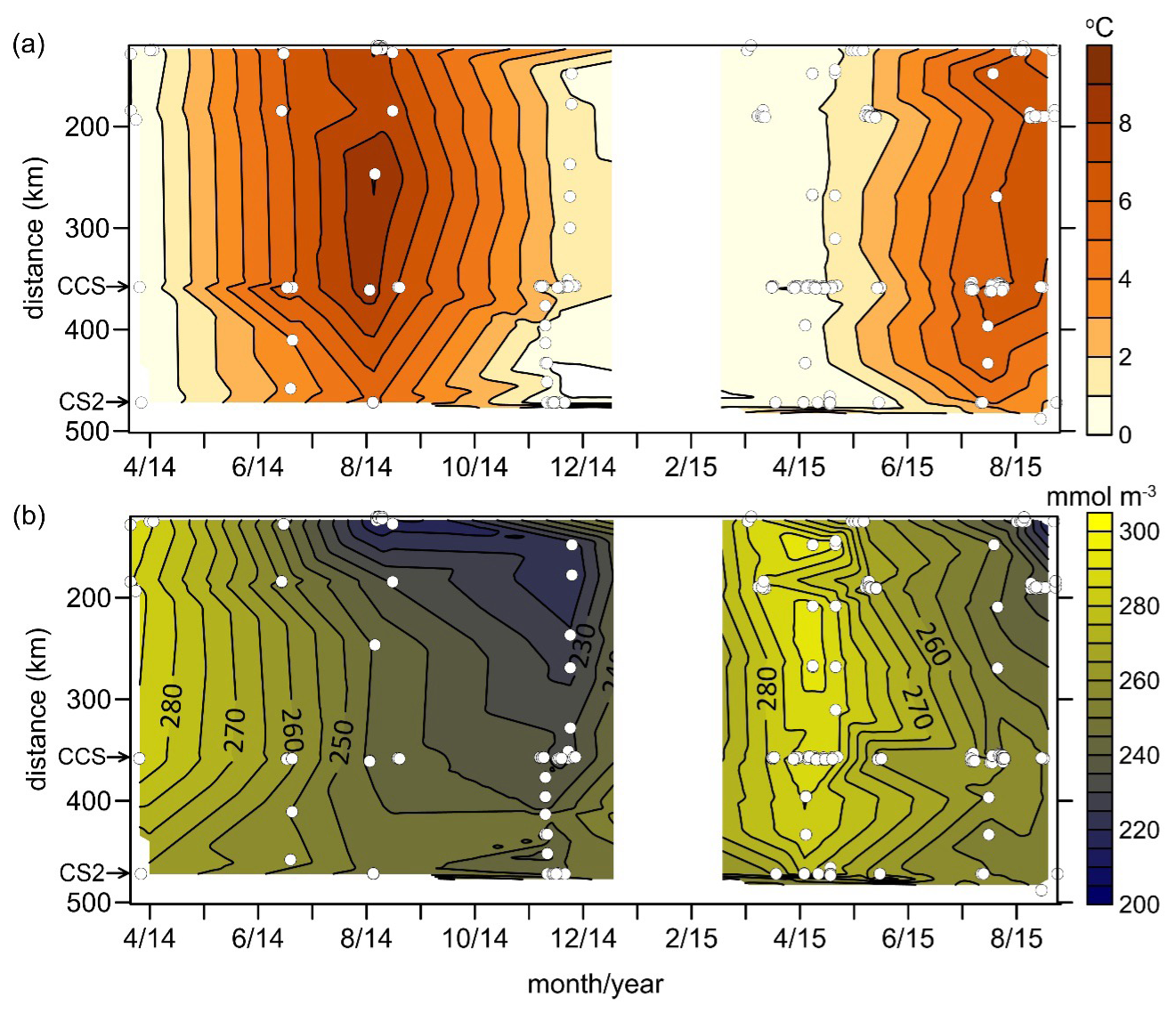
Figure 3(a) Surface–bottom temperature difference (°C) and (b) bottom mixed layer DO (mmol m−3) along the Celtic Sea transects, April 2014–August 2015. White circles are CTD stations. Distances are relative to the 0 km reference point in Fig. 1.
Bottom water DO concentrations show a seasonal cycle closely coupled to the stratification (Fig. 3b). DO begins to decline soon after stratification establishes in April, with the steepest losses during peak summer. The lowest DO concentrations (< 220 mmol m−3) occur in shallower northern areas, while deeper southern waters retain higher DO (e.g. CS2 at the edge of the continental shelf). This spatial gradient reflects both the greater thickness of the bottom layer in deeper regions and, close to the internal tide influenced shelf edge, more efficient ventilation. In winter, when the water column is fully mixed, DO concentrations recover to well-oxygenated conditions (> 280 mmol m−3) across the transect. The strong correspondence between stratification intensity and DO decline highlights the central role of isolation of bottom waters in driving summer oxygen depletion.
Stratification reaches across the shelf in both summers (Fig. 4), with low surface chlorophyll and a SCM in the base of the pycnocline (Fig. 4a, c). Surface waters are close to 100 % saturated, with the lower surface DO concentrations in 2014 associated with a thinner, warmer surface layer (Fig. 4b, d). There is a consistent DO maximum within the pycnocline across the entire shelf, caused by photosynthesis in the SCM combined with weak pycnocline mixing limiting the removal of DO from the SCM. Towards the shelf edge stratification weakens due to mixing by strong internal tides (Sharples et al., 2007). Bottom water DO concentrations (Fig. 4b, d) are minimum in shallower northern waters and increase progressively towards deeper southern regions.
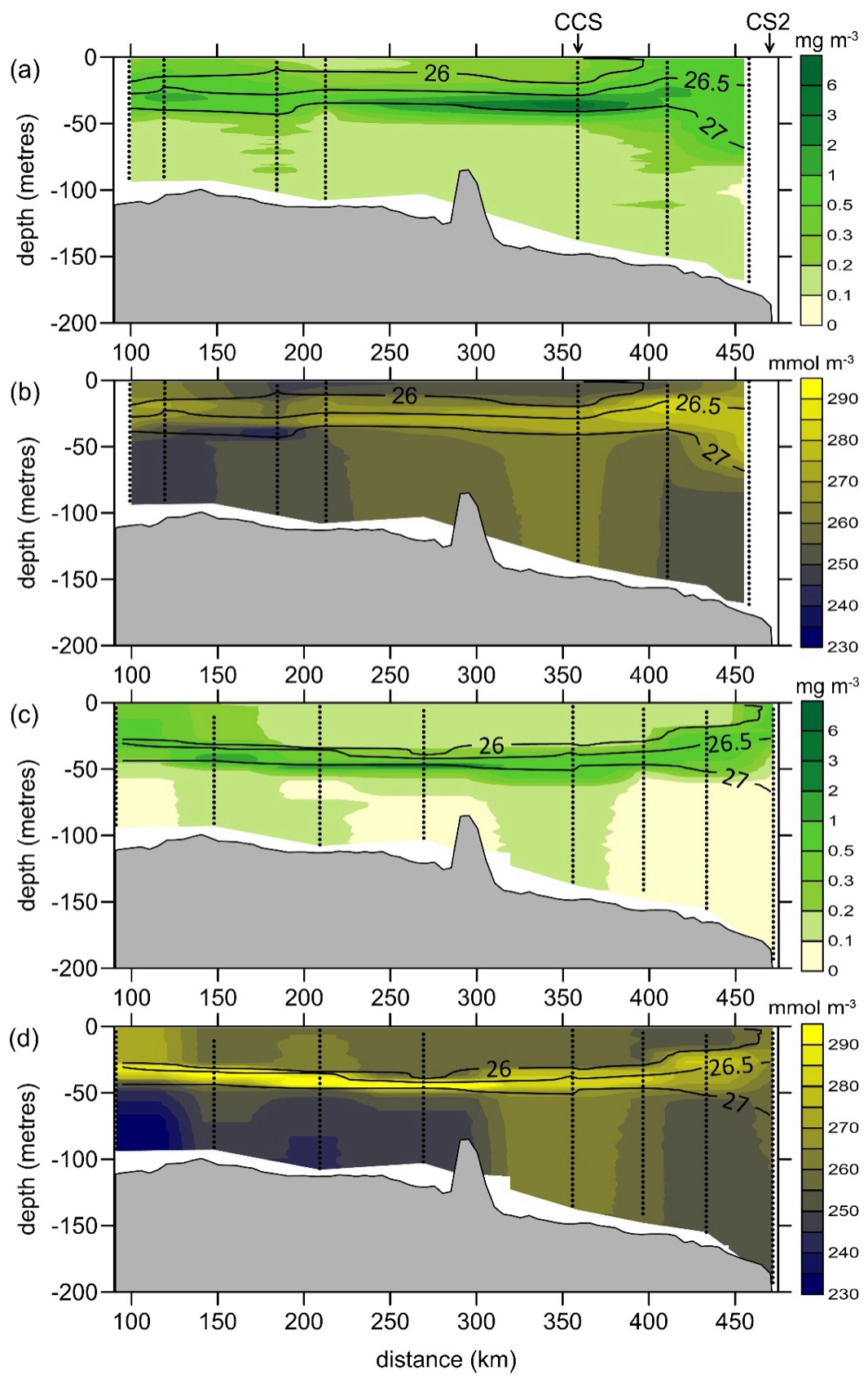
Figure 4Cross-shelf transects during June 2014 (cruise JC105) and July 2015 (cruise DY033). (a) Chlorophyll (mg m−3) June 2014; (b) DO (mmol m−3) June 2014; (c) chlorophyll (mg m−3) July 2015; (d) DO (mmol m−3) July 2015. Black contours indicate potential density (σθ, kg m−3), and the vertical dotted lines mark the CTD profiles. Distances are relative to the 0 km reference point in Fig. 1.
The otherwise increasing trend of bottom water DO across the shelf is interrupted in both years by a local peak in DO below the pycnocline near station CCS (Fig. 4b, d), which in 2015 is also associated with an increase in bottom water chlorophyll (Fig. 4c). Horizontally patchy increases in SCM have been noted previously in high-resolution transects across the Celtic Sea out to a depth of about 150 m and attributed to localized increases in internal mixing associated with variability in seabed slopes (Sharples et al., 2013). The patch of high bottom water DO does not seem to be linked to the obvious bank on the seabed, 50 km away; there are numerous seabed features across the shelf that could drive this elevated mixing (e.g. Sharples et al., 2013) and it is likely that there are seabed features adjacent to the CTD transect responsible for this localized oxygen increase. We will discuss the implications of this patch of bottom water oxygen for our oxygen budget later.
3.2 Seasonality in the central Celtic Sea
At the CCS site, mooring data illustrate the repeating seasonal cycle of stratification with spring stratification beginning in early April of 2014 and 2015 and winter mixed conditions from mid-December 2014 through to April 2015 (Fig. 5). Chlorophyll from CTD profiles indicates the sub-surface chlorophyll maximum in summer 2014 and 2015, an autumn/fall bloom in surface waters in November 2014 and a strong spring bloom in April 2015 (Fig. 5a). Note that the 2014 spring bloom was not sampled by CTD casts but it was seen in surface waters from the mooring data (Wihsgott et al., 2019). The impact of photosynthesis on DO is clear during the 2015 spring bloom, the 2014 autumn/fall bloom and in the summer subsurface chlorophyll maximum (Fig. 5b). Again, the lack of CTD data in April and May 2014 means that the DO signal linked to the 2014 spring bloom was not sampled.
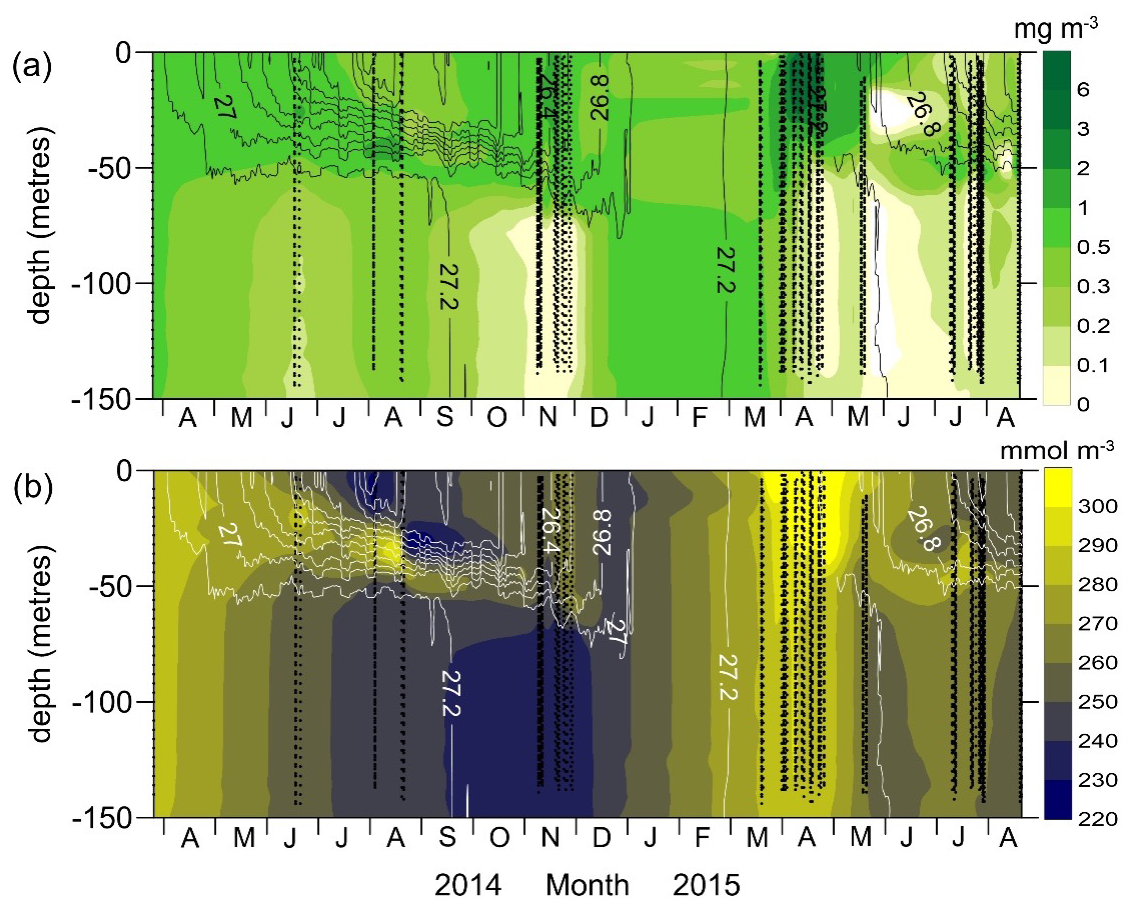
Figure 5The concentration of (a) chlorophyll (mg m−3) and (b) DO (mmol m−3) at CCS from March 2014 to August 2015. Black contours indicate potential density (σθ, kg m−3) using mooring data from Wihsgott et al. (2019). The black dots mark the CTD profiles.
Bottom water DO in March 2014 and March 2015 started at about 282 mmol m−3 and was 100 % saturated at a water temperature of about 10 °C. This sets the initial bottom water DO concentration at the start of the stratified period. In April 2015 there was a slight increase in DO following the spring bloom, reaching 288 mmol m−3; most likely the result of spring tide ventilating the BML with high DO surface water containing the spring bloom. In both summers bottom water DO concentrations declined over the stratified period, reaching a minimum concentration of 230 mmol m−3 in late November 2014 (Fig. 5b).
DO concentrations in bottom waters declined at a rate of 0.17 mmol m−3 d−1 in 2014 and 0.24 mmol m−3 d−1 in 2015 (slopes of the lines in Fig. 6a, b) and are consistent with other measurements in the Celtic Sea (Hull et al., 2020; Williams et al., 2022). At a site close to the north of our transect line, DO has previously been noted to decline at rates of 0.40, 0.32 and 0.14 mmol m−3 d−1 in spring, summer and autumn/fall, respectively (Hull et al., 2020). Using glider-based measurements near CCS, Williams et al. (2022) measured DO decline rates of 0.23 and 0.10 mmol m−3 d−1 in spring and summer respectively. While our CTD time series do not have sufficient duration or resolution in any one year to determine how rates of decline might change through the stratified period, the relatively low rate of decrease in late summer/early autumn 2014 and the higher rate of decrease in early summer 2015 are consistent with the variations seen by Hull et al. (2020) and Williams et al. (2022).
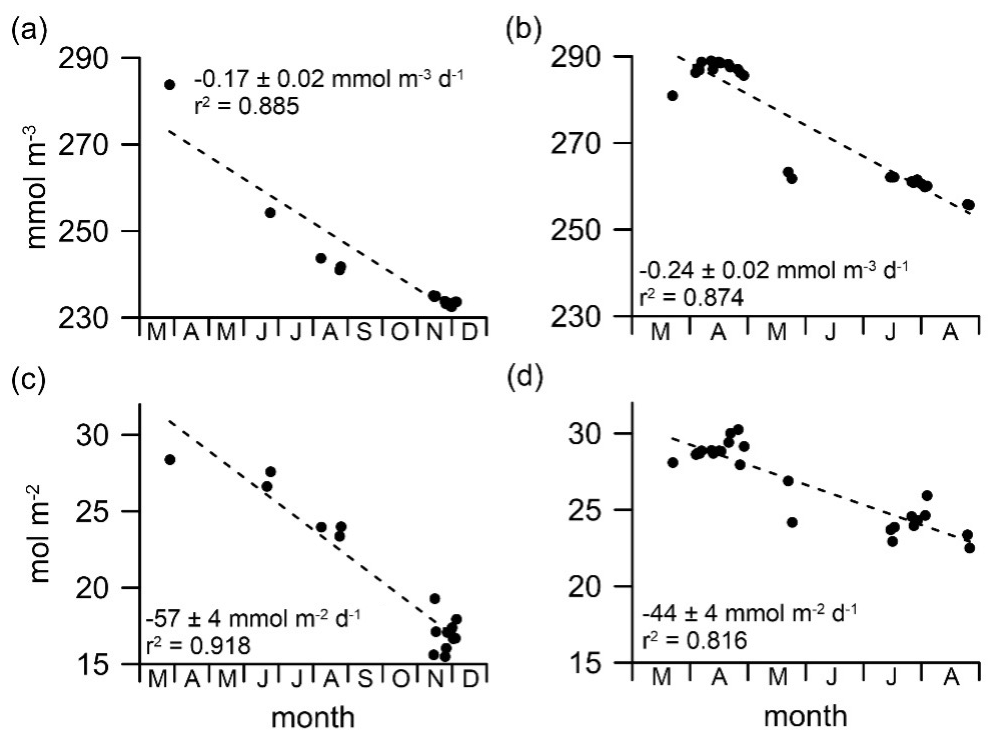
Figure 6(a) Mean DO concentration (mmol m−3) in the lower 40 m in 2014; (b) mean DO concentration (mmol m−3) in the lower 40 m in 2015; (c) integrated DO (mol m−2) below the thermocline in 2014; (d) integrated DO (mol m−2) below the thermocline in 2015.
DO inventories below the seasonal thermocline were used in the budget estimates. Mean DO concentrations were calculated over the lower 40 m of the water column (Fig. 6a, b) as a practical measure of the bottom water DO, while DO inventories were integrated between the base of the thermocline and the seabed (Fig. 2a). The inventories show clear declines over the stratified period (Fig. 6c, d). The rate of decline in 2014 (−57 ± 4 mmol m−2 d−1) was steeper than in 2015 (−44 ± 4 mmol m−2 d−1). However, the 2014 regression is influenced by the November 2014 surface layer having deepened considerably as the system approached the fully mixed state (which occurred in late December). Thus, the thickness of the water layer below the thermocline was reduced to about 70 metres, compared to 100 m through most of the rest of the stratified period (Fig. 5). The rapid change in bottom-layer thickness means that the constant-thickness assumption of the budget is violated for the late-November 2014 point. The rates of decline from 2015 are therefore more relevant to our budget because they are not affected by this autumnal thinning of the sub-thermocline layer. We note that the oxygen depletion rate in 2014 without the data from November yields −34 ± 8 mmol m−2 d−1 (n = 6; r2 = 0.84), which is not significantly different from the 2015 depletion rate.
3.3 DO budget in the bottom mixed layer
The mean rate of decline in the bottom water DO at CCS between June and November 2014 and April and August 2015 was used to evaluate the relative contributions of physical and biological processes controlling summer DO dynamics. This net decrease in the bottom water DO inventory reflects the combined influence of benthic consumption, horizontal transports, and vertical mixing acting alongside biological respiration within the bottom water (Fig. 2b). Our aim here is to achieve a reliable understanding of the relative importance of each process.
3.3.1 Vertical mixing
The effect of strong winds on the DO flux from the SCM can now be considered using the wind speed threshold and calculation of Kz described earlier (Eq. 2). We use a stratified period between mid-April and end October so that NS = 200 d. Beyond October we expect rapid convective deepening from November to dominate any influence of wind-driven mixing. Wind speed data from ERA5 (Fig. 7) illustrate the episodic nature of strong wind events. Analysis using the speed and time thresholds between mid-April and October yields Nw = 8.3 d for 2014, and Nw = 8.6 d for 2015. Equation (2) then gives Kz = 14.3 × 10⁻⁵ m2 s−1 for 2014 and Kz = 14.5 × 10⁻⁵ m2 s−1 for 2015. The wind-driven component of the DO budget then combines Kz with the vertical DO gradient from all available CTD profiles within the stratified periods of each of 2014 and 2015. The uncertainty in each arises from variability in the DO gradient. Variability caused by the range of mixing enhancements seen by Williams et al. (2013) is only about 10 % of the variability caused by the DO gradients and so has not been included. We also consider possible increases in vertical diffusivity that may be caused by nearby seabed features generating enhanced mixing, which earlier we suggested could be responsible for the persistent locally increased DO in the bottom water in summer at CCS. Palmer et al. (2013) measured thermocline diffusivity between 3 × 10⁻⁵ m2 s−1 (neap tides) and 3 × 10⁻⁴ m2 s−1 (spring tides) over the slopes of a bank in the Celtic Sea, with the larger spring tide mixing caused by breaking lee waves on the thermocline. Sections across the Celtic Sea (Sharples et al., 2013) indicate that such topographically driven diapycnal mixing is common across much of the region, particularly as the shelf becomes shallower. Taking the mean of the Palmer et al. (2013) measurements, 1.6 × 10⁻⁴ m2 s−1, and adding the wind effect using Eq. (2), with 1.6 × 10⁻⁴ m2 s−1 as the background diffusivity, suggests a diffusivity of 2.3 × 10⁻⁴ m2 s−1, about 60 % greater than our wind-influenced values in the absence of any topographic mixing.
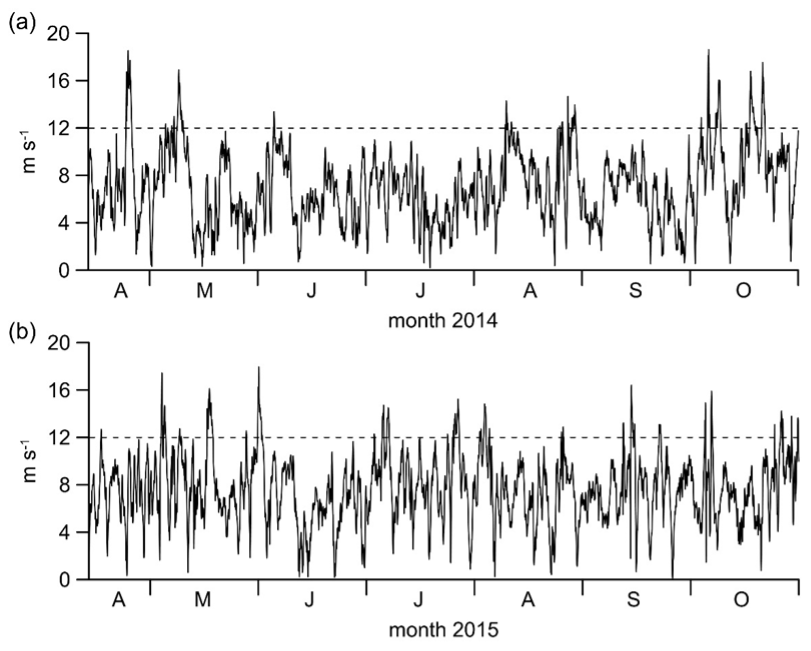
Figure 7ERA5 wind speeds (m s−1) between mid-April and October (a) 2014, (b) 2015 at CCS. The dashed line indicates the wind speed used as the threshold defining a strong wind event.
The results (Table 1) illustrate the importance of including strong wind events, with the average diapycnal DO flux in 2015 being almost doubled compared to a value that uses the canonical shelf sea diapycnal diffusivity. The addition of the effect of enhanced diapycnal mixing caused by topographically driven internal waves suggests that the variability of the shelf seabed should also be considered in an assessment of the diapycnal mixing.
Table 1Diapycnal DO fluxes for 2014 and 2015 using a background diffusivity, diffusivity influenced by wind events, and diffusivity influenced by wind events and local topographically driven mixing.

A major source of uncertainty in the estimates of diapycnal DO fluxes is the value of Kz. The full range of reported values for the background value of Kz is 4 × 10⁻⁵ to 2 × 10⁻⁴ m2 s−1. Calculations of diapycnal DO flux, with a fixed mean value for the vertical oxygen gradient and using this range of Kz give fluxes of 24–118 mmol m−2 d−1 in 2014 and 15–75 mmol m−2 d−1 in 2015. These will be the extremes of the possible range of fluxes in the Celtic Sea and serve here to illustrate the importance of acquiring a better understanding of turbulent mixing within strong vertical density gradients. Our analysis is based on the representative value of this range, 8 × 10⁻⁵ m2 s−1, which is at the higher end of the values measured in April and July 2015 from glider microstructure sensors between CCS and CS2 by Williams et al. (2022).
3.3.2 Horizontal transports
A cross-shelf gradient in bottom water DO was observed during summer. Along the transect, DO concentration in the bottom water increased from the shallow water toward CCS (from ∼ 245 to 260 mmol m−3), then decreased toward the shelf edge (from ∼ 260 to 250 mmol m−3), creating the local maximum at CCS likely driven by nearby topographically induced mixing (Fig. 4b, d). This pattern suggests that horizontal advection and diffusion act as net DO sinks at CCS.
The advective contribution was estimated from the observed horizontal DO gradient (∼ 1 × 10⁻⁴ mmol m−4) and mean near-bottom currents (∼ 0.6–0.8 km d−1), yielding DO changes of −0.06 to −0.08 mmol m−3 d−1. Accounting for the water column below the base of the seasonal thermocline, this corresponded to changes of −5.4 to −7.1 mmol m−2 d−1 (mean −6.3 ± 0.9 mmol m−2 d−1). Using a range of KH = 20–100 m2 s−1 (Okubo, 1971), the resulting diffusive DO losses ranged from −2.6 to −10.8 mmol m−2 d−1 (mean −6.7 ± 4.1 mmol m−2 d−1), similar to the advective estimates.
3.3.3 Benthic demand
Assuming the sediment type at CCS is muddy sand, we estimate mean benthic DO uptake of −7 ± 3 mmol m−2 d−1 (Hicks et al., 2017).
3.3.4 Residual and overall budget
Combining the above DO budget terms (Table 2), the residual DO demand in the bottom water at CCS over the stratified period was estimated at −84 ± 32 mmol m−2 d−1 for 2014 and −54 ± 19 mmol m−2 d−1 in 2015. Respiration and remineralisation in the bottom water are the dominant processes in removing DO, but there is an important resupply of DO through the thermocline that can offset about half of the respiration/remineralisation effect. We view the change in DO in 2014 as less reliable because the CTD sampling in November occurred during a time of rapid deepening of the thermocline as the water column remixed toward December: thus, the bottom layer thickness was reducing which would lead to a decrease in the inventory of DO below the thermocline. The budget in 2015 did not include data beyond the start of September, and so there was a generally consistent bottom layer thickness of 100 m (e.g. Fig. 5). The respiration/remineralisation term calculated for 2015 is higher than the 20 ± 8 mmol m−2 d−1 calculated by Williams et al. (2022), but our value is consistent with the 71 ± 17 mmol m−2 d−1 measured at CCS by García-Martín et al. (2019).
Table 2DO budget for the bottom water at CCS during the stratified periods in 2014 and 2015. Circled numbers refer to the processes identified in Fig. 2b. Fluxes in brackets include the effect of topographically driven internal waves as a source of diapycnal mixing.
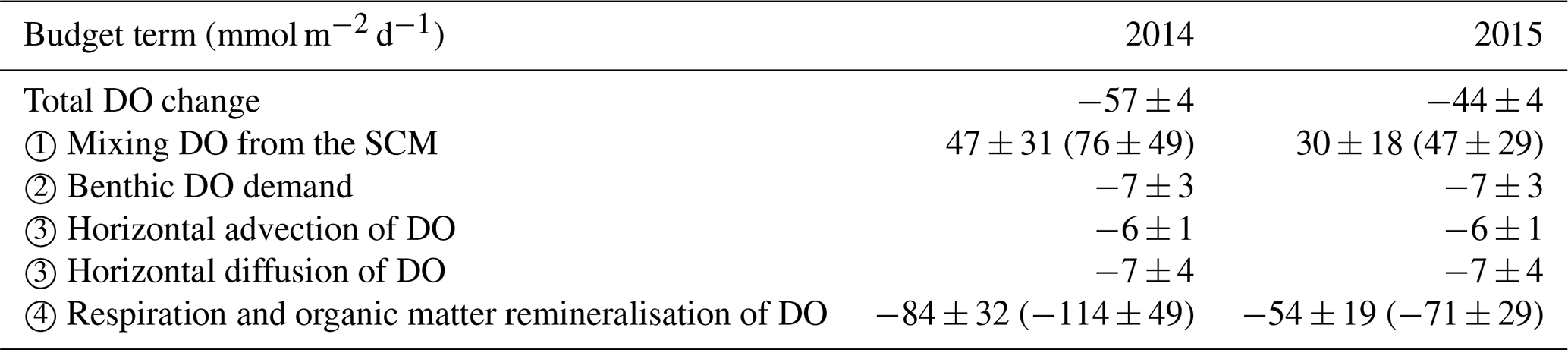
Because respiration/remineralisation is diagnosed as the residual, it is affected by uncertainty in diapycnal mixing, benthic demand, horizontal transport, the observed DO trend, and any processes omitted from the simple budget. The Kz sensitivity analysis demonstrates that uncertainty in diapycnal mixing is particularly important, with the inferred residual respiration rate varying substantially across the range of diffusivities reported for the Celtic Sea.
4.1 Key results
CTD observations between March 2014 and August 2015 show a clear seasonal cycle in the bottom water DO concentration, tightly coupled to the development and breakdown of stratification. DO concentrations decline following spring stratification, when isolation from surface exchange limits replenishment. The decline continues through summer, reaching annual minima just before autumnal mixing, consistent with mooring and glider observations in the Celtic Sea (Hull et al., 2020; Williams et al., 2022). Bottom water DO concentrations reach their lowest values in the shallower northern parts of the shelf: thermocline depths are broadly the same across most of the shelf, so shallower regions have a smaller pool of bottom water DO available for respiration and bacterial consumption. Our budget of bottom water DO at the CCS site shows that biological respiration and organic matter remineralisation dominate consumption, with the supply of DO via diapycnal mixing from the high DO concentrations within the SCM providing the next most important budget process. We find that incorporating some measure of the effect of episodic strong wind events on the mixing between the SCM and the bottom water is important. Adding the effect of topographically driven internal waves in enhancing diapycnal mixing also has a significant effect on the final value of oxygen consumption in the bottom waters. Benthic DO demand and horizontal transports contribute only 10 % to 15 % of the total DO decline.
The oxygen consumption rate for 2014 is certainly an over-estimate, because the starting value of the rate of oxygen loss (the slope in Fig. 6c) will have been steepened by the November CTD data. The bottom layer in November 2014 was significantly thinner (about 70 m) compared to the more typical 100 m over most of the stratified period due to the rapid deepening of the surface layer approaching winter. Thus, the November bottom water DO inventory will be biased to lower values. If the 2014 oxygen depletion rate is calculated without the November CTD data, the slope of Fig. 6c would instead be 34 mmol m−2 d−1, and the resulting oxygen consumption rate would be 51 mmol m−2 d−1 (with wind events) or 81 mmol m−2 d−1 (with wind events and topographic mixing), very close to the 2015 estimates.
Our estimates of consumption are similar to other work in the region. Hull et al. (2020) report a value of around 40 mmol m−2 d−1 at sites in the northern part of our CTD section. Values reported by Williams et al. (2022) for April and July 2015 at CCS are lower at 12–29 mmol m−2 d−1. Williams et al. (2022) did not include benthic oxygen demand in their budget and their estimates of horizontal transport of DO are lower than ours. Their estimate of the contribution from diapycnal mixing was significantly lower at 3–4 mmol m−2 d−1. This is mainly because of lower values of Kz, between 3 × 10⁻⁵ m2 s−1 (April 2015) and 5 × 10⁻⁵ m2 s−1 (July 2015), though Williams et al. (2022) did have the advantage of direct measurements of turbulence across the thermocline. Our background Kz = 8 × 10⁻⁵ m2 s−1, along with the wind-induced increases, covers a much longer period April–October with more wind events than seen by Williams et al. (2022), so some discrepancy is perhaps unavoidable. Observations of phytoplankton and bacterial oxygen consumption below the thermocline at CCS made by García-Martín et al. (2019) show total oxygen demand of 50 (July 2015) to 80 (April 2015) mmol m−2 d−1, very close to our estimates.
4.2 Bottom water DO in a warmer climate
Future warming is expected to exacerbate DO depletion in shelf seas through reduced oxygen solubility, stronger and longer stratification (Holt et al., 2010), and enhanced microbial respiration (Brewer and Peltzer, 2017). Our analysis also suggests that changes in winds are an important consideration. Based on the important terms in our DO budget, we now discuss possible changes in DO dynamics in a warmer world. We will focus on the budget terms for 2015, and consider how the bottom water DO inventory and concentration will change from the onset of stratification in mid-April through to late October, a total of 200 d of stratification. This avoids the added complexity of the autumn/fall mixing deepening the surface layer, thereby thinning the amount of water below the thermocline, which would affect the inventory calculation.
4.2.1 Changes in oxygen solubility
Human-induced warming has already raised global surface temperatures by ∼ 1.1 °C above pre-industrial levels and further increases across the NW European shelf of 1.5–4 °C are projected by 2100 under a “business as usual” climate scenario (SRES A1B; Holt et al., 2010). We adopt this scenario to allow direct comparison with existing shelf sea projections, acknowledging that it represents an upper bound on future warming. In the Celtic Sea, winter surface waters have already warmed by 0.3–0.5 °C since the 1990s and are predicted to rise by a further 1.5–2.5 °C by the end of this century (Holt et al., 2010). Based on this projection we will consider the effect of a temperature rise of 2 °C on oxygen solubility.
Surface water temperature in spring, when the water column is still vertically mixed but immediately prior to the onset of seasonal stratification, is critical for assessing oxygen dynamics through the subsequent stratified period. It dictates the water column DO concentration that, when stratification is established and the bottom water is isolated from the atmosphere, provides the starting point for all processes that alter the DO concentration. At a salinity of 35, and a present-day spring surface temperature of 9 °C, the DO concentration at 100 % saturation will be 288 mmol m−3. A temperature rise of +2.0 °C reduces DO to 276 mmol m−3, so a reduction of 12 mmol m−3. Assuming all DO budget terms are the same as our 2015 calculations, then the DO concentration at the end of October will be 12 mmol m−3 lower than in 2015. The oxygen concentration in October 2015 can be estimated by extrapolating the trend in Fig. 6b which yields a concentration of about 237 mmol m−3. So, in the warmer climate the change in oxygen solubility alone will lead to a decrease from 237 to 225 mmol m−3.
4.2.2 Earlier onset of stratification
In a warmer world it is projected that stratification on the NW European shelf will begin about 5 d earlier than at present (Holt et al., 2010). This will give the DO budget processes an extra 5 d to reduce the BML DO concentration. Assuming the same rates of decline as 2015, then the DO inventory will be lowered by 0.22 ± 0.02 mol m−2, and the bottom water DO concentration reduced by 2.2 ± 0.2 mmol m−3. Earlier onset of stratification therefore has a very minor effect on the bottom water DO dynamics.
4.2.3 Changes in respiration rates
We will now consider changes to respiration rates in a warmer ocean, though we note that because the present-day respiration/remineralisation term is diagnosed as a residual, the warming estimates will be affected by the uncertainties and any unrepresented processes. The temperature dependence of metabolic processes is described using the standard Q10 approach, where Q10 is the factor by which a metabolic rate changes for a 10 °C increase in temperature:
where RT is a metabolic rate at temperature T and RT+ΔT is the metabolic rate after a temperature change of ΔT. Hence
Bacterial respiration typically responds to temperature with a Q10 of about 2 (Bendtsen et al., 2015; Laufkötter et al., 2017), while respiration rates of a natural, mixed microbial community in waters similar to the Celtic Sea have a Q10 of about 5 (Lefevre et al., 1994). For a ΔT = 2 °C increase in temperature this suggests a 15 %–38 % increase in DO consumption rates, so our 2015 rate of −54 mmol m−2 d−1 (without topographically-driven diapycnal mixing) becomes −62 to −75 mmol m−2 d−1. Assuming all other processes have the 2015 rates, then the new net DO depletion rate will be −52 to −65 mmol m−2 d−1. Assuming 200 d of stratification from mid-April to the end of October and starting with our original spring 2015 oxygen inventory of 28.8 mol m−2, we obtain an autumn inventory of 15.8–18.4 mol m−2. The bottom water thickness in October 2015 had decreased to about 85 m, so the inventory changes lead to a near-bed DO concentration of 186–216 mmol m−3. Hence changes in bottom water microbial respiration rates in a 2 °C warmer ocean could reduce the bottom water DO concentration by about 21–51 mmol m−3. If we view the natural, mixed microbial community as a better model for the community respiration in the bottom waters of the Celtic Sea, then we can expect the respiration-driven loss of oxygen in a 2 °C warmer ocean to be closer to 51 mmol m−3. However, faster metabolic rates in a warmer ocean require organic fuel to draw down more oxygen. If we assume a simple Redfield stoichiometry, then a further 51 mmol m−3 loss of oxygen would require about 35 mmol m−3 of organic carbon. Davis et al. (2019) found bottom water DOC in November 2014 to be about 60 mmol m−3, but suggested that this was likely refractory material. Hence there is some uncertainty in whether faster respiration rates will lead to more oxygen consumption.
4.2.4 Variability in wind events
Finally, given the significance of the wind-mixing term in our DO budget we should consider changes in winds over the region in a warmer world. However, there is no clear consensus on how the number of strong wind events might change over the NW European shelf in response to climate warming, largely because of a wide range of model predictions for latitudinal changes in the Atlantic storm track (Woolf and Wolf, 2013). Instead, we quantify the past long-term variability in the number of spring/summer strong wind events that meet our thresholds for affecting the mean Kz over the stratified period (Fig. 8).
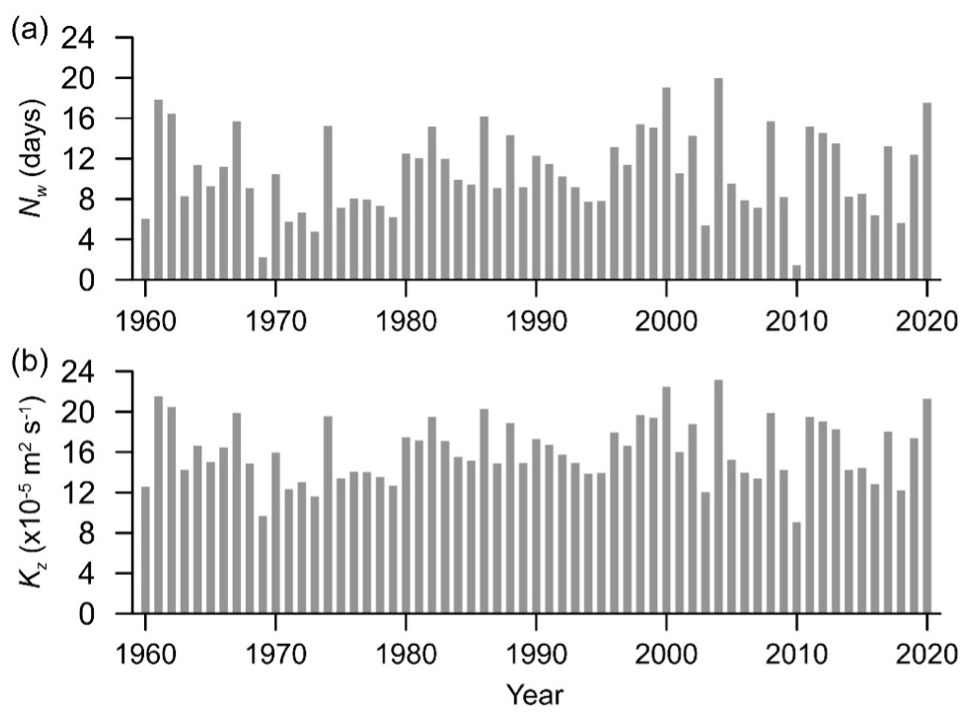
Figure 8The amount of time experiencing strong wind events (wind speed exceeding 12 m s−1 for at least 12 h) at CCS from 1960 to 2020 during the stratified period (mid-April to October). Corresponding mean diapycnal diffusivity during mid-April–October, Kz, based on Eq. (2). Wind data are from the ECMWF ERA5 reanalysis.
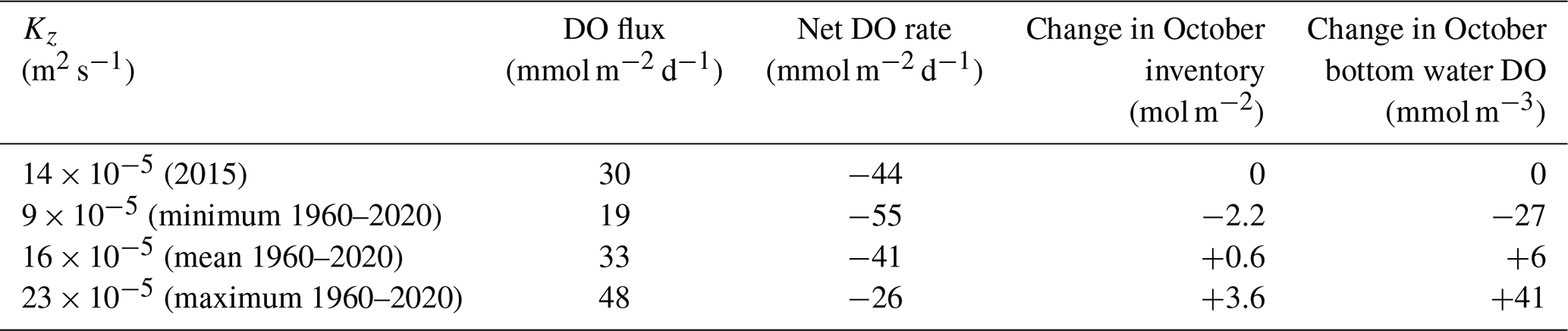
The following 1960–2020 wind-event analysis uses the same ERA5 reanalysis source and CCS location as the 2014–2015 analysis described in Sect. 2.3. Between 1960 and 2020 there was considerable variability in the contribution of wind events to mean diapycnal diffusivity. The number of days experiencing winds above our event threshold ranged between 1.5 and 20.1 d, with a mean value of 10.8 ± 4.1 d. Using the average vertical gradient in DO concentration from mid-April to October 2015 of 2.4 mmol m−4 allows us to estimate the changes we might expect in the DO inventory and concentration compared to 2015 (Table 3). The results show that variability in wind events alone could drive changes in October bottom water DO concentrations ranging from +41 mmol m−3 (maximum wind activity) to −27 mmol m−3 (minimum wind activity), highlighting a significant role for interannual wind variability in controlling late summer bottom water DO.
Table 3Variability in mixing and DO impacts caused by changes in the number of wind events. Inventory and concentration changes are relative to the values in 2015. Inventories for 2015 were 28.8 (April) and 20.1 (October) mol m−2 with an end October bottom water DO concentration of 237 mmol m−3 in a bottom layer thickness of about 85 m (based on mooring data; see Fig. 5).
4.2.5 Changes in primary production
Our analyses have assumed a fixed amount of primary production, generating the organic fuel for respiration and oxygen removal. Sea surface warming and reduced riverine supplies of nutrients are thought to be driving a recent decrease in primary production in the North Sea on the NW European shelf (Capuzzo et al., 2018). Projected future decreases in bottom water DO have been linked mainly to changes in oxygen solubility, with a much smaller impact of changes in primary production again driven by reduced riverine nutrient supplies (Wakelin et al., 2020). Projections of future changes in primary production are spatially heterogeneous, with a predicted increase of about 10 % over the next century in the Celtic Sea but a decrease of about 15 %–20 % in the North Sea (Wakelin et al., 2020). Spring bloom primary production is set mainly by the available nutrients, and hence we would expect a strong correlation with changes in nutrient supplies to the shelf and a corresponding change to the initial supply of organic matter to the bottom water. Through summer a reduction in primary production within the subsurface chlorophyll maximum might be expected to reduce the supply of organic matter to the bottom water, but at the same time would reduce the vertical oxygen gradient that drives the diapycnal supply of oxygen to the bottom water. A stoichiometric argument could be made to suggest these two influences might largely cancel each other. Subsurface primary production will also be sensitive to winds, with stronger winds perhaps mixing more nutrients into the thermocline, so increasing primary production, the subsurface oxygen gradient and organic matter supply. However, at the same time the stronger mixing could deepen the thermocline and so reduce light in the chlorophyll layer and reduce oxygen production by photosynthesis. Overall, uncertainties in winds (Sect. 4.2.4) and nutrient supplies, combined with the competing effects of changes in mixing, photosynthesis and organic matter supplies, make predictions of future primary production and its effects on bottom water oxygen difficult. We have not attempted to make any firm estimate of changes in primary production, but we stress that the role of temperature-induced changes in respiration rates will depend on organic matter supplies to the bottom water.
Based on the above analysis we suggest that the dominant process affecting bottom water DO of a temperate shelf sea in a 2 °C warmer ocean could be the increase in microbial respiration rates, leading to a DO reduction in the central Celtic Sea in autumn/fall of about 51 mmol m−3. However, we also note that this respiration-driven response will depend on there being sufficient bottom water organic material. Changes in DO due to reduced solubility in a warmer ocean are significant, at 12 mmol m−3. This is substantially less than the reduction caused by respiration rate changes, but it may be the dominant effect of a warmer ocean if there is insufficient organic material available for faster respiration rates to affect oxygen concentrations. Changes in DO concentrations caused by an earlier onset of stratification, thus inhibiting the ventilation of the BML for longer, were relatively insignificant, only reducing the DO concentration by about 2 mmol m−3.
Changes in bottom water DO caused by episodic strong wind events could be significant. Based on the past variability in winds we find that late summer BML DO concentrations could vary by about +40 to −30 mmol m−3. How winds over the NW European shelf might change in a warmer climate is currently uncertain, but the variability we calculate suggests that the effects on DO concentrations could be of a similar magnitude to those arising from solubility and respiration rate changes. We did not attempt to quantify changes in diapycnal mixing caused by the strengthening of stratification in a warmer ocean or take account of a changing DO gradient across the pycnocline. Reduced mixing across the thermocline may be expected to exacerbate the DO deficit in the bottom water by reducing the mixing of DO downwards from the SCM. However, this simple view of mixing and stratification does not consider changes in the supply of mixing energy into the water column by inertial shear and internal waves, both of which will also respond to changes in the strength of stratification. Also, any reduction in mixing will reduce the supply of nutrients upwards and so reduce primary production and the subsequent supply of organic material to the bottom water: this will decrease the bottom water DO demand.
In a 2 °C warmer ocean the combination of greater microbial respiration and decreased oxygen solubility could reduce bottom water DO concentrations by 51 + 12 = 63 mmol m−3, so an autumn/fall DO concentration of 174 mmol m−3. Thus, we find that bottom water DO in the central Celtic Sea could decrease to concentrations below oxygen deficiency, defined as a concentration below 192 mmol m−3 (Mahaffey et al., 2023), towards the end of summer. Further north in the Celtic Sea, in shallower water but where we expect broadly the same DO dynamics, the thinner bottom layer means that bottom water DO concentrations are likely to drop further below the oxygen deficiency threshold before the end of the stratified period.
Modelled predictions of future DO in the Celtic Sea show reductions of late summer bottom water concentrations by the end of this century of between 16 and 30 mmol m−3 under the RCP8.5 “business as usual” scenario (Wakelin et al., 2020), and significant areas of the NW European shelf are expected to be vulnerable to oxygen deficiency (Ciavatta et al., 2016; Wakelin et al., 2020). While these DO reductions are broadly consistent with our findings, our suggestion that most of the future changes may be caused by temperature-driven changes in respiration rates differs from recent modelling (Wakelin et al., 2020). However, as noted earlier, warming-enhanced respiration rates will need sufficient available organic material if they are to drive lower oxygen. Thus, while solubility-induced changes in oxygen dynamics are straightforward to predict, it is important to have a reliable understanding, and model descriptions, of the physical drivers of future changes in primary production.
The CTD observational data from the UK Shelf Sea Biogeochemistry programme used in this study are available at the British Oceanographic Data Centre (BODC): https://www.bodc.ac.uk/resources/inventories/edmed/report/6368/ (last access: 28 September 2026). ERA5 reanalysis wind speed data are available from the Copernicus Climate Change Service at https://doi.org/10.24381/cds.adbb2d47 (Hersbach et al., 2023).
XM was responsible for conceptualization, data curation, formal analysis, investigation, methodology, visualization, and writing the original draft. CM contributed to conceptualization, supervision, and review and editing of the manuscript. JW contributed to data curation and review and editing of the manuscript. JS was responsible for conceptualization, methodology, supervision, visualization, and review and editing of the manuscript.
The contact author has declared that none of the authors has any competing interests.
Publisher's note: Copernicus Publications remains neutral with regard to jurisdictional claims made in the text, published maps, institutional affiliations, or any other geographical representation in this paper. The authors bear the ultimate responsibility for providing appropriate place names. Views expressed in the text are those of the authors and do not necessarily reflect the views of the publisher.
Our thanks to the crews of the RRS Discovery and RRS James Cook, and to the UK National Marine Facilities for technical support, during the UK Shelf Sea Biogeochemistry research programme.
This research has been supported by the Natural Environment Research Council, UK Shelf Sea Biogeochemistry research programme (grant no. NE/K002007/1).
This paper was edited by Emilio Marañón and reviewed by giovanni galli and one anonymous referee.
Adams, K. A., Barth, J. A., and Chan, F.: Temporal variability of near‐bottom dissolved oxygen during upwelling off central Oregon, J. Geophys. Res.-Oceans, 118, 4839–4854, 2013.
Barth, J. A., Pierce, S. D., Carter, B. R., Chan, F., Erofeev, A. Y., Fisher, J. L., Feely, R. A., Jacobson, K. C., Keller, A. A., and Morgan, C. A.: Widespread and increasing near-bottom hypoxia in the coastal ocean off the United States Pacific Northwest, Scientific Reports, 14, 3798, https://doi.org/10.1038/s41598-024-54476-0, 2024.
Bendtsen, J., Hilligsøe, K. M., Hansen, J. L., and Richardson, K.: Analysis of remineralisation, lability, temperature sensitivity and structural composition of organic matter from the upper ocean, Prog. Oceanogr., 130, 125–145, 2015.
Breitburg, D.: Effects of hypoxia, and the balance between hypoxia and enrichment, on coastal fishes and fisheries, Estuaries, 25, 767–781, 2002.
Breitburg, D. L., Grégoire, M., and Isensee, K.: The ocean is losing its breath: Declining oxygen in the world's ocean and coastal waters, IOC-UNESCO, IOC Technical Series, IOC/2018/TS/137,, 40 pp., 2018.
Brewer, P. G. and Peltzer, E. T.: Depth perception: the need to report ocean biogeochemical rates as functions of temperature, not depth, Philos. T. Roy. Soc. A, 375, 20160319, https://doi.org/10.1098/rsta.2016.0319, 2017.
Burchard, H. and Rippeth, T. P.: Generation of bulk shear spikes in shallow stratified tidal seas, J. Phys. Oceanogr., 39, 969–985, 2009.
Capuzzo, E., Lynam, C. P., Barry, J., Stephens, D., Forster, R. M., Greenwood, N., McQuatters‐Gollop, A., Silva, T., van Leeuwen, S. M., and Engelhard, G. H.: A decline in primary production in the North Sea over 25 years, associated with reductions in zooplankton abundance and fish stock recruitment, Glob. Change Biol., 24, e352–e364, 2018.
Ciavatta, S., Kay, S., Saux‐Picart, S., Butenschön, M., and Allen, J.: Decadal reanalysis of biogeochemical indicators and fluxes in the North West European shelf‐sea ecosystem, J. Geophys. Res.-Oceans, 121, 1824–1845, 2016.
Davis, C. E., Blackbird, S., Wolff, G., Woodward, M., and Mahaffey, C.: Seasonal organic matter dynamics in a temperate shelf sea, Prog. Oceanogr., 177, 101925, https://doi.org/10.1016/j.pocean.2018.02.021, 2019.
Diaz, R. J. and Rosenberg, R.: Spreading dead zones and consequences for marine ecosystems, Science, 321, 926–929, 2008.
García-Martín, E. E., Daniels, C. J., Davidson, K., Davis, C. E., Mahaffey, C., Mayers, K. M., McNeill, S., Poulton, A. J., Purdie, D. A., and Tarran, G. A.: Seasonal changes in plankton respiration and bacterial metabolism in a temperate shelf sea, Prog. Oceanogr., 177, 101884, https://doi.org/10.1016/j.pocean.2017.12.002, 2019.
Greenwood, N., Parker, E. R., Fernand, L., Sivyer, D. B., Weston, K., Painting, S. J., Kröger, S., Forster, R. M., Lees, H. E., Mills, D. K., and Laane, R. W. P. M.: Detection of low bottom water oxygen concentrations in the North Sea; implications for monitoring and assessment of ecosystem health, Biogeosciences, 7, 1357–1373, https://doi.org/10.5194/bg-7-1357-2010, 2010.
Hersbach, H., Bell, B., Berrisford, P., Biavati, G., Horányi, A., Muñoz Sabater, J., Nicolas, J., Peubey, C., Radu, R., and Rozum, I.: ERA5 hourly data on single levels from 1940 to present, Copernicus Climate Change Service (C3S) Climate Data Store (CDS) [data set], https://doi.org/10.24381/cds.adbb2d47, 2023.
Hicks, N., Ubbara, G., Silburn, B., Smith, H. E., Kröger, S., Parker, E., Sivyer, D., Kitidis, V., Hatton, A., and Mayor, D.: Oxygen dynamics in shelf seas sediments incorporating seasonal variability, Biogeochemistry, 135, 35–47, 2017.
Holt, J., Wakelin, S., Lowe, J., and Tinker, J.: The potential impacts of climate change on the hydrography of the northwest European continental shelf, Prog. Oceanogr., 86, 361–379, 2010.
Hopkins, J. E., Palmer, M. R., Poulton, A. J., Hickman, A. E., and Sharples, J.: Control of a phytoplankton bloom by wind‐driven vertical mixing and light availability, Limnol. Oceanogr., 66, 1926–1949, 2021.
Hull, T., Johnson, M., Greenwood, N., and Kaiser, J.: Bottom mixed layer oxygen dynamics in the Celtic Sea, Biogeochemistry, 149, 263–289, https://doi.org/10.1007/s10533-020-00662-x, 2020.
Kemp, W. M., Sampou, P., Garber, J., Tuttle, J., and Boynton, W.: Seasonal depletion of oxygen from bottom waters of Chesapeake Bay: roles of benthic and planktonic respiration and physical exchange processes, Mar. Ecol. Prog. Ser., 85, 137–152, 1992.
Laufkötter, C., John, J. G., Stock, C. A., and Dunne, J. P.: Temperature and oxygen dependence of the remineralization of organic matter, Global Biogeochem. Cy., 31, 1038–1050, 2017.
Lefevre, D., Bentley, T., Robinson, C., and Blight, S.: The temperature response of gross and net community production and respiration in time-varying assemblages of temperate marine micro-plankton, J. Exp. Mar. Biol. Ecol., 184, 201–215, 1994.
Levin, L. A., Ekau, W., Gooday, A. J., Jorissen, F., Middelburg, J. J., Naqvi, S. W. A., Neira, C., Rabalais, N. N., and Zhang, J.: Effects of natural and human-induced hypoxia on coastal benthos, Biogeosciences, 6, 2063–2098, https://doi.org/10.5194/bg-6-2063-2009, 2009.
Lincoln, B., Rippeth, T., and Simpson, J.: Surface mixed layer deepening through wind shear alignment in a seasonally stratified shallow sea, J. Geophys. Res.-Oceans, 121, 6021–6034, 2016.
Mahaffey, C., Hull, T., Hunter, W., Greenwood, N., Palmer, M., Sharples, J., Wakelin, S., and Williams, C.: Climate change impacts on dissolved oxygen concentration in marine and coastal waters around the UK and Ireland, MCCIP Science Review, 31 pp., https://doi.org/10.14465/2023.reu07.oxy, 2023.
Okubo, A.: Oceanic diffusion diagrams, Deep Sea Research and Oceanographic Abstracts, 18, 789–802, https://doi.org/10.1016/0011-7471(71)90046-5, 1971.
Oschlies, A., Brandt, P., Stramma, L., and Schmidtko, S.: Drivers and mechanisms of ocean deoxygenation, Nat. Geosci., 11, 467–473, 2018.
Palmer, M. R., Rippeth, T. P., and Simpson, J. H.: An investigation of internal mixing in a seasonally stratified shelf sea, J. Geophys. Res.-Oceans, 113, C12005, https://doi.org/10.1029/2007JC004531, 2008.
Palmer, M. R., Inall, M. E., and Sharples, J.: The physical oceanography of Jones Bank: A mixing hotspot in the Celtic Sea, Prog. Oceanogr., 117, 9–24, 2013.
Queste, B. Y., Fernand, L., Jickells, T. D., and Heywood, K. J.: Spatial extent and historical context of North Sea oxygen depletion in August 2010, Biogeochemistry, 113, 53–68, 2013.
Rippeth, T., Shen, S., Lincoln, B., Scannell, B., Meng, X., Hopkins, J., and Sharples, J.: The deepwater oxygen deficit in stratified shallow seas is mediated by diapycnal mixing, Nat. Commun., 15, 3136, https://doi.org/10.1038/s41467-024-47548-2, 2024.
Rovelli, L., Dengler, M., Schmidt, M., Sommer, S., Linke, P., and McGinnis, D. F.: Thermocline mixing and vertical oxygen fluxes in the stratified central North Sea, Biogeosciences, 13, 1609–1620, https://doi.org/10.5194/bg-13-1609-2016, 2016.
Ruiz-Castillo, E., Sharples, J., and Hopkins, J.: Wind‐driven strain extends seasonal stratification, Geophys. Res. Lett., 46, 13244–13252, 2019.
Sarma, V., Rao, G., Viswanadham, R., Sherin, C., Salisbury, J., Omand, M. M., Mahadevan, A., Murty, V., Shroyer, E. L., and Baumgartner, M.: Effects of freshwater stratification on nutrients, dissolved oxygen, and phytoplankton in the Bay of Bengal, Oceanography, 29, 222-231, 2016.
Schmidtko, S., Stramma, L., and Visbeck, M.: Decline in global oceanic oxygen content during the past five decades, Nature, 542, 335–339, 2017.
Seguro, I., Marca, A. D., Painting, S. J., Shutler, J. D., Suggett, D. J., and Kaiser, J.: High-resolution net and gross biological production during a Celtic Sea spring bloom, Prog. Oceanogr., 177, 101885, https://doi.org/10.1016/j.pocean.2017.12.003, 2019.
Sharples, J., Moore, M. C., Rippeth, T. P., Holligan, P. M., Hydes, D. J., Fisher, N. R., and Simpson, J. H.: Phytoplankton distribution and survival in the thermocline, Limnol. Oceanogr., 46, 486–496, 2001.
Sharples, J., Tweddle, J. F., Mattias Green, J., Palmer, M. R., Kim, Y.-N., Hickman, A. E., Holligan, P. M., Moore, C. M., Rippeth, T. P., and Simpson, J. H.: Spring‐neap modulation of internal tide mixing and vertical nitrate fluxes at a shelf edge in summer, Limnol. Oceanogr., 52, 1735–1747, 2007.
Sharples, J., Holt, J., and Dye, S. R.: Impacts of climate change on shelf sea stratification, MCCIP Science Review 2013, 67–70, https://doi.org/10.14465/2013.arc08.067-070, 2013.
Sharples, J., Mayor, D. J., Poulton, A. J., Rees, A. P., and Robinson, C.: Shelf Sea Biogeochemistry: Nutrient and carbon cycling in a temperate shelf sea water column, Prog. Oceanogr., 177, 102182, https://doi.org/10.1016/j.pocean.2019.102182, 2019.
Sharples, J., Holt, J., and Wakelin, S.: Impacts of climate change on shelf sea stratification, relevant to the coastal and marine environment around the UK, MCCIP Science Review 2020, 103–115, https://doi.org/10.14465/2020.arc05.str, 2020.
Tweddle, J. F., Sharples, J., Palmer, M. R., Davidson, K., and McNeill, S.: Enhanced nutrient fluxes at the shelf sea seasonal thermocline caused by stratified flow over a bank, Prog. Oceanogr., 117, 37–47, https://doi.org/10.1016/j.pocean.2013.06.018, 2013.
Wakelin, S. L., Artioli, Y., Holt, J. T., Butenschön, M., and Blackford, J.: Controls on near-bed oxygen concentration on the Northwest European Continental Shelf under a potential future climate scenario, Prog. Oceanogr., 187, 102400, https://doi.org/10.1016/j.pocean.2020.102400, 2020.
Wihsgott, J. U., Sharples, J., Hopkins, J. E., Woodward, E. M. S., Hull, T., Greenwood, N., and Sivyer, D. B.: Observations of vertical mixing in autumn and its effect on the autumn phytoplankton bloom, Prog. Oceanogr., 177, 102059, https://doi.org/10.1016/j.pocean.2019.01.001, 2019.
Williams, C., Sharples, J., Mahaffey, C., and Rippeth, T.: Wind‐driven nutrient pulses to the subsurface chlorophyll maximum in seasonally stratified shelf seas, Geophys. Res. Lett., 40, 5467–5472, 2013.
Williams, C., Davis, C., Palmer, M., Sharples, J., and Mahaffey, C.: The three Rs: Resolving respiration robotically in shelf seas, Geophys. Res. Lett., 49, e2021GL096921, https://doi.org/10.1029/2021GL096921, 2022.
Woolf, D. and Wolf, J.: Impacts of climate change on storms and waves, MCCIP Science Review 2013, 20–26, https://doi.org/10.14465/2013.arc03.020-026, 2013.