
the Creative Commons Attribution 4.0 License.
the Creative Commons Attribution 4.0 License.
 | 07 Oct 2026
Biomarkers and diatoms as tracers of phytoplankton communities and past sea ice conditions in the southwestern Ross Sea, Antarctica: drivers and variability over the last 200 years
Emma M. de Jong
Xavier Crosta
Sebastian Naeher
Bella Duncan
Johan Etourneau
Jae Il Lee
Robert McKay
V. Holly L. Winton

The Ross Sea, Antarctica, is among the most seasonally productive regions of the global ocean, where different classes of phytoplankton, such as diatoms, dinoflagellates, and haptophytes (Phaeocystis antarctica), play key roles in marine ecosystems and the carbon cycle. Sea ice dynamics strongly influence Ross Sea phytoplankton blooms, yet the effects of recent sea ice changes on bloom composition and productivity remain poorly constrained, and longer baseline records are required to understand changes in sea ice and resulting impacts on phytoplankton and climate.
The last 200-year period provides a natural baseline before the onset of the warming and rising atmospheric carbon dioxide (CO2) associated with industrialisation, making it critical for contextualising recent and projected change. We used sedimentary biomarkers and diatom assemblages to examine the relationship between physical changes in sea ice and phytoplankton community composition, which in turn influences the chemical signatures preserved in marine sediments. We investigated phytoplankton-derived lipid biomarkers (fatty acids, highly branched isoprenoids; HBIs, sterols) and diatom assemblages in six marine sediment core tops and three short sediment cores collected along a north-south transect extending from McMurdo Sound coastal polynya to south of Terra Nova Bay. Diatoms and biomarkers in core tops reveal increased proportions of open-ocean diatom species and bacterial fatty acids towards the southern end of the transect near McMurdo Sound driven by lower summer sea ice concentration and yearly duration, along with a phytoplankton community dominated by diatoms and higher summer biomass. In contrast, the northern end of the transect, near Terra Nova Bay, is characterised by higher proportions of diatoms associated with sea ice, as well as increased concentrations of sea ice diatom-derived fatty acids, and HBIs, driven by greater sea ice concentrations. Similarly, Phaeocystis antarctica-derived fatty acid biomarkers increase towards the northern end of the transect, likely driven by differences in the phytoplankton community. A Principal Component Analysis (PCA) of the biomarker and diatom dataset confirms this spatial structure, resolving three main variance groupings: diatoms and fatty acids associated with heavier sea ice (Fragilaropsis curta group, C24:0), which are inversely related to open-water and fast ice diatom assemblages (Chaetoceros resting spores, open ocean, cold water, and sea ice diatoms), while fatty acids and HBIs form a third, independent grouping consistent with shared post-depositional degradation.
Within the short cores, sea ice associated diatoms such as Fragilariopsis curta and the sea ice proxy, PIPSO25, indicate an increase in sea ice extent over the last 200 years, accompanied by declining open ocean diatom species, a trend not captured by phytoplankton-derived fatty acids alone, which show little change in community composition over the same period. Overall, our records reveal a 200-year increasing sea ice trend in the southwestern Ross Sea, consistent with existing regional sea ice extent reconstructions from ice cores. Biomarkers in the southwestern Ross Sea sediment independently distinguish between pelagic diatoms, P. antarctica, and sea ice-associated diatoms, offering a valuable tool for developing longer decadal resolution records of sea ice and phytoplankton community changes.
- Article
(10380 KB) - Full-text XML
- BibTeX
- EndNote


Antarctic phytoplankton forms the base of the Southern Ocean marine food web and influences the rate of oceanic carbon drawdown. The Ross Sea is one of the most productive regions of the global ocean, with phytoplankton production driving the uptake and storage of carbon dioxide (CO2) in the ocean, decreasing local atmospheric CO2 compared to the global average (Arrigo and van Dijken, 2004; Bolinesi et al., 2020; Ryan-Keogh et al., 2017; Arrigo, 2003; Dong et al., 2024; Henley et al., 2020; Willis et al., 2023). High primary productivity is observed across the Ross Sea, especially in three seasonal biological hotspots, Terra Nova Bay, McMurdo Sound, and the central Ross Sea, where different phytoplankton classes dominate (Arrigo et al., 2015; Arrigo and van Dijken, 2004; Bolinesi et al., 2020; Mangoni et al., 2017). These hotspots are closely associated with polynyas, areas of open water surrounded by sea ice that form and evolve seasonally due to persistently strong winds, which drive early phytoplankton blooms by allowing light penetration and promoting water column stratification (Truax et al., 2024; Mezgec et al., 2017). The main phytoplankton groups considered in this study are diatoms, haptophytes (most notably Phaeocystis antarctica), dinoflagellates, as well as bacteria. In Antarctica, phytoplankton inhabit various habitats, including within sea ice, under sea ice, or on the ice edge, as well as in the mixed layer where the bulk of primary production occurs (Pinkerton et al., 2021; Schofield et al., 2024). Diatoms represent the bulk of biomass across the Ross Sea, with notably high proportions in the Terra Nova Bay polynya (Bolinesi et al., 2020; Eikrem et al., 2016; Mangoni et al., 2017; Arrigo et al., 2000, 2015). This region supports large diatom blooms due to strong water column stratification, which favours their growth (Arrigo and van Dijken, 2004). In contrast, the central Ross Sea typically features a deeper mixed layer, P. antarctica (haptophyte), are present in similar abundances with diatoms, as they can thrive without upper ocean stabilisation (Bolinesi et al., 2020; Eikrem et al., 2016; Mangoni et al., 2017; Arrigo et al., 2000, 2015). Despite these general patterns, interannual variability is observed. For example, P. antarctica blooms can dominate in Terra Nova Bay, contributing to almost 80 % of the total cell counts (Mangoni et al., 2019). Similarly, phytoplankton blooms in McMurdo Sound appear to fluctuate between diatom (Arrigo et al., 2000; Hayward et al., 2023, 2025; McMinn et al., 2010) and P. antarctica blooms (Mangoni et al., 2017; Stoecker et al., 1995). The proportion of different phytoplankton classes can have widespread ecological and climatic impacts. Phaeocystis antarctica, for instance, can form large colonies, which may lead to lower grazing rates relative to diatom blooms and more carbon export to the ocean floor (Mangoni et al., 2019, 2017; Saggiomo et al., 2021; Arrigo et al., 2000; Elliott et al., 2009).
Seasonal phytoplankton blooms in the Ross Sea are driven by sea ice conditions, water stratification, temperature, direct light availability, and the availability of iron, a bio-limiting nutrient for phytoplankton growth and macronutrients (Winton et al., 2016; Arrigo et al., 2015; Hayward et al., 2025). Variability in sea ice drives complex changes in the timing, duration, magnitude and composition of phytoplankton and sea ice algae blooms by creating different open-ocean and under-ice habitats for phytoplankton to inhabit (Cau et al., 2021; Mangoni et al., 2017; Pinkerton et al., 2021; Schofield et al., 2024). Climate change is predicted to impact the Southern Ocean biogeochemistry via light availability, micronutrient abundance, ocean acidification, salinity, sea ice extent, and water temperature changes, which will affect the structure, function, and abundance of phytoplankton communities in the Southern Ocean (Deppeler and Davidson, 2017; Boyd et al., 2015; Henley et al., 2020; Willis et al., 2023). However, our understanding of sea ice and phytoplankton relationships in the Ross Sea currently relies on only a couple of decades of continuous satellite-derived chlorophyll a data (Deppeler and Davidson, 2017). Longer baseline records are required to understand the natural variability of sea ice and accurately predict changes to sea ice extent as well as impacts on phytoplankton community composition and abundance. Sediment cores offer an opportunity to investigate past sea ice and phytoplankton changes on longer timescales. In the Ross Sea, only a few records document sea ice changes over the last 200 years (Thomas et al., 2019). This 200-year period encompasses the final stages of prolonged cooling across Antarctica from 1200 to 1900 CE (Stenni et al., 2017), during which cooler temperatures and stronger katabatic winds promoted an enlarged Ross Sea polynya and higher primary productivity prior to 1875 CE (Rhodes et al., 2012). In the Ross Sea, this period of enhanced polynya activity was followed by an increase in seasonal sea ice duration (Tesi et al., 2020; Truax et al., 2024). Following this, industrialisation has led to warming and rising atmospheric CO2 from the mid-1800s. Understanding how phytoplankton communities and sea ice responded during this climatically significant transition is therefore critical for contextualising recent and projected change. Past reconstructions of sea ice and phytoplankton changes have typically been determined using biogenic silica, total organic carbon and microfossil/diatom abundances (Thomas et al., 2019; Cunningham et al., 1999; Leventer et al., 1993; Mezgec et al., 2017). Diatom studies in McMurdo Sound and Granite Harbour report increases in sea ice over the last 500–1000 years and a decrease in diatoms associated with high productivity (Leventer and Dunbar, 1988; Leventer et al., 1993). In addition, biogenic silica and microfossil analyses only record siliceous material in marine sediments; consequently, haptophytes (P. antarctica), bacteria, and the majority of dinoflagellates cannot be identified and we instead propose using biomarker analysis to investigate these taxa. Reconstructions of different phytoplankton classes, such as P. antarctica, which is highly abundant in the Ross Sea, are valuable to understand past and future community dynamics and carbon cycling (Mangoni et al., 2019, 2017; Saggiomo et al., 2021; Arrigo et al., 2000; Elliott et al., 2009).
Biomarkers, namely highly branched isoprenoids (HBIs), fatty acids, and sterols, found in Antarctic sediments provide a more complete and specific record of past sea ice extent and phytoplankton response. IPSO25 (Ice Proxy Southern Ocean), a di-unsaturated C25 HBI alkene also known as “diene” and suggested to be solely sourced from the sympagic diatom Berkeleya adeliensis, has been identified in Antarctic marine sediments and used as a sea ice algae proxy (Belt, 2018; Johnson et al., 2021; Tesi et al., 2020; Etourneau et al., 2013; Schmidt et al., 2018; Lamping et al., 2020, 2021; Sadatzki et al., 2023; Vorrath et al., 2023, 2020; Belt et al., 2016; Johns et al., 1999). Fatty acids and sterols can distinguish between different phytoplankton sources, with specific compounds diagnostic of diatoms, dinoflagellates, haptophytes, and bacteria (Skerratt et al., 1995; Nichols et al., 1986; Smik et al., 2016b; Nichols et al., 1993; Skerratt et al., 1998; Hamm et al., 2001; Kaneda, 1991). In this study, we focus on the assemblage of fatty acids and two key sterols, dinosterol and brassicasterol (Vorrath et al., 2019), as well as bacterial markers (branched fatty acids), which are produced by bacteria in both the water column and sediments and are used here as indicators of bacterial contribution to sedimentary organic matter (Skerratt et al., 1995; Kaneda, 1991).
In the Ross Sea, IPSO25 has been identified in surface sediments (Belt et al., 2016) and a sediment core record reconstructing past sea ice over the last 2600 years in a localised inlet (Tesi et al., 2020). However, the Ross Sea covers a large spatial area, and records may not represent sea ice trends in the wider Ross Sea due to localised ecological and sedimentation processes. Phytoplankton biomarkers have been identified in other Antarctic regions to investigate paleo-productivity (Ashley et al., 2021). However, the restricted number of studies linking phytoplankton species sources to biomarker paleorecords in the Ross Sea and wider Southern Ocean limits our understanding of how these biomarkers relate to past sea ice and phytoplankton conditions.
Here we investigate the drivers of fatty acid and highly branched isoprenoid (HBIs) biomarkers, supported by diatom assemblages, in six shallow sediment cores along a transect of seasonally variable sea ice conditions in the southwestern Ross and discuss trends in sea ice conditions over the last 200 years.
2.1 Sediment samples and age model
Six individual sediment cores were collected along a north-south transect from McMurdo Sound coastal polynya to south of Terra Nova Bay in the southwestern Ross Sea in February 2014 and 2015 by the Korean Polar Research Institute vessel RV Araon during cruises ANA04C and ANA05B (Fig. 1, Table 1). Sea ice cover at the core sites is high (60 %–80 %, increasing to >80 % farther offshore) relative to the adjacent McMurdo Sound and Terra Nova Bay polynyas (Spreen et al., 2008; Matsuoka et al., 2021), reflecting northward advection of sea ice by katabatic winds and ocean currents, which accumulates against the Drygalski Ice Tongue (Arrigo and van Dijken, 2004; Brett et al., 2020). X-radiographic images of RS14-BC02, RS14-BC03, and RS14-BC04 were taken on 1 cm thick sediment slabs with Softex M-100W X-ray source and NTB EZ-320 digital X-ray scanner and were processed with iX-Pect EZ imaging software (Fig. A1). The three box cores (BC02, BC03, BC04) are mainly composed of olive grey diatomaceous mud, with evidence of bioturbation throughout (Figs. A1 and A2). Crude lamination is observed at 42–45 cm in BC03 and at 0–5 cm in BC04 (Figs. A1 and A2). Only the top 0–1 cm of the gravity cores (GC72, GC78, GC80) were subsampled and are composed of olive grey diatomaceous mud and no noticeable sediment loss or disturbance was observed during coring and recovery. Twenty-seven sediment samples were subsampled from these cores at various depth resolutions (see Table 1). The first subsamples in the cores are sampled from either 0–1 cm depth or 1–2 cm depth; these samples are referred to as “core top” throughout this study.
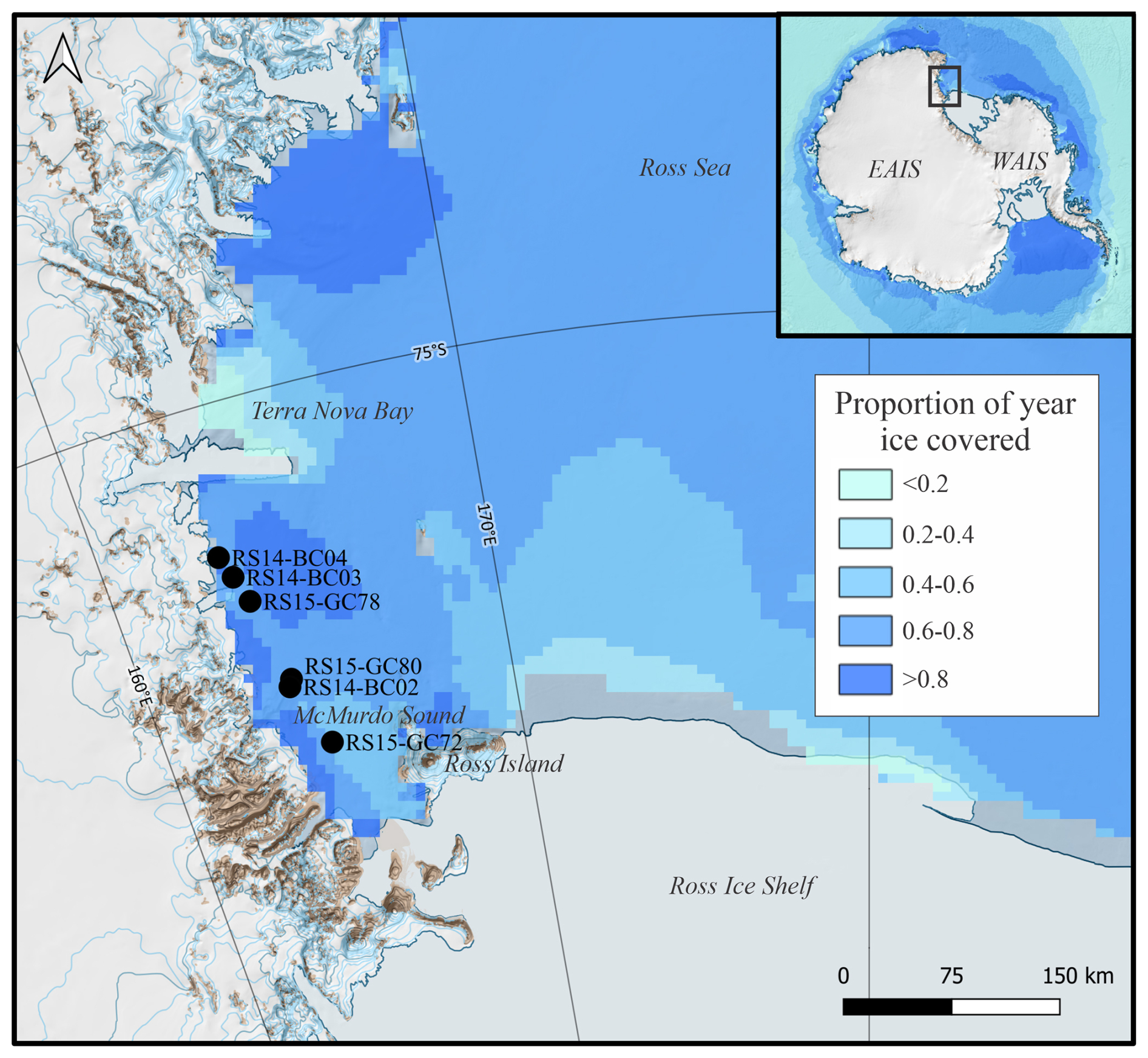
Figure 1Location of sampling sites (black circles) in the southwestern Ross Sea in relation to sea ice cover (average proportion of year ice covered, 6.25 km resolution, 2002–2011, derived using the ARTIST Sea Ice (ASI) (Spreen et al., 2008) and obtained from the Quantarctica GIS package, Norwegian Polar Institute (Matsuoka et al., 2021). Top right: Map of Antarctica, where EAIS: East Antarctic Ice Sheet, WAIS: West Antarctic Ice Sheet. Insert: Southwestern Ross Sea. Base map Quantarctica GIS package, Norwegian Polar Institute (Matsuoka et al., 2021).
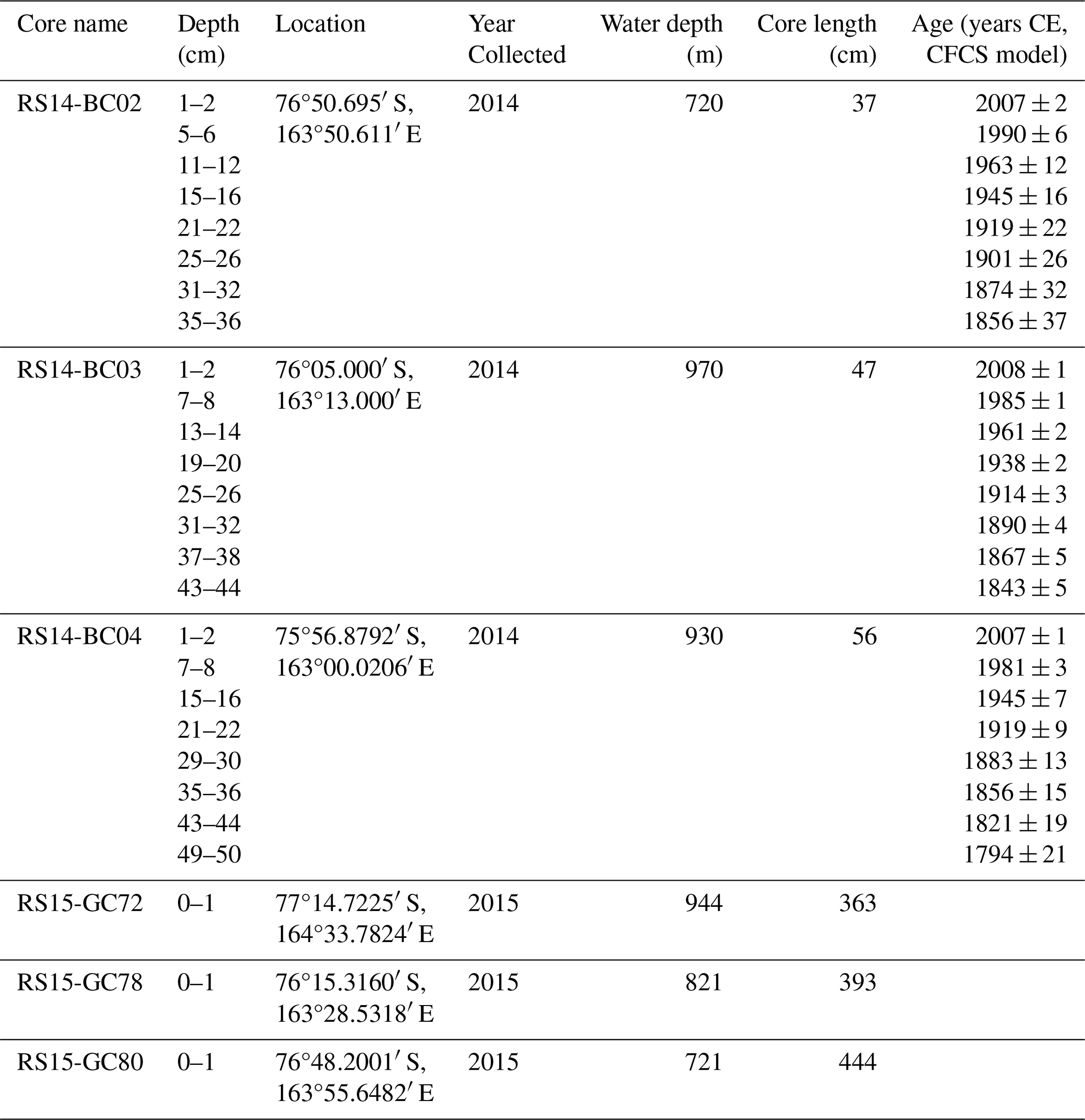
Table 1Sample details for Ross Sea sediment samples, including sediment core name, depth of sample (cm), drill location coordinates, year collected, water depth, core length, age and age error. Ages are reported in years Common Era (CE) based on a constant sedimentation rate (CFCS) lead dating model.
Age models were derived using 210Pb dating. 210Pb is produced in the atmosphere via decay of 222Rn, then deposited onto the ocean surface and scavenged from the water column by settling particles, accumulating in seafloor sediments where it decays with a half-life of 22.3 years (Appleby, 2002). Total 210Pb activity was determined indirectly by measuring its granddaughter 210Po via alpha spectrometry (Flynn, 1968) and assuming secular equilibrium between 210Pb and 210Po in sealed samples. This provides a proxy for total 210Pb activity, which was used to calculate excess (unsupported) 210Pb after subtraction of supported 210Pb, assumed to be in secular equilibrium with in situ 226Ra.
Sediment samples from cores BC02, BC03, and BC04 were analysed at the Institute of Environmental Science and Research Limited (ESR) in Christchurch, New Zealand for 210Po using alpha spectrometry (Appleby, 2002; Flynn, 1968). Sedimentation rates and sediment ages were calculated following Appleby (2002). Briefly, the sedimentation rate was calculated from the least-squares fit slope of excess 210Pb activity plotted on a logarithmic scale against depth. Raw 210Pb profiles showed evidence of a surface mixed layer in BC02 and BC04, consistent with bioturbation observed in the core logs. The uppermost two samples from BC02 and one sample from BC04 were therefore excluded from the least-squares regression. No mixed layer was identified in BC03 and all samples were retained. The constant flux and constant sedimentation rate (CFCS) model was applied, as sediment bulk density data were unavailable, precluding the use of mass-depth calculations required by alternative models such as CRS. Errors were estimated by Monte Carlo simulations using the R package “serac” (Bruel and Sabatier, 2020).
The CFCS model produced age estimates between 1856–2007 (±37 years at the base) for BC02 (Table 1, Fig. A2), with each centimetre of sediment representing approximately 4 years; sampling resolution was every 18–37 years. For BC03, age estimates spanned 1843–2008 (±5 years at the base), with ∼3.6 yr cm−1 and a sampling resolution of ∼24 years. BC04 was dated to 1794–2007 (±21 years at the base), with ∼3.3 yr cm−1 and sampling every 27–36 years.
2.2 Bulk sediment analyses
Approximately 10–15 mg of dried, homogenised, and inorganic carbon-removed sample was analysed for total organic carbon (TOC) and nitrogen (TON) via dynamic flash combustion (The FlashSmart Elemental Analyzer Thermo Fisher Scientific). CO2 and N2 gases are detected by a Thermal Conductivity Detector, and the results are calibrated against three certified standards, resulting in an error of 5 % for carbon and 8 % for nitrogen, based on replicate measurements of soil certified standards.
2.3 Lipid biomarker analysis
Organic geochemical extraction and analysis were performed in the joint Earth Sciences New Zealand/Te Herenga Waka-Victoria University of Wellington Organic Geochemistry Laboratory following Naeher et al. (2012) and Verret et al. (2025). Briefly, approximately 7 g of freeze-dried and homogenised sediment were extracted by ultrasonication using dichloromethane(DCM)methanol(MeOH) (3 : 1, v : v). An internal standard containing 5a-cholestane, n-C19 alcohol, and n-C19:0 fatty acid was added to the total lipid extract (TLE) to calculate relative concentrations. The TLE was saponified with 6 % KOH in MeOH and the fatty acids were separated from the neutral compounds and derivatised by boron trifluoride in MeOH to fatty acid methyl esters (FAMEs). To determine the number and position of double bonds, the FAME fractions were derivatised with 2-amino-2-methyl-1-propanol (AMP) to form 2-alkenyl-4, 4-dimethoxyloxazline (DMOX) derivatives. The neutral compounds were separated into three fractions by silica gel column chromatography using n-hexane, n-hexane : DCM (1 : 2, v : v), and DCM : MeOH (1 : 1, v : v) to obtain apolar fraction containing HBIs (F1), the ketone fraction (F2), and the polar fraction (F3). The F3 fraction was derivatised prior to analysis using pyridine and N, O-Bis(trimethylsilyl)trifluoroacetamide. Procedural blanks were used for data quality control and to investigate any potential laboratory contamination.
2.4 Gas chromatography-mass spectrometry
Samples were analysed on a gas chromatography mass spectrometer at Earth Sciences New Zealand (GC-MS; Agilent Technologies, model: 7890A and 5975C) with a 60 m-long capillary column (Agilent J&W DB-5MS, inner diameter of 250 µm, and film thickness of 0.25 µm), and helium as the carrier gas (1 mL min−1). Fatty acids and apolar fractions were injected on the GC-MS splitless at an inlet temperature of 300 °C, and the MS was operated in full scan ( 50–700). The temperature program of the oven was 70 °C, 70–150 °C at 20 °C min−1, 150–320 °C at 4 °C min−1 and then kept isothermal at 320 °C for 15 min. The derivatised polar fraction and DMOX fatty acid derivatives were injected and analysed as above, except the GC-MS was kept isothermal at 320 °C for up to 25 min.
2.5 Data processing and interpretation
Lipids were identified by retention time (time taken for a compound to elute from the GC column), total ion current (TIC) mass spectra output, and fragmentation patterns. Biomarker concentrations were quantified using the TIC integrated peak area of each compound and known concentrations of an internal standard, then normalised to the TOC content of the sediment. Biomarker proxies and indices were calculated to identify biomarker sources and study environmental changes.
The carbon preference index for fatty acids (CPI), which indicates the amount of microbial activity or amount of modification (Kalpana et al., 2021), was calculated for each sample using Eq. (1).
Average chain length (ACL), which indicates the dominant plant source, e.g. terrestrial plant material/ocean algae, was calculated using the concentrations of saturated fatty acids following Eq. (2):
The ratio was calculated to identify diatom sources (Nichols et al., 1993, 1986; Skerratt et al., 1995, 1998; Smik et al., 2016b; Smith et al., 1986). The C15 fatty acid index indicates levels of microbial activity and was calculated following Eq. (3):
IPSO25 was quantified using an internal standard and normalised to TOC. The phytoplankton IPSO25 index (PIPSO25) was calculated using brassicasterol (PBIPSO25) and dinosterol (PDIPSO25) following nomenclature and Eq. (4) by Vorrath et al. (2019):
The balance factor is applied to account for concentration differences between IPSO25 and the phytoplankton biomarker (c = mean IPSOmean phytoplankton biomarker) (Belt and Müller, 2013; Smik et al., 2016a; Vorrath et al., 2019). C factors were calculated individually for each core site.
2.6 Diatom assemblages
Quantitative diatom slides were prepared following Crosta et al. (2020) at Environnements et Paléoenvironnements Océaniques et Continentaux (EPOC), University of Bordeaux, to investigate diatom composition and abundances. Briefly, a subsample of dried sediment was immersed in a hydrogen peroxide and anhydrous tetra sodium pyrophosphate solution on a hotplate until reaction with organic matter was complete. The samples were centrifuged, diluted, and one drop was transferred onto a coverslip immersed in a petri dish. The water was decanted, and the dry coverslip was then glued onto a slide using NOA61. Diatom analysis was performed on an Olympus BH2 phase contrast photomicroscope at a magnification of ×1000. Two slides were made per sample, and at least 300 diatom valves were counted per sample across the two slides following the method outlined by Crosta and Koç (2007). Diatoms were identified to species level where possible, or species group level, following the taxonomic criteria detailed in Al-Handal and Wulff (2008), Almandoz et al. (2008), Andreoli et al. (1995), Baldauf and Barron (1991), Saggiomo et al. (2021), and Warnock and Scherer (2015). Absolute diatom abundances (ADA) were calculated by scaling counted valves to the total processed sample volume and normalising to sediment dry weight, yielding concentrations expressed as valves per gram of dry sediment (Crosta et al., 2008). The relative abundance of each species/group was determined as the proportion of the species/group to the whole diatom assemblage in each sample.
2.7 Statistical analysis
To assess the sources of variance and relationships among biomarker and diatom variables, a Principal Component Analysis (PCA) was performed on the combined dataset containing core top and downcore samples (n=27) in R (version 4.4.1, R Core Team, 2024) using prcomp, with variables log-transformed (log (x+1)). Variable contributions to the first two dimensions were calculated and visualised using the factoextra package (version 1.0.7; Kassambara and Mundt, 2016), with results displayed as a colour gradient on the correlation circle (Fig. 8).
2.8 Proxy rationale
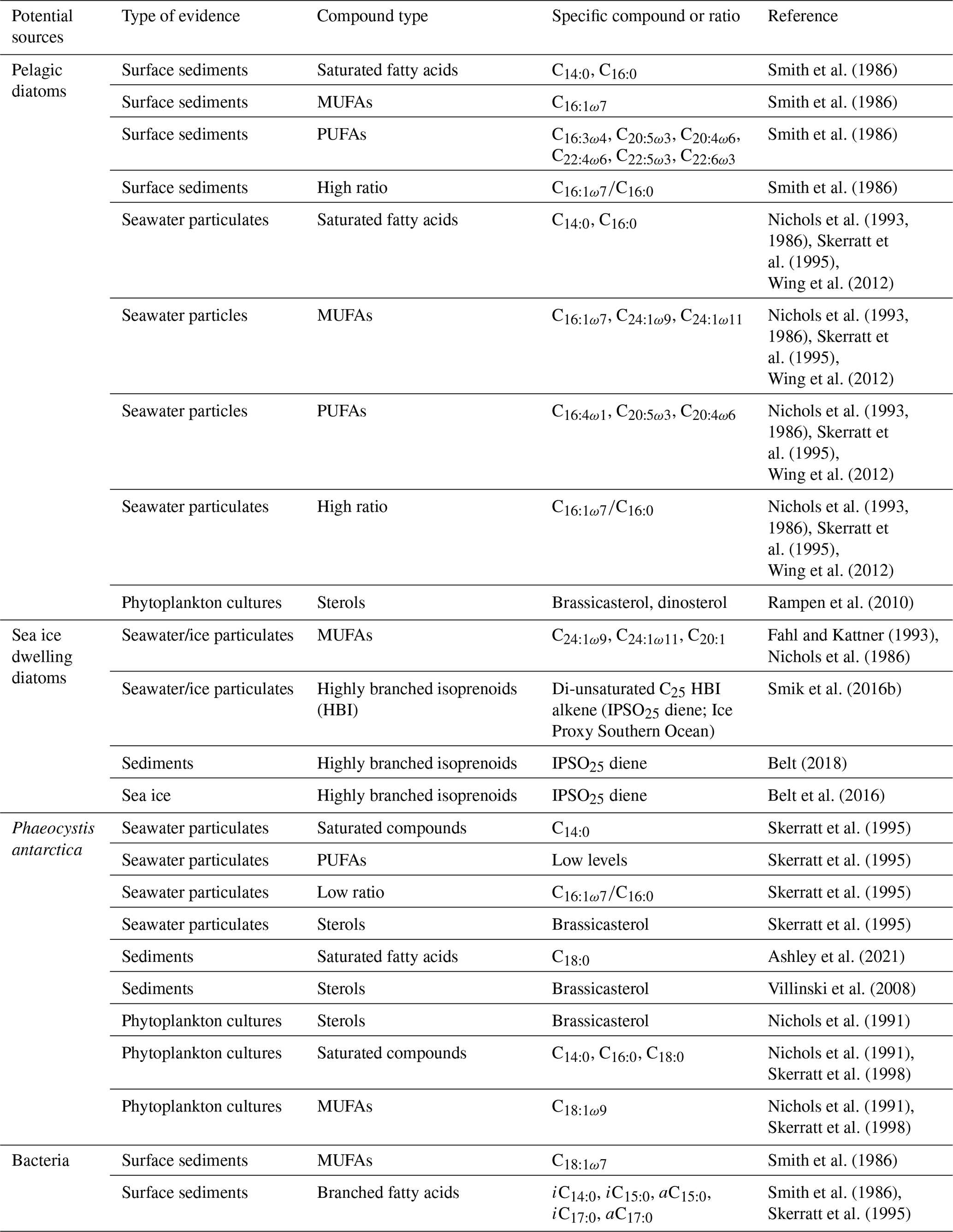
To differentiate between phytoplankton and microbial sources in the southwestern Ross Sea, we applied a multi-proxy biomarker approach incorporating fatty acid profiles, HBIs, sterols, and diatom assemblages. This framework enables us to distinguish between pelagic and sympagic diatom communities, sea ice-associated taxa, P. antarctica, and bacterial inputs. While saturated fatty acids are produced by most organisms, variations in chain length and relative dominance can indicate different sources. A predominance of C16:0 is commonly associated with diatoms (Skerratt et al., 1995; Nichols et al., 1986; Smik et al., 2016b), while C18:0 and unsaturated C18 fatty acids such as C18:1ω9 are more characteristic of P. antarctica as shown by natural blooms and pure culture studies (Skerratt et al., 1995, 1998; Nichols et al., 1986; Hamm et al., 2001). However, saturated fatty acids are less diagnostic as they have multiple sources and can be derived from the degradation of unsaturated compounds. Diatom dominated assemblages also exhibit elevated concentrations of C16:1ω7 and polyunsaturated fatty acids (PUFAs) such as C20:5ω3 and C20:4ω6, as well as high ratios, as shown by natural diatom blooms across Antarctica (Skerratt et al., 1995; Nichols et al., 1986; Smik et al., 2016b). Sea ice dwelling diatom communities from cultures and Ross Sea samples are further distinguished by long-chain monounsaturated fatty acids, including C24:1ω11, C24:1ω9, C26:1ω11, and C26:1ω9 (Nichols et al., 1993, 1986). Although diatom cultures contain C20:1ω9 (Skerratt et al., 1998), this compound is also associated with zooplankton (copepod) (Yang et al., 2016; Zhang et al., 2026). Bacterial contributions are inferred from branched-chain fatty acids, particularly iso- and anteiso-C15:0 and C17:0, which occur in pairs (Skerratt et al., 1995; Kaneda, 1991). In addition, C18:1ω7 is produced by several bacterial taxa (Wilson et al., 2010). These patterns, summarised in Table 2, provide a basis for interpreting fatty acid distributions in terms of source inputs.
Table 2Diagnostic lipid biomarkers reported for diatoms, Phaeocystis antarctica, and bacteria in Antarctic studies. Some compounds are included more than once as they represent several types of phytoplankton. MUFA = Monounsaturated fatty acids. PUFA = Polyunsaturated fatty acids.
The HBI biomarker IPSO25 diene is used across the Southern Ocean to reconstruct paleo Antarctic sea ice (Belt, 2018; Johnson et al., 2021; Tesi et al., 2020; Etourneau et al., 2013; Schmidt et al., 2018; Lamping et al., 2020, 2021; Sadatzki et al., 2023; Vorrath et al., 2023, 2020), and has also been used in conjunction with two open-water biomarkers, two sterols, brassicasterol (24-methylcholesta-5,22E-dien-3β-ol) and dinosterol (4α,23,24trimethyl-5α-cholest-22E-en-3β-ol) (Smik et al., 2016a). In the Southern Ocean, the index has been identified as PIPSO25 by Vorrath et al. (2019) and has been used around the Bransfield Strait (Lamping et al., 2021; Vorrath et al., 2023, 2020), the Amundsen Sea (Lamping et al., 2020), and near Wilkes Land (Sadatzki et al., 2023). In Antarctic seawater and sediment, high concentrations of brassicasterol are typically associated with P. antarctica blooms (Skerratt et al., 1995; Villinski et al., 2008), consistent with the high concentrations of brassicasterol found in Phaeocystis cultures (Nichols et al., 1991). Brassicasterol was present in 37 % of diatom cultures studied by Rampen et al. (2010), most notably pennate diatoms, with species such as Stauroneis constricta, Phaeodactylum tricornutum, and Dickieia ulvacea containing particularly high proportions (>60 % of total sterols). However, none of the species noted in Rampen et al. (2010), were observed in our diatom assemblages. Brassicasterol has been found to correlate with sea ice diatom abundance and spring sea ice extent (Guo et al., 2024). Dinosterol, although occasionally detected in diatom blooms (Skerratt et al., 1995), is primarily produced by dinoflagellates and is considered a source-specific indicator of this group (Skerratt et al., 1995; Villinski et al., 2008; Thomson et al., 2004; Volkman, 2006; Wisnieski et al., 2014). However, the southwestern Ross Sea is dominated by diatoms rather than dinoflagellates (Arrigo et al., 2000, 2015; McMinn et al., 2010; Noble et al., 2013) which may lead to a larger diatom source of dinosterol. We use these biomarkers to investigate the sources and environmental drivers of phytoplankton-derived compounds in our surface samples, as well as to interpret downcore changes in sea ice extent using HBI concentrations and sterol-based ratios.
To complement biomarker analysis, we assessed diatom assemblages, and diatom taxa were grouped according to their ecological affinities following previous studies (Leventer and Dunbar, 1988; Leventer et al., 1993; Crosta et al., 2004; Armand et al., 2005; Crosta et al., 2005; Campagne et al., 2016). These groupings are further supported by the PCA performed on the three box cores analysed in the present study (Fig. 8). The Sea Ice group comprises Entomoneis spp., Nitzschia stellata, Synedropsis fragilis, Synedropsis recta, and Synedropsis hyperboreoides. These taxa form part of the bottom-ice community (Horner, 1985), inhabiting platelet ice beneath fast ice (Riaux-Gobin et al., 2000), and are also found in polynyas following seasonal ice break-up (Riaux-Gobin et al., 2003). Owing to their lightly silicified frustules, these species are rarely preserved in sediments. When present, they indicate high ice-associated primary production under favourable light conditions and exceptional preservation (McMinn and Ryan, 2000). Their elevated abundance in sediments is generally interpreted as evidence of fast-ice melting (Leventer and Dunbar, 1988).
The F. curta group includes Fragilariopsis curta, F. cylindrus, and F. vanheurckii. These taxa occur within the phytoplankton assemblage associated with or beneath sea ice (Leventer and Dunbar, 1987; Gersonde and Zielinski, 2000). High abundances of F. curta and F. cylindrus characterise environments with extensive sea ice cover (Burckle et al., 1987) and strongly stratified surface waters (Beans et al., 2008). Although some lightly silicified F. cylindrus valves may be lost during settling (Burckle et al., 1987), their distribution in surface sediments exhibits a pronounced increase towards regions of high sea ice concentration, indicating that sedimentary abundances largely reflect surface production (Armand et al., 2005; Esper and Gersonde, 2014). Furthermore, high abundances of the F. curta group occur within the early spring laminae off Adélie Land (Denis et al., 2006; Maddison et al., 2012). Collectively, these taxa are considered indicative of persistent fast or pack ice that melts relatively late in the seasonal cycle (Armand et al., 2005; Campagne et al., 2016).
The F. cryophilic group consists of Fragilariopsis obliquecostata, F. sublinearis, and F. ritscherii. These species are associated with cold waters and extensive sea ice cover (Armand et al., 2005), but generally bloom later in the growing season, as indicated by their occurrence within late spring laminae (Denis et al., 2006; Maddison et al., 2012). Their heavily silicified frustules are well preserved in sediments. In particular, the distribution of F. obliquecostata in offshore sediments has been used to reconstruct the past position of the summer sea ice margin (Gersonde and Zielinski, 2000).
The E. antarctica group comprises terminal and intercalary valves of Eucampia antarctica var. recta, the only variety identified in western Ross Sea sediments. High abundances of this taxon have been reported from both the water column (Fryxell and Prasad, 1990) and modern sediments of the southern Weddell Sea (Zielinski and Gersonde, 1997; Armand et al., 2005), as well as deglacial sediments from the Antarctic Peninsula (Peck et al., 2015; Barbara et al., 2016). The heavily silicified valves are generally well preserved in sediments, and elevated abundances are widely interpreted as indicators of glacial or sea ice meltwater influence (Burckle, 1984; Cunningham et al., 1999; Peck et al., 2015).
The Centric Cold Water group comprises Actinocyclus actinochilus, Shionodiscus ritscheri, Stellarima microtrias, and Thalassiosira tumida. These taxa develop in turbulent, cold surface waters during the summer ice-free season (Fryxell, 1989), potentially following inoculation from sea ice (Garrison et al., 1987). Their heavily silicified frustules are generally well preserved in sediments (Cunningham and Leventer, 1998; Stickley et al., 2006). The Open Ocean group comprises several taxa present at relatively low abundances in the studied box cores, including Actinocyclus curvatulus, Asteromphalus hookeri, A. hyalinus, A. parvulus, Corethron pennatum, Coscinodiscus oculus-iridis, Fragilariopsis kerguelensis, Shionodiscus gracilis, S. trifulta, Thalassiosira lentiginosa, T. maculata, T. oliverana, the cold variety of T. antarctica, Thalassiothrix spp., and Trichotoxon reinboldii. Most of these species characteristically inhabit open-ocean environments (Hasle, 1969; Fenner et al., 1976; Krebs et al., 1987; Froneman et al., 1995; Grigorov et al., 2014; Rigual-Hernández et al., 2015). Their heavily silicified frustules favour excellent preservation in sediments (Crosta et al., 2005; Rigual-Hernández et al., 2016). An exception is C. pennatum, a tubular species that is generally preserved only following mass-bloom events (Torricella et al., 2026). Taxa belonging to both the Centric Cold Water and Open Ocean groups are typically associated with summer laminae (Denis et al., 2006; Maddison et al., 2012) and indicate relatively warm conditions and prolonged ice-free periods promoted by incursions of warm water masses (Cunningham and Leventer, 1998; Maddison et al., 2006).
The Chaetoceros resting spore (CRS) group comprises vegetative cells and resting spores of Chaetoceros subgenus Hyalochaete, with resting spores predominating. This group may dominate diatom assemblages in Antarctic coastal waters (Leventer, 1991; Annett et al., 2010) and underlying sediments (Armand et al., 2005), reflecting periods of elevated primary productivity in stratified surface waters that ultimately lead to nutrient depletion (Annett et al., 2010). Sustained production nevertheless requires periodic nutrient replenishment through wind-driven mixing, as these opportunistic bloom-forming taxa are otherwise outcompeted by species adapted to low-nutrient conditions (Annett et al., 2010; Campagne et al., 2016). High abundances of CRS have been reported from both spring and summer laminae off Adélie Land (Denis et al., 2006; Maddison et al., 2012), indicating production throughout the growing season under favourable environmental conditions. Similarly, abundant CRS in deglacial Antarctic shelf sediments (Cunningham et al., 1999; Leventer et al., 2006) have been linked to enhanced surface-water stratification associated with retreating ice sheets and increasingly prolonged ice-free summers (Gilmer et al., 2025). The heavily silicified, unornamented resting spores exhibit excellent preservation potential.
Antarctic shelf waters are among the most productive marine environments (Arrigo et al., 2008). Water depths are generally less than 1000 m, while sedimentation is rapid and episodic (Schloss et al., 1999; Kim et al., 2015). Consequently, in this region diatom preservation is typically excellent, and sediments are characterised by exceptionally high biogenic silica contents (Ledford-Hoffman et al., 1986; Dunbar et al., 1998; Presti et al., 2003; Denis et al., 2009; Chiarini et al., 2019; Gilmer et al., 2025). Together, these assemblages were used alongside biomarker evidence to reconstruct spatial patterns in phytoplankton community structure and infer recent environmental changes in the southwestern Ross Sea.
3.1 Biomarkers
3.1.1 Fatty acids
Fatty acids were the most abundant biomarkers in the studied sediments, and the results reported here focus on fatty acids diagnostic of different phytoplankton groups (see Sect. 2.8). Analysis of the fatty acid fraction identified 44 saturated and unsaturated compounds with carbon chain lengths between C12–C30, exhibiting a pronounced even-over-odd carbon number predominance (Fig. 2). Saturated fatty acids dominated the samples, with C14:0 and C16:0 showing the highest concentrations compared to longer-chain fatty acids. Monounsaturated fatty acids were also abundant within the C14–C18 range, with C16:1 and C18:1ω7 showing the highest concentrations. Branched fatty acids comprised between 8 % and 20 % of total fatty acids.
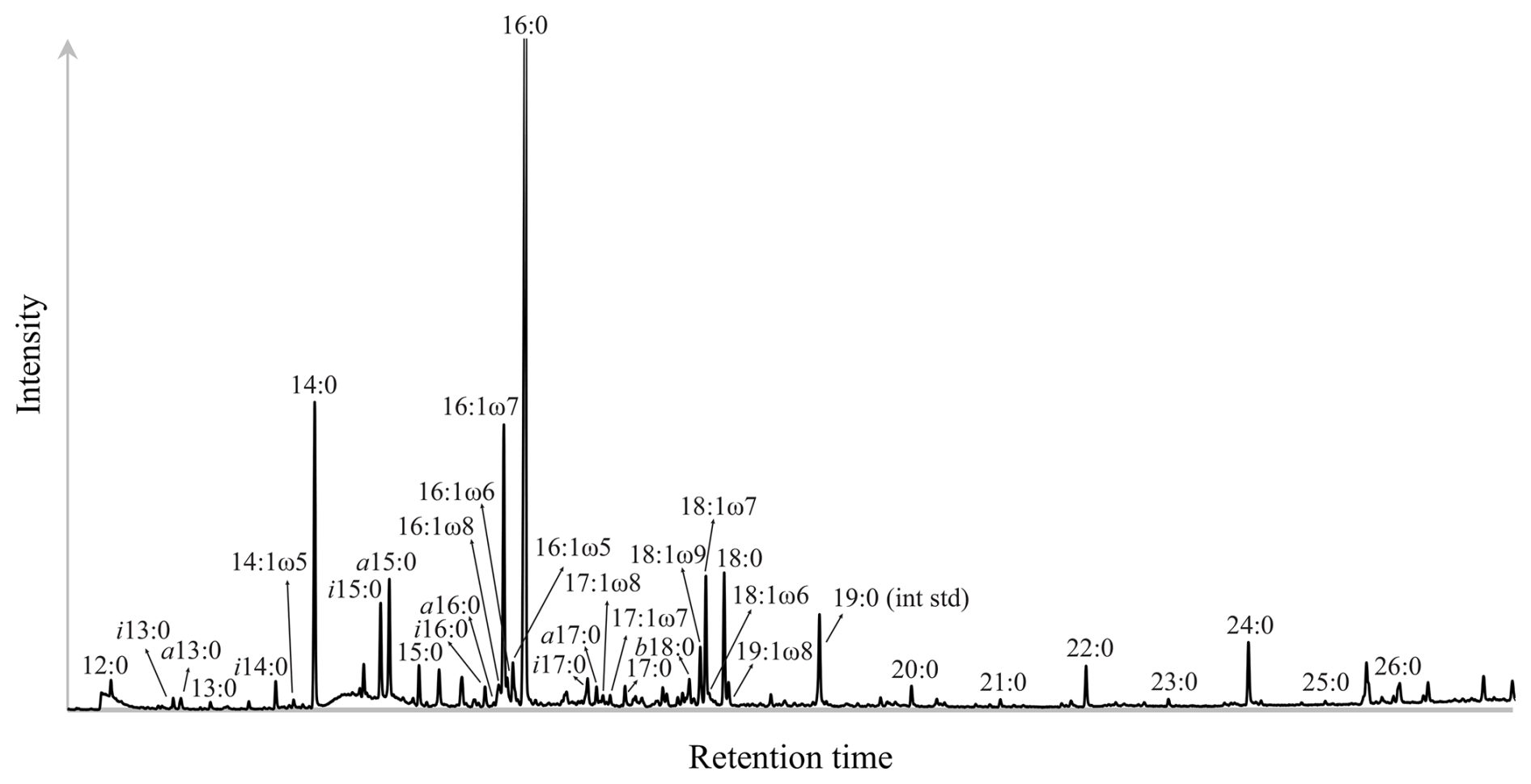
Figure 2Representative chromatogram of the fatty acid fraction of a sediment sample from BC02 core (11–12 cm). Identified compounds are annotated by carbon number, number of double bonds, and ω-position of double bonds. Abbreviations: i = iso, a = anteiso, b = branched.
Spatially, average chain length (ACL) of C12–C30 fatty acids ranged between 16.1 and 19.2 (mean=17.8; Table 3) and increases from south to north along the transect, with BC02 displaying the lowest and BC04 the highest values. The C15 fatty acid index ranged from 3 to 8.7 but was similar across core tops. Ratios of were consistent across cores. The proportion of branched saturated fatty acids increased from north (BC04; 11.5 %) to south (GC72; 19 %), with the central core tops containing similar proportions of ∼15 % (Table 3). Relative abundances of fatty acid compounds were broadly consistent across core tops, with small variations in C14:0, C18:0 and C16 compounds which varied across core tops, without any distinct spatial pattern. C24:0 increased on a south-to-north gradient, and C18:1ω9 was least concentrated towards the southern end of the transect (Fig. 4).
Table 3Chemical composition of southwestern Ross Sea sediment cores including bulk sediment characteristics (TOC and ), HBIs (IPSO25), absolute diatom abundance (ADA) expressed as valves per gram dry weight (v g dw−1) and relative species abundance (Chaetoceros resting spores (CRS), Fragilariopsis curta (F. curta), Fragilariopsis cylindrus (F. cylindrus), Thalassiosira antarctica cold (T. antarctica)), fatty acids (average chain length (ACL12–30), total fatty acids (Total FA), C15 fatty acid index, ratio of , and percentage of branched fatty acids).
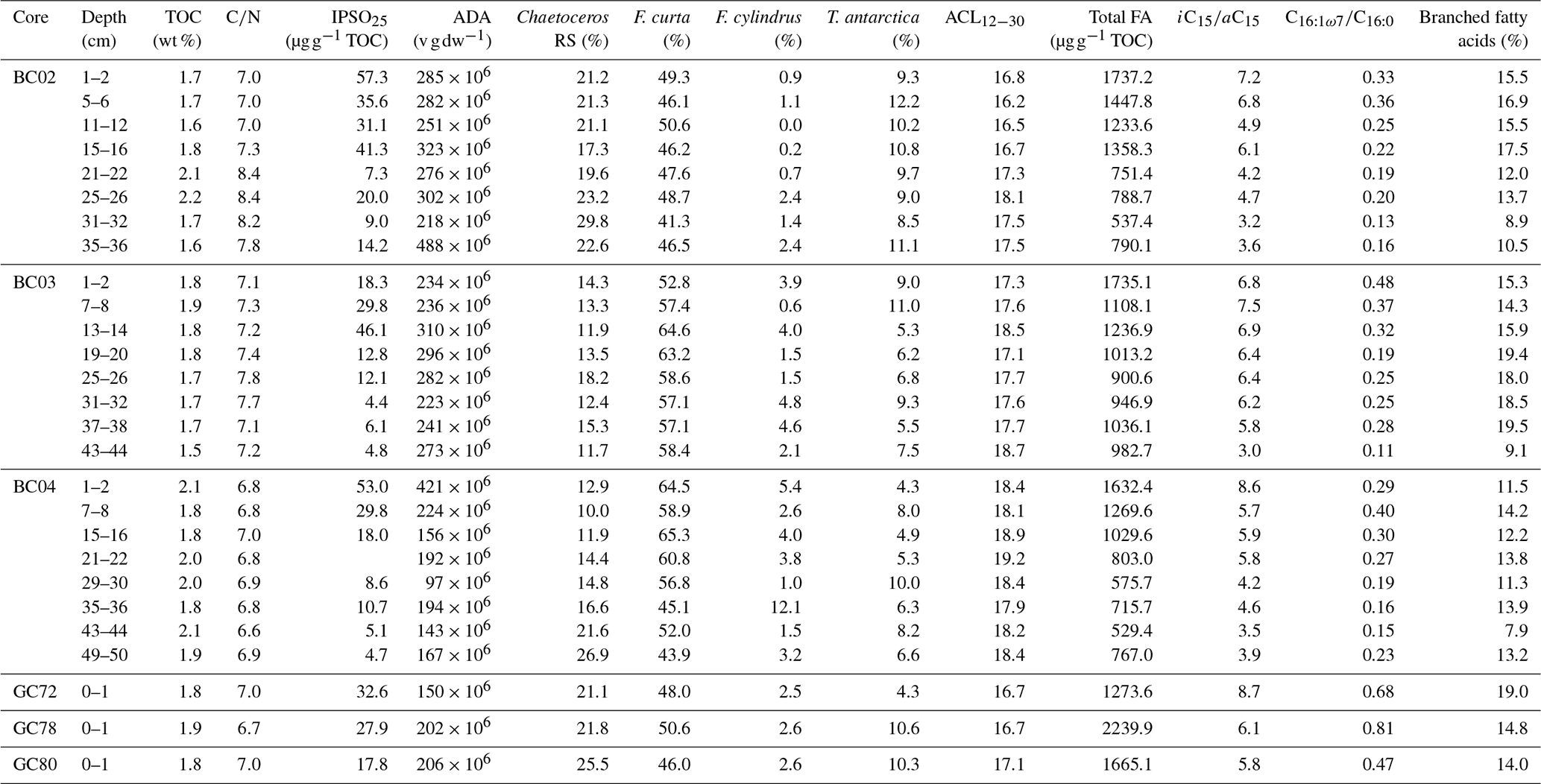
Downcore, total fatty acid concentrations decreased rapidly by ∼50 % between 1–30 cm depth before stabilising toward the base of the cores (Fig. 3). The C15 index also decreased with depth. Decay rates for target compounds, calculated from TOC-normalised fatty acid concentrations, ranged from ∼22 to 93 ng cm−1 for the first 20 cm, after which compounds are approaching an asymptote. The lowest decay rates are observed in higher chain length saturated fatty acids C18:0 and C24:0 (22–36 ng cm−1). Decay rates for saturated, unsaturated, and branched fatty acids with chain lengths lower than C18 are between 46 and 93 ng cm−1. All three sediment cores demonstrate similar decay rates over similar depths (Fig. 3).
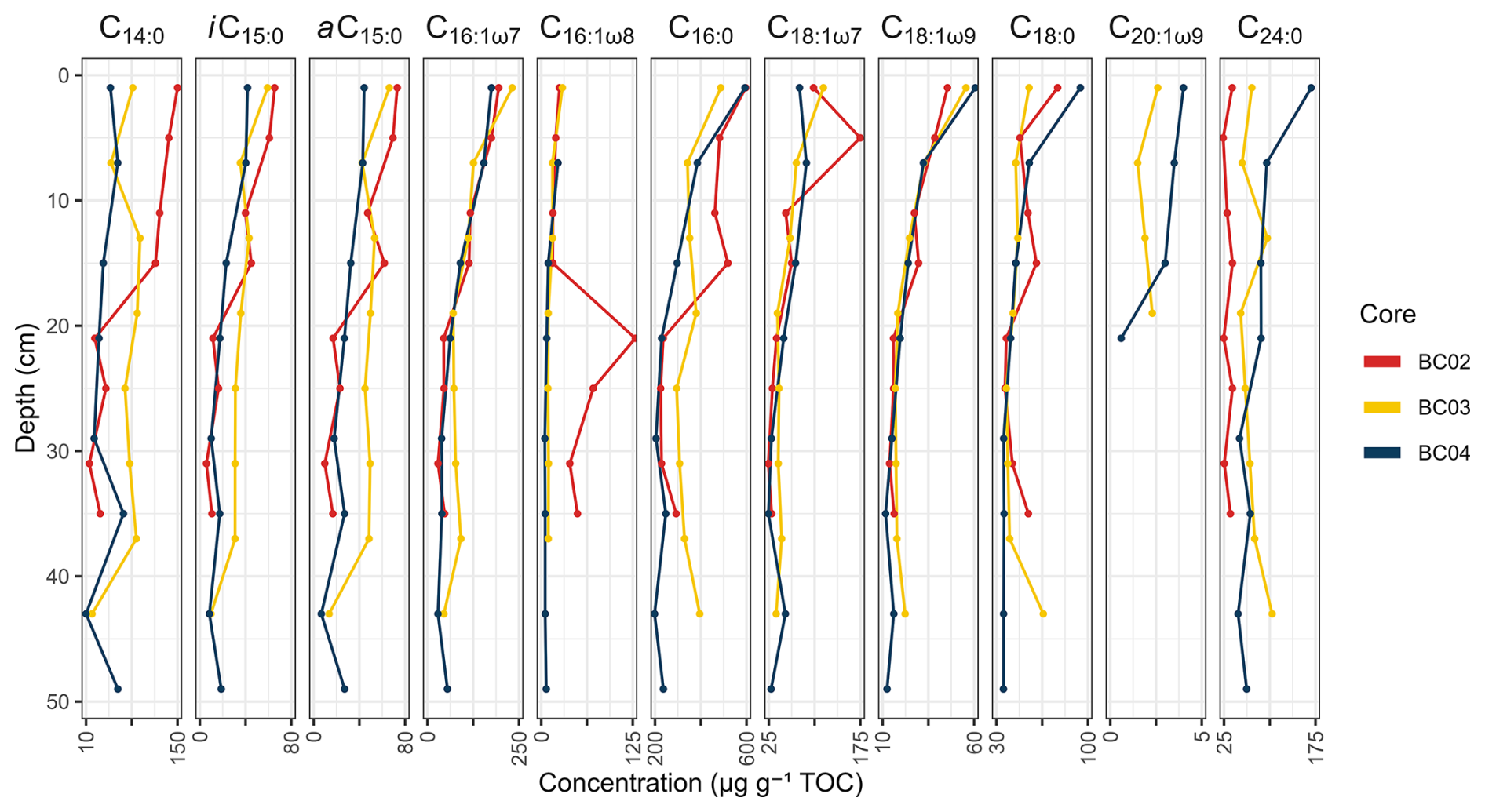
Figure 3Concentrations of saturated and unsaturated fatty acids (C14–C24) in the sediment cores vs. depth.
3.1.2 Sterols
Sterols, namely brassicasterol and dinosterol, were present in all sediment samples. Brassicasterol concentrations ranged from 19 to 182 µg g−1 TOC, while dinosterol ranged between 8 and 50 µg g−1 TOC. Although core tops show substantial differences in absolute concentrations, no clear spatial pattern is evident (Fig. 4). BC04 contained the highest core top concentrations of both brassicasterol (182 µg g−1 TOC) and dinosterol (50 µg g−1 TOC), whereas the other sites ranged between 30–77 µg g−1 TOC for brassicasterol and 9–36 µg g−1 TOC for dinosterol. Downcore concentrations of the two sterols do not follow the same decreasing trend as fatty acids (Fig. 7). Brassicasterol remains relatively stable in all three cores, except for an increased concentration in the BC04 core top. Dinosterol is relatively stable in BC03 and BC04, except the BC04 core top. However, dinosterol shows a decrease with depth in BC02.
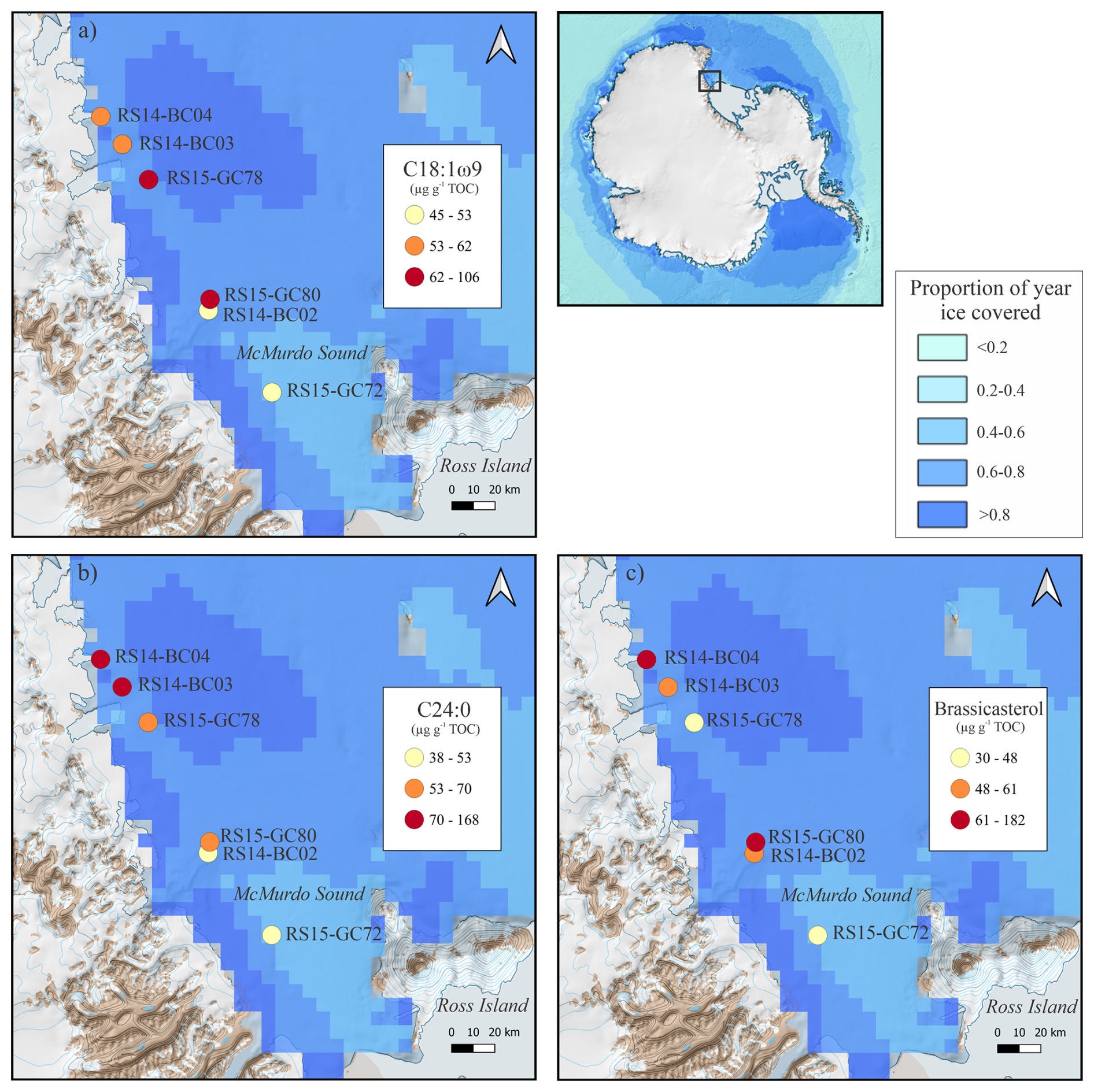
Figure 4Spatial distribution of selected phytoplankton derived biomarkers in core top sediments (0–2 cm depth). (a) C18:1ω9, (b) C24:0, and, (c) brassicasterol. Areas with lighter blue colours have open water more often throughout the year, whereas dark blues are covered with sea ice for most of the year based on sea ice concentration data between 2002 and 2011 at 6.25 km resolution (Spreen et al., 2008). Base map sourced from Quantarctica (Matsuoka et al., 2021).
3.1.3 Highly branched isoprenoids
Highly branched isoprenoids (HBIs) in the southwestern Ross Sea display both spatial and downcore variability. IPSO25 diene was present in all sediment samples except one (BC04 21–22 cm), and concentrations vary across core tops between 17.8 and 57.3 µg g−1 TOC. BC04, despite its proximity (<25 km) to BC03, has 52.9 µg g−1 TOC of IPSO25 diene in the core top, compared to BC03 with 18.3 µg g−1 TOC. BC02, which is 100 km away from BC04, has similar concentrations of IPSO25 diene, 57.3 µg g−1 TOC. The two northernmost cores (BC04 and BC03) located near each other demonstrate similar PBIPSO25 and PDIPSO25 values. Like fatty acid concentrations, IPSO25, PBIPSO25 and PDIPSO25 decrease with increasing sediment depth (Fig. 5). IPSO25 diene decreases by ∼70 % between the sediment surface and 30 cm depth, below which it remains constant in all three sediment cores (Fig. 5). The decay rate of IPSO25 calculated from TOC-normalised concentrations ranges from ∼30–60 ng cm−1 in BC02, BC03, and BC04 over the first 20–30 cm, below which concentrations remain relatively stable. Overall, all three cores demonstrate a decreasing downcore trend except for a low IPSO25 diene in the BC03 core top (Fig. 5). Other HBIs, such as the commonly found triene (Belt, 2018), were not detected.
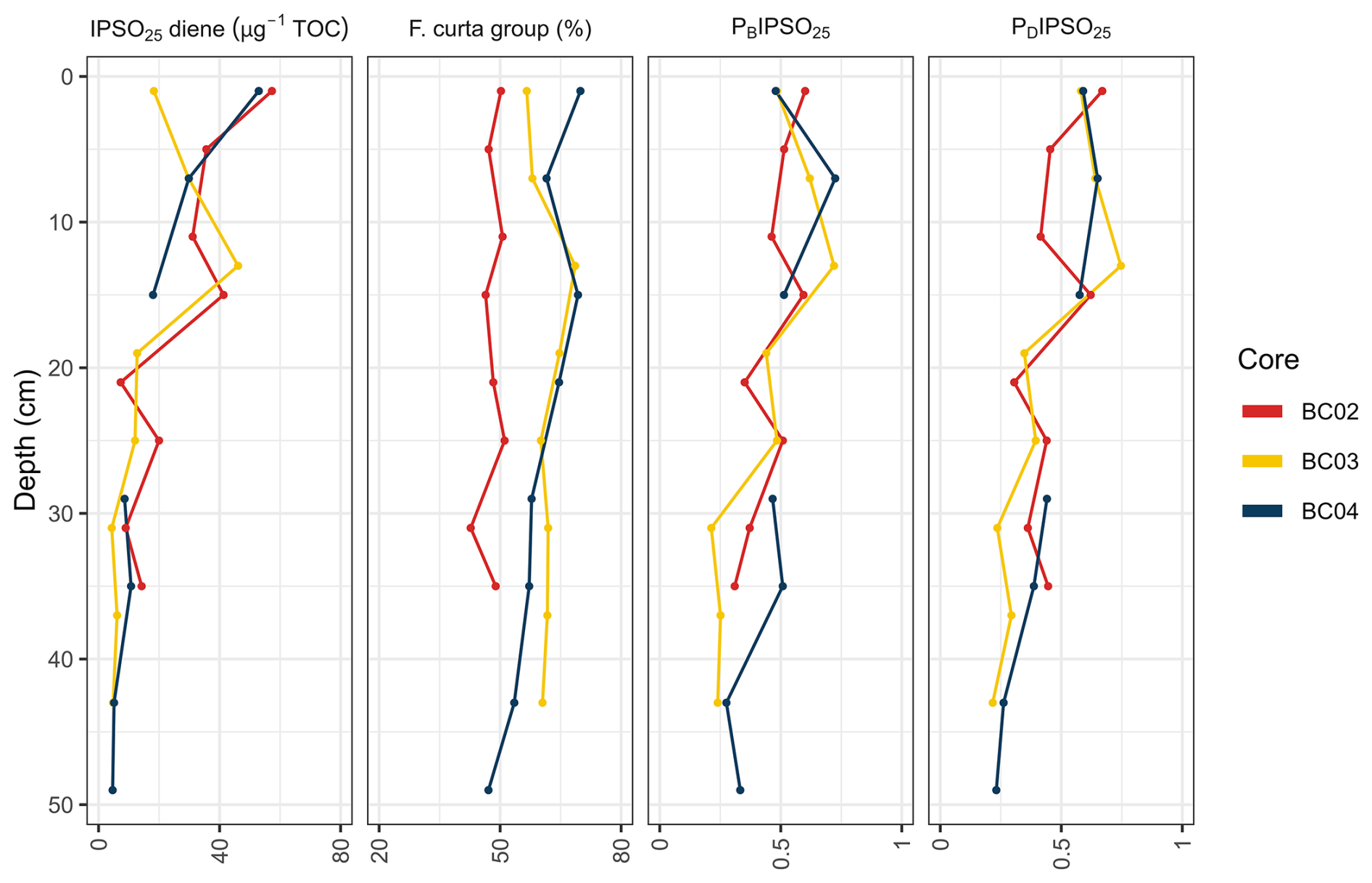
Figure 5IPSO25 diene concentrations relative to total organic carbon (TOC), percentage of Fragilariopsis curta (F. curta) group, and PIPSO ratios (PBIPSO25 and PDIPSO25) in the sediment cores vs. depth.
3.2 Diatom composition
Fifty-eight species or groups of species were identified in the sediment samples. The complete list of species and data is available at PANGAEA (de Jong et al., 2026). The diatom assemblage in all the sediment samples is characterised by high abundances of Fragilariopsis curta, Chaetoceros resting spores (CRS), Thalassiosira antarctica cold, and Fragilariopsis cylindrus (Fig. 7). However, the F. curta group dominates the diatom assemblage across the record and ranges from 42 % to 70 % of all diatoms. Average proportions of CRS ranges between 14 % and 22 %, while Thalassiosira antarctica cold represents on average ∼8 % of all diatoms counted. The absolute diatom abundance (ADA) is expressed as valves per gram dry weight (v g dw−1), and ranges from 97×106 to 488×106 v g dw−1 across the sediment samples.
Diatom abundances and species vary spatially. Diatom abundance decreased northward, with the highest ADA observed in the core top of BC02 (303 ± 76×106 v g dw−1), followed by BC03 (262 ± 30×106 v g dw−1), and the lowest ADA seen in BC04 (199 ± 91×106 v g dw−1). To assess sea ice and phytoplankton variability, spatial variation in “centric cold-water diatoms”, CRS, and F. curta were compared to the average proportion of sea ice cover across the southwestern Ross Sea from 2002–2011 (Spreen et al., 2008), covering the time represented by the core tops (Fig. 6). Relative proportions of “centric cold-water diatoms” decreased northward away from the McMurdo polynya, whereas proportions of F. curta were highest towards the north. CRS, similar to the “centric cold-water diatoms”, decreased on a south-to-north gradient, away from the polynya.
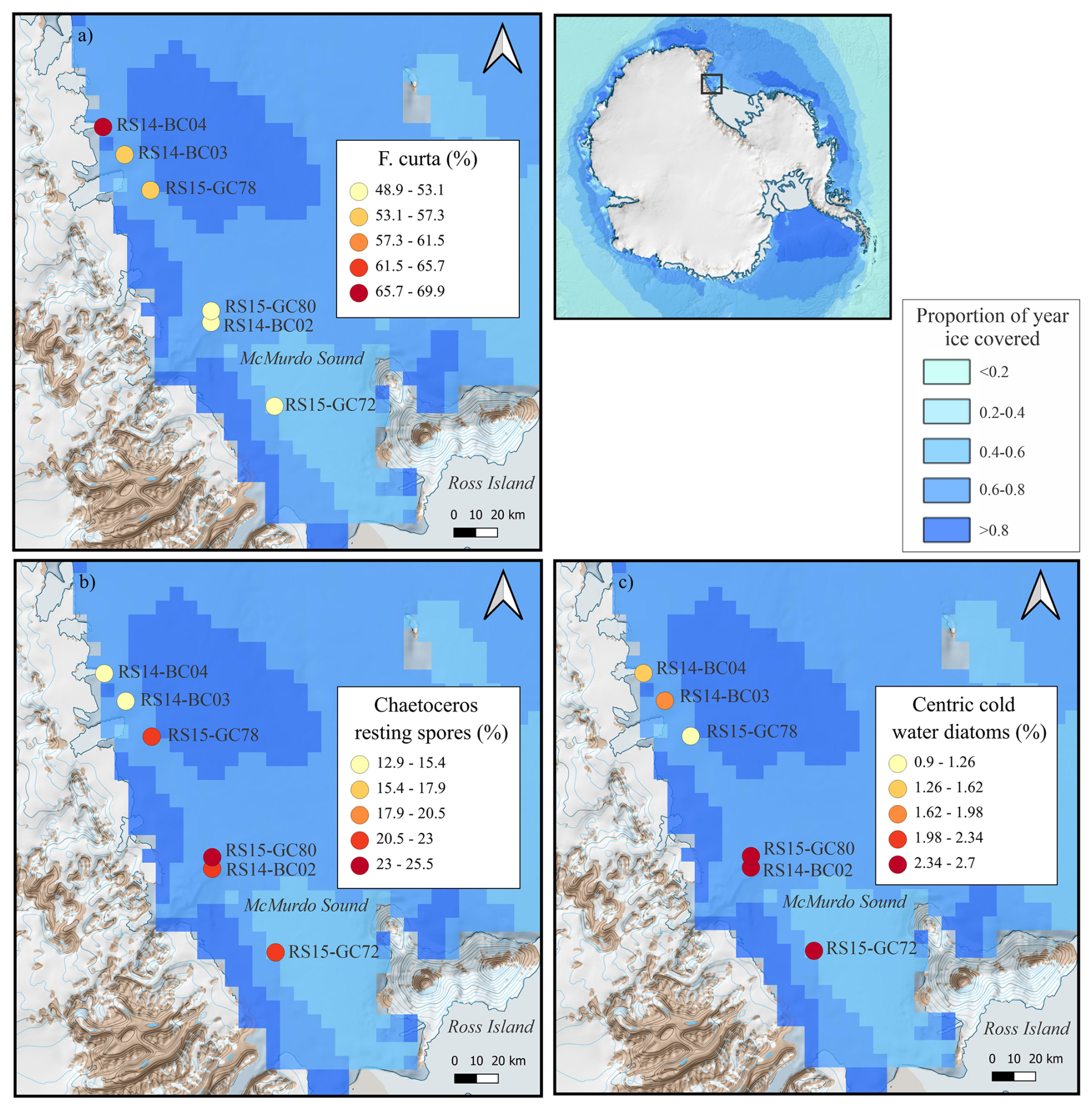
Figure 6Relative diatom concentration of selected species in core top sediments (0–2 cm depth). (a) F. curta, (b) Chaetoceros RS, and, (c) Centric cold water diatoms. Areas with lighter blue colours have open water more often throughout the year, whereas dark blues are covered with sea ice for most of the year based on sea ice concentration data between 2002 and 2011 at 6.25 km resolution (Spreen et al., 2008). Base map sourced from Quantarctica (Matsuoka et al., 2021).
Downcore, ADA decreased in BC04, while BC02 and BC03 have a relatively stable diatom abundance downcore (Fig. 7). The F. curta group decreased downcore in BC04 (Fig. 7). CRS shows the opposite trend and increased downcore in BC04 and BC02 (Fig. 7). No downcore trend is observed in relative abundances of Thalassiosira antarctica. Similarly, the F. cryophilic group, the open ocean group, the sea ice group, the centric cold water group, and E. antarctica do not demonstrate a strong increasing or decreasing trend (Fig. 7).
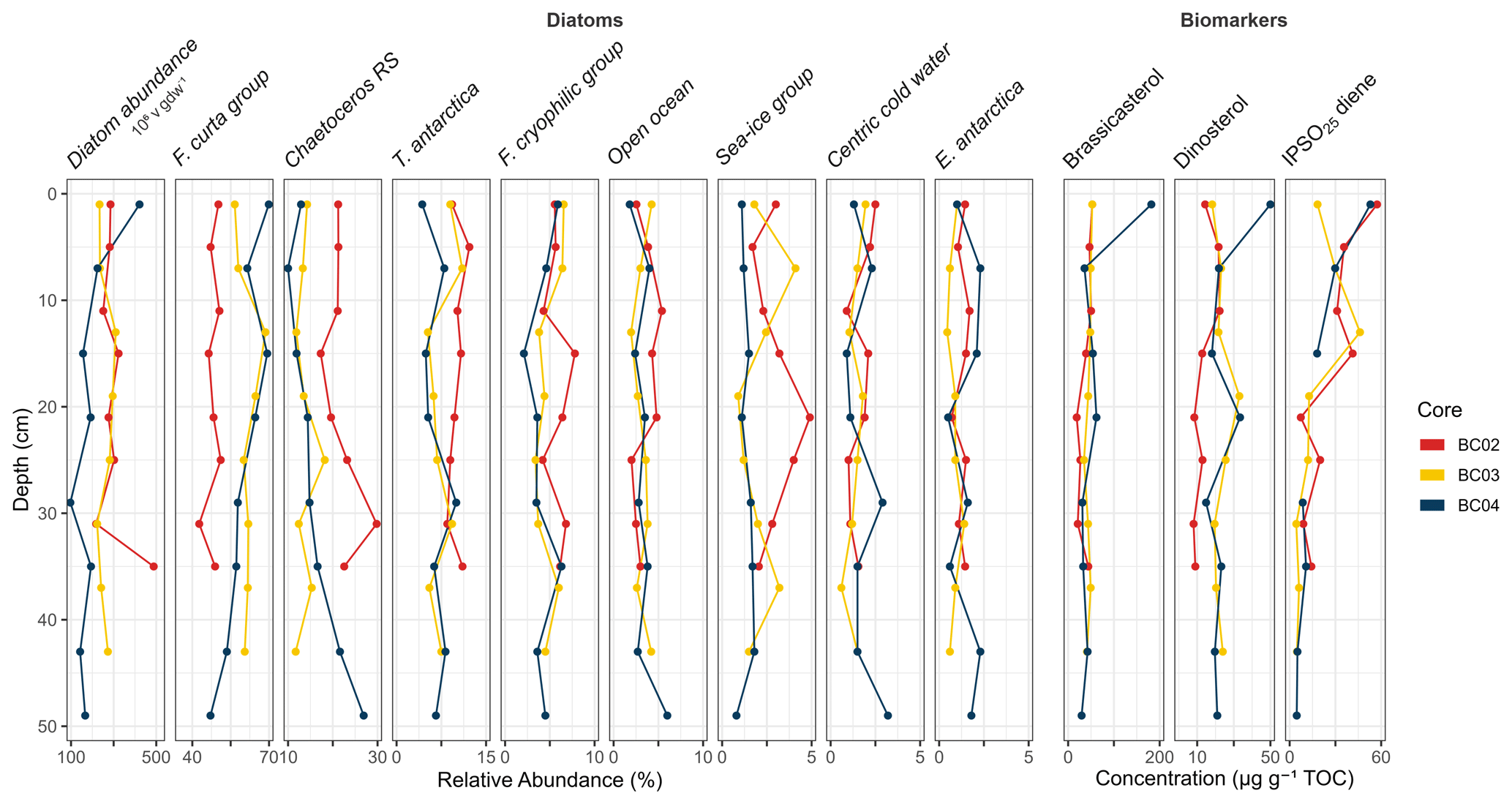
Figure 7Discontinuous downcore relative concentrations of diatom groups (F. curta group, Chaetoceros RS, T. antarctica, F. cryophilic group, open ocean group, sea ice group, centric cold water group, E. antarctica group), diatom abundance, and biomarkers (Brassicasterol, Dinosterol and IPSO25 diene) with depth.
3.3 Principal Components Analysis
A PCA of the biomarker and diatom dataset (Fig. 8) resolved 57.3 % of total variance across the first two dimensions (Dim1=37.8 %, Dim2=19.5 %). Three groupings emerge. First, the F. curta group, C24:0, and the sterols (dinosterol, brassicasterol) plot together, with C24:0 showing a strong positive correlation with F. curta (r=0.80) and a strong negative correlation with Chaetoceros resting spores (), while dinosterol and brassicasterol show more moderate correlations with the same variables (r=0.58 and −0.40; r=0.47 and −0.33, respectively). Second, Chaetoceros resting spores, the open ocean group, the centric cold water group, the sea ice diatom group, the F. cryophilic group, and T. antarctica plot in the opposing quadrant, consistent with a negative correlation with the first group. Third, the fatty acids, and HBIs cluster together and show negligible correlation with either diatom grouping ( to 0.11), indicating these variables are statistically independent of the ordination axis separating the two diatom groupings, with the notable exception of C24:0 which does not align with the rest of the fatty acid group.
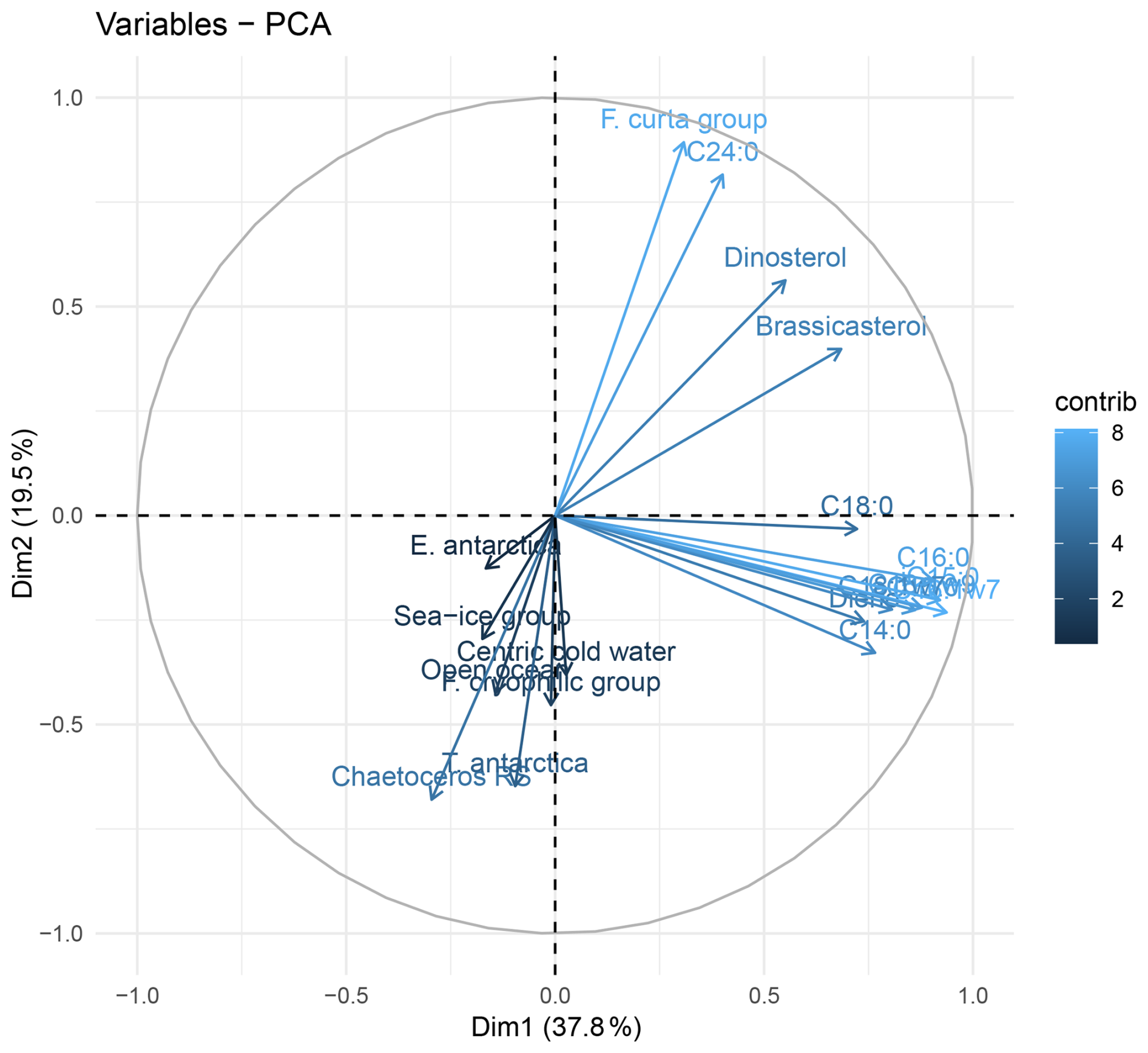
Figure 8Principal Component Analysis (PCA) of biomarker and diatom variables (n=27), showing the correlation circle for the first two principal components (Dim1=37.8 %, Dim2=19.5 % of total variance). Arrow colour indicates the contribution of each variable to the plotted dimensions.
4.1 Drivers of fatty acid and highly branched isoprenoids in Ross Sea marine sediments
4.1.1 Biomarker sources
The sediment samples are dominated by marine-derived compounds. ratios between 6.6–8.4 indicate a strong marine algae signal and low inputs from old terrestrial organic matter that may affect biomarker signals (Meyers, 1997). This is reinforced by low ACL of fatty acids and high concentrations of phytoplankton-sourced sterols and fatty acids (Table 3). The southwestern Ross Sea and McMurdo Sound phytoplankton communities tend to be dominated by diatoms due to the water column stratification (Arrigo et al., 2000, 2015; McMinn et al., 2010; Noble et al., 2013). However, year-to-year variability in environmental factors, such as less upper ocean water stabilisation, can result in P. antarctica blooms (Hayward et al., 2023, 2025; Mangoni et al., 2017; Stoecker et al., 1995), as well as occasional mixed communities where diatoms bloom in the ocean's upper layer and P. antarctica in a deeper layer (Mangoni et al., 2017). As outlined in Sect. 2.6, we use a multi-parameter approach to identify the phytoplankton and sea ice algae sources of biomarkers (Table 2). We use these findings to investigate the links between biomarkers in our sediment samples and the different phytoplankton and microbial sources.
Pelagic diatoms
A pelagic diatom source for biomarkers in sediment samples in this study is indicated by (1) high concentrations of C14:0 and saturated and unsaturated C16 fatty acid compounds, (2) high concentrations of brassicasterol and dinosterol, and (3) relatively high concentrations of C16:1ω7 fatty acid. However, the ratio of in all 27 sediment samples was, on average, ∼0.3, which is lower than other studies analysing fatty acids in Antarctic surface waters during diatom blooms from McMurdo Sound and Eastern Antarctica (Skerratt et al., 1995; Smith et al., 1986).
In the core tops, C16 fatty acid compounds were broadly similar, except for lower values in the southernmost core (GC72), suggesting a potentially reduced contribution from pelagic diatoms (Nichols et al., 1993, 1986; Skerratt et al., 1995; Wing et al., 2012). This interpretation is supported by the low abundance of dinosterol at GC72, further indicating diminished pelagic diatom input at this site (Rampen et al., 2010). In contrast, brassicasterol did not exhibit a clear spatial trend across the core tops and instead showed substantial variability along the transect. This variability may reflect additional sources, as brassicasterol has been identified as a stronger signal of haptophytes, particularly P. antarctica (Rampen et al., 2010; Nichols et al., 1991; Skerratt et al., 1995). Poly unsaturated fatty acids (PUFAs) (C16:4ω1, C20:5ω3, C20:4ω6), which can also indicate a pelagic diatom source (Nichols et al., 1993, 1986; Skerratt et al., 1995; Wing et al., 2012), were not identified in any of our core top or downcore samples, despite being detected in surface sediments from locations around Ross Island (Smith et al., 1986). The presence of pelagic diatoms in our sediment suggests PUFAs may have originally been produced in the source blooms but subsequently lost in surface waters and during sinking due to several processes. First, PUFAs are preferentially assimilated by zooplankton from their phytoplankton diet and are incorporated into zooplankton tissues before reaching the seafloor (Dalsgaard et al., 2003); second, PUFAs are highly sensitive to microbial remineralisation in the water column and sediments (Wakeham et al., 1997), and finally, they also undergo intense photo- and autooxidation in the water column before reaching the seafloor (Rontani et al., 2019). Indeed, low PUFA concentrations have been observed in surface waters of East Antarctica, despite high diatom abundances, supporting the idea of scavenging and degradation (Rontani et al., 2019; Smik et al., 2016b). The absence of PUFAs in our samples, both in core tops and downcore sediments, suggests an intense degradation compared to previous studies (Smith et al., 1986), as supported by the presence of more bacterial markers and higher C15 index values (Table 3).
Sea ice affiliated diatoms
The biomarker results indicating a sea ice diatom presence in this study are (1) high concentrations of C24:0, (2) high concentrations of C20:1ω9 compounds found in sites with heavier sea ice influence, and (3) the presence of IPSO25. C24:1ω9 and C24:1ω11 fatty acids are diagnostic of Antarctic sea ice diatoms (Nichols et al., 1986); however, these were not found in our sediment samples. C24:1ω9 and C24:1ω11 degrade over time to C24:0, likely inflating the concentration of C24:0 in samples with an important contribution from sea ice diatoms (Rontani et al., 2019). C20:1 has multiple sources, including both sea ice diatoms and zooplankton (Fahl and Kattner, 1993; Nichols et al., 1986).
In the core top samples, C24:0 increases on a south-to-north gradient, with inflated concentrations in areas of increased sea ice concentration (Fig. 4). C20:1ω9 was identified in only three of the six sites: the two northernmost (BC03, BC04) and the southernmost core (GC72). BC03 and BC04 are influenced by heavier pack ice to the north, consistent with a sea ice diatom source, while GC72 has the lowest sea ice cover of the transect, suggesting a possible zooplankton source at this site. In contrast, IPSO25 did not show a clear spatial pattern across the core tops.
Downcore, concentrations of C24:0 most closely follow trends in the F. curta group (Figs. 3 and 7). While F. curta is not strictly a sea ice dwelling diatom and can even represent open water or seasonal ice (Allen and Weich, 2022), the group which comprises of Fragilariopsis curta, Fragilariopsis cylindrus, and Fragilariopsis vanheurckii, indicates the presence of heavy fast or pack ice, with a late melting late season (Armand et al., 2005), suggesting a sea ice driver for these compounds, consistent with the strong positive correlation between C24:0 and the F. curta group shown in the PCA results (Fig. 8). C20:1ω9 was identified in the upper 20 cm in only BC03 and BC04 (Fig. 3), reflecting the sea ice conditions above these core sites. Increased C20:1ω9 also aligns with increased presence of F. curta group downcore in BC04, but not in BC03, highlighting that C20:1 compounds in the southwestern Ross Sea are likely sourced from both diatoms and zooplankton (Guo et al., 2024; Fahl and Kattner, 1993; Nichols et al., 1986; Yang et al., 2016). IPSO25 shows a decreasing trend downcore and is dominantly sourced by the sea ice diatom Berkeleya adeliensis (Belt et al., 2016); however, Berkeleya adeliensis was not identified in any core samples studied here, despite the presence of IPSO25, consistent with other studies around Antarctica (Tesi et al., 2020). Either IPSO25 is produced by other unknown sources, not yet identified (Tesi et al., 2020), despite culture experiments (Belt, 2018), or B. adeliensis is unable to reach the sediments because of its lightly silicified valves (Moriwaki, 1990; Riaux-Gobin et al., 2011; Tesi et al., 2020). Interestingly, the sea ice diatom group, comprising Entomoneis spp., Nitzschia stellata, Synedropsis fragilis, Synedropsis recta, and Synedropsis hyperboreoides, did not closely follow the sea ice diatom biomarkers, a pattern that could arise from several factors. First, their relatively low abundance (typically <4 %), which may limit their contribution to bulk fatty acid signatures dominated by more abundant taxa. Second, these species may not synthesis the fatty acids examined here. Third, heavy sea ice cover (42 %–70 % F. curta group) may reduce light availability below the sea ice, precluding their development.
Haptophytes/Phaeocystis antarctica
The presence of P. antarctica-sourced lipids in southwestern Ross Sea sediments is indicated by (1) relatively high concentrations of C16:0 and C18:0 and low ratios, (2) relatively high concentrations of C18:1ω9, and (3) high concentrations of brassicasterol.
In the six core top samples, C18:0, and C18:1ω9 concentrations were lowest towards the southern end of the transect and higher in the middle and toward the northern end of the transect (Fig. 4), suggesting a possible increase in P. antarctica stocks under heavier sea ice conditions. C16:0 and C18:0 are generic compounds synthesised by a diversity of sources. However, diatoms contain very minimal amounts of C18 compounds, which can be robustly attributed to P. antarctica sources in our study area (Nichols et al., 1993, 1986; Skerratt et al., 1995; Wing et al., 2012). The southwestern Ross Sea is known to have a varied phytoplankton community, both spatially and temporally (Arrigo et al., 2000; Mangoni et al., 2017; McMinn et al., 2010; Noble et al., 2013; Stoecker et al., 1995). High concentrations of brassicasterol are sourced by P. antarctica (Rampen et al., 2010; Nichols et al., 1991; Skerratt et al., 1995). Downcore, brassicasterol concentrations closely follow trends in the F. curta group, rather than open-water diatoms and CRS, reinforcing the core top evidence for increased P. antarctica productivity under heavier sea ice conditions.
Bacteria
High proportions of branched fatty acids (>9 %), the presence of branched fatty acid pairs such as iC15C17 and aC15C17, as well as even-chained branched fatty acids (e.g., aC16), and high C15 fatty acid index values indicate a significant presence of bacteria (Smith et al., 1986; Skerratt et al., 1995). C18:1ω7 is consistently the most abundant monounsaturated C18 compound, which has been attributed to a bacterial source in other Ross Sea sediment samples (Smith et al., 1986).
In the core top samples, branched fatty acids were present in similar proportions (Table 3); however, BC04, the southernmost site, had 65 % less branched fatty acids than BC02. This suggests spatial variability in bacterial contributions to sedimentary organic matter across the transect, though the relationship between bacterial community abundance and primary productivity in Antarctic sediments remains poorly constrained.
4.1.2 Environmental conditions
The sites investigated in this study are located along a north-south transect from south of the Drygalski Ice Tongue, an area covered in sea ice for ∼80 % of the year, to McMurdo Sound in the south, which is covered in sea ice for around 20 %–40 % of the year (Fig. 1; Spreen et al., 2008). Sea ice in the southwestern Ross Sea undergoes a drastic change every year when the warm season sea ice breakup forms ice-free biological hotspots in McMurdo and Terra Nova Bay (Brett et al., 2020). Sites BC02, GC72, and GC78 at the southern end of the transect are closest to the McMurdo polynya, where the proportion of ice-free days is the highest. In the core top samples, the lower sea ice concentration at these southern sites is reflected by the lowest relative abundances of the F. curta group, increased proportions of open ocean diatoms, decreased C24:0 fatty acids derived from sea ice diatoms (Nichols et al., 1986), and the absence of sea ice diatom-sourced C20:1 compounds (Fahl and Kattner, 1993). Biomarker and diatom distributions in the southern sites also reflect enhanced phytoplankton productivity, as fatty acid ACL is lower, the CRS concentration is increased, and the diatom absolute abundance in BC02 is 15.8 % and 52.2 % higher than in BC03 and BC04, respectively. Conversely, the northern end of the transect (GC80, BC03, and BC04) has higher sea ice concentration with a break-up later in the summer than at McMurdo Sound (Spreen et al., 2008). This increased sea ice cover is reflected by higher concentrations of C24:0 and F. curta abundances 7 % and 30 % higher in BC03 and BC04 than in the three southern core tops. GC80, BC03, and BC04 also have higher ACL, lower proportions of CRS, and lower diatom abundances, which all reflect the lower productivity in this region. Centric cold water diatoms also decrease on a south-to-north gradient, away from the polynya, likely reflecting the decreased productivity as a result of delayed sea ice opening above the northern core locations, which provides a shorter growing season and influences the release of nutrients and the stratification of the water column (Deppeler and Davidson, 2017). Based on its strong positive correlation with the F. curta diatom group (r=0.80), and the known sea ice diatom fatty acids C24:1ω11 and C24:1ω9 (Nichols et al., 1986), we propose C24:0 as a candidate sedimentary biomarker of sea ice change in the southwestern Ross Sea. This contrasts with Ashley et al. (2021), who also measured C24:0 in modern sediments, and attributed it to an open-water diatom source in an East Antarctic setting (Adélie Land), highlighting that the source and behaviour of this compound may differ regionally.
4.1.3 Degradation of biomarkers
Fatty acids in the southwestern Ross Sea decrease with sediment depth in all three box cores, indicating downcore degradation consistent with patterns commonly observed in marine sediments due to various forms of degradation such as remineralisation, biogenesis, and diagenesis (Haddad et al., 1992; Wakeham et al., 1984). Understanding these degradation processes is crucial for interpreting depth profiles and temporal patterns within each core. In our sediment cores, the decline of fatty acids is most notable in the top 10 cm, with concentrations approaching an asymptote at ∼20 cm (equivalent to 76–95 years). Sediment cores from Adélie Land, the only other Antarctic study analysing high-resolution temporal trends in Antarctic fatty acids over the last 2000 years, observe the same degradation patterns, with fatty acid concentrations approaching asymptote at a depth of >30–40 cm and the highest concentrations occurring in the top 80 cm (or 70 years) (Ashley et al., 2021). However, Ashley et al. (2021) report a dominance of saturated fatty acids suggesting degradation occurred in the surface waters and/or throughout the 1000 m water column before deposition (Ashley et al., 2021). Although the sediment cores in our study were collected from similar water depths (720–970 m), we observed unsaturated and branched fatty acids, indicating that fatty acid degradation processes, fatty acid sources, or bacterial activity may be different in the Southwestern Ross Sea region compared to Adélie Land. One possible explanation is the markedly higher primary productivity in the Ross Sea, which is considered one of the most productive regions in Antarctica (Bolinesi et al., 2020), with high vertical export of carbon (DeJong et al., 2017), which may lead to enhanced preservation of unsaturated and branched fatty acids in sediments (Ratnarajah et al., 2022; Wakeham et al., 1984). Another possibility is a difference in fatty acid preservation or a difference in fatty acid sources between the southwestern Ross Sea and Adélie Land. Coastal East Antarctica tends to be dominated by diatoms (Heidemann et al., 2024). P. antarctica blooms in McMurdo Sound form large colonies (Mangoni et al., 2019, 2017), and may contribute to an early and rapid export of carbon to the ocean floor, also leading to enhanced preservation (DiTullio et al., 2000). Another possibility is that the increased abundance of branched and unsaturated fatty acids in the southwestern Ross Sea is related to its lower sedimentation rate (0.225–0.255 cm yr−1) compared with Adélie Land (∼1 cm yr−1) (Ashley et al., 2021). Slower sedimentation rates may allow microbial activity to penetrate deeper into the sediment column, promoting greater degradation and alteration of organic matter (Bhattacharya et al., 2021), which may enhance the production or preservation of these fatty acids at depth. The detection of unsaturated and branched fatty acids is consistent with another southwestern Ross Sea study (Smith et al., 1986), where a range of unsaturated fatty acids were detected, including PUFAs, which were not identified in our study, but the study was limited to surface sediments.
Degradation can also explain the downcore decline in IPSO25 diene concentrations with sediment depth. IPSO25 shows some decay in the first 10 cm. However, trends in sea ice are preserved as demonstrated by the similar downcore trends seen in the sea ice-affiliated diatoms F. curta group and PIPSO25. Sterols did not show a pronounced downcore decay, consistent with their low reactivity (Vorrath et al., 2019; Rontani et al., 2019, 2012). This interpretation is reinforced by the PCA (Fig. 8), in which the fatty acid and HBI vectors cluster together, indicating a shared, source-independent process, such as degradation that does not impact sterols in the same way. While IPSO25 shows measurable decay, the relative reactivity differences between this HBI and the major sterols, brassicasterol and dinosterol, are yet to be quantified. Despite this, PIPSO25 ratios provide representative records of past sea ice extent and climatic conditions, as shown by the Southern Ocean studies linking HBI/sterols with satellite records of sea ice extent (Vorrath et al., 2019, 2020; Lamping et al., 2021), diatom transfer functions (Lamping et al., 2020), and ice core records (Vorrath et al., 2023).
4.2 200-year baseline record of sea ice and phytoplankton changes in the southwestern Ross Sea
The sediment archive preserved in BC02, BC03, and BC04 provides a ∼200-year paleorecord of diatom and biomarker variability in the southwestern Ross Sea. These records show both shared patterns and site-specific differences. Total diatom abundance is stable downcore in BC02 and BC03, and decreases in BC04, while most fatty acid biomarkers show a general decline in the upper ∼20 cm across all three cores, consistent with early post-depositional degradation. BC03 and BC04 also show episodic laminations (Figs. A1 and A2), which may reflect reduced bioturbation under more persistent sea ice cover at these sites. In contrast, several diatom groups (e.g., F. curta group, Chaetoceros RS) and the sea ice biomarker IPSO25 show more gradual, longer-term downcore trends.
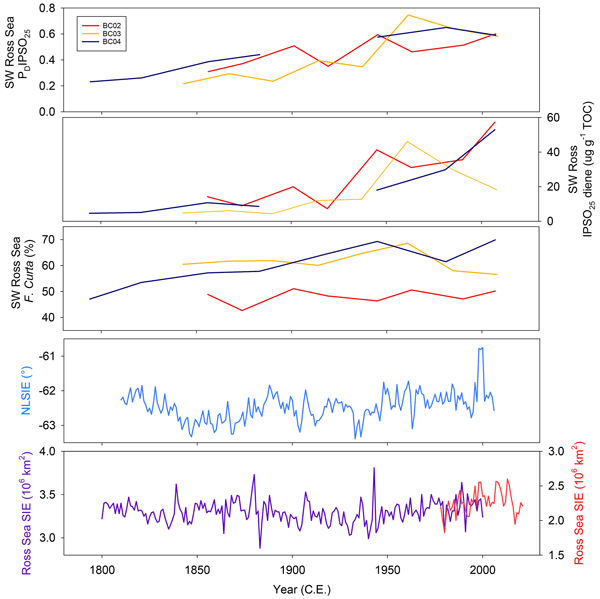
The relative abundance of F. curta, a well-established sea ice diatom proxy particularly associated with seasonal ice zones (Armand et al., 2005; Gersonde and Zielinski, 2000; Leventer and Dunbar, 1988), decreases downcore in BC02 and BC04, while it remains relatively stable throughout the record in BC03 (Fig. 9). Together, these trends suggest an overall increase in sea ice concentration in the southwestern Ross Sea from 1900 CE to present, providing an independent line of evidence to support biomarker-based reconstructions. Similarly, IPSO25 shows a decreasing trend downcore in all three cores, indicating an increasing signal of fast and platelet ice toward the present (Belt, 2018). The PIPSO25 index, which integrates IPSO25 with the open-water sterols dinosterol and brassicasterol, is considered a more robust measure of sea ice influence than IPSO25 alone (Lamping et al., 2021; Vorrath et al., 2023, 2020). Despite the low resolution, the PIPSO25 values in all three cores show an increasing trend since ∼1900 CE (Fig. 9). Collectively, diatom and biomarker records suggest a 200-year increase in sea ice duration in the southwestern Ross Sea.
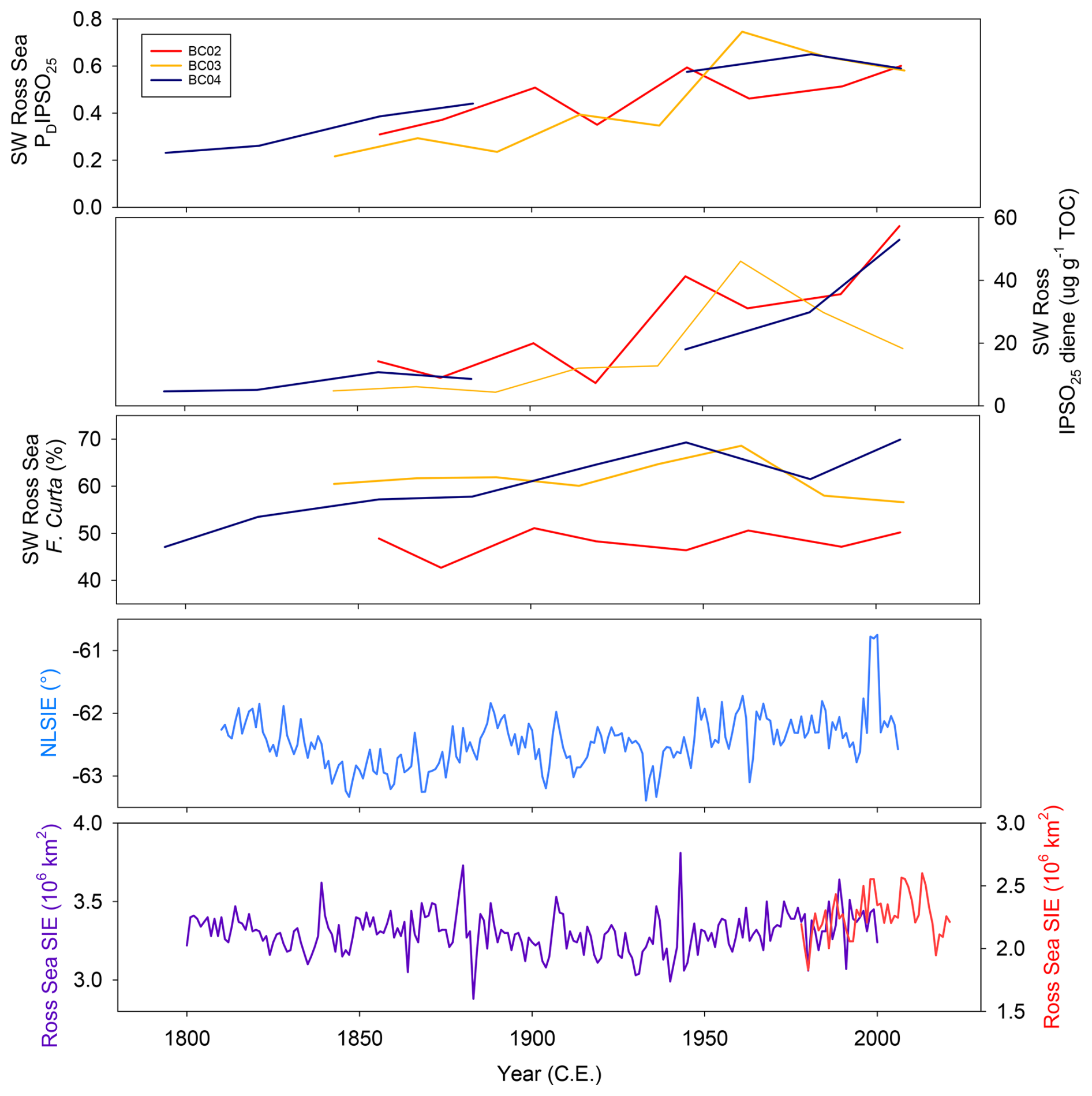
Figure 9Southwestern Ross Sea sediment results in BC02, BC03, and BC04, (a) PBIPSO25, (b) IPSO25 diene, (c) Fragilariopsis curta gp (F. curta). Ross Sea sea ice reconstructions, (d) northernmost latitude of sea ice extent in the Ross Sea (NLSIE) (blue) (Yang et al., 2021), (e) Ross Sea sea ice extent (SIE) reconstructed using high-resolution ice cores and data assimilation (purple) (Dalaiden et al., 2021) and Ross Sea sea ice extent from US National Snow and Ice Data Center (NSIDC) satellite data (red).
Our findings align closely with other Ross Sea records indicating increasing sea ice conditions over the past two centuries. Diatom-based sediment records from the southwestern Ross Sea show a similar long term trend in sea ice presence (Leventer and Dunbar, 1988; Leventer et al., 1993). Yang et al. (2021) reconstructed the northern limit of sea ice extent in the Ross Sea and observed relatively stable conditions pre-1900, followed by an increasing trend since ∼1950 CE (Fig. 9). Similarly, Dalaiden et al. (2021) used ice core records and data assimilation to reconstruct Ross Sea sea ice extent, also finding an increase beginning around 1950 after a stable pre-1900 period (Fig. 9). A coastal ice core record from the Ross Sea shows a stable sea ice area from the 1880s to the 1950s, a reduction from the 1950s to the 1990s and an increase from 1993 (Sinclair et al., 2014). Although these studies quantify sea ice extent and area at the regional scale, and our records reflect coastal sea ice duration at three coastal-proximal sites, most reconstructions point toward enhanced sea ice conditions in the Ross Sea since the mid-20th century (Fig. 9).
Differences among studies likely reflect a combination of factors. First, sediment cores generally have lower temporal resolution than ice cores and may not capture short term variations, such as the stable conditions before 1950 reported by Dalaiden et al. (2021) and Yang et al. (2021). Chronological uncertainty is another factor, as the CFCS lead dating model assumes constant sedimentation rates, a constant Pb flux, and no mixing or diffusion of Pb in the sediment (Appleby, 2002; Bruel and Sabatier, 2020). The dating uncertainty could introduce offsets in the timing of the observed trends. Second, spatial variability across the Ross Sea is well documented, with satellite observations from 1997 to 2013 showing an overall increase in sea ice extent (Yuan et al., 2017), but with significant anomalies (Dale et al., 2017; Krauzig et al., 2024). It is plausible that the southwestern Ross Sea experienced an earlier or stronger increase in sea ice duration compared with more northern or offshore regions. Sea ice variability in the southwestern Ross Sea is influenced by local processes such as fast ice formation and breakup, coastal polynya activity, and storm driven winds (Radlwimmer et al., 2026). These processes differ from those governing regional scale sea ice variability across the wider Ross Sea, where larger scale oceanic and atmospheric processes influence sea ice at the offshore margins (Dalaiden et al., 2025, 2021). Consequently, regional reconstructions may not fully capture the sea ice variability recorded at our coastal core sites. Finally, methodological and spatial differences may also contribute. Our records capture sea ice duration and concentration near the coast (Armand et al., 2005), while Dalaiden et al. (2021) and Yang et al. (2021) reconstructed sea ice extent at the regional scale. Although these metrics are related, changes in sea ice extent do not necessarily correspond to changes in local sea ice concentration and duration. Thus, differences between regional sea ice extent and the conditions recorded at our coastal sites may reflect both the spatial scale variability in sea ice across the Ross Sea and the distinct processes influencing coastal versus offshore sea ice. Despite these differences in metric and spatial coverage, all records presented in Fig. 9 show broadly consistent increases in sea ice conditions since ∼1950, underscoring the robustness of this trend across multiple archives and proxies.
Fatty acids in the surface sediments reflect inputs from a mixture of phytoplankton and bacterial sources, including diatoms and P. antarctica. The PCA analysis (Fig. 8) groups the fatty acids and HBIs together, suggesting shared post-depositional processes such as degradation. In contrast, the sterols do not follow the same grouping as the fatty acids and HBIs, consistent with their comparatively low reactivity and limited downcore decrease (Vorrath et al., 2019; Rontani et al., 2019, 2012). Downcore profiles of fatty acids show a marked decrease in concentrations within the upper ∼20 cm (corresponding to ∼76–95 years ± 2.4–22.2 years), consistent with early post depositional degradation. Below this interval, fatty acid concentrations remained relatively stable. This pattern suggests that post-depositional alteration is an important driver of fatty acid concentrations; however, it is unlikely to be the sole factor influencing downcore variability. Changes in primary production, organic matter flux, and sedimentation processes also contribute to the observed trends. Beyond the ∼20 cm fatty acid decrease, no consistent downcore trends were observed, which may suggest relatively little change in phytoplankton community composition over the past ∼200 years, despite increasing sea ice influence (Yuan et al., 2017; Dalaiden et al., 2021). However, interpretation is limited by the low sampling resolution (4–8 cm), which may obscure finer-scale variability. Higher-resolution records would allow more detailed reconstruction of short-term variability and potential responses of phytoplankton communities to sea ice changes.
In this study, lipid biomarkers (fatty acids, sterols, and HBIs) from surface and short sediment cores were combined with diatom assemblage data to assess their drivers and help interpret past sea ice dynamics and phytoplankton community changes in a 200-year record in the southwestern Ross Sea, an area characterised by the presence of coastal polynyas. Three sediment cores along a north-south transect were sampled at decadal resolution and dated using 210Pb dating, with the longest core representing years 1794–2007 (±20 years at its base). The three cores offered an opportunity to examine biosiliceous and organic records during this period and to assess the long-term behaviour of biomarkers, bacterial activity, and preservation processes. Trends in sea ice diatoms such as Fragilariopsis curta, alongside HBIs and PIPSO25, reveal an increase in sea ice extent in the southwestern Ross Sea over the last 200 years. This finding contributes to a growing picture of regional sea ice variability, with trends differing by proxy and location, emphasising the importance of high-resolution records for capturing local and broader scale sea ice change.
Spatial variations in biomarker composition across the six core tops were primarily driven by sea ice conditions and associated phytoplankton habitats, while pelagic diatoms, haptophytes (e.g. Phaeocystis antarctica), and sea ice diatoms exhibited distinctive biomarker signatures. While pelagic diatom derived fatty acids (C14:0, C16:0, C16:1ω8, C16:1ω7, C16:1ω6, C16:1ω5) were identified in this study, polyunsaturated fatty acids (specifically C16:4ω1, C20:5ω3, C20:4ω6) produced by diatoms, were not detected despite sediments containing abundant preserved diatoms and HBI markers, likely due to grazing, scavenging, and degradation in surface waters and throughout the water column. Phaeocystis antarctica fossils are not preserved in marine sediments; however, this study shows that phytoplankton derived fatty acids (high C14:0, C18:0, and C18:1ω9, low levels of polyunsaturated fatty acids, and a low ratio) demonstrate potential to record Phaeocystis antarctica variability through time. Biomarkers are also influenced by downcore degradation: fatty acids in the southwestern Ross Sea demonstrate an overall exponential decay in the top ∼20 cm of the sediment cores. This degradation derives from bacterial biogenesis, demonstrated by 10 %–20 % of branched fatty acids sourced from bacteria. Despite the degradation process, fatty acid profiling still records the relative composition of phytoplankton groups over this period. A Principal Component Analysis of the combined biomarker and diatom dataset provides additional support for this structure, resolving three distinct groupings: a sea ice associated group (F. curta group, C24:0, sterols), an inversely related open water and increased fast ice habitat group (Chaetoceros resting spores, open ocean, cold water, and sea ice diatoms), and an independent fatty acid/HBI group consistent with shared degradation processes. We propose C24:0 as a biomarker of sea ice change in the southwestern Ross Sea. Overall, biomarkers in the southwestern Ross Sea sediment independently distinguish between pelagic diatoms, haptophytes, and sea ice associated diatoms, offering a valuable tool for developing decadal resolution records of sea ice and phytoplankton changes in the Ross Sea over longer timescales.
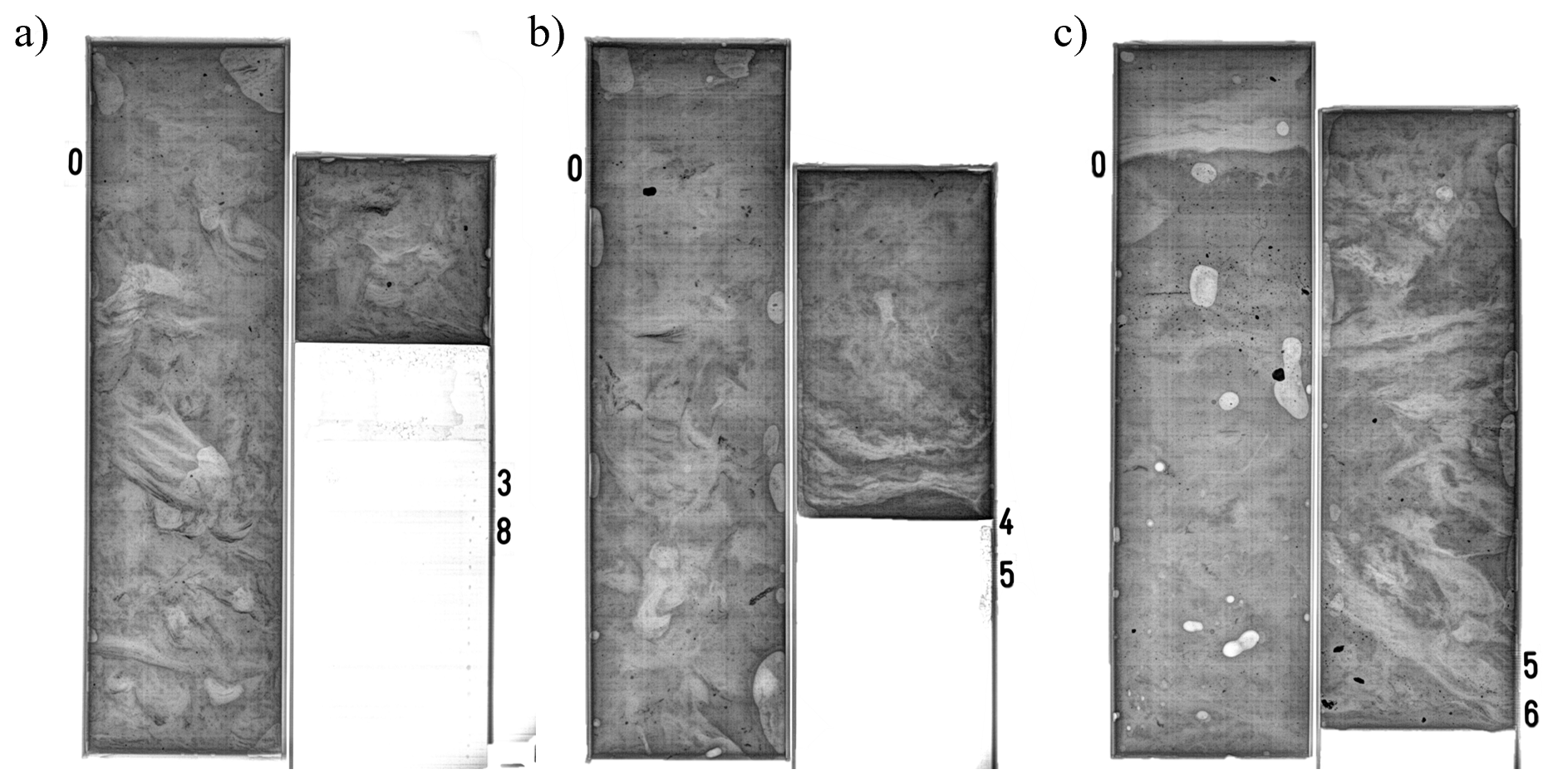
Figure A1X-radiographic images of RS14-BC02 (a), RS14-BC03 (b), and RS14-BC04 (c). Depth (cm) is noted beside each X-ray. Images were taken on 1 cm thick sediment slabs with Softex M-100W X-ray source and NTB EZ-320 digital X-ray scanner, and were processed with iX-Pect EZ imaging software.
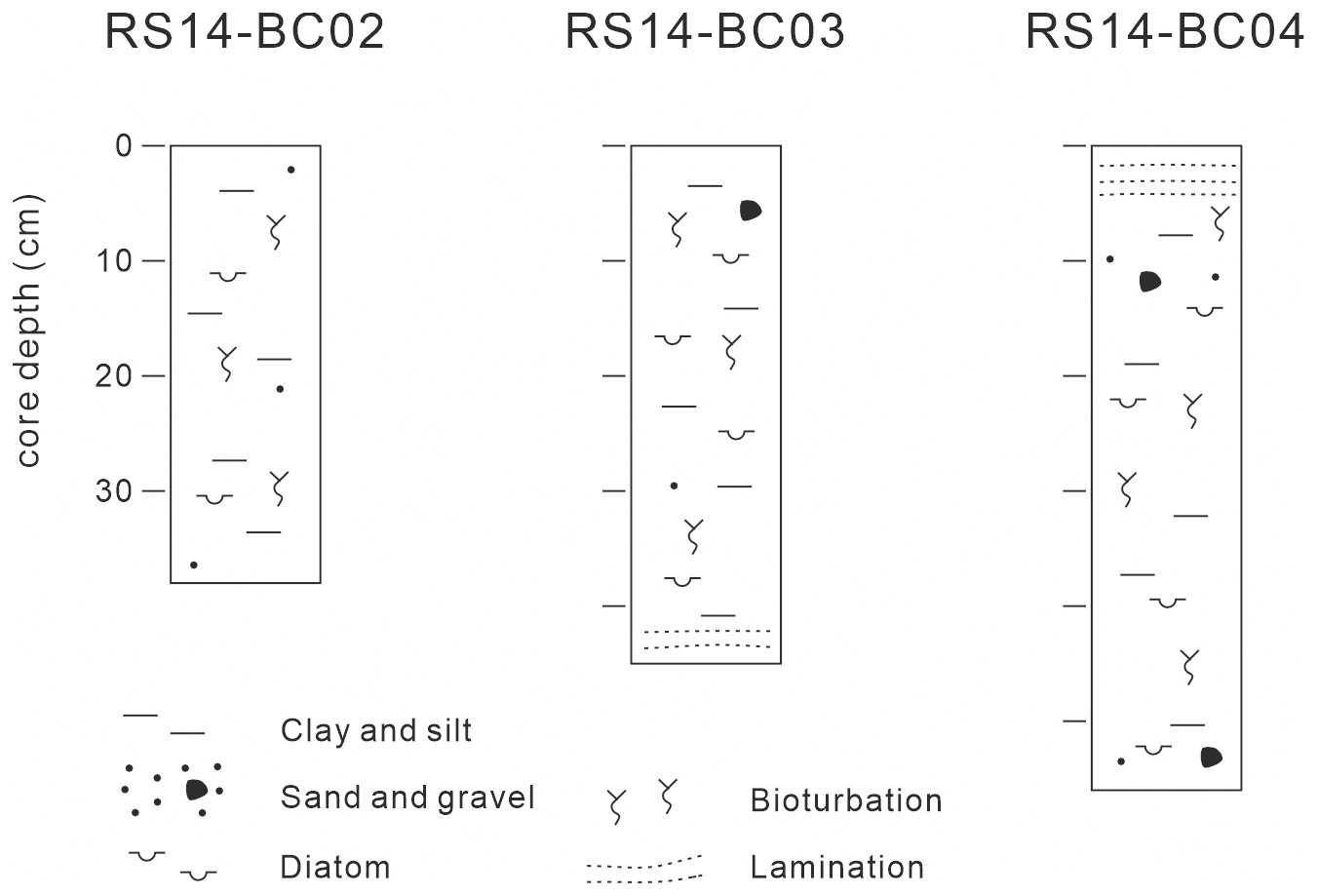
Figure A2Core logs for RS14-BC02, RS14-BC03, and RS14-BC04 from the southwestern Ross Sea, Antarctica. Lithology and sedimentary structures shown against depth (cm).
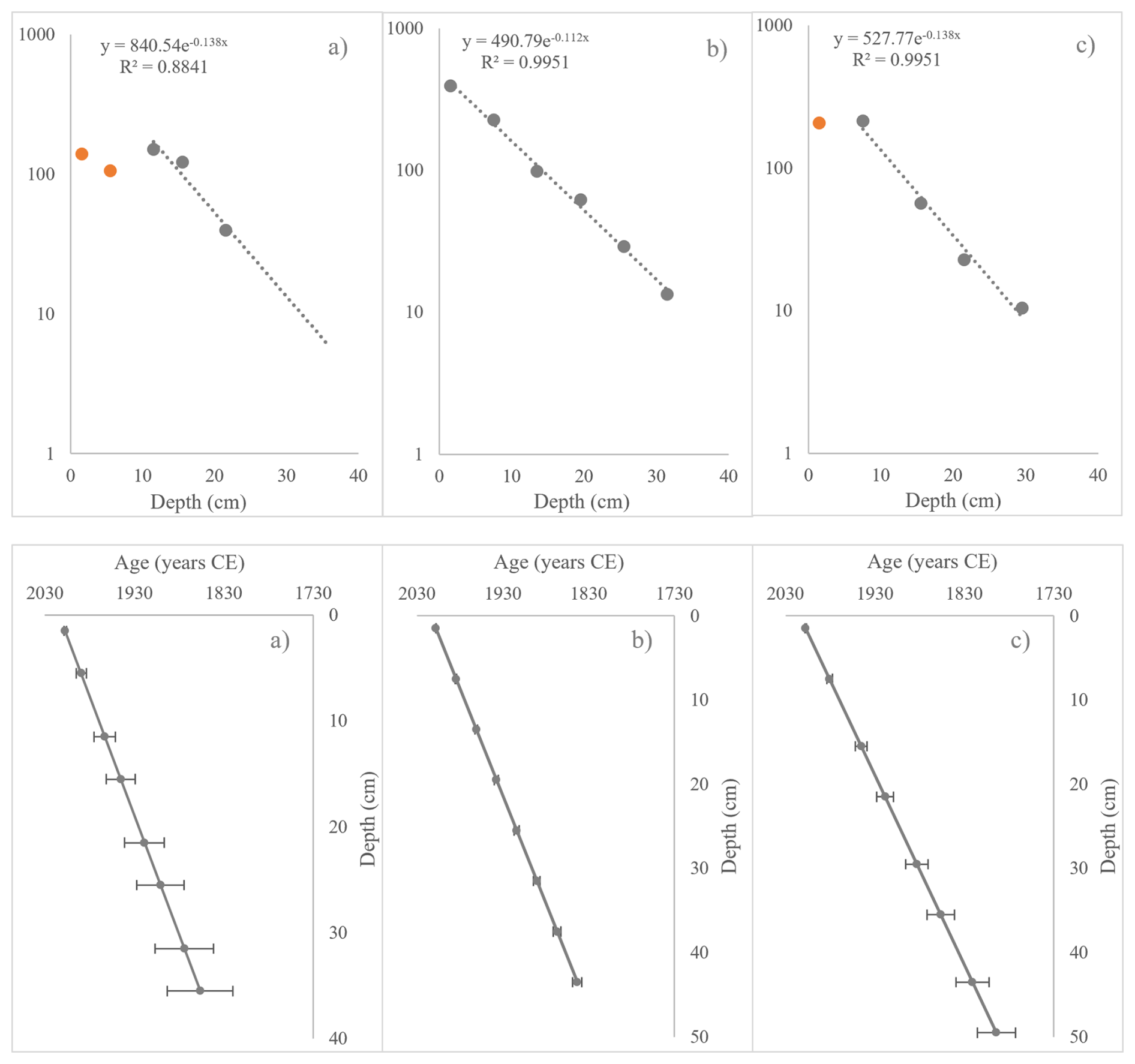
Figure A3Lead dating age-depth models for (a) BC02, (b) BC03, (c) BC04. Top: Sedimentation rates were calculated from the least-squares fit slope of 210Posupported on a logarithmic scale against depth (Appleby, 2002). The orange dots show evidence of a mixed layer in the 210Po and were not included in the least-squares fit slope. Bottom: The constant flux and constant sedimentation rate (CFCS) model was applied to determine sediment ages (Bruel and Sabatier, 2020). Errors were estimated using R package “serac” (Bruel and Sabatier, 2020).
The data sets for the sediment core age-depth model, organic compound concentrations, diatom abundance, and organic carbon are available at the PANGAEA data centre (https://doi.org/10.1594/PANGAEA.989298) (de Jong et al., 2026).
Conceptualisation: VHLW. Validation: EMdJ and SN. Data curation: EMdJ. Formal analysis: EMdJ, SN and VHLW. Investigation: XC, EMdJ, SN, VHLW. Methodology: XC, EMdJ, SN, and VHLW. Resources: XC, JIL, SN, JE and VHLW. Supervision: BD, SN and VHLW. Writing (original draft preparation, review and editing): EMdJ. Writing (review and editing): all authors. Funding acquisition: EMdJ and VHLW. All authors have read and agreed to the published version of the manuscript.
At least one of the (co-)authors is a member of the editorial board of Biogeosciences. The peer-review process was guided by an independent editor, and the authors also have no other competing interests to declare.
Publisher's note: Copernicus Publications remains neutral with regard to jurisdictional claims made in the text, published maps, institutional affiliations, or any other geographical representation in this paper. The authors bear the ultimate responsibility for providing appropriate place names. Views expressed in the text are those of the authors and do not necessarily reflect the views of the publisher.
Emma M. de Jong acknowledges support from James Kennett for the Roger Cooper Masters scholarship in Paleobiology, the Antarctic Research Centre's Endowed Development Fund, and the Trans-Antarctic Association Science Bursary. Bella Duncan was supported by the New Zealand Ministry of Business Innovation and Employment through the Antarctic Science Platform (ANTA1801). Thank you to Amy King for helpful feedback on this research and to Sabine Schmidt for advice regarding 210Pb dating. Thank you to KOPRI project PE25090, funded by the Ministry of Oceans and Fisheries, for access to core samples. Thank you to two anonymous reviewers whose helpful feedback improved this manuscript.
This project was funded by a Rutherford Discovery Fellowship awarded by the Royal Society Te Apārangi (RDF-VUW2203 to VHL Winton) and the Marsden Fund Council from New Zealand Government funding, managed by Royal Society Te Apārangi (MFP-VUW2107 to VHL Winton), and the GNS Science Global Change Through Time program (Strategic Science Investment Fund, Contract ID C05X1702).
This paper was edited by Cindy De Jonge and reviewed by two anonymous referees.
Al-Handal, A. Y. and Wulff, A.: Marine benthic diatoms from Potter Cove, King George Island, Antarctica, https://doi.org/10.1515/BOT.2008.007, 2008.
Allen, C. S. and Weich, Z. C.: Variety and Distribution of Diatom-Based Sea Ice Proxies in Antarctic Marine Sediments of the Past 2000 Years, Geosciences, 12, https://doi.org/10.3390/geosciences12080282, 2022.
Almandoz, G. O., Ferreyra, G. A., Schloss, I. R., Dogliotti, A. I., Rupolo, V., Paparazzo, F. E., Esteves, J. L., and Ferrario, M. E.: Distribution and ecology of Pseudo-nitzschia species (Bacillariophyceae) in surface waters of the Weddell Sea (Antarctica), Polar Biol., 31, 429–442, https://doi.org/10.1007/s00300-007-0369-9, 2008.
Andreoli, C., Tolomio, C., Moro, I., Radice, M., Moschin, E., and Bellato, S.: Diatoms and dinoflagellates in Terra Nova Bay (Ross Sea-Antarctica) during austral summer 1990, Polar Biol., 15, 465–475, https://doi.org/10.1007/BF00237460, 1995.
Annett, A. L., Carson, D. S., Crosta, X., Clarke, A., and Ganeshram, R. S.: Seasonal progression of diatom assemblages in surface waters of Ryder Bay, Antarctica, Polar Biol., 33, 13–29, https://doi.org/10.1007/s00300-009-0681-7, 2010.
Appleby, P. G.: Chronostratigraphic Techniques in Recent Sediments, in: Tracking Environmental Change Using Lake Sediments. Developments in Paleoenvironmental Research, edited by: Last, W. M. and Smol, J. P., vol 1, Springer, Dordrecht, https://doi.org/10.1007/0-306-47669-X_9, 2002.
Armand, L. K., Crosta, X., Romero, O., and Pichon, J.-J.: The biogeography of major diatom taxa in Southern Ocean sediments: 1. Sea ice related species, Palaeogeogr. Palaeocl., 223, 93–126, https://doi.org/10.1016/j.palaeo.2005.02.015, 2005.
Arrigo, K. R.: A coupled ocean-ecosystem model of the Ross Sea: 2. Iron regulation of phytoplankton taxonomic variability and primary production, J. Geophys. Res., 108, https://doi.org/10.1029/2001jc000856, 2003.
Arrigo, K. R. and van Dijken, G. L.: Annual changes in sea-ice, chlorophyll a, and primary production in the Ross Sea, Antarctica, Deep-Sea Res. Pt. II, 51, 117–138, https://doi.org/10.1016/j.dsr2.2003.04.003, 2004.
Arrigo, K. R., DiTullio, G. R., Dunbar, R. B., Robinson, D. H., VanWoert, M., Worthen, D. L., and Lizotte, M. P.: Phytoplankton taxonomic variability in nutrient utilization and primary production in the Ross Sea, J. Geophys. Res.-Oceans, 105, 8827–8846, https://doi.org/10.1029/1998JC000289, 2000.
Arrigo, K. R., Van Dijken, G. L., and Bushinsky, S.: Primary production in the Southern Ocean, 1997–2006, J. Geophys. Res., 113, https://doi.org/10.1029/2007jc004551, 2008.
Arrigo, K. R., van Dijken, G. L., and Strong, A. L.: Environmental controls of marine productivity hot spots around Antarctica, J. Geophys. Res.-Oceans, 120, 5545–5565, https://doi.org/10.1002/2015jc010888, 2015.
Ashley, K. E., Crosta, X., Etourneau, J., Campagne, P., Gilchrist, H., Ibraheem, U., Greene, S. E., Schmidt, S., Eley, Y., Massé, G., and Bendle, J.: Exploring the use of compound-specific carbon isotopes as a palaeoproductivity proxy off the coast of Adélie Land, East Antarctica, Biogeosciences, 18, 5555–5571, https://doi.org/10.5194/bg-18-5555-2021, 2021.
Baldauf, J. G. and Barron, J. A.: 29. Diatom Biostratigraphy: Kerguelen Plateau and Prydz Bay Regions of the Southern Ocean, Proceedings of the Ocean Drilling Program, Scientific Results, vol. 119, https://doi.org/10.2973/odp.proc.sr.119.135.1991, 1991.
Barbara, L., Crosta, X., Leventer, A., Schmidt, S., Etourneau, J., Domack, E., and Massé, G.: Environmental responses of the Northeast Antarctic Peninsula to the Holocene climate variability, Paleoceanography, 31, 131–147, https://doi.org/10.1002/2015PA002785, 2016.
Beans, C., Hecq, J.-H., Koubbi, P., Vallet, C., Wright, S., and Goffart, A.: A study of the diatom-dominated microplankton summer assemblages in coastal waters from Terre Adélie to the Mertz Glacier, East Antarctica (139° E–145° E), Polar Biol., 31, 1101–1117, https://doi.org/10.1007/s00300-008-0452-x, 2008.
Belt, S. T.: Source-specific biomarkers as proxies for Arctic and Antarctic sea ice, Org. Geochem., 125, 277–298, https://doi.org/10.1016/j.orggeochem.2018.10.002, 2018.
Belt, S. T. and Müller, J.: The Arctic sea ice biomarker IP25: a review of current understanding, recommendations for future research and applications in palaeo sea ice reconstructions, Quaternary Sci. Rev., 79, 9–25, https://doi.org/10.1016/j.quascirev.2012.12.001, 2013.
Belt, S. T., Smik, L., Brown, T. A., Kim, J.-H., Rowland, S., Allen, C. S., Gal, J.-K., Shin, K.-H., Lee, J. I., and Taylor, K.: Source identification and distribution reveals the potential of the geochemical Antarctic sea ice proxy IPSO25, Nat. Commun., 7, 12655, https://doi.org/10.1038/ncomms12655, 2016.
Bhattacharya, S., Mapder, T., Fernandes, S., Roy, C., Sarkar, J., Rameez, M. J., Mandal, S., Sar, A., Chakraborty, A. K., Mondal, N., Chatterjee, S., Dam, B., Peketi, A., Chakraborty, R., Mazumdar, A., and Ghosh, W.: Sedimentation rate and organic matter dynamics shape microbiomes across a continental margin, Biogeosciences, 18, 5203–5222, https://doi.org/10.5194/bg-18-5203-2021, 2021.
Bolinesi, F., Saggiomo, M., Ardini, F., Castagno, P., Cordone, A., Fusco, G., Rivaro, P., Saggiomo, V., and Mangoni, O.: Spatial-Related Community Structure and Dynamics in Phytoplankton of the Ross Sea, Antarctica, Frontiers in Marine Science, 7, https://doi.org/10.3389/fmars.2020.574963, 2020.
Boyd, P. W., Lennartz, S. T., Glover, D. M., and Doney, S. C.: Biological ramifications of climate-change-mediated oceanic multi-stressors, Nat. Clim. Change, 5, 71–79, https://doi.org/10.1038/NCLIMATE2441, 2015.
Brett, G. M., Irvin, A., Rack, W., Haas, C., Langhorne, P. J., and Leonard, G. H.: Variability in the distribution of fast ice and the sub-ice platelet layer near McMurdo Ice Shelf, J. Geophys. Res.-Oceans, 125, e2019JC015678, https://doi.org/10.1029/2019JC015678, 2020.
Bruel, R. and Sabatier, P.: serac: an R package for ShortlivEd RAdionuclide chronology of recent sediment cores, J. Environ. Radioact., 225, 106449, https://doi.org/10.1016/j.jenvrad.2020.106449, 2020.
Burckle, L. H.: Diatom distribution and paleoceanographic reconstruction in the Southern Ocean – Present and Last Glacial Maximum, Mar. Micropaleontol., 9, 241–261, https://doi.org/10.1016/0377-8398(84)90015-X, 1984.
Burckle, L. H., Jacobs, S. S., and McLaughlin, R. B.: Late austral spring diatom distribution between New Zealand and the Ross Ice Shelf, Antarctica: Hydrographic and sediment correlations, Micropaleontology, 33, 74–81, https://doi.org/10.2307/1485528, 1987.
Campagne, P., Crosta, X., Schmidt, S., Noëlle Houssais, M., Ther, O., and Massé, G.: Sedimentary response to sea ice and atmospheric variability over the instrumental period off Adélie Land, East Antarctica, Biogeosciences, 13, 4205–4218, https://doi.org/10.5194/bg-13-4205-2016, 2016.
Cau, A., Ennas, C., Moccia, D., Mangoni, O., Bolinesi, F., Saggiomo, M., Granata, A., Guglielmo, L., Swadling, K. M., and Pusceddu, A.: Particulate organic matter release below melting sea ice (Terra Nova Bay, Ross Sea, Antarctica): Possible relationships with zooplankton, J. Marine Syst., 217, https://doi.org/10.1016/j.jmarsys.2021.103510, 2021.
Chiarini, F., Ravaioli, M., and Capotondi, L.: Interannual variability of vertical particle fluxes in the Ross Sea (Antarctica), Nat. Conserv., 34, 417–440, https://doi.org/10.3897/natureconservation.34.30732, 2019.
Crosta, X. and Koç, N.: Chapter eight diatoms: From micropaleontology to isotope geochemistry, Developments in Marine Geology, 1, 327–369, https://doi.org/10.1016/S1572-5480(07)01013-5, 2007.
Crosta, X., Sturm, A., Armand, L., and Pichon, J.-J.: Late Quaternary sea ice history in the Indian sector of the Southern Ocean as recorded by diatom assemblages, Mar. Micropaleontol., 50, 209–223, https://doi.org/10.1016/S0377-8398(03)00072-0, 2004.
Crosta, X., Romero, O., Armand, L. K., and Pichon, J.-J.: The biogeography of major diatom taxa in Southern Ocean sediments: 2. Open ocean related species, Palaeogeogr. Palaeocl., 223, 66–92, 2005.
Crosta, X., Denis, D., and Ther, O.: Sea ice seasonality during the holocene, adelie land, east antarctica, Mar. Micropaleontol., 66, 222–232, https://doi.org/10.1016/j.marmicro.2007.10.001, 2008.
Crosta, X., Shukla, S. K., Ther, O., Ikehara, M., Yamane, M., and Yokoyama, Y.: Last Abundant Appearance Datum of Hemidiscus karstenii driven by climate change, Mar. Micropaleontol., 157, 101861, https://doi.org/10.1016/j.marmicro.2020.101861, 2020.
Cunningham, W. L. and Leventer, A.: Diatom assemblages in surface sediments of the Ross Sea: relationship to present oceanographic conditions, Antarct. Sci., 10, 134–146, https://doi.org/10.1017/S0954102098000182, 1998.
Cunningham, W. L., Leventer, A., Andrews, J. T., Jennings, A. E., and Licht, K. J.: Late Pleistocene-Holocene marine conditions in the Ross Sea, Antarctica: evidence from the diatom record, The Holocene, 9, 129–139, https://doi.org/10.1191/095968399675624796, 1999.
Dalaiden, Q., Goosse, H., Rezsöhazy, J., and Thomas, E. R.: Reconstructing atmospheric circulation and sea-ice extent in the West Antarctic over the past 200 years using data assimilation, Clim. Dynam., 57, 3479–3503, https://doi.org/10.1007/s00382-021-05879-6, 2021.
Dalaiden, Q., Goosse, H., Holland, P. R., and Barthelemy, A.: Dynamical reconstruction of Southern Ocean and Antarctic climate variability since 1700, Scientific Data, 12, 1574, https://doi.org/10.1038/s41597-025-05808-w, 2025.
Dale, E. R., McDonald, A. J., Coggins, J. H. J., and Rack, W.: Atmospheric forcing of sea ice anomalies in the Ross Sea polynya region, The Cryosphere, 11, 267–280, https://doi.org/10.5194/tc-11-267-2017, 2017.
Dalsgaard, J., John, M. S., Kattner, G., Müller-Navarra, D., and Hagen, W.: Fatty acid trophic markers in the pelagic marine environment, Advances in Marine Biology, Academic Press, 46, 225–340, ISBN 9780120261468, https://doi.org/10.1016/S0065-2881(03)46005-7, 2003.
de Jong, E. M., Winton, V. H. L., Crosta, X., Naeher, S., Duncan, B., Étourneau, J., Lee, J. I., and McKay, R. M.: Biomarkers and diatoms in a transect of southwestern Ross Sea sediment cores, PANGAEA [data set], https://doi.org/10.1594/PANGAEA.989298, 2026.
DeJong, H. B., Dunbar, R. B., Koweek, D. A., Mucciarone, D. A., Bercovici, S. K., and Hansell, D. A.: Net community production and carbon export during the late summer in the Ross Sea, Antarctica, Global Biogeochem. Cy., 31, 473–491, https://doi.org/10.1002/2016GB005417, 2017.
Denis, D., Crosta, X., Zaragosi, S., Romero, O., Martin, B., and Mas, V.: Seasonal and subseasonal climate changes recorded in laminated diatom ooze sediments, Adelie Land, East Antarctica, The Holocene, 16, 1137–1147, https://doi.org/10.1177/0959683606069414, 2006.
Denis, D., Crosta, X., Schmidt, S., Carson, D. S., Ganeshram, R. S., Renssen, H., Crespin, J., Ther, O., Billy, I., and Giraudeau, J.: Holocene productivity changes off Adélie land (East Antarctica), Paleoceanography, 24, https://doi.org/10.1029/2008PA001689, 2009.
Deppeler, S. L. and Davidson, A. T.: Southern Ocean Phytoplankton in a Changing Climate, Frontiers in Marine Science, 4, https://doi.org/10.3389/fmars.2017.00040, 2017.
DiTullio, G., Grebmeier, J., Arrigo, K., Lizotte, M., Robinson, D., Leventer, A., Barry, J., VanWoert, M., and Dunbar, R.: Rapid and early export of Phaeocystis antarctica blooms in the Ross Sea, Antarctica, Nature, 404, 595–598, https://doi.org/10.1038/35007061, 2000.
Dong, Y., Bakker, D. C., Bell, T. G., Yang, M., Landschützer, P., Hauck, J., Rödenbeck, C., Kitidis, V., Bushinsky, S. M., and Liss, P. S.: Direct observational evidence of strong CO2 uptake in the Southern Ocean, Science Advances, 10, eadn5781, https://doi.org/10.1126/sciadv.adn5781, 2024.
Dunbar, R. B., Leventer, A. R., and Mucciarone, D. A.: Water column sediment fluxes in the Ross Sea, Antarctica: Atmospheric and sea ice forcing, J. Geophys. Res.-Oceans, 103, 30741–30759, https://doi.org/10.1029/1998JC900001, 1998.
Eikrem, W., Medlin, L. K., Henderiks, J., Rokitta, S., Rost, B., Probert, I., Throndsen, J., and Edvardsen, B.: Haptophyta, in: Handbook of the Protists, Springer, 1–61, https://doi.org/10.1007/978-3-319-32669-6_38-1, 2016.
Elliott, D. T., Tang, K. W., and Shields, A. R.: Mesozooplankton beneath the summer sea ice in McMurdo Sound, Antarctica: abundance, species composition, and DMSP content, Polar Biol., 32, 113–122, https://doi.org/10.1007/s00300-008-0511-3, 2009.
Esper, O. and Gersonde, R.: New tools for the reconstruction of Pleistocene Antarctic sea ice, Palaeogeogr. Palaeocl., 399, 260–283, https://doi.org/10.1016/j.palaeo.2014.01.019, 2014.
Etourneau, J., Collins, L. G., Willmott, V., Kim, J.-H., Barbara, L., Leventer, A., Schouten, S., Sinninghe Damsté, J. S., Bianchini, A., Klein, V., Crosta, X., and Massé, G.: Holocene climate variations in the western Antarctic Peninsula: evidence for sea ice extent predominantly controlled by changes in insolation and ENSO variability, Clim. Past, 9, 1431–1446, https://doi.org/10.5194/cp-9-1431-2013, 2013.
Fahl, K. and Kattner, G.: Lipid content and fatty acid composition of algal communities in sea-ice and water from the Weddell Sea (Antarctica), Polar Biol., 13, 405–409, https://doi.org/10.1007/BF01681982, 1993.
Fenner, J., Schrader, H.-J., and Wienigk, H.: Diatom phytoplankton studies in the southern Pacific Ocean, composition and correlation to the Antarctic Convergence and its paleoecological significance, Initial Reports of the Deep Sea Drilling Project, https://doi.org/10.2973/dsdp.proc.35.app3.1976, 1976.
Flynn, W.: The determination of low levels of polonium-210 in environmental materials, Anal. Chim. Acta, 43, 221–227, https://doi.org/10.1016/S0003-2670(00)89210-7, 1968.
Froneman, P., Perissinotto, R., McQuaid, C., and Laubscher, R.: Summer distribution of netphytoplankton in the Atlantic sector of the Southern Ocean, Polar Biol., 15, 77–84, https://doi.org/10.1007/BF00241045, 1995.
Fryxell, G. A.: Marine phytoplankton at the Weddell Sea ice edge: seasonal changes at the specific level, Polar Biol., 10, 1–18, https://doi.org/10.1007/BF00238285, 1989.
Fryxell, G. and Prasad, A.: Eucampia antarctica var. recta (Mangin) stat. nov.(Biddulphiaceae, Bacillariophyceae): life stages at the Weddell Sea ice edge, Phycologia, 29, 27–38, 1990.
Garrison, D. L., Buck, K. R., and Fryxell, G. A.: Algal assemblages in Antarctic pack ice and in ice‐edge plankton 1, J. Phycol., 23, 564–572, https://doi.org/10.1111/j.1529-8817.1987.tb04206.x, 1987.
Gersonde, R. and Zielinski, U.: The reconstruction of late Quaternary Antarctic sea-ice distribution – the use of diatoms as a proxy for sea-ice, Palaeogeogr. Palaeocl., 162, 263–286, https://doi.org/10.1016/S0031-0182(00)00131-0, 2000.
Gilmer, G., Riesselman, C. R., Kim, S., Yoo, K. C., Lee, J. I., Lee, M. K., Ginnane, C. E., Rosenheim, B. E., Turnbull, J., and Parker, R.: Increased sea ice duration in Moubray Bay, northwest Ross Sea linked to early Holocene wind strength, Paleoceanogr. Paleocl., 40, e2024PA004930, https://doi.org/10.1029/2024PA004930, 2025.
Grigorov, I., Rigual-Hernandez, A. S., Honjo, S., Kemp, A. E., and Armand, L. K.: Settling fluxes of diatoms to the interior of the Antarctic circumpolar current along 170° W, Deep-Sea Res. Pt. I, 93, 1–13, https://doi.org/10.1016/j.dsr.2014.07.008, 2014.
Guo, X., Zhao, J., Pan, J., and Sun, Y.: Organic matter composition in sediments recording sea surface phytoplankton community structure in Prydz Bay of Antarctica, Org. Geochem., 104828, https://doi.org/10.1016/j.orggeochem.2024.104828, 2024.
Haddad, R. I., Martens, C. S., and Farrington, J. W.: Quantifying early diagenesis of fatty acids in a rapidly accumulating coastal marine sediment, Org. Geochem., 19, 205–216, https://doi.org/10.1016/0146-6380(92)90037-X, 1992.
Hamm, C., Reigstad, M., Riser, C. W., Mühlebach, A., and Wassmann, P.: On the trophic fate of Phaeocystis pouchetii. VII. Sterols and fatty acids reveal sedimentation of P. pouchetii-derived organic matter via krill fecal strings, Mar. Ecol. Prog. Ser., 209, 55–69, https://doi.org/10.3354/meps209055, 2001.
Hasle, G. R.: An analysis of the phytoplankton of the Pacific Southern Ocean: abundance, composition, and distribution during the Brategg Expedition, 1947–1948, Hvalradets skrifter, 52, 1–168, 1969.
Hayward, A., Pinkerton, M. H., and Gutierrez-Rodriguez, A.: phytoclass: A pigment-based chemotaxonomic method to determine the biomass of phytoplankton classes, Limnol. Oceanogr.-Meth., 21, 220–241, https://doi.org/10.1002/lom3.10541, 2023.
Hayward, A., Wright, S. W., Carroll, D., Law, C. S., Wongpan, P., Gutiérrez-Rodriguez, A., and Pinkerton, M. H.: Antarctic phytoplankton communities restructure under shifting sea-ice regimes, Nat. Clim. Change, 1–8, https://doi.org/10.1038/s41558-025-02379-x, 2025.
Heidemann, A. C., Westwood, K. J., Foppert, A., Wright, S. W., Klocker, A., Vives, C. R., Wotherspoon, S., and Bestley, S.: Drivers of phytoplankton distribution, abundance and community composition off East Antarctica, from 55–80° E (CCAMLR Division 58.4. 2 East), Frontiers in Marine Science, 11, 1454421, https://doi.org/10.3389/fmars.2024.1454421, 2024.
Henley, S. F., Cavan, E. L., Fawcett, S. E., Kerr, R., Monteiro, T., Sherrell, R. M., Bowie, A. R., Boyd, P. W., Barnes, D. K. A., Schloss, I. R., Marshall, T., Flynn, R., and Smith, S.: Changing Biogeochemistry of the Southern Ocean and Its Ecosystem Implications, Frontiers in Marine Science, 7, https://doi.org/10.3389/fmars.2020.00581, 2020.
Horner, R.: Algal species reported from sea ice, Sea ice biota, CRC Press, Boca Raton, 191–203, 1985.
Johns, L., Wraige, E., Belt, S., Lewis, C., Massé, G., Robert, J.-M., and Rowland, S.: Identification of a C25 highly branched isoprenoid (HBI) diene in Antarctic sediments, Antarctic sea-ice diatoms and cultured diatoms, Org. Geochem., 30, 1471–1475, https://doi.org/10.1016/S0146-6380(99)00112-6, 1999.
Johnson, K. M., McKay, R. M., Etourneau, J., Jiménez-Espejo, F. J., Albot, A., Riesselman, C. R., Bertler, N. A., Horgan, H. J., Crosta, X., and Bendle, J.: Sensitivity of Holocene East Antarctic productivity to subdecadal variability set by sea ice, Nat. Geosci., 1–7, https://doi.org/10.1038/s41561-021-00816-y, 2021.
Kalpana, M., Routh, J., Fietz, S., Lone, M. A., and Mangini, A.: Sources, Distribution and Paleoenvironmental Application of Fatty Acids in Speleothem Deposits From Krem Mawmluh, Northeast India, Front. Earth Sci., 9, 687376, https://doi.org/10.3389/feart.2021.687376, 2021.
Kaneda, T.: Iso-and anteiso-fatty acids in bacteria: biosynthesis, function, and taxonomic significance, Microbiol. Rev., 55, 288–302, https://doi.org/10.1128/mr.55.2.288-302.1991, 1991.
Kassambara, A. and Mundt, F.: factoextra: Extract and Visualize the Results of Multivariate Data Analyses (R package version 1.0.7), The R Foundation [code], https://doi.org/10.32614/cran.package.factoextra, 2016.
Kim, M., Hwang, J., Kim, H. J., Kim, D., Yang, E. J., Ducklow, H. W., La Hyoung, S., Lee, S. H., Park, J., and Lee, S.: Sinking particle flux in the sea ice zone of the Amundsen shelf, Antarctica, Deep-Sea Res. Pt. I, 101, 110–117, https://doi.org/10.1155/2019/3717239, 2015.
Krauzig, N., Flocco, D., Kern, S., and Zambianchi, E.: Exploring sea ice transport dynamics at the eastern gate of the Ross Sea, Deep-Sea Res. Pt. II, 218, 105428, https://doi.org/10.1016/j.dsr2.2024.105428, 2024.
Krebs, W., Lipps, J. H., and Burckle, L. H.: Ice diatom floras, Arthur Harbor, Antarctica, Polar Biol., 7, 163–171, https://doi.org/10.1007/BF00259204, 1987.
Lamping, N., Müller, J., Esper, O., Hillenbrand, C.-D., Smith, J. A., and Kuhn, G.: Highly branched isoprenoids reveal onset of deglaciation followed by dynamic sea-ice conditions in the western Amundsen Sea, Antarctica, Quaternary Sci. Rev., 228, 106103, https://doi.org/10.1016/j.quascirev.2019.106103, 2020.
Lamping, N., Müller, J., Hefter, J., Mollenhauer, G., Haas, C., Shi, X., Vorrath, M.-E., Lohmann, G., and Hillenbrand, C.-D.: Evaluation of lipid biomarkers as proxies for sea ice and ocean temperatures along the Antarctic continental margin, Clim. Past, 17, 2305–2326, https://doi.org/10.5194/cp-17-2305-2021, 2021.
Ledford-Hoffman, P. A., DeMaster, D., and Nittrouer, C.: Biogenic-silica accumulation in the Ross Sea and the importance of Antarctic continental-shelf deposits in the marine silica budget, Geochim. Cosmochim. Ac., 50, 2099–2110, https://doi.org/10.1016/0016-7037(86)90263-2, 1986.
Leventer, A.: Sediment trap diatom assemblages from the northern Antarctic Peninsula region, Deep-Sea Res. Pt. A, 38, 1127–1143, https://doi.org/10.1016/0198-0149(91)90099-2, 1991.
Leventer, A. and Dunbar, R. B.: Diatom flux in McMurdo sound, Antarctica, Mar. Micropaleontol., 12, 49–64, https://doi.org/10.1016/0377-8398(87)90013-2, 1987.
Leventer, A. and Dunbar, R. B.: Recent diatom record of McMurdo Sound, Antarctica: Implications for history of sea ice extent, Paleoceanography, 3, 259–274, https://doi.org/10.1029/PA003i003p00259, 1988.
Leventer, A., Dunbar, R. B., and DeMaster, D. J.: Diatom evidence for late Holocene climatic events in Granite Harbor, Antarctica, Paleoceanography, 8, 373–386, https://doi.org/10.1029/93PA00561, 1993.
Leventer, A., Domack, E., Dunbar, R., Pike, J., Stickley, C., Maddison, E. J., Brachfeld, S., Manley, P. L., and McClennen, C.: East Antarctic Margin marine sediment record of deglaciation, GSA Today, 16, https://doi.org/10.1130/gsat01612a.1, 2006.
Maddison, E. J., Pike, J., Leventer, A., Dunbar, R., Brachfeld, S., Domack, E. W., Manley, P., and McClennen, C.: Post-glacial seasonal diatom record of the Mertz Glacier Polynya, East Antarctica, Mar. Micropaleontol., 60, 66–88, https://doi.org/10.1016/j.marmicro.2006.03.001, 2006.
Maddison, E. J., Pike, J., and Dunbar, R.: Seasonally laminated diatom-rich sediments from Dumont d'Urville Trough, East Antarctic margin: Late-Holocene neoglacial sea-ice conditions, The Holocene, 22, 857–875, https://doi.org/10.1177/0959683611434223, 2012.
Mangoni, O., Saggiomo, V., Bolinesi, F., Margiotta, F., Budillon, G., Cotroneo, Y., Misic, C., Rivaro, P., and Saggiomo, M.: Phytoplankton blooms during austral summer in the Ross Sea, Antarctica: Driving factors and trophic implications, PLoS One, 12, e0176033, https://doi.org/10.1371/journal.pone.0176033, 2017.
Mangoni, O., Saggiomo, M., Bolinesi, F., Castellano, M., Povero, P., Saggiomo, V., and DiTullio, G. R.: Phaeocystis antarctica unusual summer bloom in stratified antarctic coastal waters (Terra Nova Bay, Ross Sea), Mar. Environ. Res., 151, 104733, https://doi.org/10.1016/j.marenvres.2019.05.012, 2019.
Matsuoka, K., Skoglund, A., Roth, G., de Pomereu, J., Griffiths, H., Headland, R., Herried, B., Katsumata, K., Le Brocq, A., Licht, K., Morgan, F., Neff, P. D., Ritz, C., Scheinert, M., Tamura, T., Van de Putte, A., van den Broeke, M., von Deschwanden, A., Deschamps-Berger, C., Van Liefferinge, B., Tronstad, S., and Melvær, Y.: Quantarctica, an integrated mapping environment for Antarctica, the Southern Ocean, and sub-Antarctic islands, Environ. Modell. Softw., 140, https://doi.org/10.1016/j.envsoft.2021.105015, 2021.
McMinn, A. and Ryan, K. G.: In situ net primary productivity of an Antarctic fast ice bottom algal community, Aquat. Microb. Ecol., 21, 177–185, https://doi.org/10.3354/ame021177, 2000.
McMinn, A., Martin, A., and Ryan, K.: Phytoplankton and sea ice algal biomass and physiology during the transition between winter and spring (McMurdo Sound, Antarctica), Polar Biol., 33, 1547–1556, https://doi.org/10.1007/s00300-010-0844-6, 2010.
Meyers, P. A.: Organic geochemical proxies of paleoceanographic, paleolimnologic, and paleoclimatic processes, Org. Geochem., 27, 213–250, https://doi.org/10.1016/S0146-6380(97)00049-1, 1997.
Mezgec, K., Stenni, B., Crosta, X., Masson-Delmotte, V., Baroni, C., Braida, M., Ciardini, V., Colizza, E., Melis, R., Salvatore, M. C., Severi, M., Scarchilli, C., Traversi, R., Udisti, R., and Frezzotti, M.: Holocene sea ice variability driven by wind and polynya efficiency in the Ross Sea, Nat. Commun., 8, 1334, https://doi.org/10.1038/s41467-017-01455-x, 2017.
Moriwaki, K.: Diatoms in water column and sea-ice in Lützow-Holm Bay, Antarctica, and their preservation in the underlying sediments, Bulletin of the National Science Museum. Series C, 16, 15–39, 1990.
Naeher, S., Smittenberg, R. H., Gilli, A., Kirilova, E. P., Lotter, A. F., and Schubert, C. J.: Impact of recent lake eutrophication on microbial community changes as revealed by high resolution lipid biomarkers in Rotsee (Switzerland), Org. Geochem., 49, 86–95, https://doi.org/10.1016/j.orggeochem.2012.05.014, 2012.
Nichols, D. S., Nichols, P. D., and Sullivan, C. W.: Fatty acid, sterol and hydrocarbon composition of Antarctic sea ice diatom communities during the spring bloom in McMurdo Sound, Antarct. Sci., 5, 271–278, https://doi.org/10.1017/S0954102093000367, 1993.
Nichols, P. D., Palmisano, A. C., Smith, G. A., and White, D. C.: Lipids of the Antarctic sea ice diatom Nitzschia cylindrus, Phytochemistry, 25, 1649–1653, https://doi.org/10.1016/S0031-9422(00)81228-5, 1986.
Nichols, P. D., Skerratt, J. H., Davidson, A., Burton, H., and Mcmeekin, T. A.: Lipids of cultured Phaeocystis pouchetii: signatures for food-web, biogeochemical and environmental studies in Antarctica and the Southern Ocean, Phytochemistry, 30, 3209–3214, https://doi.org/10.1016/0031-9422(91)83177-M, 1991.
Noble, A. E., Moran, D. M., Allen, A. E., and Saito, M. A.: Dissolved and particulate trace metal micronutrients under the McMurdo Sound seasonal sea ice: basal sea ice communities as a capacitor for iron, Front. Chem., 1, 25, https://doi.org/10.3389/fchem.2013.00025, 2013.
Peck, V. L., Allen, C. S., Kender, S., McClymont, E. L., and Hodgson, D. A.: Oceanographic variability on the West Antarctic Peninsula during the Holocene and the influence of upper circumpolar deep water, Quaternary Sci. Rev., 119, 54–65, https://doi.org/10.1016/j.quascirev.2015.04.002, 2015.
Pinkerton, M. H., Boyd, P. W., Deppeler, S., Hayward, A., Höfer, J., and Moreau, S.: Evidence for the impact of climate change on primary producers in the Southern Ocean, Frontiers in Ecology and Evolution, 9, 134, https://doi.org/10.3389/fevo.2021.592027, 2021.
Presti, M., De Santis, L., Busetti, M., and Harris, P. T.: Late Pleistocene and Holocene sedimentation on the George V continental shelf, East Antarctica, Deep-Sea Res. Pt. II, 50, 1441–1461, https://doi.org/10.1016/S0967-0645(03)00068-7, 2003.
Radlwimmer, A. L., Leonard, G. H., Pauling, A. G., Smith, I. J., and Montiel, F.: Increasing winter storminess in the southern Ross Sea, Antarctica, and its impact on land-fast sea-ice, Geophys. Res. Lett., 53, e2026GL123090, https://doi.org/10.1029/2026GL123090, 2026.
Rampen, S. W., Abbas, B. A., Schouten, S., and Sinninghe Damste, J. S.: A comprehensive study of sterols in marine diatoms (Bacillariophyta): Implications for their use as tracers for diatom productivity, Limnol. Oceanogr., 55, 91–105, https://doi.org/10.4319/lo.2010.55.1.0091, 2010.
Ratnarajah, L., Puigcorbé, V., Moreau, S., Roca-Martí, M., Janssens, J., Corkill, M., Duprat, L., Genovese, C., Lieser, J., and Masqué, P.: Distribution and export of particulate organic carbon in East Antarctic coastal polynyas, Deep-Sea Res. Pt. I, 190, 103899, https://doi.org/10.1016/j.dsr.2022.103899, 2022.
R Core Team: R: A Language and Environment for Statistical Computing (4.4.1), R Foundation for Statistical Computing [code], https://doi.org/10.32614/R.manuals, 2024.
Rhodes, R. H., Bertler, N. A. N., Baker, J. A., Steen-Larsen, H. C., Sneed, S. B., Morgenstern, U., and Johnsen, S. J.: Little Ice Age climate and oceanic conditions of the Ross Sea, Antarctica from a coastal ice core record, Clim. Past, 8, 1223–1238, https://doi.org/10.5194/cp-8-1223-2012, 2012.
Riaux-Gobin, C., Tréguer, P., Poulin, M., and Vétion, G.: Nutrients, algal biomass and communities in land-fast ice and seawater off Adélie Land (Antarctica), Antarct. Sci., 12, 160–171, https://doi.org/10.1017/S0954102000000213, 2000.
Riaux-Gobin, C., Poulin, M., Prodon, R., and Tréguer, P.: Land-fast ice microalgal and phytoplanktonic communities (Adélie Land, Antarctica) in relation to environmental factors during ice break-up, Antarct. Sci., 15, 353–364, https://doi.org/10.1017/S0954102003001378, 2003.
Riaux-Gobin, C., Poulin, M., Dieckmann, G., Labrune, C., and Vétion, G.: Spring phytoplankton onset after the ice break-up and sea-ice signature (Adélie Land, East Antarctica), Polar Res., 30, 5910, https://doi.org/10.3402/polar.v30i0.5910, 2011.
Rigual-Hernández, A. S., Trull, T. W., Bray, S. G., Cortina, A., and Armand, L. K.: Latitudinal and temporal distributions of diatom populations in the pelagic waters of the Subantarctic and Polar Frontal zones of the Southern Ocean and their role in the biological pump, Biogeosciences, 12, 5309–5337, https://doi.org/10.5194/bg-12-5309-2015, 2015.
Rigual-Hernández, A. S., Trull, T. W., Bray, S. G., and Armand, L. K.: The fate of diatom valves in the Subantarctic and Polar Frontal Zones of the Southern Ocean: Sediment trap versus surface sediment assemblages, Palaeogeogr. Palaeocl., 457, 129–143, https://doi.org/10.1016/j.palaeo.2016.06.004, 2016.
Rontani, J.-F., Charriere, B., Forest, A., Heussner, S., Vaultier, F., Petit, M., Delsaut, N., Fortier, L., and Sempéré, R.: Intense photooxidative degradation of planktonic and bacterial lipids in sinking particles collected with sediment traps across the Canadian Beaufort Shelf (Arctic Ocean), Biogeosciences, 9, 4787–4802, https://doi.org/10.5194/bg-9-4787-2012, 2012.
Rontani, J.-F., Smik, L., Belt, S. T., Vaultier, F., Armbrecht, L., Leventer, A., and Armand, L. K.: Abiotic degradation of highly branched isoprenoid alkenes and other lipids in the water column off East Antarctica, Mar. Chem., 210, 34–47, https://doi.org/10.1016/j.marchem.2019.02.004, 2019.
Ryan-Keogh, T. J., DeLizo, L. M., Smith Jr., W. O., Sedwick, P. N., McGillicuddy Jr., D. J., Moore, C. M., and Bibby, T. S.: Temporal progression of photosynthetic-strategy in phytoplankton in the Ross Sea, Antarctica, J. Marine Syst., 166, 87–96, https://doi.org/10.1016/j.jmarsys.2016.08.014, 2017.
Sadatzki, H., Opdyke, B., Menviel, L., Leventer, A., Hope, J. M., Brocks, J. J., Fallon, S., Post, A. L., O'brien, P. E., and Grant, K.: Early sea ice decline off East Antarctica at the last glacial–interglacial climate transition, Science Advances, 9, eadh9513, https://doi.org/10.1126/sciadv.adh9513, 2023.
Saggiomo, M., Escalera, L., Bolinesi, F., Rivaro, P., Saggiomo, V., and Mangoni, O.: Diatom diversity during two austral summers in the Ross Sea (Antarctica), Mar. Micropaleontol., 165, https://doi.org/10.1016/j.marmicro.2021.101993, 2021.
Schloss, I. R., Ferreyra, G. A., Mercuri, G., and Kowalke, J.: Particle flux in an Antarctic shallow coastal environment: a sediment trap study, Scientia Marina, 63, 99–111, https://doi.org/10.3989/scimar.1999.63s199, 1999.
Schmidt, K., Brown, T. A., Belt, S. T., Ireland, L. C., Taylor, K. W. R., Thorpe, S. E., Ward, P., and Atkinson, A.: Do pelagic grazers benefit from sea ice? Insights from the Antarctic sea ice proxy IPSO25, Biogeosciences, 15, 1987–2006, https://doi.org/10.5194/bg-15-1987-2018, 2018.
Schofield, O., Cimino, M., Doney, S., Friedlaender, A., Meredith, M., Moffat, C., Stammerjohn, S., Van Mooy, B., and Steinberg, D.: Antarctic pelagic ecosystems on a warming planet, Trends Ecol. Evol., https://doi.org/10.1016/j.tree.2024.08.007, 2024.
Sinclair, K. E., Bertler, N. A. N., Bowen, M. M., and Arrigo, K. R.: Twentieth century sea-ice trends in the Ross Sea from a high-resolution, coastal ice-core record, Geophys. Res. Lett., 41, 3510–3516, https://doi.org/10.1002/2014gl059821, 2014.
Skerratt, J., Nichols, P., McMeekin, T., and Burton, H.: Seasonal and inter-annual changes in planktonic biomass and community structure in eastern Antarctica using signature lipids, Mar. Chem., 51, 93–113, https://doi.org/10.1016/0304-4203(95)00047-U, 1995.
Skerratt, J. H., Davidson, A. D., Nichols, P. D., and McMeekin, T. A.: Effect of UV-B on lipid content of three Antarctic marine phytoplankton, Phytochemistry, 49, 999–1007, https://doi.org/10.1016/S0031-9422(97)01068-6, 1998.
Smik, L., Cabedo-Sanz, P., and Belt, S. T.: Semi-quantitative estimates of paleo Arctic sea ice concentration based on source-specific highly branched isoprenoid alkenes: A further development of the PIP25 index, Org. Geochem., 92, 63–69, https://doi.org/10.1016/j.orggeochem.2015.12.007, 2016a.
Smik, L., Belt, S. T., Lieser, J. L., Armand, L. K., and Leventer, A.: Distributions of highly branched isoprenoid alkenes and other algal lipids in surface waters from East Antarctica: Further insights for biomarker-based paleo sea-ice reconstruction, Org. Geochem., 95, 71–80, https://doi.org/10.1016/j.orggeochem.2016.02.011, 2016b.
Smith, G. A., Nichols, P. D., and White, D. C.: Fatty acid composition and microbial activity of benthic marine sediment from McMurdo Sound, Antarctica, FEMS Microbiol. Ecol., 2, 219–231, https://doi.org/10.1111/j.1574-6968.1986.tb01732.x, 1986.
Spreen, G., Kaleschke, L., and Heygster, G.: Sea ice remote sensing using AMSR-E 89 GHz channels, J. Geophys. Res.-Oceans, 113, https://doi.org/10.1029/2005JC003384, 2008.
Stenni, B., Curran, M. A. J., Abram, N. J., Orsi, A., Goursaud, S., Masson-Delmotte, V., Neukom, R., Goosse, H., Divine, D., van Ommen, T., Steig, E. J., Dixon, D. A., Thomas, E. R., Bertler, N. A. N., Isaksson, E., Ekaykin, A., Werner, M., and Frezzotti, M.: Antarctic climate variability on regional and continental scales over the last 2000 years, Clim. Past, 13, 1609–1634, https://doi.org/10.5194/cp-13-1609-2017, 2017.
Stickley, C., Pike, J., and Leventer, A.: Productivity events of the marine diatom Thalassiosira tumida (Janisch) Hasle recorded in deglacial varves from the East Antarctic Margin, Mar. Micropaleontol., 59, 184–196, https://doi.org/10.1016/j.marmicro.2006.02.009, 2006.
Stoecker, D. K., Putt, M., and Moisan, T.: Nano-and microplankton dynamics during the spring Phaeocystis sp. bloom in McMurdo Sound, Antarctica, J. Mar. Biol. Assoc. UK, 75, 815–832, https://doi.org/10.1017/S0025315400038170, 1995.
Tesi, T., Belt, S. T., Gariboldi, K., Muschitiello, F., Smik, L., Finocchiaro, F., Giglio, F., Colizza, E., Gazzurra, G., Giordano, P., Morigi, C., Capotondi, L., Nogarotto, A., Köseoğlu, D., Di Roberto, A., Gallerani, A., and Langone, L.: Resolving sea ice dynamics in the north-western Ross Sea during the last 2.6 ka: From seasonal to millennial timescales, Quaternary Sci. Rev., 237, https://doi.org/10.1016/j.quascirev.2020.106299, 2020.
Thomas, E. R., Allen, C. S., Etourneau, J., King, A. C., Severi, M., Winton, V. H. L., Mueller, J., Crosta, X., and Peck, V. L.: Antarctic sea ice proxies from marine and ice core archives suitable for reconstructing sea Ice over the past 2000 Years, Geosciences, 9, 506, https://doi.org/10.3390/geosciences9120506, 2019.
Thomson, P. G., Wright, S. W., Bolch, C. J., Nichols, P. D., Skerratt, J. H., and McMinn, A.: Antarctic Distribution, Pigment and Lipid Composition, and Molecular Identification of the Brine Dinoflagellate Polarella Glacialis (DINOPHYCEAE) 1, J. Phycol., 40, 867–873, https://doi.org/10.1111/j.1529-8817.2004.03169.x, 2004.
Torricella, F., Crosta, X., Capotondi, L., Battaglia, F., Giordano, P., Langone, L., Morigi, C., Pochini, E., Belt, S., and Tesi, T.: Diatom ecology in fast ice environment: Insights from laminated sedimentary patterns in Edisto Inlet, Antarctica, Mar. Micropaleontol., 204, 102560, https://doi.org/10.1016/j.marmicro.2026.102560, 2026.
Truax, O. J., Riesselman, C. R., Wilson, G. S., Stevens, C. L., Parker, R. L., Lee, J. I., McKay, R. M., Rosenheim, B. E., Ginnane, C. E., and Turnbull, J. C.: Holocene paleoceanographic variability in Robertson Bay, Ross Sea, Antarctica: A marine record of ocean, ice sheet, and climate connectivity, Quaternary Sci. Rev., 332, 108635, https://doi.org/10.1016/j.quascirev.2024.108635, 2024.
Verret, M., Naeher, S., Lacelle, D., Ginnane, C., Dickinson, W., Norton, K., Turnbull, J., and Levy, R.: Preservation and degradation of ancient organic matter in mid-Miocene Antarctic permafrost, Biogeosciences, 22, 5771–5786, https://doi.org/10.5194/bg-22-5771-2025, 2025.
Villinski, J. C., Hayes, J. M., Brassell, S. C., Riggert, V. L., and Dunbar, R. B.: Sedimentary sterols as biogeochemical indicators in the Southern Ocean, Org. Geochem., 39, 567–588, https://doi.org/10.1016/j.orggeochem.2008.01.009, 2008.
Volkman, J. K.: Lipid markers for marine organic matter, Marine organic matter: Biomarkers, isotopes and DNA, 27–70, https://doi.org/10.1007/698_2_002, 2006.
Vorrath, M.-E., Müller, J., Esper, O., Mollenhauer, G., Haas, C., Schefuß, E., and Fahl, K.: Highly branched isoprenoids for Southern Ocean sea ice reconstructions: a pilot study from the Western Antarctic Peninsula, Biogeosciences, 16, 2961–2981, https://doi.org/10.5194/bg-16-2961-2019, 2019.
Vorrath, M.-E., Müller, J., Rebolledo, L., Cárdenas, P., Shi, X., Esper, O., Opel, T., Geibert, W., Muñoz, P., Haas, C., Kuhn, G., Lange, C. B., Lohmann, G., and Mollenhauer, G.: Sea ice dynamics in the Bransfield Strait, Antarctic Peninsula, during the past 240 years: a multi-proxy intercomparison study, Clim. Past, 16, 2459–2483, https://doi.org/10.5194/cp-16-2459-2020, 2020.
Vorrath, M.-E., Müller, J., Cárdenas, P., Opel, T., Mieruch, S., Esper, O., Lembke-Jene, L., Etourneau, J., Vieth-Hillebrand, A., Lahajnar, N., Lange, C. B., Leventer, A., Evangelinos, D., Escutia, C., and Mollenhauer, G.: Deglacial and Holocene sea-ice and climate dynamics in the Bransfield Strait, northern Antarctic Peninsula, Clim. Past, 19, 1061–1079, https://doi.org/10.5194/cp-19-1061-2023, 2023.
Wakeham, S. G., Farrington, J. W., and Gagosian, R. B.: Variability in lipid flux and composition of particulate matter in the Peru upwelling region, Org. Geochem., 6, 203–215, https://doi.org/10.1016/0146-6380(84)90042-1, 1984.
Wakeham, S. G., Hedges, J. I., Lee, C., Peterson, M. L., and Hernes, P. J.: Compositions and transport of lipid biomarkers through the water column and surficial sediments of the equatorial Pacific Ocean, Deep-Sea Res. Pt. II, 44, 2131–2162, https://doi.org/10.1016/S0967-0645(97)00035-0, 1997.
Warnock, J. P. and Scherer, R. P.: Diatom species abundance and morphologically-based dissolution proxies in coastal Southern Ocean assemblages, Cont. Shelf Res., 102, 1–8, https://doi.org/10.1016/j.csr.2015.04.012, 2015.
Willis, M. D., Lannuzel, D., Else, B., Angot, H., Campbell, K., Crabeck, O., Delille, B., Hayashida, H., Lizotte, M., and Loose, B.: Polar oceans and sea ice in a changing climate, Elementa, 11, https://doi.org/10.1525/elementa.2023.00056, 2023.
Wilson, S., Steinberg, D., Chu, F.-L., and Bishop, J.: Feeding ecology of mesopelagic zooplankton of the subtropical and subarctic North Pacific Ocean determined with fatty acid biomarkers, Deep-Sea Res. Pt. I, 57, 1278–1294, https://doi.org/10.1016/j.dsr.2010.07.005, 2010.
Wing, S., McLeod, R., Leichter, J., Frew, R., and Lamare, M.: Sea ice microbial production supports Ross Sea benthic communities: influence of a small but stable subsidy, Ecology, 93, 314–323, https://doi.org/10.1890/11-0996.1, 2012.
Winton, V., Edwards, R., Delmonte, B., Ellis, A., Andersson, P., Bowie, A., Bertler, N., Neff, P., and Tuohy, A.: Multiple sources of soluble atmospheric iron to Antarctic waters, Global Biogeochem. Cy., 30, 421–437, https://doi.org/10.1002/2015GB005265, 2016.
Wisnieski, E., Bícego, M. C., Montone, R. C., Figueira, R. C., Ceschim, L. M., Mahiques, M. M., and Martins, C. C.: Characterization of sources and temporal variation in the organic matter input indicated by n-alkanols and sterols in sediment cores from Admiralty Bay, King George Island, Antarctica, Polar Biol., 37, 483–496, https://doi.org/10.1007/s00300-014-1445-6, 2014.
Yang, G., Li, C., Guilini, K., Peng, Q., Wang, Y., Zhang, Y., and Zhang, Y.: Feeding strategies of four dominant copepod species in Prydz Bay, Antarctica: insights from a combined fatty acid biomarker and stable isotopic approach, Deep-Sea Res. Pt. I, 114, 55–63, https://doi.org/10.1016/j.dsr.2016.04.016, 2016.
Yang, J., Xiao, C., Liu, J., Li, S., and Qin, D.: Variability of Antarctic sea ice extent over the past 200 years, Sci. Bull., 66, 2394–2404, https://doi.org/10.1016/j.scib.2021.07.028, 2021.
Yuan, N., Ding, M., Ludescher, J., and Bunde, A.: Increase of the Antarctic Sea Ice Extent is highly significant only in the Ross Sea, Sci. Rep.-UK, 7, 41096, https://doi.org/10.1038/srep41096, 2017.
Zhang, B., Pethybridge, H., Virtue, P., Chang, K. J. L., and Nichols, P. D.: Exploring the feeding ecology of 16 mesopelagic fish species using fatty acid trophic markers, Marine Biology, 173, 11, https://doi.org/10.1007/s00227-025-04769-3, 2026.
Zielinski, U. and Gersonde, R.: Diatom distribution in Southern Ocean surface sediments (Atlantic sector): Implications for paleoenvironmental reconstructions, Palaeogeogr. Palaeocl., 129, 213–250, https://doi.org/10.1016/S0031-0182(96)00130-7, 1997.