
the Creative Commons Attribution 4.0 License.
the Creative Commons Attribution 4.0 License.
 | 07 Oct 2026
Ideas and perspectives: Beyond microbes – integrating termites into global soil carbon cycling models
Umar Farooq

Chiara Pasut
Ying-Ping Wang
Amy E. Zanne
Habacuc Flores-Moreno
Baptiste Joseph Wijas
David I. Forrester
Jacqueline R. England
Bennett Macdonald
Zachary A. Brown
Senani Karunaratne
Termites are major detritivores in tropical and subtropical ecosystems, yet their contributions to the terrestrial carbon cycle remain absent from process-based soil organic carbon (SOC) models. Here, we present a termite carbon module that explicitly represents termite-mediated litter consumption and transfer of ingested carbon into gaseous (CO2, CH4) and SOC pools. The module integrates biome-specific termite biomass with spatially explicit productivity inputs to quantify termite-driven carbon fluxes within a mass-balance framework. Model simulations show that termites act as spatially heterogeneous carbon processors, accelerating litter turnover while modifying the pathways through which carbon is redistributed between atmospheric and SOC pools. Global sensitivity analysis identifies termite biomass and ingestion capacity as the dominant controls on flux magnitude, whereas carbon partitioning governs the fate of processed carbon. Including termite-mediated pathways in SOC models provides a mechanism for representing faunal controls on decomposition, soil carbon formation, and trace gas emissions, particularly in tropical and seasonally dry ecosystems. Globally, we estimate termites process 1569.4±800.4 Tg C yr−1, releasing 864.7±444.5 Tg C yr−1 as CO2 and 7.9±4.9 Tg C yr−1 as CH4, while transferring 689.3±367.4 Tg C yr−1 into labile and mineral-associated SOC. Explicit representation of termite-driven carbon fluxes will therefore be important for improving predictions of litter decomposition, SOC formation, and terrestrial carbon-climate feedbacks.
- Article
(1859 KB) - Full-text XML
-
Supplement
(3913 KB) - BibTeX
- EndNote


Terrestrial carbon models predominantly attribute the decomposition of plant detritus to microbial enzymatic processes (Kyker-Snowman et al., 2020; Laub et al., 2024). However, extensive ecological evidence demonstrates that macrofaunal detritivores, particularly termites, play a major and highly efficient role in the turnover, redistribution, and transformation of organic matter in tropical and subtropical ecosystems (Bourguignon et al., 2017; Jouquet et al., 2011; Zanne et al., 2022). Termites accelerate decomposition, emit greenhouse gases (GHGs), and convert woody residues into chemically distinct frass that enters soil organic carbon (SOC) stabilization pathways (Jouquet et al., 2011; Law et al., 2024; Sugimoto et al., 2000; Zanne et al., 2022). Despite these well-documented processes, termite-mediated fluxes remain absent from process-based SOC models. This omission introduces a structural gap in predictions of SOC dynamics, GHG emissions, and carbon-climate feedbacks, particularly in low- and mid-latitude regions that dominate global terrestrial productivity (Huston and Wolverton, 2009). Addressing this gap requires a mechanistic framework capable of representing termite-driven carbon processing within Earth system models.
Termites are globally widespread ecosystem engineers, with a realized habitat extent of approximately 80 million km2 concentrated in tropical and subtropical regions (Ito, 2023; Jouquet et al., 2011). Multiple independent lines of evidence indicate that termites process substantial quantities of organic carbon annually (Collins, 1981b; Seibold et al., 2021; Wijas et al., 2024; Zanne et al., 2022). A global deadwood decomposition experiment attributed ∼ 3.2±0.9 Pg C yr−1 of carbon loss to insects, dominated by termites in tropical systems (Seibold et al., 2021), while exclusion experiments suggest that termites account for approximately 58 %–64 % of deadwood decomposition in tropical rainforest (Griffiths et al., 2019). Beyond coarse woody debris (CWD), several termite functional groups also process fine litter – including leaves, roots, and small twigs – through fragmentation and ingestion, producing frass and particulate material that enhances microbial accessibility (Angst et al., 2024). These activities couple above- and belowground organic carbon pools by increasing substrate availability, redistributing particulate organic carbon (POC) into mineral-associated organic carbon (MAOC), and vertically translocating organic matter within surface soil profiles (Bignell and Eggleton, 2000; Jouquet et al., 2011).
In addition to accelerating decomposition, termite activity influences SOC stabilization through physical and biogeochemical transformations (Jouquet et al., 2011; Sugimoto et al., 2000). Through ingestion, casting, and mound construction, termites generate microaggregate-rich material that promotes physical protection of organic carbon (Myer et al., 2021; Myer and Forschler, 2019). Soils associated with mounds and galleries often exhibit elevated proportions of MAOC relative to surrounding soils (Lima et al., 2018). These modifications alter soil structure, hydrology, nutrient availability, and microbial community composition, thereby feeding back on SOC persistence and turnover (Issoufou et al., 2019; Jouquet et al., 2006, 2011). Despite strong empirical support, these biogenic pathways are not represented in conventional SOC models, which largely treat aggregation, mineral interactions, and particulate-mineral transitions as exclusively microbially mediated processes.
Termites also contribute directly to trace-gas exchange, with implications for terrestrial GHG budgets. The Global Methane Budget estimates termite methane (CH4) emissions of Tg CH4 yr−1, equivalent to ∼1.8 % of the estimated total global CH4 emissions for 2010–2019 (Saunois et al., 2025). Production is concentrated in upland regions that otherwise function as atmospheric CH4 sinks. Consequently, termite activity can offset soil methanotrophic uptake at landscape scales (Jamali et al., 2011b). At the colony level, 20 % to 80 % of produced CH4 may be oxidized within mounds or galleries prior to atmospheric release, making net fluxes highly sensitive to mound architecture, colony density, and methanotrophic activity (Nauer et al., 2018; Yatsko et al., 2026). Although isolating termite-associated CO2 fluxes from background heterotrophic respiration remains challenging, coarse estimates suggest emissions on the order of ∼ 3.5±0.7 Pg yr−1 (Sanderson, 1996). Together, these contributions indicate that neglecting termite processes may bias regional carbon and GHG budgets, particularly in termite-rich tropical and savanna ecosystems.
Termite activity is temperature sensitive, with warming influencing foraging behavior, feeding intensity, and metabolic rates. In biogeochemical models, temperature sensitivity is typically represented using the Q10 parameter, with microbial decomposition rates increasing by factors of ∼ 2.2 to 4.6 per 10 °C (Fierer et al., 2006). In contrast, empirical evidence suggests that termite-driven consumption and foraging rates can increase several-fold over similar temperature ranges, corresponding to effective behavioural Q10 values close to 7 (Zanne et al., 2022). Consequently, climate warming may disproportionately amplify termite-mediated decomposition and trace-gas fluxes. Consistent with this, model-based reconstructions indicate that termite CH4 emissions have increased over the 20th century and may continue to rise under warming and land-use change (Ito, 2023), highlighting their potential role in positive carbon-climate feedbacks.
Despite their demonstrated ecological importance and large-scale carbon fluxes, termites remain absent from SOC models because no generalizable, scale-compatible framework exists to represent their carbon partitioning, spatial distribution, and climate sensitivity. This omission limits the ability of current models to accurately simulate carbon persistence, trace-gas emissions, and carbon-climate feedbacks. Here, we develop a simple, mechanistically grounded representation of termite-driven carbon processing that is compatible with contemporary SOC model structures (Sect. 2). We incorporate this representation into a global modeling framework to quantify the magnitude and spatial distribution of termite-mediated carbon fluxes and identify key controlling parameters (Sect. 3). These results provide the first systematic pathway for integrating termite processes into SOC models and highlight critical empirical priorities for constraining macrofaunal contributions in the global carbon cycle.
Contemporary mechanistic SOC models, such as MIMICS (Kyker-Snowman et al., 2020), Millennial (Abramoff et al., 2018), and MES-C (Wang et al., 2025), represent terrestrial carbon cycling as a network of interacting organic matter pools that differ in microbial accessibility, chemical composition, and turnover time. In these models, litter inputs (I) are typically partitioned into metabolic (IM) and structural (IS) pools, where IM represents relatively labile, readily decomposable plant material, whereas IS comprises more chemically resistant, lignocellulose-rich plant material that decomposes more slowly. These two litter pools subsequently feed into microbial biomass, dissolved and low-molecular-weight carbon (LMWC), and ultimately particulate organic carbon (POC) and MAOC pools (Fig. 1). Carbon transfers among pools are governed by microbial physiology, enzyme kinetics, and soil physical protection mechanisms, including aggregation and mineral sorption.
Here, we adopt the MES-C framework as the basis to integrate termite-mediated carbon processes. To represent termite interactions with lignified plant material, we introduce an explicit CWD pool (ICWD), which is not resolved in the standard MES-C formulation but represents a major substrate for xylophagous termites (TERXP). In the extended framework, decomposition proceeds through two interacting biological pathways (Fig. 1). The first is the heterotrophic microbial pathway, mediated by r-strategist (MICr) and k-strategist (MICk) microbial functional groups, which decompose litter-derived substrates, respire CO2, and generate microbial residues that contribute to LMWC and MAOC formation. The second is the termite-mediated pathway, in which organic substrates are intercepted prior to, or concurrent with, microbial processing, transformed through ingestion and gut processing, and returned to the soil in chemically and physically altered forms. The governing equations defining carbon flows along the termite pathway are provided in Sect. S1 in the Supplement.
Termite activity within this pathway is represented using three functionally distinct feeding guilds: soil-feeding termites (TERSF), fungus-growing termites (TERFG), and xylophagous termites (TERXP). TERXP primarily consume CWD, TERFG harvest and process plant residues via fungal combs, and TERSF consume partially decomposed organic substrates (Donovan et al., 2001). For simplicity, fungal mediation is not explicitly simulated; instead, litter intercepted by TERFG is assumed to be assimilated through termite consumption, thereby aggregating fungal and termite transformations into a single pathway. Similarly, soil-feeding termites are represented as consuming the LMWC pool, which here approximates partially decomposed organic substrates available within the soil matrix. This representation necessarily simplifies the diversity of feeding pathways observed in natural systems. For example, TERFG can also collect woody material and inoculate it with Termitomyces before incorporation into fungus combs (Otani et al., 2016). Nevertheless, despite these simplifications, termites modify both the quantity and chemical composition of carbon entering soil microbial pathways.
A central feature of the termite pathway is the explicit partitioning of consumed carbon into metabolic products. Carbon ingested by termites is partitioned among respiratory CO2, CH4 production, excreted residues, and termite biomass growth. Methane production introduces an additional layer of complexity, as a substantial fraction of termite-derived CH4 is oxidized by methanotrophic microbes (MICm) within termite mounds and surrounding soils. Consequently, termite activity contributes not only to atmospheric CH4 emissions but also to MICm biomass production and associated CO2 release, thereby coupling termite metabolism with microbial CH4 cycling within the SOC system.
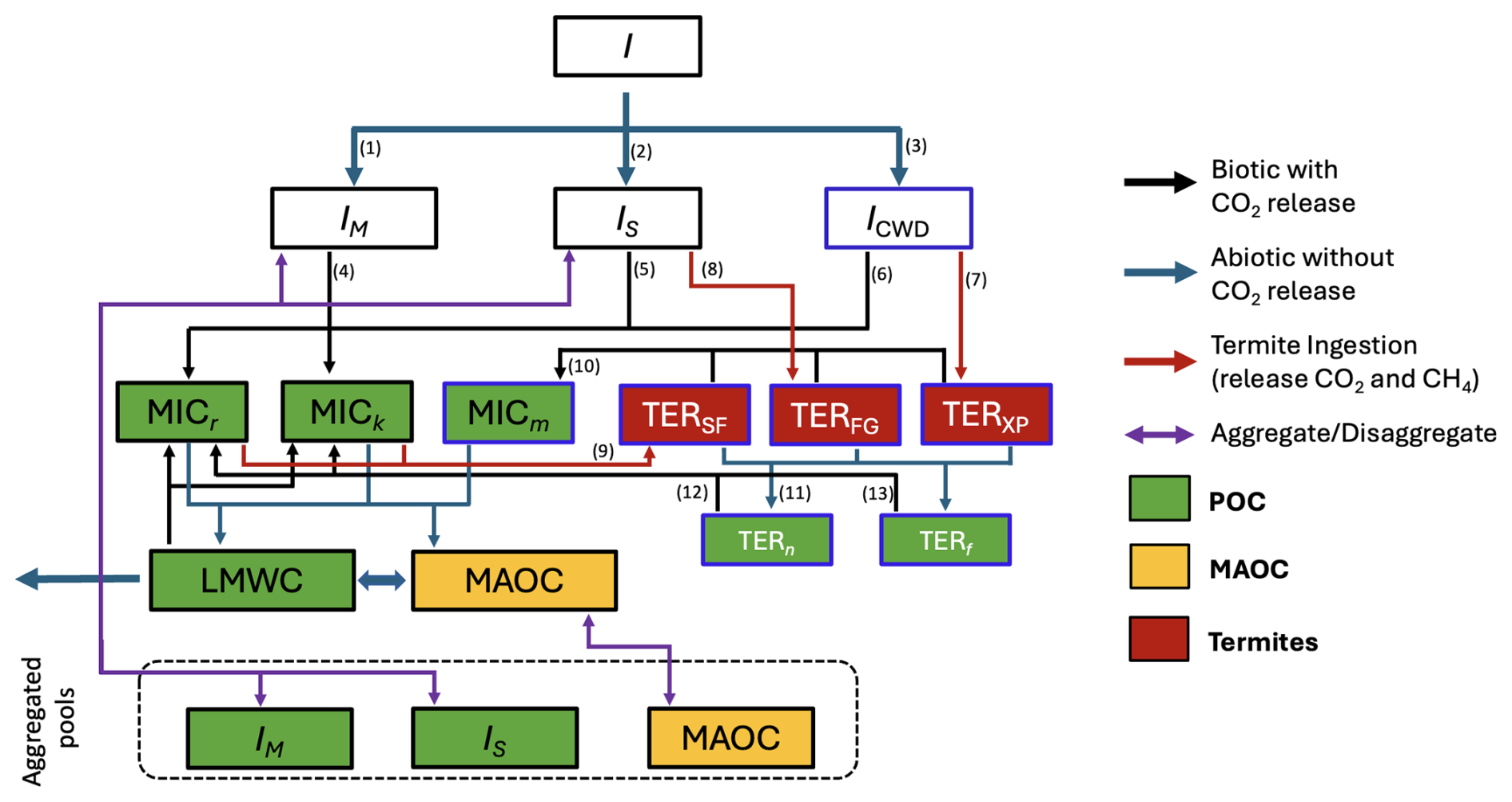
Figure 1Conceptual representation of soil organic carbon dynamics and transformation pathways in the pragmatic framework. Carbon inputs from litter (I) are partitioned into three litter pools: metabolic litter (IM), structural litter (IS), and coarse woody debris (ICWD). These substrates are decomposed by microbial functional groups representing r-strategists and k-strategists (MICr and MICk), producing dissolved organic carbon that contributes to the LMWC and MAOC pools. Termites (TERSF, TERFG, TERXP) consume IS and ICWD, releasing CO2 and CH4 and contribute to soil carbon transformations through residue inputs (TERn and TERf). Methanotrophic microbes (MICm) oxidize a fraction of the CH4 produced by termites. Arrows indicate different processes: black arrows represent biotic transformations with CO2 release, blue arrows represent abiotic transfers without CO2 release, red arrows indicate termite ingestion pathways associated with CO2 and CH4 emissions, and purple arrows represent aggregation and disaggregation processes. Boxes denote carbon pools, including POC, MAOC, and termite biomass. Carbon pools added to the model to represent termite-driven processes are indicated by blue-bordered boxes. Numbers in parenthesis indicate the equations in Sect. S1, corresponding to each depicted flux.
Termite biomass constitutes a transient carbon pool subject to continuous turnover (Fig. 1). Mortality produces termite necromass (TERn), while feeding generates frass (TERf); both re-enter the soil as organic inputs. These residues differ in their chemical characteristics and decomposition dynamics. Frass is typically finely processed and nutrient-enriched (Myer and Forschler, 2019), promoting relatively rapid decomposition and potentially enhancing soil aggregation. In contrast, necromass contains more structurally complex compounds, such as chitin and decomposes more slowly (Beier and Bertilsson, 2013; Camenzind et al., 2023). Both residual pools are processed by the heterotrophic microbial community and contribute to SOC formation through partitioning into LMWC and MAOC fluxes (Eqs. S12–S13 in the Supplement). Their decomposition rates are modulated by environmental drivers, particularly temperature and soil moisture, consistent with standard SOC model formulations.
These structural modifications represent a simple yet mechanistically interpretable extension of contemporary SOC models that preserves mass balance and microbial process representation. In the following section, we describe the spatial implementation and parameterization of the model and assess its sensitivity to key governing parameters.
The termite module was implemented within a spatially explicit framework driven by climate and ecosystem productivity. Simulations were conducted across grid cells representing major global vegetation classes in which termite activity is expected to occur. Potential termite habitat was defined using the global natural vegetation dataset of Ramankutty and Foley (1999) and was further constrained by a thermal suitability mask that excludes regions where monthly minimum air temperature falls below −8 °C, consistent with observed thermal limits for termite persistence (Fig. S1 in the Supplement; Ito, 2023).
Substrate supply to termites was represented through vegetation-derived litter inputs. The IM, IS, and ICWD pools were derived from net primary production and allocated according to vegetation-specific assumptions described in Sect. S1. Because the objective of this study was to evaluate termite-mediated carbon pathways rather than to reproduce a fully resolved SOC model, background microbial decomposition was represented using simplified first-order kinetics modified by temperature and soil moisture. This approach provides climatically realistic litter turnover and substrate availability while maintaining focus on termite-mediated carbon dynamics.
Termite biomass is strongly influenced by climate and ecosystem productivity and can vary by up to an order of magnitude across seasons (Jamali et al., 2011a). To capture this variability, termite biomass was modelled as a function of ecosystem productivity, using gross primary productivity (GPP) as a proxy for resource availability:
where TERi (g C m−2) is the biomass carbon of termite feeding guild i, GPP (g C m−2 d−1) is the daily gross primary productivity; γ (g termite m−2) and b (g−1 C m2 d) are vegetation-specific coefficients describing the relationship between ecosystem productivity and termite biomass; η is the carbon fraction of live termite biomass; λi is the fraction of total consumed carbon attributed to feeding guild i; king,i (g C g−1 termite C d−1) is the carbon ingestion rate; fB is the fraction of consumed carbon assimilated into biomass; and τB (d) is the biomass turnover time (Table 1). The first term represents biomass gains through carbon assimilation, while the second term represents losses due to turnover and mortality.
The coefficients γ and b are relatively well constrained for tropical ecosystems, where termite biomass observations are most abundant (Kirschke et al., 2013). For other vegetation types, these coefficients were calibrated to reproduce mean annual termite biomass estimates reported in previous syntheses and modelling studies (Kirschke et al., 2013; Sanderson, 1996). To reduce short-term variability, GPP was smoothed using a 7 d running mean prior to its use in biomass estimation. Total termite biomass was partitioned among three feeding guilds using vegetation- and location-specific fractions (λi) derived from the ecological observations. Baseline values and plausible ranges for all parameters are summarized in Table 1, while guild allocation assumptions are provided in Table S3 in the Supplement.
Carbon consumed by termites was subsequently partitioned among respiratory CO2, CH4 production, biomass growth, and excreted residues, consistent with the framework described in Sect. 2. Despite this process-based formulation, several parameters governing termite biomass dynamics, ingestion rates, carbon-use efficiency, and residue partitioning remain uncertain and vary across ecosystems. To systematically assess the influence of these uncertainties on model behavior and emergent carbon pathways, we conducted a global sensitivity analysis focusing on key annual fluxes, including CO2 production, CH4 emissions, and transfers to LMWC and MAOC pools. Detailed descriptions of the simulation protocol and sensitivity analysis are provided in Sects. S2 and S3.
Table 1Parameter values and ranges for integrating termite-mediated processes into SOC model.
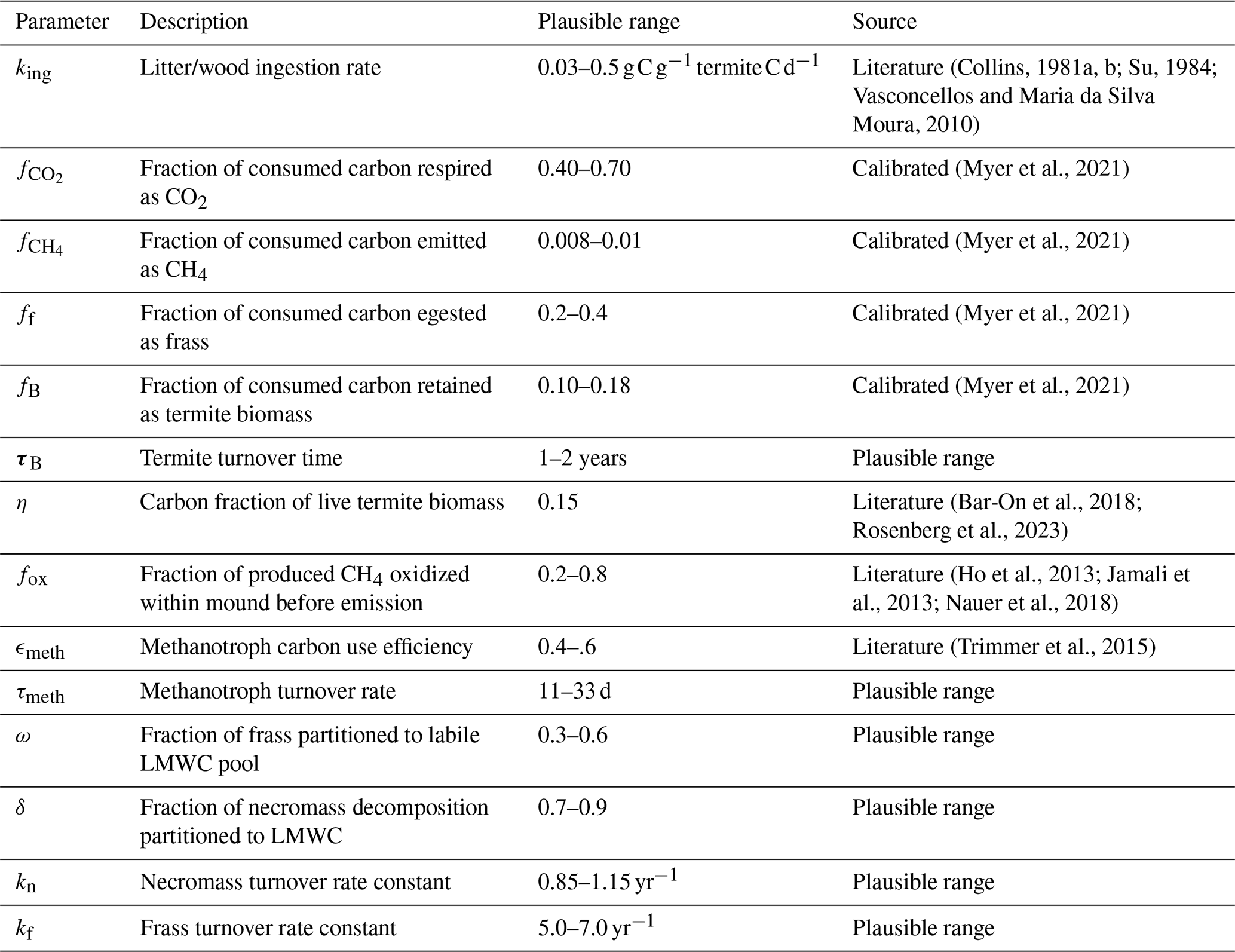
Note: Parameters marked as “Calibrated” were initialized from literature values (e.g., Myer et al., 2021) and subsequently adjusted within plausible ranges to ensure consistency with large-scale carbon flux constraints. Parameters marked as “Plausible range” were defined based on literature-informed bounds from analogous processes and mass balance considerations.
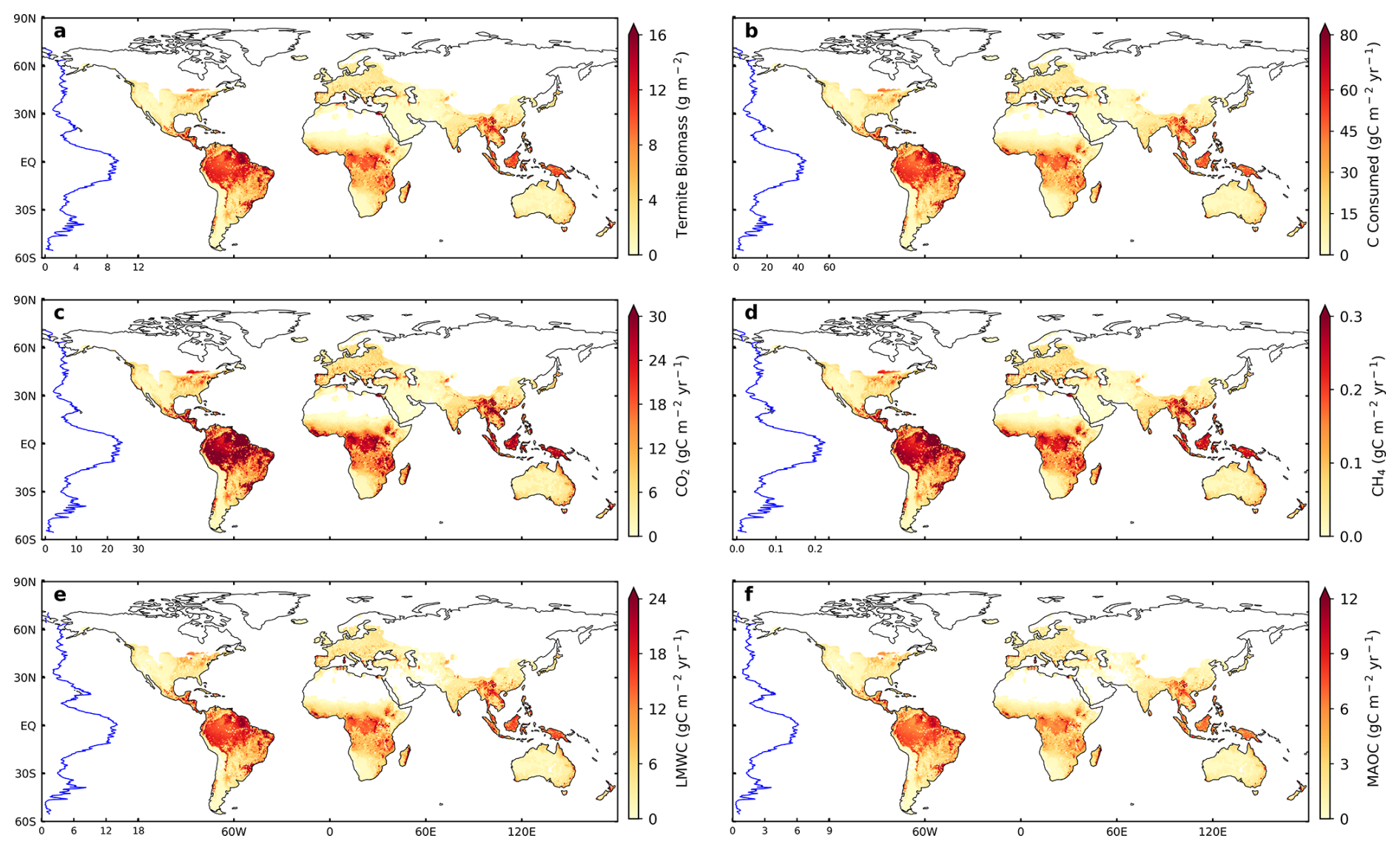
Figure 2Spatial distribution of termite-driven carbon pools. (a) Termite biomass. (b) Carbon consumed. (c) CO2 emissions. (d) Net CH4 emissions. (e) LMWC flux. (f) MAOC flux. The inset in each plot (blue line) shows the latitudinal mean of the corresponding variable, using the same units as the associated colorbar.
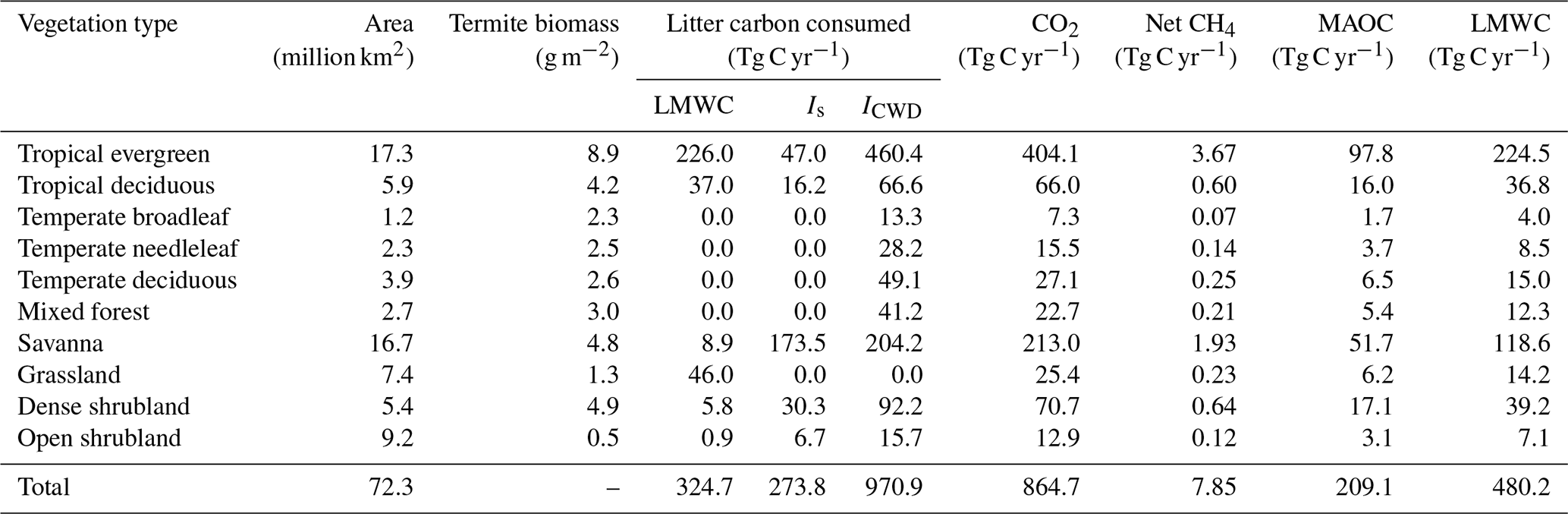
Model simulations reveal a pronounced biogeographic structure in termite-mediated carbon fluxes, shaped by vegetation type, climate, and the resulting distribution of termite biomass (Fig. 2, Table 2). Across vegetation classes, ecosystems supporting higher termite biomass consistently sustain larger termite-driven carbon fluxes, indicating that biomass exerts a dominant first-order control on flux magnitudes at the biome scale. This relationship is most evident in tropical evergreen forests, which support the highest mean termite biomass density (8.9 g m−2) and account for the largest share of global termite-mediated carbon processing, including consumption (733.4±374.0 Tg C yr−1), CO2 production (404.1±207.7 Tg C yr−1), CH4 emissions (3.7±2.3 Tg C yr−1), and soil carbon fluxes (97.8±52.8 Tg C yr−1 to MAOC; 224.5±119.0 Tg C yr−1 to LMWC). Savanna ecosystems show a similar, though less extreme, pattern, combining relatively high biomass (4.8 g m−2) with large areal extent to produce substantial regional carbon fluxes. In contrast, temperate broadleaf ecosystems, characterized by both low termite biomass and smallest areal extent, contribute the least to the termite-driven carbon pathway.
This biogeographic structure is expressed consistently across both gaseous and SOC-forming pathways. In our model estimates, termites consume 1569.4±800.4 Tg C yr−1 globally, releasing 864.7±444.5 Tg C yr−1 as CO2, and emitting 7.9±4.9 Tg C yr−1 as CH4, with tropical biomes contributing the majority of these fluxes. In addition to gaseous losses, the model indicates that termite activity generates substantial input to SOC formation, contributing 209.1±113.0 Tg C yr−1 to MAOC and 480.2±254.5 Tg C yr−1 to LMWC globally. It is important to note that the modeled MAOC flux represents carbon derived from frass and necromass and does not include additional SOC stabilization associated with soil ingestion, regurgitation, or aggregate formation during mound construction. These SOC input fluxes are likewise dominated by tropical evergreen forests and savannas, with dense shrublands contributing disproportionately relative to their areal extent (Table 2). It is important to note that most of the uncertainty in model outputs arises from the large range of king values reported in the literature. Nonetheless, the emergent spatial patterns and biome contrasts demonstrate that termites represent a globally important and spatially heterogeneous carbon-processing pathway.
Sensitivity analysis identified carbon throughput as the dominant control on termite-mediated carbon cycling (Fig. 3). Morris screening showed that the king has the largest absolute elementary effect (μ*) and standard deviation (σ) across annual outputs, indicating strong effects and some nonlinear responses. Secondary controls are associated with the productivity-biomass scaling relationship (Eq. 1) and carbon partitioning during ingestion, particularly and ff, whereas parameters related to CH4 partitioning, transient-pool turnover, and biomass retention have comparatively weak effects. Annual CH4 emissions are weakly sensitive to parameter perturbations within the tested ranges and are therefore not retained for Sobol analysis. Sobol variance decomposition confirmed that king explained the largest share of variance, followed by and the productivity-biomass scaling parameters. The influence of ff is most evident for MAOC flux, reflecting its role in transferring termite-processed carbon into stabilizable residue pools, while fB contributed little to output variance. Total-order indices only modestly exceeded first-order indices, indicating that direct parameter effects are more important than interactions. Overall, uncertainty in annual termite-mediated CO2, LMWC, and MAOC fluxes is governed mainly by the amount of carbon entering the termite pathway and its subsequent partitioning between respiration and residue formation. The implications of these findings for prioritizing future empirical work are discussed in Sect. 6.
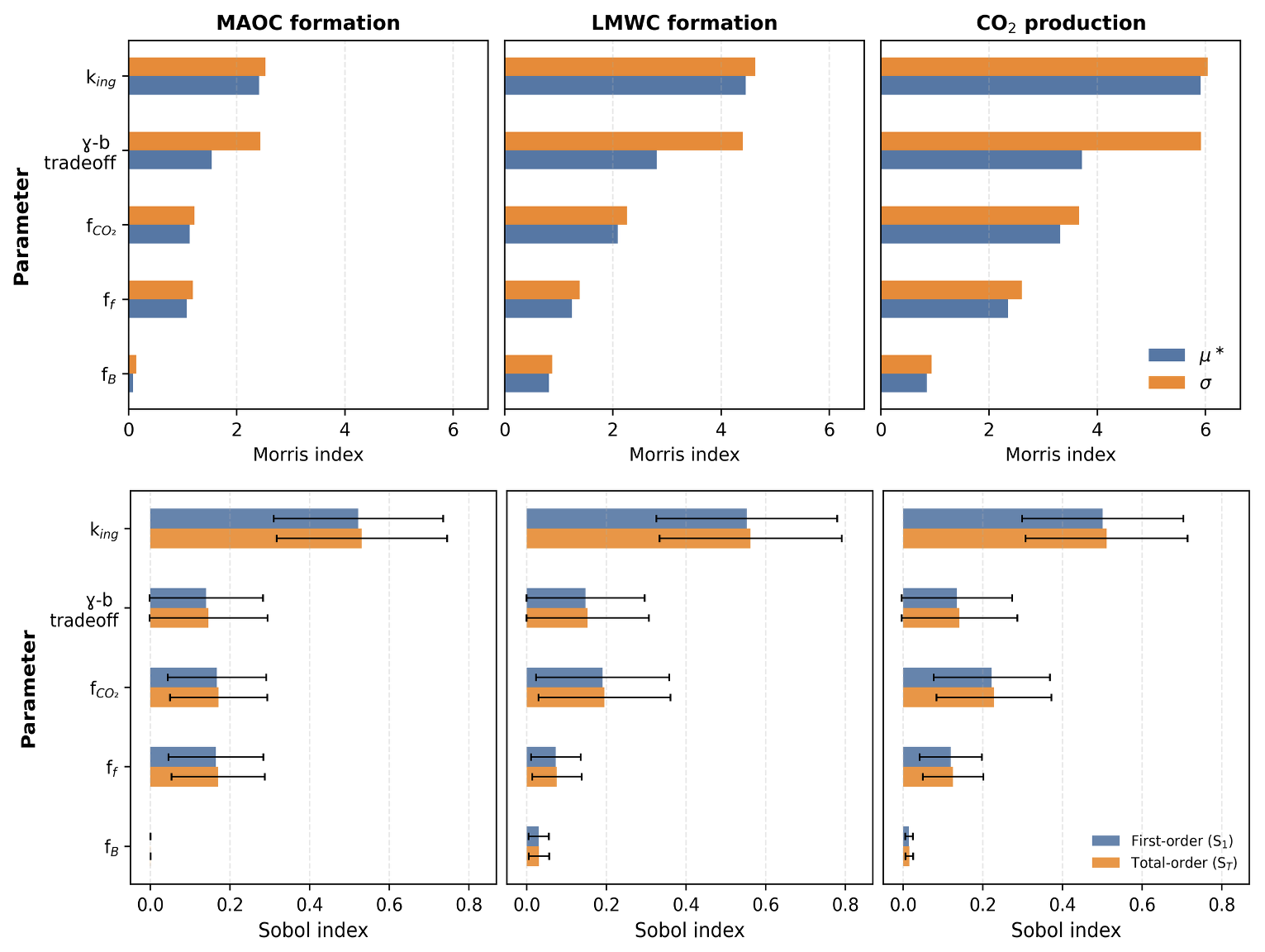
Figure 3Sensitivity analysis. Top row: Morris sensitivity analysis; bottom row: Sobol results.
Our simulations suggest that termites represent a substantial, yet still underrepresented, pathway in terrestrial carbon cycling, with their influence concentrated in tropical and seasonally dry ecosystems. Globally, the modeled termite pathway processed ∼3 % of annual litter inputs (Tables 2 and S1). This aggregate fraction, however, masks strong spatial heterogeneity: when expressed relative to litter supply, termite contributions are highest in warm, water-limited regions such as African savannas and grasslands (Fig. S2a), indicating that termites play a proportionally greater role where microbial decomposition is constrained by climatic conditions. These findings are consistent with previous studies showing that termite ecosystem engineering can enhance ecosystem resilience under water limitation, both in drylands and during droughts in tropical forests (Ashton et al., 2019; Bonachela et al., 2015). The spatial distribution of termite activity also highlight its potential sensitivity to future climate change: projected expansion of warm and seasonally dry ecosystems could increase the global extent of termite-suitable habitats and amplify the overall termite footprint in terrestrial carbon cycling (Anadón et al., 2014; Ito, 2023).
Termites' role is particularly pronounced for CWD decomposition, of which termites process ∼12 % globally. Given that CWD typically decomposes slowly due to physical protection and chemical recalcitrance (Kueppers et al., 2004; Magnússon et al., 2016), termite-driven fragmentation and translocation may alter its accessibility to microbial decomposition. While fragmentation can increase surface area and exposure, translocation often occurs into termite nests, where material may be protected or stabilized; as a result, overall accessibility may either increase or decrease depending on nest conditions and subsequent processing. Models that omit this pathway may therefore misrepresent CWD residence times and woody carbon persistence in low-latitude systems.
A substantial fraction of termite-processed carbon is rapidly returned to the atmosphere. The modeled termite-associated CO2 flux (3170.6±1629.8 Tg CO2 yr−1) corresponds to ∼3.2 %–4.7 % of global soil respiration (Bond-Lamberty and Thomson, 2010; Raich and Schlesinger, 2022), placing termites among the larger faunal contributors to terrestrial CO2 efflux. When normalized by the litter input, this flux peaks across African savannas and grasslands reaching up to 8 % of input carbon. Importantly, termite-associated CO2 flux should not be interpreted as an additional source independent of microbial respiration. Instead, termites redirect a portion of litter decomposition through a faunal pathway, implying that their omission primarily affects process representation rather than overall carbon balance. Because termite activity responds differently to temperature, moisture, and substrate characteristics than microbial decomposition, excluding this pathway may bias modeled sensitivities of soil respiration to climate variability, particularly in tropical regions where current models show persistent disagreement with top-down atmospheric constraints (Bastos et al., 2020; Chandra et al., 2022).
Termite-mediated CH4 emissions (10.5±6.5 Tg CH4 yr−1) further highlight their role in trace-gas cycling. This estimate is consistent with Global Methane Budget estimates (Saunois et al., 2025) and represents a non-negligible component of natural non-wetland CH4 sources. In contrast to wetland methanogenesis, termite-associated CH4 production depends on feeding guild, diet composition, gut symbionts, and mound-scale oxidation, all of which may respond nonlinearly to environmental conditions (Law et al., 2024; Yatsko et al., 2026). Consequently, excluding termites from CH4 inventories omits not only a source term but also a pathway with distinct environmental sensitivities, potentially limiting the ability of models to capture spatial variability in non-wetland methane emissions.
Beyond gaseous fluxes, termites influence the carbon flows within soils. By transforming litter into frass and necromass and redistributing organic material across soil horizons, termites modify both substrate accessibility and the physicochemical context for SOC stabilization. Our simulations indicate that termite activity contributes to both LMWC and MAOC pools, thereby altering the balance between short-term turnover and longer-term soil carbon retention. These effects challenge the prevailing assumption in many SOC models that microbial decomposition alone governs litter fate (Abramoff et al., 2018; Kyker-Snowman et al., 2020; Wang et al., 2025), highlighting the importance of consumer-mediated pathways in regulating the rate, location, and form of carbon inputs to microbial and mineral-associated processes.
Several structural assumptions in the current framework highlight key priorities for advancing representation of termite-driven carbon cycling. A central challenge concerns the treatment of termite biomass. As in many large-scale soil models, biomass is represented as spatially homogeneous within grid cells, whereas termite populations are inherently heterogeneous, organized into colonies, nests and mounds, and foraging networks (Eggleton and Tayasu, 2001). While this simplification is common, it is particularly consequential for termites because their activity generates localized hotspots of carbon consumption, residue deposition, and gas exchange (Davies et al., 2024; Muvengwi and Witkowski, 2020). In addition, model evaluation relies on a single global synthesis (Sanderson, 1996), based on sparse observations and large-scale extrapolation. Together, these limitations imply that while broad spatial patterns may be captured, uncertainty in both the magnitude and spatial organization of termite biomass remains a primary constraint on flux estimates.
Another important area of model development is resolving interactions between termites and the broader decomposer community. The current model isolates termite-mediated carbon processing and does not explicitly represent interactions with free-living microbes competing for or facilitated by shared substrates. Empirical evidence indicates that these interactions can shift between competitive and complementary modes depending on substrate quality and environmental conditions (Wijas et al., 2024; Zanne et al., 2022). While omission of these dynamics may still permit reasonable large-scale estimates of carbon stocks and fluxes, it limits process-level accuracy and the representation of feedbacks between faunal and microbial pathways.
Uncertainty in functional traits is a further key limitation. Although the model distinguishes major feeding guilds, it ignores biogeographic variation and assumes fixed values for ingestion rates and carbon partitioning within each guild. In reality, these traits vary across species, diets, and environmental conditions (Collins, 1981b, a; Su and LaFage, 1984; Zhou et al., 2023). Sensitivity analyses indicate that model outputs are particularly responsive to the ingestion rate, carbon partitioning to respiration, and residue allocation, as well as to the productivity-biomass scaling parameters. Improved empirical constraints on these parameters are therefore essential for reducing uncertainty in modeled fluxes. In addition, CH4 emissions are strongly modulated by within-mound oxidation processes, which depend on mound structure, moisture, temperature, and methanotrophic activity (Nauer et al., 2018; Yatsko et al., 2026). Explicit representation of this variability remains an important gap in current model formulation.
A further challenge lies in representing SOC stabilization processes. While the model estimates potential termite-mediated inputs to MAOC, it does not account for physicochemical constraints such as mineral surface area, oxide content, or saturation state (Fang et al., 2019; Georgiou et al., 2022; Haddix et al., 2020). As a result, modeled MAOC fluxes should be interpreted as potential inputs rather than realized long-term storage. Resolving where termite activity contributes to persistent carbon sequestration versus rapid cycling will require coupling biological processing with mineral constraints. Finally, the model adopts largely linear representations of process rates and carbon flows. Many underlying processes, including feeding responses, microbial priming, CH4 production and oxidation, and MAOC formation, are inherently nonlinear and subject to thresholds and saturation (King and Sokol, 2025; Morrissey et al., 2017; Yatsko et al., 2026). Incorporating these nonlinearities will be important for capturing emergent behavior, particularly under changing environmental conditions.
An additional consideration for future global implementation is how to represent termites within the broader faunal community without introducing excessive model complexity. Termite-mediated carbon cycling does not occur in isolation; interactions with larger animals, through effects on vegetation, litter inputs, soil disturbance, and termite activity, may indirectly modify termite-driven carbon processing (Buitenwerf et al., 2011; Charles et al., 2021; Kristensen et al., 2022). Explicitly representing these interactions alongside individual soil-fauna taxa and their functional subgroups would, however, increase model complexity. We therefore suggest that future frameworks prioritize process-based functional aggregation, whereby fauna sharing similar substrate use and effects on carbon transformations are represented collectively, while distinct identities are retained where they introduce biogeochemical pathways that cannot readily be generalized. Termites may warrant such distinction because, in addition to their substantial processing of plant and soil organic matter, they represent a direct biological source of CH4 (Law et al., 2024; Saunois et al., 2025) that cannot appropriately be assigned to a generic soil-fauna pool. Future model development should therefore test which faunal groups and associated processes can be aggregated without materially altering predicted carbon and GHG fluxes.
Despite these limitations and uncertainties, our model provides a first mechanistic framework for integrating termite-driven carbon processing into terrestrial carbon models. The consistency of spatial patterns with known termite biogeography and the agreement of flux magnitudes with broad empirical ranges (Ito, 2023; Sanderson, 1996; Saunois et al., 2025) suggest that the dominant controls are plausibly represented, even though uncertainties remain. Future progress will depend on embedding termite pathways within microbial-explicit SOC models, improving empirical constraints on biomass and key functional traits, and incorporating spatial and nonlinear processes. Priority measurements include biome-resolved termite biomass, guild-specific ingestion rates under field conditions, and carbon partitioning among respiration, CH4, frass, and biomass. Together, these advances will enable a transition from first-order global estimates to a more mechanistic representation of termite-driven carbon cycling in next-generation soil and Earth system models.
This study presents a process-based framework for representing termite-mediated carbon cycling that explicitly links biomass, feeding activity, and carbon partitioning within a mass-balance structure. By combining biome-specific termite biomass estimates with spatially explicit productivity forcing, the model provides a first-order global quantification of how termite activity redistributes carbon between atmospheric and soil pools.
Simulations suggest that termites process 1569±800 Tg C yr−1, releasing 3171±1630 Tg CO2 yr−1 and 10.5±6.5 Tg CH4 yr−1, while transferring 689±367 Tg C yr−1 into labile and mineral-associated SOC pools. Sensitivity analysis indicates that the magnitude of termite-mediated fluxes is primarily controlled by ingestion capacity and biomass, while the fate of processed carbon depends on partitioning among respiration, biomass, and residue formation. These results identify termites as an important pathway in terrestrial carbon cycling, and highlight key empirical priorities, particularly improved constraints on ingestion rates under field conditions and termite biomass distributions.
While the current framework simplifies spatial organization, trophic interactions, and soil physicochemical constraints, it provides a tractable basis for integrating macro-detritivore processes into SOC models. Coupling termite-driven carbon routing with microbial-explicit frameworks will be critical for resolving impacts on carbon residence times and climate feedbacks. More broadly, explicitly representing termite activity is likely to improve predictions of carbon cycling in tropical and seasonally dry ecosystems, highlighting the need to move beyond microbe-centric paradigms toward a more complete representation of terrestrial carbon-climate interactions.
The dataset presented in this article is available online at https://doi.org/10.25919/rqjd-nb40 (Farooq et al., 2026).
The supplement related to this article is available online at https://doi.org/10.5194/bg-23-7029-2026-supplement.
UF: Conceptualization, Data curation, Investigation, Writing – original draft, Writing – review & editing, Methodology, Formal analysis. CP: Conceptualization, Investigation, Writing – review & editing, Supervision, Methodology. YPW: Formal analysis, Writing – review & editing, Methodology. AEZ: Methodology, Writing – review & editing. HFM: Methodology, Writing – review & editing. BJW: Methodology, Writing – review & editing. DIF: Writing – review & editing. JRE: Writing – review & editing. BM: Writing – review & editing, Conceptualization, Funding acquisition, Resources. ZAB: Methodology, Writing – review & editing. SK: Conceptualization, Funding acquisition, Writing – review & editing, Supervision, Methodology.
The contact author has declared that none of the authors has any competing interests.
Publisher's note: Copernicus Publications remains neutral with regard to jurisdictional claims made in the text, published maps, institutional affiliations, or any other geographical representation in this paper. The authors bear the ultimate responsibility for providing appropriate place names. Views expressed in the text are those of the authors and do not necessarily reflect the views of the publisher.
This work was funded by the Terrestrial Ecosystem Research Network (TERN), an Australian Government NCRIS-enabled project and CSIRO.
This paper was edited by Bertrand Guenet and reviewed by Omar Flores and Jeppe Aagaard Kristensen.
Abramoff, R., Xu, X., Hartman, M., O'Brien, S., Feng, W., Davidson, E., Finzi, A., Moorhead, D., Schimel, J., Torn, M., and Mayes, M. A.: The Millennial model: in search of measurable pools and transformations for modeling soil carbon in the new century, Biogeochemistry, 137, 51–71, https://doi.org/10.1007/s10533-017-0409-7, 2018.
Anadón, J. D., Sala, O. E., and Maestre, F. T.: Climate change will increase savannas at the expense of forests and treeless vegetation in tropical and subtropical Americas, J. Ecol., 102, 1363–1373, https://doi.org/10.1111/1365-2745.12325, 2014.
Angst, G., Potapov, A., Joly, F.-X., Angst, ., Frouz, J., Ganault, P., and Eisenhauer, N.: Conceptualizing soil fauna effects on labile and stabilized soil organic matter, Nat. Commun., 15, 5005, https://doi.org/10.1038/s41467-024-49240-x, 2024.
Ashton, L. A., Griffiths, H. M., Parr, C. L., Evans, T. A., Didham, R. K., Hasan, F., Teh, Y. A., Tin, H. S., Vairappan, C. S., and Eggleton, P.: Termites mitigate the effects of drought in tropical rainforest, Science, 363, 174–177, https://doi.org/10.1126/science.aau9565, 2019.
Bar-On, Y. M., Phillips, R., and Milo, R.: The biomass distribution on Earth, P. Natl. Acad. Sci. USA, 115, 6506–6511, https://doi.org/10.1073/pnas.1711842115, 2018.
Bastos, A., O'Sullivan, M., Ciais, P., Makowski, D., Sitch, S., Friedlingstein, P., Chevallier, F., Rödenbeck, C., Pongratz, J., Luijkx, I. T., Patra, P. K., Peylin, P., Canadell, J. G., Lauerwald, R., Li, W., Smith, N. E., Peters, W., Goll, D. S., Jain, A. K., Kato, E., Lienert, S., Lombardozzi, D. L., Haverd, V., Nabel, J. E. M. S., Poulter, B., Tian, H., Walker, A. P., and Zaehle, S.: Sources of Uncertainty in Regional and Global Terrestrial CO2 Exchange Estimates, Global Biogeochem. Cy., 34, e2019GB006393, https://doi.org/10.1029/2019GB006393, 2020.
Beier, S. and Bertilsson, S.: Bacterial chitin degradation – mechanisms and ecophysiological strategies, Front. Microbiol., 4, https://doi.org/10.3389/fmicb.2013.00149, 2013.
Bignell, D. E. and Eggleton, P.: Termites in Ecosystems, in: Termites: Evolution, Sociality, Symbioses, Ecology, edited by: Abe, T., Bignell, D. E., and Higashi, M., Springer Netherlands, Dordrecht, 363–387, https://doi.org/10.1007/978-94-017-3223-9_17, 2000.
Bonachela, J. A., Pringle, R. M., Sheffer, E., Coverdale, T. C., Guyton, J. A., Caylor, K. K., Levin, S. A., and Tarnita, C. E.: Termite mounds can increase the robustness of dryland ecosystems to climatic change, Science, 347, 651–655, https://doi.org/10.1126/science.1261487, 2015.
Bond-Lamberty, B. and Thomson, A.: Temperature-associated increases in the global soil respiration record, Nature, 464, 579–582, https://doi.org/10.1038/nature08930, 2010.
Bourguignon, T., Lo, N., Šobotník, J., Ho, S. Y. W., Iqbal, N., Coissac, E., Lee, M., Jendryka, M. M., Sillam-Dussès, D., Křížková, B., Roisin, Y., and Evans, T. A.: Mitochondrial Phylogenomics Resolves the Global Spread of Higher Termites, Ecosystem Engineers of the Tropics, Mol. Biol. Evol., 34, 589–597, https://doi.org/10.1093/molbev/msw253, 2017.
Buitenwerf, R., Stevens, N., Gosling, C. M., Anderson, T. M., and Olff, H.: Interactions between large herbivores and litter removal by termites across a rainfall gradient in a South African savanna, J. Trop. Ecol., 27, 375–382, https://doi.org/10.1017/S0266467411000125, 2011.
Camenzind, T., Mason-Jones, K., Mansour, I., Rillig, M. C., and Lehmann, J.: Formation of necromass-derived soil organic carbon determined by microbial death pathways, Nat. Geosci., 16, 115–122, https://doi.org/10.1038/s41561-022-01100-3, 2023.
Chandra, N., Patra, P. K., Niwa, Y., Ito, A., Iida, Y., Goto, D., Morimoto, S., Kondo, M., Takigawa, M., Hajima, T., and Watanabe, M.: Estimated regional CO2 flux and uncertainty based on an ensemble of atmospheric CO2 inversions, Atmos. Chem. Phys., 22, 9215–9243, https://doi.org/10.5194/acp-22-9215-2022, 2022.
Charles, G. K., Riginos, C., Veblen, K. E., Kimuyu, D. M., and Young, T. P.: Termite mound cover and abundance respond to herbivore-mediated biotic changes in a Kenyan savanna, Ecol. Evol., 11, 7226–7238, https://doi.org/10.1002/ece3.7445, 2021.
Collins, N. M.: Consumption of Wood by Artificially Isolated Colonies of the Fungus-Growing Termite Macrotermes Bellicosus, Entomol. Exp. Appl., 29, 313–320, https://doi.org/10.1111/j.1570-7458.1981.tb03074.x, 1981a.
Collins, N. M.: The Role of Termites in the Decomposition of Wood and Leaf Litter in the Southern Guinea Savanna of Nigeria, Oecologia, 51, 389–399, 1981b.
Davies, A. B., Levick, S. R., Rensburg, B. J. van, Robertson, M. P., and Parr, C. L.: Context-dependent directional effects of termite mounds on soil nutrients, vegetation communities, and mammalian foraging, Ecosphere, 15, e4978, https://doi.org/10.1002/ecs2.4978, 2024.
Donovan, S. E., Eggleton, P., and Bignell, D. E.: Gut content analysis and a new feeding group classification of termites, Ecol. Entomol., 26, 356–366, https://doi.org/10.1046/j.1365-2311.2001.00342.x, 2001.
Eggleton, P. and Tayasu, I.: Feeding groups, lifetypes and the global ecology of termites, Ecol. Res., 16, 941–960, https://doi.org/10.1046/j.1440-1703.2001.00444.x, 2001.
Fang, K., Qin, S., Chen, L., Zhang, Q., and Yang, Y.: Al/Fe Mineral Controls on Soil Organic Carbon Stock Across Tibetan Alpine Grasslands, J. Geophys. Res.-Biogeo., 124, 247–259, https://doi.org/10.1029/2018JG004782, 2019.
Farooq, U., Pasut, C., Wang, Y., Zanned, E. A., Flores Moreno, H., Wijas, B., Forrester, D., England, J., Macdonald, B., Brown, Z., and Karunaratne, S.: Global Model Outputs for Termite-Mediated Carbon Fluxes and Soil Organic Carbon Dynamics. v1, CSIRO Data Collection [data set], https://doi.org/10.25919/rqjd-nb40, 2026.
Fierer, N., Colman, B. P., Schimel, J. P., and Jackson, R. B.: Predicting the temperature dependence of microbial respiration in soil: A continental-scale analysis, Global Biogeochem. Cy., 20, https://doi.org/10.1029/2005GB002644, 2006.
Georgiou, K., Jackson, R. B., Vinduková, O., Abramoff, R. Z., Ahlström, A., Feng, W., Harden, J. W., Pellegrini, A. F. A., Polley, H. W., Soong, J. L., Riley, W. J., and Torn, M. S.: Global stocks and capacity of mineral-associated soil organic carbon, Nat. Commun., 13, 3797, https://doi.org/10.1038/s41467-022-31540-9, 2022.
Griffiths, H. M., Ashton, L. A., Evans, T. A., Parr, C. L., and Eggleton, P.: Termites can decompose more than half of deadwood in tropical rainforest, Curr. Biol., 29, R118–R119, https://doi.org/10.1016/j.cub.2019.01.012, 2019.
Haddix, M. L., Gregorich, E. G., Helgason, B. L., Janzen, H., Ellert, B. H., and Francesca Cotrufo, M.: Climate, carbon content, and soil texture control the independent formation and persistence of particulate and mineral-associated organic matter in soil, Geoderma, 363, 114160, https://doi.org/10.1016/j.geoderma.2019.114160, 2020.
Ho, A., Erens, H., Mujinya, B. B., Boeckx, P., Baert, G., Schneider, B., Frenzel, P., Boon, N., and Van Ranst, E.: Termites Facilitate Methane Oxidation and Shape the Methanotrophic Community, Appl. Environ. Microbiol., 79, 7234–7240, https://doi.org/10.1128/AEM.02785-13, 2013.
Huston, M. A. and Wolverton, S.: The global distribution of net primary production: resolving the paradox, Ecol. Monogr., 79, 343–377, https://doi.org/10.1890/08-0588.1, 2009.
Issoufou, A. amadou, Soumana, I., Maman, G., Konate, S., and Mahamane, A.: Effects of termites growth on litter decomposition: a modeling approach, Int. J. Recycl. Org. Waste Agric., 8, 415–421, https://doi.org/10.1007/s40093-019-00314-7, 2019.
Ito, A.: Global termite methane emissions have been affected by climate and land-use changes, Sci. Rep., 13, 17195, https://doi.org/10.1038/s41598-023-44529-1, 2023.
Jamali, H., Livesley, S. J., Dawes, T. Z., Hutley, L. B., and Arndt, S. K.: Termite mound emissions of CH4 and CO2 are primarily determined by seasonal changes in termite biomass and behaviour, Oecologia, 167, 525–534, https://doi.org/10.1007/s00442-011-1991-3, 2011a.
Jamali, H., Livesley, S. J., Grover, S. P., Dawes, T. Z., Hutley, L. B., Cook, G. D., and Arndt, S. K.: The Importance of Termites to the CH4 Balance of a Tropical Savanna Woodland of Northern Australia, Ecosystems, 14, 698–709, https://doi.org/10.1007/s10021-011-9439-5, 2011b.
Jamali, H., Livesley, S. J., Hutley, L. B., Fest, B., and Arndt, S. K.: The relationships between termite mound emissions and internal concentration ratios are species specific, Biogeosciences, 10, 2229–2240, https://doi.org/10.5194/bg-10-2229-2013, 2013.
Jouquet, P., Dauber, J., Lagerlöf, J., Lavelle, P., and Lepage, M.: Soil invertebrates as ecosystem engineers: Intended and accidental effects on soil and feedback loops, Appl. Soil Ecol., 32, 153–164, https://doi.org/10.1016/j.apsoil.2005.07.004, 2006.
Jouquet, P., Traoré, S., Choosai, C., Hartmann, C., and Bignell, D.: Influence of termites on ecosystem functioning. Ecosystem services provided by termites, Eur. J. Soil Biol., 47, 215–222, https://doi.org/10.1016/j.ejsobi.2011.05.005, 2011.
King, A. E. and Sokol, N. W.: Soil carbon formation is promoted by saturation deficit and existing mineral-associated carbon, not by microbial carbon-use efficiency, Sci. Adv., 11, eadv9482, https://doi.org/10.1126/sciadv.adv9482, 2025.
Kirschke, S., Bousquet, P., Ciais, P., Saunois, M., Canadell, J. G., Dlugokencky, E. J., Bergamaschi, P., Bergmann, D., Blake, D. R., Bruhwiler, L., Cameron-Smith, P., Castaldi, S., Chevallier, F., Feng, L., Fraser, A., Heimann, M., Hodson, E. L., Houweling, S., Josse, B., Fraser, P. J., Krummel, P. B., Lamarque, J.-F., Langenfelds, R. L., Le Quéré, C., Naik, V., O'Doherty, S., Palmer, P. I., Pison, I., Plummer, D., Poulter, B., Prinn, R. G., Rigby, M., Ringeval, B., Santini, M., Schmidt, M., Shindell, D. T., Simpson, I. J., Spahni, R., Steele, L. P., Strode, S. A., Sudo, K., Szopa, S., van der Werf, G. R., Voulgarakis, A., van Weele, M., Weiss, R. F., Williams, J. E., and Zeng, G.: Three decades of global methane sources and sinks, Nat. Geosci., 6, 813–823, https://doi.org/10.1038/ngeo1955, 2013.
Kristensen, J. A., Svenning, J.-C., Georgiou, K., and Malhi, Y.: Can large herbivores enhance ecosystem carbon persistence?, Trends Ecol. Evol., 37, 117–128, https://doi.org/10.1016/j.tree.2021.09.006, 2022.
Kueppers, L. M., Southon, J., Baer, P., and Harte, J.: Dead wood biomass and turnover time, measured by radiocarbon, along a subalpine elevation gradient, Oecologia, 141, 641–651, https://doi.org/10.1007/s00442-004-1689-x, 2004.
Kyker-Snowman, E., Wieder, W. R., Frey, S. D., and Grandy, A. S.: Stoichiometrically coupled carbon and nitrogen cycling in the MIcrobial-MIneral Carbon Stabilization model version 1.0 (MIMICS-CN v1.0), Geosci. Model Dev., 13, 4413–4434, https://doi.org/10.5194/gmd-13-4413-2020, 2020.
Laub, M., Blagodatsky, S., Van de Broek, M., Schlichenmaier, S., Kunlanit, B., Six, J., Vityakon, P., and Cadisch, G.: SAMM version 1.0: a numerical model for microbial- mediated soil aggregate formation, Geosci. Model Dev., 17, 931–956, https://doi.org/10.5194/gmd-17-931-2024, 2024.
Law, S. J., Allison, S. D., Davies, A. B., Flores-Moreno, H., Wijas, B. J., Yatsko, A. R., Zhou, Y., Zanne, A. E., and Eggleton, P.: The challenge of estimating global termite methane emissions, Glob. Change Biol., 30, e17390, https://doi.org/10.1111/gcb.17390, 2024.
Lima, S. S. de, Pereira, M. G., Pereira, R. N., Pontes, R. M. de, and Rossi, C. Q.: Termite Mounds Effects on Soil Properties in the Atlantic Forest Biome, Rev. Bras. Ciênc. Solo, 42, e0160564, https://doi.org/10.1590/18069657rbcs20160564, 2018.
Magnússon, R. Í., Tietema, A., Cornelissen, J. H. C., Hefting, M. M., and Kalbitz, K.: Tamm Review: Sequestration of carbon from coarse woody debris in forest soils, For. Ecol. Manag., 377, 1–15, https://doi.org/10.1016/j.foreco.2016.06.033, 2016.
Morrissey, E. M., Mau, R. L., Schwartz, E., McHugh, T. A., Dijkstra, P., Koch, B. J., Marks, J. C., and Hungate, B. A.: Bacterial carbon use plasticity, phylogenetic diversity and the priming of soil organic matter, ISME J., 11, 1890–1899, https://doi.org/10.1038/ismej.2017.43, 2017.
Muvengwi, J. and Witkowski, E. T. F.: Cascading effects of termite mounds in African savannas, N. Z. J. Bot., 58, 167–193, https://doi.org/10.1080/0028825X.2020.1767162, 2020.
Myer, A. and Forschler, B. T.: Evidence for the Role of Subterranean Termites (Reticulitermes spp.) in Temperate Forest Soil Nutrient Cycling, Ecosystems, 22, 602–618, https://doi.org/10.1007/s10021-018-0291-8, 2019.
Myer, A., Myer, M. H., Trettin, C. C., and Forschler, B. T.: The fate of carbon utilized by the subterranean termite Reticulitermes flavipes, Ecosphere, 12, e03872, https://doi.org/10.1002/ecs2.3872, 2021.
Nauer, P. A., Hutley, L. B., and Arndt, S. K.: Termite mounds mitigate half of termite methane emissions, P. Natl. Acad. Sci. USA, 115, 13306–13311, https://doi.org/10.1073/pnas.1809790115, 2018.
Otani, S., Hansen, L. H., Sørensen, S. J., and Poulsen, M.: Bacterial communities in termite fungus combs are comprised of consistent gut deposits and contributions from the environment, Microb. Ecol., 71, 207–220, https://doi.org/10.1007/s00248-015-0692-6, 2016.
Raich, J. W. and Schlesinger, W. H.: The global carbon dioxide flux in soil respiration and its relationship to vegetation and climate, Tellus B, 44, 81–99, https://doi.org/10.3402/tellusb.v44i2.15428, 2022.
Ramankutty, N. and Foley, J. A.: Estimating historical changes in global land cover: Croplands from 1700 to 1992, Global Biogeochem. Cy., 13, 997–1027, https://doi.org/10.1029/1999GB900046, 1999.
Rosenberg, Y., Bar-On, Y. M., Fromm, A., Ostikar, M., Shoshany, A., Giz, O., and Milo, R.: The global biomass and number of terrestrial arthropods, Sci. Adv., 9, eabq4049, https://doi.org/10.1126/sciadv.abq4049, 2023.
Sanderson, M. G.: Biomass of termites and their emissions of methane and carbon dioxide: A global database, Global Biogeochem. Cy., 10, 543–557, https://doi.org/10.1029/96GB01893, 1996.
Saunois, M., Martinez, A., Poulter, B., Zhang, Z., Raymond, P. A., Regnier, P., Canadell, J. G., Jackson, R. B., Patra, P. K., Bousquet, P., Ciais, P., Dlugokencky, E. J., Lan, X., Allen, G. H., Bastviken, D., Beerling, D. J., Belikov, D. A., Blake, D. R., Castaldi, S., Crippa, M., Deemer, B. R., Dennison, F., Etiope, G., Gedney, N., Höglund-Isaksson, L., Holgerson, M. A., Hopcroft, P. O., Hugelius, G., Ito, A., Jain, A. K., Janardanan, R., Johnson, M. S., Kleinen, T., Krummel, P. B., Lauerwald, R., Li, T., Liu, X., McDonald, K. C., Melton, J. R., Mühle, J., Müller, J., Murguia-Flores, F., Niwa, Y., Noce, S., Pan, S., Parker, R. J., Peng, C., Ramonet, M., Riley, W. J., Rocher-Ros, G., Rosentreter, J. A., Sasakawa, M., Segers, A., Smith, S. J., Stanley, E. H., Thanwerdas, J., Tian, H., Tsuruta, A., Tubiello, F. N., Weber, T. S., van der Werf, G. R., Worthy, D. E. J., Xi, Y., Yoshida, Y., Zhang, W., Zheng, B., Zhu, Q., Zhu, Q., and Zhuang, Q.: Global Methane Budget 2000–2020, Earth Syst. Sci. Data, 17, 1873–1958, https://doi.org/10.5194/essd-17-1873-2025, 2025.
Seibold, S., Rammer, W., Hothorn, T., Seidl, R., Ulyshen, M. D., Lorz, J., Cadotte, M. W., Lindenmayer, D. B., Adhikari, Y. P., Aragón, R., Bae, S., Baldrian, P., Barimani Varandi, H., Barlow, J., Bässler, C., Beauchêne, J., Berenguer, E., Bergamin, R. S., Birkemoe, T., Boros, G., Brandl, R., Brustel, H., Burton, P. J., Cakpo-Tossou, Y. T., Castro, J., Cateau, E., Cobb, T. P., Farwig, N., Fernández, R. D., Firn, J., Gan, K. S., González, G., Gossner, M. M., Habel, J. C., Hébert, C., Heibl, C., Heikkala, O., Hemp, A., Hemp, C., Hjältén, J., Hotes, S., Kouki, J., Lachat, T., Liu, J., Liu, Y., Luo, Y.-H., Macandog, D. M., Martina, P. E., Mukul, S. A., Nachin, B., Nisbet, K., O'Halloran, J., Oxbrough, A., Pandey, J. N., Pavlíček, T., Pawson, S. M., Rakotondranary, J. S., Ramanamanjato, J.-B., Rossi, L., Schmidl, J., Schulze, M., Seaton, S., Stone, M. J., Stork, N. E., Suran, B., Sverdrup-Thygeson, A., Thorn, S., Thyagarajan, G., Wardlaw, T. J., Weisser, W. W., Yoon, S., Zhang, N., and Müller, J.: The contribution of insects to global forest deadwood decomposition, Nature, 597, 77–81, https://doi.org/10.1038/s41586-021-03740-8, 2021.
Su, N.-Y.: Comparison of Laboratory Methods for Estimating Wood Consumption Rates by Coptotermes formosanus (Isoptera: Rhinotermitidae), Ann. Entomol. Soc. Am., 77, 125–129, https://doi.org/10.1093/AESA/77.2.125, 1984.
Su, N.-Y. and LaFage, J. P.: Comparison of Laboratory Methods for Estimating Wood Consumption Rates by Coptotermes formosanus (Isoptera: Rhinotermitidae), Ann. Entomol. Soc. Am., 77, 125–129, https://doi.org/10.1093/aesa/77.2.125, 1984.
Sugimoto, A., Bignell, D. E., and MacDonald, J. A.: Global Impact of Termites on the Carbon Cycle and Atmospheric Trace Gases, in: Termites: Evolution, Sociality, Symbioses, Ecology, edited by: Abe, T., Bignell, D. E., and Higashi, M., Springer Netherlands, Dordrecht, 409–435, https://doi.org/10.1007/978-94-017-3223-9_19, 2000.
Trimmer, M., Shelley, F. C., Purdy, K. J., Maanoja, S. T., Chronopoulou, P.-M., and Grey, J.: Riverbed methanotrophy sustained by high carbon conversion efficiency, ISME J., 9, 2304–2314, https://doi.org/10.1038/ismej.2015.98, 2015.
Vasconcellos, A. and Maria da Silva Moura, F.: Wood litter consumption by three species of Nasutitermes termites in an area of the Atlantic Coastal Forest in northeastern Brazil, J. Insect Sci., 10, 72, https://doi.org/10.1673/031.010.7201, 2010.
Wang, L., Abramowitz, G., Wang, Y.-P., Pitman, A., Ciais, P., and Goll, D. S.: Using explainable AI to diagnose the representation of environmental drivers in process-based soil organic carbon models, Biogeosciences, 22, 7845–7863, https://doi.org/10.5194/bg-22-7845-2025, 2025.
Wijas, B. J., Flores-Moreno, H., Allison, S. D., Rodriguez, L. C., Cheesman, A. W., Cernusak, L. A., Clement, R., Cornwell, W. K., Duan, E. S., Eggleton, P., Rosenfield, M. V., Yatsko, A. R., and Zanne, A. E.: Drivers of wood decay in tropical ecosystems: Termites versus microbes along spatial, temporal and experimental precipitation gradients, Funct. Ecol., 38, 546–559, https://doi.org/10.1111/1365-2435.14494, 2024.
Yatsko, A. R., Eggleton, P., Jones, C., Pérez-Losada, M., Ramos-Tapia, I., Powell, J. R., Wijas, B., and Zanne, A. E.: Rethinking Termite Methane Emissions: Does the Mound Environment Matter?, Glob. Change Biol., 32, e70838, https://doi.org/10.1111/gcb.70838, 2026.
Zanne, A. E., Flores-Moreno, H., Powell, J. R., Cornwell, W. K., Dalling, J. W., Austin, A. T., Classen, A. T., Eggleton, P., Okada, K., Parr, C. L., Adair, E. C., Adu-Bredu, S., Alam, M. A., Alvarez-Garzón, C., Apgaua, D., Aragón, R., Ardon, M., Arndt, S. K., Ashton, L. A., Barber, N. A., Beauchêne, J., Berg, M. P., Beringer, J., Boer, M. M., Bonet, J. A., Bunney, K., Burkhardt, T. J., Carvalho, D., Castillo-Figueroa, D., Cernusak, L. A., Cheesman, A. W., Cirne-Silva, T. M., Cleverly, J. R., Cornelissen, J. H. C., Curran, T. J., D'Angioli, A. M., Dallstream, C., Eisenhauer, N., Evouna Ondo, F., Fajardo, A., Fernandez, R. D., Ferrer, A., Fontes, M. A. L., Galatowitsch, M. L., González, G., Gottschall, F., Grace, P. R., Granda, E., Griffiths, H. M., Guerra Lara, M., Hasegawa, M., Hefting, M. M., Hinko-Najera, N., Hutley, L. B., Jones, J., Kahl, A., Karan, M., Keuskamp, J. A., Lardner, T., Liddell, M., Macfarlane, C., Macinnis-Ng, C., Mariano, R. F., Méndez, M. S., Meyer, W. S., Mori, A. S., Moura, A. S., Northwood, M., Ogaya, R., Oliveira, R. S., Orgiazzi, A., Pardo, J., Peguero, G., Penuelas, J., Perez, L. I., Posada, J. M., Prada, C. M., Přívětivý, T., Prober, S. M., Prunier, J., Quansah, G. W., Resco de Dios, V., Richter, R., Robertson, M. P., Rocha, L. F., Rúa, M. A., Sarmiento, C., Silberstein, R. P., Silva, M. C., Siqueira, F. F., Stillwagon, M. G., Stol, J., Taylor, M. K., Teste, F. P., Tng, D. Y. P., Tucker, D., Türke, M., Ulyshen, M. D., Valverde-Barrantes, O. J., van den Berg, E., van Logtestijn, R. S. P., Veen, G. F., Vogel, J. G., Wardlaw, T. J., Wiehl, G., Wirth, C., Woods, M. J., and Zalamea, P.-C.: Termite sensitivity to temperature affects global wood decay rates, Science, 377, 1440–1444, https://doi.org/10.1126/science.abo3856, 2022.
Zhou, Y., Staver, A. C., and Davies, A. B.: Species-level termite methane production rates, Ecology, 104, e3905, https://doi.org/10.1002/ecy.3905, 2023.
- Abstract
- Introduction
- Incorporating termite-mediated decomposition within contemporary SOC models
- Implementation of a minimal termite module
- Emergent patterns and controls on termite carbon processing
- Implications for terrestrial carbon cycle
- Caveats and priorities for empirical work
- Conclusions
- Data availability
- Author contributions
- Competing interests
- Disclaimer
- Financial support
- Review statement
- References
- Supplement
- Abstract
- Introduction
- Incorporating termite-mediated decomposition within contemporary SOC models
- Implementation of a minimal termite module
- Emergent patterns and controls on termite carbon processing
- Implications for terrestrial carbon cycle
- Caveats and priorities for empirical work
- Conclusions
- Data availability
- Author contributions
- Competing interests
- Disclaimer
- Financial support
- Review statement
- References
- Supplement