
Articles | Volume 23, issue 19
https://doi.org/10.5194/bg-23-7029-2026
© Author(s) 2026. This work is distributed under
the Creative Commons Attribution 4.0 License.
the Creative Commons Attribution 4.0 License.
https://doi.org/10.5194/bg-23-7029-2026
© Author(s) 2026. This work is distributed under
the Creative Commons Attribution 4.0 License.
the Creative Commons Attribution 4.0 License.
Ideas and perspectives
| 
07 Oct 2026
Ideas and perspectives |
| 07 Oct 2026
| 07 Oct 2026
Ideas and perspectives: Beyond microbes – integrating termites into global soil carbon cycling models
Umar Farooq
CORRESPONDING AUTHOR

CSIRO Agriculture and Food, Canberra, Australian Capital Territory, Australia
Chiara Pasut
CSIRO Agriculture and Food, Waite Campus, South Australia, Australia
Ying-Ping Wang
CSIRO Environment, Clayton South, Victoria, Australia
Amy E. Zanne
Cary Institute of Ecosystem Studies, Millbrook, New York, USA
Habacuc Flores-Moreno
CSIRO Health and Biosecurity, Dutton Park, Queensland, Australia
Baptiste Joseph Wijas
Cary Institute of Ecosystem Studies, Millbrook, New York, USA
School of Environment, University of Queensland, Brisbane, Queensland, Australia
David I. Forrester
CSIRO Environment, Canberra, Australian Capital Territory, Australia
Jacqueline R. England
CSIRO Environment, Clayton South, Victoria, Australia
Bennett Macdonald
CSIRO Agriculture and Food, Canberra, Australian Capital Territory, Australia
Zachary A. Brown
CSIRO Agriculture and Food, Canberra, Australian Capital Territory, Australia
Senani Karunaratne
CSIRO Agriculture and Food, Canberra, Australian Capital Territory, Australia
Related authors
No articles found.
Billal Hossen, Patrick Filippi, Dhahi Al-Shammari, Nikolas Hoskin, Senani Karunaratne, and Thomas F. A. Bishop
EGUsphere, https://doi.org/10.5194/egusphere-2026-2466, https://doi.org/10.5194/egusphere-2026-2466, 2026
Short summary
Short summary
We studied how much carbon soil could store and what limits it on farms. Using data from many farms across Australia, we compared current carbon levels with achievable levels and identified the main factors holding them back. We found that limits differ by soil condition and rainfall, meaning one solution does not fit all. This approach helps farmers target the right actions to improve soil health and increase carbon storage more effectively.
Jeffrey Beem-Miller, William J. Riley, Peter B. Reich, Michael W. I. Schmidt, Yuxuan Bai, Raimundo Bermudez Villanueva, Zach Brown, Abad Chabbi, Susan E. Crow, Wenxu Dong, Serita D. Frey, Paul J. Hanson, Kai Jensen, Melissa A. Knorr, Emma Lathrop, Avni Malhotra, Patrick Megonigal, Adrienne Nicotra, Andrew Nottingham, Genevieve L. Noyce, Roy L. Rich, Heidi Rodenhizer, Agustín Sarquis, Andreas Schindlbacher, Edward A. G. Schuur, Zheng Shi, Artur Stefanski, Viktoria Unger, Tana E. Wood, Yuanhe Yang, Zhijie Yang, Jizhong Zhou, Biao Zhu, and Margaret S. Torn
Earth Syst. Sci. Data Discuss., https://doi.org/10.5194/essd-2026-23, https://doi.org/10.5194/essd-2026-23, 2026
Revised manuscript accepted for ESSD
Short summary
Short summary
The Soil Warming to Depth Data Integration Effort (SWEDDIE) synthesizes data from deep soil warming experiments around the world (n = 23), offering new insight into warming responses of both surface and subsoils. We demonstrate that variation in soil warming with depth is driven largely by warming methodology, while soil moisture changes due to warming differ by ecosystem. This work serves a foundation for future syntheses with SWEDDIE.
Lingfei Wang, Gab Abramowitz, Ying-Ping Wang, Andy Pitman, Philippe Ciais, and Daniel S. Goll
Biogeosciences, 22, 7845–7863, https://doi.org/10.5194/bg-22-7845-2025, https://doi.org/10.5194/bg-22-7845-2025, 2025
Short summary
Short summary
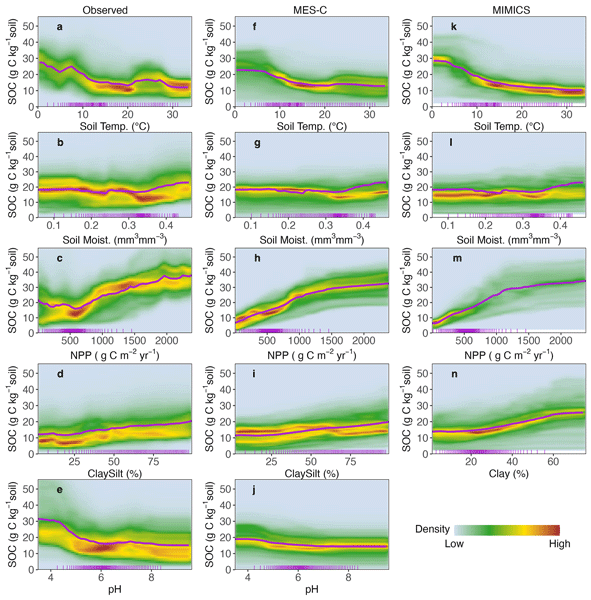
Accurate estimates of global soil organic carbon (SOC) content and its spatial pattern are critical for future climate change mitigation. However, the most advanced process-based SOC models struggle to do this task. Here we apply multiple explainable machine learning methods to identify missing variables and misrepresented relationships between environmental factors and SOC in these models, offering new insights to guide model development for more reliable SOC predictions.

Yi Xi, Philippe Ciais, Dan Zhu, Chunjing Qiu, Yuan Zhang, Shushi Peng, Gustaf Hugelius, Simon P. K. Bowring, Daniel S. Goll, and Ying-Ping Wang
Geosci. Model Dev., 18, 6043–6062, https://doi.org/10.5194/gmd-18-6043-2025, https://doi.org/10.5194/gmd-18-6043-2025, 2025
Short summary
Short summary
Including high-latitude deep carbon is critical for projecting future soil carbon emissions, yet it is absent in most land surface models. Here we propose a new carbon accumulation protocol by integrating deep carbon from Yedoma deposits and representing the observed history of peat carbon formation in ORCHIDEE-MICT. Our results show an additional 157 Pg C in present-day Yedoma deposits and a 1–5 m shallower peat depth and 43 % less passive soil carbon in peatlands compared to the conventional protocol.
Lingfei Wang, Gab Abramowitz, Ying-Ping Wang, Andy Pitman, and Raphael A. Viscarra Rossel
SOIL, 10, 619–636, https://doi.org/10.5194/soil-10-619-2024, https://doi.org/10.5194/soil-10-619-2024, 2024
Short summary
Short summary
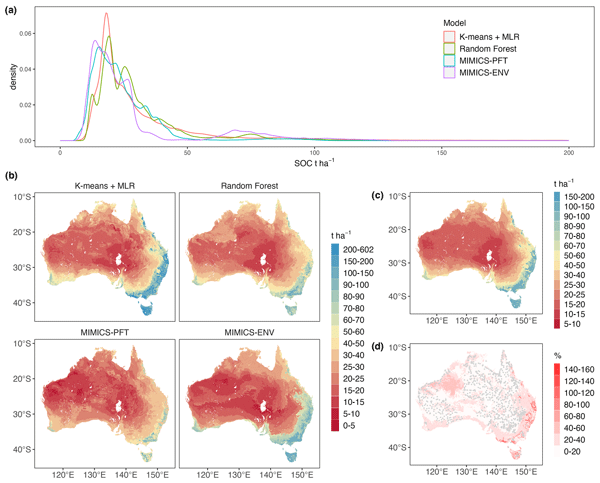
Effective management of soil organic carbon (SOC) requires accurate knowledge of its distribution and factors influencing its dynamics. We identify the importance of variables in spatial SOC variation and estimate SOC stocks in Australia using various models. We find there are significant disparities in SOC estimates when different models are used, highlighting the need for a critical re-evaluation of land management strategies that rely on the SOC distribution derived from a single approach.
Elizabeth S. Duan, Luciana Chavez Rodriguez, Nicole Hemming-Schroeder, Baptiste Wijas, Habacuc Flores-Moreno, Alexander W. Cheesman, Lucas A. Cernusak, Michael J. Liddell, Paul Eggleton, Amy E. Zanne, and Steven D. Allison
Biogeosciences, 21, 3321–3338, https://doi.org/10.5194/bg-21-3321-2024, https://doi.org/10.5194/bg-21-3321-2024, 2024
Short summary
Short summary
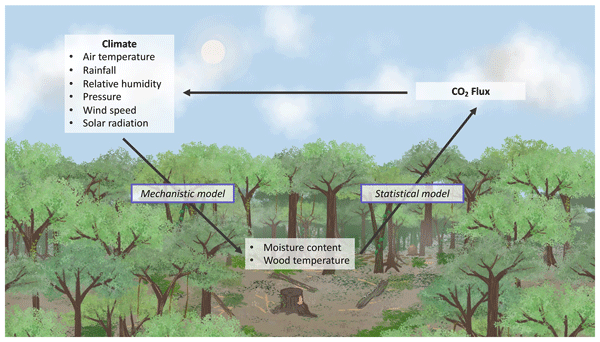
Understanding the link between climate and carbon fluxes is crucial for predicting how climate change will impact carbon sinks. We estimated carbon dioxide (CO2) fluxes from deadwood in tropical Australia using wood moisture content and temperature. Our model predicted that the majority of deadwood carbon is released as CO2, except when termite activity is detected. Future models should also incorporate wood traits, like species and chemical composition, to better predict fluxes.
Mengjie Han, Qing Zhao, Xili Wang, Ying-Ping Wang, Philippe Ciais, Haicheng Zhang, Daniel S. Goll, Lei Zhu, Zhe Zhao, Zhixuan Guo, Chen Wang, Wei Zhuang, Fengchang Wu, and Wei Li
Geosci. Model Dev., 17, 4871–4890, https://doi.org/10.5194/gmd-17-4871-2024, https://doi.org/10.5194/gmd-17-4871-2024, 2024
Short summary
Short summary
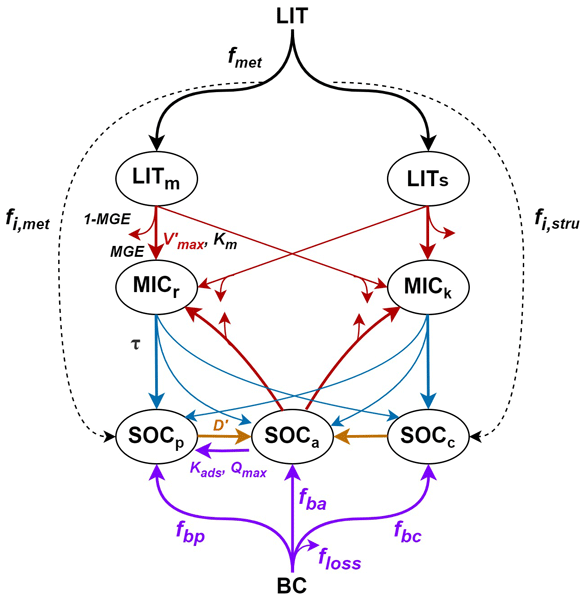
The impact of biochar (BC) on soil organic carbon (SOC) dynamics is not represented in most land carbon models used for assessing land-based climate change mitigation. Our study develops a BC model that incorporates our current understanding of BC effects on SOC based on a soil carbon model (MIMICS). The BC model can reproduce the SOC changes after adding BC, providing a useful tool to couple dynamic land models to evaluate the effectiveness of BC application for CO2 removal from the atmosphere.
Xianjin He, Laurent Augusto, Daniel S. Goll, Bruno Ringeval, Ying-Ping Wang, Julian Helfenstein, Yuanyuan Huang, and Enqing Hou
Biogeosciences, 20, 4147–4163, https://doi.org/10.5194/bg-20-4147-2023, https://doi.org/10.5194/bg-20-4147-2023, 2023
Short summary
Short summary
We identified total soil P concentration as the most important predictor of all soil P pool concentrations, except for primary mineral P concentration, which is primarily controlled by soil pH and only secondarily by total soil P concentration. We predicted soil P pools’ distributions in natural systems, which can inform assessments of the role of natural P availability for ecosystem productivity, climate change mitigation, and the functioning of the Earth system.
Xianjin He, Laurent Augusto, Daniel S. Goll, Bruno Ringeval, Yingping Wang, Julian Helfenstein, Yuanyuan Huang, Kailiang Yu, Zhiqiang Wang, Yongchuan Yang, and Enqing Hou
Earth Syst. Sci. Data, 13, 5831–5846, https://doi.org/10.5194/essd-13-5831-2021, https://doi.org/10.5194/essd-13-5831-2021, 2021
Short summary
Short summary
Our database of globally distributed natural soil total P (STP) concentration showed concentration ranged from 1.4 to 9630.0 (mean 570.0) mg kg−1. Global predictions of STP concentration increased with latitude. Global STP stocks (excluding Antarctica) were estimated to be 26.8 and 62.2 Pg in the topsoil and subsoil, respectively. Our global map of STP concentration can be used to constrain Earth system models representing the P cycle and to inform quantification of global soil P availability.
Cited articles
Abramoff, R., Xu, X., Hartman, M., O'Brien, S., Feng, W., Davidson, E., Finzi, A., Moorhead, D., Schimel, J., Torn, M., and Mayes, M. A.: The Millennial model: in search of measurable pools and transformations for modeling soil carbon in the new century, Biogeochemistry, 137, 51–71, https://doi.org/10.1007/s10533-017-0409-7, 2018.
Anadón, J. D., Sala, O. E., and Maestre, F. T.: Climate change will increase savannas at the expense of forests and treeless vegetation in tropical and subtropical Americas, J. Ecol., 102, 1363–1373, https://doi.org/10.1111/1365-2745.12325, 2014.
Ashton, L. A., Griffiths, H. M., Parr, C. L., Evans, T. A., Didham, R. K., Hasan, F., Teh, Y. A., Tin, H. S., Vairappan, C. S., and Eggleton, P.: Termites mitigate the effects of drought in tropical rainforest, Science, 363, 174–177, https://doi.org/10.1126/science.aau9565, 2019.
Bar-On, Y. M., Phillips, R., and Milo, R.: The biomass distribution on Earth, P. Natl. Acad. Sci. USA, 115, 6506–6511, https://doi.org/10.1073/pnas.1711842115, 2018.
Bastos, A., O'Sullivan, M., Ciais, P., Makowski, D., Sitch, S., Friedlingstein, P., Chevallier, F., Rödenbeck, C., Pongratz, J., Luijkx, I. T., Patra, P. K., Peylin, P., Canadell, J. G., Lauerwald, R., Li, W., Smith, N. E., Peters, W., Goll, D. S., Jain, A. K., Kato, E., Lienert, S., Lombardozzi, D. L., Haverd, V., Nabel, J. E. M. S., Poulter, B., Tian, H., Walker, A. P., and Zaehle, S.: Sources of Uncertainty in Regional and Global Terrestrial CO2 Exchange Estimates, Global Biogeochem. Cy., 34, e2019GB006393, https://doi.org/10.1029/2019GB006393, 2020.
Beier, S. and Bertilsson, S.: Bacterial chitin degradation – mechanisms and ecophysiological strategies, Front. Microbiol., 4, https://doi.org/10.3389/fmicb.2013.00149, 2013.
Bignell, D. E. and Eggleton, P.: Termites in Ecosystems, in: Termites: Evolution, Sociality, Symbioses, Ecology, edited by: Abe, T., Bignell, D. E., and Higashi, M., Springer Netherlands, Dordrecht, 363–387, https://doi.org/10.1007/978-94-017-3223-9_17, 2000.
Bonachela, J. A., Pringle, R. M., Sheffer, E., Coverdale, T. C., Guyton, J. A., Caylor, K. K., Levin, S. A., and Tarnita, C. E.: Termite mounds can increase the robustness of dryland ecosystems to climatic change, Science, 347, 651–655, https://doi.org/10.1126/science.1261487, 2015.
Bond-Lamberty, B. and Thomson, A.: Temperature-associated increases in the global soil respiration record, Nature, 464, 579–582, https://doi.org/10.1038/nature08930, 2010.
Bourguignon, T., Lo, N., Šobotník, J., Ho, S. Y. W., Iqbal, N., Coissac, E., Lee, M., Jendryka, M. M., Sillam-Dussès, D., Křížková, B., Roisin, Y., and Evans, T. A.: Mitochondrial Phylogenomics Resolves the Global Spread of Higher Termites, Ecosystem Engineers of the Tropics, Mol. Biol. Evol., 34, 589–597, https://doi.org/10.1093/molbev/msw253, 2017.
Buitenwerf, R., Stevens, N., Gosling, C. M., Anderson, T. M., and Olff, H.: Interactions between large herbivores and litter removal by termites across a rainfall gradient in a South African savanna, J. Trop. Ecol., 27, 375–382, https://doi.org/10.1017/S0266467411000125, 2011.
Camenzind, T., Mason-Jones, K., Mansour, I., Rillig, M. C., and Lehmann, J.: Formation of necromass-derived soil organic carbon determined by microbial death pathways, Nat. Geosci., 16, 115–122, https://doi.org/10.1038/s41561-022-01100-3, 2023.
Chandra, N., Patra, P. K., Niwa, Y., Ito, A., Iida, Y., Goto, D., Morimoto, S., Kondo, M., Takigawa, M., Hajima, T., and Watanabe, M.: Estimated regional CO2 flux and uncertainty based on an ensemble of atmospheric CO2 inversions, Atmos. Chem. Phys., 22, 9215–9243, https://doi.org/10.5194/acp-22-9215-2022, 2022.
Charles, G. K., Riginos, C., Veblen, K. E., Kimuyu, D. M., and Young, T. P.: Termite mound cover and abundance respond to herbivore-mediated biotic changes in a Kenyan savanna, Ecol. Evol., 11, 7226–7238, https://doi.org/10.1002/ece3.7445, 2021.
Collins, N. M.: Consumption of Wood by Artificially Isolated Colonies of the Fungus-Growing Termite Macrotermes Bellicosus, Entomol. Exp. Appl., 29, 313–320, https://doi.org/10.1111/j.1570-7458.1981.tb03074.x, 1981a.
Collins, N. M.: The Role of Termites in the Decomposition of Wood and Leaf Litter in the Southern Guinea Savanna of Nigeria, Oecologia, 51, 389–399, 1981b.
Davies, A. B., Levick, S. R., Rensburg, B. J. van, Robertson, M. P., and Parr, C. L.: Context-dependent directional effects of termite mounds on soil nutrients, vegetation communities, and mammalian foraging, Ecosphere, 15, e4978, https://doi.org/10.1002/ecs2.4978, 2024.
Donovan, S. E., Eggleton, P., and Bignell, D. E.: Gut content analysis and a new feeding group classification of termites, Ecol. Entomol., 26, 356–366, https://doi.org/10.1046/j.1365-2311.2001.00342.x, 2001.
Eggleton, P. and Tayasu, I.: Feeding groups, lifetypes and the global ecology of termites, Ecol. Res., 16, 941–960, https://doi.org/10.1046/j.1440-1703.2001.00444.x, 2001.
Fang, K., Qin, S., Chen, L., Zhang, Q., and Yang, Y.: Al/Fe Mineral Controls on Soil Organic Carbon Stock Across Tibetan Alpine Grasslands, J. Geophys. Res.-Biogeo., 124, 247–259, https://doi.org/10.1029/2018JG004782, 2019.
Farooq, U., Pasut, C., Wang, Y., Zanned, E. A., Flores Moreno, H., Wijas, B., Forrester, D., England, J., Macdonald, B., Brown, Z., and Karunaratne, S.: Global Model Outputs for Termite-Mediated Carbon Fluxes and Soil Organic Carbon Dynamics. v1, CSIRO Data Collection [data set], https://doi.org/10.25919/rqjd-nb40, 2026.
Fierer, N., Colman, B. P., Schimel, J. P., and Jackson, R. B.: Predicting the temperature dependence of microbial respiration in soil: A continental-scale analysis, Global Biogeochem. Cy., 20, https://doi.org/10.1029/2005GB002644, 2006.
Griffiths, H. M., Ashton, L. A., Evans, T. A., Parr, C. L., and Eggleton, P.: Termites can decompose more than half of deadwood in tropical rainforest, Curr. Biol., 29, R118–R119, https://doi.org/10.1016/j.cub.2019.01.012, 2019.
Haddix, M. L., Gregorich, E. G., Helgason, B. L., Janzen, H., Ellert, B. H., and Francesca Cotrufo, M.: Climate, carbon content, and soil texture control the independent formation and persistence of particulate and mineral-associated organic matter in soil, Geoderma, 363, 114160, https://doi.org/10.1016/j.geoderma.2019.114160, 2020.
Ho, A., Erens, H., Mujinya, B. B., Boeckx, P., Baert, G., Schneider, B., Frenzel, P., Boon, N., and Van Ranst, E.: Termites Facilitate Methane Oxidation and Shape the Methanotrophic Community, Appl. Environ. Microbiol., 79, 7234–7240, https://doi.org/10.1128/AEM.02785-13, 2013.
Huston, M. A. and Wolverton, S.: The global distribution of net primary production: resolving the paradox, Ecol. Monogr., 79, 343–377, https://doi.org/10.1890/08-0588.1, 2009.
Issoufou, A. amadou, Soumana, I., Maman, G., Konate, S., and Mahamane, A.: Effects of termites growth on litter decomposition: a modeling approach, Int. J. Recycl. Org. Waste Agric., 8, 415–421, https://doi.org/10.1007/s40093-019-00314-7, 2019.
Ito, A.: Global termite methane emissions have been affected by climate and land-use changes, Sci. Rep., 13, 17195, https://doi.org/10.1038/s41598-023-44529-1, 2023.
Jamali, H., Livesley, S. J., Dawes, T. Z., Hutley, L. B., and Arndt, S. K.: Termite mound emissions of CH4 and CO2 are primarily determined by seasonal changes in termite biomass and behaviour, Oecologia, 167, 525–534, https://doi.org/10.1007/s00442-011-1991-3, 2011a.
Jamali, H., Livesley, S. J., Grover, S. P., Dawes, T. Z., Hutley, L. B., Cook, G. D., and Arndt, S. K.: The Importance of Termites to the CH4 Balance of a Tropical Savanna Woodland of Northern Australia, Ecosystems, 14, 698–709, https://doi.org/10.1007/s10021-011-9439-5, 2011b.
Jamali, H., Livesley, S. J., Hutley, L. B., Fest, B., and Arndt, S. K.: The relationships between termite mound
Jouquet, P., Dauber, J., Lagerlöf, J., Lavelle, P., and Lepage, M.: Soil invertebrates as ecosystem engineers: Intended and accidental effects on soil and feedback loops, Appl. Soil Ecol., 32, 153–164, https://doi.org/10.1016/j.apsoil.2005.07.004, 2006.
Jouquet, P., Traoré, S., Choosai, C., Hartmann, C., and Bignell, D.: Influence of termites on ecosystem functioning. Ecosystem services provided by termites, Eur. J. Soil Biol., 47, 215–222, https://doi.org/10.1016/j.ejsobi.2011.05.005, 2011.
King, A. E. and Sokol, N. W.: Soil carbon formation is promoted by saturation deficit and existing mineral-associated carbon, not by microbial carbon-use efficiency, Sci. Adv., 11, eadv9482, https://doi.org/10.1126/sciadv.adv9482, 2025.
Kirschke, S., Bousquet, P., Ciais, P., Saunois, M., Canadell, J. G., Dlugokencky, E. J., Bergamaschi, P., Bergmann, D., Blake, D. R., Bruhwiler, L., Cameron-Smith, P., Castaldi, S., Chevallier, F., Feng, L., Fraser, A., Heimann, M., Hodson, E. L., Houweling, S., Josse, B., Fraser, P. J., Krummel, P. B., Lamarque, J.-F., Langenfelds, R. L., Le Quéré, C., Naik, V., O'Doherty, S., Palmer, P. I., Pison, I., Plummer, D., Poulter, B., Prinn, R. G., Rigby, M., Ringeval, B., Santini, M., Schmidt, M., Shindell, D. T., Simpson, I. J., Spahni, R., Steele, L. P., Strode, S. A., Sudo, K., Szopa, S., van der Werf, G. R., Voulgarakis, A., van Weele, M., Weiss, R. F., Williams, J. E., and Zeng, G.: Three decades of global methane sources and sinks, Nat. Geosci., 6, 813–823, https://doi.org/10.1038/ngeo1955, 2013.
Kristensen, J. A., Svenning, J.-C., Georgiou, K., and Malhi, Y.: Can large herbivores enhance ecosystem carbon persistence?, Trends Ecol. Evol., 37, 117–128, https://doi.org/10.1016/j.tree.2021.09.006, 2022.
Kueppers, L. M., Southon, J., Baer, P., and Harte, J.: Dead wood biomass and turnover time, measured by radiocarbon, along a subalpine elevation gradient, Oecologia, 141, 641–651, https://doi.org/10.1007/s00442-004-1689-x, 2004.
Kyker-Snowman, E., Wieder, W. R., Frey, S. D., and Grandy, A. S.: Stoichiometrically coupled carbon and nitrogen cycling in the MIcrobial-MIneral Carbon Stabilization model version 1.0 (MIMICS-CN v1.0), Geosci. Model Dev., 13, 4413–4434, https://doi.org/10.5194/gmd-13-4413-2020, 2020.
Laub, M., Blagodatsky, S., Van de Broek, M., Schlichenmaier, S., Kunlanit, B., Six, J., Vityakon, P., and Cadisch, G.: SAMM version 1.0: a numerical model for microbial- mediated soil aggregate formation, Geosci. Model Dev., 17, 931–956, https://doi.org/10.5194/gmd-17-931-2024, 2024.
Law, S. J., Allison, S. D., Davies, A. B., Flores-Moreno, H., Wijas, B. J., Yatsko, A. R., Zhou, Y., Zanne, A. E., and Eggleton, P.: The challenge of estimating global termite methane emissions, Glob. Change Biol., 30, e17390, https://doi.org/10.1111/gcb.17390, 2024.
Lima, S. S. de, Pereira, M. G., Pereira, R. N., Pontes, R. M. de, and Rossi, C. Q.: Termite Mounds Effects on Soil Properties in the Atlantic Forest Biome, Rev. Bras. Ciênc. Solo, 42, e0160564, https://doi.org/10.1590/18069657rbcs20160564, 2018.
Magnússon, R. Í., Tietema, A., Cornelissen, J. H. C., Hefting, M. M., and Kalbitz, K.: Tamm Review: Sequestration of carbon from coarse woody debris in forest soils, For. Ecol. Manag., 377, 1–15, https://doi.org/10.1016/j.foreco.2016.06.033, 2016.
Morrissey, E. M., Mau, R. L., Schwartz, E., McHugh, T. A., Dijkstra, P., Koch, B. J., Marks, J. C., and Hungate, B. A.: Bacterial carbon use plasticity, phylogenetic diversity and the priming of soil organic matter, ISME J., 11, 1890–1899, https://doi.org/10.1038/ismej.2017.43, 2017.
Muvengwi, J. and Witkowski, E. T. F.: Cascading effects of termite mounds in African savannas, N. Z. J. Bot., 58, 167–193, https://doi.org/10.1080/0028825X.2020.1767162, 2020.
Myer, A. and Forschler, B. T.: Evidence for the Role of Subterranean Termites (Reticulitermes spp.) in Temperate Forest Soil Nutrient Cycling, Ecosystems, 22, 602–618, https://doi.org/10.1007/s10021-018-0291-8, 2019.
Myer, A., Myer, M. H., Trettin, C. C., and Forschler, B. T.: The fate of carbon utilized by the subterranean termite Reticulitermes flavipes, Ecosphere, 12, e03872, https://doi.org/10.1002/ecs2.3872, 2021.
Nauer, P. A., Hutley, L. B., and Arndt, S. K.: Termite mounds mitigate half of termite methane emissions, P. Natl. Acad. Sci. USA, 115, 13306–13311, https://doi.org/10.1073/pnas.1809790115, 2018.
Otani, S., Hansen, L. H., Sørensen, S. J., and Poulsen, M.: Bacterial communities in termite fungus combs are comprised of consistent gut deposits and contributions from the environment, Microb. Ecol., 71, 207–220, https://doi.org/10.1007/s00248-015-0692-6, 2016.
Raich, J. W. and Schlesinger, W. H.: The global carbon dioxide flux in soil respiration and its relationship to vegetation and climate, Tellus B, 44, 81–99, https://doi.org/10.3402/tellusb.v44i2.15428, 2022.
Ramankutty, N. and Foley, J. A.: Estimating historical changes in global land cover: Croplands from 1700 to 1992, Global Biogeochem. Cy., 13, 997–1027, https://doi.org/10.1029/1999GB900046, 1999.
Rosenberg, Y., Bar-On, Y. M., Fromm, A., Ostikar, M., Shoshany, A., Giz, O., and Milo, R.: The global biomass and number of terrestrial arthropods, Sci. Adv., 9, eabq4049, https://doi.org/10.1126/sciadv.abq4049, 2023.
Sanderson, M. G.: Biomass of termites and their emissions of methane and carbon dioxide: A global database, Global Biogeochem. Cy., 10, 543–557, https://doi.org/10.1029/96GB01893, 1996.
Saunois, M., Martinez, A., Poulter, B., Zhang, Z., Raymond, P. A., Regnier, P., Canadell, J. G., Jackson, R. B., Patra, P. K., Bousquet, P., Ciais, P., Dlugokencky, E. J., Lan, X., Allen, G. H., Bastviken, D., Beerling, D. J., Belikov, D. A., Blake, D. R., Castaldi, S., Crippa, M., Deemer, B. R., Dennison, F., Etiope, G., Gedney, N., Höglund-Isaksson, L., Holgerson, M. A., Hopcroft, P. O., Hugelius, G., Ito, A., Jain, A. K., Janardanan, R., Johnson, M. S., Kleinen, T., Krummel, P. B., Lauerwald, R., Li, T., Liu, X., McDonald, K. C., Melton, J. R., Mühle, J., Müller, J., Murguia-Flores, F., Niwa, Y., Noce, S., Pan, S., Parker, R. J., Peng, C., Ramonet, M., Riley, W. J., Rocher-Ros, G., Rosentreter, J. A., Sasakawa, M., Segers, A., Smith, S. J., Stanley, E. H., Thanwerdas, J., Tian, H., Tsuruta, A., Tubiello, F. N., Weber, T. S., van der Werf, G. R., Worthy, D. E. J., Xi, Y., Yoshida, Y., Zhang, W., Zheng, B., Zhu, Q., Zhu, Q., and Zhuang, Q.: Global Methane Budget 2000–2020, Earth Syst. Sci. Data, 17, 1873–1958, https://doi.org/10.5194/essd-17-1873-2025, 2025.
Seibold, S., Rammer, W., Hothorn, T., Seidl, R., Ulyshen, M. D., Lorz, J., Cadotte, M. W., Lindenmayer, D. B., Adhikari, Y. P., Aragón, R., Bae, S., Baldrian, P., Barimani Varandi, H., Barlow, J., Bässler, C., Beauchêne, J., Berenguer, E., Bergamin, R. S., Birkemoe, T., Boros, G., Brandl, R., Brustel, H., Burton, P. J., Cakpo-Tossou, Y. T., Castro, J., Cateau, E., Cobb, T. P., Farwig, N., Fernández, R. D., Firn, J., Gan, K. S., González, G., Gossner, M. M., Habel, J. C., Hébert, C., Heibl, C., Heikkala, O., Hemp, A., Hemp, C., Hjältén, J., Hotes, S., Kouki, J., Lachat, T., Liu, J., Liu, Y., Luo, Y.-H., Macandog, D. M., Martina, P. E., Mukul, S. A., Nachin, B., Nisbet, K., O'Halloran, J., Oxbrough, A., Pandey, J. N., Pavlíček, T., Pawson, S. M., Rakotondranary, J. S., Ramanamanjato, J.-B., Rossi, L., Schmidl, J., Schulze, M., Seaton, S., Stone, M. J., Stork, N. E., Suran, B., Sverdrup-Thygeson, A., Thorn, S., Thyagarajan, G., Wardlaw, T. J., Weisser, W. W., Yoon, S., Zhang, N., and Müller, J.: The contribution of insects to global forest deadwood decomposition, Nature, 597, 77–81, https://doi.org/10.1038/s41586-021-03740-8, 2021.
Su, N.-Y.: Comparison of Laboratory Methods for Estimating Wood Consumption Rates by Coptotermes formosanus (Isoptera: Rhinotermitidae), Ann. Entomol. Soc. Am., 77, 125–129, https://doi.org/10.1093/AESA/77.2.125, 1984.
Su, N.-Y. and LaFage, J. P.: Comparison of Laboratory Methods for Estimating Wood Consumption Rates by Coptotermes formosanus (Isoptera: Rhinotermitidae), Ann. Entomol. Soc. Am., 77, 125–129, https://doi.org/10.1093/aesa/77.2.125, 1984.
Sugimoto, A., Bignell, D. E., and MacDonald, J. A.: Global Impact of Termites on the Carbon Cycle and Atmospheric Trace Gases, in: Termites: Evolution, Sociality, Symbioses, Ecology, edited by: Abe, T., Bignell, D. E., and Higashi, M., Springer Netherlands, Dordrecht, 409–435, https://doi.org/10.1007/978-94-017-3223-9_19, 2000.
Trimmer, M., Shelley, F. C., Purdy, K. J., Maanoja, S. T., Chronopoulou, P.-M., and Grey, J.: Riverbed methanotrophy sustained by high carbon conversion efficiency, ISME J., 9, 2304–2314, https://doi.org/10.1038/ismej.2015.98, 2015.
Vasconcellos, A. and Maria da Silva Moura, F.: Wood litter consumption by three species of Nasutitermes termites in an area of the Atlantic Coastal Forest in northeastern Brazil, J. Insect Sci., 10, 72, https://doi.org/10.1673/031.010.7201, 2010.
Wang, L., Abramowitz, G., Wang, Y.-P., Pitman, A., Ciais, P., and Goll, D. S.: Using explainable AI to diagnose the representation of environmental drivers in process-based soil organic carbon models, Biogeosciences, 22, 7845–7863, https://doi.org/10.5194/bg-22-7845-2025, 2025.
Wijas, B. J., Flores-Moreno, H., Allison, S. D., Rodriguez, L. C., Cheesman, A. W., Cernusak, L. A., Clement, R., Cornwell, W. K., Duan, E. S., Eggleton, P., Rosenfield, M. V., Yatsko, A. R., and Zanne, A. E.: Drivers of wood decay in tropical ecosystems: Termites versus microbes along spatial, temporal and experimental precipitation gradients, Funct. Ecol., 38, 546–559, https://doi.org/10.1111/1365-2435.14494, 2024.
Yatsko, A. R., Eggleton, P., Jones, C., Pérez-Losada, M., Ramos-Tapia, I., Powell, J. R., Wijas, B., and Zanne, A. E.: Rethinking Termite Methane Emissions: Does the Mound Environment Matter?, Glob. Change Biol., 32, e70838, https://doi.org/10.1111/gcb.70838, 2026.
Zhou, Y., Staver, A. C., and Davies, A. B.: Species-level termite methane production rates, Ecology, 104, e3905, https://doi.org/10.1002/ecy.3905, 2023.
Short summary
Global soil carbon models largely focus on microbes and overlook the role of termites in decomposing dead plant material. Here, we present a new framework for representing termite activity in carbon models and estimating how termites redistribute carbon between the atmosphere and soils. Our results suggest that termites strongly influence greenhouse gas emissions and soil carbon cycling, particularly in tropical and seasonally dry regions that are vulnerable to climate change.
Global soil carbon models largely focus on microbes and overlook the role of termites in...


Altmetrics
Final-revised paper
Preprint