
Articles | Volume 23, issue 20
https://doi.org/10.5194/bg-23-7327-2026
© Author(s) 2026. This work is distributed under
the Creative Commons Attribution 4.0 License.
the Creative Commons Attribution 4.0 License.
https://doi.org/10.5194/bg-23-7327-2026
© Author(s) 2026. This work is distributed under
the Creative Commons Attribution 4.0 License.
the Creative Commons Attribution 4.0 License.
Research article
| 
20 Oct 2026
Research article |
| 20 Oct 2026
| 20 Oct 2026
Different paths, same destination: similar benthic nitrogen cycling sustained by distinct biogeochemical mechanisms in artificialized coastal systems

Institut des sciences de la mer, Université du Québec à Rimouski, 310 Allée des Ursulines, Rimouski, QC, G5L 3A1, Canada
Éléonore Dansereau-Macias
Institut des sciences de la mer, Université du Québec à Rimouski, 310 Allée des Ursulines, Rimouski, QC, G5L 3A1, Canada
Carole-Anne Guay
Institut des sciences de la mer, Université du Québec à Rimouski, 310 Allée des Ursulines, Rimouski, QC, G5L 3A1, Canada
David Didier
Northern and Arctic Coastal Research Lab., Center for Northern Studies, Département de biologie, chimie et géographie, Université du Québec à Rimouski, 300 Allée des Ursulines, Rimouski, QC, G5L 3A1, Canada
Christian Nozais
Département de biologie, chimie et géographie, Université du Québec à Rimouski, 300 Allée des Ursulines, Rimouski, QC, G5L 3A1, Canada
Luc Sirois
Département de biologie, chimie et géographie, Université du Québec à Rimouski, 300 Allée des Ursulines, Rimouski, QC, G5L 3A1, Canada
Faten Zouaghi
Northern and Arctic Coastal Research Lab., Center for Northern Studies, Département de biologie, chimie et géographie, Université du Québec à Rimouski, 300 Allée des Ursulines, Rimouski, QC, G5L 3A1, Canada
Gwénaëlle Chaillou
Institut des sciences de la mer, Université du Québec à Rimouski, 310 Allée des Ursulines, Rimouski, QC, G5L 3A1, Canada
Related authors
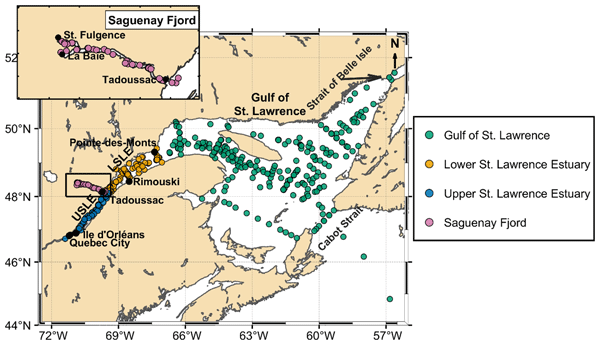
William A. Nesbitt, Alfonso O. Mucci, Toste Tanhua, Yves Gélinas, Jean-Éric Tremblay, Gwénaëlle Chaillou, Ludovic Pascal, Caroline Fradette, Lennart Gerke, Samuel W. Stevens, Mathilde Jutras, Marjolaine Blais, Martine Lizotte, Michel Starr, and Douglas W. R. Wallace
Earth Syst. Sci. Data, 18, 3609–3634, https://doi.org/10.5194/essd-18-3609-2026, https://doi.org/10.5194/essd-18-3609-2026, 2026
Short summary
Short summary
Over the past few decades, the St. Lawrence Estuary and Gulf have shown clear trends in oxygen depletion and acidification. This data description paper brings together twenty years of measurements from the St. Lawrence Estuary, Gulf of St. Lawrence, and Saguenay Fjord, carefully performing quality control procedures on data, and makes them publicly available. The resulting dataset supports future research, monitoring, and environmental management in this sensitive marine system.
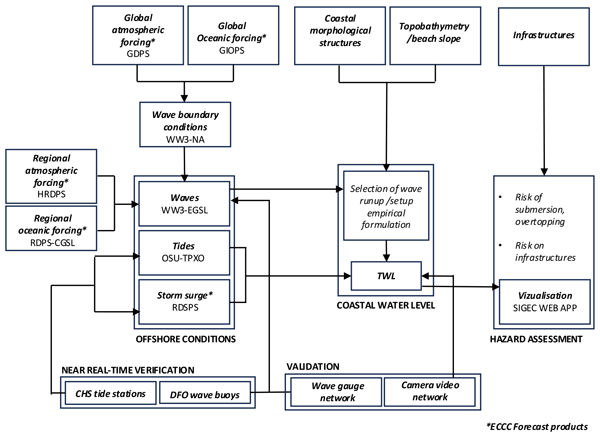
Jérémy Baudry, Dany Dumont, David Didier, Pascal Bernatchez, and Sébastien Dugas
Nat. Hazards Earth Syst. Sci., 26, 4231–4255, https://doi.org/10.5194/nhess-26-4231-2026, https://doi.org/10.5194/nhess-26-4231-2026, 2026
Short summary
Short summary
This two-part study explores the development of a short-term (up to 48 hours) coastal flood forecasting system along the Quebec coastline. The first part of the study focuses on wave prediction, a main contributor to coastal hazards. The key results of the study show that wave conditions can be accurately predicted during summer, however, the performances of the model in winter are considerably reduced, primarily because predicting sea ice conditions at fine spatial scales remains challenging.
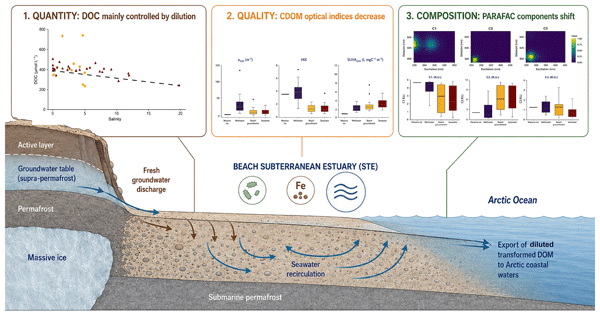
Aude Flamand, Jean-François Lapierre, and Gwénaëlle Chaillou
Biogeosciences, 23, 5901–5919, https://doi.org/10.5194/bg-23-5901-2026, https://doi.org/10.5194/bg-23-5901-2026, 2026
Short summary
Short summary
Climate change is accelerating permafrost thaw and coastal erosion, increasing dissolved organic matter (DOM) inputs to the Arctic Ocean. We show that, beyond seawater dilution, DOM is transformed as it passes through Arctic beach subterranean estuaries, shifting from humic-rich to more microbially processed material. These coastal zones act as biogeochemical reactors, modifying DOM before its export to coastal waters.
William A. Nesbitt, Alfonso O. Mucci, Toste Tanhua, Yves Gélinas, Jean-Éric Tremblay, Gwénaëlle Chaillou, Ludovic Pascal, Caroline Fradette, Lennart Gerke, Samuel W. Stevens, Mathilde Jutras, Marjolaine Blais, Martine Lizotte, Michel Starr, and Douglas W. R. Wallace
Earth Syst. Sci. Data, 18, 3609–3634, https://doi.org/10.5194/essd-18-3609-2026, https://doi.org/10.5194/essd-18-3609-2026, 2026
Short summary
Short summary
Over the past few decades, the St. Lawrence Estuary and Gulf have shown clear trends in oxygen depletion and acidification. This data description paper brings together twenty years of measurements from the St. Lawrence Estuary, Gulf of St. Lawrence, and Saguenay Fjord, carefully performing quality control procedures on data, and makes them publicly available. The resulting dataset supports future research, monitoring, and environmental management in this sensitive marine system.
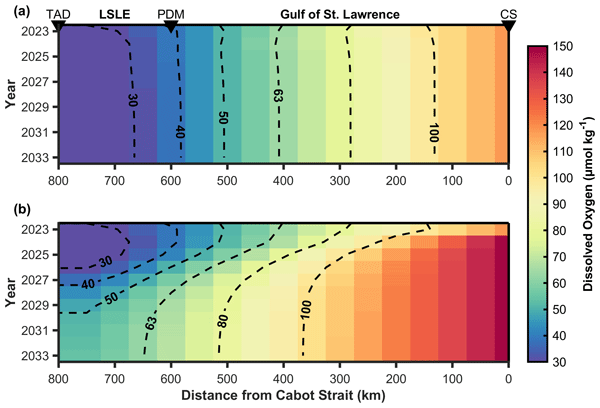
William A. Nesbitt, Samuel W. Stevens, Alfonso O. Mucci, Lennart Gerke, Toste Tanhua, Gwénaëlle Chaillou, and Douglas W. R. Wallace
Ocean Sci., 21, 2179–2195, https://doi.org/10.5194/os-21-2179-2025, https://doi.org/10.5194/os-21-2179-2025, 2025
Short summary
Short summary
We combine two decades of oxygen data with new carbon observations and a tracer-informed model to quantify oxygen loss and carbon buildup in the deep waters of the Gulf and Lower St. Lawrence Estuary. We then test a novel idea: reoxygenating these waters with the oxygen produced as a by-product from green-hydrogen production. Our results suggest this could significantly reduce hypoxia, though full recovery would require larger inputs.
Martine Lizotte, Bennet Juhls, Atsushi Matsuoka, Philippe Massicotte, Gaëlle Mével, David Obie James Anikina, Sofia Antonova, Guislain Bécu, Marine Béguin, Simon Bélanger, Thomas Bossé-Demers, Lisa Bröder, Flavienne Bruyant, Gwénaëlle Chaillou, Jérôme Comte, Raoul-Marie Couture, Emmanuel Devred, Gabrièle Deslongchamps, Thibaud Dezutter, Miles Dillon, David Doxaran, Aude Flamand, Frank Fell, Joannie Ferland, Marie-Hélène Forget, Michael Fritz, Thomas J. Gordon, Caroline Guilmette, Andrea Hilborn, Rachel Hussherr, Charlotte Irish, Fabien Joux, Lauren Kipp, Audrey Laberge-Carignan, Hugues Lantuit, Edouard Leymarie, Antonio Mannino, Juliette Maury, Paul Overduin, Laurent Oziel, Colin Stedmon, Crystal Thomas, Lucas Tisserand, Jean-Éric Tremblay, Jorien Vonk, Dustin Whalen, and Marcel Babin
Earth Syst. Sci. Data, 15, 1617–1653, https://doi.org/10.5194/essd-15-1617-2023, https://doi.org/10.5194/essd-15-1617-2023, 2023
Short summary
Short summary
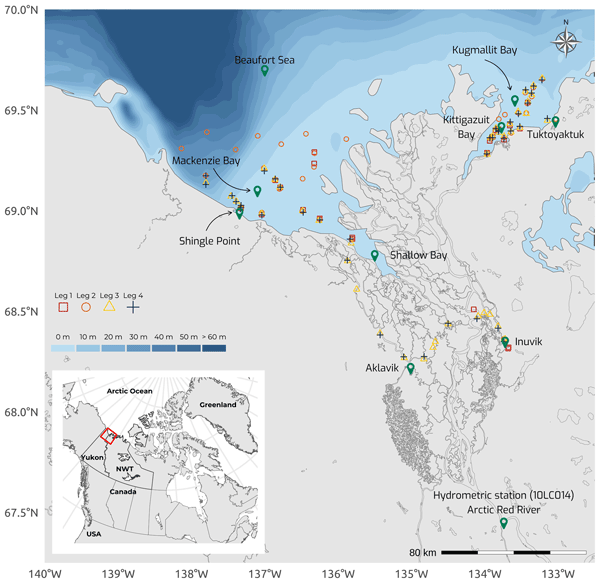
Permafrost thaw in the Mackenzie Delta region results in the release of organic matter into the coastal marine environment. What happens to this carbon-rich organic matter as it transits along the fresh to salty aquatic environments is still underdocumented. Four expeditions were conducted from April to September 2019 in the coastal area of the Beaufort Sea to study the fate of organic matter. This paper describes a rich set of data characterizing the composition and sources of organic matter.
Mathilde Jutras, Alfonso Mucci, Gwenaëlle Chaillou, William A. Nesbitt, and Douglas W. R. Wallace
Biogeosciences, 20, 839–849, https://doi.org/10.5194/bg-20-839-2023, https://doi.org/10.5194/bg-20-839-2023, 2023
Short summary
Short summary
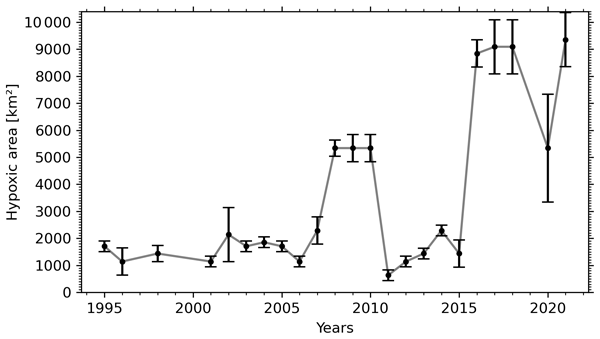
The deep waters of the lower St Lawrence Estuary and gulf have, in the last decades, experienced a strong decline in their oxygen concentration. Below 65 µmol L-1, the waters are said to be hypoxic, with dire consequences for marine life. We show that the extent of the hypoxic zone shows a seven-fold increase in the last 20 years, reaching 9400 km2 in 2021. After a stable period at ~ 65 µmol L⁻¹ from 1984 to 2019, the oxygen level also suddenly decreased to ~ 35 µmol L-1 in 2020.
Flavienne Bruyant, Rémi Amiraux, Marie-Pier Amyot, Philippe Archambault, Lise Artigue, Lucas Barbedo de Freitas, Guislain Bécu, Simon Bélanger, Pascaline Bourgain, Annick Bricaud, Etienne Brouard, Camille Brunet, Tonya Burgers, Danielle Caleb, Katrine Chalut, Hervé Claustre, Véronique Cornet-Barthaux, Pierre Coupel, Marine Cusa, Fanny Cusset, Laeticia Dadaglio, Marty Davelaar, Gabrièle Deslongchamps, Céline Dimier, Julie Dinasquet, Dany Dumont, Brent Else, Igor Eulaers, Joannie Ferland, Gabrielle Filteau, Marie-Hélène Forget, Jérome Fort, Louis Fortier, Martí Galí, Morgane Gallinari, Svend-Erik Garbus, Nicole Garcia, Catherine Gérikas Ribeiro, Colline Gombault, Priscilla Gourvil, Clémence Goyens, Cindy Grant, Pierre-Luc Grondin, Pascal Guillot, Sandrine Hillion, Rachel Hussherr, Fabien Joux, Hannah Joy-Warren, Gabriel Joyal, David Kieber, Augustin Lafond, José Lagunas, Patrick Lajeunesse, Catherine Lalande, Jade Larivière, Florence Le Gall, Karine Leblanc, Mathieu Leblanc, Justine Legras, Keith Lévesque, Kate-M. Lewis, Edouard Leymarie, Aude Leynaert, Thomas Linkowski, Martine Lizotte, Adriana Lopes dos Santos, Claudie Marec, Dominique Marie, Guillaume Massé, Philippe Massicotte, Atsushi Matsuoka, Lisa A. Miller, Sharif Mirshak, Nathalie Morata, Brivaela Moriceau, Philippe-Israël Morin, Simon Morisset, Anders Mosbech, Alfonso Mucci, Gabrielle Nadaï, Christian Nozais, Ingrid Obernosterer, Thimoté Paire, Christos Panagiotopoulos, Marie Parenteau, Noémie Pelletier, Marc Picheral, Bernard Quéguiner, Patrick Raimbault, Joséphine Ras, Eric Rehm, Llúcia Ribot Lacosta, Jean-François Rontani, Blanche Saint-Béat, Julie Sansoulet, Noé Sardet, Catherine Schmechtig, Antoine Sciandra, Richard Sempéré, Caroline Sévigny, Jordan Toullec, Margot Tragin, Jean-Éric Tremblay, Annie-Pier Trottier, Daniel Vaulot, Anda Vladoiu, Lei Xue, Gustavo Yunda-Guarin, and Marcel Babin
Earth Syst. Sci. Data, 14, 4607–4642, https://doi.org/10.5194/essd-14-4607-2022, https://doi.org/10.5194/essd-14-4607-2022, 2022
Short summary
Short summary
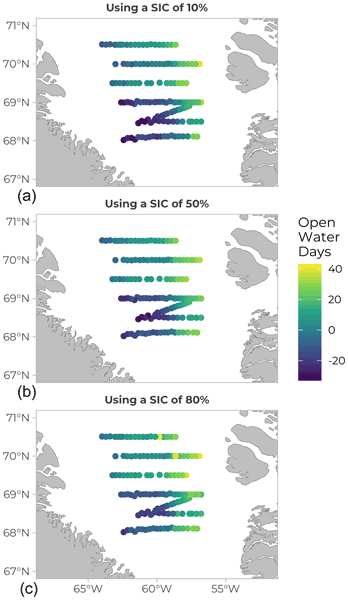
This paper presents a dataset acquired during a research cruise held in Baffin Bay in 2016. We observed that the disappearance of sea ice in the Arctic Ocean increases both the length and spatial extent of the phytoplankton growth season. In the future, this will impact the food webs on which the local populations depend for their food supply and fisheries. This dataset will provide insight into quantifying these impacts and help the decision-making process for policymakers.
Cited articles
Albert, S., Bonaglia, S., Stjärnkvist, N., Winder, M., Thamdrup, B., and Nascimento, F. J. A.: Influence of settling organic matter quantity and quality on benthic nitrogen cycling, Limnol. Oceanogr., 66, 1882–1895, https://doi.org/10.1002/lno.11730, 2021.
Aminot, A., Kérouel, R., and Coverly, S. C.: Nutrients in Seawater Using Segmented Flow Analysis, in: Practical Guidelines for the Analysis of Seawater, CRC Press, 408, https://doi.org/10.1201/9781420073072, 2009.
Anderson, L.: Simultaneous spectrophotometric determination of nitrite and nitrate by flow injection analysis, Anal. Chim. Acta, 110, 123–128, https://doi.org/10.1016/S0003-2670(01)83537-6, 1979.
Barbier, E. B., Hacker, S. D., Kennedy, C., Koch, E. W., Stier, A. C., and Silliman, B. R.: The value of estuarine and coastal ecosystem services, Ecol. Monogr., 81, 169–193, https://doi.org/10.1890/10-1510.1, 2011.
Bernatchez, P. and Fraser, C.: Evolution of Coastal Defence Structures and Consequences for Beach Width Trends, Québec, Canada, J. Coastal Res., 285, 1550–1566, https://doi.org/10.2112/JCOASTRES-D-10-00189.1, 2012.
Bernatchez, P. and Quintin, C.: Potentiel de migration des écosystèmes côtiers meubles québécois de l'estuaire et du golfe du Saint-Laurent dans le contexte de la hausse appréhendée du niveau de la mer, natcan, 140, 91–104, https://doi.org/10.7202/1036507ar, 2016.
Borja, A., Franco, J., and Pérez, V.: A Marine Biotic Index to Establish the Ecological Quality of Soft-Bottom Benthos Within European Estuarine and Coastal Environments, Mar. Pollut. Bull., 40, 1100–1114, https://doi.org/10.1016/S0025-326X(00)00061-8, 2000.
Bozek, C. M. and Burdick, D. M.: Impacts of Seawalls on Saltmarsh Plant Communities in the Great Bay Estuary, New Hampshire USA, Wetl. Ecol. Manag., 13, 553–568, https://doi.org/10.1007/s11273-004-5543-z, 2005.
Bull, D. C. and Taillefert, M.: Seasonal and topographic variations in porewaters of a southeastern USA salt marsh as revealed by voltammetric profiling, Geochem. T., 2, 104, https://doi.org/10.1186/1467-4866-2-104, 2001.
Bulleri, F. and Chapman, M. G.: The introduction of coastal infrastructure as a driver of change in marine environments, J. Appl. Ecol., 47, 26–35, https://doi.org/10.1111/j.1365-2664.2009.01751.x, 2010.
Da Silva, R. F., Hansen, J. E., Rijnsdorp, D. P., Lowe, R. J., and Buckley, M. L.: The influence of submerged coastal structures on nearshore flows and wave runup, Coast. Eng., 177, 104194, https://doi.org/10.1016/j.coastaleng.2022.104194, 2022.
Dalsgaard, T., Thamdrup, B., and Canfield, D. E.: Anaerobic ammonium oxidation (anammox) in the marine environment, Res. Microbiol., 156, 457–464, 2005.
Degen, R. and Faulwetter, S.: The Arctic Traits Database – a repository of Arctic benthic invertebrate traits, Earth Syst. Sci. Data, 11, 301–322, https://doi.org/10.5194/essd-11-301-2019, 2019.
Devol, A. H.: Denitrification, Anammox, and N2 Production in Marine Sediments, Annu. Rev. Mar. Sci., 7, 403–423, https://doi.org/10.1146/annurev-marine-010213-135040, 2015.
Dionne, J.-C.: Érosion récente des marais intertidaux de l'estuaire du Saint-Laurent, Québec, Geogr. Phys. Quatern., 40, 307–323, https://doi.org/10.7202/032651ar, 2007.
Doody, J. P.: Coastal squeeze and managed realignment in southeast England, does it tell us anything about the future?, Ocean Coast. Manage., 79, 34–41, https://doi.org/10.1016/j.ocecoaman.2012.05.008, 2013.
Duarte, C. M., Losada, I. J., Hendriks, I. E., Mazarrasa, I., and Marbà, N.: The role of coastal plant communities for climate change mitigation and adaptation, Nat. Clim. Change, 3, 961–968, https://doi.org/10.1038/nclimate1970, 2013.
Dugan, J. E., Emery, K. A., Alber, M., Alexander, C. R., Byers, J. E., Gehman, A. M., McLenaghan, N., and Sojka, S. E.: Generalizing Ecological Effects of Shoreline Armoring Across Soft Sediment Environments, Estuar. Coast., 41, 180–196, https://doi.org/10.1007/s12237-017-0254-x, 2018.
Friess, D. A., Yando, E. S., Alemu I, J. B., Wong, L.-W., Soto, S. D., and Bhatia, N.: Ecosystem services and disservices of mangrove forests and salt marshes, in: Oceanography and Marine Biology, edited by: Hawkins, S. J., Allcock, A. L., Bates, A. E., Evans, A. J., Firth, L. B., McQuaid, C. D., Russell, B. D., Smith, I. P., Swearer, S. E., and Todd, P. A., CRC Press, 107–141, https://doi.org/10.1201/9780429351495-3, 2020.
Gedan, K. B., Silliman, B. R., and Bertness, M. D.: Centuries of Human-Driven Change in Salt Marsh Ecosystems, Annu. Rev. Mar. Sci., 1, 117–141, https://doi.org/10.1146/annurev.marine.010908.163930, 2009.
Gibeault, C., Neumeier, U., and Bernatchez, P.: Spatial and Temporal Sediment Dynamics in a Subarctic Salt Marsh (Gulf of St. Lawrence, Canada), J. Coastal Res., 32, 1344–1361, https://doi.org/10.2112/JCOASTRES-D-15-00160.1, 2016.
Gittman, R. K., Fodrie, F. J., Popowich, A. M., Keller, D. A., Bruno, J. F., Currin, C. A., Peterson, C. H., and Piehler, M. F.: Engineering away our natural defenses: an analysis of shoreline hardening in the US, Frontiers Ecol. Environ., 13, 301–307, https://doi.org/10.1890/150065, 2015.
Gittman, R. K., Scyphers, S. B., Smith, C. S., Neylan, I. P., and Grabowski, J. H.: Ecological Consequences of Shoreline Hardening: A Meta-Analysis, BioScience, 66, 763–773, https://doi.org/10.1093/biosci/biw091, 2016.
Glud, R. N.: Oxygen dynamics of marine sediments, Mar. Biol. Res., 4, 243–289, https://doi.org/10.1080/17451000801888726, 2008.
Halpern, B. S., Frazier, M., Afflerbach, J., Lowndes, J. S., Micheli, F., O'Hara, C., Scarborough, C., and Selkoe, K. A.: Recent pace of change in human impact on the world's ocean, Sci. Rep., 9, 11609, https://doi.org/10.1038/s41598-019-47201-9, 2019.
Hamme, R. C. and Emerson, S. R.: The solubility of neon, nitrogen and argon in distilled water and seawater, Deep-Sea Res. Pt. I, 51, 1517–1528, https://doi.org/10.1016/j.dsr.2004.06.009, 2004.
Hansen, H. P. and Koroleff, F.: Determination of nutrients, in: Methods of Seawater Analysis, edited by: Grasshoff, K., Kremling, K., and Ehrhardt, M., Wiley, 159–228, https://doi.org/10.1002/9783527613984.ch10, 1999.
Hartig, F.: DHARMa: Residual diagnostics for hierarchical (multi-level/mixed) regression models, R package version 0.5.0, CRAN, https://doi.org/10.32614/CRAN.package.DHARMa, 2026.
Hinshaw, S. E., Tatariw, C., Flournoy, N., Kleinhuizen, A., Taylor, C., Sobecky, P. A., and Mortazavi, B.: Vegetation Loss Decreases Salt Marsh Denitrification Capacity: Implications for Marsh Erosion, Environ. Sci. Technol., 51, 8245–8253, https://doi.org/10.1021/acs.est.7b00618, 2017.
Hyacinthe, C., Anschutz, P., Carbonel, P., Jouanneau, J.-M., and Jorissen, F. J.: Early diagenetic processes in the muddy sediments of the Bay of Biscay, Mar. Geol., 177, 111–128, https://doi.org/10.1016/S0025-3227(01)00127-X, 2001.
Jevrejeva, S., Jackson, L. P., Riva, R. E. M., Grinsted, A., and Moore, J. C.: Coastal sea level rise with warming above 2 °C, P. Natl. Acad. Sci. USA, 113, 13342–13347, https://doi.org/10.1073/pnas.1605312113, 2016.
Kana, T. M., Darkangelo, Christina., Hunt, M. Duane., Oldham, J. B., Bennett, G. E., and Cornwell, J. C.: Membrane Inlet Mass Spectrometer for Rapid High-Precision Determination of N2, O2, and Ar in Environmental Water Samples, Anal. Chem., 66, 4166–4170, https://doi.org/10.1021/ac00095a009, 1994.
Kana, T. M., Cornwell, J. C., and Zhong, L.: Determination of denitrification in the Chesapeake Bay from measurements of N2 accumulation in bottom water, Estuar. Coast., 29, 222–231, https://doi.org/10.1007/BF02781991, 2006.
Koch, M. S., Maltby, E., Oliver, G. A., and Bakker, S. A.: Factors controlling denitrification rates of tidal mudflats and fringing salt marshes in south-west England, Estuar. Coast. Shelf S., 34, 471–485, https://doi.org/10.1016/S0272-7714(05)80118-0, 1992.
Koop-Jakobsen, K. and Giblin, A. E.: The effect of increased nitrate loading on nitrate reduction via denitrification and DNRA in salt marsh sediments, Limnol. Oceanogr., 55, 789–802, https://doi.org/10.4319/lo.2010.55.2.0789, 2010.
Koop-Jakobsen, K., Mueller, P., Meier, R. J., Liebsch, G., and Jensen, K.: Plant-Sediment Interactions in Salt Marshes – An Optode Imaging Study of O2, pH, and CO2 Gradients in the Rhizosphere, Front. Plant Sci., 9, https://doi.org/10.3389/fpls.2018.00541, 2018.
Kostka, J. E. and Luther, G. W.: Partitioning and speciation of solid phase iron in saltmarsh sediments, Geochim. Cosmochim. Ac., 58, 1701–1710, https://doi.org/10.1016/0016-7037(94)90531-2, 1994.
Kristensen, E., Penha-Lopes, G., Delefosse, M., Valdemarsen, T., Quintana, C., and Banta, G.: What is bioturbation? The need for a precise definition for fauna in aquatic sciences, Mar. Ecol. Prog. Ser., 446, 285–302, https://doi.org/10.3354/meps09506, 2012.
Laliberté, E. and Legendre, P.: A distance-based framework for measuring functional diversity from multiple traits, Ecology, 91, 299–305, https://doi.org/10.1890/08-2244.1, 2010.
Lê, S., Josse, J., and Husson, F.: FactoMineR: An R Package for Multivariate Analysis, J. Stat. Softw., 25, 1–18, https://doi.org/10.18637/jss.v025.i01, 2008.
Mcowen, C., Weatherdon, L., Bochove, J.-W., Sullivan, E., Blyth, S., Zockler, C., Stanwell-Smith, D., Kingston, N., Martin, C., Spalding, M., and Fletcher, S.: A global map of saltmarshes, Biodiversity Data Journal, 5, e11764, https://doi.org/10.3897/BDJ.5.e11764, 2017.
MELCCFP: Ministère de l'Environnement, de la Lutte contre les changements climatiques, de la Faune et des Parcs, Hydrometric station 030240 (Rivière Rimouski), daily discharge data, Gouvernement du Québec, https://www.cehq.gouv.qc.ca/hydrometrie/ (last access: 14 August 2026), 2026.
Mentaschi, L., Vousdoukas, M. I., Pekel, J.-F., Voukouvalas, E., and Feyen, L.: Global long-term observations of coastal erosion and accretion, Sci. Rep., 8, 12876, https://doi.org/10.1038/s41598-018-30904-w, 2018.
MNRF: Imagerie orthorectifiée du Québec, Ministère des ressources naturelles et des forêts, https://www.donneesquebec.ca/recherche/dataset/imagerie-orthorectifiee-du-quebec (last access: 15 June 2026), 2025.
Neumann, B., Vafeidis, A. T., Zimmermann, J., and Nicholls, R. J.: Future Coastal Population Growth and Exposure to Sea-Level Rise and Coastal Flooding – A Global Assessment, PLOS ONE, 10, e0118571, https://doi.org/10.1371/journal.pone.0118571, 2015.
Nielsen, L. P.: Denitrification in sediment determined from nitrogen isotope pairing, FEMS Microbiol. Lett., 86, 357–362, https://doi.org/10.1111/j.1574-6968.1992.tb04828.x, 1992.
Nixon, S. W.: Enriching the sea to death, Sci. Am., 279, 48–53, 1998.
Oksanen, J., Simpson, G. L., Blanchet, F. G., Kindt, R., Legendre, P., Minchin, P. R., O'Hara, R. B., Solymos, P., Stevens, M. H. H., Szoecs, E., Wagner, H., Barbour, M., Bedward, M., Bolker, B., Borcard, D., Carvalho, G., Chirico, M., De Caceres, M., Durand, S., Evangelista, H. B. A., FitzJohn, R., Friendly, M., Furneaux, B., Hannigan, G., Hill, M. O., Lahti, L., McGlinn, D., Ouellette, M.-H., Ribeiro Cunha, E., Smith, T., Stier, A., Ter Braak, C. J. F., and Weedon, J.: vegan: Community ecology package (R package version 2.7-6), CRAN, https://doi.org/10.32614/CRAN.package.vegan, 2022.
O'Meara, T., Thompson, S. P., and Piehler, M. F.: Effects of shoreline hardening on nitrogen processing in estuarine marshes of the U. S. mid-Atlantic coast, Wetl. Ecol. Manag., 23, 385–394, https://doi.org/10.1007/s11273-014-9388-9, 2015.
Onorevole, K. M., Thompson, S. P., and Piehler, M. F.: Living shorelines enhance nitrogen removal capacity over time, Ecol. Eng., 120, 238–248, https://doi.org/10.1016/j.ecoleng.2018.05.017, 2018.
Pascal, L., Maire, O., Volkenborn, N., Lecroart, P., Bichon, S., de Montaudouin, X., Grémare, A., and Deflandre, B.: Influence of the mud shrimp Upogebia pusilla (Decapoda: Gebiidea) on solute and porewater exchanges in an intertidal seagrass (Zostera noltei) meadow of Arcachon Bay: An experimental assessment, J. Exp. Mar. Biol. Ecol., 477, 69–79, https://doi.org/10.1016/j.jembe.2016.01.008, 2016.
Pascal, L., Bernatchez, P., Chaillou, G., Nozais, C., Lapointe Saint-Pierre, M., and Archambault, P.: Sea ice increases benthic community heterogeneity in a seagrass landscape, Estuar. Coast. Shelf S., 243, 106898, https://doi.org/10.1016/j.ecss.2020.106898, 2020.
Pascal, L., Chaillou, G., Nozais, C., Cool, J., Bernatchez, P., Letourneux, K., and Archambault, P.: Benthos response to nutrient enrichment and functional consequences in coastal ecosystems, Mar. Environ. Res., 175, 105584, https://doi.org/10.1016/j.marenvres.2022.105584, 2022.
Pascal, L., Dansereau-Macias, É., Didier, D., Nozais, C., Sirois, L., Zouaghi, F., and Chaillou, G.: Macrofauna, Sediment Characteristics, and Benthic Biogeochemical Fluxes Across a Coastal Breakwater System (Version v1), CIOOS [data set], https://doi.org/10.26071/a974587e-583e-4a2c, 2026.
Poulin, P., Pelletier, E., and Saint-Louis, R.: Seasonal variability of denitrification efficiency in northern salt marshes: An example from the St. Lawrence Estuary, Mar. Environ. Res., 63, 490–505, https://doi.org/10.1016/j.marenvres.2006.12.003, 2007.
Pratt, D. R., Pilditch, C. A., Lohrer, A. M., and Thrush, S. F.: The effects of short-term increases in turbidity on sandflat microphytobenthic productivity and nutrient fluxes, J. Sea Res., 92, 170–177, https://doi.org/10.1016/j.seares.2013.07.009, 2014.
Queirós, A. M., Birchenough, S. N. R., Bremner, J., Godbold, J. A., Parker, R. E., Romero-Ramirez, A., Reiss, H., Solan, M., Somerfield, P. J., Colen, C. V., Hoey, G. V., and Widdicombe, S.: A bioturbation classification of European marine infaunal invertebrates, Ecol. Evol., 3, 3958–3985, https://doi.org/10.1002/ece3.769, 2013.
R Core Team: R: A language and environment for statistical computing. R Foundation for Statistical Computing, Vienna, Austria, https://www.R-project.org/ (last access: 15 September 2026), 2024.
Rabalais, N. N., Turner, R. E., Díaz, R. J., and Justić, D.: Global change and eutrophication of coastal waters, ICES J. Mar. Sci., 66, 1528–1537, https://doi.org/10.1093/icesjms/fsp047, 2009.
Risgaard-Petersen, N., Nielsen, L. P., Rysgaard, S., Dalsgaard, T., and Meyer, R. L.: Application of the isotope pairing technique in sediments where anammox and denitrification coexist, Limnol. Oceanogr.-Meth., 1, 63–73, https://doi.org/10.4319/lom.2003.1.63, 2003.
Sauvé, P., Bernatchez, P., and Glaus, M.: The role of the decision-making process on shoreline armoring: A case study in Quebec, Canada, Ocean Coast. Manage., 198, 105358, https://doi.org/10.1016/j.ocecoaman.2020.105358, 2020.
Savoie-Ferron, F., Drouet, M., Drejza, S., Fraser, C., Marie, G., and Bernatchez, P.: Modélisation de l'effet de la hausse du niveau de la mer sur les marais maritimes, Rapport remis au ministère de l'Environnement et de la Lutte contre les changements climatiques, Chaire de recherche en géoscience côtière, Laboratoire de dynamique et de gestion intégrée des zones côtières, Université du Québec à Rimouski, https://ldgizc.uqar.ca/Web/docs/default-source/default-document-library/modelisationmaraismaritime_final631935a5fc7f4cfe9e19ff4fb79274e5.pdf?sfvrsn=6e502e29_2 (last access: 16 February 2026), 2021.
Schoell, M., Ayvazian, S., Cobb, D., Grunden, D., Chintala, M., Gerber-Williams, A., Pimenta, A., Strobel, C., and Rocha, K.: Exploring the Use of Living Shorelines for Stabilization and Nutrient Mitigation in New England, Ecological Rest., 41, 84–98, https://doi.org/10.3368/er.41.2-3.84, 2023.
Slomp, C. P.: Phosphorus cycling in the estuarine and coastal zones, in: Treatise on estuarine and coastal science, Elsevier, 201–229, https://doi.org/10.1016/b978-0-12-374711-2.00506-4, 2011.
Snelgrove, P. V. R., Soetaert, K., Solan, M., Thrush, S., Wei, C.-L., Danovaro, R., Fulweiler, R. W., Kitazato, H., Ingole, B., Norkko, A., Parkes, R. J., and Volkenborn, N.: Global Carbon Cycling on a Heterogeneous Seafloor, Trends Ecol. Evol., 33, 96–105, https://doi.org/10.1016/j.tree.2017.11.004, 2018.
Sousa, A., Lillebø, A., Risgaard-Petersen, N., Pardal, M., and Caçador, I.: Denitrification: an ecosystem service provided by salt marshes, Mar. Ecol. Prog. Ser., 448, 79–92, https://doi.org/10.3354/meps09526, 2012.
Sousa, A. I., Lillebø, A. I., Caçador, I., and Pardal, M. A.: Contribution of Spartina maritima to the reduction of eutrophication in estuarine systems, Environ. Pollut., 156, 628–635, https://doi.org/10.1016/j.envpol.2008.06.022, 2008.
Stief, P.: Stimulation of microbial nitrogen cycling in aquatic ecosystems by benthic macrofauna: mechanisms and environmental implications, Biogeosciences, 10, 7829–7846, https://doi.org/10.5194/bg-10-7829-2013, 2013.
Stockdale, A., Davison, W., and Zhang, H.: Micro-scale biogeochemical heterogeneity in sediments: A review of available technology and observed evidence, Earth-Sci. Rev., 92, 81–97, https://doi.org/10.1016/j.earscirev.2008.11.003, 2009.
Valiela, I. and Cole, M. L.: Comparative Evidence that Salt Marshes and Mangroves May Protect Seagrass Meadows from Land-derived Nitrogen Loads, Ecosystems, 5, 92–102, https://doi.org/10.1007/s10021-001-0058-4, 2002.
van Rijn, L. C.: Coastal erosion and control, Ocean Coast. Manage., 54, 867–887, https://doi.org/10.1016/j.ocecoaman.2011.05.004, 2011.
van Wesenbeeck, B. K., van de Koppel, J., Herman, P. M. J., Bakker, J. P., and Bouma, T. J.: Biomechanical warfare in ecology; negative interactions between species by habitat modification, Oikos, 116, 742–750, https://doi.org/10.1111/j.0030-1299.2007.15485.x, 2007.
Wang, H., Capurso, W., Chen, Q., Zhu, L., Niemoczynski, L., and Snedded, G.: Assessment of Wave Attenuation, Current Patterns, and Sediment Deposition and Erosion During Winter Storms by Living Shoreline Structures in Gandys Beach, New Jersey, U.S Geological Survey Open-File Report, 1040, https://doi.org/10.3133/ofr20211040, 2021.
Woodin, S. A., Volkenborn, N., Pilditch, C. A., Lohrer, A. M., Wethey, D. S., Hewitt, J. E., and Thrush, S. F.: Same pattern, different mechanism: Locking onto the role of key species in seafloor ecosystem process, Sci. Rep., 6, 26678, https://doi.org/10.1038/srep26678, 2016.
Yin, G., Hou, L., Liu, M., Liu, Z., and Gardner, W. S.: A Novel Membrane Inlet Mass Spectrometer Method to Measure
Zheng, Y., Hou, L., Liu, M., Yin, G., Gao, J., Jiang, X., Lin, X., Li, X., Yu, C., and Wang, R.: Community composition and activity of anaerobic ammonium oxidation bacteria in the rhizosphere of salt-marsh grass Spartina alterniflora, Appl. Microbiol. Biotechnol., 100, 8203–8212, https://doi.org/10.1007/s00253-016-7625-2, 2016.
Zouaghi, F., Dansereau-Macias, E., Caulet, C., Dugas, S., Pascal, L., Chaillou, G., Sirois, L., Bernatchez, P., Nozais, C., Roberge, B., Noël, B., Bujold, É., and Didier, D.: Analyse, modélisation et suivi des interactions entre le briselames et la dynamique sédimentaire et végétale du marais le long de l'autoroute 20 à Rivière-du-Loup, CC26.1., Présenté au ministère des transports du Québec, Québec Transport, http://www.bv.transports.gouv.qc.ca/mono/1333285.pdf (last access: 14 October 2026), 2024.
Short summary
Coastal structures built to protect against rising sea often change local environments. We studied how a breakwater in the Saint Lawrence Estuary altered sediments and marine organisms. The structure led to accumulation of fine, organic-rich sediments with different communities dominated by worms rather than mollusks. Surprisingly, the ability to filter nitrogen from water was similar between altered and natural areas, suggesting ecosystems can maintain some functions through different pathways.
Coastal structures built to protect against rising sea often change local environments. We...


Altmetrics
Final-revised paper
Preprint