Articles | Volume 23, issue 20
https://doi.org/10.5194/bg-23-7559-2026
© Author(s) 2026. This work is distributed under
the Creative Commons Attribution 4.0 License.
https://doi.org/10.5194/bg-23-7559-2026
© Author(s) 2026. This work is distributed under
the Creative Commons Attribution 4.0 License.
Synthesis of greenhouse gas emission factors for forest organic soils in the Köppen–Geiger Dfb climate zone

Latvian State Forest Research Institute (Silava), Salaspils, 2169, Latvia
Arta Bārdule
Latvian State Forest Research Institute (Silava), Salaspils, 2169, Latvia
Ieva Līcīte
Latvian State Forest Research Institute (Silava), Salaspils, 2169, Latvia
Muhammad Kamil-Sardar
Department of Geography, University of Tartu, Tartu, 51014, Estonia
Andis Lazdiņš
Latvian State Forest Research Institute (Silava), Salaspils, 2169, Latvia
Related authors
Aldis Butlers, David Ellison, Ieva Līcīte, and Arta Bārdule
EGUsphere, https://doi.org/10.5194/egusphere-2026-4089, https://doi.org/10.5194/egusphere-2026-4089, 2026
Short summary
Short summary
Restoring wetlands and planting forests are both promoted to slow climate change, but they are often discussed as competing solutions. We argue that these options should be compared using a broader perspective that considers not only greenhouse gases released from soils, but also carbon stored in forests, wood products, and practical risks. Better-informed comparisons can help decision-makers choose the most suitable climate solution for each landscape.
Aldis Butlers, Zaiga Anna Zvaigzne, Arta Bārdule, Josep Peñuelas, Andis Lazdiņš, José-Miguel Sánchez-Pérez, Laure Gandois, Noémie Carles, Romain Darnajoux, Parvez Rana, Kaido Soosaar, Julien Tournebize, Jauhiainen Jyrki, Tuula Larmola, Muhammad Kamil-Sardar, Thomas Schindler, Laura Escarmena, Nerea Parada-Reverter, Sílvia Poblador, Francesc Sabater, and Tom De Dobbelaer
EGUsphere, https://doi.org/10.5194/egusphere-2026-3623, https://doi.org/10.5194/egusphere-2026-3623, 2026
Short summary
Short summary
Measuring greenhouse gas emissions from soils is expensive and time-consuming, limiting our ability to identify where emissions occur and how to reduce them. We tested whether infrared measurements of soil could provide a faster alternative. Using samples from wetlands across six European countries, we demonstrated that this method can predict a soil’s potential to release carbon dioxide and identify areas at risk of elevated greenhouse gas emissions, supporting more effective climate action.
Aldis Butlers, Raija Laiho, Andis Lazdiņš, Thomas Schindler, Kaido Soosaar, Jyrki Jauhiainen, Arta Bārdule, Muhammad Kamil-Sardar, Ieva Līcīte, Valters Samariks, Andreas Haberl, Hanna Vahter, Dovilė Čiuldienė, Jani Anttila, and Kęstutis Armolaitis
Biogeosciences, 22, 4627–4647, https://doi.org/10.5194/bg-22-4627-2025, https://doi.org/10.5194/bg-22-4627-2025, 2025
Short summary
Short summary
A 2-year study assessed the soil carbon dioxide (CO2) balance of drained and undrained hemiboreal peatland forests across Estonia, Latvia, and Lithuania. The study sites included a wide variety of nutrient-rich organic soils, ranging from those near the threshold of organic soil definition to deep peat soils. The soils varied in pH, nutrient levels, and C : N ratio, which contributed to the observed behavior of the soils, demonstrating CO2 sink and source dynamics under both drained and undrained conditions.
Arta Bārdule, Raija Laiho, Jyrki Jauhiainen, Kaido Soosaar, Andis Lazdiņš, Kęstutis Armolaitis, Aldis Butlers, Dovilė Čiuldienė, Andreas Haberl, Ain Kull, Milda Muraškienė, Ivika Ostonen, Gristin Rohula-Okunev, Muhammad Kamil-Sardar, Thomas Schindler, Hanna Vahter, Egidijus Vigricas, and Ieva Līcīte
Biogeosciences, 22, 4241–4259, https://doi.org/10.5194/bg-22-4241-2025, https://doi.org/10.5194/bg-22-4241-2025, 2025
Short summary
Short summary
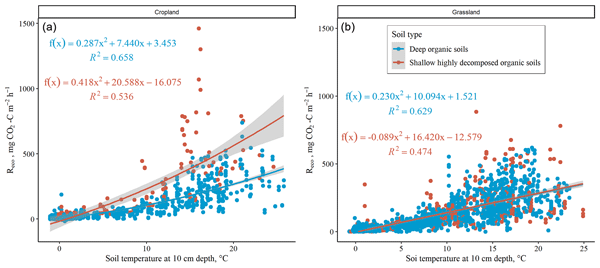
Estimates of CO2 fluxes from drained nutrient-rich organic soils in croplands and grasslands in the hemiboreal region of Europe revealed that annual net CO2 fluxes were lower than the latest (2014) IPCC (Intergovernmental Panel on Climate Change ) emission factors provided for the whole temperate zone, including the hemiboreal region. The contribution of CO2 fluxes from shallow highly decomposed organic soils, former peatlands that no longer meet the IPCC criterion for organic soils, to total emissions can be high and should not be underestimated.
Aldis Butlers, Raija Laiho, Kaido Soosaar, Jyrki Jauhiainen, Thomas Schindler, Arta Bārdule, Muhammad Kamil-Sardar, Andreas Haberl, Valters Samariks, Hanna Vahter, Andis Lazdiņš, Dovilė Čiuldienė, Kęstutis Armolaitis, and Ieva Līcīte
EGUsphere, https://doi.org/10.5194/egusphere-2024-1397, https://doi.org/10.5194/egusphere-2024-1397, 2024
Preprint archived
Short summary
Short summary
A two-year study in Estonia, Latvia, and Lithuania evaluated forest organic soil carbon balance and the impact of drainage. CO2 emissions from soil did not significantly differ, showing a uniform methodology should be applied in national greenhouse gas inventories. Neither drained or undrained soils lost carbon during the study period. However, it was estimated that the negative impact of drainage on carbon sequestration in hemiboreal forest soils is 0.43±2.69 t C ha−1 year−1.
Jyrki Jauhiainen, Juha Heikkinen, Nicholas Clarke, Hongxing He, Lise Dalsgaard, Kari Minkkinen, Paavo Ojanen, Lars Vesterdal, Jukka Alm, Aldis Butlers, Ingeborg Callesen, Sabine Jordan, Annalea Lohila, Ülo Mander, Hlynur Óskarsson, Bjarni D. Sigurdsson, Gunnhild Søgaard, Kaido Soosaar, Åsa Kasimir, Brynhildur Bjarnadottir, Andis Lazdins, and Raija Laiho
Biogeosciences, 20, 4819–4839, https://doi.org/10.5194/bg-20-4819-2023, https://doi.org/10.5194/bg-20-4819-2023, 2023
Short summary
Short summary
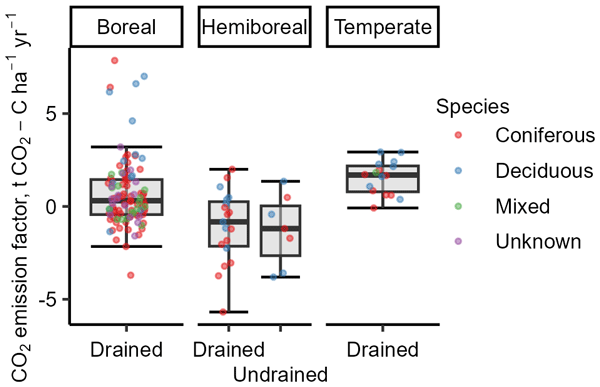
The study looked at published data on drained organic forest soils in boreal and temperate zones to revisit current Tier 1 default emission factors (EFs) provided by the IPCC Wetlands Supplement. We examined the possibilities of forming more site-type specific EFs and inspected the potential relevance of environmental variables for predicting annual soil greenhouse gas balances by statistical models. The results have important implications for EF revisions and national emission reporting.
Aldis Butlers, David Ellison, Ieva Līcīte, and Arta Bārdule
EGUsphere, https://doi.org/10.5194/egusphere-2026-4089, https://doi.org/10.5194/egusphere-2026-4089, 2026
Short summary
Short summary
Restoring wetlands and planting forests are both promoted to slow climate change, but they are often discussed as competing solutions. We argue that these options should be compared using a broader perspective that considers not only greenhouse gases released from soils, but also carbon stored in forests, wood products, and practical risks. Better-informed comparisons can help decision-makers choose the most suitable climate solution for each landscape.
Aldis Butlers, Zaiga Anna Zvaigzne, Arta Bārdule, Josep Peñuelas, Andis Lazdiņš, José-Miguel Sánchez-Pérez, Laure Gandois, Noémie Carles, Romain Darnajoux, Parvez Rana, Kaido Soosaar, Julien Tournebize, Jauhiainen Jyrki, Tuula Larmola, Muhammad Kamil-Sardar, Thomas Schindler, Laura Escarmena, Nerea Parada-Reverter, Sílvia Poblador, Francesc Sabater, and Tom De Dobbelaer
EGUsphere, https://doi.org/10.5194/egusphere-2026-3623, https://doi.org/10.5194/egusphere-2026-3623, 2026
Short summary
Short summary
Measuring greenhouse gas emissions from soils is expensive and time-consuming, limiting our ability to identify where emissions occur and how to reduce them. We tested whether infrared measurements of soil could provide a faster alternative. Using samples from wetlands across six European countries, we demonstrated that this method can predict a soil’s potential to release carbon dioxide and identify areas at risk of elevated greenhouse gas emissions, supporting more effective climate action.
Austra Zuševica, Andis Lazdiņš, Dagnija Lazdiņa, and Viktorija Vendiņa
EGUsphere, https://doi.org/10.5194/egusphere-2025-4493, https://doi.org/10.5194/egusphere-2025-4493, 2026
Short summary
Short summary
Organic soils store large amounts of carbon but also emit greenhouse gases. Drainage alters soil conditions, affecting carbon cycling and plant growth. We studied poplar trees under controlled water levels to see how soil and plant interactions influence greenhouse gas emissions and plant vitality. This helps understand how water management can improve carbon storage and sustainable use of organic soils.
Aldis Butlers, Raija Laiho, Andis Lazdiņš, Thomas Schindler, Kaido Soosaar, Jyrki Jauhiainen, Arta Bārdule, Muhammad Kamil-Sardar, Ieva Līcīte, Valters Samariks, Andreas Haberl, Hanna Vahter, Dovilė Čiuldienė, Jani Anttila, and Kęstutis Armolaitis
Biogeosciences, 22, 4627–4647, https://doi.org/10.5194/bg-22-4627-2025, https://doi.org/10.5194/bg-22-4627-2025, 2025
Short summary
Short summary
A 2-year study assessed the soil carbon dioxide (CO2) balance of drained and undrained hemiboreal peatland forests across Estonia, Latvia, and Lithuania. The study sites included a wide variety of nutrient-rich organic soils, ranging from those near the threshold of organic soil definition to deep peat soils. The soils varied in pH, nutrient levels, and C : N ratio, which contributed to the observed behavior of the soils, demonstrating CO2 sink and source dynamics under both drained and undrained conditions.
Arta Bārdule, Raija Laiho, Jyrki Jauhiainen, Kaido Soosaar, Andis Lazdiņš, Kęstutis Armolaitis, Aldis Butlers, Dovilė Čiuldienė, Andreas Haberl, Ain Kull, Milda Muraškienė, Ivika Ostonen, Gristin Rohula-Okunev, Muhammad Kamil-Sardar, Thomas Schindler, Hanna Vahter, Egidijus Vigricas, and Ieva Līcīte
Biogeosciences, 22, 4241–4259, https://doi.org/10.5194/bg-22-4241-2025, https://doi.org/10.5194/bg-22-4241-2025, 2025
Short summary
Short summary
Estimates of CO2 fluxes from drained nutrient-rich organic soils in croplands and grasslands in the hemiboreal region of Europe revealed that annual net CO2 fluxes were lower than the latest (2014) IPCC (Intergovernmental Panel on Climate Change ) emission factors provided for the whole temperate zone, including the hemiboreal region. The contribution of CO2 fluxes from shallow highly decomposed organic soils, former peatlands that no longer meet the IPCC criterion for organic soils, to total emissions can be high and should not be underestimated.
Aldis Butlers, Raija Laiho, Kaido Soosaar, Jyrki Jauhiainen, Thomas Schindler, Arta Bārdule, Muhammad Kamil-Sardar, Andreas Haberl, Valters Samariks, Hanna Vahter, Andis Lazdiņš, Dovilė Čiuldienė, Kęstutis Armolaitis, and Ieva Līcīte
EGUsphere, https://doi.org/10.5194/egusphere-2024-1397, https://doi.org/10.5194/egusphere-2024-1397, 2024
Preprint archived
Short summary
Short summary
A two-year study in Estonia, Latvia, and Lithuania evaluated forest organic soil carbon balance and the impact of drainage. CO2 emissions from soil did not significantly differ, showing a uniform methodology should be applied in national greenhouse gas inventories. Neither drained or undrained soils lost carbon during the study period. However, it was estimated that the negative impact of drainage on carbon sequestration in hemiboreal forest soils is 0.43±2.69 t C ha−1 year−1.
Jyrki Jauhiainen, Juha Heikkinen, Nicholas Clarke, Hongxing He, Lise Dalsgaard, Kari Minkkinen, Paavo Ojanen, Lars Vesterdal, Jukka Alm, Aldis Butlers, Ingeborg Callesen, Sabine Jordan, Annalea Lohila, Ülo Mander, Hlynur Óskarsson, Bjarni D. Sigurdsson, Gunnhild Søgaard, Kaido Soosaar, Åsa Kasimir, Brynhildur Bjarnadottir, Andis Lazdins, and Raija Laiho
Biogeosciences, 20, 4819–4839, https://doi.org/10.5194/bg-20-4819-2023, https://doi.org/10.5194/bg-20-4819-2023, 2023
Short summary
Short summary
The study looked at published data on drained organic forest soils in boreal and temperate zones to revisit current Tier 1 default emission factors (EFs) provided by the IPCC Wetlands Supplement. We examined the possibilities of forming more site-type specific EFs and inspected the potential relevance of environmental variables for predicting annual soil greenhouse gas balances by statistical models. The results have important implications for EF revisions and national emission reporting.
Cited articles
Ahti, T., Hämet-Ahti, L., and Jalas, J.: Vegetation zones and their sections in northwestern Europe, Ann. Bot. Fenn., 5, 169–211, 1968.
Alm, J., Wall, A., Myllykangas, J. P., Ojanen, P., Heikkinen, J., Henttonen, H. M., Laiho, R., Minkkinen, K., Tuomainen, T., and Mikola, J.: A new method for estimating carbon dioxide emissions from drained peatland forest soils for the greenhouse gas inventory of Finland, Biogeosciences, 20, 3827–3855, https://doi.org/10.5194/bg-20-3827-2023, 2023.
Bai, Y., Zhou, Y., Chen, X., An, Z., Zhang, X., Du, J., and Chang, S. X.: Tree species composition alters the decomposition of mixed litter and the associated microbial community composition and function in subtropical plantations in China, For. Ecol. Manage., 529, 120743, https://doi.org/10.1016/j.foreco.2022.120743, 2023.
Beck, H. E., McVicar, T. R., Vergopolan, N., Berg, A., Lutsko, N. J., Dufour, A., Zeng, Z., Jiang, X., van Dijk, A. I. J. M., and Miralles, D. G.: High-resolution (1 km) Köppen-Geiger maps for 1901–2099 based on constrained CMIP6 projections, Sci. Data, 10, 1–16, https://doi.org/10.1038/s41597-023-02549-6, 2023.
Bušs, K.: Forest Ecology and Typology, Zinātne, Rīga, Latvija, 64 pp., https://dom.lndb.lv/data/obj/419599.html (last access: 12 January 2026), 1981.
Butlers, A.: Appendix: Forest organic soil carbon balance and GHG emissions in Köppen–Geiger Dfb climate zone, Zenodo [data set], https://doi.org/10.5281/zenodo.18223234, 2026.
Butlers, A., Lazdiņš, A., Kalēja, S., and Bārdule, A.: Carbon Budget of Undrained and Drained Nutrient-Rich Organic Forest Soil, Forests, 13, https://doi.org/10.3390/f13111790, 2022.
Butlers, A., Lazdiņš, A., Kalēja, S., Purviņa, D., Spalva, G., Saule, G., and Bārdule, A.: CH4 and N2O Emissions of Undrained and Drained Nutrient-Rich Organic Forest Soil, Forests, 14, https://doi.org/10.3390/f14071390, 2023.
Butlers, A., Laiho, R., Lazdiņš, A., Schindler, T., Soosaar, K., Jauhiainen, J., Bārdule, A., Kamil-Sardar, M., Līcīte, I., Samariks, V., Haberl, A., Vahter, H., Čiuldienė, D., Anttila, J., and Armolaitis, K.: Organic soils can be CO2 sinks in both drained and undrained hemiboreal peatland forests, Biogeosciences, 22, 4627–4647, https://doi.org/10.5194/bg-22-4627-2025, 2025.
Doukalianou, F., Spyroglou, G., Orfanoudakis, M., Radoglou, K., Stefanou, S., Kitikidou, K., Milios, E., and Lagomarsino, A.: Effects of Forest Thinning on Soil Litter Input Nutrients in Relation to Soil CO2, CH4, and N2O Fluxes in Greece, Atmosphere (Basel), 13, https://doi.org/10.3390/atmos13030376, 2022.
Eggleston, H. S., Buendia, L., Miwa, K., Ngara, T., and Tanabe, K.: 2006 IPCC Guidelines for National Greenhouse Gas Inventories, Prepared by the National Greenhouse Gas Inventories Programme, Japan, 1–59 pp., ISBN 4-88788-032-4, 2006.
Elberling, B. B., Kovács, G. M., Hansen, H. F. E., Fensholt, R., Ambus, P., Tong, X., Gominski, D., Mueller, C. W., Poultney, D. M. N., and Oehmcke, S.: High nitrous oxide emissions from temporary flooded depressions within croplands, Commun. Earth Environ., 4, 463, https://doi.org/10.1038/s43247-023-01095-8, 2023.
Lake, R., Hlavacek, J., Fernandez, R., Qoul, C., Mandl, N., and Rigler, E.: Annual European Union greenhouse gas inventory 1990–2023 and inventory document 2025, European Environment Agency, EEA/PUBL/2025/024, 522 pp., 2025.
Hagen-Thorn, A., Callesen, I., Armolaitis, K., and Nihlgård, B.: The impact of six European tree species on the chemistry of mineral topsoil in forest plantations on former agricultural land, For. Ecol. Manage., 195, 373–384, https://doi.org/10.1016/j.foreco.2004.02.036, 2004.
Hatano, R.: Impact of land use change on greenhouse gases emissions in peatland: a review, Int. Agrophys., 33, 167–173, https://doi.org/10.31545/intagr/109238, 2019.
He, H. and Roulet, N. T.: Improved estimates of carbon dioxide emissions from drained peatlands support a reduction in emission factor, Commun. Earth Environ., 4, https://doi.org/10.1038/s43247-023-01091-y, 2023.
Hiraishi, T., Krug, T., Tanabe, K., Srivastava, N., Fukuda, M., Troxler, T., and Jamsranjav, B.: 2013 Supplement to the 2006 IPCC Guidelines for National Greenhouse Gas Inventories, Switzerland, The Intergovernmental Panel on Climate Change (IPCC), ISBN 978-92-9169-139-5, 2014.
Huang, J., Mendoza, B., Daniel, J. S., Nielsen, C. J., Rotstayn, L., and Wild, O.: Anthropogenic and natural radiative forcing, Clim. Chang. 2013 Phys. Sci. Basis Work, Gr. I Contrib. Fifth Assess. Rep. Intergov. Panel Clim. Chang., 9781107057, 659–740, https://doi.org/10.1017/CBO9781107415324.018, 2013.
Ibrahim, A., Wayayok, A., Shafri, H. Z. M., and Toridi, N. M.: Remote Sensing Technologies for Unlocking New Groundwater Insights: A Comprehensive Review, J. Hydrol. X, 23, 100175, https://doi.org/10.1016/j.hydroa.2024.100175, 2024.
Jauhiainen, J., Heikkinen, J., Clarke, N., He, H., Dalsgaard, L., Minkkinen, K., Ojanen, P., Vesterdal, L., Alm, J., Butlers, A., Callesen, I., Jordan, S., Lohila, A., Mander, Ü., Óskarsson, H., Sigurdsson, B. D., Søgaard, G., Soosaar, K., Kasimir, Å., Bjarnadottir, B., Lazdins, A., and Laiho, R.: Reviews and syntheses: Greenhouse gas emissions from drained organic forest soils – synthesizing data for site-specific emission factors for boreal and cool temperate regions, Biogeosciences, 20, 4819–4839, https://doi.org/10.5194/bg-20-4819-2023, 2023.
Jovani, A. J., Reilly, P. O., Anshari, G., Yi, X., Neil, C., Christopher, C., Stephanie, D. E., Ye, J., Christopher, G., Evi, N. G., Jamaludin, J., Jaya, A., Page, S., Yosep, Y., Upton, C., Wilson, P., and Sjögersten, S.: CH4 and N2O emissions from smallholder agricultural systems on tropical peatlands in Southeast Asia, Glob. Change Biol., 4279–4297, https://doi.org/10.1111/gcb.16747, 2023.
Kamil-Sardar, M., Laiho, R., Jauhiainen, J., Butlers, A., Schindler, T., Vahter, H., Čiuldienė, D., Vigricas, E., Teemusk, A., Kull, A., Lazdiņš, A., Haberl, A., Bārdule, A., Līcīte, I., Samariks, V., Mander, Ü., Armolaitis, K., and Soosaar, K.: Impact of drainage on soil CH4 and N2O fluxes in nutrient-rich hemiboreal peatland forests of Europe, Plant Soil, 526, https://doi.org/10.1007/s11104-026-08920-x, 2026.
Korkiakoski, M., Ojanen, P., Tuovinen, J. P., Minkkinen, K., Nevalainen, O., Penttilä, T., Aurela, M., Laurila, T., and Lohila, A.: Partial cutting of a boreal nutrient-rich peatland forest causes radically less short-term on-site CO2 emissions than clear-cutting, Agric. For. Meteorol., 332, https://doi.org/10.1016/j.agrformet.2023.109361, 2023.
Latvia's National Inventory Document: Latvia's National Inventory Document under the UNFCCC and Paris Agreement, Greenhouse Gas Emissions in Latvia from 1990 to 2023, https://unfccc.int/ghg-inventories-annex-i-parties/2024 (last access: 4 September 2025), 2025.
Lorenz, M. and Thiele-Bruhn, S.: Tree species affect soil organic matter stocks and stoichiometry in interaction with soil microbiota, Geoderma, 353, 35–46, https://doi.org/10.1016/j.geoderma.2019.06.021, 2019.
Menichetti, L., Lehtonen, A., Lindroos, A. J., Merilä, P., Huuskonen, S., Ukonmaanaho, L., and Mäkipää, R.: Soil Carbon Dynamics During Stand Rotation in Boreal Forests, Eur. J. Soil Sci., 76, https://doi.org/10.1111/ejss.70154, 2025.
Muukkonen, P. and Mäkipää, R.: Empirical biomass models of understorey vegetation in boreal forests according to stand and site attributes, Boreal Environ. Res., 11, 355–369, 2006.
Nielsen, C. K., Elsgaard, L., Jørgensen, U., and Lærke, P. E.: Soil greenhouse gas emissions from drained and rewetted agricultural bare peat mesocosms are linked to geochemistry., Sci. Total Environ., 896, 165083, https://doi.org/10.1016/j.scitotenv.2023.165083, 2023.
R Core Team: R: A Language and Environment for Statistical Computing, R Foundation for Statistical Computing, https://www.r-project.org/ (last access: 12 January 2026), 2023.
Rautakoski, H., Korkiakoski, M., Mäkelä, J., Koskinen, M., Minkkinen, K., Aurela, M., Ojanen, P., and Lohila, A.: Exploring temporal and spatial variation of nitrous oxide flux using several years of peatland forest automatic chamber data, Biogeosciences, 21, 1867–1886, https://doi.org/10.5194/bg-21-1867-2024, 2024.
Ribeiro-Kumara, C., Köster, E., Aaltonen, H., and Köster, K.: How do forest fires affect soil greenhouse gas emissions in upland boreal forests? A review, Environ. Res., 184, https://doi.org/10.1016/j.envres.2020.109328, 2020.
Rubaiyat, A., Hossain, M. L., Kabir, M. H., Sarker, M. M. H., Salam, M. M. A., and Li, J.: Dynamics of greenhouse gas fluxes and soil physico-chemical properties in agricultural and forest soils, J. Water Clim. Chang., 14, 3791–3809, https://doi.org/10.2166/wcc.2023.338, 2023.
Šantrůčková, H., Cienciala, E., Kaňa, J., and Kopáček, J.: The chemical composition of forest soils and their degree of acidity in Central Europe, Sci. Total Environ., 687, 96–103, https://doi.org/10.1016/j.scitotenv.2019.06.078, 2019.
Säurich, A., Tiemeyer, B., Dettmann, U., and Don, A.: How do sand addition, soil moisture and nutrient status influence greenhouse gas fluxes from drained organic soils?, Soil Biol. Biochem., 135, 71–84, https://doi.org/10.1016/j.soilbio.2019.04.013, 2019.
Starr, M., Saarsalmi, A., Hokkanen, T., Merilä, P., and Helmisaari, H.-S.: Models of litterfall production for Scots pine (Pinus sylvestris L.) in Finland using stand, site and climate factors, For. Ecol. Manage., 205, 215–225, https://doi.org/10.1016/j.foreco.2004.10.047, 2005.
Tiemeyer, B., Freibauer, A., Borraz, E. A., Augustin, J., Bechtold, M., Beetz, S., Beyer, C., Ebli, M., Eickenscheidt, T., Fiedler, S., Förster, C., Gensior, A., Giebels, M., Glatzel, S., Heinichen, J., Hoffmann, M., Höper, H., Jurasinski, G., Laggner, A., Leiber-Sauheitl, K., Peichl-Brak, M., and Drösler, M.: A new methodology for organic soils in national greenhouse gas inventories: Data synthesis, derivation and application, Ecol. Indic., 109, 105838, https://doi.org/10.1016/j.ecolind.2019.105838, 2020.
Tikkasalo, O.-P., Peltola, O., Alekseychik, P., Heikkinen, J., Launiainen, S., Lehtonen, A., Li, Q., Martínez-García, E., Peltoniemi, M., Salovaara, P., Tuominen, V., and Mäkipää, R.: Eddy-covariance fluxes of CO2, CH4 and N2O in a drained peatland forest after clear-cutting, Biogeosciences, 22, 1277–1300, https://doi.org/10.5194/bg-22-1277-2025, 2025.
Vancampenhout, K., De Vos, B., Wouters, K., Swennen, R., Buurman, P., and Deckers, J.: Organic matter of subsoil horizons under broadleaved forest: Highly processed or labile and plant-derived?, Soil Biol. Biochem., 50, 40–46, https://doi.org/10.1016/j.soilbio.2012.03.005, 2012.
Vesterdal, L., Clarke, N., Sigurdsson, B. D., and Gundersen, P.: Do tree species influence soil carbon stocks in temperate and boreal forests?, For. Ecol. Manage., 309, 4–18, https://doi.org/10.1016/j.foreco.2013.01.017, 2013.
Wang, H., Liu, S. R., Wang, J. X., Shi, Z. M., Xu, J., Hong, P. Z., Ming, A. G., Yu, H. L., Chen, L., Lu, L. H., and Cai, D. X.: Differential effects of conifer and broadleaf litter inputs on soil organic carbon chemical composition through altered soil microbial community composition, Sci. Rep., 6, 1–9, https://doi.org/10.1038/srep27097, 2016.
Yang, L., Niu, S., Tian, D., Zhang, C., Liu, W., Yu, Z., Yan, T., Yang, W., Zhao, X., and Wang, J.: A global synthesis reveals increases in soil greenhouse gas emissions under forest thinning., Sci. Total Environ., 804, 150225, https://doi.org/10.1016/j.scitotenv.2021.150225, 2022.
Zhou, Y., Meng, D., Osborne, B., Fan, Y., and Zou, J.: The Impact of Modifications in Forest Litter Inputs on Soil N2O Fluxes: A Meta-Analysis, Atmosphere, 13, 1–10, https://doi.org/10.3390/atmos13050742, 2022.
Short summary
Knowledge on greenhouse gas emissions from organic soils is continuously improving and requires periodic re-evaluation. This study compiled emission estimates from regions characterised by cold winters, warm summers, and no dry season. The findings indicate that, on average, emissions from drained forest organic soils are not substantially higher than those from undrained soils. This challenges a common assumption that drained areas consistently produce elevated emissions.
Knowledge on greenhouse gas emissions from organic soils is continuously improving and requires...
Altmetrics
Final-revised paper
Preprint