
the Creative Commons Attribution 4.0 License.
the Creative Commons Attribution 4.0 License.
 | 28 Oct 2026
Liquid polymer enhances methanogenesis and restructures prokaryotic communities in freshwater sediments
Alexander Feckler

Eric Bollinger
Alexandra Unik
Peter Mueller
Sabine Filker
Christian Plicht
Zacharias Steinmetz
Mirco Bundschuh
The widespread use of synthetic hydrophilic polymers, such as polyvinylpyrrolidone (PVP), has raised concerns about their potential effects on environmental biogeochemical processes, yet their impact on sediment ecosystems remains largely unexplored. We investigated how PVP influences methane (CH4) production and prokaryotic community composition in freshwater sediments over a 56 d anoxic incubation. PVP exposure accelerated the onset of methanogenesis, increased maximum CH4 production rates, and elevated maximum CH4 concentrations. Notably, a substantial proportion of the response occurred already at environmentally relevant concentrations. These functional changes were accompanied by shifts in bacterial communities, particularly among fermentative taxa known to produce key methanogenic substrates. In contrast, archaeal communities, including methanogens, exhibited comparatively weak and transient responses. The concomitant increase in CO2 and CH4 production and the observed microbial community shifts suggest that PVP altered microbial carbon-processing pathways, although the mechanisms responsible for these effects remain unresolved. As a proof-of-concept study, our results provide initial evidence that a widespread synthetic hydrophilic polymer can modify sediment microbial communities and stimulate methane production. These findings highlight the need for future studies addressing the mechanistic basis of these responses and their relevance under environmentally realistic conditions.
- Article
(1669 KB) - Full-text XML
-
Supplement
(1738 KB) - BibTeX
- EndNote


The widespread use and disposal of plastic consumer products are major drivers of environmental pollution and contribute to exceeding the planetary boundary for novel entities (Arp et al., 2021; Walker and Fequet, 2023). Global plastic production has increased rapidly in recent decades, reaching approximately 400 million metric tons (Mt) annually, with over 2489 Mt already accumulated in landfills or natural ecosystems (Brooks et al., 2018; Geyer et al., 2017). Research on plastic pollution has largely focused on solid, hydrophobic, and water-insoluble polymers, including macroplastics, microplastics, and nanoplastics (Brunning et al., 2022; Groh et al., 2023; Hartmann et al., 2019). In contrast, synthetic hydrophilic polymers (SHPs) remain poorly studied, despite an annual global production volume of 36.3 Mt and their widespread use in personal care products, pharmaceuticals, industry, and agriculture (Graves et al., 2021; Wang et al., 2023). Therefore, the effects of SHPs on ecosystem structure and biogeochemical processes remain largely unknown, particularly in sediments where data are scarce (Steinmetz et al., 2024). Despite their widespread use and environmental occurrence, the potential for SHPs to interfere with sediment biogeochemistry remains unexplored. This is surprising given that sediments are both a likely sink for SHPs (Guezennec et al., 2015) and a central environmental compartment in which fundamental biogeochemical processes, such as carbon and greenhouse-gas cycling, occur (McClain et al., 2003; Rabaey et al., 2024). Whether SHPs can alter microbial community structure or disrupt the syntrophic pathways underlying methanogenesis is entirely unknown
Methane (CH4) production is one fundamental biogeochemical process in sediments with the potential for widespread effects on ecosystems due to its global warming potential and major contribution to radiative forcing (IPCC, 2021), and its substantial emissions from natural freshwaters and wetlands (Saunois et al., 2025). In sediments, CH4 is formed as the terminal product of anaerobic organic matter degradation through a multi-step, syntrophic microbial cascade, in which the intermediate steps are performed by a diverse anaerobic microbial community and the final step is carried out by methanogenic archaea (Conrad, 2020; Megonigal et al., 2003). This syntrophic microbial cascade may experience direct exposure to anthropogenic stress, with potential consequences for community structure and CH4 production. Similar to microplastics (He et al., 2024; Zhang et al., 2022), SHPs may affect methanogenesis by altering sediment geochemistry and microbial activity as it has been shown for water soluble organic chemicals such as antibiotics (Bollinger et al., 2021). At the same time, chemical stressors can shift microbial community composition toward more tolerant taxa (Blanck et al., 1988). Such structural changes can subsequently shape the long-term metabolic capacity of microbial communities and ultimately alter CH4 production dynamics (Bollinger et al., 2024, 2025).
To assess the effects of SHPs on sediment-associated prokaryotic communities and their associated ecosystem functions, we exposed freshwater sediment with a natural microbial community for 56 d to four concentrations of polyvinylpyrrolidone (PVP) serving as a model SHP. PVP represents a suitable model SHP because it is highly water soluble and highly resistant to chemical degradation under environmental conditions (Julinová et al., 2012; Luo et al., 2021). This persistence, together with its widespread use in industrial and pharmaceutical applications, contributes to its frequent detection in aquatic environments, such as surface waters downstream of wastewater treatment plants, with measured environmental concentrations of up to 7 mg L−1 (Antić et al., 2011). We quantified CH4 production under anoxic conditions through weekly measurements and thereby assessed PVP-induced functional responses over time. In parallel, we characterized the active sediment-associated prokaryotic communities using 16S rRNA metabarcoding after 7, 28 and 56 d of exposure to link functional responses to structural community changes. Based on reported effects of microplastics on CH4 production (He et al., 2024; Zhang et al., 2022), we hypothesized that PVP exposure increases methanogenesis.
2.1 Sediment sampling and processing
In June 2024, we collected a fine-grained sediment from the upper 20 cm of a naturally vegetated pond at the Eußerthal Ecosystem Research Station of the RPTU University Kaiserslautern-Landau, Germany (49°25′ N, 7°96′ E), which was immediately transported to the laboratory. The pond receives water from a forest stream and supports a natural prokaryotic community (Bollinger et al., 2021). To enrich the sediment with an additional organic carbon source, we amended it with 20 g (dry weight) of Alnus glutinosa (L.) Gaertn. leaf powder per kg wet sediment (gravimetric water content: Θg=2.53 ± 0.42 g g−1). Adding organic substrates (e.g., leaf litter and glucose) to the test system is common practice when mechanistically addressing methane production (e.g., Bhullar et al., 2013; Bollinger et al., 2025) to ensure sufficient substrate availability for microbial metabolism (including methanogenesis) during incubation. In a previous study using the same approach, the added leaf material contributed approximately 12 % of the total sediment organic carbon (Bollinger et al., 2021). Due to limited leaf availability at the sediment source site, leaves were collected from a different site near Landau, Germany (49°12′ N, 8°08′ E), dried at 60 °C for 24 h, and ground into a fine powder using an electric mill prior to sediment amendment.
2.2 PVP treatment and quantification
We included three PVP treatments (0.5, 50, and 5000 mg L−1), prepared from PVP K30 (40 kDa, CAS 9003-39-8; Carl Roth, Karlsruhe, Germany), along with a PVP-free control. All treatments and the control were replicated 32 times. The selected concentration range reflected environmentally relevant levels reported for European rivers receiving municipal sewage discharges (up to 0.1 mg L−1) and wastewater treatment plant effluents (0.9–7 mg L−1; Antić et al., 2011), whereas the higher concentrations were selected to assess concentration-dependent effects. We prepared serial dilutions of the PVP product in unfiltered pond water collected from the sediment source. Because anaerobic organic matter degradation is highly sensitive to pH (Wang et al., 1993; Zhang et al., 2010), we adjusted the test solutions to neutral pH after PVP application using NaOH. This standardization minimized pH as a confounding factor among treatments and ensured that observed treatment effects could be attributed to PVP exposure rather than differences in pH. We collected triplicate water samples from each treatment, including the control, on days 0, 7, and 56, and stored all samples in glass vials at 4 °C until chemical analysis.
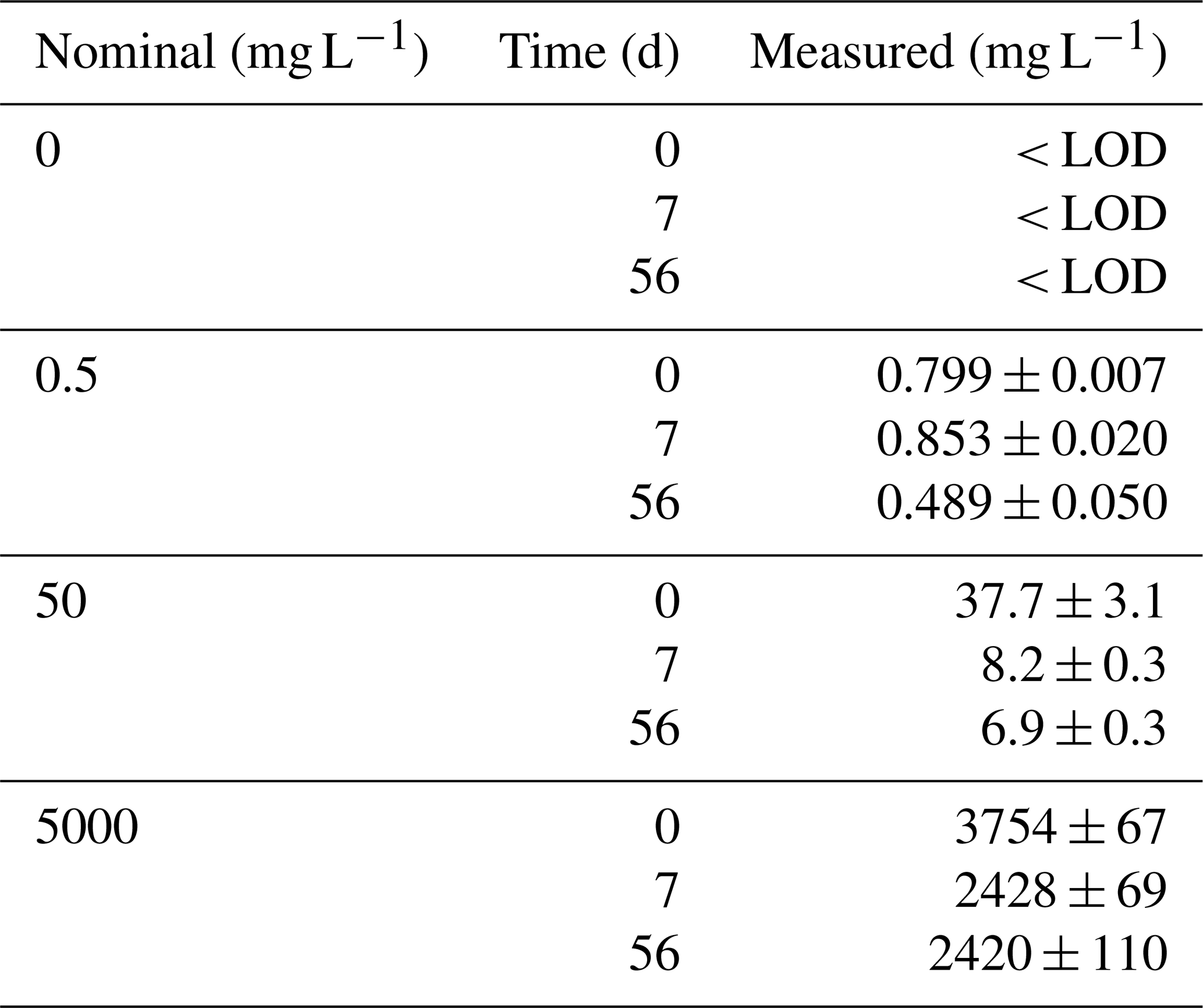
We quantified PVP by pyrolysis–gas chromatography–mass spectrometry (Py-GC/MS) following Steinmetz et al. (2020). In brief, we coupled a Pyroprobe 6150 filament pyrolyzer (CDS Analytical, USA) to a Trace GC Ultra and a DSQII single quadrupole mass spectrometer (Thermo Fisher Scientific, Germany). We ultrasonicated water samples for 10 min and applied 2 µL to a quartz filter (Whatman QM-A) in a quartz tube. We dried samples at 105 °C for 3 min under helium (20 mL min−1), then flash-pyrolyzed them at 550 °C for 15 s (10 K s−1). We set the transfer line to 250 °C and operated the injector at 300 °C (split 1:10; helium 1.3 mL min−1). We separated pyrolysates on a 30 m × 0.25 mm × 0.25 µm ZB-5MS column (Phenomenex, Germany). The oven program started at 35 °C (2 min), increased to 104 °C at 3 K min−1, then to 300 °C at 50 K min−1, and held for 5 min. We maintained the GC–MS transfer line at 280 °C and the ion source at 230 °C. We identified PVP pyrolysates by analyzing a 2 mg mL−1 aqueous standard in scan mode ( 45–250) using OpenChrom v1.5.0 (Wenig and Odermatt, 2010) and the NIST08 database (National Institute of Standards and Technology, 2009). We quantified PVP via the main fragment, 1-vinyl-2-pyrrolidinone, in selective ion monitoring mode ( 56 and 111). We established an 11-point calibration (5–200 mg L−1), measured blanks, and included quality controls (125 mg L−1). The limits of detection (LOD) and quantification (LOQ) were 2.2 and 6.5 mg L−1, respectively. We diluted samples 50-fold or preconcentrated them 10-fold (50 °C, redissolved in deionized water) to match the calibration range and be able to quantify PVP concentrations in the lower two treatments. The initial deviation between nominal and measured PVP concentrations (Table 1) may have resulted from adsorption of PVP to the glass walls of the storage vials, as PVP is known to adsorb to silica-based surfaces (Al-Harbi et al., 2016). The more pronounced decline in measured concentrations during later stages of the experiment (Table 1) may additionally reflect interactions of PVP with sediment constituents, including organic matter, as PVP has been shown to associate with humic and fulvic substances (Watanabe and Kuwatsuka, 1992). Because initial measured concentrations remained within the intended treatment range and did not alter the interpretation of treatment effects, nominal concentrations are used throughout the manuscript for ease of presentation.
Table 1Nominal and measured (mean ± standard deviation; n=3) PVP concentrations in the test medium on days 0, 7, and 56 of the incubation.
2.3 Experimental setup and greenhouse gas measurements
As described by Bollinger et al. (2021) we added 5.12 ± 0.22 g (wet weight; N=128) of carbon-spiked sediment and 30 mL of pond water containing the respective PVP concentration (i.e., 0, 0.5, 50 and 5000 mg L−1; n=32) into airtight glass microcosms. We flushed the headspace of each microcosm with nitrogen for 30 s and subsequently hermetically sealed the vessels. This procedure removed oxygen from the headspace but did not immediately eliminate dissolved oxygen present in the sediment slurry. Consequently, fully anoxic conditions developed progressively during the initial incubation period as residual oxygen was consumed by aerobic microbial respiration. This initial oxygen-consuming phase is supported by the observed increase in CO2 concentrations (Fig. S1 in the Supplement), with oxygen depletion inferred to occur after approximately seven days. We incubated all vessels for 56 d in a climate-controlled cabinet (WB 345 KHFL; mytron, Germany) at 20 ± 0.2 °C in darkness (Fig. S2).
Every seven days, we quantified CH4 by withdrawing a 100 µL headspace gas sample (Vi) from each microcosm and injected it into a cavity-enhanced absorption spectrometer (UGGA, model 915-0011, Los Gatos Research Inc., USA) operated in a closed-loop configuration. To determine the true mole fraction in the headspace (xh), we corrected the equilibrium mole fraction (xe, ppm) measured by the analyzer after equilibration of the injected sample gas with the gas initially present in the analyzer loop (Wilkinson et al., 2018). The correction accounts for dilution caused by the loop volume (Vl; calibrated using certified CH4 and CO2 reference gases; Messer Industriegase, Germany), the injected gas sample (Vi), and the background mole fraction (x0) assuming ambient pressure in the microcosms (Eq. 1):
Afterwards, we estimated the amount of dissolved CH4 (nw) using Henry's law (Eq. 2):
where Vw is the water volume, f1 is a conversion factor (10−1 Pa ppm−1), and KH is Henry's law constant adjusted for the test temperature of 293.15 K (Lide, 2004; Weiss, 1974):
where TK is the temperature in Kelvin.
Finally, we normalize the total amounts of CH4 to the dry weight of sediment (ms) in each system (Eq. 4):
where Vh is the headspace volume, R is the universal gas constant, ms and Θg are the wet weight and the gravimetric water content of the sediment, respectively.
2.4 RNA extraction and metabarcoding
After measuring CH4 (and CO2) on days 7, 28, and 56, we destructively sampled six microcosms per treatment to collect sediment for metabarcoding analyses. We immediately stored the sediment samples at −80 °C. From each sample, we extracted RNA from 2 g of sediment using the RNeasy PowerSoil Total RNA Kit (Qiagen) according to the manufacturer's protocol. We quantified RNA concentrations using a NanoDrop 2000 spectrophotometer (Thermo Fisher Scientific) and evaluated RNA integrity with a 2100 Bioanalyzer system (Agilent).
To characterize the potentially active sediment-associated prokaryotic community, we used an RNA-based sequencing approach rather than DNA-based 16S rRNA gene sequencing. Specifically, 2 µL of each RNA extract was reverse-transcribed into cDNA using random primers supplied with the iScript cDNA Synthesis Kit (Bio-Rad). The resulting cDNA, representing cellular 16S rRNA transcripts, was subsequently used for amplicon sequencing. This approach targets the potentially active fraction of the microbial community and was therefore selected to better link microbial community composition to observed biogeochemical processes. We amplified the hypervariable V4 region of the 16S rRNA gene using primers 515Fm (5′-GTGYCAGCMGCCGCGGTAA-3′) and 806Rm (5′-GGACTACNVGGGTWTCTAAT-3′) (Walters et al., 2015). Each PCR used 2 µL of cDNA as template and consisted of an initial denaturation at 98 °C for 30 s, followed by 26 cycles at 98 °C for 10 s, 63 °C for 30 s, and 72 °C for 30 s, with a final extension at 72 °C for 5 min. To minimize PCR bias, each biological replicate (i.e., microcosm per treatment) was amplified in three independent PCR reactions, which were pooled to obtain one technical composite. In a second pooling step, two biological replicates were randomly combined, reducing the number of biological replicates per treatment from six to three for sequencing. Sequencing libraries were then prepared using the NEBNext Ultra DNA Library Prep Kit for Illumina (NEB, USA). We assessed library quality with a 2100 Bioanalyzer system (Agilent) and the libraries were sequenced on an Illumina MiSeq platform (2 × 300 bp paired-end; StarSeq GmbH, Germany).
We processed raw reads following Bollinger et al. (2024). Briefly, we removed primers using cutadapt (v1.18; Martin, 2011) and analyzed reads with the DADA2 pipeline (Callahan et al., 2016) using the following parameters: truncLen = c(216, 183), maxEE = 1, maxN = 0 and minOverlap = 20. We detected and removed chimeras with vsearch (v2.13.7; Rognes et al., 2016) and assigned taxonomy to amplicon sequence variants (ASVs) using the SINTAX algorithm (Edgar, 2016) against the Greengenes reference database (v13.5; McDonald et al., 2012). We removed ASVs lacking taxonomic assignment and those with fewer than five total occurrences across all samples (Bokulich et al., 2013). The filtered ASV table, combined with taxonomy information, was used for downstream statistical analyses. We created a rarefaction curve on the final reads to confirm saturated sampling profiles across all samples (Fig. S3).
2.5 Data processing and statistics
For the statistical analysis of CH4 production profiles, we followed the approach by Bollinger et al. (2024) and Middelanis et al. (2024), using a non-linear function to describe methane production dynamics. To characterize temporal dynamics of cumulative CH4 production over time (t, days), we fitted an extended form of the von Bertalanffy growth function (Eq. 5):
where A and L represent the lower and upper asymptotes of the curve, respectively, k is a rate constant controlling the steepness of the increase, τ determines the temporal displacement of the curve (i.e., the location where the incubation reaches its fastest methane production), and v controls the curve's symmetry. In the following, we primarily focus on L, representing the maximum attainable CH4 concentration, and τ, describing the timing until the temporal displacement of the curve is reached.
The maximum CH4 production rate (rmax) was afterwards calculated as (Eq. 6):
We built the methanogenesis models using non-linear Bayesian regression implemented in the brms package (v2.20.0; Bürkner, 2021), which interfaces with rstan (v2.32.3; Stan Development Team, 2023). We ran four Markov chains with 20 000 iterations each, a thinning interval of 10, and a warm-up of 16 000 iterations. To ensure stable sampling and model convergence, we used previously described priors (Bollinger et al., 2024). These priors were informative enough to support reliable convergence while remaining broad enough to avoid introducing bias. Sensitivity analyses revealed no bias from the priors on the posterior distributions (Fig. S4), and validity analyses showed that the models could reliably detect parameter effects (Fig. S5). We report posterior distributions for τ, rmax, and L using the maximum a posteriori estimate (MAP) together with the 95 % highest density credible interval (CRI). We evaluated the certainty for treatment differences using Bayes factors (BF), which indicate the relative likelihood of the alternative hypothesis (H1) versus the null hypothesis (H0) given the observed data. For clarity and comparability across contrasts, we expressed BF values as > 1 irrespective of the direction of the effect. When all posterior samples favor H1 over H0 (or vice versa), BF is technically undefined but approaches infinity (Inf).
For metabarcoding analyses, we first analyzed the complete prokaryotic community and subsequently examined Euryarchaeota separately, as this phylum comprises the methanogenic Archaea responsible for CH4 production. This hierarchical approach allowed us to distinguish broad shifts in prokaryotic community composition from responses specifically associated with methanogenic microorganisms. Therefore, we expressed taxon-specific responses as centered log-ratio (CLR) differences relative to the control, which accounts for the compositional nature of amplicon sequencing data and allows mathematically valid comparisons among taxa (Eq. 7; Aitchison, 1982; Gloor et al., 2017):
where RAi is the relative abundance of ASVi, RAj is the relative abundance of ASVj,D is the total number of ASVs in the sample, and ) is a pseudocount added to avoid zero values. CLR differences between treatment and control therefore reflect deviations in taxon abundance relative to the overall community composition. We removed one replicate at 5000 mg L−1 on day 7 from further analyses because it was identified as an outlier using the Mahalanobis distance (Filzmoser et al., 2008). We then performed non-metric multidimensional scaling (NMDS) based on Euclidian distances of CLR-transformed ASV abundances to ordinate samples in low-dimensional space using the R package vegan (version 2.6-6.1; Oksanen et al., 2022). We evaluated differences in community structure among PVP treatments and the control using permutational multivariate analysis of variance (PERMANOVA) on the same CLR-based Euclidean distance matrix (Anderson, 2001). NMDS plots were visually scaled such that axes reflect relative differences in community composition while maintaining mathematically valid distances. To identify taxa contributing most to observed dissimilarities, we performed similarity percentage (SIMPER) analyses on CLR-transformed data, summarizing taxon-specific contributions across time points using the R package vegan (version 2.6-6.1; Oksanen et al., 2022). We conducted all data analyses in R (version 4.4.0; R Core Team, 2025).
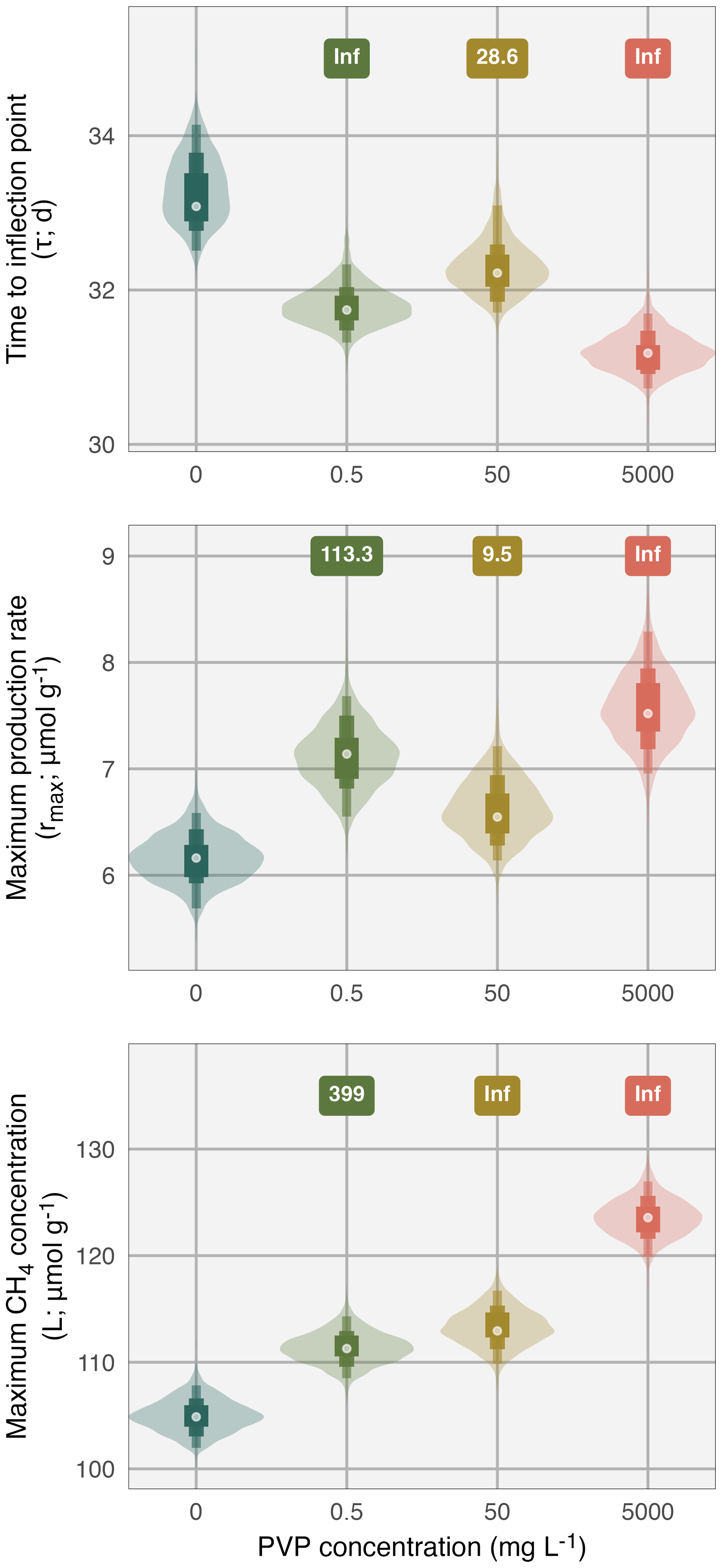
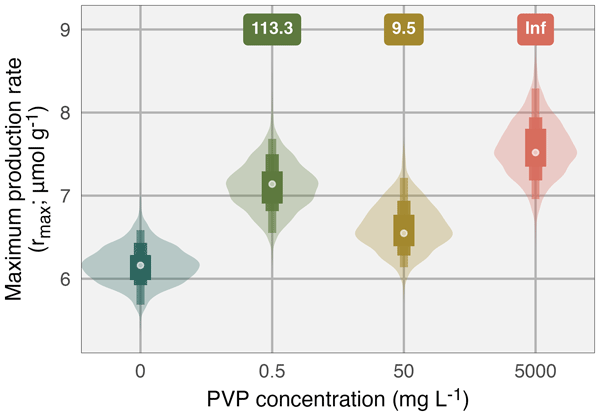
Figure 1Violin plots showing (top) the time until the inflection point is reached (τ), (middle) the maximum CH4 production rate (rmax), and (bottom) the maximum attainable CH4 concentration (L) in the control and under PVP exposure. Within each violin, bars indicate the 50 % (thick), 75 % (medium), and 95 % (slim) credible intervals, and circles mark the maximum a posteriori estimate. Bayes factors (BF) compared to the control are printed above and represent the odds ratio for the probability that the effect is greater or less than zero, with values expressed as ≥1. PVP concentrations are indicated by color: light blue = control, green = 0.5 mg L−1, ochre = 50 mg L−1, red = 5000 mg L−1.
3.1 Methane production
Across all experimental treatments, including the control, the CH4 development followed a generalized logistic growth curve (Fig. S1) progressing through the typical phases of methanogenesis under anoxic conditions. Exposure to PVP, however, caused altered CH4 production patterns compared to the PVP-free control. Specifically, at all PVP concentrations, the time until the inflection point was reached (τ; the location where the incubation reaches its fastest methane production) was 2 days earlier (BF = 28.6–Inf; Fig. 1), indicating a faster transition from the initial to the exponential phase. Maximum CH4 production rates (rmax) were up to 25 % higher under PVP exposure compared with the control (BF = 9.5–Inf; Fig. 1). Furthermore, the maximum attainable CH4 concentration by the end of the incubation (L) was up to 20 % higher in PVP-treated samples than in the control (BF = 399–Inf; Fig. 1).
3.2 Metabarcoding
A total of 9188 ASVs from 59 phyla, 138 classes, and 206 orders were analyzed with an average of 1233 ± 704 ASVs across 147 602 ± 42 653 reads per sample. Independent of the PVP treatment, the same prokaryotic classes (Clostridia, Bacteroidia, Proteobacteria, and Methanomicrobia) dominated all communities, despite slightly different dominance patterns among sampling times (7, 28, and 56 d; Fig. 2). Nevertheless, across all assigned prokaryotes, both PVP concentration and sampling time significantly affected the community composition (PERMANOVA; p<0.001), while the PVP treatment and sampling time showed an interaction effect (PERMANOVA; p=0.029; Fig. 3; Table 2). Changes in prokaryotic communities were mostly detected at the highest PVP concentration (Fig. 3). Across the three sampling times, the classes that contributed most to average similarities between the highest treatment and the control were Clostridia (15.2 %), Bacteroidia (12.1 %), Gammaprobacteria (5.3 %), Betaprobacteria (2.8 %), and unassigned ASVs (2 %; Fig. 3). Methanomicrobia, the prokaryotic class that contains most methanogenic archaea, also showed considerable effect sizes that revert the observed changes in CH4 production in the exponential phase of the incubation (28 d), with negative effects at all tested PVP concentrations. However, the overall contribution of the relative abundance of these ASVs average similarities between the highest treatment and the control was rather moderate with a dissimilarity contribution of 1.7 %.
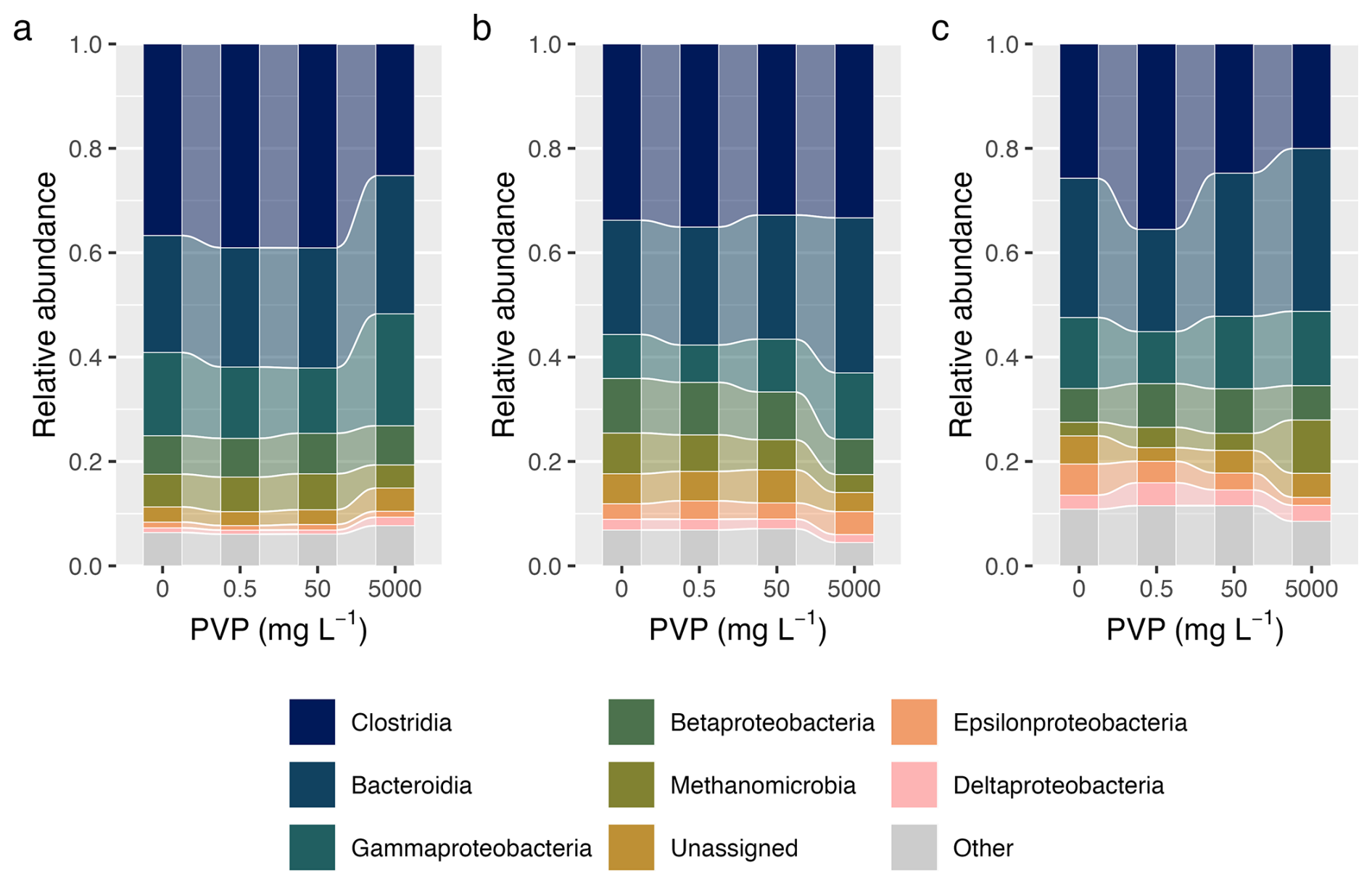
Figure 2Relative abundance of prokaryotic classes in the control as well as under exposure to PVP, separated by samplings after (a) 7 d, (b) 28 d, and (c) 56 d.
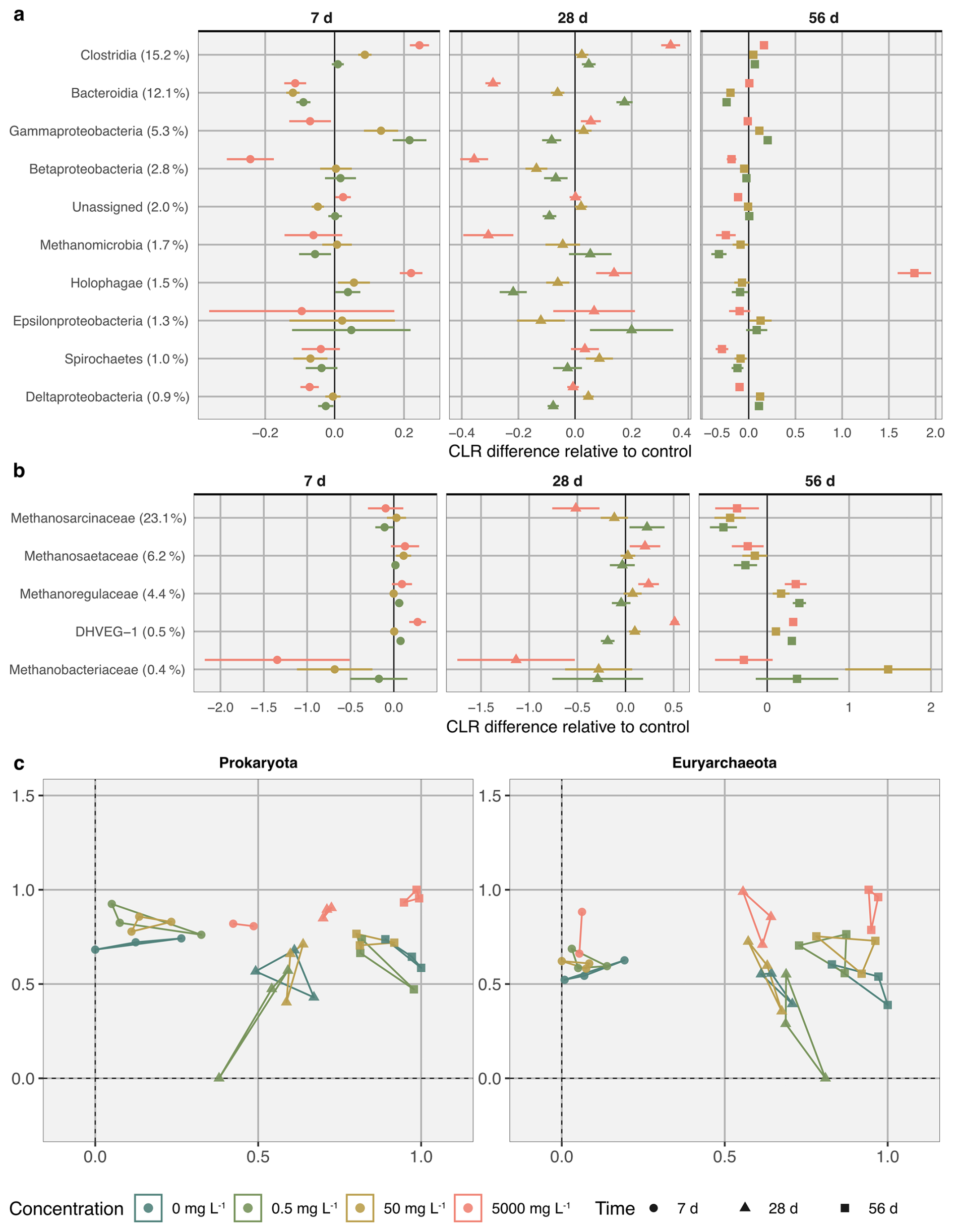
Figure 3(a) SIMPER analysis of all prokaryotes: average centered log-ratio (CLR) differences relative to the control (mean ± SE) for taxonomic classes after 7, 28, and 56 d of incubation. Negative CLR differences indicate taxa reduced relative to the control; positive values indicate taxa enriched under PVP exposure. Classes are ordered according to their contribution to the dissimilarity between the highest PVP concentration (5000 mg L−1) and the control, averaged across time points, with the mean contribution (%) shown in parentheses. (b) SIMPER analysis of Euryarchaeota: average CLR differences relative to the control (mean ± SE) for taxonomic families after 7, 28, and 56 d, plotted and ordered as described for prokaryotes. (c) NMDS plots based on Euclidean distances of CLR-transformed ASV abundances. Left: all prokaryotes (stress = 0.114); right: Euryarchaeota (stress = 0.008). Colors indicate PVP concentration (light blue = control, green = 0.5 mg L−1, ochre = 50 mg L−1, red = 5000 mg L−1), while symbols indicate sampling times (circles = 7 d, triangles = 28 d, squares = 56 d).
Table 2PERMANOVA results for community compositions of all prokaryotic taxa and the Euryarchaeota subset. Statistical significance is highlighted in bold.
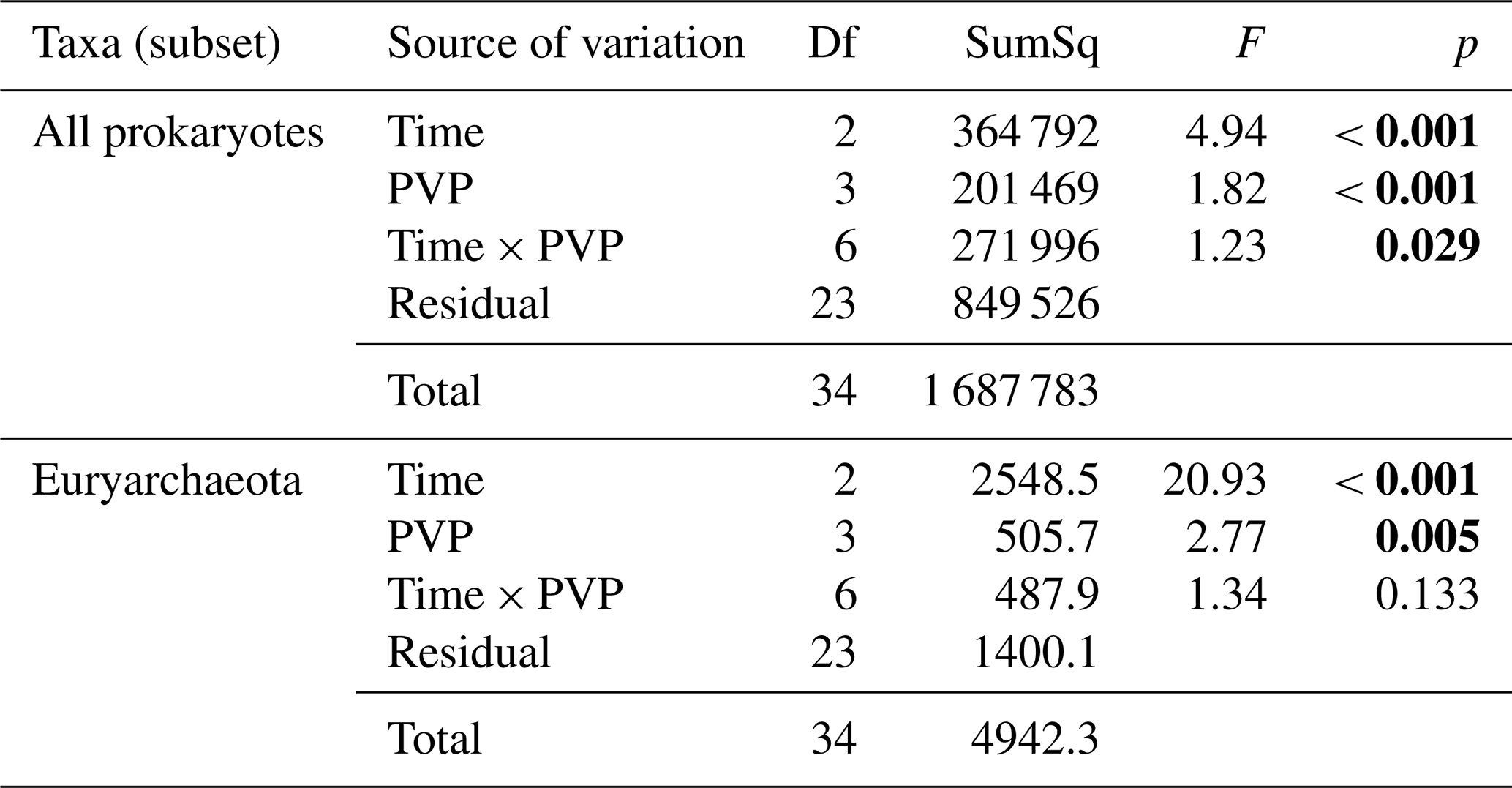
Df: degrees of freedom, SumSq: sums of squares,
Within the phylum of Euryarcheota, effects of PVP on the community composition were less pronounced compared to the entire prokaryotic community composition (PERMANOVA; p=0.005), but the effect of the sampling time was consistent and significant (PERMANOVA; p<0.001; Table 1). The most relevant families for dissimilarities between the highest PVP treatment and the control across samplings were Methanosarcinaceae (23.1 %), Methanosaetaceae (6.2 %) and Methanoregulaceae (4.4 %; Fig. 3).
4.1 PVP effects on methanogenesis
PVP clearly affected methanogenesis, resulting in shorter times needed to reach the inflection point (τ), higher maximum CH4 production rates (rmax), and higher maximum attainable CH4 concentrations (L). Notably, the response magnitude was relatively modest compared with the large PVP concentration range tested. Moreover, the response did not follow a simple concentration-dependent pattern, which was contrary to our initial expectation. A substantial proportion of the observed effect occurred already at the environmentally relevant concentration of 0.5 mg L−1, whereas further increases in PVP concentration caused comparatively small additional stimulation. This pattern was particularly evident for τ and rmax, indicating that the lowest exposure treatment already accounted for a considerable fraction of the total response observed across the entire concentration gradient. The absence of a proportional increase in methanogenesis across four orders of magnitude in PVP concentration suggests that the affected process became saturated at relatively low exposure levels. Rather than reflecting a continuously increasing effect of PVP concentration, the observed response appears more consistent with a threshold-like alleviation of a constraint on methanogenesis. Once this constraint was sufficiently reduced, additional PVP may have produced only limited further stimulation. Although the identity of this constraint remains unknown, the findings indicate that environmentally realistic concentrations may already be sufficient to induce measurable changes in methane-production dynamics. Despite the comparatively modest increase in total CH4 production, PVP consistently accelerated CH4 formation, with all exposure concentrations reaching the phase of maximum CH4 accumulation earlier than the control. Because all incubations were established and maintained under identical conditions except for PVP addition, alternative experimental explanations for the observed differences appear unlikely. The concomitant increase in both CO2 and CH4 production further suggests that PVP exposure enhanced overall anaerobic carbon turnover. Consequently, the stimulation of methanogenesis likely reflected changes in microbial carbon processing and substrate supply rather than direct stimulation of methanogenic Archaea. This interpretation is further supported by the microbial community analyses.
4.2 PVP effects on prokaryotes
The overall prokaryotic community began changing early in the incubation, with treatment effects becoming progressively more pronounced over time. In contrast, and consistent with previous observations (Bollinger et al., 2024, 2025), Euryarchaeota exhibited comparatively weak and taxon-specific compositional responses despite the clear stimulation of methanogenesis. The stronger response of bacteria relative to archaea may reflect differences in how these groups interact with PVP. Besides potential effects on substrate availability, PVP has been reported to interact with a wide range of organic compounds (see Sect. 4.3), including signaling molecules involved in bacterial quorum sensing (Xue et al., 2011). Because bacterial growth, metabolism, and biofilm formation are often regulated through quorum-sensing pathways (Waters and Bassler, 2005), sequestration of signaling molecules could disproportionately affect bacterial communities, whereas archaea generally appear less dependent on quorum-sensing mechanisms (Charlesworth et al., 2017). Although this hypothesis remains untested in the present study, it is consistent with the stronger bacterial than archaeal community responses observed under PVP exposure.
Several methanogenic families showed transient positive or negative responses during the incubation period, but no consistent compositional shift mirrored the observed methane-production patterns across treatments and sampling dates. Similar decoupling between archaeal community composition and CH4 production has been observed previously (Bollinger et al., 2024, 2025) and suggests that changes in methane production cannot be explained solely by shifts in methanogen composition. Instead, the microbial data suggest that bacterial community restructuring may have contributed to the observed stimulation of methanogenesis. Several fermentative families, including Ruminococcaceae, Veillonellaceae, Lachnospiraceae, and Syntrophomonadaceae, contributed substantially to treatment-related community differences (Fig. S6). These taxa are known to produce acetate, hydrogen, and formate, which represent key substrates for methanogenesis (La Reau and Suen, 2018; Marchandin and Jumas-Bilak, 2014; Sobieraj and Boone, 2006). The responses of these families generally coincided with the period during which methane-production trajectories began to diverge among treatments. Through syntrophic interactions, methanogens consume fermentation products such as H2, thereby facilitating continued decomposition of organic matter and accelerating anaerobic carbon turnover (Mosbæk et al., 2016; Sousa et al., 2009; Westerholm et al., 2022). Consequently, the observed shifts in fermentative bacterial taxa are broadly consistent with the enhanced methane production observed under PVP exposure. However, these associations should be interpreted cautiously because relative abundance patterns do not necessarily reflect metabolic activity and functional redundancy may obscure direct taxon-process relationships (Louca et al., 2018). Furthermore, the RNA-derived 16S approach applied here primarily provides information on the composition of the potentially active microbial community rather than direct measurements of functional activity. As no functional gene expression or metabolic pathway data were collected, the present results do not permit direct attribution of the observed methane response to specific microbial processes. Thus, while the data suggest that altered bacterial carbon processing may have contributed to enhanced methanogenesis, the underlying mechanisms remain unresolved.
The present study was designed as a proof-of-concept experiment to determine whether the widely used soluble polymer PVP can influence sediment methanogenesis and microbial community composition. The results demonstrate that PVP exposure can alter both microbial communities and methane-production dynamics. However, the study was not designed to resolve the mechanisms responsible for these effects. Consequently, the findings should primarily be interpreted as evidence that SHPs can influence sediment biogeochemical functioning rather than as a definitive identification of the underlying pathways. A particularly noteworthy finding is that much of the observed methanogenic response occurred already at environmentally relevant PVP concentrations. This suggests that potential ecosystem consequences may not be restricted to highly contaminated environments and highlights the need to consider SHPs as potentially relevant drivers of biogeochemical processes. Several non-exclusive mechanisms may contribute to the observed responses. PVP may alter substrate availability through interactions with dissolved and particulate organic matter, consistent with its documented affinity for both mineral and organic surfaces (Al-Harbi et al., 2016; Watanabe and Kuwatsuka, 1992). In addition, interactions with nutrients, metals, signaling molecules, and sediment particles could modify microbial competition and carbon-processing pathways (Liu et al., 2000; Xue et al., 2011; Wang et al., 2024). Another possible mechanism involves interactions between PVP and redox-active metals such as iron. By complexing iron, PVP may alter iron speciation and bioavailability (Liu et al., 2000; Shi et al., 2024). Because Fe(III) reduction commonly competes with methanogenesis under anoxic conditions (Baek et al., 2019), such interactions could theoretically weaken competitive constraints on methanogenic pathways. However, iron chemistry was not quantified and iron-cycling taxa did not exhibit consistent responses across treatments, leaving the relevance of this mechanism uncertain. Stress-induced production of extracellular polymeric substances (EPS) may represent another potential pathway, as EPS production has been reported in microbial systems exposed to synthetic polymers and can affect carbon turnover and microbial interactions (Zhou et al., 2015; Liu et al., 2022). However, EPS production was not quantified and therefore this mechanism remain speculative.
The broader environmental relevance of these findings remains largely unexplored. The experiment was conducted under controlled laboratory conditions using homogenized sediments in closed incubations, whereas natural ecosystems are characterized by fluctuating hydrological regimes, heterogeneous redox environments, seasonal variability, and strong biological interactions (Canfield et al., 2005; Lacroix et al., 2023). In particular, PVP entering aquatic and terrestrial ecosystems is likely to interact with plant roots and rhizosphere microbial communities rather than with bulk sediments alone. Root exudates, radial oxygen loss, plant-mediated carbon inputs, and species-specific rhizosphere effects strongly influence microbial community assembly, carbon cycling, and methane production (Canarini et al., 2019; Kuzyakov and Razavi, 2019; Mueller et al., 2020), and may therefore substantially modify PVP effects under field conditions. Additionally, PVP may influence the physical structure of the porewater environment. By increasing viscosity or promoting polymer-induced aggregation, PVP could restrict diffusive transport of dissolved electron acceptors within sediments (Siebel et al., 2015) and create spatial heterogeneity in redox conditions. Localized microsites may thus develop in which oxidants are rapidly depleted, creating strongly reducing conditions that favor anaerobic metabolic pathways (Lacroix et al., 2023). Future studies should evaluate PVP under environmentally realistic scenarios, including different sediment types, plant communities, hydrological regimes, and long-term exposure conditions. Combining geochemical measurements with microbial community analyses, functional gene expression analyses, metabolomics, and process-based measurements will be essential for identifying the mechanisms responsible for the observed stimulation of methanogenesis. In particular, quantifying carbon mobilization, iron speciation, terminal electron-acceptor dynamics, quorum-sensing processes, EPS production, and rhizosphere-mediated effects would help disentangle the relative importance of the hypothesized pathways.
This proof-of-concept study demonstrates that the widely used soluble polymer PVP can alter sediment microbial communities and stimulate methanogenesis, even at environmentally relevant concentrations. The observed responses suggest that SHPs may represent an overlooked driver of sediment carbon cycling. However, the mechanisms responsible for these effects remain unresolved and should be investigated through future studies combining microbial, geochemical, and process-based approaches under environmentally realistic conditions.
Data and code are publicly available on Zenodo (https://doi.org/10.5281/zenodo.18859767, Feckler et al., 2026). Raw sequencing data have been deposited at NCBI's Sequence Read Archive under accession number PRJNA1426585.
The supplement related to this article is available online at https://doi.org/10.5194/bg-23-7577-2026-supplement.
Conceptualization: A. Feckler, E. Bollinger, M. Bundschuh; Data curation: A. Feckler; Formal analysis and visualization: A. Feckler, E. Bollinger; Funding acquisition: M. Bundschuh; Investigation: A. Feckler, E. Bollinger, A. Unik, S. Filker, C. Plicht, Z. Steinmetz; Methodology: A. Feckler, E. Bollinger, S. Filker, C. Plicht, Z. Steinmetz, M. Bundschuh; Project administration: M. Bundschuh; Writing – original draft: A. Feckler; Writing – review and editing: E. Bollinger, A. Unik, P. Mueller, S. Filker, C. Plicht, Z. Steinmetz, M. Bundschuh.
The contact author has declared that none of the authors has any competing interests.
Publisher's note: Copernicus Publications remains neutral with regard to jurisdictional claims made in the text, published maps, institutional affiliations, or any other geographical representation in this paper. The authors bear the ultimate responsibility for providing appropriate place names. Views expressed in the text are those of the authors and do not necessarily reflect the views of the publisher.
We thank Hajar Bourassi and Simon Rudolph for laboratory assistance with sample analysis. During the preparation of this work the authors used AI (ChatGPT; GPT-5.2) to improve readability and language of the work. The authors reviewed and edited the content and take full responsibility for the content of the publication.
This study was financially supported by the research initiative “NanoKat” of the federal state of Rhineland-Palatinate, Germany.
This paper was edited by Kerneels Jaars and reviewed by two anonymous referees.
Aitchison, J.: The statistical analysis of compositional data, J. R. Stat. Soc. B, 44, 139–177, https://doi.org/10.1111/j.2517-6161.1982.tb01195.x, 1982.
Al-Harbi, L. M., Kosa, S. A., Baloch, M. K., Bhatti, Q. A., and El-Mossalamy, E.-S. E.-B. H.: Adsorption of polyvinylpyrrolidone over the silica surface: as affected by pretreatment of adsorbent and molar mass of polymer adsorbate, Int. J. Polym. Sci., 2016, 2417292, https://doi.org/10.1155/2016/2417292, 2016.
Anderson, M. J.: Permutation tests for univariate or multivariate analysis of variance and regression, Can. J. Fish. Aquat. Sci., 58, 626–639, https://doi.org/10.1139/f01-004, 2001.
Antić, V. V., Antić, M. P., Kronimus, A., Oing, K., and Schwarzbauer, J.: Quantitative determination of poly(vinylpyrrolidone) by continuous-flow off-line pyrolysis-GC/MS, J. Anal. Appl. Pyrolysis., 90, 93–99, https://doi.org/10.1016/j.jaap.2010.10.011, 2011.
Arp, H. P. H., Kühnel, D., Rummel, C., MacLeod, M., Potthoff, A., Reichelt, S., Rojo-Nieto, E., Schmitt-Jansen, M., Sonnenberg, J., Toorman, E., and Jahnke, A.: Weathering plastics as a planetary boundary threat: exposure, fate, and hazards, Environ. Sci. Technol., 55, 7246–7255, https://doi.org/10.1021/acs.est.1c01512, 2021.
Baek, G., Kim, J., and Lee, C.: A review of the effects of iron compounds on methanogenesis in anaerobic environments, Renew. Sustain. Energy Rev., 113, 109282, https://doi.org/10.1016/j.rser.2019.109282, 2019.
Bhullar, G. S., Edwards, P. J., and Olde Venterink, H.: Variation in the plant-mediated methane transport and its importance for methane emission from intact wetland peat mesocosms, J. Plant Ecol., 6, 298–304, https://doi.org/10.1093/jpe/rts045, 2013.
Blanck, H., Wängberg, S.-Å., and Molander, S.: Pollution-induced community tolerance – a new ecotoxicological tool, Functional Testing of Aquatic Biota for Estimating Hazards of Chemicals, ASTM International, https://doi.org/10.1520/STP26265S, 1988.
Bokulich, N. A., Subramanian, S., Faith, J. J., Gevers, D., Gordon, J. I., Knight, R., Mills, D. A., and Caporaso, J. G.: Quality-filtering vastly improves diversity estimates from Illumina amplicon sequencing, Nat. Methods., 10, 57–59, https://doi.org/10.1038/nmeth.2276, 2013.
Bollinger, E., Zubrod, J. P., Lai, F. Y., Ahrens, L., Filker, S., Lorke, A., and Bundschuh, M.: Antibiotics as a silent driver of climate change? A case study investigating methane production in freshwater sediments, Ecotox. Environ. Saf., 228, 113025, https://doi.org/10.1016/j.ecoenv.2021.113025, 2021.
Bollinger, E., Schwilden, P., Lai, F. Y., Schulz, R., Bundschuh, M., and Filker, S.: Higher temperatures exacerbate effects of antibiotics on methanogenesis in freshwater sediment, Commun. Earth Environ., 5, 647, https://doi.org/10.1038/s43247-024-01828-3, 2024.
Bollinger, E., Mayer, J., Lai, F. Y., Schulz, R., Filker, S., and Bundschuh, M.: Adaptation of methanogenic microbial assemblages to antibiotics: The role of resistance genes and taxonomic composition, Environ. Pollut., 383, 126828, https://doi.org/10.1016/j.envpol.2025.126828, 2025.
Brooks, A. L., Wang, S., and Jambeck, J. R.: The Chinese import ban and its impact on global plastic waste trade, Sci. Adv., 4, eaat0131, https://doi.org/10.1126/sciadv.aat0131, 2018.
Brunning, H., Sallach, J. B., Zanchi, V., Price, O., and Boxall, A.: Toward a framework for environmental fate and exposure assessment of polymers, Environ. Toxicol. Chem., 41, 515–540, https://doi.org/10.1002/etc.5272, 2022.
Bürkner, P.-C.: Bayesian item response Modeling in R with brms and Stan, J. Stat. Softw., 100, 1–54, https://doi.org/10.18637/jss.v100.i05, 2021.
Callahan, B. J., McMurdie, P. J., Rosen, M. J., Han, A. W., Johnson, A. J. A., and Holmes, S. P.: DADA2: High-resolution sample inference from Illumina amplicon data, Nat. Methods, 13, 581–583, https://doi.org/10.1038/nmeth.3869, 2016.
Canarini, A., Kaiser, C., Merchant, A., Richter, A., and Wanek, W.: Root exudation of primary metabolites: mechanisms and their roles in plant responses to environmental stimuli, Front. Plant Sci., 10, https://doi.org/10.3389/fpls.2019.00157, 2019.
Canfield, D. E., Kristensen, E., and Thamdrup, B.: Structure and Growth of Microbial Populations, in: Aquatic Geomicrobiology, edited by: Canfield, D. E., Kristensen, E., and Thamdrup, B., Academic Press, vol. 48, 23–64, https://doi.org/10.1016/S0065-2881(05)48002-5, 2005.
Charlesworth, J. C., Beloe, C., Watters, C., and Burns, B. P.: Quorum Sensing in Archaea: Recent Advances and Emerging Directions, in: Biocommunication of Archaea, edited by: Witzany, G., Springer International Publishing, Cham, 119–132, https://doi.org/10.1007/978-3-319-65536-9_8, 2017.
Conrad, R.: Importance of hydrogenotrophic, aceticlastic and methylotrophic methanogenesis for methane production in terrestrial, aquatic and other anoxic environments: A mini review, Pedosphere, 30, 25–39, https://doi.org/10.1016/S1002-0160(18)60052-9, 2020.
Edgar, R. C.: SINTAX: a simple non-Bayesian taxonomy classifier for 16S and ITS sequences, bioRxiv, 074161, https://doi.org/10.1101/074161, 2016.
Feckler, A., Bollinger, E., Unik, A., Mueller, P., Filker, S., Plicht, C., Steinmetz, Z., and Bundschuh, M.: Liquid polymer enhances methanogenesis and restructures prokaryotic communities in freshwater sediments (Version v1), Zenodo [data set and code], https://doi.org/10.5281/zenodo.18859767, 2026.
Filzmoser, P., Maronna, R., and Werner, M.: Outlier identification in high dimensions, Comput. Stat. Data Anal., 52, 1694–1711, https://doi.org/10.1016/j.csda.2007.05.018, 2008.
Geyer, R., Jambeck, J. R., and Law, K. L.: Production, use, and fate of all plastics ever made, Sci. Adv., 3, e1700782, https://doi.org/10.1126/sciadv.1700782, 2017.
Gloor, G. B., Macklaim, J. M., Pawlowsky-Glahn, V., and Egozcue, J. J.: Microbiome datasets are compositional: and this is not optional, Front. Microbiol., 8, https://doi.org/10.3389/fmicb.2017.02224, 2017.
Graves, C., Hinchclidde, T., Johnson, N., Noakes, D., and Williams, S.: Polymers in liquid formulations: a landscape view of the global PLFs market, Royal Society of Chemistry, 2021.
Groh, K. J., Arp, H. P. H., MacLeod, M., and Wang, Z.: Assessing and managing environmental hazards of polymers: historical development, science advances and policy options, Environ. Sci.: Processes Impacts, 25, 10–25, https://doi.org/10.1039/D2EM00386D, 2023.
Guezennec, A. G., Michel, C., Bru, K., Touze, S., Desroche, N., Mnif, I., and Motelica-Heino, M.: Transfer and degradation of polyacrylamide-based flocculants in hydrosystems: a review, Environ. Sci. Pollut. Res., 22, 6390–6406, https://doi.org/10.1007/s11356-014-3556-6, 2015.
Hartmann, N. B., Hüffer, T., Thompson, R. C., Hassellöv, M., Verschoor, A., Daugaard, A. E., Rist, S., Karlsson, T., Brennholt, N., Cole, M., Herrling, M. P., Hess, M. C., Ivleva, N. P., Lusher, A. L., and Wagner, M.: Are we speaking the same language? Recommendations for a definition and categorization framework for plastic debris, Environ. Sci. Technol., 53, 1039–1047, https://doi.org/10.1021/acs.est.8b05297, 2019.
He, Y., Li, Y., Yang, X., Liu, Y., Guo, H., Wang, Y., Zhu, T., Tong, Y., Ni, B.-J., and Liu, Y.: Biodegradable microplastics aggravate greenhouse gas emissions from urban lake sediments more severely than conventional microplastics, Water Res., 266, 122334, https://doi.org/10.1016/j.watres.2024.122334, 2024.
IPCC: Climate Change 2021 – the Physical Science Basis: Working Group I Contribution to the Sixth Assessment Report of the Intergovernmental Panel on Climate Change, 1st Edn., Cambridge University Press, ISBN 9781009157896, 2021.
Julinová, M., Kupec, J., Houser, J., Slavík, R., Marušincová, H., Červeňáková, L., and Klívar, S.: Removal of polyvinylpyrrolidone from wastewater using different methods, Water Environ. Res., 84, 2123–2132, https://doi.org/10.2175/106143012X13373575830999, 2012.
Kuzyakov, Y. and Razavi, B. S.: Rhizosphere size and shape: temporal dynamics and spatial stationarity, Soil Biol. Biochem., 135, 343–360, https://doi.org/10.1016/j.soilbio.2019.05.011, 2019.
Lacroix, E. M., Aeppli, M., Boye, K., Brodie, E., Fendorf, S., Keiluweit, M., Naughton, H. R., Noël, V., and Sihi, D.: Consider the anoxic microsite: acknowledging and appreciating spatiotemporal redox heterogeneity in soils and sediments, ACS Earth Space Chem., 7, 1592–1609, https://doi.org/10.1021/acsearthspacechem.3c00032, 2023.
La Reau, A. J. and Suen, G.: The Ruminococci: key symbionts of the gut ecosystem, J Microbiol., 56, 199–208, https://doi.org/10.1007/s12275-018-8024-4, 2018.
Lide, D. R.: CRC Handbook of Chemistry and Physics, CRC Press, ISBN 0849304857, 2004.
Liu, M., Yan, X., Liu, H., and Yu, W.: An investigation of the interaction between polyvinylpyrrolidone and metal cations, React. Funct. Polym., 44, 55–64, https://doi.org/10.1016/S1381-5148(99)00077-2, 2000.
Liu, X., Li, Y., Tang, J., Wang, D., Guo, S., Liu, Q., and Giesy, J. P.: Nano- and microplastics aided by extracellular polymeric substances facilitate the conjugative transfer of antibiotic resistance genes in bacteria, ACS EST Water, 2, 2528–2537, https://doi.org/10.1021/acsestwater.2c00330, 2022.
Louca, S., Polz, M. F., Mazel, F., Albright, M. B. N., Huber, J. A., O'Connor, M. I., Ackermann, M., Hahn, A. S., Srivastava, D. S., Crowe, S. A., Doebeli, M., and Parfrey, L. W.: Function and functional redundancy in microbial systems, Nat. Ecol. Evol., 2, 936–943, https://doi.org/10.1038/s41559-018-0519-1, 2018.
Luo, Y., Hong, Y., Shen, L., Wu, F., and Lin, X.: Multifunctional role of polyvinylpyrrolidone in pharmaceutical formulations, AAPS PharmSciTech, 22, 34, https://doi.org/10.1208/s12249-020-01909-4, 2021.
Marchandin, H. and Jumas-Bilak, E. R.: The family Veillonellaceae, in: The Prokaryotes, edited by: Dworkin, M., Falkow, S., Rosenberg, E., Schleifer, K.-H., and Stackebrandt, E., Springer, Berlin, Heidelberg, 433–453, ISBN 978-3-642-30193-3, 2014.
Martin, M.: Cutadapt removes adapter sequences from high-throughput sequencing reads, EMB.net Journal, 17, 10–12, 2011.
McClain, M. E., Boyer, E. W., Dent, C. L., Gergel, S. E., Grimm, N. B., Groffman, P. M., Hart, S. C., Harvey, J. W., Johnston, C. A., Mayorga, E., McDowell, W. H., and Pinay, G.: Biogeochemical hot spots and hot moments at the interface of terrestrial and aquatic ecosystems, Ecosyst., 6, 301–312, 2003.
McDonald, D., Price, M. N., Goodrich, J., Nawrocki, E. P., DeSantis, T. Z., Probst, A., Andersen, G. L., Knight, R., and Hugenholtz, P.: An improved Greengenes taxonomy with explicit ranks for ecological and evolutionary analyses of bacteria and archaea, ISME J., 6, 610–618, https://doi.org/10.1038/ismej.2011.139, 2012.
Megonigal, J. P., Hines, M. E., and Visscher, P. T.: 8.08 – Anaerobic Metabolism: Linkages to Trace Gases and Aerobic Processes, in: Treatise on Geochemistry, edited by: Holland, H. D. and Turekian, K. K., Pergamon, Oxford, 317–424, https://doi.org/10.1016/B0-08-043751-6/08132-9, 2003.
Middelanis, T., Looschelders, D., Mueller, P., and Knorr, K.-H.: Potential of biochar to mitigate methane production in paddy soils – application of a new incubation and modelling approach, Biogeochemistry, 168, 6, https://doi.org/10.1007/s10533-024-01200-9, 2024.
Mosbæk, F., Kjeldal, H., Mulat, D. G., Albertsen, M., Ward, A. J., Feilberg, A., and Nielsen, J. L.: Identification of syntrophic acetate-oxidizing bacteria in anaerobic digesters by combined protein-based stable isotope probing and metagenomics, ISME J., 10, 2405–2418, https://doi.org/10.1038/ismej.2016.39, 2016.
Mueller, P., Mozdzer, T. J., Langley, J. A., Aoki, L. R., Noyce, G. L., and Megonigal, J. P.: Plant species determine tidal wetland methane response to sea level rise, Nat. Commun., 11, 5154, https://doi.org/10.1038/s41467-020-18763-4, 2020.
National Institute of Standards and Technology: NIST Inorganic Crystal Structure Database, NIST Standard Reference Database Number 3, https://doi.org/10.18434/M32147, 2009.
Oksanen, J., Simpson, G. L., Blanchet, F. G., Kindt, R., Legendre, P., Minchin, P. R., O'Hara, R. B., Solymos, P., Stevens, M. H. H., Szoecs, E., Wagner, H., Barbour, M., Bedward, M., Bolker, B., Borcard, D., Carvalho, G., Chirico, M., De Caeres, M., Durand, S., Antoniazi Evangelista, H. B., FitzJohn, R., Friendly, M., Furneaux, B., Hannigan, G., Hill, M. O., Lahti, L., McGlinn, D., Ouellette, M.-H., Ribeiro Cunha, E., Smith, T., Stier, A., Ter Braak, C. J. F., and Weedon, J.: vegan: Community Ecology Package, R package version 2.6-6.1, https://CRAN.R-project.org/package=vegan (last access: 20 August 2026), 2022.
R Core Team: R: A Language and Environment for Statistical Computing, R Foundation for Statistical Computing, Vienna, Austria, https://www.R-project.org/ (last access: 20 August 2026), 2025.
Rabaey, J. S., Holgerson, M. A., Richardson, D. C., Andersen, M. R., Bansal, S., Bortolotti, L. E., Cotner, J. B., Hornbach, D. J., Martinsen, K. T., Moody, E. K., and Schloegel, O. F.: Freshwater biogeochemical hotspots: high primary production and ecosystem respiration in shallow waterbodies, Geophys. Res. Lett., 51, e2023GL106689, https://doi.org/10.1029/2023GL106689, 2024.
Rognes, T., Flouri, T., Nichols, B., Quince, C., and Mahé, F.: VSEARCH: a versatile open source tool for metagenomics, PeerJ, https://doi.org/10.7717/peerj.2584, 2016.
Saunois, M., Martinez, A., Poulter, B., Zhang, Z., Raymond, P. A., Regnier, P., Canadell, J. G., Jackson, R. B., Patra, P. K., Bousquet, P., Ciais, P., Dlugokencky, E. J., Lan, X., Allen, G. H., Bastviken, D., Beerling, D. J., Belikov, D. A., Blake, D. R., Castaldi, S., Crippa, M., Deemer, B. R., Dennison, F., Etiope, G., Gedney, N., Höglund-Isaksson, L., Holgerson, M. A., Hopcroft, P. O., Hugelius, G., Ito, A., Jain, A. K., Janardanan, R., Johnson, M. S., Kleinen, T., Krummel, P. B., Lauerwald, R., Li, T., Liu, X., McDonald, K. C., Melton, J. R., Mühle, J., Müller, J., Murguia-Flores, F., Niwa, Y., Noce, S., Pan, S., Parker, R. J., Peng, C., Ramonet, M., Riley, W. J., Rocher-Ros, G., Rosentreter, J. A., Sasakawa, M., Segers, A., Smith, S. J., Stanley, E. H., Thanwerdas, J., Tian, H., Tsuruta, A., Tubiello, F. N., Weber, T. S., van der Werf, G. R., Worthy, D. E. J., Xi, Y., Yoshida, Y., Zhang, W., Zheng, B., Zhu, Q., Zhu, Q., and Zhuang, Q.: Global Methane Budget 2000–2020, Earth Syst. Sci. Data, 17, 1873–1958, https://doi.org/10.5194/essd-17-1873-2025, 2025.
Shi, T., Peng, C., Lu, L., Yang, Z., Wu, Y., Wang, Z., and Kappler, A.: Response of Fe(III)-reducing kinetics, microbial community structure and Fe(III)-related functional genes to Fe(III)-organic matter complexes and ferrihydrite in lake sediment, Biogeochemistry, 167, 1553–1565, https://doi.org/10.1007/s10533-024-01186-4, 2024.
Siebel, D., Scharfer, P., and Schabel, W.: Determination of concentration-dependent diffusion coefficients in polymer–solvent systems: analysis of concentration profiles measured by raman spectroscopy during single drying experiments excluding boundary conditions and phase equilibrium, Macromolecules, 48, 8608–8614, https://doi.org/10.1021/acs.macromol.5b02144, 2015.
Sobieraj, M. and Boone, D. R.: Syntrophomonadaceae, in: The Prokaryotes: Volume 4: Bacteria: Firmicutes, Cyanobacteria, edited by: Dworkin, M., Falkow, S., Rosenberg, E., Schleifer, K.-H., and Stackebrandt, E., Springer US, New York, NY, 1041–1049, https://doi.org/10.1007/0-387-30744-3_37, 2006.
Sousa, D. Z., Smidt, H., Alves, M. M., and Stams, A. J. M.: Ecophysiology of syntrophic communities that degrade saturated and unsaturated long-chain fatty acids, FEMS Microbiol. Ecol., 68, 257–272, https://doi.org/10.1111/j.1574-6941.2009.00680.x, 2009.
Stan Development Team: RStan: the R interface to Stan. R package version 2.32.3, http://mc-stan.org/, 2023.
Steinmetz, Z., Kintzi, A., Muñoz, K., and Schaumann, G. E.: A simple method for the selective quantification of polyethylene, polypropylene, and polystyrene plastic debris in soil by pyrolysis-gas chromatography/mass spectrometry, J. Anal. Appl. Pyrolysis, 147, 104803, https://doi.org/10.1016/j.jaap.2020.104803, 2020.
Steinmetz, Z., Plicht, C., Buchmann, C., Knott, M., Meyer, M., Müller-Schüssele, S., Strieth, D., Prosenc, M. H., Steinmetz, H., Jungkunst, H. F., Thiel, W. R., and Bundschuh, M.: Plastic problem solved? Environmental implications of synthetic hydrophilic polymers across ecosystem boundaries, Trends Anal. Chem., 181, 118000, https://doi.org/10.1016/j.trac.2024.118000, 2024.
Walker, T. R. and Fequet, L.: Current trends of unsustainable plastic production and micro(nano)plastic pollution, Trends Anal. Chem., 160, 116984, https://doi.org/10.1016/j.trac.2023.116984, 2023.
Walters, W., Hyde Embriette, R., Berg-Lyons, D., Ackermann, G., Humphrey, G., Parada, A., Gilbert, J. A., Jansson, J. K., Caporaso, J. G., Fuhrman, J. A., Apprill, A., and Knight, R.: Improved bacterial 16S rRNA gene (V4 and V4-5) and fungal internal transcribed spacer marker gene primers for microbial community surveys, mSystems, 1, https://doi.org/10.1128/msystems.00009-15, 2015.
Wang, D., Zheng, Y., Deng, Q., and Liu, X.: Water-soluble synthetic polymers: their environmental emission relevant usage, transport and transformation, persistence, and toxicity, Environ. Sci. Technol., 57, 6387–6402, https://doi.org/10.1021/acs.est.2c09178, 2023.
Wang, X., Xu, Y., Ou, Q., Chen, W., van der Meer, W., and Liu, G.: Adsorption characteristics and mechanisms of water-soluble polymers (PVP and PEG) on kaolin and montmorillonite minerals, J. Haz. Mat., 466, 133592, https://doi.org/10.1016/j.jhazmat.2024.133592, 2024.
Wang, Z. P., DeLaune, R. D., Patrick Jr., W. H., and Masscheleyn, P. H.: Soil redox and pH effects on methane production in a flooded rice soil, Soil Sci. Soc. Am. J., 57, 382–385, https://doi.org/10.2136/sssaj1993.03615995005700020016x, 1993.
Watanabe, A. and Kuwatsuka, S.: Chemical characteristics of soil fulvic acids fractionated using polyvinylpyrrolidone (PVP), Soil Sc. Plant Nutr., 38, 31–41, https://doi.org/10.1080/00380768.1992.10416949, 1992.
Waters, C. M. and Bassler, B. L.: QUORUM SENSING: Cell-to-cell dommunication in bacteria, Ann. Rev. Cell Dev. Biol., 21, 319–346, https://doi.org/10.1146/annurev.cellbio.21.012704.131001, 2005.
Weiss, R. F.: Carbon dioxide in water and seawater: the solubility of a non-ideal gas, Mar. Chem., 2, 203–215, https://doi.org/10.1016/0304-4203(74)90015-2, 1974.
Wenig, P. and Odermatt, J.: OpenChrom: a cross-platform open source software for the mass spectrometric analysis of chromatographic data, BMC Bioinform., 11, 405, https://doi.org/10.1186/1471-2105-11-405, 2010.
Westerholm, M., Calusinska, M., and Dolfing, J.: Syntrophic propionate-oxidizing bacteria in methanogenic systems, FEMS Microbiol. Rev., 46, fuab057, https://doi.org/10.1093/femsre/fuab057, 2022.
Wilkinson, J., Bors, C., Burgis, F., Lorke, A., and Bodmer, P.: Measuring CO2 and CH4 with a portable gas analyzer: closed-loop operation, optimization and assessment, PloS One, 14, e0206080, https://doi.org/10.1371/journal.pone.0193973, 2018.
Xue, X., Pasparakis, G., Halliday, N., Winzer, K., Howdle, S. M., Cramphorn, C. J., Cameron, N. R., Gardner, P. M., Davis, B. G., Fernández-Trillo, F., and Alexander, C.: Synthetic polymers for simultaneous bacterial sequestration and quorum sense interference, Angew. Chem. Int. Ed., 50, 9852–9856, https://doi.org/10.1002/anie.201103130, 2011.
Zhang, D., Chen, Y., Zhao, Y., and Zhu, X.: New sludge pretreatment method to improve methane production in waste activated sludge digestion, Environ. Sci. Technol., 44, 4802–4808, https://doi.org/10.1021/es1000209, 2010.
Zhang, W., Liu, X., Liu, L., Lu, H., Wang, L., and Tang, J.: Effects of microplastics on greenhouse gas emissions and microbial communities in sediment of freshwater systems, J. Haz. Mat., 435, 129030, https://doi.org/10.1016/j.jhazmat.2022.129030, 2022.
Zhou, G., Shi, Q.-S., Huang, X.-M., and Xie, X.-B.: The three bacterial lines of defense against antimicrobial agents, Int. J. Mol. Sci., 16, 21711–21733, https://doi.org/10.3390/ijms160921711, 2015.