
the Creative Commons Attribution 4.0 License.
the Creative Commons Attribution 4.0 License.
 | 05 Nov 2026
Divergent mercury accumulation dynamics in tropical dry and moist broadleaf forests
Juan Francisco Morales Arteaga

Grace Tatiana Páez-Barrera
Matthias Beyer
Christian Birkel
Werner Huber
María Auxiliadora Zúñiga Amador
Harald Biester
Marta Pérez-Rodríguez
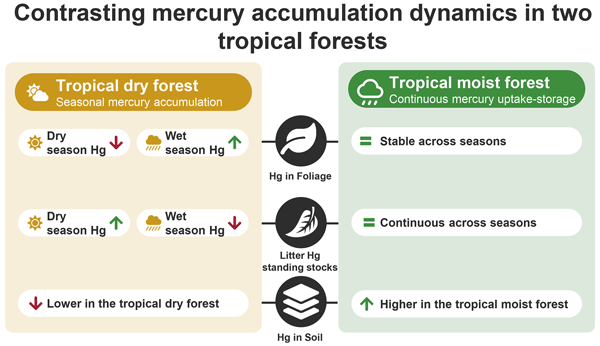
Forests are major sinks for atmospheric mercury (Hg) due to the efficiency of stomatal uptake and litter deposition. Tropical forests, highly productive ecosystems, remain understudied despite their pronounced climatic and phenological variability. We investigated whether seasonal rainfall regimes and associated tree adaptations influence Hg dynamics in secondary tropical moist broadleaf (TMBF) and tropical dry broadleaf (TDBF) forests in Costa Rica by examining foliar Hg concentrations, litter Hg standing stocks, and soil Hg concentrations. Seasonal differences in rainfall and associated environmental conditions strongly influenced foliar Hg concentration in the TDBF. Deciduous trees showed 4.7 times higher foliar Hg concentration in the wet season, when leaves were mature, compared to the dry season, when newly flushed leaves emerged after leaf shedding. Evergreen trees in TDBF demonstrated 2.3 times lower foliar Hg concentrations in the dry season than in the wet season (23 vs. 53 µg kg−1), likely due to various associated physiological processes (e.g., leaf flushing). However, the primary mechanism remains unclear given the complex and unexplored Hg dynamics in TDBF. TMBF showed no clear seasonal variation in foliar Hg in either deciduous (dry: 48; wet: 54 µg kg−1) or evergreen trees (dry: 57; wet: 53 µg kg−1), likely due to longer leaf lifespan sustaining year-round transpiration and stomatal Hg uptake under high humidity. Atmospheric Hg concentrations in TDBF were two times higher than in TMBF (1.2 vs. 0.7 ng m−3) across both seasons, likely reflecting greater Hg capture per unit area in TMBF due to denser vegetation and enhanced wet deposition via rainfall. Foliar Hg was not correlated with stomatal density or specific leaf area in either forest type. Soil Hg concentrations, however, were correlated with litter-derived inputs, supporting litter as the dominant Hg transfer pathway. Higher seasonally averaged litter Hg standing stocks (34 µg m−2) in TMBF than in the TDBF (19 µg m−2) resulted in 3.4 times higher soil Hg concentrations (0–30 cm) in TMBF (115 µg kg−1) than in TDBF (34 µg kg−1). Soil Hg concentrations were 2.6 times lower at a previously deforested TMBF site, indicating persistent disturbance effects despite almost three decades of reforestation. Overall, foliar Hg concentrations in the TDBF varied markedly between seasons, while both TDBF and TMBF appeared to be important Hg0 reservoirs, with contrasting dynamics that are potentially sensitive to climate change.
- Article
(3503 KB) - Full-text XML
-
Supplement
(642 KB) - BibTeX
- EndNote


Mercury (Hg) is a highly toxic metal ranked among the top ten chemicals of public health concern, originating from both natural sources (volcanism and rock weathering) and anthropogenic sources (gold mining and biomass burning) (Gworek et al., 2020). In the atmosphere, 90 %–99 % of Hg exists as gaseous elemental mercury (GEM, Hg0), with the remainder as gaseous oxidized mercury (Hg2+) and particulate-bound mercury (Hgp) (Gustin et al., 2013). Due to its high volatility, Hg0 undergoes long-range atmospheric transport from emission sources until deposition (Selin, 2009).
Forests are major sinks for Hg0, with vegetation accounting for ∼ 60 %–90 % of the uptake, and depositing ∼ 1180–1410 Mg Hg yr−1 to soil (Denzler et al., 2025; Zhou et al., 2021). Plant uptake involves (I) stomatal assimilation of Hg0 followed by oxidation and internal transport (tree rings store atmospheric Hg) (Peng et al., 2024), although the site of foliar oxidation remains uncertain (Gustin et al., 2022), and (II) non-stomatal (cuticular) uptake, including diffusion of lipophilic Hg0 through the cuticle and co-entry/oxidation of Hg2+ deposited on leaf surfaces (Laacouri et al., 2013; Rea et al., 2002; Stamenkovic and Gustin, 2009). Once incorporated into foliage, Hg is transferred to soils through litter, with more than 80 % of global soil Hg originating from litter deposition (Jiskra et al., 2015; Wang et al., 2016). Additional mechanisms, including dry and wet Hg deposition, binding to organic matter, and soil erosion, also contribute to Hg accumulation in soils (Gerson et al., 2022; Monteiro et al., 2024; Silva-Filho et al., 2006).
Recent global estimates found that forests remove ∼ 2200–3400 Mg Hg yr−1 (∼ 40 %–65 % of the Hg0) and store ∼ 500–1100 Gg in surface soils and vegetation (Wang et al., 2022). Litter Hg fluxes are controlled by multiple interacting factors, including vegetation structure (leaf area and canopy density), phenology and leaf age, and environmental conditions such as climate, temperature, and moisture availability (Guentzel et al., 1998; Jiskra et al., 2018; Rea et al., 2002; Wang et al., 2019). These controls are especially pronounced in tropical forests, where high productivity, large leaf area, continuous or prolonged growing seasons, and rapid biogeochemical cycling can promote substantial Hg0 uptake by vegetation and subsequent Hg transfer to soils through litter (Poorter, 2004; Schneider et al., 2023; Wang et al., 2016). Once deposited on the forest floor, Hg can be retained through interactions with soil organic matter, while rapid litter and organic-matter turnover in tropical forests can enhance post-depositional Hg transformations and redistribution, including Hg reduction and subsequent Hg0 re-emission (Yuan et al., 2023). Tropical trees also exhibit elevated foliar Hg concentrations, linked to higher stomatal pore density and higher photosynthetic capacity than temperate and boreal species (Larcher, 2003; Teixeira et al., 2018). Consequently, tropical regions such as the Amazon Basin and Central Africa exhibit the highest global Hg0 removal via litter (65.0 ± 30.0 g km−2 yr−1; Wang et al., 2016). Soils in tropical forests represent a major Hg sink, with concentrations up to 10 times higher than in temperate forests (Teixeira et al., 2017). Despite their global importance, tropical forests remain understudied compared to temperate and boreal forests (Yuan et al., 2023), even though they exhibit distinct patterns of climatic seasonality, vegetation productivity, and hydrology (Bonan, 2008; Cusack et al., 2024; Klock et al., 2022).
There are two main types of tropical forests: tropical rainforests and tropical seasonal forests (Holzman, 2008). Tropical rainforests, or more specifically referred to as tropical moist broadleaf forests (TMBF), are predominantly evergreen, species-rich systems with annual precipitation typically > 2000 mm and as high as 10 000 mm, and relatively small seasonal differences in climatic conditions. They generally experience short or weakly pronounced dry periods, which may be interrupted by episodic rainfall events (Stork et al., 2008). By contrast, tropical seasonal forests, also referred to as tropical dry broadleaf forests (TDBF), are characterized by pronounced wet and dry periods and predominantly deciduous vegetation structure, with substantial leaf shedding during the dry season. The dry season typically lasts 5–6 months, with monthly precipitation below 100 mm (Portillo-Quintero and Sánchez-Azofeifa, 2010), while total annual rainfall ranges from 700 to 2000 mm (Ruangpanit, 1995).
To date, studies of Hg dynamics in tropical forests have focused on TMBF affected by artisanal small-scale gold mining pollution, leaving natural Hg cycling poorly characterized and limited to local study areas, often without considering the role of seasonal variation (Escobar-Camacho et al., 2024; Fostier et al., 2015; Gerson et al., 2022; Lima et al., 2022; Lucchini et al., 2025; Rodriguez-Pascual et al., 2024; Silva do Nascimento et al., 2025; Silva-Filho et al., 2006; Teixeira et al., 2017, 2018). In some of those contaminated areas, elevated atmospheric Hg concentrations may further override seasonal patterns in Hg uptake and cycling, making it difficult to distinguish natural seasonal controls from pollution-driven effects. Moreover, the role of Hg sequestration in TDBF remains unexplored, despite their wide distribution across tropical and subtropical regions (∼ 42 %; Hasnat and Hossain, 2020) and their status as one of the most threatened tropical ecosystems due to extensive deforestation and high vulnerability to climate change. In particular, longer and more intense dry seasons may alter key phenological processes such as leaf flushing, leaf shedding, and flowering, among others (Chidumayo, 2025; Hasnat and Hossain, 2020; Siyum, 2020; Lai et al., 2025). These changes may have consequences for Hg uptake, litterfall Hg fluxes, and Hg sequestration in forest soils.
Studies in the Northern Hemisphere have shown that seasonal changes in Hg0 concentrations are linked to seasonal changes in plant photosynthetic activity, as vegetation acts as a Hg0 pump (Jiskra et al., 2018), yet the influence of seasonal patterns on Hg0 uptake and sequestration remains largely unexamined in tropical forests. This may be especially relevant in TDBF, which experiences severe water deficits during the dry season, leading deciduous trees to shed leaves as a water-conservation strategy (Zhang et al., 2014). During this dry period, leaves retained on trees typically exhibit reduced stomatal conductance, leaf transpiration, and net photosynthesis rates as adaptive responses to water stress (Ávila-Lovera et al., 2019; Hasselquist et al., 2010; Mendes et al., 2020). These physiological responses may, in turn, influence Hg0 uptake by vegetation and subsequent Hg sequestration in those forest ecosystems.
Recent models have estimated Hg pools in vegetation biomass, litter, soil, and the atmosphere across a range of forest types using machine learning and process-based simulation approaches. Thus, Chen et al. (2024) estimated a global mean foliar Hg concentration of 24 µg kg−1 and a total foliar Hg pool of 4561.3 Mg, with TMBF accounting for nearly half of the global pool. Zhou and Obrist (2021) reported annual vegetation Hg assimilation of 3062 ± 607 Mg yr−1, with tropical forest mosses and lichens showing the highest mean concentrations. Feinberg et al. (2022) estimated global Hg0 dry deposition to land at 2276 Mg yr−1, with ∼ 29 % occurring in the Amazon. However, these studies also identified substantial uncertainty, particularly in tropical forests, where field measurements remain scarce compared to forests from East Asia, Europe, and North America (Chen et al., 2024; Feinberg et al., 2022; Zhou and Obrist, 2021). The above-mentioned models omit the pronounced seasonal variations in plant photosynthetic activity reported among tropical tree species (Tiwari et al., 2025), as well as interspecific differences, evergreen–deciduous phenological transitions, and other forms of vegetation heterogeneity characteristic of tropical forests. In addition, TDBF remains unstudied in this context and is not considered in estimations, despite being strongly season-dependent and widely distributed. This limitation may constrain model performance and reduce the accuracy of regional and global Hg flux estimates. Climate change may further increase uncertainty by altering vegetation dynamics and water availability, potentially affecting Hg0 exchange with the atmosphere (Teixeira et al., 2017) and reducing Hg sequestration through increased tree mortality during prolonged or intensified dry periods (Yuan et al., 2024).
Our study aimed to evaluate how seasonal rainfall patterns influence Hg dynamics in TDBF and TMBF across the dry and wet seasons by quantifying Hg concentrations in key forest compartments involved in Hg uptake, transfer, and storage (i.e., foliage, litter, and soil) and by assessing litter as a pathway for Hg transfer from vegetation to soils.
2.1 Study area
The study was conducted in twelve plots (∼ 100 m2 each, adjusted to site orography) located in secondary forests in Costa Rica (Fig. 1), with six plots in the tropical dry broadleaf forest (TDBF; H1–H6) and six plots in the tropical moist broadleaf forest (TMBF; G1–G6). The TDBF plots were located at the Horizontes Experimental Research Station, in the Área de Conservación Guanacaste (60–184 m a.s.l. (metres above sea level); Mora-Chacón et al., 2022), northwestern Costa Rica.
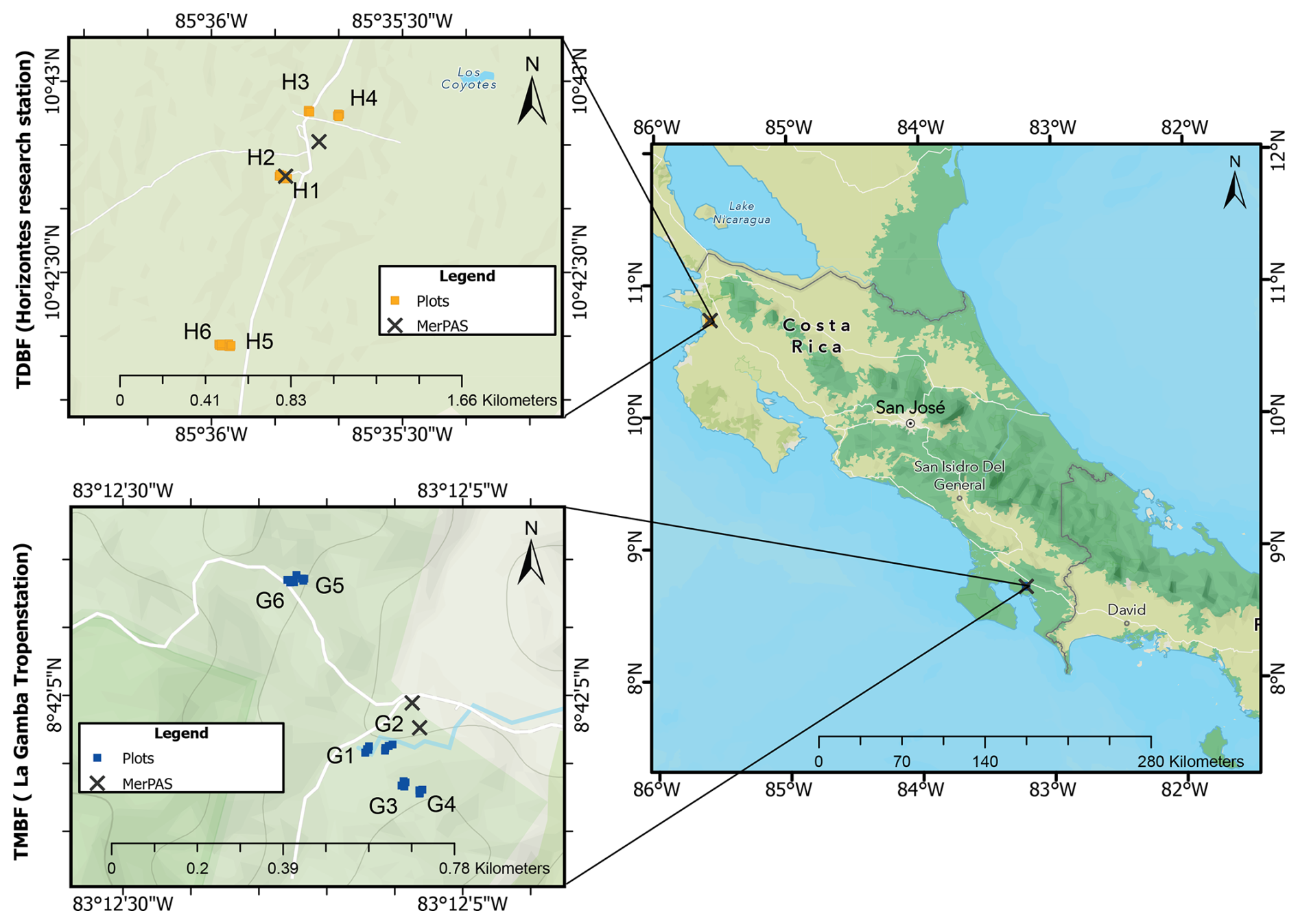
Figure 1Location of the sampling sites in the tropical dry broadleaf forest (TDBF) and tropical moist broadleaf forest (TMBF) in Costa Rica and the sites where the atmospheric mercury samplers (MerPAS) were deployed.
The TMBF plots were near the La Gamba Tropenstation (60–345 m a.s.l.; Höbinger et al., 2012) in the Golfo Dulce region, on the edge of Piedras Blancas National Park (Área de Conservación Osa). GPS coordinates are listed in Table S1 in the Supplement.
The TDBF site has a mean annual temperature of 25 °C, a six-month dry season from mid-November to mid-May, and an average annual rainfall of ∼ 1575 mm (interannual range 880–3030 mm) (Gei and Powers, 2013; Höbinger et al., 2012). The area of study in TDBF has undergone natural regeneration for ∼ 37 years (since approximately 1989), following the cessation of rice cultivation and cattle grazing, and is now dominated by deciduous trees with some evergreen species (Werden et al., 2018). The TMBF has a mean annual temperature of 28.2 °C and receives ∼ 5900 mm of rain annually, with a short, nominal dry period from December to April that is often interrupted by rainfall (Huber et al., 2008; Huber and Weissenhofer, 2019). Owing to its wet climate, biogeographic setting, and environmental heterogeneity, it supports humid evergreen lowland forest and is considered one of the most species-rich lowland rainforests in Central America (Albert et al., 2008). The TMBF study area was previously affected by partial land-use impacts from cattle grazing, plantations, and pasture use. It has undergone reforestation for ∼ 33 years (since approximately 1993) and now consists of a mosaic of primary and secondary forest (Huber and Weissenhofer, 2019). The specific sites sampled in both TDBF and TMBF are secondary forests without any known close source of anthropogenic Hg emission (e.g., gold mining, cement production, etc.) (Fig. 1).
Three sampling campaigns (SC1, SC2, and SC3) were conducted, two at the end of the dry season and one at the end of the wet season, as shown in Table 1. This design enabled evaluation of seasonal effects in both TDBF and TMBF. Climate data for each season in both forest types, including daily precipitation, UV radiation, and earth skin temperature, were obtained from 15 November 2023 to 15 June 2026 from NASA's Prediction of Worldwide Energy Resources (POWER) project (NASA POWER, 2025).
Table 1Design of the sampling campaigns in the tropical dry broadleaf forest (TDBF) and tropical moist broadleaf forest (TMBF).
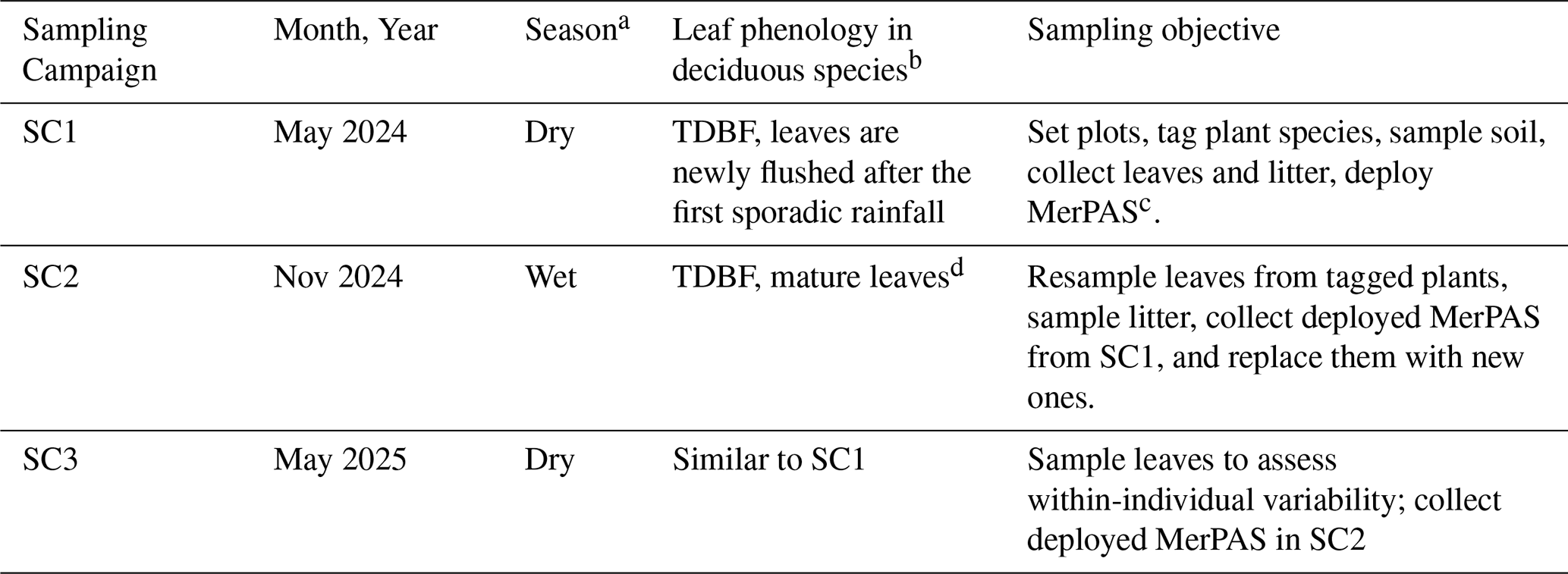
aSamples were taken at the end of the specified season; bIn TMBF, deciduous trees behaved more like evergreens, renewing leaves periodically throughout the year. They were found with mature leaves during all sampling campaigns; i.e., only mature leaves were collected. cMercury passive samplers; dFully expanded, non-senescent leaves were considered mature leaves
2.2 Leaves, litter, and soil sampling and processing
Sampling of living leaves: In each forest (TDBF and TMBF), composite leaf samples were collected primarily from trees, with fewer bushes, ferns, and lianas, in proportion to their local distribution across the twelve plots (TDBF: H1–H6; TMBF: G1–G6) during SC1, SC2, and SC3 (Table 1). In SC1, 60 samples were collected per forest (n= 120); in SC2, 90 samples were collected per forest (n= 180); and in SC3, a total of 91 samples were collected across both forests. This yielded an overall total of n= 391 samples to fulfill the sampling objectives detailed in Table 1. As most of the sampled species in both forests were trees, we refer to them as tree species throughout the manuscript. The leaves were sampled using a telescopic pruner at heights between 1 and 5 m. In SC3, to assess within-individual repeatability of foliar Hg, we sampled ≥ 3 leaves from different branches or positions of the same tagged individual. After sampling, the leaves were washed thoroughly with tap water to remove soil, dust or moss, rinsed with deionized water, dried, and stored until analysis. Most plant individuals were classified to the species level, with a few identified to the genus level due to the high similarity between species. All samples were then classified by leaf habit (evergreen vs. deciduous), a trait strongly influenced by seasonal dynamics. Total Hg concentrations were analyzed in all the samples following sample preparation.
Litter sampling: Excluding green leaves and twigs, litter was sampled from four replicates per plot at the end of the dry season (SC1) and the wet season (SC2), resulting in 96 samples in total (n= 96). This sampling design enables the assessment of seasonal differences. All litter within a ∼ 400 cm2 sampling square was collected into sealed plastic bags, dried to constant weight (50 °C, ∼ 14 d), and weighed to estimate litter accumulation (g m−2) before grinding. Total Hg concentrations were analyzed following sampling preparation.
Soil sampling. Four soil cores were collected from each of six plots in each forest type during the SC1 sampling campaign, resulting in 48 cores in total. Each core was sectioned into four depth intervals (0–5, 5–10, 10–20, and 20–30 cm), yielding 96 soil samples per forest and 192 samples in total (n= 192). Soil samples were collected using a stainless-steel soil corer; sampling coordinates are provided in Table S1. All samples were dried, sieved (< 2 mm), and ground prior to analysis. Total Hg concentrations were analyzed following sample preparation.
Sample preparation: Litter, soil, and leaf samples were dried to constant weight at 50 °C, homogenized, and ground to a fine powder with a zirconia ball mill (MM40, Retsch, Germany).
2.3 Mercury analysis
Total Hg concentrations were measured in dried, milled, homogeneous litter, soil, and leaf samples using a direct mercury analyzer (DMA-80; MWS, Germany). Analytical quality control included instrument triplicates for every tenth sample. For foliage and litter, NIST SRM 1515 (Apple Leaves) and IPE-181 (Mango Leaves; WEPAL-QUASIMEME) yielded mean recoveries of 96 % and 102 %, respectively. For soils, Chinese SRMs NCS DC7303 (soil) and NCS DC73048 (sediment) (NCS Testing Technology Co., Ltd., China) gave recoveries of 94 % and 97 %, respectively.
2.4 Soil physical properties
The 2 mm-sieved, air-dried soil was used for the analysis of the physical properties. Soil texture was determined using the Pario sedimentation analysis system (Meter Group Inc., USA), which applies Stokes' Law to estimate the relative proportions of fine soil particles based on the integral suspension pressure method (Durner et al., 2017). Soil pH was measured in 2 mm-sieved, air-dried soil collected from the 0–5 cm depth, using water as the extractant at a soil-to- water ratio of 1:5 () (ISO 10390, 2005).
2.5 Specific leaf area and stomatal density determination
Specific leaf area (SLA) was determined using the method proposed by Pérez-Harguindeguy et al. (2013). Briefly, mature leaves were collected during sampling SC2, rinsed, gently blotted dry with absorbent paper, and scanned. The scanned images were processed using a Python script to estimate leaf surface area. The leaves were then dried to constant weight and weighed. SLA was calculated by dividing the surface area by the weight of the dried sample.
For stomatal density (SDN), mature leaves collected in the second campaign (SC2) were analyzed following Millstead et al. (2020). Nail polish epidermal impressions of the abaxial surface were prepared, and stomata were counted under a light microscope at 40× magnification. Counts were performed in triplicate from three different sections of the leaf abaxial surface (all stomata were found abaxial in this study).
For SLA and SDN, at least one individual per species was assessed. When additional individuals were available, extra measurements were taken, depending on the species' distribution across plots. For SDN, when more than three individuals were sampled, three random individuals were measured, and values were averaged.
2.6 Determination of atmospheric mercury concentrations
A total of 32 mercury passive samplers (MerPAS®, Tekran) were deployed in both the TDBF and TMBF. In each forest, two sites were selected (Table S1). At each site, four MerPAS® were deployed at approximately 1.5 m above the soil surface, including three passive samplers and one field blank. Samplers were initially deployed at the end of the dry season (May 2024) and left in the field for approximately 6 months. They were then collected and replaced with new samplers to assess seasonal variation in atmospheric Hg concentrations (Table 1). Total Hg concentrations were analyzed using the DMA-80 instrument (described above), based on the method suggested by McLagan et al. (2016). To assess measurement quality control, SRM 2685c (NIST, USA) was used, with an average recovery of 101 %.
2.7 Statistical analysis
Statistical analysis included the Shapiro-Wilk test for normality and Levene's test for homogeneity of variances. Group differences were assessed using the Wilcoxon rank-sum test, two-sample Student's t-test, or the Welch two-sample t-test, depending on data distribution and variance structure. Correlation patterns were evaluated using Spearman's and Pearson's correlations. Statistical significance was defined as p< 0.05. All analyses were conducted in RStudio (version 2025.05.0).
Leaf Hg concentrations for the dry season were calculated as the mean of the two dry season campaigns (SC1 and SC3) when data from both campaigns were available. When data were available from only one campaign, that single measurement was used to represent the dry season (Figs. 3, S3 in the Supplement). Soil and litter data are reported separately per sampling event.
In the manuscript, mean values are expressed as ± standard error, except for Hg concentrations in different species from TDBF and TMBF (Fig. S3), and Hg concentrations in MerPAS® samplers (Fig. 2), where means are expressed with standard deviation.
3.1 Atmospheric Hg in tropical dry and moist broadleaf forests
Given that elemental atmospheric Hg (Hg0) is the primary source of natural Hg to tropical forests, we measured its concentrations using MerPAS® to assess seasonal and forest-level differences between tropical dry broadleaf forest (TDBF) and tropical moist broadleaf forest (TMBF), and their potential relationship with foliar Hg. In the TDBF, Hg0 did not differ significantly between seasons (dry: 1.3 ± 0.2; wet: 1.1 ± 0.2 ng m−3; n= 6; Fig. 2).
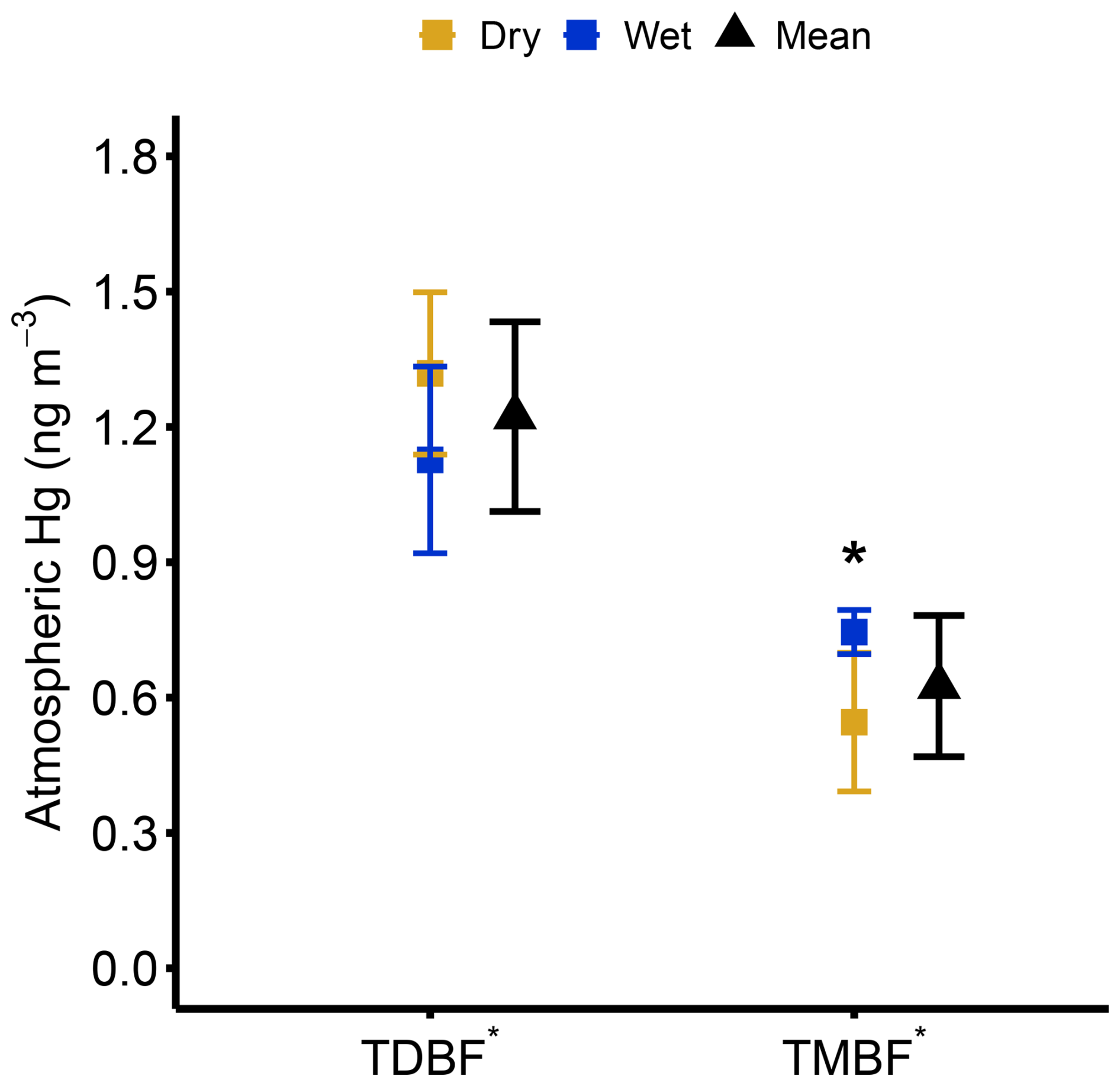
Figure 2Mean (± standard deviation) of atmospheric Hg concentration in tropical dry broadleaf forest (TDBF) and tropical moist broadleaf forest (TMBF) during the dry and wet seasons (TDBF dry n= 6, TDBF wet n= 6, TMBF dry n= 6, TMBF wet n= 4; two Hg passive sampler measurements from the TMBF wet season could not be obtained because of a catalyst-related instrument malfunction during Hg analysis; total n= 22). Forest means across both dry and wet seasons (TDBF n= 12, TMBF n= 10) are represented with a black triangle ± standard deviation. (∗) on the x-axis indicates statistically significant differences between the forests, while within the graph indicates significant seasonal differences according to the two-sample t-test.
The TMBF showed slightly higher Hg0 concentrations during the wet season (0.8 ± 0.1 ng m−3, n= 4) than during the dry season (0.6 ± 0.2 ng m−3, n= 6), potentially reflecting air mass dynamics associated with rainfall events (Koenig et al., 2021). However, the main difference was observed between forests, as Hg0 concentrations in TDBF (1.2 ± 0.2 ng m−3, n= 6) were approximately twice those in TMBF (Fig. 2). The lower atmospheric Hg0 concentration in TMBF is consistent with higher wet deposition, but alternative explanations (e.g., differences in regional air mass history) cannot be ruled out.
Compared to global background levels, Hg0 concentrations in TDBF were close to the reported Southern Hemisphere background (1.1 ng m−3) (Lindberg et al., 2007; Sprovieri et al., 2010), whereas concentrations in TMBF were approximately 1.6 times lower. The lower Hg0concentration in TMBF compared to the background concentration in the Southern Hemisphere may be attributable to greater vegetation-mediated Hg0 uptake resulting from higher canopy density, combined with other factors such as meteorological conditions, as explained above. To our knowledge, baseline values for Hg0 concentrations in non-polluted areas have not previously been reported for TDBF. For TMBF, Gerson et al. (2022) reported Hg0 concentrations of approximately 1 ng m−3 at remote, non-mining background sites in Madre de Dios, Peru, which is still roughly 1.4 times higher than our seasonally averaged value of 0.7 ng m−3. Thus, our study provides baseline values for Hg0 concentrations under natural conditions in TDBF, and adds a comparison point for TMBF. However, additional MerPAS® deployments across multiple seasons and locations are needed to better understand seasonal dynamics in Hg0 concentrations in both forests.
3.2 Foliar Hg among different plant species from TDBF and TMBF
3.2.1 Seasonal patterns of Hg concentration in tropical forest plant species
Seasonal patterns in foliar Hg concentrations were observed in both deciduous and evergreen trees in the TDBF. Deciduous trees showed a more pronounced seasonal difference, with leaf Hg concentrations 4.7 times higher in the wet season (49 ± 27 µg kg−1, n= 53) than in the dry season (10 ± 11 µg kg−1, n= 50) (Fig. 3a). Evergreen trees showed the same pattern, although less pronounced, with leaf Hg concentrations 2.3 times higher in the wet season (53 ± 27 µg kg−1, n= 37) compared to the dry season (23 ± 18 µg kg−1, n= 35). The higher wet-season leaf Hg concentrations were also observed when plants were analyzed at the species level (Fig. S1).
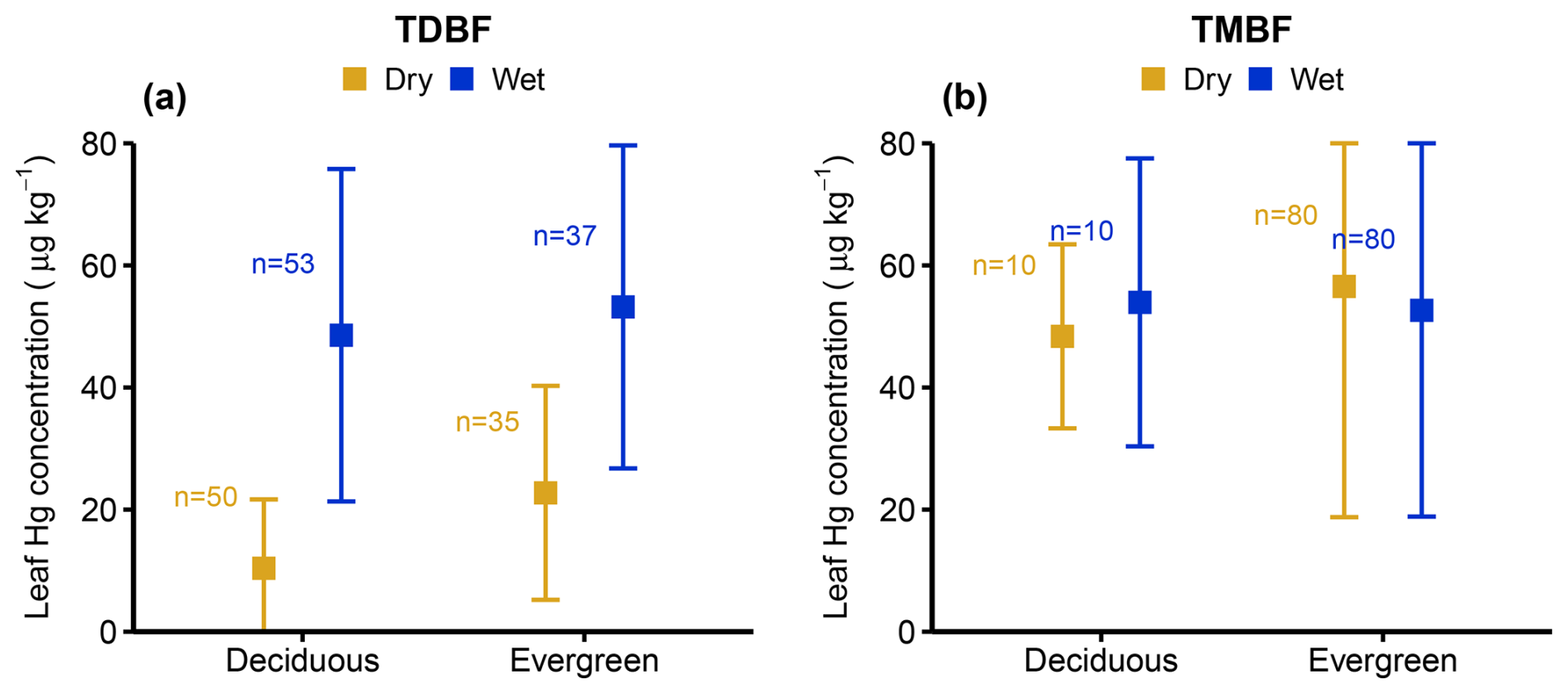
Figure 3Mean (± standard deviation) concentrations of Hg in leaves of deciduous and evergreen species during the dry and wet seasons in the tropical dry broadleaf forest (TDBF, a) and tropical moist broadleaf forest (TMBF, b). Dry season values represent the average of two sampling campaigns (SC1 and SC3); wet season values represent a single sampling campaign (SC2). Sampling campaign details are explained above in Table 1.
The lower leaf Hg concentration observed in deciduous trees during the dry season most likely reflects seasonal leaf turnover. In TDBF, deciduous trees shed their leaves during the dry season as a strategy to reduce water loss and drought stress and to protect their hydraulic function (Bullock et al., 1995; Eamus, 1999; Wolfe et al., 2016). Consequently, leaves sampled at the end of the dry season were likely newly flushed following the onset of rainfall, as in the field they seemed young, small, not well developed, and therefore had less time to accumulate Hg than older leaves. This interpretation is consistent with previous studies showing that foliar Hg concentrations generally increase with leaf age (Laacouri et al., 2013; Pleijel et al., 2021). For evergreen trees, the influence of several mechanisms may have contributed to the lower foliar Hg concentrations in the dry season. First, leaves collected during the dry season may have been newly flushed shortly before sampling. Although classified as evergreen trees, some species lose their leaves during dry periods and rapidly develop new foliage following incipient rainfall. Therefore, some authors call them semi- or brevi-deciduous depending on the degree and timing of leaf shedding (Eamus, 1999). This explanation is consistent with our field observations. While all selected trees had sufficient foliage for sampling during the first campaign, the same individuals showed substantial variation in canopy coverage and visually estimated leaf age during the second dry-season campaign. Thus, some trees could still be sampled despite reduced or predominantly young foliage, while others were completely leafless and could not be sampled. For example, all sampled individuals of Tabernaemontana glabra had foliage during the first dry-season campaign, whereas during the second dry-season campaign, three individuals were completely leafless and eight individuals had predominantly young leaves (visually determined). Canopy coverage among those individuals ranged from 5 % to 90 % (Table S2). Consistent with our field observations and interpretation, Borchert (1994) described evergreen trees in the same region as facultative evergreens, whose leaf phenology is primarily driven by water status. This suggests that foliar Hg accumulation for evergreen trees from TDBF may also be controlled by seasonal variation in water availability, as happens for deciduous trees.
A second potential mechanism is Hg0 re-emission from leaves. Although research on foliar Hg re-emission remains limited, Yuan et al. (2019) found that stomatal uptake of Hg0 followed by internal oxidation to Hg2+ can be reversed through photochemical reduction, potentially allowing Hg0 to be re-emitted from leaves. Canopy-scale studies suggest that up to ∼ 45 % of Hg taken up by foliage may return to the atmosphere via re-emission (Graydon et al., 2012). Therefore, higher UV radiation during the dry season in TDBF could potentially have enhanced Hg re-emission via light-driven reductive loss from leaves (Yuan et al., 2019), although the roles of lower humidity and higher leaf temperature observed during the dry season may also contribute to Hg re-emission; however, this process has not yet been investigated specifically in TDBF. Consistent with this possible Hg re-emission mechanism, the evergreen Hymenaea courbaril, which retained visually mature leaves during the dry season (Table S2), showed substantially lower foliar Hg concentrations in both dry season campaigns (14 and 24 µg kg−1) than in the wet season (82 µg kg−1; Fig. S1).
Although we did not directly evaluate foliar Hg0 re-emission in this study, weather station data indicate that environmental conditions were potentially more favourable for re-emission during the dry season. UV radiation was slightly higher in the dry season (2.2 averaged across the two dry seasons) than during the wet season (1.9 W m−2 × 40), and the median temperature was approximately 1 °C higher during the dry season (29 °C, average of the two dry seasons) than during the wet season (28 °C). The dry season also had more days exceeding 28 °C, with 137 d during the first dry season and 102 d during the second dry season, compared with only 43 d during the wet season, as shown in Fig. S2. In contrast, cumulative precipitation was 11 times higher during the wet season (3083 mm) than during the dry season (349 mm, averaged across the two dry season campaigns). Moreover, Gerchow et al. (2025) used UAV-based thermal imaging to analyse leaf-scale forest canopy temperatures in the same study area and found that daytime canopy temperatures can exceed 42 °C during the dry season. Together, higher radiation and temperature, sparser canopy cover, and lower precipitation suggest environmental conditions that could potentially favour foliar Hg0 re-emission during the dry season.
Finally, Hg translocation, defined as the transport of Hg from leaves to woody tissues via phloem, may also contribute to lower foliar Hg concentration during the dry season. Estimates suggest that approximately 5 %–15 % of foliar Hg can be translocated to woody tissues, contributing to dendrochemical records of atmospheric Hg (Monaci and Baroni, 2025; Peng et al., 2024).
Although all of these mechanisms – including variation in the timing of shedding, foliar Hg re-emission, and Hg translocation– may have contributed to the decline in foliar Hg concentrations in evergreen trees from the TDBF during the dry season, none was directly measured in this study. Moreover, to our knowledge, their contribution to seasonal foliar dynamics in evergreen trees in TDBF has not been evaluated. Therefore, the mechanisms underlying the lower foliar Hg concentration observed in evergreen trees during the dry season warrant further investigation. Future studies should consider normalizing foliar Hg by time-integrated stomatal conductance or by leaf age to try to separate seasonal variations in Hg uptake from age-related accumulation. They should account for substantial inter-individual variation in canopy coverage, which may reflect heterogeneous plant water availability conditions. To our knowledge, our data provide the baseline foliar Hg concentrations for TDBF, for which comparable measurements have not previously been reported.
No seasonal patterns in foliar Hg concentrations were observed in the TMBF. Deciduous trees showed similar Hg concentrations during the dry (48 ± 15 µg kg−1, n= 10) and wet seasons (54 ± 24 µg kg−1, n= 10). Evergreen trees showed a similar pattern, with comparable concentrations during the dry (57 ± 38 µg kg−1, n= 80) and wet (53 ± 34 µg kg−1, n= 80) seasons (Fig. 3b). At the species level, foliar Hg concentrations varied substantially, but no consistent seasonal differences were observed (Fig. S1). The absence of seasonal variation in foliar Hg concentrations in evergreen trees is likely related to leaf age, as the sampled leaves were mature during both the dry and wet seasons, and foliar Hg accumulation is known to be correlated with leaf lifespan (Pleijel et al., 2021). Evergreen trees can retain leaves for 1.6 to 4.7 years, depending on species and light conditions (Reich et al., 2004), allowing continuous Hg accumulation over time. In addition, the absence of a pronounced dry season and the resulting relatively high humidity may reduce seasonal constraints on stomatal conductance, photosynthesis, and transpiration, potentially supporting relatively continuous atmospheric Hg uptake by foliage throughout the year (Teixeira et al., 2018). Dense canopy structure may further enhance foliar Hg retention and limit Hg0 re-emission by reducing light penetration and, consequently, the potential for Hg re-emission from foliage (Yuan et al., 2019).
Regarding the lack of seasonal variation in foliar Hg observed in trees classified as deciduous based on the typical phenology of those species, we assumed that the sampled leaves were mature during both the dry and wet seasons based on our field observations, which is consistent with the high foliar Hg concentrations found in both seasons. This assumption is supported by the typical phenology of deciduous trees in TMBF, where leaf shedding is followed by fast regrowth under favorable moisture conditions, with phenology patterns regulated by drought and light availability (Kearsley et al., 2024). Leaves from deciduous trees therefore remain mature for longer periods, allowing continuous Hg accumulation and sustained high foliar Hg concentrations across seasons. However, leaf age was not quantitatively determined, representing a limitation of this study.
Overall, water availability, which differed markedly between seasons, appeared to be an important driver of foliar Hg accumulation across both forest types. During the dry season, accumulated precipitation in TMBF was almost three times higher than in TDBF (937 vs. 349 mm; Fig. S2), which likely sustained continuous plant water availability, supporting both stomatal activity and the extended leaf maturity explained above, potentially contributing to the consistently high foliar Hg concentrations observed in TMBF across seasons. In TDBF, although foliar Hg concentrations declined during the dry season, both evergreen and deciduous trees showed rapid foliar Hg accumulation during the wet season, reaching concentrations in mature leaves comparable to those observed in TMBF.
3.2.2 Leaf Hg concentration in TDBF and TMBF at the tree species level and intra-individual variation
In the TDBF, considering the most sampled species, the deciduous species Tabebuia ochracea exhibited the highest leaf Hg concentration (99 ± 45 µg kg−1, n= 4) (wet season), while among evergreens, Tabernaemontana glabra reached the highest concentration (72 ± 12 µg kg−1; n= 11) (Fig. S3). In the TMBF, Psychotria elata (evergreen) showed the highest Hg concentrations (dry season: 92 ± 15, n= 5; wet season: 86 ± 12 µg kg−1, n= 5), whereas Amphirrhox longifolia showed the highest Hg concentrations among deciduous species (dry: 57 ± 9, n= 5; wet: 68 ± 24 µg kg−1, n= 5) (Fig. S3).
At the forest level, foliar Hg concentrations varied substantially among individual trees in both TDBF (range: 4–161 µg kg−1, n= 90) and TMBF (range: 2–167 µg kg−1, n= 90), reflecting considerable interspecific variability that should be considered when estimating global foliar Hg budgets. To explore potential mechanisms underlying the high variability in foliar Hg concentrations among species, we evaluated the relationship between foliar Hg concentrations and two static morphological traits, specific leaf area (SLA) and stomatal density (SD). Neither trait showed a strong or statistically significant relationship with foliar Hg concentrations (Fig. S4a–d), suggesting that these morphological traits alone do not adequately explain the observed interspecific variability. These findings highlight the need for future studies to incorporate direct physiological measurements (e.g., stomatal conductance, net photosynthesis, transpiration rate) on the same leaves used for Hg analysis to identify which mechanisms are most closely related to foliar Hg accumulation, while minimizing bias from high intra-individual variability, as described below.
Marked variability in foliar Hg concentrations was observed among leaves collected from different parts of the canopy within the same individual tree, in both evergreen and deciduous species. This was expressed as the percentage deviation of each subsample from the tree-level mean foliar Hg concentration (MPD), where positive and negative values indicate Hg concentrations above and below that mean, respectively. This variability was especially pronounced in TDBF species such as Amphilophium paniculatum (MPD range: −29 % to 19 %, n= 3), Hymenaea courbaril (MPD range: −73 % to 57 %, n= 3), and Bromelia pinguin (MPD range: −59 % to 63 %, n= 3). Similar variability was observed in TMBF species including Theobroma cacao (MPD range: −71 % to 42 %, n= 3), Cyathea arborea (MPD range: −70 % to 72 %, n= 3), and Cardulovica palmata (MPD range: −66 % to 71 %, n= 3) (Fig. 4). This within-tree variability may reflect differences among leaves in age, light exposure, humidity, stomatal conductance, net photosynthesis, pest presence, and other factors (Pleijel et al., 2021; Teixeira et al., 2017, 2018). These results highlight the importance of collecting a large number of leaf samples (multiple leaves per individual) to ensure representative foliar Hg measurements. It is also worth noting that our sampling strategy covered a maximum height of 5 m, whereas trees in TDBF and TMBF can reach heights of up to 20 and 50 m, respectively (Brienen et al., 2010). Therefore, variability in foliar Hg concentrations may be even greater along the canopy height gradient, which was not captured by our sampling design.
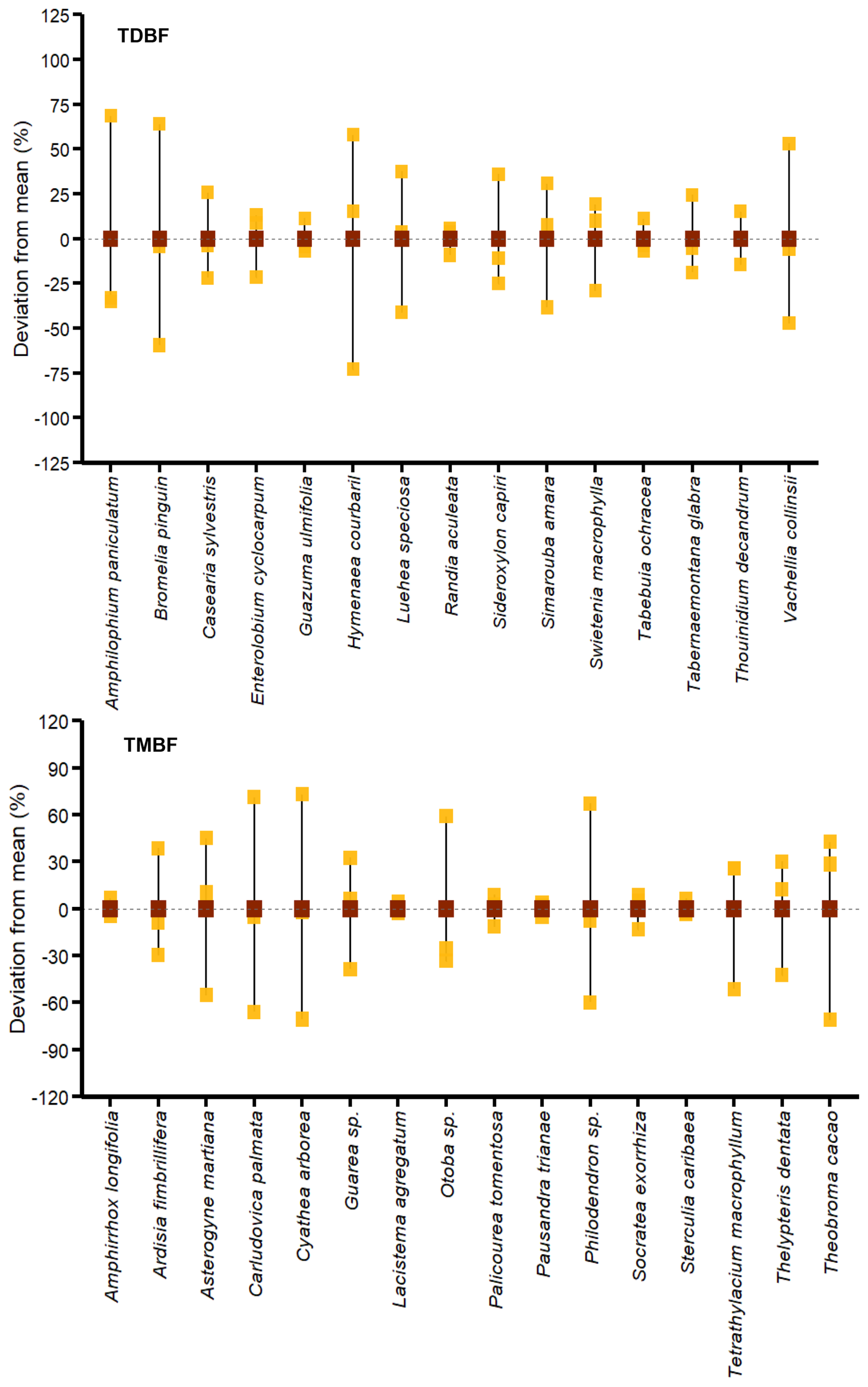
Figure 4Within-individual variability in leaf subsamples collected from different parts of the same plant across multiple species in the tropical dry broadleaf forest (TDBF) and the tropical moist broadleaf forest (TMBF) during the dry season (SC3). Yellow squares represent Hg concentrations in individual subsamples, brown squares indicate the mean of the three measurements, and black lines connect subsamples belonging to the same plant.
3.2.3 TDBF and TMBF contributions to the global foliar Hg pool
Across all species, mature leaves in the TDBF averaged 50 µg kg−1 Hg (n= 90), while those in the TMBF averaged 53 µg kg−1 (n= 90). These values are 2.1-fold (TDBF) and 2.2-fold (TMBF) higher than the estimated global foliar Hg mean concentration (24 µg kg−1; Chen et al., 2024) and exceed typical concentrations reported for temperate and boreal forests including 16.3 µg kg−1 in U.S. temperate forests (Yang et al., 2018) 20–40 µg kg−1 in Canadian temperate deciduous forests (Siwik et al., 2009) and 11–26 µg kg−1 in European forests (Wohlgemuth et al., 2020). Although atmospheric Hg0 concentrations are generally higher in the Northern Hemisphere (1.5–1.7 ng m−3; Sprovieri et al., 2010), where most temperate and boreal forests are located, they were lower in our studied forests (TDBF and TMBF values). Despite these lower atmospheric Hg concentrations, foliar Hg concentrations in both tropical forest types were higher than those typically reported for temperate and boreal forests. This contrast highlights that atmospheric Hg0 concentrations alone do not determine foliar Hg concentrations. Importantly, atmospheric Hg0 concentrations measured within the forest reflect not only regional and local atmospheric Hg emission and transport but also the removal of Hg0 by vegetation and other atmospheric sinks. Taken together, these findings underscore the importance of tropical forests as relevant contributors to the global foliar Hg pool, as their dense vegetation and relatively sustained stomatal conductance and photosynthetic activity may promote foliar Hg uptake and subsequent retention in foliage.
Our study provides, to our knowledge, the first baseline data on foliar Hg concentrations in TDBF and highlights the importance of accounting for seasonal differences when sampling and modeling foliar Hg, particularly in highly seasonal systems such as TDBF. Although our results are consistent with the modelled mean foliar Hg concentration for TMBF (∼ 53 ± 24 µg kg−1, n= 263; Zhou et al., 2021), our data also reveal high variability, including marked intra-individual differences in foliar Hg concentrations in both forests. Given the limited availability of field-based Hg data, these findings highlight the need for more in-field measurements that account for seasonal differences in tropical forests to improve model accuracy.
3.3 Mercury inputs from litter in tropical forests
3.3.1 Seasonal patterns in litter accumulation in TDBF and TMBF
In the TDBF, litter mass accumulation in soil was significantly higher during the dry season compared to the wet season in all plots except H3 (Fig. 5a).
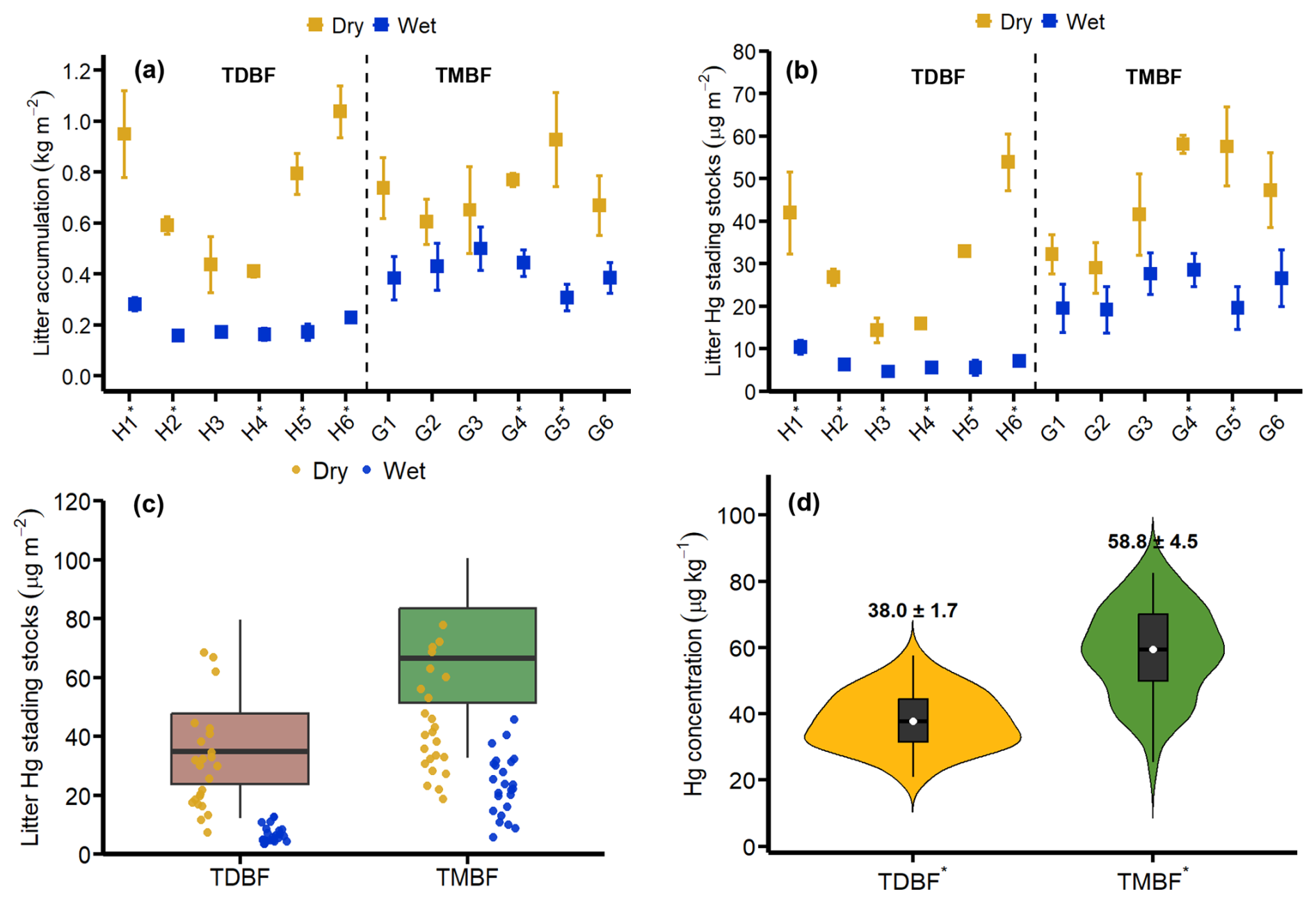
Figure 5Mean (± standard error) of litter accumulation and litter Hg standing stocks (n= 4 individual samples) across different plots in the tropical dry broadleaf forest (TDBF), plots H1–H6; and the tropical moist broadleaf forest (TMBF), plots G1–G6, during the dry (yellow) and wet (blue) seasons (a, b). (c) Mean (± standard error) of litter Hg standing stocks during the dry and wet seasons per forest. Individual data points are shown as dots, coloured by season. (d) Violin plot of the Hg concentration mean (± standard error) in litter per forest (n= 6 plots), values represent plot-level averages for the dry and wet seasons. (∗) at the x-axis indicates statistically significant differences according to the Wilcoxon signed-rank test, or Student's t-test (p< 0.05), depending on data distribution.
Averaged across plots (H1–H6), dry-season litter mass was 3.6 times higher (0.7 ± 0.1 kg m−2, n= 24) than wet-season litter mass (0.2 ± 0.0 kg m−2, n= 24). At TMBF, no significant seasonal differences in litter mass accumulation were found at most plots, except for G4 and G5 (Fig. 5a). However, when averaged across all plots (G1–G6), litter accumulation at forest level was 1.8 times higher during the dry season (0.7 ± 0.1 kg m−2, n= 24) than during the wet season (0.4 ± 0.0 kg m−2, n= 24). Plot-level differences in litter accumulation likely reflect the high heterogeneity in species distribution in both forests, as litter inputs are influenced by the phenology of dominant species, in situ water availability, and species drought tolerance (Tonin et al., 2021). The higher litter accumulation observed during the dry season in both forests is consistent with previous reports of intensified leaf shedding in Mexican TDBF associated with deciduous leaf abscission (Morffi-Mestre et al., 2020) and in secondary rainforest (TMBF) in Brazil as a tree response to moisture stress (Oliveira de Morais et al., 2021).
It is important to note that we quantified forest-floor litter present at the time of sampling (end of each season), rather than trap-based litter. Our measurements, therefore, represent net litter accumulation, which is shaped not only by leaf shedding but also by decomposition dynamics influenced by temperature, tree species composition, precipitation, soil moisture, and other environmental factors (Bothwell et al., 2014; Wood et al., 2012). The lower litter mass observed during the wet season is consistent with reduced leaf shedding and higher decomposition rates, whereas during the dry season, limited soil moisture likely constrains microbial activity, slowing decomposition and allowing greater litter accumulation. However, our study design does not allow the relative contributions of increased leaf shedding and reduced decomposition to the seasonal litter pool to be distinguished, as both processes are likely to contribute. Differences among plots presumably reflect local variation in microclimate, successional stage, topography, tree species diversity, and forest structural patterns (Giweta, 2020).
When comparing the two forest types across seasons, the TMBF showed 1.3 times higher mean litter accumulation (0.57 ± 0.0 kg m−2, n= 6 plots, Fig. S5a) than the TDBF (0.45 ± 0.1 kg m−2, n= 6 plots). Although litter mass in the TDBF was low during the wet season, the higher accumulation during the dry season resulted in overall seasonal litter masses comparable to those observed in the TMBF. These patterns broadly align with previous reports showing higher litter in TMBF (∼ 8–14 Mg ha−1 yr−1; Chave et al., 2010) compared to TDBF (4–8 Mg ha−1 yr−1; Montañez-S. et al., 2023; Morffi-Mestre et al., 2020; Souza et al., 2019), though ranges overlap between forest types.
3.3.2 Hg concentration in litter and its relationship to foliar Hg
Litter Hg concentrations averaged across all plots in the TDBF were 43 µg kg−1 (n= 24) during the dry season and 33 µg kg−1 (n= 24) during the wet season. At the plot level, seasonal differences were not statistically significant (Welch's two-sample t-test, n= 4 per season per plot), except for H6 (p= 0.003) (Fig. S5b). In the TMBF, plot-averaged litter Hg concentrations were 61 µg kg−1 (n= 24) during the dry season and 57 µg kg−1 (n= 24) during the wet season. Similarly, no significant seasonal differences were observed at most plots, except for G4 (p= 0.028). The relatively small sample size within individual plots (n= 4 per season) may have limited our ability to detect modest seasonal effects. Slightly higher dry-season litter Hg concentrations in some plots are plausible because wet-season rain has been shown to leach/dilute dry-deposited Hg, diverting it to throughflow and streams (Silva-Filho et al., 2006; Teixeira et al., 2017). Overall, Hg concentration in litter in TMBF was comparable to that reported for rainforests in Brazil and French Guiana (∼ 60 µg kg−1; Fostier et al., 2015; Wright et al., 2016). To our knowledge, there are no data on Hg concentration in litter from TDBF.
In the TDBF, the average foliar Hg concentration of mature living leaves during the wet season (50 µg kg−1, n= 90) was 34 % higher than in litter, potentially reflecting Hg losses from litter through leaching, decomposition, and other post-shedding processes. In contrast, during the dry season, Hg concentration in litter was 64 % higher than in living leaves (15 µg kg−1, n= 85). This pattern may indicate that dry-season litter consisted primarily of older, Hg-enriched leaves, which are shed after prolonged Hg0 accumulation, whereas many living leaves had relatively low Hg concentration because of the seasonal processes described above, including the presence of newly flushed foliage in deciduous trees and potential re-emission. This seasonal reversal pattern, in which litter Hg concentrations exceed those of living leaves during the dry season but were lower during the wet season, suggests that litter Hg dynamics may be driven by both the timing of leaf senescence relative to Hg accumulation and post-shedding losses through leaching and decomposition. In the TMBF, litter Hg concentrations were 8 % and 7 % higher than those in living leaves during the dry (56 µg kg−1, n= 90) and wet seasons (53 µg kg−1, n= 90), respectively. This pattern may reflect a greater contribution of older, Hg-enriched leaves to the litter layer, which had accumulated Hg over longer periods before senescence. Post-shedding Hg losses through different mechanisms (e.g., leaching and re-emission) in TMBF may not have offset the higher Hg concentrations of older leaves. However, this difference was much smaller than the pronounced dry-season difference observed in the TDBF, as described above.
3.3.3 Seasonal patterns of litter Hg standing stocks in TDBF and TMBF
Strong seasonal patterns in litter Hg standing stocks were observed in TDBF across all plots, except for H3 (Fig. 5b). Averaged across plots (H1–H6), standing stocks were 4.7 times higher during the dry season (31 ± 6 µg Hg m−2, n= 24) than during the wet season (7 ± 1 µg Hg m−2, n= 24), primarily due to greater litter mass accumulation during the dry season (Fig. 5a). In TMBF, consistent with the pattern observed in litter accumulation, no significant seasonal differences in litter Hg standing stocks were observed across plots, except for G4 and G5 (Fig. 5b). However, at the forest level (plots G1–G6), higher overall litter accumulation during the dry season resulted in greater standing stocks, which were 1.9 times higher during the dry season (44 ± 5 µg Hg m−2, n= 24) than during the wet season (24 ± 2 µg Hg m−2, n= 24).
Seasonal patterns of litter Hg standing stocks were potentially driven by both leaf phenology and decomposition dynamics in both forest types, but these effects were more pronounced in the TDBF. In TDBF, leaf shedding occurs mainly during the dry season, when litter consists mainly of mature leaves with higher Hg concentrations, including leaves retained from the preceding growing season in deciduous trees. In addition, Hg concentrations in litter reflect not only the elemental content of leaves at abscission but also changes occurring during decomposition. This is particularly relevant because we measured net litter accumulation, which reflects litter inputs and post-abscission losses. Thus, seasonal differences in Hg (both concentration and standing stocks) are shaped by both the timing of leaf fall and the degree of post-abscission degradation.
Overall, our data indicate that litter Hg standing stocks in TDBF are strongly influenced by seasonal variations, with peak inputs occurring during the dry season. In contrast, in the TMBF, litter Hg standing stocks appear to be maintained more continuously throughout the year, although some sites exhibited higher standing stocks under dry-season conditions, potentially reflecting differences in species composition and distribution, species-specific drought tolerance, and other factors described above (Sect. 3.3.1). Greater litter-derived Hg standing stocks during the dry season may also be associated with reduced decomposition rates, as dry conditions can slow litter breakdown (Rowland et al., 2014; Teixeira et al., 2017; Yavitt et al., 2004). Thus, seasonal differences may influence Hg transfer from vegetation to soil not only through their effects on litter deposition but also indirectly through their effects on decomposition and potential reemission, although these mechanisms need further investigation. Importantly, our litter Hg standing stocks represent a snapshot of Hg retained in the litter layer at specific sampling times rather than annual Hg inputs. Consequently, the dry-season standing stocks should not be interpreted as equivalent to annual Hg transfer from litter to soil. Some of the Hg present in dry-season litter may remain in undecomposed material and may subsequently be lost through re-emission, leaching, or other processes before being incorporated into mineral soil. Therefore, the actual annual transfer of Hg from litter to mineral soil may be lower than suggested by the maximum dry-season standing stocks observed in this study.
3.3.4 Litter Hg standing stocks in TDBF and TMBF compared with global estimates
Seasonally averaged litter Hg standing stocks were 1.8 times higher in TMBF (34 ± 3 µg Hg m−2, n= 6 plots) than in the TDBF (19 ± 3 µg Hg m−2, n= 6 plots; Fig. 5c). Although our estimates are seasonal sums rather than annualized values, they are comparable to findings from rainforests (34.6 ± 1.2 µg m−2 yr−1; Teixeira et al., 2017) and fall within modelled ranges in the Amazon (49 ± 14 µg Hg m−2 yr−1; Fostier et al., 2015). Hg concentration in litter was 1.5 times higher in TMBF than in TDBF, with density peaks near ∼ 60 and ∼ 33 µg Hg kg−1, respectively (Fig. 5d). TMBF peaks are similar to the Amazon rainforest estimates by Fostier et al. (2015) (∼ 60.5 µg Hg kg−1). For TDBF, the lack of datasets on litter Hg concentration limits cross-study comparison, while direct comparisons with global means are further complicated by differences in Hg0 concentration, climate, vegetation characteristics, and species composition. Nevertheless, the mean litter Hg concentration observed in the TDBF in this study was lower than the global forest litter estimate of 54 µg Hg kg−1 (n= 168; Wang et al., 2016). This difference highlights the need for additional measurements in TDBF to establish more robust baseline litter Hg concentrations for this forest type.
Overall, our study shows that although TDBF can accumulate foliar Hg at levels comparable to TMBF in mature leaves, post-senescence processes (e.g., re-emission, leaching and decomposition) may alter Hg concentrations and reduce the amount of Hg in litter before it is incorporated into soil. These findings highlight the importance of incorporating seasonal dynamics into Hg modelling estimates. Given the wide global distribution of TDBF and its high foliar Hg sequestration capacity, these ecosystems should be explicitly included in global Hg budgets.
3.4 Mercury dynamics in soils from TDBF and TMBF
3.4.1 Role of litter in Hg accumulation in tropical soils
Consistent with previous studies identifying litter as the primary Hg source to forest soils (Feng et al., 2019; Jiménez et al., 2025; Lu et al., 2016; Ma et al., 2022; Zhou et al., 2018), our results showed a positive correlation between litter Hg standing stocks and soil Hg concentrations (0–30 cm depth-averaged) in both tropical forests (Fig. 6a). However, it is worth noting that our correlation does not demonstrate causality; Hg transfer from litter to soil may be independently influenced by common environmental factors (e.g., organic matter accumulation). Moreover, post-senescence Hg losses from litter before incorporation into mineral soil remain unquantified.
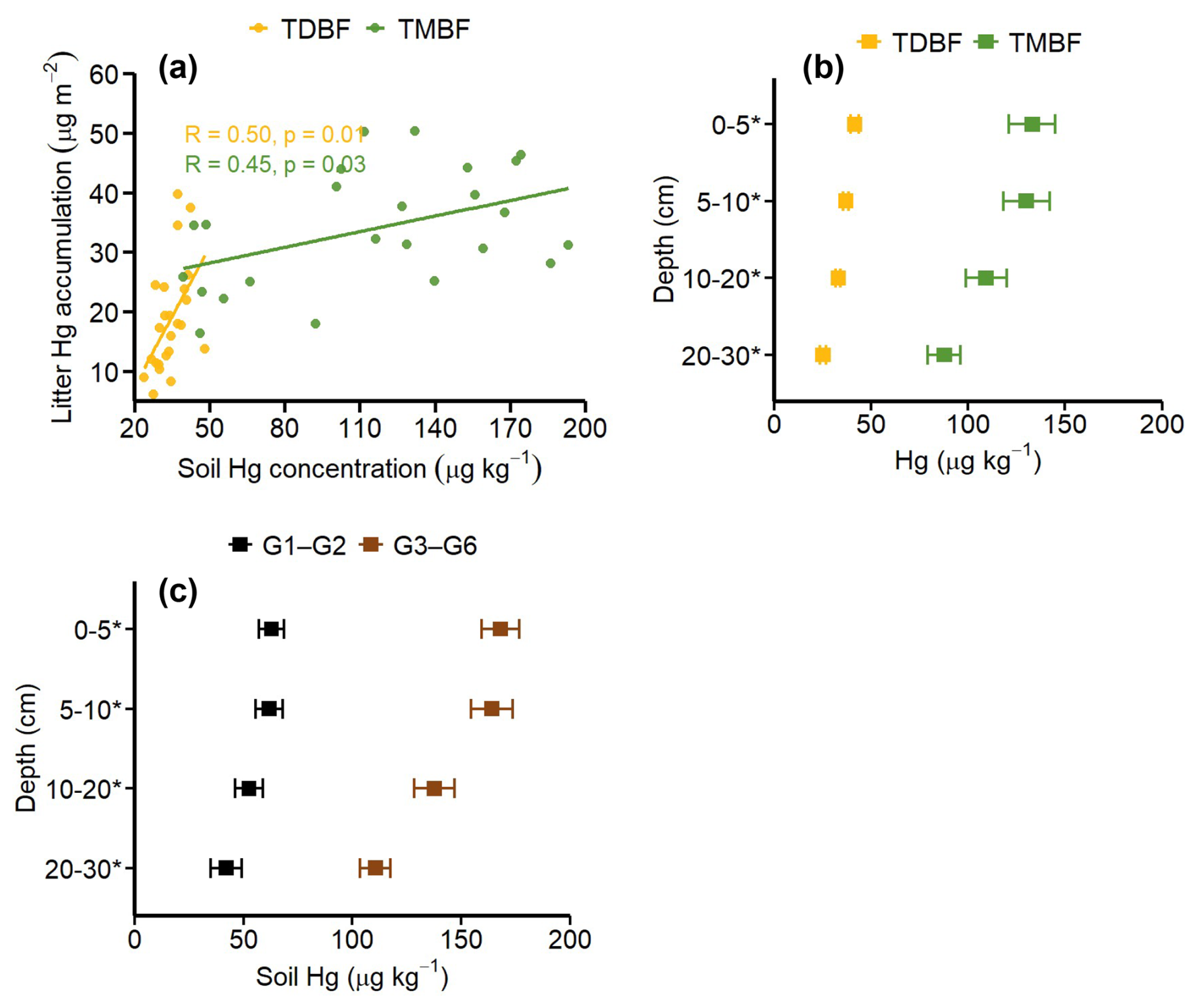
Figure 6(a) Pearson's correlations (based on data distribution), with the R coefficients and p-values, between Hg accumulation in litter across all six plots (mean of litter from dry and wet seasons) and soil Hg concentration (averaged at 0–30 cm depth) in tropical dry broadleaf forest (TDBF) and tropical moist broadleaf forest (TMBF). Trend lines were added to visualise overall patterns in the data. (b) Mean (± standard error) concentrations of Hg at different depths in the TDBF and TMBF. (c) Mean (± standard error) concentrations of Hg at different depths in the anthropogenically disturbed (G1–G2) and less disturbed (G3–G6) plots in TMBF. (∗) on the y-axis indicates statistically significant differences between forests at each depth (Wilcoxon rank sum test p< 0.05).
This litter-mediated influence was also reflected in the vertical distribution of soil Hg concentrations. In TMBF (pH 5.1 ± 0.1 at 0–5 cm; silty clay), soil Hg concentrations decreased with depth from 133 to 88 µg kg−1 across the 0–30 cm profile (Fig. 6b). A similar depth-dependent decline was observed in TDBF (pH 6.6 ± 0.1; silty clay), with concentrations approximately 3.4 times lower than those in the TMBF across all depths ranging from 42 to 25 µg kg−1. In both forest types, the vertical distribution of soil Hg concentrations closely followed that of C (R> 0.7 for both forests; data not shown), consistent with the well-known Hg-C associations in soil (Ma et al., 2022; Semu et al., 1987).
Despite TDBF and TMBF exhibiting, on average, similar foliar Hg concentrations in mature leaves (50 vs. 53 µg kg−1, respectively), soils in TMBF contained substantially more Hg. This difference might be related to more continuous litter production in TMBF, which sustains a steady litter-mediated Hg input to the soil throughout the year, as relatively stable litter Hg standing stocks were found across both dry and wet seasons, as explained in the litter section. In contrast, TDBF showed a peak of litter Hg standing stocks during the dry season, followed by a decrease during the wet season, driven by the leaf-shedding phenology of deciduous trees. Thus, the combination of lower litter Hg standing stocks and the lower tree density and canopy cover observed in the field may have contributed to the lower soil Hg concentrations in the TDBF compared with the TMBF. Differences in Hg-soil dynamics between the two forest types are also evident in Fig. 6a, where contrasting slopes in the soil–litter Hg relationship indicate differences in long-term Hg accumulation and retention in soils. In TMBF, consistently high foliar Hg concentrations and frequent rainfall likely promote steady Hg inputs but also increase leaching potential. In TDBF, episodic yet high dry-season litter Hg standing stocks, combined with reduced leaching under drier conditions, may favour more efficient Hg retention over time.
3.4.2 Anthropogenic disturbances affecting soil Hg concentrations in tropical forests
The depth-averaged Hg concentration (0–30 cm) in soils from plots G1 and G2 (55 µg kg−1) was 2.6 times lower than in plots G3–G6 (Fig. 6c). This pattern was consistent across the entire soil profile (0–5, 5–10, 10–20, and 20–30 cm), with Hg concentrations remaining approximately 2.6 times lower in G1–G2 (63, 62, 53, 42 µg kg−1) than in G3–G6 (168, 164, 138, 111 µg kg−1) at every depth. The lower soil Hg concentrations may be attributable to human disturbance. Although plots G1 and G2, similar to plots G3–G6, were also deforested, they were subsequently grazed and reforested predominantly with Theobroma cacao for ∼ 33 years (since approximately 1993), resulting in lower species diversity compared to G3–G6; litter Hg standing stocks in G1–G2 were also, on average, 1.5 times lower (25 ± 3 µg Hg m−2, n= 16) than G3–G6 (38 ± 11 µg Hg m−2, n= 32). As we did not measure Hg loss pathways (e.g., volatilisation, leaching, erosion, re-emission), their relative contributions cannot be determined from our data, and, given the unbalanced number of plots in the disturbed sites (n= 2) compared with the less disturbed ones (n= 4), these findings should be interpreted as a case study rather than a definitive demonstration of deforestation effects. Nonetheless, the magnitude of Hg loss is comparable to Mainville et al. (2006), who reported up to 60 % lower topsoil Hg following forest to pasture conversion in Ecuadorian rainforests, linked to erosion, leaching, and reduced organic matter inputs (Almeida et al., 2005); similarly, reforested soils in deciduous forests have remained Hg-depleted even after 60–80 years of regrowth (Gamby et al., 2015).
Therefore, our findings suggest that forest maturity and disturbance history may be important considerations when evaluating Hg sequestration in tropical forests. Our data also suggest that soil Hg concentrations in TMBF may remain altered for several decades following disturbance. The TDBF site had also undergone spatially heterogeneous reforestation; however, soil Hg concentrations were consistent across plots. Because we did not sample comparable disturbed and undisturbed sites, we are unable to determine whether forest maturity or disturbance contributed to the observed patterns.
Overall, topsoil Hg concentrations at the forest level were 1.8 times higher in TMBF and 1.8 times lower in TDBF than the estimated global average (74 µg kg−1) by Liu et al. (2023). Our results for TMBF fall within the range reported for less disturbed near primary forest areas (128–225 µg kg−1) (Almeida et al., 2005; Mainville et al., 2006). However, our results highlight the substantial variability that can be found among sampling sites. As no baseline data exist for disturbed or undisturbed TDBF soils, further research is needed, particularly considering that TDBF represents one of the most extensive yet endangered tropical forest ecosystems (Hasnat and Hossain, 2000). Future modelling approaches should therefore also include this ecosystem. Overall, soils in TDBF and TMBF have been shown to efficiently store Hg derived primarily from litter, but they are highly vulnerable to human disturbances and may require long periods and a diverse native species assemblage for proper recovery of soil Hg concentrations.
Our study demonstrated that foliar Hg concentrations in TDBF vary strongly between the dry and wet seasons, likely as a result of seasonal differences in plant water availability and associated changes in leaf phenology. In both forest types, mature leaves had higher foliar Hg concentrations than newly flushed leaves. As a result, evergreen and deciduous trees in TDBF exhibited lower foliar Hg during the dry season due to leaf phenological patterns (leaf shedding and flushing). During the wet season, evergreen and deciduous trees in TDBF showed a rapid increase in foliar Hg concentrations, reaching concentrations similar to those of mature leaves of both deciduous and evergreen species in TMBF. In contrast, TMBF maintained consistently high foliar Hg across seasons, likely due to the longer leaf lifespan and less pronounced seasonal constraints on plant water availability. Litter Hg standing stocks were also influenced by seasonal differences, particularly in TDBF, where they peaked during the dry season. A similar dry-season peak in litter Hg standing stocks was observed at a few TMBF sites, potentially reflecting spatially heterogeneous species distribution and phenology, with some species/individuals increasing litter production under drier conditions. Thus, both forests, especially TDBF, appear highly vulnerable to year-to-year climate fluctuations, as their Hg accumulation capacity is strongly climate-dependent. Prolonged drought periods could delay leaf flushing, reducing the time available for foliar Hg uptake and accumulation.
Our findings also highlight the need to refine global Hg estimates by accounting for high species-level diversity, pronounced seasonal dynamics, and substantial within-individual local variability in tropical forests. For foliar Hg assessment, collecting multiple leaves per individual is essential, as foliar Hg concentrations varied considerably among leaves from the same tree, potentially reflecting differences in canopy position, light exposure, leaf age, and other leaf-level factors.
Foliar Hg concentrations in both forest types exceeded global estimates and concentrations reported for temperate, boreal, and deciduous temperate forests, highlighting the importance of tropical forests as potential hotspots for Hg accumulation. Although soil Hg concentrations in TDBF were lower than in TMBF, the accumulation potential of undisturbed TDBF (primary forest) remains unexplored. Further in situ measurements, combined with improved modelling approaches, are therefore essential to better quantify and refine global Hg budgets. Conserving both forest types is crucial, as deforestation might reduce soil Hg concentrations, and recovery likely requires long-term ecosystem stability and native species diversity.
The data will be made available upon request, as they will be further used to estimate Hg accumulation and storage budgets in tropical dry forests and rainforests using the Normalized Difference Vegetation Index (NDVI) (manuscript in preparation).
The supplement related to this article is available online at https://doi.org/10.5194/bg-23-7787-2026-supplement.
JFMA: Conceptualization, Investigation, Methodology, Data curation, Writing – original draft, Writing-Review; GTPB: Investigation; MB: Investigation; CB: Investigation; WH: Investigation; MAZA: Investigation; HB: Investigation, Writing-Review; MPR: Writing – original draft, Writing-Review, Project administration, Supervision, Methodology, Conceptualization, Funding acquisition.
The contact author has declared that none of the authors has any competing interests.
Publisher's note: Copernicus Publications remains neutral with regard to jurisdictional claims made in the text, published maps, institutional affiliations, or any other geographical representation in this paper. The authors bear the ultimate responsibility for providing appropriate place names. Views expressed in the text are those of the authors and do not necessarily reflect the views of the publisher.
The authors acknowledge Petra Schmidt, José Andrés Herra Araya, and Antonia Schmidtke for their assistance in the field, and Malkin Gerchow for developing the Python script used to determine leaf area. We also thank Adelina Calean, Sanaz Arianmesh, André Dörrie, Amelie Rother, and Alexandra Mayer for their laboratory support, as well as the workers at the Horizontes Experimental Research Station and La Gamba Tropenstation.
The study was supported by the German Science Foundation (DFG) through a grant to M. P.-R. (grant no. PE3026/3-1).
This open-access publication was funded by Technische Universität Braunschweig.
This paper was edited by Anja Rammig and reviewed by two anonymous referees.
Almeida, M. D., Lacerda, L. D., Bastos, W. R., and Herrmann, J. C.: Mercury loss from soils following conversion from forest to pasture in Rondônia, Western Amazon, Brazil, Environ. Pollut., 137, 179–186, https://doi.org/10.1016/j.envpol.2005.02.026, 2005.
Ávila-Lovera, E., Urich, R., Coronel, I., and Tezara, W.: Seasonal gas exchange and resource-use efficiency in evergreen versus deciduous species from a tropical dry forest, Tree Physiol., 39, 1561–1571, https://doi.org/10.1093/treephys/tpz060, 2019.
Bonan, G. B.: Forests and Climate Change: Forcings, Feedbacks, and the Climate Benefits of Forests, Science, 320, 1444–1449, https://doi.org/10.1126/science.1155121, 2008.
Borchert, R.: Soil and Stem Water Storage Determine Phenology and Distribution of Tropical Dry Forest Trees, Ecology, 75, 1437–1449, https://doi.org/10.2307/1937467, 1994.
Bothwell, L. D., Selmants, P. C., Giardina, C. P., and Litton, C. M.: Leaf litter decomposition rates increase with rising mean annual temperature in Hawaiian tropical montane wet forests, PeerJ, 2, e685, https://doi.org/10.7717/peerj.685, 2014.
Brienen, R. J. W., Zuidema, P. A., and Martínez-Ramos, M.: Attaining the canopy in dry and moist tropical forests: strong differences in tree growth trajectories reflect variation in growing conditions, Oecologia, 163, 485–496, https://doi.org/10.1007/s00442-009-1540-5, 2010.
Bullock, S. H., Mooney, H. A., and Medina, E. (Eds.): Seasonally Dry Tropical Forests, Cambridge University Press, Cambridge, https://doi.org/10.1017/CBO9780511753398, 1995.
Chave, J., Navarrete, D., Almeida, S., Álvarez, E., Aragão, L. E. O. C., Bonal, D., Châtelet, P., Silva-Espejo, J. E., Goret, J.-Y., von Hildebrand, P., Jiménez, E., Patiño, S., Peñuela, M. C., Phillips, O. L., Stevenson, P., and Malhi, Y.: Regional and seasonal patterns of litterfall in tropical South America, Biogeosciences, 7, 43–55, https://doi.org/10.5194/bg-7-43-2010, 2010.
Chen, L., Zhou, J., Guo, L., Bian, X., Xu, Z., Chen, Q., Wen, S.-H., Wang, K., and Liu, Y.-R.: Global Distribution of Mercury in Foliage Predicted by Machine Learning, Environ. Sci. Technol., 58, 15629–15637, https://doi.org/10.1021/acs.est.4c00636, 2024.
Chidumayo, E. N.: Stem water monitoring reveals an association with rainfall and leaf flush timing in a tropical dry forest of Zambia, Tree Physiol., 45, tpaf084, https://doi.org/10.1093/treephys/tpaf084, 2025.
Cusack, D. F., Reed, S., Andersen, K. M., Cinoğlu, D., Craig, M. E., Dietterich, L. H., Hogan, J. A., Holm, J. A., Nottingham, A. T., Ostertag, R., Soper, F. M., Wood, T. E., and Wong, M. Y.: Tropical forests and global change: biogeochemical responses and opportunities for cross-site comparisons, an organized INSPIRE session at the 108th Annual Meeting, Ecological Society of America, Portland, Oregon, USA, August 2023, New Phytol., 241, 1922–1926, https://doi.org/10.1111/nph.19511, 2024.
Denzler, B., Eugster, W., Bogdal, C., Bishop, K., Buchmann, N., Hungerbühler, K., and Osterwalder, S.: Uptake of Gaseous Elemental Mercury by a Rainforest: Insights from a Tropical Glasshouse Used as a Dynamic Flux Chamber, Environ. Sci. Technol., 59, 18675–18686, https://doi.org/10.1021/acs.est.5c05823, 2025.
Durner, W., Iden, S. C., and von Unold, G.: The integral suspension pressure method (ISP) for precise particle-size analysis by gravitational sedimentation, Water Resour. Res., 53, 33–48, https://doi.org/10.1002/2016WR019830, 2017.
Eamus, D.: Ecophysiological traits of deciduous and evergreen woody species in the seasonally dry tropics, Trends Ecol. Evol., 14, 11–16, https://doi.org/10.1016/S0169-5347(98)01532-8, 1999.
Escobar-Camacho, D., Rosero-López, D., Ruiz-Urigüen, M., Barragán, K. S., Carpintero-Salvador, N., Daza, J. R., Aldous, A., Benítez, S., Tear, T., and Encalada, A. C.: Mercury in aquatic ecosystems of two indigenous communities in the Piedmont Ecuadorian Amazon: evidence from fish, water, and sediments, Ecotoxicol. Lond. Engl., 33, 440–456, https://doi.org/10.1007/s10646-024-02764-w, 2024.
Feinberg, A., Dlamini, T., Jiskra, M., Shah, V., and E. Selin, N.: Evaluating atmospheric mercury (Hg) uptake by vegetation in a chemistry-transport model, Environ. Sci. Process. Impacts, 24, 1303–1318, https://doi.org/10.1039/D2EM00032F, 2022.
Feng, C., Wang, Z., Ma, Y., Fu, S., and Chen, H. Y. H.: Increased litterfall contributes to carbon and nitrogen accumulation following cessation of anthropogenic disturbances in degraded forests, For. Ecol. Manag., 432, 832–839, https://doi.org/10.1016/j.foreco.2018.10.025, 2019.
Fostier, A., Melendez-Perez, J., and Richter, L.: Litter mercury deposition in the Amazonian rainforest., Environ. Pollut., 206, 605–610, https://doi.org/10.1016/j.envpol.2015.08.010, 2015.
Gamby, R. L., Hammerschmidt, C. R., Costello, D. M., Lamborg, C. H., and Runkle, J. R.: Deforestation and cultivation mobilize mercury from topsoil, Sci. Total Environ., 532, 467–473, https://doi.org/10.1016/j.scitotenv.2015.06.025, 2015.
Gei, M. G. and Powers, J. S.: Do legumes and non-legumes tree species affect soil properties in unmanaged forests and plantations in Costa Rican dry forests?, Soil Biol. Biochem., 57, 264–272, https://doi.org/10.1016/j.soilbio.2012.09.013, 2013.
Gerchow, M., Kühnhammer, K., Iraheta, A., Marshall, J. D., and Beyer, M.: Enhanced flight planning and calibration for UAV based thermal imaging: implications for canopy temperature and transpiration analysis, Front. For. Glob. Change, 8, https://doi.org/10.3389/ffgc.2025.1457762, 2025.
Gerson, J. R., Szponar, N., Zambrano, A. A., Bergquist, B., Broadbent, E., Driscoll, C. T., Erkenswick, G., Evers, D. C., Fernandez, L. E., Hsu-Kim, H., Inga, G., Lansdale, K. N., Marchese, M. J., Martinez, A., Moore, C., Pan, W. K., Purizaca, R. P., Sánchez, V., Silman, M., Ury, E. A., Vega, C., Watsa, M., and Bernhardt, E. S.: Amazon forests capture high levels of atmospheric mercury pollution from artisanal gold mining, Nat. Commun., 13, 559, https://doi.org/10.1038/s41467-022-27997-3, 2022.
Giweta, M.: Role of litter production and its decomposition, and factors affecting the processes in a tropical forest ecosystem: a review, J. Ecol. Environ., 44, 11, https://doi.org/10.1186/s41610-020-0151-2, 2020.
Graydon, J. A., St. Louis, V. L., Lindberg, S. E., Sandilands, K. A., Rudd, J. W. M., Kelly, C. A., Harris, R., Tate, M. T., Krabbenhoft, D. P., Emmerton, C. A., Asmath, H., and Richardson, M.: The role of terrestrial vegetation in atmospheric Hg deposition: Pools and fluxes of spike and ambient Hg from the METAALICUS experiment, Glob. Biogeochem. Cycles, 26, https://doi.org/10.1029/2011GB004031, 2012.
Guentzel, J. L., Landing, W. M., Gill, G. A., and Pollman, C. D.: Mercury and major ions in rainfall, throughfall, and foliage from the Florida Everglades, Sci. Total Environ., 213, 43–51, https://doi.org/10.1016/S0048-9697(98)00071-0, 1998.
Gustin, M. S., Huang, J., Miller, M. B., Peterson, C., Jaffe, D. A., Ambrose, J., Finley, B. D., Lyman, S. N., Call, K., Talbot, R., Feddersen, D., Mao, H., and Lindberg, S. E.: Do We Understand What the Mercury Speciation Instruments Are Actually Measuring? Results of RAMIX, Environ. Sci. Technol., 47, 7295–7306, https://doi.org/10.1021/es3039104, 2013.
Gustin, M. S., Dunham-Cheatham, S. M., Harper, J. F., Choi, W.-G., Blum, J. D., and Johnson, M. W.: Investigation of the biochemical controls on mercury uptake and mobility in trees, Sci. Total Environ., 851, 158101, https://doi.org/10.1016/j.scitotenv.2022.158101, 2022.
Gworek, B., Dmuchowski, W., and Baczewska-Dąbrowska, A. H.: Mercury in the terrestrial environment: a review, Environ. Sci. Eur., 32, 128, https://doi.org/10.1186/s12302-020-00401-x, 2020.
Hasnat, G. N. T. and Hossain, M. K.: Global Overview of Tropical Dry Forests, in: Handbook of Research on the Conservation and Restoration of Tropical Dry Forests, edited by: Bhadouria, R., Tripathi, S., Srivastava, P., and Singh, P., IGI Global, 1–23, https://doi.org/10.4018/978-1-7998-0014-9.ch001, 2020.
Hasnat, G. N. T., Hossain, M. K., Hasnat, G. N. T., and Hossain, M. K.: Global Overview of Tropical Dry Forests, 1–23TS10 , https://doi.org/10.4018/978-1-7998-0014-9.ch001, 2020.
Hasselquist, N. J., Allen, M. F., and Santiago, L. S.: Water relations of evergreen and drought-deciduous trees along a seasonally dry tropical forest chronosequence, Oecologia, 164, 881–890, https://doi.org/10.1007/s00442-010-1725-y, 2010.
Höbinger, T., Schindler, S., Seaman, B. S., Wrbka, T., and Weissenhofer, A.: Impact of oil palm plantations on the structure of the agroforestry mosaic of La Gamba, southern Costa Rica: potential implications for biodiversity, Agrofor. Syst., 85, 367–381, https://doi.org/10.1007/s10457-011-9425-0, 2012.
Holzman, B. A.: Tropical Forest Biomes, Greenwood, https://doi.org/10.5040/9798216027669, 2008.
Huber, W. and Weissenhofer, A.: The La Gamba Research Station in Costa Rica – History, Nature and Research., in: Research at the Tropical Field Station La Gamba in Costa Rica., Verl. der Zoologisch-Botanischen Ges. in Österreich, Wien, 56, 3–11, https://www.zobodat.at/pdf/VZBG_156_0003-0011.pdf (last access: 26 October 2026), 2019.
Huber, W., Weissenhofer, A., Zamora, N., and Weber, A.: Plant diversity and biogeography of the Golfo Dulce region, Costa Rica/Diversidad vegetal y biogeografía de la región de Golfo Dulce, Costa Rica, in: Natural and cultural history of the Golfo Dulce Region, Costa Rica, edited by: Weissenhofer, A., Biologiezentrum, Linz, 97–103, https://www.zobodat.at/pdf/STAPFIA_0088_0097-0103.pdf (last access: 26 October 2026), 2008.
Jiménez, L., Ramón, P., Sarango, J., Burneo, J. I., Gusmán, J., and Gusmán-Montalván, E.: Long-term grazing exclusion enhances soil carbon and nitrogen stocks in tropical dry forests of southern Ecuador, Front. Soil Sci., 5, https://doi.org/10.3389/fsoil.2025.1617798, 2025.
Jiskra, M., Wiederhold, J. G., Skyllberg, U., Kronberg, R.-M., Hajdas, I., and Kretzschmar, R.: Mercury Deposition and Re-emission Pathways in Boreal Forest Soils Investigated with Hg Isotope Signatures, Environ. Sci. Technol., 49, 7188–7196, https://doi.org/10.1021/acs.est.5b00742, 2015.
Jiskra, M., Sonke, J. E., Obrist, D., Bieser, J., Ebinghaus, R., Myhre, C. L., Pfaffhuber, K. A., Wängberg, I., Kyllönen, K., Worthy, D., Martin, L. G., Labuschagne, C., Mkololo, T., Ramonet, M., Magand, O., and Dommergue, A.: A vegetation control on seasonal variations in global atmospheric mercury concentrations, Nat. Geosci., 11, 244–250, https://doi.org/10.1038/s41561-018-0078-8, 2018.
Kearsley, E., Verbeeck, H., Stoffelen, P., Janssens, S. B., Yakusu, E. K., Kosmala, M., De Mil, T., Bauters, M., Kitima, E. R., Ndiapo, J. M., Chuda, A. L., Richardson, A. D., Wingate, L., Ilondea, B. A., Beeckman, H., van den Bulcke, J., Boeckx, P., and Hufkens, K.: Historical tree phenology data reveal the seasonal rhythms of the Congo Basin rainforest, Plant-Environ. Interact., 5, e10136, https://doi.org/10.1002/pei3.10136, 2024.
Klock, A. M., Vogt, K. A., Vogt, D. J., Gordon, J. G., Scullion, J. J., Suntana, A. S., Mafune, K. K., Polyakov, A. Y., Gmur, S. J., and Gómez de la Rosa, C.: See the forest not the trees! Ecosystem-based assessment of response, resilience, and scope for growth of global forests, Ecol. Indic., 140, 108973, https://doi.org/10.1016/j.ecolind.2022.108973, 2022.
Koenig, A. M., Magand, O., Laj, P., Andrade, M., Moreno, I., Velarde, F., Salvatierra, G., Gutierrez, R., Blacutt, L., Aliaga, D., Reichler, T., Sellegri, K., Laurent, O., Ramonet, M., and Dommergue, A.: Seasonal patterns of atmospheric mercury in tropical South America as inferred by a continuous total gaseous mercury record at Chacaltaya station (5240 m) in Bolivia, Atmos. Chem. Phys., 21, 3447–3472, https://doi.org/10.5194/acp-21-3447-2021, 2021.
Laacouri, A., Nater, E. A., and Kolka, R. K.: Distribution and Uptake Dynamics of Mercury in Leaves of Common Deciduous Tree Species in Minnesota, U.S.A., Environ. Sci. Technol., 47, 10462–10470, https://doi.org/10.1021/es401357z, 2013.
Lai, H. R., Hill, T., Stivanello, S., and Chapman, H. M.: Changes in quantity and timing of foliar and reproductive phenology of tropical dry-forest trees under a warming and drying climate, J. Ecol., 113, 1560–1572, https://doi.org/10.1111/1365-2745.70044, 2025.
Larcher, W.: Physiological Plant Ecology: Ecophysiology and Stress Physiology of Functional Groups, Springer Science & Business Media, 540 pp., https://link.springer.com/book/9783540435167 (last access: 26 October 2026), 2003.
Lima, F. R. D., Pereira, P., Silva Junior, E. C., Vasques, I. C. F., Oliveira, J. R., Windmöller, C. C., Inda, A. V., Weindorf, D. C., Curi, N., Ribeiro, B. T., Guilherme, L. R. G., and Marques, J. J.: Geochemistry signatures of mercury in soils of the Amazon rainforest biome, Environ. Res., 215, 114147, https://doi.org/10.1016/j.envres.2022.114147, 2022.
Lindberg, S., Bullock, R., Ebinghaus, R., Engstrom, D., Feng, X., Fitzgerald, W., Pirrone, N., Prestbo, E., and Seigneur, C.: A Synthesis of Progress and Uncertainties in Attributing the Sources of Mercury in Deposition, AMBIO J. Hum. Environ., 36, 19–33, https://doi.org/10.1579/0044-7447(2007)36[19:ASOPAU]2.0.CO;2, 2007.
Liu, Y.-R., Guo, L., Yang, Z., Xu, Z., Zhao, J., Wen, S.-H., Delgado-Baquerizo, M., and Chen, L.: Multidimensional Drivers of Mercury Distribution in Global Surface Soils: Insights from a Global Standardized Field Survey, Environ. Sci. Technol., 57, 12442–12452, https://doi.org/10.1021/acs.est.3c04313, 2023.
Lu, Z., Wang, X., Zhang, Y., Zhang, Y.-J., Luo, K., and Sha, L.: High mercury accumulation in two subtropical evergreen forests in South China and potential determinants, J. Environ. Manage., 183, 488–496, https://doi.org/10.1016/j.jenvman.2016.08.073, 2016.
Lucchini, R. G., Basta, P. C., Crespo-Lopez, M. E., Gastañaga, M. del C., O'Callaghan-Gordo, C., Olivero-Verbel, J., Vega, C., Moncada Barbosa, S. M., Espinal, C., Felty, Q., and Deoraj, A.: Mercury Contamination and Co-exposures in the Amazon Basin: At the Center of the Planetary Environmental Crisis, Ann. Glob. Health, 91, 42, https://doi.org/10.5334/aogh.4817, 2025.
Ma, H., Cheng, H., Guo, F., Zhang, L., Tang, S., Yang, Z., and Peng, M.: Distribution of mercury in foliage, litter and soil profiles in forests of the Qinling Mountains, China, Environ. Res., 211, 113017, https://doi.org/10.1016/j.envres.2022.113017, 2022.
Mainville, N., Webb, J., Lucotte, M., Davidson, R., Betancourt, O., Cueva, E., and Mergler, D.: Decrease of soil fertility and release of mercury following deforestation in the Andean Amazon, Napo River Valley, Ecuador, Sci. Total Environ., 368, 88–98, https://doi.org/10.1016/j.scitotenv.2005.09.064, 2006.
McLagan, D. S., Mitchell, C. P. J., Huang, H., Lei, Y. D., Cole, A. S., Steffen, A., Hung, H., and Wania, F.: A High-Precision Passive Air Sampler for Gaseous Mercury, Environ. Sci. Technol. Lett., 3, 24–29, https://doi.org/10.1021/acs.estlett.5b00319, 2016.
Mendes, K. R., Campos, S., da Silva, L. L., Mutti, P. R., Ferreira, R. R., Medeiros, S. S., Perez-Marin, A. M., Marques, T. V., Ramos, T. M., de Lima Vieira, M. M., Oliveira, C. P., Gonçalves, W. A., Costa, G. B., Antonino, A. C. D., Menezes, R. S. C., Bezerra, B. G., and Santos e Silva, C. M.: Seasonal variation in net ecosystem CO2 exchange of a Brazilian seasonally dry tropical forest, Sci. Rep., 10, 9454, https://doi.org/10.1038/s41598-020-66415-w, 2020.
Millstead, L., Jayakody, H., Patel, H., Kaura, V., Petrie, P. R., Tomasetig, F., and Whitty, M.: Accelerating Automated Stomata Analysis Through Simplified Sample Collection and Imaging Techniques, Front. Plant Sci., 11, https://doi.org/10.3389/fpls.2020.580389, 2020.
Monaci, F. and Baroni, D.: Leaves and Tree Rings as Biomonitoring Archives of Atmospheric Mercury Deposition: An Ecophysiological Perspective, Plants, 14, 1275, https://doi.org/10.3390/plants14091275, 2025.
Montañez-Salinas, A., Avella-Muñoz, A., and López-Camacho, R.: Litterfall and nutrient transfer dynamics in a successional gradient of tropical dry forest in Colombia, Rev. Biol. Trop., 71, https://doi.org/10.15517/rev.biol.trop..v71i1.52278, 2023.
Monteiro, L. C., Vieira, L. C. G., Bernardi, J. V. E., Recktenvald, M. C. N. do N., Nery, A. F. da C., Fernandes, I. O., de Miranda, V. L., da Rocha, D. M. S., de Almeida, R., and Bastos, W. R.: Mercury distribution, bioaccumulation, and biomagnification in riparian ecosystems from a neotropical savanna floodplain, Araguaia River, central Brazil, Environ. Res., 252, 118906, https://doi.org/10.1016/j.envres.2024.118906, 2024.
Mora-Chacón, F., Meza-Picado, V., Chinchilla-Mora, O., Gutiérrez-Leitón, M., Mora-Chacón, F., Meza-Picado, V., Chinchilla-Mora, O., and Gutiérrez-Leitón, M.: Curvas de altura dominante e índice de sitio locales para plantaciones de Samanea saman en Liberia, Guanacaste, Costa Rica, Rev. Cienc. Ambient., 56, 63–80, https://doi.org/10.15359/rca.56-2.4, 2022.
Morffi-Mestre, H., Ángeles-Pérez, G., Powers, J. S., Andrade, J. L., Huechacona Ruiz, A. H., May-Pat, F., Chi-May, F., and Dupuy, J. M.: Multiple Factors Influence Seasonal and Interannual Litterfall Production in a Tropical Dry Forest in Mexico, Forests, 11, 1241, https://doi.org/10.3390/f11121241, 2020.
NASA POWER: Prediction Of Worldwide Energy Resources (POWER) Data Access Viewer, https://power.larc.nasa.gov/data-access-viewer/, last access: 14 September 2025.
Oliveira de Morais, T. M., Berenguer, E., Barlow, J., França, F., Lennox, G. D., Malhi, Y., Chesini Rossi, L., Maria Moraes de Seixas, M., and Ferreira, J.: Leaf-litter production in human-modified Amazonian forests following the El Niño-mediated drought and fires of 2015–2016, For. Ecol. Manag., 496, 119441, https://doi.org/10.1016/j.foreco.2021.119441, 2021.
Peng, H., Zhang, X., Bishop, K., Marshall, J., Nilsson, M. B., Li, C., Björn, E., and Zhu, W.: Tree Rings Mercury Controlled by Atmospheric Gaseous Elemental Mercury and Tree Physiology, Environ. Sci. Technol., 58, 16833–16842, https://doi.org/10.1021/acs.est.4c05662, 2024.
Pérez-Harguindeguy, N., Díaz, S., Garnier, E., Lavorel, S., Poorter, H., Jaureguiberry, P., Bret-Harte, M. S., Cornwell, W. K., Craine, J. M., Gurvich, D. E., Urcelay, C., Veneklaas, E. J., Reich, P. B., Poorter, L., Wright, I. J., Ray, P., Enrico, L., Pausas, J. G., de Vos, A. C., Buchmann, N., Funes, G., Quétier, F., Hodgson, J. G., Thompson, K., Morgan, H. D., ter Steege, H., van der Heijden, M. G. A., Sack, L., Blonder, B., Poschlod, P., Vaieretti, M. V., Conti, G., Staver, A. C., Aquino, S., and Cornelissen, J. H. C.: New handbook for standardised measurement of plant functional traits worldwide, Aust. J. Bot., 61, 167–234, https://doi.org/10.1071/BT12225, 2013.
Pleijel, H., Klingberg, J., Nerentorp, M., Broberg, M. C., Nyirambangutse, B., Munthe, J., and Wallin, G.: Mercury accumulation in leaves of different plant types – the significance of tissue age and specific leaf area, Biogeosciences, 18, 6313–6328, https://doi.org/10.5194/bg-18-6313-2021, 2021.
Poorter, H., Larcher, W.: Physiological plant ecology. 4th edn, Ann. Bot., 93, 616–617, https://doi.org/10.1093/aob/mch084, 2004.
Portillo-Quintero, C. A. and Sánchez-Azofeifa, G. A.: Extent and conservation of tropical dry forests in the Americas, Biol. Conserv., 143, 144–155, https://doi.org/10.1016/j.biocon.2009.09.020, 2010.
Rea, A. W., Lindberg, S. E., Scherbatskoy, T., and Keeler, G. J.: Mercury Accumulation in Foliage over Time in Two Northern Mixed-Hardwood Forests, Water. Air. Soil Pollut., 133, 49–67, https://doi.org/10.1023/A:1012919731598, 2002.
Reich, P. B., Uhl, C., Walters, M. B., Prugh, L., and Ellsworth, D. S.: Leaf demography and phenology in Amazonian rain forest: A census of 40 000 leaves of 23 tree species, Ecol. Monogr., 74, 3–23, https://doi.org/10.1890/02-4047, 2004.
Rodriguez-Pascual, M. J., Vega, C. M., Andrade, N., Fernández, L. E., Silman, M. R., and Torrents, A.: Hg distribution and accumulation in soil and vegetation in areas impacted by artisanal gold mining in the Southern Amazonian region of Madre de Dios, Peru, Chemosphere, 361, 142425, https://doi.org/10.1016/j.chemosphere.2024.142425, 2024.
Rowland, L., Hill, T. C., Stahl, C., Siebicke, L., Burban, B., Zaragoza-Castells, J., Ponton, S., Bonal, D., Meir, P., and Williams, M.: Evidence for strong seasonality in the carbon storage and carbon use efficiency of an Amazonian forest, Glob. Change Biol., 20, 979–991, https://doi.org/10.1111/gcb.12375, 2014.
Ruangpanit, N.: Tropical seasonal forests in monsoon Asia: With emphasis on continental southeast Asia, 33, 31–40, https://doi.org/10.1007/978-94-011-0343-5_4, 1995.
Schneider, L., Fisher, J. A., Diéguez, M. C., Fostier, A.-H., Guimaraes, J. R. D., Leaner, J. J., and Mason, R.: A synthesis of mercury research in the Southern Hemisphere, part 1: Natural processes, Ambio, 52, 897–917, https://doi.org/10.1007/s13280-023-01832-5, 2023.
Selin, N. E.: Global Biogeochemical Cycling of Mercury: A Review, Annu. Rev. Environ. Resour., 34, 43–63, https://doi.org/10.1146/annurev.environ.051308.084314, 2009.
Semu, E., Singh, B. R., and Selmer-Olsen, A. R.: Adsorption of mercury compounds by tropical soils II. Effect of soil: Solution ratio, ionic strength, pH, and organic matter, Water. Air. Soil Pollut., 32, 1–10, https://doi.org/10.1007/BF00227678, 1987.
Silva do Nascimento, L., Abreu Pestana, I., Seidel, M., Marques da Silva Junior, J., Cherene Vaz de Oliveira, B., Ribeiro Gomes, P., Koschinsky, A., Dittmar, T., and de Rezende, C. E.: Mercury concentrations along the Amazon estuary and plume: Spatial trends and geochemical processes, Environ. Res., 271, 121129, https://doi.org/10.1016/j.envres.2025.121129, 2025.
Silva-Filho, E. V., Machado, W., Oliveira, R. R., Sella, S. M., and Lacerda, L. D.: Mercury deposition through litterfall in an Atlantic forest at Ilha Grande, Southeast Brazil, Chemosphere, 65, 2477–2484, https://doi.org/10.1016/j.chemosphere.2006.04.053, 2006.
Siwik, E. I. H., Campbell, L. M., and Mierle, G.: Fine-scale mercury trends in temperate deciduous tree leaves from Ontario, Canada, Sci. Total Environ., 407, 6275–6279, https://doi.org/10.1016/j.scitotenv.2009.08.044, 2009.
Siyum, Z. G.: Tropical dry forest dynamics in the context of climate change: syntheses of drivers, gaps, and management perspectives, Ecol. Process., 9, 25, https://doi.org/10.1186/s13717-020-00229-6, 2020.
Souza, S. R., Veloso, M. D. M., Espírito-Santo, M. M., Silva, J. O., Sánchez-Azofeifa, A., Souza e Brito, B. G., and Fernandes, G. W.: Litterfall dynamics along a successional gradient in a Brazilian tropical dry forest, For. Ecosyst., 6, 35, https://doi.org/10.1186/s40663-019-0194-y, 2019.
Sprovieri, F., Pirrone, N., Ebinghaus, R., Kock, H., and Dommergue, A.: A review of worldwide atmospheric mercury measurements, Atmos. Chem. Phys., 10, 8245–8265, https://doi.org/10.5194/acp-10-8245-2010, 2010.
Stamenkovic, J. and Gustin, M. S.: Nonstomatal versus Stomatal Uptake of Atmospheric Mercury, Environ. Sci. Technol., 43, 1367–1372, https://doi.org/10.1021/es801583a, 2009.
Stork, N. E., Goosem, S., and Turton, S. M.: Australian Rainforests in a Global Context, in: Living in a Dynamic Tropical Forest Landscape, edited by: Stork, N. E. and Turton, S. M., Blackwell Publishing, 4–20, https://doi.org/10.1002/9781444300321.ch1, 2008.
Teixeira, D. C., Lacerda, L. D., and Silva-Filho, E. V.: Mercury sequestration by rainforests: The influence of microclimate and different successional stages, Chemosphere, 168, 1186–1193, https://doi.org/10.1016/j.chemosphere.2016.10.081, 2017.
Teixeira, D. C., Lacerda, L. D., and Silva-Filho, E. V.: Foliar mercury content from tropical trees and its correlation with physiological parameters in situ, Environ. Pollut., 242, 1050–1057, https://doi.org/10.1016/j.envpol.2018.07.120, 2018.
Tiwari, R., Hegde, B., Hegde, S., Bandaru, P., Ramesh Babu, M., Somashekhara Achar, K. G., Greiser, C., Muscarella, R., Barua, D., Galbraith, D., and Gloor, E.: Contrasting Seasonal Variation of Photosynthesis in Evergreen and Deciduous Tree Species From a Tropical Forest, Physiol. Plant., 177, e70410, https://doi.org/10.1111/ppl.70410, 2025.
Tonin, A. M., Lima, L. S., Bambi, P., Figueiredo, M. L., Rezende, R. S., and Gonçalves, J. F.: Litterfall Chemistry Is Modulated by Wet-Dry Seasonality and Leaf Phenology of Dominant Species in the Tropics, Front. For. Glob. Change, 4, https://doi.org/10.3389/ffgc.2021.666116, 2021.
Wang, X., Bao, Z., Lin, C.-J., Yuan, W., and Feng, X.: Assessment of Global Mercury Deposition through Litterfall, Environ. Sci. Technol., 50, 8548–8557, https://doi.org/10.1021/acs.est.5b06351, 2016.
Wang, X., Yuan, W., Lin, C.-J., Zhang, L., Zhang, H., and Feng, X.: Climate and Vegetation As Primary Drivers for Global Mercury Storage in Surface Soil, Environ. Sci. Technol., 53, 10665–10675, https://doi.org/10.1021/acs.est.9b02386, 2019.
Wang, X., Yuan, W., Lin, C.-J., and Feng, X.: Mercury cycling and isotopic fractionation in global forests, Crit. Rev. Environ. Sci. Technol., 52, 3763–3786, https://doi.org/10.1080/10643389.2021.1961505, 2022.
Werden, L. K., Alvarado J., P., Zarges, S., Calderón M., E., Schilling, E. M., Gutiérrez L., M., and Powers, J. S.: Using soil amendments and plant functional traits to select native tropical dry forest species for the restoration of degraded Vertisols, J. Appl. Ecol., 55, 1019–1028, https://doi.org/10.1111/1365-2664.12998, 2018.
Wohlgemuth, L., Osterwalder, S., Joseph, C., Kahmen, A., Hoch, G., Alewell, C., and Jiskra, M.: A bottom-up quantification of foliar mercury uptake fluxes across Europe, Biogeosciences, 17, 6441–6456, https://doi.org/10.5194/bg-17-6441-2020, 2020.
Wolfe, B. T., Sperry, J. S., and Kursar, T. A.: Does leaf shedding protect stems from cavitation during seasonal droughts? A test of the hydraulic fuse hypothesis, New Phytol., 212, 1007–1018, https://doi.org/10.1111/nph.14087, 2016.
Wood, T. E., Cavaleri, M. A., and Reed, S. C.: Tropical forest carbon balance in a warmer world: a critical review spanning microbial- to ecosystem-scale processes, Biol. Rev., 87, 912–927, https://doi.org/10.1111/j.1469-185X.2012.00232.x, 2012.
Wright, L. P., Zhang, L., and Marsik, F. J.: Overview of mercury dry deposition, litterfall, and throughfall studies, Atmos. Chem. Phys., 16, 13399–13416, https://doi.org/10.5194/acp-16-13399-2016, 2016.
Yang, Y., Yanai, R. D., Driscoll, C. T., Montesdeoca, M., and Smith, K. T.: Concentrations and content of mercury in bark, wood, and leaves in hardwoods and conifers in four forested sites in the northeastern USA, PLoS One, 13, e0196293, https://doi.org/10.1371/journal.pone.0196293, 2018.
Yavitt, J. B., Wright, S. J., and Wieder, R. K.: Seasonal drought and dry-season irrigation influence leaf-litter nutrients and soil enzymes in a moist, lowland forest in Panama, Austral. Ecol., 29, 177–188, https://doi.org/10.1111/j.1442-9993.2004.01334.x, 2004.
Yuan, T., Huang, S., Zhang, P., Song, Z., Ge, J., Miao, X., Wang, Y., Pang, Q., Peng, D., Wu, P., Shao, J., Zhang, P., Wang, Y., Guo, H., Guo, W., and Zhang, Y.: Potential decoupling of CO2 and Hg uptake process by global vegetation in the 21st century, Nat. Commun., 15, 4490, https://doi.org/10.1038/s41467-024-48849-2, 2024.
Yuan, W., Sommar, J., Lin, C.-J., Wang, X., Li, K., Liu, Y., Zhang, H., Lu, Z., Wu, C., and Feng, X.: Stable Isotope Evidence Shows Re-emission of Elemental Mercury Vapor Occurring after Reductive Loss from Foliage, Environ. Sci. Technol., 53, 651–660, https://doi.org/10.1021/acs.est.8b04865, 2019.
Yuan, W., Wang, X., Lin, C.-J., Song, Q., Zhang, H., Wu, F., Liu, N., Lu, H., and Feng, X.: Deposition and Re-Emission of Atmospheric Elemental Mercury over the Tropical Forest Floor, Environ. Sci. Technol., 57, 10686–10695, https://doi.org/10.1021/acs.est.3c01222, 2023.
Albert, R., Huber, W., Weber, A., and Weissenhofer, A. (Eds.): Die Tropenstation La Gamba “Regenwald der Österreicher”: Wissenschaftlicher Bericht (1993–2008), Verein zur Förderung der Tropenstation La Gamba, Vienna, Austria, https://www.yumpu.com/de/document/read/4245416/die-tropenstation-la-gamba (last access: 28 October 2025), 2008.
Zhang, H., Yuan, W., Dong, W., and Liu, S.: Seasonal patterns of litterfall in forest ecosystem worldwide, Ecol. Complex., 20, 240–247, https://doi.org/10.1016/j.ecocom.2014.01.003, 2014.
Zhou, J. and Obrist, D.: Global Mercury Assimilation by Vegetation, Environ. Sci. Technol., 55, 14245–14257, https://doi.org/10.1021/acs.est.1c03530, 2021.
Zhou, J., Wang, Z., and Zhang, X.: Deposition and Fate of Mercury in Litterfall, Litter, and Soil in Coniferous and Broad-Leaved Forests, J. Geophys. Res. Biogeosciences, 123, 2590–2603, https://doi.org/10.1029/2018JG004415, 2018.
Zhou, J., Obrist, D., Dastoor, A., Jiskra, M., and Ryjkov, A.: Vegetation uptake of mercury and impacts on global cycling, Nat. Rev. Earth Environ., 2, 269–284, https://doi.org/10.1038/s43017-021-00146-y, 2021.