
the Creative Commons Attribution 4.0 License.
the Creative Commons Attribution 4.0 License.
 | 09 Nov 2026
Tree height uncertainty biases aboveground biomass estimation more than wood density in miombo woodlands
Arthur M. Yambayamba

Ferdinand Handavu
Kondwani Kapinga
Tommaso Jucker
Accurate and unbiased estimation of tree aboveground biomass (AGB) is essential for large-scale monitoring of forest carbon stocks. But estimating AGB typically requires several data imputation steps that can introduce substantial errors that are hard to quantify and correct for. Two sources of uncertainty that are thought to be particularly important but remain understudied are tree height – which is generally estimated using allometric models – and wood density – which is most commonly assigned from databases based on taxonomic matching. Here we used data from 155 destructively harvested trees in Zambia's miombo woodlands that span a large range of sizes to quantify errors in AGB arising from uncertainty in tree height and wood density. We found that when locally-calibrated height-diameter allometries are used to estimate missing tree height information and when wood density is imputed from species-specific values derived from public databases, AGB can be estimated with high precision and little or no bias. However, when tree height and wood density are imputed more coarsely using data that are not biome specific, errors in AGB can be substantial. Specifically, estimating tree height using a regional allometric model developed for tropical dry forests led to underestimating AGB by nearly 30 %. Our study underscores the importance of accurately accounting for tree height and wood density to estimate AGB, thereby paving the way for more robust estimation of forest carbon stocks and their uncertainties across a range of ecosystem types.
- Article
(3726 KB) - Full-text XML
-
Supplement
(1680 KB) - BibTeX
- EndNote


Forests and savannas play a crucial role in regulating the terrestrial carbon cycle by sequestering large amounts of carbon dioxide (CO2) from the atmosphere and storing it as woody biomass (Rathgeber et al., 2016). This potential of forests to act as long-term carbon sinks, that slow the pace of climate change by partially offsetting anthropogenic CO2 emissions, has gained widespread attention in recent decades (Grantham et al., 2020; Ellis et al., 2021; Arias et al., 2021). This has led to growing interest in restoration programs centered around forest creation and expansion (Lewis et al., 2019; Hua et al., 2024), as well as burgeoning international forest carbon markets underpinned by programs such as REDD+ (Bomfim et al., 2022) and dedicated satellite missions to map global forest carbon stocks (Quegan et al., 2019; Dubayah et al., 2020). However, a fundamental assumption of these efforts is that forest carbon stocks can be estimated accurately and without bias. In practice, this is rarely the case even at the most basic level of the individual tree (Demol et al., 2024; Fareed and Numata, 2024; Terryn et al., 2024), as there are multiple sources of uncertainty that affect tree biomass estimation and we lack a clear understanding of their relative importance and magnitude.
A fundamental unit of forest carbon stock estimation is a tree's aboveground woody biomass (AGB). Direct measurements of AGB involves destructive sampling to weigh the trunk and branches, which in addition to killing the tree is laborious and costly (Clark and Kellner, 2012; Colgan et al., 2013). In practice, AGB is therefore almost always estimated using allometric equations that have been calibrated using data from relatively small numbers of trees whose mass has been destructively measured (Chave et al., 2004) – although more recently terrestrial laser scanning is being increasingly used to generate accurate, non-destructive estimates of tree woody volume and AGB (Momo Takoudjou et al., 2018; Calders et al., 2022; Demol et al., 2024). These allometric biomass equations typically rely on some combination of stem diameter at breast height (D), tree height (H), wood density (ρ) and, in rarer cases, crown width as input variables (Chave et al., 2014; Goodman et al., 2014; Ploton et al., 2016; Jucker et al., 2017). A myriad of such equations exist (Henry et al., 2013; Chojnacky et al., 2014; Zianis et al., 2005), but among the most widely used for tropical trees is the pantropical model developed by Chave et al. (2014), which express AGB as a power-law function of – a compound variable that approximates a tree's trunk volume (D2×H) and multiplies this by the density of its wood to estimate AGB.
However, the estimation of AGB using such models can be greatly impacted by the quality of measurements or imputation of the input variables. In particular, while D is generally recorded accurately and precisely in forest inventories, the same is not true for H and ρ. Common approaches to measuring H in the field using clinometers and laser range finders are both difficult to do accurately and time consuming. When H is measured directly in the field, estimates are therefore often uncertain and in some cases systematically biased (Larjavaara and Muller‐Landau, 2013; Sullivan et al., 2018; Terryn et al., 2024), with the height of tall trees often underestimated. More commonly, H is not measured at all, but is instead itself estimated from D using allometric equations (Fayolle et al., 2016; Sullivan et al., 2018). These H–D allometries not only propagate any underlying biases in the H measurements used to parameterize them, but can also introduce additional sources of uncertainty that are hard to quantify once scaled to AGB. This includes errors arising from the choice of functional form used to model H–D allometries (Fayolle et al., 2016; Ledo et al., 2016; Martínez Cano et al., 2019; Terryn et al., 2024) and the fact that H–D scaling relationships can vary considerably among tree species and forest types (Feldpausch et al., 2011; Banin et al., 2012; Jucker et al., 2022, 2025).
Similarly, ρ is very rarely measured as part of field inventories and is instead almost always assigned from global databases based on taxonomic or geographic matching (Chave et al., 2009; Réjou-Méchain et al., 2017; Fischer et al., 2026). While these databases are invaluable, they still only cover <15 % of known tree species, meaning that in many cases ρ is imputed using either taxonomic (e.g., genus or family-level means) or geographic proxies (e.g., plot or regional-level means). Depending on a region's taxonomic coverage in the database and the choice of imputation method, uncertainty in ρ can therefore substantially bias AGB estimates (Flores and Coomes, 2011; Mitchard et al., 2014; Phillips et al., 2019).
Here we provide a rigorous quantitative assessment of how uncertainty in both H and ρ propagates to tree-level AGB estimates, focusing specifically on southern Africa's miombo woodlands. Like other tropical dry forests, miombo woodlands remain underrepresented in the research and conservation agenda despite being among the most extensive tropical dry forests in Africa and globally (around 2 million km2; Ribeiro et al., 2020) and storing substantial amounts of carbon in their vegetation (around 20–30 Mg C ha−1; McNicol et al., 2018). To address this knowledge gap, we compiled data for 155 trees whose AGB was measured via destructive sampling in the miombo woodlands of Zambia. These trees cover a wide spectrum of sizes (D=5.0–68.2 cm; H=4.2–25.0 m) and represent 37 uniquely identified species that vary considerably in their wood density (ρ=0.34–0.86 g cm−3). Using these data, we set out to address three research objectives:
-
Compare the predictive performance of existing local and pantropical biomass models that differ in their functional form;
-
Reparametrize existing biomass models with new data to assess how this improves their fit;
-
Determine how different approaches to imputing H and ρ affect tree-level AGB estimates.
2.1 Study system
The study was conducted using datasets acquired in miombo woodlands from three sites in the Copperbelt Province of Zambia – Mwekera, Miengwe and Katanino (Fig. 1). Miombo woodlands are characterized by the dominance of trees in the genus Brachystegia that form open-canopy habitats where trees and grasses co-exist. Regionally, they cover around 2 million km2 of land, forming a belt that stretches from Angola's Atlantic coast to the Indian Ocean in Mozambique and Tanzania (Dziba et al., 2020). Miombo woodlands are shaped by long dry seasons (5–8 months), followed by months of intense rainfall which usually falls between November and April. Annual rainfall varies considerably across the region, from around 1600 mm in northern Zambia and southern DRC to as little as 600 mm in Angola and southern Zambia (Ribeiro et al., 2020). Accordingly, the woodlands can be divided into wet (>1000 mm) and dry miombo (<1000 mm), which differ in their structure and species composition (White, 1983). These woodlands are further shaped by human disturbances comprising mainly of fires, wood harvesting and land clearing for agriculture (Chidumayo, 2013a). Trees have evolved and adapted to these disturbances and recover remarkably quickly (Chidumayo, 2004; Syampungani et al., 2017), with aboveground carbon stocks returning to pre-disturbance levels in around 25–40 years (Williams et al., 2008; McNicol et al., 2015). However, regional aboveground carbon density estimates vary significantly among studies (15–72 Mg C ha−1 for mature woodlands; Ribeiro et al., 2020). While some of this variation reflects differences in climate, species composition and disturbance regimes (Handavu et al., 2021), it also arises from differences in the way AGB is estimated (Demol et al., 2024). This underscores the importance of resolving these sources of uncertainty to improve regional carbon stock estimates.
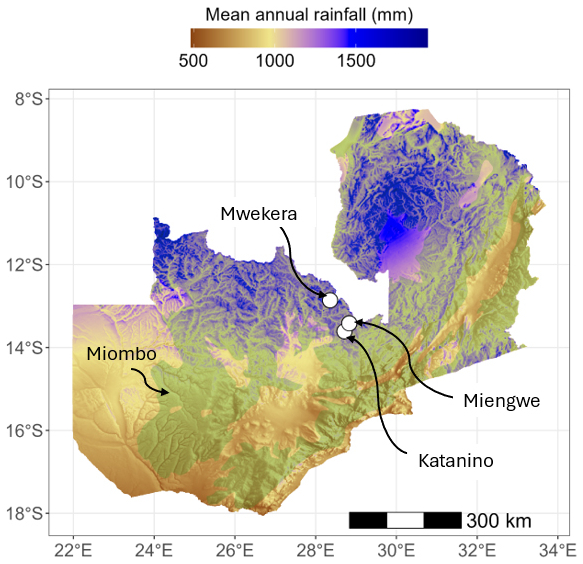
Figure 1A map of Zambia showing the extent of the miombo woodlands (green shading) and the location of the three sites (white filled circles) from where the data used in the study were collected. The distribution of mean annual precipitation across the country shows the approximate locations of wet miombo (northern part) and dry miombo (southern part) within Zambia. Precipitation data was extracted from the CHELSA-BIOCLIM+ database at a spatial resolution of 30 arcsec (approximately 1 km) (Brun et al., 2022). The shapefile for miombo woodlands extent was obtained from Poppenwimer (2022) based on the description of ecoregions by Olson et al. (2001).
2.2 Tree harvest data
We compiled three separate datasets for which a combined total of 158 individual trees belonging to 37 tree species were destructively harvested to measure AGB. Prior to conducting destructive sampling, vegetation surveys were conducted to assign trees to different D classes (minimum D=5 cm) from which a random subset was selected for harvesting. In all the three sites, D was measured to the nearest 0.1 cm using diameter tapes while H was measured using either a Suunto hypsometer (before trees were felled, at the Mwekera site) or a 50 m measuring tape (after felling trees at the other two sites). Selected trees were felled at ground level (<15 cm from the ground) and then cut into manageable segments of between 1–3 m using chain saws. The cut segments were then weighed for fresh mass in the field using the END-T3 weighing indicator with a capacity of 600 kg and a precision of 0.01 kg. Furthermore, all small branches, twigs and leaves were cut from each trunk and measured for mass (Kapinga et al., 2018; Handavu et al., 2021).
In addition to AGB, D, and H, the wood density (ρ, in g cm−3) for each tree was also measured. Specifically, ρ was determined using sample discs cut from all wood components (trunk base, trunk segments, large and small branches) to account for variation in ρ within a tree. The cut discs were taken to the laboratory where they were oven dried at 105 °C for 48 h and then mass was determined using a scale with precision of 0.001 g. The oven dried discs were then submerged in water for 48 h to reach saturation before determining the volume of green (fresh) wood. The volume for each disc was determined using the water displacement method using graduated cylinders. ρ was then calculated as the oven dry mass per unit volume of green wood (Kapinga et al., 2018; Handavu et al., 2021).
To rule out potential measurement errors that could unduly influence the calibration of AGB models, we used Cook's distance and studentized residuals to check for outliers in the bivariate relationship between AGB and D (on a log-log scale). Based on this, we identified three data points that were flagged as outliers and excluded from further analysis (Fig. S1a). This left us with 155 trees for comparing and reparametrizing AGB models. This dataset covered a large spectrum of sizes (D=5.0–68.2 cm; H=4.2–25.0 m), with AGB ranging between 5.7–3209.9 kg and wood density ranging between 0.34–0.86 g cm−3 (Table 1 and see Fig. 2 for a summary of the tree harvest data and the relationship between AGB and its predictors).
Table 1Breakdown of the tree harvest dataset for the three sites in miombo woodlands, including number of trees harvested and species, as well as the median and range (in square brackets) of stem diameter at breast height, total tree height, wood density, aboveground biomass, elevation, mean total annual precipitation and mean annual temperature.
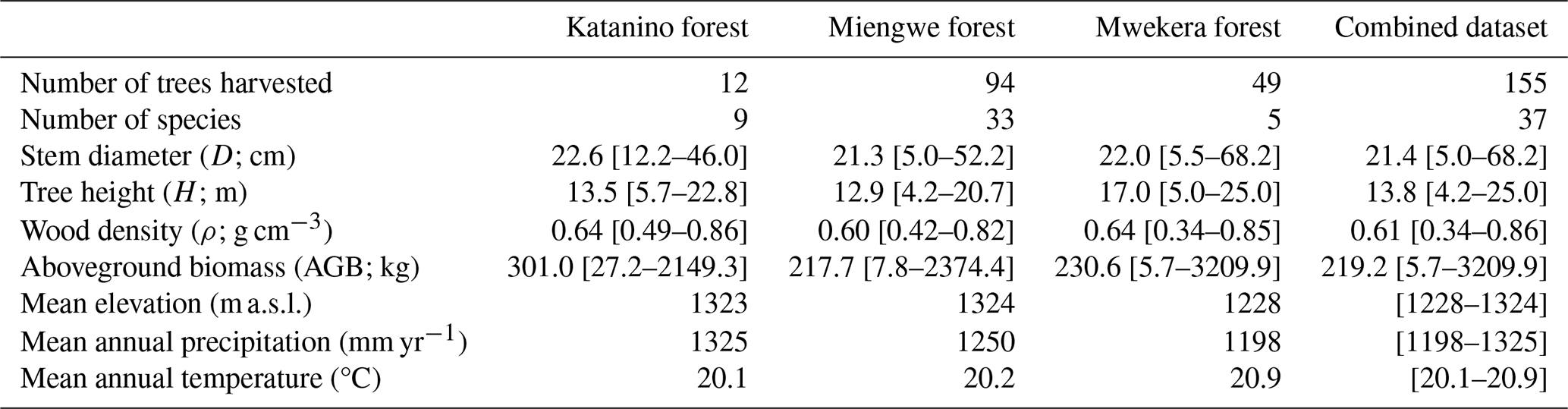
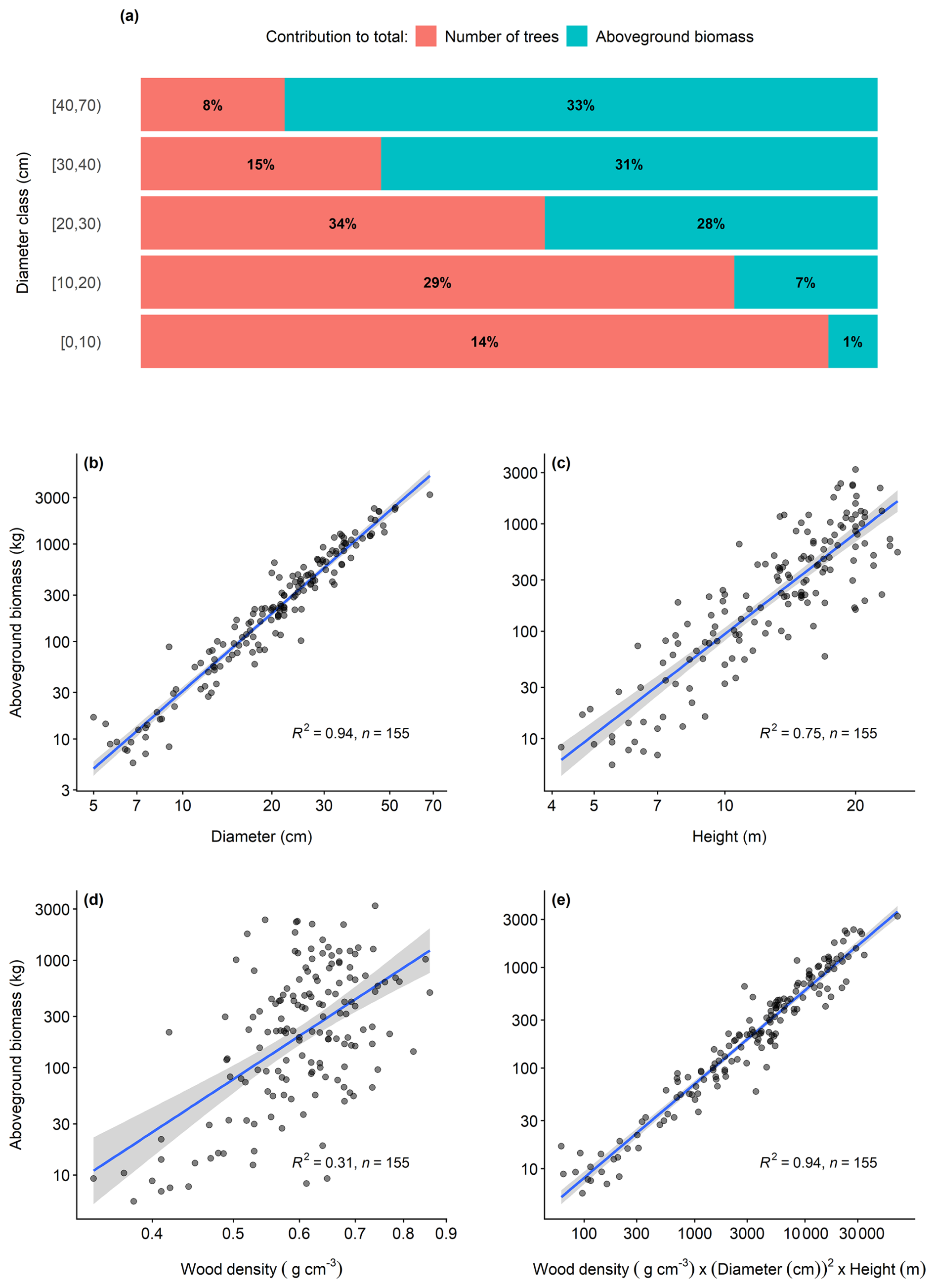
Figure 2Overview of the tree harvest dataset. The bar plot (a) shows the distribution of samples across the five tree diameter classes in terms of both number of trees and their contribution to above ground biomass (AGB), both expressed as percentages of the total – Note that the bars in (a) are not plotted to scale but merely show the percentage contribution of each D class to total number of trees and total AGB. Scatterplots show the relationship between AGB and the predictors used to model it, including (b) stem diameter (D), (c) total tree height (H), (d) wood density (ρ) and (e) the compound variable of D, H and ρ. The coefficient of determination (R2) between AGB and each of the predictor variables is shown along with the line of best fit (blue colour) and its 95 % confidence bound (grey colour). The dark grey filled circles represent the AGB values of each of the 155 destructively harvested trees, plotted on a log-log scale.
Apart from the tree harvest datasets used here, there are a number of other studies where destructive sampling for AGB has been conducted across miombo woodlands, including those in Mozambique (Ryan et al., 2011; Guedes et al., 2018), Malawi (Kachamba et al., 2016; Kuyah et al., 2016), Tanzania (Chamshama et al., 2004; Mugasha et al., 2013) and Zambia (Chidumayo, 2013b). However, all these datasets lack wood density measurements at the individual tree level and were therefore not suitable to address the core questions of our research.
2.3 Height–diameter modelling data
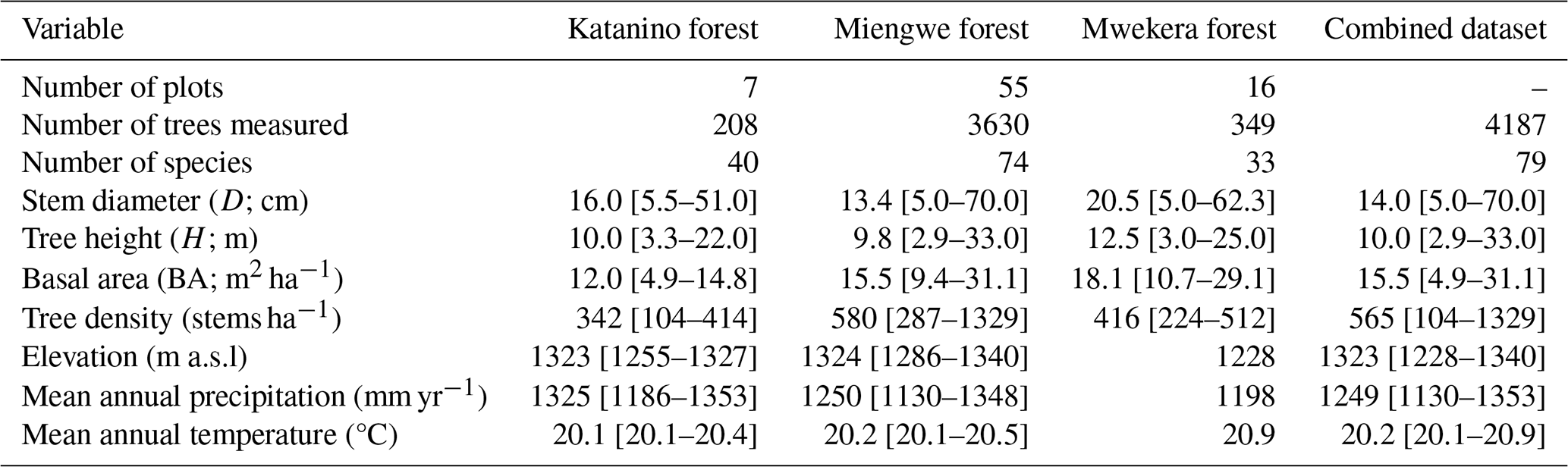
To determine how different approaches to imputing missing tree height values impact AGB estimates, we compiled an additional dataset of trees from miombo woodlands in Zambia for which both H and D were measured in the field. This included forest inventory data from the three study sites (Mwekera, Miengwe and Katanino) where trees were also destructively harvested to measure AGB (Kapinga et al., 2018; Handavu et al., 2021). In Mwekera, 16 square plots (25 × 25 m) were laid out and all trees with D≥5 cm in each quadrat were identified to species level. For each tree, D was measured to the nearest 0.1 cm using a diameter tape while H was measured to the nearest 0.1 m using a Suunto hypsometer (Kapinga et al., 2018). The same forest inventory approach was used in Miengwe and Katanino forests, although in these two sites circular plots with a 20 m radius were used instead (Handavu et al., 2021). Collectively, H and D were measured for a total of 4410 trees – excluding the 155 trees which were harvested for AGB.
We assessed the data for potential outliers by fitting a log-log linear model relating H and D. Based on the Cook's distance, a total of 223 trees were flagged as likely measurement errors and were thus excluded from further analysis (Fig. S1b). This left us with 4187 trees for H–D model fitting, belonging to 79 tree species and spanning a similar range of tree sizes to those sampled for AGB (D=5.0–70 cm; H=2.9–33.0 m) (Table 2).
Table 2Breakdown of the height-diameter modelling dataset for the three sites in wet miombo woodlands, including number of plots, trees measured, species as well as the median and range of stem diameter at breast height, total tree height, basal area, tree density, elevation, mean total annual precipitation and mean annual temperature. Climate data were extracted from the CHELSA-BIOCLIM+ database (Brun et al., 2022) at a spatial resolution of 30 arcsec (approximately 1 km).
2.4 Data harmonization and analysis
All data processing and statistical analyses were conducted in R (version 4.3.1; R Core Team, 2023) using the brms, GGally, geodata, terra, tidyverse, data.table, ggpmisc, cowplot, multcompView, BIOMASS, rWCVP and U.Taxonstand packages (Bürkner, 2017; Réjou-Méchain et al., 2017; Wickham et al., 2019; Wilke, 2020; Schloerke et al., 2021; Hijmans, 2023; Dowle and Srinivasan, 2023; Brown et al., 2023; Zhang and Qian, 2023; Aphalo, 2024). Prior to conducting statistical analyses, we used the rWCVP and U.Taxonstand packages to harmonize tree species names across all datasets using the World Checklist of Vascular Plants (Govaerts et al., 2021; Brown et al., 2023). For this step, we also cross-referenced and matched species names against the Global Wood Density Database (GWDD) which we used in subsequent analyses to assign ρ values to species using the BIOMASS package (Chave et al., 2009; Réjou-Méchain et al., 2017).
2.5 Objective 1 – Comparing the performance of existing AGB models
To determine how much tree-level AGB estimates are influenced by the choice of biomass equation, we calculated and compared AGB estimates obtained using two existing biomass models. The first AGB equation we tested is one of most commonly used pantropical models developed by (Chave et al., 2014), which expresses AGB as the following function of D, H and ρ:
where is the Baskerville correction factor defined as , with corresponding to the estimated residual standard error of the model. The correction factor is used to account for the systematic bias introduced when back-transforming from a log-log linear model to a power law function (Baskerville, 1972). This model was developed using a large collection of tree harvest data (4004 trees) from across the tropics, including the miombo. It has been used to estimate AGB in tropical forests, including the miombo woodlands of Zambia (Pelletier et al., 2018; Kanja et al., 2025).
The second literature model we considered is a local AGB model developed as part of Zambia's second integrated land-use assessment (ILUA2) which estimates AGB from D alone (ILUA, 2016; Forestry Department, 2016):
As mentioned previously, there are other AGB models developed from destructive samples across miombo woodlands, but for the purpose of this study, we chose Eq. (2) for two reasons. First, the model was developed using one of the largest collated tree harvest datasets in the region: 649 out of the 1319 harvested trees in Botswana, Tanzania and Zambia. The trees were harvested in Acacia, mopane and miombo vegetation types but with the majority of trees (∼ 85 %) coming from dry and wet miombo (Forestry Department, 2016). Further, the dataset used to develop Eq. (2) covered the majority of the tree species (73 %) that were harvested to measure AGB in our study. To our knowledge, all the other existing models developed from destructive samples in the miombo are based on much smaller sample sizes (20–170 harvested trees). Second, this model has been adopted for use at national level in Zambia to estimate AGB for all vegetation types (ILUA, 2016), including to generate Zambia's forest reference emission level (FREL) submission to the United Nations Convention for Climate Change (UNFCC) (GRZ, 2016, 2021).
We used Eqs. (1) and (2) to estimate the AGB for each of the 155 trees using measurements of D, H and ρ as inputs. We then compared the predictive ability of these two models on the basis of the root mean square error (RMSE, in kg) as a measure of precision, and percentage error (PE, in %) as a measure of bias:
where AGBi is the measured AGB for tree i and is the predicted AGBfor tree i.
We used PE to estimate the magnitude of the mean error relative to the mean observed AGB. We chose PE among other metrics of model performance because it gives more weight to large trees, which are the biggest source of uncertainty in AGB estimation and contribute disproportionately towards total forest carbon stocks (Fig. 1a; Lutz et al., 2018; Calders et al., 2022).
Finally, we also assessed the performance of the models by fitting a linear regression between observed and predicted AGB values and extracting the intercept and slope parameters with their associated 95 % confidence intervals. If the model is unbiased, we would expect the intercept to have a value close to 0 and the slope to be approximately 1 (Sileshi, 2014).
2.6 Objective 2 – Reparametrizing AGB models to compare their performance to published equations
To complement the two existing AGB models, we used the tree harvest dataset described above to reparametrize a miombo-specific version of Eqs. (1) and (2). Specifically, we fit linear regressions to log-log transformed data to model the power law relationship between AGB and either ρD2H or D alone. Models were fit in a Bayesian framework using the brms package. We used weak priors for the normalization constant (intercept) and scaling exponent (slope), which we assumed to be normally distributed. Parameter estimates were based on 6000 posterior samples drawn from four parallel chains after discarding 1000 burn-in draws per chain. Models were assessed based on the Gelman-Rubin statistic (Rhat = 1.00), the Bulk_ESS and Tail_ESS statistics (both > 1000), and posterior predictive checks (Fig. S2), all of which confirmed that the models adequately converged and fitted the observed data well (see Appendix S1 for additional details on model fitting and validation). The resulting fitted models were as follows:
Having reparametrized the two literature AGB models (Eqs. 1 and 2), we then compared the performance of the four models (Eqs. 1–2 and 5–6) based on RMSE and PE. This allowed us to determine which of the two functional forms is most suitable for predicting AGB estimation in miombo woodlands.
2.7 Objective 3 – Influence of height and wood density uncertainty on AGB estimates
To better understand how different approaches to imputing H and ρ impact tree-level AGB estimates, we devised a series of scenarios in which we imputed values of H and ρ following commonly used practices for dealing with missing data and quantified their relative contribution to AGB errors. For the purposes of this analysis, we used the pantropical model of Chave et al. (2014) to predict AGB (Eq. 1) since it performed well on our dataset (see Results for details) and is widely used by the research community. As above, model performance was assessed by comparing predicted and observed AGB values on the basis of RMSE and PE for the entire dataset, as well as PE when grouping trees into different D size classes (<10, 10–20, 20–30, 30–40, >40 cm).
As a starting point, we began by using Eq. (1) to predict the AGB of all the 155 harvested trees when using field-measured values of both H and ρ as inputs. This served as our best case scenario, in which all inputs data have been directly measured in the field. Next, we repeated this same process but replaced field-measured H values with estimates derived from two alternative H–D allometries: (1) a locally-calibrated, species-specific allometry and (2) a regional, biome-specific allometry. The local allometry was derived using H and D values from the 4187 trees described above. The relationship was modelled as a power-law function fit to log–log transformed data (), where both the scaling coefficient (α, intercept) and scaling exponent (β, slope) were allowed to vary across species (j, 79 species + 1 group for 21 trees with no species identification) in a hierarchical Bayesian framework. Model fitting and assessment followed the same procedures described above for the reparametrized AGB models. Estimated species-level parameters are reported in Table S4, while the population-level fit (or fixed effects) was:
For the regional H–D allometry, we used an existing model for tropical dry forest trees developed using the Tallo database (Jucker et al., 2022):
Finally, we used a similar approach to vary the wood density inputs in the AGB equation. Specifically, we replaced field-measured ρ values with either (1) species-specific mean values (or closest taxonomic unit) obtained from the GWDD using the BIOMASS package (Réjou-Méchain et al., 2017) or (2) with a regional mean value for African tropical forests (ρ=0.598 g cm−3; Chave et al., 2009). When matching to the GWDD, 55 % of trees were assigned species-level values, 43 % genus-level means and the remaining 2 % a mean of the dataset (0.682 g cm−3).
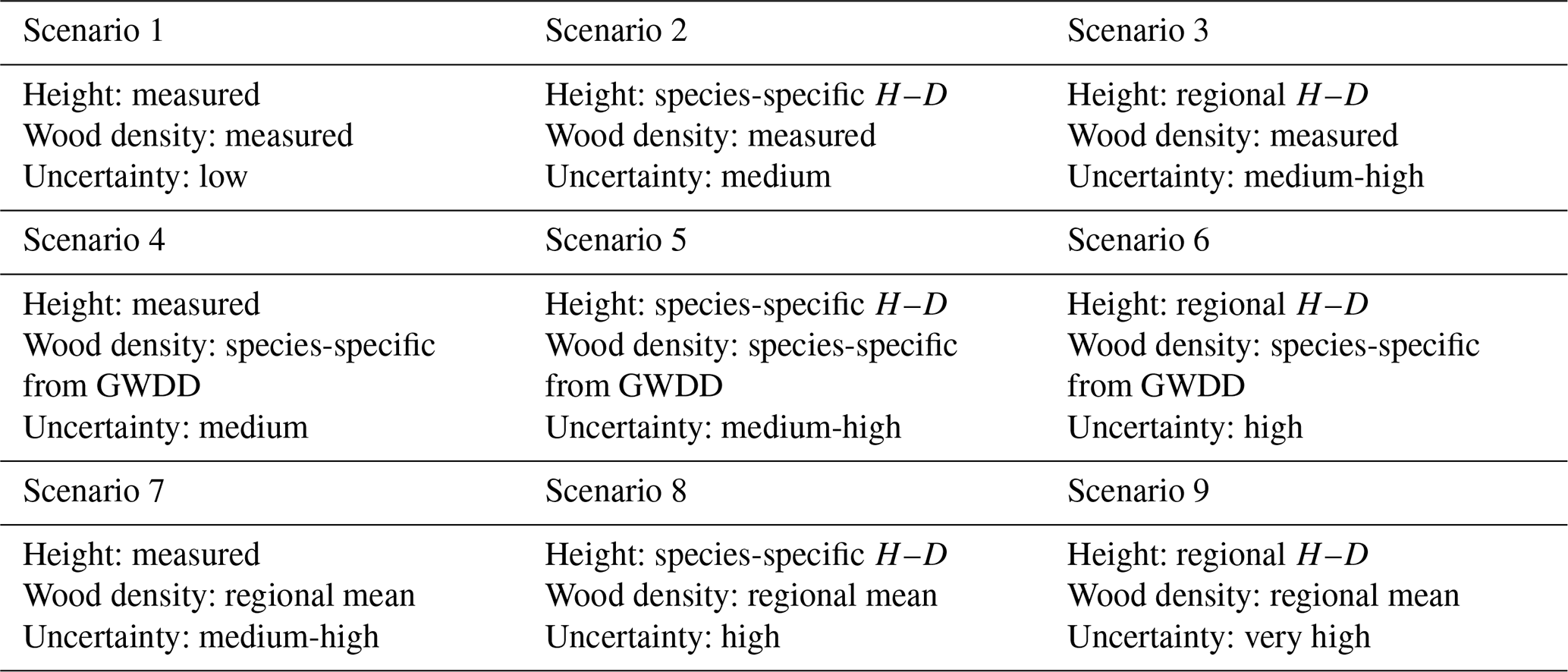
In total, this gave us nine scenarios to compare: three possible H inputs into the AGB equation (field-measured, species-specific or biome-specific), three possible wood density inputs (field-measured, species-specific or biome-specific), and their respective combinations (Table 3).
Table 3Summary of the nine scenarios used to determine the impact of different height and wood density inputs when estimating AGB. Uncertainty, in AGB estimates, increasing from left to right for height inputs and from top to bottom for wood density.
3.1 Objectives 1 and 2 – Uncertainty in AGB estimation due to choice of AGB model
Of the four AGB models we compared, three performed similarly well and produced unbiased estimates of AGB across the range of tree sizes (Figs. 3 and S4): the two models calibrated using the tree harvest data presented in this paper (Eqs. 5 and 6) and the existing pantropical model developed by Chave et al. (2014) (Eq. 1). In particular, regressions between predicted and observed AGB values for both models that used ρD2H as predictors (Eqs. 1 and 5) had intercepts with 95 % confidence intervals that overlapped with 0 and slopes equal to 1. Of the three AGB models that performed similarly well, the reparametrized model with ρD2H as a predictor of AGB model had the lowest RMSE (214.2 kg) and PE (−1.6 %; Fig. 3c). By contrast, the ILUA2 model (Eq. 2) developed as part of Zambia's forest inventory program substantially underestimated AGB and had the worst performance metrics (RMSE = 305.7 kg and PE = −36.3 %) (Fig. 3b), especially for large trees (blue line in Fig. 3f; see also Fig. S4). On average, predicted values of AGB obtained using the ILUA2 model were around 35 % lower than those measured in the field (slope coefficient = 1.5; Fig. 3b) and trees in the largest size class had a PE of −37 % (Fig. 3f).
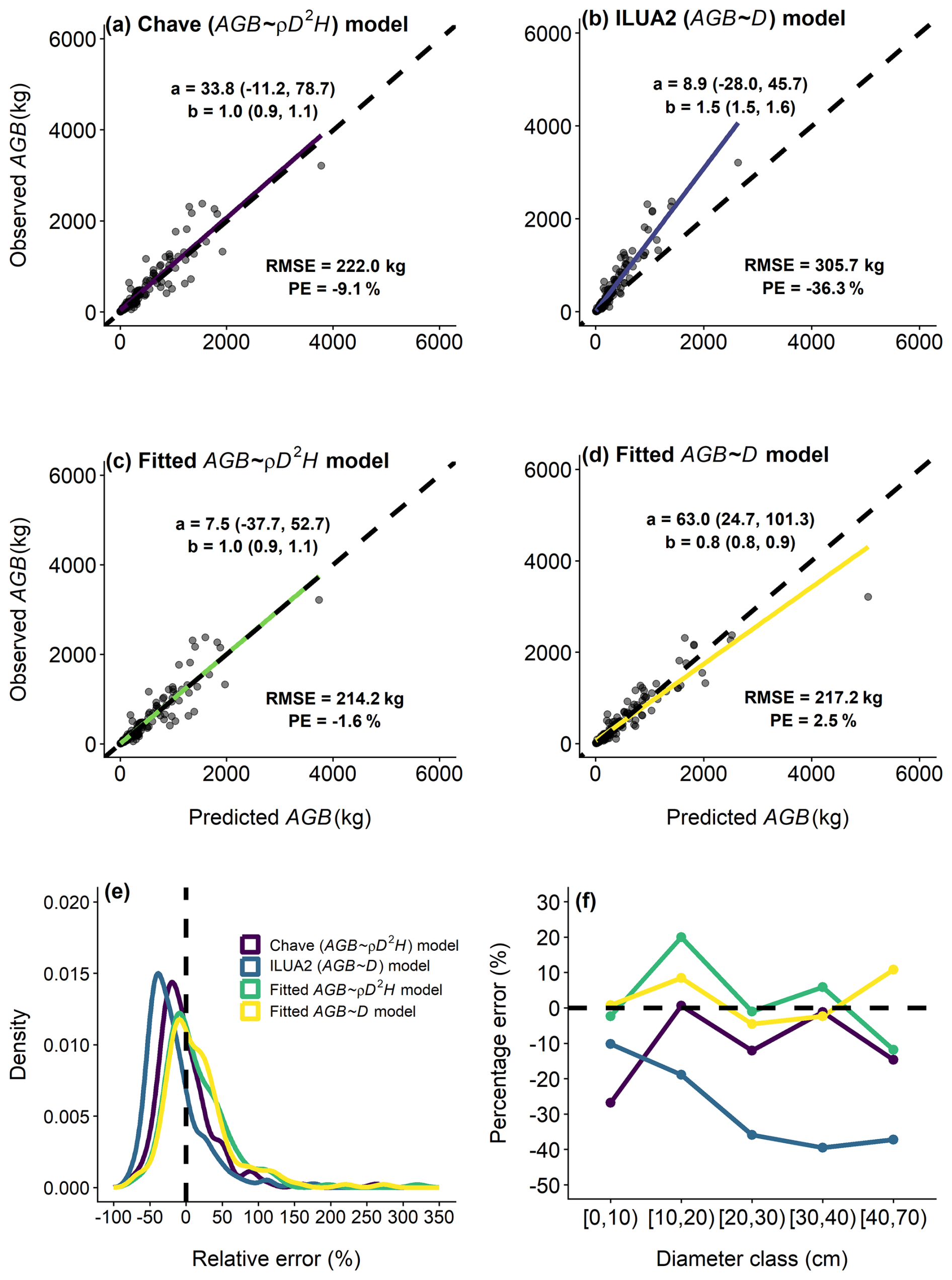
Figure 3Predictive accuracy of the four alternative aboveground biomass (AGB) models. Scatterplots (a)–(d) show the relationship between observed and predicted AGB values across the 155 trees included in the dataset. Coloured lines correspond to the fit of a linear model between observed and predicted AGB values, while dashed lines illustrate a 1:1 relationship. Fit statistics for each model are reported in the panels, including the intercept, (a), and slope, (b), of the regression line with 95 % confidence intervals in brackets. Model errors are visualised in the bottom two panels, including (e) the distribution of relative errors, as a percentage, (calculated as: ; where AGBi is the measured AGBfor tree i; and is the estimated AGB for tree i) for each of the four models and (f) the percentage error (PE, in %) of trees grouped into five stem diameter classes.
3.2 Objective 3 – Error in AGB estimation due to uncertainty in height and wood density
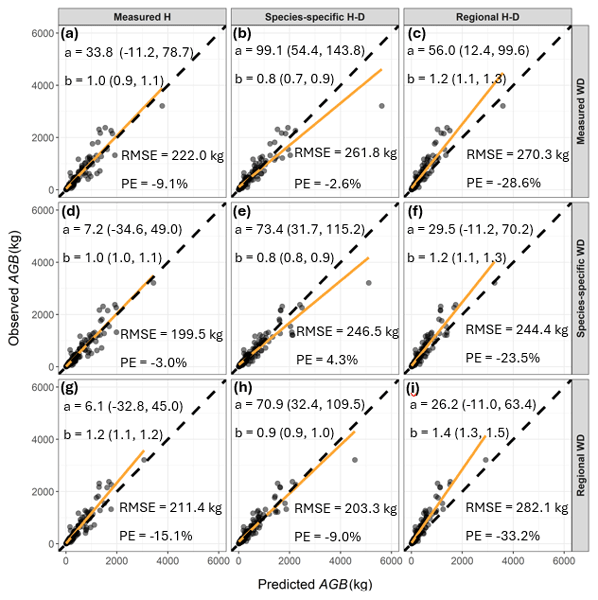
Across the nine scenarios in which we modified height (H) and wood density (ρ) inputs in the pantropical AGB model, we found that replacing field-measured values of H and ρ with species-specific estimates did not substantially worsen AGB estimates (Figs. 4–5). In particular, height estimates obtained using the locally-calibrated, species-specific H–D allometry (Eq. 7) were statistically indistinguishable (Fig. S5a) from those measured in the field and consequently had little impact on predicted AGB values (PE = −2.6 % and RMSE = 261.8 kg; Fig. 4b). Similarly, while species-specific wood density values obtained from the GWDD were significantly higher (Fig. S5b) than those measured on the destructively harvested trees, their use in the AGB model had almost no impact on AGB estimation (PE = −3.0 % and RMSE = 199.5 kg, with a slope coefficient of 1.0 when comparing predicted and observed values of AGB; Fig. 4d).
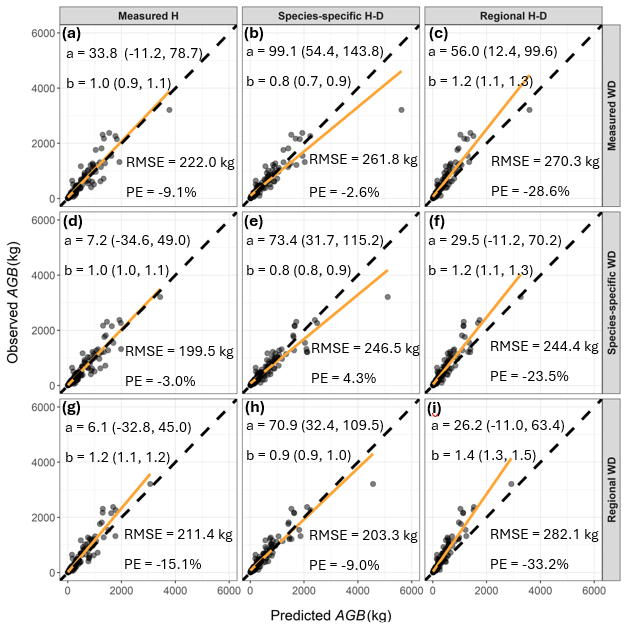
Figure 4Errors in aboveground biomass (AGB) estimation arising from uncertainty in tree height (H) and wood density (ρ). Each panel corresponds to one of the nine scenarios described in Table 3 in which we altered inputs of H and ρ in the AGB model developed by Chave et al. (2014). H inputs vary in uncertainty from left to right, from field measured, to those estimated using a species-specific H–D model (Eq. 7), and finally those derived from a regional H–D model (Eq. 8). ρ inputs vary in uncertainty from top to bottom, from field measured ρ values, to species-specific (or closest taxonomic unit) mean values derived from the Global Wood Density Database, and finally those based on a single regional mean value for African tropical forests derived from the literature. The orange coloured solid lines correspond to the fit of a linear model between observed and predicted AGB values, while dashed lines illustrate a 1:1 relationship. Fit statistics for each model are reported in the panels, including the intercept (a) and slope (b) of the regression line (with 95 % confidence intervals in brackets), as well as the RMSE and PE. Refer to Fig. S8 for a similar plot but excluding the largest observed/predicted AGB value which, by visual inspection, appears like an outlier when compared to other data values.
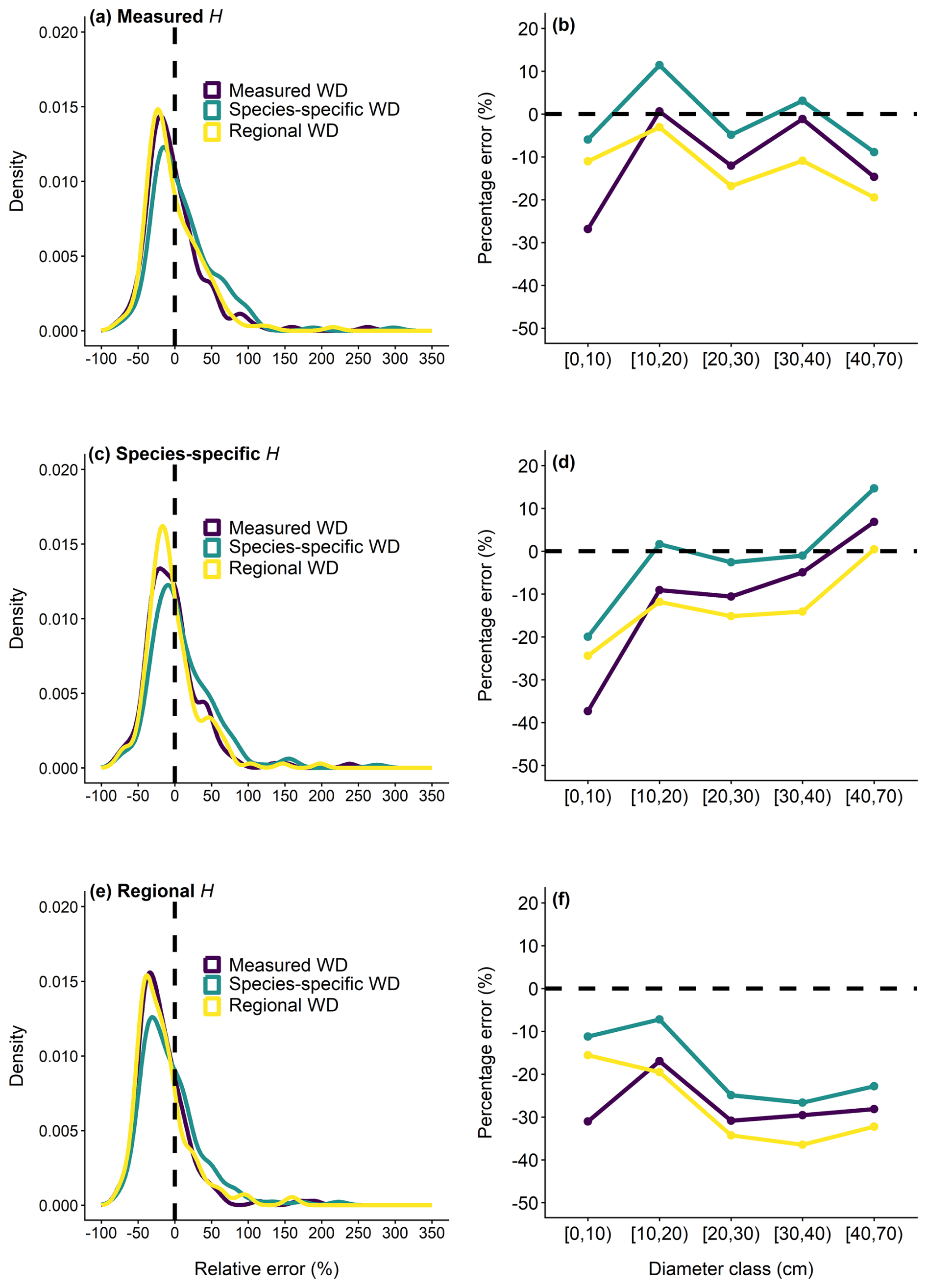
Figure 5Errors in aboveground biomass (AGB) estimation due to uncertainty in tree height (H) and wood density (ρ) across the nine scenarios depicted in Table 3. Panels on the left show the distribution of relative errors, as a percentage, (calculated as: ; where AGBi is the measured AGB for tree i; and is the estimated AGB for tree i) in AGB across the nine scenarios, while those on the right show the percentage error (PE, in %) for trees grouped into the five stem diameter classes across scenarios. In all cases, AGB was estimated using the pan-tropical model developed by Chave et al. (2014). Species-specific H (Fig. 5c) refers to using Eq. (7) to estimate tree H while regional H (Fig. 5e) corresponds to using Eq. (8) to estimate tree H.
By contrast, when H and ρ values were replaced with coarser regional-level estimates, errors in AGB increased substantially. This was most pronounced for scenarios that involved using height estimates derived from the regional H–D allometry for tropical dry forests (Eq. 8; Fig. 4c, f, i). Because this allometry severely underestimated tree heights by several meters (Figs. 6 and S6), its use led to a nearly 30 % underestimation of AGB (slope coefficient between observed and predicted values = 1.2; Fig. 4c). A similar, albeit much weaker trend was also observed for wood density. The regional mean ρ value for African tropical forests was only slightly lower than the mean ρ value of species sampled in our study (0.598 vs 0.607 g cm−3). Therefore, replacing field-measured ρ values with a regional mean resulted in a slight increase in underestimation of AGB (PE = −15.1 % and slope coefficient = 1.2; Fig. 4g). When these two sources of errors were combined, they compounded each other and led to an underestimation of AGB that was comparable in magnitude to that of using the ILUA2 model to estimate AGB instead of the pantropical equation of Chave et al. (2014) (PE = −33.2 %, RMSE = 282.1 kg and slope coefficient = 1.4; Fig. 4i).
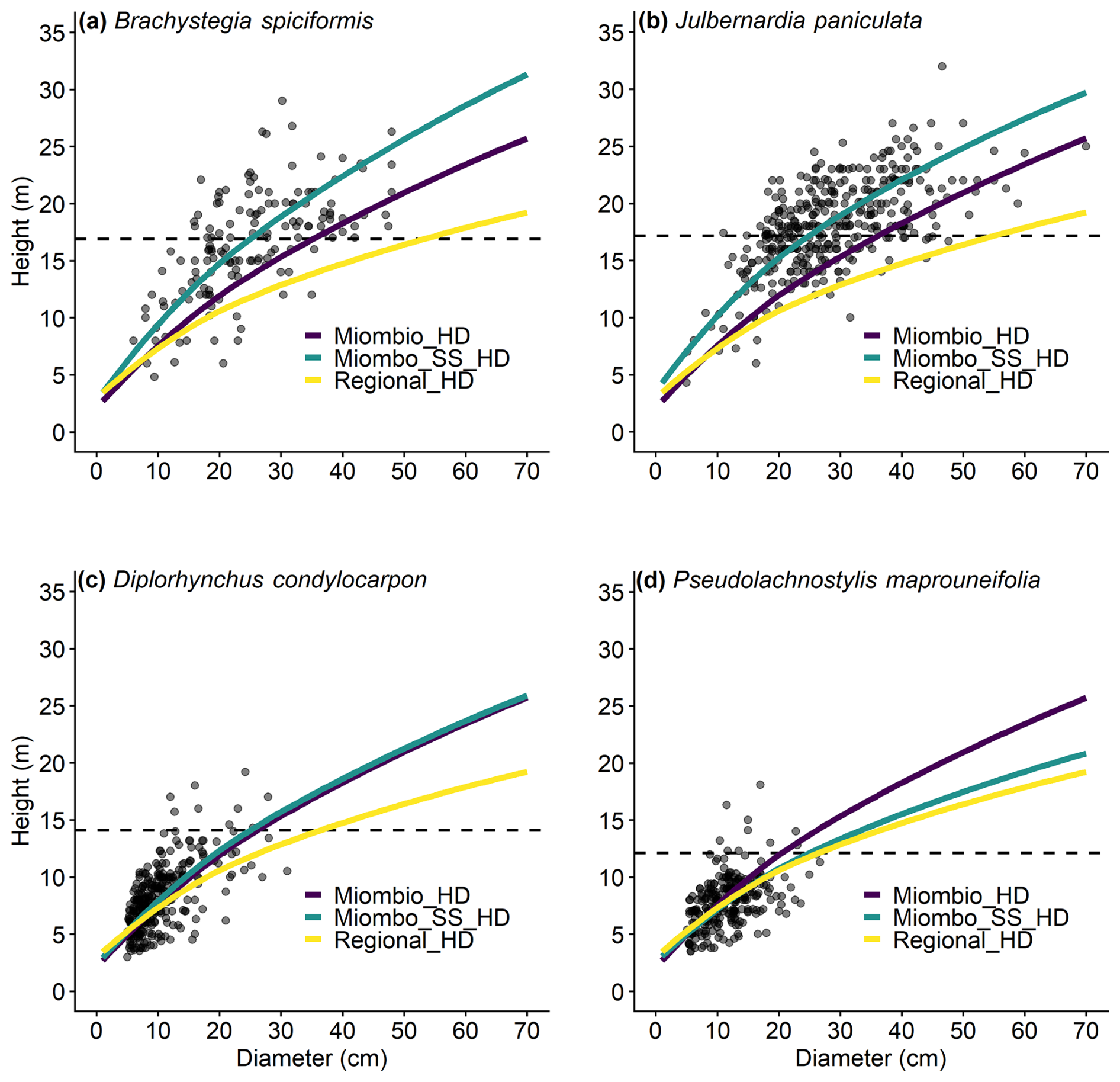
Figure 6Variability in height-diameter (H–D) relationships among common miombo tree species with differing adult statures. Fitted lines correspond to the population-level fit of Eq. (7) (purple), the species-level deviations from the population-level fit (green; see Table S4 for species-level parameter values), and the fit of the regional H–D allometry derived from the Tallo database (yellow; Eq. 8). The horizontal dashed black lines show the height prediction for a tree with diameter of 25 cm using the species-specific H–D model.
4.1 Strength in numbers: pantropical model provides robust estimates of AGB
Our study shows that when accurate measurements or estimates of tree height and wood density are available, the pantropical model developed by Chave et al. (2014) can generate unbiased estimates of AGB. In fact in our case, this pantropical model performed similarly well to AGB equations calibrated against new data (Figs. 3 and S4). A key feature of this pantropical model is that compared to other regional or species-specific models that exist in the literature, it was developed using a large number of harvested trees (>4000) that span a broad range of environments and sizes. This is clearly a major strength when it comes to making predictions against new data. A priority for future research in this field should therefore be to further consolidate and expand data on harvested trees into a common database so that robust and widely applicable AGB models can be built.
By contrast, we found that the regional ILUA2 model developed to predict AGB for Zambia's forests as part of the national forest inventory severely underestimated AGB, particularly that of large trees. There are two plausible reasons for this underestimation. First, although the ILUA2 model was developed using 649 harvested trees, these comprised mostly small to medium size trees (D≤30 cm) (Forestry Department, 2016). Small sample sizes and/or large sample sizes with mostly smaller trees to parameterize AGB models have been identified as major sources of AGB errors and uncertainty (Chave et al., 2004). Second, the ILUA2 model uses D as the sole predictor of AGB. While D is clearly the single strongest correlate of AGB (Fig. 1b), in doing so the model does not account for differences in H–D scaling among species (Fig. 6) and forest types (Timberlake et al., 2010; Munalula et al., 2020; Yambayamba et al., 2025), nor does it incorporate variability in wood density which can substantially affect AGB estimates (Mitchard et al., 2014; Jucker et al., 2018; Phillips et al., 2019). Our findings align with a recent study in the same region suggesting that commonly applied allometric models underestimate AGB of miombo woodlands (Demol et al., 2024). This has important practical implications, including reporting and verification of forest carbon stocks and dynamics under REDD+ and emerging carbon trading initiatives (Köhl et al., 2020; GRZ, 2021; Melo et al., 2023), as well as the calibration and validation of satellite-derived estimates of forest carbon stocks. For instance, Zambia has previously used the ILUA2 model to estimate FREL submissions to the UNFCCC (GRZ, 2016) but most recently identified the pantropical model for consideration (GRZ, 2021). In this respect, our study highlights the challenges associated with accurate estimation of AGB stocks and therefore underscores the need for rigorous methods for quantifying AGB stocks and dynamics in miombo woodlands and beyond.
4.2 Tree height uncertainty can severely bias AGB estimates
Our study reiterates the recommendation of previous works to account for tree height when estimating AGB (Feldpausch et al., 2012; Chave et al., 2014; Djomo et al., 2016; Handavu et al., 2021). However, our results also underscore how the inclusion of H in AGB models is not without its challenges (Chave et al., 2014; Kapinga et al., 2018). First, conventional field measurements of H are not only time consuming to take but also prone to errors, especially for large trees and in closed canopies (Larjavaara and Muller‐Landau, 2013; Wang et al., 2019). Second, the common practice of using H–D models to estimate tree height when this is not measured is equally subject to errors, especially where locally fitted H–D models are unavailable (Fayolle et al., 2016; Sullivan et al., 2018). In line with previous studies, our results demonstrate the peril of applying generic and regional H–D models to specific locations that are environmentally or taxonomically distinct (Feldpausch et al., 2012; Kearsley et al., 2013; Molto et al., 2014; Ledo et al., 2016; Fayolle et al., 2016). Using a regional H–D model developed for tropical dry forests led to a severe underestimation of AGB. Worse still, this underestimation increased with D (Fig. 5f), which is particularly undesirable since larger trees contribute disproportionately to total forest carbon stocks (Fig. 1a; Lutz et al., 2018). Our approach of fitting a locally-calibrated and species-specific H–D model substantially improved the accuracy of AGB estimates. However, access to high-quality local datasets to parameterize such allometries is often limited (Jucker et al., 2022).
The importance of tree height in AGB estimation has also been demonstrated in studies using remote sensing methods to map forest structure. For example, detailed reconstructions of tree architecture made possible by terrestrial laser scanning have shown that traditional allometric models can underestimate tree height and therefore AGB (Calders et al., 2022; Terryn et al., 2024). Given the obvious challenges associated with accurate measurement of H using conventional field methods, we argue that improvement in AGB estimation in miombo woodlands requires leveraging increasingly available and affordable remote sensing technologies such as LiDAR (Momo Takoudjou et al., 2018; Calders et al., 2022; Demol et al., 2022; Demol et al., 2024). These data provide a robust way to characterise the 3D architecture of trees that can be used to describe forest structure, functioning and dynamics with greater accuracy and across larger scales than traditional field methods (Jucker et al., 2023; Battison et al., 2024).
4.3 The importance of accounting for wood density when estimating AGB
Wood density can vary considerably among tree species, with values ranging almost three fold from as low as 0.34 to 0.86 g cm−3 across those sampled in our study. As previous work in Amazonia has shown, failure to properly account for this variability in wood density among species and forest types can severely bias large-scale estimates of forest carbon stocks inferred via remote sensing (Mitchard et al., 2014; Phillips et al., 2019). In the case of the miombo woodlands studied here, uncertainty in wood density was of secondary importance to that in tree height in driving errors in AGB estimation. But this is likely to differ among forest types and will depend on both the accuracy of available H–D allometries and the coverage of wood density databases like the GWDD.
When field-measured values of wood density were replaced with ones obtained from the GWDD, we found that overall wood density was overestimated across the population. This led to only a modest reduction in underestimation of AGB, as wood density values from the GWDD were generally correlated to those measured in the field (Fig. S7). This confirms previous work showing that while wood density can vary somewhat within species, it is generally quite a conserved trait (Chave et al., 2009; Fischer et al., 2026). Therefore, provided trees have been identified to species level and that these species have matching observations in the GWDD, our results suggest that AGB can be estimated with limited bias. This provides a strong incentive to continue to curate and expand field reference collections of wood density to support large-scale mapping of forest carbon stocks (Fischer et al., 2026). In the context of Zambia's miombo woodlands, only 31 tree species (out of approximately 238 species identified in the most recent national forest inventory (Pelletier et al., 2018; Yambayamba et al., 2025)) have wood density records (Forestry Department, 2016), making it imperative that taxonomic coverage is increased in the future.
Uncertainty in wood density can compound the errors in AGB associated with the use of a generic H–D allometry, but it is easy to imagine a situation in which these errors could instead cancel each other out, making them even harder to detect and quantify. In this regard, our framework provides a simple and robust way to decompose errors in AGB arising from uncertainty in both height and wood density. Replicating this analysis on a larger dataset, such as the pantropical AGB database developed by Chave et al. (2014), would provide valuable insights into the main sources of error in AGB estimation and how these vary across forest types and biogeographic regions.
Our study aimed at comparing the predictive performance of existing and reparametrized AGB models in miombo woodlands and quantifying the errors associated with using different approaches to imputing of height and wood density. We have shown that using AGB models that incorporate H and ρ, in addition to D, provide better and more transferable estimates than those that rely exclusively on D. The reparametrized model of Chave et al. (2014) we develop here thus provides a good starting point for improving AGB estimates in miombo woodlands. However, looking ahead, we encourage the research community to continue to move towards larger, integrated databases of tree AGB in order to develop generalised models that can underpin accurate accounting of forest carbon stocks under REDD+ and carbon trading initiatives.
Our study further revealed that uncertainty in H (more than in ρ in the miombo) can lead to substantial errors in AGB estimates. Since H is typically only measured for a small sub-sample of trees and mostly estimated using H–D models in conventional forest inventories, we therefore reiterate that great care is needed when selecting the approach to estimate H (particularly if locally available H data are not available to assess model performance). Collating and curating accurately measured H–D data and developing local species-specific H–D allometries remain a priority for the miombo and many other regions (particularly those in the tropics). The species-specific H–D models we develop here thus serve as a baseline for improving AGB estimation in miombo woodlands, although future work should also consider comparing different functional forms for modelling H–D relationships (Martínez Cano et al., 2019).
The AGB and H–D allometries developed in this study will hopefully serve as a blueprint for improving the characterization and modelling of tree allometry, ecosystem function and biomass estimation in miombo woodlands. In particular, emerging remote sensing technologies such as terrestrial and airborne LiDAR are increasingly being used to characterize tree structure and map landscape-scale carbon stocks, but require field based approaches for validation and calibration (Jucker et al., 2017; Chave et al., 2019). Similarly, improved allometries are crucial to accurate simulation of vegetation response to environmental change in dynamic global vegetation models (Fischer et al., 2019).
The aboveground biomass and height-diameter data used in this study are publicly archived on Zenodo (https://doi.org/10.5281/zenodo.22307029, Yambayamba et al., 2026), with the exception of the data from the Katanino and Miengwe sites, which are available upon request from the second author. All R codes used for the analysis are available upon request from the corresponding author.
The supplement related to this article is available online at https://doi.org/10.5194/bg-23-7955-2026-supplement.
AMY and TJ designed the study. Kondwani Kapinga (KK) did the vegetation assessment, forest inventory, destructive sampling and laboratory analysis for the Mwekera forest dataset. Ferdinand Handavu (FH) did the vegetation assessment, forest inventory, destructive sampling and laboratory analysis, with assistance from KK, for the Katanino and Miengwe forests datasets. AMY did the data collating and led the analysis with assistance from TJ. AMY wrote the first draft of the manuscript with all the authors contributing substantially to revisions.
The contact author has declared that none of the authors has any competing interests.
Publisher's note: Copernicus Publications remains neutral with regard to jurisdictional claims made in the text, published maps, institutional affiliations, or any other geographical representation in this paper. The authors bear the ultimate responsibility for providing appropriate place names. Views expressed in the text are those of the authors and do not necessarily reflect the views of the publisher.
Arthur M. Yambayamba (AMY) was supported by a PhD scholarship through the Commonwealth Scholarship Commission (CSC) programme (grant: ZMCS-2021-542). Tommaso Jucker (TJ) was supported by a NERC Independent Research Fellowship (grant: NE/S01537X/1) and through a UKRI Frontier Research grant (grant: EP/Y003810/1) that also supported AMY.
This research has been supported by the Commonwealth Scholarship Commission (grant no. ZMCS-2021-542), the UK Research and Innovation, Innovate UK (grant no. EP/Y003810/1), the Natural Environment Research Council, Centre for Ecology and Hydrology (grant no. NE/S01537X/1).
This paper was edited by Marijn Bauters and reviewed by Sybryn Maes and Miro Demol.
Aphalo, P.: ggpmisc: Miscellaneous Extensions to 'ggplot2', R package version 0.6.0, CRAN [code], https://CRAN.R-project.org/package=ggpmisc (last access: 7 July 2026), 2024.
Arias, P. A., Bellouin, N., Coppola, et al.: Climate Change 2021: The Physical Science Basis. Contribution of Working Group I to the Sixth Assessment Report of the Intergovernmental Panel on Climate Change; Technical Summary, in, edited by: Masson-Delmotte, V., Zhai, P., Pirani, A., Connors, S. L., Péan, C., Berger, S., Caud, N., Chen, Y., Goldfarb, L., Gomis, M. I., Huang, M., Leitzell, K., Lonnoy, E., Matthews, J. B. R., Maycock, T. K., Waterfield, T., Yelekçi, O., Yu, R., and Zhou, B., Cambridge University Press, Cambridge, United Kingdom and New York, NY, USA, 33–144, https://doi.org/10.1017/9781009157896.002, 2021.
Banin, L., Feldpausch, T. R., Phillips, O. L., Baker, T. R., Lloyd, J., Affum‐Baffoe, K., Arets, E., Berry, N. J., Bradford, M., and Brienen, R. J. W.: What controls tropical forest architecture? Testing environmental, structural and floristic drivers, Global Ecol. Biogeogr., 21, 1179–1190, 2012.
Baskerville, G.: Use of logarithmic regression in the estimation of plant biomass, Can. J. Forest Res., 2, 49–53, 1972.
Battison, R., Prober, S. M., Zdunic, K., Jackson, T. D., Fischer, F. J., and Jucker, T.: Tracking tree demography and forest dynamics at scale using remote sensing, New Phytol., 244, 2251–2266, 2024.
Bomfim, B., Pinagé, E. R., Emmert, F., and Kueppers, L. M.: Improving sustainable tropical forest management with voluntary carbon markets, Plant Soil, 479, https://doi.org/10.1007/s11104-021-05249-5, 2022.
Brown, M. J. M., Walker, B. E., Black, N., Govaerts, R. H. A., Ondo, I., Turner, R., and Nic Lughadha, E.: rWCVP: a companion R package for the World Checklist of Vascular Plants, New Phytol., 240, 1355–1365, https://doi.org/10.1111/nph.18919, 2023.
Brun, P., Zimmermann, N. E., Hari, C., Pellissier, L., and Karger, D. N.: Global climate-related predictors at kilometer resolution for the past and future, Earth Syst. Sci. Data, 14, 5573–5603, https://doi.org/10.5194/essd-14-5573-2022, 2022.
Bürkner, P.-C.: brms: An R Package for Bayesian Multilevel Models Using Stan, J. Stat. Softw., 80, 1–28, https://doi.org/10.18637/jss.v080.i01, 2017.
Calders, K., Verbeeck, H., Burt, A., Origo, N., Nightingale, J., Malhi, Y., Wilkes, P., Raumonen, P., Bunce, R. G. H., and Disney, M.: Laser scanning reveals potential underestimation of biomass carbon in temperate forest, Ecological Solutions and Evidence, 3, e12197, https://doi.org/10.1002/2688-8319.12197, 2022.
Chamshama, S., Mugasha, A., and Zahabu, E.: Stand biomass and volume estimation for Miombo woodlands at Kitulangalo, Morogoro, Tanzania, The Southern African Forestry Journal, 200, 59–70, 2004.
Chave, J., Condit, R., Aguilar, S., Hernandez, A., Lao, S., and Perez, R.: Error propagation and scaling for tropical forest biomass estimates, Philos. T. Roy. Soc. B, 359, 409–420, 2004.
Chave, J., Coomes, D., Jansen, S., Lewis, S. L., Swenson, N. G., and Zanne, A. E.: Towards a worldwide wood economics spectrum, Ecol. Lett., 12, 351–366, 2009.
Chave, J., Davies, S. J., Phillips, O. L., Lewis, S. L., Sist, P., Schepaschenko, D., Armston, J., Baker, T. R., Coomes, D., and Disney, M.: Ground data are essential for biomass remote sensing missions, Surv. Geophys., 40, https://doi.org/10.1007/s10712-019-09528-w, 2019.
Chave, J., Réjou‐Méchain, M., Búrquez, A., Chidumayo, E., Colgan, M. S., Delitti, W. B. C., Duque, A., Eid, T., Fearnside, P. M., and Goodman, R. C.: Improved allometric models to estimate the aboveground biomass of tropical trees, Glob. Change Biol., 20, 3177–3190, 2014.
Chidumayo, E.: Development of Brachystegia‐Julbernardia woodland after clear‐felling in central Zambia: Evidence for high resilience, Appl. Veg. Sci., 7, 237–242, 2004.
Chidumayo, E. N.: Forest degradation and recovery in a miombo woodland landscape in Zambia: 22 years of observations on permanent sample plots, Forest Ecol. Manag., 291, 154–161, 2013a.
Chidumayo, E. N.: Estimating tree biomass and changes in root biomass following clear-cutting of Brachystegia-Julbernardia (miombo) woodland in central Zambia, Environ. Conserv., 41, 54–63, 2013b.
Chojnacky, D. C., Heath, L. S., and Jenkins, J. C.: Updated generalized biomass equations for North American tree species, Forestry, 87, 129–151, 2014.
Clark, D. B. and Kellner, J. R.: Tropical forest biomass estimation and the fallacy of misplaced concreteness, J. Veg. Sci., 23, 1191–1196, 2012.
Colgan, M. S., Asner, G. P., and Swemmer, T.: Harvesting tree biomass at the stand level to assess the accuracy of field and airborne biomass estimation in savannas, Ecol. Appl., 23, 1170–1184, https://doi.org/10.1890/12-0922.1, 2013.
Demol, M., Verbeeck, H., Gielen, B., Armston, J., Burt, A., Disney, M., Duncanson, L., Hackenberg, J., Kükenbrink, D., and Lau, A.: Estimating forest above‐ground biomass with terrestrial laser scanning: Current status and future directions, Methods Ecol. Evol., 13, 1628–1639, 2022.
Demol, M., Aguilar-Amuchastegui, N., Bernotaite, G., Disney, M., Duncanson, L., Elmendorp, E., Espejo, A., Furey, A., Hancock, S., Hansen, J., Horsley, H., Langa, S., Liang, M., Locke, A., Manjate, V., Mapanga, F., Omidvar, H., Parsons, A., Peneva-Reed, E., Perry, T., Puma Vilca, B. L., Rodríguez-Veiga, P., Sutcliffe, C., Upham, R., de Walque, B., and Burt, A.: Multi-scale lidar measurements suggest miombo woodlands contain substantially more carbon than thought, Communications Earth & Environment, 5, 366, https://doi.org/10.1038/s43247-024-01448-x, 2024.
Djomo, A. N., Picard, N., Fayolle, A., Henry, M., Ngomanda, A., Ploton, P., McLellan, J., Saborowski, J., Adamou, I., and Lejeune, P.: Tree allometry for estimation of carbon stocks in African tropical forests, Forestry: An International Journal of Forest Research, 89, 446–455, 2016.
Dowle, M. and Srinivasan, A.: data.table: Extension of 'data.frame', R package version 1.14.8, CRAN [code], https://CRAN.R-project.org/package=data.table(last access: 7 July 2026), 2023.
Dubayah, R., Blair, J. B., Goetz, S., Fatoyinbo, L., Hansen, M., Healey, S., Hofton, M., Hurtt, G., Kellner, J., Luthcke, S., Armston, J., Tang, H., Duncanson, L., Hancock, S., Jantz, P., Marselis, S., Patterson, P. L., Qi, W., and Silva, C.: The Global Ecosystem Dynamics Investigation: High-resolution laser ranging of the Earth's forests and topography, Science of Remote Sensing, 1, 100002, https://doi.org/10.1016/j.srs.2020.100002, 2020.
Dziba, L., Ramoelo, A., Ryan, C., Harrison, S., Pritchard, R., Tripathi, H., Sitas, N., Selomane, O., Engelbrecht, F., Pereira, L., Katerere, Y., Chirwa, P. W., Ribeiro, N. S., and Grundy, I. M.: Scenarios for Just and Sustainable Futures in the Miombo Woodlands, in: Miombo Woodlands in a Changing Environment: Securing the Resilience and Sustainability of People and Woodlands, edited by: Ribeiro, N. S., Katerere, Y., Chirwa, P. W., and Grundy, I. M., Springer International Publishing, Cham, 191–234, https://doi.org/10.1007/978-3-030-50104-4_6, 2020.
Ellis, E. C., Gauthier, N., Klein Goldewijk, K., Bliege Bird, R., Boivin, N., Díaz, S., Fuller, D. Q., Gill, J. L., Kaplan, J. O., Kingston, N., Locke, H., McMichael, C. N. H., Ranco, D., Rick, T. C., Shaw, M. R., Stephens, L., Svenning, J.-C., and Watson, J. E. M.: People have shaped most of terrestrial nature for at least 12,000 years, P. Natl. Acad. Sci. USA, 118, e2023483118, https://doi.org/10.1073/pnas.2023483118, 2021.
Fareed, N. and Numata, I.: Evaluating the impact of field-measured tree height errors correction on aboveground biomass modeling using airborne laser scanning and GEDI datasets in Brazilian Amazonia, Trees, Forests and People, 100751, https://doi.org/10.1016/j.tfp.2024.100751, 2024.
Fayolle, A., Panzou, G. J. L., Drouet, T., Swaine, M. D., Bauwens, S., Vleminckx, J., Biwole, A., Lejeune, P., and Doucet, J.-L.: Taller trees, denser stands and greater biomass in semi-deciduous than in evergreen lowland central African forests, Forest Ecol. Manag., 374, 42–50, 2016.
Feldpausch, T. R., Banin, L., Phillips, O. L., Baker, T. R., Lewis, S. L., Quesada, C. A., Affum-Baffoe, K., Arets, E. J. M. M., Berry, N. J., Bird, M., Brondizio, E. S., de Camargo, P., Chave, J., Djagbletey, G., Domingues, T. F., Drescher, M., Fearnside, P. M., França, M. B., Fyllas, N. M., Lopez-Gonzalez, G., Hladik, A., Higuchi, N., Hunter, M. O., Iida, Y., Salim, K. A., Kassim, A. R., Keller, M., Kemp, J., King, D. A., Lovett, J. C., Marimon, B. S., Marimon-Junior, B. H., Lenza, E., Marshall, A. R., Metcalfe, D. J., Mitchard, E. T. A., Moran, E. F., Nelson, B. W., Nilus, R., Nogueira, E. M., Palace, M., Patiño, S., Peh, K. S.-H., Raventos, M. T., Reitsma, J. M., Saiz, G., Schrodt, F., Sonké, B., Taedoumg, H. E., Tan, S., White, L., Wöll, H., and Lloyd, J.: Height-diameter allometry of tropical forest trees, Biogeosciences, 8, 1081–1106, https://doi.org/10.5194/bg-8-1081-2011, 2011.
Feldpausch, T. R., Lloyd, J., Lewis, S. L., Brienen, R. J. W., Gloor, M., Monteagudo Mendoza, A., Lopez-Gonzalez, G., Banin, L., Abu Salim, K., Affum-Baffoe, K., Alexiades, M., Almeida, S., Amaral, I., Andrade, A., Aragão, L. E. O. C., Araujo Murakami, A., Arets, E. J. M. M., Arroyo, L., Aymard C., G. A., Baker, T. R., Bánki, O. S., Berry, N. J., Cardozo, N., Chave, J., Comiskey, J. A., Alvarez, E., de Oliveira, A., Di Fiore, A., Djagbletey, G., Domingues, T. F., Erwin, T. L., Fearnside, P. M., França, M. B., Freitas, M. A., Higuchi, N., E. Honorio C., Iida, Y., Jiménez, E., Kassim, A. R., Killeen, T. J., Laurance, W. F., Lovett, J. C., Malhi, Y., Marimon, B. S., Marimon-Junior, B. H., Lenza, E., Marshall, A. R., Mendoza, C., Metcalfe, D. J., Mitchard, E. T. A., Neill, D. A., Nelson, B. W., Nilus, R., Nogueira, E. M., Parada, A., Peh, K. S.-H., Pena Cruz, A., Peñuela, M. C., Pitman, N. C. A., Prieto, A., Quesada, C. A., Ramírez, F., Ramírez-Angulo, H., Reitsma, J. M., Rudas, A., Saiz, G., Salomão, R. P., Schwarz, M., Silva, N., Silva-Espejo, J. E., Silveira, M., Sonké, B., Stropp, J., Taedoumg, H. E., Tan, S., ter Steege, H., Terborgh, J., Torello-Raventos, M., van der Heijden, G. M. F., Vásquez, R., Vilanova, E., Vos, V. A., White, L., Willcock, S., Woell, H., and Phillips, O. L.: Tree height integrated into pantropical forest biomass estimates, Biogeosciences, 9, 3381–3403, https://doi.org/10.5194/bg-9-3381-2012, 2012.
Fischer, F. J., Maréchaux, I., and Chave, J.: Improving plant allometry by fusing forest models and remote sensing, New Phytol., 223, 1159–1165, 2019.
Fischer, F. J., Chave, J., Zanne, A., Jucker, T., Fajardo, A., Fayolle, A., de Lima, R. A. F., Vieilledent, G., Beeckman, H., Hubau, W., De Mil, T., Wallenus, D., Aldana, A. M., Alvarez-Dávila, E., Alves, L. F., Apgaua, D. M. G., Arcanjo, F., Bastin, J.-F., Bilous, A., Birnbaum, P., Blyshchyk, V., Borah, J., Boukili, V., Camarero, J. J., Casas, L., Cazzolla Gatti, R., Chambers, J. Q., Fabiano, E. C., Choat, B., Conti, G., Cornwell, W., Dar, J. A., Das, A. K., Dobler, M., Dougabka, D., Edwards, D. P., Evans, R., Falster, D., Fearnside, P., Flores, O., Fyllas, N., Gérard, J., Goodman, R. C., Guibal, D., Henao-Diaz, L. F., Hervé, V., Hietz, P., Homeier, J., Ibanez, T., Ilic, J., Jansen, S., Kalita, R. M., Kenzo, T., Kindermann, L., Kothandaraman, S., Kotowska, M., Kubota, Y., Langbour, P., Lawson, J., de Lima, A. L. A., Link, R. M., Linstädter, A., López, R., Macinnis-Ng, C., Magnago, L. F. S., Martin, A. R., Matheny, A. M., McCarthy, J. K., Miller, R. B., Nath, A. J., Nelson, B. W., Njana, M., Nogueira, E. M., Oliveira, A., Oliveira, R., Olson, M., Onoda, Y., Paul, K., Piotto, D., Radtke, P., Razafindratsima, O., Ramananantoandro, T., Read, J., Richardson, S., de la Riva, E. G., Rodríguez-Reyes, O., Rolim, S. G., Rolo, V., Rosell, J. A., Salguero-Gómez, R., Santini, N. S., Schuldt, B., Schwendenmann, L., Sellin, A., Staples, T., Stevenson, P. R., Sundarapandian, S., van der Sande, M. T., Thibaut, B., Tng, D. Y. P., Torezan, J. M. D., Villanueva, B., Weiskittel, A., Wells, J., Wright, S. J., and Zieminska, K.: Beyond species means – the intraspecific contribution to global wood density variation, New Phytol., 249, 2630–2651, https://doi.org/10.1111/nph.70860, 2026a.
Flores, O. and Coomes, D. A.: Estimating the wood density of species for carbon stock assessments, Methods Ecol. Evol., 2, 214–220, 2011.
Forestry Department: Ministry of Lands Natural Resources and Environmental Protection, Integrated Land Use Assessment Phase II – Technical Paper 3, Assessment of Existing Models for Biomass Volume Calculations. Food and Agricultural Organization of the United Nations, Ministry of Foreign Affairs Finland, Lusaka, Zambia, 59, https://microdata.fao.org/index.php/catalog/2975/related-materials (last access: 7 July 2026), 2016.
Goodman, R. C., Phillips, O. L., and Baker, T. R.: The importance of crown dimensions to improve tropical tree biomass estimates, Ecol. Appl., 24, 680–698, 2014.
Govaerts, R., Nic Lughadha, E., Black, N., Turner, R., and Paton, A.: The World Checklist of Vascular Plants, a continuously updated resource for exploring global plant diversity, Scientific Data, 8, 215, https://doi.org/10.1038/s41597-021-00997-6, 2021.
Grantham, H. S., Duncan, A., Evans, T. D., Jones, K. R., Beyer, H. L., Schuster, R., Walston, J., Ray, J. C., Robinson, J. G., Callow, M., Clements, T., Costa, H. M., DeGemmis, A., Elsen, P. R., Ervin, J., Franco, P., Goldman, E., Goetz, S., Hansen, A., Hofsvang, E., Jantz, P., Jupiter, S., Kang, A., Langhammer, P., Laurance, W. F., Lieberman, S., Linkie, M., Malhi, Y., Maxwell, S., Mendez, M., Mittermeier, R., Murray, N. J., Possingham, H., Radachowsky, J., Saatchi, S., Samper, C., Silverman, J., Shapiro, A., Strassburg, B., Stevens, T., Stokes, E., Taylor, R., Tear, T., Tizard, R., Venter, O., Visconti, P., Wang, S., and Watson, J. E. M.: Anthropogenic modification of forests means only 40 % of remaining forests have high ecosystem integrity, Nat. Commun., 11, 5978, https://doi.org/10.1038/s41467-020-19493-3, 2020.
GRZ: Zambia's Forest Reference Emissions Level Submission to the UNFCCC, 41, https://redd.unfccc.int/files/2016_submission_frel_zambia.pdf (last access: 20 December 2021), 2016.
GRZ: Zambia's Forest Reference Emissions Level Submission to the UNFCCC, 41, https://redd.unfccc.int/files/zambia_frel-2020-technical_assessment.pdf (last access: 20 December 2022), 2021.
Guedes, B. S., Sitoe, A. A., and Olsson, B. A.: Allometric models for managing lowland miombo woodlands of the Beira corridor in Mozambique, Global Ecology and Conservation, 13, e00374, https://doi.org/10.1016/j.gecco.2018.e00374, 2018.
Handavu, F., Syampungani, S., Sileshi, G. W., and Chirwa, P. W.: Aboveground and belowground tree biomass and carbon stocks in the miombo woodlands of the Copperbelt in Zambia, Carbon Manag., 12, https://doi.org/10.1080/17583004.2021.1926330, 2021.
Henry, M., Bombelli, A., Trotta, C., Alessandrini, A., Birigazzi, L., Sola, G., Vieilledent, G., Santenoise, P., Longuetaud, F., Valentini, R., Picard, N., and Saint-André, L.: GlobAllomeTree: international platform for tree allometric equations to support volume, biomass and carbon assessment, iForest, 6, 326–330, https://doi.org/10.3832/ifor0901-006, 2013.
Hijmans, R.: terra: Spatial Data Analysis, R package version 1.7–39, CRAN [code], https://CRAN.R-project.org/package=terra (last access: 7 July 2026), 2023.
Hua, F., Liu, M., and Wang, Z.: Integrating forest restoration into land-use planning at large spatial scales, Curr. Biol., 34, R452–R472, https://doi.org/10.1016/j.cub.2024.02.034, 2024.
ILUA: Integrated land use assessment phase II – report for Zambia, The Food and Agriculture Organization of the United Nations and the Forestry Department, Ministry of Lands and Natural Resources, Lusaka, Zambia, https://microdata.fao.org/index.php/catalog/2975/related-materials (last access: 7 July 2026), 2016.
Jucker, T., Bongalov, B., Burslem, D. F. R. P., Nilus, R., Dalponte, M., Lewis, S. L., Phillips, O. L., Qie, L., and Coomes, D. A.: Topography shapes the structure, composition and function of tropical forest landscapes, Ecol. Lett., 21, 989–1000, https://doi.org/10.1111/ele.12964, 2018.
Jucker, T., Caspersen, J., Chave, J., Antin, C., Barbier, N., Bongers, F., Dalponte, M., van Ewijk, K. Y., Forrester, D. I., and Haeni, M.: Allometric equations for integrating remote sensing imagery into forest monitoring programmes, Glob. Change Biol., 23, 177–190, 2017.
Jucker, T., Gosper, C. R., Wiehl, G., Yeoh, P. B., Raisbeck-Brown, N., Fischer, F. J., Graham, J., Langley, H., Newchurch, W., O'Donnell, A. J., Page, G. F. M., Zdunic, K., and Prober, S. M.: Using multi-platform LiDAR to guide the conservation of the world's largest temperate woodland, Remote Sens. Environ., 296, 113745, https://doi.org/10.1016/j.rse.2023.113745, 2023.
Jucker, T., Fischer, F. J., Chave, J., Coomes, D. A., Caspersen, J., Ali, A., Loubota Panzou, G. J., Feldpausch, T. R., Falster, D., Usoltsev, V. A., Adu-Bredu, S., Alves, L. F., Aminpour, M., Angoboy, I. B., Anten, N. P. R., Antin, C., Askari, Y., Muñoz, R., Ayyappan, N., Balvanera, P., Banin, L., Barbier, N., Battles, J. J., Beeckman, H., Bocko, Y. E., Bond-Lamberty, B., Bongers, F., Bowers, S., Brade, T., van Breugel, M., Chantrain, A., Chaudhary, R., Dai, J., Dalponte, M., Dimobe, K., Domec, J.-C., Doucet, J.-L., Duursma, R. A., Enríquez, M., van Ewijk, K. Y., Farfán-Rios, W., Fayolle, A., Forni, E., Forrester, D. I., Gilani, H., Godlee, J. L., Gourlet-Fleury, S., Haeni, M., Hall, J. S., He, J.-K., Hemp, A., Hernández-Stefanoni, J. L., Higgins, S. I., Holdaway, R. J., Hussain, K., Hutley, L. B., Ichie, T., Iida, Y., Jiang, H.-s., Joshi, P. R., Kaboli, H., Larsary, M. K., Kenzo, T., Kloeppel, B. D., Kohyama, T., Kunwar, S., Kuyah, S., Kvasnica, J., Lin, S., Lines, E. R., Liu, H., Lorimer, C., Loumeto, J.-J., Malhi, Y., Marshall, P. L., Mattsson, E., Matula, R., Meave, J. A., Mensah, S., Mi, X., Momo, S., Moncrieff, G. R., Mora, F., Nissanka, S. P., O'Hara, K. L., Pearce, S., Pelissier, R., Peri, P. L., Ploton, P., Poorter, L., Pour, M. J., Pourbabaei, H., Dupuy-Rada, J. M., Ribeiro, S. C., Ryan, C., Sanaei, A., Sanger, J., Schlund, M., Sellan, G., Shenkin, A., Sonké, B., Sterck, F. J., Svátek, M., Takagi, K., Trugman, A. T., Ullah, F., Vadeboncoeur, M. A., Valipour, A., Vanderwel, M. C., Vovides, A. G., Wang, W., Wang, L.-Q., Wirth, C., Woods, M., Xiang, W., Ximenes, F. d. A., Xu, Y., Yamada, T., and Zavala, M. A.: Tallo: A global tree allometry and crown architecture database, Glob. Change Biol., 28, 5254–5268, https://doi.org/10.1111/gcb.16302, 2022.
Jucker, T., Fischer, F. J., Chave, J., Coomes, D. A., Caspersen, J., Ali, A., Loubota Panzou, G. J., Feldpausch, T. R., Falster, D., Usoltsev, V. A., Jackson, T. D., Adu-Bredu, S., Alves, L. F., Aminpour, M., Angoboy Ilondea, B., Anten, N. P. R., Antin, C., Askari, Y., Ayyappan, N., Banin, L. F., Barbier, N., Battles, J. J., Beeckman, H., Bocko, Y. E., Bond-Lamberty, B., Bongers, F., Bowers, S., van Breugel, M., Chantrain, A., Chaudhary, R., Dai, J., Dalponte, M., Dimobe, K., Domec, J.-C., Doucet, J.-L., Dupuy Rada, J. M., Duursma, R. A., Enríquez, M., van Ewijk, K. Y., Farfán-Rios, W., Fayolle, A., Ferretti, M., Forni, E., Forrester, D. I., Gilani, H., Godlee, J. L., Haeni, M., Hall, J. S., He, J.-K., Hemp, A., Hernández-Stefanoni, J. L., Higgins, S. I., Holdaway, R. J., Hussain, K., Hutley, L. B., Ichie, T., Iida, Y., Jiang, H.-S., Joshi, P. R., Kaboli, H., Kazempour Larsary, M., Kenzo, T., Kloeppel, B. D., Kohyama, T. S., Kunwar, S., Kuyah, S., Kvasnica, J., Lin, S., Lines, E. R., Liu, H., Lorimer, C., Loumeto, J.-J., Malhi, Y., Marshall, P. L., Mattsson, E., Matula, R., Meave, J. A., Mensah, S., Mi, X., Momo, S. T., Moncrieff, G. R., Mora, F., Muñoz, R., Nissanka, S. P., Nur Hajar, Z. S., O'Hara, K. L., Pearce, S., Pelissier, R., Peri, P. L., Ploton, P., Poorter, L., Pour, M. J., Pourbabaei, H., Ribeiro, S. C., Ryan, C., Sanaei, A., Sanger, J., Schlund, M., Sellan, G., Shenkin, A., Sonké, B., Sterck, F. J., Svátek, M., Takagi, K., Trugman, A. T., Vadeboncoeur, M. A., Valipour, A., Vanderwel, M. C., Vovides, A. G., Waldner, P., Wang, W., Wang, L.-Q., Wirth, C., Woods, M., Xiang, W., de Aquino Ximenes, F., Xu, Y., Yamada, T., Zavala, M. A., and Zimmermann, N. E.: The global spectrum of tree crown architecture, Nat. Commun., 16, 4876, https://doi.org/10.1038/s41467-025-60262-x, 2025.
Kachamba, D., Eid, T., and Gobakken, T.: Above- and belowground biomass models for trees in the miombo woodlands of Malawi, Forests, 7, 38, https://doi.org/10.3390/f7020038, 2016.
Kanja, K., Zhang, C., and Atkinson, P. M.: Evaluating multi-seasonal SAR and optical imagery for above-ground biomass estimation using the national forest inventory of Zambia, Int. J. Appl. Earth Obs., 139, 104494, https://doi.org/10.1016/j.jag.2025.104494, 2025.
Kapinga, K., Syampungani, S., Kasubika, R., Yambayamba, A. M., and Shamaoma, H.: Species-specific allometric models for estimation of the above-ground carbon stock in miombo woodlands of Copperbelt Province of Zambia, Forest Ecol. Manag., 417, 184–196, 2018.
Kearsley, E., De Haulleville, T., Hufkens, K., Kidimbu, A., Toirambe, B., Baert, G., Huygens, D., Kebede, Y., Defourny, P., and Bogaert, J.: Conventional tree height–diameter relationships significantly overestimate aboveground carbon stocks in the Central Congo Basin, Nat. Commun., 4, 2269, https://doi.org/10.1038/ncomms3269, 2013.
Köhl, M., Neupane, P. R., and Mundhenk, P.: REDD+ measurement, reporting and verification – A cost trap? Implications for financing REDD+MRV costs by result-based payments, Ecol. Econ., 168, 106513, https://doi.org/10.1016/j.ecolecon.2019.106513, 2020.
Kuyah, S., Sileshi, G. W., and Rosenstock, T. S.: Allometric models based on bayesian frameworks give better estimates of aboveground biomass in the miombo woodlands, Forests, 7, 13, https://doi.org/10.3390/f7020013, 2016.
Larjavaara, M. and Muller‐Landau, H. C.: Measuring tree height: a quantitative comparison of two common field methods in a moist tropical forest, Methods Ecol. Evol., 4, 793–801, 2013.
Ledo, A., Cornulier, T., Illian, J. B., Iida, Y., Kassim, A. R., and Burslem, D. F.: Re‐evaluation of individual diameter: height allometric models to improve biomass estimation of tropical trees, Ecol. Appl., 26, 2376–2382, 2016.
Lewis, S. L., Wheeler, C. E., Mitchard, E. T., and Koch, A.: Restoring natural forests is the best way to remove atmospheric carbon, Nature, 568, 25–28, 2019.
Lutz, J. A., Furniss, T. J., Johnson, D. J., Davies, S. J., Allen, D., Alonso, A., Anderson‐Teixeira, K. J., Andrade, A., Baltzer, J., and Becker, K. M.: Global importance of large‐diameter trees, Global Ecol. Biogeogr., 27, 849–864, 2018.
Martínez Cano, I., Muller-Landau, H. C., Wright, S. J., Bohlman, S. A., and Pacala, S. W.: Tropical tree height and crown allometries for the Barro Colorado Nature Monument, Panama: a comparison of alternative hierarchical models incorporating interspecific variation in relation to life history traits, Biogeosciences, 16, 847–862, https://doi.org/10.5194/bg-16-847-2019, 2019.
McNicol, I. M., Ryan, C. M., and Mitchard, E. T.: Carbon losses from deforestation and widespread degradation offset by extensive growth in African woodlands, Nat. Commun., 9, 3045, https://doi.org/10.1038/s41467-018-05386-z, 2018.
McNicol, I. M., Ryan, C. M., and Williams, M.: How resilient are African woodlands to disturbance from shifting cultivation?, Ecol. Appl., 25, 2320–2336, https://doi.org/10.1890/14-2165.1, 2015.
Melo, J., Baker, T., Nemitz, D., Quegan, S., and Ziv, G.: Satellite-based global maps are rarely used in forest reference levels submitted to the UNFCCC, Environ. Res. Lett., 18, 034021, https://doi.org/10.1088/1748-9326/acba31, 2023.
Mitchard, E. T., Feldpausch, T. R., Brienen, R. J., Lopez‐Gonzalez, G., Monteagudo, A., Baker, T. R., Lewis, S. L., Lloyd, J., Quesada, C. A., and Gloor, M.: Markedly divergent estimates of A mazon forest carbon density from ground plots and satellites, Global Ecol. Biogeogr., 23, 935–946, 2014.
Molto, Q., Hérault, B., Boreux, J.-J., Daullet, M., Rousteau, A., and Rossi, V.: Predicting tree heights for biomass estimates in tropical forests – a test from French Guiana, Biogeosciences, 11, 3121–3130, https://doi.org/10.5194/bg-11-3121-2014, 2014.
Momo Takoudjou, S., Ploton, P., Sonké, B., Hackenberg, J., Griffon, S., de Coligny, F., Kamdem, N. G., Libalah, M., Mofack, G. I., Le Moguédec, G., Pélissier, R., and Barbier, N.: Using terrestrial laser scanning data to estimate large tropical trees biomass and calibrate allometric models: A comparison with traditional destructive approach, Methods Ecol. Evol., 9, 905–916, https://doi.org/10.1111/2041-210X.12933, 2018.
Mugasha, W. A., Eid, T., Bollandsås, O. M., Malimbwi, R. E., Chamshama, S. A. O., Zahabu, E., and Katani, J. Z.: Allometric models for prediction of above-and belowground biomass of trees in the miombo woodlands of Tanzania, Forest Ecol. Manag., 310, 87–101, 2013.
Munalula, F., Seifert, T., and Meincken, M.: Inter-annual growth response of three Miombo tree species to climatic effects, South. Forests, 82, 135–147, https://doi.org/10.2989/20702620.2020.1814111, 2020.
Olson, D. M., Dinerstein, E., Wikramanayake, E. D., Burgess, N. D., Powell, G. V. N., Underwood, E. C., D'amico, J. A., Itoua, I., Strand, H. E., Morrison, J. C., Loucks, C. J., Allnutt, T. F., Ricketts, T. H., Kura, Y., Lamoreux, J. F., Wettengel, W. W., Hedao, P., and Kassem, K. R.: Terrestrial Ecoregions of the World: A New Map of Life on Earth: A new global map of terrestrial ecoregions provides an innovative tool for conserving biodiversity, BioScience, 51, 933–938, https://doi.org/10.1641/0006-3568(2001)051[0933:Teotwa]2.0.Co;2, 2001.
Pelletier, J., Paquette, A., Mbindo, K., Zimba, N., Siampale, A., Chendauka, B., Siangulube, F., and Roberts, J. W.: Carbon sink despite large deforestation in African tropical dry forests (miombo woodlands), Environ. Res. Lett., 13, 094017, https://doi.org/10.1088/1748-9326/aadc9a, 2018.
Phillips, O. L., Sullivan, M. J. P., Baker, T. R., Monteagudo Mendoza, A., Vargas, P. N., and Vásquez, R.: Species Matter: Wood Density Influences Tropical Forest Biomass at Multiple Scales, Surv. Geophys., 40, 913–935, https://doi.org/10.1007/s10712-019-09540-0, 2019.
Ploton, P., Barbier, N., Takoudjou Momo, S., Réjou-Méchain, M., Boyemba Bosela, F., Chuyong, G., Dauby, G., Droissart, V., Fayolle, A., Goodman, R. C., Henry, M., Kamdem, N. G., Mukirania, J. K., Kenfack, D., Libalah, M., Ngomanda, A., Rossi, V., Sonké, B., Texier, N., Thomas, D., Zebaze, D., Couteron, P., Berger, U., and Pélissier, R.: Closing a gap in tropical forest biomass estimation: taking crown mass variation into account in pantropical allometries, Biogeosciences, 13, 1571–1585, https://doi.org/10.5194/bg-13-1571-2016, 2016.
Poppenwimer, T.: WWF Spatial Regions, FigShare [data set], https://doi.org/10.6084/m9.figshare.20972071.v1, 2022.
Quegan, S., Le Toan, T., Chave, J., Dall, J., Exbrayat, J.-F., Minh, D. H. T., Lomas, M., D'Alessandro, M. M., Paillou, P., Papathanassiou, K., Rocca, F., Saatchi, S., Scipal, K., Shugart, H., Smallman, T. L., Soja, M. J., Tebaldini, S., Ulander, L., Villard, L., and Williams, M.: The European Space Agency BIOMASS mission: Measuring forest above-ground biomass from space, Remote Sens. Environ., 227, 44–60, https://doi.org/10.1016/j.rse.2019.03.032, 2019.
R Core Team: R: A Language and Environment for Statistical Computing, R Foundation for Statistical Computing, https://www.R-project.org/ (last access: 13 July 2026), 2023.
Rathgeber, C. B., Cuny, H. E., and Fonti, P.: Biological basis of tree-ring formation: a crash course, Front. Plant Sci., 7, 734, https://doi.org/10.3389/fpls.2016.00734, 2016.
Réjou-Méchain, M., Tanguy, A., Piponiot, C., Chave, J., and Hérault, B.: biomass: an r package for estimating above-ground biomass and its uncertainty in tropical forests, Methods Ecol. Evol., 8, 1163–1167, https://doi.org/10.1111/2041-210X.12753, 2017.
Ribeiro, N. S., Silva de Miranda, P. L., and Timberlake, J.: Biogeography and ecology of miombo woodlands, in: Miombo woodlands in a changing environment: securing the resilience and sustainability of people and woodlands, Springer, 9–53, ISBN 978-3-030-50104-4 (eBook), https://doi.org/10.1007/978-3-030-50104-4_2, 2020.
Ryan, C. M., Williams, M., and Grace, J.: Above‐and belowground carbon stocks in a miombo woodland landscape of Mozambique, Biotropica, 43, 423–432, 2011.
Schloerke, B., Cook, D., Larmarange, J., Briatte, F., Marbach, M., Thoen, E., Elberg, A., and Crowley, J.: GGally: Extension to 'ggplot2', R package version 2.1.2, CRAN [code], https://CRAN.R-project.org/package=GGally (last access: 7 July 2026), 2021.
Sileshi, G. W.: A critical review of forest biomass estimation models, common mistakes and corrective measures, Forest Ecol. Manag., 329, 237–254, 2014.
Sullivan, M. J., Lewis, S. L., Hubau, W., Qie, L., Baker, T. R., Banin, L. F., Chave, J., Cuni‐Sanchez, A., Feldpausch, T. R., and Lopez‐Gonzalez, G.: Field methods for sampling tree height for tropical forest biomass estimation, Methods Ecol. Evol., 9, 1179–1189, 2018.
Syampungani, S., Tigabu, M., Matakala, N., Handavu, F., and Oden, P. C.: Coppicing ability of dry miombo woodland species harvested for traditional charcoal production in Zambia: a win–win strategy for sustaining rural livelihoods and recovering a woodland ecosystem, J. Forestry Res., 28, 549–556, https://doi.org/10.1007/s11676-016-0307-1, 2017.
Terryn, L., Calders, K., Meunier, F., Bauters, M., Boeckx, P., Brede, B., Burt, A., Chave, J., da Costa, A. C. L., and D'hont, B., Disney, M., Jucker, T., Lau, A., Laurance, S. G. W., Maeda, E. E., Meir, P., Krishna Moorthy, S. M., Nunes, M. H., Shenkin, A., Sibret, T., Verhelst, T. E., Wilkes, P., and Verbeeck, H.: New tree height allometries derived from terrestrial laser scanning reveal substantial discrepancies with forest inventory methods in tropical rainforests, Glob. Change Biol., 30, e17473, https://doi.org/10.1111/gcb.17473, 2024.
Timberlake, J., Chidumayo, E., and Sawadogo, L.: Distribution and characteristics of African dry forests and woodlands, in: The dry forests and woodlands of Africa: managing for products and services, edited by: Chidumayo, E. N. and Gumbo, D. J., Earthscan, London – UK, 11–41, ISBN 978-1-84971-131-9, 2010.
Wang, Y., Lehtomäki, M., Liang, X., Pyörälä, J., Kukko, A., Jaakkola, A., Liu, J., Feng, Z., Chen, R., and Hyyppä, J.: Is field-measured tree height as reliable as believed–A comparison study of tree height estimates from field measurement, airborne laser scanning and terrestrial laser scanning in a boreal forest, ISPRS J. Photogramm., 147, 132–145, 2019.
White, F.: The vegetation of Africa, Unesco, Paris, https://unesdoc.unesco.org/ark:/48223/pf0000058054 (last access: 7 July 2026), 1983.
Wickham, H., Averick, M., Bryan, J., Chang, W., McGowan, L. D. A., François, R., Grolemund, G., Hayes, A., Henry, L., and Hester, J.: Welcome to the Tidyverse, Journal of Open Source Software, 4, 1686, https://doi.org/10.21105/joss.01686, 2019.
Wilke, C.: cowplot: Streamlined Plot Theme and Plot Annotations for 'ggplot2', R package version 1.1.1, CRAN [code], https://CRAN.R-project.org/package=cowplot (last access: 7 July 2026), 2020.
Williams, M., Ryan, C., Rees, R., Sambane, E., Fernando, J., and Grace, J.: Carbon sequestration and biodiversity of re-growing miombo woodlands in Mozambique, Forest Ecol. Manag., 254, 145–155, 2008.
Yambayamba, A. M., Fischer, F. J., and Jucker, T.: Competition, Precipitation, and Temperature Shape Deviations From Scaling Laws in the Crown Allometries of Miombo Woodlands, Biotropica, 57, e70093, https://doi.org/10.1111/btp.70093, 2025.
Yambayamba, A. M., Handavu, F., Kapinga, K., and Jucker, T.: Tree height uncertainty biases aboveground biomass estimation more than wood density in miombo woodlands, Zenodo [data set], https://doi.org/10.5281/zenodo.22307029, 2026.
Zhang, J. and Qian, H.: U.Taxonstand: An R package for standardizing scientific names of plants and animals, Plant Diversity, 45, 1–5, https://doi.org/10.1016/j.pld.2022.09.001, 2023.
Zianis, D., Muukkonen, P., Mäkipää, R., and Mencuccini, M.: Biomass and stem volume equations for tree species in Europe, Silva Fennica Monographs, 4, 1–63, https://doi.org/10.14214/sf.sfm4, 2005.