Articles | Volume 23, issue 21
https://doi.org/10.5194/bg-23-8079-2026
© Author(s) 2026. This work is distributed under
the Creative Commons Attribution 4.0 License.
https://doi.org/10.5194/bg-23-8079-2026
© Author(s) 2026. This work is distributed under
the Creative Commons Attribution 4.0 License.
Technical note: a Recognition-assisted Camera for Automated Microscopy (RaCAM)

Martin Tetard
CORRESPONDING AUTHOR
ESNZ, Lower Hutt, New Zealand
Ross Marchant
InFarm, Goondiwindi, Australia
Related authors
Luc Beaufort, Denis Dollfus, Yves Gally, Nicolas Barbarin, Martin Tetard, Baptiste Sucheras-Marx, Alexander Nistor, and Mathieu Biaut
EGUsphere, https://doi.org/10.5194/egusphere-2026-3901, https://doi.org/10.5194/egusphere-2026-3901, 2026
Short summary
Short summary
Microscopic marine algae produce much of the calcium carbonate that sinks to the deep ocean and plays an important role in the carbon cycle. We describe how thirty years of advances in automated microscopy and artificial intelligence have improved the analysis of these tiny fossils. Using the same samples studied decades ago, the new approach provides more detailed information, helping scientists better understand changes in marine ecosystems and the carbon cycle through time.
Vitalina Lokteva, Vahram Serobyan, Martin Tetard, Pierre Breuer, and Taniel Danelian
J. Micropalaeontol., 45, 405–413, https://doi.org/10.5194/jm-45-405-2026, https://doi.org/10.5194/jm-45-405-2026, 2026
Short summary
Short summary
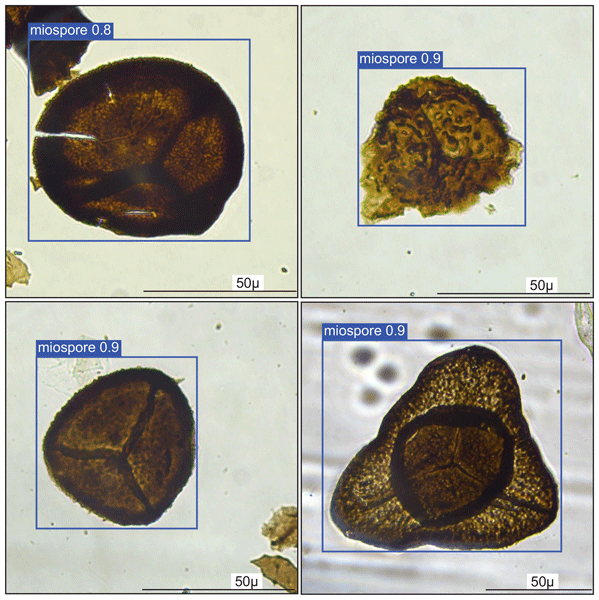
This study develops a semi-automated workflow using artificial intelligence to detect and classify Devonian miospores in microscopic slides. Focusing on three biostratigraphically important species used for dating rocks and correlating distant localities, the method achieved high accuracy, reduced observer bias, and accelerated analysis. This workflow offers a scalable tool for research and potential industrial applications in fossil-based stratigraphy.
Babette A.A. Hoogakker, Catherine Davis, Yi Wang, Stephanie Kusch, Katrina Nilsson-Kerr, Dalton S. Hardisty, Allison Jacobel, Dharma Reyes Macaya, Nicolaas Glock, Sha Ni, Julio Sepúlveda, Abby Ren, Alexandra Auderset, Anya V. Hess, Katrin J. Meissner, Jorge Cardich, Robert Anderson, Christine Barras, Chandranath Basak, Harold J. Bradbury, Inda Brinkmann, Alexis Castillo, Madelyn Cook, Kassandra Costa, Constance Choquel, Paula Diz, Jonas Donnenfield, Felix J. Elling, Zeynep Erdem, Helena L. Filipsson, Sebastián Garrido, Julia Gottschalk, Anjaly Govindankutty Menon, Jeroen Groeneveld, Christian Hallmann, Ingrid Hendy, Rick Hennekam, Wanyi Lu, Jean Lynch-Stieglitz, Lélia Matos, Alfredo Martínez-García, Giulia Molina, Práxedes Muñoz, Simone Moretti, Jennifer Morford, Sophie Nuber, Svetlana Radionovskaya, Morgan Reed Raven, Christopher J. Somes, Anja S. Studer, Kazuyo Tachikawa, Raúl Tapia, Martin Tetard, Tyler Vollmer, Xingchen Wang, Shuzhuang Wu, Yan Zhang, Xin-Yuan Zheng, and Yuxin Zhou
Biogeosciences, 22, 863–957, https://doi.org/10.5194/bg-22-863-2025, https://doi.org/10.5194/bg-22-863-2025, 2025
Short summary
Short summary
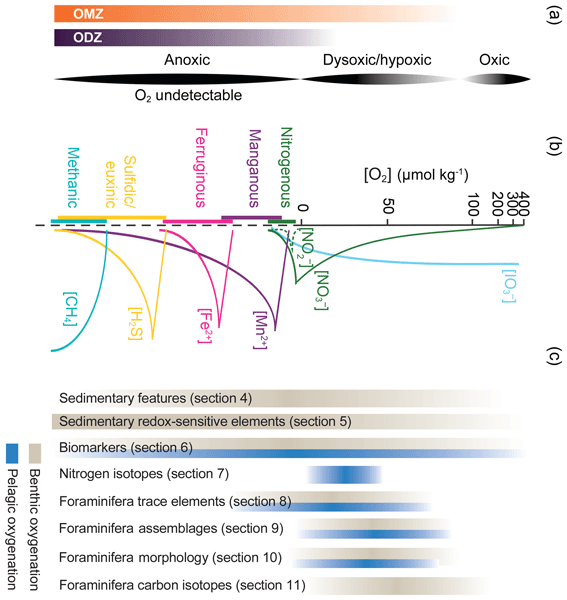
Paleo-oxygen proxies can extend current records, constrain pre-anthropogenic baselines, provide datasets necessary to test climate models under different boundary conditions, and ultimately understand how ocean oxygenation responds on longer timescales. Here we summarize current proxies used for the reconstruction of Cenozoic seawater oxygen levels. This includes an overview of the proxy's history, how it works, resources required, limitations, and future recommendations.
Tobias Walla, Christine Barras, Emmanuelle Geslin, Camille Godbillot, Louis Lanoy, Ross Marchant, Delphine Dissard, and Thibault de Garidel-Thoron
J. Micropalaeontol., 45, 623–652, https://doi.org/10.5194/jm-45-623-2026, https://doi.org/10.5194/jm-45-623-2026, 2026
Short summary
Short summary
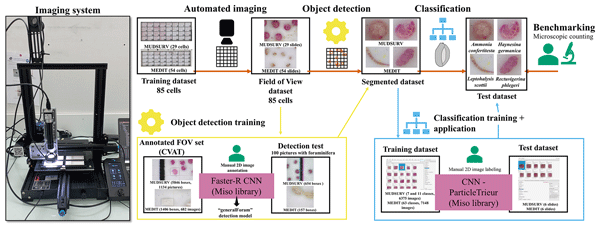
We developed an automated method that uses artificial intelligence to identify marine microscopic organisms called foraminifera, which serve as bioindicators of ocean health. By combining a low-cost imaging system with computer vision, our approach can quickly and accurately recognize both living and dead specimens. This makes environmental monitoring faster, more consistent, and more accessible for studying how coastal ecosystems respond to pollution and climate change.
Luc Beaufort, Denis Dollfus, Yves Gally, Nicolas Barbarin, Martin Tetard, Baptiste Sucheras-Marx, Alexander Nistor, and Mathieu Biaut
EGUsphere, https://doi.org/10.5194/egusphere-2026-3901, https://doi.org/10.5194/egusphere-2026-3901, 2026
Short summary
Short summary
Microscopic marine algae produce much of the calcium carbonate that sinks to the deep ocean and plays an important role in the carbon cycle. We describe how thirty years of advances in automated microscopy and artificial intelligence have improved the analysis of these tiny fossils. Using the same samples studied decades ago, the new approach provides more detailed information, helping scientists better understand changes in marine ecosystems and the carbon cycle through time.
Vitalina Lokteva, Vahram Serobyan, Martin Tetard, Pierre Breuer, and Taniel Danelian
J. Micropalaeontol., 45, 405–413, https://doi.org/10.5194/jm-45-405-2026, https://doi.org/10.5194/jm-45-405-2026, 2026
Short summary
Short summary
This study develops a semi-automated workflow using artificial intelligence to detect and classify Devonian miospores in microscopic slides. Focusing on three biostratigraphically important species used for dating rocks and correlating distant localities, the method achieved high accuracy, reduced observer bias, and accelerated analysis. This workflow offers a scalable tool for research and potential industrial applications in fossil-based stratigraphy.
Babette A.A. Hoogakker, Catherine Davis, Yi Wang, Stephanie Kusch, Katrina Nilsson-Kerr, Dalton S. Hardisty, Allison Jacobel, Dharma Reyes Macaya, Nicolaas Glock, Sha Ni, Julio Sepúlveda, Abby Ren, Alexandra Auderset, Anya V. Hess, Katrin J. Meissner, Jorge Cardich, Robert Anderson, Christine Barras, Chandranath Basak, Harold J. Bradbury, Inda Brinkmann, Alexis Castillo, Madelyn Cook, Kassandra Costa, Constance Choquel, Paula Diz, Jonas Donnenfield, Felix J. Elling, Zeynep Erdem, Helena L. Filipsson, Sebastián Garrido, Julia Gottschalk, Anjaly Govindankutty Menon, Jeroen Groeneveld, Christian Hallmann, Ingrid Hendy, Rick Hennekam, Wanyi Lu, Jean Lynch-Stieglitz, Lélia Matos, Alfredo Martínez-García, Giulia Molina, Práxedes Muñoz, Simone Moretti, Jennifer Morford, Sophie Nuber, Svetlana Radionovskaya, Morgan Reed Raven, Christopher J. Somes, Anja S. Studer, Kazuyo Tachikawa, Raúl Tapia, Martin Tetard, Tyler Vollmer, Xingchen Wang, Shuzhuang Wu, Yan Zhang, Xin-Yuan Zheng, and Yuxin Zhou
Biogeosciences, 22, 863–957, https://doi.org/10.5194/bg-22-863-2025, https://doi.org/10.5194/bg-22-863-2025, 2025
Short summary
Short summary
Paleo-oxygen proxies can extend current records, constrain pre-anthropogenic baselines, provide datasets necessary to test climate models under different boundary conditions, and ultimately understand how ocean oxygenation responds on longer timescales. Here we summarize current proxies used for the reconstruction of Cenozoic seawater oxygen levels. This includes an overview of the proxy's history, how it works, resources required, limitations, and future recommendations.
Cited articles
Abdelmguid, D., Kloster, M., and Beszteri, B.: Retrieving fine-grained diatom classifications from deep learning models trained on coarse-grained data by over-clustering, Biodivers. Conserv., 35, https://doi.org/10.1007/s10531-025-03218-3, 2026. a
Beaufort, L. and Dollfus, D.: Automatic recognition of coccoliths by dynamical neural networks, Mar. Micropaleontol., 51, 57–73, https://doi.org/10.1016/j.marmicro.2003.09.003, 2004. a
Beaufort, L., Dollfus, D., Gally, Y., Barbarin, N., Tetard, M., Sucheras-Marx, B., Nistor, A., and Biaut, M.: Technical note: From coccolith counts to quantitative carbonate fluxes: three decades of AI-assisted automated coccolith analysis, EGUsphere [preprint], https://doi.org/10.5194/egusphere-2026-3901, 2026. a, b, c
Bourel, B., Marchant, R., de Garidel-Thoron, T., Tetard, M., Barboni, D., Gally, Y., and Beaufort, L.: Automated recognition by multiple convolutional neural networks of modern, fossil, intact and damaged pollen grains, Comput. Geosci., 140, 104498, https://doi.org/10.1016/j.cageo.2020.104498, 2020. a, b
Carlsson, V., Danelian, T., Boulet, P., Devienne, P., Laforge, A., and Renaudie, J.: Artificial intelligence applied to the classification of eight middle Eocene species of the genus Podocyrtis (polycystine radiolaria), J. Micropalaeontol., 41, 165–182, https://doi.org/10.5194/jm-41-165-2022, 2022. a
Carlsson, V., Danelian, T., Tetard, M., Meunier, M., Boulet, P., Devienne, P., and Ventalon, S.: Convolutional neural network application on a new middle Eocene radiolarian dataset, Mar. Micropaleontol., 183, 102268, https://doi.org/10.1016/j.marmicro.2023.102268, 2023. a, b
Daood, A., Ribeiro, E., and Bush, M.: Sequential recognition of pollen grain Z-stacks by combining CNN and RNN, in: The Thirty-First International Florida Artificial Intelligence Research Society Conference, Melbourne, Florida, USA, 8–13, https://aaai.org/papers/8-flairs-2018-17642/ (last access: 2 November 2026), 2018. a
Dollfus, D. and Beaufort, L.: Fat neural network for recognition of position-normalised objects, Neural Networks, 12, 553–560, https://doi.org/10.1016/S0893-6080(99)00011-8, 1999. a
Gimenez, B., Joannin, S., Pasquet, J., Beaufort, L., Gally, Y., de Garidel-Thoron, T., Combourieu-Nebout, N., Bouby, L., Canal, S., Ivorra, S., Limier, B., Terral, J.-F., Devaux, C., and Peyron, O.: A user-friendly method to get automated pollen analysis from environmental samples, New Phytol., 243, 797–810, https://doi.org/10.1111/nph.19857, 2024. a
Govindankutty Menon, A., Davis, C. V., Nurnberg, D. Nomaki, H., Salonen, I., Schmiedl, G., and Glock, N.: A deep-learning automated image recognition method for measuring pore patterns in closely related bolivinids and calibration for quantitative nitrate paleo-reconstructions, Sci. Rep., 13, 19628, https://doi.org/10.1038/s41598-023-46605-y, 2023. a
Grant, S. D., Richford, K., Burdett, H. L., McKee, D., and Patton, B. R.: Low-cost, open-access quantitative phase imaging of algal cells using the transport of intensity equation, R. Soc. Open Sci., 7, 191921, https://doi.org/10.1098/rsos.191921, 2020. a
Hoffecker, E.: Local Innovation: what it is and why it matters for developing economies, D-Lab Working Papers: NDIR Working Paper 01, Cambridge: MIT D-Lab, https://d-lab.mit.edu/sites/default/files/inline-files/Local Innovation Working Paper 01.pdf (last access: 2 November 2026), 2018. a
Hsiang, A. Y., Brombacher, A., Rillo, M. C., Mleneck-Vautravers, M. J., Conn, S., Lordsmith, S., Jentzen, A., Henehan, M. J., Metcalfe, B., Fenton, I. S., Wade, B. S., Fox, L., Meilland, J., Davis, C. V., Baranowski, U., Groeneveld, J., Edgar, K. M., Movellan, A., Aze, T., Dowsett, H. J., Giles Miller, C., Rios, N., and Hull, P. M.: Endless Forams: > 34,000 modern planktonic foraminiferal images for taxonomic training and automated species recognition using convolutional neural networks, Paleoceanogr. Paleoclimatol., 34, 1157–1177, https://doi.org/10.1029/2019PA003612, 2019. a
Itaki, T., Taira, Y., Kuwamori, N., Saito, H., Ikehara, M., and Hoshino, T.: Innovative microfossil (radiolarian) analysis using a system for automated image collection and AI-based classification of species, Sci. Rep., 10, 21136, https://doi.org/10.1038/s41598-020-77812-6, 2020. a
Johnston, S. J. and Cox, S. J.: The Raspberry Pi: A Technology Disrupter, and the Enabler of Dreams, Electronics, 6, 51, https://doi.org/10.3390/electronics6030051, 2017. a
Lokteva, V., Serobyan, V., Tetard, M., Breuer, P., and Danelian, T.: Artificial intelligence applied to the automated detection and identification of Devonian miospores, J. Micropalaeontol., 45, 405–413, https://doi.org/10.5194/jm-45-405-2026, 2026. a
Lynn, H.: A low-cost, open-source, computer-assisted microscope, https://www.raspberrypi.com/news/a-low-cost-open-source-computer-assisted-microscope/ (last access: 20 December 2025), 2019. a
Mimura, K., Nakamura, K., Yasukawa, K., Sibert, E. C., Ohta, J., Kitazawa, T., and Kato, Y.: Applicability of object detection to microfossil research: Implications from deep learning models to detect microfossil fish teeth and denticles using YOLO-v7, Earth Space Sci., 11, e2023EA003122, https://doi.org/10.1029/2023EA003122, 2024. a
Mimura, K., Itaki, T., Kataoka, H., and Miyakawa, A.: Classifying microfossil radiolarians on fractal pre-trained vision transformers, Sci. Rep., 15, 7189, https://doi.org/10.1038/s41598-025-90988-z, 2025. a
Martinsen, I., Ricaud, B., Wade, D., Kolbjørnsen, O., and Godtliebsen, F.: The Fossil Frontier: An answer to the 3-billion fossil question, Artif. Intell. Geosci., 7, 100184, https://doi.org/10.1016/j.aiig.2025.100184, 2026. a
Mitra, R., Marchitto, T. M., Ge, Q., Zhong, B., Kanakiya, B., Cook, M. S., Fehrenbacher, J. S., Ortiz, J. D., Tripati, A., and Lobaton, E.: Automated species-level identification of planktic foraminifera using convolutional neural networks, with comparison to human performance, Mar. Micropaleontol., 148, 1–14, https://doi.org/10.1016/j.marmicro.2019.01.005, 2019. a, b
Nowosad, M.: Build your own 10.000 €microscope for around 150 €, https://martinnowosad.medium.com/turning-my-trinocular-microscope-into-a-smart-digital-lab-camera-for-around-150-2dfe13afcb1c (last access: 20 December 2025), 2025. a
Piva, A., Raimondi, L., Rasca, E., Kozmanyan, A., and De Matteis, M.: A machine learning application for the automatic recognition of planktonic foraminifera in thin sections, Mar. Petrol. Geol., 166, 106911, https://doi.org/10.1016/j.marpetgeo.2024.106911, 2024. a
Richmond, T., Cole, J., Dangler, G., Daniele, M., and Marchitto, T., Lobaton, E.: Forabot: Automated planktic foraminifera isolation and imaging, Geochem. Geophy. Geosy., 23, e2022GC010689, https://doi.org/10.1029/2022GC010689, 2022. a
Sanhueza, I., Coelho, P., Viafora, L. Jofre-Cerda, R., Salamanca-Levi, V., Muñoz, B., Obregón-Rivas, Cofré, J., A. M., Rondanelli-Reyes, M., Lamas, I., Troncoso, J., Toro, C., Cariñe, J., Staforelli-Vivanco, J.: A High-Resolution Multifocal RGB Pollen Grain Image Dataset for Deep Learning Computer Vision Tasks from Biobío Region, Chile, Sci. Data, https://doi.org/10.1038/s41597-026-07495-7, 2026. a
Schneider, C. A., Rasband, W. S., and Eliceiri, K. W.: NIH Image to ImageJ: 25 years of image analysis, Nat. Meth., 9, 671–675, https://doi.org/10.1038/nmeth.2089, 2012. a
Schneidereit, D., Kraus, L., Meier, J. C., Friedrich, O., and Gilbert, D. F.: Step-by-step guide to building an inexpensive 3D printed motorized positioning stage for automated high-content screening microscopy, Biosens. Bioelectron., 92, 472–481, https://doi.org/10.1016/j.bios.2016.10.078, 2017. a
Shi, X., Hou, G., Wang, F., and Li, H.: Pollen-YOLO: A Deep Learning Framework for Automated Pollen Identification and Its Application to Palaeoecological Reconstruction on the Tibetan Plateau, Quaternary, 9, https://doi.org/10.3390/quat9010006, 2026. a
Tetard, M. and Marchant, R.: RaCAM_IS and RaCAM_OD software; Tetard and Marchant, 2026, Zenodo [software], https://doi.org/10.5281/zenodo.23869112, 2026. a
Tetard, M., Marchant, R., Cortese, G., Gally, Y., de Garidel-Thoron, T., and Beaufort, L.: Technical note: A new automated radiolarian image acquisition, stacking, processing, segmentation and identification workflow, Clim. Past, 16, 2415–2429, https://doi.org/10.5194/cp-16-2415-2020, 2020. a, b, c, d, e, f
Tetard, M., Carlsson, V., Meunier, M., and Danelian, T.: Merging databases for CNN image recognition, increasing bias or improving results?, Mar. Micropaleontol. 185, 102296, https://doi.org/10.1016/j.marmicro.2023.102296, 2023. a, b, c, d
Tetard, M., Pohl, A., Okazaki, Y., Ridgwell, A., Ovsepyan, E., and Beaufort, L.: Last glacial North Pacific oxygenation due to North Atlantic circulation changes, Nat. Geosci., accepted, https://doi.org/10.1038/s41561-026-02122-x, 2026. a
Theuerkauf, M. and Gillert, A.: Efficient Automatic Pollen Recognition From Fossil Pollen Samples: A High-Resolution Example Record From Palaeolake Kieshofer Moor, Northeastern Germany, Ecol. Evol., 16, e73866, https://doi.org/10.1002/ece3.73866, 2026. a
Webb, H.: Raspberry Pi Microscopy, http://www.microscopy-uk.org.uk/mag/artfeb17/hw-RaspberryPi.html (last access: 20 December 2025), 2017. a
Whittaker, A.: Raspberry Pi High Quality Camera powers up homemade microscope by DIY-Maxwell, https://www.raspberrypi.com/news/raspberry-pi-high-quality-camera-powers-up-homemade-microscope/, (last access: 20 December 2025), 2020. a
William, W.: Openflexure Microscope V7.0.0-beta1 released, https://openflexure.discourse.group/t/openflexure-microscope-v7-0-0-beta1-released/1098 (last access: 20 December 2025), 2022. a
William, W.: Minimal manual version of the Openflexure microscope, https://openflexure.discourse.group/t/minimal-manual-version-of-the-openflexure-microscope/1257 (last access: 20 December 2025), 2023. a
Wong, A. P. S., Wijffels, S. E., Riser, S. C., Pouliquen, S., Hosoda, S., Roemmich, D., Gilson, J., Johnson, G. C., Martini, K., Murphy, D. J., Scanderbeg, M., Bhaskar, T. V. S. U., Buck, J. J. H., Merceur, F., Carval, T., Maze, G., Cabanes, C., André, X., Poffa, N., Yashayaev, I., Barker, P. M., Guinehut, S., Belbéoch, M., Ignaszewski, M., Baringer, M. O., Schmid, C., Lyman, J. M., McTaggart, K. E., Purkey, S. G., Zilberman, N., Alkire, M. B., Swift, D., Owens, W. B., Jayne, S. R., Hersh, C., Robbins, P., West-Mack, D., Bahr, F., Yoshida, S., Sutton, P. J. H., Cancouët, R., Coatanoan, C., Dobbler, D., Juan, A. G., Gourrion, J., Kolodziejczyk, N., Bernard, V., Bourlès, B., Claustre, H., D'Ortenzio, F., Le Reste, S., Le Traon, P. -Y., Rannou, J.-P., Saout-Grit, C., Speich, S., Thierry, V., Verbrugge, N., Angel-Benavides, I. M., Klein, B., Notarstefano, G., Poulain, P.-M., Vélez-Belchí, P., Suga, T., Ando, K., Iwasaska, N., Kobayashi, T., Masuda, S., Oka, E., Sato, K., Nakamura, T., Sato, K., Takatsuki, Y., Yoshida, T., Cowley, R., Lovell, J. L., Oke, P. R., van Wijk, E. M., Carse, F., Donnelly, M., Gould, W. J., Gowers, K., King, B. A., Loch, S.G., Mowat, M., Turton, J., Rama Rao, E. P., Ravichandran, M., Freeland, H. J., Gaboury, I., Gilbert, D., Greenan, B. J. W., Ouellet, M., Ross, T., Tran, A., Dong, M., Liu, Z., Xu, J., Kang, K., Jo, H., Kim, S.-D. and Park, H.-M.: Argo data 1999–2019: Two million temperature-salinity profiles and subsurface velocity observations from a global array of profiling floats, Front. Mar. Sci., 7, 700, https://doi.org/10.3389/fmars.2020.00700, 2020. a
Zhang J, Vieira, D. N., Cheng, Q., Zhu, Y., Deng, K., Zhang, J., Qin, Z., Sun, Q., Zhang, T., Ma, K., Zhang, X., and Huang, P.: DiatomNet v1.0: A novel approach for automatic diatom testing for drowning diagnosis in forensically biomedical application, Comput. Methods Programs Biomed., 232, 107434, https://doi.org/10.1016/j.cmpb.2023.107434, 2023. a
Short summary
We designed an AI-assisted, and affordable camera, that can be mounted on top of most microscopes (or used as a regular camera) and allows for an automated workflow including image capture, processing and identification of detected objects using artificial neural network to be performed. As this camera runs using a micro-computer and can be powered on a regular power bank, it is ideal to perform microscopy and computer tasks directly on field without the need for an expert to be deployed.
We designed an AI-assisted, and affordable camera, that can be mounted on top of most...
Altmetrics
Final-revised paper
Preprint