
the Creative Commons Attribution 4.0 License.
the Creative Commons Attribution 4.0 License.
 | 03 Feb 2026
Effects of fire and grazing on biogeochemical cycles in Brazilian pastures using LPJmL5-Pasture-Burning
Stephen B. Wirth
Markus Drüke
Kirsten Thonicke
Henrique Barbosa
Jens Heinke
Susanne Rolinski
Farmers across the world frequently use fire during the winter or dry season, to remove accumulated dead pasture biomass. These fire-management practices have profound effects on vegetation, soil nutrients, and biogeochemical cycles, yet they are rarely represented in process-based fire models embedded within Dynamic Global Vegetation Models (DGVMs). We couple the Chalumeau algorithm, which estimates expected burning dates, with the SPITFIRE module in the DGVM LPJmL and enable the modelling of fire as a grassland management method. Using this model development, we examine the short- and long-term impacts of varying burning strategies, frequencies, and livestock densities across distinct regions, using Brazil as a case study. Our results show that integrating grazing and fire management leads to a gradual decline in vegetation carbon, accompanied by a substantial reduction of the ecosystem and soil nitrogen. This study emphasises the importance of incorporating such practices into DGVMs to enhance the accuracy of impact assessments for pasture management. Furthermore, our findings call for improved data collection describing fire usage methods by farmers, as well as long-term measurements, particularly on vegetation, soil carbon and nitrogen development under burning practices.
- Article
(8891 KB) - Full-text XML
- BibTeX
- EndNote


In seasonally dry biomes, it is customary for farmers to utilise fire to manage their land in the winter or dry season, which is commonly known as the dormant season and typically occurs in Brazil between May and November. These practices, based on farmers' observations and assessment of field conditions (Mistry, 1998; Sorrensen, 2000; van der Werf et al., 2008), serve essentially for clearing the accumulated dead grassland biomass (Pillar and de Quadros, 1997; Mistry, 1998; Csiszar et al., 2012; Barlow et al., 2020). During the dormant season, when above-ground biomass usually dies off, there is a build-up of material that is burned by farmers. This practice is reported to promote the growth of herbaceous species with high nutritional value (Mistry, 1998; van der Werf et al., 2008). Fires additionally help to remove undesirable vegetation from these areas such as shrubs and trees (Pivello, 2011; López-Mársico et al., 2019). From an economic perspective, fires are viewed as the most affordable way of achieving these purposes with the least possible human labour and investment costs (Mistry, 1998; Pivello et al., 2021). Nonetheless, notable disadvantages exist. The practice of fire impacts to the deterioration of the atmosphere through the emission of greenhouse gases, smoke, and particulate matter, which may have adverse effects on the health of the local population and impact local and global climate (Freitas et al., 2005; Ignotti et al., 2010; Nawaz and Henze, 2020). Additionally, such practices increase the risk of wildfires especially in the Amazon region (Cano-Crespo et al., 2015; Brando et al., 2020). These out-of-control human-started fires often spill over into other vegetative layers, most frequently, the driest edges of residual woodland patches, which are highly susceptible to burn (Achard et al., 2002; Nepstad et al., 2008; Bonaudo et al., 2014; Barlow et al., 2020). The situation is even more complicated through land clearing and fragmentation, which heighten the perimeter of contact between cultivated land and natural vegetation so that the potential danger of fire outbreaks is increased (Cochrane and Laurance, 2002; Cochrane, 2009). With all these factors, achieving effective outcomes from fire use requires careful timing and meticulous planning.
Variations of burning methods can be observed with respect to when, where, and how often the fires are set. The decision of farmers to set fire is determined primarily by the state of the vegetation cover, and hence by climate and its seasonal variation (van der Werf et al., 2008; Brunel et al., 2021). In Brazil, the climate can be divided into two distinct regions: areas like the Pampas and the south of the Atlantic Forest are influenced by temperature seasonality, characterised by colder winters and hot summers, while the rest of the territory experiences precipitation seasonality, with noticeable wet and dry seasons. Farmers typically burn during the dormant season – either the winter months in temperature-seasonal regions or the dry season in precipitation-seasonal areas – when vegetation growth slows, and dead biomass accumulates. Fire may be set just before anticipated rain to help control fire spread, though this can also contribute to increased soil erosion. It is applied very often, e.g. every two years in the Cerrado, as well as less frequent, e.g. every three to ten years in the Amazon (Pivello et al., 2021).
It is estimated that 40 % of the annual burned area in South America can be attributed to fire practices on pastures (Rabin et al., 2015) excluding escaping fire dynamics. In Brazil, pastures account for around 20 % of the total burned area. The Cerrado region has experienced an increase in grassland burning, which now represents approximately 35 % of the total regional burned area, despite the fact that pastureland area was roughly constant in the past 20 years (MapBiomas, 2021). Recently, there has been a growing interest within the scientific community in grassland ecosystems and the role of fire practices, highlighting the necessity to better understand their specific issues (Overbeck et al., 2015, 2024). Santos et al. (2023) argue that management of pastures is important not only for carbon sequestration but also for soil fertility. Studies show that in order to ensure the sustainability of pastures in the Brazilian savannahs, there is a need to monitor the carbon stocks (Fronza et al., 2024). For example, estimated carbon stocks provide important benchmarks for evaluating the impacts of different management practices. In the Cerrado, the average carbon stocks in the soil (0–20 cm) and above-ground biomass are estimated at approximately 31 and 4 MgC ha−1, respectively, based on modelling studies with the CENTURY model (Santos et al., 2023). Monitoring these stocks over time would allow for assessing whether management practices, such as grazing or fertilisation, are helping to maintain or improve these levels.
In temperate pasture areas in North America, fire affects soil properties, especially nitrogen dynamics (Neary and Leonard, 2020). For example, the annual burning of tallgrass prairies in the Great Plains of the central United States has led to a notable decrease in soil organic nitrogen and microbial biomass along with higher carbon to nitrogen (C : N) ratios in soil organic matter (Ojima et al., 1994). Although burning initially boosts soil fertility by elevating nutrient amounts and improving factors such as pH, exchangeable cations, and NO3-N, these benefits often fade over time, ultimately returning to or falling below pre-burn levels (Mapiye et al., 2008).
Understanding fire-vegetation interactions is critical for predicting carbon and nitrogen fluxes, land management impacts, and vegetation dynamics. Modelling approaches using Dynamic Global Vegetation Models (DGVMs) are helpful in ascertaining the fire practices' benefits and drawbacks, offering insights into their ecological implications. However, DGVMs struggle to accurately capture human-caused ignitions in natural vegetation and many neglect fires on managed land. This remains difficult because the onset of the burning season in pastures depends upon the choice of farmers, considering vegetation conditions and current weather. They usually decide on an appropriate burning period mostly based on their experience and the purpose of carrying out the burning, taking into account climatic but also social and economic factors (Mistry, 1998; van der Werf et al., 2008). For example, the Fire Including Natural & Agricultural Lands (FINAL) model incorporates cropland and pasture burning from natural fires through a dedicated module (Rabin et al., 2018). It considers fire seasonality, fire occurrence rates, and land cover data to simulate burned areas. However, the climatological approach of the model relies on only nine years of observational data, which inevitably limits its ability to capture interannual variability. While this limitation is understandable given the constraints of available data, it does pose the question on the performance of the calibrated parametrisations under long-term historical simulations or future scenario projections.
To overcome these limitations, our research aims to go a step further and include the decision processes of the farmers into the algorithm. This approach seeks to improve the representation of region-specific fire ignitions and their interaction with pasture biogeochemistry, providing a more nuanced understanding of fire dynamics on managed lands. The DGVM Lund-Potsdam-Jena managed Land (LPJmL) (Bondeau et al., 2007; Schaphoff et al., 2018a, b), simulates natural vegetation as well as managed land, including pastures, with integrated carbon and nitrogen cycles (von Bloh et al., 2018a, b). The model features the SPITFIRE module (Thonicke et al., 2010), which simulates both natural and human-caused wildfires in natural vegetation in the absence of firefighting or other fire management techniques. While SPITFIRE is calibrated to better capture the spatial and temporal patterns of fire in South American biomes (Drüke et al., 2019), it does not explicitly account for region-specific fire management practices, such as pasture burning in biomes like the Cerrado or the Pampas. Fire ignition is driven by lightning and population density, which does not reflect the ignition dynamic of fire practices on grasslands.
To better assess fire regimes also in the agricultural context, we developed the Chalumeau algorithm to estimate expected burning dates based on management strategies and precipitation or temperature data (Brunel et al., 2021). In this study, we coupled Chalumeau as the fire ignition mechanism with the SPITFIRE module, adjusted specifically to grassland, in LPJmL to simulate fire practices on pastures and quantify its feedback with soil carbon and nitrogen fluxes. We prescribe burned area and implement management strategies such as specific burning frequencies, e.g. every 2, 5, or 10 years, which will allow us to investigate the impacts of different management practices. This coupling attempts to improve the accuracy of modelling fire practices on pastures by better representing annual seasonality and interannual variability of burning dates, which remains to be thoroughly tested. Hence, giving an opportunity to evaluate their consequences over a wider range of spatial and temporal scales.
The aim of this study is to analyse the short- and long-term impacts of fire practices coupled with grazing activity on pasture scale, focusing on dimensions vegetation status and productivity, field productivity, soil nutrient levels, and nitrogen emissions. We assess the field productivity by examining the vegetation development and the dry matter intake as it represents the yield. By analysing the C : N ratio in both leaves and soil pools, we can identify fertilisation effects due to potential nitrogen enrichment. Additionally, studying the ecosystem and soil nitrogen cycle enhances our understanding of how these effects interconnect and their underlying dynamics. Through this comprehensive analysis, we provide insights into how pasture burnings influence grassland ecosystems across Brazilian regions, supporting the urge for better understanding and consideration of fire practices on pastures and their impacts.
The methods section provides an overview of the LPJmL modelling framework, introduces the SPITFIRE grassland module used for simulating fire dynamics, and details the model configuration, the experimental setup and the post-processing employed in this study.
2.1 LPJmL modelling concept
2.1.1 Overview
The LPJmL model simulates the carbon, nitrogen, and water cycles as well as vegetation dynamics depending on climatic conditions, soil characteristics, and management methods. The photosynthesis is represented by a simplified Farquhar approach, as typical for global models (Collatz et al., 1991, 1992; Farquhar et al., 1980). Resulting gross primary production (GPP) and the auto- and heterotrophic respiration constitute the carbon fluxes into and out of the vegetation-soil continuum and impact the different carbon reservoirs composed of: leaves, sapwood, heartwood, roots, storage organs, litter, and soil. Additionally, other processes also contribute to these fluxes: fire emissions and harvesting or grazing act as losses, removing carbon from the system, while returned manure from grazing animals contributes as an influx, adding carbon back into the soil pool. The main processes of the water balance, precipitation, interception, percolation, evaporation, transpiration, and run-off, are captured following Schaphoff et al. (2018a).
The model is usually applied at a resolution of 0.5°×0.5° latitude and longitude. Every grid cell is split into spatial units, so-called stands, which possess separate specific carbon, nitrogen, and water budgets. The soil is characterised by a depth of 3 m divided into 5 layers with respective thicknesses of 0.2, 0.3, 0.5, 1 and 1 m.
2.1.2 Managed grassland and grazing
In the LPJmL model, there are 12 crop functional types (CFTs) (Bondeau et al., 2007; Müller and Robertson, 2013) which can be cultivated under rainfed or irrigated conditions (Rost et al., 2008; Jägermeyr et al., 2015) on specifically assigned stands. For this study, we focused exclusively on rainfed and managed grasslands. In LPJmL, they are established through the inclusion of three herbaceous plant functional types (PFTs). Plant growth, vegetation, water, carbon, and nitrogen dynamics are calculated for one representative average individual for every PFT. PFTs compete for light, available soil water, mineral nitrogen, and space. Carbon assimilation via photosynthesis, biological nitrogen fixation (BNF), plants' nitrogen uptake, and water consumption are parametrised at the leaf level. Values are determined at daily time steps, similar to plant and soil respiration. Harvest events are modelled as the removal of leaves by mowing or grazing. Grass biomass is calculated on a daily basis, following the allocation of absorbed carbon as described by Rolinski et al. (2018).
For simulating continuous grazing, a fixed amount of leaf carbon is consumed every day per livestock unit (LSU), equivalent to one bovine of 650 kg body weight. The stocking density is set for each grid cell. To prevent long-term damage to the pasture, grazing is restricted to times when there is at least 5 gC m−2 of leaf carbon available, following the assumption that livestock are removed or fed externally at periods of low biomass. The daily grazing requirement is given at 4 kgC per LSU per day.
Following Soussana et al. (2014), we assume that 25 % of the carbon contained in the ingested grass is returned to the field as manure and incorporated into the fast soil carbon pool. For nitrogen, 66.7 % of the grazed nitrogen is returned to the soil, as urine and dung, and is allocated to the NO pool in the first soil layer. This value lies at the lower end of the empirically observed range of 70 %–95 % reported by Selbie et al. (2015), reflecting the fact that cattle are not continuously present on the pasture. Periods during which livestock are housed or moved off-site are thus taken into account by this assumption.
2.1.3 Soil nitrogen pools
In the LPJmL model, the nitrogen soil organic matter (SOM-N) is represented by the soil nitrogen pool, while the combined nitrate (NO) and ammonium (NH) soil pools encompass the nitrogen soil mineral matter (SMM-N). Each of these pools is calculated for individual soil layers and aggregated across the soil column for assessment in this study. The primary nitrogen inputs to the SOM-N pool originate from plant litterfall and manure. The SMM-N pool directly receives nitrogen from fire via ash deposition into the NO pool, manure and BNF into the NH pool, and atmospheric deposition into the NO and NH pools. BNF is calculated from the 20-year average of annual evapotranspiration (etp; in mm yr−1) following the empirical relationship from Cleveland et al. (1999); von Bloh et al. (2018a) (Eq. 1) and does not distinguish between the symbiotic and asymbiotic. The resulting BNF is added to the NH pool in the first soil layer.
Vegetation then assimilates nitrogen from this reservoir through uptake and nitrogen allocation processes.
These two nitrogen pools are interconnected through the dynamics of immobilisation and mineralisation. Immobilisation involves the conversion of inorganic nitrogen into organic forms by soil microorganisms. This process transforms SMM-N to SOM-N, making it unavailable to plants. Conversely, mineralisation is the microbial decomposition of organic nitrogen into inorganic forms, releasing nitrogen that plants can readily absorb.
2.1.4 Nitrogen in- and out-fluxes
LPJmL simulates multiple nitrogen fluxes that together describe the ecosystem and soil nitrogen budget. The ecosystem nitrogen budget is determined by the balance of nitrogen inputs (biological nitrogen fixation and atmospheric deposition) and outputs (leaching, denitrification, volatilisation, plant uptake, harvested nitrogen and NOX emissions from fire). Harvesting nitrogen occurs in grazing system, and it excludes the part returned to the soil as manure. Emissions from fire occurs in burning scenarios. Outputs consist of leaching, nitrification, denitrification, volatilisation, and plant uptake.
2.2 SPITFIRE grassland module
SPITFIRE (SPread and InTensity of FIRE, Thonicke et al., 2010) is a process-based fire module that is used in LPJmL to represent fire disturbances. It models fire dynamics by simulating the different stages of fire: ignition, fire danger, spread, and its impacts on the ecosystem. Human activities and lightning as potential sources of combustion are both taken into account. Fire danger is estimated by the Nesterov index (Nesterov, 1949), which is determined with daily maximum and dew point temperatures along its scaling factors for specific PFTs. This feature was improved by Drüke et al. (2019), who incorporated the water vapour pressure deficit (VPD) into the estimation of fire danger, with a particular focus on the Caatinga and the Cerrado biomes in Brazil. The forward rate of spread is calculated employing Rothermel's equations (Rothermel, 1972). The module then combines fire ignitions, danger, and spread to provide the extent of the area burned, fire-related carbon emissions, and plant mortality. Notably, it only simulates wildfires in natural vegetation and could be applied to fires in managed zones like agricultural and pasture lands.
The following subsections outline the modifications necessary to utilise SPITFIRE for simulating fires on pasture.

Figure 1LPJmL5-Pasture-Burning model's conceptual scheme depicting the interaction of environmental inputs (soil, atmospheric nitrogen deposition, CO2, burned area and climate) in relation to grassland processes and fire modules Chalumeau and SPITFIRE Grassland.
2.2.1 Burning date
Contrary to wildfires in natural vegetation, managed grassland fires are intentionally planned in advance and are ignited by farmers at some predetermined time. The annual burning date is estimated through the “Chalumeau” rule-based algorithm (Brunel et al., 2021), which takes into account the climatic conditions and the burning strategy. Although the seasonal conditions restrict potential time windows for burning, the modelling scheme (Fig. 1) has to incorporate assumptions on human judgement processes. “Chalumeau” calculates first the dormant season (DS) for every grid cell. The determination of winter or dry season is based on daily temperature or daily precipitation depending on the seasonality type of each location (Waha et al., 2012). The burning date is extracted from the duration of the DS and a predefined burning strategy. Four burning strategies are implemented to describe the setting of fire before or after the end of the DS in order to cover the wide range of choices across Brazil (Brunel et al., 2021): “early season”, “late season”, “end season” and “early spring”. More details are given within the Appendix A.
2.2.2 Fuel condition
This subsection details the estimation of fuel conditions based on litter moisture. Since fuel within SPITFIRE Grassland is herbaceous, adjustments are incorporated to better represent the expected fire behaviour specific to this vegetation type.
Burned area
The burned area is computed as an output within the SPITFIRE module along with fire characteristics (Thonicke et al., 2010). However, for fire practices, we assume that farmers set the area to be burned as an objective target for the management of the pasture. Thus, in SPITFIRE grassland the surface burned is given as a parameter, expressed as a fraction of the total area of the stand.
Daily litter moisture ratio and moisture extinction
The litter moisture ratio ωn describes the moisture status of the surface litter within the interval [0,1]. ωn is calculated as the ratio between the litter humidity and the litter's water-holding capacity of the surface (Lutz et al., 2019). A low value for the ratio indicates a completely dry litter and a high value means a water-saturated litter.
The moisture extinction represents the inverse of the fractional humidity content of a fuel pool that prevents fire from developing. It is 0 at full fuel humidity and increases to 1 for entirely dry fuel. In the case of fire practices, however, we assume fires are initiated by farmers. Hence, the ignition is not dependent on fuel humidity since extra energy and time are added until burning objectives are executed. Therefore, the moisture extinction value for dead fuel and live grass is set to 1.
2.2.3 Dead and live fuel consumption
SPITFIRE categorises fuel into four distinct types: 1, 10, 100, and 1000 h fuel classes, which indicate the fuel's relative burning potential in different vegetation types. The 1 h fuel class includes materials that ignite and burn quickly, such as living herbaceous biomass or leaf and small woody litter components.
Only the 1 h fuel class of the four implemented in SPITFIRE is considered in the SPITFIRE grassland version. The computation of the dead and live fuel consumption is based on the methodology of Peterson and Ryan (1986) and previous work on SPITFIRE module for natural vegetation (Thonicke et al., 2010). Specifically, the functions dead-fuel-consumption, fuel-load, and fuel-consumption are employed in this version to model grassland fire dynamics. The amount of fuel combusted FC in gC m−2, is calculated depending on the fuel moisture Fm, fuel load Fml in gC m−2, and the fire fraction Firefrac (Eq. 2).
For the dead fuel consumption calculation, Eq. (2) is employed, taking the daily litter moisture ratio ωn as fuel moisture Fm indication. The live fuel computation accounts for the moisture content in living vegetation, which is influenced by the soil moisture available in the topsoil layer, as described by Thonicke et al. (2010). The fuel load is composed of the carbon and nitrogen content of leaves. The fire fraction is determined by the burned area.
2.3 Model setup and input parameters
2.3.1 Input data sources
The NASA Global Land Data Assimilation System (GLDAS, Rodell et al., 2004; NASA, 2015) provides daily average temperature, radiation and total daily precipitation data from 1948 to 2019. These datasets are initially made available with a temporal resolution of three hours and a spatial resolution of 0.25°×0.25° for latitude and longitude. For our analysis, we aggregated the data to a daily temporal resolution and a spatial resolution of 0.5°×0.5° using the Climate Data Operator software (CDO, Schulzweida, 2019), applying a weighted average approach with the size of each cell as the weight. Characteristics of soils are sourced from the Harmonised World Soil Database (version 1.2) (Fischer et al., 2012). The model incorporates historical atmospheric nitrogen deposition data (Tian et al., 2018) and global annual atmospheric CO2 concentrations levels derived from the Mauna Loa station (Le Quéré et al., 2015).
2.3.2 Model configuration and experimental setup
The primary goal of the experiments is to examine how fire management interacts with grazing rather than to achieve exact pasture yield estimates, which would require more detailed input on land-use and specific field management practices and is beyond the scope of this study.

Figure 2Map of Brazil illustrating the selected study sites within the major biomes: Amazon, Cerrado, Caatinga, Atlantic Forest, and Pampas (Instituto Brasileiro de Geografia e Estatística, 2025). The red line delineates regions where seasonal variations are dominated by temperature (south) or precipitation (north). The lower panel shows the average monthly temperature (red line) and cumulative monthly precipitation (blue bars) for each region.
Model experiments using LPJmL are performed at selected locations across Brazil with at least one site per biogeographic region to capture the diverse climate, vegetation and soil conditions of the country (Fig. 2). These specific study sites are chosen to represent the diversity of conditions in Brazil, as applying the protocol to a single grid cell representing averaged conditions allows for a clearer focus on understanding the interactions between the system and the introduction of fire practices. The designated study sites are selected to represent the average regional climate, based on GLDAS data (Sect. 2.3.1), ensuring that their long-term annual averages for temperature, precipitation, and radiation fall within the mean ± one standard deviation. With this process, one representative grid cell per region could be identified except for the Amazon, for which two locations are selected due to its heterogeneous climate.

Figure 3Scenario setup for the simulations of pasture management with disturbances, livestock densities, and burning strategies calculated by Chalumeau. The upper part portrays the spin-up and simulation setup, depicting how natural vegetation is being transformed into managed pastures under recent and pre-established disturbance scenarios over time. The lower part explains the scenario conditions, including disturbances, livestock densities, and burning strategies with different seasonal timings and frequencies.
The model simulations begin with a spin-up of 7000 years during which only natural vegetation is simulated to allow the carbon and nitrogen pools to reach equilibrium. Following this, pasture is introduced, and a subsequent spin-up of 390 years is conducted to account for the transition from natural vegetation to pastures. For both spin-up phases, the first 30 years (1948 to 1978) of the climate data and atmospheric deposition input data are utilised in cycles.
Burning practices form an important disturbance for the system. Therefore one additional pasture spin-up of 390 years is added with livestock and fire practices to simulate a pre-established disturbance scenario. The main simulation is then carried out over 70 years for both recent and pre-established scenario beginning in 1948 (Fig. 3).
The pre-established spin-up and the core simulation phase are conducted under a pasture management scenario defined by various factors. These included grazing and livestock density, set at 0, 0.1, and 0.5 LSU ha−1. These levels are determined through preliminary sensitivity analyses aimed at identifying a range that effectively captures the dynamics of fire management in grazed pastures. To keep the experimental setup and the analysis as simple as possible, burning practices are the only fires applied to the pasture during the experiment. Fire practices, especially the frequency of burning, varied from every 0, 2, 5, to 10 years, with each frequency scenario replicated based on the starting year. For instance, the 2 year burning frequency scenario is executed twice: once with burning beginning in year 0 and once in year 1. This results in 2, 5, and 10 so 17 replicates for the 2, 5, and 10 year burning frequency scenarios respectively. In order to simplify and limit the number of scenarios, the burned fraction is set to 1 assuming complete burning of the pasture stand. The final aspect of the management scenario involved the burning date, determined by the four strategies calculated using the Chalumeau algorithm (Sect. 2.2.1).
A complete list of the general parameters used during the simulations can be found in the configuration files of the model, which are available via the link provided in the Code and data availability section. More specific parameters for this study are listed in the Appendix Table B1.
2.4 Post-processing
LPJmL can generate multiple yearly, monthly, and daily outputs to describe the evolution of the biosphere. This study explores the impact of fire practices on vegetation conditions, with a particular focus on their contribution to the soil fertilisation. The above-ground biomass (AGB) is assessed through the annual leaf biomass and the field productivity by the dry matter intake of the livestock. The recovery status after burning is evaluated using the cumulative Net Primary Production (NPP) over one post-fire month. The NPP represents the carbon assimilation from the atmosphere to the plant and gives an indication of the regrowth process. Observing the soil C : N ratio and the evolution of SOM-N and SMM-N pools can provide insights into how soil nitrogen is affected by fire practices and help detect potential fertilisation effects. A detailed analysis of the nitrogen cycle fluxes, such as biological nitrogen fixation (BNF), atmospheric deposition, leaching, denitrification, volatilisation, and plant uptake, enhances understanding of the key dynamics underlying the interaction between fire practices and soil nitrogen.
As explained in the model configuration Sect. 2.3.2, four main burning-frequency scenarios are examined, each with distinct starting years. In order to facilitate comparison between the scenarios, we averaged output variables over all scenarios with the same burning frequency.
2.4.1 Exclusion of locations and scenarios
Under certain conditions, applying specific scenarios leads to a short-term state of the grass biomass that is insufficient to sustain livestock. A viability threshold is established and set at 80 % of the dry matter intake requirement, which is commonly fixed to 356 g DM m−2 annually for 1 LSU ha−1 (Rolinski et al., 2018), adjusted according to livestock density. Since burning practices are closely linked to livestock activity, it would be unreasonable to retain scenarios where burning renders the pasture insufficiently productive to sustain animal feeding. Therefore, during the analysis, scenarios where the averaged dry matter intake over 70 years of core simulation phase falls below this threshold are excluded.
2.4.2 Normalisation of output
To isolate the impact of disturbances and enable comparisons between sites, results are normalised using the reference value of each site under undisturbed conditions (i.e. without burning or grazing).
The results are then expressed as the multi-year average percentage change relative to the reference scenario, following the formula (Eq. 3).
3.1 Vegetation condition and field productivity
The interaction between fire practices, grazing, and vegetation dynamics is very important in the evaluation of the productivity and the balance of grassland ecosystems. Both burning practices and livestock density affect the carbon and nitrogen content of the vegetation which, in turn, has consequences for the productivity of the field. This section focuses on the various effects of these practices on the different types and levels of vegetation cover, nitrogen supply, and agricultural productivity at distinct locations in Brazil, representatively for the Cerrado and the Pampas sites.

Figure 4Percentage change in aggregated leaf carbon (mean ± standard deviation) relative to the undisturbed conditions scenario, averaged over a 70-year period. Results are shown for recent (a, c) and pre-established disturbance (b, d) scenarios, organised by burning frequency (columns) and burning date (rows) at the Cerrado site. The 1-month post-fire average cumulative NPP (in brackets) indicates recovery status. Hatched areas mark scenarios excluded due to insufficient dry matter intake fulfilment (Sect. 3.1.2).
3.1.1 Above-ground biomass decline and lower nutritional supply
Long-term burning practices at the Cerrado site, represented by the pre-established disturbance scenario, lead to a drop in leaf carbon between 30 % and 85 % compared to an undisturbed condition without fire and grazing (Fig. 4b). When burning practices are combined with a livestock density of 0.1 LSU ha−1 (Fig. 4d), the range is smaller with reductions between 75 % and 88 %. The overall decrease in vegetation becomes more pronounced with higher burning frequencies.

Figure 5Percentage change in aggregated leaf carbon (mean ± standard deviation) relative to the undisturbed conditions scenario, averaged over a 70-year period. Results are shown for recent (a, c) and pre-established disturbance (b, d) scenarios, organised by burning frequency (columns) and burning date (rows) at the Pampas site. The 1-month post-fire average cumulative NPP (in brackets) indicates recovery status.
Earlier burning dates have a negative critical impact on AGB development. The difference between “early season” and “early spring” burning strategies is, on average 16 percentage points (Fig. 4). The recovery status appears to be largely driven by the burning timing. Later burning dates show higher cumulative net primary productivity (NPP), suggesting a faster post-burning recovery.
Other regions, such as the South Atlantic Forest and the area of Caatinga, exhibit similar patterns (Fig. C1). In the Pampas site, however, later burning practices lead to the lowest vegetation levels (Fig. 5).

Figure 6Percentage change in aggregated leaf C : N ratio (mean ± standard deviation) relative to the undisturbed conditions scenario, averaged over a 70-year period. Results are shown for pre-established disturbance scenarios, organised by burning frequency (columns) and burning date (rows) at the Cerrado (a, b) and Pampas (c, d) sites.
Burning practices lead to a nitrogen deficit in leaves, affecting the nutrient balance of the vegetation. Within pre-established disturbance scenario, the leaf C : N ratio strongly increases, between 10 % and 70 % at the Cerrado (Fig. 6a, b) and between 10 % and 24 % at the Pampas sites (Fig. 6c, d), depending on the burning frequency and the grazing scenario. All other locations exhibit the same trend (Fig. C2).

Figure 7Percentage change in aggregated average dry matter intake (mean ± standard deviation) relative to the undisturbed conditions scenario, averaged over a 70-year period. Results are shown for recent (a, c) and pre-established disturbance (b, d) scenarios, organised by burning frequency (columns) and burning date (rows) at the Cerrado site. Nutritional requirements for a livestock density of 0.1 and 0.5 LSU ha−1 are respectively 35 and 178 g m−2. Under 80 % of these values, scenario is considered non-viable and is represented with hatching.
3.1.2 Impact on dry matter intake
The dry matter intake is directly derived from the leaf carbon dynamics. In scenarios where the leaf carbon pool is substantially impacted, e.g. under higher frequency and earlier burning strategies, the dry matter intake is also affected. At the Cerrado site, in the recent disturbance scenarios with a livestock density of 0.1 LSU ha−1, 2 year burning frequency and “early season” burning (Hatched area in Fig. 7a), the dry matter intake decreases to 25 %, dropping below the viability threshold, i.e. the productivity is insufficient to feed the animals.
Contrary to the leaf carbon pool, which decreases over time represented by the difference between the recent and pre-established disturbance scenarios (Fig. 4), the dry matter intake declines at the introduction of the disturbance (Fig. 7a) to a lower value than the viability threshold but stabilises in the pre-established disturbance scenario (Fig. 7b). This pattern results from differences in the response of biomass pools and fluxes to repeated disturbances, as discussed in Sect. 4. “Early season” burning strategy constitutes the most affected case with an average dry matter intake decrease of 5 % in a pre-established disturbance scenario.
Under increased livestock density of 0.5 LSU ha−1, the dry matter intake is substantially impacted due to the extremely low vegetation levels in the Cerrado site (Fig. 7c, d) and all scenarios fall below the viability limit. However, it is important to note that even without burning practices, this livestock density is too intensive and dry matter intake falls below the viability limit as well.
The drastic grazing impact of 0.5 LSU ha−1 is present in the results of all studied sites (Figs. C3, C4). In some regions, such as the Atlantic Forest, Amazon, and Pampas locations, short-term practices remain viable. However, for all sites, long-term practices under intensive livestock density, with or without burning practices, lead to non-viable conditions.
3.2 Soil conditions and nitrogen budget
This section puts emphasis on the imbalance of the rapid fire-related changes in fluxes and the slower changes in pools. More specifically, the assessment of the burning practices includes approaches that address the burning frequency, the burning timing, and the livestock density, along with their effects on SOM-N and SMM-N pools and the nitrogen budget of the ecosystem and the soil.

Figure 8Percentage change in aggregated soil C : N ratio (mean ± standard deviation) relative to the undisturbed conditions scenario, averaged over a 70-year period. Results are shown for recent (a, c) and pre-established disturbance (b, d) scenarios, organised by burning frequency (columns) and burning date (rows) at the Cerrado site. Hatched areas mark scenarios excluded due to insufficient dry matter intake fulfilment (Sect. 3.1.2).
3.2.1 Soil nitrogen impoverishment
Our results show that the nitrogen deficit increases with the frequency of burning practices. In fact, even in undisturbed scenarios, the soil in the Cerrado site is not rich in nitrogen, as indicated by a soil C : N ratio of 16.65, which is above the threshold of 15 considered an optimum for maintaining nitrogen availability to plants (Gerber et al., 2010). In the case of the pre-established disturbance scenario, C : N ratios rise by 1.5 % to 4.2 % by burning practices only and up to 6.9 % in combination with a livestock density of 0.1 LSU ha−1 (Fig. 8b, d). The primary cause of this rise is the unbalanced reduction in both the soil organic carbon and nitrogen pools over time, which is more pronounced for nitrogen and increases the nitrogen debt. However, in the recent disturbance scenario, we notice that the introduction of burning practices helps to alleviate the initial soil nitrogen deficit, decreasing the C : N ratio up to 1.6 % without grazing and 1.14 % with a livestock density of 0.1 LSU ha−1 both with frequent burning (Fig. 8a, b).

Figure 9Percentage change in aggregated SOM (a, b) and SMM (c, d) nitrogen (mean ± standard deviation) relative to the undisturbed conditions scenario, averaged over a 70-year period. Results are shown for recent (a, c) and pre-established disturbance (b, d) scenarios, organised by burning frequency (columns) and burning date (rows) at the Cerrado site. Hatched areas mark scenarios excluded due to insufficient dry matter intake fulfilment (Sect. 3.1.2).
In the Cerrado biome, the nitrogen content in SOM and SMM pools strongly decline under pre-established disturbance scenario with a livestock density of 0.1 LSU ha−1. Particularly, SOM-N decreases between 29.5 % and 45.6 % (Fig. 9b) while the decreases for SMM-N range from 73.0 % to 86.3 % (Fig. 9d).
The frequency of burning is a important factor to consider for aggravated SOM-N and SMM-N depletion. However, short-term scenarios with recent disturbances show a slight increase in the SMM-N pool when burning is coupled with grazing and performed early in the season (“early season” and “late season” burning strategies, Fig. 9c). Later burning like the “early spring” strategy results in higher decrease in the SOM-N pool.

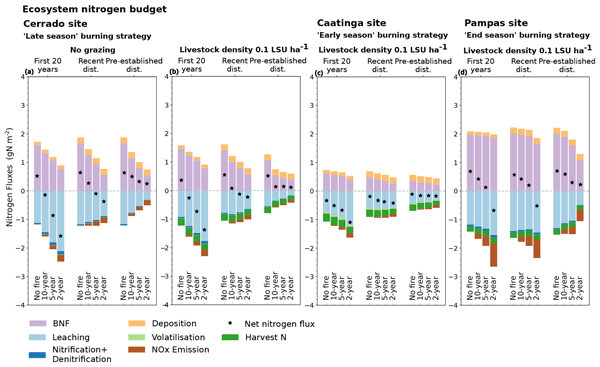
Figure 10Ecosystem nitrogen budget at the Cerrado (a, b), Caatinga (c) and Pampas (d) sites across burning frequencies, livestock densities, and practice durations. The nitrogen budget summarises the N-input and output fluxes coming in and out the system (Sect. 2.1.4). For clarity, only one burning strategy is depicted for each site, illustrating the observed practices as detailed by Brunel et al. (2021) respectively for the Cerrado, Caatinga and Pampas sites “late season”, “early season” and “end season”.

Figure 11Soil nitrogen budget at the Cerrado (a, b), Caatinga (c) and Pampas (d) sites across burning frequencies, livestock densities, and practice durations (Sect. 2.1.4). The nitrogen budget summarises the N-input and output fluxes coming in and out from SOM-N and SMM-N pools. For clarity, only one burning strategy is depicted for each site, illustrating the observed practices as detailed by Brunel et al. (2021) respectively for the Cerrado, Caatinga and Pampas sites “late season”, “early season” and “end season”.
3.2.2 Altered nitrogen budgets over disturbance scenarios
Considering the ecosystem nitrogen cycle for the Cerrado site (Fig. 10a, b), nitrogen inputs, which consist of biological nitrogen fixation (BNF) and atmospheric deposition, decrease with increasing levels of burning activities and grazing. This decline is driven entirely by reductions in BNF, as atmospheric deposition is determined by the inputs provided to the model (Sect. 2.3.1) and, consequently, remains the same regardless of the scenario. The drop is linked to the decline in foliage cover, which is caused by a decrease in plant biomass, leading to a generally lower evapotranspiration. In scenarios involving pre-established and 2 year burning practices, BNF diminishes by up to 60 % compare to the corresponding no fire scenario. The Caatinga and the Pampas sites (Fig. 10c, d) display similar reductions regarding the overall nitrogen input and BNF.
Concerning the nitrogen cycle losses, they are composed mostly of losses from leaching (NO3) and emissions from nitrification and denitrification (N2 and N2O), volatilisation (NH3), harvest N and NOX. When livestock are present, nitrogen removal through dry matter intake has to be considered. In the first 20 years after the introduction of an intensive disturbance (first group of bars on the left), such as 2 year burning frequency, nitrogen losses are at their maximum. This increase is primarily driven by leaching, which is proportional to the size of the SMM-N pool. In later years of practice, the dominance of leaching for the losses subsides following the reduction of soil nitrogen pools (Sect. 3.2.1).
In the first 20 years of disturbances, the overall nitrogen budget is substantially affected, even hitting negative values under scenarios with higher burning frequencies. Over time, nitrogen fluxes approach equilibrium, and the net nitrogen budget becomes positive in all scenarios except at the Caatinga site, where it levels off near zero. The introduction of disturbances into the system induces a drastic shift in the nitrogen fluxes, which is the primary driver of the decrease in nitrogen pools (Fig. 9). Such patterns are also visible at other locations, as shown in Appendix Fig. C5.
In the case of the soil nitrogen budget for the Cerrado site (Fig. 11a, b), the BNF and the litterfall, directly derived from the plant nitrogen pools, are the primary input fluxes. As stated in Sect. 3.1.1, with increasing intensity of these practices gradually, and over time, the leaf pools decrease, which causes a reduction in litterfall. This drop also affects the nitrogen uptake of plants from the soil SMM-N pool, which in turn is affected by the same fate. The net budget drops to negative values with the introduction of burning practices, but over time returns to positive values or stabilises near zero. Similar dynamics are observed at the Pampas site (Fig. 11d) and at other locations in the Amazon and Atlantic Forest (Fig. C6).
In the Caatinga region, extreme water stress strongly constrains vegetation pools. This is reflected in Fig. 11c, where litterfall and uptake fluxes are markedly lower than in the other locations. Across all scenarios, the net ecosystem and soil nitrogen budgets remain negative. Indeed even without fire practices, the ecosystem and the soil experience a net nitrogen loss (Figs. 10c and 11c).
This study examines the impact of fire practices on grassland ecosystems using the Chalumeau algorithm integrated into the SPITFIRE module of the LPJmL DGVM. Our findings show a substantial reduction in the overall ecosystem and soil nitrogen budget with repeated burning, indicating that frequent fires can degrade soil fertility over time. The depletion of soil nitrogen, along with a decrease in the soil carbon pool, negatively affects vegetation, leading to a decline in pasture productivity, especially under intensive grazing. However, with moderate livestock density and across nearly all fire regime tested, soil and vegetation pools reach a sustainable equilibrium, maintaining adequate dry matter intake and supporting long-term viability.
Notably, in LPJmL, it is assumed that burning itself does not directly alter the leaf C : N ratio, as both carbon and nitrogen pools are reduced proportionally during fire events in the SPITFIRE module. The difference occurs during the regrowth phase, when the balance of allocation shifts from carbon to nitrogen dominance. The observed shifts result from a non-linear allocation scheme driven by water and nitrogen availability. Over time, the total amount of nitrogen assimilated by the plants decreases compared to the amount of assimilated carbon.
Grazing and fire practices, applied separately or combined have a notable influence on the above-ground biomass net primary productivity (ANPP). Walker (1999) found that the combined effects of both practices are most beneficial in humid regions, observing it across multiple grassland sites in the US. This indicates that precipitation is needed to achieve high productivity to balance vegetation loss from fire. Our study covers multiple locations in Brazil that do not match the humid climate described by Walker (1999). The Caatinga and the Cerrado regions, for instance, are characterised by dry climatic conditions. For both sites, the joint application of both practices negatively impacts the ANPP as shown by our result regarding the vegetation level and the dry matter intake. Conversely, in the Pampas, which experiences a wetter climate with year-round rainfall, the effects of grazing and fire on productivity are more favourable compared to other regions. This highlights how a site-specific precipitation regime influences the response of ecosystems with smaller impacts on vegetation productivity, whereas in drier areas like the Cerrado and the Caatinga, these disturbances severely impact pasture health.
Burning timing appears from our results to be another parameter linked to climate conditions. Earlier burning strategies critically impact the AGB development as seen in the Sect. 3.1.1, as burning during the dormant season, when growth is inactive, hinders post-fire recovery. An exception to this context is observed in the Pampas, where burning earlier during winter leads to higher vegetation levels and a slightly more efficient recovery compared to other sites. This behaviour is due to the region's seasonal temperature pattern, which supports the vegetation cycle during the dormant period. In this area, the vegetation's regrowth slows down over the winter, resuming later in time to benefit from the warmer summer. In this way, burning at the end of winter tends to deteriorate conditions for optimal vegetation regrowth, whereas burning earlier in winter has minimal impact on the natural vegetation cycle.
As noted in the Sect. 3.2.1, the soil is subject to a nitrogen impoverishment, and the soil nitrogen budget (Sect. 3.2.2) shows a substantial drop in the nitrogen uptake over time when fire and grazing practices are intensified. Additionally, a reduction in the soil carbon pool occurs (Fig. C7), driven by the decrease in AGB and, consequently, in the primary input into the soil by shed leaves. These findings align with the observations made by Ojima et al. (1994), who investigate the short-term effects of fire on production and microbial activity in the tallgrass prairie in Kansas (US). They also examine the long-term consequences of annual burning on SOM and nutrient cycling through a combination of the field, laboratory, and modelling studies. Their research reveals reductions in SOM-N, microbial biomass, nitrogen availability, and an increase in the C : N ratio of SOM following fire. Using the CENTURY model, they simulate a decrease in soil carbon and net nitrogen mineralisation.
One important direct outcome of fire is ash production, which is believed to enhance soil fertility (Alencar et al., 2011; Barlow et al., 2020; Pivello et al., 2021). Our result shows a beneficial short-term effect after the introduction of fire expressed as a slight decline of the soil C : N ratio and an increase of the SMM-N pool by up to 50 %, which suggests a brief enhancement of the soil nitrogen pool. Looking at sub-annual dynamics (not shown), we observe that this enhancement is due to the input of nitrogen through ash in a few days period, thereby reducing the soil C : N ratio. Nitrogen from ashes contributes to the SMM-N pool and is subsequently immobilised when the soil C : N ratio is above its optimum, which is, in general, the case at all our study sites. Consequently, the C : N ratio shows a slight decrease.
Finally, an important aspect and especially relevant in the context of livestock farming is the impact of fire practices on the grassland production. In their observation and experimentation with the CENTURY model, Ojima et al. (1994) noticed a minimal impact on grass production. In our simulations, dry matter intake is considered as an indicator of productivity. Our results indicate that under moderate livestock density, there is an initial reduction in intake with the introduction of fire, but it balances over time, maintaining approximately 80 % of the livestock's feed requirement (Sect. 3.1.2). This dynamic differs from the decrease observed for the AGB (Sect. 3.1.1). With the pre-established disturbance scenario, so after long-term application of disturbances, we obtain a system with less biomass but a stabilised intake. The differences in how pools and fluxes respond to disturbances drive these outcomes. Indeed, the AGB pool is originally not affected much since grazing and burning only reduce the carbon pool by a small share. Over time, however, an incremental decline becomes apparent, leading to a drastic reduction in biomass by the end of the pre-established disturbance scenario. For the dry matter intake, the picture looks different since magnitudes of the net flux and loss from burning are comparable (Sect. 3.1.2). The intake is initially strongly impacted by the disturbances, which diminish over time as biomass decreases. This leads to a gradual return of the intake into a stable equilibrium, being less affected by the shrinking disturbance intensity due to the lack of fuel availability. This balance can be maintained as long as the biomass remains high enough to supply sufficient intake.
However, increasing grazing intensity leads to a collapse in pasture viability, rendering it unsustainable for livestock. From our results we cannot conclude about the viability of livestock densities above 0.5 LSU since we did not include fertilisation in our stylised scenarios.
This study investigates the impact of pasture fire practices on vegetation conditions, field productivity, and soil fertility in grasslands. This is achieved by integrating the Chalumeau algorithm into the SPITFIRE module within the LPJmL DGVM and performing a set of sensitivity simulations according to a handful of management scenarios.
While the results represent a great advancement and novelty in how fire management practices are modelled in DGVMs, it is important to recognise that many limitations are still present. By thoroughly identifying and discussing these critical points, we aim to provide a foundation for enhancing the accuracy and applicability of future models in simulating fire impacts on grassland's vegetation and soil.
This study does not rely on experimental field data to calibrate or validate the results specific to burning practices. Indeed, datasets documenting the impact of burning on vegetation structure, yields, and soil carbon and nitrogen content are either unavailable or entirely lacking for Brazil and the various locations analysed here. However, the LPJmL model itself, along with the underlying process dynamics it simulates, has been previously evaluated (Thonicke et al., 2010; Schaphoff et al., 2018a, b; von Bloh et al., 2018a).
In this study, we investigate the effects of burning practices on pasture ecosystems using model simulations for a set of burning and grazing scenarios. The proposed scenarios are comprehensive but do not account for all real field conditions.
For example, the burned area is prescribed as an input parameter. To properly assess burning dynamics within our modelling framework in LPJmL, the most appropriate method is to perform burning of the entire pasture, in other words, the burned area parameter is set to 1 and remains constant throughout the entire period. In reality, farmers might conduct rotational burning, selecting fire spots based on their own observations regarding the field status (Pivello et al., 2021). Criteria such as the amount of dead biomass, small bushes, or toxic plants for cattle often guide these decisions (Pivello, 2011; López-Mársico et al., 2019), a dimension not represented in LPJmL. In the LPJmL grass modelling approach, there is no distinction between living and dead biomass within the plants. During pasture burning, all above-ground biomass is treated as fuel, although the fire will affect primarily dead plant parts, particularly when fire occurs at the end of the dormant season. This timing is critical considering that the dead biomass build-up takes place in this period, which entices farmers to burn it. Implementing a proper way to separate the living and dead biomass would enable a full usage of SPITFIRE functionality, especially the one regarding fuel estimation and fire ignition condition. Incorporating this aspect into the determination of the burning date, in addition to the already existing climate condition, might better align with the initial purpose of setting fire.
Applying the pasture burning version of LPJmL and Chalumeau module beyond Brazil would require region-specific information on fire management practices. While the current implementation is technically flexible, meaningful application in other regions depends on adapting fire-use assumptions. In particular, the Chalumeau algorithm, which is driven by seasonal and climatic constraints, should be carefully re-evaluated before application to temperate regions.
We demonstrate the negative effects of intensive and prolonged combined disturbances, such as grazing and burning, on grassland ecosystems. Indeed intensive grazing alone can drastically impact the vegetation and soil carbon and nitrogen pools, leading to non-viable conditions for livestock rearing. When combined with burning as a biomass management strategy, this degradation is further amplified. However, our results indicate that burning in accordance with livestock density, can establish a new equilibrium, retaining the ecosystem sustainable for livestock. Additionally, the impacts vary depending on the climatic conditions, with wetter climates exhibiting greater resilience compared to drier areas.
This background should be taken into consideration when attempting to evaluate current land management practices in Brazilian pastures. To conduct such evaluations effectively, it is essential to obtain context-specific knowledge about actual practices, such as burning frequency, timing, fertilisation application, and the extent of burned areas. This highlights the need for the scientific community to broaden their appreciation of fire practices by better methods of data collection, monitoring of grasslands and further investigations of the issues raised in this paper.
Chalumeau (French for blowtorch) estimates the burning date depending on climatic conditions (Fig. A1). Brazilian climatic zones range from subtropical to tropical, with seasonality driven by either temperature or precipitation. The respective seasonality type is determined first from daily climate data following the approach described in Waha et al. (2012). Coefficients of variation for precipitation (CVP) and temperature (CVL) are used to distinguish seasonality types based on daily climate data. They are calculated as the ratio of the standard deviation to the mean of the daily temperature or precipitation values.
The dormant season (DS) can be calculated following two distinct approaches depending on the seasonality type. In the case of temperature-driven seasonality, the calculation of DS is based on daily temperatures. Annual temperature thresholds for separating dormant seasons are taken as the 25th percentile of the respective year. The annual resulting DS corresponds to the period where the moving temperature averaged over 10 d is below the threshold and where the cumulative temperature below the threshold Cbt calculated as shown by the Eq. (A1) is the highest. This ensures that the dormant season corresponds to the coldest sustained period within the year, rather than short cold spells.
For the precipitation-driven seasonality case, the calculation is based on moving cumulative sums of the daily precipitation over the previous 10 d (Pcs). Days belonging to the possible dormant season are those with Pcs below the 50th percentile threshold of the respective year. The longest continuous dry period is selected as the DS.
To emulate personal preferences and strategies of farmers, Chalumeau includes different choices for the burning date in relation to DS. According to the average duration of DS depending on the seasonality type, a fraction of DS is chosen to define the burning strategy:
The two factors for the fraction differ for the seasonality type because of their average duration. Four strategies are implemented corresponding to setting fire before or after the end of the DS and labelled according to their timing. Burning before the end of the period as “short season” or “early season” refer to two and one fraction, before the end of the season. A third choice would be the “end season” which corresponds to the last day of DS. And finally, the “early spring” strategy is burning one fraction later than the last day.

Figure A1Process implemented in the Chalumeau module to determine the dormant season (DS) and extract burning dates. Seasonality type (temperature- or precipitation-driven) is first identified using daily climate data. For temperature seasonality, DS corresponds to the period where the 10 d moving average falls below the 25th percentile threshold, with the coldest sustained period selected. For precipitation seasonality, DS is the longest period where the 10 d cumulative precipitation falls below the 50th percentile threshold. Based on DS duration and user-defined strategies, burning dates are extracted for each grid cell.
Table B1Parameters specific to LPJmL5-Pasture-Burning model version.


Figure C1Percentage change in aggregated leaf carbon (mean ± standard deviation) relative to the undisturbed conditions scenario, averaged over a 70-year period. Results are shown for recent (a, c, e, g) and pre-established disturbance (b, d, f, h) scenarios, organised by burning frequency (columns) and burning date (rows) at the Amazon North (a, b) and South (c, d), the Caatinga (e, f), the Atlantic Forest (g, h) sites under livestock density equals to 0.1 LSU ha−1. The 1-month post-fire average cumulative NPP (in brackets) indicates recovery status. Hatched areas mark scenarios excluded due to insufficient dry matter intake fulfilment (Sect. 3.1.2).

Figure C2Percentage change in aggregated leaf C : N ratio (mean ± standard deviation) relative to the undisturbed conditions scenario, averaged over a 70-year period. Results are shown for recent (a, c, e, g) and pre-established disturbance (b, d, f, h) scenarios, organised by burning frequency (columns) and burning date (rows) at the Amazon North (a, b) and South (c, d), the Caatinga (e, f), and the Atlantic Forest (g, h) sites under livestock density equals to 0.1 LSU ha−1. Hatched areas mark scenarios excluded due to insufficient dry matter intake fulfilment (Sect. 3.1.2).

Figure C3Percentage change in aggregated dry matter intake (mean ± standard deviation) relative to the undisturbed conditions scenario, averaged over a 70-year period. Results are shown for recent (a, c, e, g, i) and pre-established disturbance (b, d, f, h, j) scenarios, organised by burning frequency (columns) and burning date (rows) at the Amazon North (a, b) and South (c, d), the Caatinga (e, f), the Atlantic Forest (g, h) and Pampas (i, j) sites under livestock density equals to 0.1 LSU ha−1. Hatched areas mark scenarios excluded due to insufficient dry matter intake fulfilment (Sect. 3.1.2).

Figure C4Percentage change in aggregated dry matter intake (mean ± standard deviation) relative to the undisturbed conditions scenario, averaged over a 70-year period. Results are shown for recent (a, c, e, g, i) and pre-established disturbance (b, d, f, h, j) scenarios, organised by burning frequency (columns) and burning date (rows) at the Amazon North (a, b) and South (c, d), the Caatinga (e, f), the Atlantic Forest (g, h) and Pampas (i, j) sites under livestock density equals to 0.5 LSU ha−1. Hatched areas mark scenarios excluded due to insufficient dry matter intake fulfilment (Sect. 3.1.2).

Figure C5Ecosystem nitrogen budget at the Amazon North (a) and South (b) and the Atlantic Forest (c) sites under livestock density equals to 0.1 LSU ha−1, across burning frequencies and practice duration. The nitrogen budget summarises the N-input and output fluxes coming in and out the system (Sect. 2.1.4). For clarity, only one burning strategy is depicted for each site, representing the observed practices as detailed by Brunel et al. (2021) respectively “early season” for the Amazon sites and “late season” for the Atlantic Forest.

Figure C6Soil nitrogen budget at the Amazon North (a) and South (b) and the Atlantic Forest (c) sites under livestock density equals to 0.1 LSU ha−1, across burning frequencies and practice duration. The nitrogen budget summarises the N-input and output fluxes coming in and out the SOM-N and SMM-N pools (Sect. 2.1.4). For clarity, only one burning strategy is depicted for each site, representing the observed practices as detailed by Brunel et al. (2021) respectively “early season” for the Amazon sites and “late season” for the Atlantic Forest.

Figure C7Percentage of change in aggregated average soil carbon (mean ± standard deviation) over a 70 year period on recent or pre-established disturbance scenarios, displayed by frequency (columns) and burning date (rows), at the Cerrado (a, b) and Pampas (c, d) sites. Values under undisturbed conditions are taken as reference and the percentage is based on it. Under undisturbed conditions, soil carbon is equal respectively to 6220 and 14 670 gC m−2. The colouring represents the magnitude of the reduction in soil carbon compared to undisturbed conditions. Hatching within the mosaics represent non-selected scenarios due to insufficient dry matter intake fulfilment (Sect. 3.1.2). The results indicate that higher fire frequencies lead to more pronounced declines in soil carbon. At both study sites, soil carbon levels under disturbed conditions show reductions of up to 45 % compared to undisturbed conditions under pre-established disturbance scenarios.
The LPJmL5 Pasture-Burning version used to produce the results of this paper as well as the data and the post-processing python script are archived on Zenodo at https://doi.org/10.5281/zenodo.14926359 (Brunel, 2025).
MB and SR led the conceptualisation and development of the methodology. MB implemented the computer code with contributions from SR, MD, and KT. MB conducted the formal computational analysis, created the visualisations and prepared the original draft of the manuscript. SR provided supervision throughout the project. The manuscript was reviewed and edited by SR, SW, MD, KT, HB and JH.
At least one of the (co-)authors is a member of the editorial board of Biogeosciences. The peer-review process was guided by an independent editor, and the authors also have no other competing interests to declare.
Publisher’s note: Copernicus Publications remains neutral with regard to jurisdictional claims made in the text, published maps, institutional affiliations, or any other geographical representation in this paper. While Copernicus Publications makes every effort to include appropriate place names, the final responsibility lies with the authors. Views expressed in the text are those of the authors and do not necessarily reflect the views of the publisher.
The authors gratefully acknowledge the European Regional Development Fund (ERDF), the German Federal Ministry of Education and Research, and the Land Brandenburg for supporting this project by providing resources on the high-performance computing system at the Potsdam Institute for Climate Impact Research. AI algorithms were used during the writing process to assist with English spelling, formulation, and syntax.
The article processing charges for this open-access publication were covered by the Potsdam Institute for Climate Impact Research (PIK).
This paper was edited by Akihiko Ito and reviewed by Pritha Pande and one anonymous referee.
Achard, F., Eva, H. D., Stibig, H.-J., Mayaux, P., Gallego, J., Richards, T., and Malingreau, J.-P.: Determination of Deforestation Rates of the World's Humid Tropical Forests, Science, 297, 999–1002, https://doi.org/10.1126/science.1070656, 2002. a
Alencar, A., Asner, G. P., Knapp, D., and Zarin, D.: Temporal variability of forest fires in eastern Amazonia, Ecological Applications, 21, 2397–2412, https://doi.org/10.1890/10-1168.1, 2011. a
Barlow, J., Berenguer, E., Carmenta, R., and França, F.: Clarifying Amazonia's burning crisis, Global Change Biology, 26, 319–321, https://doi.org/10.1111/gcb.14872, 2020. a, b, c
Bonaudo, T., Bendahan, A. B., Sabatier, R., Ryschawy, J., Bellon, S., Leger, F., Magda, D., and Tichit, M.: Agroecological principles for the redesign of integrated crop-livestock systems, European Journal of Agronomy, 57, 43–51, https://doi.org/10.1016/j.eja.2013.09.010, 2014. a
Bondeau, A., Smith, P. C., Zaehle, S., Schaphoff, S., Lucht, W., Cramer, W., Gerten, D., Lotze-Campen, H., Müller, C., Reichstein, M., and Smith, B.: Modelling the role of agriculture for the 20th century global terrestrial carbon balance, Global Change Biology, 13, 679–706, https://doi.org/10.1111/j.1365-2486.2006.01305.x, 2007. a, b
Brando, P., Macedo, M., Silvério, D., Rattis, L., Paolucci, L., Alencar, A., Coe, M., and Amorim, C.: Amazon wildfires: Scenes from a foreseeable disaster, Flora, 268, 151609, https://doi.org/10.1016/j.flora.2020.151609, 2020. a
Brunel, M.: LPJmL5-Pasture-Burning: Effects of fire and grazing on biogeochemical cycles in Brazilian pastures, Zenodo [code, data set], https://doi.org/10.5281/zenodo.14926359, 2025. a
Brunel, M., Rammig, A., Furquim, F., Overbeck, G., Barbosa, H. M. J., Thonicke, K., and Rolinski, S.: When do Farmers Burn Pasture in Brazil: A Model-Based Approach to Determine Burning Date, Rangeland Ecology & Management, 79, 110–125, https://doi.org/10.1016/j.rama.2021.08.003, 2021. a, b, c, d, e, f, g, h, i, j
Cano-Crespo, A., Oliveira, P. J. C., Boit, A., Cardoso, M., and Thonicke, K.: Forest edge burning in the Brazilian Amazon promoted by escaping fires from managed pastures, Journal of Geophysical Research-Biogeosciences, 120, 2095–2107, https://doi.org/10.1002/2015JG002914, 2015. a
Cleveland, C. C., Townsend, A. R., Schimel, D. S., Fisher, H., Howarth, R. W., Hedin, L. O., Perakis, S. S., Latty, E. F., Von Fischer, J. C., Elseroad, A., and Wasson, M. F.: Global patterns of terrestrial biological nitrogen (N2) fixation in natural ecosystems, Global Biogeochemical Cycles, 13, 623–645, https://doi.org/10.1029/1999GB900014, 1999. a, b, c
Cochrane, M. and Laurance, W.: Fire as a Large-Scale Edge Effect in Amazonian Forests, Journal of Tropical Ecology, 18, 311–325, https://doi.org/10.1017/S0266467402002237, 2002. a
Cochrane, M. A.: Fire, land use, land cover dynamics, and climate change in the Brazilian Amazon, in: Tropical Fire Ecology: Climate Change, Land Use, and Ecosystem Dynamics, edited by: Cochrane, M. A., Springer Praxis Books, 389–426, Springer, ISBN 978-3-540-77381-8, https://doi.org/10.1007/978-3-540-77381-8_14, 2009. a
Collatz, G. J., Ball, J. T., Grivet, C., and Berry, J. A.: Physiological and environmental regulation of stomatal conductance, photosynthesis and transpiration: a model that includes a laminar boundary layer, Agricultural and Forest Meteorology, 54, 107–136, https://doi.org/10.1016/0168-1923(91)90002-8, 1991. a
Collatz, G. J., Ribas-Carbo, M., and Berry, J. A.: Coupled Photosynthesis-Stomatal Conductance Model for Leaves of C4 Plants, Functional Plant Biology, 19, 519–538, https://doi.org/10.1071/pp9920519, 1992. a
Csiszar, I. A., Justice, C. O., McGuire, A. D., Cochrane, M. A., Roy, D. P., Brown, F., Conard, S. G., Frost, P. G. H., Giglio, L., Elvidge, C. D., Flannigan, M. D., Kasischke, E. S., McRae, D. J., Rupp, T. S., Stocks, B. J., and Verbyla, D. L.: Land Use and Fires, in: Land Change Science. Remote Sensing and Digital Image Processing, edited by: Gutman, G., Janetos, A. C., Justice, C. O., Moran, E. F., Mustard, J. F., Rindfuss, R. R., Skole, D., TurnerII, B. L., and Cochrane, M. A., 6, 329–350, Springer, Dordrecht, https://doi.org/10.1007/978-1-4020-2562-4_19, 2012. a
Drüke, M., Forkel, M., von Bloh, W., Sakschewski, B., Cardoso, M., Bustamante, M., Kurths, J., and Thonicke, K.: Improving the LPJmL4-SPITFIRE vegetation–fire model for South America using satellite data, Geosci. Model Dev., 12, 5029–5054, https://doi.org/10.5194/gmd-12-5029-2019, 2019. a, b
Farquhar, G. D., von Caemmerer, S., and Berry, J. A.: A biochemical model of photosynthetic CO2 assimilation in leaves of C3 species, Planta, 149, 78–90, https://doi.org/10.1007/BF00386231, 1980. a
Fischer, G., Nachtergaele, F., Prieler, S., Teixeira, E., Toth, G., Velthuizen, H., Verelst, L., and Wiberg, D.: Global Agro‐Ecological Zones (GAEZ v3.0) – Model Documentation, IIASA/FAO, https://www.gaez.iiasa.ac.at/docs/GAEZ_Model_Documentation.pdf (last access: 13 January 2026), 2012. a
Freitas, S. R., Longo, K. M., Silva Dias, M. A. F., Silva Dias, P. L., Chatfield, R., Prins, E., Artaxo, P., Grell, G. A., and Recuero, F. S.: Monitoring the transport of biomass burning emissions in South America, Environmental Fluid Mechanics, 5, 135–167, https://doi.org/10.1007/s10652-005-0243-7, 2005. a
Fronza, E. E., Caten, A. t., Bittencourt, F., Zambiazi, D. C., Schmitt Filho, A. L., Seó, H. L. S., and Loss, A.: Carbon sequestration potential of pastures in Southern Brazil: A systematic review, Revista Brasileira de Ciência do Solo, 48, e0230121, https://doi.org/10.36783/18069657rbcs20230121, 2024. a
Gerber, S., Hedin, L. O., Oppenheimer, M., Pacala, S. W., and Shevliakova, E.: Nitrogen cycling and feedbacks in a global dynamic land model, Global Biogeochemical Cycles, 24, https://doi.org/10.1029/2008GB003336, 2010. a
Ignotti, E., Valente, J. G., Longo, K. M., Freitas, S. R., Hacon, S. d. S., and Netto, P. A.: Impact on human health of particulate matter emitted from burnings in the Brazilian Amazon region, Revista De Saude Publica, 44, 121–130, https://doi.org/10.1590/s0034-89102010000100013, 2010. a
Instituto Brasileiro de Geografia e Estatística: IBGE – Instituto Brasileiro de Geografia e Estatística, https://www.ibge.gov.br/ (last access: 9 février 2025), 2025. a
Jägermeyr, J., Gerten, D., Heinke, J., Schaphoff, S., Kummu, M., and Lucht, W.: Water savings potentials of irrigation systems: global simulation of processes and linkages, Hydrol. Earth Syst. Sci., 19, 3073–3091, https://doi.org/10.5194/hess-19-3073-2015, 2015. a
Le Quéré, C., Moriarty, R., Andrew, R. M., Canadell, J. G., Sitch, S., Korsbakken, J. I., Friedlingstein, P., Peters, G. P., Andres, R. J., Boden, T. A., Houghton, R. A., House, J. I., Keeling, R. F., Tans, P., Arneth, A., Bakker, D. C. E., Barbero, L., Bopp, L., Chang, J., Chevallier, F., Chini, L. P., Ciais, P., Fader, M., Feely, R. A., Gkritzalis, T., Harris, I., Hauck, J., Ilyina, T., Jain, A. K., Kato, E., Kitidis, V., Klein Goldewijk, K., Koven, C., Landschützer, P., Lauvset, S. K., Lefèvre, N., Lenton, A., Lima, I. D., Metzl, N., Millero, F., Munro, D. R., Murata, A., Nabel, J. E. M. S., Nakaoka, S., Nojiri, Y., O'Brien, K., Olsen, A., Ono, T., Pérez, F. F., Pfeil, B., Pierrot, D., Poulter, B., Rehder, G., Rödenbeck, C., Saito, S., Schuster, U., Schwinger, J., Séférian, R., Steinhoff, T., Stocker, B. D., Sutton, A. J., Takahashi, T., Tilbrook, B., van der Laan-Luijkx, I. T., van der Werf, G. R., van Heuven, S., Vandemark, D., Viovy, N., Wiltshire, A., Zaehle, S., and Zeng, N.: Global Carbon Budget 2015, Earth Syst. Sci. Data, 7, 349–396, https://doi.org/10.5194/essd-7-349-2015, 2015. a
Lutz, F., Herzfeld, T., Heinke, J., Rolinski, S., Schaphoff, S., von Bloh, W., Stoorvogel, J. J., and Müller, C.: Simulating the effect of tillage practices with the global ecosystem model LPJmL (version 5.0-tillage), Geosci. Model Dev., 12, 2419–2440, https://doi.org/10.5194/gmd-12-2419-2019, 2019. a
López-Mársico, L., Farías-Moreira, L., Lezama, F., Altesor, A., and Rodríguez, C.: Light intensity triggers different germination responses to fire-related cues in temperate grassland species, Folia Geobotanica, 54, 53–63, https://doi.org/10.1007/s12224-019-09336-5, 2019. a, b
MapBiomas: Collection 6 of Brazilian Land Cover & Use Map Series, http://mapbiomas.org/ (last access: 23 March 2024), 2021. a
Mapiye, C., Chikumba, N., Chimonyo, M., and Mwale, M.: Fire as a rangeland management tool in the savannas of southern Africa: A review, Tropical and Subtropical Agroecosystems, 8, 115–124, 2008. a
Mistry, J.: Decision-making for fire use among farmers in savannas: an exploratory study in the Distrito Federal, central Brazil, Journal of Environmental Management, 54, 321–334, https://doi.org/10.1006/jema.1998.0239, 1998. a, b, c, d, e
Müller, C. and Robertson, R.: Projecting future crop productivity for global economic modeling, Agricultural Economics, 45, https://doi.org/10.1111/agec.12088, 2013. a
NASA: Global Land Data Assimilation System, https://ldas.gsfc.nasa.gov/ (last access: 15 June 2020), 2015. a
Nawaz, M. O. and Henze, D. K.: Premature Deaths in Brazil Associated With Long-Term Exposure to PM2.5 From Amazon Fires Between 2016 and 2019, GeoHealth, 4, e2020GH000268, https://doi.org/10.1029/2020GH000268, 2020. a
Neary, D. and Leonard, J.: Effects of Fire on Grassland Soils and Water: A Review, in: Grasses and grassland aspects, Kindomihou, Valentin Missiako, ISBN 978-1-78984-949-3, https://doi.org/10.5772/intechopen.90747, 2020. a
Nepstad, D. C., Stickler, C. M., Soares-Filho, B., and Merry, F.: Interactions among Amazon land use, forests and climate: prospects for a near-term forest tipping point, Philosophical Transactions of the Royal Society B-Biological Sciences, 363, 1737–1746, https://doi.org/10.1098/rstb.2007.0036, 2008. a
Nesterov, V.: Combustibility of the Forest and Methods for Its Determination, USSR State Industry Press, 1949 (in Russian). a
Ojima, D., Schimel, D., Parton, W., and Owensby, C.: Long- and Short-Term Effects of Fire on Nitrogen Cycling in Tall Grass Prairie, Biogeochemistry, 24, 67–84, https://doi.org/10.1007/BF02390180, 1994. a, b, c
Overbeck, G., Vélez-Martin, E., Scarano, F., Lewinsohn, T., Fonseca, C., Meyer, S., Müller, S., Ceotto, P., Dadalt, L., Durigan, G., Ganade, G., Gossner, M., Guadagnin, D., Lorenzen, K., Jacobi, C., Weisser, W., and Pillar, V.: Conservation in Brazil needs to include non-forest ecosystems, Divers. Distrib., 21, 1455–1460, https://doi.org/10.1111/ddi.12380, 2015. a
Overbeck, G. E., Pillar, V. D. P., Müller, S. C., and Bencke, G. A. (Eds.): South Brazilian Grasslands: Ecology and Conservation of the Campos Sulinos, Springer International Publishing, ISBN 978-3-031-42579-0 978-3-031-42580-6, https://doi.org/10.1007/978-3-031-42580-6, 2024. a
Peterson, D. and Ryan, K.: Modeling postfire conifer mortality for long-range planning, Environmental Management, 10, 797–808, https://doi.org/10.1007/BF01867732, 1986. a
Pillar, V. and de Quadros, F. L. F.: Grassland-forest boundaries in Southern Brazil, Coenoses, 12, 119–126, https://www.jstor.org/stable/43461200, 1997. a
Pivello, V. R.: The Use of Fire in the Cerrado and Amazonian Rainforests of Brazil: Past and Present, Fire Ecology, 7, 24–39, https://doi.org/10.4996/fireecology.0701024, 2011. a, b
Pivello, V. R., Vieira, I., Christianini, A. V., Ribeiro, D. B., da Silva Menezes, L., Berlinck, C. N., Melo, F. P. L., Marengo, J. A., Tornquist, C. G., Tomas, W. M., and Overbeck, G. E.: Understanding Brazil’s catastrophic fires: Causes, consequences and policy needed to prevent future tragedies, Perspectives in Ecology and Conservation, 19, 233–255, https://doi.org/10.1016/j.pecon.2021.06.005, 2021. a, b, c, d
Rabin, S. S., Magi, B. I., Shevliakova, E., and Pacala, S. W.: Quantifying regional, time-varying effects of cropland and pasture on vegetation fire, Biogeosciences, 12, 6591–6604, https://doi.org/10.5194/bg-12-6591-2015, 2015. a
Rabin, S. S., Ward, D. S., Malyshev, S. L., Magi, B. I., Shevliakova, E., and Pacala, S. W.: A fire model with distinct crop, pasture, and non-agricultural burning: use of new data and a model-fitting algorithm for FINAL.1, Geosci. Model Dev., 11, 815–842, https://doi.org/10.5194/gmd-11-815-2018, 2018. a
Rodell, M., Houser, P. R., Jambor, U., Gottschalck, J., Mitchell, K., Meng, C.-J., Arsenault, K., Cosgrove, B., Radakovich, J., Bosilovich, M., Entin, J. K., Walker, J. P., Lohmann, D., and Toll, D.: The Global Land Data Assimilation System, Bulletin of the American Meteorological Society, 85, 381–394, https://doi.org/10.1175/BAMS-85-3-381, 2004. a
Rolinski, S., Müller, C., Heinke, J., Weindl, I., Biewald, A., Bodirsky, B. L., Bondeau, A., Boons-Prins, E. R., Bouwman, A. F., Leffelaar, P. A., te Roller, J. A., Schaphoff, S., and Thonicke, K.: Modeling vegetation and carbon dynamics of managed grasslands at the global scale with LPJmL 3.6, Geosci. Model Dev., 11, 429–451, https://doi.org/10.5194/gmd-11-429-2018, 2018. a, b, c, d
Rost, S., Gerten, D., Bondeau, A., Lucht, W., Rohwer, J., and Schaphoff, S.: Agricultural green and blue water consumption and its influence on the global water system, Water Resources Research, 44, https://doi.org/10.1029/2007WR006331, 2008. a
Rothermel, R. C.: A mathematical model for predicting fire spread in wildland fuels, Res. Pap. INT-115. Ogden, UT: U.S. Department of Agriculture, Intermountain Forest and Range Experiment Station. 40 p., 115, http://www.fs.usda.gov/treesearch/pubs/32533 (last access: 13 December 2024), 1972. a
Santos, C. O. D., Pinto, A. D. S., Silva, J. R. D., Parente, L. L., Mesquita, V. V., Santos, M. P. D., and Ferreira, L. G.: Monitoring of Carbon Stocks in Pastures in the Savannas of Brazil through Ecosystem Modeling on a Regional Scale, Land, 12, 60, https://doi.org/10.3390/land12010060, 2023. a, b
Schaphoff, S., von Bloh, W., Rammig, A., Thonicke, K., Biemans, H., Forkel, M., Gerten, D., Heinke, J., Jägermeyr, J., Knauer, J., Langerwisch, F., Lucht, W., Müller, C., Rolinski, S., and Waha, K.: LPJmL4 – a dynamic global vegetation model with managed land – Part 1: Model description, Geosci. Model Dev., 11, 1343–1375, https://doi.org/10.5194/gmd-11-1343-2018, 2018a. a, b, c
Schaphoff, S., Forkel, M., Müller, C., Knauer, J., von Bloh, W., Gerten, D., Jägermeyr, J., Lucht, W., Rammig, A., Thonicke, K., and Waha, K.: LPJmL4 – a dynamic global vegetation model with managed land – Part 2: Model evaluation, Geosci. Model Dev., 11, 1377–1403, https://doi.org/10.5194/gmd-11-1377-2018, 2018b. a, b
Schulzweida, U.: CDO User Guide, Zenodo, https://doi.org/10.5281/zenodo.3539275, 2019. a
Selbie, D. R., Buckthought, L. E., and Shepherd, M. A.: Chapter Four – The Challenge of the Urine Patch for Managing Nitrogen in Grazed Pasture Systems, in: Advances in Agronomy, edited by: Sparks, D. L., 129, 229–292, Academic Press, https://doi.org/10.1016/bs.agron.2014.09.004, 2015. a
Sorrensen, C. L.: Linking smallholder land use and fire activity: examining biomass burning in the Brazilian Lower Amazon, Forest Ecology and Management, 128, 11–25, https://doi.org/10.1016/S0378-1127(99)00283-2, 2000. a
Soussana, J.-F., Klumpp, K., and Ehrhardt, F.: The role of grassland in mitigating climate change, Organising Committee of the 25th General Meeting of the European Grassland Federation IBERS, 75–87, https://hal.inrae.fr/hal-02738557 (last access: 13 January 2026), 2014. a, b
Thonicke, K., Spessa, A., Prentice, I. C., Harrison, S. P., Dong, L., and Carmona-Moreno, C.: The influence of vegetation, fire spread and fire behaviour on biomass burning and trace gas emissions: results from a process-based model, Biogeosciences, 7, 1991–2011, https://doi.org/10.5194/bg-7-1991-2010, 2010. a, b, c, d, e, f, g
Tian, H., Yang, J., Lu, C., Xu, R., Canadell, J. G., Jackson, R. B., Arneth, A., Chang, J., Chen, G., Ciais, P., Gerber, S., Ito, A., Huang, Y., Joos, F., Lienert, S., Messina, P., Olin, S., Pan, S., Peng, C., Saikawa, E., Thompson, R. L., Vuichard, N., Winiwarter, W., Zaehle, S., Zhang, B., Zhang, K., and Zhu, Q.: The Global N2O Model Intercomparison Project, Bulletin of the American Meteorological Society, 99, 1231–1251, https://doi.org/10.1175/BAMS-D-17-0212.1, 2018. a
van der Werf, G. R., Randerson, J. T., Giglio, L., Gobron, N., and Dolman, A. J.: Climate controls on the variability of fires in the tropics and subtropics, Global Biogeochemical Cycles, https://doi.org/10.1029/2007GB003122, 2008. a, b, c, d
von Bloh, W., Schaphoff, S., Müller, C., Rolinski, S., Waha, K., and Zaehle, S.: Implementing the nitrogen cycle into the dynamic global vegetation, hydrology, and crop growth model LPJmL (version 5.0), Geosci. Model Dev., 11, 2789–2812, https://doi.org/10.5194/gmd-11-2789-2018, 2018a. a, b, c, d, e, f, g
von Bloh, W., Schaphoff, S., Müller, C., Rolinski, S., Waha, K., and Zaehle, S.: Implementing the nitrogen cycle into the dynamic global vegetation, hydrology, and crop growth model LPJmL (version 5.0), Geosci. Model Dev., 11, 2789–2812, https://doi.org/10.5194/gmd-11-2789-2018, 2018b. a
Waha, K., van Bussel, L. G. J., Müller, C., and Bondeau, A.: Climate-driven simulation of global crop sowing dates, Global Ecology and Biogeography, 21, 247–259, https://doi.org/10.1111/j.1466-8238.2011.00678.x, 2012. a, b, c, d
Walker, L. R.: Ecosystems of Disturbed Ground, Elsevier, ISBN 978-0-08-055084-8, 1999. a, b
- Abstract
- Introduction
- Methods
- Results
- Discussion
- Limitations and outlook
- Appendix A: Chalumeau module for burning date calculation
- Appendix B: Model parameters
- Appendix C: Additional results for DMI, leaf C : N ratio, soil carbon and nitrogen budget
- Code and data availability
- Author contributions
- Competing interests
- Disclaimer
- Acknowledgements
- Financial support
- Review statement
- References
- Abstract
- Introduction
- Methods
- Results
- Discussion
- Limitations and outlook
- Appendix A: Chalumeau module for burning date calculation
- Appendix B: Model parameters
- Appendix C: Additional results for DMI, leaf C : N ratio, soil carbon and nitrogen budget
- Code and data availability
- Author contributions
- Competing interests
- Disclaimer
- Acknowledgements
- Financial support
- Review statement
- References