Articles | Volume 22, issue 23
https://doi.org/10.5194/bg-22-7901-2025
© Author(s) 2025. This work is distributed under
the Creative Commons Attribution 4.0 License.
https://doi.org/10.5194/bg-22-7901-2025
© Author(s) 2025. This work is distributed under
the Creative Commons Attribution 4.0 License.
The evolution of methane production rates from young to mature thermokarst lakes

Yarden Gerera
Department of Earth and Environmental Science, Ben-Gurion University of the Negev, Beer Sheva, 8410501, Israel
André Pellerin
Institut des sciences de la mer, Université du Québec à Rimouski, Rimouski, Québec, G5L 3A1, Canada
Efrat Eliani Russak
Department of Earth and Environmental Science, Ben-Gurion University of the Negev, Beer Sheva, 8410501, Israel
Katey Walter Anthony
Water and Environmental Research Center, University of Alaska Fairbanks, Fairbanks, AK, 99775, USA
Nicholas Hasson
Water and Environmental Research Center, University of Alaska Fairbanks, Fairbanks, AK, 99775, USA
Yoav Oved Rosenberg
Geological Survey of Israel, Jerusalem, 9692100, Israel
Orit Sivan
CORRESPONDING AUTHOR
Department of Earth and Environmental Science, Ben-Gurion University of the Negev, Beer Sheva, 8410501, Israel
Related authors
No articles found.
Hailey Webb, Ethan Pierce, Benjamin W. Abbott, William B. Bowden, Yaping Chen, Yating Chen, Thomas A. Douglas, Joel F. Eklof, Eugénie S. Euskirchen, Moritz Langer, Isla H. Myers-Smith, Irina Overeem, Jens Strauss, Katey Walter Anthony, Kang Wang, Matthew A. Whitley, and Merritt R. Turetsky
Earth Syst. Sci. Data Discuss., https://doi.org/10.5194/essd-2025-557, https://doi.org/10.5194/essd-2025-557, 2025
Preprint under review for ESSD
Short summary
Short summary
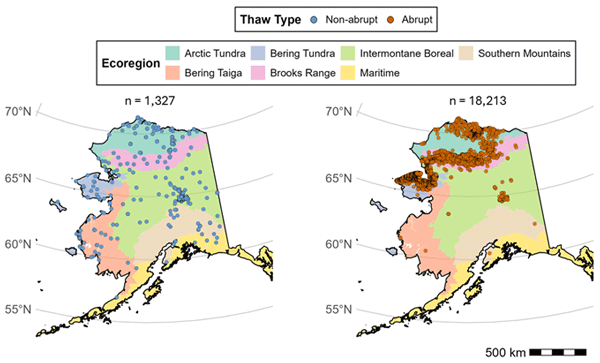
We created a database of 19,540 thawing permafrost sites across Alaska, including both abrupt and non-abrupt thaw features and explored relationships with elevation, slope, and incoming solar radiation. We use the database to show that existing ground ice maps are too coarse to predict abrupt thaw risk. This database can enhance predictions of future thaw, improve greenhouse gas budget calculations, and guide planning and climate adaptation strategies.
Anna-Maria Virkkala, Isabel Wargowsky, Judith Vogt, McKenzie A. Kuhn, Simran Madaan, Richard O'Keefe, Tiffany Windholz, Kyle A. Arndt, Brendan M. Rogers, Jennifer D. Watts, Kelcy Kent, Mathias Göckede, David Olefeldt, Gerard Rocher-Ros, Edward A. G. Schuur, David Bastviken, Kristoffer Aalstad, Kelly Aho, Joonatan Ala-Könni, Haley Alcock, Inge Althuizen, Christopher D. Arp, Jun Asanuma, Katrin Attermeyer, Mika Aurela, Sivakiruthika Balathandayuthabani, Alan Barr, Maialen Barret, Ochirbat Batkhishig, Christina Biasi, Mats P. Björkman, Andrew Black, Elena Blanc-Betes, Pascal Bodmer, Julia Boike, Abdullah Bolek, Frédéric Bouchard, Ingeborg Bussmann, Lea Cabrol, Eleonora Canfora, Sean Carey, Karel Castro-Morales, Namyi Chae, Andres Christen, Torben R. Christensen, Casper T. Christiansen, Housen Chu, Graham Clark, Francois Clayer, Patrick Crill, Christopher Cunada, Scott J. Davidson, Joshua F. Dean, Sigrid Dengel, Matteo Detto, Catherine Dieleman, Florent Domine, Egor Dyukarev, Colin Edgar, Bo Elberling, Craig A. Emmerton, Eugenie Euskirchen, Grant Falvo, Thomas Friborg, Michelle Garneau, Mariasilvia Giamberini, Mikhail V. Glagolev, Miquel A. Gonzalez-Meler, Gustaf Granath, Jón Guðmundsson, Konsta Happonen, Yoshinobu Harazono, Lorna Harris, Josh Hashemi, Nicholas Hasson, Janna Heerah, Liam Heffernan, Manuel Helbig, Warren Helgason, Michal Heliasz, Greg Henry, Geert Hensgens, Tetsuya Hiyama, Macall Hock, David Holl, Beth Holmes, Jutta Holst, Thomas Holst, Gabriel Hould-Gosselin, Elyn Humphreys, Jacqueline Hung, Jussi Huotari, Hiroki Ikawa, Danil V. Ilyasov, Mamoru Ishikawa, Go Iwahana, Hiroki Iwata, Marcin Antoni Jackowicz-Korczynski, Joachim Jansen, Järvi Järveoja, Vincent E. J. Jassey, Rasmus Jensen, Katharina Jentzsch, Robert G. Jespersen, Carl-Fredrik Johannesson, Chersity P. Jones, Anders Jonsson, Ji Young Jung, Sari Juutinen, Evan Kane, Jan Karlsson, Sergey Karsanaev, Kuno Kasak, Julia Kelly, Kasha Kempton, Marcus Klaus, George W. Kling, Natacha Kljun, Jacqueline Knutson, Hideki Kobayashi, John Kochendorfer, Kukka-Maaria Kohonen, Pasi Kolari, Mika Korkiakoski, Aino Korrensalo, Pirkko Kortelainen, Egle Koster, Kajar Koster, Ayumi Kotani, Praveena Krishnan, Juliya Kurbatova, Lars Kutzbach, Min Jung Kwon, Ethan D. Kyzivat, Jessica Lagroix, Theodore Langhorst, Elena Lapshina, Tuula Larmola, Klaus S. Larsen, Isabelle Laurion, Justin Ledman, Hanna Lee, A. Joshua Leffler, Lance Lesack, Anders Lindroth, David Lipson, Annalea Lohila, Efrén López-Blanco, Vincent L. St. Louis, Erik Lundin, Misha Luoto, Takashi Machimura, Marta Magnani, Avni Malhotra, Marja Maljanen, Ivan Mammarella, Elisa Männistö, Luca Belelli Marchesini, Phil Marsh, Pertti J. Martkainen, Maija E. Marushchak, Mikhail Mastepanov, Alex Mavrovic, Trofim Maximov, Christina Minions, Marco Montemayor, Tomoaki Morishita, Patrick Murphy, Daniel F. Nadeau, Erin Nicholls, Mats B. Nilsson, Anastasia Niyazova, Jenni Nordén, Koffi Dodji Noumonvi, Hannu Nykanen, Walter Oechel, Anne Ojala, Tomohiro Okadera, Sujan Pal, Alexey V. Panov, Tim Papakyriakou, Dario Papale, Sang-Jong Park, Frans-Jan W. Parmentier, Gilberto Pastorello, Mike Peacock, Matthias Peichl, Roman Petrov, Kyra St. Pierre, Norbert Pirk, Jessica Plein, Vilmantas Preskienis, Anatoly Prokushkin, Jukka Pumpanen, Hilary A. Rains, Niklas Rakos, Aleski Räsänen, Helena Rautakoski, Riika Rinnan, Janne Rinne, Adrian Rocha, Nigel Roulet, Alexandre Roy, Anna Rutgersson, Aleksandr F. Sabrekov, Torsten Sachs, Erik Sahlée, Alejandro Salazar, Henrique Oliveira Sawakuchi, Christopher Schulze, Roger Seco, Armando Sepulveda-Jauregui, Svetlana Serikova, Abbey Serrone, Hanna M. Silvennoinen, Sofie Sjogersten, June Skeeter, Jo Snöälv, Sebastian Sobek, Oliver Sonnentag, Emily H. Stanley, Maria Strack, Lena Strom, Patrick Sullivan, Ryan Sullivan, Anna Sytiuk, Torbern Tagesson, Pierre Taillardat, Julie Talbot, Suzanne E. Tank, Mario Tenuta, Irina Terenteva, Frederic Thalasso, Antoine Thiboult, Halldor Thorgeirsson, Fenix Garcia Tigreros, Margaret Torn, Amy Townsend-Small, Claire Treat, Alain Tremblay, Carlo Trotta, Eeva-Stiina Tuittila, Merritt Turetsky, Masahito Ueyama, Muhammad Umair, Aki Vähä, Lona van Delden, Maarten van Hardenbroek, Andrej Varlagin, Ruth K. Varner, Elena Veretennikova, Timo Vesala, Tarmo Virtanen, Carolina Voigt, Jorien E. Vonk, Robert Wagner, Katey Walter Anthony, Qinxue Wang, Masataka Watanabe, Hailey Webb, Jeffrey M. Welker, Andreas Westergaard-Nielsen, Sebastian Westermann, Jeffrey R. White, Christian Wille, Scott N. Williamson, Scott Zolkos, Donatella Zona, and Susan M. Natali
Earth Syst. Sci. Data Discuss., https://doi.org/10.5194/essd-2025-585, https://doi.org/10.5194/essd-2025-585, 2025
Preprint under review for ESSD
Short summary
Short summary
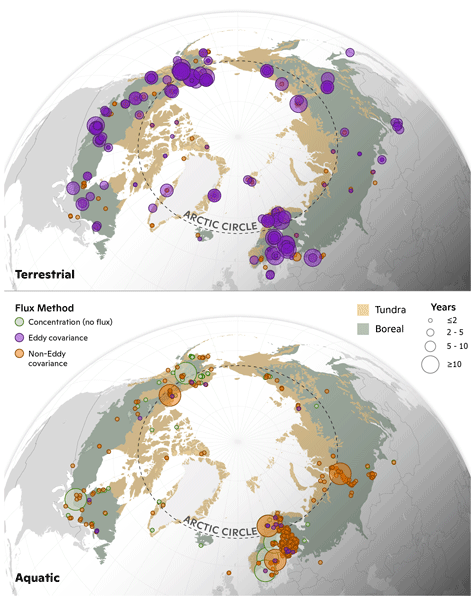
This dataset includes monthly measurements of carbon dioxide and methane exchange between land, water, and the atmosphere from over 1,000 sites in Arctic and boreal regions. It combines measurements from a variety of ecosystems, including wetlands, forests, tundra, lakes, and rivers, gathered by over 260 researchers from 1984–2024. This dataset can be used to improve and reduce uncertainty in carbon budgets in order to strengthen our understanding of climate feedbacks in a warming world.
Guy Sapir, Alon Angert, Yoav Oved Rosenberg, and Rotem Golan
EGUsphere, https://doi.org/10.5194/egusphere-2025-2763, https://doi.org/10.5194/egusphere-2025-2763, 2025
Short summary
Short summary
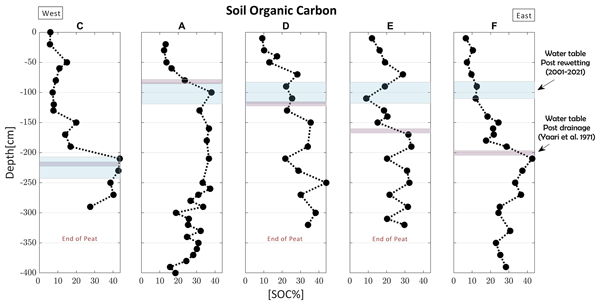
Peatland drainage causes over 3.5 % of global anthropogenic GHG emissions, with ~75 % from warm climates. This study examines a drained and partially rewetted warm-climate wetland. Over 66 years, drainage caused ~70 % loss of soil organic matter and substantial CO2 emissions. Rewetting, initiating ~30 years ago, helped preserve organic matter. Yet, long-term data and modeling shows a limited window for its effectiveness, highlighting the need to prioritize sites based on time since drainage.
Alexie Roy-Lafontaine, Rebecca Lee, Peter M. J. Douglas, Dustin Whalen, and André Pellerin
EGUsphere, https://doi.org/10.5194/egusphere-2025-2570, https://doi.org/10.5194/egusphere-2025-2570, 2025
Short summary
Short summary
As Arctic coastlines change with the climate, we studied how these changes might affect methane release, a powerful greenhouse gas. We found that coastal sediments can produce a lot of methane, even when exposed to seawater, which was thought to prevent it. This suggests that Arctic coasts could be an overlooked source of methane to the atmosphere as the climate continues to warm and sea levels rise.
Tal Weiner, Yoav O. Rosenberg, and Alon Angert
EGUsphere, https://doi.org/10.5194/egusphere-2025-2774, https://doi.org/10.5194/egusphere-2025-2774, 2025
Preprint archived
Short summary
Short summary
Soil organic matter stores most of the terrestrial carbon, and changes in this storage can have a significant effect on the global carbon cycle. Here we estimated the long-term soil organic matter stability by measuring emission products from soil pyrolysis and measured the respiratory carbon dioxide and oxygen fluxes in soil incubations at different temperatures, to learn about the short-term processes, and to achieve a more complete understanding of the state of the organic matter in the soil.
Hanni Vigderovich, Werner Eckert, Michal Elul, Maxim Rubin-Blum, Marcus Elvert, and Orit Sivan
Biogeosciences, 19, 2313–2331, https://doi.org/10.5194/bg-19-2313-2022, https://doi.org/10.5194/bg-19-2313-2022, 2022
Short summary
Short summary
Anaerobic oxidation of methane (AOM) is one of the major processes limiting the release of the greenhouse gas methane from natural environments. Here we show that significant AOM exists in the methane zone of lake sediments in natural conditions and even after long-term (ca. 18 months) anaerobic slurry incubations with two stages. Methanogens were most likely responsible for oxidizing the methane, and humic substances and iron oxides are likely electron acceptors to support this oxidation.
McKenzie A. Kuhn, Ruth K. Varner, David Bastviken, Patrick Crill, Sally MacIntyre, Merritt Turetsky, Katey Walter Anthony, Anthony D. McGuire, and David Olefeldt
Earth Syst. Sci. Data, 13, 5151–5189, https://doi.org/10.5194/essd-13-5151-2021, https://doi.org/10.5194/essd-13-5151-2021, 2021
Short summary
Short summary
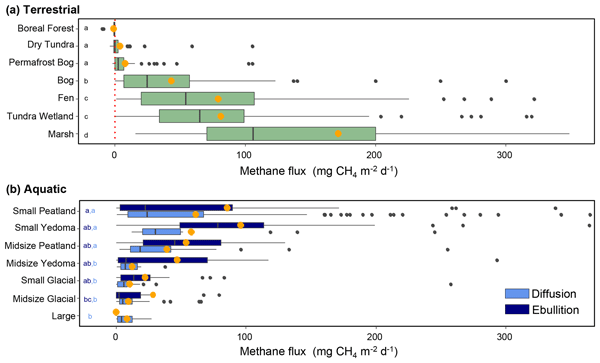
Methane (CH4) emissions from the boreal–Arctic region are globally significant, but the current magnitude of annual emissions is not well defined. Here we present a dataset of surface CH4 fluxes from northern wetlands, lakes, and uplands that was built alongside a compatible land cover dataset, sharing the same classifications. We show CH4 fluxes can be split by broad land cover characteristics. The dataset is useful for comparison against new field data and model parameterization or validation.
Lydia Stolpmann, Caroline Coch, Anne Morgenstern, Julia Boike, Michael Fritz, Ulrike Herzschuh, Kathleen Stoof-Leichsenring, Yury Dvornikov, Birgit Heim, Josefine Lenz, Amy Larsen, Katey Walter Anthony, Benjamin Jones, Karen Frey, and Guido Grosse
Biogeosciences, 18, 3917–3936, https://doi.org/10.5194/bg-18-3917-2021, https://doi.org/10.5194/bg-18-3917-2021, 2021
Short summary
Short summary
Our new database summarizes DOC concentrations of 2167 water samples from 1833 lakes in permafrost regions across the Arctic to provide insights into linkages between DOC and environment. We found increasing lake DOC concentration with decreasing permafrost extent and higher DOC concentrations in boreal permafrost sites compared to tundra sites. Our study shows that DOC concentration depends on the environmental properties of a lake, especially permafrost extent, ecoregion, and vegetation.
Frederic Thalasso, Katey Walter Anthony, Olya Irzak, Ethan Chaleff, Laughlin Barker, Peter Anthony, Philip Hanke, and Rodrigo Gonzalez-Valencia
Hydrol. Earth Syst. Sci., 24, 6047–6058, https://doi.org/10.5194/hess-24-6047-2020, https://doi.org/10.5194/hess-24-6047-2020, 2020
Short summary
Short summary
Methane (CH4) seepage is the steady or episodic flow of gaseous hydrocarbons from subsurface reservoirs that has been identified as a significant source of atmospheric CH4. The monitoring of these emissions is important and despite several available methods, large macroseeps are still difficult to measure due to a lack of a lightweight and inexpensive method deployable in remote environments. Here, we report the development of a mobile chamber for measuring intense CH4 macroseepage in lakes.
Cited articles
Behar, F., Beaumont, V., and De B. Penteado, H. L.: Rock-Eval 6 Technology: Performances and Developments, Oil & Gas Science and Technology – Rev. IFP, 56, 111–134, https://doi.org/10.2516/ogst:2001013, 2001.
Berberish, M. E., Beaulieu, J. J., Hamilton, T. L., Waldo, S., and Buffam, I.: the spatial of sediment methane production communities within ta eutrophic reservoir: Imoportance of organic matter source and quantity, Limnology and Oceanography, 65, 1336–1358, https://doi.org/10.1002/lno.11392, 2020.
Carrie, J., Sanei, H., and Stern, G.: Standardisation of Rock–Eval pyrolysis for the analysis of recent sediments and soils, Organic Geochemistry, 46, 38–53, https://doi.org/10.1016/j.orggeochem.2012.01.011, 2012.
de Jong, A. E. E., In 'T Zandt, M. H., Meisel, O. H., Jetten, M. S. M., Dean, J. F., Rasigraf, O., and Welte, C. U.: Increases in temperature and nutrient availability positively affect methane-cycling microorganisms in Arctic thermokarst lake sediments, Environmental Microbiology, 20, 4314–4327, https://doi.org/10.1111/1462-2920.14345, 2018.
Dickens, G. R., Koelling, M., Smith, D. C., Schnieders, L., and the IODP Expedition 302 Scientists: Rhizon Sampling of Pore Waters on Scientific Drilling Expeditions: An Example from the IODP Expedition 302, Arctic Coring Expedition (ACEX), Sci. Dril., 4, 22–25, https://doi.org/10.2204/iodp.sd.4.08.2007, 2007.
Douglas, T. A., Turetsky, R. T., and Koven, C. D.: Increased rainfall stimulates permafrost thaw across a variety of Interior Alaskan Boreal ecosystems, Climate and Atmospheric Science, 3, https://doi.org/10.1038/s41612-020-0130-4, 2020.
Dutta, K., Schuur, E. A. G., Neff, J. C., and Zimov, S. A.: Potential carbon release from permafrost soils of Northeastern Siberia, Global Change Biology, 12, 2336–2351, https://doi.org/10.1111/j.1365-2486.2006.01259.x, 2006.
Elder, C. D., Thompson, D. R., Thorpe, A. K., Chandanpurkar, H. A., Hanke, P. J., Hasson, N., James, S. R., Minsley, B. J., Pastick, N. J., Olefeldt, D., Walter Anthony, K. M., and Miller, C. E.: Characterizing Methane Emission Hotspots From Thawing Permafrost, Global Biogeochemical Cycles, 35, e2020GB006922, https://doi.org/10.1029/2020GB006922, 2021.
Emond, A. M., Daanen, R. P., Graham, G. R. C., Anthony, K. W., Liljedahl, A. K., Minsley, B. J., Barnes, D. L., Romanovsky, V. E., and CGG Canada Services Ltd.: Airborne electromagnetic and magnetic survey, Goldstream Creek watershed, interior Alaska, Alaska Division of Geological & Geophysical Surveys, https://doi.org/10.14509/29681, 2018.
Estop-Aragonés, C., Olefeldt, D., Abbott, B. W., Chanton, J. P., Czimczik, C. I., Dean, J. F., Egan, J. E., Gandois, L., Garnett, M. H., Hartley, I. P., Hoyt, A., Lupascu, M., Natali, S. M., O'Donnell, J. A., Raymond, P. A., Tanentzap, A. J., Tank, S. E., Schuur, E. A. G., Turetsky, M., and Anthony, K. W.: Assessing the Potential for Mobilization of Old Soil Carbon After Permafrost Thaw: A Synthesis of 14C Measurements From the Northern Permafrost Region, Global Biogeochemical Cycles, 34, e2020GB006672, https://doi.org/10.1029/2020GB006672, 2020.
Farquharson, L., Anthony, K. W., Bigelow, N., Edwards, M., and Grosse, G.: Facies analysis of Yedoma thermokarst lakes on the northern Seward Peninsula, Alaska, Sedimentary Geology, 340, 25–37, https://doi.org/10.1016/j.sedgeo.2016.01.002, 2016.
Freitas, N. L., Walter Anthony, K., Lenz, J., Porras, R. C., and Torn, M. S.: Substantial and overlooked greenhouse gas emissions from deep Arctic lake sediment, Nat. Geosci., 18, 65–71, https://doi.org/10.1038/s41561-024-01614-y, 2025.
Hasson, N., Walter Anthony, K. M., Elder, C., Baptiste, D., Miller, C. E., Kholodov, A. L., Rybakov, S., Anthony, P., and Daanen, R. P.: Methane emissions show exponential inverse relationship with electrical resistivityfrom discontinuous permafrost wetlands in Alaska, AGU Fall Meeting 2022, Chicago, https://ui.adsabs.harvard.edu/abs/2022AGUFM.B15E..06H/abstract (last access: 15 July 2024), 2022.
Heslop, J. K., Walter Anthony, K. M., Sepulveda-Jauregui, A., Martinez-Cruz, K., Bondurant, A., Grosse, G., and Jones, M. C.: Thermokarst lake methanogenesis along a complete talik profile, Biogeosciences, 12, 4317–4331, https://doi.org/10.5194/bg-12-4317-2015, 2015.
Hopkins, D. M.: Thaw Lakes and Thaw Sinks in the Imuruk Lake Area, Seward Peninsula, Alaska, The Journal of Geology, 57, 119–131, https://doi.org/10.1086/625591, 1949.
Hugelius, G., Strauss, J., Zubrzycki, S., Harden, J. W., Schuur, E. A. G., Ping, C.-L., Schirrmeister, L., Grosse, G., Michaelson, G. J., Koven, C. D., O'Donnell, J. A., Elberling, B., Mishra, U., Camill, P., Yu, Z., Palmtag, J., and Kuhry, P.: Estimated stocks of circumpolar permafrost carbon with quantified uncertainty ranges and identified data gaps, Biogeosciences, 11, 6573–6593, https://doi.org/10.5194/bg-11-6573-2014, 2014.
Kessler, M. A., Plug, L. J., and Walter Anthony, K. M.: Simulating the decadal- to millennial-scale dynamics of morphology and sequestered carbon mobilization of two thermokarst lakes in NW Alaska, J. Geophys. Res., 117, 2011JG001796, https://doi.org/10.1029/2011JG001796, 2012.
Knoblauch, C., Beer, C., Liebner, S., Grigoriev, M. N., and Pfeiffer, E.-M.: Methane production as key to the greenhouse gas budget of thawing permafrost, Nat. Clim. Change, 8, 309–312, https://doi.org/10.1038/s41558-018-0095-z, 2018.
Krause, S. J. E. and Treude, T.: Deciphering cryptic methane cycling: Coupling of methylotrophic methanogenesis and anaerobic oxidation of methane in hypersaline coastal wetland sediment, Geochimica et Cosmochimica Acta, 302, 160–174, https://doi.org/10.1016/j.gca.2021.03.021, 2021.
Liu, J., Young, E. D., Pellerin, A., Ash, J. L., Barrett, G., Feng, X., Girguis, P. R., Krause, S. J. E., Leavitt, W. D., Murphy, K., Qin, Q., Teske, A., Valentine, D. L., Anthony, K. W., and Treude, T.: Clumped isotopes of methane trace bioenergetics in the environment, Science Advances, 11, https://doi.org/10.1126/sciadv.adu1401, 2025.
Lotem, N., Pellerin, A., Anthony, K. W., Gafni, A., Boyko, V., and Sivan, O.: Anaerobic oxidation of methane does not attenuate methane emissions from thermokarst lakes, Limnology & Oceanography, 68, 1316–1330, https://doi.org/10.1002/lno.12349, 2023.
Maltby, J., Sommer, S., Dale, A. W., and Treude, T.: Microbial methanogenesis in the sulfate-reducing zone of surface sediments traversing the Peruvian margin, Biogeosciences, 13, 283–299, https://doi.org/10.5194/bg-13-283-2016, 2016.
Martinez-Cruz, K., Sepulveda-Jauregui, A., Casper, P., Anthony, K. W., Smemo, K. A., and Thalasso, F.: Ubiquitous and significant anaerobic oxidation of methane in freshwater lake sediments, Water Research, 144, 332–340, https://doi.org/10.1016/j.watres.2018.07.053, 2018.
Obu, J.: How Much of the Earth's Surface is Underlain by Permafrost?, J. Geophys. Res. Earth Surface, 126, e2021JF006123, https://doi.org/10.1029/2021JF006123, 2021.
Olefeldt, D., Goswami, S., Grosse, G., Hayes, D., Hugelius, G., Kuhry, P., McGuire, A. D., Romanovsky, V. E., Sannel, A. B. K., Schuur, E. A. G., and Turetsky, M. R.: Circumpolar distribution and carbon storage of thermokarst landscapes, Nat. Commun., 7, 13043, https://doi.org/10.1038/ncomms13043, 2016.
Pellerin, A., Lotem, N., Walter Anthony, K., Eliani Russak, E., Hasson, N., Røy, H., Chanton, J. P., and Sivan, O.: Methane production controls in a young thermokarst lake formed by abrupt permafrost thaw, Global Change Biology, 28, 3206–3221, https://doi.org/10.1111/gcb.16151, 2022.
Péwé, T. L.: Quaternary geology of Alaska, United States Department of the Interior, Geological Survey, https://doi.org/10.3133/pp835, 1975.
Post, E., Alley, R. B., Christensen, T. R., Macias-Fauria, M., Forbes, B. C., Gooseff, M. N., Iler, A., Kerby, J. T., Laidre, K. L., Mann, M. E., Olofsson, J., Stroeve, J. C., Ulmer, F., Virginia, R. A., and Wang, M.: The polar regions in a 2 °C warmer world, Sci. Adv., 5, eaaw9883, https://doi.org/10.1126/sciadv.aaw9883, 2019.
Schädel, C., Schuur, E. A. G., Bracho, R., Elberling, B., Knoblauch, C., Lee, H., Luo, Y., Shaver, G. R., and Turetsky, M. R.: Circumpolar assessment of permafrost C quality and its vulnerability over time using long-term incubation data, Global Change Biology, 20, 641–652, https://doi.org/10.1111/gcb.12417, 2014.
Schuur, E. A. G., McGuire, A. D., Schädel, C., Grosse, G., Harden, J. W., Hayes, D. J., Hugelius, G., Koven, C. D., Kuhry, P., Lawrence, D. M., Natali, S. M., Olefeldt, D., Romanovsky, V. E., Schaefer, K., Turetsky, M. R., Treat, C. C., and Vonk, J. E.: Climate change and the permafrost carbon feedback, Nature, 520, 171–179, https://doi.org/10.1038/nature14338, 2015.
Sepulveda-Jauregui, A., Walter Anthony, K. M., Martinez-Cruz, K., Greene, S., and Thalasso, F.: Methane and carbon dioxide emissions from 40 lakes along a north–south latitudinal transect in Alaska, Biogeosciences, 12, 3197–3223, https://doi.org/10.5194/bg-12-3197-2015, 2015.
Shaver, G. R., Giblin, A. E., Nadelhoffer, K. J., Thieler, K. K., Downs, M. R., Laundre, J. A., and Rastetter, E. B.: Carbon turnover in Alaskan tundra soils: effects of organic matter quality, temperature, moisture and fertilizer, Journal of Ecology, 94, 740–753, https://doi.org/10.1111/j.1365-2745.2006.01139.x, 2006.
Sivan, O., Adler, M., Pearson, A., Gelman, F. , Bar-Or, I., John, S. G., and Eckert W.: Geochemical evidence for iron-mediated anaerobic oxidation of methane, Limnology and Oceanography, 56, 4, 1536-1544, https://doi.org/10.4319/lo.2011.56.4.1536, 2011.
Strauss, J., Schirrmeister, L., Grosse, G., Wetterich, S., Ulrich, M., Herzschuh, U., and Hubberten, H.: The deep permafrost carbon pool of the Yedoma region in Siberia and Alaska, Geophysical Research Letters, 40, 6165–6170, https://doi.org/10.1002/2013GL058088, 2013.
Turetsky, M. R., Abbott, B. W., Jones, M. C., Anthony, K. W., Olefeldt, D., Schuur, E. A. G., Grosse, G., Kuhry, P., Hugelius, G., Koven, C., Lawrence, D. M., Gibson, C., Sannel, A. B. K., and McGuire, A. D.: Carbon release through abrupt permafrost thaw, Nat. Geosci., 13, 138–143, https://doi.org/10.1038/s41561-019-0526-0, 2020.
Wagner, D., Gattinger, A., Embacher, A., Pfeiffer, E., Schloter, M., and Lipski, A.: Methanogenic activity and biomass in Holocene permafrost deposits of the Lena Delta, Siberian Arctic and its implication for the global methane budget, Global Change Biology, 13, 1089–1099, https://doi.org/10.1111/j.1365-2486.2007.01331.x, 2007.
Walter Anthony, K. M., Zimov, S. A., Grosse, G., Jones, M. C., Anthony, P. M., Iii, F. S. C., Finlay, J. C., Mack, M. C., Davydov, S., Frenzel, P., and Frolking, S.: A shift of thermokarst lakes from carbon sources to sinks during the Holocene epoch, Nature, 511, 452–456, https://doi.org/10.1038/nature13560, 2014.
Walter Anthony, K., Schneider von Deimling, T., Nitze, I., et al.: 21st-century modeled permafrost carbon emissions accelerated by abrupt thaw beneath lakes, Nat. Commun., 9, 3262, https://doi.org/10.1038/s41467-018-05738-9, 2018.
Whiticar, M. J.: Carbon and Hydrogen Isotope Systematics of Bacterial Formation and Oxidation of Methane, Chemical Geology, 161, 291–314, https://doi.org/10.1016/S0009-2541(99)00092-3, 1999.
Whiticar, M. J., Faber, E., and Schoell, M.: Biogenic Methane Formation in Marine and Freshwater Environments: CO2 Reduction vs. Acetate Fermentation – Isotope Evidence,Geochimica et Cosmochimica Acta, 50, 693–709, https://doi.org/10.1016/0016-7037(86)90346-7, 1986.
Zhang, T., Barry, R. G., Knowles, K., Heginbottom, J. A., and Brown, J.: Statistics and characteristics of permafrost and ground-ice distribution in the Northern Hemisphere, Polar Geography, 31, 47–68, https://doi.org/10.1080/10889370802175895, 2008.
Zimov, S. A., Voropaev, Y. V., Semiletov, I. P., Davidov, S. P., Prosiannikov, S. F., Chapin, F. S., Chapin, M. C., Trumbore, S., and Tyler, S.: North Siberian Lakes: A Methane Source Fueled by Pleistocene Carbon, Science, 277, 800–802, https://doi.org/10.1126/science.277.5327.800, 1997.
Short summary
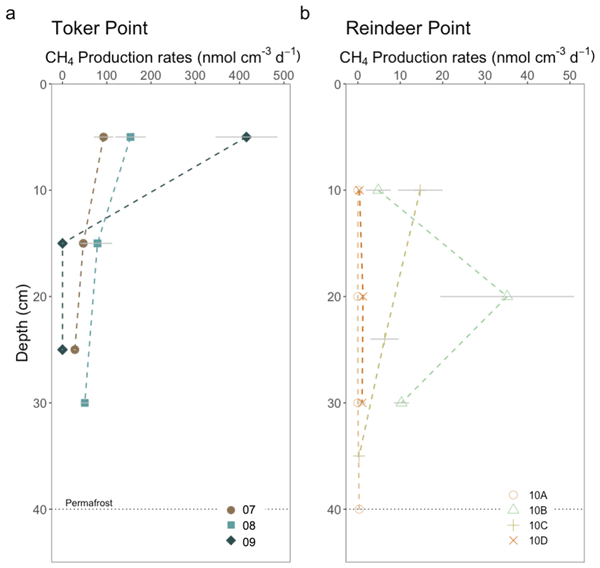
Thermokarst lakes have formed over thousands of years from permafrost thaw in the Arctic. Here, we quantify the change in methane production rates as thermokarst lakes evolve through an incubation-based approach of measuring and comparing methane production rates and organic carbon lability between a more mature thermokarst lake and a young dynamic thermokarst lake. We also show the use of the Rock-Eval analysis of organic carbon along the sediments as a proxy for organic susceptibility for methanogenesis.
Thermokarst lakes have formed over thousands of years from permafrost thaw in the Arctic. Here,...
Altmetrics
Final-revised paper
Preprint