
Articles | Volume 23, issue 3
https://doi.org/10.5194/bg-23-1181-2026
© Author(s) 2026. This work is distributed under
the Creative Commons Attribution 4.0 License.
the Creative Commons Attribution 4.0 License.
https://doi.org/10.5194/bg-23-1181-2026
© Author(s) 2026. This work is distributed under
the Creative Commons Attribution 4.0 License.
the Creative Commons Attribution 4.0 License.
Research article
| Highlight paper
| 
10 Feb 2026
Research article | Highlight paper |
| 10 Feb 2026
| 10 Feb 2026
An unpredictable body size response to the Permo-Triassic climate crisis
William J. Foster
CORRESPONDING AUTHOR
Department for Earth System Sciences, Universität Hamburg, Hamburg, Germany
Herwig Prinoth
Museum Ladin Ciastel de Tor, San Martin de Tor, Italy
Evelyn Kustatscher
Tirolerlandesmuseen, Department of Natural History, Innsbruck, Austria
Michael Hautmann
Department of Paleontology, University of Zürich, Zürich, Switzerland
Related authors
Simon M. Schad, Denise K. Kulhanek, Jiří Bárta, Stella Z. Buchwald, Sten-Andreas Grundvåg, William J. Foster, Mads E. Jelby, Morgan T. Jones, Luke Marsden, Sverre Planke, Kasia K. Śliwińska, Aleksandra Smyrak-Sikora, Lidya G. Tarhan, Madeleine L. Vickers, Valentin Zuchuat, and Kim Senger
Earth Syst. Sci. Data Discuss., https://doi.org/10.5194/essd-2026-487, https://doi.org/10.5194/essd-2026-487, 2026
Preprint under review for ESSD
Short summary
Short summary
This study gathers ancient climate data from Svalbard, a Norwegian Arctic archipelago. Its rocks preserve a 540-million-year record of major extinctions and warming events. Researchers compiled scattered data into organized, open-access packages covering chemical markers and fossils. These resources help scientists understand Arctic responses to rapid climate change, which is vital for improving future predictions and supporting new research.
Aleksandra Smyrak-Sikora, Peter Betlem, Victoria S. Engelschiøn, William J. Foster, Sten-Andreas Grundvåg, Mads E. Jelby, Morgan T. Jones, Grace E. Shephard, Kasia K. Śliwińska, Madeleine L. Vickers, Valentin Zuchuat, Lars Eivind Augland, Jan Inge Faleide, Jennifer M. Galloway, William Helland-Hansen, Maria A. Jensen, Erik P. Johannessen, Maayke Koevoets, Denise Kulhanek, Gareth S. Lord, Tereza Mosociova, Snorre Olaussen, Sverre Planke, Gregory D. Price, Lars Stemmerik, and Kim Senger
Clim. Past, 21, 2133–2187, https://doi.org/10.5194/cp-21-2133-2025, https://doi.org/10.5194/cp-21-2133-2025, 2025
Short summary
Short summary
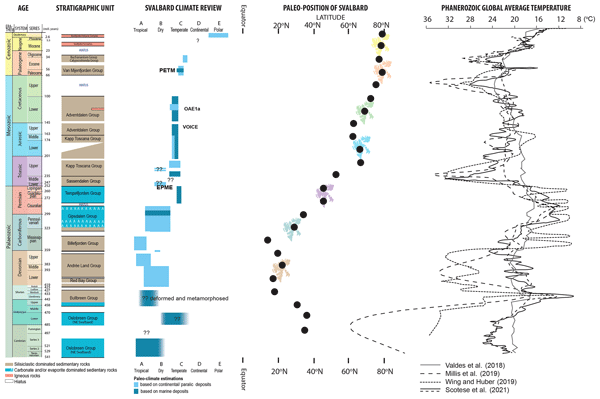
In this review article we present Svalbard’s unique geological archive, revealing its climate history over the last 540 million years. We uncover how this Arctic region recorded key global events, including the End-Permian Mass Extinction, and climate crises like the Paleocene–Eocene Thermal Maximum. The overall climate trend recorded in sedimentary successions in Svalbard is discussed in the context of global climate fluctuations and continuous drift of Svalbard from near equatorial to Arctic latitudes.
Kim Senger, Denise Kulhanek, Morgan T. Jones, Aleksandra Smyrak-Sikora, Sverre Planke, Valentin Zuchuat, William J. Foster, Sten-Andreas Grundvåg, Henning Lorenz, Micha Ruhl, Kasia K. Sliwinska, Madeleine L. Vickers, and Weimu Xu
Sci. Dril., 32, 113–135, https://doi.org/10.5194/sd-32-113-2023, https://doi.org/10.5194/sd-32-113-2023, 2023
Short summary
Short summary
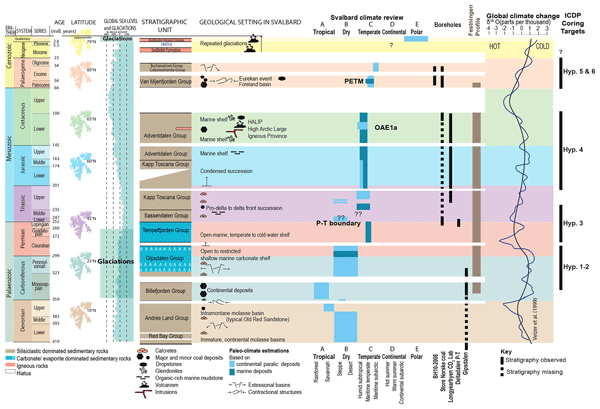
Geologists can decipher the past climates and thus better understand how future climate change may affect the Earth's complex systems. In this paper, we report on a workshop held in Longyearbyen, Svalbard, to better understand how rocks in Svalbard (an Arctic archipelago) can be used to quantify major climatic shifts recorded in the past.
Simon M. Schad, Denise K. Kulhanek, Jiří Bárta, Stella Z. Buchwald, Sten-Andreas Grundvåg, William J. Foster, Mads E. Jelby, Morgan T. Jones, Luke Marsden, Sverre Planke, Kasia K. Śliwińska, Aleksandra Smyrak-Sikora, Lidya G. Tarhan, Madeleine L. Vickers, Valentin Zuchuat, and Kim Senger
Earth Syst. Sci. Data Discuss., https://doi.org/10.5194/essd-2026-487, https://doi.org/10.5194/essd-2026-487, 2026
Preprint under review for ESSD
Short summary
Short summary
This study gathers ancient climate data from Svalbard, a Norwegian Arctic archipelago. Its rocks preserve a 540-million-year record of major extinctions and warming events. Researchers compiled scattered data into organized, open-access packages covering chemical markers and fossils. These resources help scientists understand Arctic responses to rapid climate change, which is vital for improving future predictions and supporting new research.
Aleksandra Smyrak-Sikora, Peter Betlem, Victoria S. Engelschiøn, William J. Foster, Sten-Andreas Grundvåg, Mads E. Jelby, Morgan T. Jones, Grace E. Shephard, Kasia K. Śliwińska, Madeleine L. Vickers, Valentin Zuchuat, Lars Eivind Augland, Jan Inge Faleide, Jennifer M. Galloway, William Helland-Hansen, Maria A. Jensen, Erik P. Johannessen, Maayke Koevoets, Denise Kulhanek, Gareth S. Lord, Tereza Mosociova, Snorre Olaussen, Sverre Planke, Gregory D. Price, Lars Stemmerik, and Kim Senger
Clim. Past, 21, 2133–2187, https://doi.org/10.5194/cp-21-2133-2025, https://doi.org/10.5194/cp-21-2133-2025, 2025
Short summary
Short summary
In this review article we present Svalbard’s unique geological archive, revealing its climate history over the last 540 million years. We uncover how this Arctic region recorded key global events, including the End-Permian Mass Extinction, and climate crises like the Paleocene–Eocene Thermal Maximum. The overall climate trend recorded in sedimentary successions in Svalbard is discussed in the context of global climate fluctuations and continuous drift of Svalbard from near equatorial to Arctic latitudes.
Kim Senger, Denise Kulhanek, Morgan T. Jones, Aleksandra Smyrak-Sikora, Sverre Planke, Valentin Zuchuat, William J. Foster, Sten-Andreas Grundvåg, Henning Lorenz, Micha Ruhl, Kasia K. Sliwinska, Madeleine L. Vickers, and Weimu Xu
Sci. Dril., 32, 113–135, https://doi.org/10.5194/sd-32-113-2023, https://doi.org/10.5194/sd-32-113-2023, 2023
Short summary
Short summary
Geologists can decipher the past climates and thus better understand how future climate change may affect the Earth's complex systems. In this paper, we report on a workshop held in Longyearbyen, Svalbard, to better understand how rocks in Svalbard (an Arctic archipelago) can be used to quantify major climatic shifts recorded in the past.
Cited articles
Albano, P. G., Schultz, L., Wessely, J., Taviani, M., Dullinger, S., and Danise, S.: The dawn of the tropical Atlantic invasion into the Mediterranean Sea, P. Natl. Acad. Sci. USA, 121, e2320687121, https://doi.org/10.1073/pnas.2320687121, 2024.
Algeo, T. J. and Twitchett, R. J.: Anomalous Early Triassic sediment fluxes due to elevated weathering rates and their biological consequences, Geology, 38, 1023–1026, 2010.
Atkinson, J. W., Wignall, P. B., Morton, J. D., and Aze, T.: Body size changes in bivalves of the family Limidae in the aftermath of the end-Triassic mass extinction: the Brobdingnag effect, Palaeontology, 62, 561–582, 2019.
Bomfleur, B., Blomenkemper, P., Kerp, H., and McLoughlin, S.: Polar regions of the Mesozoice-Paleogene Greenhouse World as Refugia for Relict Plant Groups, in: Transformative Paleobotany, edited by: Krings, M., Harper, C. J., Rubén Cúneo, N., and Rothwell, G. W., 593–611, ISBN: 978-0-12-813012-4, 2018.
Bond, D. P. G., Wignall, P. B., Joachimski, M. M., Sun, Y., Savov, I., Grasby, S. E., Beauchamp, B., and Blomeier, D. P. G.: An abrupt extinction in the Middle Permian (Capitanian) of the Boreal Realm (Spitsbergen) and its link to anoxia and acidification, GSA Bulletin, 127, 1411–1421, 2015.
Bosellini, A., Gianolla, P., and Stefani, M.: Geology of the Dolomites, Episodes, 26, 181–185, 2003.
Brand, U., Posenato, R., Came, R., Affek, H., Angiolini L., Azmy, K., and Farabegoli, E.: The end-Permian mass extinction: A rapid volcanic CO2 and CH4-climatic catastrophe, Chemical Geology, 322–323, 121–144, 2012.
Brandner, R., Horacek, M., Keim, L., and Scholger, R.: The Pufels/Bulla road section: deciphering environmental changes across the Permian-Triassic boundary to the Olenekian by integrated litho-, magneto-and isotope stratigraphy. A field trip guide, Geo. Alp, 6, 116–132, 2009.
Brayard, A., Nützel, A., Stephem, D. A., Bylund, K. G., Jenks, J., and Bucher, H.: Gastropod evidence against the Early Triassic Lilliput effect, Geology, 38, 147–150, 2010.
Brayard, A., Meier, M., Escarguel, G., Fara, E., Nützel, A., Olivier, N., Bylund, K., Jenks, J., Stephen, D., Hautmann, M., Vennin, E., and Bucher, H.: Early Triassic Gulliver gastropods: spatio-temporal distribution and significance for the biotic recovery after the end-Permian mass extinction, Earth-Science Reviews, 146, 31–64, 2015.
Broglio Loriga, C. and Mirabella, S.: Il genere Eumorphotis Bittner 1901 nella biostratigrafia dello Scitico, Formazione di Werfen (Dolomiti), Memorie di Scienze Geologiche 38, 245–281, 1986.
Broglio Loriga, C., Masetti, D., and Neri, C.: La Formazione di Werfen (Scitico) delle Dolomiti occidentali. Rivista Italiana di Paleontologia e Stratigrafia, 88, 501–598, 1983.
Broglio Loriga, C., Neri, C., and Posenato R.: The early Macrofaunas of the Werfen Formation and the Permian-Triassic boundary in the Dolomites (Southern Alps, Italy), Studi Trentini di Scienze Naturali, 62, 3–18, 1986.
Buchwald, S. Z., Birgel, D., Senger, K., Mosociova, T., Pei, Y., Frank, A. B., Galasso, F., Gómez Correa, M. A., Koşun, E., Karapunar, B., Wang, X., Kustatscher, E., Prinoth, H., Steinkrauss, R., Peckmann, J., and Foster, W. J.: Primary productivity blooms on the Barents Shelf, Svalbard, associated with the Permian–Triassic mass extinction, ESS Open Archive [preprint], https://doi.org/10.22541/essoar.174558961.14311943/v1, 2025.
Chen, Z.-Q. and Benton, M. J.: The timing and pattern of biotic recovery following the end-Permian mass extinction, Nature Geoscience, 5, 375–383, 2012.
Chen, J., Shen, S.-Z., Li, X.-H., Xu, Y.-G., Joachimski, M. M., Bowring, S. A., Erwin, D. H., Yuan, D.-X., Chen, B., Zhang, H., and Wang, Y.: High-resolution SIMS oxygen isotope analysis on conodont apatite from South China and implications for the end-Permian mass extinction, Palaeogeogr. Palaeocl., 448, 26–38, 2016.
Chen, J., Song, H., He, W., Tong, J., Wang, F., and Wu, S.: Size variation of brachiopods from the Late Permian through the Middle Triassic in South China: evidence for the Lilliput effect following the Permian-Triassic extinction, Palaeogeogr. Palaeocl., 519, 248–257, 2019.
Chu, D., Tong, J., Song, H., Benton, M. J., Song, H., Yu, J., Qiu, X., Huang, Y., and Tian, L.: Lilliput effect in freshwater ostracods during the Permian–Triassic extinction, Palaeogeogr. Palaeocl., 435, 38–52, 2015.
Clapham, M. E. and Renne P. R.: Flood basalts and mass extinctions, Annual Review of Earth and Planetary Sciences, 47, 275–303, 2019.
Daufresne, M., Lengfellner, K., and Sommer, U.: Global warming benefits the small in aquatic ecosystems, P. Natl. Acad. Sci. USA, 106, 12788–12793, 2009.
De Baets, K., Nätscher, P. S., Rita, P., Fara, E., Neige, P., Bardin, J., Dera, G., Duarte, l. V., Hughes, Z., Laschinger, P., García-Ramos, J. C., Piñuela, L., Übelacker, C., and Weis, R.: The impact of the Pliensbachian–Toarcian crisis on belemnite assemblages and size distribution, Swiss Journal of Palaeontology, 140, 25, https://doi.org/10.1186/s13358-021-00242-y, 2021.
De Baets, K., Jarochowska, E., Buchwald, S. Z., Klug, C., and Korn, D.: Lithology controls ammonoid size distributions, PALAIOS, 37, 1–11, 2022.
Dercourt, J., Gaetani, M., Vrielynck, B., Barrier, E., Biju-Duval, B., Bru-net, M. F., Cadet, J. P., Crasquin, S., and Sandulescu, M.: Atlas Peri-Tethys, Palaeogeographical Maps, Maps and explanatory notes, 1–269, 2000.
Farabegoli, E. and Perri, M. C.: Millennial physical events and the end-Permian mass mortality in the western Palaeotethys: Timing and primary causes, in: Earth and Life: Global Biodiversity, Extinction Intervals and Biogeographic Perturbations Through Time, Springer Netherlands, Dordrecht, 719–758, https://doi.org/10.1007/978-90-481-3428-1_24, 2012.
Farabegoli, E., Perri, M., and Posenato, R.: Environmental and biotic changes across the Permian–Triassic boundary in western Tethys: the Bulla parastratotype, Italy, Glob. Planet. Chang., 55, 109–135, 2007.
Feng, Y., Song, H., and Bond, D. P. G.: Size variations in foraminifers from the early Permian to the Late Triassic: implications for the Guadalupian–Lopingian and the Permian–Triassic mass extinctions, Paleobiology, 46, 511–532, 2020.
Forel, M.-B., Crasquin, S., Chitnarin, A., Angiolini, L., and Gaetani, M.: Precocious sexual dimorphism and the Lilliput effect in Neo-Tethyan Ostracoda (Crustacea) through the Permian-Triassic boundary, Palaeontology, 58, 409–454, 2015.
Foster, W.: An unpredictable body size response to the Permo-Triassic climate crisis, Zenodo [code and data set], https://doi.org/10.5281/zenodo.18380698, 2026.
Foster, W. J., Danise, S., Price, G. D., and Twitchett, R. J.: Subsequent biotic crises delayed marine recovery following the late Permian mass extinction event in northern Italy, PLoS One, 12, e0172321, https://doi.org/10.1371/journal.pone.0172321, 2017.
Foster, W. J., Lehrmann, D. J., Hirtz, J. A., White, M., Yu, M., Li, J., and Martindale, R. C.: Early Triassic benthic invertebrates from the Great Bank of Guizhou, South China: systematic palaeontology and palaeobiology, Papers in Palaeontology 5, 613–656, 2019.
Foster, W. J., Gliwa, J., Lembke, C., Pugh, A., Hofmann, R., Tietje, M., Varela, S., Korn, D., and Aberhan, M.: Evolutionary and ecophenotypic controls on bivalve body size distributions following the end-Permian mass extinction, Global and Planetary Change, 185, 103088, https://doi.org/10.1016/j.gloplacha.2019.103088, 2020.
Foster, W. J., Allen, B. J., Kitzmann, N. H., Münchmeyer, J., Rettelbach, T., Witts, J. D., Whittle, R. J., Larina, E., Clapham, M. E., and Dunhill, A. M.: How predictable are mass extinction events?, Royal Society Open Science, 10, 221507, https://doi.org/10.1098/rsos.221507, 2023a.
Foster, W. J., Asatryan, G., Rauzi, S., Botting, J. P., Buchwald. S. Z., Lazarus, D. B., Isson, T., Renaudie, J., and Kiessling, W.: Response of siliceous marine organisms to the Permian-Triassic climate crisis based on new findings from central Spitsbergen, Svalbard, Paleoceanography and Paleoclimatology, 38, e2023PA004766, https://doi.org/10.1029/2023PA004766, 2023b.
Foster, W. J., Frank, A. B., Li, Q., Danise, S., Wang, X., and Peckmann, J.: Thermal and nutrient stress drove Permian–Triassic shallow marine extinctions, Cambridge Prisms: Extinction, 2, e9, https://doi.org/10.1017/ext.2024.9, 2024.
Fraiser, M. L. and Bottjer, D. J.: When bivalves took over the world, Paleobiology, 33, 397–413, 2007.
Fraiser, M. L., Twitchett, R. J., Frederickson, J. A., Metcalfe, B., and Bottjer, D. J.: Gastropod evidence against the Early Triassic Lilliput effect: comment, Geology 39, e232–e232, 2011.
Frank, A. B., Warncke-Rüting, E., Grasby, S. E., Kustatscher, E., Prinoth, H., Poulton, S. W., Xiong, Y., Korn, D., Gliwa, J., and Foster, W. J.: Oxic conditions in shallow marine settings during the Permian-Triassic Mass Extinction, Earth ArXiv [preprint], https://doi.org/10.31223/X5K135, 2025.
Gliwa, J., Wiedenbeck, M., Schobben, M., Ullmann, C. V., Kiessling, W., Ghaderi, A., Struck, U., and Korn, D.: Gradual warming prior to the end-Permian mass extinction, Palaeontology, 65, e12621, https://doi.org/10.1111/pala.12621, 2022.
Godbold, A., Schoepfer, S., Shen, S.-Z., and Henderson, C. H.: Precarious ephemeral refugia during the earliest Triassic, Geology, 45, 607–610, 2017.
Gómez Correa, M. A., Frank, A., Wiedenbeck, M., Gliwa, J., Korn, D., Prinoth, H., Kustatscher, E., and Foster, W. J.: Insights into thermal stress during the Permian-Triassic mass extinction using ostracods from the Southern Alps (Italy), EGU General Assembly 2025, Vienna, Austria, 27 Apr–2 May 2025, EGU25-13354, https://doi.org/10.5194/egusphere-egu25-13354, 2025.
Groves, J. R., Rettori, R., Payne, J. L., Boyce, M. D., and Altiner, D.: End-Permian mass extinction of lagenide foraminifers in the southern Alps (northern Italy), Journal of Paleontology, 81, 415–434, 2007.
Hautmann, M., Bagherpour, B., Brosee, M., Frisk, Å., Hofmann, R., Baud, A., Nützel, A., Goudemand, N., and Bucher, H.: Competition in slow motion: the unusual case of benthic marine communities in the wake of the end-Permian mass extinction, Palaeontology, 58, 871–901, 2015.
He, W., Twitchett, R. J., Zhang, Y., Shi, G. R., Feng, Q.-L., Yu, J.-X., Wu, S.-B., and Peng, X.-F.: Controls on body size during the Late Permian mass extinction event, Geobiology, 8, 391–402, 2010.
He, W., Zhang, K., Yang, T., and Wu, S.: Morphological evolution of Claraia species from the Late Permian (Changhsingian) to the Early Triassic (Induan) and the response to the Permian–Triassic stressed environment, in: STRATI 2013, edited by: Rocha, R., Pais, J., Kullberg, J., and Finney, S., Springer Geology, 1159–1163, https://doi.org/10.1007/978-3-319-04364-7_197, 2014.
Hofmann, R., Hautmann, M., and Bucher, H.: Recovery dynamics of benthic marine communities from the Lower Triassic Werfen Formation, northern Italy, Lethaia, 48, 474–496, 2015.
Holser, W. T., Schönlaub, H. P., Boeckelmann, K., and Magaritz, M.: The Permian-Triassic of the Gartnerköfel-1 core (Carnic Alps, Austria): Synthesis and conclusions, Abh. Geol. B.-A., 45, 213–232, 1991.
Horacek, M., Brandner, R., and Abart, R.: Carbon isotope record of the P/T boundary and the Lower Triassic in the Southern Alps: Evidence for rapid changes in storage of organic carbon, Palaeogeogr. Palaeocl., 252, 347–354, 2007.
Huang, Y., Chen, Z.-Q., Roopnarine, P., Benton, M. J., Zhao, L., Feng, X., and Li, Z.: The stability and collapse of marine ecosystems during the Permian-Triassic mass extinction, Current Biology, 33, 1002–1011, 2023a.
Huang, Y., Tong, J., Tian, L., Song, H., Chu, D., Miao, X., and Song, T.: Temporal shell-size variations of bivalves in South China from the Late Permian to the Early Middle Triassic, Palaeogeogr. Palaeocl., 609, 111307, https://doi.org/10.1016/j.palaeo.2022.111307, 2023b.
Isson, T. T., Planavsky, N. J., Coogan, L. A., Stewart, E. M., Ague, J. J., Bolton, E. W., Zhang, S., McKenzie, N. R., and Kump, L. R.: Evolution of the Global Carbon Cycle and Climate Regulation on Earth, Global Biogeochemical Cycles, 34, e2018GB006061, https://doi.org/10.1029/2018GB006061, 2020.
Jarrett, M.: Lilliput Effect Dynamics across the Cretaceous-Paleogene Mass Extinction: Approaches, Prevalence, and Mechanisms, PhD thesis, University of South Florida, https://www.proquest.com/openview/ca73dfd305bb907ecb4992e89406ac9c/1?pq-origsite=gscholar&cbl=18750&casa_token=UDGPOXZBHnUAAAAA:CaDD6O3uxwMAZw1at-eNJTaKMPsXaKzCw5ox6lzbSESnj_Jw7TR-pz-RR8CBc_VLZG04KsdO4YNb (last access: 4 February 2026), 2016.
Jurikova, H., Gutjahr, M., Wallmann, K., Flögel, S., Liebetrau, V., Posenato, R., Angiolini, L., Garbelli, C., Brand, U., Wiedenbeck, M., and Eisenhauer, A.: Permian–Triassic mass extinction pulses driven by major marine carbon cycle perturbations, Nature Geoscience, 13, 745–750, 2020.
Karapunar, B., Wang, X., Frank, A. B., Gürsoy, M., Buchwald, S. Z., Gómez Correa, M. A., Liu, Z., Xu, X., Meng, L., Demir, D., Koşun, E., and Foster, W.: Environmental and ecological changes across the Permian–Triassic transition in Türkiye: integratingvirtual outcrop models and new fieldwork data, EarthArXiv [preprint], https://doi.org/10.31223/X5KQ9B, 2025a.
Karapunar, B., Wolniewicz, A. S., Romano, C., Osvárt, P., Rochín-Bañaga, H., Kustatscher, E., Buchwald, S. Z., Galasso, F., Davis, D., López-Arbarello, A., Prinoth, H., Bernardi, M., and Foster, W. J.: New insights into the extinction and recovery of marine vertebrates across the Permian-Triassic mass extinction event in the Dolomites, Southern Alps, Italy, BioRxiv [preprint], https://doi.org/10.1101/2025.08.23.671916, 2025b.
Kearsey, T., Twitchett, R. J., Price, G. D., and Grimes, S. T.: Isotope excursions and palaeotemperature estimates from the Permian/Triassic boundary in the Southern Alps (Italy), PPalaeogeogr. Palaeocl., 279, 29–40, 2009.
Kiessling, W., Schobben, M., Ghaderi, A., Hairapetian, V., Leda, L., and Korn, D.: Pre-mass extinction decline of latest Permian ammonoids, Geology, 46, 283–286, 2018.
Kocsis, A. T., Reddin, C. J., Aloy, J., and Kiessling, W.: The r package divDyn for quantifying diversity dynamics using fossil sampling data, Methods in Ecology and Evolution, 10, 765–746, 2018.
Kovács, S., Sudar, M., Grădinaru, E., Gawlick, H.-J., Karamata, S., Haas, J., Péró, C., Gaetani, M., Mell, J., Polák, M., Aljinović, D., Ogorelec, B., Kolar-Jurkovšek, T., Jurkovšek, B., and Buser, S.: Triassic Evolution of the Tectonostratigraphic Units of the Circum-Pannonian Region, Jb. Geol. B.-A., 151, 199–280, 2011.
Kruft Welton, R. A., Hoppit, G., Schmidt, D. N., Witts, J. D., and Moon, B. C.: Reviews and syntheses: The clam before the storm – a meta-analysis showing the effect of combined climate change stressors on bivalves, Biogeosciences, 21, 223–239, https://doi.org/10.5194/bg-21-223-2024, 2024.
Kump, L. R., Bralower T. J., and Ridgwell, A.: Ocean acidification in deep time, Oceanography, 22, 94–107, 2009.
Kustatscher, E., Novack, H., Bernardi, M., Krainer, K., Petti, F. M., Prinoth, H., Roghi, G., Preto, N., Tomasoni, R., Rigo, M., and Spötl, C.: The Permian-Triassic boundary and the end-Permian mass extinction in the southern and eastern Alps, Geo. Alp, 16, 73–76, 2019.
Lockwood, R.: Body size, extinction events, and the early Cenozoic record of veneroid bivalves: a new role for recoveries?, Paleobiology, 31, 578–590, 2005.
McRoberts, C. A.: Triassic bivalves and the initial marine Mesozoic revolution: a role for predators?, Geology, 29, 359–362, 2001.
Metcalfe, B., Twitchett, R. J., and Price-Lloyd, N.: Changes in size and growth rate of `Lilliput' animals in the earliest Triassic, Palaeogeogr. Palaeocl., 308, 171–180, 2011.
Mette, W. and Roozbahani, P.: Late Permian (Changsingian) ostracods of the Bellerophon Formation at Seis (Siusi) (Dolomites, Italy), Journal of Micropalaeontology, 31, 73–87, https://doi.org/10.1144/0262-821X11-010, 2012.
Monarrez, P. B., Heim, N. A., and Payne, J. L.: Mass extinctions alter extinction and origination dynamics with respect to body size, Proc. R. Soc. B, 288, 20211681, https://doi.org/10.1098/rspb.2021.1681, 2020.
Morten, S. D. and Twitchett, R. J.: Fluctuations in the body size of marine invertebrates through the Pliensbachian–Toarcian extinction event, Palaeogeogr. Palaeocl., 284, 29–38, 2009.
Muttoni, G., Gaetani, M., Kent, D. V., Sciunnach, D., Angiolini, L., Berra, F., Garzanti, E., Mattei, M., and Zanchi, A.: Opening of the Neo-Tethys Ocean and the Pangea B to Pangea A transformation during the Permian, GeoArabia, 14, 17–48, 2009.
Nakazawa, K.: Permian bivalves from West Spitsbergen, Svalbard islands, Norway, Paleontological Research, 3, 1–17, 1999.
Nakazawa, K. and Newell, N. D.: Permian bivalves of Japan, Memoirs of the Faculty of Science, Kyoto University, Series of Geology and Mineralogy, 35, 1–108, 1968.
Nakazawa, T., Ishida, N., Kato, M., and Yannamura, N.: Larger body size with higher predation rate, Ecology of Freshwater Fish, 16, 362–372, 2007.
Nätscher, P., Dera, G., Reddin, C. J., Rita, P., and De Baets, K.: Morphological response accompanying size reduction of belemnites during an Early Jurassic hyperthermal event modulated by life history, Scientific Reports, 11, 14480, https://doi.org/10.1038/s41598-021-93850-0, 2021.
Nätscher, P., Gliwa, J., De Baets, K., Ghaderi, A., and Korn, D.: Exceptions to the temperature–size rule: no Lilliput Effect in end-Permian ostracods (Crustacea) from Aras Valley (northwest Iran), Paleontology, 66, e12667, https://doi.org/10.1111/pala.12667, 2023.
Nätscher, P., De Baets, K., and Kiessling, W.: Unique fingerprint of marine ectotherm body size change during hyperthermal crises, biorXiv, https://doi.org/10.1101/2025.07.25.666730, 2025.
Neri, C. and Posenato, R.: New biostratigraphical data on uppermost Werfen Formation of western Dolomites (Trento, Italy), Geol. Paläont. Mitt. Innsbruck, 14, 83–107, 1985.
Newell, N. D. and Boyd, D. W.: Parallel evolution in early Trigoniacean bivalves, Bulletin of the American Museum of Natural History, 154, 57–158, 1975.
Nützel, A., Mannani, M., Senowbari-Daryan, B., and Yazdi, M.: Gastropods from the Late Triassic Nayband Formation (Iran), their relationships to other Tethyan faunas and remarks on the Triassic gastropod body size problem, N. Jb. Geol. Paläont. (Abh.), 256, 213–228, 2010.
Opazo, L. F. and Twitchett R. J.: Bivalve body-size distribution through the Late Triassic mass extinction event, Paleobiology, 48, 420–445, 2022.
Payne, J. L., Bush, A. M., Heim, N. A., Knope, M. L., and McCauley, D. J.: Ecological selectivity of the emerging mass extinction in the oceans, Science, 353, 1284–1288, 2016.
Payne, N. L. and Smith, J. A.: An alternative explanation for global trends in thermal tolerance, Ecology Letters, 20, 70–77, 2017.
Penn, J. L., Deutsch C., Payne J. J., and Sperling E. D.: Temperature-dependent hypoxia explains biogeography and severity of end-Permian marine mass extinction, Science, 362, 1130, https://doi.org/10.1126/science.aat1327, 2018.
Pérez-Valera, F., Pérez-López, A., Götz, A. E., Ros-Franch, S., Márquez-Aliaga, A., Baeza-Carratalá, J. F., and Pérez-Valera, J. A.: First record of Anisian deposits in the Betic External Zone of southern Spain and its paleogeographical implications, Sedimentary Geology, 449, 106374, https://doi.org/10.1016/j.sedgeo.2023.106374, 2023.
Piazza, V., Duarte, l. V., Renaudie, J., and Aberhan, M.: Reductions in body size of benthic macroinvertebrates as a precursor of the early Toarcian (Early Jurassic) extinction event in the Lusitanian Basin, Portugal, Paleobiology, 45, 296–316, 2019.
Piazza, V., Ullmann, C. V., and Aberhan, M.: Temperature-related body size change of marine benthic macroinvertebrates across the Early Toarcian Anoxic Event, Scientific Reports, 10, 4675, https://doi.org/10.1038/s41598-020-61393-5, 2020.
Pörtner, H.-O., Scholes, R. J., Arneth, A., Barnes, D. K. A., Burrows, M. T., Diamond, S. E., Duarte, C. M., Kiessling, W., Leadley, P., Managi, S., and McElwee, P.: Overcoming the coupled climate and biodiversity crises and their societal impacts, Science, 380, eabl4881, https://doi.org/10.1126/science.abl4881, 2023.
Posenato, R.: Tirolites (Ammonoidea) from the Dolomites, Bakony and Dalmatia: taxonomy and biostratigraphy, Eclogae Geol. Helv., 85, 893–929, 1992.
Posenato, R.: Global correlations of mid Early Triassic events: the Induan/Olenekian boundary in the Dolomites (Italy), Earth Sci. Rev., 91, 93–105, 2008.
Posenato, R.: Survival patterns of macrobenthic marine assemblages during the end-Permian mass extinction in the western Tethys (Dolomites, Italy), Palaeogeogr. Palaeocl., 280, 150–167, 2009.
Posenato, R.: The end-Permian mass extinction (EPME) and the Early Triassic biotic recovery in the western Dolomites (Italy): state of the art, Bollettino della Società Paleontologica Italiana, 58, 11–34, 2019.
Posenato, R., Pelikan, P., and Hips, K.: Bivalves and brachiopods near the Permian-Triassic boundary from Bükk Mountains (Balvany-North section, northern Hungary), Revista Italiana di Paleontologia e Stratigrafia, 111, 215–232, 2005.
Prinoth, H. and Posenato, R.: Bivalves from the Changhsingian (upper Permian) Bellerophon Formation of the Dolomites (Italy): ancestors of Lower Triassic post-extinction benthic communities, Papers in Palaeontology, 9, e1486, https://doi.org/10.1002/spp2.1486, 2023.
Qiu, Z., Song, H., Hu, C., Wignall, P. B., and Song, H.: Carbonate thermoluminescence and its implication for marine productivity change during the Permian–Triassic transition, Palaeogeogr. Palaeocl., 526, 72–79, 2019.
Rauzi, S., Foster, W. J., Takahashi, S., Hori, R. S., Beaty, B. J., Tarhan, L. G., and Isson, T. T.: Lithium isotopic evidence for enhanced reverse weathering during the Early Triassic warm period, P. Natl. Acad. Sci. USA, 121, e2318860121, https://doi.org/10.1073/pnas.2318860121, 2024.
R Core Team: R: A Language and Environment for Statistical Computing, R Foundation for Statistical Computing [data set], Vienna, Austria, https://www.R-project.org/ (last access: 4 February 2026), 2019.
Rego, B. L., Wang, S. C., Altiner, D., and Payne, J. L.: Within- and among-genus components of size evolution during mass extinction, recovery, and background intervals: a case study of Late Permian through Late Triassic foraminifera, Paleobiology, 38, 627–643, 2012.
Rita, P., Nätscher P., Duarte, L. V., Weis, R., and De Baets, K.: Mechanisms and drivers of belemnite body-size dynamics across the Pliensbachian–Toarcian crisis, Royal Society Open Science, 6, 190494, https://doi.org/10.1098/rsos.190494, 2019.
Romano, C., Goudemand, N., Vennemann, T. W., Ware, D., Schneebeli-Hermann, E., Hochuli, P. A., Brühwiler, T., Brinkmann, W., and Bucher, H.: Climatic and biotic upheavals following the end-Permian mass extinction, Nat. Geosci., 6, 57–60, 2012.
Sandoval-Castillo, J., Gates, K., Brauer, C. J., Smith, S., Bernatchez, L., and Beheregaray, B.: Adaptation of plasticity to projected maximum temperatures and across climatically defined bioregions, P. Natl. Acad. Sci. USA, 117, 17112–17121, 2020.
Scheyer, T. M., Romano, C., Jenks, J., and Bucher, H.: Early Triassic marine biotic recovery: the predators' perspective, PLoS One, 9, e88987, https://doi.org/10.1371/journal.pone.0088987, 2014.
Schobben, M., Joachimski, M. M., Korn, D., Leda, L., and Korte, C.: Palaeotethys seawater temperature rise and an intensified hydrological cycle following the end-Permian mass extinction, Gondwana Res., 26, 675–683, 2014.
Schubert, J. K. and Bottjer, D. J.: Aftermath of the Permian-Triassic mass extinction event: Paleoecology of lower Triassic carbonates in the western USA, Palaeogeogr. Palaeocl., 116, 1–39, 1995.
Shen, J., Schoepfer, S. D., Feng, Q., Zhou, L., Yu, J., Song, H., Wie, H., and Algeo, T. J.: Marine productivity changes during the end-Permian crisis and Early Triassic recovery, Earth-Science Reviews, 149, 136–162, 2015.
Siegert, S., Kraus, S. H., Mette, W., Struck, U., and Korte, C.: Organic carbon isotope values from the Late Permian Seis/Siusi succession (Dolomites, Italy): Implications for palaeoenvironmental changes, Foss. Rec., 14, 207–217, https://doi.org/10.1002/mmng.201100008, 2011.
Song, H., Tong, J., and Chen, Z.-Q.: Evolutionary dynamics of the Permian–Triassic foraminifer size: evidence for Lilliput effect in the end-Permian mass extinction and its aftermath, Palaeogeogr. Palaeocl., 308, 98–110, 2011.
Spiejer, R., Schneibner, C., Stassen, P., and Morsi, A. M. M.: Response of marine ecosystems to deep-time global warming: a synthesis of biotic patterns across the Paleocene-Eocene thermal maximum (PETM), Austrian Journal of Earth Sciences, 105, 6–16, 2012.
Stanley, S. M.: An explanation for Cope's rule, Evolution, International Journal of Organic Evolution, 27, 1–26, 1973.
Stefani, M., Brack, P., Gianolla, P., Keim, L., Mauer, F., Neri, C., Preto, N., Riva, A., Roghi, G., and Russo, F.: Triassic carbonate platforms of the Dolomites: Carbonate production, relative sea-level fluctuations and the shaping of the depositional architecture, in: Field Trip Guide Book, 1–44, 2004.
Sun, Y., Joachimski, M. M., Wignall, P. B., Yan, C., Chen, Y., Jiang. H., Wang, L., and Lai, X.: Lethally Hot Temperatures During the Early Triassic Greenhouse, Science, 338, 366–370, 2012.
Tong, J., Zhang, S., Zuo, J., and Xiong, X.: Events during Early Triassic recovery from the end-Permian extinction, Global and Planetary Change, 55, 66–80, 2007.
Twitchett, R. J.: Incompleteness of the Permian-Triassic fossil record: a consequence of productivity decline?, Geol. J., 36, 341–353, 2001.
Twitchett, R. J.: The Lilliput effect in the aftermath of the end-Permian extinction event, Palaeogeogr. Palaeocl., 252, 132–144, 2007.
Twitchett, R. J. and Wignall, P. B.: Trace fossils and the aftermath of the Permo-Triassic mass extinction: evidence from northern Italy, Palaeogeogr. Palaeocl., 24, 137–151, 1996.
Urbanek, A.: Biotic crises in the history of Upper Silurian graptoloids: a palaeobiological model, Hist. Biol., 7, 29–50, 1993.
Wu, Y., Cui, Y., Chu, D., Song, H., Tong, J., Dal Corso., J., and Ridgwell A.: Volcanic CO2 degassing postdates thermogenic carbon emission during the end-Permian mass extinction, Science Advances, 9, eabq4082, https://doi.org/10.1126/sciadv.abq4082, 2023.
Yasuhara, M., Wei, C.-L., Kucera, M., Costello, M. J., Tittensor, D. P., Kiessling, W., Bonebrake, T. C., Tabor, C. R., Feng, R., Baselga, A., Kretschmer, K., Kusumoto, B., and Kubota, Y.: Past and future decline of tropical pelagic biodiversity, P. Natl. Acad. Sci. USA, 117, 12891–12896, 2020.
Zhang, Y., Shi, G. R., He, W.-H., Wu, H.-T., Lei, K.-X., Du, C.-C., Yang, T.-L., Yue, M.-L., and Xiao, Y.-F.: Significant pre-mass extinction animal body-size changes: Evidences from the Permian–Triassic boundary brachiopod faunas of South China, Palaeogeogr. Palaeocl., 448, 85–95, 2016.
Zhang, Y., Wen, H., Zhu, C., Fan, H., and Cloquet, C.: Cadmium isotopic evidence for the evolution of marine primary productivity and the biological extinction event during the Permian-Triassic crisis from the Meishan section, South China, Chemical Geology, 481, 110–118, 2018.
Editorial statement
This study provides an exceptional, high-resolution, specimen-level record of marine bivalve body-size dynamics across the Permian–Triassic mass extinction, one of the most extreme climate crises in Earth’s history. By distinguishing species- from genus-level responses, the authors show that post-extinction size reductions are driven mainly by faunal turnover and the emergence of smaller species, rather than by universal dwarfism within surviving taxa, thereby refining interpretations of the “Lilliput effect.” The identification of two distinct recovery phases highlights the complex interplay of evolutionary and environmental controls during prolonged climate stress and offers valuable context for understanding biological responses to rapid warming in the past and future.
This study provides an exceptional, high-resolution, specimen-level record of marine bivalve...
Short summary
Analysis of Permian–Triassic bivalve fossils from the Dolomites reveals that apparent size reductions reflect faunal turnover, not within-species dwarfing. The extinction eliminated most species, with smaller new species dominating the recovery. Whereas survivors showed no size body change. The subsequent size rebound occurred in two pulses: growth within survivors (late Griesbachian) and evolution of larger taxa (early Spathian), refining interpretations of the “Lilliput effect.”
Analysis of Permian–Triassic bivalve fossils from the Dolomites reveals that apparent size...


Altmetrics
Final-revised paper
Preprint