
the Creative Commons Attribution 4.0 License.
the Creative Commons Attribution 4.0 License.
 | 22 Apr 2026
Mercury concentration records in tree rings of sessile oak and Douglas fir – The role of pollution and climate
Alexander Land
Aleta Neugebauer
Jürgen Franzaring
Petra Schmidt
Harald Biester
Stomatal uptake of mercury (Hg) by trees and litterfall are the major pathways of atmospheric Hg to the terrestrial environment. However, underlying processes and controlling factors of Hg accumulation in tree rings which have been used in numerous studies to reconstruct historical atmospheric Hg concentrations at polluted sites are poorly understood. Especially the role of changing climatic conditions such as rising temperature and frequent drought events compared to local Hg contamination levels have been widely ignored. We investigated tree rings of oaks at a former Hg mining site and an unpolluted reference site and compared the oak tree-ring records with tree rings of Douglas fir from unpolluted sites, all located in western Germany. Our data indicates that the overall Hg accumulation in trees is determined by local Hg loads in soil, but did not follow the historical record of atmospheric Hg pollution. In contrast, the long-term evolution of tree-ring Hg concentrations can statistically be attributed to changing hydroclimatic conditions. We suggest that different physiological heat adaption strategies of the investigated oaks are likely to lead to continuously increasing tree-ring Hg concentration with rising temperature and precipitation rates during the past century, whereas the investigated Douglas fir trees show a strongly declining trend in Hg load in the same period. Our findings indicate that climate conditions appear to overwrite changes in atmospheric Hg and may alter the Hg accumulation in different forest types and likely the related transfer of atmospheric Hg to the soil through litterfall.
- Article
(3256 KB) - Full-text XML
- BibTeX
- EndNote


Stomatal mercury (Hg) uptake of atmospheric Hg has been shown to be a major component in the global biogeochemical Hg cycle and litterfall is the major vector of atmospheric Hg fluxes to soils. Based on the assumption that tree-ring Hg concentrations reflect atmospheric Hg concentrations, tree-ring records have been widely used to reconstruct atmospheric pollution. At present, it is believed that stomatal Hg uptake and transport through the conductive tissue is the major pathway of atmospheric Hg into tree rings and that Hg uptake through roots or the tree's bark is of minor importance (Liu et al., 2024). However, it is widely unknown to which extent other factors than atmospheric Hg concentrations such as temperature, precipitation or physiological processes affect the Hg accumulation in tree rings. Previous studies suggest that coniferous trees are more suitable than broadleaf trees e.g. oak recording changes in atmospheric Hg loads by tree-ring Hg concentrations. Processes influencing the formation of the Hg signal in tree rings of broadleaved trees are poorly constrained. Pine and Larch are the best investigated tree species regarding historical Hg records. At Hg contaminated sites these tree species show close response to elevated atmospheric Hg concentration in their tree rings caused by anthropogenic or natural Hg emissions (Gustin et al., 2022b; Scanlon et al., 2020; Peckham et al., 2019; Navrátil et al., 2018; Nováková et al., 2022; Peng et al., 2024; Kang et al., 2022; McLagan et al., 2022). Oaks have been assumed to be not suitable for dendro-chemical studies (e.g. Scanlon et al., 2020; Siwik et al., 2010; Gustin et al., 2022b). The main arguments have been that oak Hg records show no temporal trends, hold much lower Hg concentrations compared to coniferous tree species and are low in high-frequency variability. Radial Hg movement between hardwood and softwood (translocation) has been suggested as a process to rule out Hg records of oaks for dendro-chemical studies. However, a proof of these arguments is still missing, which may have caused that only a small number of tree-ring investigations on oaks, and broadleaf species in general, have been carried out so far. Long-term Hg records of these species are thus rare, but urgently needed to get more insight regarding the dendro-chemical potential of oaks and the role of deciduous forests in the global Hg cycle.
Up to now, most studies on tree-ring Hg records have neglected the influence of changing climatic conditions, specifically the strong increase in temperature and severe drought events in the past decades. This might be attributed to the far higher tree-ring Hg concentrations in polluted trees compared to trees from unpolluted areas which may overwrite climate induced patterns. Moreover, tree-ring Hg records from different locations on larger scale have only been rarely compared to decipher common patterns in Hg accumulation. Climate change affects Hg loads in soils through litterfall and Hg reemission (Guo et al., 2024; Wang et al., 2019) and adjacent aquatic ecosystems (Li et al., 2020; Zhang et al., 2016) and thus are important drivers for Hg accumulation in tree rings. Here we present tree-ring Hg records of oak and Douglas fir from contaminated and uncontaminated sites (soil) covering the past ∼150 years to decipher climatic and soil Hg related controlling factors of Hg accumulation in tree rings. In addition, we compared literature data of tree-ring Hg records from different sites in the Northern Hemisphere and compared them to climatic variables and the evolution of atmospheric Hg concentrations.
2.1 Tree species and tree-ring samples
Five trees per location at Stahlberg and Leimen (each sessile oak, Quercus petraea (Matt.) Liebl.) as well as at Karlshausen (Douglas fir, Pseudotsuga menziesii var. menziesii (Mirbel) Franco) were sampled in Rhineland-Palatinate, Germany. From each tree a wood sample at breast height (1 m) was taken using an increment borer (Jim-Gem, USA). The tree rings were measured with an accuracy of 0.01 mm (Rinn, 2002–2013) and precisely dated to their specific calendar years. All single tree-ring series were cross-checked to one another to ensure accurate tree-ring dating. Then, 5 year blocks (with mid-point years 2017, 2012, 2007 and so forth) were cut with a scalpel. Additionally, the sapwood tree rings were marked and counted. The cut wood samples were stored in plastic tubes, uniquely labeled and sent to the laboratory at Technische Universität Braunschweig (Germany) for mercury measurements.
From each individual tree-ring mercury (Hg) concentration time series, the values were z score transformed to ensure equal mean and standard deviation before averaging the series to obtain mean site Hg records for Stahlberg, Leimen and Karlshausen. For further analysis the two mean site Hg records of the oak locations (Stahlberg, Leimen) were combined to a mean oak Hg record with equal weight between the two oak Hg records.
2.2 Mercury concentration measurements in wood and soil samples
The precisely dated tree-ring samples were freeze-dried to constant weight prior to Hg analyses. The Hg concentration in each wood sample was determined by means of cold-vapor atomic absorption spectroscopy after thermal decomposition and pre-concentration of Hg through amalgamation on a gold trap using a DMA-80 EVO III direct mercury analyzer (Milestone, USA); EPA Method 7473 (U.S. Environmental Protection Agency, (EPA), “Mercury in solids and solutions by thermal decomposition, amalgamation, and atomic absorption spectrophotometry”, 1998). NIST 1515 (Apple Leaves, ) was used as a standard reference material.
The same method was used to determine Hg concentrations in soil samples. Ten soil samples were taken from each tree location 10–15 cm below the surface. Each soil sample had been stored frozen in a separate plastic bag and was freeze dried prior to Hg analysis.
2.3 Regional averages of seasonal mean air temperature and precipitation sum
The climate data used were downloaded from the German Weather Service Homepage (https://opendata.dwd.de/climate_environment/CDC/regional_averages_DE/seasonal/, last access: 7 November 2024). We used the regional averages of seasonal mean air temperature and precipitation sum to calculate the spring–summer records for Rhineland-Palatinate (Germany), respectively. Spring and summer air temperature data were averaged and spring and summer precipitation sum data were summed on annual basis to calculate the spring–summer records. Thereafter, for each 5 year block (mid-point year of blocks are 2017, 2012, 2007 etc.) the spring–summer temperature/precipitation sum values were averaged and z score transformed.
2.4 Multilinear regression modeling and statistical analysis
To account for the specific proportion of spring–summer air temperature and precipitation sum influencing the tree-ring mercury concentration, multi-linear regression modeling was performed (Montgomery et al., 2001). We used Pearson correlation statistics to calculate associations between tree-ring mercury concentrations and the climate records. Statistical significance was assumed at α=1 %.
2.5 Hemisphere-wide tree-ring mercury concentration records
To analyze the synchronicity between different tree-ring Hg concentration records in the Northern Hemisphere, we used published and available datasets of different tree species with different tree age at the continents of North America, Asia and Europe. These Hg records were treated in the following way: If a specific Hg record represented the mean Hg concentration of several trees, the values were z score transformed. In the case, when such a mean Hg record was on annual timescale, the values were averaged for 5 year blocks with mid-point years 2017, 2012, 2007 etc. to reduce data points for better visibility. If tree-ring Hg concentration series for several trees at a specific site were available, a mean Hg record was calculated by averaging the Hg data by the corresponding year or year-blocks. The tree-ring Hg records used are: Scanlon et al. (2020), Chellman et al. (2020), Ghotra et al. (2020), Nováková et al. (2021), Wang et al. (2021), Baroni et al. (2023), Peng et al. (2024), and Fornasaro et al. (2023). Thereafter, all values were z score transformed.
2.6 Average surface temperature, atmospheric mercury concentration data
Air temperature data were received from the National Centers for Environmental Information, National Oceanic and Atmospheric Administration (https://www.ncei.noaa.gov/access/monitoring/climate-at-a-glance/global/time-series, last access: 7 November 2024).
The atmospheric mercury concentration data were received from Emissions Database for Global Atmospheric Research (EDGAR, https://edgar.jrc.ec.europa.eu/country_profile, last access: 7 November 2024).
Leaf activity (number of days between bud break and leaf discoloration) data were obtained for the station Otterberg (station-id: 10238, Rhineland-Palatinate, Germany) from the German Weather Service (https://opendata.dwd.de/climate_environment/CDC/observations_germany/phenology/, last access: 7 November 2024).
All values were averaged for 5 year blocks and z score transformed.
3.1 Tree-ring mercury concentrations in oak and Douglas fir
Measurements of mercury (Hg) accumulation in tree rings of sessile oak (Quercus petraea (Matt. Liebl.)) and Douglas fir (Pseudotsuga menziesii var. menziesii (Mirbel) Franco) are rare and controlling factors are poorly investigated. We analysed tree-ring Hg concentration in these two species growing in Rhineland-Palatinate, western Germany (Fig. 1). Oak tree-ring samples were taken in a mixed deciduous forest at Stahlberg. The site is located at a former Hg mining site where cinnabar ore (HgS) had been extracted since medieval age and especially during the 1934–1942 common era, but ore was not processed on-site. Ore roasting and related Hg emissions to the atmosphere took place at the Moschellandsberg site approx. 6 km far from Stahlberg. A deciduous forest at Leimen about 40 km distant from the Stahlberg site was selected as an uncontaminated reference site for oak. Douglas fir was sampled at Karlshausen as an uncontaminated reference site for coniferous trees. Soil Hg concentration at the Stahlberg site show high heterogeneity with a median of 34 mg kg−1 (max. 205 mg kg−1) attributed to the widespread occurrence of cinnabar and soil organic matter bound Hg in these soils (Siebelt, 2024), whereas Hg concentration in soils at the two reference sites are in the range of background values ().
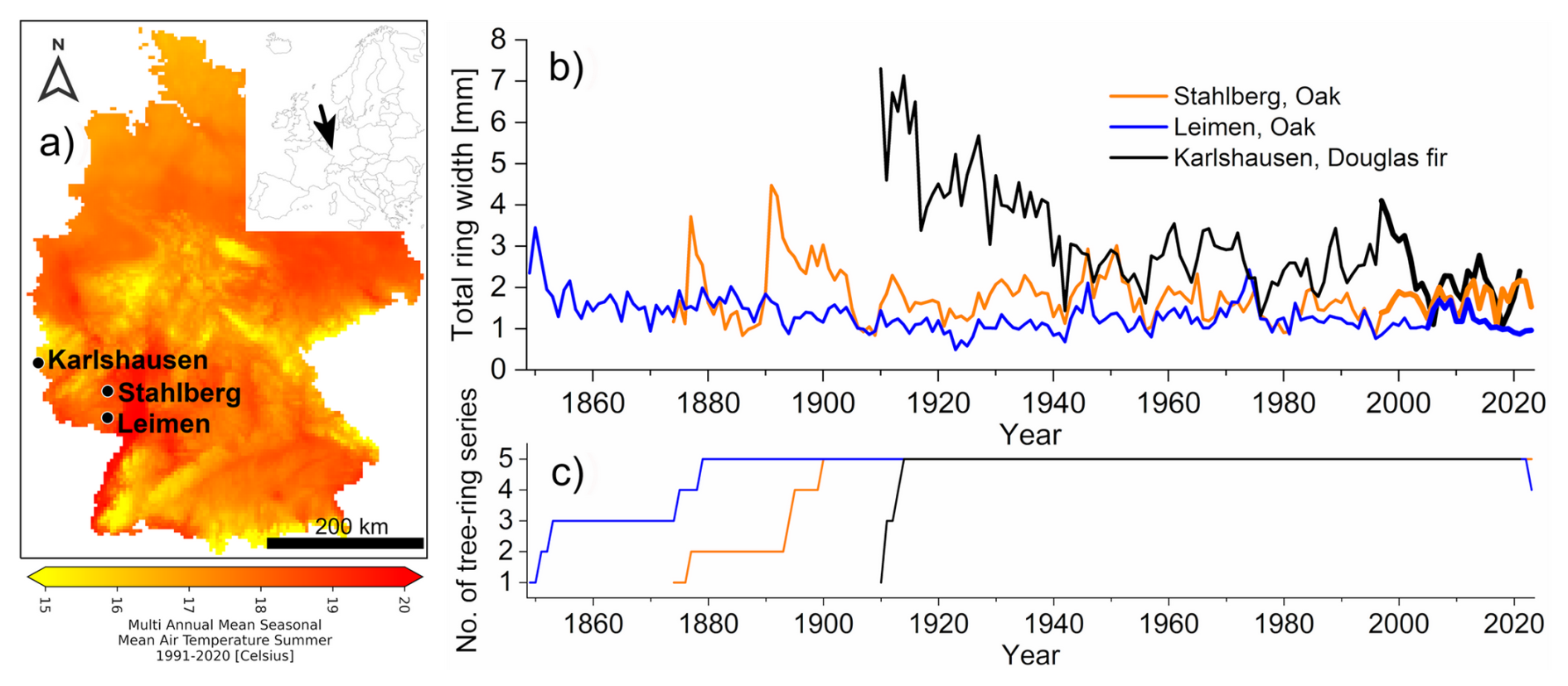
Figure 1Area of interest and tree growth dynamic. (a) Map color shows the mean air summer temperature in the reference period 1991–2020 and the geographical location of the three sites. (b) Mean total ring width of oaks and Douglas firs at the different sites. (c) Number of used tree-ring series available per year.
At the contaminated site (Stahlberg, oak) the mean tree-ring Hg concentration of 50 µg kg−1 (since 1950) is 25-fold and 10-fold higher than at the uncontaminated sites at Leimen (oak) and Karlshausen (Douglas fir), respectively (Fig. 2). Tree-ring Hg concentration variability is high among trees at the contaminated site with concentrations ranging from 3–144 µg kg−1. At the uncontaminated sites inter-tree-ring Hg concentration variability is much more homogenous with values ranging from (oak, Leimen) and 3–11 µg kg−1 (Douglas fir, Karlshausen). Mean annual radial tree growth (total ring width, Fig. 1) of oaks at both sites is lower (1.8 mm at Stahlberg and 1.3 mm at Leimen) compared to Douglas fir (3.1 mm yr−1). The Douglas fir trees show a pronounced juvenile growth trend, which is suppressed in oaks. The number of sapwood rings is similar in the investigated trees (∼27 in oaks at Stahlberg, ∼19 in oaks at Leimen, ∼25 in Douglas fir at Karlshausen).
Despite the large difference in tree-ring Hg concentration (mean factor of 10, Fig. 2) between the contaminated and the uncontaminated site, Hg concentrations in tree rings at both oak sites show a clear trend of increasing values and a similar factor of increase (∼9.5), although the range was higher at the Stahlberg site (2.8–26.9) than at the Leimen site (3.3–13.8). Hg concentrations in tree rings of Douglas fir are by an average factor of two higher than in oak at the reference site, but do not show a trend of increasing values. Here, Hg concentration in Douglas fir shows a maximum in the 1950s–1970s and decreasing values thereafter (1980s–2000s).
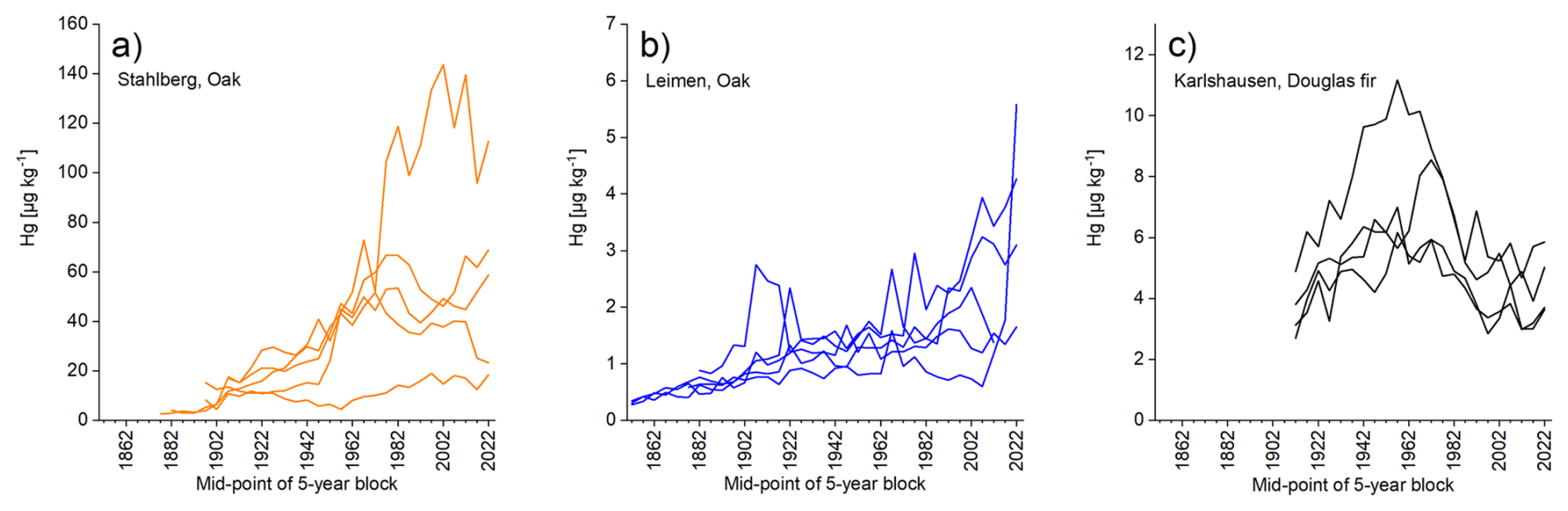
Figure 2Tree-ring mercury (Hg) concentration in individual trees through time from three locations in Rhineland-Palatinate, Germany.
The high tree-ring Hg concentrations at the Stahlberg site (oak) compared to the Leimen (oak) and Karlshausen (Douglas fir) reference sites indicate a local signal of high atmospheric Hg levels at this former Hg mining site although no ore processing has taken place at this site. We suggest that elevated Hg degassing from the Hg contaminated soil at the Stahlberg site is the main reason for the high tree-ring Hg concentrations. This signal seems to be local only, as the Hg emissions from the roasting site in Moschellandsberg (6 km away) during World War II are not recorded in the oak trees from the Stahlberg site.
The strongly differing absolute tree-ring Hg concentrations at the two oak sites suggest a strong influence of local atmospheric Hg concentration, especially through soil Hg degassing, which is largely controlled by temperature as an important forcing factor (Wang et al., 2019). When relative tree-ring Hg variability, including the high among tree variation in factors of concentration increase is considered, the similar trend of increasing Hg concentrations at both oak sites suggests an additional common underlying controlling factor different from atmospheric Hg concentrations (Fig. 3). The same assumption is made for relative tree-ring Hg variability in Douglas fir, but Douglas fir appear to react different to this controlling factor. Here, the tree-ring Hg record does not show a trend of a continuous increase until today, but an increase until 1950s and a pronounced decrease since the 1970s (Fig. 3) opposite to what has been observed in oaks.
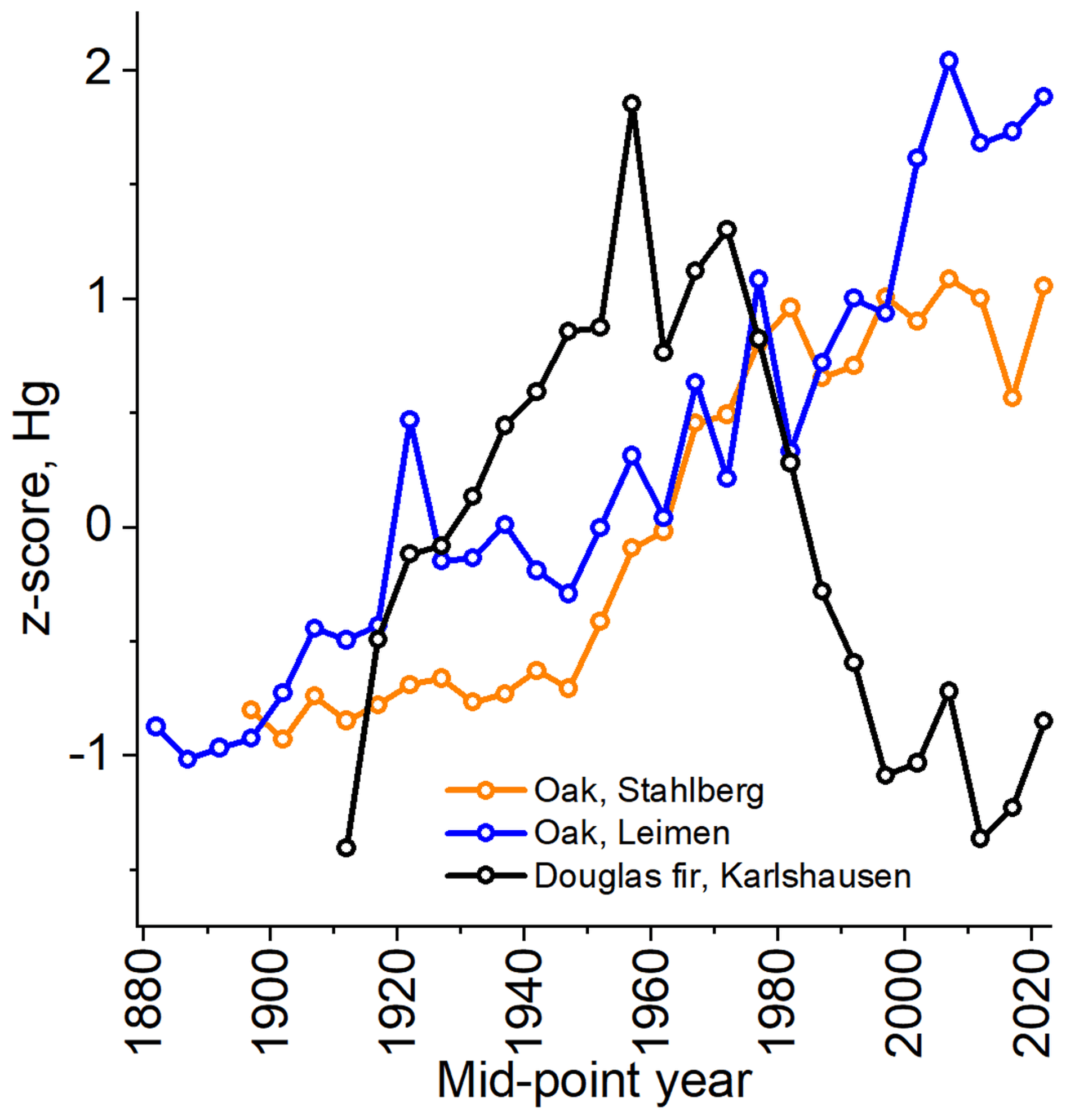
Figure 3Tree-ring mercury (Hg) records at the investigated oak (Stahlberg, Leimen) and Douglas fir (Karlshausen) sites in Rhineland-Palatinate, Germany.
There is consensus regarding the different factors influencing Hg accumulation in tree rings for coniferous species, for broadleaved trees – especially oak – it seems not. In literature, oak has been only rarely investigated and often only a small number of individuals were used. Based on these few studies the impression arose that oak is not suitable to record historical atmospheric Hg contamination (Gustin et al., 2022b; Scanlon et al., 2020; Siwik et al., 2010). However, in the original literature, no clear evidence has been presented. The main argument is that Hg concentrations in tree rings of oaks show no trend through time or have very low Hg concentrations. Recent studies have further argued that besides atmospheric Hg concentration multiple factors including tree physiology may have an effect on the tree-ring Hg record (Peng et al., 2024; Boonen et al., 2025). Beside climate factors, foliage uptake strategies (isohydric/anisohydric) of different tree-species may influence Hg accumulation in tree rings although this effect has not yet been investigated. In addition, radial translocation has been suggested to alter tree-ring Hg concentrations (Arnold et al., 2018; Chellman et al., 2020; Gustin et al., 2022a; Liu et al., 2024; Nováková et al., 2021). Radial translocation is basically defined as a bi-directional movement (Kuroda et al., 2021) of an element between softwood and heartwood via living ray cells. Living tissue in the outermost softwood may be detoxified by this process. This would suggest, that Hg is mainly transported radially inwards, i.e. from sapwood into the heartwood, which would severely alter the recorded Hg tree-ring signal (Liu et al., 2023 and references therein) towards higher Hg concentration in tree rings of past decades. Jaozandry et al. (2024) estimated the radial translocation of nutrients in oak and found that the cumulative translocation in stems are substantially lower than in leaves, giving another hint that the topic of translocation on tree-ring level needs more investigation. In fact, we cannot present evidence if and to what extent Hg is translocated between hardwood and sapwood in oak and Douglas fir. But, our investigated oaks at the contaminated and uncontaminated sites do not display elevating Hg concentration in the heartwood compared to the softwood. Moreover, Hg is a heavy metal which shows a strong affinity to form stable organic complexes which are unlike to undergo translocation. Thus, we are convinced that even if radially translocation occurs, our Hg oak records are biased by radially translocation to a minimal extent only. As other authors before, Gustin et al. (2022b), we believe that much more effort is needed to comprehensively investigate and understand radial translocation and its influence on Hg tree ring records.
Our Hg oak records from central Europe show a clear elevating trend from past to present. This is different to what other published Hg oak series show (e.g. Siwik et al., 2010; Scanlon et al., 2020; Gustin et al., 2022b; Perone et al., 2018), namely a low temporal trend as well as low high-frequency variability. Like in previous studies, we assume that stomatal uptake of Hg is the major pathway of Hg into tree rings and that Hg uptake by roots or bark can be neglected. The reasons for the observed differences to other oak tree-ring records could be due to physiological differences among the investigated oak species, such as growth factors or heat/drought adaption. Most Hg oak records are constructed from trees of the Northern American continent and only few from Europe (Perone et al., 2018), which could lead to significant differences in trend patterns. In those studies, Red oak, White oak and Downy oak are published (Perone et al., 2018; Scanlon et al., 2020; Siwik et al., 2010), whereas sessile oak was used in our study. Sessile oak is very drought tolerant, forms a deep root system and holds a high water-use-efficiency compared to other oak species such as Red oak (Kuehne et al., 2014). The number of used trees (3–10) to construct a Hg record also differ between the published studies and may bias a comparison. However, we believe the Hg tree-ring records constructed here are chronologically robust, because the records of the contaminated and uncontaminated sites are similar with regard to the temporal pattern, in their relative variance and in the age of the trees used. The difference in Hg concentrations levels in oak trees between our sites can be explained by high site-specific Hg loads. However, the similar trend in Hg tree-ring records in oaks from both sites is likely attributed to other factors such as climate.
3.2 Comparison of Hg tree ring records to the evolution of atmospheric Hg loads
If atmospheric Hg concentration is the major factor for levels of Hg concentrations in tree-rings, a clear correlation between the record of atmospheric Hg concentrations and the tree-rings record has to be expected. However, neither our German tree-ring Hg records nor other published European tree-ring records (Fig. 4) match with the modeled Hg emission record for Europe since 1850 (Streets et al., 2017) or emission based modeled atmospheric Hg concentration (Horowitz et al., 2014). Although both, the modeled atmospheric Hg concentration curve and our oak tree-ring records show a steady increase starting at the end of the 19th century, the first increase in modeled global, hemispheric atmospheric Hg concentrations starting from the 1850 until about 1900 as well as the second strong increase between 1930 and 1940 are almost absent in our oak tree-ring records. The peak of atmospheric Hg concentration in the 1960s–1970s is poorly visible and occurs only in some trees at the contaminated Stahlberg site, but not at the uncontaminated Leimen site. Here, the highest Hg concentrations are reached significantly later between 2002 and 2010.
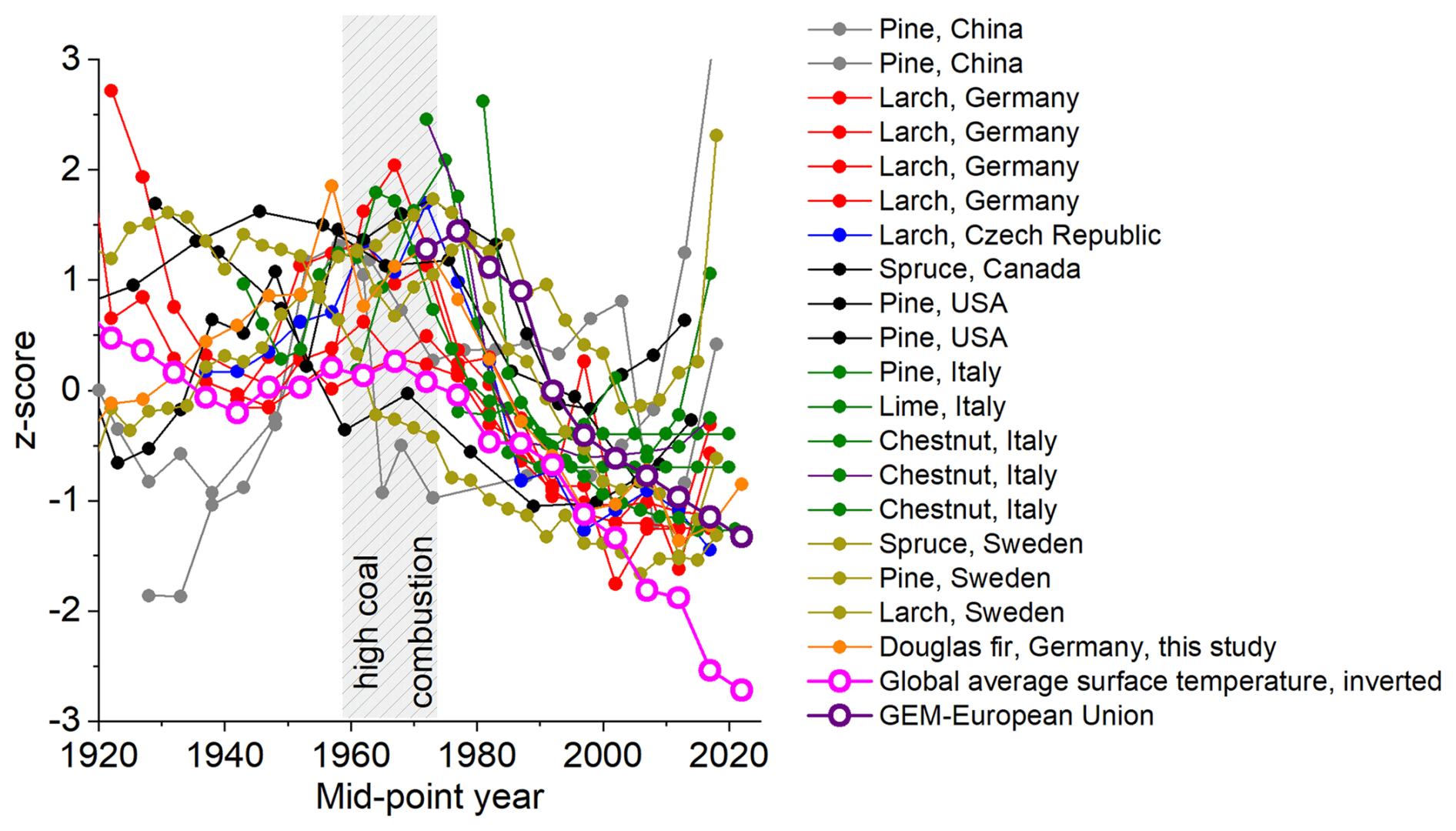
Figure 4Records of tree-ring mercury concentration (filled points) at different sites in the Northern Hemisphere (colors refer to countries) (Scanlon et al., 2020; Chellman et al., 2020; Ghotra et al., 2020; Nováková et al., 2021; Wang et al., 2021; Baroni et al., 2023; Peng et al., 2024; Fornasaro et al., 2023) and records (circles) of global average surface temperature (inverted) and atmospheric mercury concentration emitted in the European Union. The grey shaded area shows the period of intense coal combustion in Europe according to Streets et al. (2017).
The transfer function between atmospheric Hg concentrations, the Hg content in leaves and finally in tree rings is not known. It is important to note that modeled global atmospheric Hg concentration increase by a factor of about seven between 1850 and 1970 (European emission increase 4-fold), whereas concentrations in oak tree rings increase by factors of 2–17 and 2–6 at the Stahlberg and Leimen site, respectively. Hg in Douglas fir tree rings show maximum Hg concentration between the 1955 and 1970 and all other trees show a decline after 1970 by factors between 1.5 and 2 to the Hg levels of the early 20th century. This differs from modeled atmospheric Hg concentrations which show a much weaker decrease of −1.5 % and −2.2 % per year in the past three decades (Obrist et al., 2018). Similar inconsistency of tree-ring records with hemispheric or global atmospheric Hg concentration or Hg emission records have been reported in previous studies and were explained mainly by local Hg emission sources (Scanlon et al., 2020). Local or regional factors – such as temperature, precipitation, air humidity, soil Hg emissions, and the physiological responses of different tree species to these factors – may play a critical role for the accumulation of Hg in tree rings. If local or regional climatic factors determine the accumulation of Hg in tree rings to a considerable amount, in coniferous as well as broadleaves, common trends in tree-ring Hg records should be evident throughout large geographical distances. If this would be true, even when contaminated and uncontaminated sites of the same tree species are compared, the relative trend through time should be similar.
It becomes further evident that our Douglas fir tree-ring Hg record shows the same pattern as those of other coniferous (e.g. Pine, Spruce, Larch) and some broadleaved trees (e.g. Chestnut) from other locations disregarding local Hg contamination, tree species, forest structure or geographical attributes (Fig. 4). However, as seen for the German Douglas fir site, the strong decline in tree-ring Hg concentration by 2–3 standard deviations in the past 50 years do not correspond to the evolution of global/hemisphere atmospheric Hg concentrations, showing a Hg decrease to a much lower extent and a delay in time. This discrepancy suggests that a global or hemispheric underlying factor, or a combination of multiple factors, may exert a larger influence on tree-ring Hg concentrations than atmospheric Hg levels alone. The synchronous widespread spiking of tree-ring Hg records in the ∼1970s with their subsequent rapid decline until the year 2000 could be driven by a hemispherical-wide acting factor. Changes in air temperature occur continental-wide and changes in precipitation often appears on regional scale, and thus may act as dominant tree-growth factors, which could explain the common pattern. The investigated oak trees – from contaminated and uncontaminated sites – show a similar relative Hg pattern, which underlines that site-unspecific factors do influence Hg accumulation, like climate, soil type, degree of foliage.
3.3 The influence of climatic factors on Hg accumulation in oak and Douglas fir tree rings
Previous studies have shown that the stomatal uptake of Hg by trees has a physiological component which is controlled by seasonality (Jiskra et al., 2018). Furthermore, temperature and humidity may favor or impede growth and increasing atmospheric CO2 concentrations will increase plant growth and thus the leaf surface/stomata density and likely the Hg uptake by leaves. Zhang et al. (2016) projected that by 2050 the annual mean Hg(0) dry deposition flux over land will increase by 20 % in northern mid-latitudes, driven by a combination of increased atmospheric gaseous elemental Hg exposure and increased vegetation and foliage density induced by CO2 fertilization.
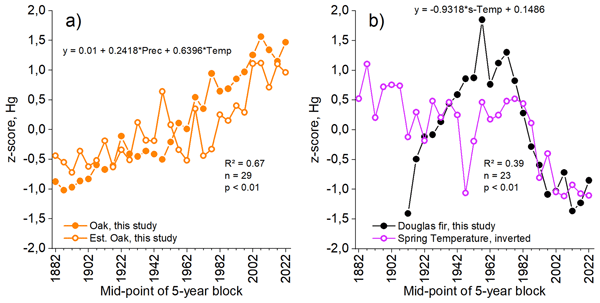
In order to investigate the impact of climatic parameters on oak and Douglas fir tree-ring Hg records from this study, spring and summer air temperature and precipitation data were used. The results of these climate-response analyses differ between the investigated coniferous (Douglas fir) and broadleaved (oak) tree species (Fig. 5). Hg in oak tree rings is significantly increasing with rising spring–summer air temperature and spring–summer precipitation sum. Spring-summer temperature influences tree-ring Hg roughly by two thirds and precipitation sum by one third (for exact weights see formula in Fig. 5a). By weighting these climatic parameters, the tree-ring Hg values can be estimated. The original and estimated oak tree-ring Hg records are significantly related (R2=0.67, p<0.01). However, the estimation is slightly off during the 1970s, which may be attributed to the hot and extraordinarily dry year 1976 and pronounced effects of air pollution (esp. Hg emissions from coal burning).
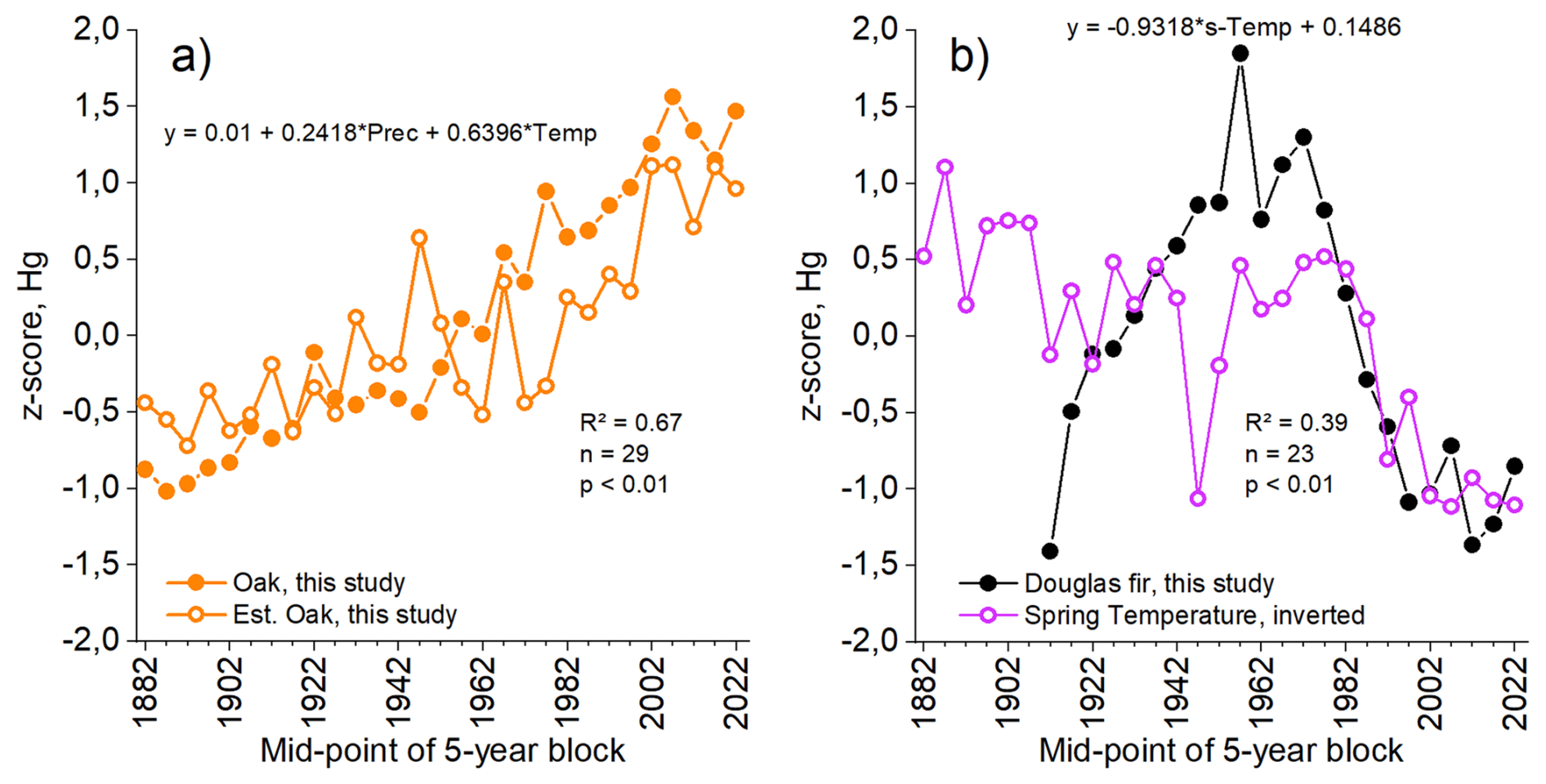
Figure 5Climate response of tree-ring mercury (Hg) concentration variability for oak (a) and Douglas fir (b). Tree-ring Hg concentration in oak trees can be estimated by spring–summer mean air temperature (Temp) and spring–summer precipitation sum (Prec) and by spring mean air temperature (s-Temp) for Douglas fir trees (b).
On the other hand, decreasing Hg in Douglas fir tree rings is also related to climate. Here, the concentration of Hg is decreasing with rising spring temperature and is thus showing a statistically significant negative relationship (R2=0.39, p<0.01, Fig. 5b). The patterns of Douglas fir tree-ring Hg and spring temperature are much closer related during the past 100 years and almost identical since the past 40 years. The extraordinary warm decade (1945–1954) after the World War II did not result in lower Douglas fir tree-ring Hg, as should be expected by the before mentioned negative relationship. Instead, the Douglas fir tree-ring Hg record is peaking around this decade likely due to the distinct Hg emissions during 1950s–1970s (coal combustion, Streets et al., 2019).
Site-climatic factors, namely temperature and precipitation, appear to significantly control Hg accumulation in oak and Douglas fir tree rings. In addition, Hg evasion form soil is known to increase with temperature (Obrist et al., 2018). Several studies have shown, that high temperature leads to nearly complete or entire stomatal closure and suppressed sap flow (Samuelson et al., 2019; Niessner et al., 2024; Irvine et al., 1998) blocking foliage Hg uptake and as a consequence Hg accumulation in tree rings in coniferous trees. Rising temperature at a coniferous site should therefore result in lower tree-ring Hg concentration, which is also true for our investigated Douglas firs, with the exception of the past 20 years when hemisphere-wide tree-ring Hg records are compared to global average surface temperature. Here, a disconnection can be observed which could be explained by an increase of biomass in boreal and temperate forests during the past two decades mirroring the global atmospheric CO2 growth rate (Yang et al., 2023; Norby et al., 2024) and in consequence likely leading to a net rise in tree-ring Hg accumulation in many tree species. In addition, rising temperatures prolong a tree's growing season and might facilitate extended Hg assimilation in relatively humid seasons (i.e. spring and/or autumn). This would also mean that seasonal prolongation by climate change could be an additional driving factor and leads to a disconnection of tree-ring accumulation in coniferous species and local hot temperature periods.
To put such climate-response results into a broader context it is necessary to mention that not only local climate conditions play a crucial role in regards of tree-ring Hg concentration, but also how specific tree species respond physiologically to severe drought (Tardieu and Simonneau, 1998). One strategy (isohydric) to deal with drought is to reduce stomatal conductance (and to fully close the stomata under extraordinary dry conditions) as soil moisture decreases and atmospheric conditions get drier, which appears to be more frequent in mid- to high-latitude conifers. A vast number of tree-ring Hg records are established from conifers, underlining our results that Hg accumulation decreases with temperature-induced lower stomatal conductance. Another strategy (anisohydric) is to maintain stomata open under drought stress, allowing to perform photosynthesis. Such a behavior is often observed for broadleaved trees.
Performing tree-ring Hg climate-response analysis for the used oaks and interpreting the results accordingly, we see that tree-ring Hg accumulation in oak is positively correlated to site-specific changes of temperature and precipitation (Fig. 5). This is contrary to how other investigated tree species respond (Fig. 4) and needs to involve all aspects of oak physiology and site conditions to interpret these results. One aspect could be that the increase in tree-ring Hg with rising temperature and precipitation may be attributed to anisohydric eco-physiological features of oaks growing in the mid-latitudes and its temperate climate. Oaks may increase growth and thus CO2 and Hg uptake under increasingly warmer conditions as long as humidity is sufficient. Moreover these oaks are able to maintain sap flow and continue to operate stomatal conductance under hot and dry summer conditions (Bréda et al., 1993; Kunz et al., 2016; Raftoyannis and Radoglou, 2002; Gauthey et al., 2024), leading to continuous foliage Hg assimilation and tree-ring Hg accumulation.
A mismatch between most tree-ring Hg records and the evolution of atmospheric Hg concentrations (Fig. 4) can be observed and may indicate that at least hemispheric trends in atmospheric Hg loads appear to be overwritten by (local) climate change effects. Relative changes in tree-ring Hg concentration as well as long-term trends suggest to be predominately controlled by transregional and hemisphere-wide climatic factors controlling tree' s stomatal conductance, the area and mass of needles/leaves, annual growth rates as well as forest coverage.
The presented tree-ring Hg concentrations in oak and Douglas fir from western Germany and the comparison of literature data on Hg tree-ring records from the Northern Hemisphere of the past century and the related evolution of temperature and humidity suggest that Hg concentrations in tree rings are to a large extent determined by climatic conditions. It may partly overwrite pollution effects and the evolution of atmospheric Hg loads. These findings imply that climate change, specifically rising temperatures and more frequent drought events as well as increasing atmospheric CO2 concentrations, are altering the role of forests in the global biogeochemical Hg cycle. Although the relationship between tree-ring and leaf Hg concentrations is not yet exactly understood, it is likely that our observed climate related changes in tree-ring Hg concentrations in different tree species alter litterfall Hg fluxes to soil which is the most important terrestrial vector of atmospheric Hg to soil and adjacent aquatic systems (Obrist et al., 2021, 2018; Zhou et al., 2021). Moreover, global warming may force forest management in mid-latitudes to transfer coniferous monocultural forest into mixed or broadleaf forests, which is likely to further alter the role of forests as a temporal Hg sink. During the past decades Europe's forest areas have increased by up to 9 %, with an ∼ even ratio between coniferous and broadleaved trees (Köhl et al., 2020; Palmero-Iniesta et al., 2021). Climate change capable of affecting future forest productivity in different forest types in temperate and boreal regions and the practice of forestry currently undergoes a transformation process (Park et al., 2014). One forest management strategy is to expand (non-)native tree species mixture to build climate-resilient forests (Bohn et al., 2018) and planting deciduous tree species could reduce climate-driven fire occurrence (Terrier et al., 2013). Future forest tree species composition depends on local to regional climate evolution and forest management strategies (Park et al., 2014). Native drought-tolerant oak-rich forests, or forests containing tree species with positive temperature-Hg responses in general, can serve as a distinct sink for atmospheric Hg with changing climate. Additionally, such forests are less vulnerable to large-scale fires, so that the release of Hg into the atmosphere could be reduced. Finally, our study suggests a strong climatic component in the Hg accumulation in oak tree rings. We suggest to address climatic conditions in future Hg tree ring studies in general as temperature and water availability are likely to influence the Hg uptake of all trees.
Tree-ring mercury concentration data of this study (sessile oak, Douglas fir) can be received from the following repository: https://doi.org/10.5281/zenodo.19163965 (Land and Biester, 2026).
AL sampled the trees, dated and cut the tree rings, performed statistical analysis, interpreted the data, discussed the results and wrote the manuscript. AN sampled the trees, dated and cut the tree rings, discussed the results. JF interpreted the data, discussed the results and wrote the manuscript. PS performed the tree-ring mercury measurements. HB performed the tree-ring mercury measurements, interpreted the data, discussed the results and wrote the manuscript.
The contact author has declared that none of the authors has any competing interests.
Publisher's note: Copernicus Publications remains neutral with regard to jurisdictional claims made in the text, published maps, institutional affiliations, or any other geographical representation in this paper. The authors bear the ultimate responsibility for providing appropriate place names. Views expressed in the text are those of the authors and do not necessarily reflect the views of the publisher.
We thank Marta Pérez Rodriguez and Matthias Beyer for reviewing the manuscript.
This open-access publication was funded by Technische Universität Braunschweig.
This paper was edited by Edzo Veldkamp and reviewed by two anonymous referees.
Arnold, J., Gustin, M. S., and Weisberg, P. J.: Evidence for Nonstomatal Uptake of Hg by Aspen and Translocation of Hg from Foliage to Tree Rings in Austrian Pine, Environ. Sci. Technol., 52, 1174–1182, https://doi.org/10.1021/acs.est.7b04468, 2018.
Baroni, D., Ancora, S., Franzaring, J., Loppi, S., and Monaci, F.: Tree-rings analysis to reconstruct atmospheric mercury contamination at a historical mining site, Front. Plant Sci., 14, 1260431, https://doi.org/10.3389/fpls.2023.1260431, 2023.
Bohn, F. J., May, F., and Huth, A.: Species composition and forest structure explain the temperature sensitivity patterns of productivity in temperate forests, Biogeosciences, 15, 1795–1813, https://doi.org/10.5194/bg-15-1795-2018, 2018.
Boonen, K., Shetti, R., Navrátil, T., Nováková, T., Rohovec, J., and Lehejček, J.: Atmospheric mercury pollution recorded in conifer tree rings: Disentangling the effects of tree-ring width, water content, and climate on mercury concentrations, Dendrochronologia, 92, 126370, https://doi.org/10.1016/j.dendro.2025.126370, 2025.
Bréda, N., Cochard, H., Dreyer, E., and Granier, A.: Field comparison of transpiration, stomatal conductance and vulnerability to cavitation of Quercus petraea and Quercus robur under water stress, Ann. Sci. Forest., 50, 571–582, 1993.
Chellman, N., Csank, A., Gustin, M. S., Arienzo, M. M., Vargas Estrada, M., and McConnell, J. R.: Comparison of co-located ice-core and tree-ring mercury records indicates potential radial translocation of mercury in whitebark pine, Sci. Total Environ., 743, 140695, https://doi.org/10.1016/j.scitotenv.2020.140695, 2020.
Fornasaro, S., Ciani, F., Nannoni, A., Morelli, G., Rimondi, V., Lattanzi, P., Cocozza, C., Fioravanti, M., and Costagliola, P.: Tree Rings Record of Long-Term Atmospheric Hg Pollution in the Monte Amiata Mining District (Central Italy): Lessons from the Past for a Better Future, Minerals, 13, 688, https://doi.org/10.3390/min13050688, 2023.
Gauthey, A., Kahmen, A., Limousin, J.-M., Vilagrosa, A., Didion-Gency, M., Mas, E., Milano, A., Tunas, A., and Grossiord, C.: High heat tolerance, evaporative cooling, and stomatal decoupling regulate canopy temperature and their safety margins in three European oak species, Glob. Change Biol., 30, e17439, https://doi.org/10.1111/gcb.17439, 2024.
Ghotra, A., Lehnherr, I., Porter, T. J., and Pisaric, M. F. J.: Tree-Ring Inferred Atmospheric Mercury Concentrations in the Mackenzie Delta (NWT, Canada) Peaked in the 1970s but Are Increasing Once More, ACS Earth Space Chem., 4, 457–466, https://doi.org/10.1021/acsearthspacechem.0c00003, 2020.
Guo, W., Liu, M., Zhang, Q., Deng, Y., Chu, Z., Qin, H., Li, Y., Liu, Y.-R., Zhang, H., Zhang, W., Tao, S., and Wang, X.: Warming-Induced Vegetation Greening May Aggravate Soil Mercury Levels Worldwide, Environ. Sci. Technol., https://doi.org/10.1021/acs.est.4c01923, 2024.
Gustin, M. S., Dunham-Cheatham, S. M., Harper, J. F., Choi, W.-G., Blum, J. D., and Johnson, M. W.: Investigation of the biochemical controls on mercury uptake and mobility in trees, Sci. Total Environ., 851, 158101, https://doi.org/10.1016/j.scitotenv.2022.158101, 2022a.
Gustin, M. S., Ingle, B., and Dunham-Cheatham, S. M.: Further investigations into the use of tree rings as archives of atmospheric mercury concentrations, Biogeochemistry, 158, 167–180, https://doi.org/10.1007/s10533-022-00892-1, 2022b.
Horowitz, H. M., Jacob, D. J., Amos, H. M., Streets, D. G., and Sunderland, E. M.: Historical Mercury releases from commercial products: global environmental implications, Environ. Sci. Technol., 48, 10242–10250, https://doi.org/10.1021/es501337j, 2014.
Irvine, J., Perks, M. P., Magnani, F., and Grace, J.: The response of Pinus sylvestris to drought: stomatal control of transpiration and hydraulic conductance, Tree Physiol., 18, 393–402, https://doi.org/10.1093/treephys/18.6.393, 1998.
Jaozandry, C. C., Leban, J.-M., Legout, A., van der Heijden, G., Santenoise, P., Nourrisson, G., and Saint-André, L.: Advances in assessing Ca, K, and Mn translocation in oak tree stems (Quercus spp.), Heliyon, 10, e32627, https://doi.org/10.1016/j.heliyon.2024.e32627, 2024.
Jiskra, M., Sonke, J. E., Obrist, D., Bieser, J., Ebinghaus, R., Myhre, C. L., Pfaffhuber, K. A., Wängberg, I., Kyllönen, K., Worthy, D., Martin, L. G., Labuschagne, C., Mkololo, T., Ramonet, M., Magand, O., and Dommergue, A.: A vegetation control on seasonal variations in global atmospheric mercury concentrations, Nat. Geosci., 11, 244–250, https://doi.org/10.1038/s41561-018-0078-8, 2018.
Kang, H., Liu, X., Guo, J., Zhang, Q., Wang, Y., Huang, J., Xu, G., Wu, G., Ge, W., and Kang, S.: Long-term mercury variations in tree rings of the permafrost forest, northeastern China, Sci. China Earth Sci., 65, 1328–1338, https://doi.org/10.1007/s11430-021-9886-1, 2022.
Köhl, M., Linser, S., and Prins, K.: State of Europe's Forests 2020, Ministerial Conference on the Protection of Forests in Europe, https://doi.org/10.13140/RG.2.2.12881.76643, 2020.
Kuehne, C., Nosko, P., Horwath, T., and Bauhus, J.: A comparative study of physiological and morphological seedling traits associated with shade tolerance in introduced red oak (Quercus rubra) and native hardwood tree species in southwestern Germany, Tree Physiol., 34, 184–193, https://doi.org/10.1093/treephys/tpt124, 2014.
Kunz, J., Räder, A., and Bauhus, J.: Effects of Drought and Rewetting on Growth and Gas Exchange of Minor European Broadleaved Tree Species, Forests, 7, 239, https://doi.org/10.3390/f7100239, 2016.
Kuroda, K., Yamane, K., and Itoh, Y.: In Planta Analysis of the Radial Movement of Minerals from Inside to Outside in the Trunks of Standing Japanese Cedar (Cryptomeria japonica D. Don) Trees at the Cellular Level, Forests, 12, 251, https://doi.org/10.3390/f12020251, 2021.
Land, A. and Biester, H.: Mercury concentration records in tree rings of sessile oak and Douglas fir – The role of pollution and climate, Zenodo [data set], https://doi.org/10.5281/zenodo.19163965, 2026.
Li, F., Ma, C., and Zhang, P.: Mercury Deposition, Climate Change and Anthropogenic Activities: A Review, Front. Earth Sci., 8, https://doi.org/10.3389/feart.2020.00316, 2020.
Liu, X., Wang, X., Yuan, W., Wang, D., and Feng, X.: Tree rings recording historical atmospheric mercury: A review of progresses and challenges, Crit. Rev. Env. Sci. Tec., 1–18, https://doi.org/10.1080/10643389.2023.2250706, 2023.
Liu, X., Wang, X., and Wang, D.: Assessment of tree-ring mercury radial translocation and age effect in Masson pine: Implications for historical atmospheric mercury reconstruction, J. Environ. Sci.-China, 138, 266–276, https://doi.org/10.1016/j.jes.2022.10.027, 2024.
McLagan, D. S., Biester, H., Navrátil, T., Kraemer, S. M., and Schwab, L.: Internal tree cycling and atmospheric archiving of mercury: examination with concentration and stable isotope analyses, Biogeosciences, 19, 4415–4429, https://doi.org/10.5194/bg-19-4415-2022, 2022.
Montgomery, D. C., Peck, E. A., and Vining, D. C.: Introduction to linear regression analysis, A Wiley interscience publication, Wiley, New York [u.a.], 641 pp., ISBN 0471315656, 2001.
Navrátil, T., Nováková, T., Shanley, J. B., Rohovec, J., Matoušková, Š., Vaňková, M., and Norton, S. A.: Larch Tree Rings as a Tool for Reconstructing 20th Century Central European Atmospheric Mercury Trends, Environ. Sci. Technol., 52, 11060–11068, https://doi.org/10.1021/acs.est.8b02117, 2018.
Niessner, A., Ehekircher, S., Zimmermann, R., Horna, V., Reichle, D., Land, A., Spangenberg, G., and Hein, S.: Soil drought sets site specific limits to stem radial growth and sap flow of Douglas-fir across Germany, Front. Plant Sci., 15, https://doi.org/10.3389/fpls.2024.1401833, 2024.
Norby, R. J., Loader, N. J., Mayoral, C., Ullah, S., Curioni, G., Smith, A. R., Reay, M. K., van Wijngaarden, K., Amjad, M. S., Brettle, D., Crockatt, M. E., Denny, G., Grzesik, R. T., Hamilton, R. L., Hart, K. M., Hartley, I. P., Jones, A. G., Kourmouli, A., Larsen, J. R., Shi, Z., Thomas, R. M., and MacKenzie, A. R.: Enhanced woody biomass production in a mature temperate forest under elevated CO2, Nat. Clim. Change, 14, 983–988, https://doi.org/10.1038/s41558-024-02090-3, 2024.
Nováková, T., Navrátil, T., Demers, J. D., Roll, M., and Rohovec, J.: Contrasting tree ring Hg records in two conifer species: Multi-site evidence of species-specific radial translocation effects in Scots pine versus European larch, Sci. Total Environ., 762, 144022, https://doi.org/10.1016/j.scitotenv.2020.144022, 2021.
Nováková, T., Navrátil, T., Schütze, M., Rohovec, J., Matoušková, Š., Hošek, M., and Matys Grygar, T.: Reconstructing atmospheric Hg levels near the oldest chemical factory in central Europe using a tree ring archive, Environ. Pollut. (Barking, Essex 1987), 304, 119215, https://doi.org/10.1016/j.envpol.2022.119215, 2022.
Obrist, D., Kirk, J. L., Zhang, L., Sunderland, E. M., Jiskra, M., and Selin, N. E.: A review of global environmental mercury processes in response to human and natural perturbations: Changes of emissions, climate, and land use, Ambio, 47, 116–140, https://doi.org/10.1007/s13280-017-1004-9, 2018.
Obrist, D., Roy, E. M., Harrison, J. L., Kwong, C. F., Munger, J. W., Moosmüller, H., Romero, C. D., Sun, S., Zhou, J., and Commane, R.: Previously unaccounted atmospheric mercury deposition in a midlatitude deciduous forest, P. Natl. Acad. Sci. USA, 118, https://doi.org/10.1073/pnas.2105477118, 2021.
Palmero-Iniesta, M., Pino, J., Pesquer, L., and Espelta, J. M.: Recent forest area increase in Europe: expanding and regenerating forests differ in their regional patterns, drivers and productivity trends, Eur. J. Forest Res., 140, 793–805, https://doi.org/10.1007/s10342-021-01366-z, 2021.
Park, A., Puettmann, K., Wilson, E., Messier, C., Kames, S., and Dhar, A.: Can Boreal and Temperate Forest Management be Adapted to the Uncertainties of 21st Century Climate Change?, Crit. Rev. Plant Sci., 33, 251–285, https://doi.org/10.1080/07352689.2014.858956, 2014.
Peckham, M. A., Gustin, M. S., and Weisberg, P. J.: Assessment of the Suitability of Tree Rings as Archives of Global and Regional Atmospheric Mercury Pollution, Environ. Sci. Technol., 53, 3663–3671, https://doi.org/10.1021/acs.est.8b06786, 2019.
Peng, H., Zhang, X., Bishop, K., Marshall, J., Nilsson, M. B., Li, C., Björn, E., and Zhu, W.: Tree Rings Mercury Controlled by Atmospheric Gaseous Elemental Mercury and Tree Physiology, Environ. Sci. Technol., https://doi.org/10.1021/acs.est.4c05662, 2024.
Perone, A., Cocozza, C., Cherubini, P., Bachmann, O., Guillong, M., Lasserre, B., Marchetti, M., and Tognetti, R.: Oak tree-rings record spatial–temporal pollution trends from different sources in Terni (Central Italy), Environ. Pollut. (Barking, Essex 1987), 233, 278–289, https://doi.org/10.1016/j.envpol.2017.10.062, 2018.
Raftoyannis, Y. and Radoglou, K.: Physiological responses of beech and sessile oak in a natural mixed stand during a dry summer, Ann. Bot.-London, 89, 723–730, https://doi.org/10.1093/aob/mcf133, 2002.
Rinn, F.: TSAP-Win Professional, RINNTECH, Heidelberg, 2002–2013.
Samuelson, L. J., Stokes, T. A., Ramirez, M. R., and Mendonca, C. C.: Drought tolerance of a Pinus palustris plantation, Forest Ecol. Manag., 451, 117557, https://doi.org/10.1016/j.foreco.2019.117557, 2019.
Scanlon, T. M., Riscassi, A. L., Demers, J. D., Camper, T. D., Lee, T. R., and Druckenbrod, D. L.: Mercury Accumulation in Tree Rings: Observed Trends in Quantity and Isotopic Composition in Shenandoah National Park, Virginia, J. Geophys. Res.-Biogeo., 125, https://doi.org/10.1029/2019JG005445, 2020.
Siebelt, L.: Investigation of the role of mercury input through litterfall in forest soils at a former mercury mining site (Moschellandsberg), Thesis, Institute of Geoecology, Environmental Geochemistry group, TU Braunschweig, Braunschweig, 2024.
Siwik, E. I. H., Campbell, L. M., and Mierle, G.: Distribution and trends of mercury in deciduous tree cores, Environ. Pollut. (Barking, Essex 1987), 158, 2067–2073, https://doi.org/10.1016/j.envpol.2010.03.002, 2010.
Streets, D. G., Horowitz, H. M., Jacob, D. J., Lu, Z., Levin, L., Schure, A. F. H. ter, and Sunderland, E. M.: Total Mercury Released to the Environment by Human Activities, Environ. Sci. Technol., 51, 5969–5977, https://doi.org/10.1021/acs.est.7b00451, 2017.
Tardieu, F. and Simonneau, T.: Variability among species of stomatal control under fluctuating soil water status and evaporative demand: modelling isohydric and anisohydric behaviours, J. Exp. Bot., 49, 419–432, https://doi.org/10.1093/jxb/49.Special_Issue.419, 1998.
Terrier, A., Girardin, M. P., Périé, C., Legendre, P., and Bergeron, Y.: Potential changes in forest composition could reduce impacts of climate change on boreal wildfires, Ecological applications a publication of the Ecological Society of America, 23, 21–35, https://doi.org/10.1890/12-0425.1, 2013.
Wang, X., Yuan, W., Lin, C.-J., Wu, F., and Feng, X.: Stable mercury isotopes stored in Masson Pinus tree rings as atmospheric mercury archives, J. Hazard. Mater., 415, 125678, https://doi.org/10.1016/j.jhazmat.2021.125678, 2021.
Wang, X., Yuan, W., Lin, C.-J., Zhang, L., Zhang, H., and Feng, X.: Climate and Vegetation As Primary Drivers for Global Mercury Storage in Surface Soil, Environ. Sci. Technol., 53, 10665–10675, https://doi.org/10.1021/acs.est.9b02386, 2019.
Yang, H., Ciais, P., Frappart, F., Li, X., Brandt, M., Fensholt, R., Fan, L., Saatchi, S., Besnard, S., Deng, Z., Bowring, S., and Wigneron, J.-P.: Global increase in biomass carbon stock dominated by growth of northern young forests over past decade, Nat. Geosci., 16, 886–892, https://doi.org/10.1038/s41561-023-01274-4, 2023.
Zhang, H., Holmes, C. D., and Wu, S.: Impacts of changes in climate, land use and land cover on atmospheric mercury, Atmos. Environ., 141, 230–244, https://doi.org/10.1016/j.atmosenv.2016.06.056, 2016.
Zhou, J., Obrist, D., Dastoor, A., Jiskra, M., and Ryjkov, A.: Vegetation uptake of mercury and impacts on global cycling, Nat. Rev. Earth Environ., 2, 269–284, https://doi.org/10.1038/s43017-021-00146-y, 2021.