Articles | Volume 23, issue 8
https://doi.org/10.5194/bg-23-2803-2026
© Author(s) 2026. This work is distributed under
the Creative Commons Attribution 4.0 License.
https://doi.org/10.5194/bg-23-2803-2026
© Author(s) 2026. This work is distributed under
the Creative Commons Attribution 4.0 License.
Mercury concentration records in tree rings of sessile oak and Douglas fir – The role of pollution and climate

Alexander Land
CORRESPONDING AUTHOR
Institute of Biology (190a), University of Hohenheim, Stuttgart, Germany
Aleta Neugebauer
Institute of Biology (190a), University of Hohenheim, Stuttgart, Germany
Jürgen Franzaring
Institute of Landscape and Plant Ecology (320), University of Hohenheim, Stuttgart, Germany
Petra Schmidt
Institute for Geoecology, Department of Environmental Geochemistry, Technische Universität Braunschweig, Germany
Harald Biester
CORRESPONDING AUTHOR
Institute for Geoecology, Department of Environmental Geochemistry, Technische Universität Braunschweig, Germany
Related authors
No articles found.
Juan Francisco Morales Arteaga, Grace Tatiana Páez-Barrera, Matthias Beyer, Christian Birkel, Werner Huber, María Auxiliadora Zúñiga Amador, Harald Biester, and Marta Pérez-Rodríguez
EGUsphere, https://doi.org/10.5194/egusphere-2026-1354, https://doi.org/10.5194/egusphere-2026-1354, 2026
This preprint is open for discussion and under review for Biogeosciences (BG).
Short summary
Short summary
Mercury (Hg) is a toxic pollutant that vegetation removes from the atmosphere. We examined how rainfall seasonality regulates Hg sequestration in understudied tropical dry and rainforests. Dry forests showed strong seasonality, with Hg uptake peaking in the wet season, while high water availability kept stable uptake in rainforests. Vegetation absorbed Hg in both, but higher litterfall enhanced Hg transfer to rainforest soils, emphasizing tropical forests as major yet vulnerable global Hg sinks.
David S. McLagan, Carina Esser, Lorenz Schwab, Jan G. Wiederhold, Jan-Helge Richard, and Harald Biester
SOIL, 10, 77–92, https://doi.org/10.5194/soil-10-77-2024, https://doi.org/10.5194/soil-10-77-2024, 2024
Short summary
Short summary
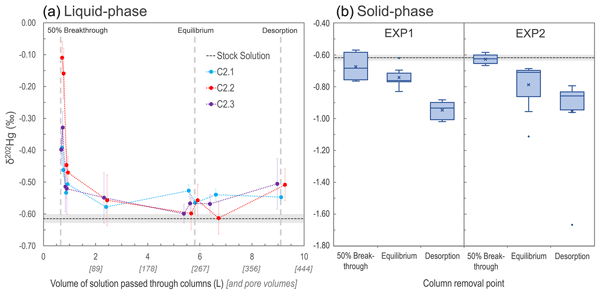
Sorption of mercury in soils, aquifer materials, and sediments is primarily linked to organic matter. Using column experiments, mercury concentration, speciation, and stable isotope analyses, we show that large quantities of mercury in soil water and groundwater can be sorbed to inorganic minerals; sorption to the solid phase favours lighter isotopes. Data provide important insights on the transport and fate of mercury in soil–groundwater systems and particularly in low-organic-matter systems.
Laura Balzer, Carluvy Baptista-Salazar, Sofi Jonsson, and Harald Biester
Biogeosciences, 20, 1459–1472, https://doi.org/10.5194/bg-20-1459-2023, https://doi.org/10.5194/bg-20-1459-2023, 2023
Short summary
Short summary
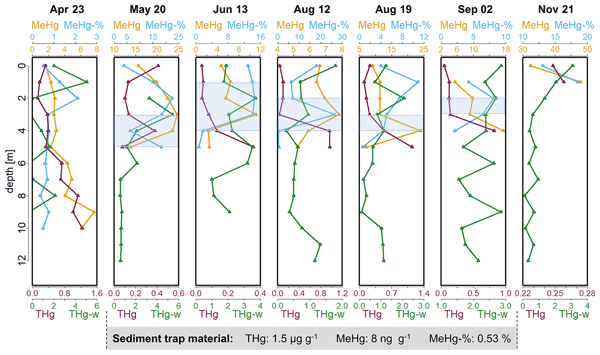
Toxic methylmercury (MeHg) in lakes can be enriched in fish and is harmful for humans. Phytoplankton is the entry point for MeHg into the aquatic food chain. We investigated seasonal MeHg concentrations in plankton of a productive lake. Our results show that high amounts of MeHg occur in algae and suspended matter in lakes and that productive lakes are hot spots of MeHg formation, which is mainly controlled by decomposition of algae organic matter and water-phase redox conditions.
David S. McLagan, Harald Biester, Tomas Navrátil, Stephan M. Kraemer, and Lorenz Schwab
Biogeosciences, 19, 4415–4429, https://doi.org/10.5194/bg-19-4415-2022, https://doi.org/10.5194/bg-19-4415-2022, 2022
Short summary
Short summary
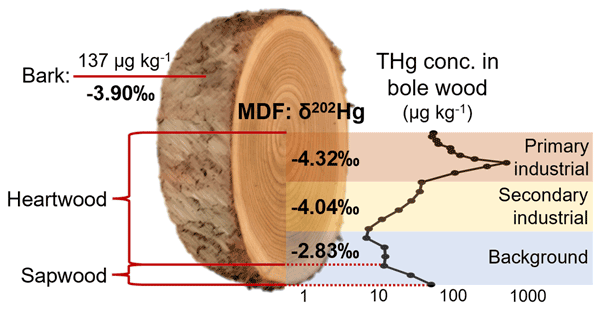
Spruce and larch trees are effective archiving species for historical atmospheric mercury using growth rings of bole wood. Mercury stable isotope analysis proved an effective tool to characterise industrial mercury signals and assess mercury uptake pathways (leaf uptake for both wood and bark) and mercury cycling within the trees. These data detail important information for understanding the mercury biogeochemical cycle particularly in forest systems.
Cited articles
Arnold, J., Gustin, M. S., and Weisberg, P. J.: Evidence for Nonstomatal Uptake of Hg by Aspen and Translocation of Hg from Foliage to Tree Rings in Austrian Pine, Environ. Sci. Technol., 52, 1174–1182, https://doi.org/10.1021/acs.est.7b04468, 2018.
Baroni, D., Ancora, S., Franzaring, J., Loppi, S., and Monaci, F.: Tree-rings analysis to reconstruct atmospheric mercury contamination at a historical mining site, Front. Plant Sci., 14, 1260431, https://doi.org/10.3389/fpls.2023.1260431, 2023.
Bohn, F. J., May, F., and Huth, A.: Species composition and forest structure explain the temperature sensitivity patterns of productivity in temperate forests, Biogeosciences, 15, 1795–1813, https://doi.org/10.5194/bg-15-1795-2018, 2018.
Boonen, K., Shetti, R., Navrátil, T., Nováková, T., Rohovec, J., and Lehejček, J.: Atmospheric mercury pollution recorded in conifer tree rings: Disentangling the effects of tree-ring width, water content, and climate on mercury concentrations, Dendrochronologia, 92, 126370, https://doi.org/10.1016/j.dendro.2025.126370, 2025.
Bréda, N., Cochard, H., Dreyer, E., and Granier, A.: Field comparison of transpiration, stomatal conductance and vulnerability to cavitation of Quercus petraea and Quercus robur under water stress, Ann. Sci. Forest., 50, 571–582, 1993.
Chellman, N., Csank, A., Gustin, M. S., Arienzo, M. M., Vargas Estrada, M., and McConnell, J. R.: Comparison of co-located ice-core and tree-ring mercury records indicates potential radial translocation of mercury in whitebark pine, Sci. Total Environ., 743, 140695, https://doi.org/10.1016/j.scitotenv.2020.140695, 2020.
Fornasaro, S., Ciani, F., Nannoni, A., Morelli, G., Rimondi, V., Lattanzi, P., Cocozza, C., Fioravanti, M., and Costagliola, P.: Tree Rings Record of Long-Term Atmospheric Hg Pollution in the Monte Amiata Mining District (Central Italy): Lessons from the Past for a Better Future, Minerals, 13, 688, https://doi.org/10.3390/min13050688, 2023.
Gauthey, A., Kahmen, A., Limousin, J.-M., Vilagrosa, A., Didion-Gency, M., Mas, E., Milano, A., Tunas, A., and Grossiord, C.: High heat tolerance, evaporative cooling, and stomatal decoupling regulate canopy temperature and their safety margins in three European oak species, Glob. Change Biol., 30, e17439, https://doi.org/10.1111/gcb.17439, 2024.
Ghotra, A., Lehnherr, I., Porter, T. J., and Pisaric, M. F. J.: Tree-Ring Inferred Atmospheric Mercury Concentrations in the Mackenzie Delta (NWT, Canada) Peaked in the 1970s but Are Increasing Once More, ACS Earth Space Chem., 4, 457–466, https://doi.org/10.1021/acsearthspacechem.0c00003, 2020.
Guo, W., Liu, M., Zhang, Q., Deng, Y., Chu, Z., Qin, H., Li, Y., Liu, Y.-R., Zhang, H., Zhang, W., Tao, S., and Wang, X.: Warming-Induced Vegetation Greening May Aggravate Soil Mercury Levels Worldwide, Environ. Sci. Technol., https://doi.org/10.1021/acs.est.4c01923, 2024.
Gustin, M. S., Dunham-Cheatham, S. M., Harper, J. F., Choi, W.-G., Blum, J. D., and Johnson, M. W.: Investigation of the biochemical controls on mercury uptake and mobility in trees, Sci. Total Environ., 851, 158101, https://doi.org/10.1016/j.scitotenv.2022.158101, 2022a.
Gustin, M. S., Ingle, B., and Dunham-Cheatham, S. M.: Further investigations into the use of tree rings as archives of atmospheric mercury concentrations, Biogeochemistry, 158, 167–180, https://doi.org/10.1007/s10533-022-00892-1, 2022b.
Horowitz, H. M., Jacob, D. J., Amos, H. M., Streets, D. G., and Sunderland, E. M.: Historical Mercury releases from commercial products: global environmental implications, Environ. Sci. Technol., 48, 10242–10250, https://doi.org/10.1021/es501337j, 2014.
Irvine, J., Perks, M. P., Magnani, F., and Grace, J.: The response of Pinus sylvestris to drought: stomatal control of transpiration and hydraulic conductance, Tree Physiol., 18, 393–402, https://doi.org/10.1093/treephys/18.6.393, 1998.
Jaozandry, C. C., Leban, J.-M., Legout, A., van der Heijden, G., Santenoise, P., Nourrisson, G., and Saint-André, L.: Advances in assessing Ca, K, and Mn translocation in oak tree stems (Quercus spp.), Heliyon, 10, e32627, https://doi.org/10.1016/j.heliyon.2024.e32627, 2024.
Jiskra, M., Sonke, J. E., Obrist, D., Bieser, J., Ebinghaus, R., Myhre, C. L., Pfaffhuber, K. A., Wängberg, I., Kyllönen, K., Worthy, D., Martin, L. G., Labuschagne, C., Mkololo, T., Ramonet, M., Magand, O., and Dommergue, A.: A vegetation control on seasonal variations in global atmospheric mercury concentrations, Nat. Geosci., 11, 244–250, https://doi.org/10.1038/s41561-018-0078-8, 2018.
Kang, H., Liu, X., Guo, J., Zhang, Q., Wang, Y., Huang, J., Xu, G., Wu, G., Ge, W., and Kang, S.: Long-term mercury variations in tree rings of the permafrost forest, northeastern China, Sci. China Earth Sci., 65, 1328–1338, https://doi.org/10.1007/s11430-021-9886-1, 2022.
Köhl, M., Linser, S., and Prins, K.: State of Europe's Forests 2020, Ministerial Conference on the Protection of Forests in Europe, https://doi.org/10.13140/RG.2.2.12881.76643, 2020.
Kuehne, C., Nosko, P., Horwath, T., and Bauhus, J.: A comparative study of physiological and morphological seedling traits associated with shade tolerance in introduced red oak (Quercus rubra) and native hardwood tree species in southwestern Germany, Tree Physiol., 34, 184–193, https://doi.org/10.1093/treephys/tpt124, 2014.
Kunz, J., Räder, A., and Bauhus, J.: Effects of Drought and Rewetting on Growth and Gas Exchange of Minor European Broadleaved Tree Species, Forests, 7, 239, https://doi.org/10.3390/f7100239, 2016.
Kuroda, K., Yamane, K., and Itoh, Y.: In Planta Analysis of the Radial Movement of Minerals from Inside to Outside in the Trunks of Standing Japanese Cedar (Cryptomeria japonica D. Don) Trees at the Cellular Level, Forests, 12, 251, https://doi.org/10.3390/f12020251, 2021.
Land, A. and Biester, H.: Mercury concentration records in tree rings of sessile oak and Douglas fir – The role of pollution and climate, Zenodo [data set], https://doi.org/10.5281/zenodo.19163965, 2026.
Li, F., Ma, C., and Zhang, P.: Mercury Deposition, Climate Change and Anthropogenic Activities: A Review, Front. Earth Sci., 8, https://doi.org/10.3389/feart.2020.00316, 2020.
Liu, X., Wang, X., Yuan, W., Wang, D., and Feng, X.: Tree rings recording historical atmospheric mercury: A review of progresses and challenges, Crit. Rev. Env. Sci. Tec., 1–18, https://doi.org/10.1080/10643389.2023.2250706, 2023.
Liu, X., Wang, X., and Wang, D.: Assessment of tree-ring mercury radial translocation and age effect in Masson pine: Implications for historical atmospheric mercury reconstruction, J. Environ. Sci.-China, 138, 266–276, https://doi.org/10.1016/j.jes.2022.10.027, 2024.
McLagan, D. S., Biester, H., Navrátil, T., Kraemer, S. M., and Schwab, L.: Internal tree cycling and atmospheric archiving of mercury: examination with concentration and stable isotope analyses, Biogeosciences, 19, 4415–4429, https://doi.org/10.5194/bg-19-4415-2022, 2022.
Montgomery, D. C., Peck, E. A., and Vining, D. C.: Introduction to linear regression analysis, A Wiley interscience publication, Wiley, New York [u.a.], 641 pp., ISBN 0471315656, 2001.
Navrátil, T., Nováková, T., Shanley, J. B., Rohovec, J., Matoušková, Š., Vaňková, M., and Norton, S. A.: Larch Tree Rings as a Tool for Reconstructing 20th Century Central European Atmospheric Mercury Trends, Environ. Sci. Technol., 52, 11060–11068, https://doi.org/10.1021/acs.est.8b02117, 2018.
Niessner, A., Ehekircher, S., Zimmermann, R., Horna, V., Reichle, D., Land, A., Spangenberg, G., and Hein, S.: Soil drought sets site specific limits to stem radial growth and sap flow of Douglas-fir across Germany, Front. Plant Sci., 15, https://doi.org/10.3389/fpls.2024.1401833, 2024.
Norby, R. J., Loader, N. J., Mayoral, C., Ullah, S., Curioni, G., Smith, A. R., Reay, M. K., van Wijngaarden, K., Amjad, M. S., Brettle, D., Crockatt, M. E., Denny, G., Grzesik, R. T., Hamilton, R. L., Hart, K. M., Hartley, I. P., Jones, A. G., Kourmouli, A., Larsen, J. R., Shi, Z., Thomas, R. M., and MacKenzie, A. R.: Enhanced woody biomass production in a mature temperate forest under elevated CO2, Nat. Clim. Change, 14, 983–988, https://doi.org/10.1038/s41558-024-02090-3, 2024.
Nováková, T., Navrátil, T., Demers, J. D., Roll, M., and Rohovec, J.: Contrasting tree ring Hg records in two conifer species: Multi-site evidence of species-specific radial translocation effects in Scots pine versus European larch, Sci. Total Environ., 762, 144022, https://doi.org/10.1016/j.scitotenv.2020.144022, 2021.
Nováková, T., Navrátil, T., Schütze, M., Rohovec, J., Matoušková, Š., Hošek, M., and Matys Grygar, T.: Reconstructing atmospheric Hg levels near the oldest chemical factory in central Europe using a tree ring archive, Environ. Pollut. (Barking, Essex 1987), 304, 119215, https://doi.org/10.1016/j.envpol.2022.119215, 2022.
Obrist, D., Kirk, J. L., Zhang, L., Sunderland, E. M., Jiskra, M., and Selin, N. E.: A review of global environmental mercury processes in response to human and natural perturbations: Changes of emissions, climate, and land use, Ambio, 47, 116–140, https://doi.org/10.1007/s13280-017-1004-9, 2018.
Obrist, D., Roy, E. M., Harrison, J. L., Kwong, C. F., Munger, J. W., Moosmüller, H., Romero, C. D., Sun, S., Zhou, J., and Commane, R.: Previously unaccounted atmospheric mercury deposition in a midlatitude deciduous forest, P. Natl. Acad. Sci. USA, 118, https://doi.org/10.1073/pnas.2105477118, 2021.
Palmero-Iniesta, M., Pino, J., Pesquer, L., and Espelta, J. M.: Recent forest area increase in Europe: expanding and regenerating forests differ in their regional patterns, drivers and productivity trends, Eur. J. Forest Res., 140, 793–805, https://doi.org/10.1007/s10342-021-01366-z, 2021.
Park, A., Puettmann, K., Wilson, E., Messier, C., Kames, S., and Dhar, A.: Can Boreal and Temperate Forest Management be Adapted to the Uncertainties of 21st Century Climate Change?, Crit. Rev. Plant Sci., 33, 251–285, https://doi.org/10.1080/07352689.2014.858956, 2014.
Peckham, M. A., Gustin, M. S., and Weisberg, P. J.: Assessment of the Suitability of Tree Rings as Archives of Global and Regional Atmospheric Mercury Pollution, Environ. Sci. Technol., 53, 3663–3671, https://doi.org/10.1021/acs.est.8b06786, 2019.
Peng, H., Zhang, X., Bishop, K., Marshall, J., Nilsson, M. B., Li, C., Björn, E., and Zhu, W.: Tree Rings Mercury Controlled by Atmospheric Gaseous Elemental Mercury and Tree Physiology, Environ. Sci. Technol., https://doi.org/10.1021/acs.est.4c05662, 2024.
Perone, A., Cocozza, C., Cherubini, P., Bachmann, O., Guillong, M., Lasserre, B., Marchetti, M., and Tognetti, R.: Oak tree-rings record spatial–temporal pollution trends from different sources in Terni (Central Italy), Environ. Pollut. (Barking, Essex 1987), 233, 278–289, https://doi.org/10.1016/j.envpol.2017.10.062, 2018.
Raftoyannis, Y. and Radoglou, K.: Physiological responses of beech and sessile oak in a natural mixed stand during a dry summer, Ann. Bot.-London, 89, 723–730, https://doi.org/10.1093/aob/mcf133, 2002.
Rinn, F.: TSAP-Win Professional, RINNTECH, Heidelberg, 2002–2013.
Samuelson, L. J., Stokes, T. A., Ramirez, M. R., and Mendonca, C. C.: Drought tolerance of a Pinus palustris plantation, Forest Ecol. Manag., 451, 117557, https://doi.org/10.1016/j.foreco.2019.117557, 2019.
Scanlon, T. M., Riscassi, A. L., Demers, J. D., Camper, T. D., Lee, T. R., and Druckenbrod, D. L.: Mercury Accumulation in Tree Rings: Observed Trends in Quantity and Isotopic Composition in Shenandoah National Park, Virginia, J. Geophys. Res.-Biogeo., 125, https://doi.org/10.1029/2019JG005445, 2020.
Siebelt, L.: Investigation of the role of mercury input through litterfall in forest soils at a former mercury mining site (Moschellandsberg), Thesis, Institute of Geoecology, Environmental Geochemistry group, TU Braunschweig, Braunschweig, 2024.
Siwik, E. I. H., Campbell, L. M., and Mierle, G.: Distribution and trends of mercury in deciduous tree cores, Environ. Pollut. (Barking, Essex 1987), 158, 2067–2073, https://doi.org/10.1016/j.envpol.2010.03.002, 2010.
Streets, D. G., Horowitz, H. M., Jacob, D. J., Lu, Z., Levin, L., Schure, A. F. H. ter, and Sunderland, E. M.: Total Mercury Released to the Environment by Human Activities, Environ. Sci. Technol., 51, 5969–5977, https://doi.org/10.1021/acs.est.7b00451, 2017.
Tardieu, F. and Simonneau, T.: Variability among species of stomatal control under fluctuating soil water status and evaporative demand: modelling isohydric and anisohydric behaviours, J. Exp. Bot., 49, 419–432, https://doi.org/10.1093/jxb/49.Special_Issue.419, 1998.
Terrier, A., Girardin, M. P., Périé, C., Legendre, P., and Bergeron, Y.: Potential changes in forest composition could reduce impacts of climate change on boreal wildfires, Ecological applications a publication of the Ecological Society of America, 23, 21–35, https://doi.org/10.1890/12-0425.1, 2013.
Wang, X., Yuan, W., Lin, C.-J., Wu, F., and Feng, X.: Stable mercury isotopes stored in Masson Pinus tree rings as atmospheric mercury archives, J. Hazard. Mater., 415, 125678, https://doi.org/10.1016/j.jhazmat.2021.125678, 2021.
Wang, X., Yuan, W., Lin, C.-J., Zhang, L., Zhang, H., and Feng, X.: Climate and Vegetation As Primary Drivers for Global Mercury Storage in Surface Soil, Environ. Sci. Technol., 53, 10665–10675, https://doi.org/10.1021/acs.est.9b02386, 2019.
Yang, H., Ciais, P., Frappart, F., Li, X., Brandt, M., Fensholt, R., Fan, L., Saatchi, S., Besnard, S., Deng, Z., Bowring, S., and Wigneron, J.-P.: Global increase in biomass carbon stock dominated by growth of northern young forests over past decade, Nat. Geosci., 16, 886–892, https://doi.org/10.1038/s41561-023-01274-4, 2023.
Zhang, H., Holmes, C. D., and Wu, S.: Impacts of changes in climate, land use and land cover on atmospheric mercury, Atmos. Environ., 141, 230–244, https://doi.org/10.1016/j.atmosenv.2016.06.056, 2016.
Zhou, J., Obrist, D., Dastoor, A., Jiskra, M., and Ryjkov, A.: Vegetation uptake of mercury and impacts on global cycling, Nat. Rev. Earth Environ., 2, 269–284, https://doi.org/10.1038/s43017-021-00146-y, 2021.
Short summary
Trees take up mercury through their leaves and enrich it in their tree-rings. We investigated tree-ring records of oak and Douglas fir in Germany reaching back ~120 years. We have found that the overall magnitude of mercury loads in trees are determined by local atmospheric Hg concentrations while changes in mercury uptake are controlled by climate. Oak and Douglas fir show different Hg records through time as a results of different adaptation strategies to high temperatures and drought.
Trees take up mercury through their leaves and enrich it in their tree-rings. We investigated...
Altmetrics
Final-revised paper
Preprint