
Articles | Volume 23, issue 10
https://doi.org/10.5194/bg-23-3637-2026
© Author(s) 2026. This work is distributed under
the Creative Commons Attribution 4.0 License.
the Creative Commons Attribution 4.0 License.
https://doi.org/10.5194/bg-23-3637-2026
© Author(s) 2026. This work is distributed under
the Creative Commons Attribution 4.0 License.
the Creative Commons Attribution 4.0 License.
Research article
| Highlight paper
| 
28 May 2026
Research article | Highlight paper |
| 28 May 2026
| 28 May 2026
Shoreline exposure controls teal carbon accumulation in boreal lakes
Ana Lúcia Lindroth Dauner
CORRESPONDING AUTHOR

Environmental Geochemistry Group, Department of Geosciences and Geography, University of Helsinki, Gustaf Hällströmin Katu 2, Helsinki, 00560, Finland
Max O. A. Kankainen
Environmental Geochemistry Group, Department of Geosciences and Geography, University of Helsinki, Gustaf Hällströmin Katu 2, Helsinki, 00560, Finland
Sakari Väkevä
Finnish Environment Institute (Syke), Latokartanonkaari 11, Helsinki, 00790, Finland
Eero Asmala
Geological Survey of Finland (GTK), Vuorimiehentie 5, P.O. Box 96, Espoo, 02151, Finland
Marko Järvinen
Finnish Environment Institute (Syke), Latokartanonkaari 11, Helsinki, 00790, Finland
Karoliina Koho
Geological Survey of Finland (GTK), Vuorimiehentie 5, P.O. Box 96, Espoo, 02151, Finland
Tom Jilbert
Environmental Geochemistry Group, Department of Geosciences and Geography, University of Helsinki, Gustaf Hällströmin Katu 2, Helsinki, 00560, Finland
Related authors
Max Oliver Aleksi Kankainen, Ana Lúcia Lindroth Dauner, Tuomas Junna, Asko Simojoki, Karoliina Koho, and Tom Jilbert
EGUsphere, https://doi.org/10.5194/egusphere-2026-3899, https://doi.org/10.5194/egusphere-2026-3899, 2026
Short summary
Short summary
Lakes are important for the global carbon cycle, yet the variability in carbon burial and degradation, especially in vegetated shorelines, is not well understood. We found that vegetated shorelines can accumulate sediment carbon over long periods with low degradation or over short periods with high degradation, depending on hydrodynamic energy. In contrast, open water sediments accumulate less carbon but do so more reliably over time, with degradation influenced by the source of organic matter.
Ana Lúcia Lindroth Dauner, Frederik Schenk, Katherine Elizabeth Power, and Maija Heikkilä
The Cryosphere, 18, 1399–1418, https://doi.org/10.5194/tc-18-1399-2024, https://doi.org/10.5194/tc-18-1399-2024, 2024
Short summary
Short summary
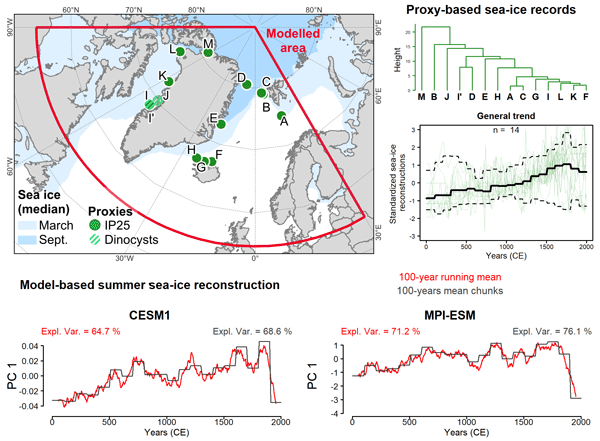
In this study, we analysed 14 sea-ice proxy records and compared them with the results from two different climate simulations from the Atlantic sector of the Arctic Ocean over the Common Era (last 2000 years). Both proxy and model approaches demonstrated a long-term sea-ice increase. The good correspondence suggests that the state-of-the-art sea-ice proxies are able to capture large-scale climate drivers. Short-term variability, however, was less coherent due to local-to-regional scale forcings.
Nishant Nishant, Janina Pykäri, Roel Lammerant, Anna Villnäs, Camilla Gustafsson, Alf Norkko, Gregory Cowie, and Tom Jilbert
EGUsphere, https://doi.org/10.5194/egusphere-2026-4456, https://doi.org/10.5194/egusphere-2026-4456, 2026
This preprint is open for discussion and under review for Biogeosciences (BG).
Short summary
Short summary
Carbon storage in shallow coastal sediments varies strongly with wave exposure and local environmental conditions. Across 20 shallow brackish-water coastal sites in Southern Finland, sheltered sediments held much more carbon than wave-exposed sediments. The carbon-rich sediments further showed more active ongoing carbon breakdown. Our approach highlights the diversity of shallow coastal seafloor environments in terms of sediment carbon storage and recycling.
Max Oliver Aleksi Kankainen, Ana Lúcia Lindroth Dauner, Tuomas Junna, Asko Simojoki, Karoliina Koho, and Tom Jilbert
EGUsphere, https://doi.org/10.5194/egusphere-2026-3899, https://doi.org/10.5194/egusphere-2026-3899, 2026
Short summary
Short summary
Lakes are important for the global carbon cycle, yet the variability in carbon burial and degradation, especially in vegetated shorelines, is not well understood. We found that vegetated shorelines can accumulate sediment carbon over long periods with low degradation or over short periods with high degradation, depending on hydrodynamic energy. In contrast, open water sediments accumulate less carbon but do so more reliably over time, with degradation influenced by the source of organic matter.
Felix Strobel, Gregor Hillers, Tom Jilbert, John Loehr, Christian Stranne, Tahvo Oksanen, Jonathan Vänskä, Roméo Courbis, Annukka Rintamäki, Amir Sadeghi-Bagherabadi, Lasse Weißgräber, Yinshuai Ding, Marc de Langenhagen, Eduardo Valero Cano, Kwabena Atobra, Vicent Doñate Felip, Valtteri Hopiavuori, Max Kankainen, Mohammad Alem Khodadadi, Kauri Kolehmainen, Emma Makkonen, Liisa Nygrén, Eero Purhonen, Niklas Rolleberg, Jasmiina Tuomiranta, Tommi Vuorinen, Aurélien Mordret, Cédric Schmelzbach, Ludovic Moreau, Olivier Coutant, and Céline Hadziioannou
EGUsphere, https://doi.org/10.5194/egusphere-2026-2106, https://doi.org/10.5194/egusphere-2026-2106, 2026
Short summary
Short summary
We describe an experiment to investigate variations of lake ice properties. We put a large number of seismic instruments on a frozen lake to record the ambient ice vibrations and make a range of supporting measurements. The initial results show that environmental effects can be resolved from the vibrations. This includes meteorological changes but also the trapping of methane or other gas bubbles during ice formation, which can help quantify the release of greenhouse gases from lakes.
Marie Korppoo, Inese Huttunen, Markus Huttunen, Maiju Narikka, Jari Silander, Tom Jilbert, Martin Forsius, Pirkko Kortelainen, Niina Kotamäki, Cintia Uvo, and Anna-Kaisa Ronkanen
Hydrol. Earth Syst. Sci., 30, 3095–3119, https://doi.org/10.5194/hess-30-3095-2026, https://doi.org/10.5194/hess-30-3095-2026, 2026
Short summary
Short summary
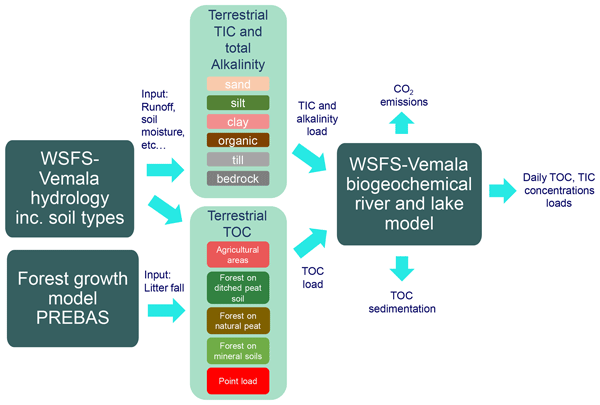
The development of carbon processes in the water quality model WSFS (Watershed Simulation and Forecasting System)-Vemala presents a significant advancement in simulating both total organic and inorganic carbon dynamics, burial and emissions through a river/lake network. The addition of organic acids to the total alkalinity definition improved pH simulations and thus the simulation of CO2 emissions in the acidic and organic rich waters of Finland. The new Vemala model provides a robust foundation to support water management in the future.
Dana Hellemann, Xiaole Sun, Tom Jilbert, Eva Ehrnsten, Lora Harris, Bo Gustafsson, Christoph Humborg, and Alf Norkko
EGUsphere, https://doi.org/10.5194/egusphere-2026-959, https://doi.org/10.5194/egusphere-2026-959, 2026
Short summary
Short summary
Using model-simulations and field data, we assess the effect of past eutrophication on present and future ammonium dynamics in coastal sediments of the Baltic Sea and their impact on the coastal ecosystem. Our results indicate a clear eutrophication legacy effect on the persistence of ammonium being released from the sediment to the water column, particularly under oxygen deficiency, with long-lasting effects into the far future and thus important implications for ecosystem recovery measures.

Margaret F. Williamson, Tom Jilbert, Alf Norkko, and Camilla Gustafsson
Biogeosciences, 23, 1327–1340, https://doi.org/10.5194/bg-23-1327-2026, https://doi.org/10.5194/bg-23-1327-2026, 2026
Short summary
Short summary
Reed bed carbon (C) storage is a topic of interest due to increased global distribution of reeds. C budgets to combat climate change often catalog reed beds as saltmarshes. Our findings show that reed beds are unique from saltmarshes, C storage is highest in reed bed sediments, and that reed bed zones may impact C storage. Further research into reed bed C is needed to better combat climate change and to ensure reeds are managed in a way that does not release excess C.
Ana Lúcia Lindroth Dauner, Frederik Schenk, Katherine Elizabeth Power, and Maija Heikkilä
The Cryosphere, 18, 1399–1418, https://doi.org/10.5194/tc-18-1399-2024, https://doi.org/10.5194/tc-18-1399-2024, 2024
Short summary
Short summary
In this study, we analysed 14 sea-ice proxy records and compared them with the results from two different climate simulations from the Atlantic sector of the Arctic Ocean over the Common Era (last 2000 years). Both proxy and model approaches demonstrated a long-term sea-ice increase. The good correspondence suggests that the state-of-the-art sea-ice proxies are able to capture large-scale climate drivers. Short-term variability, however, was less coherent due to local-to-regional scale forcings.
K. Mareike Paul, Martijn Hermans, Sami A. Jokinen, Inda Brinkmann, Helena L. Filipsson, and Tom Jilbert
Biogeosciences, 20, 5003–5028, https://doi.org/10.5194/bg-20-5003-2023, https://doi.org/10.5194/bg-20-5003-2023, 2023
Short summary
Short summary
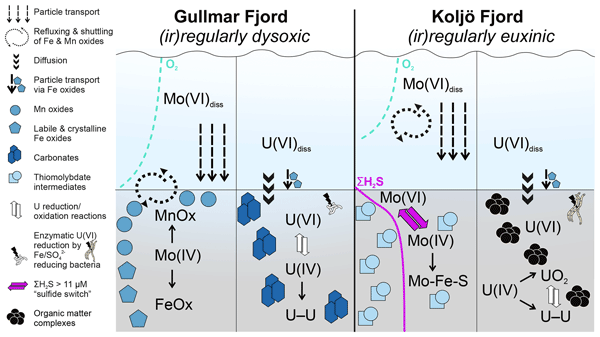
Seawater naturally contains trace metals such as Mo and U, which accumulate under low oxygen conditions on the seafloor. Previous studies have used sediment Mo and U contents as an archive of changing oxygen concentrations in coastal waters. Here we show that in fjords the use of Mo and U for this purpose may be impaired by additional processes. Our findings have implications for the reliable use of Mo and U to reconstruct oxygen changes in fjords.
Joonas J. Virtasalo, Peter Österholm, and Eero Asmala
Biogeosciences, 20, 2883–2901, https://doi.org/10.5194/bg-20-2883-2023, https://doi.org/10.5194/bg-20-2883-2023, 2023
Short summary
Short summary
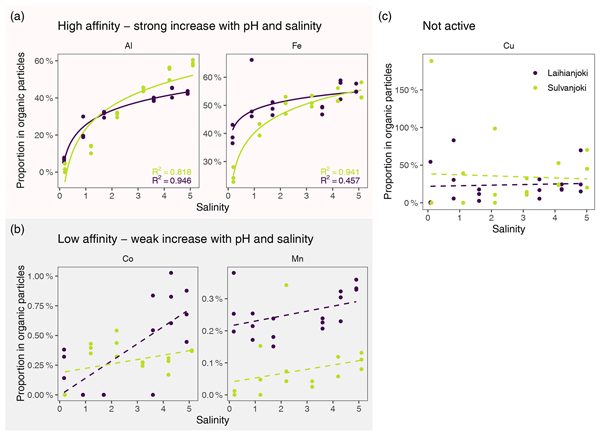
We mixed acidic metal-rich river water from acid sulfate soils and seawater in the laboratory to study the flocculation of dissolved metals and organic matter in estuaries. Al and Fe flocculated already at a salinity of 0–2 to large organic flocs (>80 µm size). Precipitation of Al and Fe hydroxide flocculi (median size 11 µm) began when pH exceeded ca. 5.5. Mn transferred weakly to Mn hydroxides and Co to the flocs. Up to 50 % of Cu was associated with the flocs, irrespective of seawater mixing.
Inda Brinkmann, Christine Barras, Tom Jilbert, Tomas Næraa, K. Mareike Paul, Magali Schweizer, and Helena L. Filipsson
Biogeosciences, 19, 2523–2535, https://doi.org/10.5194/bg-19-2523-2022, https://doi.org/10.5194/bg-19-2523-2022, 2022
Short summary
Short summary
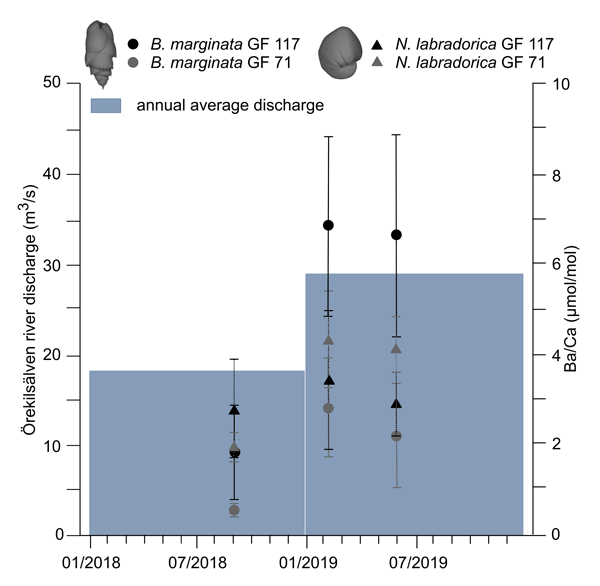
The concentration of the trace metal barium (Ba) in coastal seawater is a function of continental input, such as riverine discharge. Our geochemical records of the severely hot and dry year 2018, and following wet year 2019, reveal that prolonged drought imprints with exceptionally low Ba concentrations in benthic foraminiferal calcium carbonates of coastal sediments. This highlights the potential of benthic Ba / Ca to trace past climate extremes and variability in coastal marine records.
Karol Kuliński, Gregor Rehder, Eero Asmala, Alena Bartosova, Jacob Carstensen, Bo Gustafsson, Per O. J. Hall, Christoph Humborg, Tom Jilbert, Klaus Jürgens, H. E. Markus Meier, Bärbel Müller-Karulis, Michael Naumann, Jørgen E. Olesen, Oleg Savchuk, Andreas Schramm, Caroline P. Slomp, Mikhail Sofiev, Anna Sobek, Beata Szymczycha, and Emma Undeman
Earth Syst. Dynam., 13, 633–685, https://doi.org/10.5194/esd-13-633-2022, https://doi.org/10.5194/esd-13-633-2022, 2022
Short summary
Short summary
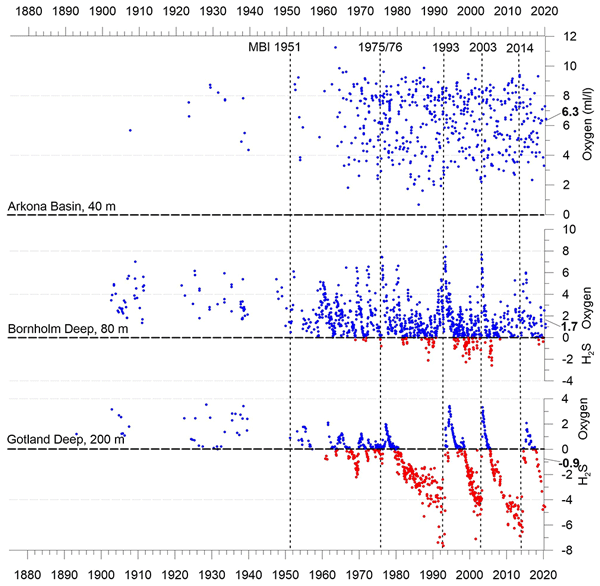
The paper covers the aspects related to changes in carbon, nitrogen, and phosphorus (C, N, P) external loads; their transformations in the coastal zone; changes in organic matter production (eutrophication) and remineralization (oxygen availability); and the role of sediments in burial and turnover of C, N, and P. Furthermore, this paper also focuses on changes in the marine CO2 system, the structure of the microbial community, and the role of contaminants for biogeochemical processes.
Cited articles
Alongi, D. M.: Impacts of climate change on Blue Carbon stocks and fluxes in mangrove forests, Forests, 13, 149, https://doi.org/10.3390/f13020149, 2022.
Bernal, B. and Mitsch, W. J.: Comparing carbon sequestration in temperate freshwater wetland communities, Glob. Change Biol., 18, 1636–1647, https://doi.org/10.1111/j.1365-2486.2011.02619.x, 2012.
Bianchi, T. S.: Biogeochemistry of estuaries, 1st Edn., Oxford University Press, New York, USA, 721 pp., ISBN: 9780195160826, 2007.
Bornette, G. and Puijalon, S.: Macrophytes: Ecology of aquatic plants, Encycl. Life Sci., https://doi.org/10.1002/9780470015902.a0020475, 2009.
Buczko, U., Jurasinski, G., Glatzel, S., and Karstens, S.: Blue carbon in coastal Phragmites wetlands along the southern Baltic Sea, Estuar. Coast., 45, 2274–2282, https://doi.org/10.1007/s12237-022-01085-7, 2022.
Burdige, D. J. (Ed.): Physical properties of sediments, in: Geochemistry of Marine Sediments, Princeton University Press, New Jersey, 624, ISBN: 978-0691095066, 2006.
Carnell, P. E., Windecker, S. M., Brenker, M., Baldock, J., Masque, P., Brunt, K., and Macreadie, P. I.: Carbon stocks, sequestration, and emissions of wetlands in south eastern Australia, Glob. Change Biol., 24, 4173–4184, https://doi.org/10.1111/gcb.14319, 2018.
Cole, J. J., Prairie, Y. T., Caraco, N. F., McDowell, W. H., Tranvik, L. J., Striegl, R. G., Duarte, C. M., Kortelainen, P., Downing, J. A., Middelburg, J. J., and Melack, J.: Plumbing the global carbon cycle: Integrating inland waters into the terrestrial carbon budget, Ecosystems, 10, 171–184, https://doi.org/10.1007/s10021-006-9013-8, 2007.
Convention on Wetlands: Global Wetland Outlook: Special Edition 2021, edited by: Dudley, N., Secretariat of the Convention on Wetlands, Gland, Switzerland, 98–100, https://doi.org/10.2307/jj.9561408.32, 2021.
Dauner, A. L. L, Kankainen, M. O. A., Väkevä, S., Asmala, E., Järvinen, M., Koho, K., and Jilbert, T.: Grain size, dry bulk density and organic carbon from samples of sediment cores retrieved in Finnish lakes, PANGAEA [data set], https://doi.org/10.1594/PANGAEA.986726, 2025a.
Dauner, A. L. L., Kankainen, M. O. A., Väkevä, S., Asmala, E., Järvinen, M., Koho, K., and Jilbert, T.: Sedimentary organic carbon and environmental characteristics of vegetated shoreline from Finnish lakes, PANGAEA [data set], https://doi.org/10.1594/PANGAEA.986727, 2025b.
Duarte, C. M., Middelburg, J. J., and Caraco, N. F.: Major role of marine vegetation on the oceanic carbon cycle C, Biogeosciences, 2, 1–8, https://doi.org/10.5194/bg-2-1-2005, 2005.
DVV: Digija väestötietovirasto (Digital and Population Information Agency of Finland), Finland shapefile, https://www.avoindata.fi/data/fi/dataset/, 2021, last access: 25 May 2023.
Fagherazzi, S. and Wiberg, P. L.: Importance of wind conditions, fetch, and water levels on wave-generated shear stresses in shallow intertidal basins, J. Geophys. Res.-Earth Surf., 114, F03022, https://doi.org/10.1029/2008JF001139, 2009.
FMI database: Finnish Meteorological Institute: FMI database: https://en.ilmatieteenlaitos.fi/download-observations (last access: 9 August 2024), 2024.
Glückert, G.: On deglaciation between Pieksämäki and Pielavesi in central Finland, Bull. Geol. Soc. Finl., 46, 43–51, https://doi.org/10.17741/bgsf/46.1.007, 1974.
Grasset, C., Mesman, J. P., Tranvik, L. J., Maranger, R., and Sobek, S.: Contribution of lake littoral zones to the continental carbon budget, Nat. Geosci., 18, 747–752, https://doi.org/10.1038/s41561-025-01739-8, 2025.
Green, M. O. and Coco, G.: Review of wave-driven sediment resuspension and transport in estuaries Reviews of Geophysics, Eos, Trans. Am. Geophys., 52, 77–117, https://doi.org/10.1002/2013RG000437, 2014.
GTK: Geological Survey of Finland, Maankamara, https://gtkdata.gtk.fi/maankamara/ (last access: 3 April 2024), 2024.
Gurwick, N. P., Groffman, P. M., Yavitt, J. B., Gold, A. J., Blazejewski, G., and Stolt, M.: Microbially available carbon in buried riparian soils in a glaciated landscape, Soil Biol. Biochem., 40, 85–96, https://doi.org/10.1016/j.soilbio.2007.07.007, 2008.
Hayes, M. O.: An exposure index for oiled shorelines, Spill Sci. Technol. Bull., 3, 139–147, https://doi.org/10.1016/S1353-2561(96)00014-X, 1996.
Hijmans, R. J., Bivand, R., Cordano, E., Dyba, K., Pebesma, E., and Sumner, M. D.: terra: Spatial Data Analysis. R package version 1.7-83, https://cran.r-project.org/web/packages/terra/index.html (last access: 27 January 2025), 2024.
Hyvärinen, H.: The deglaciation history of eastern Fennoscandia - recent data from Finland, Boreas, 2, 85–102, https://doi.org/10.1111/j.1502-3885.1973.tb00975.x, 1973.
Järvi-meriwiki: Oulujärvi: https://www.jarviwiki.fi/wiki/Oulujärvi_(yhd.), last access: 29 September 2025.
Junna, T., Asmala, E., Mäkinen, J., Kortelainen, P., Jilbert, T., and Koho, K.: Land use as a key driver of increased organic carbon burial in boreal lakes, Biogeochemistry, 168, 1–16, 2025.
Kairesalo, T. and Vakkilainen, K.: Lake Vesijärvi and the City of Lahti (southern Finland) comprehensive interactions between the lake and the coupled human community, SIL news, 41, 1–12, 2004.
Kankaala, P., Ojala, A., and Käki, T.: Temporal and spatial variation in methane emissions from a flooded transgression shore of a boreal lake, Biogeochemistry, 68, 297–311, https://doi.org/10.1023/B:BIOG.0000031030.77498.1f, 2004.
Karimpour, A., Chen, Q., and Twilley, R. R.: Wind wave behavior in fetch and depth limited estuaries, Sci. Rep., 7, 40654, https://doi.org/10.1038/srep40654, 2017.
Keil, R. G. and Cowie, G. L.: Organic matter preservation through the oxygen-deficient zone of the NE Arabian Sea as discerned by organic carbon:mineral surface area ratios, Mar. Geol., 161, 13–22, https://doi.org/10.1016/S0025-3227(99)00052-3, 1999.
Keil, R. G., Montluçon, D. B., Prahl, F. G., and Hedges, J. I.: Sorptive preservation of labile organic matter in marine sediments, Lett. Nat., 370, 549–551, 1994.
Kennedy, H., Pagès, J. F., Lagomasino, D., Arias-Ortiz, A., Colarusso, P., Fourqurean, J. W., Githaiga, M. N., Howard, J. L., Krause-Jensen, D., Kuwae, T., Lavery, P. S., Macreadie, P. I., Marbà, N., Masqué, P., Mazarrasa, I., Miyajima, T., Serrano, O., and Duarte, C. M.: Species traits and geomorphic setting as drivers of global soil carbon stocks in seagrass meadows, Global Biogeochem. Cy., 36, 1–18, https://doi.org/10.1029/2022GB007481, 2022.
Keränen, R., Riihimäki, J., Asunmaa, A., Madekivi, O., Hellsten, S., Alasaarela, E., and Seppänen, E.: Oulujärven rantojen kasvillisuuden kehittyminen ja käyttöedellytysten parantaminen, Vesija ympäristöhallituksen monistesarja, Helsinki, 104 pp., ISBN: 951-47-5585-5, 1992.
Koponen, S., Väkevä, S., Jokinen, A.-P., Virtanen, E., Viitasalo, M., Blenckner, T., and Cervo, A. de: Blue Carbon Habitats – a comprehensive mapping of Nordic salt marshes for estimating Blue Carbon storage potential, Nordic Council of Ministers, 33 pp., https://doi.org/10.6027/temanord2022-506, 2022.
Kortelainen, P., Pajunen, H., Rantakari, M., and Saarnisto, M.: A large carbon pool and small sink in boreal Holocene lake sediments, Glob. Change Biol., 10, 1648–1653, https://doi.org/10.1111/j.1365-2486.2004.00848.x, 2004.
Lamont-Smith, T. and Waseda, T.: Wind wave growth at short fetch, J. Phys. Oceanogr., 38, 1597–1606, https://doi.org/10.1175/2007JPO3712.1, 2007.
Leonard, L. A. and Luther, M. E.: Flow hydrodynamics in tidal marsh canopies, Limnol. Oceanogr., 40, 1474–1484, https://doi.org/10.4319/lo.1995.40.8.1474, 1995.
Leonard, L. A., Wren, P. A., and Beavers, R. L.: Flow dynamics and sedimentation in Spartina alterniflora and Phragmites australis marshes of the Chesapeake Bay, Wetlands, 22, 415–424, https://doi.org/10.1672/0277-5212(2002)022[0415:FDASIS]2.0.CO;2, 2002.
Li, H. and Yang, S. L.: Trapping effect of tidal marsh vegetation on suspended sediment, Yangtze Delta, J. Coast. Res., 25, 915–924, https://doi.org/10.2112/08-1010.1, 2009.
Lunkka, J. P., Ojala, A. E. K., Kaakinen, A., Hovikoski, J., Kultti, S., Kuosmanen, N., Palmu, J. P., Putkinen, N., Sarala, P., and Virtasalo, J.: Stratigraphic framework for the classification of Quaternary deosits in Finland, Geol. Surv. Finl. Bull., 418, 77–143, 2024.
Marchand, P. and Gill, D.: waver: Calculate Fetch and Wave Energy, R package version 0.3.0, https://cran.r-project.org/web/packages/waver/index.html (last access: 27 January 2025), 2023.
Marschner, I. and Donoghoe, M. W.: glm2: Fitting Generalized Linear Models, R package version 1.2.1, https://cran.r-project.org/web/packages/glm2/index.html (last access: 24 October 2024), 2022.
Mendonça, R., Müller, R. A., Clow, D., Verpoorter, C., Raymond, P., Tranvik, L. J., and Sobek, S.: Organic carbon burial in global lakes and reservoirs, Nat. Commun., 8, 1–6, https://doi.org/10.1038/s41467-017-01789-6, 2017.
Milliman, J. D.: Organic matter content in U.S. Atlantic continental slope sediments: Decoupling the grain-size factor, Deep-Sea Res. Pt. II, 41, 797–808, https://doi.org/10.1016/0967-0645(94)90049-3, 1994.
Mohamed Anas, M. U., Scott, K. A., and Wissel, B.: Carbon budgets of boreal lakes: state of knowledge, challenges, and implications, Environ. Rev., 23, 275–287, 2015.
Murphy, K. J.: Plant communities and plant diversity in softwater lakes of northern Europe, Aquat. Bot., 73, 287–324, https://doi.org/10.1016/S0304-3770(02)00028-1, 2002.
Murtojärvi, M., Suominen, T., Tolvanen, H., Leppänen, V., and Nevalainen, O. S.: Quantifying distances from points to polygons-applications in determining fetch in coastal environments, Comput. Geosci., 33, 843–852, https://doi.org/10.1016/j.cageo.2006.10.006, 2007.
Nahlik, A. M. and Fennessy, M. S.: Carbon storage in US wetlands, Nat. Commun., 7, 1–9, https://doi.org/10.1038/ncomms13835, 2016.
Nikora, V., Larned, S., Debnath, K., Cooper, G., and Reid, M.: Hydraulic resistance due to aquatic vegetation in small streams: Field study, J. Hydraul. Eng., 134, 1326–1332, 2008.
Noori, R., Bateni, S. M., Saari, M., Almazroui, M., and Torabi Haghighi, A.: Strong warming rates in the surface and bottom layers of a boreal lake: Results from approximately six decades of measurements (1964–2020), Earth Sp. Sci., 9, https://doi.org/10.1029/2021EA001973, 2022.
Ojala, A. E. K., Luoto, T. P., and Virtasalo, J. J.: Establishing a high-resolution surface sediment chronology with multiple dating methods – Testing 137Cs determination with Nurmijärvi clastic-biogenic varves, Quat. Geochronol., 37, 32–41, https://doi.org/10.1016/j.quageo.2016.10.005, 2017.
Finnish National Geoportal (Orthophotos): https://kartta.paikkatietoikkuna.fi/?lang=en, last access: 17 July 2023.
Pajunen, H.: Carbon in Finnish lake sediments, Vammalan Kirjapaino Oy, Espoo, ISBN: 951-690-781-4, 2000.
Partanen, S., Keto, A., Visuri, M., Tarvainen, A., Riihimäki, J., and Hellsten, S.: The relationship between water level fluctuation and distribution of emergent aquatic macrophytes in large, mildly regulated lakes in the Finnish Lake District, SIL Proceedings, 1922–2010, 29, 1160–1166, https://doi.org/10.1080/03680770.2005.11902867, 2006.
QGIS Development Team: QGIS Geographic Information System: Open Source Geospatial Foundation Project, Version 3.28.4-Firenze, http://qgis.org (last access: 20 February 2025), 2024.
R Core Team: R: A language and environment for statistical computing (version 4.3.3), https://www.r-project.org/ (last access: 4 May 2026), 2024.
Rainio, H., Saarnisto, M., and Ekman, I.: Younger Dryas end moraines in Finland and NW Russia, Quaternary Int., 28, 179–192, https://doi.org/10.1016/1040-6182(95)00051-J, 1995.
Regnier, P., Resplandy, L., Najjar, R. G., and Ciais, P.: The land-to-ocean loops of the global carbon cycle, Nature, 603, 401–410, https://doi.org/10.1038/s41586-021-04339-9, 2022.
Repo, R. and Tynni, R.: Observations on the Quaternary geology of an area between the 2nd Salpausselkä and the ice-marginal formation of central Finland, Bull. Geol. Soc. Finl., 43, 185–202, https://doi.org/10.17741/bgsf/43.2.005, 1971.
van Rijn, L. C.: Principles of sediment transport in rivers, estuaries and coastal seas, Aqua Publications, Amsterdam, 690 pp., ISBN: 90-800356-2-9, 1993.
Silan, G., Buosi, A., Bertolini, C., and Sfriso, A.: Dynamics and drivers of carbon sequestration and storage capacity in Phragmites australis-dominated wetlands, Estuar. Coast. Shelf Sci., 298, 108640, https://doi.org/10.1016/j.ecss.2024.108640, 2024.
Stanley, D. J. and Hait, A. K.: Deltas, radiocarbon dating, and measurements of sediment storage and subsidence, Geology, 28, 295–298, 2000.
Sutfin, N. A., Wohl, E. E., and Dwire, K. A.: Banking carbon: A review of organic carbon storage and physical factors influencing retention in floodplains and riparian ecosystems, Earth Surf. Process. Landf., 41, 38–60, https://doi.org/10.1002/esp.3857, 2016.
Syke: Finnish Environmental Institute, Ecological status of surface waters 2019 – Finland, https://www.vesi.fi/en/karttapalvelu/ (last access: 17 January 2025), 2019.
Syke: Finnish Environmental Institute: VALUE – valuma-alueen rajaustyökalu (watershed delineation tool), https://paikkatieto.ymparisto.fi/value/ (last access: 21 January 2025), 2024.
Syke: Finnish Environmental Institute, Hertta database of Syke, 3rd River Basin Management Plan, data from 2012–2017, https://www.syke.fi/fi-fi/avoin_/ymparistotietojarjestelmat (last access: 21 January 2025), 2025.
Tangen, B. A. and Bansal, S.: Soil organic carbon stocks and sequestration rates of inland, freshwater wetlands: Sources of variability and uncertainty, Sci. Total Environ., 749, 141444, https://doi.org/10.1016/j.scitotenv.2020.141444, 2020.
Taran, M., Ahirwal, J., Deb, S., and Sahoo, U. K.: Variability of carbon stored in inland freshwater wetland in Northeast India, Sci. Total Environ., 859, 160384, https://doi.org/10.1016/j.scitotenv.2022.160384, 2023.
Tikkanen, M.: The changing landforms of Finland, Fennia, 180, 21–30, 2002.
Tikkanen, M.: The landforms of Finland, in: Finland – land of mires, edited by: Lindholm, T. and Heikkilä, R., Finnish Environment Institute, 27–38, 2006.
Tranvik, L. J., Cole, J. J., and Prairie, Y. T.: The study of carbon in inland waters – from isolated ecosystems to players in the global carbon cycle, Limnol. Oceanogr. Lett., 3, 41–48, https://doi.org/10.1002/lol2.10068, 2018.
Turunen, J., Hellsten, S., and Marttunen, M.: Oulujoen vesistöalueen säännös-teltyjen järvien säännöstely-suositusten toteutuminen, ARVOVESI-hankkeen raportti, 5, 1–63, 2022.
Verpoorter, C., Kutser, T., Seekell, D. A., and Tranvik, L. J.: A global inventory of lakes based on high-resolution satellite imagery, Geophys. Res. Lett., 41, 6396–6402, https://doi.org/10.1002/2014GL060641, 2014.
Wang, H. J., Wang, H. Z., Liang, X. M., Pan, B. Z., and Kosten, S.: Macrophyte species strongly affects changes in C, N, and P stocks in shallow lakes after a regime shift from macrophyte to phytoplankton dominance, Inl. Waters, 6, 449–460, https://doi.org/10.1080/IW-6.3.837, 2016.
Wickham, H.: ggplot2: Elegant Graphics for Data Analysis. R package version 3.5.0, Springer-Verlag New York, https://ggplot2.tidyverse.org/ ( last access: 4 May 2026), 2016.
Editorial statement
This publication presents measurements of sedimentary organic carbon stocks in the vegetated shorelines of boreal lakes, so called ‘teal carbon’ environments. The three large Finland lakes in this study show a large variability in teal carbon storage, with grain size as the most significant parameter explaining the variability. The amount of sedimentary organic carbon storage is related further to abiotic and biotic controls. Teal carbon is an important component of overall lacustrine carbon storage, and the process-based controls elucidated in this study may provide insight into carbon storage in other boreal lakes as well.
This publication presents measurements of sedimentary organic carbon stocks in the vegetated...
Short summary
Aquatic vegetated ecosystems are important for global carbon storage, but freshwater shorelines remain understudied. We found that the sedimentary organic carbon (SOC) stocks ranged from 0 to 40.8 kg m−2, with a large spatial variability. Large SOC stocks were found in sheltered areas, with the predominance of fine-grained sediments. In exposed areas, vegetation might also impact SOC accumulation. Accounting for shoreline exposure is crucial for improving regional carbon budget estimates.
Aquatic vegetated ecosystems are important for global carbon storage, but freshwater shorelines...


Altmetrics
Final-revised paper
Preprint