
the Creative Commons Attribution 4.0 License.
the Creative Commons Attribution 4.0 License.
 | 08 Jun 2026
Ideas and perspectives: Max MACS – constraining the potential global scale of Marine Anoxic Carbon Storage for CO2 removal
Nitai Amiel
Dror L. Angel
James P. Barry
Thomas M. Blattmann
Laura Boicenco
Antoine Crémière
Natalya Evans
Nora Gallarotti
Sebastian Haas
Jan-Hendrik Hehemann
Peter Krost
Pranay Lal
David Lordkipanidze
Tiia Luostarinen
Aaron M. Martinez
Allison J. Matzelle
Selma Menabit
Mihaela Muresan
Andreas Neumann
Jean-Daniel Paris
Christopher R. Pearce
Nick Reynard
Daniel L. Sanchez
Florence Schubotz
Violeta Slabakova
Adrian Stanica
Elena Stoica
Andrew K. Sweetman
Tina Treude
Yoana G. Voynova
Nikolaos D. Zarokanellos
Marine Anoxic Carbon Storage (MACS) is a potential strategy for enhancing atmospheric CO2 removal (CDR) by sequestering organic carbon produced by terrestrial plants in stable, anoxic marine reservoirs. Initial results suggest that MACS could, in theory, operate at the gigatonne scale that would be required to impact global climate, with limited environmental risk and promising opportunities for co-benefits. However, several outstanding knowledge gaps make it challenging to quantify the actual potential global scale of MACS with confidence. To inform decisions about climate mitigation and trade-offs in the future, it is essential that we know how MACS implementation at scale would impact critical environmental and economic systems in the context of likely future scenarios.
Building on the results of a workshop in Bucharest, Romania in 2025, we discuss the potential impacts of MACS activities on the ecology, biogeochemistry, economy, and community around the Black Sea, seafloor brines, and other anoxic marine sites. Quantifiable limits to the potential maximum feasible scale of MACS for CDR are organized into five criteria: (1) Durable storage site capacity; (2) Biomass sources and logistics; (3) Greenhouse gas balance; (4) Oxygen and sulfide impacts at the redoxcline; and (5) Impacts on dissolved organic matter or nutrients in the oxic zone. For each criterion, we evaluate the factors that could limit scale, our current state of knowledge, and the priority knowledge gaps that, if addressed, would improve our ability to estimate the potential global scale of MACS for CDR. Research is needed to understand its potential impacts at scale, but MACS is nonetheless worthy of serious consideration as a potential pathway for climate mitigation in coming decades.
- Article
(1182 KB) - Full-text XML
- BibTeX
- EndNote


Marine Anoxic Carbon Storage (MACS) is a carbon dioxide removal (CDR) approach that would sequester organic carbon in the form of plant biomass in naturally-occurring, anoxic (O2-free) marine environments like isolated basins, brines, or sediments. MACS is thus a hybrid land–ocean approach for CDR. Terrestrial, lignocellulosic organic matter can be efficiently preserved in these environments by natural mechanisms over timescales of thousands of years or more, preventing the reoxidation of this organic C to CO2. Here, we focus exclusively on the potential sequestration of terrestrial plants; the use of aquatic biomass would introduce additional categories of potential impact on the ocean that are beyond the current scope (cf., Roberts et al., 2025).
1.1 Earth's carbon fluxes and global CO2 removal goals
Climate change is driven largely by excess atmospheric CO2 (IPCC AR6, 2021). Given current emissions trajectories, on the order of 10 Gt yr−1 of CO2 (200 Gt CO2 by 2050) will need to be removed from the atmosphere in coming decades to meet climate targets of ≤ 2 °C average warming by the end of the century (IPCC AR6, 2021). Net greenhouse gas removals can be met through a combination of approaches, each of which might contribute the equivalent of ∼ 0.1 to 1 Gt worth of CO2 removal (CO2e) yr−1 (National Academies of Sciences, Engineering, and Medicine, 2022). (By convention, units of “CO2 equivalent” (CO2e) treat all carbon atoms as CO2 and can include contributions from other greenhouse gases, normalized by their climate impact.) This scale of activity would approach that of some of the largest industries on the planet today, including cement and oil production, as well as that of modern fluxes in the global carbon cycle (Table 1). For example, global rates of organic carbon (OC) burial in marine sediments today are equivalent to 2.87 ± 1.3 Gt CO2e yr−1, including approximately 0.23–0.33 Gt CO2e yr−1 of terrestrially-sourced OC (Dunne et al., 2007; Talling et al., 2024).
Table 1Proposed scale of global CDR relative to natural and anthropogenic fluxes. NPP = net primary production; OC = organic carbon; OAE-2 = Ocean Anoxic Event 2; PETM = Paleocene–Eocene Thermal Maximum. Sources: USGS = United States Geological Survey; UNEP = United Nations Environment Programme; US EIA = United States Energy Information Administration; US DOE = United States Department of Energy.
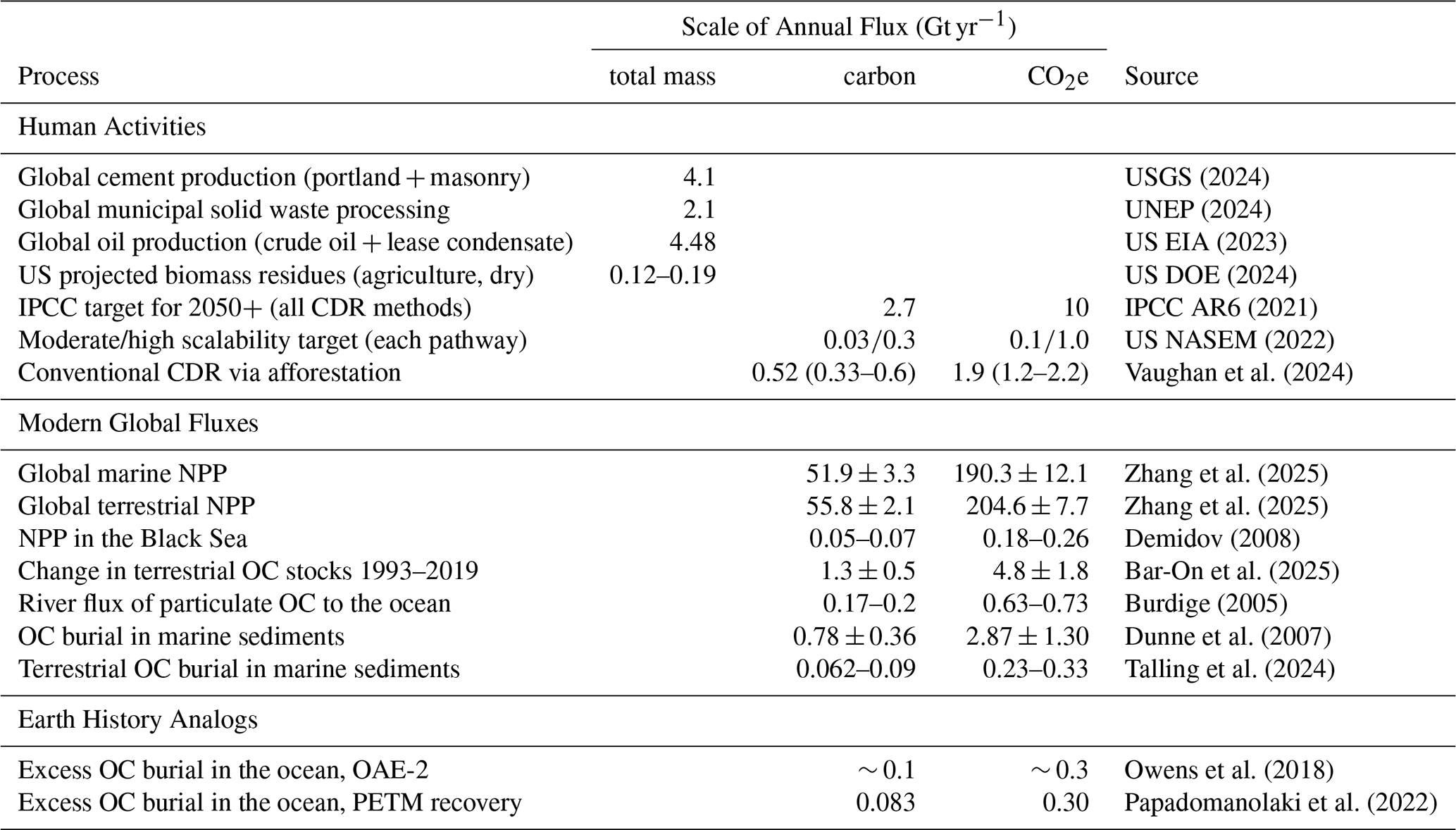
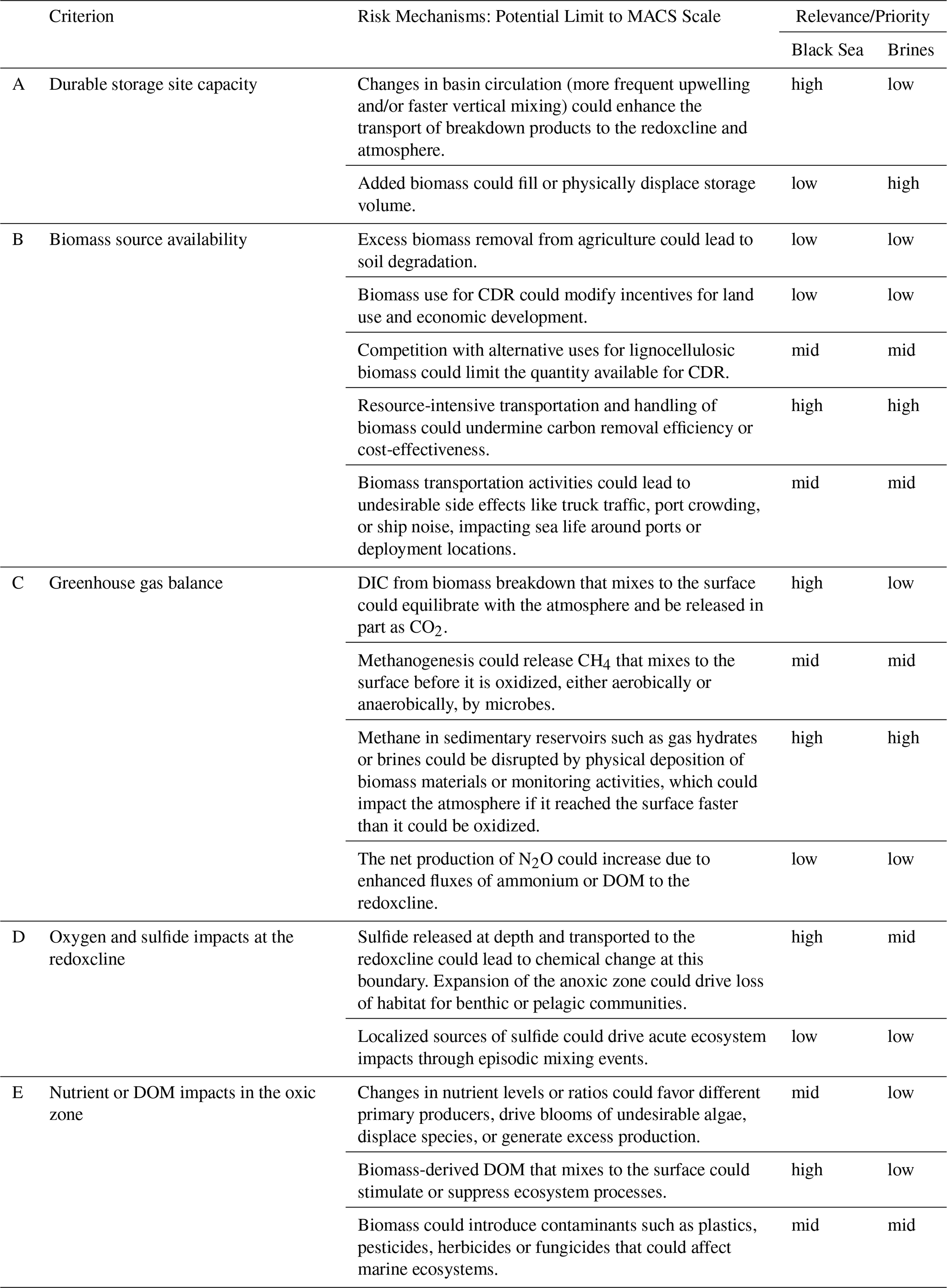
Table 2Summary of risk mechanisms that could represent limits to the global scale of MACS for CDR. Columns at right indicate mechanisms that are expected to have low, moderate, or high relevance for determining potential scale at each site.
Terrestrial plants are active participants in the inter-annual carbon cycle and their growth has substantial leverage over atmospheric CO2 concentrations. Annual fluctuations in the Keeling Curve show seasonal oscillations in atmospheric CO2 of ∼ 5 ppm, which is roughly equivalent to ∼ 39 Gt CO2e (Ballantyne et al., 2012). A slight imbalance between terrestrial production and respiration allows nearly a third of current anthropogenic C emissions to be stored on land (Friedlingstein et al., 2025). Most of this storage may be in the form of nonliving (soil) organic carbon (Georgiou et al., 2022); recent models suggest that global stocks may have increased by as much as 4.8 Gt CO2e yr−1 since 1993 (Bar-On et al., 2025). For comparison, conventional CDR (e.g., afforestation) currently uses terrestrial plants to remove ∼ 2 Gt CO2e yr−1 (Vaughan et al., 2024).
Throughout Earth's history, changes in the fluxes of organic carbon into long-lived reservoirs like soils and marine sediments have substantially impacted atmospheric CO2 concentrations and global climate, typically over timescales of thousands to tens of thousands of years. For example, during events like Ocean Anoxic Event 2 (OAE-2; ∼ 97 Ma), widespread anoxia supported the burial and preservation of vast amounts of largely marine OC, which contributed to global cooling (Jarvis et al., 2011). Marine sediments accumulated approximately 40 000 Gt excess C (150 000 Gt CO2e) over the course of this 500 kyr event (Owens et al., 2018), which implies an average excess OC burial of ∼ 0.3 Gt CO2e yr−1. This average presumably includes shorter periods of higher excess OC burial, but it is nevertheless of the same order of magnitude as scalability goals for individual CDR pathways (NASEM 2022, Table 1).
Terrestrial OC burial has also contributed to more recent shifts in global climate. Fluxes of terrestrial OC to the ocean via rivers are sensitive to changes in hydrology and weathering, both of which generally increase under warmer climates, generating a stabilizing climate feedback. Under the right conditions, the preservation efficiency of terrestrial materials in coastal sediments can approach 100 %, although it averages 20 %–44 % today (Blair and Aller, 2012; Galy et al., 2007, 2015). During the Paleocene–Eocene Thermal Maximum (PETM) at ∼ 56 Myr, the burial of terrestrial OC in marine sediments may have contributed substantially to enhanced global carbon burial and CO2 drawdown (Inglis et al., 2025). Approximately 3300 Gt excess OC was buried in marine sediments during the 40 000-year recovery period, equivalent to an average sequestration rate of around 0.30 Gt CO2e yr−1 (Table 1; Papadomanolaki et al., 2022). Terrestrial OC burial in marine sediments may have contributed similarly to recovery from Eocene hyperthermals and other hothouse events with high rates of weathering (Inglis et al., 2025). Average rates of excess global OC preservation associated with periods of climate cooling in the Cenozoic thus approach the scales of sequestration being proposed for individual CDR pathways (Table 1). Like OAE-2, these events can serve as valuable analogs to understand the mechanisms and impacts of enhanced OC preservation in the ocean.
1.2 Current state of MACS research and development
A variety of different CDR approaches will be needed to meet total CDR targets (NASEM, 2022), but potential techniques vary substantially in terms of their scalability, energy efficiency, carbon storage durability, economic implications, and environmental and social impacts. Different CDR approaches are expected to come “on-line” at different times in the coming century (Ganti et al., 2024), ideally in a way that would optimize for their relative advantages under different scenarios. As more data become available, it will become increasingly important to compare these advantages and risks among different approaches, including geochemical storage and ocean alkalinity enhancement, to develop a portfolio of mitigation tools.
MACS has several potential advantages that make it a promising target for further research. Because it relies on plants to concentrate atmospheric CO2, MACS avoids the need for “clean” grid power that plagues direct air capture and other energy-intensive CDR approaches. Additionally, biomass sourcing can rely on largely extant agricultural infrastructure, minimizing the CO2 emissions from construction. MACS could therefore have some of the lowest energy requirements per tonne and some of the highest carbon efficiencies of any proposed CDR approach (Sanchez et al., 2025; Strand and Benford, 2009). Marine anoxic storage is only one of several proposed methods for sequestering terrestrial biomass; woody materials are also being stored in anoxic vaults on land (Zeng et al., 2024) and as slurries injected into fractured, deep geological formations (Snyder, 2022). Carbon efficiency and energy needs for all of these storage alternatives will depend on biomass type, transportation mode, and processing method, which is likely to favor different storage options in different locations. The first carbon credits for terrestrial woody biomass burial on land were issued in 2024 (https://registry.puro.earth/issuances, last access: 1 May 2026).
Although biomass materials described here are sourced from land, their long-term storage would occur in specific parts of the ocean. MACS differs from other ocean-based methods for C storage like ocean alkalinity enhancement (OAE), direct ocean carbon capture and storage (DOCCS), or marine biomass cultivation in two notable ways: first, it sources plants, which directly remove carbon from the atmosphere without requiring air-sea gas exchange; and second, relatively isolated reservoirs are targeted for storage. Spatially limited sequestration sites can facilitate monitoring and permitting within a single jurisdiction, and they may reduce risks of impact to surrounding ecosystems. Nevertheless, MACS faces many of the same challenges as other marine CDR techniques, especially related to legal, social, and political issues.
The intentional placement of materials in the ocean, whether that is termed storage, burial, or dumping (e.g., in the U.S. EPA MPRSA framework), is regulated by the London Convention and Protocol. Active negotiations are underway to update the London Protocol framework to be fit-for-purpose for ocean-based CDR, and this legal framework is likely to continue to evolve rapidly in coming years (GESAMP, 2025; Silverman-Roati and Webb, 2025). Within current legal frameworks, early field studies are underway, but regulatory barriers and permitting challenges remain significant. In the United States, the Environmental Protection Agency (EPA) issued an MPRSA research permit in March 2026 that would allow the placement of 20 t of sugarcane bagasse into Orca Basin, a hypersaline brine pool on the deep (2200 m) US continental shelf, over 18 months (http://www.epa.gov/carboniferous, last access: 1 May 2026). In Europe, the Romanian National Environmental Protection Agency (ANPM) requested the execution of an Environmental Impact Assessment prior to permitting the placement of 100 t of woody biomass on the deep Black Sea seafloor.
In addition to establishing clear and efficient regulatory pathways, successful growth of the MACS field will require mechanisms for verifying the results of CDR actions in a way that earns social acceptance as well as trust in the scientific community. One step toward that goal is the release of a first protocol for future carbon credit verification this year (Puro.Earth, 2025b). This protocol focuses exclusively on enclosed anoxic basins and lignocellulosic (woody) biomass, and it requires both ex-situ experiments and in-situ measurements as evidence for ≥ 200 years storage. Over the long term, revised protocols could ideally be embedded into regulatory frameworks and environmental impact standards such as the Marine Strategy Framework Directive or the EU Carbon Removal Certification Framework.
1.3 Scope and Purpose of this Analysis
MACS research currently sits at an inflection point. There is a strong infusion of energy into the CDR field as awareness grows and initial scientific results are published in the peer-reviewed literature. At a time of extraordinarily tight resources for climate-related research and development, however, the justification for serious investment in MACS as a CDR pathway hinges on the question of whether this process can actually make a serious dent in atmospheric CO2. Currently, we don't know the answer – but we do know how to get there.
The purpose of this paper is to review the current state of knowledge related to predicting the outcomes of MACS at a climatically-relevant scale and to identify gaps in that knowledge. We aim to integrate global perspectives as a step toward building international research capacity and collaborative networks for MACS-related science, and to support and develop an international research infrastructure capable of testing feasibility on a global scale.
This work was catalyzed by a two-day intensive workshop in Bucharest, Romania in February 2025, which involved primarily academic and NGO researchers but also experts in governance, CDR verifiers, local environmental leaders, and entrepreneurs. Participants in the workshop came from 14 countries and 25 institutions, including all countries with Exclusive Economic Zones (EEZs) relevant to the Black Sea and Orca Basin except Russia and Ukraine. The goals of the workshop were to broadly discuss the CDR potential and risks of MACS with local and global scientists and stakeholders, and to identify high-impact research questions that could help evaluate limits to scale. The central ideas in this manuscript arose from workshop discussions, as refined through iterative conversations over the subsequent months.
Philosophically, the authors emphasize that support for research is not an endorsement of any particular technology or action at scale. Participants in the Bucharest Workshop came to the consensus conclusion that there may be significant potential for MACS to contribute to global CDR needs, and that the risks associated with small-scale field research are expected to be negligible relative to its potential value. They also concluded that several clear uncertainties limit our ability to predict some important impacts of MACS implementation at scale. Addressing these uncertainties would provide critical information for future decision makers in government, philanthropy, and industry. This report represents the first part of a roadmap to answer those questions.
The authors also acknowledge that the maximum potential global scale of MACS is only one component of a societal strategy toward responsible decision making around climate mitigation and CDR. This analysis is intended to support interdisciplinary efforts by identifying quantifiable physical and biogeochemical limits on the potential scale of MACS, which can help guide resources toward strategies with the potential for meaningful climate impact and inform ongoing conversations around how to meet global needs for hundreds of gigatonnes of net CO2 removal in coming decades.
In order to calculate a realistic estimate for the maximum feasible scale of MACS for CDR, we need to first decide which anoxic environments to prioritize in our analysis.
Anoxic marine environments in the water column and sediments are extremely diverse, including deep-sea brines, inland seas, river deltas, and large regions of sediments along the continental shelves. Participants at the Bucharest Workshop discussed the benefits and downsides of including different types of sites in a MACS global scale estimate. The Black Sea and deep hypersaline anoxic basins (e.g., Orca Basin) were selected for initial analysis due to their long-term redox stability and intense stratification, as well as their relatively mature level of scientific understanding and operational readiness. Carbon storage in a third type of anoxic environment, rapidly-accumulating sediment in (e.g.) major river-fan systems, is less well understood but has the advantages of engaging multiple sites across the global North and South and having vast potential storage capacity. In contrast, anoxic zones near eutrophic river outflows are highly dynamic environments characterized by mobile muds, strong lateral transport, and rapid sediment reworking (Aller et al., 2008; Bianchi et al., 2011), making them poorly suitable for MACS despite their high sedimentation rates. O2-deficient zones (ODZs) in eastern boundary systems are similarly unfavorable sites for MACS due to strong upwelling. Although this report prioritizes the Black Sea and brines, it retains a consideration of sediment burial as a forward-looking area for potential expansion.
2.1 The Black Sea
The Black Sea is the world's largest permanently anoxic basin, with a sulfidic water column below its shallow chemocline at approximately 80 to 150 m depth. Abyssal waters between 1750–2212 m have a volume of ∼ 75 137 km3, most of which have been isolated from the atmosphere for > 1000 years (Lee et al., 2002; Murray et al., 1991). Conditions in the Black Sea have famously preserved wooden ships for millennia (Pacheco-Ruiz et al., 2019). Its isolation and long water residence time make the Black Sea a critical site for MACS at scale, particularly as it exists in a region with abundant potential biomass sources and transport infrastructure. However, there is also a long history of conflict and environmental damage in the region, such as ongoing warfare and the dumping of nuclear materials.
For MACS, the leading environmental concerns with this site pertain to its shallow redoxcline that separates oxic from anoxic waters. This interface and the overlying oxic waters are critical to communities in the region for fisheries, recreation, and cultural and historical significance. The position of the redoxcline has historically moved due to changes in water and carbon budgets, regional climate, and eutrophication (nutrient input), requiring coupled models to project its behavior into the future. These factors also impact ecosystems throughout the upper oxic zone of the Black Sea (Mikaelyan et al., 2013) and control whether surface waters are a net source or sink for CO2 (Sergeev et al., 2024). Establishing the current sensitivity of the Black Sea system to changes in drivers like surface temperature, nutrient inputs, river flows, and circulation will be essential to understand its baseline state and facilitate comparisons against the outcomes of potential MACS interventions.
2.2 Orca Basin and other brines
The Orca Basin is a 10.24 km3 brine pool located at 2200 m depth in the Gulf of Mexico, approximately 200 km from the Louisiana coast (Shokes et al., 1977). It formed roughly 7800 years ago when a buried layer of salt was exposed on the seafloor and dissolved. The brine is strongly inhibited from mixing with the overlying seawater due to its strong density gradient (Addy and Behrens, 1980). As a result, Orca Basin is anoxic and physically traps both solid and dissolved carbon (Harvey and Kennicutt, 1992; Shah et al., 2013)). Sediments from Orca Basin exhibit exceptional organic matter preservation efficiencies, with reports of unprecedented levels of seaweed preservation for thousands of years (Kennett and Penrose, 1978). Other brines are known across the US continental shelf, the Mediterranean Sea, and the Red Sea, although only a few examples have received as much research attention as the Orca Basin.
2.3 River deltas and research sites
Major river deltas like those of the Amazon, Mississippi, Ganges-Brahmaputra, Yangtze, and Congo transport hundreds of millions of tonnes of sediment each year into coastal and offshore environments. River fans today bury the equivalent of 0.18–0.37 Pg yr−1 CO2e, and they have been important carbon sinks throughout Earth's history (Blair and Aller, 2012). Due to the combination of rapid sedimentation rates and high organic matter concentrations, river fan sediments often develop anoxic zones that contribute to total organic carbon preservation.
In the Bay of Bengal region, for example, monsoonal rivers are a primary driver for land-to-sea transport of plant- and soil-derived organic carbon (Contreras-Rosales et al., 2016). Water and sediments are carried into the Bengal Fan, which covers an area of 3000×1000 km to a maximum thickness of 16.5 km (Curray et al., 2002) and has been estimated to hold about 10 %–20 % of the total terrestrial organic carbon sequestered in global marine sediments (France-Lanord and Derry, 1997; Galy et al., 2007). In fan sediments, lighter and darker organic-rich bands reflect biomass burial associated with high-discharge events, which support high OC burial efficiency by delivering recalcitrant biomass swiftly through rivers and then burying it under inorganic sediments (Battin et al., 2023; Raymond et al., 2016). The circulation of the Bay Bengal region also creates a zone of low O2 in the water column, from ∼ 50–200 m depth (Rao et al., 1994).
In the Bengal Fan and other major river systems, much of the terrestrial OC is transported to the deep sea by episodic turbidity currents. Individual events are capable of transporting massive amounts of material thousands of kilometers down submarine canyons, where rapid burial can lead to efficient (60 %–100 %) organic carbon preservation (Baker et al., 2024; Masson et al., 2010). In the Congo River system, which carries roughly 7 % of all global riverine organic carbon, turbidity currents eroded ∼ 2.7 km3 of sediment over a single year, which is equal to ∼ 25 % of the global annual suspended sediment river flux (Hage et al., 2024; Talling et al., 2022). Both river deltas and adjacent canyon systems can thus be significant repositories for organic carbon.
In principle, rapidly accumulating sediments could support carbon storage for CDR at a continental scale. Large sediment transport systems exhibit physical dynamics and mineral interactions that add complexity to carbon quantification and the prediction of environmental impacts, necessitating additional research into these processes. River deltas and canyons are also less isolated from the open ocean than anoxic basins, which offers advantages for carbon transport and storage scale but also presents challenges for governance, carbon quantification, and monitoring. Consequently, although sediment burial represents a potentially viable pathway for MACS development in the Bay of Bengal region and elsewhere, it is not the focus of the scaling analysis below.
Additional sites may be valuable scientific resources and analogs for the development of MACS datasets and MRV systems. Fjords with anoxic bottom water, for example in Norway, British Columbia, and Alaska, provide insights into anoxic organic carbon burial over centuries to millennia, although their ecological sensitivity and cultural significance make them poorly suited for MACS deployment at scale.
The goal of this section is to evaluate mechanisms that could limit the potential global scalability of MACS for CDR. Each of the following sections covers one of five criteria that could define such a maximum deployment scale: (a) Durable storage site capacity (physical considerations); (b) Biomass sources and logistics; (c) Oxygen and sulfide impacts at the redoxcline; (d) Greenhouse gas balance; and (e) Impacts on dissolved organics or nutrients in the oxic zone (Table 2). For each criterion, we discuss the fundamental processes involved, potential risk mechanisms associated with MACS, the current state of knowledge, and key knowledge gaps. In this analysis, we focus on quantifiable issues of mass, energy, and economics to identify first-order constraints on the potential scale of MACS. These results are one component of societal discussions related to the social, technical, political, ecological, and cultural aspects of decision making around climate interventions (American Geophysical Union, 2024; Cooley et al., 2023; Nawaz et al., 2023).
3.1 Durable storage site capacity
Estimating the physical capacity of the Black Sea and brines, as well as other sites in the future, requires quantifying the total volume of water masses that have favorable characteristics for carbon sequestration. Although many factors will contribute to an evaluation of site favorability, one essential criterion is durability, which describes the amount of time that sequestered carbon will be isolated from the atmosphere. Some of the same factors that affect durability – like mixing, stratification, and circulation – also control the timescale and intensity of potential environmental impacts in the oxic ocean. The physical processes limiting the mixing of deep, anoxic water at potential sites are therefore foundational controls on global MACS scale.
Critically, to predict how long the products of biomass breakdown will take to reach the oxic ocean or atmosphere (i.e., their durability), we must understand how deep waters are likely to circulate and mix in the future. This requires more than simply knowing how long today's deep waters have been isolated from the surface. In the Black Sea, changes in surface temperatures, hydroclimate and river inputs, wind forcings, and sea level may affect stratification and circulation of the storage environment over decades to centuries (Capet et al., 2013, 2016). Secondary effects on circulation and durability could be caused by changes in physical dynamics or turbulence on the seafloor due to physical structures or modified bathymetry. Heat generated during microbial breakdown could in theory influence deep mixing, but this effect is likely small (Raven et al., 2024). Additional considerations for defining favorable regions of the deep Black Sea are sediment characteristics, sedimentation rate, subseafloor processes (e.g. mud volcanism and gas seepage), and the avoidance of sensitive locations.
3.1.1 Risk mechanisms
-
Changes in basin circulation (more frequent upwelling and/or faster vertical mixing) could transport breakdown products to the redoxcline and atmosphere.
-
Added biomass could fill or physically displace storage volume.
3.1.2 Current level of understanding
The seawater or brine volumes of the reservoirs discussed here (Black Sea, Orca Basin) are well known. The abyssal Black Sea as a whole is not physically storage-limited at the Gt scale (Murray et al., 1991; Raven et al., 2024), but sub-regions of the Black Sea with particularly favorable conditions for storage remain to be quantified.
In contrast, for brines, physical volumes may be important limits to the potential scale of biomass storage. The MACS capacity for the Orca Basin may be roughly 0.1 to 0.5 Gt CO2e. This estimate is driven by the physical capacity of the brine pool, as the addition of ∼ 0.26 Gt biomass would cause an approximately 4 m vertical displacement of the brine interface (Raven et al., 2024). A comprehensive global survey of potentially favorable brine sites for CDR is not yet available, and estimates are largely dependent on the availability of quality data at the appropriate scales for the system. Additional work is needed to expand and improve bathymetric, hydrographic, and circulation datasets and to apply modern data science tools to extract as much information from those data as possible.
A key uncertainty for all of these stratified systems is the stability of the redox horizon, which may be perturbed by biomass emplacement, internal waves, or episodic turbulent mixing. Underwater landslides appear to be common occurrences in Orca Basin and can drive turbulence near the pycnocline (Sawyer et al., 2019). In the Black Sea, water column stratification may be particularly sensitive to changes in the Cold Intermediate Layer, which appear to be driven by interannual trends in hydrology and temperature (Kubryakov et al., 2016). Changes in vertical exchange due to biomass placement, episodic natural processes, and climate trends may all be relevant for predicting site-specific MACS outcomes.
3.1.3 Key unknowns
-
Over what timescales are anoxic water masses isolated from the surface? How will the isolation of these water masses change in the future?
-
What is the global volume of deep hypersaline brine pools? Which brine types (chemistry, temperature) are most conducive to MACS?
3.2 Biomass Sources and Logistics
The main biomass sources considered here are terrestrial plants, including: (1) agricultural materials/wastes that can be sustainably removed from fields and processing facilities; and (2) excess woody material produced during ongoing forest management or wood processing activities. In principle, MACS could utilize a wide diversity of biomass materials (e.g., the biogenic portion of municipal solid waste streams, nuisance algae like Sargassum blooms), although an acceptable level of resistance to breakdown (recalcitrance) and density/specific gravity would need to be demonstrated, as well as an absence of contaminants. Final biomass density would need to exceed local seawater density for effective placement and storage, as low-density biomass could be susceptible to dispersal as particulate OC. For some biomass types, biomass processing or containment strategies would also need to resist dispersal or flocculation under hypersaline conditions.
The quantity of available biomass sources will depend on several management factors (whether agronomic, forest, or waste management), all of which vary in a geospatial context. In addition to knowing the net annual production of a particular biomass residue, it will be necessary to determine what proportion of that material could be removed from land without detrimental effects on soil health and nutrient budgets, and to consider the energy and infrastructure impacts of the full life-cycle assessment. Here, “sustainable” biomass sources with acceptable lifecycle CO2 emissions profiles would define maximum reasonable sources.
Additionally, the practical availability of biomass resources will depend on socioeconomic factors, including consideration of their competing uses. This analysis requires some socioeconomic projections and assumptions, but energy-efficient supply chains for MACS are a priority because they would be needed across many potential future scenarios. Efficient biomass transportation networks and handling and densification strategies are likely to be key determinants of whether any particular biomass source is favorable for MACS. Like any large-scale industrial effort, MACS could impact economic incentives and opportunities for agriculture and other industries by changing the market demand and associated price for inputs or products. Incentives for economic development may include job creation in biomass collection and transport, infrastructure investment in coastal regions, and revenue from carbon credit markets associated with verified MACS sequestration.
Greenhouse gas emissions associated with biomass transportation and handling are also discussed under criterion D, below.
3.2.1 Risk mechanisms
-
Excess biomass removal from agriculture could lead to soil degradation, soil organic carbon loss, biodiversity loss, and/or potential loss of future production.
-
Biomass use for CDR could modify incentives for land use and economic development. Changes driven by those incentives could be deemed negative for a diversity of political, economic, and social reasons and represent a limit to scale.
-
Competition with alternative uses for lignocellulosic biomass could limit the quantity available for CDR.
-
Resource-intensive transportation and handling of biomass could undermine carbon removal efficiency or cost-effectiveness.
-
Biomass transportation activities could lead to undesirable side effects like truck traffic, port crowding, or ship noise, impacting sea life around ports or deployment locations.
3.2.2 Current level of understanding
Substantial work has been done to understand availability and suitability of biomass resources for other purposes like biofuels, which provides a largely complete conceptual framework, particularly in the United States and Europe (Huntington et al., 2024; Pett-Ridge et al., 2023). However, other aspects are more specific to ocean-based CDR and remain underdeveloped, most notably a geospatial context that considers the proximity of the potential storage area, transportation distances, water-based logistics, navigation safety, and the total carbon footprint of carbon removal activity. This necessitates place-based consideration of alternative biomass uses.
Existing and potential future sustainable biomass resources are relatively well characterized for the purposes of transportation logistics analysis. Price, type, and quantity of biomass at a county-level resolution is available in the United States (Langholtz, 2024; Table 1), and similar datasets exist for the European Union (Rosa et al., 2021). Datasets for other regions are more scarce and may require additional evaluation.
Analyses of regional and continental-scale biomass supply and logistics analyses have been performed at increasingly realistic levels of detail in recent years, especially in the United States. Specifically, researchers can leverage advanced geospatial data related to biomass availability, available transportation modes, and potential locations for collection, aggregation, and processing to propose transportation logistics that meet varying economic and social criteria (optimizing for cost, carbon emissions, truck traffic, etc.) (Huntington et al., 2024; Oyedeji et al., 2025; Pett-Ridge et al., 2023). Modeling can typically be completed using linear or mixed-integer linear programming, reducing computational intensity.
Biomass sources may represent a practical limit on the CDR potential for MACS, depending on actual environmental, political, and economic trajectories. Global agricultural systems generate approximately 4–6 t C km−2 yr−1 in crop residues (Lal, 2005), equivalent to ∼ 0.016–0.024 t C acre−1 yr−1, depending on crop type, management, and climate. In the United States, this leads to estimates of available agricultural residues that range from ∼ 0.12 Gt yr−1 (dry mass) in the near term to 0.19 Gt yr−1 in a projected “mature market” scenario (Langholtz, 2024). For maximum theoretical values, global biomass resources of up to 10 Gt CO2e yr−1 have been proposed (Zeng et al., 2024). In the context of actual supply chains, competing biomass uses, and regulatory structures, however, additional work is needed to quantify potential biomass sources for alternative deployment scenarios.
3.2.3 Key unknowns
- 3.
Where could effective supply chains link biomass source locations, waterways that minimize the interference with shipping and other marine uses, and anoxic basin storage sites?
- 4.
Which potential biomass sources and transportation alternatives could provide the highest efficiency in terms of net carbon removal? How much of the terrestrial biomass that is produced today would meet a minimum threshold for carbon efficiency via MACS?
- 5.
How do potential biomass sources and transportation options differ in terms of their energy requirements, infrastructure needs, and projected economic impacts? What other social, political, and environmental factors will affect the feasibility and favorability of potential biomass sources?
3.3 Greenhouse gas balance
Greenhouse gas budgets relevant to MACS include CO2, methane (CH4), and nitrous oxide (N2O). Methane and nitrous oxide are high priorities for mitigation because their 100-year global warming potentials exceed that of CO2 by 25× and 273×, respectively. Greenhouse gases can be released as part of the biomass sourcing process as well as during biomass breakdown. Additionally, both the Black Sea and Orca Basin are naturally methane-rich environments (Reeburgh et al., 1991; Wiesenburg et al., 1985), and changes to natural rates of methane release would contribute to the net greenhouse gas impacts of a hypothetical MACS project.
Transportation and, optionally, drying and densification of biomass are responsible for CO2 and potentially methane emissions. Transportation is typically one of the largest sources of greenhouse gas emissions in envisioned biomass carbon removal and storage processes, although biomass processing can be significant depending on biomass type, handling process, and the efficiency of local electricity. Greenhouse gas emissions associated with supply chains are reflected in calculations of carbon efficiency (see criterion B).
CO2 is one component of the dissolved inorganic carbon (DIC) pool in seawater, along with bicarbonate (HCO) and carbonate ion (CO). The equilibration among these species is a function of pH and alkalinity, and only CO2 exchanges with the atmosphere (Wanninkhof et al., 1999). Changes in these parameters will therefore affect the capacity of surface waters to store carbon, as has been observed over storm and seasonal cycles in the Black Sea (Müller et al., 2016; Voynova et al., 2026). DIC is produced by a wide diversity of anaerobic microbial metabolisms through the oxidation of organic C (Middelburg et al., 2020). In the deep Black Sea, DIC concentrations of approximately 4.1 mM reflect accumulation over the long residence time of deep waters (Hiscock and Millero, 2006). Orca Basin DIC concentrations also exceed 4.5 mM due to long-term trapping of biomass breakdown products.
Methanogenesis is a fermentative metabolism that can dominate in environments without electron acceptors like sulfate. Even at sulfate-replete sites, some groups of methanogens (e.g., methylotrophs) can generate methane by taking advantage of “non-competitive” substrates like the methoxy groups in lignins. Importantly, however, only a tiny fraction of the methane that is released from the seafloor reaches the atmosphere because methane can be readily oxidized by methanotrophic microorganisms under both anoxic and oxic conditions (Hinrichs and Boetius, 2002). Naturally-occurring populations of methanotrophs in both the Gulf of Mexico and the Black Sea appear to have the capacity to respond rapidly to sudden influxes of methane and prevent the vast majority from reaching the atmosphere (Kessler et al., 2011; Schmale et al., 2011). Under some conditions, methane can also be released from vents on the seafloor as bubbles. Methane bubbles largely dissolve into the surrounding water as they rise, and if released at high pressure, mass transfer calculations suggest that such dissolution increases (Haeckel et al., 2015). As such, ebullition is not expected to release significant amounts of methane into the atmosphere if the water column is > 100 m deep (Grilli et al., 2021; McGinnis et al., 2006).
Despite its active internal methane cycle, the net flux of methane from the Black Sea to the atmosphere, excluding coasts, is small: ∼ 0.05 Tg CH4 yr−1 (Kessler et al., 2006; Reeburgh et al., 1991). Methane in deep Black Sea water (∼ 11 µM) derives from both microbial and thermogenic sources, including hydrocarbon seeps and mud volcanoes caused by the heating and diagenesis of deeply buried sediments (Starostenko et al., 2010). Microbial methanogenesis in the sediments is an important source of methane to the basin above ∼ 1500 m depth, while sediments in the deepest part of the basin are methane sinks (Reeburgh et al., 1991). Despite large and sometimes sudden inputs of methane to the water column from seeps and tectonic activity, the residence time of methane in the deep Black Sea is around 75 years due to efficient reoxidation (Kessler et al., 2006; Schmale et al., 2011). For MACS at deep sites, this suggests that CO2 rather than methane is the greenhouse gas with the largest potential to be released to the atmosphere.
In Orca Basin, methane concentrations are more than 600 µM in the brine but drop sharply to less than 10 nM at the redoxcline (Wiesenburg et al., 1985). Methane is effectively trapped by the density interface and may also be oxidized within the redoxcline (Adepoju et al., 2026). The vast majority of this trapped methane likely derives primarily from active hydrocarbon seepage of biogenic gas into the brine pool (Sackett et al., 1979). Although sulfate is abundant in both the brine and pore water, methylotrophic methanogens are present and appear to contribute methane at low rates (Nigro et al., 2020; Zhuang et al., 2016). Nevertheless, in the absence of physical perturbations to the density interface, the addition of methane and CO2 to the brine from MACS is unlikely to significantly change fluxes of these greenhouse gases to the overlying water column.
Nitrous oxide can be produced by multiple N-cycling reactions near oxic-anoxic interfaces, including ammonium oxidation (nitrification) and nitrate/nitrite reduction (denitrification). In the upper parts of the redoxcline where O2 concentrations are low, chemoautotrophic microorganisms oxidize upward-diffusing ammonium with O2 to produce N2O along with nitrite and nitrate (Kim and Craig, 1990). In the deeper parts of the redoxcline, upward-diffusing DOC meeting downward-diffusing nitrate from overlying oxic waters may also result in the production of N2O by incomplete denitrification. However, denitrification can also remove N2O by reducing it to N2 (Cohen and Gordon, 1978; Haas, 2020). All of these processes have been shown to occur in different anoxic water columns in different combinations (Haas, 2020; Wenk et al., 2016; Westley et al., 2006). Notably, in the Black Sea, the net production of N2O is roughly equivalent to open-ocean sites; nearly all of the N2O generated from nitrification is consumed by denitrification (Westley et al., 2006). Any impact of MACS on N2O cycling would likely depend on the degree to which biomass breakdown increases ammonium and organic carbon fluxes to the redoxcline, as modulated by the physical processes that influence redoxcline structure. Impacts of MACS on the nutrient and DOM cycles are also discussed under criterion E.
3.3.1 Risk mechanisms
-
DIC from biomass breakdown that mixes to the surface could equilibrate with the atmosphere and be released in part as CO2.
-
Methanogenesis could release CH4 that mixes to the surface before it is oxidized, either aerobically or anaerobically, by microbes.
-
Methane in sedimentary reservoirs such as gas hydrates or brines could be disrupted by physical deposition of biomass materials or monitoring activities. This methane could impact the atmosphere if it were transported to the surface faster than it could be oxidized.
-
The net production of N2O could increase due to enhanced fluxes of ammonium (fueling nitrification) or DOM (driving denitrification) to the redoxcline.
3.3.2 Current level of understanding
Greenhouse gas emissions associated with biomass supply chains have been the subject of intensive work by others, and procedures for their calculation are well established (e.g., Puro.earth, 2025a). Mapping emissions onto specific biomass source scenarios for MACS remains an area for future work (criterion B).
Rates of greenhouse gas production by microbial processes have been studied in many natural environments, but a hypothetical MACS deployment would fall outside of the range of most natural analogs. Experimental and/or observational data are needed to quantify at least two key parameters – breakdown rate and the recalcitrant fraction of carbon (Arndt et al., 2013; Westrich and Berner, 1984) – for conditions of sudden biomass addition to Black Sea or brine environments.
The physics of gas exchange at the sea surface are well understood, but local variations in temperature, productivity, circulation, and other factors lead to complex dynamics. For example, in the summer and during most of the warm season, and increasingly under a warming climate, shelf seas like the Black Sea can be classified as weak net CO2 sources to the atmosphere, except during the spring-early summer productive seasons, when surface waters can become CO2 sinks. Over decadal timescales, increases in dissolved inorganic carbon are observed in the oxic layers (Dorofeev and Sukhikh, 2024). Determining the limits of the processes driving DIC accumulation and their effects on the layers below the redoxcline will be essential to estimate future CO2 fluxes from the Black Sea. Similarly, given the multitude of processes impacting N2O production and consumption at redox interfaces, coupled physical-biogeochemical models will be needed to understand how the effects of changing ammonium and DOM fluxes are modulated or overprinted by mixing and climate dynamics.
Another important area for future evaluation considers non-steady-state processes in the natural methane cycle. The “baseline” conditions for both environments are subject to natural disruption from tectonics (earthquakes, venting, diapirism), sedimentary processes (landsliding), and circulation change (deep water ventilation). These intermittent events present a challenge for future predictions of the “natural” methane cycle and the attribution of any direct or indirect impacts from MACS.
3.3.3 Key unknowns
- 6.
At what rate will DIC and methane be produced from biomass at the seafloor? What fraction of biomass is effectively resistant to breakdown under site conditions?
- 7.
What is the efficiency of methane oxidation in response to a hypothetical increase of methane emissions from MACS?
- 8.
How susceptible are seafloor methane hydrates and brine interfaces to physical disruption? How is excess methane mixed and transported in the context of non-steady-state processes?
3.4 Oxygen and sulfide impacts at the redoxcline
The availability of dissolved O2 is a fundamental control on most marine ecosystems, and the anoxic regions targeted by MACS generally lack benthic animals and other eukaryotic organisms, with the exception of some fungi (Kopytina, 2019). Many marine animals exposed to hypoxic waters (i.e., at concentrations below ∼ 60 µM) experience physiological stress, although recent studies have identified dense aggregations of cold-water corals in hypoxic waters (Hebbeln et al., 2020). Oxic respiration is severely curtailed, even for microbes, below ∼ 5 µM (0.2, 0.14 mL L−1) (Vaquer-Sunyer and Duarte, 2008). Anoxia is often practically defined by the detection limit of standard sensors and titrations at 1–2 µM, although microbial O2 dynamics remain significant into the range of nanomolar O2 concentrations (Deutsch et al., 2024; Tiano et al., 2014). Below even these trace concentrations, fully anoxic water comes in multiple flavors. In the deep Black Sea and many other anoxic basins, seawater is sulfidic, having accumulated dissolved H2S from microbial sulfate reduction. In certain sites like Orca Basin, anoxic seawater is ferruginous, containing high concentrations of dissolved Fe2+, but no detectable O2 or H2S. In either case, the interface between the well-oxygenated surface layer and an underlying anoxic zone, the “redoxcline” (Fig. 1), is a critical boundary where largely microbial processes exchange electrons between reduced species like sulfide and oxidized species like O2. This O2 gradient is often co-located with a density gradient (pycnocline) that impedes mixing, especially for brines.
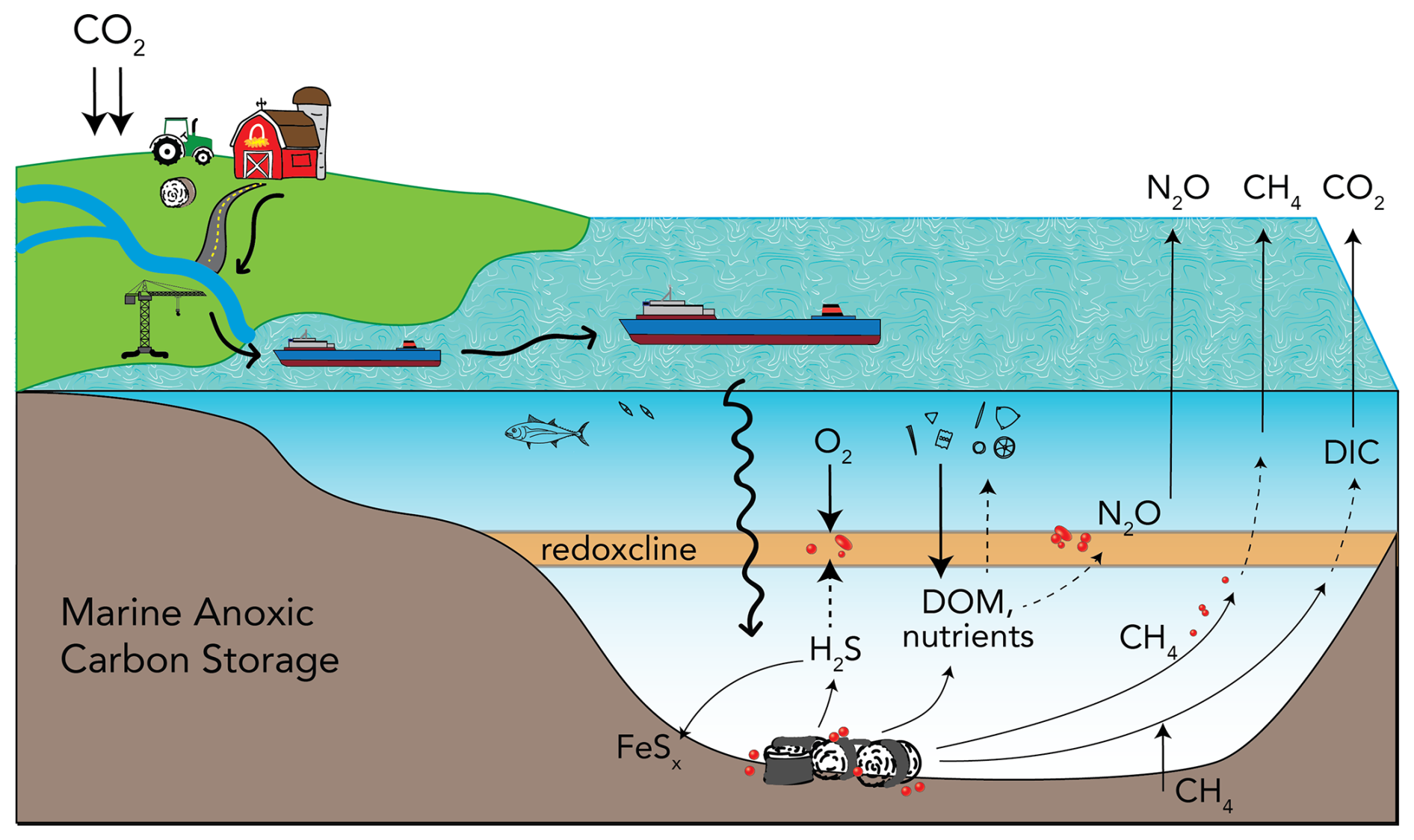
Figure 1Important processes related to marine anoxic carbon storage. Diagram is not to scale and is generalizable to both the Black Sea and brine pool systems. Red spots indicate important microbial processes discussed below. Dashed lines represent limited mixing across stratified water masses.
Biomass breakdown by sulfate reduction below the redoxcline produces H2S, which has several possible fates in the environment. In the presence of dissolved iron or poorly crystalline iron (oxy)hydroxide minerals, which are common in sediments, sulfide can react to form iron monosulfide or disulfide minerals, which tend to precipitate as solids. Alternatively, sulfide that is transported toward the redoxcline can be oxidized by a variety of biological and abiotic mechanisms, typically to sulfate (Zhang and Millero, 1993). Sulfide may also react with functionalized organic molecules and trace metals, modifying their chemical properties (Dyrssen and Kremling, 1990; Saager et al., 1993). If it invades otherwise oxygenated areas, dissolved sulfide is toxic to many marine organisms at micromolar concentrations. In eastern boundary upwelling systems with anoxic waters, for example, episodic sulfide plumes from sediments are implicated in fish population losses (Schunck et al., 2013).
In the Black Sea, processes at the shallow (∼ 150 m) redoxcline are particularly important because they determine whether chemical species produced in the anoxic zone reach the ecologically rich and economically valuable oxic layers above. The position of the oxic-anoxic interface in the water column has varied over time in response to changes in mesoscale activity, agricultural runoff (eutrophication), and hydroclimate (Konovalov and Murray, 2001; Pakhomova et al., 2014). Regardless of mechanism, elevated concentrations of sulfide in the upper anoxic water column would be expected to cause greater O2 loss and a shoaling of the redoxcline, compressing this upper oxic layer and influencing biodiversity and nutrient cycles (Gilly et al., 2013; Köhn et al., 2022), as appears to have occurred throughout the Holocene (Huang et al., 2000). Understanding these mechanisms is essential for estimating how MACS-related perturbations could interact with the existing anthropogenic pressure in the Black Sea.
The Orca Basin, in contrast, is ferruginous, with concentrations of dissolved Fe2+ as high as 26 µM (Wiesenburg et al., 1985). Sulfide produced by sulfate-reducing microorganisms, either within the redoxcline or near the sediment-water interface, reacts rapidly with this dissolved iron to precipitate FeS solids, which accumulate to remarkable concentrations in sediments (> 1 wt. %; Hurtgen et al., 1999). The position of the Orca Basin redoxcline is primarily driven by salinity, but large changes in sulfide fluxes could affect the chemistry of the brine and the distribution of microbial communities within its chemical gradients.
3.4.1 Risk mechanisms
-
Sulfide released at depth and transported to the redoxcline could lead to the consumption of O2 or nitrate at this boundary. Expansion of the anoxic zone could drive loss of habitat for benthic or pelagic communities.
-
Localized sources of sulfide could drive acute ecosystem impacts through episodic mixing events.
3.4.2 Current level of understanding
In general, biomass breakdown rates are sensitive to the properties of both the biomass and the environment (Arndt et al., 2013). Rates of sulfide production during biomass breakdown have been studied in a wide range of anoxic environments, although only a subset of these studies consider the combination of terrestrial materials and anoxic marine conditions (Blair and Aller, 2012; Hage et al., 2020). In one set of two-year-long mesocosms, breakdown rates for ground crop residues (corn, soy, alder) mixed into sediments were 1.3 to 3 times faster for oxic respiration than for sulfate reduction (Keil et al., 2010). Additional biomass breakdown experiments are needed to constrain breakdown rates and the recalcitrant fraction for potential MACS materials.
There is a solid foundation of academic literature available to estimate some important secondary reactions between sulfide and iron species, trace metals, organics, and oxidants. However, several potentially important chemical reactions remain difficult to predict in the environment. For example, both iron oxide and iron sulfide minerals can contribute to organic carbon preservation in sediments. These and other minerals (e.g., clays) may adsorb, encapsulate, or co-precipitate organic molecules (Keil and Mayer, 2014; Hemingway et al., 2019), protecting them from microbial breakdown and contributing to long-term OC stabilization (Lalonde et al., 2012; Nabeh et al., 2022). Changes in redoxcline position and sulfide availability can dissolve and re-form those minerals, but the net effect of this reaction on carbon storage has not yet been quantified.
Another area of active research focuses on the interactions between O2, sulfide, and other redox-active species at the redoxcline, in the context of dynamic physical mixing and transport processes that span the timescales of eddies, upwelling plumes, or decadal climate oscillations (e.g., Pakhomova et al., 2014; Buchanan et al., 2023). In the Black Sea, observations of the relationships between oxygen depletion and sulfide dynamics near the redoxcline of the Black Sea illustrate the impacts of both natural variability and human activities on this system (Konovalov et al., 2006). Twentieth-century eutrophication in particular serves as a valuable case study for the response of the Black Sea to changes in organic matter availability and sulfide production (Capet et al., 2013; Kroiss et al., 2006), although the analog is imperfect as the enhanced rates of sulfide production from eutrophication occur largely in the water column, while those from hypothetical MACS interventions would occur on the deep seafloor.
3.4.3 Key unknowns
- 9.
What proportion of excess terrestrial biomass added to an anoxic environment will be consumed through microbial sulfate reduction over short (days to months) and long (years +) timescales?
- 10.
What are the sinks for sulfide in the deep Black Sea and seafloor brines? How do changes in sulfide flux affect net carbon storage?
- 11.
How would ecosystems within and overlying the Black Sea redoxcline respond to changes in deep sulfide flux?
3.5 Impacts on nutrients or dissolved organic matter (DOM) in the oxic zone
A hypothetical MACS deployment could impact nutrients and/or DOM in the surface ocean at two different points in the deployment process. Nutrients could leach rapidly during initial wetting and placement of terrestrial biomass, or nutrients released at the seafloor could be transported to the surface by upwelling water and mixing (Raven et al., 2025). The specific nutrients and organic molecules released from biomass during both stages will depend on the biomass type and its preparation.
Concentrations of most nutrients in lignocellulosic biomass are low relative to marine organisms, with C : N ratios in wood often ≥ 300 : 1 (Cowling and Merrill, 1966). Nevertheless, at scale, the breakdown of this biomass could impact marine ecosystems through changes in nutrient availability. Essential nutrients for primary production in the photic zone include the macronutrients nitrogen (N) and phosphorus (P) as well as silica (Si), iron (Fe), and other trace metals. Nutrients are primary controls on the amount and distribution of net primary productivity (NPP) in the surface ocean, and the relative availability of different nutrients in the environment affects ecosystem structure. Changes to either the amount or the type of NPP (e.g., its chemical composition, seasonality, or export ratio) have direct ramifications for higher trophic levels like marine mammals and fish (Berger et al., 2023; Tagliabue et al., 2023).
The nitrogen cycle is also an active participant in redox cycles at the redoxcline, influencing both N2O production (criterion C) and redoxcline position due to the consumption of O2 by NH4 oxidation (criterion D). Many micronutrients are also actively cycled near the redoxcline, including iron and many trace metals. These reactions will determine if and how changes in nutrient concentrations in deep water translate into discernable changes in oxic environments.
Ecosystems both within and below the photic zone are highly sensitive to the availability of dissolved organic matter (DOM). DOM can be released from essentially all forms of biomass through senescence, leaching, or heterotrophic activity in seawater, although lignocellulosic biomass is generally less soluble in seawater than biomass from marine primary producers. Many anthropogenic organic contaminants also fall in the category of DOM, including many agricultural chemicals like pesticides as well as products of the breakdown of (micro)plastics. From the perspective of marine organisms, the vast pool of molecules categorized as DOM includes energy sources (food), building blocks for biosynthesis (e.g., amino acids), and key reactants in cellular processes (e.g., B vitamins, signalling molecules) (Carlson and Hansell, 2015). Certain biogenic molecules like fucoidan, which is produced in vast quantities by brown algae, appear to be highly recalcitrant (Buck-Wiese et al., 2023; Li et al., 2024). Additionally, some DOM molecules are acidic and can cause pH change (e.g., carboxylic acids), while others can complex and stabilize trace metals. Therefore, it will be important to understand both the amount and the chemical properties of any DOM added to the environment in order to predict ecosystem response.
In the Black Sea, concentrations and ratios of nutrients and DOM in the photic zone have experienced dramatic change since at least 1960, in parallel with major ecosystem shifts. The primary source of nutrients to photic zone ecosystems is mixing with deep water (Ludwig et al., 2009). Products of biomass breakdown have accumulated in deep Black Sea water due to its slow turnover time, reaching up to 100 µM ammonium and 8 µM phosphate (Brewer and Murray, 1973; Konovalov et al., 2006). In the seasonal Cold Intermediate Layer that feeds much of the surface nutrient budget, concentrations of inorganic N roughly tripled between the 1950s and 1980s and then recovered to levels around 2× pre-eutrophication values (Mikaelyan et al., 2013; Pakhomova et al., 2014). These dramatic changes in nutrient availability have been associated with changes in both the amount and the source of primary production in the basin (dinoflagellates, diatoms, and/or coccolithophorids; Mikaelyan et al., 2013). Changes in the chemical composition, particle export, and seasonality of primary producers all have downstream effects on ecosystems, as seen in the Black Sea in recent decades (Oguz and Gilbert, 2007).
Orca Basin contains even more highly concentrated levels of biomass breakdown products than the Black Sea. The deep brine contains ≥ 450 µM dissolved OC, ≥ 520 µM ammonium, and ≥ 50 µM phosphate (Van Cappellen et al., 1998), as nutrients and DOM released within the brine are effectively trapped within that water mass without being consumed or metabolized. The Orca Basin pycnocline intersects the sides of the basin such that there is essentially no lateral connectivity with the overlying ocean. The overlying water column is generally oligotrophic, although surface nutrients and primary productivity vary in response to seasonal cycles and mesoscale eddies (Damien et al., 2021).
3.5.1 Risk mechanisms
-
Changes in nutrient levels or ratios could favor different primary producers, drive blooms of undesirable algae, displace species, or generate excess production that could impact O2.
-
Biomass-derived DOM that mixes to the surface could stimulate or alter ecosystem processes in the oxic zone.
-
Biomass could introduce contaminants such as plastics, pesticides, herbicides or fungicides that could affect marine ecosystems.
3.5.2 Current level of understanding
Macronutrient–NPP relationships are relatively well implemented in marine ecosystem models. Basic biogeochemical and redox budgets have been created for the Black Sea (Brewer and Murray, 1973; Konovalov et al., 2006), and relatively large datasets exist to explore the relationships between twentieth-century fertilization trends and ecosystem impact (e.g., Pakhomova et al., 2014; Stanev et al., 2022). Strategically placed coastal stations in regions with large freshwater influxes, like the western Black Sea, have been helpful to observe the impacts of seasonal and interannual changes in river discharge, and of coastal upwelling and extreme events on coastal ecosystems (Voynova et al., 2026). Modeling tools are also poised to explore potential impacts of hypothetical MACS deployments in the context of mesoscale and dynamic circulation patterns.
For brines like Orca Basin, water mass trapping at the redoxcline limits the potential impacts of nutrient and DOM release on the overlying environment from long-term biomass breakdown. The primary mechanism for impact on the oxic zone from MACS is more likely to be short-term effects during initial wetting and placement. Short-team leachates from some biomass types have been characterized, but potential ecosystem sensitivities to various large-scale deployment strategies still require evaluation (Martinez et al., 2024). Nutrient and DOM impacts may be minimized through engineering choices and biomass selection for low nutrient content in leachate.
In the context of large-scale deployment, several additional mechanisms for nutrient and DOM impacts could become important and would require additional research attention. DOM from specific terrestrial sources may differ from pre-existing DOM in ways that may impact the availability of essential trace metals. Certain DOM molecules may also either stimulate or repress anaerobic secondary production (heterotrophic growth). And finally, the release of organic acids could also have local effects on pH and alkalinity, which also has implications for measurement and monitoring methods that rely on those parameters.
3.5.3 Key unknowns
- 12.
Which nutrients and organic molecules are released from biomass during deposition? Which biomass alternatives or biomass processing measures minimize release?
- 13.
At what rate would DOM and macronutrients be released during biomass breakdown on the seafloor?
- 14.
How reactive is the released DOM in the environment? Is it labile for anaerobic heterotrophs? How does it affect the speciation of trace metals?
Unchecked climate change is a clear threat to marine ecosystems as well as the foundational activities on which human societies rely (Doney, 2010; Müller et al., 2011). In the absence of net-negative CDR, there is a meaningful risk that global climate exceeds critical and effectively irreversible planetary thresholds with devastating consequences to human societies (Armstrong McKay et al., 2022; Drijfhout et al., 2025). Therefore, globally, we must find a way to remove hundreds of gigatonnes of CO2 from the atmosphere in the coming decades in addition to achieving immediate and dramatic emissions reductions (IPCC AR6, 2021). To chart the most effective and ethical path forward, it will be essential to transparently balance the risks of different potential climate inventions against the risks of inaction.
Marine Anoxic Carbon Storage (MACS) may have the potential to contribute substantially to global CO2 removal goals by sequestering biomass in restricted, anoxic marine reservoirs. The feasibility and societal acceptability of this pathway will depend on many factors, but there are at least five fundamental constraints on scale that will need to be met by any proposed actions. These include: sufficient durable (≥ kyr) storage capacity, suitable and sufficient biomass sources, an acceptable greenhouse gas balance, limited impacts on oxygenation, and acceptable impacts on nutrients and DOM in the oxic zone. For each of these criteria, there are remaining uncertainties that need to be addressed in order to estimate the potential responsible global scale of MACS for CDR. Broadly speaking, we have a basic understanding of many of the key processes in this system as they operate today and in the recent past, but we still need to develop models and analogs to answer questions concerning the outcomes of much larger-scale biomass addition for CDR.
Based on what we know so far, it may be possible for MACS to exceed the 0.1–1.0 Gt yr−1 CO2e significance thresholds for moderate or high scalability (NASEM, 2022). To increase confidence in this assessment, we need to answer several top-priority questions that have particularly high leverage in this calculation:
-
How is the circulation of the Black Sea likely to change in a changing climate?
-
What is the global volume of seafloor brines with favorable properties for MACS?
-
How do the carbon and energy efficiency of potential biomass sources compare, and how much biomass is well suited for MACS?
-
What is the long-term (kyr) preservation efficiency of lignocellulosic biomass for various deployment scenarios?
-
What is the potential for physical disruption of sediments and/or methane reservoirs, and how can it be minimized?
-
How would biomass breakdown products impact biogeochemical processes and the carbon system at the redoxcline, in the context of its physical dynamics?
-
What is the potential for MACS in anoxic sedimentary systems like river deltas and submarine canyons?
These key questions represent the mission ahead for collaborative research across the field and are urgent areas to prioritize in future research. They have major leverage on the calculation of potential MACS scale because they may identify early “no-go” outcomes, or limits on feasibility. This list is not intended to be exhaustive of the scientific knowledge gaps worthy of detailed attention, especially related to the response and ecosystem function of deep microbial communities. Instead, these questions interrogate to what extent such detailed scientific efforts would potentially unlock real and positive benefits to climate and society.
In parallel with a scientific effort to address these unknowns, broad and interdisciplinary work is essential to understand the priorities and interests of local communities that would be impacted by MACS activities at scale. Building on the global-scale risk assessment initiated here, robust protocols and metrics will need to adapt to those local considerations while ensuring that environmental protection standards are met regardless of political jurisdiction. Multilateral international collaboration among coastal nations will be essential for effective MACS implementation, as hydrology and circulation patterns do not recognize national boundaries.
We have focused on anoxic basins in this first analysis, which have several key practical advantages due to their relative isolation from the global ocean. Nevertheless, enhanced terrestrial OC burial events in Earth history have been centered primarily in large coastal river and submarine canyon systems, motivating future research in these areas. For example, in the Bay of Bengal region, joint research programs involving India, Bangladesh, and Myanmar could help characterize biogeochemical processes governing carbon cycling in the region and facilitate the development of a unified regional framework for MACS deployment that accounts for shared hydrological connectivity, equitable benefit distribution, and coordinated monitoring protocols.
MACS at the scale of 1 Gt CO2e yr−1 would represent a roughly three-fold acceleration of excess OC burial relative to 40 000-year averages for the PETM recovery (Papadomanolaki et al., 2022) or a 30 % increase in modern global OC burial rates in the ocean (Dunne et al., 2007; Table 1). These are large changes, but they fall within the apparent range of Earth's natural variability. Geologically recent historical analogs like the PETM (∼ 56 Myr) provide opportunities to understand how large-scale terrestrial OM burial events impact climate, ecosystems, and other feedbacks in the Earth system, and they provide confidence that large-scale terrestrial OM burial in the ocean can effectively lower atmospheric CO2.
Important scientific questions need to be answered before we can make informed decisions about if and how to deploy MACS at scale for CDR. Nevertheless, there is a clear path toward addressing those unknowns, and substantial research progress could be achieved over reasonable time scales. MACS amplifies a natural feedback in the Earth system for which comparable analogs exist, and its integration within existing agricultural and economic processes provides opportunities for global participation and co-benefits in a future MACS industry. Marine anoxic carbon storage (MACS) of lignocellulosic biomass is therefore worthy of serious consideration as an important potential CDR pathway for climate mitigation in coming decades.
No new data or code are used in this manuscript.
All authors participated in the in-person Bucharest Workshop discussions except TT, DS, NE, and SH. All authors contributed to the analysis and content of the manuscript. MR led writing and preparation of the manuscript.
In addition to her primary role as UCSB faculty, MR serves as the Chief Science Officer for Carboniferous, a US-based startup company exploring potential applications of MACS. Both the coordination of the Bucharest Workshop and the resulting analysis presented here were supported by philanthropic funds and/or grants to UCSB; an unconflicted PI is included on all CDR-related funds in the Raven group. Co-authors TL and SH are employed at Puro.earth Oy, a Finland-based crediting platform for engineered carbon removals whose portfolio includes a standard for Marine Anoxic Carbon Storage. At least one of the (co-)authors is a member of the editorial board of Biogeosciences. The peer-review process was guided by an independent editor.
Publisher's note: Copernicus Publications remains neutral with regard to jurisdictional claims made in the text, published maps, institutional affiliations, or any other geographical representation in this paper. The authors bear the ultimate responsibility for providing appropriate place names. Views expressed in the text are those of the authors and do not necessarily reflect the views of the publisher.
The Bucharest Workshop was partly funded by the European Union Horizon 2020 DOORS project (Developing Optimal and Open Research Support for the Black Sea, no. 101000518) and hosted by GeoEcoMar (Romania) with additional support from the Grantham Foundation for the Protection of the Environment. Workshop logistics and organization were provided by R. Amar and Rewind (Israel) with logistical support from Ocean Visions (USA). Additional financial support was provided by the Grantham Foundation as a research grant to M. Raven at UCSB (USA).
We are grateful to C. Vivian, B. Tutak, and M. Ilicak for their constructive feedback on early drafts of this manuscript. We also thank L. V. Pérez, M. Paiu, S. Besiktepe, and V. Papathanassiou for their valuable contributions to the 2025 Bucharest workshop.
The Bucharest Workshop was partly funded by the European Union Horizon 2020 DOORS project (Developing Optimal and Open Research Support for the Black Sea, no. 101000518) and hosted by GeoEcoMar (Romania) with additional support from the Grantham Foundation for the Protection of the Environment. Additional financial support was provided by the Grantham Foundation for the Protection of the Environment as a research grant to M. Raven at UCSB (USA).
This paper was edited by Mark Lever and reviewed by two anonymous referees.
Addy, S. K. and Behrens, E. W.: Time of accumulation of hypersaline anoxic brine in Orca basin (Gulf of Mexico), Mar. Geol., 37, 241–252, https://doi.org/10.1016/0025-3227(80)90104-8, 1980.
Adepoju, L. A., McKaig, J. M., Salcedo, R. S. R., Martinez, A., Buessecker, S., Skoog, E. J., Elbon, C. E., Paris, E. R., Desmarais, M., Sephus, C. D., Pozarycki, C., Hegelein, V., Quartini, E. S., Schartup, A. T., Doran, P. T., Carr, C. E., Ingall, E. D., Bartlett, D. H., Murali, R., Raven, M. R., Dekas, A. E., Bowman, J. S., Schmidt, B. E., and Glass, J. B.: Anaerobic methane oxidation by ANME-2a at two molar chloride in Orca Basin, bioRxiv [preprint], https://doi.org/10.64898/2026.02.09.704686, 2026.
Aller, R. C., Blair N. E., and Brunskill G. J.: Early diagenetic cycling, incineration, and burial of sedimentary organic carbon in the central Gulf of Papua (Papua New Guinea), J. Geophys. Res., 113, F01S09, https://doi.org/10.1029/2006JF000689, 2008.
American Geophysical Union: Ethical Framework Principles for Climate Intervention Research, ESS Open Archive, https://doi.org/10.22541/essoar.172917365.53105072/v1, 2024.
Armstrong McKay, D. I., Staal, A., Abrams, J. F., Winkelmann, R., Sakschewski, B., Loriani, S., Fetzer, I., Cornell, S. E., Rockström, J., and Lenton, T. M.: Exceeding 1.5 °C global warming could trigger multiple climate tipping points, Science, 377, eabn7950, https://doi.org/10.1126/science.abn7950, 2022.
Arndt, S., Jørgensen, B. B., LaRowe, D. E., Middelburg, J. J., Pancost, R. D., and Regnier, P.: Quantifying the degradation of organic matter in marine sediments: A review and synthesis, Earth-Sci. Rev., 123, 53–86, https://doi.org/10.1016/j.earscirev.2013.02.008, 2013.
Baker, M. L., Hage, S., Talling, P. J., Acikalin, S., Hilton, R. G., Haghipour, N., Ruffell, S. C., Pope, E. L., Jacinto, R. S., Clare, M. A., and Sahin, S.: Globally significant mass of terrestrial organic carbon efficiently transported by canyon-flushing turbidity currents, Geology, 52, 631–636, https://doi.org/10.1130/G51976.1, 2024.
Ballantyne, A. P., Alden, C. B., Miller, J. B., Tans, P. P., and White, J. W. C.: Increase in observed net carbon dioxide uptake by land and oceans during the past 50 years, Nature, 488, 70–72, https://doi.org/10.1038/nature11299, 2012.
Bar-On, Y. M., Li, X., O'Sullivan, M., Wigneron, J.-P., Sitch, S., Ciais, P., Frankenberg, C., and Fischer, W. W.: Recent gains in global terrestrial carbon stocks are mostly stored in nonliving pools, Science, 387, 1291–1295, https://doi.org/10.1126/science.adk1637, 2025.
Battin, T. J., Lauerwald, R., Bernhardt, E. S., Bertuzzo, E., Gener, L. G., Hall, R. O., Hotchkiss, E. R., Maavara, T., Pavelsky, T. M., Ran, L., Raymond, P., Rosentreter, J. A., and Regnier, P.: River ecosystem metabolism and carbon biogeochemistry in a changing world, Nature, 613, 449–459, https://doi.org/10.1038/s41586-022-05500-8, 2023.
Berger, M., Kwiatkowski, L., Ho, D. T., and Bopp, L.: Ocean dynamics and biological feedbacks limit the potential of macroalgae carbon dioxide removal, Environ. Res. Lett., 18, 024039, https://doi.org/10.1088/1748-9326/acb06e, 2023.
Bianchi, T. S.: The Role of Terrestrially Derived Organic Carbon in the Coastal Ocean: A Changing Paradigm and the Priming Effect, P. Natl. Acad. Sci., 108, 19473–19481, https://doi.org/10.1073/pnas.1017982108, 2011.
Blair, N. E. and Aller, R. C.: The Fate of Terrestrial Organic Carbon in the Marine Environment, Annu. Rev. Mar. Sci., 4, 401–423, https://doi.org/10.1146/annurev-marine-120709-142717, 2012.
Brewer, P. G. and Murray, J. W.: Carbon, nitrogen and phosphorus in the black sea, Deep Sea Research and Oceanographic Abstracts, 20, 803–818, https://doi.org/10.1016/0011-7471(73)90003-X, 1973.
Buchanan, P. J., Sun, X., Weissman, J., McCoy, D., Bianchi, D., and Zakem, E. J.: Oxygen intrusions sustain aerobic nitrite-oxidizing bacteria in anoxic marine zones, 388, 1069–1074, bioRxiv [preprint], https://doi.org/10.1101/2023.02.22.529547, 2023.
Buck-Wiese, H., Andskog, M. A., Nguyen, N. P., Bligh, M., Asmala, E., Vidal-Melgosa, S., Liebeke, M., Gustafsson, C., and Hehemann, J.-H.: Fucoid brown algae inject fucoidan carbon into the ocean, P. Natl. Acad. Sci. USA, 120, e2210561119, https://doi.org/10.1073/pnas.2210561119, 2023.
Burdige, D. J.: Burial of terrestrial organic matter in marine sediments: A re-assessment, Global Biogeochem. Cy., 19, 2004GB002368, https://doi.org/10.1029/2004GB002368, 2005.
Capet, A., Beckers, J.-M., and Grégoire, M.: Drivers, mechanisms and long-term variability of seasonal hypoxia on the Black Sea northwestern shelf – is there any recovery after eutrophication?, Biogeosciences, 10, 3943–3962, https://doi.org/10.5194/bg-10-3943-2013, 2013.
Capet, A., Stanev, E. V., Beckers, J.-M., Murray, J. W., and Grégoire, M.: Decline of the Black Sea oxygen inventory, Biogeosciences, 13, 1287–1297, https://doi.org/10.5194/bg-13-1287-2016, 2016.
Carlson, C. A. and Hansell, D. A.: DOM Sources, Sinks, Reactivity, and Budgets, in: Biogeochemistry of Marine Dissolved Organic Matter, Elsevier, 65–126, https://doi.org/10.1016/B978-0-12-405940-5.00003-0, 2015.
Cohen, Y. and Gordon, L. I.: Nitrous oxide in the oxygen minimum of the eastern tropical North Pacific: evidence for its consumption during denitrification and possible mechanisms for its production, Deep-Sea Res., 25, 509–524, https://doi.org/10.1016/0146-6291(78)90640-9, 1978.
Contreras-Rosales, L. A., Schefuß, E., Meyer, V., Palamenghi, L., Lückge, A., and Jennerjahn, T. C.: Origin and fate of sedimentary organic matter in the northern Bay of Bengal during the last 18 ka, Global Planet. Change, 146, 53–66, https://doi.org/10.1016/j.gloplacha.2016.09.008, 2016.
Cooley, S. R., Klinsky, S., Morrow, D. R., and Satterfield, T.: Sociotechnical Considerations About Ocean Carbon Dioxide Removal, Annu. Rev. Mar. Sci., 15, 41–66, https://doi.org/10.1146/annurev-marine-032122-113850, 2023.
Cowling E. B. and Merrill W., Nitrogen in Wood and Its Role in Wood Deterioration, Can. J. Botany, 44, 1539–1554, https://doi.org/10.1139/b66-167, 1966.
Curray, J. R., Emmel, F. J., and Moore, D. G.: The Bengal Fan: morphology, geometry, stratigraphy, history and processes, Mar. Petrol. Geol., 19, 1191–1223, https://doi.org/10.1016/S0264-8172(03)00035-7, 2002.
Damien, P., Sheinbaum, J., Pasqueron de Fommervault, O., Jouanno, J., Linacre, L., and Duteil, O.: Do Loop Current eddies stimulate productivity in the Gulf of Mexico?, Biogeosciences, 18, 4281–4303, https://doi.org/10.5194/bg-18-4281-2021, 2021.
Demidov, A. B.: Seasonal dynamics and estimation of the annual primary production of phytoplankton in the Black Sea, Oceanology, 48, 664–678, https://doi.org/10.1134/S0001437008050068, 2008.
Deutsch, C., Penn, J. L., and Lucey, N.: Climate, Oxygen, and the Future of Marine Biodiversity, Annu. Rev. Mar. Sci., 16, 217–245, https://doi.org/10.1146/annurev-marine-040323-095231, 2024.
Doney, S. C.: The Growing Human Footprint on Coastal and Open-Ocean Biogeochemistry, Science, 328, 1512–1516, https://doi.org/10.1126/science.1185198, 2010.
Dorofeev, V. L. and Sukhikh, L. I.: Estimation of Carbon Dioxide Fluxes through the Surface of the Black Sea from the Numerical Simulation Results, Ecological Safety of Coastal and Shelf Zones of Sea, 3, 36–48, 2024.
Drijfhout, S., Angevaare, J. R., Mecking, J., Van Westen, R. M., and Rahmstorf, S.: Shutdown of northern Atlantic overturning after 2100 following deep mixing collapse in CMIP6 projections, Environ. Res. Lett., 20, 094062, https://doi.org/10.1088/1748-9326/adfa3b, 2025.
Dunne, J. P., Sarmiento, J. L., and Gnanadesikan, A.: A synthesis of global particle export from the surface ocean and cycling through the ocean interior and on the seafloor: Global particle export and cycling, Global Biogeochem. Cy., 21, 1–16, https://doi.org/10.1029/2006GB002907, 2007.
Dyrssen, D. and Kremling, K.: Increasing hydrogen sulfide concentration and trace metal behavior in the anoxic Baltic waters, Mar. Chem., 30, 193–204, https://doi.org/10.1016/0304-4203(90)90070-S, 1990.
France-Lanord, C. and Derry, L. A.: Organic carbon burial forcing of the carbon cycle from Himalayan erosion, Nature, 390, 65–67, https://doi.org/10.1038/36324, 1997.
Friedlingstein, P., O'Sullivan, M., Jones, M. W., Andrew, R. M., Hauck, J., Landschützer, P., Le Quéré, C., Li, H., Luijkx, I. T., Olsen, A., Peters, G. P., Peters, W., Pongratz, J., Schwingshackl, C., Sitch, S., Canadell, J. G., Ciais, P., Jackson, R. B., Alin, S. R., Arneth, A., Arora, V., Bates, N. R., Becker, M., Bellouin, N., Berghoff, C. F., Bittig, H. C., Bopp, L., Cadule, P., Campbell, K., Chamberlain, M. A., Chandra, N., Chevallier, F., Chini, L. P., Colligan, T., Decayeux, J., Djeutchouang, L. M., Dou, X., Duran Rojas, C., Enyo, K., Evans, W., Fay, A. R., Feely, R. A., Ford, D. J., Foster, A., Gasser, T., Gehlen, M., Gkritzalis, T., Grassi, G., Gregor, L., Gruber, N., Gürses, Ö., Harris, I., Hefner, M., Heinke, J., Hurtt, G. C., Iida, Y., Ilyina, T., Jacobson, A. R., Jain, A. K., Jarníková, T., Jersild, A., Jiang, F., Jin, Z., Kato, E., Keeling, R. F., Klein Goldewijk, K., Knauer, J., Korsbakken, J. I., Lan, X., Lauvset, S. K., Lefèvre, N., Liu, Z., Liu, J., Ma, L., Maksyutov, S., Marland, G., Mayot, N., McGuire, P. C., Metzl, N., Monacci, N. M., Morgan, E. J., Nakaoka, S.-I., Neill, C., Niwa, Y., Nützel, T., Olivier, L., Ono, T., Palmer, P. I., Pierrot, D., Qin, Z., Resplandy, L., Roobaert, A., Rosan, T. M., Rödenbeck, C., Schwinger, J., Smallman, T. L., Smith, S. M., Sospedra-Alfonso, R., Steinhoff, T., Sun, Q., Sutton, A. J., Séférian, R., Takao, S., Tatebe, H., Tian, H., Tilbrook, B., Torres, O., Tourigny, E., Tsujino, H., Tubiello, F., van der Werf, G., Wanninkhof, R., Wang, X., Yang, D., Yang, X., Yu, Z., Yuan, W., Yue, X., Zaehle, S., Zeng, N., and Zeng, J.: Global Carbon Budget 2024, Earth Syst. Sci. Data, 17, 965–1039, https://doi.org/10.5194/essd-17-965-2025, 2025.
Galy, V., France-Lanord, C., Beyssac, O., Faure, P., Kudrass, H., and Palhol, F.: Efficient organic carbon burial in the Bengal fan sustained by the Himalayan erosional system, Nature, 450, 407–410, https://doi.org/10.1038/nature06273, 2007.
Galy, V., Peucker-Ehrenbrink, B., and Eglinton, T.: Global carbon export from the terrestrial biosphere controlled by erosion, Nature, 521, 204–207, https://doi.org/10.1038/nature14400, 2015.
Ganti, G., Gasser, T., Bui, M., Geden, O., Lamb, W. F., Minx, J. C., Schleussner, C.-F., and Gidden, M. J.: Evaluating the near- and long-term role of carbon dioxide removal in meeting global climate objectives, Commun. Earth Environ., 5, 377, https://doi.org/10.1038/s43247-024-01527-z, 2024.
Georgiou, K., Jackson, R. B., Vindušková, O., Abramoff, R. Z., Ahlström, A., Feng, W., Harden, J. W., Pellegrini, A. F. A., Polley, H. W., Soong, J. L., Riley, W. J., and Torn, M. S.: Global stocks and capacity of mineral-associated soil organic carbon, Nat. Commun., 13, 3797, https://doi.org/10.1038/s41467-022-31540-9, 2022.
GESAMP: The State of the Science for Marine Carbon Dioxide Removal (mCDR) – A Scientific Summary for Policy-Makers, UNESCO-IOC, Paris, Zenodo, https://doi.org/10.5281/zenodo.15490407, 2025.
Gilly, W. F., Beman, J. M., Litvin, S. Y., and Robison, B. H.: Oceanographic and Biological Effects of Shoaling of the Oxygen Minimum Zone, Annu. Rev. Mar. Sci., 5, 393–420, https://doi.org/10.1146/annurev-marine-120710-100849, 2013.
Grilli, R., Birot, D., Schumacher, M., Paris, J.-D., Blouzon, C., Donval, J. P., Guyader, V., Leau, H., Giunta, T., Delmotte, M., Radulescu, V., Balan, S., Greinert, J., and Ruffine, L.: Inter-Comparison of the Spatial Distribution of Methane in the Water Column From Seafloor Emissions at Two Sites in the Western Black Sea Using a Multi-Technique Approach, Front. Earth Sci., 9, 626372, https://doi.org/10.3389/feart.2021.626372, 2021.
Haas, S.: Biogeochemical transformations under contrasting mixing regimes in two coastal water columns, PhD thesis, Dalhousie University, Department of Oceanography, https://dalspace.library.dal.ca/items/e35a644c-8f52-4e9f-8bf8-e541c3451618 (last access: 5 January 2026), 2020.
Haeckel, M., Bialas, J., Klaucke, I., Wallmann, K., Bohrmann, G., and Schwalenberg, K.: Gas hydrate occurrences in the Black sea – new observations from the German SUGAR Project, Fire in the Ice: Methane Hydrate Newsletter, 6–9, 2015.
Hage, S., Galy, V. V., Cartigny, M. J. B., Acikalin, S., Clare, M. A., Gröcke, D. R., Hilton, R. G., Hunt, J. E., Lintern, D. G., McGhee, C. A., Parsons, D. R., Stacey, C. D., Sumner, E. J., and Talling, P. J.: Efficient preservation of young terrestrial organic carbon in sandy turbidity-current deposits, Geology, 48, 882–887, https://doi.org/10.1130/G47320.1, 2020.
Hage, S., Baker, M. L., Babonneau, N., Soulet, G., Dennielou, B., Silva Jacinto, R., Hilton, R. G., Galy, V., Baudin, F., Rabouille, C., Vic, C., Sahin, S., Açikalin, S., and Talling, P. J.: How is particulate organic carbon transported through the river-fed submarine Congo Canyon to the deep sea?, Biogeosciences, 21, 4251–4272, https://doi.org/10.5194/bg-21-4251-2024, 2024.
Harvey, H. R. and Kennicutt, M. C.: Selective alteration of Sargassum lipids in anoxic sediments of the Orca Basin, Org. Geochem., 18, 181–187, https://doi.org/10.1016/0146-6380(92)90128-K, 1992.
Hebbeln, D., Wienberg, C., Dullo, W.-C., Freiwald, A., Mienis, F., Orejas, C., and Titschack, J.: Cold-water coral reefs thriving under hypoxia, Coral Reefs, 39, 853–859, https://doi.org/10.1007/s00338-020-01934-6, 2020.
Hemingway J. D., Rothman, D. H., Grant, K. E., Rosengard, S. Z., Eglinton, T. I., Derry, L. A., and Galy, V. V.: Mineral Protection Regulates Long-Term Global Preservation of Natural Organic Carbon, Nature 570, 228–231, https://doi.org/10.1038/s41586-019-1280-6, 2019.
Hinrichs, K.-U. and Boetius, A.: The Anaerobic Oxidation of Methane: New Insights in Microbial Ecology and Biogeochemistry, in: Ocean Margin Systems, edited by: Wefer, G., Billett, D., Hebbeln, D., Jørgensen, B. B., Schlüter, M., and Van Weering, T. C. E., Springer Berlin Heidelberg, Berlin, Heidelberg, 457–477, https://doi.org/10.1007/978-3-662-05127-6_28, 2002.
Hiscock, W. T. and Millero, F. J.: Alkalinity of the anoxic waters in the Western Black Sea, Deep-Sea Res. Pt. II, 53, 1787–1801, https://doi.org/10.1016/j.dsr2.2006.05.020, 2006.
Huang, Y., Freeman, K. H., Wilkin, R. T., Arthur, M. A., and Jones, A. D.: Black Sea chemocline oscillations during the Holocene: molecular and isotopic studies of marginal sediments, Org. Geochem., 31, 1525–1531, https://doi.org/10.1016/S0146-6380(00)00090-5, 2000.
Huntington, T., Scown, C., Breunig, H., Kavvada, O., Cui, X., Hendrickson, T., Nordahl, S., Baral, N. R., Yang, M., and Moore, M.: BioSiting Tool (BioSiting) v2, US DOE, https://doi.org/10.11578/DC.20240815.9, 2024.
Hurtgen, M. T., Lyons, T., Ingall, E., and Cruse, A.: Anomalous enrichments of iron monosulfide in euxinic marine sediments and the role of H 2 S in iron sulfide transformations; examples from Effingham Inlet, Orca Basin, and the Black Sea, Am. J. Sci., 299, 556–588, https://doi.org/10.2475/ajs.299.7-9.556, 1999.
Inglis, G., Hemingway, J., Stockey, R., Hollingsworth, E., Valdes, P., Farnsworth, A., Elling, F., Badger, M., Pancost, R., Pearson, A., Gernon, T., and Hilton, R.: Marine burial of terrestrial organic carbon modulates past warm climates, Research Square, https://doi.org/10.21203/rs.3.rs-7272686/v1, 2025.
IPCC AR6: Intergovernmental Panel on Climate Change, Working Group II, Sixth Assessment Report: Technical Summary, https://www.ipcc.ch/report/ar6/wg2/chapter/technical-summary/ (last access: 5 January 2026), 2021.
Jarvis, I., Lignum, J. S., Gröcke, D. R., Jenkyns, H. C., and Pearce, M. A.: Black shale deposition, atmospheric CO2 drawdown, and cooling during the Cenomanian-Turonian Oceanic Anoxic Event: CO2 drawdown and cooling during OAE2, Paleoceanography, 26, https://doi.org/10.1029/2010PA002081, 2011.
Keil, R. G. and Mayer, L. M.: Mineral matrices and organic matter, Treatise on Geochemistry, 12, 337–359, Elsevier, https://doi.org/10.1016/B978-0-08-095975-7.01024-X, 2014.
Keil, R. G., Nuwer, J. M., and Strand, S. E.: Burial of agricultural byproducts in the deep sea as a form of carbon sequestration: A preliminary experiment, Mar. Chem., 122, 91–95, https://doi.org/10.1016/j.marchem.2010.07.007, 2010.
Kennett, J. P. and Penrose, N. L.: Fossil Holocene seaweed and attached calcareous polychaetes in an anoxic basin, Gulf of Mexico, Nature, 276, 172–173, https://doi.org/10.1038/276172a0, 1978.
Kessler, J. D., Reeburgh, W. S., Southon, J., Seifert, R., Michaelis, W., and Tyler, S. C.: Basin-wide estimates of the input of methane from seeps and clathrates to the Black Sea, Earth Planet. Sc. Lett., 243, 366–375, https://doi.org/10.1016/j.epsl.2006.01.006, 2006.
Kessler, J. D., Valentine, D. L., Redmond, M. C., Du, M., Chan, E. W., Mendes, S. D., Quiroz, E. W., Villanueva, C. J., Shusta, S. S., Werra, L. M., Yvon-Lewis, S. A., and Weber, T. C.: A Persistent Oxygen Anomaly Reveals the Fate of Spilled Methane in the Deep Gulf of Mexico, Science, 331, 312–315, https://doi.org/10.1126/science.1199697, 2011.
Kim, K.-R. and Craig, H.: Two-isotope characterization of N20 in the Pacific Ocean and constraints on its origin in deep water, Nature, 347, 58–61, https://doi.org/10.1038/347058a0, 1990.
Köhn, E. E., Münnich, M., Vogt, M., Desmet, F., and Gruber, N.: Strong Habitat Compression by Extreme Shoaling Events of Hypoxic Waters in the Eastern Pacific, J. Geophys. Res.-Oceans, 127, e2022JC018429, https://doi.org/10.1029/2022JC018429, 2022.
Konovalov, S. K. and Murray, J. W.: Variations in the chemistry of the Black Sea on a time scale of decades (1960–1995), J. Marine Syst., 31, 217–243, 2001.
Konovalov, S. K., Murray, J. W., Luther, G. W., and Tebo, B. M.: Processes controlling the redox budget for the oxic/anoxic water column of the Black Sea, Deep-Sea Res. Pt. II, 53, 1817–1841, https://doi.org/10.1016/j.dsr2.2006.03.013, 2006.
Kopytina, N. I.: Fungi of the Black Sea basin: Directions and perspectives of research, mbj, 4, 15–33, https://doi.org/10.21072/mbj.2019.04.4.02, 2019.
Kroiss, H., Zessner, M., and Lampert, C.: daNUbs: Lessons learned for nutrient management in the Danube Basin and its relation to Black Sea euthrophication, Chem. Ecol., 22, 347–357, https://doi.org/10.1080/02757540600917518, 2006.
Kubryakov, A. A., Stanichny, S. V., Zatsepin, A. G., and Kremenetskiy, V. V.: Long-term variations of the Black Sea dynamics and their impact on the marine ecosystem, J. Marine Syst., 163, 80–94, https://doi.org/10.1016/j.jmarsys.2016.06.006, 2016.
Lal, R.: World crop residues production and implications of its use as a biofuel, Environ. Int., 31, 575–584, 2005.
Lalonde, K., Mucci, A., Ouellet, A., and Gélinas, Y.: Preservation of organic matter in sediments promoted by iron, Nature, 483, 198–200, https://doi.org/10.1038/nature10855, 2012.
Langholtz, M. H.: Chapter 1: Background and Introduction, in: 2023 Billion-Ton Report: An Assessment of U.S. Renewable Carbon Resources, Oak Ridge National Laboratory (ORNL), Oak Ridge, TN, United States, https://doi.org/10.23720/BT2023/2316165, 2024.
Lee, B.-S., Bullister, J. L., Murray, J. W., and Sonnerup, R. E.: Anthropogenic chlorofluorocarbons in the Black Sea and the Sea of Marmara, Deep-Sea Res. Pt. I, 49, 895–913, https://doi.org/10.1016/S0967-0637(02)00005-5, 2002.
Li, W., Chen, J., Feng, Y., Li, X., and Gao, G.: Production and ecological function of fucoidans from marine algae in a changing ocean, Int. J. Biol. Macromol., 283, 137944, https://doi.org/10.1016/j.ijbiomac.2024.137944, 2024.
Ludwig, W., Dumont, E., Meybeck, M., and Heussner, S.: River discharges of water and nutrients to the Mediterranean and Black Sea: Major drivers for ecosystem changes during past and future decades?, Prog. Oceanogr., 80, 199–217, https://doi.org/10.1016/j.pocean.2009.02.001, 2009.
Martinez, A., Evans, N., and Raven, M. R.: Biomass Breakdown Rates Under Anoxic and Hypersaline Conditions: Implications for mCDR, AGU Fall Meeting Abstracts, ADS Bibcode: 2024AGUFMGC31B..04M, GC31B-04, American Geophysical Union, https://ui.adsabs.harvard.edu/abs/2024AGUFMGC31B..04M/abstract (last access: 1 May 2026), 2024.
Masson, D. G., Huvenne, V. A. I., De Stigter, H. C., Wolff, G. A., Kiriakoulakis, K., Arzola, R. G., and Blackbird, S.: Efficient burial of carbon in a submarine canyon, Geology, 38, 831–834, https://doi.org/10.1130/G30895.1, 2010.
McGinnis, D. F., Greinert, J., Artemov, Y., Beaubien, S. E., and Wüest, A.: Fate of rising methane bubbles in stratified waters: How much methane reaches the atmosphere?, J. Geophys. Res., 111, 2005JC003183, https://doi.org/10.1029/2005JC003183, 2006.
Middelburg, J. J., Soetaert, K., and Hagens, M.: Ocean Alkalinity, Buffering and Biogeochemical Processes, Rev. Geophys., 58, https://doi.org/10.1029/2019RG000681, 2020.
Mikaelyan, A. S., Zatsepin, A. G., and Chasovnikov, V. K.: Long-term changes in nutrient supply of phytoplankton growth in the Black Sea, J. Marine Syst., 117–118, 53–64, https://doi.org/10.1016/j.jmarsys.2013.02.012, 2013.
Müller, B., Meyer, J. S., and Gächter, R.: Alkalinity regulation in calcium carbonate-buffered lakes: Alkalinity regulation in calcium carbonate-buffered lakes, Limnol. Oceanogr., 61, 341–352, https://doi.org/10.1002/lno.10213, 2016.
Müller, C., Cramer, W., Hare, W. L., and Lotze-Campen, H.: Climate change risks for African agriculture, P. Natl. Acad. Sci. USA, 108, 4313–4315, https://doi.org/10.1073/pnas.1015078108, 2011.
Murray, J. W., Top, Z., and Özsoy, E.: Hydrographic properties and ventilation of the Black Sea, Deep-Sea Res. Pt. A, 38, S663–S689, https://doi.org/10.1016/S0198-0149(10)80003-2, 1991.
Nabeh, N., Brokaw, C., and Picard, A.: Quantification of Organic Carbon Sequestered by Biogenic Iron Sulfide Minerals in Long-Term Anoxic Laboratory Incubations, Front. Microbiol., 13, 662219, https://doi.org/10.3389/fmicb.2022.662219, 2022.
NASEM (National Academies of Sciences, Engineering, and Medicine): Committee on A Research Strategy for Ocean-based Carbon Dioxide Removal and Sequestration, Ocean Studies Board, and Division on Earth and Life Studies: A Research Strategy for Ocean-based Carbon Dioxide Removal and Sequestration, National Academies Press, Washington, D.C., https://doi.org/10.17226/26278, 2022.
Nawaz, S., Peterson St-Laurent, G., and Satterfield, T.: Public evaluations of four approaches to ocean-based carbon dioxide removal, Clim. Policy, 23, 379–394, https://doi.org/10.1080/14693062.2023.2179589, 2023.
Nigro, L. M., Elling, F. J., Hinrichs, K.-U., Joye, S. B., and Teske, A.: Microbial ecology and biogeochemistry of hypersaline sediments in Orca Basin, PLoS ONE, 15, e0231676, https://doi.org/10.1371/journal.pone.0231676, 2020.
Oguz, T. and Gilbert, D.: Abrupt transitions of the top-down controlled Black Sea pelagic ecosystem during 1960–2000: Evidence for regime-shifts under strong fishery exploitation and nutrient enrichment modulated by climate-induced variations, Deep-Sea Res. Pt. I, 54, 220–242, https://doi.org/10.1016/j.dsr.2006.09.010, 2007.
Owens, J. D., Lyons, T. W., and Lowery, C. M.: Quantifying the missing sink for global organic carbon burial during a Cretaceous oceanic anoxic event, Earth Planet. Sc. Lett., 499, 83–94, https://doi.org/10.1016/j.epsl.2018.07.021, 2018.
Oyedeji, O. A., Moore, A. M., Kamath, D., Busch, I. K., Curran, S. J., Henriksen, M., Jamieson, M., Fout, T. E., Webb, E. G., Langholtz, M. H., and Theiss, T. J.: Economic and environmental performance of biomass gasification for renewable natural gas production in the context of the U.S. natural gas supply, Biomass and Bioenergy, 197, 107670, https://doi.org/10.1016/j.biombioe.2025.107670, 2025.
Pacheco-Ruiz, R., Adams, J., Pedrotti, F., Grant, M., Holmlund, J., and Bailey, C.: Deep sea archaeological survey in the Black Sea – Robotic documentation of 2,500 years of human seafaring, Deep-Sea Res. Pt. I, 152, 103087, https://doi.org/10.1016/j.dsr.2019.103087, 2019.
Pakhomova, S., Vinogradova, E., Yakushev, E., Zatsepin, A., Shtereva, G., Chasovnikov, V., and Podymov, O.: Interannual variability of the Black Sea Proper oxygen and nutrients regime: The role of climatic and anthropogenic forcing, Estuar. Coast. Shelf S., 140, 134–145, https://doi.org/10.1016/j.ecss.2013.10.006, 2014.
Papadomanolaki, N. M., Lenstra, W. K., Wolthers, M., and Slomp, C. P.: Enhanced phosphorus recycling during past oceanic anoxia amplified by low rates of apatite authigenesis, Sci. Adv., 8, eabn2370, https://doi.org/10.1126/sciadv.abn2370, 2022.
Pett-Ridge, J., Kuebbing, S., Mayer, A., Hovorka, S., Pilorgé, H., Baker, S., Pang, S., Scown, C., Mayfield, K., Wong, A., Aines, R., Ammar, H., Aui, A., Ashton, M., Basso, B., Bradford, M., Bump, A., Busch, I., Calzado, E., Chirigotis, J., Clauser, N., Crotty, S., Dahl, N., Dai, T., Ducey, M., Dumortier, J., Ellebracht, N., Egui, R., Fowler, A., Georgiou, K., Giannopoulos, D., Goldstein, H., Harris, T., Hayes, D., Hellwinckel, C., Ho, A., Hong, M., Hunter-Sellars, E., Kirkendall, W., Langholtz, M., Layer, M., Lee, I., Lewis, R., Li, W., Liu, W., Lozano, J., Lunstrum, A., McNeil, W., Nico, P., O'Rourke, A., Paustian, K., Peridas, G., Pisciotta, M., Price, L., Psarras, P., Robertson, G., Sagues, W., Sanchez, D., Schmidt, B., Slessarev, E., Sokol, N., Stanley, A., Swan, A., Toureene, C., Wright, M., Yao, Y., Zhang, B., and Zhang, Y.: Roads to Removal: Options for Carbon Dioxide Removal in the United States, US office of Science and Technical Information (OSTI), https://doi.org/10.2172/2301853, 2023.
Puro.earth: Biomass Sourcing Criteria v1.2, https://7518557.fs1.hubspotusercontent (last access: 5 January 2026), 2025a.
Puro.Earth: Marine Anoxic Carbon Storage: Methodology for CO2 removal, https://puro.earth/methodologies/marine-anoxic-carbon-storage/ (last access: 1 May 2026), 2025b.
Rao, C. K., Naqvi, S. W. A., Kumar, M. D., Varaprasad, S. J. D., Jayakumar, D. A., George, M. D., and Singbal, S. Y. S.: Hydrochemistry of the Bay of Bengal: possible reasons for a different water-column cycling of carbon and nitrogen from the Arabian Sea, Mar. Chem., 47, 279–290, https://doi.org/10.1016/0304-4203(94)90026-4, 1994.
Raven, M. R., Crotteau, M. A., Evans, N., Girard, Z. C., Martinez, A. M., Young, I., and Valentine, D. L.: Biomass Storage in Anoxic Marine Basins: Initial Estimates of Geochemical Impacts and CO2 Sequestration Capacity, AGU Advances, 5, e2023AV000950, https://doi.org/10.1029/2023AV000950, 2024.
Raven, M. R., Evans, N., Martinez, A. M., and Phillips, A. A.: Big decisions from small experiments: observational strategies for biomass-based marine carbon storage, Environ. Res. Lett., 20, 051001, https://doi.org/10.1088/1748-9326/adc28d, 2025.
Raymond, P. A., Saiers, J. E., and Sobczak, W. V.: Hydrological and biogeochemical controls on watershed dissolved organic matter transport: pulse-shunt concept, Ecology, 97, 5–16, https://doi.org/10.1890/14-1684.1, 2016.
Reeburgh, W. S., Ward, B. B., Whalen, S. C., Sandbeck, K. A., Kilpatrickt, K. A., and Kerkhof, L. J.: Black Sea methane geochemistry, Deep-Sea Res. Pt. A, 38, S1189–S1210, https://doi.org/10.1016/S0198-0149(10)80030-5, 1991.
Roberts, K. E., Rohr, T. W., Raven, M. R., Diamond, M. S., Visioni, D., Heneghan, R., Bianchi, D., Ortega-Cisneros, K., Morrison, M. A., Heerden, V. V., Wiseman, N., Anil, G., Cannizzo, Z. J., Coll, M., Coupe, J., Freedman, R. M., Kravitz, B., Krumhardt, K. M., Kwiatkowski, L., Lovenduski, N. S., Luo, J. Y., Olivarez, H. C., Petrik, C. M., Robock, A., Steenbeek, J. G., and Harrison, C. S.: Potential impacts of climate interventions on marine ecosystems, ESS Open Archive, https://doi.org/10.22541/essoar.173482381.11257447/v1, 2025.
Rosa, L., Sanchez, D. L., and Mazzotti, M.: Assessment of carbon dioxide removal potential via BECCS in a carbon-neutral Europe, Energy Environ. Sci., 14, 3086–3097, https://doi.org/10.1039/D1EE00642H, 2021.
Saager, P. M., Schijf, J., and De Baar, H. J. W.: Trace-metal distributions in seawater and anoxic brines in the eastern Mediterranean Sea, Geochim. Cosmochim. Ac., 57, 1419–1432, https://doi.org/10.1016/0016-7037(93)90003-F, 1993.
Sackett, W. M., Brooks, J. M., Bernard, B. B., Schwab, C. R., Chung, H., and Parker, R. A.: A carbon inventory for Orca Basin brines and sediments, Earth Planet. Sc. Lett., 44, 73–81, https://doi.org/10.1016/0012-821X(79)90009-8, 1979.
Sanchez, D. L., Psarras, P., Murnen, H. K., and Rogers, B.: Carbon removal efficiency and energy requirement of engineered carbon removal technologies, RSC Sustain., https://doi.org/10.1039/D4SU00552J, 2025.
Sawyer, D. E., Mason, R. A., Cook, A. E., and Portnov, A.: Submarine Landslides Induce Massive Waves in Subsea Brine Pools, Sci. Rep. 9, 128, https://doi.org/10.1038/s41598-018-36781-7, 2019.
Schmale, O., Haeckel, M., and McGinnis, D. F.: Response of the Black Sea methane budget to massive short-term submarine inputs of methane, Biogeosciences, 8, 911–918, https://doi.org/10.5194/bg-8-911-2011, 2011.
Schunck, H., Lavik, G., Desai, D. K., Großkopf, T., Kalvelage, T., Löscher, C. R., Paulmier, A., Contreras, S., Siegel, H., Holtappels, M., Rosenstiel, P., Schilhabel, M. B., Graco, M., Schmitz, R. A., Kuypers, M. M. M., and LaRoche, J.: Giant Hydrogen Sulfide Plume in the Oxygen Minimum Zone off Peru Supports Chemolithoautotrophy, PLoS ONE, 8, e68661, https://doi.org/10.1371/journal.pone.0068661, 2013.
Sergeev, D. A., Troitskaya, Y. I., Ermakova, O. S., and Orekhova, N. A.: Investigation of the Relationship between Partial Pressure of Carbon Dioxide and Sea Surface Temperature in the Cyclic Seasonal Variations in the Black Sea, Morskoy Gidrofizicheskiy Zhurnal, 40, 805–820, https://doi.org/10.2172/10107773, 2024.
Shah, S. R., Joye, S. B., Brandes, J. A., and McNichol, A. P.: Carbon isotopic evidence for microbial control of carbon supply to Orca Basin at the seawater–brine interface, Biogeosciences, 10, 3175–3183, https://doi.org/10.5194/bg-10-3175-2013, 2013.
Shokes, R. F., Trabant, P. K., Presley, B. J., and Reid, D. F.: Anoxic, Hypersaline Basin in the Northern Gulf of Mexico, Science, 196, 1443–1446, https://doi.org/10.1126/science.196.4297.1443, 1977.
Silverman-Roati, K. and Webb, R. M.: International Legal Guidelines for Marine Carbon Dioxide Removal Governance under the London Convention and London Protocol, Sabin Center for Climate Change Law, https://scholarship.law.columbia.edu/sabin_climate_change/255 (last access: 5 January 2026), 2025.
Snyder, B. F.: Biomass slurry fracture injection as a potential low-cost negative emissions technology, Environ. Res. Lett., 17, 024013, https://doi.org/10.1088/1748-9326/ac4c5c, 2022.
Stanev, E. V., Wahle, K., and Staneva, J.: The Synergy of Data From Profiling Floats, Machine Learning and Numerical Modeling: Case of the Black Sea Euphotic Zone, J. Geophys. Res.-Oceans, 127, https://doi.org/10.1029/2021JC018012, 2022.
Starostenko, V. I., Rusakov, O. M., Shnyukov, E. F., Kobolev, V. P., and Kutas, R. I.: Methane in the northern Black Sea: characterization of its geomorphological and geological environments, Geological Society of London, 340, 57–75, https://doi.org/10.1144/SP340.5, 2010.
Strand, S. E. and Benford, G.: Ocean Sequestration of Crop Residue Carbon: Recycling Fossil Fuel Carbon Back to Deep Sediments, Environ. Sci. Technol., 43, 1000–1007, https://doi.org/10.1021/es8015556, 2009.
Tagliabue, A., Twining, B. S., Barrier, N., Maury, O., Berger, M., and Bopp, L.: Ocean iron fertilization may amplify climate change pressures on marine animal biomass for limited climate benefit, Glob. Change Biol., gcb.16854, https://doi.org/10.1111/gcb.16854, 2023.
Talling, P. J., Baker, M. L., Pope, E. L., Ruffell, S. C., Jacinto, R. S., Heijnen, M. S., Hage, S., Simmons, S. M., Hasenhündl, M., Heerema, C. J., McGhee, C., Apprioual, R., Ferrant, A., Cartigny, M. J. B., Parsons, D. R., Clare, M. A., Tshimanga, R. M., Trigg, M. A., Cula, C. A., Faria, R., Gaillot, A., Bola, G., Wallance, D., Griffiths, A., Nunny, R., Urlaub, M., Peirce, C., Burnett, R., Neasham, J., and Hilton, R. J.: Longest sediment flows yet measured show how major rivers connect efficiently to deep sea, Nat. Commun., 13, 4193, https://doi.org/10.1038/s41467-022-31689-3, 2022.
Talling, P. J., Hage, S., Baker, M. L., Bianchi, T. S., Hilton, R. G., and Maier, K. L.: The Global Turbidity Current Pump and Its Implications for Organic Carbon Cycling, Annu. Rev. Mar. Sci., 16, 105–133, https://doi.org/10.1146/annurev-marine-032223-103626, 2024.
Tiano, L., Garcia-Robledo, E., Dalsgaard, T., Devol, A. H., Ward, B. B., Ulloa, O., Canfield, D. E., and Peter Revsbech, N.: Oxygen distribution and aerobic respiration in the north and south eastern tropical Pacific oxygen minimum zones, Deep-Sea Res. Pt. I, 94, 173–183, https://doi.org/10.1016/j.dsr.2014.10.001, 2014.
UNEP: Global Waste Management Outlook 2024: Beyond an Age of Waste – Turning Rubbish into a Resource, https://doi.org/10.59117/20.500.11822/44939, 2024.
US DOE: 2023 Billion-Ton Report: An Assessment of U.S. Renewable Carbon Resources, https://www.energy.gov/eere/bioenergy/2023-billion-ton-report (last access: 5 January 2026), 2024.
US EIA: Petroleum and other liquids, US EIA [data set], https://www.eia.gov/international/data/world/petroleum-and-other-liquids (last access: 5 January 2026), 2023.
USGS: Mineral Commodity Summaries 2024, USGS, https://pubs.usgs.gov/periodicals/mcs2024/mcs2024-cement.pdf (last access: 5 January 2026), 2024.
Van Cappellen, P., Viollier, E., Roychoudhury, A., Clark, L., Ingall, E., Lowe, K., and Dichristina, T.: Biogeochemical Cycles of Manganese and Iron at the Oxic-Anoxic Transition of a Stratified Marine Basin (Orca Basin, Gulf of Mexico), Environ. Sci. Technol., 32, 2931–2939, https://doi.org/10.1021/es980307m, 1998.
Vaquer-Sunyer, R. and Duarte, C. M.: Thresholds of hypoxia for marine biodiversity, P. Natl. Acad. Sci. USA, 105, 15452–15457, https://doi.org/10.1073/pnas.0803833105, 2008.
Vaughan, N., Fuss, S., Buck, H., Schenuit, F., Pongratz, J., Schulte, I., Lamb, W. F., Probst, B., Edwards, M., Nemet, G. F., Cox, E., Smith, S., Injy Johnstone, Geden, O., Burke, J., Gidden, M., Roe, S., Müller-Hansen, F., and Minx, J.: The State of Carbon Dioxide Removal – 2nd Edition, https://doi.org/10.17605/OSF.IO/F85QJ, 2024.
Voynova, Y., Slabakova, V., Macovei, V.-A., Drumeva, N., Neumann, A., Gramcianinov, C., and Staneva, J.: Extreme storms impact on coastal sea-air CO2 fluxes: Black Sea shelf dynamics, EGU General Assembly 2026, Vienna, Austria, 3–8 May 2026, EGU26-15009, https://doi.org/10.5194/egusphere-egu26-15009, 2026.
Wanninkhof, R., Lewis, E., Feely, R. A., and Millero, F. J.: The optimal carbonate dissociation constants for determining surface water pCO2 from alkalinity and total inorganic carbon, Mar. Chem., 65, 291–301, https://doi.org/10.1016/S0304-4203(99)00021-3, 1999.
Wenk, C. B., Frame, C. H., Koba, K., Casciotti, K. L., Veronesi, M., Niemann, H., Schubert, C. J., Yoshida, N., Toyoda, S., Makabe, A., Zopfi, J., and Lehmann, M. F.: Differential N2 O dynamics in two oxygen-deficient lake basins revealed by stable isotope and isotopomer distributions: Differential N2 O Dynamics in Two Lake Basins, Limnol. Oceanogr., 61, 1735–1749, https://doi.org/10.1002/lno.10329, 2016.
Westley, M. B., Yamagishi, H., Popp, B. N., and Yoshida, N.: Nitrous oxide cycling in the Black Sea inferred from stable isotope and isotopomer distributions, Deep-Sea Res. Pt. II, 53, 1802–1816, https://doi.org/10.1016/j.dsr2.2006.03.012, 2006.
Westrich, J. T. and Berner, R. A.: The Role of Sedimentary Organic Matter in Bacterial Sulfate Reduction: The G Model Tested, Limnol. Oceanogr., 29, 236–249, 1984.
Wiesenburg, D. A., Brooks, J. M., and Bernard, B. B.: Biogenic hydrocarbon gases and sulfate reduction in the Orca Basin brine, Geochim. Cosmochim. Ac., 49, 2069–2080, https://doi.org/10.1016/0016-7037(85)90064-X, 1985.
Zeng, N., Zhao, X., Poisson, G., Clifford, B., Liu, Y., Liu, H., Meng, T., Picard, L., Zeng-Mariotti, E., Zaitchik, B., and Hu, L.: 3775-year-old wood burial supports “wood vaulting” as a durable carbon removal method, Science, 385, 1454–1459, https://doi.org/10.1126/science.adm8133, 2024.
Zhang, J.-Z. and Millero, F. J.: The chemistry of the anoxic waters in the Cariaco Trench, Deep-Sea Res. Pt. I, 40, 1023–1041, https://doi.org/10.1016/0967-0637(93)90088-K, 1993.
Zhang, Y., Li, W., Sun, G., Mao, J., Dannenberg, M., Xiao, J., Li, Z., Zhao, H., Zhang, Q., Hu, S., Song, C., and Cassar, N.: Contrasting biological production trends over land and ocean, Nat. Clim. Change, 15, 880–888, https://doi.org/10.1038/s41558-025-02375-1, 2025.
Zhuang, G.-C., Elling, F. J., Nigro, L. M., Samarkin, V., Joye, S. B., Teske, A., and Hinrichs, K.-U.: Multiple evidence for methylotrophic methanogenesis as the dominant methanogenic pathway in hypersaline sediments from the Orca Basin, Gulf of Mexico, Geochim. Cosmochim. Ac., 187, 1–20, https://doi.org/10.1016/j.gca.2016.05.005, 2016.
- Abstract
- Motivation for Marine Anoxic Carbon Storage (MACS)
- Defining potential locations for MACS
- Key Criteria to Define the Maximum Scale of MACS for CDR
- Summary and Next Steps
- Code and data availability
- Author contributions
- Competing interests
- Disclaimer
- Acknowledgements
- Financial support
- Review statement
- References
- Abstract
- Motivation for Marine Anoxic Carbon Storage (MACS)
- Defining potential locations for MACS
- Key Criteria to Define the Maximum Scale of MACS for CDR
- Summary and Next Steps
- Code and data availability
- Author contributions
- Competing interests
- Disclaimer
- Acknowledgements
- Financial support
- Review statement
- References