
Articles | Volume 23, issue 12
https://doi.org/10.5194/bg-23-4343-2026
© Author(s) 2026. This work is distributed under
the Creative Commons Attribution 4.0 License.
the Creative Commons Attribution 4.0 License.
https://doi.org/10.5194/bg-23-4343-2026
© Author(s) 2026. This work is distributed under
the Creative Commons Attribution 4.0 License.
the Creative Commons Attribution 4.0 License.
Research article
| 
01 Jul 2026
Research article |
| 01 Jul 2026
| 01 Jul 2026
Quantification, spatial distribution and persistence of root-derived carbon for 12 crop species
Baptiste Hulin
CORRESPONDING AUTHOR

Laboratoire de Géologie, CNRS – École Normale supérieure, PSL University, Paris, France
Centre de Recherche en Ecologie Expérimentale et Prédictive (CEREEP-Ecotron Ile de France), Ecole Normale Supérieure, CNRS, PSL Research University, Paris, France
Florent Massol
Centre de Recherche en Ecologie Expérimentale et Prédictive (CEREEP-Ecotron Ile de France), Ecole Normale Supérieure, CNRS, PSL Research University, Paris, France
Simon Chollet
Centre de Recherche en Ecologie Expérimentale et Prédictive (CEREEP-Ecotron Ile de France), Ecole Normale Supérieure, CNRS, PSL Research University, Paris, France
Francis Dohou
Centre de Recherche en Ecologie Expérimentale et Prédictive (CEREEP-Ecotron Ile de France), Ecole Normale Supérieure, CNRS, PSL Research University, Paris, France
Stéphane Paolillo
Centre de Recherche en Ecologie Expérimentale et Prédictive (CEREEP-Ecotron Ile de France), Ecole Normale Supérieure, CNRS, PSL Research University, Paris, France
Samuel Abiven
Laboratoire de Géologie, CNRS – École Normale supérieure, PSL University, Paris, France
Centre de Recherche en Ecologie Expérimentale et Prédictive (CEREEP-Ecotron Ile de France), Ecole Normale Supérieure, CNRS, PSL Research University, Paris, France
Related authors
Baptiste Hulin, Scott Saleska, Didier Jehanno, Simon Chollet, Katerina Dontsova, Hannes Bauser, Valerie Milici, and Samuel Abiven
EGUsphere, https://doi.org/10.5194/egusphere-2025-4243, https://doi.org/10.5194/egusphere-2025-4243, 2025
Short summary
Short summary
Studying biogeochemical processes requires expertise in many disciplines. To meet this challenge, we set up an experimental facility that combines 15 lysimeters and a climate chamber. We developed instrumentation that would enable us to monitor the water cycle and facilitate sampling for all lysimeters, thus allowing replication. By providing automated access to a variety of data, this facility fosters interdisciplinarity and offers an alternative to field and laboratory studies.
Zoé Ott, Zoé Favaro, Samuel Abiven, Priscia Oliva, Hugo Pradalier, Jonathan Prunier, Christophe Jourdan, Laurent Ruiz, Baptiste Alran, Sambuddha Misra, Muddu Sekhar, and Jean Riotte
EGUsphere, https://doi.org/10.5194/egusphere-2026-4848, https://doi.org/10.5194/egusphere-2026-4848, 2026
This preprint is open for discussion and under review for SOIL (SOIL).
Short summary
Short summary
We investigate the impact of depth and two land-uses on the decomposition of soil organic matter (SOM) and fine roots in one South-Indian conventional irrigated agriculture and agroforestry, at 0–15 cm and 8 to 10 m depths. We demonstrate that mineralization of SOM and of roots exert strong but element-specific effects on nutrient mobility, with soil depth being the primary control. Decomposition-driven nutrient mobilization is also filtered by the chemical adsorption and ion exchange pools.
Johanne Lebrun Thauront, Philippa Ascough, Sebastian Doetterl, Negar Haghipour, Pierre Barré, Christian Walter, and Samuel Abiven
Biogeosciences, 23, 155–179, https://doi.org/10.5194/bg-23-155-2026, https://doi.org/10.5194/bg-23-155-2026, 2026
Short summary
Short summary
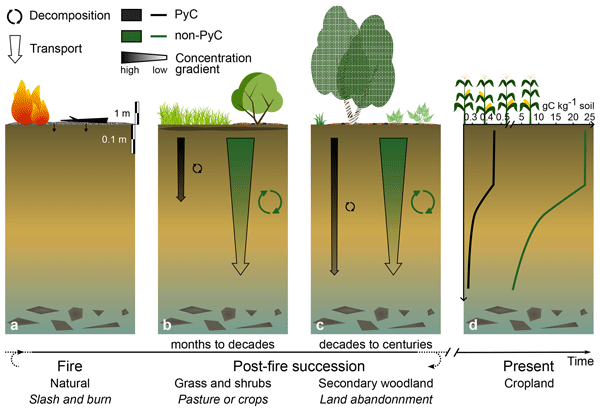
Fire-derived carbon is a form of organic carbon that has a long persistence in soils. However, its persistence at the landscape scale may be underestimated due to lateral and vertical redistribution. We measured fire-derived carbon in soils of a hilly agricultural watershed to identify the result of transport processes on the centennial time-scale. We show that the subsoil stores a large amount of fire-derived carbon and that erosion can redistribute it to localized accumulation zones.
Baptiste Hulin, Scott Saleska, Didier Jehanno, Simon Chollet, Katerina Dontsova, Hannes Bauser, Valerie Milici, and Samuel Abiven
EGUsphere, https://doi.org/10.5194/egusphere-2025-4243, https://doi.org/10.5194/egusphere-2025-4243, 2025
Short summary
Short summary
Studying biogeochemical processes requires expertise in many disciplines. To meet this challenge, we set up an experimental facility that combines 15 lysimeters and a climate chamber. We developed instrumentation that would enable us to monitor the water cycle and facilitate sampling for all lysimeters, thus allowing replication. By providing automated access to a variety of data, this facility fosters interdisciplinarity and offers an alternative to field and laboratory studies.
Cited articles
Agapit, C., Gigon, A., and Blouin, M.: Earthworm Effect on Root Morphology in a Split Root System, Plant Biosyst., 152, 780–786, https://doi.org/10.1080/11263504.2017.1338627, 2018. a
Ahmadi, S. H., Seidel, S. J., Lopez, G., Kamali, B., Gaiser, T., Hadir, S., Demie, D. T., Andersen, M. N., Ewert, F., and Ochoa, I. H.: Root:Shoot Ratio of Field Crops under Conventional and Conservation Tillage: A Meta Analysis, Soil Use Manage., 41, e70026, https://doi.org/10.1111/sum.70026, 2025. a
Andrade, G., Mihara, K., Linderman, R., and Bethlenfalvay, G.: Soil Aggregation Status and Rhizobacteria in the Mycorrhizosphere, Plant Soil, 202, 89–96, https://doi.org/10.1023/A:1004301423150, 1998. a
ARVALIS: Les fiches Couverts, https://www.arvalis.fr/outils-et-services/outils-et-fiches/les-fiches-couverts (last access: 24 June 2026), 2022. a
ARVALIS: Cultures intermédiaires : bien adapter sa technique de semis, https://www.arvalis.fr/infos-techniques/quelles-techniques-de-semis (last access: 24 June 2026), 2025. a
Atere, C. T., Ge, T., Zhu, Z., Tong, C., Jones, D. L., Shibistova, O., Guggenberger, G., and Wu, J.: Rice Rhizodeposition and Carbon Stabilisation in Paddy Soil Are Regulated via Drying-Rewetting Cycles and Nitrogen Fertilisation, Biol. Fertil. Soils, 53, 407–417, https://doi.org/10.1007/s00374-017-1190-4, 2017. a
Austin, E. E., Wickings, K., McDaniel, M. D., Robertson, G. P., and Grandy, A. S.: Cover Crop Root Contributions to Soil Carbon in a No-till Corn Bioenergy Cropping System, GCB Bioenergy, 9, 1252–1263, https://doi.org/10.1111/gcbb.12428, 2017. a
Baptist, F., Aranjuelo, I., Legay, N., Lopez-Sangil, L., Molero, G., Rovira, P., and Nogués, S.: Rhizodeposition of Organic Carbon by Plants with Contrasting Traits for Resource Acquisition: Responses to Different Fertility Regimes, Plant Soil, 394, 391–406, https://doi.org/10.1007/s11104-015-2531-4, 2015. a, b
Bastida, F., García, C., Fierer, N., Eldridge, D. J., Bowker, M. A., Abades, S., Alfaro, F. D., Asefaw Berhe, A., Cutler, N. A., Gallardo, A., García-Velázquez, L., Hart, S. C., Hayes, P. E., Hernández, T., Hseu, Z.-Y., Jehmlich, N., Kirchmair, M., Lambers, H., Neuhauser, S., Peña-Ramírez, V. M., Pérez, C. A., Reed, S. C., Santos, F., Siebe, C., Sullivan, B. W., Trivedi, P., Vera, A., Williams, M. A., Luis Moreno, J., and Delgado-Baquerizo, M.: Global Ecological Predictors of the Soil Priming Effect, Nat. Commun., 10, 3481, https://doi.org/10.1038/s41467-019-11472-7, 2019. a
Bates, D., Mächler, M., Bolker, B., and Walker, S.: Fitting Linear Mixed-Effects Models Using Lme4, J. Stat. Softw., 67, 1–48, https://doi.org/10.18637/jss.v067.i01, 2015. a
Baumert, V. L., Vasilyeva, N. A., Vladimirov, A. A., Meier, I. C., Kögel-Knabner, I., and Mueller, C. W.: Root Exudates Induce Soil Macroaggregation Facilitated by Fungi in Subsoil, Front. Environ. Sci., 6, 140, https://doi.org/10.3389/fenvs.2018.00140, 2018. a, b
Berenstecher, P., Araujo, P. I., and Austin, A. T.: Worlds Apart: Location above- or below-Ground Determines Plant Litter Decomposition in a Semi-Arid Patagonian Steppe, J. Ecol., 109, 2885–2896, https://doi.org/10.1111/1365-2745.13688, 2021. a
Bertrand, I., Chabbert, B., Kurek, B., and Recous, S.: Can the Biochemical Features and Histology of Wheat Residues Explain Their Decomposition in Soil?, Plant Soil, 281, 291–307, https://doi.org/10.1007/s11104-005-4628-7, 2006. a
Bicharanloo, B., Bagheri Shirvan, M., Cavagnaro, T. R., Keitel, C., and Dijkstra, F. A.: Nitrogen Fertilisation Reduces the Contribution of Root-Derived Carbon to Mineral-Associated Organic Matter Formation at Low and High Defoliation Frequencies in a Grassland Soil, Plant Soil, 508, 925–938, https://doi.org/10.1007/s11104-024-06835-z, 2024. a
Bolinder, M., Angers, D., and Dubuc, J.: Estimating Shoot to Root Ratios and Annual Carbon Inputs in Soils for Cereal Crops, Agr. Ecosyst. Environ., 63, 61–66, https://doi.org/10.1016/S0167-8809(96)01121-8, 1997. a, b
Bolinder, M., Angers, D. A., Bélanger, G., Michaud, R., and Laverdière, M. R.: Root Biomass and Shoot to Root Ratios of Perennial Forage Crops in Eastern Canada, Can. J. Plant Sci., 82, 731–737, https://doi.org/10.4141/P01-139, 2002. a
Boström, B., Comstedt, D., and Ekblad, A.: Isotope Fractionation and 13C Enrichment in Soil Profiles during the Decomposition of Soil Organic Matter, Oecologia, 153, 89–98, https://doi.org/10.1007/s00442-007-0700-8, 2007. a
Brown, L. K., George, T. S., Neugebauer, K., and White, P. J.: The Rhizosheath – a Potential Trait for Future Agricultural Sustainability Occurs in Orders throughout the Angiosperms, Plant Soil, 418, 115–128, https://doi.org/10.1007/s11104-017-3220-2, 2017. a
Cotrufo, M. F., Wallenstein, M. D., Boot, C. M., Denef, K., and Paul, E.: The Microbial Efficiency-Matrix Stabilization (MEMS) Framework Integrates Plant Litter Decomposition with Soil Organic Matter Stabilization: Do Labile Plant Inputs Form Stable Soil Organic Matter?, Glob. Change Biol., 19, 988–995, https://doi.org/10.1111/gcb.12113, 2013. a
Davenport, J. R. and Thomas, R. L.: Carbon Partitioning and Rhizodeposition in Corn and Bromegrass, Can. J. Soil Sci., 68, 693–701, https://doi.org/10.4141/cjss88-067, 1988. a
Dietzel, R., Liebman, M., and Archontoulis, S.: A Deeper Look at the Relationship between Root Carbon Pools and the Vertical Distribution of the Soil Carbon Pool, SOIL, 3, 139–152, https://doi.org/10.5194/soil-3-139-2017, 2017. a
Dormaar, J. F.: Effect of Active Roots on the Decomposition of Soil Organic Materials, Biol. Fert. Soils, 10, 121–126, https://doi.org/10.1007/BF00336247, 1990. a
Farrar, J., Hawes, M., Jones, D., and Lindow, S.: How Roots Control the Flux of Carbon to the Rhizosphere, Ecology, 84, 827–837, https://doi.org/10.1890/0012-9658(2003)084[0827:HRCTFO]2.0.CO;2, 2003. a
Fox, J. and Weisberg, S.: An R Companion to Applied Regression, Sage, Thousand Oaks CA, 3rd Edn., https://www.john-fox.ca/Companion/ (last access: 24 June 2026), 2019. a
Freschet, G. T., Cornwell, W. K., Wardle, D. A., Elumeeva, T. G., Liu, W., Jackson, B. G., Onipchenko, V. G., Soudzilovskaia, N. A., Tao, J., and Cornelissen, J. H.: Linking Litter Decomposition of Above- and below-Ground Organs to Plant–Soil Feedbacks Worldwide, J. Ecol., 101, 943–952, https://doi.org/10.1111/1365-2745.12092, 2013. a
Freschet, G. T., Pagès, L., Iversen, C. M., Comas, L. H., Rewald, B., Roumet, C., Klimešová, J., Zadworny, M., Poorter, H., Postma, J. A., Adams, T. S., Bagniewska-Zadworna, A., Bengough, A. G., Blancaflor, E. B., Brunner, I., Cornelissen, J. H. C., Garnier, E., Gessler, A., Hobbie, S. E., Meier, I. C., Mommer, L., Picon-Cochard, C., Rose, L., Ryser, P., Scherer-Lorenzen, M., Soudzilovskaia, N. A., Stokes, A., Sun, T., Valverde-Barrantes, O. J., Weemstra, M., Weigelt, A., Wurzburger, N., York, L. M., Batterman, S. A., Gomes De Moraes, M., Janeček, Š., Lambers, H., Salmon, V., Tharayil, N., and McCormack, M. L.: A Starting Guide to Root Ecology: Strengthening Ecological Concepts and Standardising Root Classification, Sampling, Processing and Trait Measurements, New Phytol., 232, 973–1122, https://doi.org/10.1111/nph.17572, 2021. a, b, c
Gill, R., Burke, I. C., Milchunas, D. G., and Lauenroth, W. K.: Relationship Between Root Biomass and Soil Organic Matter Pools in the Shortgrass Steppe of Eastern Colorado, Ecosystems, 2, 226–236, https://doi.org/10.1007/s100219900070, 1999. a
Guenet, B., Camino-Serrano, M., Ciais, P., Tifafi, M., Maignan, F., Soong, J. L., and Janssens, I. A.: Impact of Priming on Global Soil Carbon Stocks, Glob. Change Biol., 24, 1873–1883, https://doi.org/10.1111/gcb.14069, 2018. a
Hegazy, A. K., Fahmy, G. M., Ali, M. I., and Gomaa, N. H.: Growth and Phenology of Eight Common Weed Species, J. Arid Environ., 61, 171–183, https://doi.org/10.1016/j.jaridenv.2004.07.005, 2005. a
Heinemann, H., Hirte, J., Seidel, F., and Don, A.: Increasing Root Biomass Derived Carbon Input to Agricultural Soils by Genotype Selection – a Review, Plant Soil, 490, 19–30, https://doi.org/10.1007/s11104-023-06068-6, 2023. a
Henneron, L., Kardol, P., Wardle, D. A., Cros, C., and Fontaine, S.: Rhizosphere Control of Soil Nitrogen Cycling: A Key Component of Plant Economic Strategies, New Phytol., 228, 1269–1282, https://doi.org/10.1111/nph.16760, 2020b. a
Henneron, L., Balesdent, J., Alvarez, G., Barré, P., Baudin, F., Basile-Doelsch, I., Cécillon, L., Fernandez-Martinez, A., Hatté, C., and Fontaine, S.: Bioenergetic Control of Soil Carbon Dynamics across Depth, Nat. Commun., 13, 7676, https://doi.org/10.1038/s41467-022-34951-w, 2022. a, b
Hinsinger, P., Plassard, C., and Jaillard, B.: Rhizosphere: A New Frontier for Soil Biogeochemistry, J. Geochem. Explor., 88, 210–213, https://doi.org/10.1016/j.gexplo.2005.08.041, 2006. a
Hirte, J., Leifeld, J., Abiven, S., Oberholzer, H.-R., and Mayer, J.: Below Ground Carbon Inputs to Soil via Root Biomass and Rhizodeposition of Field-Grown Maize and Wheat at Harvest Are Independent of Net Primary Productivity, Agr. Ecosyst. Environ., 265, 556–566, https://doi.org/10.1016/j.agee.2018.07.010, 2018. a, b
Hu, T., Sørensen, P., Wahlström, E. M., Chirinda, N., Sharif, B., Li, X., and Olesen, J. E.: Root Biomass in Cereals, Catch Crops and Weeds Can Be Reliably Estimated without Considering Aboveground Biomass, Agr. Ecosyst. Environ., 251, 141–148, https://doi.org/10.1016/j.agee.2017.09.024, 2018. a
Huang, J., Liu, W., Pan, S., Wang, Z., Yang, S., Jia, Z., Wang, Z., Deng, M., Yang, L., Liu, C., Chang, P., and Liu, L.: Divergent Contributions of Living Roots to Turnover of Different Soil Organic Carbon Pools and Their Links to Plant Traits, Funct. Ecol., 35, 2821–2830, https://doi.org/10.1111/1365-2435.13934, 2021. a, b, c, d, e, f
Hudek, C., Putinica, C., Otten, W., and De Baets, S.: Functional Root Trait-Based Classification of Cover Crops to Improve Soil Physical Properties, Eur. J. Soil Sci., 73, e13147, https://doi.org/10.1111/ejss.13147, 2022. a
Hulin, B., Chollet, S., Massol, F., and Abiven, S.: Dataset of a Multi-Pulse Labelling Experiment with 13C CO2 to Trace Root-Derived Carbon in the Soil, Zenodo [data set], https://doi.org/10.5281/zenodo.17482237, 2025. a, b
Huo, C., Luo, Y., and Cheng, W.: Rhizosphere Priming Effect: A Meta-Analysis, Soil Biol. Biochem., 111, 78–84, https://doi.org/10.1016/j.soilbio.2017.04.003, 2017. a, b, c
Hütsch, B. W., Augustin, J., and Merbach, W.: Plant Rhizodeposition — an Important Source for Carbon Turnover in Soils, J. Plant Nutr. Soil Sci., 165, 397, https://doi.org/10.1002/1522-2624(200208)165:4<397::AID-JPLN397>3.0.CO;2-C, 2002. a
Islam, M. R., Bicharanloo, B., Yu, X., Singh, B., and Dijkstra, F. A.: Rhizodeposition Stimulates Soil Carbon Decomposition and Promotes Formation of Mineral-Associated Carbon with Increased Clay Content, Geoderma, 454, 117180, https://doi.org/10.1016/j.geoderma.2025.117180, 2025. a
Kleemola, J., Teittinen, M., and Karvonen, T.: Modelling Crop Growth and Biomass Partitioning to Shoots and Roots in Relation to Nitrogen and Water Availability, Using a Maximization Principle, Plant Soil, 185, 99–111, https://doi.org/10.1007/BF02257567, 1996. a
Li, H., Chang, L., Liu, H., and Li, Y.: Diverse Factors Influence the Amounts of Carbon Input to Soils via Rhizodeposition in Plants: A Review, Sci. Total Environ., 948, 174858, https://doi.org/10.1016/j.scitotenv.2024.174858, 2024. a
Li, J., Yuan, X., Ge, L., Li, Q., Li, Z., Wang, L., and Liu, Y.: Rhizosphere Effects Promote Soil Aggregate Stability and Associated Organic Carbon Sequestration in Rocky Areas of Desertification, Agr. Ecosyst. Environ., 304, 107126, https://doi.org/10.1016/j.agee.2020.107126, 2020. a
Lu, Y., Watanabe, A., and Kimura, M.: Carbon Dynamics of Rhizodeposits, Root- and Shoot-Residues in a Rice Soil, Soil Biol. Biochem., 35, 1223–1230, https://doi.org/10.1016/S0038-0717(03)00184-6, 2003. a, b
Lüdecke, D., Ben-Shachar, M., Patil, I., Waggoner, P., and Makowski, D.: Performance: An R Package for Assessment, Comparison and Testing of Statistical Models, Journal of Open Source Software, 6, 3139, https://doi.org/10.21105/joss.03139, 2021. a
Mattila, T. J. and Häkkinen, L.: Exploring the Effects of Soil Structure, Nutrients, and Farm Management on Crop Root Biomass and Depth Distribution, Field Crops Res., 327, 109909, https://doi.org/10.1016/j.fcr.2025.109909, 2025. a
Meier, U.: Phenological Growth Stages, in: Phenology: An Integrative Environmental Science, edited by Kratochwil, A., Lieth, H., and Schwartz, M. D., Vol. 39, 269–283, Springer Netherlands, Dordrecht, ISBN 978-1-4020-1580-9 978-94-007-0632-3, https://doi.org/10.1007/978-94-007-0632-3_17, 2003. a, b
Minasny, B., Malone, B. P., McBratney, A. B., Angers, D. A., Arrouays, D., Chambers, A., Chaplot, V., Chen, Z.-S., Cheng, K., Das, B. S., Field, D. J., Gimona, A., Hedley, C. B., Hong, S. Y., Mandal, B., Marchant, B. P., Martin, M., McConkey, B. G., Mulder, V. L., O'Rourke, S., Richer-de-Forges, A. C., Odeh, I., Padarian, J., Paustian, K., Pan, G., Poggio, L., Savin, I., Stolbovoy, V., Stockmann, U., Sulaeman, Y., Tsui, C.-C., Vågen, T.-G., van Wesemael, B., and Winowiecki, L.: Soil Carbon 4 per Mille, Geoderma, 292, 59–86, https://doi.org/10.1016/j.geoderma.2017.01.002, 2017. a
Nakagawa, S. and Schielzeth, H.: A General and Simple Method for Obtaining R2 from Generalized Linear Mixed-Effects Models, Method. Ecol. Evol., 4, 133–142, https://doi.org/10.1111/j.2041-210x.2012.00261.x, 2013. a
Ndour, P. M. S., Hatté, C., Achouak, W., Heulin, T., and Cournac, L.: Rhizodeposition Efficiency of Pearl Millet Genotypes Assessed on a Short Growing Period by Carbon Isotopes (Δ13C and F14C), SOIL, 8, 49–57, https://doi.org/10.5194/soil-8-49-2022, 2022. a, b
Nguyen, C.: Rhizodeposition of Organic C by Plants: Mechanisms and Controls, Agronomie, 23, 375–396, https://doi.org/10.1051/agro:2003011, 2003. a, b, c, d
Pellerin, S., Bamière, L., Launay, C., Martin, R., Schiavo, M., Angers, D., Augusto, L., Balesdent, J., Basile-Doelsch, I., Bellassen, V., Cardinael, R., Cécillon, L., Ceschia, E., Chenu, C., Constantin, J., Daroussin, J., Delacote, P., Delame, N., Gastal, F., Gilbert, D., Graux, A.-I., Guenet, B., Houot, S., Klumpp, K., Letort, E., Litrico, I., Martin, M., Menasseri-Aubry, S., Meziere, D., Morvan, T., Mosnier, C., Roger-Estrade, J., Saint-André, L., Sierra, J., Therond, O., Viaud, V., Grateau, R., Le Perchec, S., Savini, I., and Rechauchère, O.: Stocker Du Carbone Dans Les Sols Français. Quel Potentiel Au Regard de l'objectif 4 Pour 1000 et à Quel Coût ?, Other, INRA, https://doi.org/10.15454/nhxt-gn38, 2020. a, b
Poeplau, C. and Don, A.: Carbon Sequestration in Agricultural Soils via Cultivation of Cover Crops – A Meta-Analysis, Agr. Ecosyst. Environ., 200, 33–41, https://doi.org/10.1016/j.agee.2014.10.024, 2015. a
Postma, J. A., Hecht, V. L., Hikosaka, K., Nord, E. A., Pons, T. L., and Poorter, H.: Dividing the Pie: A Quantitative Review on Plant Density Responses, Plant Cell Environ., 44, 1072–1094, https://doi.org/10.1111/pce.13968, 2021. a
R Core Team: R: A Language and Environment for Statistical Computing, R Foundation for Statistical Computing, Vienna, Austria, https://www.R-project.org/ (last access: 24 June 2026), 2021. a
Rasse, D. P., Rumpel, C., and Dignac, M.-F.: Is Soil Carbon Mostly Root Carbon? Mechanisms for a Specific Stabilisation, Plant Soil, 269, 341–356, https://doi.org/10.1007/s11104-004-0907-y, 2005. a, b, c
Robinson, D., Griffiths, B., Ritz, K., and Wheatley, R.: Root-Induced Nitrogen Mineralisation: A Theoretical Analysis, Plant Soil, 117, 185–193, https://doi.org/10.1007/BF02220711, 1989. a
Ryan, P., Delhaize, E., and Jones, D.: Function and Mechanism of Organic Anion Exudation from Plant Roots, Ann. Rev. Plant Phys., 52, 527–560, https://doi.org/10.1146/annurev.arplant.52.1.527, 2001. a
Sainju, U. M., Singh, B. P., and Whitehead, W. F.: Cover Crop Root Distribution and Its Effects on Soil Nitrogen Cycling, Agron. J., 90, 511–518, https://doi.org/10.2134/agronj1998.00021962009000040012x, 1998. a
Schaub, M. and Alewell, C.: Stable Carbon Isotopes as an Indicator for Soil Degradation in an Alpine Environment (Urseren Valley, Switzerland), Rapid Commun. Mass Sp., 23, 1499–1507, https://doi.org/10.1002/rcm.4030, 2009. a
Schiedung, M., Don, A., Beare, M. H., and Abiven, S.: Soil Carbon Losses Due to Priming Moderated by Adaptation and Legacy Effects, Nat. Geosci., 16, 909–914, https://doi.org/10.1038/s41561-023-01275-3, 2023. a, b, c
Schweizer, M., Fear, J., and Cadisch, G.: Isotopic (13C) Fractionation during Plant Residue Decomposition and Its Implications for Soil Organic Matter Studies, Rapid Commun. Mass Sp., 13, 1284–1290, https://doi.org/10.1002/(SICI)1097-0231(19990715)13:13<1284::AID-RCM578>3.0.CO;2-0, 1999. a
Searle, S. R., Speed, F. M., and Milliken, G. A.: Population Marginal Means in the Linear Model: An Alternative to Least Squares Means, Am. Stat., 34, 216–221, https://doi.org/10.1080/00031305.1980.10483031, 1980. a
See, C. R., Luke McCormack, M., Hobbie, S. E., Flores-Moreno, H., Silver, W. L., and Kennedy, P. G.: Global Patterns in Fine Root Decomposition: Climate, Chemistry, Mycorrhizal Association and Woodiness, Ecol. Lett., 22, 946–953, https://doi.org/10.1111/ele.13248, 2019. a, b
Semchenko, M., Xue, P., and Leigh, T.: Functional Diversity and Identity of Plant Genotypes Regulate Rhizodeposition and Soil Microbial Activity, New Phytol., 232, 776–787, https://doi.org/10.1111/nph.17604, 2021. a
Shipley, B. and Meziane, D.: The Balanced-Growth Hypothesis and the Allometry of Leaf and Root Biomass Allocation, Funct. Ecol., 16, 326–331, https://doi.org/10.1046/j.1365-2435.2002.00626.x, 2002. a
Silver, W. L. and Miya, R. K.: Global Patterns in Root Decomposition: Comparisons of Climate and Litter Quality Effects, Oecologia, 129, 407–419, https://doi.org/10.1007/s004420100740, 2001. a
Studer, M. S., Siegwolf, R. T. W., and Abiven, S.: Carbon Transfer, Partitioning and Residence Time in the Plant-Soil System: A Comparison of Two 13CO2; Labelling Techniques, Biogeosciences, 11, 1637–1648, https://doi.org/10.5194/bg-11-1637-2014, 2014. a
Teixeira, P. P., Vidal, A., Teixeira, A. P., Souza, I. F., Hurtarte, L. C., Silva, D. H., Almeida, L. F., Buegger, F., Hammer, E. C., Jansa, J., Mueller, C. W., and Silva, I. R.: Decoding the Rhizodeposit-Derived Carbon's Journey into Soil Organic Matter, Geoderma, 443, 116811, https://doi.org/10.1016/j.geoderma.2024.116811, 2024. a
Teixeira, P. P. C., Trautmann, S., Buegger, F., Felde, V. J. M. N. L., Pausch, J., Müller, C. W., and Kögel-Knabner, I.: Role of Root Hair Elongation in Rhizosheath Aggregation and in the Carbon Flow into the Soil, Biol. Fertil. Soil., 59, 351–361, https://doi.org/10.1007/s00374-023-01708-6, 2023. a, b
Van der Krift, T. A., Kuikman, P. J., Möller, F., and Berendse, F.: Plant Species and Nutritional-Mediated Control over Rhizodeposition and Root Decomposition, Plant Soil, 228, 191–200, https://doi.org/10.1023/A:1004834128220, 2001. a, b
Veeken, A., Santos, M. J., McGowan, S., Davies, A. L., and Schrodt, F.: Pollen-Based Reconstruction Reveals the Impact of the Onset of Agriculture on Plant Functional Trait Composition, Ecol. Lett., 25, 1937–1951, https://doi.org/10.1111/ele.14063, 2022. a
Verdier, B., Jouanneau, I., Simonnet, B., Rabin, C., Van Dooren, T. J. M., Delpierre, N., Clobert, J., Abbadie, L., Ferrière, R., and Le Galliard, J.-F.: Climate and Atmosphere Simulator for Experiments on Ecological Systems in Changing Environments, Environ. Sci. Technol., 48, 8744–8753, https://doi.org/10.1021/es405467s, 2014. a
Villarino, S. H., Pinto, P., Jackson, R. B., and Piñeiro, G.: Plant Rhizodeposition: A Key Factor for Soil Organic Matter Formation in Stable Fractions, Sci. Adv., 7, eabd3176, https://doi.org/10.1126/sciadv.abd3176, 2021. a, b
Warembourg, F. R. and Estelrich, H. D.: Towards a Better Understanding of Carbon Flow in the Rhizosphere: A Time-Dependent Approach Using Carbon-14, Biol. Fertil. Soil., 30, 528–534, https://doi.org/10.1007/s003740050032, 2000. a
Watt, M., McCully, M. E., and Canny, M. J.: Formation and Stabilization of Rhizosheaths of Zea Mays L. (Effect of Soil Water Content), Plant Physiol., 106, 179–186, https://doi.org/10.1104/pp.106.1.179, 1994. a
Wen, Z., White, P. J., Shen, J., and Lambers, H.: Linking Root Exudation to Belowground Economic Traits for Resource Acquisition, New Phytol., 233, 1620–1635, https://doi.org/10.1111/nph.17854, 2022. a
Weng, Z. H., Van Zwieten, L., Singh, B. P., Tavakkoli, E., Kimber, S., Morris, S., Macdonald, L. M., and Cowie, A.: The Accumulation of Rhizodeposits in Organo-Mineral Fractions Promoted Biochar-Induced Negative Priming of Native Soil Organic Carbon in Ferralsol, Soil Biol. Biochem., 118, 91–96, https://doi.org/10.1016/j.soilbio.2017.12.008, 2018. a, b
Williams, A., Langridge, H., Straathof, A. L., Muhamadali, H., Hollywood, K. A., Goodacre, R., and De Vries, F. T.: Root Functional Traits Explain Root Exudation Rate and Composition across a Range of Grassland Species, J. Ecol., 110, 21–33, https://doi.org/10.1111/1365-2745.13630, 2022. a, b
York, L. M., Carminati, A., Mooney, S. J., Ritz, K., and Bennett, M. J.: The Holistic Rhizosphere: Integrating Zones, Processes, and Semantics in the Soil Influenced by Roots, J. Exp. Bot., 67, 3629–3643, https://doi.org/10.1093/jxb/erw108, 2016. a
Zhang, X. and Wang, W.: The Decomposition of Fine and Coarse Roots: Their Global Patterns and Controlling Factors, Sci. Rep., 5, 9940, https://doi.org/10.1038/srep09940, 2015. a, b
Short summary
Root-derived carbon is a major input fuelling soil organic carbon stock. However, root sampling generally omits a considerable fraction of this input. Here, we used isotopic tracing, performed on 12 crops, to quantify this carbon pool and to evaluate its persistence through an 18-month field incubation experiment. We highlighted that it represents a large share of root-derived carbon (27 %) with differences between plant families, and that its persistence in the soil might exceed that of roots.
Root-derived carbon is a major input fuelling soil organic carbon stock. However, root sampling...


Altmetrics
Final-revised paper
Preprint