
Articles | Volume 23, issue 13
https://doi.org/10.5194/bg-23-4759-2026
© Author(s) 2026. This work is distributed under
the Creative Commons Attribution 4.0 License.
the Creative Commons Attribution 4.0 License.
https://doi.org/10.5194/bg-23-4759-2026
© Author(s) 2026. This work is distributed under
the Creative Commons Attribution 4.0 License.
the Creative Commons Attribution 4.0 License.
Research article
| Highlight paper
| 
09 Jul 2026
Research article | Highlight paper |
| 09 Jul 2026
| 09 Jul 2026
Biosignatures of microbial mats in Pleistocene coral reef cores from IODP Expedition 389 (Hawaiian Drowned Reefs)
Hildegard Westphal
CORRESPONDING AUTHOR

Leibniz Centre for Tropical Marine Research, Bremen, Germany
Department of Geosciences, University of Bremen, Bremen, Germany
Elisa Garuglieri
Physical Science and Engineering Division, KAUST, Thuwal, Saudi Arabia
Gregory E. Webb
School of the Environment, The University of Queensland, Brisbane, QLD 4072, Australia
Luke Nothdurft
School of Earth and Atmospheric Sciences Faculty of Science, Queensland University of Technology, Brisbane, QLD 4000, Australia
Anna Merkel
GeoZentrum Nordbayern, Friedrich-Alexander-Universität Erlangen-Nürnberg, Erlangen, Germany
Pankaj Khanna
Department of Earth Sciences, Indian Institute of Technology Gandhinagar, Gandhinagar, Gujarat, India
Poornima Karki
Department of Earth Sciences, Indian Institute of Technology Gandhinagar, Gandhinagar, Gujarat, India
Theresa Nohl
Department of Palaeontology, University of Vienna, Vienna, Austria
Eberhard Gischler
Institut für Geowissenschaften, Goethe Universität, Frankfurt am Main, Germany
Jody M. Webster
Geocoastal Research Group, School of Geosciences, The University of Sydney, Sydney, NSW 2006, Australia
Related authors
Marleen Stuhr, Yannis Kappelmann, Thomas Mann, Dominik Kneer, Jamaluddin Jompa, and Hildegard Westphal
EGUsphere, https://doi.org/10.5194/egusphere-2026-3460, https://doi.org/10.5194/egusphere-2026-3460, 2026
Short summary
Short summary
Tropical shelf seas produce carbonate sediment from shells of small marine organisms, but mud and nutrients from land, carried in during seasonal rains, can disrupt this. We studied seafloor sediment and shell-forming organisms at 51 sites on a shelf in Indonesia to see how land input shapes carbonate production. Sediment composition shifts abruptly with distance from shore, and differs by region, reflecting river influence. Findings may help interpret carbonate sediments in the geological past.
Marleen Stuhr, Yannis Kappelmann, Thomas Mann, Dominik Kneer, Jamaluddin Jompa, and Hildegard Westphal
EGUsphere, https://doi.org/10.5194/egusphere-2026-3460, https://doi.org/10.5194/egusphere-2026-3460, 2026
Short summary
Short summary
Tropical shelf seas produce carbonate sediment from shells of small marine organisms, but mud and nutrients from land, carried in during seasonal rains, can disrupt this. We studied seafloor sediment and shell-forming organisms at 51 sites on a shelf in Indonesia to see how land input shapes carbonate production. Sediment composition shifts abruptly with distance from shore, and differs by region, reflecting river influence. Findings may help interpret carbonate sediments in the geological past.
Thomas M. DeCarlo, Oliwia Jasnos, Avi Strange, Andreas Andersson, Angel T. Bautista VII, Sierra Bloomer, Isaiah W. Bolden, Maartje Bosman, Thomas C. Brachert, Giulia B. Braz, Gabriel O. Cardoso, Juan P. Carricart-Ganivet, Jessica E. Carilli, Karl D. Castillo, Leticia Cavole, Sylvia Chan, Xuefei Chen, Ben Chomitz, Thierry Correge, Travis A. Courtney, Mikayla Deigan, Juan Pablo D'Olivo, Robert Dunbar, Ian C. Enochs, Ludmilla Falsarella, Thomas Felis, Gabriela Gutierrez-Estrada, Brighton Hedger, Shijian Hu, Seamus Jameson, Stacy Jupiter, Paul Kench, Diego K. Kersting, Ke Lin, Yi-Wei Liu, Carla A. B. Lorigados, Derek P. Manzello, Malcolm T. McCulloch, Miguel Mies, Rodrigo L. Moura, Ferdinand Oberle, Natan Pereira, Nancy Prouty, Riovie D. Ramos, Haojia Ren, Emma Ryan, Diane M. Thompson, Lauren T. Toth, Marina J. Vergotti, Jody M. Webster, and Jens Zinke
Earth Syst. Sci. Data, 18, 3341–3353, https://doi.org/10.5194/essd-18-3341-2026, https://doi.org/10.5194/essd-18-3341-2026, 2026
Short summary
Short summary
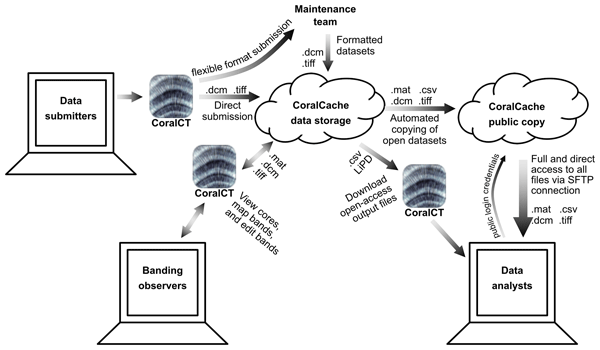
We present CoralCache, a virtual coral core repository with global coverage. This repository fills a key gap by enabling researchers to transparently archive and share the raw core image datasets and the visual interpretations of those images, rather than simply the summarized growth rate data, which on their own cannot be traced or precisely reproduced. CoralCache is designed to meet the data-sharing principles of findability, accessibility, interoperability, and reusability (FAIR).
Ariella K. Arzey, Helen V. McGregor, Tara R. Clark, Jody M. Webster, Stephen E. Lewis, Jennie Mallela, Nicholas P. McKay, Hugo W. Fahey, Supriyo Chakraborty, Tries B. Razak, and Matt J. Fischer
Earth Syst. Sci. Data, 16, 4869–4930, https://doi.org/10.5194/essd-16-4869-2024, https://doi.org/10.5194/essd-16-4869-2024, 2024
Short summary
Short summary
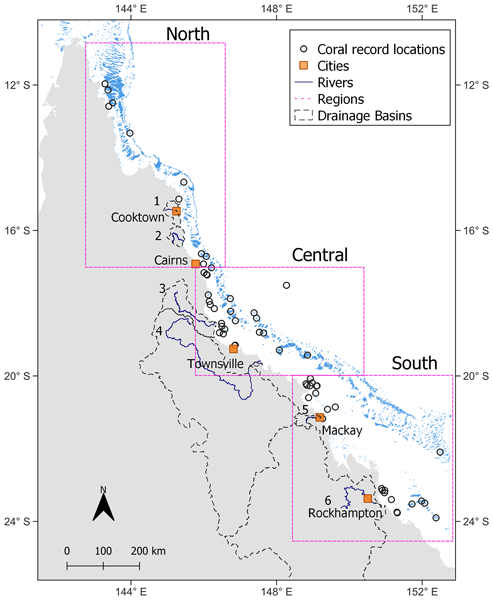
Coral skeletal records from the Great Barrier Reef (GBR) provide vital data on climate and environmental change. Presented here is the Great Barrier Reef Coral Skeletal Records Database, an extensive compilation of GBR coral records. The database includes key metadata, primary data, and access instructions, and it enhances research on past, present, and future climate and environmental variability of the GBR. The database will assist with contextualising present-day threats to reefs globally.
Nina M. A. Wichern, Or M. Bialik, Theresa Nohl, Lawrence M. E. Percival, R. Thomas Becker, Pim Kaskes, Philippe Claeys, and David De Vleeschouwer
Clim. Past, 20, 415–448, https://doi.org/10.5194/cp-20-415-2024, https://doi.org/10.5194/cp-20-415-2024, 2024
Short summary
Short summary
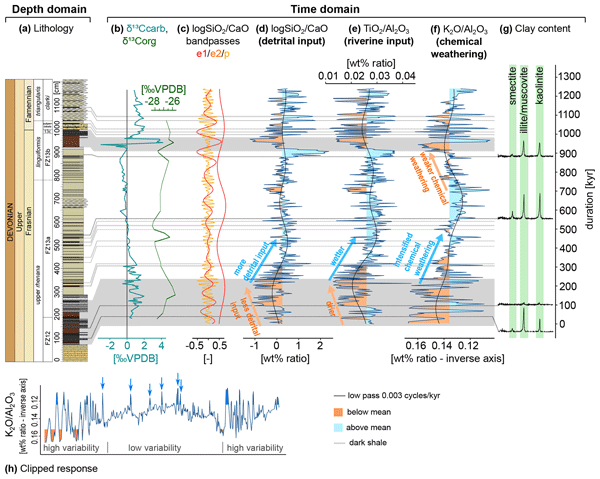
Middle–Late Devonian sedimentary rocks are often punctuated by anoxic black shales. Due to their semi-regular nature, anoxic events may be linked to periodic changes in the Earth’s climate caused by astronomical forcing. We use portable X-ray fluorescence elemental records, measured on marine sediments from Germany, to construct an astrochronological framework for the Kellwasser ocean anoxic Crisis. Results suggest that the Upper Kellwasser event was preceded by a specific orbital configuration.
David De Vleeschouwer, Theresa Nohl, Christian Schulbert, Or M. Bialik, and Gerald Auer
Sci. Dril., 32, 43–54, https://doi.org/10.5194/sd-32-43-2023, https://doi.org/10.5194/sd-32-43-2023, 2023
Short summary
Short summary
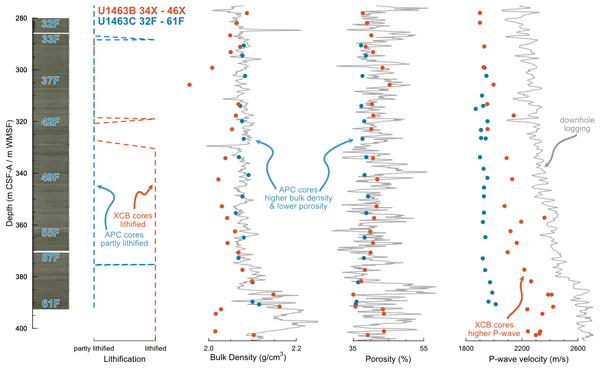
Differences exist in International Ocean Discovery Program (IODP) sediment lithification depending on the coring tool used. Advanced piston corers (APCs) display less pronounced lithification compared to extended core barrels (XCBs) of the same formation. The difference stems from the destruction of early cements between sediment grains and an
acoustic compactioncaused by the piston-core pressure wave. XCB cores provide a more accurate picture of the lithification of the original formation.
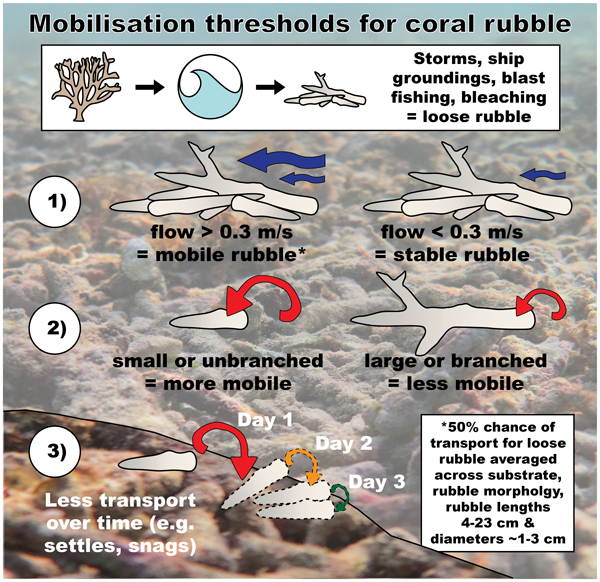
Tania M. Kenyon, Daniel Harris, Tom Baldock, David Callaghan, Christopher Doropoulos, Gregory Webb, Steven P. Newman, and Peter J. Mumby
Biogeosciences, 20, 4339–4357, https://doi.org/10.5194/bg-20-4339-2023, https://doi.org/10.5194/bg-20-4339-2023, 2023
Short summary
Short summary
The movement of rubble on coral reefs can lead to persistent unstable rubble beds that hinder reef recovery. To identify where such rubble beds are, we need to know the minimum velocity that will move rubble. We found that loose rubble had a 50 % chance of being moved when near-bed wave orbital velocities reached ~0.3 m s−1; rubble moved more if pieces were small and had no branches. Rubble beds that experience frequent movement would be good candidates for rubble stabilisation interventions.
Cited articles
Allwood, A. C., Walter, M. R., Kamber, B. S., Marshall, C. P., and Burch, I. W.: Stromatolite reef from the Early Archaean era of Australia, Nature, 441, 714–718, 2006.
Baud, A., Cirilli, S., and Marcoux, J.: Biotic response to mass extinction: the lowermost Triassic microbialites, Facies, 36, 238–242, 1997.
Berger, A. and Loutre, M. F.: Insolation values for the climate of the last 10 million years, Quaternary Sci. Rev., 10, 297–317, https://doi.org/10.1016/0277-3791(91)90033-Q, 1991.
Braga, J. C., Puga-Bernabéu, Á., Heindel, K., Patterson, M. A., Birgel, D., Peckmann, J., Sánchez-Almazo, I. M., Webster, J. M., Yokoyama, Y., and Riding, R.: Microbialites in Last Glacial Maximum and deglacial reefs of the Great Barrier Reef (IODP Expedition 325, NE Australia), Palaeogeogr. Palaeocl., 514, 1–17, 2019.
Burne, R. V. and Moore, L. S.: Microbialites: Organosedimentary deposits of benthic microbial communities, Palaios, 2, 241–254, 1987.
Camoin, G. F. and Montaggioni, L.: High energy coralgal-stromatolite frameworks from Holocene reefs (Tahiti, French Polynesia), Sedimentology, 41, 655–676, 1994.
Camoin, G. F., Gautret, P., Montaggioni, L., and Cabioch, G.: Nature and environmental significance of microbialites in Quaternary reefs: the Tahiti paradox, Sediment. Geol., 126, 271–304, 1999.
Castanier, S., Le Metayer-Levrel, G., and Perthuisot, J.-P.: Ca-carbonate precipitation and limestone genesis – the microbiogeologist point of view, Sediment. Geol., 126, 9–23, https://doi.org/10.1016/S0037-0738(99)00028-7, 1999.
Caumartin, J., Benzerara, K., Havas, R., Thomazo, C., Fogret, L., Betancourt, V., Tavera, R., Doisneau, B., Jézéquel, D., and Lopez-Garcia, P.: Huntite [CaMg3(CO3)4], a rare carbonate phase formed during early diagenesis in modern microbialites, ACS Earth Space Chem., 9, https://doi.org/10.1021/acsearthspacechem.5c00022, 2025.
Chafetz, H. and Buczynski, C.: Bacterially Induced Lithification of Microbial Mats. Palaios, 7, 277–293, https://doi.org/10.2307/3514973, 1992.
de Bakker, D. M., Perry, C. T., Magana-Gallegos, E., Perez-Cervantes, E., and Alvarez-Filip, L.: Fine-grained sediment production by endolithic sponges on Caribbean coral reefs, Limnol. Oceanogr., 69, 2015–2028, https://doi.org/10.1002/lno.12640, 2024.
Degen, T., Sadki, M., Bron, E., König, U., and Nénert, G.: The HighScore suite, Powder Diffr., 29, S13–S18, https://doi.org/10.1017/S0885715614000840, 2014.
Dohnalkova, A. C., Marshall, M. J., Arey, B. W., Williams, K. H., Buck, E. C., and Fredrickson, J. K.: Imaging hydrated microbial extracellular polymers: comparative analysis by electron microscopy, Appl. Environ. Microb., 77, 1254–1262, 2011.
Dupraz, C. and Strasser, A.: Nutritional modes in coral-microbialite reefs (Jurassic, Oxfordian, Switzerland): Evolution of trophic structure as a response to environmental change, Palaios, 17, 449–471, 2002.
Dupraz, C. and Visscher, P. T.: Microbial lithification in marine stromatolites and hypersaline mats, Trends Microbiol., 13, 429–438, 2005.
Dupraz, C., Reid, R. P., Braissant, O., Decho, A. W., Norman, R. S., and Visscher, P. T.: Processes of carbonate precipitation in modern microbial mats, Earth-Sci. Rev., 96, 141–162, 2009.
Eckhardt, S., Ainsworth, T. D., Leggat, W., and Page, C. E.: Colonial ascidian populations at inshore coral reefs of Norfolk Island, South Pacific, Diversity, 16, 384, https://doi.org/10.3390/d16070384, 2024.
Falkenberg, P., Vahrenkamp, S., Garuglieri, E., Petrovic, A., Hachmann, K., Chandra, V., and Vahrenkamp, V.: Polygonal tepee structures of Arabia, The Depositional Record, 12, e70043, https://doi.org/10.1002/dep2.70043, 2026.
Garuglieri, E., Marasco, R., Odobel, C., Chandra, V., Teillet, T., Areias, C., Sánchez-Román, M., Vahrenkamp, V., and Daffonchio, D.: Searching for microbial contribution to micritization of shallow marine sediments, Environ. Microbiol., 26, e16573, https://doi.org/10.1111/1462-2920.16573, 2024.
Gischler, E., Heindel, K., Birgel, D., Brunner, B., Reitner, J., and Peckmann, J.: Cryptic biostalactites in a submerged karst cave of the Belize Barrier Reef revisited: pendant bioconstructions cemented by microbial micrite, Palaeogeogr. Palaeocl., 468, 34–51, 2017.
Gomes, M. L., Klatt, J. M., Dick, G. J., Grim, S. L., Rico, K. I., Medina, M., Ziebis, W., Kinsman-Costello, L., Sheldon, N. D., and Fike, D. A.: Sedimentary pyrite sulfur isotope compositions preserve signatures of the surface microbial mat environment in sediments underlying low-oxygen cyanobacterial mats, Geobiology, 20, 60–78, https://doi.org/10.1111/gbi.12466, 2022.
Grotzinger, J. P. and Knoll, A. H.: Stromatolites in Precambrian carbonates: Evolutionary mileposts or environmental dipsticks?, Annu. Rev. Earth Pl. Sc., 27, 313–358, 1999.
Hardy, R. G. and Tucker, M.: X-ray powder diffraction of sediments, in: Techniques in sedimentology, edited by: Tucker, M., Oxford Blackwell, 191–228, ISBN 0632013729, 1988.
Heindel, K., Birgel, D., Peckmann, J., Kuhnert, H., and Westphal, H.: Sulfate-reducing bacteria as major players in the formation of reef-microbialites during the last sea-level rise (Tahiti, IODP 310), Geochim. Cosmochim. Ac., 73, Goldschmidt Conference A514-A514, 2009a.
Heindel, K., Westphal, H., and Wisshak, M.: Bioerosion in the reef framework, IODP Expedition #310 off Tahiti (Tiarei, Mara'a, and Faa'a), in: Proceedings IODP, 310, edited by: Camoin, G. F., Iryu, Y., McInroy, D. B., and the Expedition 310 Scientists, 28 p. https://doi.org/10.2204/iodp.proc.310.201.2009, 2009b.
Heindel, K., Birgel, D., Peckmann, J., Kuhnert, H., and Westphal, H.: Formation of deglacial microbialites in coral reefs off Tahiti (IODP 310) involving sulfate-reducing bacteria, Palaios, 25, 618–635, https://doi.org/10.2110/palo.2010.p10-032r, 2010.
Heindel, K., Birgel, D., Brunner, B., Thiel, V., Westphal, H., Gischler, E., Ziegenbalg, S. B., Cabioch, G., Sjövall, P., and Peckmann, J.: Post-glacial microbialite formation in coral reefs in the Pacific, Atlantic, and Indian Ocean, Chem. Geol., 304–305, 117–130, https://doi.org/10.1016/j.chemgeo.2012.02.009, 2012.
Holtedahl, O.: The Paleozoic formations of Finmarken in northern Norway, Am. J. Sci., 4, 85–107, 1919.
Imbrie, J., Hays, J. D., Martinson, D. G., McIntyre, A., Mix, A. C., Morley, J. J., Pisias, N. G., Prell, W. L., and Shackleton, N. J.: The orbital theory of Pleistocene climate: support from a revised chronology of the marine δ18O record, in: Milankovitch and climate: understanding the response to orbital forcing, edited by: Berger, A., Imbrie, J., Hays, J., and Kukla, G., D. Reidel Publishing Company, 269–305, ISBN 978-9027717771, 1984.
Jell, J. S. and Webb, G. E.: Geology of heron island and adjacent reefs, Great Barrier Reef, Australia, Episodes, 35, 110–119, 2012.
Kurtz, A. C., Derry, A. D., and Chadwick, O. A.: Accretion of Asian dust to Hawaiian soils: isotopic, elemental, and mineral mass balances, Geochim. Cosmochim. Ac., 65, 1971–1983, https://doi.org/10.1016/S0016-7037(01)00575-0, 2001.
Lea, D. W., Martin, P. A., Pak, D. K., and Spero, H. J.: Reconstructing a 350 kyr history of sea level using planktonic Mg/Ca and oxygen isotope records from a Cocos Ridge core, Quaternary Sci. Rev., 21, 283–293. https://doi.org/10.1016/S0277-3791(01)00081-6, 2002.
Lin, F., Zhu, X., Li, J., Yu, P., Luo, Y., and Liu, M.: Effect of extracellular polymeric substances (EPS) conditioned by combined lysozyme and cationic polyacrylamide on the dewatering performance of activated sludge, Chemosphere, 235, 679–689, 2019.
Maak, J. M., Birgel, D., Reitner, J., Gischler, E., Dullo, W. C., Foster, W., and Peckmann, J.: Molecular fossils in microbial carbonates and sponges of the deep fore reef of Mayotte and Moheli, Comoro Islands, Facies, 70, https://doi.org/10.1007/s10347-023-00678-3, 2024.
Marshall, J. F. and Davies, P. J.: Halimeda bioherms of the northern Great Barrier Reef, Coral Reefs, 6, 139–148, 1988.
Melim, L. A., Northup, D. E., Spilde, M. N., and Boston, P. J.: Update: Living reticulated filaments from Herbstlabyrinth-Adventhöhle Cave System Germany, J. Cave Karst Stud., 77, 87–90, 2015.
Noffke, N. and Awramik, S. M.: A tale of two microbialites: Stromatolites and microbially induced sedimentary structures, Sedimentology, https://doi.org/10.1111/sed.70109, 2026.
Nothdurft, L. D., Webb, G. E., Bostrom, T., and Rintoul, L.: Calcite-filled borings in the most recently deposited skeleton in live-collected Porites (Scleractinia): implications for trace element archives, Geochim. Cosmochim. Ac., 71, 5423–5438, https://doi.org/10.1016/j.gca.2007.09.025, 2007.
Pei, Y., Hagdorn, H., Voigt, T., Duda, J.-P., and Reitner, J.: Palaeoecological Implications of Lower-Middle Triassic Stromatolites and Microbe-Metazoan Build-Ups in the Germanic Basin: Insights into the Aftermath of the Permian–Triassic Crisis, Geosciences, 12, 133, https://doi.org/10.3390/geosciences12030133, 2022.
Perri, E., Tucker, M. E., Słowakiewicz, M., Whitaker, F., Bowen, L., and Perrotta, I. D.: Carbonate and silicate biomineralization in a hypersaline microbial mat (Mesaieed sabkha, Qatar): Roles of bacteria, extracellular polymeric substances and viruses, Sedimentology, 65, 1213–1245, https://doi.org/10.1111/sed.12419, 2018.
Power, I. M., Wilson, S. A., Thom, J. M., Dipple, G. M., and Southam, G.: Biologically induced mineralization of dypingite by cyanobacteria from an alkaline wetland near Atlin, British Columbia, Canada, Geochem. T., 8, 13, https://doi.org/10.1186/1467-4866-8-13, 2007.
Pratt, B. R.: Stromatolite decline – a reconsideration, Geology, 10, 512–515, 1982.
Puga-Bernabéu, Á., Webster, J. M., Braga, J. C., Clague, D. A., Dutton, A., Eggins, S., Fallon, S., Jacobsen, G., Paduan, J. B., and Potts, D. C.: Morphology and evolution of drowned carbonate terraces during the last two intergla-cial cycles, off Hilo, NE Hawaii, Mar. Geol., 371, 57–81, https://doi.org/10.1016/j.margeo.2015.10.016, 2016.
Reid, P., Visscher, T. P., Decho, A. W., Stolz, J. F., Bebout, B. M., Dupraz, C., MacIntyre, I. G., Paerl, H. W., Pinckney, J. L., Prufert-Bebout, L., Steppe, T. F., and DesMarais, D. J.: The role of microbes in accretion, lamination, and early lithification of modern marine stromatolites, Nature, 406, 989–992, 2000.
Reid, R. P., Suosaari, E. P., Oehlert, A. M., Pollier, C. G. L., and Dupraz, C.: Microbialite accretion and growth: lessons from Shark Bay and The Bahamas, Annu. Rev. Mar. Sci., 16, 487–511, 2024.
Reitner, J.: Modern cryptic microbialite-metazoan facies from Lizard Island (Great Barrier Reef, Australia), formation and concepts, Facies, 29, 3–40, 1993.
Reitner, J., Gautret, P., Marin, F., and Neuweiler, F.: Automicrites in a modern microbialite. Formation model via organic matrices (Lizard Island, Great Barrier Reef, Australia), Bull. Inst. Océanogr. Monaco, 14, 237–263, 1995.
Reitner, J., Thiel, V., Zankl, H., Michaelis, W., Wörheide, G., and Gautret, P.: Organic and biogeochemical patterns in cryptic microbialites, in: Microbial sediments, Springer Berlin Heidelberg, Berlin, Heidelberg, 149–160, https://doi.org/10.1007/978-3-662-04036-2_17, 2000.
Ribes, M., Coma, R., Atkinson, M. J., and Kinzie III, R. A.: Sponges and ascidians control removal of particulate organic nitrogen from coral reef water, Limnol. Oceanogr., 50, 2005, 1480–1489, 2005.
Riding, R.: Microbial carbonates: the geological record of calcified bacterial-algal mats and biofilms, Sedimentology, 47, 179–214, 2000.
Riding, R.: Microbial carbonate abundance compared with fluctuations in metazoan diversity over geological time, Sediment. Geol., 185, 229–238, 2006.
Riding, R.: Microbialites, stromatolites, and thrombolites, in: Reefs in Time and Space: The History and Evolution of the Reef-Building Biota, 103–120, https://doi.org/10.1007/978-1-4020-9212-1_196, 2011.
Riding, R. and Awramik, S. M. (Eds.): Microbial Sediments, Springer Verlag, Heidelberg, 331 pp., https://doi.org/10.1007/978-3-662-04036-2, 2000.
Riding, R. and Liang, L.: Geobiology of microbial carbonates: Metazoan and seawater saturation state influences on secular trends during the Phanerozoic, Geobiology: Objectives, Concepts, Perspectives, 101–115, https://doi.org/10.1016/B978-0-444-52019-7.50010-3, 2005.
Riding, R., Liang, L., and Braga, J. C.: Millennial-scale ocean acidification and late Quaternary decline of cryptic bacterial crusts in tropical reefs, Geobiol., 12, 387–405, 2014.
Robles-Fernández, A., Areias, C., Daffonchio, D., Vahrenkamp, V. C., and Sánchez-Román, M.: The Role of Microorganisms in the Nucleation of Carbonates, Environmental Implications and Applications, Mineral.-Basel, 12, 1562, https://doi.org/10.3390/min12121562, 2022.
Salas-Saavedra, M., Dechnik, B., Webb, G. E., Webster, J. M., Zhao, J.-X., Nothdurft, L. D., Clark, T. R., Graham, T., and Duce, S.: Holocene reef growth over irregular Pleistocene karst confirms major influence of hydrodynamic factors on Holocene reef development, Quaternary Sci. Rev., 180, 157–176, https://doi.org/10.1016/j.chemgeo.2022.120871, 2018.
Sanborn, K. L., Webster, J. M., Yokoyama, Y., Dutton, A., Braga, J. C., Clague, D. A., Paduan, J. B., Wagner, D., Rooney, J. J., and Hansen, J. R.: New evidence of Hawaiian coral reef drowning in response to meltwater pulse-1A, Quaternary Sci. Rev., 175, 60–72, https://doi.org/10.1016/j.quascirev.2017.08.022, 2017.
Sanfilippo, K., Timm, O. E., Frazier, A. G., and Giambelluca, T. W.: Effects of systematic predictor selection for statistical downscaling of rainfall in Hawai'i, Int. J. Climatol., 44, 571–591, https://doi.org/10.1002/joc.8345, 2024.
Schubert, J. K. and Bottjer, D. J.: Early Triassic stromatolites as post-mass extinction disaster forms, Geology, 20, 883–886, 1992.
Séard, C., Camoin, G., Yokoyama, Y., Matsuzaki, H., Durand, N., Bard, E., Sepulcre, S., and Deschamps, P.: Microbialite development patterns in the last deglacial reefs from Tahiti (French Polynesia; IODP Expedition #310): Implications on reef framework architecture, Mar. Geol., 279, 63–86, https://doi.org/10.1016/j.margeo.2010.10.013, 2011.
Shirokova, L. S., Mavromatis, V., Bundeleva, I. A., Pokrovsky, O. S., Bénézeth, P., Gérard, E., Pearce, C. R., and Oelkers, E. H.: Using Mg Isotopes to Trace Cyanobacterially Mediated Magnesium Carbonate Precipitation in Alkaline Lakes, Aquat. Geochem., 19, 1–24, https://doi.org/10.1007/s10498-012-9174-3, 2013.
Stolz, J., Reid, R. P., Visscher, P., Decho, A., Norman, R., Aspden, R., Bowlin, E., Franks, J., Foster, J., Paterson, D., Przekop, K., Underwood, G., and Prufert-Bebout, L.: The Microbial Communities of the Modern Marine Stromatolites at Highborne Cay, Bahamas, Atoll Research Bulletin, 567, https://doi.org/10.5479/si.00775630.567.1, 2009.
Szilagyi, Z., Webster, J. M., Patterson, M. A., Hips, K., Riding, R., Foley, M., Humblet, M., Yokoyama, Y., Liang, L., Gischler, E., Montaggioni, L., Gherardi, D., and Braga, J. C.: Controls on the spatio-temporal distribution of microbialite crusts on the Great Barrier Reef over the past 30 000 years, Mar. Geol., https://doi.org/10.1016/j.margeo.2020.106312, 2020.
Taylor, B.: Shoreline slope breaks revise understanding of Hawaiian shield volcanoes evolution, Geochem. Geophy. Geosy., 20, 4025–4045, https://doi.org/10.1029/2019GC008436, 2019.
van Lith, Y., Warthmann, R., Vasconselos, C., and McKenzie, J. A.: Sulphate-reducing bacteria induce low-temperature Ca-dolomite and high Mg-calcite formation, Geobiology, 1, 71–79, 2003.
Visscher, P. T. and Stolz, J. F.: Microbial mats as bioreactors: populations, processes, and products, Palaeogeogr. Palaeocl., 219, 87–100, 2005.
Vogt, C., Lauterjung, J., and Fischer, R. X.: Investigation of the clay fraction (<2 µm) of the clay mineral society reference clays, Clay. Clay Miner., 50, 388–400, 2002.
Watts, A. B.: An analysis of isostasy in the world's oceans, 1. Hawaiian-Emperor Seamount Chain, J. Geophys. Res.-Sol. Ea., 83, 5989–6004, https://doi.org/10.1029/JB083iB12p05989, 1978.
Webb, G. E.: Was Phanerozoic reef history controlled by the distribution of nonenzymatically secreted reef carbonates (microbial carbonate and biologically induced cement)?, Sedimentology, 43, 947–971, 1996.
Webb, G. E.: Quantitative Analysis and Paleoecology of Earliest Mississippian Microbial Reefs, Gudman Formation, Queensland, Australia: Not Just Post-Disaster Phenomena, J. Sediment. Res., 75, 875–894, https://doi.org/10.2110/jsr.2005.068, 2005.
Webb, G. E. and Jell, J. S.: Cryptic microbialite in subtidal reef framework and intertidal solution cavities in beachrock, Heron Reef, Great Barrier Reef, Australia: preliminary observations, in: Biosedimentology of microbial buildups, edited by: Neuweiler, F., Reitner, J., and Monty, C., IGCP Project No. 380, Proceedings of 2nd Meeting Göttingen/Germany 1996, Facies, 36, 219–223, 1997.
Webb, G. E. and Kamber, B. S.: Trace Element Geochemistry as a Tool for Interpreting Microbialites, in: Earliest Life on Earth: Habitats, Environments and Methods of Detection, edited by: Golding, S. and Glikson, M., Springer, Dordrecht, https://doi.org/10.1007/978-90-481-8794-2_6, 2010.
Webb, G. E., Baker, J. C., and Jell, J. S.: Inferred syngenetic textural evolution in Holocene cryptic reefal microbialites, Heron Reef, Great Barrier Reef, Australia, Geology, 26, 355–358, 1998.
Webster, J. M., Braga, J. C., Clague, D. A., Gallup, C., Hein, J. R., Potts, D. C., Renema, W., Riding, R., Riker-Coleman, K., Silver, E., and Wallace, L. M.: Coral reef evolution on rapidly subsiding margins, Global Planet. Change, 66, 129–148, https://doi.org/10.1016/j.gloplacha.2008.07.010, 2009.
Webster, J. M., Ravelo, A. C., and Grant, H. L. J.: Expedition 389 Scientific Prospectus: Hawaiian Drowned Reefs, International Ocean Discovery Program, https://doi.org/10.14379/iodp.sp.389.2023, 2023.
Webster, J. M., Ravelo, A. C., Grant, H. L. J., and the Expedition 389 Scientists: Expedition 389 Preliminary Report: Hawaiian Drowned Reefs, International Ocean Discovery Program, https://doi.org/10.14379/iodp.pr.389.2024, 2024.
Webster, J. M., Ravelo, A. C., Grant, H. L. J., and the Expedition 389 Scientists: Hawaiian Drowned Reefs, Proceedings of the International Ocean Discovery Program, 389, International Ocean Discovery Program, College Station, TX, https://doi.org/10.14379/iodp.proc.389.2025, 2025.
Westphal, H., Heindel, K., Brandano, M., and Peckmann, J.: Genesis of microbialites as contemporaneous framework components of coral reefs, deglacial of Tahiti (IODP 310), Facies, 56, 337–352, https://doi.org/10.1007/s10347-009-0207-3, 2010.
Westphal, H., Garuglieri, E., Webb, G. E., Nothdurft, L., Merkel, A., Khanna, P., Karki, P., Nohl, T., Gischler, E., and Webster, J. M.: Scanning Electron Micrographs of biosignatures of microbial mats (IODP Expedition 389), PANGAEA [data set], https://doi.org/10.1594/PANGAEA.995587, 2026.
White, B., Kurkjy, K. A., Curran, H. A., and Besom, K. A.: Shallowing-upward sequence in a Pleistocene coral reef and associated facies, San Salvador, Bahamas, AAPG Bull., 68, 539–539, 1984.
Zhang, H. S., Dai, M.-Y., Qi, Y.-A., Han, L.-L., Yin, Z.-L., Chen, S.-H., and Lin, L.-B.: Girvanella fossils from the Phanerozoic: Distribution, evolution and controlling factors, J. Palaeogeogr., 13, 924–938, 2024.
Zhao, Y., Wei, X., Gao, X., Li, J., Zhang, Y., Hu, K., Han, C., Wang, Q., and Han, Z.: Proto-dolomite spherulites with heterogeneous interior precipitated in brackish water cultivation of freshwater cyanobacterium Leptolyngbya boryana, Sci. Total Environ., 906, 167552, https://doi.org/10.1016/j.scitotenv.2023.167552, 2024.
Zhu, Y. and Dittrich, M.: Carbonate precipitation through microbial activities in natural environments, and their potential in biotechnology: a review, Front. Bioeng. Biotechnol., 4, 4, https://doi.org/10.3389/fbioe.2016.00004, 2016.
Editorial statement
This study documents exceptionally well-preserved microbial biosignatures within Pleistocene reefal microbialites recovered from the Hawaiian Drowned Reefs during IODP Expedition 389, including calcified exopolymeric substances, microbial filaments, and putative cyanobacterial structures rarely preserved in marine carbonate environments. The remarkable quality of preservation provides direct evidence for the role of euphotic microbial mat communities in reef microbialite formation and offers a rare opportunity to reconstruct microbial community structure and environmental conditions through time. These findings highlight the value of reefal microbialites as archives of past microbial ecosystems and environmental change during Quaternary climate fluctuations.
This study documents exceptionally well-preserved microbial biosignatures within Pleistocene...
Short summary
Drilling beneath Hawai‘i's sea-level into ancient coral reefs, scientists have recovered "living rocks" from more than 100 000 years ago. These massive microbial crusts grew on the coral framework and are exceptionally well preserved archives of former life, showing delicate structures of microbes that usually vanish. Using electron microscopy, researchers found ancient microbial mats and indicators of light-dependent bacteria, thriving in the coral reefs of that time.
Drilling beneath Hawai‘i's sea-level into ancient coral reefs, scientists have recovered "living...


Altmetrics
Final-revised paper
Preprint