
the Creative Commons Attribution 4.0 License.
the Creative Commons Attribution 4.0 License.
 | 22 Jul 2026
Shifts in riverine POC sources reduce terrestrial OC burial in the Changjiang subaqueous delta
Jiyuan Jin
Ya Ping Wang
Hui Sheng
Bixuan Tang
Wei Feng
Lanyue Liu
Rui Liu
Global riverine particulate organic carbon (POC) fluxes have declined worldwide due to dam-induced reductions in sediment load. However, how the composition of riverine POC has evolved in response to declining sediment supply, and how such shifts influence OC burial in subaqueous deltaic systems remain unclear. Here, we collected suspended particulate matter (SPM) from the Changjiang Estuary in summer and winter 2025 to analyze N C molar ratios and δ13C values. These data were integrated with a four-decade (1980–2021) dataset comprising OC proxies (N C molar ratios, δ13C and Δ14C) for SPM in the Changjiang Estuary and surface sediments from the Changjiang subaqueous delta. Our results reveal a temporal increase in N C molar ratios and a decrease in δ13C values in riverine SPM. Based on a Bayesian end-member mixing model, we attribute these trends to an increasing proportion of POC derived from freshwater algae and a decreasing proportion of POC originating from soil/bedrock erosion. This temporal increase in river-delivered labile algae POC drove a decrease in OC preservation efficiency in the Changjiang subaqueous delta from 15.1 % (before 2003) to 10.7 % (after 2003), resulting in a pronounced reduction in deltaic OC burial. Consequently, the amount of OC retained in sediments decreased by approximately 50 %, from 68 kt per month in 2001 to an average of 34 kt per month during the flood seasons of 2011–2020. Our findings emphasize that the shifts in riverine OC sources, not merely the decline in total OC flux, may exert great effects on OC burial in deltaic systems globally.
- Article
(2930 KB) - Full-text XML
-
Supplement
(1271 KB) - BibTeX
- EndNote


Rivers deliver annually a large amount of (480 Mt yr−1) terrestrial organic carbon (OC) into the ocean, and thus plays a key role in land-ocean carbon cycling and further climate change (Galy et al., 2015; Regnier et al., 2022; Liu et al., 2024). Particulate OC (POC) is an important component of riverine OC, accounting for approximately 180 Mt C budgets input into the ocean each year (Liu et al., 2024). In recent decades, however, the riverine sediment loads have decreased sharply worldwide due to anthropogenic activities including river damming, land use change and water and soil conservation policies (Dethier et al., 2022), exerting a substantial influence on riverine POC budgets and the broader global OC cycles (Maavara et al., 2017; Ke et al., 2022).
Deltas and their adjacent inner shelves, account for less than 10 % of the global ocean area, but contribute more than 90 % of overall OC burial in the oceans, making them disproportionally important hotspots for oceanic OC preservation (Hedges and Keil, 1995; Muller-Karger et al., 2005; Hage et al., 2022). As the channels connecting terrestrial and marine realms, sediments in these regions are subjected to complex marine hydrodynamic settings during seaward transport, resulting in OC exchange between sediment-water interface and ultimately OC burial (Blair and Aller, 2012; Bauer et al., 2013). Given that a substantial fraction of riverine POC is deposited in deltaic sediments, the marked decline in POC flux would be expected to have profound implications for OC burial in these coastal depocenters. In two largest rivers of China, the Changjiang River and the Yellow River, the POC fluxes decreased evidently from 13.4 and 7.7 Tg yr−1 in 1950s to 2.9 and 0.4 Tg yr−1 in 2016, respectively (Liu et al., 2020). In the mainstem of the Red River in Vietnam, the POC fluxes decreased evidently from 0.68 Tg yr−1 in 1960s to 0.05 Tg yr−1 in 2016 (Le et al., 2018).
Riverine POC originates from multiple sources that span a continuum of lability under varying physicochemical conditions (Hilton et al., 2024). For instance, petrogenic OC, primarily supplied by bedrock and soil erosion in the upstream watershed, is relatively stable during riverine transport due to its strong organo-mineral protection. Nevertheless, this stability can be disrupted in estuarine environments, where intense shear stress destabilizes organo-mineral associations and enhances degradation (Sun et al., 2022; Sun et al., 2024). In contrast, algal-derived OC, mainly produced by aquatic plankton, is highly labile and readily decomposed in the water column through biological processes owing to its enrichment in proteins, carbohydrates and lipids with high bioavailability (Wang et al., 2024). Vascular plant–derived POC, primarily composed of C3 plants debris from the watershed, is generally resistant to degradation during downstream transport; as a result, it can be transported over long distances and ultimately deposited and preserved within proximal deltaic sediments (Rathburn et al., 2017; Sun et al., 2021). These source-specific POC components respond sensitively to variations in sediment flux, and their relative contributions exert a critical influence on OC transport and burial along the river–estuary–shelf continuum. Given the substantial shifts in riverine sediment budgets, as well as the consequent changes in both the magnitude and composition of POC delivery, the fluxes of OC burial in deltaic areas may change profoundly and necessitates a systematic re-evaluation.
The Changjiang subaqueous delta offers an ideal natural laboratory to address this knowledge gap. Due to the construction of upstream dams since 1980s, the Changjiang River had experienced sustained reduction in sediment load over time (Fig. 1f). Sediments delivered by the river are predominantly deposited in the subaqueous delta, while this depocenter has experienced extensive seabed erosion in response to the reduced fluvial sediment supply (Luan et al., 2016). Previous work has shown that POC burial in the Changjiang subaqueous delta has decreased markedly, primarily driven by the sharp reductions in transport flux and deposition rate of OC-bearing sediments (Zhao et al., 2021a). However, how terrestrial POC components shift in response to declining sediment supply and their impact on deltaic OC burial have not yet been clearly elucidated. By combining newly collected suspended particulate matter (SPM) samples from the Changjiang Estuary with a multi-decadal dataset of OC-related characteristics (C N, δ13C and Δ14C) for estuarine SPM and surface sediments in the Changjiang subaqueous delta, and applying a Bayesian end-member mixing model, our study aims to clarify: (i) how the source composition of riverine POC delivered to the ocean has changed over recent decades; and (ii) how such changes have influenced OC burial in the Changjiang subaqueous delta.
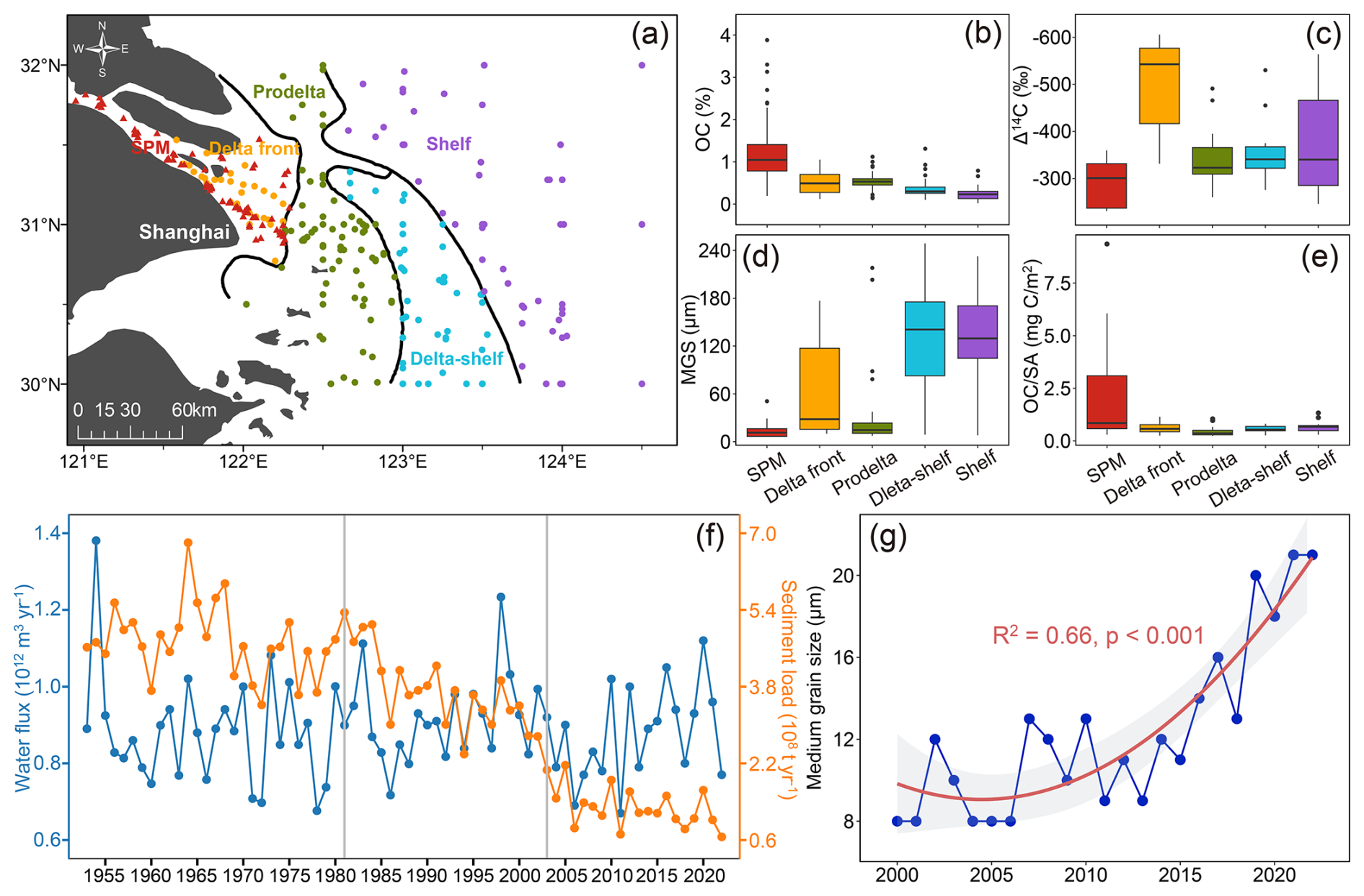
Figure 1Sampling sites of suspended particulate matters (SPM) and surface sediment in Changjiang Estuary and its adjacent areas, including both field-collected samples and literature-compiled data (a). Differences in parameters between riverine SPM and deltaic sediments, including organic carbon (OC) contents (wt % of dry sediment) (b), Δ14C (c), medium grain size (MGS) (d) and ratios between OC contents and specific surface area (OC SA) (e). Variations of annual mean water flux and sediment load of the Changjiang River from 1953 to 2022 (f). Changes of annual MGS of the sediment delivered by the Changjiang River from 2000 to 2022 (g). Four sedimentary facies (Delta front, Prodelta, Delta-shelf and Shelf) of the Changjiang subaqueous delta in panel (a) are classified according to Chen et al. (1991) and delineated by black lines. In panels (b–e), the horizontal line inside each box represents the median, and the lower and upper edges of the box indicate the first and third quartiles, respectively. The box height denotes the interquartile range (IQR), and the whiskers extend to the most extreme data points within 1.5 × IQR of the lower and upper quartiles. The two gray vertical lines in panel (f) correspond to the construction of the Gezhouba Dam in 1981 and the Three Gorges Dam in 2003, respectively, on the mainstream of the Changjiang River. Data of riverine water flux, sediment load and MGS in Datong Gauge Station are applied to represent characteristics of water and sediment input into the East China Sea based on Zhao et al. (2021a) and the China River Sediment Bulletin for 2000–2022 (Ministry of Water Resources of the People's Republic of China, 2001–2023). The fitted line in panel (g) represents a quadratic fit, and the gray shaded area indicates the 95 % confidence interval.
2.1 Study area
Changjiang River, with a length of 6300 km and a watershed area of 1.8 × 10⁶ km2, is the largest river in East Asia (Fig. S1 in the Supplement). Prior to the construction of dams, the river annually delivered approximately 472 Mt of sediment and 900 km3 of freshwater to the East China Sea (Zhao et al., 2021a). These fluxes were predominantly concentrated during the flood season (May–October), accounting for over 70 % of the annual water discharge and more than 87 % of the sediment load, in contrast to the dry season (November–April) based on the China River Sediment Bulletin for 2000–2022 (Ministry of Water Resources of the People's Republic of China, 2001–2023). Historically, the estimated OC budgets export to the estuary ranged from 0.86 to 13 Mt yr−1, of which approximate 50 % was POC (Milliman et al., 1985; Wang et al., 2012). However, the sediment flux and its related POC flux declined continuously since about 1981 due to sediment retention by upstream dam operation (Fig. 1f). Two sharp reductions of sediment flux were observed in 1981 and 2003, corresponding to the commissioning years of Gezhouba Dam and Three Gorges Dam, respectively, both of which were constructed on the main stem of the Changjiang River (Fig. S1; Table S1). Given the limited dataset prior to the operation of the Gezhouba Dam in 1981, the commissioning of the Three Gorges Dam in 2003 was used as a temporal breakpoint to examine changes in the characteristics of river-delivered POC and deltaic OC associated with the sharp reduction in sediment flux.
The East China Sea is affected by a complex circulation system driven by the East Asian monsoon and Kuroshio–shelf interactions (Fig. S2). Major currents in this region include the Changjiang Diluted Water, Taiwan Warm Current and Kuroshio Current (Xu et al., 2012; Feng et al., 2017). These currents regulate regional water-mass exchange and the along-shelf transport of Changjiang-derived materials. Within this circulation setting, the Changjiang subaqueous delta forms a major depositional region at the land–sea interface and provides an important area for investigating sedimentary OC burial. More than 90 % of the sediments deposited in the Changjiang subaqueous delta are derived from the Changjiang River; in comparison, the contributions from other rivers, including Yellow River, Qiantang River and Taiwanese rivers, are relatively small that can be basically ignored (Liu et al., 2007; Van der Voort et al., 2018). Because of the accumulation of a large amount of POC, the Changjiang subaqueous delta is widely recognized as an important OC sink (Zhao et al., 2021a; Shi et al., 2024; Ran and Wang, 2025). The combined influence of river discharge and complex regional shelf circulation leads to spatially heterogeneous sediment deposition and distinct grain-size distributions across the Changjiang subaqueous delta.
Based on the characteristics of accumulated sediments, the Changjiang subaqueous delta can be subdivided into four sedimentary facies: the Delta front, the Prodelta, the transition zone from delta to continental shelf (Delta-shelf), and the continental shelf (Shelf) (Chen et al., 1991). The Delta front, located at water depths shallower than 12 m, lies above the wave base and has a gentle slope. It is dominated by silty sediments and is subject to strong river–tidal dynamics, resulting in relatively low sedimentation rates (Jia et al., 2018). The Prodelta, at water depths of 12–50 m, shows an offshore transition from silt to silty clay and is characterized by weaker hydrodynamic conditions and higher sediment accumulation rates (Wei et al., 2007). The Delta–shelf transition zone, at water depths of 50–60 m, contains mixed and poorly sorted sediments with abundant shell debris, indicating sediment reworking by storms and bottom currents, and thus relatively low and spatially heterogeneous sediment accumulation (Chen et al., 2000). The Shelf facies, located farther seaward at water depths greater than 60 m, is dominated by relict shelf sands and is more strongly influenced by regional shelf circulation, representing a shallow-marine depositional environment (Chen et al., 2000; Zhan et al., 2020). These contrasts in hydrodynamic conditions, sediment sources, grain-size composition, and sediment accumulation rates provide the sedimentological basis for comparing OC burial patterns across different depositional environments (Fig. 1a).
2.2 Sample collection and data compilation
The SPM samples from the Changjiang Estuary were collected during winter (March) and summer (July) cruises in 2025 aboard the R/V Runjiang I. At each sampling site, surface seawater was collected using a Seabird® SBE 55 water sampler and subsequently filtered through pre-combusted (450 °C, 5 h) 0.7 µm glass fiber membranes (47 mm diameter, Whatman GF/F) and pre-weighed 0.7 µm acetate cellulose membranes, respectively. In total, 20 SPM samples were collected. To determine the POC, particulate nitrogen (PN) and δ13C, the particle-laden glass fiber membranes were acidified with 4 mol L HCl for 24 h to remove inorganic carbon completely (Leithold et al., 2013) prior to analysis using an Elemental Analyzer (Elementar Analysen Systeme GmbH, Germany) and an Isotope-Ratio Mass Spectrometer (IRMS, IsoPrime100, UK). Total suspended matter (TSM) concentrations were obtained gravimetrically by calculating the weight difference of the acetate cellulose membranes before and after freeze-drying.
A dataset of OC-related parameters (N C molar ratio, δ13C and Δ14C) and sediment characteristics (medium grain size (MGS) and specific surface area (SA)) in estuarine SPM and in surface sediments of the Changjiang subaqueous delta from 1980 to 2021 was compiled. The dataset was comprehensively incorporated the available sources (data was shared or can be extracted from figures and tables) from published articles. To better approximate a terrestrially dominated POC source, we refined the SPM dataset by selecting surface samples collected mainly from nearshore, low-salinity estuarine waters, which are generally more strongly influenced by riverine inputs than by marine production (Yao et al., 2024). Together with the SPM samples collected during our field work in winter and summer 2025, a total of 321 individual samples were incorporated in the dataset, including 84 SPM and 237 surface sediments (Fig. 1a). Details of the data processing are presented in the Supplement.
2.3 Sources of OC in SPM and surface sediment
The Bayesian end-member mixing model, implemented in R Studio (version 4.2.3) based on the “rjags” package, was run with 107 iterations, using a burn-in of 10 000 steps, and a data thinning of 100 according to (Andersson et al., 2015). By using N C molar ratio and δ13C values, the relative contributions of three sources of POC were separated, targeting petrogenic (fPetrogenic), C3 plant (fPlant) and freshwater algae sources (fAlgae), based on the following formulas:
where f represents the proportion of a specific terrestrial source of POC. Selection of end-member values is presented in Table S2.
Surface sediment OC in the Changjiang subaqueous delta was partitioned into terrestrial and marine components using the following equations:
where f represents the proportion of OC source, and the end-member values of δ13C are −25.6‰ and −20.0‰ for terrestrial and marine sources, respectively (Chen et al., 2021).
2.4 OC burial efficiency and OC preservation efficiency
The OC burial efficiency in surface sediments from the Changjiang subaqueous delta was estimated according to Keil et al. (1997) through the following formula:
where the OC loadingSurface sediment represents the loading of terrestrial OC (OC SA × terrestrial OC proportion) in surface sediment, and the OC loading SPM denotes the OC SA in SPM.
Note that OC loading SPM is used here to approximate the OC loading of terrestrially dominated SPM normalized to its specific surface area. Although this approximation may lead to an underestimation of OC burial efficiency because marine-derived OC was not explicitly separated from bulk OC, the studied estuarine SPM samples were collected from the low-salinity mixing zone, where riverine particles and terrestrial OC inputs generally dominate the suspended particle pool and the influence of marine primary production is expected to be limited (Yao et al., 2024). Thus, the contribution of marine-derived OC is likely minor relative to the terrestrial component, and the use of OC loading SPM as an approximation of terrestrial OC loading is considered reasonable.
Besides the calculation of OC burial efficiency, we also estimated the preservation of terrestrial OC during sediment transport by comparing differences between the terrestrial OC contents (wt % of dry sediment) in surface sediments and riverine SPM in terms of Blair and Aller (2012). To distinguish this metric from burial efficiency, it is defined as preservation efficiency in our study. The preservation efficiencies of terrestrial OC in different sedimentary facies of the Changjiang subaqueous delta are calculated through the following formula:
where the OCSurface sediment represents the terrestrial OC contents in surface sediment, and the OCSPM denotes the OC contents in SPM.
Based on the assessed OC burial and preservation efficiencies at different sampling sites, we calculated the overall OC burial and preservation efficiencies across the entire subaqueous Changjiang Delta. Using the estimated OC preservation efficiency, we further quantified the net preservation flux of terrestrial OC delivered by the Changjiang River. Details of the data calculations are provided in the Supplementary Material.
2.5 Statistical analyses
Regression analyses were conducted in R Studio (version 4.2.3) to estimate temporal trends in riverine SPM grain size, OC-related parameters (N C molar ratio, δ13C) and the proportion of different sources of terrestrial POC, as well as riverine POC flux and the amount of OC preserved in the Changjiang subaqueous delta. Relationships between C N and δ13C were plotted to identify potential OC sources in SPM and surface sediments. Kriging interpolation was performed in ArcMap 10.8 to visualize the spatial pattern of OC preservation efficiency in the Changjiang subaqueous delta. Factors controlling OC loss and retention during sediment transport are further evaluated by examining relationships among OC loading (OC SA), OC-related parameters (C N, δ13C and Δ14C) and sediment characteristics (MGS and SA) in SPM and surface sediment using scatter plot and linear regression analysis.
3.1 Temporal variations in grain size and OC characteristics of riverine SPM
Since 2000, the grain size of Changjiang-derived SPM delivered to the East China Sea has progressively coarsened (p<0.001; Fig. 1g). Concurrently, C N ratios and δ13C values exhibited systematic temporal changes, with riverine POC composition shifting from a higher petrogenic OC contribution toward a greater algal OC contribution (Fig. S3).
The N C molar ratio in surface SPM collected within the Changjiang Estuary increased significantly (p<0.001) from 1980 to 2025, with the value increasing from 0.07 in 1980 to 0.17 in 2025 (Fig. 2a). In comparison, the δ13C values decreased evidently (p<0.01) during the same period (Fig. 2c), with the value ranged from −23.5 ‰ to −28.0 ‰ (Table S3). Between flood and dry seasons, the N C molar ratios and δ13C values exhibited limited differences (p>0.05) (Fig. 2b, d).
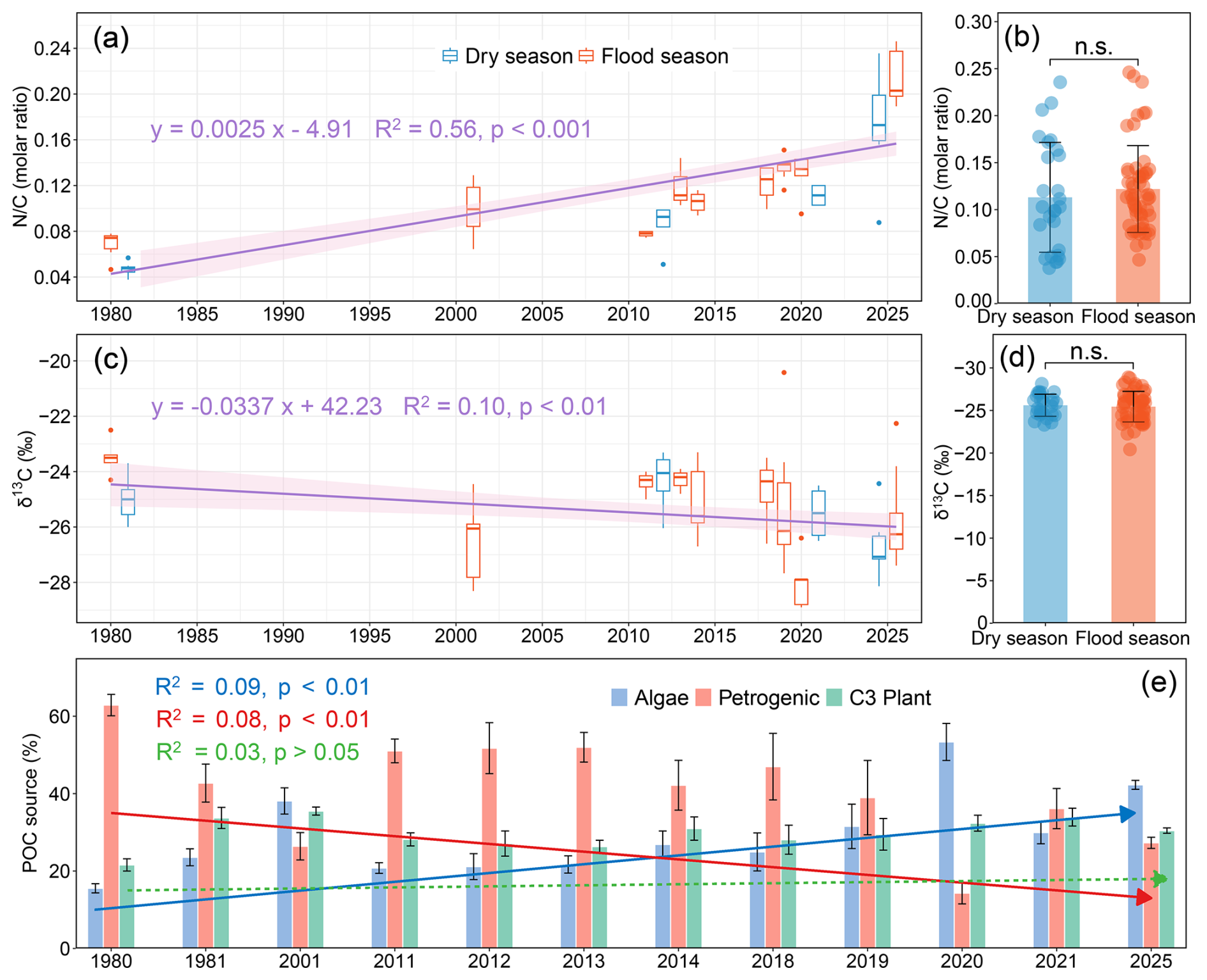
Figure 2Temporal variations of N C molar ratios (a) and δ13C values (c) in suspended particulate matter (SPM) collected in surface water in the Changjiang Estuary from 1980 to 2025. Differences of N C molar ratios (b) and δ13C values (d) between dry and flood seasons. Temporal trends of proportions of particulate organic carbon (POC) derived from different terrestrial sources (freshwater algae, petrogenic and C3 plant sources) estimated through a Bayesian End-member Mixing approach from 1980 to 2025 (e). Solid lines represent significant (p<0.05) linear associations, and the light purple areas around the line indicate 95 % confidence interval. The n.s. indicates non-significant (p>0.05) differences.
Based on the Bayesian End-member Mixing model, the riverine POC in SPM were separated into three terrestrial sources (freshwater algae, petrogenic and C3 plant). Temporally, the proportion of algae OC increased significantly (p<0.01), rising from 16 % in 1980 to 42 % in 2025. In contrast, the proportion of petrogenic OC showed a marked decline (p<0.01), decreasing from 63 % in 1980 to 27 % in 2025 (Fig. 2e). The contribution of C3 plant OC exhibited limited temporal variation (p>0.05), ranging between 22 % and 35 % over the study period (Fig. 2e).
3.2 Spatial heterogeneity and temporal changes in OC characteristics among sedimentary facies
Marked spatial heterogeneity in OC-related indices and sediment properties was observed across the four sedimentary facies. OC contents were substantially higher in nearshore zones than in offshore areas (Fig. 1b), corresponding to the seaward coarsening of sediment grain size (Fig. 1d). In contrast, OC loading (OC SA) was generally comparable among sedimentary facies, except for notably lower values in the Prodelta (Fig. 1e). For Δ14C, the lowest values were recorded in the Delta Front, whereas the other facies exhibited little differences (Fig. 1c).
In the Delta front, surface sediments after 2003 showed higher δ13C values but lower C N ratios than those before 2003 (Fig. 3a). Samples collected after 2003 predominantly plotted within the petrogenic domain and broadly followed a mixing trend between the marine and riverine OC end-members. In contrast, pre-2003 samples showed δ13C and C N values that fell outside the fields defined by the petrogenic and freshwater algal end-members, and deviated from a simple binary mixing trend between marine and riverine OC. In the Prodelta, δ13C values and C N ratios in surface sediments exhibited only minor temporal variability (Fig. 3b), with pre-2003 samples showing slightly lower δ13C values than those collected after 2003. Most data points plotted within the petrogenic domain and aligned broadly along the mixing trend between marine and riverine OC end-members. By comparison, in the Delta-shelf and Shelf, δ13C values and C N ratios displayed limited temporal changes (Fig. 3c, d). These values were consistently closer to the marine OC end-member (δ13C = −20.5 ‰, C N = 7), showed only partial overlap with the petrogenic component, and generally fell within the mixing zone between marine and riverine OC.
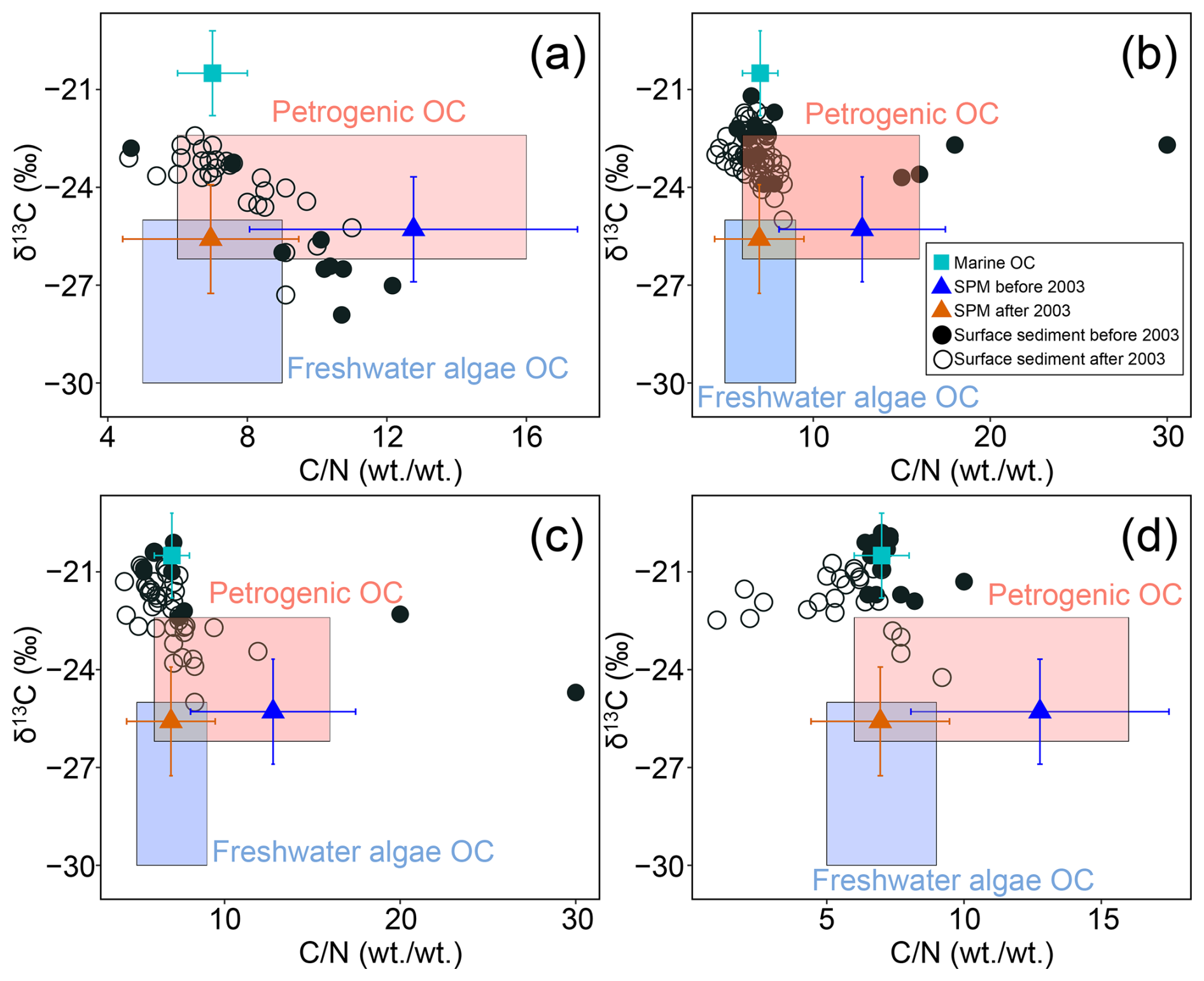
Figure 3Relationships between δ13C and C N in surface sediments in the Delta front (a), Prodelta (b), Delta-shelf (c) and Shelf (d) before and after 2003. Light red and blue areas represent ranges of δ13C and C N corresponding to terrestrial organic carbon (OC) derived from petrogenic and freshwater algae sources, respectively, in terms of Lamb et al. (2006) and Menges et al. (2020). The marine OC end-member of δ13C is from −19.2 ‰ to −21.8 ‰ and of C N is 6–8 (Xing et al., 2011; Bao et al., 2018).
3.3 OC burial efficiency and OC preservation efficiency
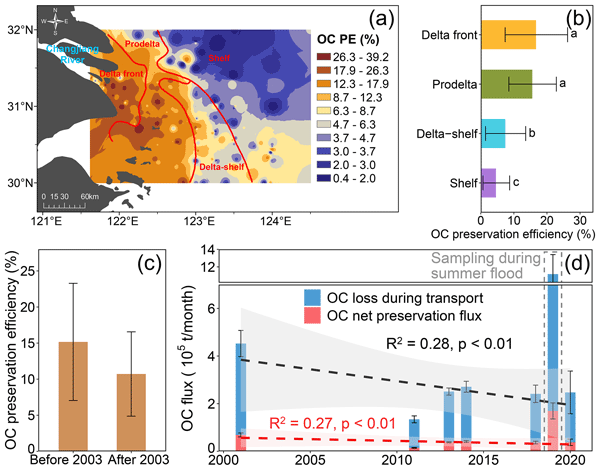
Terrestrial OC burial efficiency in the Changjiang subaqueous delta was 12.6 %, with the range from 2.3 % to 43.3 % (Fig. S4). Higher OC burial efficiency was observed in the Delta front (21.3 %), which was significantly higher (p< 0.05) than that in the Prodelta (9.8 %), Delta-shelf (9.6 %) and Shelf (9.7 %) (Fig. S4a). The OC burial efficiency is closely (p< 0.001) related to OC preservation efficiency (Fig. S4b). The OC preservation efficiency in the Changjiang subaqueous delta is 11.2 %, with the range from 0.4 % to 39.2 % (Fig. 4a). Higher OC preservation efficiency was detected in the Delta front (16.8 %) and Prodelta (15.7 %) regions when compared with the Delta-shelf (7.5 %) and Shelf (4.7 %) (Fig. 4b).
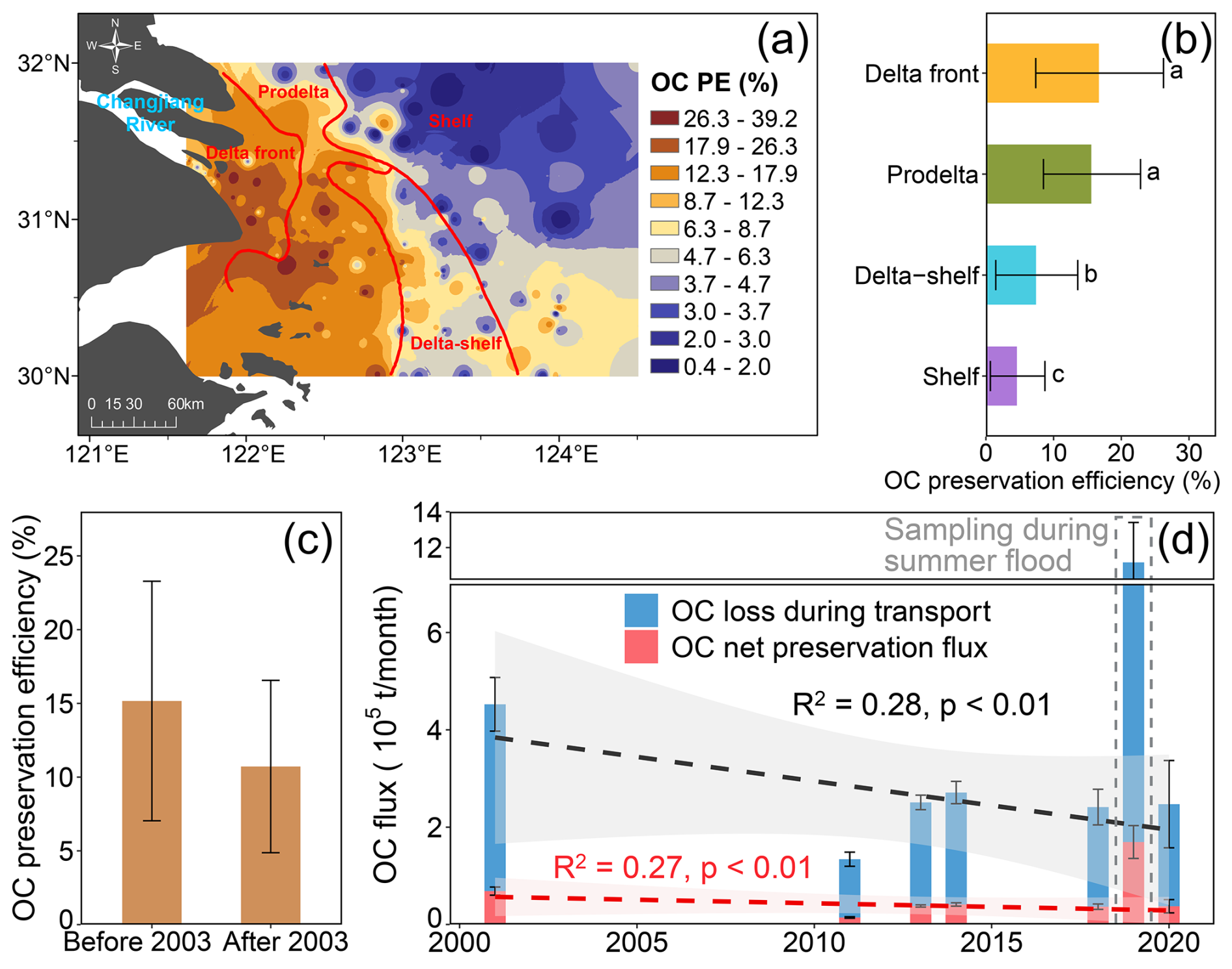
Figure 4Spatial pattern of organic carbon (OC) preservation efficiency in the Changjiang subaqueous delta (a), and OC preservation efficiency in different sedimentary facies (b). Changes in OC preservation efficiency in the Changjiang subaqueous delta before and after 2003 (c). Temporal trends in the amount of OC preserved in deltaic sediments (red dashed line) and riverine OC flux (black dashed line) from 2001 to 2020, and the blue bars reflect OC loss (difference between amount of OC preservation and riverine OC flux) during sediment transport (d). The PE indicates preservation efficiency in panel (a). Different lowercase letters in panel (b) denote statistically significant differences (p< 0.05) among sedimentary facies. In panel (d), the high value in 2019 (gray dashed circles) primarily induced by extreme summer flood (Sun et al., 2021) was excluded from trend analysis. The dashed lines indicate linear relationships, and the light gray and red areas around the line represent 95 % confidence interval.
Temporally, the OC preservation efficiency decreased from 15.1 % before 2003 to 10.7 % after 2003 (Fig. 4c). During flood seasons, based on these estimated preservation efficiencies, the amounts of OC preserved in sediments decreased by about 50 %, from 68 kt per month in 2001 to an average of 34 kt per month during 2011 to 2020 (R2=0.27, p< 0.01). Similarly, the riverine OC flux decreased by approximately 49 %, from 450 kt per month in 2001 to an average of 230 kt per month (R2=0.28, p< 0.01) (Fig. 4d).
4.1 Temporal changes of riverine POC sources in the Changjiang Estuary
Since the construction and operation of mainstream dams in the upper reaches of the Changjiang River began in the 1980s, the characteristics of terrestrial POC transported to the East China Sea have changed markedly, with N C molar ratios increasing significantly (p< 0.001) and δ13C values decreasing significantly (p< 0.01) over time (Fig. 2a, c). These shifts resulted in temporally elevated proportion of POC derived from freshwater algae and declined proportion of POC originated from watershed bedrock/soil erosion (Fig. 2e). Although previous studies have revealed the increased proportion of freshwater algae source OC induced by the impoundment of Three Gorges Dam after 2003 (Wang et al., 2021, 2024; Lyu et al., 2023; Ke et al., 2025), we propose that this shift may have initiated in the 1980s, when sediment loads began to decrease under the operation of the Gezhouba Dam on the mainstem of the Changjiang River (Fig. 1f; Fig. S1; Table S1). Notably, the N C molar ratio was evidently higher in 2001 (0.099) than in 1980 (0.068) (Fig. 2a), reflecting an increase in the proportion of algal OC from 16 % in 1980 to 38 % in 2001, and a decrease in the proportion of petrogenic OC from 63 % in 1980 to 26 % in 2001 (Fig. 2e). These results capture, for the first time, the temporal variations in the relative contributions of different terrestrial sources of POC input to the East China Sea, highlighting the substantial influence of anthropogenic disturbances on the composition of river-borne terrestrial POC.
Despite the limited number of studies examining the impacts of river damming on the temporal variations of individual terrestrial OC sources along the river–ocean continuum, our findings are broadly consistent with previous studies conducted within the Changjiang River Basin. The impoundment of Three Gorges Dam in 2003 significantly raised the proportion of riverine primary productivity-derived POC in the downstream Changjiang River, resulting in higher fluxes of these labile POC components entering into the East China Sea (Lyu et al., 2023). Wang et al. (2024) also revealed that the proportion of autochthonous OC, originating from aquatic primary productivity, increased markedly from the Three Gorges Dam to the estuary along the Changjiang mainstem. Changes in the relative contributions of different POC sources in the Changjiang River are also comparable to those observed in other large rivers worldwide that have experienced intensified anthropogenic activities. In four major rivers in the United States—the Mississippi, Colorado, Rio Grande, and Columbia—the construction of dams has substantially increased the relative contribution of plankton-derived POC in downstream waters compared with upstream reaches (Kendall et al., 2001). In the Yellow River, the operation of the Xiaolangdi Reservoir substantially altered the composition of riverine POC transported downstream, increasing the proportion of soil-derived POC from 56.4 % to 82.0 % and decreasing the proportion of plant-derived POC from 43.6 % to 18.0 % (Lv et al., 2022).
These findings indicate that the relative contributions of terrestrial POC sources were primarily regulated by the riverine sediment budget. A reduction in sediment load prompted a shift in the dominant OC component from petrogenic OC (derived from bedrock/soil erosion) to OC derived from aquatic productivity (Dai et al., 2016). This interpretation is consistent with our observation that total suspended matter concentration was positively correlated with the proportion of petrogenic OC but negatively correlated with the proportion of algae OC (Fig. S5). Two potential mechanisms may explain this alteration. On the one hand, a large amount of riverine sediment in the upper reaches of the Changjiang River, primarily derived from montane bedrock weathering and soil erosion, was intercepted by reservoirs after dam construction (Li et al., 2015; Lambert et al., 2017). Therefore, the proportion of OC derived from aquatic biomass in downstream sections increased because of reduced mixing with petrogenic OC. On the other hand, the decline in sediment load in the downstream Changjiang River may have increased light penetration into the water column, indirectly enhancing aquatic productivity and thereby increasing the proportion of algae-originated OC (Robertson et al., 1993; Huettel et al., 2014). However, our current data are insufficient to determine which mechanism is dominant. Future studies combining seasonal observations of sediment load, light conditions, and phytoplankton biomass would help better constrain the mechanisms driving changes in OC composition in the Changjiang River.
We observed no significant differences (p> 0.05) in N C molar ratios or δ13C values between the dry and flood seasons (Fig. 2b, d), while this pattern may have resulted from the long-term averaging of our dataset. During monthly monitoring conducted from September 2009 to August 2010 at Xuliujing Station (a Hydrological Gauging Station in the lower Changjiang River), the N C molar ratios were higher in the flood season (0.099; 0.090–0.116) than in the dry season (0.086; 0.073–0.098), whereas the δ13C values were comparable between seasons (Gao et al., 2012). Similarly, Ming et al. (2023) reported that from November 2016 to June 2019 at Xuliujing Station, the N C molar ratio in the flood season (0.112 ± 0.015) was clearly higher than that in the dry season (0.093 ± 0.013), whereas δ13C values showed little seasonal variation. By comparison, across multiple sites in the lower reaches of the Changjiang River, Mao et al. (2011) found similar N C molar ratios between the flood (0.109) and dry (0.118) seasons, with slightly lower δ13C values in the flood season (−25.4 ‰ to −24.1 ‰) than in the dry season (−25.4 ‰ to −21.6 ‰). These contrasting findings across seasons and locations reveal pronounced temporal and spatial variability in the terrestrial sources of POC, underscoring the critical role of the river-estuary-ocean continuum in regulating the composition of river-delivered POC. Such variability may, in turn, exert an important influence on OC burial in subaqueous deltas, thereby highlighting the need for sustained, high-temporal-resolution monitoring.
4.2 Patterns of OC burial in the Changjiang subaqueous delta
Burial efficiency of terrestrial OC in the Changjiang subaqueous delta was 12.6 % estimated in our study (Fig. S4a). This indicates a large proportion of OC in sediment is reworked into the water column rather than being preserved over prolonged timescales, which is primarily attributed to the desorption and decomposition of POC during sediment seaward transport (Sun et al., 2021, 2024). The burial efficiency of terrestrial OC (12.6 %) in the Changjiang subaqueous delta is similar with Zhao et al. (2021b), who revealed that the OC burial efficiency was 16 % in East China Sea. Spatially, OC burial efficiency exhibits marked heterogeneity among different sedimentary environments, with higher values observed in the proximal delta than in offshore regions (Fig. S4a). This is in a good line with Wu et al. (2013), who reported that the burial efficiency of organic matter was higher in inner shelf sediment (24.7 % versus 21.3 % in the Delta front in our study) and lower in outer shelf sediment (10.7 % versus 9.8 % in the Prodelta, 9.6 % in the Delta-shelf and 9.7 % in the Shelf in our study). However, these estimated values were markedly lower than the reported burial efficiency of petrogenic OC (33 %–94 %) (Sun et al., 2022). This suggests the petrogenic OC is comparatively resistant to degradation during sediment offshore transport, implying heterogeneous losses among different terrestrial POC sources. Our results also showed that the higher OC contents were observed in the Prodelta surface sediments, which primarily corresponded to petrogenic OC components in terms of C N and δ13C end-member values (Figs. 3b and S6). These patterns underscore the need to account for source-specific dynamics when evaluating POC delivery.
Beyond assessing OC burial efficiency via OC loadings in riverine SPM and deltaic sediments, the ratios of terrestrial OC contents between SPM and surface sediments were also employed as a quantified metric (Blair and Aller, 2012). In our study, we calculated this metric and termed it “OC preservation efficiency” to distinguish from “burial efficiency” (Sect. 2.4). Unlike surface-area-normalized OC burial efficiency, this content-based metric does not explicitly normalize OC loading to sediment SA. This distinction is mechanistically important because sedimentary OC contents are controlled not only by degradation and preservation processes, but also by sediment grain-size sorting and mineral surface area. Fine-grained sediments generally have larger SA and greater capacity for mineral-associated OC protection, whereas coarser sediments tend to have lower OC retention capacity (Bergamaschi et al., 1997; Bock and Mayer, 2000; Babakhani et al., 2025). Therefore, variations in sediment texture may partly influence the calculated OC preservation efficiency and introduce uncertainty when environments with substantially different grain-size compositions are compared.
Nevertheless, the content-based preservation efficiency remains a useful metric for evaluating terrestrial OC retention, because the main objective of our study is to examine changes in terrestrial OC contents from riverine SPM to deposited sediments during seaward transport. Moreover, the OC content-based apparent preservation efficiency was tightly correlated (p< 0.001) with the OC SA-based burial efficiency (Fig. S4b), indicating that this metric provides an assessment broadly consistent with the surface-area-normalized burial efficiency approach. This relationship supports its use as an alternative indicator of terrestrial OC retention, particularly when sediment SA or OC loading data are unavailable. This advantage is important for integrating extensive published datasets, as OC contents in riverine SPM and surface sediments are much more commonly reported than sediment SA and OC loading data. Thus, although the content-based preservation efficiency should be interpreted as an apparent metric that may partly include grain-size effects, it remains appropriate for assessing temporal changes in terrestrial OC retention and loss in the Changjiang subaqueous delta.
We found that the OC preservation efficiency is similar to the burial efficiency of terrestrial OC (12.6 %), yielding values of 11.2 % in the Changjiang subaqueous delta, which is notably lower than approximately 28 % estimated in Blair and Aller (2012). This can be ascribed to the fact that our study accounts for distinct sedimentary environments, rather than treating the marginal system as an entity. We observed higher OC preservation efficiency in proximal deltaic areas when compared with offshore regions, with burial efficiencies reaching 25 %–40 % in the Delta front and Prodelta, where sediments are predominantly fine grained (Fig. 1d; Fig. 4a). Sediment grain size is closely linked to OC retention capacity, as fine-grained sediments generally exhibit higher OC loading due to their greater specific surface area and stronger mineral-associated protection by constituent minerals (e.g., quartz, feldspar, calcite, and phyllosilicates) (Bao et al., 2019; Sun et al., 2022, 2024). These results highlight the importance of distinguishing different sedimentary environments, as they are characterized by distinct sediment properties shaped by hydrodynamic processes (Table S4), which in turn influence OC sequestration in deltaic sediments.
Advanced from spatial pattern of OC preservation efficiency in the Changjiang subaqueous delta, we further investigated its temporal changes. We found that the OC preservation efficiency decreased visibly from 15.1 % prior to 2003 to average 10.7 % after 2003 (Fig. 4c). This implied that the river-delivered POC after 2003 is more prone to decompose during transport, primarily due to the increased proportion of freshwater algae OC in river-delivered SPM over time (Figs. 2e and S3). The algal OC components, derived from aquatic primary productivity, was composed of algae cells, debris and aggregates, enriching in proteins, carbohydrates (e.g., polysaccharides) and lipids (Henderson et al., 2008; Villacorte et al., 2015). These components are easily degraded and assimilated through biological processes (Guo et al., 2025). The temporal decrease in the terrestrial OC proportion in the Delta front, from 91.8 % before 2003 to 64.9 % after 2003 (Fig. S7), also verified that a larger amount of riverine POC was decomposed prior to burial, consistent with the deviation of OC characteristics from typical algal-derived organic matter signatures (Fig. 3a).
The temporal decline in OC preservation efficiency in the Changjiang subaqueous delta was primarily driven by decreased preservation efficiency in the Delta front (from 21.7 % to 16.5 %) and Prodelta (from 21.6 % to 14.9 %) between the pre-2003 and post-2003 periods. This suggests that, in the nearshore Changjiang Estuary, fine-grained, OC-rich sediments, with OC dominated by petrogenic components (Figs. 3a, b and S6), may have been progressively washed away into distal regions, with less replenishment because of reduced riverine sediment supply. Given the decreased riverine petrogenic OC input and coarser sediment grain size (Figs. 1g and 2e), we infer that OC preservation efficiency in the proximal delta is likely to continue declining in the future. Although our data are insufficient to directly quantify the contribution of sediment coarsening to this decline, this process may have partly reduced the apparent OC preservation efficiency in the Changjiang subaqueous delta. Such an effect is expected to be more pronounced in the proximal delta, where the reduction in riverine sediment supply after the construction of the Three Gorges Dam in 2003 has been linked to seabed erosion and sediment coarsening (Luan et al., 2016; Wu et al., 2025). Because coarser sediments generally have a lower capacity for OC retention, progressive coarsening may reduce sedimentary OC contents and thereby contribute to the observed decline in OC content-based preservation efficiency.
Riverine POC flux declined significantly (p< 0.01) by 49 % from 0.45 Mt per month in July 2001 before construction of the Three Gorges Dam to an average of 0.23 Mt per month in flood seasons from 2011 to 2020 as expected from the temporal reduction of sediment load (Figs. 1f and 4d). This estimation is comparable to that of Wang et al. (2022), who reported a POC flux of 0.21 Mt per month in flood seasons from 2013–2014 and 2018–2019. By considering OC preservation efficiency in different periods, we further identified a visible decrease (p< 0.01) in the amount of OC preserved in sediments by 50 %, from 68 kt per month in 2001 to an average of 34 kt per month during the flood seasons from 2011 to 2020 (Fig. 4d). This decline likely reflects the preferential degradation of algal POC during seaward transport, as indicated by deviations in end-member values (C N, δ13C) between surface sediments and SPM (Fig. 3). It is further supported by the temporal decline in the proportion of terrestrial OC preserved in proximal deltaic deposits, particularly in the Delta front of the Changjiang subaqueous delta (Fig. S7). Future studies should account for temporal variations in the contributions of different terrestrial sources of POC when evaluating deltaic OC burial in other large estuarine systems.
4.3 Loss of labile POC during sediment transport
Although previous investigations have found that river damming predominantly changes contributions of different sources of POC (Kendall et al., 2001; Pradhan et al., 2014; Bianchi et al., 2015; Ulseth and Hall Jr., 2015; Lv et al., 2022; Lyu et al., 2023; Wang et al., 2024; Hu et al., 2025; Ke et al., 2025), to the best of our knowledge, limited studies have explored the influence of this alteration on terrestrial OC burial in marginal seas. By compiling a dataset of riverine POC characteristics in the Changjiang Estuary since 1980, prior to dam constructions in the upper mainstem (Gezhouba Dam and Three Gorges Dam) (Table S1), we reveal that the proportion of labile POC (primarily derived from freshwater algae) input to the East China Sea increased continuously over time (Fig. 2e), thereby decreasing OC preservation efficiency and reducing OC retention in deltaic sediments. Globally, riverine sediment fluxes have declined sharply over time due to intensified anthropogenic activities such as dam construction (Dethier et al., 2022). These reductions in sediment loads not only diminish OC burial in marginal seas by directly lowering riverine POC fluxes, but may also enhance OC degradation during seaward transport by improving the relative contributions of labile OC fractions. To clarify the loss of labile OC along its offshore transport, we analyzed contrasts in OC-related metrics between SPM and surface sediments.
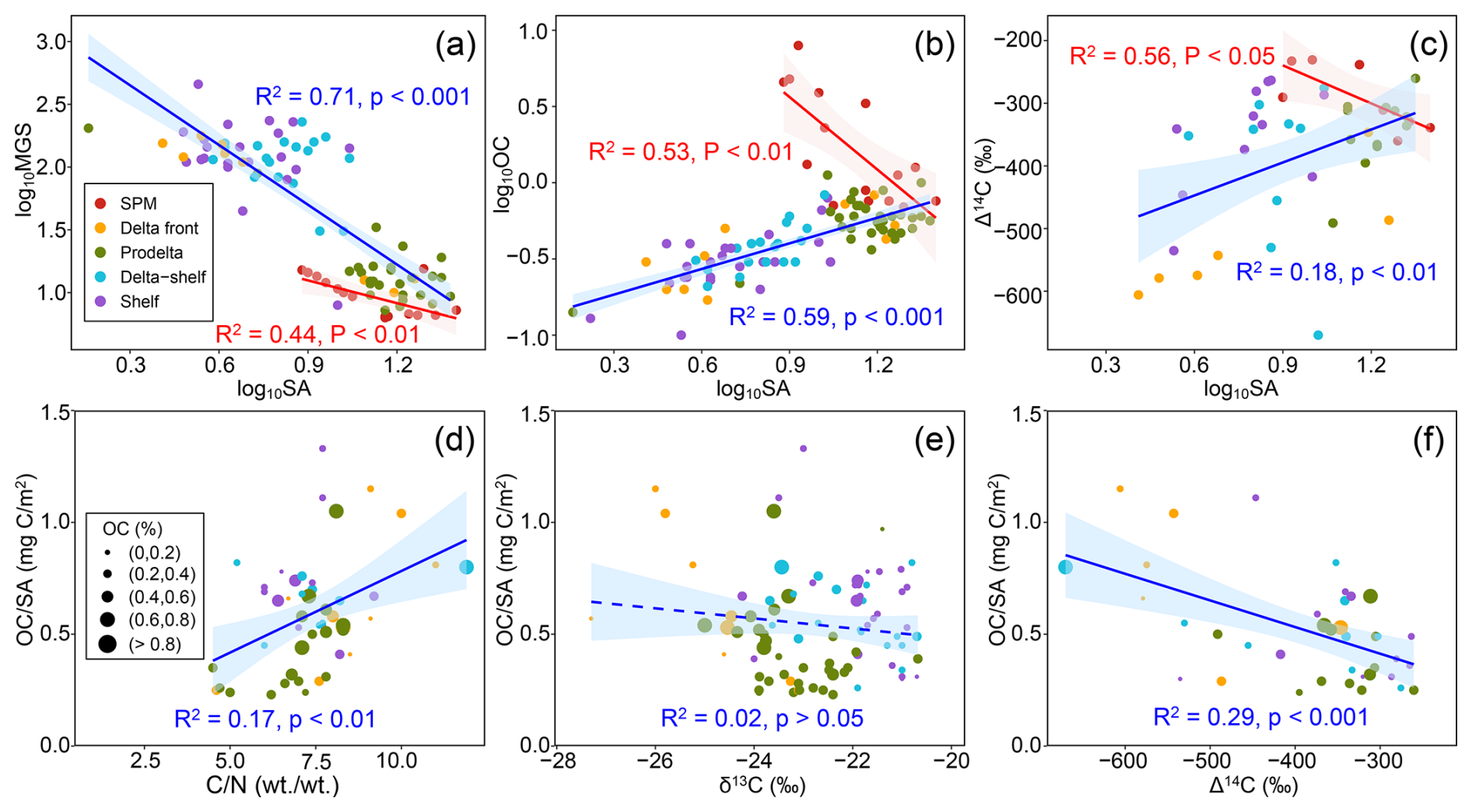
Figure 5Relationships among medium grain size (MGS), specific surface area (SA), organic carbon (OC) properties, and SA-normalized OC loading (OC SA) in suspended particulate matter (SPM) from the Changjiang Estuary and surface sediments from the Changjiang subaqueous delta. Relationships of SA with MGS (a), OC content (b) and Δ14C (c) in SPM and surface sediments. Relationships of OC SA with C N (d), δ13C (e), and Δ14C (f) in surface sediments. Solid and dashed lines indicate statistically significant (p< 0.05) and non-significant (p> 0.05) relationships, respectively. Shaded areas represent 95 % confidence intervals.
Specific surface area (SA), which is generally higher in fine-grained sediments, is considered a key factor controlling OC retention capacity (Bergamaschi et al., 1997; Bock and Mayer, 2000; Yang et al., 2015). Our results also found that SA was closely associated with MGS in both SPM and surface sediments from the Changjiang Estuary (Fig. 5a), whereas it exhibited opposite relationships with OC contents and Δ14C between SPM and surface sediments (Fig. 5b, c). In surface sediments, SA was positively correlated with both OC contents and Δ14C, suggesting that mineral protection plays an important role in the initial stabilization of OC. However, this influence weakens progressively offshore (from the Delta front to the Shelf), likely due to repeated cycles of sediment resuspension and redistribution under dynamic estuarine conditions, which ultimately promote the loss and aging of sedimentary OC (Sun et al., 2021). In contrast, OC contents in SPM decreased with increasing SA and aging of OC, suggesting a clear mixing between petrogenic OC (older and carbon-poor) and algal OC (younger and carbon-rich). Unfortunately, the lack of Δ14C measurements in SPM across different years limits our ability to further demonstrate the temporal shift in dominant terrestrial OC sources. The vanish of these younger, OC-enriched components in surface sediments indicates the preferential decomposition of labile algal OC prior to deposition. Over time, the increasing proportion of freshwater algal OC in SPM may further enhance the overall lability of OC derived from these easily degradable biospheric POC (Zhao et al., 2023), ultimately resulting in reduced OC burial in the Changjiang subaqueous delta.
Ratios of OC to SA (OC SA) in sediments, reflecting OC loading per unit surface area of sediment (mg C m−2), were assessed to represent potential remineralization of OC during sediment transport and OC burial (Bouchez et al., 2014; Sun et al., 2021). Typical OC SA ratios in marginal sediments ranged from 0.5 to 1 mg C m−2 (Mayer, 1994; Hedges and Keil, 1995; Blair and Aller, 2012; Bianchi et al., 2018). This range was comparable to our results for surface sediments (0.23–1.33) in the Changjiang subaqueous delta, while it was markedly lower than the OC SA values of SPM (2.4 ± 0.7) collected from the inner Changjiang Estuary (Fig. 1e). Given that the protective effect on OC is commonly associated with sediment mineral composition, similar mineralogies would be expected to result in comparable OC loadings. Although clay mineral assemblages are comparable between riverine SPM and surface sediments (Sun et al., 2022), the markedly higher OC loading in SPM suggests that SPM may contain a larger proportion of relatively labile OC, which is more susceptible to loss during sediment transport. To investigate the burial patterns of OC from different sources across sedimentary environments, we examined the relationships between OC SA and C N, δ13C and Δ14C. The δ13C showed a weak association (p> 0.05) with OC SA (Fig. 5e), whereas C N and Δ14C were positively and negatively correlated (p< 0.05) with OC SA, respectively (Fig. 5d, f). In the Delta front, the OC was characterized by lower Δ14C, higher C N ratios and higher OC SA (Fig. 5d, f), suggesting preferential deposition of relatively old, coarse-grained terrestrial OC in the proximal delta. This material likely consists mainly of coarse petrogenic fragments and C3 plant debris derived from the river basin (Sun et al., 2021, 2022). In contrast, in the Prodelta, Delta-shelf and Shelf, the OC was characterized by higher Δ14C, lower C N and lower OC SA (Fig. 5d, f), indicating a relatively younger, fine-grained mixture of petrogenic and marine OC in the distal delta. This mixture was likely supplied by catchment soil erosion and marine primary production (Zhu et al., 2013; Sun et al., 2021), as further supported by the overlap of many samples with both petrogenic and marine OC end-member ranges (Fig. 3b–d). Despite the multiple sources of OC, freshwater algal OC signatures, as indicated by C N, δ13C and Δ14C, were largely absent from both proximal and distal deltaic sediments (Figs. 3 and 5f), implying the preferential loss of this OC component during seaward transport prior to burial.
This study reveals that the decline in sediment load of the Changjiang River since 1980 has led to a temporal increase in N C molar ratios and decreased δ13C values of POC delivered to the East China Sea. These changes reflect a decreasing proportion of POC derived from soil/bedrock erosion and an increasing contribution of POC originating from freshwater primary production. Given the higher lability of freshwater algal OC, this shift in riverine POC composition may have enhanced OC degradation during seaward transport, thereby reducing the amount of OC ultimately buried in the Changjiang subaqueous delta. The reduction in terrestrial OC preservation mainly occurred in proximal deltaic sediments, where OC preservation efficiency decreased markedly after the impoundment of the Three Gorges Dam in 2003, from 21.7 % to 16.5 % in the Delta front and from 21.6 % to 14.9 % in the Prodelta. This trend is further evidenced by the pronounced decline in terrestrial OC proportion and the increasing dominance of petrogenic OC in nearshore sediments. As a result, the OC preservation efficiency across the entire Changjiang subaqueous delta declined from 15.1 % before 2003 to 10.7 % afterward. Consequently, the amount of OC preserved in sediments declined by approximately 50 %, from 68 kt per month in 2001 to an average of 34 kt per month during the flood season of 2011–2020. Our study demonstrates that, in the context of intense anthropogenic disturbance, assessment of deltaic OC burial should consider not only the decline in terrestrial POC flux caused by basin dam constructions, but also shifts in POC sources, since the stability of POC varies markedly among its different components, thereby altering the efficiency of OC burial in the subaqueous deltaic systems.
All data used in this study are available from Zenodo at https://doi.org/10.5281/zenodo.20260902 (Jin, 2026).
The supplement related to this article is available online at https://doi.org/10.5194/bg-23-5055-2026-supplement.
Jiyuan Jin: designation of this study, data compilation and processing, methodology and software, writing (original draft preparation, review and editing). Ya Ping Wang: project administration, supervision, writing (review and editing). Hui Sheng: project administration. Bixuan Tang: investigation. Wei Feng: writing (review and editing). Lanyue Liu: investigation. Rui Liu: investigation.
The contact author has declared that none of the authors has any competing interests.
Publisher's note: Copernicus Publications remains neutral with regard to jurisdictional claims made in the text, published maps, institutional affiliations, or any other geographical representation in this paper. The authors bear the ultimate responsibility for providing appropriate place names. Views expressed in the text are those of the authors and do not necessarily reflect the views of the publisher.
Suspended surface sediment samples were collected onboard of R/V Runjiang I implementing the open research cruise NORC2025-03 and NORC2025-07 supported by National Natural Science Foundation of China Shiptime Sharing Project.
This research has been supported by the National Natural Science Foundation of China (grant nos. U2240220 and 4230061287).
This paper was edited by Jun Zhong and reviewed by Bin Zhao and Aislinn Fox.
Andersson, A., Deng, J. J., Du, K., Zheng, M., Yan, C. Q., Sköld, M., and Gustafsson, O.: Regionally-varying combustion sources of the January 2013 severe haze events over Eastern China, Environ. Sci. Technol., 49, 2038–2043, https://doi.org/10.1021/es503855e, 2015.
Babakhani, P., Dale, A. W., Woulds, C., Moore, O. W., Xiao, K. Q., Curti, L., and Peacock, C. L.: Preservation of organic carbon in marine sediments sustained by sorption and transformation processes, Nat. Geosci., 18, 78–83, https://doi.org/10.1038/s41561-024-01606-y, 2025.
Bao, R., Blattmann, T. M., McIntyre, C., Zhao, M. X., and Eglinton, T. I.: Relationships between grain size and organic carbon 14C heterogeneity in continental margin sediments, Earth Planet. Sc. Lett., 505, 76–85, https://doi.org/10.1016/j.epsl.2018.10.013, 2019.
Bao, R., van der Voort, T. S., Zhao, M. X., Guo, X. Y., Montlucon, D. B., McIntyre, C., and Eglinton, T. I.: Influence of hydrodynamic processes on the fate of sedimentary organic matter on continental margins, Global Biogeochem. Cy., 32, 1420–1432, https://doi.org/10.1029/2018GB005921, 2018.
Bauer, J. E., Cai, W. J., Raymond, P. A., Bianchi, T. S., Hopkinson, C. S., and Regnier, P. A. G.: The changing carbon cycle of the coastal ocean, Nature, 504, 61–70, https://doi.org/10.1038/nature12857, 2013.
Bergamaschi, B. A., Tsamakis, E., Keil, R. G., Eglinton, T. I., Montlucon, D. B., and Hedges, J. I.: The effect of grain size and surface area on organic matter, lignin and carbohydrate concentration, and molecular compositions in Peru Margin sediments, Geochim. Cosmochim. Acta, 61, 1247–1260, https://doi.org/10.1016/S0016-7037(96)00394-8, 1997.
Bianchi, T. S., Cui, X. Q., Blair, N. E., Burdige, D. J., Eglinton, T. I., and Galy, V.: Centers of organic carbon burial and oxidation at the land-ocean interface, Org. Geochem., 115, 138–155, https://doi.org/10.1016/j.orggeochem.2017.09.008, 2018.
Bianchi, T. S., Galy, V., Rosenheim, B. E., Shields, M., Cui, X. Q., and Van Metre, P.: Paleoreconstruction of organic carbon inputs to an oxbow lake in the Mississippi River watershed: Effects of dam construction and land use change on regional inputs, Geophys. Res. Lett., 42, 7983–7991, https://doi.org/10.1002/2015GL065595, 2015.
Blair, N. E. and Aller, R. C.: The fate of terrestrial organic carbon in the marine environment, Annu. Rev. Mar. Sci., 4, 401–423, https://doi.org/10.1146/annurev-marine-120709-142717, 2012.
Bock, M. J. and Mayer, L. M.: Mesodensity organo-clay associations in a near-shore sediment, Mar. Geol., 163, 65–75, https://doi.org/10.1016/S0025-3227(99)00105-X, 2000.
Bouchez, J., Galy, V., Hilton, R. G., Gaillardet, J., Moreira-Turcq, P., Perez, M. A., France-Lanord, C., and Maurice, L.: Source, transport and fluxes of Amazon River particulate organic carbon: Insights from river sediment depth-profiles, Geochim. Cosmochim. Acta, 133, 280–298, https://doi.org/10.1016/j.gca.2014.02.032, 2014.
Chen, Y., Hu, C., Yang, G. P., and Gao, X. C.: Source, distribution and degradation of sedimentary organic matter in the South Yellow Sea and East China Sea, Estuar. Coast. Shelf S., 255, 107372, https://doi.org/10.1016/j.ecss.2021.107372, 2021.
Chen, Z. Y., Song, B. P., Wang, Z. H., and Cai, Y. L.: Late Quaternary evolution of the sub-aqueous Yangtze Delta, China: sedimentation, stratigraphy, palynology, and deformation, Mar. Geol., 162, 423–441, https://doi.org/10.1016/S0025-3227(99)00064-X, 2000.
Chen, Z. Y., Xu, S. Y., and Yan, Q. S.: Sedimentary facies of Holocene subaqueous Changjiang River Delta, Oceanol. Limnol. Sin., 1, 29–37, 1991 (in Chinese with English abstract).
Dai, Z. J., Fagherazzi, S., Mei, X. F., and Gao, J. J.: Decline in suspended sediment concentration delivered by the Changjiang (Yangtze) river into the East China Sea between 1956 and 2013, Geomorphology, 268, 123–132, https://doi.org/10.1016/j.geomorph.2016.06.009, 2016.
Dethier, E. N., Renshaw, C. E., and Magilligan, F. J.: Rapid changes to global river suspended sediment flux by humans, Science, 376, 1447–1452, https://doi.org/10.1126/science.abn7980, 2022.
Feng, Z. B., Liu, B. H., Zhao, Y. X., Li, X. S., Data, O. A., Jiang, L., and Si, S. K.: Structure, distribution, and evolution history of the Early Holocene erosional mud ridge system on the inner East China Sea shelf near the Yangtze River estuary, Geomorphology, 283, 173–188, https://doi.org/10.1016/j.geomorph.2017.01.011, 2017.
Galy, V., Peucker-Ehrenbrink, B., and Eglinton, T.: Global carbon export from the terrestrial biosphere controlled by erosion, Nature, 521, 204–207, https://doi.org/10.1038/nature14400, 2015.
Gao, L., Li, D. J., and Zhang, Y. W.: Nutrients and particulate organic matter discharged by the Changjiang (Yangtze River): Seasonal variations and temporal trends, J. Geophys. Res. Biogeosci., 117, G04001, https://doi.org/10.1029/2012JG001952, 2012.
Guo, J. Q., Achterberg, E. P., Shen, Y., Zhou, B., Song, J. M., Li, X. G., Duan, L. Q., and Yuan, H. M.: Sources and fate of particulate organic matter along the river-estuary-coastal ocean continuum: Constraints from amino acid and amino sugar carbon isotopes, Geochim. Cosmochim. Acta, 393, 31–42, https://doi.org/10.1016/j.gca.2025.02.004, 2025.
Hage, S., Romans, B. W., Peploe, T. G. E., Poyatos-More, M., Ardakani, O. H., Bell, D., Englert, R. G., Kaempfe-Droguett, S. A., Nesbit, P. R., Sherstan, G., Synnott, D. P., and Hubbard, S. M.: High rates of organic carbon burial in submarine deltas maintained on geological timescales, Nat. Geosci., 15, 919–924, https://doi.org/10.1038/s41561-022-01048-4, 2022.
Hedges, J. I. and Keil, R. G.: Sedimentary organic-matter preservation—an assessment and speculative synthesis, Mar. Chem., 49, 81–115, https://doi.org/10.1016/0304-4203(95)00008-F, 1995.
Henderson, R. K., Baker, A., Parsons, S. A., and Jefferson, B.: Characterisation of algogenic organic matter extracted from cyanobacteria, green algae and diatoms, Water Res., 42, 3435–3445, https://doi.org/10.1016/j.watres.2007.10.032, 2008.
Hilton, R. G., Schwab, M., and Galy, V.: Dynamics of particulate organic carbon mobilization, storage, and export across river sedimentary systems, in: Treatise on Geochemistry, Earth's surface Envelope: freshwater, groundwater, and atmosphere, edited by: Paytan, A., Elsevier, Amsterdam, the Netherlands, 215–250, https://doi.org/10.1016/B978-0-323-99762-1.00021-8, 2024.
Hu, R. J., Li, D. H., Qiu, J. D., Lyu, J. X., Wang, Y., Xu, Y. C., Zhang, X. D., Zhu, L. H., and Li, J. R.: Changes in sedimentary organic carbon sources from rivers to bays and their responses to human activities, Environ. Res., 285, 122353, https://doi.org/10.1016/j.envres.2025.122353, 2025.
Huettel, M., Berg, P., and Kostka, J. E.: Benthic exchange and biogeochemical cycling in permeable sediments, Annu. Rev. Mar. Sci., 6, 23–51, https://doi.org/10.1146/annurev-marine-051413-012706, 2014.
Jia, J. J., Gao, J. H., Cai, T. L., Li, Y., Yang, Y., Wang, Y. P., Xia, X. M., Li, J., Wang, A. J., and Gao, S.: Sediment accumulation and retention of the Changjiang (Yangtze River) subaqueous delta and its distal muds over the last century, Mar. Geol, 401, 2–16, https://doi.org/10.1016/j.margeo.2018.04.005, 2018.
Jin, J. Y.: Shifts in riverine POC sources reduce terrestrial OC burial in the Changjiang subaqueous delta, Zenodo [data set], https://doi.org/10.5281/zenodo.20260902, 2026.
Ke, Y., Calmels, D., Bouchez, J., and Quantin, C.: MOdern River archivEs of Particulate Organic Carbon: MOREPOC, Earth Syst. Sci. Data, 14, 4743–4755, https://doi.org/10.5194/essd-14-4743-2022, 2022.
Ke, Y. T., Calmels, D., Bouchez, J., Noret, A., Massault, M., Chetelat, B., Cai, H. M., Chen, J. B., Quantin, C., and Gaillardet, J.: Regulation of particulate organic carbon by cascade mega-reservoirs in the Changjiang basin: Enhanced sequestration and altered downstream composition, Global Biogeochem. Cy., 39, e2024GB008479, https://doi.org/10.1029/2024GB008479, 2025.
Keil, R. G., Mayer, L. M., Quay, P. D., Richey, J. E., and Hedges, J. I.: Loss of organic matter from riverine particles in deltas, Geochim. Cosmochim. Acta, 61, 1507–1511, https://doi.org/10.1016/S0016-7037(97)00044-6, 1997.
Kendall, C., Silva, S. R., and Kelly, V. J.: Carbon and nitrogen isotopic compositions of particulate organic matter in four large river systems across the United States, Hydrol. Process., 15, 1301–1346, https://doi.org/10.1002/hyp.216, 2001.
Lamb, A. L., Wilson, G. P., and Leng, M. J.: A review of coastal palaeoclimate and relative sea-level reconstructions using δ13C and C N ratios in organic material, Earth-Sci. Rev., 75, 29–57, https://doi.org/10.1016/j.earscirev.2005.10.003, 2006.
Lambert, T., Bouillon, S., Darchambeau, F., Morana, C., Roland, F. A. E., Descy, J. P., and Borges, A. V.: Effects of human land use on the terrestrial and aquatic sources of fluvial organic matter in a temperate river basin (The Meuse River, Belgium), Biogeochemistry, 136, 191–211, https://doi.org/10.1007/s10533-017-0387-9, 2017.
Le, T. P. Q., Le, N. D., Dao, V. N., Rochelle-Newall, E., Nguyen, T. M. H., Marchand, C., Duong, T. T., and Phung, T. X. B.: Change in carbon flux (1960–2015) of the Red River (Vietnam), Environ. Earth Sci., 77, 658, https://doi.org/10.1007/s12665-018-7851-2, 2018.
Leithold, E. L., Blair, N. E., Childress, L. B., Brulet, B. R., Marden, M., Orpin, A. R., Kuehl, S. A., and Alexander, C. R.: Signals of watershed change preserved in organic carbon buried on the continental margin seaward of the Waipaoa River, New Zealand, Mar. Geol., 346, 355–365, https://doi.org/10.1016/j.margeo.2013.10.007, 2013.
Li, G., Wang, X. T., Yang, Z. F., Mao, C. P., West, A. J., and Ji, J. F.: Dam-triggered organic carbon sequestration makes the Changjiang (Yangtze) river basin (China) a significant carbon sink, J. Geophys. Res. Biogeosci., 120, 39–53, https://doi.org/10.1002/2014JG002646, 2015.
Liu, D., Bai, Y., He, X. Q., Chen, C. T. A., Huang, T. H., Pan, D. L., Chen, X. Y., Wang, D. F., and Zhang, L.: Changes in riverine organic carbon input to the ocean from mainland China over the past 60 years, Environ. Int., 134, 105258, https://doi.org/10.1016/j.envint.2019.105258, 2020.
Liu, J. P., Xu, K. H., Li, A. C., Milliman, J. D., Velozzi, D. M., Xiao, S. B., and Yang, Z. S.: Flux and fate of Yangtze River sediment delivered to the East China Sea, Geomorphology, 85, 208–224, https://doi.org/10.1016/j.geomorph.2006.03.023, 2007.
Liu, M. D., Raymond, P. A., Lauerwald, R., Zhang, Q. R., Trapp-Mueller, G., Davis, K. L., Moosdorf, N., Xiao, C. H., Middelburg, J. J., Bouwman, A. F., Beusen, A. H. W., Peng, C. H., Lacroix, F., Tian, H. Q., Wang, J. J., Li, M. X., Zhu, Q., Cohen, S., van Hoek, W. J., Li, Y., Li, Y. M. K., Yao, Y. Z., and Regnier, P.: Global riverine land-to-ocean carbon export constrained by observations and multi-model assessment, Nat. Geosci., 17, 896–904, https://doi.org/10.1038/s41561-024-01524-z, 2024.
Luan, H. L., Ding, P. X., Wang, Z. B., Ge, J. Z., and Yang, S. L.: Decadal morphological evolution of the Yangtze Estuary in response to river input changes and estuarine engineering projects, Geomorphology, 265, 12–23, https://doi.org/10.1016/j.geomorph.2016.04.022, 2016.
Lv, Y. C., Ren, Y. X., and Li, X. Y.: Influence of reservoir management on the source and transport of particulate organic carbon in surface waters of the lower Yellow River, J. Soils Sediments, 22, 2548–2556, https://doi.org/10.1007/s11368-022-03268-y, 2022.
Lyu, J. X., Shi, Y., Zhang, S., Liu, S. J., Liu, T., Xu, X. M., Yang, G., and Gao, J. H.: The reservoirs gradually changed the distribution, source, and flux of particulate organic carbon within the Changjiang River catchment, J. Hydrol., 623, 129808, https://doi.org/10.1016/j.jhydrol.2023.129808, 2023.
Maavara, T., Lauerwald, R., Regnier, P., and van Cappellen, P.: Global perturbation of organic carbon cycling by river damming, Nat. Commun., 8, 15347, https://doi.org/10.1038/ncomms15347, 2017.
Mao, C. P., Ji, J. F., Luo, Y., Yuan, X. Y., Yang, Z. F., Song, Y. X., and Chen, J.: Seasonal variation in the flux and isotopic composition of particulate organic carbon along the mainstream of the Changjiang River, Earth Science Frontiers, 18, 161–168, 2011 (in Chinese with English abstract).
Mayer, L. M.: Surface area control of organic carbon accumulation in continental shelf sediments, Geochim. Cosmochim. Acta, 58, 1271–1284, https://doi.org/10.1016/0016-7037(94)90381-6, 1994.
Menges, J., Hovius, N., Andermann, C., Lupker, M., Haghipour, N., Maerki, L., and Sachse, D.: Variations in organic carbon sourcing along a trans-Himalayan river determined by a Bayesian mixing approach, Geochim. Cosmochim. Acta, 286, 159–176, https://doi.org/10.1016/j.gca.2020.07.003, 2020.
Milliman, J. D., Chen, H. T., Yang, Z. S., and Meade, R. H.: Transport and deposition of river sediment in the Changjiang Estuary and adjacent continental shelf, Cont. Shelf Res., 4, 37–45, https://doi.org/10.1016/0278-4343(85)90020-2, 1985.
Ministry of Water Resources of the People's Republic of China: China River Sediment Bulletin, 2000–2022, http://www.mwr.gov.cn/sj/tjgb/zghlnsgb/ (last access: 21 July 2026), 2001–2023.
Ming, Y., Gao, L., and Guo, L. D.: Dissolved and particulate organic carbon dynamics in the lower Changjiang River on timescales from seasonal to decades: Response to climate and human impacts, J. Mar. Syst., 239, 103855, https://doi.org/10.1016/j.jmarsys.2022.103855, 2023.
Muller-Karger, F. E., Varela, R., Thunell, R., Luerssen, R., Hu, C. M., and Walsh, J. J.: The importance of continental margins in the global carbon cycle, Geophys. Res. Lett., 32, L01602, https://doi.org/10.1029/2004GL021346, 2005,
Pradhan, U. K., Wu, Y., Shirodkar, P. V., Zhang, J., and Zhang, G. S.: Multi-proxy evidence for compositional change of organic matter in the largest tropical (peninsular) river basin of India, J. Hydrol., 519, 999–1009, https://doi.org/10.1016/j.jhydrol.2014.08.018, 2014.
Ran, X. B. and Wang, H.: Changes in carbon and silica burial in a river-dominated estuary, Sci. China Earth Sci., 68, 2891–2903, https://doi.org/10.1007/s11430-024-1582-8, 2025.
Rathburn, S. L., Bennett G. L., Wohl, E. E., Briles, C., McElroy, B., and Sutfin, N.: The fate of sediment, wood, and organic carbon eroded during an extreme flood, Colorado Front Range, USA, Geology, 45, 499–502, https://doi.org/10.1130/G38935.1, 2017.
Regnier, P., Resplandy, L., Najjar, R. G., and Ciais, P.: The land-to-ocean loops of the global carbon cycle, Nature, 603, 401–410, https://doi.org/10.1038/s41586-021-04339-9, 2022.
Robertson, A. I., Daniel, P. A., Dixon, P., and Alongi, D. M.: Pelagic biological processes along a salinity gradient in the Fly delta and adjacent river plume (Papua New Guinea), Cont. Shelf Res., 13, 205–224, https://doi.org/10.1016/0278-4343(93)90106-8, 1993.
Shi, X. F., Wu, B., Qiao, S. Q., Yao, Z. Q., Hu, L. M., Bai, Y. Z., Hu, S., Sheng, J., Liu, Y. G., Liu, S. F., Wang, K. S., and Zou, J. J.: Distribution, burial fluxes and carbon sink effect of sedimentary organic carbon in the eastern China seas, Sci. China Earth Sci., 67, 3062–3082, https://doi.org/10.1007/s11430-024-1412-0, 2024.
Sun, X. S., Fan, D. J., Cheng, P., Hu, L. M., Sun, X., Guo, Z. G., and Yang, Z. S.: Source, transport and fate of terrestrial organic carbon from Yangtze River during a large flood event: Insights from multiple-isotopes (δ13C, δ15N, Δ14C) and geochemical tracers, Geochim. Cosmochim. Acta, 308, 217–236, https://doi.org/10.1016/j.gca.2021.06.004, 2021.
Sun, X. S., Fan, D. J., Hu, L. M., Yang, Z. S., and Guo, Z. G.: Oxidation of petrogenic organic carbon in a large river-dominated estuary, Geochim. Cosmochim. Acta, 338, 136–153, https://doi.org/10.1016/j.gca.2022.10.028, 2022.
Sun, X. S., Hu, L. M., Fan, D. J., Wang, H. J., Yang, Z. S., and Guo, Z. G.: Sediment resuspension accelerates the recycling of terrestrial organic carbon at a large river‐coastal ocean interface, Global Biogeochem. Cy., 38, e2024GB008213, https://doi.org/10.1029/2024GB008213, 2024.
Ulseth, A. J. and Hall Jr., R. O.: Dam tailwaters compound the effects of reservoirs on the longitudinal transport of organic carbon in an arid river, Biogeosciences, 12, 4345–4359, https://doi.org/10.5194/bg-12-4345-2015, 2015.
Van der Voort, T. S., Mannu, U., Blattmann, T. M., Bao, R., Zhao, M. X., and Eglinton, T. I.: Deconvolving the fate of carbon in coastal sediments, Geophys. Res. Lett., 45, 4134–4142, https://doi.org/10.1029/2018GL077009, 2018.
Villacorte, L. O., Ekowati, Y., Neu, T. R., Kleijn, J. M., Winters, H., Amy, G., Schippers, J. C., and Kennedy, M. D.: Characterisation of algal organic matter produced by bloom-forming marine and freshwater algae, Water Res., 73, 216–230, https://doi.org/10.1016/j.watres.2015.01.028, 2015.
Wang, H., Ran, X. B., Bouwman, A. F., Wang, J. J., Xu, B. C., Song, Z. L., Sun, S. B., Yao, Q. Z., and Yu, Z. G.: Damming alters the particulate organic carbon sources, burial, export and estuarine biogeochemistry of rivers, J. Hydrol., 607, 127525, https://doi.org/10.1016/j.jhydrol.2022.127525, 2022.
Wang, K., Pang, Y., Gao, C., Chen, L., Jiang, X. H., Li, P. H., He, C., Shi, Q., and He, D.: Hydrological management affected dissolved organic matter chemistry and organic carbon burial in the Three Gorges Reservoir, Water Res., 199, 117195, https://doi.org/10.1016/j.watres.2021.117195, 2021.
Wang, X. C., Ma, H. Q., Li, R. H., Song, Z. S., and Wu, J. P.: Seasonal fluxes and source variation of organic carbon transported by two major Chinese Rivers: The Yellow River and Changjiang (Yangtze) River, Global Biogeochem. Cyc., 26, GB2025, https://doi.org/10.1029/2011GB004130, 2012.
Wang, Y. M., Wang, C. L., Zhang, C. C., Liao, Q. H., Feng, Z. Y., and Zou, X. Q.: Variations in provenance and transport of terrestrial organic matter in the Changjiang River during the flood season, Catena, 242, 108083, https://doi.org/10.1016/j.catena.2024.108083, 2024.
Wei, T. Y., Chen, Z. Y., Duan, L. Y., Gu, J., Saito, Y., Zhang, W. G., Wang, Y. H., and Kanai, Y.: Sedimentation rates in relation to sedimentary processes of the Yangtze Estuary, China, Estuar. Coast Shelf S., 71, 37–46, https://doi.org/10.1016/j.ecss.2006.08.014, 2007.
Wu, Y., Eglinton, T., Yang, L. Y., Deng, B., Montlucon, D., and Zhang, J.: Spatial variability in the abundance, composition, and age of organic matter in surficial sediments of the East China Sea, J. Geophys. Res. Biogeosci., 118, 1495–1507, https://doi.org/10.1002/2013JG002286, 2013.
Wu, Y. J., Fan, D. D., and Su, J. F.: Cascading erosion in the tide-dominated Changjiang Delta: A novel radionuclide approach, Geophys. Res. Lett., 52, e2024GL113057, https://doi.org/10.1029/2024GL113057, 2025.
Xing, L., Zhang, H. L., Yuan, Z. N., Sun, Y., and Zhao, M. X.: Terrestrial and marine biomarker estimates of organic matter sources and distributions in surface sediments from the East China Sea shelf, Cont. Shelf Res., 31, 1106–1115, https://doi.org/10.1016/j.csr.2011.04.003, 2011.
Xu, K., Li, A., Liu, J. P., Milliman, J. D., Yang, Z. S., Liu, C. S., Kao, S. J., Wan, S. M., and Xu, F. J.: Provenance, structure, and formation of the mud wedge along inner continental shelf of the East China Sea: A synthesis of the Yangtze dispersal system, Mar. Geol., 291, 176–191, https://doi.org/10.1016/j.margeo.2011.06.003, 2012.
Yang, B., Cao, L., Liu, S. M., and Zhang, G. S.: Biogeochemistry of bulk organic matter and biogenic elements in surface sediments of the Yangtze River Estuary and adjacent sea, Mar. Pollut. Bull., 96, 471–484, https://doi.org/10.1016/j.marpolbul.2015.05.003, 2015.
Yao, J., Chen, Z., Ge, J., and Zhang, W.: Source-to-sink pathways of dissolved organic carbon in the river–estuary–ocean continuum: a modeling investigation, Biogeosciences, 21, 5435–5455, https://doi.org/10.5194/bg-21-5435-2024, 2024.
Zhan, Q., Li, M. T., Liu, X. Q., Chen, J., and Chen, Z. Y.: Sedimentary transition of the Yangtze subaqueous delta during the past century: Inspiration for delta response to future decline of sediment supply, Mar. Geol., 428, 106279, https://doi.org/10.1016/j.margeo.2020.106279, 2020.
Zhao, B., Yao, P., Bianchi, T. S., and Yu. Z. G.: Controls on organic carbon burial in the Eastern China Marginal Seas: A regional synthesis, Global Biogeochem. Cy., 35, e2020GB006608, https://doi.org/10.1029/2020GB006608, 2021b.
Zhao, B., Yao, P., Bianchi, T. S., Wang, X. C., and Yu, Z. G.: Contrasting controls of particulate organic carbon composition and age from riverine to coastal sediments of Eastern China Marginal Seas, Chem. Geol., 624, 121429, https://doi.org/10.1016/j.chemgeo.2023.121429, 2023.
Zhao, B., Yao, P., Li, D., and Yu, Z. G.: Effects of river damming and delta erosion on organic carbon burial in the Changjiang Estuary and adjacent East China Sea inner shelf, Sci. Total Environ., 793, 148610, https://doi.org/10.1016/j.scitotenv.2021.148610, 2021a.
Zhu, C., Wagner, T., Talbot, H. M., Weijers, J. W. H., Pan, J. M., and Pancost, R. D.: Mechanistic controls on diverse fates of terrestrial organic components in the East China Sea, Geochim. Cosmochim. Acta, 117, 129–143, https://doi.org/10.1016/j.gca.2013.04.015, 2013.
Dam construction has altered riverine organic carbon (OC) composition, but its impact on deltaic OC burial remains unclear. Analysis of a four-decadal dataset of suspended and surface sediments in the Changjiang subaqueous delta reveals a temporal increase in freshwater algal OC and a decrease in petrogenic OC input to the East China Sea. This shift toward more labile OC reduced OC preservation efficiency from 15.1% to 10.7%, resulting in an approximately 50% loss of net OC preservation.
Dam construction has altered riverine organic carbon (OC) composition, but its impact on deltaic...