
Articles | Volume 23, issue 14
https://doi.org/10.5194/bg-23-5095-2026
© Author(s) 2026. This work is distributed under
the Creative Commons Attribution 4.0 License.
the Creative Commons Attribution 4.0 License.
https://doi.org/10.5194/bg-23-5095-2026
© Author(s) 2026. This work is distributed under
the Creative Commons Attribution 4.0 License.
the Creative Commons Attribution 4.0 License.
Research article
| 
24 Jul 2026
Research article |
| 24 Jul 2026
| 24 Jul 2026
Assessing methane emissions from an offshore marine aggregate extraction site near Sylt, Eastern North Sea
Martina Schmidt
CORRESPONDING AUTHOR

Institute of Environmental Physics, Heidelberg University, Heidelberg, Germany
Heidelberg Center for the Environment (HCE), Heidelberg University, Heidelberg, Germany
Ingeborg Bussmann
Alfred-Wegener-Institute, Helmholtz Centre for Polar and Marine Research, Section Shelf Sea System Ecology, Helgoland, Germany
Sarah J. E. Reith
Institute of Environmental Physics, Heidelberg University, Heidelberg, Germany
Annika Palzer
Institute of Earth Sciences, Heidelberg University, Heidelberg, Germany
Cedric Couret
German Environment Agency (UBA), Zugspitze, Germany
Frank Keppler
Institute of Earth Sciences, Heidelberg University, Heidelberg, Germany
Heidelberg Center for the Environment (HCE), Heidelberg University, Heidelberg, Germany
Daniela Polag
Institute of Earth Sciences, Heidelberg University, Heidelberg, Germany
Lasse Sander
Alfred-Wegener-Institute, Helmholtz Centre for Polar and Marine Research, Wadden Sea Research Station, List/Sylt, Germany
Moritz Schroll
Institute of Earth Sciences, Heidelberg University, Heidelberg, Germany
Julia B. Wietzel
Institute of Environmental Physics, Heidelberg University, Heidelberg, Germany
Related authors
Audrey McManemin, Catherine Juéry, Vincent Blandin, Matthew Baker, Stéphane Bauguitte, Dominik Brunner, Philippine Burdeau, James Lawrence France, Anders M. Fredenslund, Andreas Hueni, Gerrit Kuhlmann, Patryk Łakomiec, Sando Meier, Roberto Paglini, Roubina Papaconstantinou, Jean-Daniel Paris, Pierre-Yves Quehe, Thomas Röckmann, Charlotte Scheutz, Martina Schmidt, Marius Vögtli, Julia B. Wietzel, and Adam R. Brandt
EGUsphere, https://doi.org/10.5194/egusphere-2026-1744, https://doi.org/10.5194/egusphere-2026-1744, 2026
Short summary
Short summary
Researchers tested five university-led systems to measure methane leaks at a facility in France. By releasing known amounts of gas, researchers checked if mobile tools on vehicles and planes could accurately detect and quantify emissions. Most sensors were excellent at finding leaks, but their accuracy in measuring the exact emission rate varied. Weather, especially low wind, significantly impacted results. These findings help improve how we track greenhouse gases to meet climate goals.
Julian Großmann, Frank Meinhardt, Antje Hoheisel, Bryan Hellack, and Martina Schmidt
EGUsphere, https://doi.org/10.5194/egusphere-2026-849, https://doi.org/10.5194/egusphere-2026-849, 2026
Short summary
Short summary
Long-term measurements of atmospheric CO2 have been conducted at Schauinsland station in southwest Germany since 1972. In order possibly to relocate the air intake line from 12 m to 35 m above ground, we compared three years of parallel CO2 and CH4 measurements. We find systematic differences in diurnal and seasonal variations for CO2, but not for CH4. The results of our study indicate that measurements should be taken at both heights to ensure consistency with historical records.
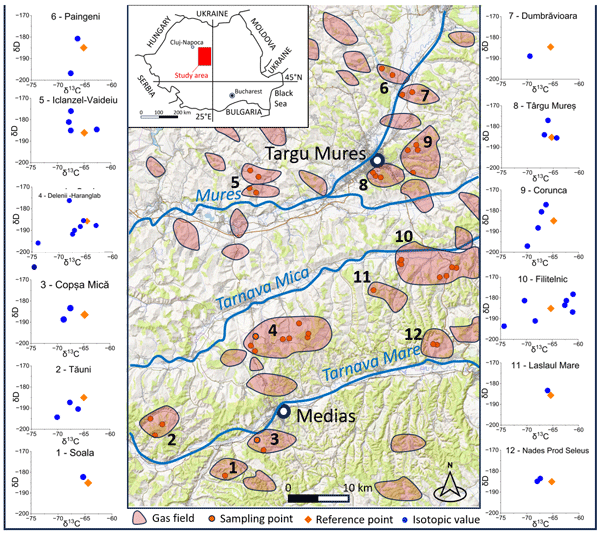
Thomas Röckmann, Malika Menoud, Jacoline van Es, Carina van der Veen, Hossein Maazallahi, Pawel Jagoda, Jaroslav M. Necki, Jakub Bartyzel, Piotr Korben, Sara Defratyka, Martina Schmidt, Marius Corbu, Sebastian Iancu, Andreea Calcan, Magdalena Ardelean, Sorin Ghemulet, Cristian Pop, Andrei Radovici, Alexandru Mereuta, Horatiu Stefanie, and Calin Baciu
Atmos. Chem. Phys., 26, 723–731, https://doi.org/10.5194/acp-26-723-2026, https://doi.org/10.5194/acp-26-723-2026, 2026
Short summary
Short summary
We report the isotopic composition of CH4 emitted from 48 installations in the gas production region of Transylvania, Romania which confirm the biogenic origin of the Transylvanian gas, produced by hydrogenotrophic CO2 reduction. This is similar to values reported previously from natural seeps and natural gas in a major city in the region. However, is more depleted in heavy isotopes than the oil-associated gas emitted in the Southern Romanian Plain, and gas leakages in the city of Bucharest.
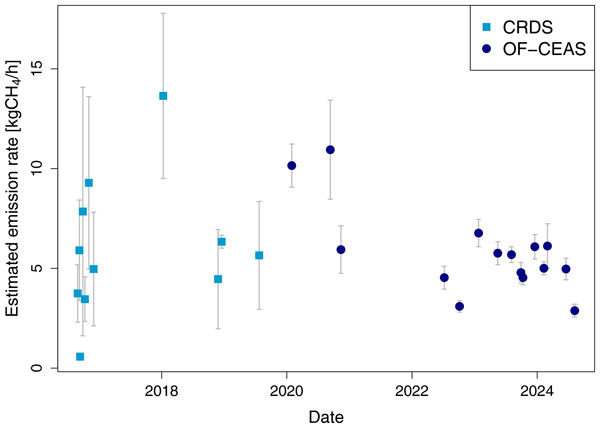
Julia Beate Wietzel, Piotr Korben, Antje Hoheisel, and Martina Schmidt
Atmos. Meas. Tech., 18, 4631–4645, https://doi.org/10.5194/amt-18-4631-2025, https://doi.org/10.5194/amt-18-4631-2025, 2025
Short summary
Short summary
Long-term measurements of CH4 emission rates at a biogas plant in Germany were performed for eight years using mobile measurements combined with a Gaussian plume model. The average CH4 emission rate of the biogas plant was 5.9 ± 0.5 kg CH4 h-1. To increase the accuracy of the emission rate calculations and harmonize the dataset, the methodology was evaluated through six controlled methane release experiments demonstrating an uncertainty lower than 30 %, following several recommendations.
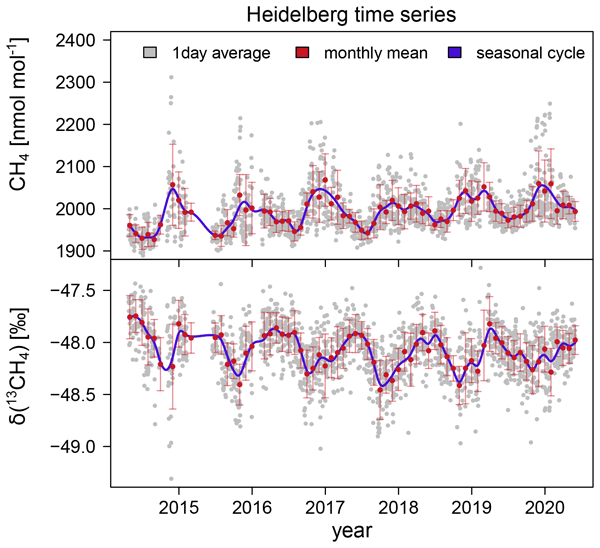
Antje Hoheisel and Martina Schmidt
Atmos. Chem. Phys., 24, 2951–2969, https://doi.org/10.5194/acp-24-2951-2024, https://doi.org/10.5194/acp-24-2951-2024, 2024
Short summary
Short summary
In Heidelberg, Germany, methane and its stable carbon isotope composition have been measured continuously with a cavity ring-down spectroscopy (CRDS) analyser since April 2014. These 6-year time series are analysed with the Keeling plot method for the isotopic composition of the sources, as well as seasonal variations and trends in methane emissions. The source contributions derived from atmospheric measurements were used to evaluate global and regional emission inventories of methane.
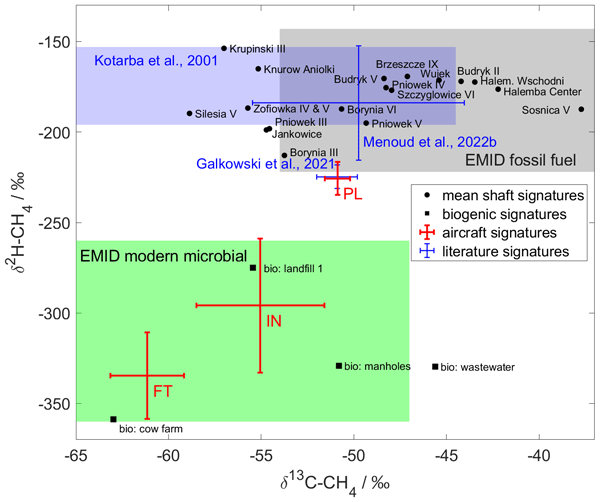
Alina Fiehn, Maximilian Eckl, Julian Kostinek, Michał Gałkowski, Christoph Gerbig, Michael Rothe, Thomas Röckmann, Malika Menoud, Hossein Maazallahi, Martina Schmidt, Piotr Korbeń, Jarosław Neçki, Mila Stanisavljević, Justyna Swolkień, Andreas Fix, and Anke Roiger
Atmos. Chem. Phys., 23, 15749–15765, https://doi.org/10.5194/acp-23-15749-2023, https://doi.org/10.5194/acp-23-15749-2023, 2023
Short summary
Short summary
During the CoMet mission in the Upper Silesian Coal Basin (USCB) ground-based and airborne air samples were taken and analyzed for the isotopic composition of CH4 to derive the mean signature of the USCB and source signatures of individual coal mines. Using δ2H signatures, the biogenic emissions from the USCB account for 15 %–50 % of total emissions, which is underestimated in common emission inventories. This demonstrates the importance of δ2H-CH4 observations for methane source apportionment.
Tobias D. Schmitt, Jonas Kuhn, Ralph Kleinschek, Benedikt A. Löw, Stefan Schmitt, William Cranton, Martina Schmidt, Sanam N. Vardag, Frank Hase, David W. T. Griffith, and André Butz
Atmos. Meas. Tech., 16, 6097–6110, https://doi.org/10.5194/amt-16-6097-2023, https://doi.org/10.5194/amt-16-6097-2023, 2023
Short summary
Short summary
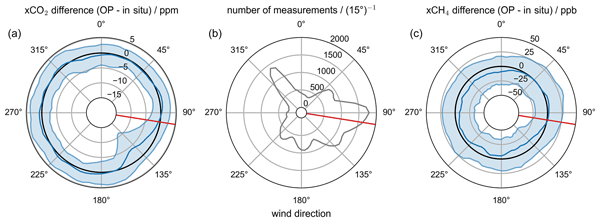
Our new observatory measures greenhouse gas concentrations of carbon dioxide (CO2) and methane (CH4) along a 1.55 km long light path over the city of Heidelberg, Germany. We compared our measurements with measurements that were taken at a single point at one end of our path. The two mostly agreed but show a significant difference for CO2 with certain wind directions. This is important when using greenhouse gas concentration measurements to observe greenhouse gas emissions of cities.
Douglas E. J. Worthy, Michele K. Rauh, Lin Huang, Felix R. Vogel, Alina Chivulescu, Kenneth A. Masarie, Ray L. Langenfelds, Paul B. Krummel, Colin E. Allison, Andrew M. Crotwell, Monica Madronich, Gabrielle Pétron, Ingeborg Levin, Samuel Hammer, Sylvia Michel, Michel Ramonet, Martina Schmidt, Armin Jordan, Heiko Moossen, Michael Rothe, Ralph Keeling, and Eric J. Morgan
Atmos. Meas. Tech., 16, 5909–5935, https://doi.org/10.5194/amt-16-5909-2023, https://doi.org/10.5194/amt-16-5909-2023, 2023
Short summary
Short summary
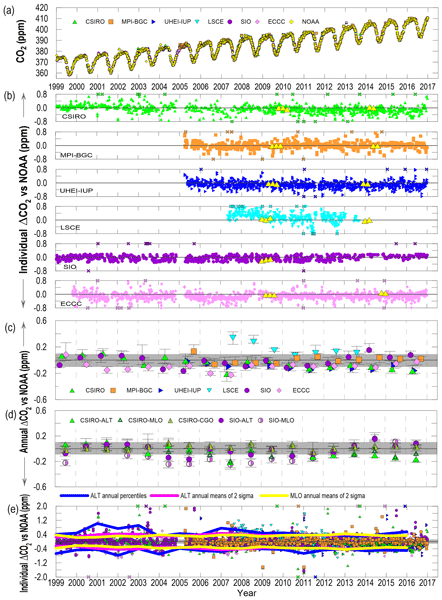
Network compatibility is important for inferring greenhouse gas fluxes at global or regional scales. This study is the first assessment of the measurement agreement among seven individual programs within the World Meteorological Organization community. It compares co-located flask air measurements at the Alert Observatory in Canada over a 17-year period. The results provide stronger confidence in the uncertainty estimation while using those datasets in various data interpretation applications.
Foteini Stavropoulou, Katarina Vinković, Bert Kers, Marcel de Vries, Steven van Heuven, Piotr Korbeń, Martina Schmidt, Julia Wietzel, Pawel Jagoda, Jaroslav M. Necki, Jakub Bartyzel, Hossein Maazallahi, Malika Menoud, Carina van der Veen, Sylvia Walter, Béla Tuzson, Jonas Ravelid, Randulph Paulo Morales, Lukas Emmenegger, Dominik Brunner, Michael Steiner, Arjan Hensen, Ilona Velzeboer, Pim van den Bulk, Hugo Denier van der Gon, Antonio Delre, Maklawe Essonanawe Edjabou, Charlotte Scheutz, Marius Corbu, Sebastian Iancu, Denisa Moaca, Alin Scarlat, Alexandru Tudor, Ioana Vizireanu, Andreea Calcan, Magdalena Ardelean, Sorin Ghemulet, Alexandru Pana, Aurel Constantinescu, Lucian Cusa, Alexandru Nica, Calin Baciu, Cristian Pop, Andrei Radovici, Alexandru Mereuta, Horatiu Stefanie, Alexandru Dandocsi, Bas Hermans, Stefan Schwietzke, Daniel Zavala-Araiza, Huilin Chen, and Thomas Röckmann
Atmos. Chem. Phys., 23, 10399–10412, https://doi.org/10.5194/acp-23-10399-2023, https://doi.org/10.5194/acp-23-10399-2023, 2023
Short summary
Short summary
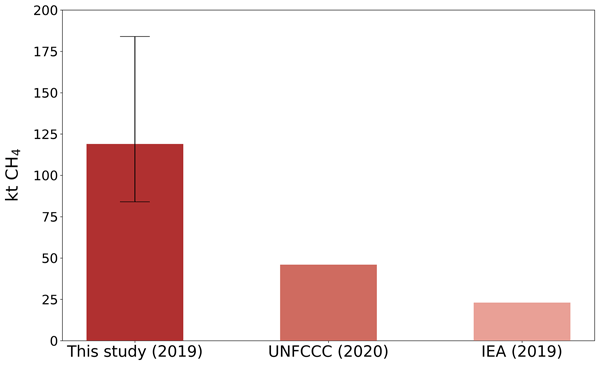
In this study, we quantify CH4 emissions from onshore oil production sites in Romania at source and facility level using a combination of ground- and drone-based measurement techniques. We show that the total CH4 emissions in our studied areas are much higher than the emissions reported to UNFCCC, and up to three-quarters of the detected emissions are related to operational venting. Our results suggest that oil and gas production infrastructure in Romania holds a massive mitigation potential.
Antje Hoheisel, Cedric Couret, Bryan Hellack, and Martina Schmidt
Atmos. Meas. Tech., 16, 2399–2413, https://doi.org/10.5194/amt-16-2399-2023, https://doi.org/10.5194/amt-16-2399-2023, 2023
Short summary
Short summary
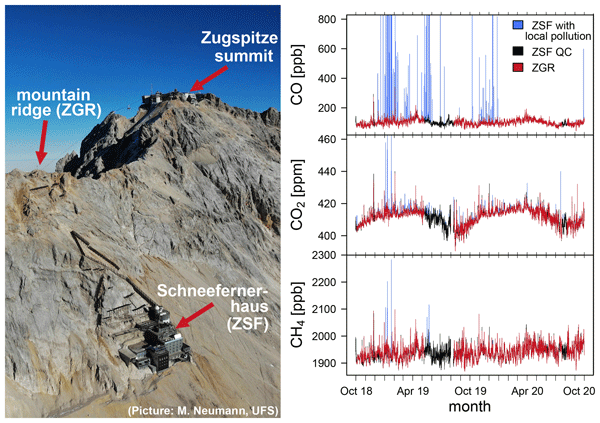
High-precision CO2, CH4 and CO measurements have been carried out at Zugspitze for decades. New technologies make it possible to analyse these gases with high temporal resolution. This allows the detection of local pollution. To this end, measurements have been performed on the mountain ridge (ZGR) and are compared to routine measurements at the Schneefernerhaus (ZSF). Careful manual flagging of pollution events in the ZSF data leads to consistency with the little influenced ZGR time series.
Malika Menoud, Carina van der Veen, Dave Lowry, Julianne M. Fernandez, Semra Bakkaloglu, James L. France, Rebecca E. Fisher, Hossein Maazallahi, Mila Stanisavljević, Jarosław Nęcki, Katarina Vinkovic, Patryk Łakomiec, Janne Rinne, Piotr Korbeń, Martina Schmidt, Sara Defratyka, Camille Yver-Kwok, Truls Andersen, Huilin Chen, and Thomas Röckmann
Earth Syst. Sci. Data, 14, 4365–4386, https://doi.org/10.5194/essd-14-4365-2022, https://doi.org/10.5194/essd-14-4365-2022, 2022
Short summary
Short summary
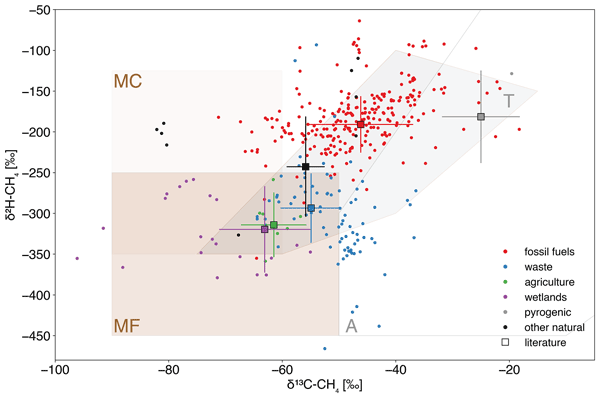
Emission sources of methane (CH4) can be distinguished with measurements of CH4 stable isotopes. We present new measurements of isotope signatures of various CH4 sources in Europe, mainly anthropogenic, sampled from 2017 to 2020. The present database also contains the most recent update of the global signature dataset from the literature. The dataset improves CH4 source attribution and the understanding of the global CH4 budget.
Randulph Morales, Jonas Ravelid, Katarina Vinkovic, Piotr Korbeń, Béla Tuzson, Lukas Emmenegger, Huilin Chen, Martina Schmidt, Sebastian Humbel, and Dominik Brunner
Atmos. Meas. Tech., 15, 2177–2198, https://doi.org/10.5194/amt-15-2177-2022, https://doi.org/10.5194/amt-15-2177-2022, 2022
Short summary
Short summary
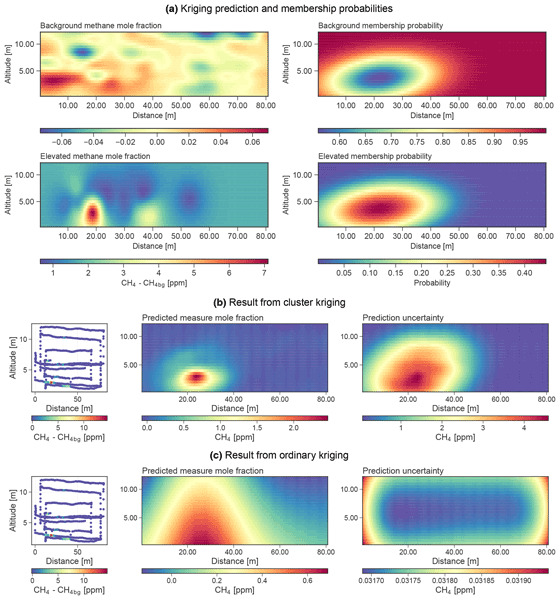
Mapping trace gas emission plumes using in situ measurements from unmanned aerial vehicles (UAVs) is an emerging and attractive possibility to quantify emissions from localized sources. We performed an extensive controlled-release experiment to develop an optimal quantification method and to determine the related uncertainties under various environmental and sampling conditions. Our approach was successful in quantifying local methane sources from drone-based measurements.
Sophie F. Warken, Therese Weißbach, Tobias Kluge, Hubert Vonhof, Denis Scholz, Rolf Vieten, Martina Schmidt, Amos Winter, and Norbert Frank
Clim. Past, 18, 167–181, https://doi.org/10.5194/cp-18-167-2022, https://doi.org/10.5194/cp-18-167-2022, 2022
Short summary
Short summary
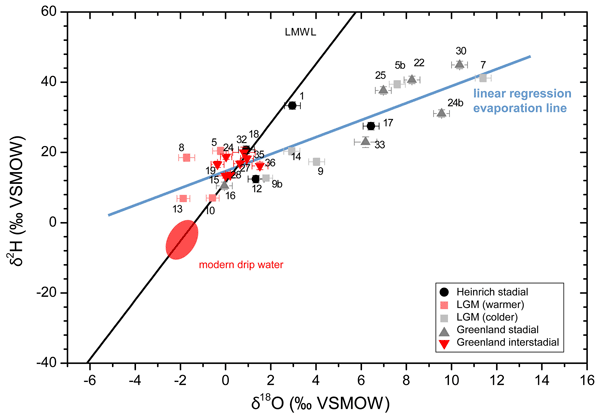
The analysis of fluid inclusions from a Puerto Rican speleothem provides quantitative information about past rainfall conditions and temperatures during the Last Glacial Period, when the climate was extremely variable. Our data show that the region experienced a climate that was generally colder and drier. However, we also reconstruct intervals when temperatures reached nearly modern values, and convective activity was comparable to or only slightly weaker than the present day.

Nils Schorndorf, Sophie F. Warken, René Eichstädter, Aaron S. Mielke, Jerónimo Avilés Olguín, Frank Keppler, Dominik Hennhöfer, Fátima Tec Pool, Carlos Evia, María José Gómez, Wolfgang Stinnesbeck, and Norbert Frank
Geochronology, 8, 511–528, https://doi.org/10.5194/gchron-8-511-2026, https://doi.org/10.5194/gchron-8-511-2026, 2026
Short summary
Short summary
To accurately understand past climate change, exact chronologies are fundamental. We dated multiple stalagmites from the Yucatán Peninsula covering the last 2700 years. Because these cave deposits contain high and variable amounts of contaminating elements that distort age models, we developed a multi-method approach to correct the timelines. Our corrected records now provide a reliable foundation for future studies to track ancient droughts, floods, and their links to Maya cultural evolution.
Anna-Maria Virkkala, Isabel Wargowsky, Judith Vogt, McKenzie A. Kuhn, Simran Madaan, Tiffany Windholz, Kyle A. Arndt, Gerard Rocher-Ros, Mathias Göckede, David Olefeldt, Edward A. G. Schuur, David Bastviken, Richard O'Keefe, Brendan M. Rogers, Jennifer D. Watts, Kelcy Kent, Kristoffer Aalstad, Kelly Aho, Joonatan Ala-Könni, Haley Alcock, Inge Althuizen, Christopher D. Arp, Jun Asanuma, Mika Aurela, Sivakiruthika Balathandayuthabani, Katrin Attermeyer, Alan Barr, Maialen Barret, Ochirbat Batkhishig, Christina Biasi, Mats P. Björkman, Andrew Black, Elena Blanc-Betes, Pascal Bodmer, Julia Boike, Abdullah Bolek, Frédéric Bouchard, Ingeborg Bussmann, Lea Cabrol, Eleonora Canfora, Sean Carey, Karel Castro-Morales, Namyi Chae, Andreas Christen, Torben R. Christensen, Casper T. Christiansen, Housen Chu, Graham Clark, Francois Clayer, Patrick Crill, Christopher Cunada, Scott J. Davidson, Joshua F. Dean, Sigrid Dengel, Matteo Detto, Catherine Dieleman, Florent Domine, Egor Dyukarev, Colin Edgar, Bo Elberling, Craig A. Emmerton, Eugenie Euskirchen, Grant Falvo, Thomas Friborg, Michelle Garneau, Mariasilvia Giamberini, Mikhail V. Glagolev, Miquel A. Gonzalez-Meler, Gustaf Granath, Jón Guðmundsson, Konsta Happonen, Yoshinobu Harazono, Lorna Harris, Josh Hashemi, Nicholas Hasson, Janna Heerah, Liam Heffernan, Manuel Helbig, Warren Helgason, Michal Heliasz, Greg Henry, Geert Hensgens, Tetsuya Hiyama, Beth Holmes, Macall Hock, David Holl, Jutta Holst, Thomas Holst, Gabriel Hould-Gosselin, Elyn Humphreys, Jacqueline Hung, Jussi Huotari, Hiroki Ikawa, Danil V. Ilyasov, Mamoru Ishikawa, Go Iwahana, Hiroki Iwata, Marcin Antoni Jackowicz-Korczynski, Joachim Jansen, Järvi Järveoja, Vincent E. J. Jassey, Rasmus Jensen, Katharina Jentzsch, Robert G. Jespersen, Carl-Fredrik Johannesson, Cheristy P. Jones, Anders Jonsson, Ji Young Jung, Sari Juutinen, Evan Kane, Jan Karlsson, Sergey Karsanaev, Kuno Kasak, Julia Kelly, Kasha Kempton, Marcus Klaus, George W. Kling, Natascha Kljun, Jacqueline Knutson, Hideki Kobayashi, John Kochendorfer, Kukka-Maaria Kohonen, Pasi Kolari, Mika Korkiakoski, Aino Korrensalo, Pirkko Kortelainen, Egle Koster, Kajar Koster, Ayumi Kotani, Praveena Krishnan, Juliya Kurbatova, Lars Kutzbach, Min Jung Kwon, Ethan D. Kyzivat, Jessica Lagroix, Theodore Langhorst, Elena Lapshina, Tuula Larmola, Klaus S. Larsen, Isabelle Laurion, Justin Ledman, Hanna Lee, A. Joshua Leffler, Lance Lesack, Anders Lindroth, David Lipson, Annalea Lohila, Efrén López-Blanco, Vincent L. St. Louis, Erik Lundin, Miska Luoto, Takashi Machimura, Marta Magnani, Avni Malhotra, Marja Maljanen, Ivan Mammarella, Elisa Männistö, Luca Belelli Marchesini, Phil Marsh, Pertti J. Martikainen, Maija E. Marushchak, Mikhail Mastepanov, Alex Mavrovic, Trofim Maximov, Christina Minions, Daniel F. Nadeau, Marco Montemayor, Tomoaki Morishita, Patrick Murphy, Erin Nicholls, Mats B. Nilsson, Anastasia Niyazova, Jenni Nordén, Koffi Dodji Noumonvi, Hannu Nykänen, Walter Oechel, Anne Ojala, Tomohiro Okadera, Sujan Pal, Alexey V. Panov, Tim Papakyriakou, Dario Papale, Sang-Jong Park, Frans-Jan W. Parmentier, Gilberto Pastorello, Mike Peacock, Matthias Peichl, Roman Petrov, Kyra St. Pierre, Norbert Pirk, Jessica Plein, Vilmantas Preskienis, Anatoly Prokushkin, Jukka Pumpanen, Hilary A. Rains, Niklas Rakos, Aleksi Räsänen, Helena Rautakoski, Riikka Rinnan, Janne Rinne, Adrian Rocha, Nigel Roulet, Alexandre Roy, Anna Rutgersson, Aleksandr F. Sabrekov, Torsten Sachs, Erik Sahlée, Alejandro Salazar, Henrique Oliveira Sawakuchi, Christopher Schulze, Roger Seco, Armando Sepulveda-Jauregui, Svetlana Serikova, Abbey Serrone, Hanna M. Silvennoinen, Sofie Sjogersten, June Skeeter, Jo Snöälv, Sebastian Sobek, Oliver Sonnentag, Emily H. Stanley, Maria Strack, Lena Strom, Patrick Sullivan, Ryan Sullivan, Anna Sytiuk, Torbern Tagesson, Pierre Taillardat, Julie Talbot, Suzanne E. Tank, Mario Tenuta, Irina Terenteva, Frederic Thalasso, Antoine Thiboult, Halldor Thorgeirsson, Fenix Garcia Tigreros, Margaret Torn, Amy Townsend-Small, Claire Treat, Alain Tremblay, Carlo Trotta, Eeva-Stiina Tuittila, Merritt Turetsky, Masahito Ueyama, Muhammad Umair, Aki Vähä, Lona van Delden, Maarten van Hardenbroek, Andrej Varlagin, Ruth K. Varner, Tarmo Virtanen, Elena Veretennikova, Timo Vesala, Carolina Voigt, Jorien E. Vonk, Robert Wagner, Katey Walter Anthony, Qinxue Wang, Masataka Watanabe, Hailey Webb, Jeffrey M. Welker, Andreas Westergaard-Nielsen, Sebastian Westermann, Jeffrey R. White, Christian Wille, Scott N. Williamson, Scott Zolkos, Donatella Zona, and Susan M. Natali
Earth Syst. Sci. Data, 18, 6357–6409, https://doi.org/10.5194/essd-18-6357-2026, https://doi.org/10.5194/essd-18-6357-2026, 2026
Short summary
Short summary
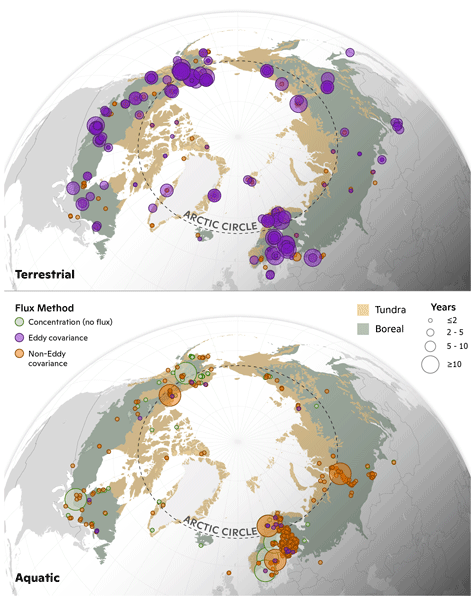
This dataset includes monthly measurements of carbon dioxide and methane exchange between land, water, and the atmosphere from over 1000 sites in Arctic and boreal regions. It combines measurements from a variety of ecosystems, including wetlands, forests, tundra, lakes, and rivers, gathered by over 260 researchers from 1984–2024. This dataset can be used to improve and reduce uncertainty in carbon budgets in order to strengthen our understanding of climate feedbacks in a warming world.
Yanan Zhao, Vera Sidorenko, Carsten Lemmen, and Ingeborg Bussmann
EGUsphere, https://doi.org/10.5194/egusphere-2026-4822, https://doi.org/10.5194/egusphere-2026-4822, 2026
This preprint is open for discussion and under review for Biogeosciences (BG).
Short summary
Short summary
Shallow coastal waters release methane, a strong greenhouse gas, but bacteria living in the water consume part of it before it reaches the air. How fast they do this can normally only be measured in the laboratory, so it is rarely known. Using four years of measurements from the Elbe estuary and the German Bight, we found that this speed can be predicted from temperature, salinity and nutrients alone, making it possible to estimate the methane removal from routine monitoring data.
Audrey McManemin, Catherine Juéry, Vincent Blandin, Matthew Baker, Stéphane Bauguitte, Dominik Brunner, Philippine Burdeau, James Lawrence France, Anders M. Fredenslund, Andreas Hueni, Gerrit Kuhlmann, Patryk Łakomiec, Sando Meier, Roberto Paglini, Roubina Papaconstantinou, Jean-Daniel Paris, Pierre-Yves Quehe, Thomas Röckmann, Charlotte Scheutz, Martina Schmidt, Marius Vögtli, Julia B. Wietzel, and Adam R. Brandt
EGUsphere, https://doi.org/10.5194/egusphere-2026-1744, https://doi.org/10.5194/egusphere-2026-1744, 2026
Short summary
Short summary
Researchers tested five university-led systems to measure methane leaks at a facility in France. By releasing known amounts of gas, researchers checked if mobile tools on vehicles and planes could accurately detect and quantify emissions. Most sensors were excellent at finding leaks, but their accuracy in measuring the exact emission rate varied. Weather, especially low wind, significantly impacted results. These findings help improve how we track greenhouse gases to meet climate goals.
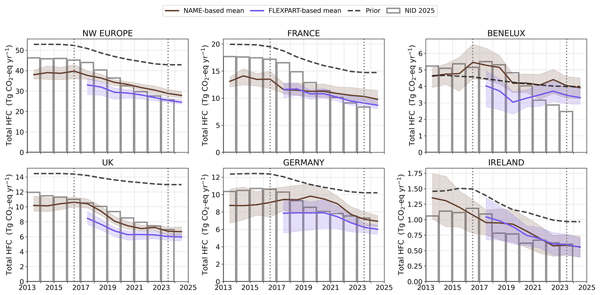
Hélène De Longueville, Daniela B. Melo, Alison L. Redington, Alice Ramsden, Alexandre Danjou, Peter Andrews, Joseph Pitt, Brendan Murphy, Lionel Constantin, Kieran M. Stanley, Simon O'Doherty, Angelina Wenger, Dickon Young, Andreas Engel, Tanja Schuck, Katharina Meixner, Thomas Wagenhaeuser, Fides Gad, Martin K. Vollmer, Stefan Reimann, Michela Maoine, Jgor Arduini, Chris Lunder, Norbert Schmidtbauer, László Haszpra, Mihály Molnár, Arnoud Frumau, Cedric Couret, Matthew Rigby, Stephan Henne, Alistair Manning, and Anita L. Ganesan
Atmos. Chem. Phys., 26, 7647–7675, https://doi.org/10.5194/acp-26-7647-2026, https://doi.org/10.5194/acp-26-7647-2026, 2026
Short summary
Short summary
This study estimates emissions of hydrofluorocarbons, potent greenhouse gases, in north-western Europe using atmospheric observations and atmospheric modelling. The estimates are compared with nationally reported emissions submitted to the United Nations. Overall, our results are consistent with reported values, although differences are found for some gases and countries. The findings indicate that emissions in north-western Europe are declining, reflecting the effects of climate regulations.
Julian Großmann, Frank Meinhardt, Antje Hoheisel, Bryan Hellack, and Martina Schmidt
EGUsphere, https://doi.org/10.5194/egusphere-2026-849, https://doi.org/10.5194/egusphere-2026-849, 2026
Short summary
Short summary
Long-term measurements of atmospheric CO2 have been conducted at Schauinsland station in southwest Germany since 1972. In order possibly to relocate the air intake line from 12 m to 35 m above ground, we compared three years of parallel CO2 and CH4 measurements. We find systematic differences in diurnal and seasonal variations for CO2, but not for CH4. The results of our study indicate that measurements should be taken at both heights to ensure consistency with historical records.
Chueh-Chen Tung, Moritz Holtappels, Alexa Wrede, Male Köster, Lasse Sander, Jan Beermann, Vera Sidorenko, and Lars Gutow
EGUsphere, https://doi.org/10.5194/egusphere-2026-966, https://doi.org/10.5194/egusphere-2026-966, 2026
Short summary
Short summary
Using 171 taxa from 50 stations in the southeastern North Sea, we show that environmental gradients structure benthic macrofaunal communities and their traits. Deeper communities had higher bioturbation and bioirrigation, whereas shallow communities showed greater respiration and secondary production. Environmental gradients also shifted biodiversity–ecosystem functioning relationships, highlighting macrofaunal control of carbon sequestration–related processes in shelf sea sediments.
Thomas Röckmann, Malika Menoud, Jacoline van Es, Carina van der Veen, Hossein Maazallahi, Pawel Jagoda, Jaroslav M. Necki, Jakub Bartyzel, Piotr Korben, Sara Defratyka, Martina Schmidt, Marius Corbu, Sebastian Iancu, Andreea Calcan, Magdalena Ardelean, Sorin Ghemulet, Cristian Pop, Andrei Radovici, Alexandru Mereuta, Horatiu Stefanie, and Calin Baciu
Atmos. Chem. Phys., 26, 723–731, https://doi.org/10.5194/acp-26-723-2026, https://doi.org/10.5194/acp-26-723-2026, 2026
Short summary
Short summary
We report the isotopic composition of CH4 emitted from 48 installations in the gas production region of Transylvania, Romania which confirm the biogenic origin of the Transylvanian gas, produced by hydrogenotrophic CO2 reduction. This is similar to values reported previously from natural seeps and natural gas in a major city in the region. However, is more depleted in heavy isotopes than the oil-associated gas emitted in the Southern Romanian Plain, and gas leakages in the city of Bucharest.
Julia Beate Wietzel, Piotr Korben, Antje Hoheisel, and Martina Schmidt
Atmos. Meas. Tech., 18, 4631–4645, https://doi.org/10.5194/amt-18-4631-2025, https://doi.org/10.5194/amt-18-4631-2025, 2025
Short summary
Short summary
Long-term measurements of CH4 emission rates at a biogas plant in Germany were performed for eight years using mobile measurements combined with a Gaussian plume model. The average CH4 emission rate of the biogas plant was 5.9 ± 0.5 kg CH4 h-1. To increase the accuracy of the emission rate calculations and harmonize the dataset, the methodology was evaluated through six controlled methane release experiments demonstrating an uncertainty lower than 30 %, following several recommendations.
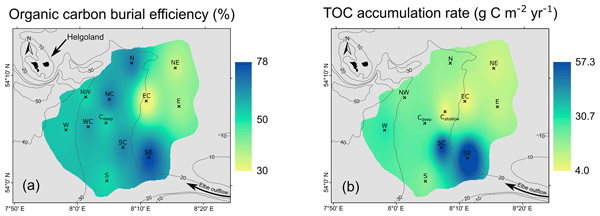
Daniel Müller, Bo Liu, Walter Geibert, Moritz Holtappels, Lasse Sander, Elda Miramontes, Heidi Taubner, Susann Henkel, Kai-Uwe Hinrichs, Denise Bethke, Ingrid Dohrmann, and Sabine Kasten
Biogeosciences, 22, 2541–2567, https://doi.org/10.5194/bg-22-2541-2025, https://doi.org/10.5194/bg-22-2541-2025, 2025
Short summary
Short summary
Coastal and shelf sediments are the most important sinks for organic carbon (OC) on Earth. We produced a new high-resolution sediment and porewater data set from the Helgoland Mud Area (HMA), North Sea, to determine which depositional factors control the preservation of OC. The burial efficiency is highest in an area of high sedimentation and terrigenous OC. The HMA covers 0.09 % of the North Sea but accounts for 0.76 % of its OC accumulation, highlighting the importance of the depocentre.
Lydia Stolpmann, Ingmar Nitze, Ingeborg Bussmann, Benjamin M. Jones, Josefine Lenz, Hanno Meyer, Juliane Wolter, and Guido Grosse
EGUsphere, https://doi.org/10.5194/egusphere-2024-2822, https://doi.org/10.5194/egusphere-2024-2822, 2024
Preprint archived
Short summary
Short summary
We combine hydrochemical and lake change data to show consequences of permafrost thaw induced lake changes on hydrochemistry, which are relevant for the global carbon cycle. We found higher methane concentrations in lakes that do not freeze to the ground and show that lagoons have lower methane concentrations than lakes. Our detailed lake sampling approach show higher concentrations in Dissolved Organic Carbon in areas of higher erosion rates, that might increase under the climate warming.
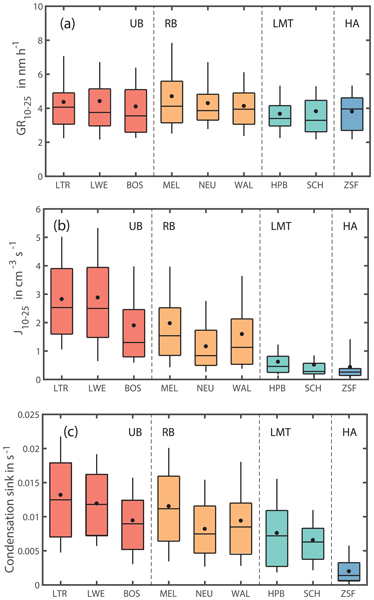
Jia Sun, Markus Hermann, Kay Weinhold, Maik Merkel, Wolfram Birmili, Yifan Yang, Thomas Tuch, Harald Flentje, Björn Briel, Ludwig Ries, Cedric Couret, Michael Elsasser, Ralf Sohmer, Klaus Wirtz, Frank Meinhardt, Maik Schütze, Olaf Bath, Bryan Hellack, Veli-Matti Kerminen, Markku Kulmala, Nan Ma, and Alfred Wiedensohler
Atmos. Chem. Phys., 24, 10667–10687, https://doi.org/10.5194/acp-24-10667-2024, https://doi.org/10.5194/acp-24-10667-2024, 2024
Short summary
Short summary
We investigated the characteristics of new particle formation (NPF) for various environments from urban background to high Alpine and the impacts of NPF on cloud condensation nuclei and aerosol radiative forcing. NPF features differ between site categories, implying the crucial role of local environmental factors such as the degree of emissions and meteorological conditions. The results also underscore the importance of local environments when assessing the impact of NPF on climate in models.
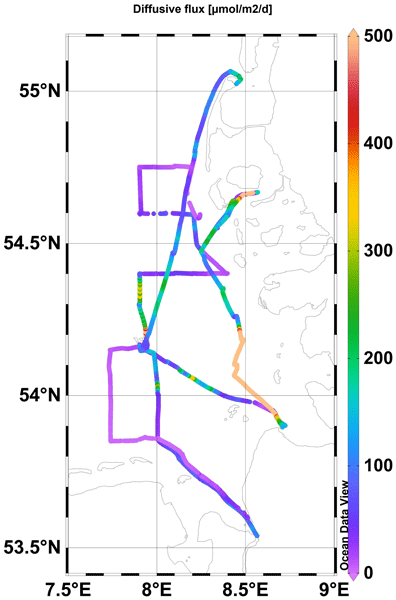
Ingeborg Bussmann, Eric P. Achterberg, Holger Brix, Nicolas Brüggemann, Götz Flöser, Claudia Schütze, and Philipp Fischer
Biogeosciences, 21, 3819–3838, https://doi.org/10.5194/bg-21-3819-2024, https://doi.org/10.5194/bg-21-3819-2024, 2024
Short summary
Short summary
Methane (CH4) is an important greenhouse gas and contributes to climate warming. However, the input of CH4 from coastal areas to the atmosphere is not well defined. Dissolved and atmospheric CH4 was determined at high spatial resolution in or above the North Sea. The atmospheric CH4 concentration was mainly influenced by wind direction. With our detailed study on the spatial distribution of CH4 fluxes we were able to provide a detailed and more realistic estimation of coastal CH4 fluxes.
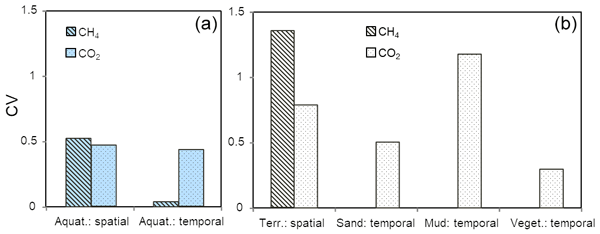
Matthias Koschorreck, Norbert Kamjunke, Uta Koedel, Michael Rode, Claudia Schuetze, and Ingeborg Bussmann
Biogeosciences, 21, 1613–1628, https://doi.org/10.5194/bg-21-1613-2024, https://doi.org/10.5194/bg-21-1613-2024, 2024
Short summary
Short summary
We measured the emission of carbon dioxide (CO2) and methane (CH4) from different sites at the river Elbe in Germany over 3 days to find out what is more important for quantification: small-scale spatial variability or diurnal temporal variability. We found that CO2 emissions were very different between day and night, while CH4 emissions were more different between sites. Dried out river sediments contributed to CO2 emissions, while the side areas of the river were important CH4 sources.
Antje Hoheisel and Martina Schmidt
Atmos. Chem. Phys., 24, 2951–2969, https://doi.org/10.5194/acp-24-2951-2024, https://doi.org/10.5194/acp-24-2951-2024, 2024
Short summary
Short summary
In Heidelberg, Germany, methane and its stable carbon isotope composition have been measured continuously with a cavity ring-down spectroscopy (CRDS) analyser since April 2014. These 6-year time series are analysed with the Keeling plot method for the isotopic composition of the sources, as well as seasonal variations and trends in methane emissions. The source contributions derived from atmospheric measurements were used to evaluate global and regional emission inventories of methane.
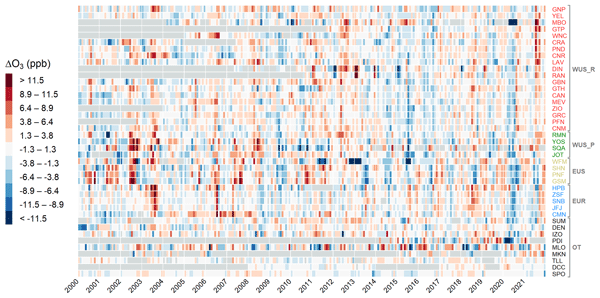
Davide Putero, Paolo Cristofanelli, Kai-Lan Chang, Gaëlle Dufour, Gregory Beachley, Cédric Couret, Peter Effertz, Daniel A. Jaffe, Dagmar Kubistin, Jason Lynch, Irina Petropavlovskikh, Melissa Puchalski, Timothy Sharac, Barkley C. Sive, Martin Steinbacher, Carlos Torres, and Owen R. Cooper
Atmos. Chem. Phys., 23, 15693–15709, https://doi.org/10.5194/acp-23-15693-2023, https://doi.org/10.5194/acp-23-15693-2023, 2023
Short summary
Short summary
We investigated the impact of societal restriction measures during the COVID-19 pandemic on surface ozone at 41 high-elevation sites worldwide. Negative ozone anomalies were observed for spring and summer 2020 for all of the regions considered. In 2021, negative anomalies continued for Europe and partially for the eastern US, while western US sites showed positive anomalies due to wildfires. IASI satellite data and the Carbon Monitor supported emission reductions as a cause of the anomalies.
Alina Fiehn, Maximilian Eckl, Julian Kostinek, Michał Gałkowski, Christoph Gerbig, Michael Rothe, Thomas Röckmann, Malika Menoud, Hossein Maazallahi, Martina Schmidt, Piotr Korbeń, Jarosław Neçki, Mila Stanisavljević, Justyna Swolkień, Andreas Fix, and Anke Roiger
Atmos. Chem. Phys., 23, 15749–15765, https://doi.org/10.5194/acp-23-15749-2023, https://doi.org/10.5194/acp-23-15749-2023, 2023
Short summary
Short summary
During the CoMet mission in the Upper Silesian Coal Basin (USCB) ground-based and airborne air samples were taken and analyzed for the isotopic composition of CH4 to derive the mean signature of the USCB and source signatures of individual coal mines. Using δ2H signatures, the biogenic emissions from the USCB account for 15 %–50 % of total emissions, which is underestimated in common emission inventories. This demonstrates the importance of δ2H-CH4 observations for methane source apportionment.
Tobias D. Schmitt, Jonas Kuhn, Ralph Kleinschek, Benedikt A. Löw, Stefan Schmitt, William Cranton, Martina Schmidt, Sanam N. Vardag, Frank Hase, David W. T. Griffith, and André Butz
Atmos. Meas. Tech., 16, 6097–6110, https://doi.org/10.5194/amt-16-6097-2023, https://doi.org/10.5194/amt-16-6097-2023, 2023
Short summary
Short summary
Our new observatory measures greenhouse gas concentrations of carbon dioxide (CO2) and methane (CH4) along a 1.55 km long light path over the city of Heidelberg, Germany. We compared our measurements with measurements that were taken at a single point at one end of our path. The two mostly agreed but show a significant difference for CO2 with certain wind directions. This is important when using greenhouse gas concentration measurements to observe greenhouse gas emissions of cities.
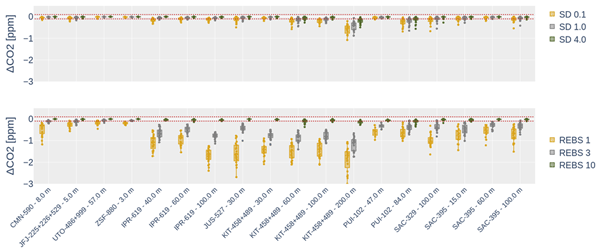
Paolo Cristofanelli, Cosimo Fratticioli, Lynn Hazan, Mali Chariot, Cedric Couret, Orestis Gazetas, Dagmar Kubistin, Antti Laitinen, Ari Leskinen, Tuomas Laurila, Matthias Lindauer, Giovanni Manca, Michel Ramonet, Pamela Trisolino, and Martin Steinbacher
Atmos. Meas. Tech., 16, 5977–5994, https://doi.org/10.5194/amt-16-5977-2023, https://doi.org/10.5194/amt-16-5977-2023, 2023
Short summary
Short summary
We investigated the application of two automatic methods for detecting spikes due to local emissions in greenhouse gas (GHG) observations at a subset of sites from the ICOS Atmosphere network. We analysed the sensitivity to the spike frequency of using different methods and settings. We documented the impact of the de-spiking on different temporal aggregations (i.e. hourly, monthly and seasonal averages) of CO2, CH4 and CO 1 min time series.
Douglas E. J. Worthy, Michele K. Rauh, Lin Huang, Felix R. Vogel, Alina Chivulescu, Kenneth A. Masarie, Ray L. Langenfelds, Paul B. Krummel, Colin E. Allison, Andrew M. Crotwell, Monica Madronich, Gabrielle Pétron, Ingeborg Levin, Samuel Hammer, Sylvia Michel, Michel Ramonet, Martina Schmidt, Armin Jordan, Heiko Moossen, Michael Rothe, Ralph Keeling, and Eric J. Morgan
Atmos. Meas. Tech., 16, 5909–5935, https://doi.org/10.5194/amt-16-5909-2023, https://doi.org/10.5194/amt-16-5909-2023, 2023
Short summary
Short summary
Network compatibility is important for inferring greenhouse gas fluxes at global or regional scales. This study is the first assessment of the measurement agreement among seven individual programs within the World Meteorological Organization community. It compares co-located flask air measurements at the Alert Observatory in Canada over a 17-year period. The results provide stronger confidence in the uncertainty estimation while using those datasets in various data interpretation applications.
Foteini Stavropoulou, Katarina Vinković, Bert Kers, Marcel de Vries, Steven van Heuven, Piotr Korbeń, Martina Schmidt, Julia Wietzel, Pawel Jagoda, Jaroslav M. Necki, Jakub Bartyzel, Hossein Maazallahi, Malika Menoud, Carina van der Veen, Sylvia Walter, Béla Tuzson, Jonas Ravelid, Randulph Paulo Morales, Lukas Emmenegger, Dominik Brunner, Michael Steiner, Arjan Hensen, Ilona Velzeboer, Pim van den Bulk, Hugo Denier van der Gon, Antonio Delre, Maklawe Essonanawe Edjabou, Charlotte Scheutz, Marius Corbu, Sebastian Iancu, Denisa Moaca, Alin Scarlat, Alexandru Tudor, Ioana Vizireanu, Andreea Calcan, Magdalena Ardelean, Sorin Ghemulet, Alexandru Pana, Aurel Constantinescu, Lucian Cusa, Alexandru Nica, Calin Baciu, Cristian Pop, Andrei Radovici, Alexandru Mereuta, Horatiu Stefanie, Alexandru Dandocsi, Bas Hermans, Stefan Schwietzke, Daniel Zavala-Araiza, Huilin Chen, and Thomas Röckmann
Atmos. Chem. Phys., 23, 10399–10412, https://doi.org/10.5194/acp-23-10399-2023, https://doi.org/10.5194/acp-23-10399-2023, 2023
Short summary
Short summary
In this study, we quantify CH4 emissions from onshore oil production sites in Romania at source and facility level using a combination of ground- and drone-based measurement techniques. We show that the total CH4 emissions in our studied areas are much higher than the emissions reported to UNFCCC, and up to three-quarters of the detected emissions are related to operational venting. Our results suggest that oil and gas production infrastructure in Romania holds a massive mitigation potential.
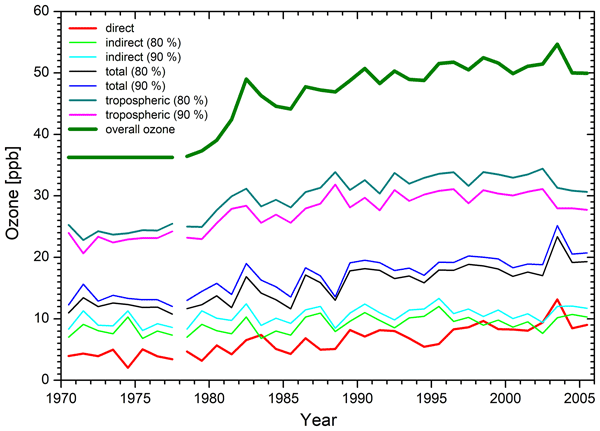
Thomas Trickl, Cédric Couret, Ludwig Ries, and Hannes Vogelmann
Atmos. Chem. Phys., 23, 8403–8427, https://doi.org/10.5194/acp-23-8403-2023, https://doi.org/10.5194/acp-23-8403-2023, 2023
Short summary
Short summary
Downward atmospheric transport from the stratosphere (STT) is the most important natural source of tropospheric ozone. We analyse the stratospheric influence on the long-term series of ozone and carbon monoxide measured on the Zugspitze in the Bavarian Alps (2962 m a.s.l.). Since the 1970s, there has been a pronounced ozone rise that has been ascribed to an increase in STT. We determine the stratospheric influence from the observational data alone (humidity and 7Be).
Antje Hoheisel, Cedric Couret, Bryan Hellack, and Martina Schmidt
Atmos. Meas. Tech., 16, 2399–2413, https://doi.org/10.5194/amt-16-2399-2023, https://doi.org/10.5194/amt-16-2399-2023, 2023
Short summary
Short summary
High-precision CO2, CH4 and CO measurements have been carried out at Zugspitze for decades. New technologies make it possible to analyse these gases with high temporal resolution. This allows the detection of local pollution. To this end, measurements have been performed on the mountain ridge (ZGR) and are compared to routine measurements at the Schneefernerhaus (ZSF). Careful manual flagging of pollution events in the ZSF data leads to consistency with the little influenced ZGR time series.
Malika Menoud, Carina van der Veen, Dave Lowry, Julianne M. Fernandez, Semra Bakkaloglu, James L. France, Rebecca E. Fisher, Hossein Maazallahi, Mila Stanisavljević, Jarosław Nęcki, Katarina Vinkovic, Patryk Łakomiec, Janne Rinne, Piotr Korbeń, Martina Schmidt, Sara Defratyka, Camille Yver-Kwok, Truls Andersen, Huilin Chen, and Thomas Röckmann
Earth Syst. Sci. Data, 14, 4365–4386, https://doi.org/10.5194/essd-14-4365-2022, https://doi.org/10.5194/essd-14-4365-2022, 2022
Short summary
Short summary
Emission sources of methane (CH4) can be distinguished with measurements of CH4 stable isotopes. We present new measurements of isotope signatures of various CH4 sources in Europe, mainly anthropogenic, sampled from 2017 to 2020. The present database also contains the most recent update of the global signature dataset from the literature. The dataset improves CH4 source attribution and the understanding of the global CH4 budget.
Anna Wieland, Markus Greule, Philipp Roemer, Jan Esper, and Frank Keppler
Clim. Past, 18, 1849–1866, https://doi.org/10.5194/cp-18-1849-2022, https://doi.org/10.5194/cp-18-1849-2022, 2022
Short summary
Short summary
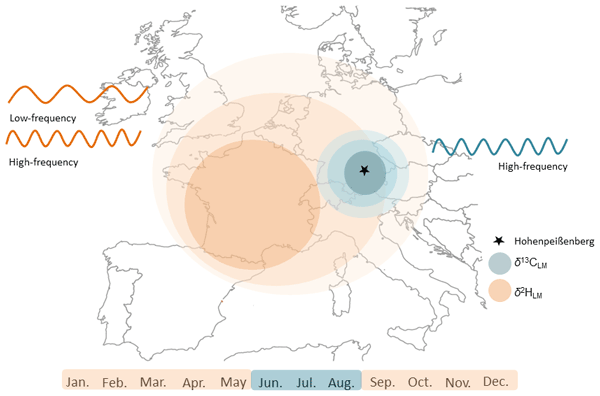
We examined annually resolved stable carbon and hydrogen isotope ratios of wood lignin methoxy groups of beech trees growing in temperate, low elevation environments. Here, carbon isotope ratios reveal highest correlations with regional summer temperatures while hydrogen isotope ratios correlate more strongly with large-scale temperature changes. By combining the dual isotope ratios of wood lignin methoxy groups, a proxy for regional- to subcontinental-scale temperature patterns can be applied.
Randulph Morales, Jonas Ravelid, Katarina Vinkovic, Piotr Korbeń, Béla Tuzson, Lukas Emmenegger, Huilin Chen, Martina Schmidt, Sebastian Humbel, and Dominik Brunner
Atmos. Meas. Tech., 15, 2177–2198, https://doi.org/10.5194/amt-15-2177-2022, https://doi.org/10.5194/amt-15-2177-2022, 2022
Short summary
Short summary
Mapping trace gas emission plumes using in situ measurements from unmanned aerial vehicles (UAVs) is an emerging and attractive possibility to quantify emissions from localized sources. We performed an extensive controlled-release experiment to develop an optimal quantification method and to determine the related uncertainties under various environmental and sampling conditions. Our approach was successful in quantifying local methane sources from drone-based measurements.
Sophie F. Warken, Therese Weißbach, Tobias Kluge, Hubert Vonhof, Denis Scholz, Rolf Vieten, Martina Schmidt, Amos Winter, and Norbert Frank
Clim. Past, 18, 167–181, https://doi.org/10.5194/cp-18-167-2022, https://doi.org/10.5194/cp-18-167-2022, 2022
Short summary
Short summary
The analysis of fluid inclusions from a Puerto Rican speleothem provides quantitative information about past rainfall conditions and temperatures during the Last Glacial Period, when the climate was extremely variable. Our data show that the region experienced a climate that was generally colder and drier. However, we also reconstruct intervals when temperatures reached nearly modern values, and convective activity was comparable to or only slightly weaker than the present day.
Cited articles
Affolter, S., Schibig, M., Berhanu, T., Bukowiecki, N., Steinbacher, M., Nyfeler, P., Hervo, M., Lauper, J., and Leuenberger, M.: Assessing local CO2 contamination revealed by two near-by high altitude records at Jungfraujoch, Switzerland, Environ. Res. Lett., 16, https://doi.org/10.1088/1748-9326/abe74a, 2021.
Borges, A. V., Royer, C., Martin, J. L., Champenois, W., and Gypens, N.: Response of marine methane dissolved concentrations and emissions in the Southern North Sea to the European 2018 heatwave, Cont. Shelf Res., 190, https://doi.org/10.1016/j.csr.2019.104004, 2019.
BSH: Umweltbericht zum Raumordnungsplan für die deutsche ausschließliche Wirtschaftszone in der Nordsee, https://www.bsh.de/DE/THEMEN/Offshore/Meeresraumplanung/Raumordnungsplan_2021/_Anlagen/Downloads/Umweltbericht_Nordsee_Endfassung.pdf;jsessionid=8C5252FD9F31DE012EF764EB3A08A156.live21304?__blob=publicationFile&v=6 (last access: 30 October 2024), 2021.
BSH, German Federal Maritime and Hydrographic Agency: Meeresboden DGM, http://www.geoseaportal.de/, last access: 12 September 2025.
Bussmann, I.: Dissolved methane concentration and diffusive flux near Sylt, North Sea in summer 2023, PANGAEA [data set], https://doi.org/10.1594/PANGAEA.995741, 2026.
Bussmann, I., Brix, H., Flöser, G., Ködel, U., and Fischer, P.: Detailed Patterns of Methane Distribution in the German Bight, Front. Mar. Sci., 8, https://doi.org/10.3389/fmars.2021.728308, 2021.
Bussmann, I., Koedel, U., Schüze, C., Kamjunke, N., and Koschorreck, M.: Spatial Variability and Hotspots of Methane Concentrations in a Large Temperate River, Front. Env. Sci.-Switz., 10, 833936, https://doi.org/10.3389/fenvs.2022.833936, 2022.
Bussmann, I., Achterberg, E. P., Brix, H., Brüggemann, N., Flöser, G., Schütze, C., and Fischer, P.: Influence of wind strength and direction on diffusive methane fluxes and atmospheric methane concentrations above the North Sea, Biogeosciences, 21, 3819–3838, https://doi.org/10.5194/bg-21-3819-2024, 2024.
Conrad, R.: The global methane cycle: recent advances in understanding the microbial processes involved, Env. Microbiol. Rep., 1, 285–292, https://doi.org/10.1111/j.1758-2229.2009.00038.x, 2009.
Couret, C. and Schmidt, M.: ICOS ATC CH4 Release from Westerland (14.0 m), 2021-07-23–2026-03-31, ICOS RI, https://hdl.handle.net/11676/FfF9lAK8yXSH1Bqa7r2Acpbu, last access: 29 June 2026.
Cunnold, D. M., Steele, L. P., Fraser, P. J., Simmonds, P. G., Prinn, R. G., Weiss, R. F., Porter, L. W., O'Doherty, S., Langenfelds, R. L., Krummel, P. B., Wang, H. J., Emmons, L., Tie, X. X., and Dlugokencky, E. J.: In situ measurements of atmospheric methane at GAGE/AGAGE sites during 1985-2000 and resulting source inferences, J. Geophys. Res.-Atmos., 107, 4225, https://doi.org/10.1029/2001jd001226, 2002.
DelSontro, T., McGinnis, D. F., Wehrli, B., and Ostrovsky, I.: Size Does Matter: Importance of Large Bubbles and Small-Scale Hot Spots for Methane Transport, Environ. Sci. Technol., 49, 1268–1276, https://doi.org/10.1021/es5054286, 2015.
DGM-W: 2020 Wattenmeer Schleswig-Holstein, https://www.kuestendaten.de (last access: 12 September 2025), 2020.
DWD: Bilanz zu Sturmtief “POLY”: https://www.dwd.de/DE/wetter/thema_des_tages/2023/7/6.html (last access: 11 October 2024), 2023.
Einzmann, T., Schroll, M., Kleint, J. F., Greule, M., and Keppler, F.: Application of concentration and 2-dimensional stable isotope measurements of methane to constrain sources and sinks in a seasonally stratified freshwater lake, Front. Env. Sci.-Switz., 10, 865862, https://doi.org/10.3389/fenvs.2022.865862, 2022.
El Yazidi, A., Ramonet, M., Ciais, P., Broquet, G., Pison, I., Abbaris, A., Brunner, D., Conil, S., Delmotte, M., Gheusi, F., Guerin, F., Hazan, L., Kachroudi, N., Kouvarakis, G., Mihalopoulos, N., Rivier, L., and Serça, D.: Identification of spikes associated with local sources in continuous time series of atmospheric CO, CO2 and CH4, Atmos. Meas. Tech., 11, 1599–1614, https://doi.org/10.5194/amt-11-1599-2018, 2018.
EMODnet: EMODnet Human Activities – Aggregate Extraction, https://emodnet.ec.europa.eu/en/human-activities (last access: 15 July 2026), 2024.
EUMETSAT: Storm Poly, https://user.eumetsat.int/resources/case-studies/storm-poly (last access: 11 October 2024), 2023.
Figge, K., Zeiler, M., Griewatsch, K., Mittelstaedt, E., Klein, H., Schwarzer, K., and Diesing, M.: Regenerierung von Materialentnahmestellen in Nord- und Ostsee. Abschlussbericht, KFKI-Projekt, FKZ 03KIS008, Bundesamt für Seeschifffahrt und Hydrographie (BSH), 94, 2002.
Hackbusch, S., Wichels, A., and Bussman, I.: Abundance, activity and diversity of methanotrophic bacteria in the Elbe Estuary and southern North Sea, Aquat. Microb. Ecol., 83, 35–48, https://doi.org/10.3354/ame01899, 2019.
Heiskanen, J., Brümmer, C., Buchmann, N., Calfapietra, C., Chen, H. L., Gielen, B., Gkritzalis, T., Hammer, S., Hartman, S., Herbst, M., Janssens, I. A., Jordan, A., Juurola, E., Karstens, U., Kasurinen, V., Kruijt, B., Lankreijer, H., Levin, I., Linderson, M. L., Loustau, D., Merbold, L., Myhre, C. L., Papale, D., Pavelka, M., Pilegaard, K., Ramonet, M., Rebmann, C., Rinne, J., Rivier, L., Saltikoff, E., Sanders, R., Steinbacher, M., Steinhoff, T., Watson, A., Vermeulen, A. T., Vesa, A. T., Vítková, G., and Kutsch, W.: The Integrated Carbon Observation System in Europe, B. Am. Meteorol. Soc., 103, E855–E872, https://doi.org/10.1175/Bams-D-19-0364.1, 2022.
Hoheisel, A. and Schmidt, M.: Six years of continuous carbon isotope composition measurements of methane in Heidelberg (Germany) – a study of source contributions and comparison to emission inventories, Atmos. Chem. Phys., 24, 2951–2969, https://doi.org/10.5194/acp-24-2951-2024, 2024.
Hoheisel, A., Yeman, C., Dinger, F., Eckhardt, H., and Schmidt, M.: An improved method for mobile characterisation of δ13CH4 source signatures and its application in Germany, Atmos. Meas. Tech., 12, 1123–1139, https://doi.org/10.5194/amt-12-1123-2019, 2019.
Hoheisel, A., Couret, C., Hellack, B., and Schmidt, M.: Comparison of atmospheric CO, CO2 and CH4 measurements at the Schneefernerhaus and the mountain ridge at Zugspitze, Atmos. Meas. Tech., 16, 2399–2413, https://doi.org/10.5194/amt-16-2399-2023, 2023.
IPCC: Climate Change 2021 – The Physical Science Basis: Working Group I Contribution to the Sixth Assessment Report of the Intergovernmental Panel on Climate Change, Cambridge University Press, Cambridge, https://doi.org/10.1017/9781009157896, 2023.
Judd, A. G.: Natural seabed gas seeps as sources of atmospheric methane, Environ. Geol., 46, 988–996, https://doi.org/10.1007/s00254-004-1083-3, 2004.
Klintzsch, T., Geisinger, H., Wieland, A., Langer, G., Nehrke, G., Bizic, M., Greule, M., Lenhart, K., Borsch, C., Schroll, M., and Keppler, F.: Stable Carbon Isotope Signature of Methane Released From Phytoplankton, Geophys. Res. Lett., 50, https://doi.org/10.1029/2023gl103317, 2023.
Lan, X., Nisbet, E. G., Dlugokencky, E. J., and Michel, S. E.: What do we know about the global methane budget? Results from four decades of atmospheric CH4 observations and the way forward, Philos. T. R. Soc. A, 379, 20200440, https://doi.org/10.1098/rsta.2020.0440, 2021.
Lan, X., Thoning, K. W. and Dlugokencky, E. J.: Trends in globally-averaged CH4, N2O, and SF6, NOAA Global Monitoring Laboratory measurements [data set], https://doi.org/10.15138/P8XG-AA10, 2024.
Levin, I., Graul, R., and Trivett, N. B. A.: Long-Term Observations of Atmospheric CO2 and Carbon Isotopes at Continental Sites in Germany, Tellus B, 47, 23–34, https://doi.org/10.1034/j.1600-0889.47.issue1.4.x, 1995.
LKN.SH: Küstenschutz auf Sylt Sandaufspülungen 2022, https://www.schleswig-holstein.de/DE/landesregierung/ministerien-behoerden/LKN/Service/Downloads/faltblattKuestenschutzSyltSand2022.pdf?blob=publicationFile&v=1 (last access: 7 October 2024), 2022.
LKN.SH: Sandaufspülungen 2024, https://www.schleswig-holstein.de/DE/fachinhalte/K/kuestenschutz_fachplaene/2_Sylt/3_bishKuestenschutz/Downloads/Flyer_Aufspuelungen_Sylt_2024.pdf?blob=publicationFile&v=1 (last access: 30 September 2025), 2024.
Lowry, D., Holmes, C. W., Rata, N. D., O'Brien, P., and Nisbet, E. G.: London methane emissions: Use of diurnal changes in concentration and δ13C fo identify urban sources and verify inventories, J. Geophys. Res.-Atmos., 106, 7427–7448, https://doi.org/10.1029/2000jd900601, 2001.
Magen, C., Lapham, L. L., Pohlman, J. W., Marshall, K., Bosman, S., Casso, M., and Chanton, J. P.: A simple headspace equilibration method for measuring dissolved methane, Limnol. Oceanogr.-Meth., 12, 637–650, https://doi.org/10.4319/lom.2014.12.637, 2014.
Mau, S., Römer, M., Torres, M. E., Bussmann, I., Pape, T., Damm, E., Geprägs, P., Wintersteller, P., Hsu, C. W., Loher, M., and Bohrmann, G.: Widespread methane seepage along the continental margin off Svalbard – from Bjornoya to Kongsfjorden, Sci. Rep.-UK, 7, 42997, https://doi.org/10.1038/srep42997, 2017.
McGinnis, D. F., Greinert, J., Artemov, Y., Beaubien, S. E., and Wüest, A.: Fate of rising methane bubbles in stratified waters:: How much methane reaches the atmosphere?, J. Geophys. Res.-Oceans, 111, C09007, https://doi.org/10.1029/2005jc003183, 2006.
MEKUN.SH: Generalplan Küstenschutz des Landes Schleswig-Holstein – Fortschreibung 2022, Ministerium für Energiewende, Landwirtschaft, Umwelt, Natur und Digitalisierung des Landes Schleswig-Holstein, Kiel, Germany, 112 pp., https://www.schleswig-holstein.de/DE (last access: 30 September 2025), 2022.
Mielck, F., Holler, P., Bürk, D., and Hass, H. C.: Interannual variability of sorted bedforms in the coastal German Bight (SE North Sea), Cont. Shelf Res., 111, 31–41, https://doi.org/10.1016/j.csr.2015.10.016, 2015.
Mielck, F., Hass, H. C., Michaelis, R., Sander, L., Papenmeier, S., and Wiltshire, K. H.: Morphological changes due to marine aggregate extraction for beach nourishment in the German Bight (SE North Sea), Geo.-Mar. Lett., 39, 47–58, https://doi.org/10.1007/s00367-018-0556-4, 2019.
Mielck, F., Michaelis, R., Hass, H. C., Hertel, S., Ganal, C., and Armonies, W.: Persistent effects of sand extraction on habitats and associated benthic communities in the German Bight, Biogeosciences, 18, 3565–3577, https://doi.org/10.5194/bg-18-3565-2021, 2021.
Müller, D., Liu, B., Geibert, W., Holtappels, M., Sander, L., Miramontes, E., Taubner, H., Henkel, S., Hinrichs, K.-U., Bethke, D., Dohrmann, I., and Kasten, S.: Depositional controls and budget of organic carbon burial in fine-grained sediments of the North Sea – the Helgoland Mud Area as a natural laboratory, Biogeosciences, 22, 2541–2567, https://doi.org/10.5194/bg-22-2541-2025, 2025.
Nightingale, P. D., Malin, G., Law, C. S., Watson, A. J., Liss, P. S., Liddicoat, M. I., Boutin, J., and Upstill-Goddard, R. C.: In situ evaluation of air-sea gas exchange parameterizations using novel conservative and volatile tracers, Global Biogeochem. Cy., 14, 373–387, https://doi.org/10.1029/1999gb900091, 2000.
Nijman, T. P. A., Lemmens, M., Lurling, M., Kosten, S., Welte, C., and Veraart, A. J.: Phosphorus control and dredging decrease methane emissions from shallow lakes, Sci. Total Environ., 847, 157584, https://doi.org/10.1016/j.scitotenv.2022.157584, 2022.
Nørgaard-Pedersen, N. B., Ole , Pérez, L. F., Haase, E., and Rödel, L. G.: Investigations of sand resources for the Danish North Sea energy island, Aggregate mapping for the Danish Energy Agency, GEUS. Danmarks og Grønlands Geologiske Undersøgelse Rapport Vol. 2022 No. 27, https://doi.org/10.22008/gpub/34662, 2022.
Porz, L., Chen, J. Y., Yilmaz, R., Kuhlmann, J., Zhang, W. Y., and Schrum, C.: Dredging and dumping impact coastal fluxes of sediment and organic carbon, Nat. Commun., 17, 216, https://doi.org/10.1038/s41467-025-68105-5, 2026.
Rolph, G., Stein, A., and Stunder, B.: Real-time Environmental Applications and Display sYstem: READY, Environ. Modell. Softw., 95, 210–228, https://doi.org/10.1016/j.envsoft.2017.06.025, 2017.
Røy, H., Lee, J. S., Jansen, S., and de Beer, D.: Tide-driven deep pore-water flow in intertidal sand flats, Limnol. Oceanogr., 53, 1521–1530, https://doi.org/10.4319/lo.2008.53.4.1521, 2008.
Schmale, O., Leifer, I., Deimling, J. S. V., Stolle, C., Krause, S., Kiesslich, K., Frahm, A., and Treude, T.: Bubble Transport Mechanism: Indications for a gas bubble-mediated inoculation of benthic methanotrophs into the water column, Cont. Shelf Res., 103, 70–78, https://doi.org/10.1016/j.csr.2015.04.022, 2015.
Schmidt, M., Graul, R., Sartorius, H., and Levin, I.: Carbon dioxide and methane in continental Europe: A climatology, and (222)Radon-based emission estimates, Tellus B, 48, 457–473, https://doi.org/10.1034/j.1600-0889.1994.t01-2-00002.x-i1, 1996.
Schmidt, M., Reith, S. J. E., Wietzel, J. B., Palzer, A., Keppler, F., Polag, D., and Schroll, M.: Assessing methane emissions from an offshore marine aggregate extraction site near Sylt, Eastern North Sea, V1, heiDATA [data set], https://doi.org/10.11588/DATA/SEQZGB, 2026.
Schultze, M., and Nehls, G.: Wadden Sea Quality Status Report: Extraction and dredging, Common Wadden Sea Secretariat, Zenodo, https://doi.org/10.5281/zenodo.15225922, 2017.
Simmonds, P. G., Derwent, R. G., McCulloch, A., O'Doherty, S., and Gaudry, A.: Long-term trends in concentrations of halocarbons and radiatively active trace gases in atlantic and european air masses monitored at mace head, Ireland from 1987–1994, Atmos. Environ., 30, 4041–4063, https://doi.org/10.1016/1352-2310(96)00055-6, 1996.
Slamet, N. S., Dargusch, P., Aziz, A. A., and Wadley, D.: Mangrove vulnerability and potential carbon stock loss from land reclamation in Jakarta Bay, Indonesia, Ocean Coast. Manage., 195, 105283, https://doi.org/10.1016/j.ocecoaman.2020.105283, 2020.
Staudt, F., Gijsman, R., Ganal, C., Mielck, F., Wolbring, J., Hass, H. C., Goseberg, N., Schüttrumpf, H., Schlurmann, T., and Schimmels, S.: The sustainability of beach nourishments: a review of nourishment and environmental monitoring practice, J. Coast. Conserv., 25, 34, https://doi.org/10.1007/s11852-021-00801-y, 2021.
Tremmler, H.: Gutachten des Geologischen Landesamtes Schleswig-Holstein über den Aufbau des tieferen Untergrundes im Hinblick auf die Gewinnung von Spülsand im Umfeld der Insel Sylt, Geologisches Landesamt Schleswig-Holstein, Kiel, Germany, 36, 1994.
Upstill-Goddard, R. C. and Barnes, J.: Methane emissions from UK estuaries: Re-evaluating the estuarine source of tropospheric methane from Europe, Mar. Chem., 180, 14–23, https://doi.org/10.1016/j.marchem.2016.01.010, 2016.
van Dalfsen, J. A., Essink, K., Madsen, H. T., Birklund, J., Romero, J., and Manzanera, M.: Differential response of macrozoobenthos to marine sand extraction in the North Sea and the Western Mediterranean, Ices J. Mar. Sci., 57, 1439–1445, https://doi.org/10.1006/jmsc.2000.0919, 2000.
Wanninkhof, R.: Relationship between wind speed and gas exchange over the ocean revisited, Limnol. Oceanogr.-Meth., 12, 351–362, https://doi.org/10.4319/lom.2014.12.351, 2014.
Wanninkhof, R., Asher, W. E., Ho, D. T., Sweeney, C., and McGillis, W. R.: Advances in Quantifying Air-Sea Gas Exchange and Environmental Forcing, Annu. Rev. Mar. Sci., 1, 213–244, https://doi.org/10.1146/annurev.marine.010908.163742, 2009.
Whiticar, M. J.: Carbon and hydrogen isotope systematics of bacterial formation and oxidation of methane, Chem. Geol., 161, 291–314, https://doi.org/10.1016/s0009-2541(99)00092-3, 1999.
Whiticar, M. J.: The Biogeochemical Methane Cycle, in: Hydrocarbons, Oils and Lipids: Diversity, Origin, Chemistry and Fate, edited by: Wilkes, H., Springer International Publishing, Cham, 669–746, https://doi.org/10.1007/978-3-319-90569-3_5, 2020.
Wiesenburg, D. A. and Guinasso, N. L.: Equilibrium Solubilities of Methane, Carbon-Monoxide, and Hydrogen in Water and Sea-Water, J. Chem. Eng. Data, 24, 356–360, https://doi.org/10.1021/je60083a006, 1979.
Wietzel, J. B. and Schmidt, M.: Methane emission mapping and quantification in two medium-sized cities in Germany: Heidelberg and Schwetzingen, Atmospheric Environment: X, 20, 100228, https://doi.org/10.1016/j.aeaoa.2023.100228, 2023.
Wu, C. S., Roy, H., and de Beer, D.: Methanogenesis in sediments of an intertidal sand flat in the Wadden Sea, Estuar. Coast. Shelf S., 164, 39–45, https://doi.org/10.1016/j.ecss.2015.06.031, 2015.
Wietzel, J. B., Korben, P., Hoheisel, A., and Schmidt, M.: Best practices and uncertainties in CH4 emission quantification: employing mobile measurements and Gaussian plume modelling at a biogas plant, Atmos. Meas. Tech., 18, 4631–4645, https://doi.org/10.5194/amt-18-4631-2025, 2025.
Yang, M., Bell, T. G., Brown, I. J., Fishwick, J. R., Kitidis, V., Nightingale, P. D., Rees, A. P., and Smyth, T. J.: Insights from year-long measurements of air–water CH4 and CO2 exchange in a coastal environment, Biogeosciences, 16, 961–978, https://doi.org/10.5194/bg-16-961-2019, 2019.
Yin, X., Wu, W., Maeke, M., Richter-Heitmann, T., Kulkarni, A. C., Oni, O. E., Wendt, J., Elvert, M., and Friedrich, M. W.: CO2 conversion to methane and biomass in obligate methylotrophic methanogens in marine sediments, ISME J., 13, 2107–2119, https://doi.org/10.1038/s41396-019-0425-9, 2019.
York, D., Evensen, N. M., Martínez, M. L., and De Basabe Delgado, J.: Unified equations for the slope, intercept, and standard errors of the best straight line, Am. J. Phys., 72, 367–375, https://doi.org/10.1119/1.1632486, 2004.
Yver-Kwok, C., Philippon, C., Bergamaschi, P., Biermann, T., Calzolari, F., Chen, H., Conil, S., Cristofanelli, P., Delmotte, M., Hatakka, J., Heliasz, M., Hermansen, O., Komínková, K., Kubistin, D., Kumps, N., Laurent, O., Laurila, T., Lehner, I., Levula, J., Lindauer, M., Lopez, M., Mammarella, I., Manca, G., Marklund, P., Metzger, J.-M., Mölder, M., Platt, S. M., Ramonet, M., Rivier, L., Scheeren, B., Sha, M. K., Smith, P., Steinbacher, M., Vítková, G., and Wyss, S.: Evaluation and optimization of ICOS atmosphere station data as part of the labeling process, Atmos. Meas. Tech., 14, 89–116, https://doi.org/10.5194/amt-14-89-2021, 2021.
Zeiler, M., Schulz-Ohlberg, J., and Figge, K.: Mobile sand deposits and shoreface sediment dynamics in the inner German Bight (North Sea), Mar. Geol., 170, 363–380, https://doi.org/10.1016/S0025-3227(00)00089-X, 2000.
Short summary
Methane (CH4) measurements near a sand dredging site off Sylt (North Sea) revealed elevated concentrations in both air and water, particularly during summer. CH4 fluxes were significantly higher at the dredging site compared to surrounding areas. Isotopic signatures suggest a microbial origin. These findings indicate that coastal sand extraction may represent a previously unaccounted source of atmospheric CH4.
Methane (CH4) measurements near a sand dredging site off Sylt (North Sea) revealed elevated...


Altmetrics
Final-revised paper
Preprint