
the Creative Commons Attribution 4.0 License.
the Creative Commons Attribution 4.0 License.
 | 31 Jul 2026
Biogeochemical controls on carbonate dynamics driven by methane and freshwater inputs in shallow sediments of a brackish continental shelf sea
Katarzyna Łukawska-Matuszewska
Grzegorz Rzepa
Aleksandra Brodecka-Goluch
Andrzej Borkowski
Beata Gebus-Czupyt
Artur Błachowski
Maciej Manecki
Jarosław Kania
Maciej Dwornik
Magdalena Radzikowska
Continental shelf seas are essential to the carbon cycle, supporting nearly one-third of global marine primary production and significantly contributing to the burial of organic and inorganic carbon. Processes such as organoclastic sulfate reduction (OSR), methane production or anaerobic oxidation of methane (AOM), occurring in coastal sediments, have a significant impact on the carbon cycling in the marine environment. That impact may be modified by an increased organic matter (OM) supply or freshwater input. In the present interdisciplinary study, we investigated carbonate dynamics in three benthic environments of a brackish continental shelf sea: (1) anoxic sediments dominated by OSR; (2) nearshore sediments with high terrigenous OM input and active methanogenesis; and (3) sediments influenced by groundwater infiltration and pore-water freshening, coupled with methanogenesis. We analyzed pore-water chemistry (DIC, total alkalinity, major ions, nutrients), sediment geochemistry (CH4, total organic carbon, total nitrogen, total sulfur), and mineralogy, including authigenic carbonates and iron sulfides. We used stable isotopes of DIC (δ13C-DIC), methane (δ13C-CH4, δ2H-CH4) and organic matter (δ13C, δ15N) to trace carbon transformations. We also determined rates of OSR and AOM experimentally. Based on these data, we have proposed conceptual models of carbon cycling in the three sedimentary environments. In the methane-free sediment, organic matter degradation was primarily governed by OSR, producing 54 mmol m−2 d−1 of DIC within the top 100 cm, accompanied by limited carbonate burial and dominant pyrite accumulation. In sediments where the flux of OM exceeded sulfate supply, a substantial portion of OM remineralization shifted to methanogenesis in the uppermost decimeters, leading to rapid sulfate depletion, a shoaled sulfate–methane transition, and elevated DIC concentrations; these processes were especially pronounced in sediments affected by freshwater seepage, where pore water freshening further limited sulfate availability. In such conditions carbonate dynamics were markedly enhanced: methane-related processes – in particular AOM, which reached up to 1077 µmol dm−3 d−1 in freshwater-influenced sediments – produced additional DIC, contributed to carbonate supersaturation and promoted pronounced authigenic carbonate (mainly dolomite) formation. Depth-integrated DIC production from AOM (331 mmol m−2 d−1 over 0–100 cm) substantially exceeded OSR-derived DIC (58 mmol m−2 d−1) in these settings, corresponding with elevated authigenic dolomite burial rates (467–994 µmol m−2 d−1). To our knowledge, this study provides the first quantitative estimate of authigenic carbonate burial rates for Baltic Sea sediments.
- Article
(3402 KB) - Full-text XML
-
Supplement
(3307 KB) - BibTeX
- EndNote


Continental shelf seas cover ∼ 7 % of the global ocean surface but play a disproportionate role in the carbon (C) cycle. They support 10 %–30 % of global marine primary production due to high nutrient availability (Bauer et al., 2013). Shelf sediments account for 30 %–50 % of marine inorganic C burial and ∼ 80 % of organic C burial (Bauer et al., 2013; Liu et al., 2010).
Over recent decades, enhanced nitrogen and phosphorus inputs from watersheds have intensified coastal eutrophication (Rabalais et al., 2010; Paerl et al., 2014). In shallow systems, a large fraction of organic matter (OM) from primary production reaches the seabed (Berner, 1982; Hedges and Keil, 1995; Wollast, 1998; Cai, 2011; Bauer et al., 2013). The oxidation of OM in surface sediments follows a redox cascade determined by available electron acceptors (Froelich et al., 1979). Under oxic conditions aerobic respiration dominates. Degradation of the increased OM resulting from eutrophication rapidly consumes oxygen and promotes the expansion of bottom water hypoxia and anoxia (Rabalais et al., 2010; Fennel and Testa, 2019). Once bottomwater O2 is depleted, OM oxidation shifts to anaerobic pathways via denitrification, reduction of Mn(IV), Fe(III) and sulfate (SO), although their relative importance depends on local electron acceptor availability and sedimentary conditions.
Organoclastic sulfate reduction (OSR) commonly dominates in coastal and margin sediments accounting for up to 70 % of OM oxidation (Thamdrup and Canfield, 1996; Jørgensen and Kasten, 2006). When OM supply exceeds SO availability, methanogenesis occurs (Froelich et al., 1979). Most biogenic methane (CH4) produced in subsurface environment is oxidized within sediments, predominantly by sulfate-driven anaerobic oxidation of methane (SO–AOM) at the sulfate–methane transition (SMT) zone, where downward-diffusing sulfate meets upward-migrating methane (Boetius et al., 2000; Beulig et al., 2019; Egger et al., 2018); however CH4 may also be oxidized anaerobically with nitrate (in't Zandt et al., 2018), Mn(IV), or Fe(III) (Beal et al., 2009; Sturm et al., 2019).
Degradation of OM in marine sediment contributes to the production of dissolved inorganic carbon (DIC) (Table S1 in the Supplement: R1–R6). Anaerobic reactions (Table S1: R2–R5) additionally lead to the production of total alkalinity (TA). Methanogenesis itself does not change TA (Table S1: R6); anaerobic CH4 oxidation, however, increases both DIC and TA (Table S1: R12–R14). Overall, anoxic diagenesis elevates DIC and TA in pore waters relative to seawater (e.g. Chatterjee et al., 2011). Sediments therefore act as internal alkalinity sources to the water column (Chen, 2002; Thomas et al., 2009). This flux may buffer seawater against acidification driven by rising atmospheric pCO2 (Friedlingstein et al., 2020). Elevated alkalinity also promotes supersaturation with respect to carbonate minerals and favors authigenic carbonate precipitation (Baker and Burns, 1985; Jørgensen, 1992). In this way, sediments may constitute a long-term sink for inorganic C (Akam et al., 2020).
Porewater alkalinity can be also modified by reoxidation of reduced by-products of OM degradation. Reoxidation consumes alkalinity (Table S1: R7–R11) and lowers pH, promoting CaCO3 dissolution (Table S1: R17). By contrast, precipitation and preservation of reduced species as authigenic minerals – for example the reaction of sulfide with Fe(III) to form pyrite (Table S1: R15) – yields a net alkalinity gain and favors carbonate precipitation (Mucci et al., 2000; Budrige, 2011). This process is also considered as a long-term sink for both iron and sulfur, because pyrite is thermodynamically stable (Chanton et al., 1987).
Sedimentary processes described above have important implications for the carbon cycle and are particularly important in shallow shelf seas with strong benthic-pelagic coupling (Rassmann et al., 2016; Griffiths et al., 2017). The Baltic Sea represents such a system. It is a shallow, semi-enclosed water body with substantial riverine input and pronounced eutrophication. High sedimentation rates and elevated OM supply enhance rates of anaerobic remineralization, producing high concentrations of DIC in subsurface sediments. Relatively low sulfate availability from reduced salinity together with high input of OM promote shallow methanogenesis (Egger et al., 2018) and causes the SMT to shift upward toward the sediment surface (Jilbert et al., 2021). Local fresh groundwater discharge may also influence the progression of these processes by further lowering sulfate availability. In shallow Baltic waters, release of DIC and TA from anoxic sediments can significantly modify water-column chemistry (Gustafsson et al., 2019). Alternatively, precipitation of authigenic carbonates can act as a long-term sedimentary sink for inorganic carbon, which is especially relevant in the Baltic Sea where planktonic calcifiers are largely absent except in the westernmost region (Tyrrell et al., 2008).
This study investigates carbonate dynamics in three benthic environments of a continental shelf sea: (1) anoxic sediments dominated by OSR; (2) nearshore sediments with high terrigenous OM input and active methanogenesis; and (3) sediments influenced by groundwater infiltration and pore-water freshening, coupled with methanogenesis.
We aim to constrain the biogeochemical controls on DIC and TA production and on authigenic carbonate precipitation. We analyzed pore-water chemistry (DIC, TA, major ions, nutrients), sediment geochemistry (CH4, total organic carbon, total nitrogen, total sulfur), and mineralogy (bulk phases and authigenic carbonates and iron sulfides). Stable isotopes of DIC (δ13C-DIC), methane (δ13C-CH4, δ2H-CH4), and organic matter (δ13C, δ15N) were used to trace carbon transformations. Rates of OSR and AOM were determined experimentally. Based on these data, we propose conceptual models of carbon cycling in the three sedimentary environments.
2.1 Sampling
Sediment and water samples were collected from three stations located in the Gdańsk Basin (southeastern Baltic Sea) at water depths of 50–103 m: ZGG, MET2, and MET1-MP (Fig. S1). Station MET1-MP represents an active deepwater pockmark influenced by both methane seepage and freshwater infiltration. Station MET2 is characterized by shallow methane accumulation without distinct seabed morphology and freshwater infiltration (Janiewicz et al., 2019; Brodecka-Goluch et al., 2022). Station ZGG, designated as the reference site, shows no evidence of methane occurrence or freshwater discharge. Sampling was conducted from RV Oceanograf in July 2023 and February 2024. Hydroacoustic surveys were performed prior to coring using a Reson Teledyne SeaBat 7125 multibeam echosounder, an EdgeTech SB-216S subbottom profiler, and a Simrad EK80 split-beam echosounder to determine precise sampling locations.
Sediment cores were collected with a Rumohr-Lot gravity corer equipped with Plexiglas liners (7.5 cm diameter, 150 cm length). At each station, seven cores (90–110 cm long) were collected during the July 2023 sampling campaign and additional seven cores in February 2024. These cores were used for analyses of: (1) total organic carbon (TOC), total nitrogen (TN), total sulfur (TS), stable isotopes of organic matter (δ13C, δ15N), loss on ignition (LOI), and water content (W); (2) CH4, CO2 and their stable isotopes (δ13C-CH4, δ13C-CO2, δ2H-CH4), and oxidation–reduction potential (ORP); (3) pH and total alkalinity (TA); (4) dissolved inorganic carbon (DIC) and δ13C-DIC; (5) sulfate (SO), chloride (Cl−), calcium (Ca2+), magnesium (Mg2+), hydrogen sulfide (∑H2S, the sum of H2S, HS− and S2−), ammonia (∑NH, the sum of NH and NH3), phosphate (PO), manganese (Mn2+) and iron (Fe2+) in pore water; (6) mineralogy and micromorphology; and (7) experimental rates of organoclastic sulfate reduction (ROSR) and anaerobic oxidation of methane (RAOM).
Pore waters were extracted from intact, sealed cores using Rhizon® samplers (0.15 µm pore size). For each core liner, 4 mm holes matching the Rhizon® sampler fitting were pre-drilled at 5 cm intervals and sealed with a tape. After cores retrieval aboard, the tape was pierced and samplers inserted; to minimize contact with air, cores remained sealed throughout porewater collection. The uppermost sampler (1–4 cm above the sediment surface, depending on station) collected bottom water overlying the core. Porewater was drawn into attached 20 cm3 plastic syringes. To minimize oxidation, all subsequent subsampling and treatment were performed immediately after porewater sampling. Immediately after extraction, TA, pH, ∑H2S, ∑NH, and PO were measured onboard. Samples for major ions, Mn2+, and Fe2+ were acidified with HNO3. DIC samples were poisoned with HgCl2 and stored in sealed, nearly full tubes (< 1 % headspace) at 4 °C. Sampling for carbon isotopic composition of DIC (δ13C-DIC) was carried out in an N2 glove box; porewater samples were collected into 2 cm3 septum vials that were filled by injecting porewater with one needle while displacing N2 through a second needle; vials were completely filled with porewater and stored at 4 °C prior to analysis.
For CH4 analysis, sediment was subsampled through 12 mm holes in the liners and transferred immediately to glass vials containing 2.5 % NaOH, which were sealed with butyl rubber stoppers and aluminum crimp caps (Jørgensen et al., 2001). NaOH was added to halt microbial activity, preventing biological production or consumption of CH4. A headspace was equilibrated by shaking, and vials were stored caps-down at 4 °C until gas chromatographic analysis. Samples for carbon isotopic composition of methane and carbon dioxide (δ13C-CH4, δ13C-CO2) were collected in the same manner as the CH4 samples but the procedure was carried out inside an N2 glove box. Instead of adding NaOH, vials were pre-filled with Milli Q water.
Cores designated for solid-phase analyses were sectioned at 5 cm intervals using a PVC ring and plastic spatula; samples were taken from the central part of each section. Each sample was placed in a separate polyethylene bag. Samples for microbial analyses were collected from five depth intervals (0–20, 20–40, 40–60, 60–80, and 80–100 cm) using sterile tools. Samples for mineralogical analyses were taken from 10–15, 40–45, and 80–85 cm. All sediment samples were stored at −21 °C until analysis.
2.2 Analytical procedures
2.2.1 Pore-water and bottom-water parameters
Sulfate (SO) and chloride (Cl−) concentrations were determined by high-performance ion chromatography (Metrohm 850 Professional IC). Calcium (Ca2+), magnesium (Mg2+), manganese (Mn2+), and iron (Fe2+) were measured using inductively coupled plasma–optical emission spectrometry (ICP-OES; PerkinElmer OPTIMA 8300).
Concentrations of ∑H2S, ∑NH, and PO were determined spectrophotometrically (Hach-Lange DR6000). The methylene blue method was applied for ∑H2S (Cline, 1969), the indophenol blue method for ∑NH, and the molybdenum blue method for PO (Grasshoff et al., 1999). The limit of quantification (LOQ) was 0.03 mmol dm−3 for SO and < 2.5 µmol dm−3 for other major ions. For Mn2+, Fe2+, ∑H2S, ∑NH, and PO, LOQ values ranged from 0.05 to 1.00 µmol dm−3. Analytical precision (RSD) was ≤ 5 % for all parameters.
DIC concentrations were measured in duplicate using a VarioTOC Cube analyzer (Elementar GmbH) equipped with a nondispersive infrared detector. Samples were acidified in-line with 1 % H3PO4, and liberated CO2 was quantified after purging. Accuracy, based on certified reference material recovery, was 98 %. RSD was ≤ 1 %.
Carbon isotopic composition of DIC (δ13C-DIC) was determined using a Thermo Delta V plus isotope ratio mass spectrometer coupled to a Thermo GasBench II under continuous helium flow. Samples were reacted with H3PO4 for 24 h at 25 °C. The evolved CO2 was analyzed for carbon isotope composition. Standards NBS-19, NBS-18 were measured with each analytical series. The assigned δ13C values for the standards were: NBS-19 1.95 ‰ and NBS-18 5.014 ‰ (VPDB). Results are reported in δ-notation (‰) relative to Vienna Pee Dee Belemnite (VPDB; Coplen, 2011). Analytical precision was ±0.1 ‰.
Total alkalinity (TA) was determined by potentiometric titration with 0.01 M HCl using an automatic titrator (SM-Titrino 702, Metrohm). Data were evaluated using the Gran method over pH 4.5–3.5 (10–12 points). pH was monitored with a combined pH/ATC electrode (accuracy ±0.002 units). The HCl titrant was standardized against certified Na2CO3 (Sigma-Aldrich) dissolved in 0.2 mol dm−3 NaCl to match Baltic Sea ionic strength. Accuracy of TA determination was ≤ 3 µmol kg−1. Precision was ≤ 0.2 % for standards and ≤ 0.3 % for samples.
pH was measured spectrophotometrically using m-cresol purple as indicator (Hammer et al., 2014). Precision was ≤ 0.010 %. Salinity and dissolved oxygen in bottom water were measured with a WTW Multi 3630 IDS multimeter equipped with TetraCon® 925 and FDO® 925 sensors.
Methane concentrations were determined by the headspace method using a PerkinElmer gas chromatograph equipped with a flame ionization detector and an HP-5 column (30 m × 0.32 mm × 0.25 µm). The detection limit was 0.2 µmol dm−3. Concentrations were corrected for sediment porosity (φ), calculated from water content (W) after Håkanson and Jansson (1983) and Graca et al. (2006):
where W is water content (%) and d is wet bulk density (g cm−3):
where IG is the loss on ignition (LOI) in percent of wet sediment. LOI was determined after ignition at 450 °C to constant mass. Water content was determined by drying at 105 °C to constant mass.
Carbon isotopic composition of methane and carbon dioxide (δ13C-CH4, δ13C-CO2) was measured using a Finnigan Delta Plus isotope ratio mass spectrometer coupled via a GC Combustion III interface to an HP 6890 gas chromatograph. After chromatographic separation, CH4 was oxidized at 980 °C to CO2 in a ceramic reactor containing CuO, Cr2O3, and Pt catalyst. Calibration employed RM8563, NBS 22, NBS 19, and two certified methane standards (Methane #2 and Methane #7, Indiana University). Results are reported in δ-notation (‰) relative to VPDB (Coplen, 2011). Analytical precision was ±0.2 ‰. The detection limit for obtaining reliable δ13C data was 0.1 % CH4. No pre-concentration unit was used.
Hydrogen isotopes in methane (δ2H-CH4) were determined using a Delta V Plus mass spectrometer coupled via a Conflo IV GC Isolink interface to a Trace GC Ultra chromatograph. Methane was converted to H2 at 1420 °C in a high-temperature reactor. Calibration used VSMOW2, SLAP-2, GISP, and the methane standards Methane #2 and Methane #7. Results are reported relative to Vienna Standard Mean Ocean Water (VSMOW). Analytical precision was ±3 ‰.
2.2.2 Sediment geochemistry and mineralogy
Total nitrogen (TN), total sulfur (TS), and total organic carbon (TOC) were determined at the Uranium-Series Laboratory, Institute of Geological Sciences, Polish Academy of Sciences (Warsaw, Poland). Wet sediment samples were homogenized and subsamples were weighted, dried overnight at 50 °C, and reweighted (Hedges and Stern, 1984). Prior to analysis, carbonates were removed by treating 400 mg of sediment with 20 cm3 of 1 M HCl for 24 h at 50 °C. Samples were rinsed three times with deionized water, dried at 40–50 °C, reweighted and ground in an agate mortar. Approximately 5 mg of homogenized material was sealed in tin capsules and combusted at 1150 °C using a Vario MicroCUBE elemental analyzer (Elementar). Evolved CO2, N2, and SO2 were separated chromatographically and quantified by thermal conductivity detection. Results were calibrated against sulfanilic acid and reported as wt %. Analytical precision (1σ) was ±0.6 % for TOC, ±0.2 % for TN, and ±0.4 % for TS.
Stable carbon and nitrogen isotopes in organic matter (δ13C, δ15N) were analyzed at the Stable Isotope Laboratory, Institute of Geological Sciences, Polish Academy of Sciences. Measurements were performed using a Flash 1112 HT elemental analyzer coupled via ConFlo IV to a Delta V Advantage isotope ratio mass spectrometer (Thermo Scientific). Samples wrapped in tin foil were combusted at 1020 °C. Generated CO2 and N2 were purified, chromatographically separated, and introduced into the mass spectrometer. Calibration employed USGS 41a, USGS 40, and IAEA 600 reference materials. Results are reported in δ-notation (‰) relative to VPDB (δ13C) and atmospheric N2 (δ15N). Analytical precision (1σ) was ±0.1 ‰ for δ13C and ±0.3 ‰ for δ15N. Each sample was analyzed in duplicate, and mean values are reported.
Mineral composition was characterized by powder X-ray diffraction (PXRD), optical microscopy, scanning electron microscopy with energy-dispersive spectroscopy (SEM-EDS), 57Fe Mössbauer spectroscopy. PXRD data were collected using a Rigaku SmartLab diffractometer with a graphite monochromator and rotating Cu anode. Samples were ground in ethanol in an agate mortar. Mineral composition was quantified by Rietveld full-pattern X-ray diffraction fitting technique using SIROQUANT analysis of randomly oriented powders. Uncertainty of mineral quantification was estimated from the standard deviations of individual scale factors for each phase and is 0.3 wt % for pyrite, 0.5 wt % for dolomite, and 0.4 wt % for calcite. The < 2 µm clay fraction was analyzed using oriented mounts prepared as air-dried, ethylene glycol–saturated, and heated (550 °C) specimens (Moore and Reynolds, 1997).
SEM analyses of powders and thin sections were performed in low-vacuum mode using a FEI Quanta 200 FEG microscope equipped with an EDS system. Undisturbed, air-dried samples of relevant horizons were embedded in Technovit EPOX resin to prepare thin sections. 57Fe Mössbauer spectroscopy measurements were performed at room temperature applying the RENON MsAa-4 spectrometer (Błachowski et al., 2008) equipped with the LND Kr-filled proportional detector and the 57Co(Rh) source. Raman microspectroscopy measurements were performed with a Thermo Scientific DXR Raman Microscope. Spectra were recorded at room temperature using 532 nm diode laser and Olympus (100 ×) objective lens.
Thermodynamic equilibrium and mineral–water interactions in pore waters were modeled using PHREEQC (version 3.6) with the validated thermodynamic database wateq4f.dat of Parkhurst and Appelo (2013), using the measured pore-water pH (Fig. S2) and the measured concentrations of dissolved ions (Figs. 2 and 3) as inputs; redox conditions were set from pe values calculated from measured ORP data (Fig. S2), and those pe values were subsequently used to calculate dissolved Fe(II) and Fe(III) species.
2.2.3 Dolomite and pyrite burial rates
Dolomite and pyrite burial rates (A; µmol m−2 d−1) were calculated as:
where d is wet bulk density of sediment (g cm−3), [Conc.] is mineral concentration (µmol g−1 dry weight), ω is linear sedimentation rate (cm d−1), and W is water content (%). Sedimentation rates were 2.06 mm yr−1 for MET1-MP, 0.90 mm yr−1 for MET2, and 2.01 mm yr−1 for ZGG (Zalewska et al., 2020). Burial rates were calculated using mean mineral concentrations for each station. Mineral contents were derived from PXRD data and SEM–EDS elemental distribution maps.
2.2.4 Determination of organoclastic sulfate reduction and anaerobic methane oxidation rates
Rates of organoclastic sulfate reduction (ROSR) and anaerobic oxidation of methane (RAOM) measured in the present study represent potential rates. Incubations were conducted without substrate limitation and thus reflect the maximum metabolic capacity of the microbial community.
For determination of OSR, 10 cm3 of sediment was mixed with 30 cm3 of sterile seawater amended with 1 % sodium lactate. Lactate was added as an electron donor during sample pre-treatment to ensure that measured H2S production primarily reflected OSR. From this slurry, 1 cm3 aliquots (in duplicate) were transferred to incubation cuvettes. Each aliquot was amended with 0.5 cm3 Na2SO4 solution to obtain five substrate concentrations (0–0.1 mol dm−3). Incubations were conducted for 12–14 h at 20 °C. For AOM, 2 cm3 of sediment was placed in sterile 20 cm3 glass flasks sealed with septum caps. Each flask was injected with 1 cm3 of 13C-labeled CH4 (99 atom % 13C; Sigma-Aldrich). Parallel incubations without added substrate were performed to determine basal activity. Incubations lasted 70–76 h at 20 °C and were terminated by adding 0.2 cm3 of tenfold-diluted HgCl2. To analyze sulfate reduction microbial activity, sulfide concentrations were determined spectrophotometrically using N,N-Dimethyl-p-phenyl-enediamine sulfate salt (98 %, SigmaAldrich), and the Michaelis–Menten relationship was plotted.
For AOM, produced CO2 was analyzed using a Delta Plus Finnigan isotope ratio mass spectrometer coupled to a Hewlett Packard 6890 gas chromatograph equipped with a Chrompack packed column (27.5 × 0.32 mm). Helium (> 99.999 %) was used as the carrier gas at a constant flow rate of 2 cm3 min−1. The oven temperature was programmed from 27 to 60 °C at 5 °C min−1. Headspace gas (0.1 cm3) was injected with a split ratio of 1 : 80. A 0.2 % 13C-labeled CO2 standard was used for calibration.
3.1 Distribution of TOC, TN, and TS and stable isotopic composition of carbon (δ13C) and nitrogen (δ15N) in sedimentary organic matter
OM content is highest in surface sediments (0–20 cm) at all stations (Fig. 1). TOC correlates positively with TN (Fig. 1a, b), indicating that nitrogen is predominantly associated with organic matter. TOC ranges from 2.8 wt % to 10.7 wt %, TN from 0.2 wt % to 1.4 wt %, and TS from 0.8 wt % to 3.6 wt % (Fig. 1a–c). The molar TOC : TN ratio varies between 7.4 and 13.7 (Fig. 1d).
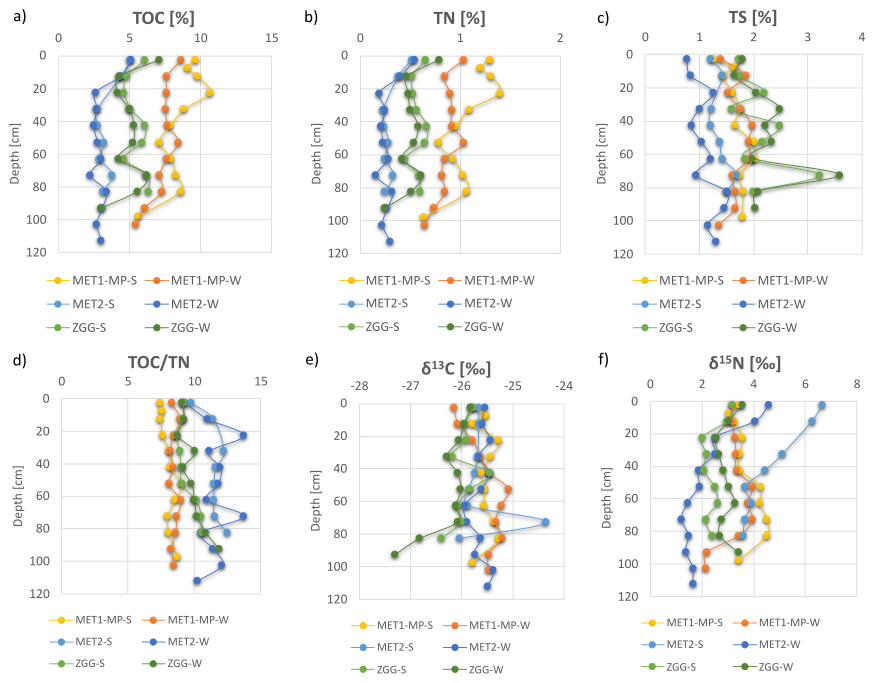
Figure 1Depth distribution of total organic carbon (TOC), total nitrogen (TN), and total sulfur (TS), molar TOC : TN ratio, and stable isotopic composition of carbon (δ13C) and nitrogen (δ15N) in sedimentary organic matter at the reference station (ZGG), the methane-influenced station (MET2), and the station affected by both methane and freshwater discharge (MET1-MP). Data are shown for summer 2023 (S) and winter 2024 (W).
The highest OM contents occur at station MET1-MP. TOC ranges from 5.5 wt % to 10.7 wt %, and TN from 0.6 wt % to 1.4 wt %. This station also shows the strongest downcore variability. The lowest OM contents are observed at MET2, with similar values in both seasons. TOC ranges from 2.5 wt % to 5.0 wt % and TN from 0.2 wt % to 0.5 wt %. Station ZGG exhibits intermediate values. TOC ranges from 3.0 wt % to 6.3 wt % and TN from 0.3 wt % to 0.8 wt %.
TS contents exceed 1 wt % at most depths (Fig. 1c). The highest average TS (2.2 wt %) occurs at ZGG. Maximum values (≥ 3.2 wt %) are recorded at 70–75 cm in both seasons. The lowest average TS (1.2 wt %) occurs at MET2. At MET1-MP, mean TS is 1.7 wt %. The TOC : TN ratio at MET1-MP ranges from 7.4 to 9.1. At ZGG, values range from 8.7 to 11.9. The highest ratios occur at MET2 (9.3–13.7).
Sediment oxidation–reduction potential (ORP) ranges from −502 to −5 mV. The highest values occur in surface layers (Fig. S2). Loss on ignition (LOI) ranges from 5.5 wt % to 20.2 wt % (Fig. S2). Values are highest at MET1-MP (13.5 wt %–20.2 wt %), intermediate at ZGG (6.5 wt %–14.4 wt %), and lowest at MET2 (5.5 wt %–10.5 wt %). Water content (W) follows a similar pattern (Fig. S2). The highest values occur at MET1-MP (67.4 wt %–97.7 wt %). At ZGG, W ranges from 66.0 wt % to 90.6 wt %. At MET2, W ranges from 50.4 wt % to 79.5 wt %.
The isotopic composition of organic carbon (δ13C) ranges from −27.3 ‰ to −24.4 ‰, and that of nitrogen (δ15N) from 1.2 ‰ to 6.7 ‰ (Fig. 1e, f). The lowest δ13C values occur at station ZGG in both seasons. The highest values are observed at MET2 in summer. The largest δ13C variability (∼ 1.5 ‰) is recorded at ZGG (−27.3 ‰ to −25.5 ‰) and MET2 (−26.0 ‰ to −24.4 ‰). At MET1-MP, δ13C varies within a narrower range (< 1 ‰), from −26.2 ‰ to −25.2 ‰. The greatest δ15N variability occurs at MET2 (1.2 ‰–6.7 ‰). At this station, deeper sediments are depleted in 15N relative to surface layers. The depletion reaches ∼ 3 ‰ in the deepest intervals. At MET1-MP and ZGG, δ15N varies over a narrower range (2.0 ‰–4.5 ‰).
3.2 Composition of pore water and bottom water
Results from summer and winter show that spatial differences among stations exceed seasonal variability (Figs. 2, 3). Depth profiles of major ions (Cl−, SO, Ca2+, Mg2+) are shown in Fig. 2. The concentration of Cl− ranges from 70.30 to 180.40 mmol dm−3, SO from 0.03 to 9.23 mmol dm−3, Ca2+ from 2.52 to 4.84 mmol dm−3, while Mg2+ from 8.34 to 18.37 mmol dm−3.
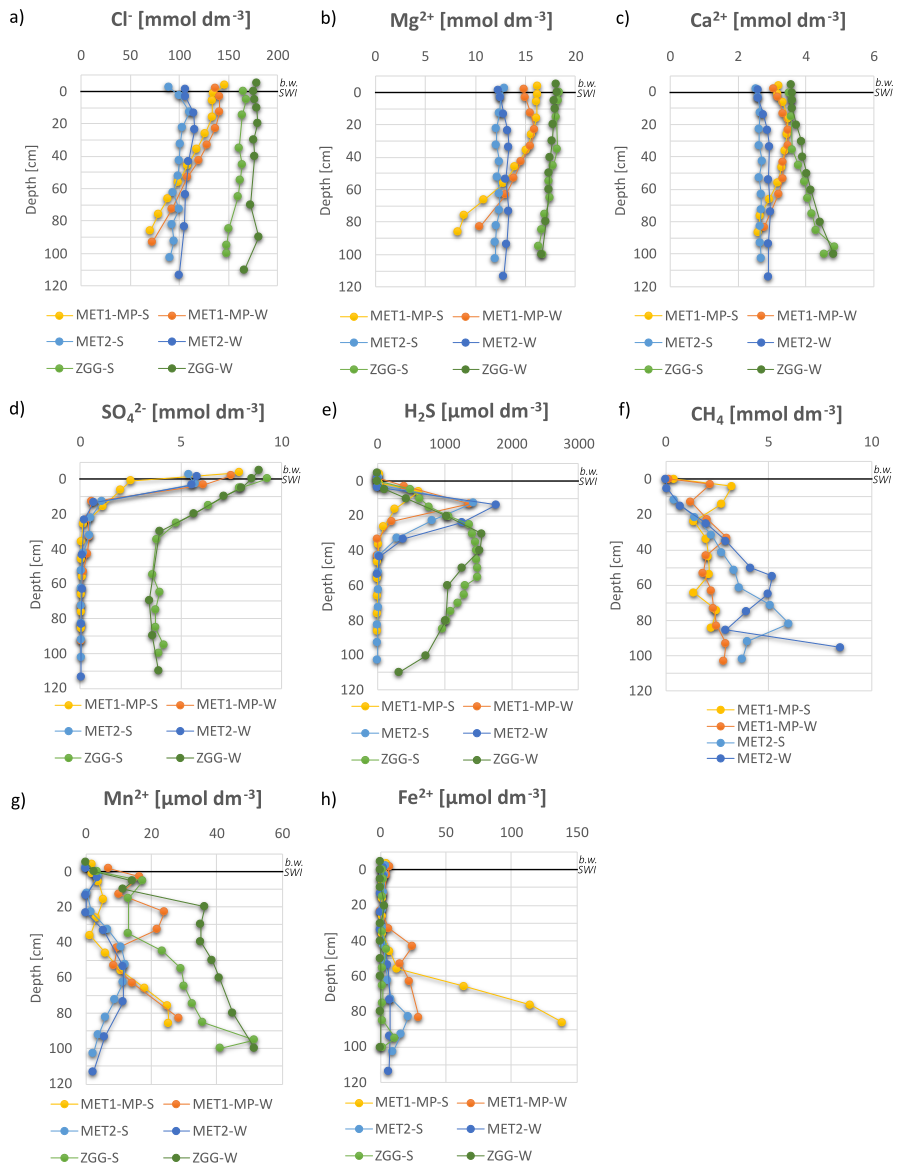
Figure 2Concentrations of (a) chloride, (b) magnesium, (c) calcium, (d) sulfate, (e) hydrogen sulfide, (f) methane, (g) manganese, and (h) iron in bottom water (b.w.) and pore water at the reference station (ZGG), the methane-influenced station (MET2), and the station affected by both methane and freshwater discharge (MET1-MP) during summer 2023 (S) and winter 2024 (W). SWI denotes the sediment–water interface.
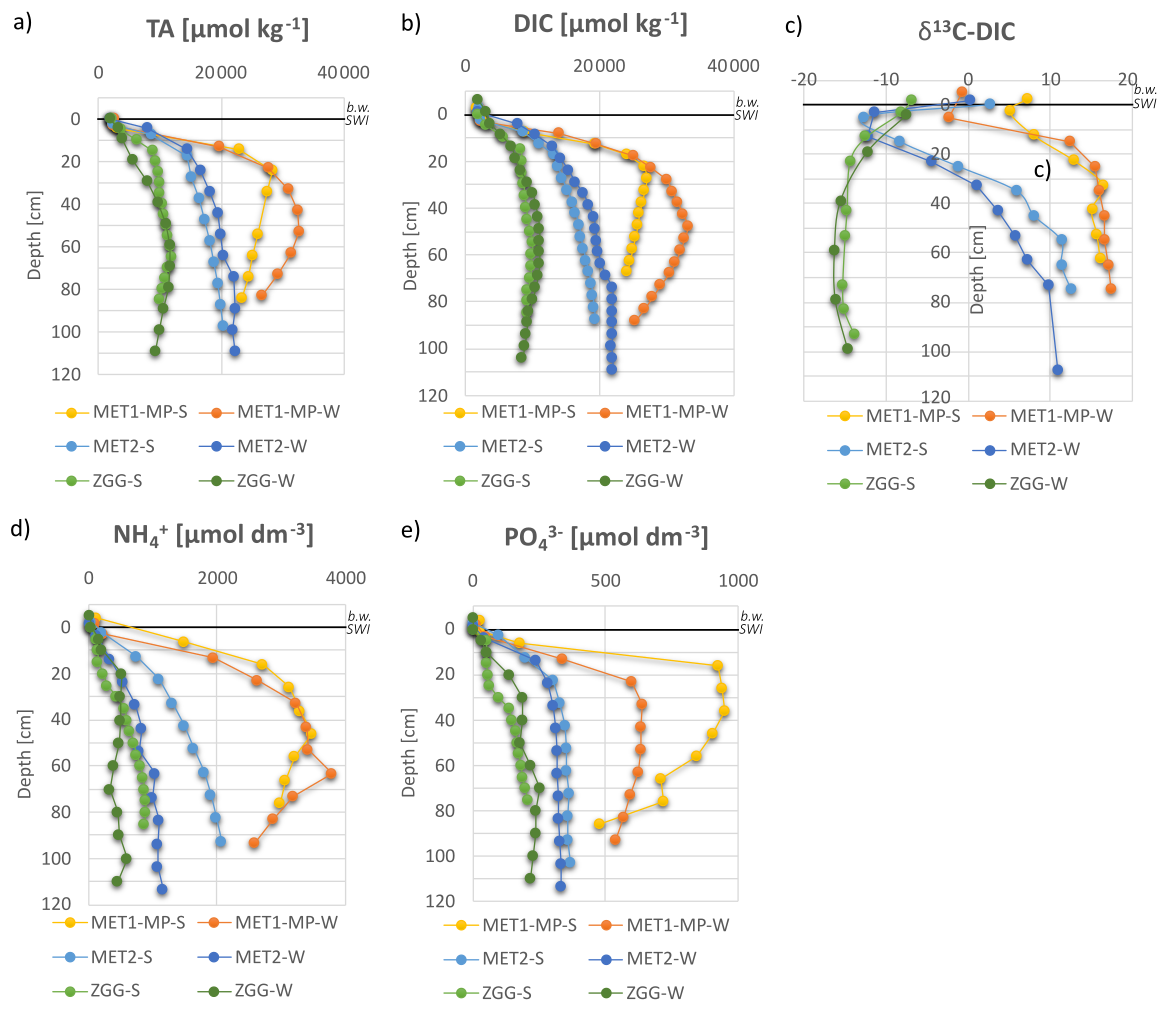
Figure 3Total alkalinity (TA) (a), dissolved inorganic carbon (DIC) (b), stable carbon isotopic composition of DIC (δ13C-DIC) (c), ammonium (d), and phosphate (e) concentrations in bottom water (b.w.) and pore waters. Labels as in Fig. 2.
Major-ion concentrations in bottom water and surface-most sediments reflect salinity. Salinity is highest at ZGG (12.2 in summer; 12.1 in winter) and lowest at MET2 (8.0 in summer; 7.5 in winter). At MET2, Cl−, Ca2+, and Mg2+ remain nearly constant with depth. In contrast, these ions decrease markedly with depth at MET1-MP. At ZGG, Ca2+ increases significantly downcore. Sulfate remains relatively high (≥ 3.5 mmol dm−3) throughout the ZGG profile. At MET1-MP and MET2, sulfate is restricted to the upper 30–40 cm.
∑H2S reaches maximum concentrations at ZGG (up to 2026 µmol dm−3). At MET1-MP and MET2, ∑H2S ranges from < LOQ to 1783 µmol dm−3 and is confined to discrete sediment intervals (Fig. 2e), corresponding to zones of sulfate-dependent methane oxidation. Bottom waters at MET2 are oxic (3.1 mg dm−3 O2 in summer; 5.9 mg dm−3 in winter). At ZGG and MET1-MP, O2 concentrations are < 0.2 in summer and < 1.7 mg dm−3 in winter.
Pore-water Fe2+ concentrations are generally < 30 µmol dm−3 (Fig. 2h). Elevated values occur only at MET1-MP, reaching 139.3 µmol dm−3 below 60 cm in summer. Mn2+ concentrations range from < LOQ to 51.6 µmol dm−3, with highest values at ZGG (Fig. 2g).
∑NH ranges from 22.2 to 3794.9 µmol dm−3. PO ranges from 1.4 to 950.2 µmol dm−3. Both species attain maximum concentrations at MET1-MP (Fig. 3d, e). At ZGG and MET2, concentrations are lower, ranging from 22.2 to 2027.0 µmol dm−3 for ∑NH and from 1.4 to 361.1 µmol dm−3 for PO.
The pH at all sampling sites was from 7.00 to 8.31, with an average of 7.57 ± 0.21 at station MET1-MP, 7.66 ± 0.26 at station MET2, and 7.57 ± 0.20 at station ZGG (Fig. S2).
The TA in the pore water varied in the range of 1911.3–32 747.2 µmol kg−1. Overall, the highest TA in pore waters was found in the sediment of pockmark MET1-MP, while the lowest values were observed at ZGG, similarly to DIC, which is the main component of TA in seawater (Fig. 3a).
DIC concentrations range from 1851 to 33 323 µmol kg−1 (Fig. 3b). The highest values occur at MET1-MP. The lowest concentrations and the smallest downcore variability are observed at the non-methane station ZGG.
The δ13C-DIC values range from −16.2 ‰ to 17.3 ‰ (Fig. 3c). At ZGG, δ13C-DIC remains negative throughout the profile. At MET2, negative values are restricted to the upper ∼ 25 cm, whereas deeper layers show positive values. At MET1-MP, δ13C-DIC exhibits limited variability. Negative values occur only in the surface layer (0–5 cm) during summer.
3.3 Methane concentration and stable C and H isotopes in gases
Methane concentrations at MET1-MP range from 0.17 to 3.24 mmol dm−3, and at MET2 from < LOQ to 8.49 mmol dm−3 (Fig. 2f). At MET1-MP, maximum CH4 concentrations occur near the sediment surface (∼ 5 cm b.s.f.). Concentrations decrease with depth and stabilize at ∼ 2 mmol dm−3. At MET2, CH4 increases progressively with depth and reaches a maximum at ≤ 80 cm b.s.f. Methane is not detected at ZGG.
Depth profiles of δ13C-CH4, δ2H-CH4, and δ13C-CO2 at MET1-MP and MET2 are shown in Fig. S3. At MET1-MP, δ13C-CH4 ranges from −62.6 ‰ to −55.8 ‰. At MET2, values are lower, from −76.6 ‰ to −69.6 ‰. The δ2H-CH4 values range from −271 ‰ to −257 ‰ at MET1-MP and from −250 ‰ to −239 ‰ at MET2. At MET2, δ13C-CO2 remains negative throughout the profile (−8.1 ‰ to −2.6 ‰). At MET1-MP, δ13C-CO2 ranges from −1.0 ‰ to 5.7 ‰ and is predominantly positive, except in the surface layer and at ∼ 90 cm b.s.f.
3.4 Rate of organoclastic sulfate reduction and anaerobic methane oxidation
The measured rates of organoclastic sulfate reduction (ROSR) and anaerobic oxidation of methane (RAOM) presented in Table 1 represent the maximum metabolic capacity of the microbial community (potential rates); incubations were conducted without substrate limitation and therefore reflect relative microbial activity between samples rather than absolute in situ rates.
ROSR ranges from 15 to 164 µmol dm−3 d−1 (Table 1). At ZGG, values range from 24 to 46 µmol dm−3 d−1. At MET2, rates vary between 21 and 48 µmol dm−3 d−1. The highest variability occurs at MET1-MP (16–163 µmol dm−3 d−1). At MET1-MP and MET2, maximum rates are observed in the 0–20 cm interval. At ZGG, the highest ROSR occurs at 20–40 cm depth.
RAOM ranges from 6 to 1077 µmol dm−3 d−1. At MET1-MP, rates are elevated throughout the profile (59–1077 µmol dm−3 d−1). Maximum values occur at 40–60 and 80–100 cm depth (Table 1). At MET2, RAOM is lower (6–33 µmol dm−3 d−1) and is concentrated in surface sediments. At ZGG, rates are relatively uniform with depth (8–10 µmol dm−3 d−1). Additional raw data concerning the determination of OSR and AOM are provided in the Supplement (Tables S2 and S3).
Table 1Organoclastic sulfate reduction (ROSR) and anaerobic methane oxidation (RAOM) rates (mean of two replicates), and the corresponding DIC production calculated from the stoichiometry of OSR (R5) and AOM (R14), at the reference station (ZGG), the methane-influenced station (MET2), and the station affected by both methane and freshwater discharge (MET1-MP).
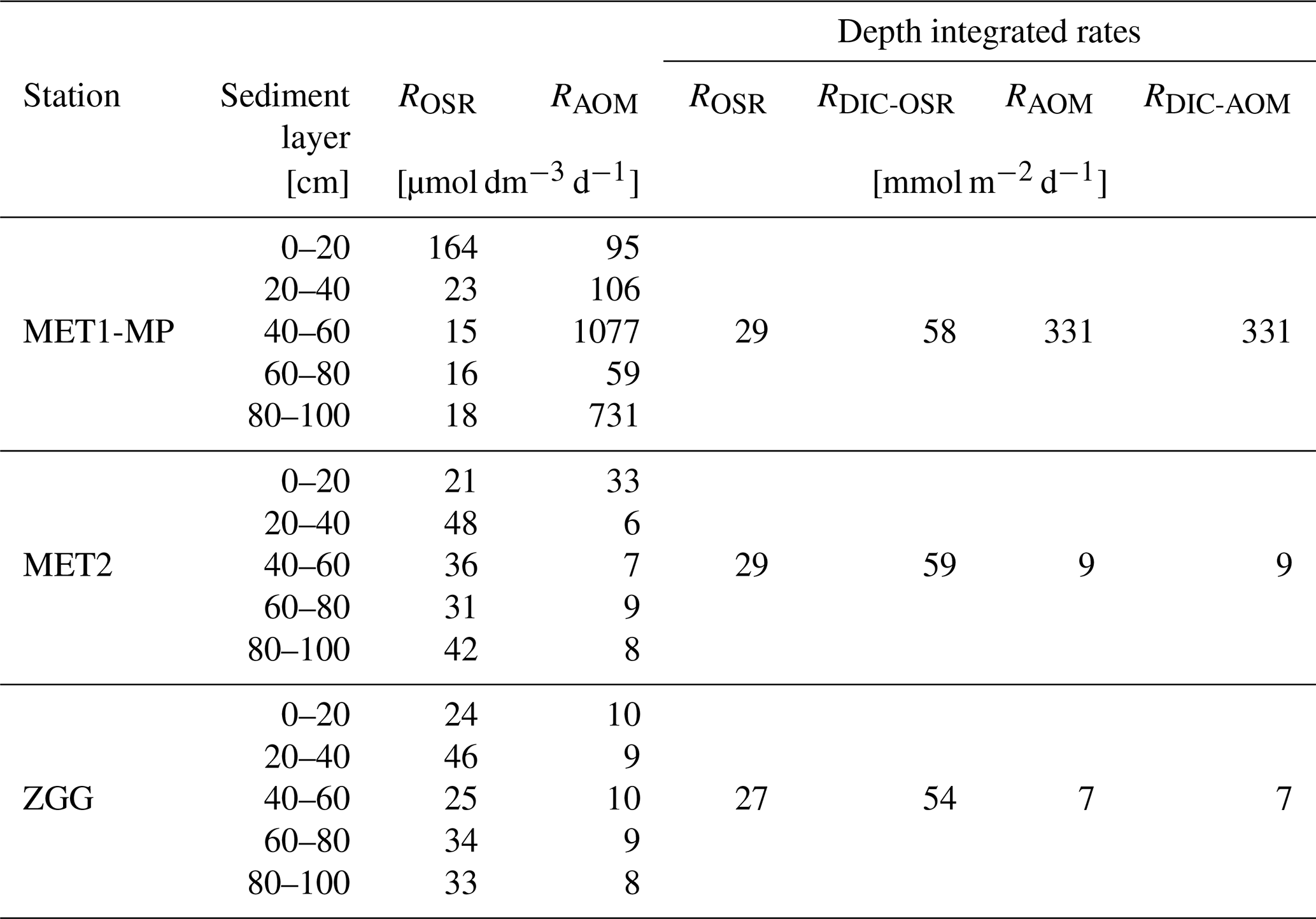
Depth-integrated ROSR and RAOM (0–100 cm) and the corresponding DIC production are summarized in Table 1. DIC production from OSR is comparable among stations. In contrast, MET1-MP exhibits exceptionally high RAOM and associated DIC production, exceeding values at the other stations by two orders of magnitude. The lowest process rates and DIC production occur at ZGG.
3.5 Mineralogy
The studied sediments are fine-grained (Brodecka et al., 2013) and classified as silt (MET1-MP), sandy silt (MET2), and clayey silt (ZGG). They are dominated by a matrix composed of clay minerals, biogenic silica, and organic matter (Fig. S5). This matrix constitutes ∼ 20 vol %–50 vol % of the sediment and generally increases with depth. At MET1-MP it ranges from 30 % to 54 %, at MET2 from 20 % to 39 %, and at ZGG from 36 % to 53 %.
Detrital aluminosilicates (mainly quartz, feldspars, and micas) occur as dispersed grains within this matrix. Their proportion remains relatively constant at MET2 (∼ 30 %–35 %) but decreases with depth at MET1-MP (13 % to 8 %) and ZGG (24 % to 13 %).
PXRD analyses of bulk samples (Fig. S6) and clay fractions (Fig. S7) indicate that phyllosilicates are dominated by mica/illite, chlorite, and kaolinite. A ∼ 17 Å reflection in glycolated samples that disappears upon heating indicates mixed-layer illite–smectite. The position of the (060) reflection is consistent with dioctahedral phyllosilicates (Moore and Reynolds, 1997). Microscopy also reveals glauconite, an Fe-rich mica-group mineral. It occurs sporadically at MET1-MP and MET2 and is more common at ZGG.
Authigenic carbonates and sulfides are minor components (< several wt %; Table 2). Pyrite (FeS2) is the dominant sulfide. It occurs as isolated euhedral crystals (cubic or octahedral, ≤ 1 µm) or as framboids with diameters of a few to ∼ 20 µm (Fig. 4). Irregular framboidal aggregates also occur. Pyrite framboids are commonly associated with diatom frustules or organic-rich domains. Microscopy and PXRD indicate higher average pyrite contents at ZGG than at MET1-MP and MET2 (Table 2).
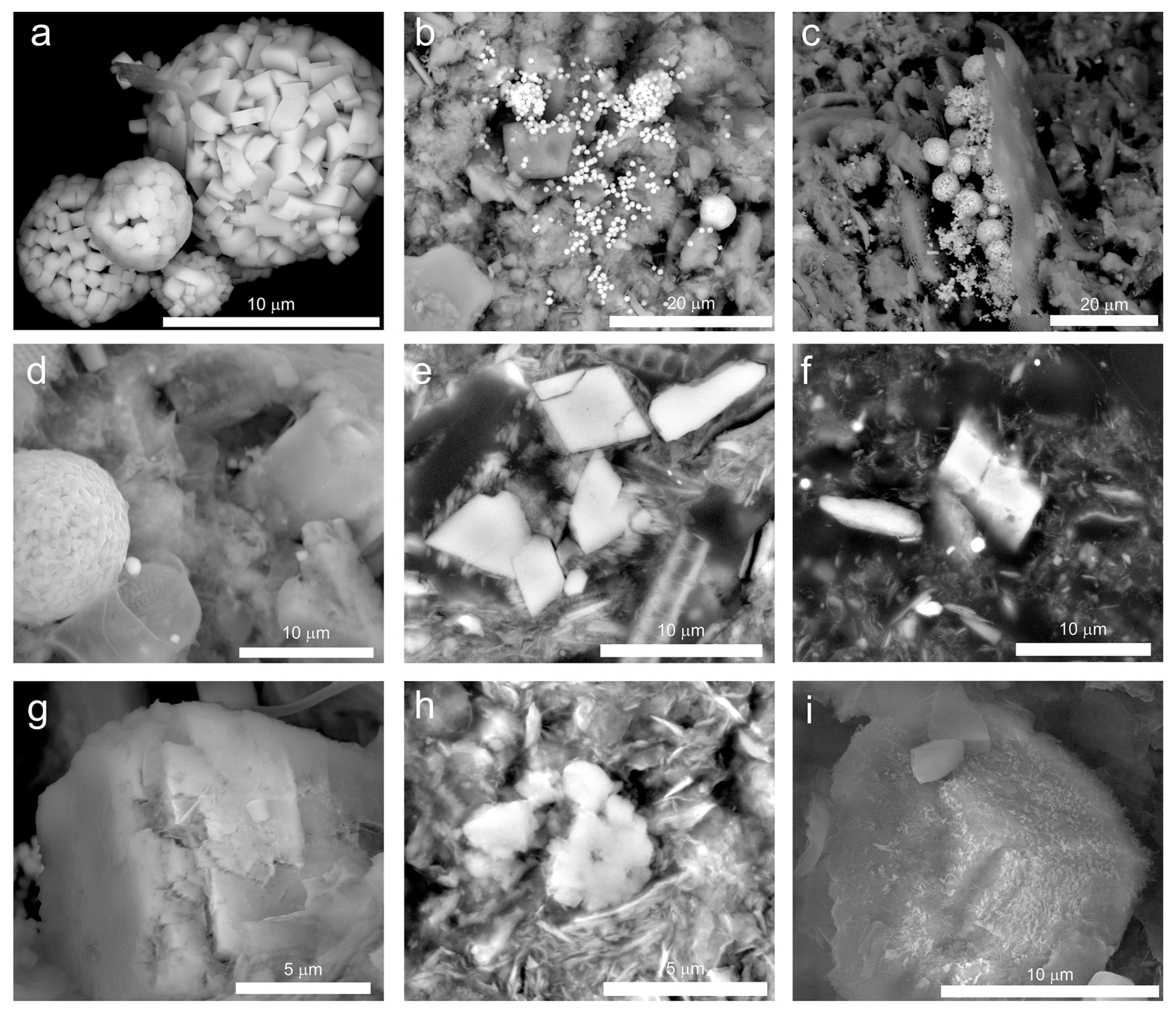
Figure 4Examples of SEM-BSE images of authigenic sulfides and carbonates: (a) pyrite framboids, MET2 (40–45 cm); (b) pyrite framboid and disseminated pyrite crystals, ZGG (10–15 cm); (c) pyrite framboids within a diatom shell, ZGG (40–45 cm); (d) pyrite framboid, diatom, dolomite, MET1-MP (40–45 cm); (e) euhedral and subhedral dolomite crystals, MET1-MP (10–15 cm; thin section); (f) euhedral dolomite, MET1-MP (10–15 cm; thin section); (g) dolomite, MET1-MP (40–45 cm); (h) calcite surrounded by clay minerals, ZGG (40–45 cm: thin section); (i) siderite, MET2 (40–45 cm).
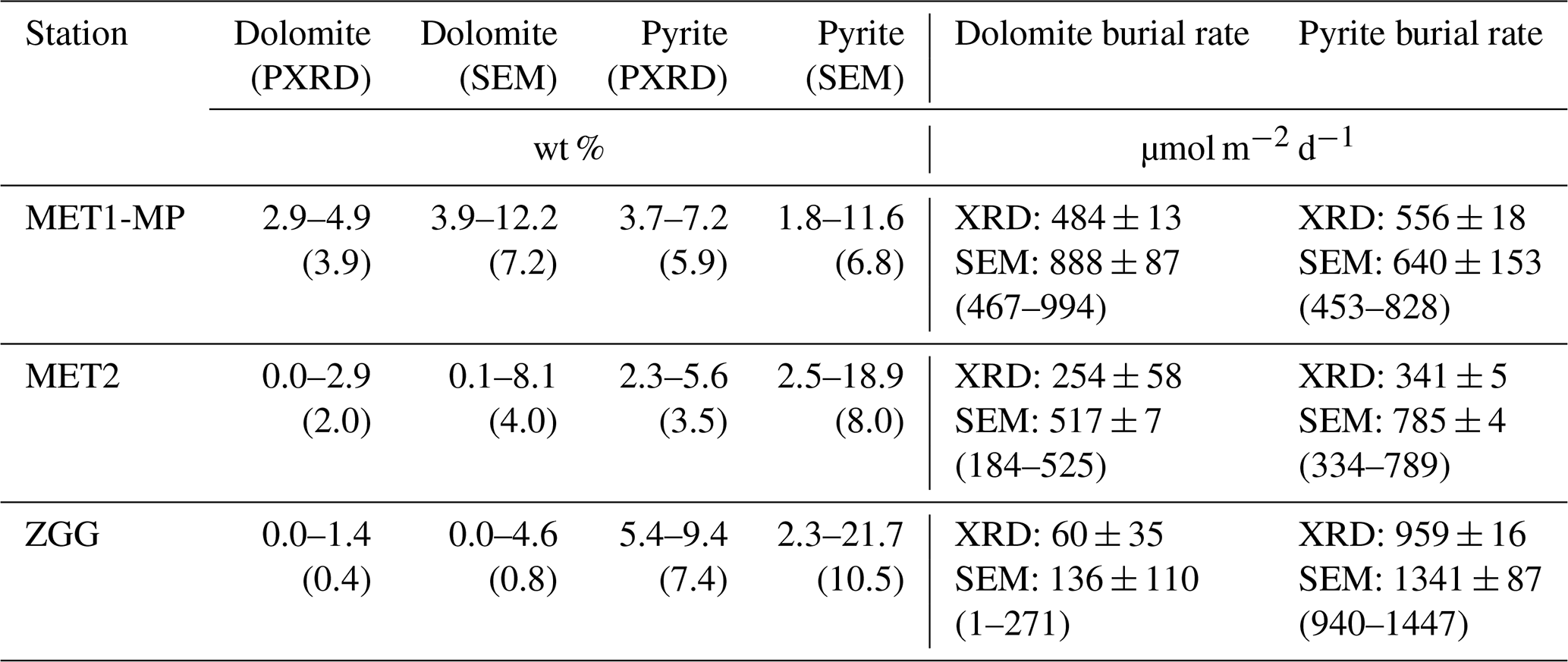
Table 2Dolomite and pyrite contents in sediments (range and mean values determined by PXRD and SEM–EDS elemental mapping) and corresponding burial rates. Burial rates are reported as mean values (based on PXRD and SEM–EDS) and as ranges derived from both methods within a 10–85 cm sediment column.
Dolomite [CaMg(CO3)2] is the predominant carbonate phase. Its presence is indicated by the 2.88 Å reflection in PXRD patterns (Fig. S6). Due to low concentrations, unambiguous interpretation is not possible because diffraction peaks (101), (015) and (021) indicative of space group of dolomite (Gregg et al., 2015; Lukoczki et al., 2026) are not apparent. However, SEM–EDS analyses (Fig. S8) show near-equimolar Ca and Mg, consistent with dolomite rather than high-Mg calcite. Also Raman microspectroscopy of carbonate crystals revealed typical dolomite (and not Mg-calcite) features (Fig. S9): strong sharp bands at 1100 (symmetric stretching), 305 (librational mode), and 180 (translational mode), as well as weak bands at 730 and 1445 cm−1, related to in-plane bending and asymmetric stretching, respectively (Sun et al., 2014; Zheng et al., 2021; Alves et al., 2023). Comparison of the Raman spectra with that of proper dolomite (Rędziny quarry, Southern Poland, Kowalski et al., 1976) indicates that the band broadening (Sun et al., 2014; Zheng et al., 2021) that should be associated with structural disorder (expected in protodolomite and high-Mg calcite) does not occur, as the band half-widths are of the same order as for crystalline dolomite (Fig. S9b). Moreover, euhedral to subhedral rhombohedral habits are typical for authigenic dolomite (Fig. 4), and not nanocrystalline aggregates characteristic of protodolomite (Liu et al., 2020; Zheng et al., 2021). Therefore, despite the lack of unambiguous PXRD evidence, both the chemical composition, morphology, and Raman features suggest that the dominant carbonate in the sediments is dolomite.
Dolomite is most abundant at MET1-MP, slightly less abundant at MET2, and nearly absent at ZGG (Table 2). At MET1-MP, dolomite forms euhedral crystals several to ∼ 20 µm in size (Fig. 4). At MET2, both fine (< 20 µm) euhedral or subhedral crystals and larger subhedral to anhedral grains occur. The euhedral/subhedral morphology of many of the crystals indicates that they are authigenic. At ZGG, small (5–10 µm) subhedral to anhedral grains are restricted to the subsurface layer (10–15 cm).
All sediments contain trace amounts of calcite (CaCO3), occurring as fine (< 10 µm) subhedral grains (Fig. 4h). Isolated euhedral siderite (FeCO3) crystals were identified only at MET2 (Fig. 4i).
All Mössbauer spectra (Fig. S10; Table S4) are similar and dominated by Fe(II) components. The principal doublet, comprising ∼ 50 %–60 % of the spectral area, exhibits an isomer shift (IS) of ∼ 0.3 and quadrupole splitting (QS) of ∼ 0.6 mm s−1. These parameters are characteristic of Fe(II) in pyrite (Byrne and Kappler, 2019). Two additional doublets contribute ∼ 25 %–30 % of the spectral area. They display high IS and QS values typical of Fe(II) in silicates (Dyar et al., 2006), although those of the minority doublet are also similar to Fe(II) in siderite (Rothwell et al., 2025). A further doublet, accounting for ∼ 10 %–28 % of the spectral area, shows relatively low IS (∼ 0.4–0.6 mm s−1) and moderate QS (∼ 0.7–0.9 mm s−1). These parameters indicate high-spin Fe(III) in octahedral coordination. The precise mineral host of this component cannot be resolved. The hyperfine parameters are consistent with paramagnetic Fe(III) oxyhydroxides at room temperature (Byrne and Kappler, 2019). However, Fe(III) incorporated in phyllosilicates such as micas/illite, chlorites, or glauconite is also plausible (De Grave et al., 1987).
3.6 Burial rate of dolomite and pyrite
Carbonate burial rates were calculated using dolomite contents, as dolomite is the dominant carbonate phase. Pyrite burial rates were also determined due to pronounced inter-station variability. The highest dolomite burial occurs at MET1-MP (Table 2). Rates are 484 ± 13 based on PXRD and 888 ± 87 µmol m−2 d−1 based on SEM–EDS. Intermediate values are observed at MET2 (254 ± 58 and 517 ± 7 µmol m−2 d−1, respectively). The lowest rates occur at ZGG (60 ± 35 from PXRD and 136 ± 110 µmol m−2 d−1 from SEM–EDS). In contrast, pyrite burial is highest at ZGG. Rates reach 959 ± 16 (PXRD) and 1341 ± 87 µmol m−2 d−1 (SEM–EDS). At MET1-MP, values are 556 ± 18 and 640 ± 153 µmol m−2 d−1, respectively. At MET2, pyrite burial rates are 341 ± 5 (PXRD) and 785 ± 4 µmol m−2 d−1 (SEM–EDS).
4.1 Typical anoxic sediment dominated by organoclastic sulfate reduction as the primary pathway of organic matter decomposition (station ZGG)
Nutrient enrichment associated with intensified fertilizer application has promoted widespread coastal eutrophication. Elevated nitrogen and phosphorus inputs stimulate primary production and increase the flux of OM to the seafloor. Enhanced organic carbon delivery raises sedimentary oxygen demand and promotes hypoxia and anoxia in bottom waters (Rabalais et al., 2010). These effects are amplified under strong density stratification, which limits vertical mixing and oxygen replenishment from surface layers (Carstensen et al., 2014). Under anoxic conditions, sulfate reduction becomes the dominant mineralization pathway, leading to hydrogen sulfide accumulation in bottom water.
Station ZGG, located in the western Gdańsk Deep in the southern Baltic Sea (Fig. S1), represents such an environment. The seafloor is covered by fine-grained sediments with mean water and OM contents of 76 % and 11 %, respectively, characteristic of an accumulation bottom type (Jönsson et al., 2005). TOC and TN values fall within the range typical for deep Baltic sediments (Ucinowicz, 2011). Maximum concentrations occur in the uppermost centimeters (Fig. 1a, b), reflecting enhanced eutrophication.
The molar TOC : TN ratio ranges from 8.5 to 11.8, exceeding typical marine values of 4–8 and indicating a contribution of terrestrial OM, for which TOC : TN commonly exceeds 12 (Meyers, 1997; Carneiro et al., 2021; Yadav et al., 2025). Carbon isotopic compositions further support this interpretation. δ13C values at ZGG range from −27.3 ‰ to −25.5 ‰ (Fig. 1e). These values are more negative than those of marine phytoplankton (−18 ‰ to −24 ‰; Yadav et al., 2025) and typical mid-latitude marine OM (−22 ‰ to −20 ‰; Meyers, 1994), and fall within the range characteristic of terrestrial C3 plants (−35 ‰ to −25 ‰; average 27 ‰). The combined TOC : TN and δ13C data indicate a significant input of vascular plant-derived organic carbon, which is carbon-rich and isotopically depleted relative to marine primary production (Meyers, 1994, 1997), in all the studied sediments. Riverine discharge is a major source of terrestrial carbon, contributing up to 10 %–30 % of the total carbon pool in Baltic sediments (Miltner and Emeis, 2001). Nitrogen isotopic compositions (δ15N=2.0 ‰–3.6 ‰; Fig. 1f) are at or slightly below the typical range for marine OM (3 ‰–12 ‰; Maksymowska et al., 2000; Wada and Hattori, 1991). In contrast, terrestrial C3 plants exhibit a broader range (−10 ‰ to +10 ‰). The relatively low δ15N values at ZGG therefore further support a substantial allochthonous contribution. Increased biomass development may also lead to a modification of the isotopic composition of both nitrogen and carbon in sediments, the effect of which may also be visible in the case described. For example, a decrease in the δ15N value of OM can be caused by the addition of isotopically light nitrogen to the N pool, bound by diazotrophic cyanobacteria, as in the case described by Struck et al. (2000) for the Gotland Basin. In turn, increased primary production can lead to an increase in 13C content in sediment organic matter. For example, in the Oder Haff an increase of δ13C in OM of 1.7 ‰ was found, while in the Gotland Basin it was 2.6 ‰ (Struck et al., 2000).
Sediments at ZGG are also characterized by elevated TS contents (1.59 wt %–3.58 wt %; Fig. 1c). The TOC : TS ratio provides insight into depositional redox and salinity conditions (Berner et al., 1979; Berner and Raiswell, 1984). A ratio of 2.8 ± 0.4 is typical of normal marine sediments underlying oxygenated waters (Berner, 1982). Lower values indicate enhanced sulfide formation under anoxic conditions, whereas TOC : TS > 2.8 is characteristic of freshwater environments. The mean TOC : TS ratio at ZGG (2.5 ± 0.6) is slightly lower below the marine oxic benchmark. This suggests suboxic to anoxic depositional conditions, controlled by substantial water depth, persistent stratification, and bottom-water oxygen depletion.
In the uppermost centimeters, pore-water composition closely resembles that of bottom water (Fig. 2). With increasing depth, diagenetic processes progressively modify the chemical composition. Sulfate concentrations decrease rapidly within the upper ∼ 30 cm and stabilize at ∼ 3.5 mmol dm−3 in deeper layers (Fig. 2d). In parallel, H2S concentrations increase (Fig. 2e), reflecting active microbial sulfate reduction. Concentrations of NH, PO, DIC, and TA also increase with depth (Fig. 3), indicating that a common mineralization process supplies these components to pore waters. Sulfate can be consumed during both OSR (Table S1: R5) and AOM (Table S1: R14). Although methanogenesis and AOM may occur deeper in the sediment at ZGG, sulfate remains relatively abundant throughout the studied profile, and CH4 concentrations are below LOQ (Fig. 2f). These observations indicate that sampling captured the sulfate reduction zone above the sulfate–methane transition (SMT). This interpretation is consistent with the inhibitory effect of sulfate on methanogenesis, as sulfate-reducing microorganisms outcompete methanogens for H2 and acetate (Reeburgh, 2007). The δ13C-DIC profile further supports this conclusion. δ13C-DIC values decrease with depth (Fig. 3c), whereas methanogenesis typically increases δ13C-DIC due to preferential removal of 12C into CH4 (Whiticar, 1999). Moreover, DIC and δ13C-DIC exhibit a strong linear correlation (R2 = 0.98), and no δ13C-DIC minimum characteristic of the SMT is observed (Malinverno and Pohlman, 2011). The slope of the regression corresponds to δ13C values typical of marine OM (−22 ‰ to −20 ‰; Meyers, 1994), indicating that DIC is derived predominantly from organic carbon oxidation (Chen et al., 2024).
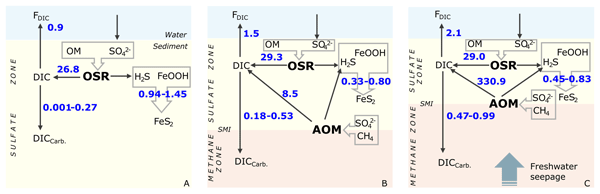
These data demonstrate that OSR is the principal process consuming SO and controlling pore-water DIC and TA at ZGG. According to stoichiometry, OSR produces two moles of DIC per mole of sulfate reduced (Table S1: R5), whereas sulfate-driven AOM yields a 1 : 1 ratio (Table S1: R14). The relationship between the increase in DIC (ΔDIC) and the decrease in sulfate (ΔSO) therefore provides a diagnostic criterion for distinguishing these processes (Masuzawa et al., 1992; Rassmann et al., 2016). At ZGG, the ΔDIC : ΔSO ratio is 1.85 : 1 (Fig. S4), close to the theoretical 2 : 1 value expected for OSR. Minor deviations from the theoretical ratio may reflect partial DIC removal by authigenic carbonate precipitation (Akam et al., 2020). Chemoautotrophic CO2 fixation may also contribute to DIC consumption (Treude et al., 2007). In addition, a fraction of sediment-produced DIC diffuses into the overlying water. Assuming oxidation of H2S at the sediment–water interface, the estimated net diffusive benthic flux of carbonate alkalinity ([HCO] + 2[CO]) and DIC at ZGG is 983 ± 40 and 942 µmol m−2 d−1, respectively (Łukawska-Matuszewska and Kiełczewska, 2016; Łukawska-Matuszewska and Dwornik, 2025).
The ROSR values in ZGG sediments (24–46 µmol dm−3 d−1) are consistent with rates reported from other Baltic regions using radioisotope methods. These include 0.2–42.3 in the Curonian and Vistula Lagoons (Pimenov et al., 2013), 0–43 in the Gdańsk Basin (Pimenov et al., 2010), and < 1.0–21.4 µmol dm−3 d−1 in Kattegat (Iversen and Jørgensen, 1985). The measured values also fall within the lower range of rates reported from Eckernförde Bay (10–465 µmol dm−3 d−1; Treude et al., 2005), Himmerfjärden (0.2–338 µmol dm−3 d−1; Sawicka and Brüchert, 2017), and the Gotland Deep (< 250 µmol dm−3 d−1; Piker et al., 1998). Incubation-derived potential ROSR values are several times higher than rates previously calculated for the same area from sulfate pore-water gradients (0.2–4.6 µmol dm−3 d−1; Łukawska-Matuszewska and Dwornik, 2025). This discrepancy is expected, as incubation experiments determine gross sulfate reduction, whereas pore-water profiles reflect net sulfate consumption (Iversen and Jørgensen, 1985). Experiments with labeled substrates in the present study indicate the potential for AOM at ZGG (Table 1), with rates up to ∼ 10 µmol dm−3 d−1. This suggests that methane could be oxidized if supplied from deeper layers. However, geochemical evidence indicates that the sampled interval corresponds to the sulfate reduction zone above the SMT. Consequently, AOM does not significantly contribute to DIC and TA production in the studied sediments. It should be also mentioned that experimentally-derived AOM rates represent the potential activity of the microbial community under substrate-replete conditions rather than the actual in situ process rates. Therefore, the similar experimentally-derived rates at MET-2 and ZGG indicate a comparable microbial potential for AOM at both sites. In contrast, the porewater profiles reflect in situ conditions, where methane availability differs substantially between the sites. At MET-2, methane is present and supports active AOM, which is reflected in the porewater profiles. At ZGG, methane concentrations are negligible, so AOM appears less significant in situ despite the presence of a microbial community capable of performing this process if methane became available.
Based on stoichiometry (Table S1: R5) and measured ROSR, OSR contributes 49–92 µmol dm−3 d−1 of DIC to ZGG pore waters. The depth-integrated DIC production from OSR within the 0–100 cm interval equals 54 mmol m−2 d−1 (Table 1). Reduction of Mn(IV) during OM degradation may represent an additional DIC source, as indicated by the presence of Mn2+ in pore waters (Fig. 2g). However, Mn2+ concentrations are low relative to H2S, the byproduct of sulfate reduction. Therefore, Mn(IV) reduction likely contributes only marginally to DIC production and is not included in the quantitative assessment. Besides Mn(IV) reduction, organic matter oxidation in marine sediments can proceed via denitrification. However, in the reducing sediments examined here nitrate was consistently below detection limit and nitrite occurred only at trace levels (data not shown), so denitrification was not quantified. While denitrification can produce DIC, we have no evidence for substantial availability of oxidized nitrogen species in these samples and therefore expect its contribution to be negligible.
The progressive increase in DIC with depth leads to pore-water supersaturation with respect to carbonate minerals, primarily calcite and dolomite, throughout most of the sediment column, except for the upper 5–10 cm (Fig. S11). Despite thermodynamic supersaturation, carbonate contents remain low (Table 2). Calcite occurs only in trace amounts, and dolomite was identified exclusively in the subsurface layer during summer. Moreover, anhedral morphology of many grains raises uncertainty as to whether all these carbonates are entirely authigenic. The dolomite burial rate is substantially lower than in methane-bearing sediments (Table 2) and does not exceed 271 µmol m−2 d−1. For comparison, burial rates reach 525 at MET2 and 994 µmol m−2 d−1 at MET1-MP. Comparable rates to those recorded at the ZGG – 60 ± 35 from PXRD and 136 ± 110 µmol m−2 d−1 from SEM–EDS – were reported by Zha et al. (2022) for sediments on the northern slope of the South China Sea. Using reactive transport modeling, they estimated the burial rate of Ca-Mg carbonates to be 65 in the upper 30 cm of sediment at one site and 79 µmol−2 d−1 in the upper 10 cm at another.
The DIC : TA ratio is a simple diagnostic of the relative contribution of non-carbonate bases to total alkalinity. In seawater, DIC defined as the sum of [CO] + [HCO] + [CO] with [CO] denoting the sum of dissolved [CO2] and [H2CO3] (Dickson et al., 2007), typically represents over 95 % of TA (Emerson and Hedges, 2008). In this concept, lower DIC : TA values signal a larger noncarbonate alkalinity fraction (e.g., HS−, NH3), whereas values near unity indicate TA is dominated by carbonate species. The mean DIC : TA ratio in ZGG pore waters is 0.75. This value indicates that approximately 25 % of total alkalinity derives from non-carbonate bases, primarily H2S. Hydrogen sulfide constitutes an independent acid–base system capable of proton exchange (Hu et al., 2010) and is therefore included in TA calculations. Upward diffusion of H2S toward the sediment–water interface followed by oxidation leads to partial consumption of alkalinity (Table S1: R10) generated during anaerobic mineralization (Krumins et al., 2013). In contrast, precipitation of sulfides within the sediment (Table S1: R15) prevents complete reoxidation and results in a net increase in pore-water TA.
Geochemical modeling indicates that pore waters at ZGG are supersaturated with respect to iron sulfides, including greigite, mackinawite, and pyrite, throughout the sediment column (Fig. S11). Increasing TS content with depth and relatively low TOC : TS ratios further support enhanced sulfide accumulation compared to the methane-affected stations. Mineralogical data confirm that pyrite is more abundant at ZGG than at MET1-MP and MET2. Its burial rate ranges from 940 to 1447 µmol m−2 d−1, several times higher than at the other sites, where OSR rates and pore-water H2S concentrations are lower. These values are high and comparable to the upper range reported by Jørgensen et al. (1990) for sediments from the Baltic–North Sea transition zone (50–1240 µmol m−2 d−1).
The rate of sulfate reduction in the studied sediments likely exceeds the rate of reaction between H2S and reactive iron phases. This imbalance promotes the accumulation of dissolved H2S in pore waters (Boesen and Postma, 1988; Canfield et al., 1992). Accordingly, H2S concentrations remain high throughout the sediment profile, whereas Fe2+ is largely depleted from pore waters (Fig. 2). Mössbauer spectroscopy indicates that iron is predominantly divalent (Fig. S10). Thus, the availability of reactive Fe(III) phases likely limits pyrite formation. Such limitation is typical of anoxic to euxinic marine environments (Raiswell and Berner, 1985; Boesen and Postma, 1988) and has previously been documented for sediments of the Gdańsk Deep (Łukawska-Matuszewska et al., 2019). Incomplete removal of H2S as solid sulfides and its reoxidation (Table S1: R10) may contribute to pore-water acidification. The observed increase in Ca2+ concentration with depth (Fig. 2) may therefore reflect carbonate dissolution driven by lowered pH.
4.2 Nearshore methane-bearing sediment with high terrigenous organic matter input (station MET2)
High OM loading from local primary production and terrigenous sources increases oxygen demand in coastal sediments and frequently exceeds oxygen supply (Hedges et al., 1997; Schlünz and Schneider, 2000). Oxygen penetration is therefore shallow. It is typically < 1 mm in muddy and silty sediments and only a few centimeters in sands (Glud, 2008), owing to limited transport and rapid consumption. As a consequence, anaerobic mineralization dominates in most coastal settings (Soetaert et al., 1996), with sulfate serving as the principal electron acceptor, as observed at station ZGG. When organic carbon input exceeds sulfate availability, mineralization proceeds via methanogenesis (Froelich et al., 1979). Diagenetic zonation in coastal sediments differs markedly from that in open-ocean environments. Redox zones are thinner and shifted closer to the sediment surface (D'Hondt et al., 2004; Egger et al., 2018). In low-salinity settings, sulfate reduction, the SMT, and methanogenesis commonly occur at shallow depths (Albert et al., 1998; Thang et al., 2013; Egger et al., 2015). Station MET2 is located in a nearshore zone (Fig. S1) with bottom-water salinity of ∼ 7–8. The molar TOC : TN ratio (9.3–13.7; Fig. 1d) indicates a substantial contribution of terrestrial OM, which is relatively nitrogen-poor compared to protein-rich marine phytoplankton. Carbon isotopic compositions support this interpretation. δ13C values range from −26.0 ‰ to −24.4 ‰, i.e., below −24 ‰, consistent with terrestrial input (Yadav et al., 2025). Nitrogen isotopic values (δ15N = 1.21 ‰–6.66 ‰) show the greatest 15N enrichment in the upper 0–20 cm, coinciding with elevated TOC and TN contents. Terrestrial OM is generally less degradable than marine OM due to the abundance of cellulose and lignin in vascular plant tissues (Dickens et al., 2006). The observed isotopic and compositional variations therefore reflect preferential degradation of labile phytoplankton-derived compounds and the relative accumulation of more refractory terrestrial material in the sediment.
Because MET2 is located in a shallower, transport-dominated setting, the sediment consists of sandy silt and contains lower TOC and TN than the silty and clayey sediments at the other stations (Fig. 1a, b). Owing to the relatively low salinity, major ion concentrations in bottom and pore waters are the lowest among all sites. These concentrations remain nearly constant with depth, except for SO (Fig. 2a–d). Sulfate decreases rapidly within the upper 0–40 cm due to microbial reduction and falls below LOQ at greater depths. In the upper ∼ 20 cm b.s.f., the ΔDIC : ΔSO ratio ranges from 1.0 to 2.1, consistent with contributions from both sulfate-driven AOM and OSR. The mean ratio of 1.51 : 1 indicates a mixed origin of DIC. Below this interval, DIC production becomes disproportionately high relative to sulfate consumption, and the ΔDIC : ΔSO ratio increases to ∼ 4.0 (Fig. S4). Such excess DIC may reflect processes that produce DIC but do not consume sulfate, including methanogenesis, or alternative AOM pathways coupled to Mn(IV) or Fe(III) reduction (Meister et al., 2019). Elevated Mn2+ concentrations between 30 and 80 cm and Fe2+ below 80 cm (Fig. 2g, h) may suggest involvement of these pathways. However, the absolute concentrations of Mn2+ and Fe2+ are low, indicating that metal-driven AOM likely contributes only marginally to DIC and TA production and is not considered further.
Methane concentrations at MET2 reach 6.5 in summer and 8.45 mmol dm−3 in winter (Fig. 2f). Stable isotope data for δ13C-CH4, δ2H-CH4, and δ13C-CO2 (Fig. 5) indicate a microbiological origin, predominantly via hydrogenotrophic methanogenesis (Whiticar, 1999). Methane concentrations decrease upward from maxima in deeper layers to values below LOQ in the uppermost centimeters. Methane is absent from the overlying water column, demonstrating that the sediment acts as an efficient methane filter despite the shallow SMT at ∼ 5–13 cm b.s.f. In Baltic Sea sediments, SMT depths vary widely, ranging from 80–160 cm in the Danish Straits (Iversen and Jørgensen, 1985), ∼ 150 cm in Aarhus Bay (Thomsen et al., 2001), and 30–40 cm in the Gotland Deep (Piker et al., 1998). SMT depths comparable to those observed here have been reported from Storfjärden and Pojo Bay (Myllykangas et al., 2020; Jilbert et al., 2021), the western Gotland Basin (Ketzer et al., 2024), and Eckernförde Bay in the southwestern Baltic Sea (Treude et al., 2005; Maltby et al., 2018).
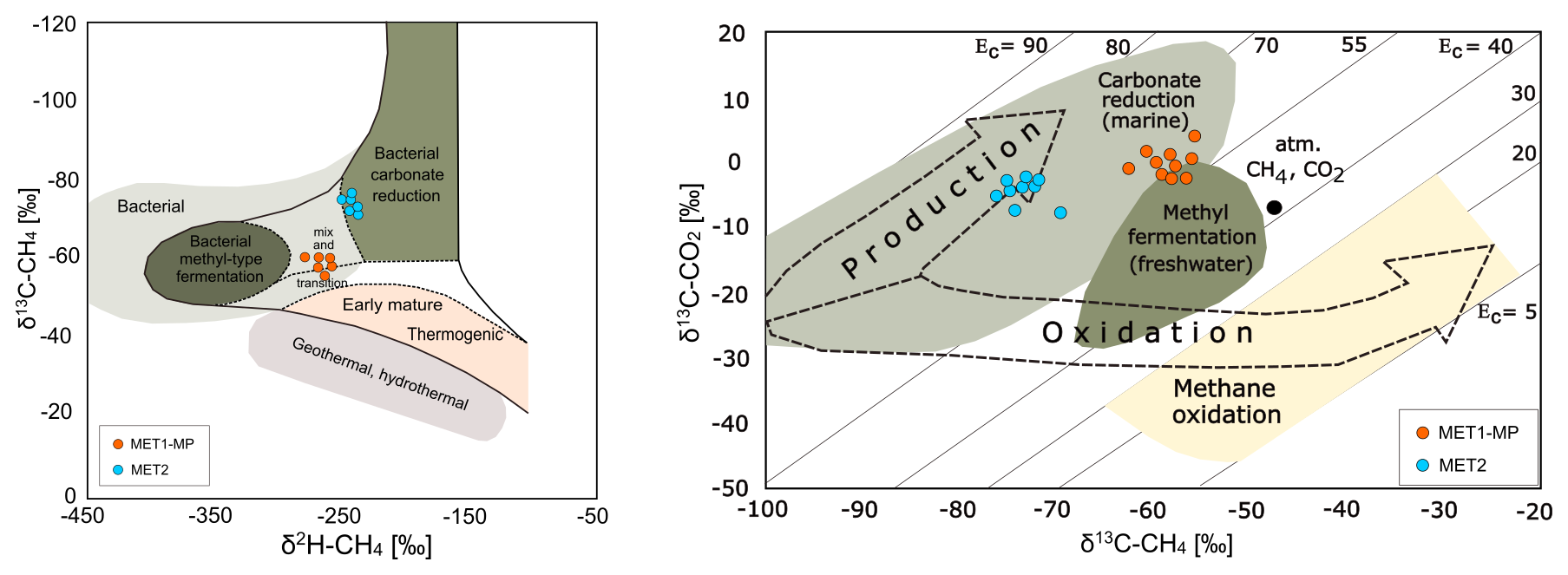
Figure 5Origin of methane inferred from the combined δ13C and δ2H composition of methane (a) and from δ13C values of methane and carbon dioxide (b) in sediments at stations MET1-MP and MET2 in the Gdańsk Basin (modified after Whiticar, 1999).
The occurrence of sulfate-dependent AOM within the 5–13 cm b.s.f. interval is indicated by the most negative δ13C-DIC values (Fig. 3c) (Malinverno and Pohlman, 2011). In the overlying sediment, OM is oxidized primarily via OSR. However, separation of OSR and AOM zones based solely on isotopic data is difficult, as both processes produce 13C-depleted DIC. OSR shifts δ13C-DIC from values near 0 ‰, typical of seawater, toward approximately −21 ‰, characteristic of marine OM. Subsequent sulfate-driven AOM may further deplete DIC in 13C through oxidation of isotopically light CH4 (Meister and Reyes, 2019). At MET2, δ13C-DIC values range from −12.7 ‰ to −1.2 ‰. These values are markedly less negative than expected for only AOM or OSR end-members. If DIC generated by sulfate-AOM inherited the isotopic signature of methane entering the SMT, δ13C-DIC values would approach 76 ‰. Conversely, DIC derived from OSR should approximate the δ13C of sedimentary OM (−25.6 ‰ at MET2). The relatively enriched δ13C-DIC values observed in both AOM and OSR intervals suggest mixing with 13C-enriched DIC diffusing upward from the methanogenic zone (Malinverno and Pohlman, 2011; Meister and Reyes, 2019). Overall, pore-water DIC at MET2 reflects a mixture of inorganic carbon produced by overlapping diagenetic processes. A comparable situation has been reported from Storfjärden, where OSR, sulfate-driven AOM, and methanogenesis co-occur within compressed redox zones (Jilbert et al., 2021).
The ROSR values at MET2 range from 21 to 48 µmol dm−3 d−1. These rates are comparable to those measured at the other stations (Table 2) and fall within ranges reported in the literature (Sect. 4.1). The RAOM values (6–33 µmol dm−3 d−1) are also consistent with data from other Baltic regions, including 0–50 in the Gdańsk Basin (Pimenov et al., 2010), 0.03–14 in Eckernförde Bay (Treude et al., 2005), and 0.002–6.2 µmol dm−3 d−1 in Kattegat and Skagerrak (Iversen and Jørgensen, 1985). The highest RAOM occurs within the 0–20 cm layer. Rates in this interval are up to six times higher than those in the 20–40 cm layer. This distribution corresponds to geochemical indicators, including the steepest SO gradient, maximum H2S concentrations, ΔDIC : ΔSO ratios lower than expected exclusively for OSR, and negative δ13C-DIC values in the upper sediment. At MET2, ROSR contributes 41–96 µmol DIC dm−3 d−1 to pore waters. The depth-integrated DIC production from OSR within the 0–100 cm interval equals 59 mmol m−2 d−1, similar to values obtained for ZGG (Table 1). In addition, AOM contributes 6–33 µmol dm−3 d−1 of DIC, corresponding to an integrated production rate of 9 mmol m−2 d−1. The pronounced chemical gradients at the sediment–water interface correspond to a diffusive benthic flux of carbonate alkalinity ([HCO] + 2[CO]) estimated at 1498 ± 80 µmol m−2 d−1 (Łukawska-Matuszewska and Dwornik, 2025). The mean DIC : TA ratio in MET2 pore waters is 0.97. This value indicates a relatively minor contribution of non-carbonate bases to total alkalinity compared to ZGG. The dominance of carbonate alkalinity suggests that alkalinity production at MET2 is less reversible. In contrast, at ZGG, substantial H2S production and its subsequent oxidation release H+ and partially consume alkalinity (Table S1: R10).
Pore waters at MET2 exhibit higher saturation indices with respect to calcite and dolomite than those at methane-free ZGG (Fig. S11). Intense diagenesis leads to a strong increase in DIC, which raises porewater saturation with respect to carbonates and thereby promotes precipitation of authigenic phases. This is consistent with the greater abundance of dolomite throughout the sediment column, as documented by PXRD and microscopic observations (Table 2). The dolomite burial rate at MET2 (184–525 µmol m−2 d−1) substantially exceeds that at ZGG (1–271 µmol m−2 d−1). Taken together, the porewater chemistry and burial rates suggest that methane-bearing sediments in our study area sequester more inorganic carbon than methane-free, OSR-dominated sediments (ZGG) – likely because methane-related processes generate additional DIC.
In deeper layers at MET2, pore waters are also supersaturated with respect to siderite. In contrast, siderite is undersaturated throughout the ZGG profile (Fig. S11). This difference likely reflects Fe2+ availability. At ZGG, Fe2+ is efficiently removed from pore waters through reaction with abundant H2S and subsequent sulfide precipitation. At MET2, H2S is restricted to a narrow interval, with maximum concentrations at ∼ 13 cm b.s.f. (Fig. 2e). Below this depth, H2S concentrations fall below LOQ. Under these conditions, a fraction of dissolved Fe2+ may precipitate as siderite rather than as iron sulfides.
In MET2 sediments, the mean TOC : TS ratio is 2.8. This value corresponds to typical marine sediments deposited beneath oxygenated bottom waters (Berner, 1982). Under such conditions, H2S required for pyrite formation is produced within the anaerobic sediment during OM degradation. The rate of FeS2 formation is controlled primarily by sedimentation rate and organic matter supply (Berner, 1982).
In contrast, at ZGG, H2S frequently occurs in the overlying water column. This allows pyrite to form not only within the sediment but also in the water column (Raiswell and Berner, 1985) and, as a result, pyrite is more abundant at ZGG than at MET2 (Table 2). At MET2, the pyrite burial rate ranges from 334 to 789 µmol m−2 d−1, the lowest among the studied sites. This reflects oxygenated bottom waters and comparatively low H2S concentrations in pore waters. These conditions likely explain the Mössbauer results, which show a slightly lower proportion of Fe(II) associated with pyrite in the upper sediment layers at MET2 compared to deeper layers and to the other stations (Table S4).
4.3 Sediment affected by freshwater infiltration and methanogenesis (pockmark MET1-MP)
Sedimentation rate and organic carbon burial strongly regulate sulfate consumption and the depth of the SMT in marine sediments (Canfield, 1991; Egger et al., 2018). In coastal settings, submarine groundwater discharge (SGD) constitutes an additional controlling factor. SGD involves the exchange of terrestrial groundwater mixed with recirculated seawater that has infiltrated coastal aquifers. Its chemical composition often deviates from conservative mixing due to biogeochemical reactions within the aquifer (Moore, 2010). In the Gdańsk Basin, SGD occurs in both coastal and deeper offshore areas. It is expressed by anomalous salinity distributions, with lower salinity in bottom and pore waters relative to the overlying water column (Piekarek-Jankowska et al., 1994; Falkowska and Piekarek-Jankowska, 1999; Ehlert von Ahn et al., 2024; Matciak et al., 2024). In nearshore zones, SGD significantly affects water quality by supplying carbon, nutrients, and contaminants (Szymczycha et al., 2012, 2013, 2023). However, station MET1-MP, located in central Gulf of Gdańsk ∼ 80 m water depth, represents a deepwater pockmark where freshwater originates from the Upper Cretaceous aquifer beneath the seafloor (Kozerski et al., 1987). Fresh groundwater infiltration into the pockmark has been documented previously (Brodecka-Goluch et al., 2022) and is confirmed here by the Cl− profile in pore waters (Fig. 2a). The inflow of freshwater dilutes pore waters and reduces SO availability for OM and methane oxidation. This alteration of sulfate supply modifies early diagenetic processes and promotes shallow methanogenesis (Pimenov et al., 2010; Ehlert von Ahn et al., 2024).
As a seabed depression formed by gas expulsion, this pockmark acts as a natural sediment trap. It accumulates both autochthonous and allochthonous OM. Consequently, silty sediments at MET1-MP exhibit the highest TOC and TN concentrations among the studied sites (Fig. 1a, b). The TOC : TN ratio (7.8–8.7) approaches that typical of marine OM. However, the isotopic composition of carbon and nitrogen in the organic fraction (Fig. 1e, f) indicates an additional contribution of terrestrial material.
The pockmark's physical and sedimentary characteristics concentrate OM, raising demand for electron acceptors and fueling intense diagenesis; as a result, porewater sulfate is rapidly consumed in the uppermost decimeters and the sulfate–methane transition shifts toward the sediment surface. Methanogenesis and AOM supply additional DIC alongside OSR, causing elevated porewater DIC through intense diagenesis. Pore waters at MET1-MP are also characterized by very high concentrations of NH and PO (Fig. 3d, e). These elevated nutrient levels further indicate intense degradation of the substantial OM inventory accumulated within the pockmark sediments.
The substantial water depth and persistent stratification at MET1-MP further constrain oxygen supply to the sediment, similar to conditions at ZGG. Under these conditions, SO is rapidly depleted from pore waters. The SMT is extremely shallow. The δ13C-DIC profile (Fig. 3c) indicates that the SMT center is located immediately below the sediment surface, likely within 3–5 cm b.s.f. Within the upper ∼ 8 cm, ΔDIC : ΔSO ratios reflect contributions from OSR, AOM, or both processes. The mean ratio of 1.24 : 1 suggests that sulfate-driven AOM plays a dominant role in SO consumption in this interval (Miller et al., 2017). At greater depths, ΔDIC values exceed those expected from OSR and AOM, indicating an additional DIC source unrelated to SO consumption. With increasing depth, δ13C-DIC shifts toward positive values, reaching up to +16.4 ‰ (Fig. 3c). Similar values (up to +14 ‰) and comparable pore-water profiles were reported by Ehlert von Ahn et al. (2024) from a station located in similar area. This enrichment likely reflects the upward diffusion of 13C-enriched DIC generated during methanogenesis, as observed at MET2. However, groundwater infiltration may also contribute.
Groundwaters from the Upper Cretaceous aquifer in the Gdańsk region are predominantly of the HCO3–Na and HCO3–Ca types (Sadurski, 1985). They are alkaline (pH 7.5–8.3) and exhibit variable dissolved solute concentrations, with DIC values reaching ∼ 11 mmol dm−3 (Kozerski et al., 1987). These waters circulate through glauconitic sands forming the principal aquifer and migrate upward through carbonate and siliceous strata, including carbonates, gaizes, and marls (Sadurski, 1985). Infiltrating groundwater can dilute pore waters and reduce DIC concentrations in deeper sediment layers (Fig. 3b). Moreover, groundwater DIC is commonly enriched in 13C due to carbonate dissolution and isotopic exchange with CaCO3, for which δ13C values typically exceed 0 ‰ (Walter et al., 2007; Han et al., 2014; Campeau et al., 2017). Consequently, both methanogenesis and SGD influence the δ13C-DIC signature in pore waters of the MET1-MP pockmark.
Stable isotope data indicate that CH4 at MET1-MP is of microbiological origin (Fig. 5). Methane is generated not only by CO2 reduction but also by acetate fermentation, a pathway commonly associated with freshwater environments (Whiticar, 1999; Batther et al., 2025). This dual signature further demonstrates the influence of freshwater infiltration on sedimentary microbial processes. In contrast to MET2, where CH4 concentrations increase progressively with depth, the MET1-MP profile exhibits a subsurface or intermediate maximum (Fig. 2f). The extremely shallow SMT and the occurrence of methane close to the sediment surface may enhance the potential for gas escape into the water column. Lapham et al. (2024) showed that methane leakage across the SMT is widespread in organic-rich Baltic Sea sediments, with a highly variable amount of subseafloor gas escaping oxidation (0 %–100 %). Previous investigations documented gas emissions from multiple locations within the MET1-MP pockmark (Brodecka et al., 2013; Majewski and Klusek, 2014; Łukawska-Matuszewska et al., 2025). The pockmark is a large structure (∼ 1200 m long and ∼ 500 m wide), and gas discharge is spatially heterogeneous. Fluid migration pathways and rates vary considerably. During the present study, CH4 concentrations in bottom water were below LOQ, whereas surface sediments contained ∼ 0.3 mmol dm−3 CH4. Thus, diffusion into bottom water followed by aerobic oxidation cannot be excluded.
The ROSR attains a maximum of 164 µmol dm−3 d−1 in the 0–20 cm layer. This peak corresponds to steep SO depletion and elevated H2S concentrations, reflecting active sulfate reduction. Below 20 cm, ROSR decreases markedly and remains relatively uniform across deeper layers (Table 2). Excluding the surface interval, ROSR is lower than at the other stations. In contrast, RAOM is substantially higher, ranging from 59 to 1077 µmol dm−3 d−1. These RAOM values exceed most rates reported for the Baltic Sea. Rates measured in the 0–20, 20–40, and 60–80 cm layers are comparable to those reported by Pimenov et al. (2008), who observed a maximum of 80.6 µmol dm−3 d−1 in another gas-saturated pockmark in the Gdańsk Basin, among the highest previously documented in the region. By comparison, AOM rates in Eckernförde Bay range from 0.03 to 14 µmol dm−3 d−1 (Treude et al., 2005), in the Curonian and Vistula Lagoons from 0.07 to 2.89 µmol dm−3 d−1 (Pimenov et al., 2013), and in Kattegat and Skagerrak from 0.002 to 6.2 µmol dm−3 d−1 (Iversen and Jørgensen, 1985). The highest RAOM values at MET1-MP approach those reported for gassy sediments at a cold seep in Monterey Bay (280 ± 40 µmol dm−3 d−1) and fall within the lower range measured at a cold seep in the Gulf of Mexico, where rates reached 4800 ± 400 µmol dm−3 d−1 (Bowles et al., 2019).
Direct comparison of microbial rates among studies remains challenging: even when identical radiotracer protocols are used, variability in microbial community structure, sediment properties and incubation conditions can produce substantially different rate estimates. At MET1-MP, RAOM varies by up to two orders of magnitude between sediment layers. Comparable intra-profile variability has been documented elsewhere in the Baltic Sea (e.g., Iversen and Jørgensen, 1985; Pimenov et al., 2008; Pimenov et al., 2013), where rates differed by as much as 300 % among layers. Nevertheless, the MET1-MP pockmark exhibits a markedly greater AOM capacity than the other sites investigated in this study and than most previously studied Baltic sediments. Depth-integrated calculations demonstrate that AOM is the dominant DIC source at MET1-MP. OSR contributes 58 mmol m−2 d−1 of DIC, whereas AOM supplies 331 mmol m−2 d−1, more than five times greater. Consistently, MET1-MP represents the strongest benthic DIC source among the studied sites. The estimated net diffusive flux of carbonate alkalinity equals 2017 ± 47 µmol m−2 d−1 (Łukawska-Matuszewska and Dwornik, 2025), exceeding fluxes from the other sediments by 50 %–100 %.
Intense DIC production within the MET1-MP pockmark results in markedly elevated DIC and TA concentrations relative to the other stations (Fig. 3a, b). In contrast to MET2 and ZGG, however, DIC does not increase progressively with depth. Below ∼ 30 cm, DIC concentrations decline. This pattern may partly reflect dilution by infiltrating freshwater. Because the exact chemical composition of the discharging waters is not fully constrained, their quantitative influence on DIC variability cannot be assessed. Notably, the decrease in DIC coincides with pronounced declines in Mg2+ and Ca2+ concentrations (Fig. 2b, c). This relationship suggests that authigenic carbonate precipitation represents an additional controlling process. Comparable pore-water trends have been reported from methane-affected settings, including shallow sediments of the western slope of the Mid-Okinawa Trough (Xu et al., 2018), pockmark sediments of the Northern Congo Fan (Nöthen and Kasten, 2011), and pockmarks on the inner shelf of the East China Sea (Wang et al., 2024).
Among the studied sites, MET1-MP affected by methanogenesis and freshwater infiltration exhibits the highest average dolomite content. Euhedral crystals are common, supporting an authigenic origin. In addition to dolomite and minor calcite, traces of siderite were identified. Authigenic carbonate formation at MET1-MP therefore constitutes an efficient inorganic carbon sink. This observation is consistent with Rzepa et al. (2026), who found that freshwater input in another deepwater pockmark in the Gdańsk Basin lowers porewater sulfate and promotes methanogenesis and Fe-mediated AOM, increasing dissolved inorganic carbon and thereby favoring authigenic carbonate formation. The dolomite burial rate ranges from 467 to 994 µmol m−2 d−1, substantially exceeding values at ZGG (1–271 µmol m−2 d−1) and MET2 (184–525 µmol m−2 d−1). Similarly, Chen et al. (2024) found that at the Makran continental margin, sediments with a high methane flux exhibited authigenic carbonate precipitation rates that were at least double those of the background area.
In the MET1-MP pockmark influenced by freshwater infiltration, the effect of CH4 on redox-sensitive elements (Fe and Mn) is more pronounced than at MET2. Freshening and reduced sulfate availability enhance the relative importance of alternative methane oxidation pathways (Egger et al., 2015). The observed increase in Fe2+ and Mn2+ concentrations below the sulfate reduction zone likely reflects reductive dissolution of Fe(III) and Mn(IV) phases coupled to AOM. The measured RAOM values probably include contributions from both sulfate-dependent AOM and metal-dependent AOM, provided that microorganisms capable of these pathways were present. This distinction does not affect DIC production estimates, as oxidation of 1 mole of CH4 yields 1 mol of HCO irrespective of the terminal electron acceptor (Table S1: R12–R14). MET1-MP exhibits the highest Fe2+ concentrations among the studied stations. This contrasts with ZGG, where Fe2+ is almost entirely removed from pore waters through reaction with abundant H2S. The total sulfur content in MET1-MP sediments is lower than at ZGG, and the TOC : TS ratio is several times higher (Fig. 1). These relations indicate that H2S availability limits pyrite formation in sediments influenced by freshwater infiltration. Despite this limitation, pyrite remains a common authigenic phase at MET1-MP. However, its mean concentration is significantly lower than at ZGG. The pyrite burial rate ranges from 453 to 828 µmol m−2 d−1, comparable to values at MET2. These rates are approximately half those observed at ZGG, where intense sulfate reduction promotes high H2S production and enhanced iron sulfide precipitation.
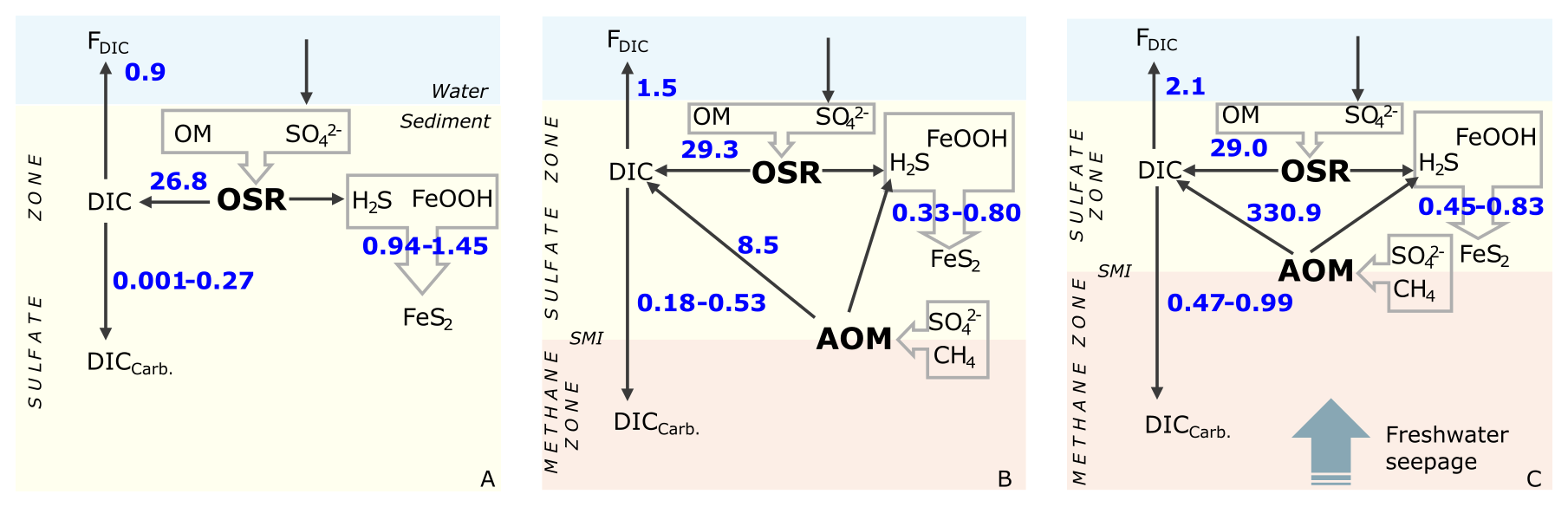
Figure 6Simplified conceptual model of inorganic carbon cycling in shelf sediments under contrasting environmental settings: (A) anoxic sediments dominated by organoclastic sulfate reduction as the principal pathway of organic matter oxidation; (B) nearshore sediments characterized by substantial terrigenous organic matter input and active methanogenesis; and (C) sediments influenced by freshwater infiltration and methanogenesis. Abbreviations: OSR – organoclastic sulfate reduction; AOM – anaerobic oxidation of methane; OM – organic matter; DIC – dissolved inorganic carbon in pore water; FDIC – diffusive benthic DIC flux (after Łukawska-Matuszewska and Dwornik, 2025); DICcarb. – burial of authigenic carbonate (dolomite). Numerical values represent fluxes and depth-integrated rates of DIC production and consumption associated with individual processes, expressed in mmol m−2 d−1.
This comparative study of shelf sediments highlights the complexity of diagenetic processes controlled by local environmental conditions and their implications for the carbon cycle. It demonstrates that the function of sediments as sources or sinks of inorganic carbon varies in response to redox regime, methane dynamics, sulfate availability, and freshwater input. Our synthesis shows that carbonate dynamics are governed by interactions among OSR, methanogenesis, AOM, sulfate supply, and freshwater input (Fig. 6). Recognition of these coupled processes is essential for predicting sedimentary carbon cycling under changing environmental conditions and for refining current models of carbonate dynamics in shelf environments.
Methane-bearing sediments differ markedly from anoxic sediments dominated solely by OSR. In the latter, DIC production is approximately 40 % lower, based on the sites studied. Where OM supply exceeds sulfate availability, methanogenesis and the coupled AOM become important additional sources of DIC in pore waters, contributing to the elevated DIC levels observed in methane-bearing sediments. Sediments in which both OSR and AOM operate release substantially more inorganic carbon to the overlying water. Benthic fluxes are 50 %–100 % higher than in sediments lacking active methanogenesis. The role of methane-related processes becomes increasingly important in sediments influenced by freshwater input, where the SMT is shallower and AOM can be a principal DIC source relative to OSR. AOM – particularly where freshwater inflow reduces sulfate availability – supplies additional DIC that contributes to carbonate supersaturation; this favors authigenic carbonate formation, which can act as an important inorganic carbon sink.
To our knowledge, this study provides the first quantitative estimate of authigenic carbonate burial rates in Baltic Sea sediments. Overall, the results demonstrate that anaerobic methane oxidation can play a significant role in regulating authigenic carbonate burial and, consequently, seawater chemistry.
The original data presented in the study are included in the article/Supplement; further inquiries can be directed to the corresponding author.
The supplement related to this article is available online at https://doi.org/10.5194/bg-23-5255-2026-supplement.
KŁM: Writing (original draft preparation); Writing (review and editing); Conceptualization; Investigation; Validation; Formal analysis; Visualization; Project administration; Supervision. GRz: Writing (original draft preparation); Writing (review and editing); Investigation; Validation; Formal analysis; Visualization; Project administration; Supervision. ABG: Investigation; Writing (original draft preparation); Writing (review and editing); AB: Investigation; Methodology; Writing (original draft preparation); Writing (review and editing); BG-Cz: Writing (original draft preparation); Writing (review and editing); Investigation. AB: Writing (original draft preparation); Writing (review and editing); Investigation; Formal Analysis. MM: Writing (original draft preparation); Writing (review and editing); Formal Analysis. JK: Formal analysis; Visualization. MD: Methodology; Formal analysis; Data Curation. MR: Investigation.
The contact author has declared that none of the authors has any competing interests.
Publisher's note: Copernicus Publications remains neutral with regard to jurisdictional claims made in the text, published maps, institutional affiliations, or any other geographical representation in this paper. The authors bear the ultimate responsibility for providing appropriate place names. Views expressed in the text are those of the authors and do not necessarily reflect the views of the publisher.
The authors would like to thank the captains and the crew of r/v Oceanograf. The authors thank Tom Jilbert and an anonymous reviewer for their constructive comments and suggestions that improved the manuscript.
The authors declare that financial support was received for the research and/or publication of this article. The study was funded by the National Science Centre, Poland (grant no. 2022/45/B/ST10/00395).
This paper was edited by Hermann Bange and reviewed by Tom Jilbert and one anonymous referee.
Akam, S. A., Coffin, R. B., Abdulla, H. A. N., and Lyons, T. W.: Dissolved Inorganic Carbon Pump in Methane-Charged Shallow Marine Sediments: State of the Art and New Model Perspectives, Front. Mar. Sci., 7, 206, https://doi.org/10.3389/fmars.2020.00206, 2020.
Albert, D. B., Martens, C. S., and Alperin, M. J.: Biogeochemical Processes Controlling Methane in Gassy Coastal Sediments – Part 2: Groundwater Flow Control of Acoustic Turbidity in Eckernförde Bay Sediments, Cont. Shelf Res., 18, 1771–1793, https://doi.org/10.1016/S0278-4343(98)00057-0, 1998.
Alves, J. F., Edwards, H. G. M., Korsakov, A., and Cappa de Oliveira, L. F. C.: Revisiting the Raman Spectra of Carbonate Minerals, Minerals, 13, 1358, https://doi.org/10.3390/min13111358, 2023.
Baker, P. A. and Burns, S. J.: Occurrence and Formation of Dolomite in Organic-Rich continental Margin Sediments, AAPG Bull., 69, 1917–1930, https://doi.org/10.1306/94885570-1704-11d7-8645000102c1865d, 1985.
Bauer, J. E., Cai, W.-J., Raymond, P. A., Bianchi, T. S., Hopkins, C. S., and Regnier, P. A. G.: The changing carbon cycle of the coastal ocean, Nature, 504, 61–70, https://doi.org/10.1038/nature12857, 2013.
Batther, H. K., Templeton, A. S., Hoehler, T., Howells, A., Bill, M., Gropp, J., and Kopf, S.: The stable carbon isotope fractionation of methanogenesis products at complete carbon consumption, Geochem. Perspect. Lett., 37, 35–39, https://doi.org/10.7185/geochemlet.2543, 2025.
Beal, E. J., House, C. H., and Orphan V. J.: Manganese- and Iron-Dependent Marine Methane oxidation, Science, 325, 184–187, https://doi.org/10.1126/science.1169984, 2009.
Berner, R. A.: Burial of organic carbon and pyrite sulfur in the modern ocean: its geo-chemical and environmental significance, Am. J. Sci., 282, 451–473, https://doi.org/10.2475/ajs.282.4.451, 1982.
Berner, R. A. and Raiswell, R.: C S method for distinguishing freshwater from marine sedimentary rocks, Geology, 12, 365–368, https://doi.org/10.1130/0091-7613(1984)12<365:CMFDFF>2.0.CO;2, 1984.
Berner, R. A., Baldwin, T., and Holdren, G. R.: Authigenic iron sulfides as paleosalinity indicators, J. Sediment Res., 49, 1345–1350, https://doi.org/10.1306/212F7923-2B24-11D7-8648000102C1865D, 1979.
Beulig, F., Røy, H., McGlynn, S. E., and Jørgensen, B. B.: Cryptic CH4 cycling in the sulfate–methane transition of marine sediments apparently mediated by ANME-1 archaea, ISME J., 13, 250–262, https://doi.org/10.1038/s41396-018-0273-z, 2019.
Błachowski, A., Ruebenbauer, K., ukrowski, J., and Górnicki, R.: Early design stage of the MsAa-4 Mössbauer spectrometer, Acta Phys. Pol. A, 114, 1707–1713, https://doi.org/10.12693/APhysPolA.114.1707, 2008.
Boesen, C. and Postma, D.: Pyrite formation in anoxic environments of the Baltic, Am. J. Sci., 288, 575–603, https://doi.org/10.2475/ajs.288.6.575, 1988.
Boetius, A., Ravenschlag, K., Schubert, C. J., Rickert, D., Widdel, F., Gieseke, A., Amann, R., Jørgensen, B. B., Witte, U., and Pfannkuche, O.: A marine microbial consortium apparently mediating anaerobic oxidation of methane, Nature, 407, 623–626, https://doi.org/10.1038/35036572, 2000.
Bowles, M. W., Samarkin, V. A., Hunter, K. S., Finke, N., Teske, A. P., Girguis, P. R., and Joye, S. B.: Remarkable capacity for anaerobic oxidation of methane at high methane concentration, Geophys. Res. Lett., 46, https://doi.org/10.1029/2019GL084375, 2019.
Brodecka, A., Majewski, P., Bolałek, J., and Klusek, Z.: Geochemical and acoustic evidence for the occurrence of methane in sediments of the Polish sector of the southern Baltic Sea, Oceanologia, 55, 951–978, https://doi.org/10.5697/oc.55-4.951, 2013.
Brodecka-Goluch, A., Łukawska-Matuszewska, K., Kotarba, M. J., Borkowski, A., Idczak, J., and Bolałek, J.: Biogeochemistry of three different shallow gas systems in continental shelf sediments of the South-Eastern Baltic Sea (Gulf of Gdańsk): carbon cycling, origin of methane and microbial community composition, Chem. Geol., 597, 120799, https://doi.org/10.1016/j.chemgeo.2022.120799, 2022.
Budrige, D. J.: Estuarine and coastal sediments – coupled biogeochemical cycling, Treatise Estuar. Coast. Sci., 5, 279–316, https://doi.org/10.1016/B978-0-12-374711-2.00511-8, 2011.
Byrne, J. M. and Kappler, A.: Mössbauer spectroscopy, in: Analytical Geomicrobiology. A Handbook of Instrumental Techniques, edited by: Kenney, J. P. L., Veeraramani, H., and Alessi, D. S., Cambridge University Press, 314–337, https://doi.org/10.1017/9781107707399.013, 2019.
Cai, W.-J.: Estuarine and Coastal Ocean Carbon Paradox: CO2 sinks and sites of terrestrial carbon incineration?, Annu. Rev. Mar. Sci., 3, 123–145, https://doi.org/10.1146/annurev-marine-120709-142723, 2011.
Campeau, A., Wallin, M. B., Giesler, R., Löfgren, S., Mörth, C.-M., Schiff, S., Vekiteswaran, J. J., and Bishop, K.: Multiple sources and sinks of dissolved inorganic carbon across Swedish streams, refocusing the lens of stable C isotopes, Sci. Rep., 7, 9158, https://doi.org/10.1038/s41598-017-09049-9, 2017.
Canfield, D. E.: Sulfate Reduction in Deep-Sea Sediments, Am. J. Sci., 291, 177–188, https://doi.org/10.2475/ajs.291.2.177, 1991.
Canfield, D. E., Raiswell, R., and Bottrell, S. H.: The reactivity of sedimentary iron minerals toward sulfide, Am. J. Sci., 292, 659–683, https://doi.org/10.2475/ajs.292.9.659, 1992.
Carneiro, M. L., Zucchi, M., Bomfim de Jesus, T., Junior, J., and Hadlich, G.: δ13C, δ15N and TOC TN as indicators of the origin of organic matter in sediment samples from the estuary of a tropical river, Mar. Pollut. Bull., 172, 112857, https://doi.org/10.1016/j.marpolbul.2021.112857, 2021.
Carstensen, J., Andersen, J. H., Gustafsson, B. G., and Conley, D. J.: Deoxygenation of the Baltic Sea during the last century, Proc. Natl. Acad. Sci. USA, 111, 5628–5633, https://doi.org/10.1073/pnas.1323156111, 2014.
Chanton, J., Martens, C., and Goldhaber, M.: Biogeochemical cycling in an organic-rich coastal marine basin. 7. Sulfur mass balance, oxygen uptake and sulfide retention, Geochim. Cosmochim. Acta, 51, 1187–1199, 1987.
Chatterjee, S., Dickens, G. R., Bhatnagar, G., Chapman, W. G., Dugan, B., Snyder, G. T., and Hirasaki, G. J.: Pore water sulfate, alkalinity, and carbon isotope profiles in shallow sediment above marine gas hydrate systems: a numerical modeling perspective, J. Geophys. Res.-Sol. Ea., 116, https://doi.org/10.1029/2011JB008290, 2011.
Chen, C.-T. A.: Shelf-vs. dissolution-generated alkalinity above the chemical lysocline, Deep-Sea Res.-Pt. II, 49, 5365–5375, https://doi.org/10.1016/S0967-0645(02)00196-0, 2002.
Chen, Y., Xu, S., Liu, W., Zhang, Z., Yang, T., Xiao, X., Deng, X., Li, J., Yao, H., and Wu, Z.: Assessing biogeochemical controls on porewater dissolved inorganic carbon cycling in the gas hydrate-bearing sediments of the Makran accretionary wedge, Northeastern Arabian Sea off Pakistan, Front. Mar. Sci., 10, 1181921, https://doi.org/10.3389/fmars.2023.1181921, 2024.
Cline, J. D.: Spectrophotometric determination of hydrogen sulfide in natural waters, Limnol. Oceanogr., 14, 454–458, https://doi.org/10.4319/lo.1969.14.3.0454, 1969.
Coplen, T. B.: Guidelines and recommended terms for expression of stable-isotope-ratio and gas-ratio measurement results, Rapid Commun. Mass Spectrom., 25, 2538–2560, https://doi.org/10.1002/rcm.5129, 2011.
De Grave, E., Vanderbruwaene, J., and Van Bockstael, M.: 57Fe Mössbauer spectroscopic analysis of chlorite, Phys. Chem. Miner., 15, 173–180, https://doi.org/10.1007/BF00308781, 1987.
D'Hondt, S., Jørgensen, B. B., Miller, D. J., Batzke, A., Blake, R., Cragg, B. A., Cypionka, H., Dickens, G. R., Ferdelman, T., Hinrichs, K. U., Holm, N. G., Mitterer, R., Spivack, A., Wang, G., Bekins, B., Engelen, B., Ford, K., Gettemy, G., Rutherford, S. D., Sass, H., and Skilbeck, C. G.: Distributions of microbial activities in deep subseafloor sediments, Science, 306, 2216–2221, https://doi.org/10.1126/science.1101155, 2004.
Dickens, A. F., Baldock, J. A., Smernik, R. J., Wakeham, S. G., Arnarson, T. S., Gélinas, Y., and Hedges, J. I.: Solid-state 13C NMR analysis of size and density fractions of marine sediments: Insight into organic carbon sources and preservation mechanisms, Geochim. Cosmochim. Acta, 70, 666–686, https://doi.org/10.1016/j.gca.2005.10.024, 2006.
Dickson, A. G., Sabine, C. L., and Christian, J. R. (Eds.): Guide to Best Practices for Ocean CO2 Measurements, PICES Special Publication 3, 191 pp., ISBN 1-897176-07-4, 2007.
Dyar, M. D., Agresti, D. G., Schaefer, M. W., Grant, C. A., and Sklute, E. C.: Mössbauer spectroscopy of Earth and planetary materials, Annu. Rev. Earth Planet. Sci., 34, 83–125, https://doi.org/10.1146/annurev.earth.34.031405.125049, 2006.
Egger, M., Rasigraf, O., Sapart, C. J., Jilbert, T., Jetten, M. S., Röckmann, T., van der Veen, C., Bândă, N., Kartal, B., Ettwig, K. F., and Slomp, C. P.: Iron-mediated anaerobic oxidation of methane in brackish coastal sediments, Environ. Sci. Technol., 49, 277–83, https://doi.org/10.1021/es503663z, 2015.
Egger, M., Riedinger, N., Mogollón, J. M., and Jørgensen, B. B.: Global diffusive fluxes of methane in marine sediments, Nat. Geosci., 11, 421–425, https://doi.org/10.1038/s41561-018-0122-8, 2018.
Ehlert von Ahn, C. M., Dellwig, O., Szymczycha, B., Kotwicki, L., Rooze, J., Endler, R., Escher, P., Schmiedinger, I., Sültenfuß, J., Diak, M., Gehre, M., Struck, U., Vogler, S., and Böttcher, M. E.: Submarine groundwater discharge into a semi-enclosed coastal bay of the southern Baltic Sea: A multi-method approach, Oceanologia, 66, 111–138, https://doi.org/10.1016/j.oceano.2024.01.001, 2024.
Emerson, S. and Hedges, J.: Chemical oceanography and the Marine Carbon Cycle, Cambridge University Press; 1st edn., 470 pp., ISBN 978-0-521-83313-4, 2008.
Falkowska, L. and Piekarek-Jankowska, H.: Submarine seepage of fresh groundwater: disturbance in hydrological and chemical structure of the water column in the Gdańsk Basin, J. Mar. Sci., 56, 153–160, https://doi.org/10.1006/JMSC.1999.0616, 1999.
Fennel, K. and Testa, J. M.: Biogeochemical controls on coastal hypoxia, Annu. Rev. Mar. Sci., 11, 105–130, https://doi.org/10.1146/annurev-marine-010318-095138, 2019.
Friedlingstein, P., O'Sullivan, M., Jones, M. W., Andrew, R. M., Hauck, J., Olsen, A., Peters, G. P., Peters, W., Pongratz, J., Sitch, S., Le Quéré, C., Canadell, J. G., Ciais, P., Jackson, R. B., Alin, S., Aragão, L. E. O. C., Arneth, A., Arora, V., Bates, N. R., Becker, M., Benoit-Cattin, A., Bittig, H. C., Bopp, L., Bultan, S., Chandra, N., Chevallier, F., Chini, L. P., Evans, W., Florentie, L., Forster, P. M., Gasser, T., Gehlen, M., Gilfillan, D., Gkritzalis, T., Gregor, L., Gruber, N., Harris, I., Hartung, K., Haverd, V., Houghton, R. A., Ilyina, T., Jain, A. K., Joetzjer, E., Kadono, K., Kato, E., Kitidis, V., Korsbakken, J. I., Landschützer, P., Lefèvre, N., Lenton, A., Lienert, S., Liu, Z., Lombardozzi, D., Marland, G., Metzl, N., Munro, D. R., Nabel, J. E. M. S., Nakaoka, S.-I., Niwa, Y., O'Brien, K., Ono, T., Palmer, P. I., Pierrot, D., Poulter, B., Resplandy, L., Robertson, E., Rödenbeck, C., Schwinger, J., Séférian, R., Skjelvan, I., Smith, A. J. P., Sutton, A. J., Tanhua, T., Tans, P. P., Tian, H., Tilbrook, B., van der Werf, G., Vuichard, N., Walker, A. P., Wanninkhof, R., Watson, A. J., Willis, D., Wiltshire, A. J., Yuan, W., Yue, X., and Zaehle, S.: Global Carbon Budget 2020, Earth Syst. Sci. Data, 12, 3269–3340, https://doi.org/10.5194/essd-12-3269-2020, 2020.
Froelich, P., Klinkhammer, G., Bender, M., Luedtke, N., Heath, G. R., Cullen, D., Dauphin, P., Hammond, D., Hartman, B., and Maynard, V.: Early oxidation of organic matter in pelagic sediments of the eastern equatorial Atlantic: suboxic diagenesis, Geochim. Cosmochim. Acta, 43, 1075–1090, https://doi.org/10.1016/0016-7037(79)90095-4, 1979.
Glud, R. N.: Oxygen dynamics of marine sediments, Mar. Biol. Res., 4, 243–289, https://doi.org/10.1080/17451000801888726, 2008.
Graca, B., Witek, Z., Burska, D., Białkowska, I., Łukawska-Matuszewska, K., and Bolałek, J.: Pore water phosphate and ammonia below the permanent halocline in the south-eastern Baltic Sea and their benthic fluxes under anoxic conditions, J. Marine Syst., 63, 141–154, https://doi.org/10.1016/j.jmarsys.2006.06.003, 2006.
Grasshoff, K., Kremling, K., and Ehrhardt, M.: Methods of Seawater Analysis, 3rd edn., Wiley-VCH, Weinheim, ISBN 9783527295890, 1999.
Gregg, J. M., Bish, D. L., Kaczmarek, S. E., and Machel, H. G.: Mineralogy, nucleation and growth of dolomite in the laboratory and sedimentary environment: A review, Sedimentology, 62, 1749–1769, https://doi.org/10.1111/sed.12202, 2015.
Griffiths, J. R., Kadin, M., Nascimento, F. J. A., Tamelander, T., Törnroos, A., Bonaglia, S., Bonsdorff, E., Brüchert, V., Gårdmark, A., Järnström, M., Kotta, J., Lindegren, M., Nordström, M. C., Norkko, A., Olsson, J., Weigel, B., ydelis, R., Blenckner, T., Niiranen, S., and Winder, M.: The importance of benthic-pelagic coupling for marine ecosystem functioning in a changing world, Glob. Chang. Biol., 23, 2179–2196, https://doi.org/10.1111/gcb.13642, 2017.
Gustafsson, E., Hagens, M., Sun, X., Reed, D. C., Humborg, C., Slomp, C. P., and Gustafsson, B. G.: Sedimentary alkalinity generation and long-term alkalinity development in the Baltic Sea, Biogeosciences, 16, 437–456, https://doi.org/10.5194/bg-16-437-2019, 2019.
Håkanson, L. and Jansson, M.: Principles of Lake Sedimentology, Springer-Verlag Berlin Heidelberg, 316 pp., ISBN 0387126457, 1983.
Hammer, K., Schneider, B., Kuliński, K., and Schulz-Bull, D. E.: Precision and accuracy of spectrophotometric pH measurements at environmental conditions in the Baltic Sea, Estuarine, Coastal and Shelf Science, 146, 24–32, https://doi.org/10.1016/j.ecss.2014.05.003, 2014.
Han, L.-F., Plummer, L. N., and Aggarwal, P.: The curved 14C vs δ13C relationship in dissolved inorganic carbon: A useful tool for groundwater age- and geochemical interpretations, Chem. Geol., 387, 111–125, https://doi.org/10.1016/j.chemgeo.2014.08.026, 2014.
Hedges, I. and Stern, J.: Carbon and nitrogen determinations of carbonate containing solids, Limnol. Oceanogr., 29, 657–663, 1984.
Hedges, J. I. and Keil, R. G.: Sedimentary organic-matter preservation – an assessment and speculative synthesis, Mar. Chem., 49, 81–115, 1995.
Hedges, J. I., Keil, R. G., and Benner, R.: What happens to terrestrial organic matter in the ocean?, Org. Geochem., 27, 195–212, https://doi.org/10.1016/S0146-6380(97)00066-1, 1997.
Hu, X., Cai, W.-J., Wang, Y., Luo, S., and Guo, X.: Pore-water geochemistry of two contrasting brine-charged seep sites in the northern Gulf of Mexico continental slope, Mar. Chem., 118, 99–107, https://doi.org/10.1016/j.marchem.2009.11.006, 2010.
in 't Zandt, M. H., de Jong, A. E. E., Slomp, C. P., and Jetten, M. S. M.: The hunt for the most-wanted chemolithoautotrophic spookmicrobes, FEMS Microbiol. Ecol., 94, fiy064, https://doi.org/10.1093/femsec/fiy064, 2018.
Iversen, N. and Jørgensen, B. B.: Anaerobic methane oxidation rates at the sulfate‐methane transition in marine sediments from Kattegat and Skagerrak (Denmark), Limnol. Oceanogr., 30, 944–955, https://doi.org/10.4319/lo.1985.30.5.0944, 1985.
Jilbert, T., Cowie, G., Lintumäki, L., Jokinen, S., Asmala, E., Sun, X., Mörth, C.-M., Norkko, A., and Humborg, C.: Anthropogenic Inputs of Terrestrial Organic Matter Influence Carbon Loading and Methanogenesis in Coastal Baltic Sea Sediments, Front. Earth Sci., 9, 716416, https://doi.org/10.3389/feart.2021.716416, 2021.
Jørgensen, B. B., Bang, M., and Blackburn, T. H.: Anaerobic mineralization in marine-sediments from the Baltic-Sea-North-Sea transition, Mar. Ecol. Prog. Ser., 59, 39–54, http://www.jstor.org/stable/24842420 (last access: 26 February 2026), 1990.
Jørgensen, N. O.: Methane-derived carbonate cementation of marine sediments from the Kattegat, Denmark: geochemical and geological evidence, Mar. Geol., 103, 1–13, https://doi.org/10.1016/0025-3227(92)90006-4, 1992.
Jørgensen, B. B. and Kasten, S.: Sulfur cycling and methane oxidation, in: Marine geochemistry, edited by: Schulz, H. D., Zabel, M., Berlin, Heidelberg, Springer, ISBN 3-540-32143-8, 2006.
Jørgensen, B. B., Weber, A., and Zopfi, J.: Sulfate reduction and anaerobic oxidation in Black Sea sediments, Deep-Sea Res.-Pt.I, 48, 2097–2120, https://doi.org/10.1016/S0967-0637(01)00007-3, 2001.
Jönsson, A., Danielsson, Å., and Rahm, L.: Bottom type distribution based on wave friction velocity in the Baltic Sea, Cont. Shelf Res., 25, 419–435, https://doi.org/10.1016/j.csr.2004.09.011, 2005.
Ketzer, M., Stranne, C., Rahmati-Abkenar, M., Shahabi-Ghahfarokhi, S., Jaeger, L., Pivel, M. A. G., Josefsson, S., and Zillén, L.: Near seafloor methane flux in the world's largest human-induced dead zone is regulated by sediment accumulation rate, Mar. Geol., 468, 107220, https://doi.org/10.1016/j.margeo.2024.107220, 2024.
Kowalski, W., Mazurek, Z., and Mazurek, A.: Geochemiczno mineralogiczna charakterystyka marmurów dolomitycznych ze złoa Rędziny, Geol. Q., 20, 21–34, 1976 (in Polish).
Kozerski, B., Macioszczyk, A., Pazdro, Z., and Sadurski, A.: Fluoride in groundwater of the Gdańsk region, Ann. Soc. Geol. Pol., 57, 349–374, 1987 (in Polish).
Krumins, V., Gehlen, M., Arndt, S., Van Cappellen, P., and Regnier, P.: Dissolved inorganic carbon and alkalinity fluxes from coastal marine sediments: model estimates for different shelf environments and sensitivity to global change, Biogeosciences, 10, 371–398, https://doi.org/10.5194/bg-10-371-2013, 2013.
Lapham, L. L., Lloyd, K. G., Fossing, H., Flury, S., Jensen, J. B., Alperin, M. J., Rehder, G., Holzhueter, W., Ferdelman, T., and Jørgensen, B. B.: Methane leakage through the sulfate–methane transition zone of the Baltic seabed, Nat. Geosci., 17, 1277–1283, https://doi.org/10.1038/s41561-024-01594-z, 2024.
Liu, D., Fan, Q., Papineau, D., Yu, N., Chu, Y., Wang, H., Qiu, X., and Wang, X.: Precipitation of protodolomite facilitated by sulfate-reducing bacteria: The role of capsule extracellular polymeric substances, Chem. Geol., 533, 119415, https://doi.org/10.1016/j.chemgeo.2019.119415, 2020.
Liu, K. K., Atkinson, L., Quinones, R., and Talaue-McManus, L.: Carbon and Nutrient Fluxes in Continental Margins: A Global Synthesis, Springer-Verlag, Berlin-Heidelberg, https://doi.org/10.1007/978-3-540-92735-8, 2010.
Łukawska-Matuszewska, K. and Dwornik, M.: Early diagenesis in anoxic sediments of the Gulf of Gdańsk (southern Baltic Sea): Implications for porewater chemistry and benthic flux of carbonate alkalinity, Front. Earth Sci., 13, 1593031, https://doi.org/10.3389/feart.2025.1593031, 2025.
Łukawska-Matuszewska, K. and Kiełczewska, J.: Effects of near-bottom water oxygen concentration on biogeochemical cycling of C, N and S in sediments of the Gulf of Gdansk (southern Baltic), Cont. Shelf Res., 117, 30–42, https://doi.org/10.1016/j.csr.2016.02.001, 2016.
Łukawska-Matuszewska, K., Graca, B., Brocławik, O., and Zalewska, T.: The impact of declining oxygen conditions on pyrite accumulation in shelf sediments (Baltic Sea), Biogeochemistry, 142, 209–230, https://doi.org/10.1007/s10533-018-0530-2, 2019.
Łukawska-Matuszewska, K., Brodecka-Goluch, A., Czachor, A., and Rios-Quintero, R.: Gas bubble release areas as new potential hot spots for water column enrichment with nutrients in eutrophicated sea, Mar. Environ. Res., 205, 106981, https://doi.org/10.1016/j.marenvres.2025.106981, 2025.
Lukoczki, G., Bish, D., and Gregg, J. M.: A best-practices guide to X-ray diffraction studies of sedimentary carbonates, Sed. Geol., 493, 107028, https://doi.org/10.1016/j.sedgeo.2026.107028, 2026.
Majewski, P. and Klusek, Z.: Parameters of echo signals originated from a gas seepage site in the southern Baltic Sea, Hydroacoustics, 17, 143–150, 2014.
Maksymowska, D., Richard, P., Piekarek-Jankowska, H., and Riera, P.: Chemical and isotopic composition of the organic matter sources in the Gulf of Gdansk (Southern Baltic Sea), Estuar. Coast. Shelf Sci., 51, 585–598, https://doi.org/10.1006/ecss.2000.0701, 2000.
Malinverno, A. and Pohlman, J. W.: Modeling sulfate reduction in methane hydrate-bearing continental margin sediments: Does a sulfate-methane transition require anaerobic oxidation of methane?, Geochem. Geophys. Geosyst., 12, https://doi.org/10.1029/2011GC003501, 2011.
Maltby, J., Steinle, L., Löscher, C. R., Bange, H. W., Fischer, M. A., Schmidt, M., and Treude, T.: Microbial methanogenesis in the sulfate-reducing zone of sediments in the Eckernförde Bay, SW Baltic Sea, Biogeosciences, 15, 137–157, https://doi.org/10.5194/bg-15-137-2018, 2018.
Masuzawa, T., Handa, N., Kitagawa, H., and Kusakabe, M.: Sulfate reduction using methane in sediments beneath a bathyal cold seep giant clam community off Hatsushima-Island, Sagami Bay, Japan, Earth Planet. Sci. Lett., 110, 39–50, https://doi.org/10.1016/0012-821X(92)90037-V, 1992.
Matciak, M., Misiewicz, M. M., Szymczycha, B., Idczak, J., Tęgowski, J., and Diak, M.: Pockmarks and associated fresh submarine groundwater discharge in the seafloor of Puck Bay, southern Baltic Sea, Sci. Total Environ., 942, 173617, https://doi.org/10.1016/j.scitotenv.2024.173617, 2024.
Meister, P. and Reyes, C.: The Carbon-Isotope Record of the Sub-Seafloor Biosphere, Geosciences, 9, 507, https://doi.org/10.3390/geosciences9120507, 2019.
Meister, P., Liu, B., Khalili, A., Böttcher, M. E., and Jørgensen, B. B.: Factors controlling the carbon isotope composition of dissolved inorganic carbon and methane in marine porewater: an evaluation by reaction-transport modelling, J. Mar. Syst., 200, 103227, https://doi.org/10.1016/j.jmarsys.2019.103227, 2019.
Meyers, P. A.: Preservation of elemental and isotopic source identification of sedimentary organic matter, Chem. Geol., 114, 289–302, https://doi.org/10.1016/0009-2541(94)90059-0, 1994.
Meyers, P. A.: Organic geochemical proxies of paleoceanographic, paleolimnologic, and paleoclimatic processes, Org. Geochem., 27, 213–250, https://doi.org/10.1016/S0146-6380(97)00049-1, 1997.
Miller, C. M., Dickens, G. R., Jakobsson, M., Johansson, C., Koshurnikov, A., O'Regan, M., Muschitiello, F., Stranne, C., and Mörth, C.-M.: Pore water geochemistry along continental slopes north of the East Siberian Sea: inference of low methane concentrations, Biogeosciences, 14, 2929–2953, https://doi.org/10.5194/bg-14-2929-2017, 2017.
Miltner, A. and Emeis, K.-C.: Terrestrial organic matter in surface sediments of the Baltic Sea, Northwest Europe, as determined by CuO oxidation, Geochim. Cosmochim. Acta, 65, 1285–1299, https://doi.org/10.1016/S0016-7037(00)00603-7, 2001.
Moore, D. M. and Reynolds Jr., R. C.: X-Ray Diffraction and the Identification and Analysis of Clay Minerals, 2nd Edn., Oxford University Press, Oxford, 379 pp., ISBN 0 19 508713 5, 1997.
Moore, W. S.: The Effect of Submarine Groundwater Discharge on the Ocean, Annu. Rev. Mar. Sci., 2, 59–88, https://doi.org/10.1146/annurev-marine-120308-081019, 2010.
Mucci, A., Sundby, B., Gehlen, M., Arakaki, T., Zhong, S., and Silverberg, N.: The fate of carbon in continental shelf sediments of eastern Canada: a case study, Deep-Sea Res.-Pt. II, 47, 733–760, https://doi.org/10.1016/S0967-0645(99)00124-1, 2000.
Myllykangas, J. P., Hietanen, S., and Jilbert, T.: Legacy Effects of Eutrophication on Modern Methane Dynamics in a Boreal Estuary, Estuar. Coast., 43, 189–206, https://doi.org/10.1007/s12237-019-00677-0, 2020.
Nöthen, K. and Kasten, S.: Reconstructing changes in seep activity by means of pore water and solid phase Sr Ca and Mg Ca ratios in pockmark sediments of the Northern Congo Fan, Mar. Geol., 287, 1–13, https://doi.org/10.1016/j.margeo.2011.06.008, 2011.
Paerl, H. W., Hall, N. S., Peierls, B. L., and Rossignol, K. L.: Evolving paradigms and challenges in estuarine and coastal eutrophication dynamics in a culturally and climatically stressed world, Estuar. Coast., 37, 243–258, http://www.jstor.org/stable/44851148 (last access: 1 December 2025), 2014.
Parkhurst, D. L. and Appelo, C. A. J.: Description of Input and Examples for PHREEQC Version 3 – A Computer Program for Speciation, Batch-Reaction, One-Dimensional Transport, and Inverse Geochemical Calculations, US Geological Survey Techniques and Methods, Book 6, Chapter A43, 497 pp., http://pubs.usgs.gov/tm/06/a43 (last access: 10 May 2026), 2013.
Piekarek-Jankowska, H., Matciak, M., and Nowacki, J.: Salinity variations as an effect of groundwater seepage through the seabed (Puck Bay, Poland), Oceanologia, 36, 33–46, 1994.
Piker, L., Schmaljohann, R., and Imhoff, J. F.: Dissimilatory sulfate reduction and methane production in Gotland Deep sediments (Baltic Sea) during a transition period from oxic to anoxic bottom water (1993–1996), Aquat. Microb. Ecol., 14, 183–193, https://doi.org/10.3354/ame014183, 1998.
Pimenov, N. V., Ul'yanova, M. O., Kanapatskii, T. A., Sivkov, V. V., and Ivanov, M. V.: Microbiological and biogeochemical processes in a pockmark of the Gdansk depression, Baltic Sea, Microbiology, 77, 579–586, https://doi.org/10.1134/S0026261708050111, 2008.
Pimenov, N. V., Ulyanova, M. O., Kanapatsky, T. A., Veslopolova, E. F., Sigalevich, P. A., and Sivkov, V. V.: Microbially mediated methane and sulfur cycling in pockmark sediments of the Gdansk Basin, Baltic Sea, Geo. Mar.-Lett., 30, 439–448, https://doi.org/10.1007/s00367-010-0200-4, 2010.
Pimenov, N. V., Ul'yanova, M. O., Kanapatskii, T. A., Mitskevich, I. N., Rusanov, I. I., Sigalevich, P. A., Nemirovskaya, I. A., and Sivkov, V. V.: Sulfate reduction, methanogenesis, and methane oxidation in the upper sediments of the Vistula and Curonian Lagoons, Baltic Sea, Microbiology, 82, 224–233, https://doi.org/10.1134/S0026261713020136, 2013.
Rabalais, N. N., Díaz, R. J., Levin, L. A., Turner, R. E., Gilbert, D., and Zhang, J.: Dynamics and distribution of natural and human-caused hypoxia, Biogeosciences, 7, 585–619, https://doi.org/10.5194/bg-7-585-2010, 2010.
Raiswell, R. and Berner, R. A.: Pyrite formation in euxinic and semi-euxinic sediments, Am. J. Sci., 285, 710–724, https://doi.org/10.2475/ajs.285.8.710, 1985.
Rassmann, J., Lansard, B., Pozzato, L., and Rabouille, C.: Carbonate chemistry in sediment porewaters of the Rhône River delta driven by early diagenesis (northwestern Mediterranean), Biogeosciences, 13, 5379–5394, https://doi.org/10.5194/bg-13-5379-2016, 2016.
Reeburgh, W. S.: Oceanic methane biogeochemistry, Chem. Rev., 107, 486–513, https://doi.org/10.1021/cr050362v, 2007.
Rothwell, K. A., ThomasArrigo, L. K., Kaegi, R., and Kretzschmar, R.: Low molecular weight organic acids stabilise siderite against oxidation and influence the composition of iron (oxyhydr)oxide oxidation products, Environ. Sci.-Proc. Imp., 27, 133–145, https://doi.org/10.1039/D4EM00363B, 2025.
Rzepa, G., Borkowski, A., Manecki, M., Brodecka-Goluch, A., Łukawska-Matuszewska, K., Kania, J., Błachowski, A., Działak, P., and De Mey-nieyska, I.: The effect of freshwater discharge on the microbial-induced precipitation of minerals in a Baltic Sea bottom pockmark, Oceanologia, https://doi.org/10.5697/NDCH3019, in press, 2026.
Sadurski, A.: Warunki hydrochemiczne utworów kredowych w rejonie Gdańska, Geol. Q., 29, 405–418, 1985 (in Polish).
Sawicka, J. E. and Brüchert, V.: Annual variability and regulation of methane and sulfate fluxes in Baltic Sea estuarine sediments, Biogeosciences, 14, 325–339, https://doi.org/10.5194/bg-14-325-2017, 2017.
Schlünz, B. and Schneider, R. R.: Transport of Terrestrial Organic Carbon to the Oceans by Rivers: Re-estimating Flux- and Burial Rates, Int. J. Earth Sci., 88, 599–606, https://doi.org/10.1007/s005310050290, 2000.
Soetaert, K., Herman, P. M. J., and Middelburg, J. J.: A model of early diagenetic processes from the shelf to abyssal depths, Geochim. Cosmochim. Acta, 60, 1019–1040, https://doi.org/10.1016/0016-7037(96)00013-0, 1996.
Struck, U., Emeis, K., Voss, M., Christiansen, C., and Kunzendorf, H.: Records of southern and central Baltic Sea eutrophication in δ13C and δ15N of sedimentary organic matter, Mar. Geol., 164, 157–171, 2000.
Sturm, A., Fowle, D. A., Jones, C. A, Leslie, K., Nomosatryo, S., Henny, C., Canfield, D. E., and Crowe, S. A.: Rates and pathways of CH4 oxidation in ferruginous Lake Matano, Indonesia, Geobiology, 17, 294–307, https://doi.org/10.1111/gbi.12325, 2019.
Sun, J., Wu, Z., Cheng, H., Zhang, Z., and Frost, R. L.: A Raman spectroscopic comparison of calcite and dolomite, Spectrochim. Acta A, 117, 158–162, https://doi.org/10.1016/j.saa.2013.08.014, 2014.
Szymczycha, B., Vogler, S., and Pempkowiak, J.: Nutrient fluxes via submarine groundwater discharge to the Bay of Puck, southern Baltic Sea, Sci. Total Environ., 438, 86–93, https://doi.org/10.1016/j.scitotenv.2012.08.058, 2012.
Szymczycha, B., Miotk, M., and Pempkowiak, J.: Submarine groundwater discharge as a source of mercury in the Bay of Puck, the Southern Baltic Sea, Water Air Soil Poll., 224, https://doi.org/10.1007/s11270-013-1542-0, 2013.
Szymczycha, B., Böttcher, M. E., Diak, M., Koziorowska-Makuch, K., Kuliski, K., Makuch, P., Ehlert von Ahn, C. M., and Winogradow, A.: The benthic-pelagic coupling affects the surface water carbonate system above groundwater-charged coastal sediments, Front. Mar. Sci., 10, 1218245, https://doi.org/10.3389/fmars.2023.1218245, 2023.
Thamdrup, B. and Canfield, D. E.: Pathways of carbon oxidation in continental margin sediments off central Chile, Limnol. Oceanogr., 41, 1629–1650, https://doi.org/10.4319/lo.1996.41.8.1629, 1996.
Thang, N. M., Brüchert, V., Formolo, M., Wegener, G., Ginters, L., and Jørgensen, B. B.: The Impact of Sediment and Carbon Fluxes on the Biogeochemistry of Methane and Sulfur in Littoral Baltic Sea Sediments (Himmerfjärden, Sweden), Estuar. Coast., 36, 98–115, https://doi.org/10.1007/s12237-012-9557-0, 2013.
Thomas, H., Schiettecatte, L.-S., Suykens, K., Koné, Y. J. M., Shadwick, E. H., Prowe, A. E. F., Bozec, Y., de Baar, H. J. W., and Borges, A. V.: Enhanced ocean carbon storage from anaerobic alkalinity generation in coastal sediments, Biogeosciences, 6, 267–274, https://doi.org/10.5194/bg-6-267-2009, 2009.
Thomsen, T. R., Finster, K., and Ramsing, N. B.: Biogeochemical and molecular signatures of anaerobic methane oxidation in marine sediment, Appl. Environ. Microbiol., 67, 1646–1656, https://doi.org/10.1128/AEM.67.4.1646-1656.2001, 2001.
Treude, T., Krüger, M., Boetius, A., and Jørgensen, B. B.: Environmental control on anaerobic oxidation of methane in the gassy sediments of Eckernförde Bay (German Baltic), Limnol. Oceanogr., 50, 1771–1786, https://doi.org/10.4319/lo.2005.50.6.1771, 2005.
Treude, T., Orphan, V., Knittel, K., Gieseke, A., House, C. H., and Boetius, A.: Consumption of Methane and CO2 by Methanotrophic Microbial Mats from Gas Seeps of the Anoxic Black Sea, Appl. Environ. Microb., 73, 2271–2283, https://doi.org/10.1128/AEM.02685-06, 2007.
Tyrrell, T., Schneider, B., Charalampopoulou, A., and Riebesell, U.: Coccolithophores and calcite saturation state in the Baltic and Black Seas, Biogeosciences, 5, 485–494, https://doi.org/10.5194/bg-5-485-2008, 2008.
Ucinowicz, S. Z.: Geochemistry of Baltic Sea surface sediments, Polish Geolog. Inst.-National Res. Inst., Warsaw, 356 pp., ISBN 978-83-7538-814-5, 2011.
Wada, E. and Hattori, A.: Nitrogen in the Sea: Forms, Abundances, and Rate Processes, CRC Press, Boca Raton, 208 pp., ISBN 0-8493-6273-3, 1991.
Walter, L. M., Ku, T. C. W., Muehlenbachs, K., Patterson, W. P., and Bonnell, L.: Controls on the δ13C of dissolved inorganic carbon in marine pore waters: An integrated case study of isotope exchange during syndepositional recrystallization of biogenic carbonate sediments (South Florida Platform, USA), Deep Sea Res.-Pt. II, 54, 1163–1200, https://doi.org/10.1016/j.dsr2.2007.04.014, 2007.
Wang, C., Su, J., Song, L., Qiao, P., and Fan, D.: Response of early diagenesis to methane leakage in the inner shelf of the East China Sea, Front. Mar. Sci., 11, 1410241, https://doi.org/10.3389/fmars.2024.1410241, 2024.
Whiticar, M. J.: Carbon and hydrogen isotope systematics of bacterial formation and oxidation of methane, Chem. Geol., 161, 291–314, https://doi.org/10.1016/S0009-2541(99)00092-3, 1999.
Wollast, R.: Evaluation and comparison of the global carbon cycle in the coastal zone and in the open ocean, in: The Sea, edited by: Brink, K. H., Robinson, A. R., John Wiley, New York, 213–252, ISBN 0-471-11544-4, 1998.
Xu, C., Wu, N., Sun, Z., Zhang, X., Geng, W., Cao, H., Wang, L., Zhang, X., and Xu, G.: Methane seepage inferred from pore water geochemistry in shallow sediments in the western slope of the Mid-Okinawa Trough, Mar. Pet. Geol., 98, 306–315, https://doi.org/10.1016/j.marpetgeo.2018.08.021, 2018.
Yadav, V. B., Pulhani, V. A., and Kumar, A. V.: Study of sedimentary organic carbon using δC, δN and TOC TN as indicator in sediment core samples from Mumbai Harbor Bay, Environ. Monit. Assess., 197, 552, https://doi.org/10.1007/s10661-025-13980-0, 2025.
Zalewska, T., Przygrodzki, P., Supliska, M., and Saniewski, M.: Geochronology of the southern Baltic Sea sediments derived from 210Pb dating, Quat. Geochronol., 56, 101039, https://doi.org/10.1016/j.quageo.2019.101039, 2020.
Zha, R., Yang, T., Shi, X., Su, P., and Fang, Y.: Quantitative assessment of dissolved inorganic carbon cycling in marine sediments from gas hydrate-bearing areas in the South China Sea, Mar. Petrol. Geol., 145, 105881, https://doi.org/10.1016/j.marpetgeo.2022.105881, 2022.
Zheng, W., Liu, D., Yang, S., Fan, Q., Papineau, D., Wang, H., Qiu, X., Chang, B., and She, Z.: Transformation of protodolomite to dolomite proceeds under dry-heating conditions, Earth Planet. Sci. Lett., 576, 117249, https://doi.org/10.1016/j.epsl.2021.117249, 2021.