Articles | Volume 23, issue 16
https://doi.org/10.5194/bg-23-5943-2026
Research article
 | Highlight paper
 | 
28 Aug 2026
Research article | Highlight paper |  | 28 Aug 2026

Saturation effect of background temperature and aridity on vegetation phenological sensitivity to urban warming

Zhang Zhenzhen, Hu Xinxin, Zhang Yongqi, Cui Shufen, Sun Liheng, Lin Xingwen, Wu Chaofan, Zhang Zhaoyang, Chen Yuanjian, and Wen Qingqing

Related authors

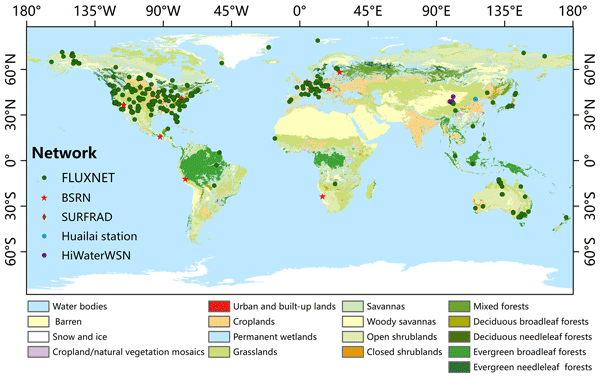
A coarse pixel-scale ground “truth” dataset based on global in situ site measurements to support validation and bias correction of satellite surface albedo products
Fei Pan, Xiaodan Wu, Qicheng Zeng, Rongqi Tang, Jingping Wang, Xingwen Lin, Dongqin You, Jianguang Wen, and Qing Xiao
Earth Syst. Sci. Data, 16, 161–176, https://doi.org/10.5194/essd-16-161-2024,https://doi.org/10.5194/essd-16-161-2024, 2024
Short summary
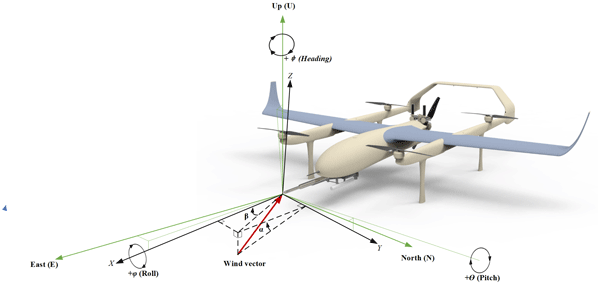
Quality evaluation for measurements of wind field and turbulent fluxes from a UAV-based eddy covariance system
Yibo Sun, Bilige Sude, Xingwen Lin, Bing Geng, Bo Liu, Shengnan Ji, Junping Jing, Zhiping Zhu, Ziwei Xu, Shaomin Liu, and Zhanjun Quan
Atmos. Meas. Tech., 16, 5659–5679, https://doi.org/10.5194/amt-16-5659-2023,https://doi.org/10.5194/amt-16-5659-2023, 2023
Short summary

Cited articles

Angilletta, M. J.: Thermal Adaptation: A Theoretical and Empirical Synthesis, Oxford University Press, Oxford, https://doi.org/10.1093/acprof:oso/9780198570875.001.1, 2009. 
Badeck, F.-W., Bondeau, A., Böttcher, K., Doktor, D., Lucht, W., Schaber, J., and Sitch, S.: Responses of spring phenology to climate change, New Phytol., 162, 295–309, https://doi.org/10.1111/j.1469-8137.2004.01059.x, 2004. 
Brodribb, T. J. and McAdam, S. A. M.: Abscisic acid mediates a divergence in the drought response of two conifers, Plant Physiol., 162, 1370–1377, https://doi.org/10.1104/pp.113.217877, 2013. 
Buyantuyev, A. and Wu, J.: Urbanization diversifies land surface phenology in arid environments: Interactions among vegetation, climatic variation, and land use pattern in the Phoenix metropolitan region, USA, Landsc. Urban Plan., 105, 149–159, https://doi.org/10.1016/j.landurbplan.2011.12.013, 2012. 
Büntgen, U., Krusic, P. J., Piermattei, A., Coomes, D. A., Esper, J., Myglan, V. S., Kirdyanov, A. V., Camarero, J. J., Crivellaro, A., and Körner, C.: Limited capacity of tree growth to mitigate the global greenhouse effect under predicted warming, Nat. Commun., 10, 2171, https://doi.org/10.1038/s41467-019-10174-4, 2019. 
Download
Editorial statement
This study identifies thermal limits to vegetation phenological responses to urban warming across 293 Chinese cities and shows that these responses are further constrained by aridity. The findings challenge a simple linear view of warming-induced growing-season extension and demonstrate how background climate regulates vegetation responses to urban warming.
Short summary
Using satellite data from 293 Chinese cities, we tested how background climate shapes vegetation responses to urban warming. Urban heat advances spring growth 12 days and delays autumn aging nearly 10 days, yet responses saturate with extra warming. Dryness weakens and reverses growing‑season extension in dry inland zones. Temperature and moisture explain about 75 % spatial variation. Our results challenge the view that urban heat always lengthens growing seasons for climate‑adapted greening.
Share
Altmetrics
Final-revised paper
Preprint