
Articles | Volume 23, issue 17
https://doi.org/10.5194/bg-23-6003-2026
© Author(s) 2026. This work is distributed under
the Creative Commons Attribution 4.0 License.
the Creative Commons Attribution 4.0 License.
https://doi.org/10.5194/bg-23-6003-2026
© Author(s) 2026. This work is distributed under
the Creative Commons Attribution 4.0 License.
the Creative Commons Attribution 4.0 License.
Research article
| 
01 Sep 2026
Research article |
| 01 Sep 2026
| 01 Sep 2026
Quantifying patterns and drivers of larval dispersal in Japanese anchovy (Engraulis japonicus) in the China Seas
Deep Sea and Polar Fisheries Research Center, and Key Laboratory of Mariculture, Ministry of Education, Ocean University of China, Qingdao, 266100, China
Environmental Fluid Dynamics Laboratory, Department of Civil Engineering, Queen's University, Kingston, ON K7L 3N6, Canada
Leon Boegman
Environmental Fluid Dynamics Laboratory, Department of Civil Engineering, Queen's University, Kingston, ON K7L 3N6, Canada
Shiliang Shan
Environmental Fluid Dynamics Laboratory, Department of Civil Engineering, Queen's University, Kingston, ON K7L 3N6, Canada
Department of Physics and Space Science, Royal Military College of Canada, Kingston, ON K7K 7B4, Canada
Yongjun Tian
Deep Sea and Polar Fisheries Research Center, and Key Laboratory of Mariculture, Ministry of Education, Ocean University of China, Qingdao, 266100, China
Yang Liu
Deep Sea and Polar Fisheries Research Center, and Key Laboratory of Mariculture, Ministry of Education, Ocean University of China, Qingdao, 266100, China
Peng Sun
Deep Sea and Polar Fisheries Research Center, and Key Laboratory of Mariculture, Ministry of Education, Ocean University of China, Qingdao, 266100, China
Zhenjiang Ye
Deep Sea and Polar Fisheries Research Center, and Key Laboratory of Mariculture, Ministry of Education, Ocean University of China, Qingdao, 266100, China
Qinwang Xing
CORRESPONDING AUTHOR

College of Marine Living Resource Sciences and Management, Shanghai Ocean University, Shanghai, 201306, China
Jianchao Li
CORRESPONDING AUTHOR
Deep Sea and Polar Fisheries Research Center, and Key Laboratory of Mariculture, Ministry of Education, Ocean University of China, Qingdao, 266100, China
Related authors
Wei Shi, Leon Boegman, Josef D. Ackerman, Shiliang Shan, and Yingming Zhao
Geosci. Model Dev., 19, 1213–1228, https://doi.org/10.5194/gmd-19-1213-2026, https://doi.org/10.5194/gmd-19-1213-2026, 2026
Short summary
Short summary
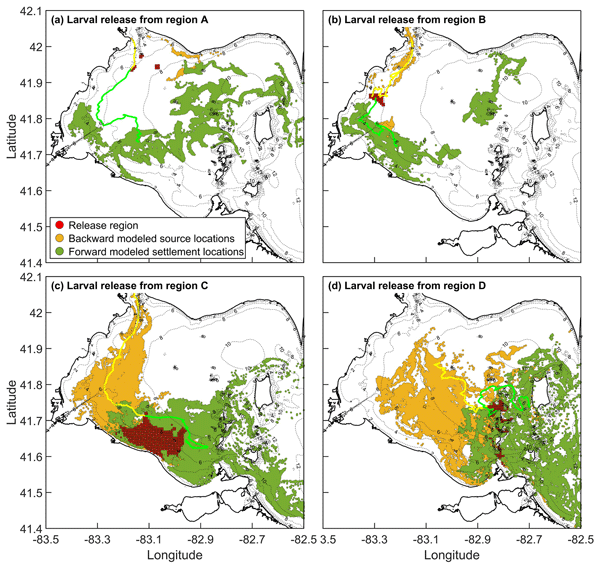
Self-recruitment of a population at a given larval settlement location is dependent on larval production from each source location, independent of larval recruits at the settlement location. An arbitrary choice of the number of larvae released from each source location in forward tracking is found to cause ambiguous self-recruitment. In contrast, we found that an arbitrary choice of the number of larvae released from the settlement location in backtracking leads to unambiguous self-recruitment.
Wei Shi, Leon Boegman, Josef D. Ackerman, Shiliang Shan, and Yingming Zhao
Geosci. Model Dev., 19, 1213–1228, https://doi.org/10.5194/gmd-19-1213-2026, https://doi.org/10.5194/gmd-19-1213-2026, 2026
Short summary
Short summary
Self-recruitment of a population at a given larval settlement location is dependent on larval production from each source location, independent of larval recruits at the settlement location. An arbitrary choice of the number of larvae released from each source location in forward tracking is found to cause ambiguous self-recruitment. In contrast, we found that an arbitrary choice of the number of larvae released from the settlement location in backtracking leads to unambiguous self-recruitment.
Laura L. Swatridge, Ryan P. Mulligan, Leon Boegman, and Shiliang Shan
Geosci. Model Dev., 17, 7751–7766, https://doi.org/10.5194/gmd-17-7751-2024, https://doi.org/10.5194/gmd-17-7751-2024, 2024
Short summary
Short summary
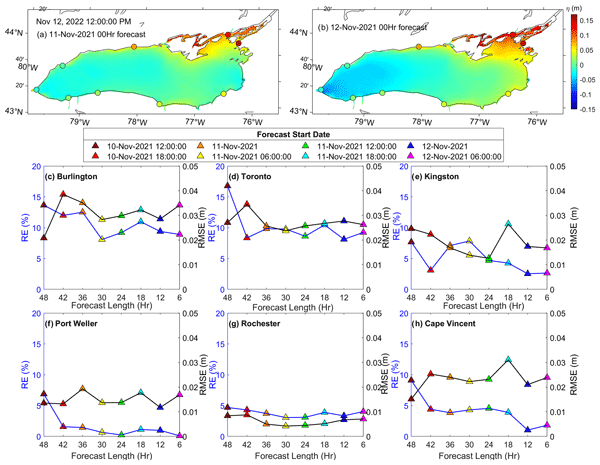
We develop an operational forecast system, Coastlines-LO, that can simulate water levels and surface waves in Lake Ontario driven by forecasts of wind speeds and pressure fields from an atmospheric model. The model has relatively low computational requirements, and results compare well with near-real-time observations, as well as with results from other existing forecast systems. Results show that with shorter forecast lengths, storm surge and wave predictions can improve in accuracy.
Shuqi Lin, Leon Boegman, Shiliang Shan, and Ryan Mulligan
Geosci. Model Dev., 15, 1331–1353, https://doi.org/10.5194/gmd-15-1331-2022, https://doi.org/10.5194/gmd-15-1331-2022, 2022
Short summary
Short summary
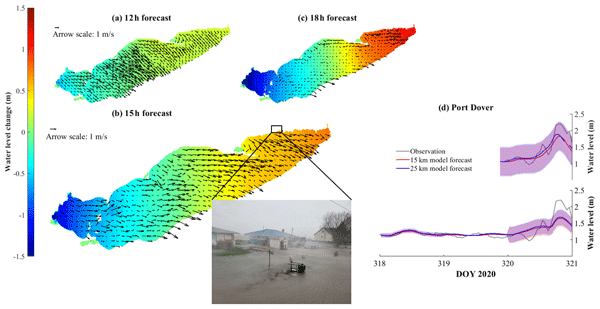
An operational hydrodynamics forecast system, COASTLINES, using the Windows Task Scheduler, Python, and MATLAB scripts, to automate application of a 3-D model (AEM3D) in Lake Erie was developed. The system predicted storm-surge and up-/downwelling events that are important for flood water and drinking water/fishery management. This example of the successful development of an operational forecast system can be adapted to simulate aquatic systems as required for management and public safety.
Cited articles
Almany, G. R., Hamilton, R. J., Bode, M., Matawai, M., Potuku, T., Saenz-Agudelo, P., Planes, S., Berumen, M. L., Rhodes, K. L., Thorrold, S. R., Russ, G. R., and Jones, G. P.: Dispersal of grouper larvae drives local resource sharing in a coral reef fishery, Curr. Biol., 23, 626–630, https://doi.org/10.1016/j.cub.2013.03.006, 2013.
Almany, G. R., Planes, S., Thorrold, S. R., Berumen, M. L., Bode, M., Saenz-Agudelo, P., Bonin, M. C., Frisch, A. J., Harrison, H. B., Messmer, V., Nanninga, G. B., Priest, M. A., Srinivasan, M., Sinclair-Taylor, T., Williamson, D. H., and Jones, G. P.: Larval fish dispersal in a coral-reef seascape, Nat. Ecol. Evol., 1, 148, https://doi.org/10.1038/s41559-017-0148, 2017.
Alvarez-Noriega, M., Burgess, S. C., Byers, J. E., Pringle, J. M., Wares, J. P., and Marshall, D. J.: Global biogeography of marine dispersal potential, Nat. Ecol. Evol., 4, 1196–1203, https://doi.org/10.1038/s41559-020-1238-y, 2020.
Ayata, S.-D., Lazure, P., and Thiébaut, É.: How does the connectivity between populations mediate range limits of marine invertebrates? A case study of larval dispersal between the Bay of Biscay and the English Channel (North-East Atlantic), Prog. Oceanogr., 87, 18-36, https://doi.org/10.1016/j.pocean.2010.09.022, 2010.
Botsford, L. W., Hastings, A., and Gaines, S. D.: Dependence of sustainability on the configuration of marine reserves and larval dispersal distance, Ecol. Lett., 4, 144–150, https://doi.org/10.1046/j.1461-0248.2001.00208.x, 2001.
Botsford, L. W., White, J. W., Coffroth, M. A., Paris, C. B., Planes, S., Shearer, T. L., Thorrold, S. R., and Jones, G. P.: Connectivity and resilience of coral reef metapopulations in marine protected areas: matching empirical efforts to predictive needs, Coral Reefs, 28, 327–337, https://doi.org/10.1007/s00338-009-0466-z, 2009.
Catalano, K. A., Dedrick, A. G., Stuart, M. R., Puritz, J. B., Montes Jr., H. R., and Pinsky, M. L.: Quantifying dispersal variability among nearshore marine populations, Mol. Ecol., 30, 2366–2377, https://doi.org/10.1111/mec.15732, 2021.
Chaput, R., Sochala, P., Miron, P., Kourafalou, V. H., Iskandarani, M., and Kaplan, D. M.: Quantitative uncertainty estimation in biophysical models of fish larval connectivity in the Florida Keys, ICES J. Mar. Sci., 79, 609–632, https://doi.org/10.1093/icesjms/fsac021, 2022.
Choi, J.-G., Jo, Y.-H., Moon, I.-J., Park, J., Kim, D.-W., and Lippmann, T. C.: Physical forces determine the annual bloom intensity of the giant jellyfish Nemopilema nomurai off the coast of Korea, Regional Studies in Marine Science, 24, 55–65, https://doi.org/10.1016/j.rsma.2018.07.003, 2018.
Cowen, R. K. and Sponaugle, S.: Larval Dispersal and Marine Population Connectivity, Annu. Rev. Mar. Sci., 1, 443-466, https://doi.org/10.1146/annurev.marine.010908.163757, 2009.
D'Aloia, C. C., Bogdanowicz, S. M., Francis, R. K., Majoris, J. E., Harrison, R. G., and Buston, P. M.: Patterns, causes, and consequences of marine larval dispersal, P. Natl. Acad. Sci. USA, 112, 13940–13945, https://doi.org/10.1073/pnas.1513754112, 2015.
Dedrick, A. G., Catalano, K. A., Stuart, M. R., White, J. W., Montes Jr., H. R., and Pinsky, M. L.: Persistence of a reef fish metapopulation via network connectivity: theory and data, Ecol. Lett., 24, 1121–1132, https://doi.org/10.1111/ele.13721, 2021.
Edwards, K. P., Hare, J. A., Werner, F. E., and Seim, H.: Using 2-dimensional dispersal kernels to identify the dominant influences on larval dispersal on continental shelves, Mar. Ecol. Prog. Ser., 352, 77–87, https://doi.org/10.3354/meps07169, 2007.
Faillettaz, R., Paris, C. B., and Irisson, J.-O.: Larval Fish Swimming Behavior Alters Dispersal Patterns From Marine Protected Areas in the North-Western Mediterranean Sea, Frontiers in Marine Science, 5, https://doi.org/10.3389/fmars.2018.00097, 2018.
Hamilton, R. J., Lozano‐Cortés, D., Bode, M., Almany, Glenn R., Harrison, H. B., Pita, J., Saenz‐Agudelo, P., Gereniu, C., Waldie, P. A., Peterson, N., Choat, J. H., and Berumen, M. L.: Larval dispersal and fishing pressure influence recruitment in a coral reef fishery, J. Appl. Ecol., 58, 2924–2935, https://doi.org/10.1111/1365-2664.14027, 2021.
Hao, W., Jian, S., Ruijing, W., Lei, W., and Yi'an, L.: Tidal front and the convergence of anchovy (Engraulis japonicus) eggs in the Yellow Sea, Fish. Oceanogr., 12, 434–442, https://doi.org/10.1046/j.1365-2419.2003.00259.x, 2003.
Hinrichsen, H.-H., Kühn, W., Peck, M. A., and Voss, R.: The impact of physical and biological factors on the drift and spatial distribution of larval sprat: A comparison of the Baltic and North Seas, Prog. Oceanogr., 107, 47–60, https://doi.org/10.1016/j.pocean.2012.05.004, 2012.
Huggett, J., Fréon, P., Mullon, C., and Penven, P.: Modelling the transport success of anchovy Engraulis encrasicolus eggs and larvae in the southern Benguela: the effect of spatio-temporal spawning patterns, Mar. Ecol. Prog. Ser., 250, 247–262, 2003.
Huret, M., Petitgas, P., and Woillez, M.: Dispersal kernels and their drivers captured with a hydrodynamic model and spatial indices: A case study on anchovy (Engraulis encrasicolus) early life stages in the Bay of Biscay, Prog. Oceanogr., 87, 6–17, https://doi.org/10.1016/j.pocean.2010.09.023, 2010.
Iseki, K. and Kiyomoto, Y.: Distribution and settling of Japanese anchovy (Engraulis japonicus eggs at the spawning ground off Changjiang River in the East China Sea, Fish. Oceanogr., 6, 205–210, https://doi.org/10.1046/j.1365-2419.1997.00040.x, 1997.
Itoh, S., Yasuda, I., Nishikawa, H., Sasaki, H., and Sasai, Y.: Transport and environmental temperature variability of eggs and larvae of the Japanese anchovy (Engraulis japonicus) and Japanese sardine (Sardinops melanostictus) in the western North Pacific estimated via numerical particle‐tracking experiments, Fish. Oceanogr., 18, 118–133, https://doi.org/10.1111/j.1365-2419.2009.00501.x, 2009.
Langsrud, Ø.: 50–50 multivariate analysis of variance for collinear responses, Statistician, 51, 305–317, 2002.
Lett, C., Roy, C., Levasseur, A., Van Der Lingen, C. D., and Mullon, C.: Simulation and quantification of enrichment and retention processes in the southern Benguela upwelling ecosystem, Fish. Oceanogr., 15, 363–372, https://doi.org/10.1111/j.1365-2419.2005.00392.x, 2006.
Lett, C., Ayata, S.-D., Huret, M., and Irisson, J.-O.: Biophysical modelling to investigate the effects of climate change on marine population dispersal and connectivity, Prog. Oceanogr., 87, 106–113, https://doi.org/10.1016/j.pocean.2010.09.005, 2010.
Lett, C., Penven, P., Ayón, P., and Fréon, P.: Enrichment, concentration and retention processes in relation to anchovy (Engraulis ringens) eggs and larvae distributions in the northern Humboldt upwelling ecosystem, J. Marine Syst., 64, 189–200, https://doi.org/10.1016/j.jmarsys.2006.03.012, 2007.
Liang, S. and Sun, Z.: Typical seasonal circulation in the Bohai Sea[C]//ISOPE International Ocean and Polar Engineering Conference, ISOPE, ISOPE-I-03-123, 2003.
Liu, S., Liu, Y., Alabia, I. D., Tian, Y., Ye, Z., Yu, H., Li, J., and Cheng, J.: Impact of Climate Change on Wintering Ground of Japanese Anchovy (Engraulis japonicus) Using Marine Geospatial Statistics, Frontiers in Marine Science, 7, https://doi.org/10.3389/fmars.2020.00604, 2020.
Masuda, R.: Ontogeny of swimming speed, schooling behaviour and jellyfish avoidance by Japanese anchovy Engraulis japonicus, J. Fish Biol., 78, 1323–1335, https://doi.org/10.1111/j.1095-8649.2011.02936.x, 2011.
Matsuno, T., Lee, J. S., Shimizu, M., Kim, S. H., and Pang, I. C.: Measurements of the turbulent energy dissipation rate ε and an evaluation of the dispersion process of the Changjiang Diluted Water in the East China Sea, J. Geophys. Res.-Oceans, 111, https://doi.org/10.1029/2005jc003196, 2006.
Moon, J.-H., Pang, I.-C., Yang, J.-Y., and Yoon, W. D.: Behavior of the giant jellyfish Nemopilema nomurai in the East China Sea and East/Japan Sea during the summer of 2005: A numerical model approach using a particle-tracking experiment, J. Marine Syst., 80, 101–114, https://doi.org/10.1016/j.jmarsys.2009.10.015, 2010.
Nathan, R.: Long-distance dispersal of plants, Science, 313, https://doi.org/10.1126/science.112497, 2008.
Nathan, R., Schurr, F. M., Spiegel, O., Steinitz, O., Trakhtenbrot, A., and Tsoar, A.: Mechanisms of long-distance seed dispersal, Trends Ecol. Evol., 23, 638–647, https://doi.org/10.1016/j.tree.2008.08.003, 2008.
Nickols, K. J., White, J. W., Largier, J. L., and Gaylord, B.: Marine population connectivity: reconciling large-scale dispersal and high self-retention, Am. Nat., 185, 196–211, https://doi.org/10.1086/679503, 2015.
Paris, C. B. and Cowen, R. K.: Direct evidence of a biophysical retention mechanism for coral reef fish larvae, Limnol. Oceanogr., 49, 1964–1979, https://doi.org/10.4319/lo.2004.49.6.1964, 2004.
Puckett, B. J., Eggleston, D. B., Kerr, P. C., and Luettich, R. A.: Larval dispersal and population connectivity among a network of marine reserves, Fish. Oceanogr., 23, 342–361, https://doi.org/10.1111/fog.12067, 2014.
Sato, M., Honda, K., Nakamura, Y., Bernardo, L. P. C., Bolisay, K. O., Yamamoto, T., Herrera, E. C., Nakajima, Y., Lian, C., Uy, W. H., Fortes, M. D., Nadaoka, K., and Nakaoka, M.: Hydrodynamics rather than type of coastline shapes self‐recruitment in anemonefishes, Limnol. Oceanogr., 69, https://doi.org/10.1002/lno.12399, 2023.
Selkoe, K. A. and Toonen, R. J.: Marine connectivity: a new look at pelagic larval duration and genetic metrics of dispersal, Mar. Ecol. Prog. Ser., 436, 291–305, https://doi.org/10.3354/meps09238, 2011.
Shanks, A., L.,, Grantham, B. A., and Carr, M. H.: Propagule dispersal distance and the size and spacing of marine reserves, Ecol. Appl., 13, https://doi.org/10.1890/1051-0761(2003)013[0159:PDDATS]2.0.CO;2, 2003.
Shanks, A. L.: Pelagic larval duration and dispersal distance revisited, Biol. Bull., 216, 373–385, 2009.
Shi, W., Shao, D., Gualtieri, C., Purnama, A., and Cui, B.: Modelling long‐distance floating seed dispersal in salt marsh tidal channels, Ecohydrology, 13, https://doi.org/10.1002/eco.2157, 2019.
Shi, W., Boegman, L., Shan, S., Zhao, Y., Ackerman, J. D., Amidon, Z., Jabbari, A., and Roseman, E.: A Larval “Recruitment Kernel” to Predict Hatching Locations and Quantify Recruitment Patterns, Water Resour. Res., 60, https://doi.org/10.1029/2023wr036099, 2024.
Shi, W., Boegman, L., Shan, S., Tian, Y., Liu, Y., Sun, P., Ye, Z., Xing, Q., and Li, J.: Data for for manuscript: Quantifying Patterns and Drivers of Larval Dispersal in Japanese Anchovy (Engraulis japonicus) in the China Seas, Zenodo [code, data set], https://doi.org/10.5281/zenodo.21902024, 2026.
Siegel, D. A., Kinlan, B. P., Gaylord, B., and Gaines, S. D.: Lagrangian descriptions of marine larval dispersion, Mar. Ecol. Prog. Ser., 260, 83–96, https://doi.org/10.3354/meps260083, 2003.
Takeshige, A., Miyake, Y., Nakata, H., Kitagawa, T., and Kimura, S.: Simulation of the impact of climate change on the egg and larval transport of Japanese anchovy (Engraulis japonicus) off Kyushu Island, the western coast of Japan, Fish. Oceanogr., 24, 445–462, https://doi.org/10.1111/fog.12121, 2015.
Tu, C. Y., Tseng, Y. H., Chiu, T. S., Shen, M. L., and Hsieh, C. H.: Using coupled fish behavior–hydrodynamic model to investigate spawning migration of Japanese anchovy, Engraulis japonicus, from the East China Sea to Taiwan, Fish. Oceanogr., 21, 255–268, https://doi.org/10.1111/j.1365-2419.2012.00619.x, 2012.
Vaz, A. C., Karnauskas, M., Smith, M., Denson, L. S., Paris, C. B., Le Hénaff, M., and Siegfried, K.: Red Snapper connectivity in the Gulf of Mexico, Mar. Coastal Fish., 15, https://doi.org/10.1002/mcf2.10275, 2023.
Wan, R. J., Huang, D. J., and Zhang, J.: Abundance and distribution of eggs and larvae of Engraulis japonicus in the Northern part of East China Sea and the Southern part of Yellow Sea and its relationship with environmental conditions, Journal of Fisheries of China, 26, http://scxuebao.ijournals.cn/scxuebao/article/abstract/20020406 (last access: 27 August 2026), 2002.
Wan, R. J., Wei, H., Sun, S., and Zhao, X. Y.: Spawning Ecology of the Anchovy Engraulis japonicus in the Spawning Ground of the Southern Shandong Peninsula I. Abundance and Distribution Characters of Anchovy Eggs and Larvae, Acta Zoologica Sinica, 54, https://kns.cnki.net/kcms2/article/abstract?v= hH4QDuxDhLRmgvpK0E4_qIH3_2jX4ZSpdSjUy6F6g YanYGhuCzzsrUlvPC6mOjFzAvAhroVTEmMUqSXg6HvNf VWUPPIGOPPYTSFZ00MwLCpMcyb88jWV8wKOM5t5 wWynnUK0yXL4Vk6CSMMXApAcUKq43FW6UsLjoqlo _9XyiXmW8jNg8kBY4g==&uniplatform= NZKPT&language=CHS (last access: 27 August 2026), 2008.
Wei, H., Su, J., Wan, R. J., Wang, L., and Lin, Y. A.: Tidal front and the convergence of anchovy (Engraulis japonicus) eggs in the Yellow Sea, Fish. Oceanogr., 12, 434–442, https://doi.org/10.1046/j.1365-2419.2003.00259.x, 2003.
Willis, J.: Modelling swimming aquatic animals in hydrodynamic models, Ecol. Model., 222, 3869–3887, https://doi.org/10.1016/j.ecolmodel.2011.10.004, 2011.
Woillez, M., Rivoirard, J., and Petitgas, P.: Notes on survey-based spatial indicators for monitoring fish populations, Aquat. Living Resour., 22, 155–164, https://doi.org/10.1051/alr/2009017, 2009.
Wood, S., Paris, C. B., Ridgwell, A., and Hendy, E. J.: Modelling dispersal and connectivity of broadcast spawning corals at the global scale, Global Ecol. Biogeogr., 23, 1–11, https://doi.org/10.1111/geb.12101, 2013.
Xing, Q., Yu, H., Yu, H., Sun, P., Liu, Y., Ye, Z., Li, J., and Tian, Y.: A comprehensive model-based index for identification of larval retention areas: A case study for Japanese anchovy Engraulis japonicus in the Yellow Sea, Ecol. Indic., 116, https://doi.org/10.1016/j.ecolind.2020.106479, 2020.
Xing, Q., Yu, H., Ito, S.-i., Ma, S., Yu, H., Wang, H., Tian, Y., Sun, P., Liu, Y., Li, J., and Ye, Z.: Using a larval growth index to detect the environment-recruitment relationships and its linkage with basin-scale climate variability: A case study for Japanese anchovy (Engraulis japonicus) in the Yellow Sea, Ecol. Indic., 122, https://doi.org/10.1016/j.ecolind.2020.107301, 2021.
Ye, M. Z. and Zhang, Z.: The distribution and behabiour of Engraulis japonicus Temminck and schlegel and its detection in the north China Seas (Hwang-hai and Po-hai), Journal of Fisheries of China, 2, 27–34, 1965.
Yu, H. T., Lee, Y. J., Huang, S. W., and Chiu, T. S.: Genetic analysis of the populations of Japanese anchovy (Engraulidae: Engraulis japonicus) using microsatellite DNA, Mar. Biotechnol., 4, 471–479, https://doi.org/10.1007/s10126-002-0035-8, 2002.
Yu, J. Z., Zhang, Y. W., Bian, X. D., Chen, Y. L., and Zhang, X. Q.: Key impact factor identification and future distribution prediction of the anchovy spawning ground in the Bohai Sea, China Environmental Science, 40, 2214–2221, https://doi.org/10.19674/j.cnki.issn1000-6923.2020.0253, 2020.
Yu, Z. N., Kong, X. Y., Guo, T. H., Jiang, Y. Y., Zhuang, Z. M., and Jin, X. S.: Mitochondrial DNA sequence variation of Japanese anchovy Engraulis japonicus from the Yellow Sea and East China Sea, Fisheries Sci., 71, 299–307, 2005.
Zenitani, H. and Kimura, R.: Elemental analysis of otoliths of Japanese anchovy: trial to discriminate between Seto Inland Sea and Pacific sotck, Fisheries Sci., 73, https://doi.org/10.1111/j.1444-2906.2007.01295.x, 2007.
Zhang, B.-D., Li, Y.-L., Xue, D.-X., and Liu, J.-X.: Population Genomics Reveals Shallow Genetic Structure in a Connected and Ecologically Important Fish From the Northwestern Pacific Ocean, Frontiers in Marine Science, 7, https://doi.org/10.3389/fmars.2020.00374, 2020a.
Zhang, W., Yu, H., Ye, Z., Tian, Y., Liu, Y., Li, J., Xing, Q., and Jiang, Y.: Spawning strategy of Japanese anchovy Engraulis japonicus in the coastal Yellow Sea: Choice and dynamics, Fish. Oceanogr., 30, 366–381, https://doi.org/10.1111/fog.12523, 2020b.
Zhang, W., Ye, Z., Jiang, Y., Zhang, C., Li, J., and Tian, Y.: Early Growth Pattern of Japanese Anchovy Engraulis japonicus in the Coastal Yellow Sea and Its Influencing Factors, Fish. Oceanogr., 34, 1–16, https://doi.org/10.1111/fog.12732, 2025.
Zhao, X., Hamre, J., Li, F., Jin, X., and Tang, Q.: Recruitment, sustainable yield and possible ecological consequences of the sharp decline of the anchovy (Engraulis japonicus) stock in the Yellow Sea in the 1990s, Fish. Oceanogr., 12, 495–501, https://doi.org/10.1046/j.1365-2419.2003.00262.x, 2003.
Zhao, X. Y.: Population dynamic characteristics and sustainable utilization of the anchovy stock in the Yellow Sea, Ocean University of China, Qingdao, https://kns.cnki.net/kcms2/article/abstract?v= hH4QDuxDhLSZjvrumcWKUDaayxAdkToCcGYPRkqnFymz- lCJVGxPck2HziZTimyOysuQJJl8EmIyQRjH5Y79S0EmO0d TTqFEjtnBWmIB5fgTXArsRJD_quUsFJUkGu2381TY81 QBDuy2d73fRE4Bi_TVLlH0Y27emADAQZUzqRb3wQJggC7ULQ ==&uniplatform=NZKPT&language=CHS (last access: 27 August 2026), 2006.
Zhao, Y., Jones, M. L., Shuter, B. J., and Roseman, E. F.: A biophysical model of Lake Erie walleye (Sander vitreus) explains interannual variations in recruitment, Can. J. Fish. Aquat. Sci., 66, 114–125, https://doi.org/10.1139/f08-188, 2009.
Zheng, W., Zou, L., and Han, Z.: Genetic analysis of the populations of Japanese anchovy Engraulis japonicus from the Yellow Sea and East China Sea based on mitochondrial cytochrome b sequence, Biochem. Syst. Ecol., 58, 169–177, https://doi.org/10.1016/j.bse.2014.12.007, 2015.
Short summary
Japanese anchovy is a highly abundant and important fish, where its larvae travel and settle after spawning were modeled here. Most larvae remain in nearby coastal waters, especially in the Bohai Sea, the northern Yellow Sea, and along the southern Shandong Peninsula. In contrast, larvae from the Changjiang Estuary can travel much farther, reaching distant regions. This highlights its key role in connecting populations and provides useful insight for fisheries management and conservation.
Japanese anchovy is a highly abundant and important fish, where its larvae travel and settle...


Altmetrics
Final-revised paper
Preprint