
Articles | Volume 23, issue 18
https://doi.org/10.5194/bg-23-6521-2026
© Author(s) 2026. This work is distributed under
the Creative Commons Attribution 4.0 License.
the Creative Commons Attribution 4.0 License.
https://doi.org/10.5194/bg-23-6521-2026
© Author(s) 2026. This work is distributed under
the Creative Commons Attribution 4.0 License.
the Creative Commons Attribution 4.0 License.
Research article
| 
18 Sep 2026
Research article |
| 18 Sep 2026
| 18 Sep 2026
Introducing shrubs enhances the representation of high-latitude vegetation and carbon cycling in the ORCHIDEE land surface model

Department of Environmental Science, Aarhus University, Roskilde, Denmark
Efrén López-Blanco
Department of Ecoscience, Aarhus University, Roskilde, Denmark
Department of Environment and Minerals, Greenland Institute of Natural Resources, Nuuk, Greenland
Vladislav Bastrikov
Science Partners, Paris, France
Sebastiaan Luyssaert
ALIFE, Systems Ecology, Vrije Universiteit Amsterdam, Amsterdam, the Netherlands
Philippe Peylin
Laboratoire des Sciences du Climat et de l'Environnement, LSCE/IPSL, CEA-CNRS-UVSQ, Université Paris-Saclay, Gif-sur-Yvette, France
Department of Environmental Science, Aarhus University, Roskilde, Denmark
Related authors
No articles found.
Karoliina Särkelä, Timo Vesala, Torben R. Christensen, Juval Cohen, Angelika Kübert, Xuefei Li, Hannu Marttila, Jouni Pulliainen, Eeva-Stiina Tuittila, and Efrén López-Blanco
Biogeosciences, 23, 6037–6052, https://doi.org/10.5194/bg-23-6037-2026, https://doi.org/10.5194/bg-23-6037-2026, 2026
Short summary
Short summary
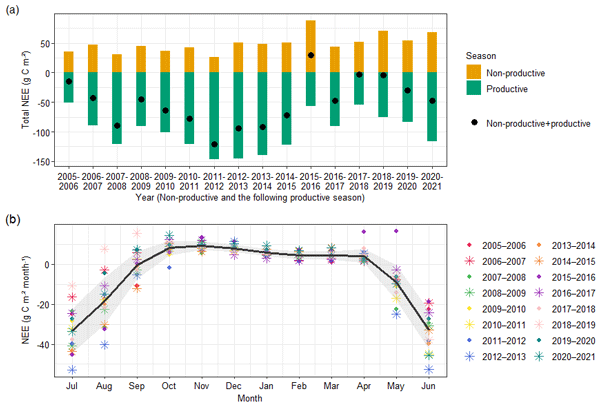
Using a 17-year record of year-round peatland carbon exchange, we found that over half of the carbon sequestrated during summer was released during winter. In one year, CO₂ emissions during snow melt and soil thaw in spring were large enough to shift the peatland from a net carbon sink to a source. These findings demonstrate that winter and early-spring processes have a strong impact over the annual carbon balance of northern peatlands.
Anna-Maria Virkkala, Isabel Wargowsky, Judith Vogt, McKenzie A. Kuhn, Simran Madaan, Tiffany Windholz, Kyle A. Arndt, Gerard Rocher-Ros, Mathias Göckede, David Olefeldt, Edward A. G. Schuur, David Bastviken, Richard O'Keefe, Brendan M. Rogers, Jennifer D. Watts, Kelcy Kent, Kristoffer Aalstad, Kelly Aho, Joonatan Ala-Könni, Haley Alcock, Inge Althuizen, Christopher D. Arp, Jun Asanuma, Mika Aurela, Sivakiruthika Balathandayuthabani, Katrin Attermeyer, Alan Barr, Maialen Barret, Ochirbat Batkhishig, Christina Biasi, Mats P. Björkman, Andrew Black, Elena Blanc-Betes, Pascal Bodmer, Julia Boike, Abdullah Bolek, Frédéric Bouchard, Ingeborg Bussmann, Lea Cabrol, Eleonora Canfora, Sean Carey, Karel Castro-Morales, Namyi Chae, Andreas Christen, Torben R. Christensen, Casper T. Christiansen, Housen Chu, Graham Clark, Francois Clayer, Patrick Crill, Christopher Cunada, Scott J. Davidson, Joshua F. Dean, Sigrid Dengel, Matteo Detto, Catherine Dieleman, Florent Domine, Egor Dyukarev, Colin Edgar, Bo Elberling, Craig A. Emmerton, Eugenie Euskirchen, Grant Falvo, Thomas Friborg, Michelle Garneau, Mariasilvia Giamberini, Mikhail V. Glagolev, Miquel A. Gonzalez-Meler, Gustaf Granath, Jón Guðmundsson, Konsta Happonen, Yoshinobu Harazono, Lorna Harris, Josh Hashemi, Nicholas Hasson, Janna Heerah, Liam Heffernan, Manuel Helbig, Warren Helgason, Michal Heliasz, Greg Henry, Geert Hensgens, Tetsuya Hiyama, Beth Holmes, Macall Hock, David Holl, Jutta Holst, Thomas Holst, Gabriel Hould-Gosselin, Elyn Humphreys, Jacqueline Hung, Jussi Huotari, Hiroki Ikawa, Danil V. Ilyasov, Mamoru Ishikawa, Go Iwahana, Hiroki Iwata, Marcin Antoni Jackowicz-Korczynski, Joachim Jansen, Järvi Järveoja, Vincent E. J. Jassey, Rasmus Jensen, Katharina Jentzsch, Robert G. Jespersen, Carl-Fredrik Johannesson, Cheristy P. Jones, Anders Jonsson, Ji Young Jung, Sari Juutinen, Evan Kane, Jan Karlsson, Sergey Karsanaev, Kuno Kasak, Julia Kelly, Kasha Kempton, Marcus Klaus, George W. Kling, Natascha Kljun, Jacqueline Knutson, Hideki Kobayashi, John Kochendorfer, Kukka-Maaria Kohonen, Pasi Kolari, Mika Korkiakoski, Aino Korrensalo, Pirkko Kortelainen, Egle Koster, Kajar Koster, Ayumi Kotani, Praveena Krishnan, Juliya Kurbatova, Lars Kutzbach, Min Jung Kwon, Ethan D. Kyzivat, Jessica Lagroix, Theodore Langhorst, Elena Lapshina, Tuula Larmola, Klaus S. Larsen, Isabelle Laurion, Justin Ledman, Hanna Lee, A. Joshua Leffler, Lance Lesack, Anders Lindroth, David Lipson, Annalea Lohila, Efrén López-Blanco, Vincent L. St. Louis, Erik Lundin, Miska Luoto, Takashi Machimura, Marta Magnani, Avni Malhotra, Marja Maljanen, Ivan Mammarella, Elisa Männistö, Luca Belelli Marchesini, Phil Marsh, Pertti J. Martikainen, Maija E. Marushchak, Mikhail Mastepanov, Alex Mavrovic, Trofim Maximov, Christina Minions, Daniel F. Nadeau, Marco Montemayor, Tomoaki Morishita, Patrick Murphy, Erin Nicholls, Mats B. Nilsson, Anastasia Niyazova, Jenni Nordén, Koffi Dodji Noumonvi, Hannu Nykänen, Walter Oechel, Anne Ojala, Tomohiro Okadera, Sujan Pal, Alexey V. Panov, Tim Papakyriakou, Dario Papale, Sang-Jong Park, Frans-Jan W. Parmentier, Gilberto Pastorello, Mike Peacock, Matthias Peichl, Roman Petrov, Kyra St. Pierre, Norbert Pirk, Jessica Plein, Vilmantas Preskienis, Anatoly Prokushkin, Jukka Pumpanen, Hilary A. Rains, Niklas Rakos, Aleksi Räsänen, Helena Rautakoski, Riikka Rinnan, Janne Rinne, Adrian Rocha, Nigel Roulet, Alexandre Roy, Anna Rutgersson, Aleksandr F. Sabrekov, Torsten Sachs, Erik Sahlée, Alejandro Salazar, Henrique Oliveira Sawakuchi, Christopher Schulze, Roger Seco, Armando Sepulveda-Jauregui, Svetlana Serikova, Abbey Serrone, Hanna M. Silvennoinen, Sofie Sjogersten, June Skeeter, Jo Snöälv, Sebastian Sobek, Oliver Sonnentag, Emily H. Stanley, Maria Strack, Lena Strom, Patrick Sullivan, Ryan Sullivan, Anna Sytiuk, Torbern Tagesson, Pierre Taillardat, Julie Talbot, Suzanne E. Tank, Mario Tenuta, Irina Terenteva, Frederic Thalasso, Antoine Thiboult, Halldor Thorgeirsson, Fenix Garcia Tigreros, Margaret Torn, Amy Townsend-Small, Claire Treat, Alain Tremblay, Carlo Trotta, Eeva-Stiina Tuittila, Merritt Turetsky, Masahito Ueyama, Muhammad Umair, Aki Vähä, Lona van Delden, Maarten van Hardenbroek, Andrej Varlagin, Ruth K. Varner, Tarmo Virtanen, Elena Veretennikova, Timo Vesala, Carolina Voigt, Jorien E. Vonk, Robert Wagner, Katey Walter Anthony, Qinxue Wang, Masataka Watanabe, Hailey Webb, Jeffrey M. Welker, Andreas Westergaard-Nielsen, Sebastian Westermann, Jeffrey R. White, Christian Wille, Scott N. Williamson, Scott Zolkos, Donatella Zona, and Susan M. Natali
Earth Syst. Sci. Data, 18, 6357–6409, https://doi.org/10.5194/essd-18-6357-2026, https://doi.org/10.5194/essd-18-6357-2026, 2026
Short summary
Short summary
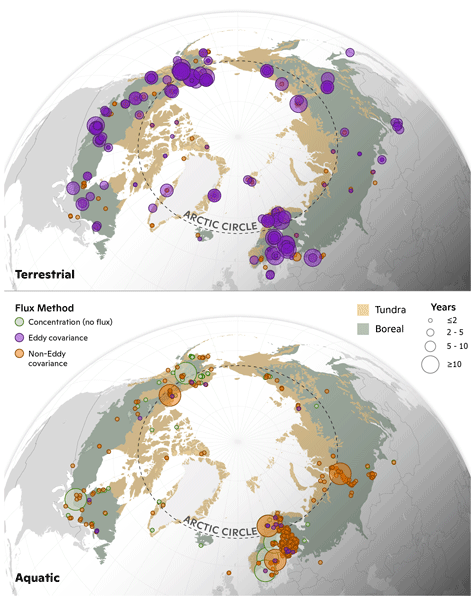
This dataset includes monthly measurements of carbon dioxide and methane exchange between land, water, and the atmosphere from over 1000 sites in Arctic and boreal regions. It combines measurements from a variety of ecosystems, including wetlands, forests, tundra, lakes, and rivers, gathered by over 260 researchers from 1984–2024. This dataset can be used to improve and reduce uncertainty in carbon budgets in order to strengthen our understanding of climate feedbacks in a warming world.
Signe Hillerup Larsen, Kirsty Langley, Daniel A. Rudd, Mikhail Mastepanov, Niels Martin Schmidt, Arno C. Hammann, Andreas Westergaard-Nielsen, Efrén Lopéz-Blanco, and Torben R. Christensen
EGUsphere, https://doi.org/10.5194/egusphere-2026-3962, https://doi.org/10.5194/egusphere-2026-3962, 2026
This preprint is open for discussion and under review for The Cryosphere (TC).
Short summary
Short summary
Snow cover shapes Arctic ecosystems by controlling for example when plants flower and glaciers melt. Using 26 years of daily satellite images over Greenland, we found high year-to-year variability and no systematic change in the length of the snow-free season at three long-term ecosystem monitoring sites. Thus, detecting the effects of climate change on snow cover and the ecosystems depending on it requires longer monitoring records, underscoring the value of continued long-term observation.
Konstantin Gregor, Benjamin F. Meyer, Tillmann Gaida, Victor Justo Vasquez, Karina Bett-Williams, Matthew Forrest, João P. Darela-Filho, Sam Rabin, Marcos Longo, Joe R. Melton, Johan Nord, Peter Anthoni, Vladislav Bastrikov, Thomas Colligan, Christine Delire, Michael C. Dietze, George Hurtt, Akihiko Ito, Lasse T. Keetz, Jürgen Knauer, Johannes Köster, Tzu-Shun Lin, Lei Ma, Marie Minvielle, Stefan Olin, Sebastian Ostberg, Hao Shi, Reiner Schnur, Qing Sun, Peter E. Thornton, and Anja Rammig
Geosci. Model Dev., 19, 2407–2436, https://doi.org/10.5194/gmd-19-2407-2026, https://doi.org/10.5194/gmd-19-2407-2026, 2026
Short summary
Short summary
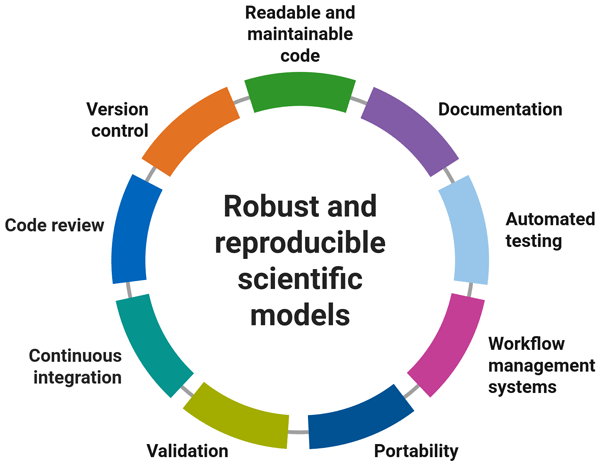
Geoscientific models are crucial for understanding Earth’s processes. However, they sometimes do not adhere to highest software quality standards, and scientific results are often hard to reproduce due to the complexity of the workflows. Here we gather the expertise of 20 modeling groups and software engineers to define best practices for making geoscientific models maintainable, usable, and reproducible. We conclude with an open-source example serving as a reference for modeling communities.
Natalie Douglas, Simon Beylat, Tristan Quaife, Philippe Peylin, Nina Raoult, and Ross Bannister
EGUsphere, https://doi.org/10.5194/egusphere-2026-132, https://doi.org/10.5194/egusphere-2026-132, 2026
Short summary
Short summary
This study investigates a statistical method, called 4DEnVar, to calibrate uncertain land surface model parameters against observations. This method is easy to use but can lead to unphysical parameter values. The study explores the causes of this while proposing a simple way to overcome the problem. We show that the 4DEnVar method exhibits considerable versatility by applying the method to two different land surface models, under different settings, to calibrate photosynthetic parameters.

Rémi Gaillard, Patricia Cadule, Philippe Peylin, Nicolas Vuichard, and Bertrand Guenet
Geosci. Model Dev., 19, 661–711, https://doi.org/10.5194/gmd-19-661-2026, https://doi.org/10.5194/gmd-19-661-2026, 2026
Short summary
Short summary
The release of carbon from thawing permafrost soils could amplify future climate warming. However, this feedback is highly uncertain because most Earth system models (ESM) do not represent permafrost carbon. We have improved the Institut Pierre-Simon Laplace ESM by including permafrost physical, carbon and nitrogen processes to better represent Arctic ecosystems. The model more accurately represents past and present permafrost physics and biogeochemistry, paving the way for future projections.
Siqing Xu, Sebastiaan Luyssaert, Yves Balkanski, Philippe Ciais, Nicolas Viovy, Liang Wan, and Jean Sciare
Geosci. Model Dev., 19, 1–25, https://doi.org/10.5194/gmd-19-1-2026, https://doi.org/10.5194/gmd-19-1-2026, 2026
Short summary
Short summary
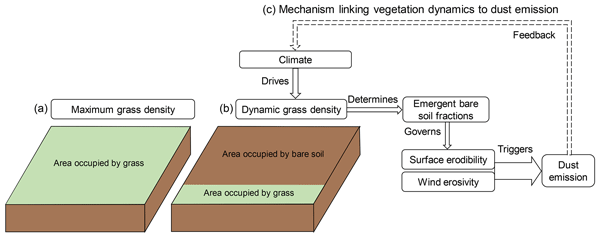
Prescribing a fixed grassland density in the ORCHIDEE model limits its ability to capture grassland dynamics, leading to unrealistic mortality, especially in semi-arid grasslands. We proposed a dynamic density approach where a positive density-precipitation relationship emerges. This method improves spatial pattern, significantly reduces mortality, sustains productivity, and raises the aridity threshold above which frequent mortality events occur in grasslands.
Espoir Koudjo Gaglo, Emeline Chaste, Sebastiaan Luyssaert, Olivier Roupsard, Christophe Jourdan, Sidy Sow, Nadeige Vandewalle, Frédéric C. Do, Daouda Ngom, and Aude Valade
Geosci. Model Dev., 18, 9541–9563, https://doi.org/10.5194/gmd-18-9541-2025, https://doi.org/10.5194/gmd-18-9541-2025, 2025
Short summary
Short summary
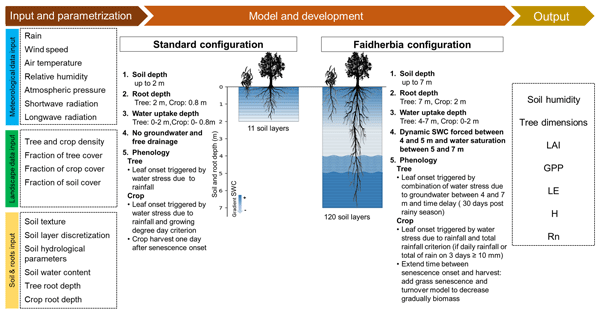
Agroforestry in the Sahel help store carbon and support food production, but land surface models struggle to capture their dynamics. We adapted the ORCHIDEE model to simulate Faidherbia albida, a tree that taps deep groundwater. This work highlights the need to integrate deep water uptake in land surface models for groundwater-dependent ecosystems, as it could enhance predictions, helping to sustain agroforestry in a changing climate.
Nikolina Mileva, Julia Pongratz, Vivek K. Arora, Akihiko Ito, Sebastiaan Luyssaert, Sonali S. McDermid, Paul A. Miller, Daniele Peano, Roland Séférian, Yanwu Zhang, and Wolfgang Buermann
Earth Syst. Dynam., 16, 2137–2160, https://doi.org/10.5194/esd-16-2137-2025, https://doi.org/10.5194/esd-16-2137-2025, 2025
Short summary
Short summary
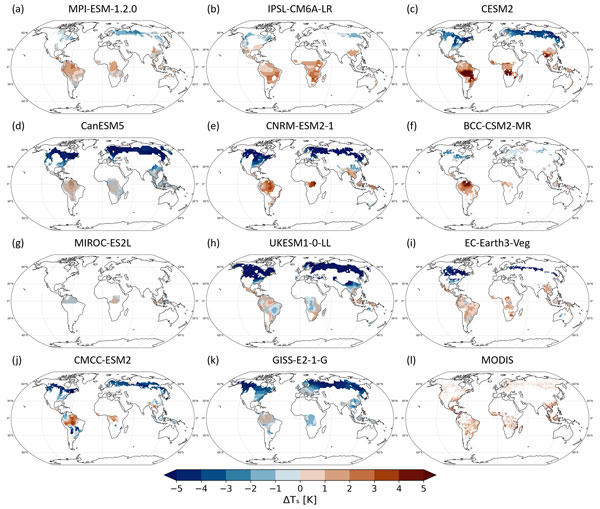
Despite forests being so important for mitigating climate change, there are still uncertainties about how much the changes in forest cover contribute to the cooling/warming of the climate. Climate models and real-world observations often disagree about the magnitude and even the direction of these changes. We constrain climate models scenarios of widespread deforestation with satellite and in-situ data and show that models still have difficulties representing the movement of heat and water.
Eeva Järvi-Laturi, Teemu Tahvanainen, Eero Koskinen, Efrén López-Blanco, Juho Lämsä, Hannu Marttila, Mikhail Mastepanov, Riku Paavola, Maria Väisänen, and Torben R. Christensen
Biogeosciences, 22, 6343–6367, https://doi.org/10.5194/bg-22-6343-2025, https://doi.org/10.5194/bg-22-6343-2025, 2025
Short summary
Short summary
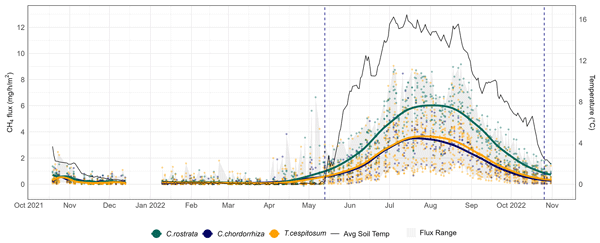
Our research investigates how plant community composition influences methane emissions in a northern boreal rich fen. We measured methane fluxes year-round using manual chambers across 36 plots. Our findings suggest that sedges, particularly Carex rostrata, significantly impact the fluxes throughout the year. This study enhances our understanding of vegetation-driven methane emissions, providing valuable insights for predicting future changes in peatland methane emissions.
Simon Beylat, Nina Raoult, Cédric Bacour, Natalie Douglas, Tristan Quaife, Vladislav Bastrikov, Peter J. Rayner, and Philippe Peylin
Geosci. Model Dev., 18, 7501–7527, https://doi.org/10.5194/gmd-18-7501-2025, https://doi.org/10.5194/gmd-18-7501-2025, 2025
Short summary
Short summary
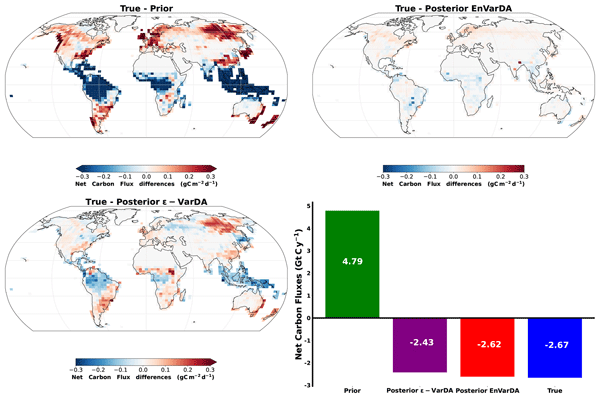
Land surface models are important tools for understanding and predicting the land components of the carbon cycle. Atmospheric CO2 concentration data are a valuable source of information that can be used to improve the accuracy of these models. In this study, we present a statistical ensemble-variational data assimilation method named EnVarDA to calibrate parameters of a land surface model using these data. We show that this method is easy to implement and more efficient and accurate than traditional methods.
Lei Zhu, Philippe Ciais, Yitong Yao, Daniel Goll, Sebastiaan Luyssaert, Isabel Martínez Cano, Arthur Fendrich, Laurent Li, Hui Yang, Sassan Saatchi, Ricardo Dalagnol, and Wei Li
Geosci. Model Dev., 18, 4915–4933, https://doi.org/10.5194/gmd-18-4915-2025, https://doi.org/10.5194/gmd-18-4915-2025, 2025
Short summary
Short summary
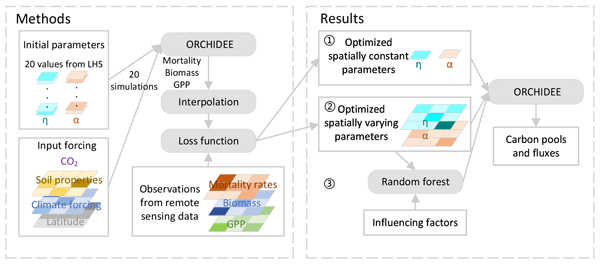
This study enhances the accuracy of modeling the carbon dynamics of the Amazon rainforest by optimizing key model parameters based on satellite data. Using spatially varying parameters for tree mortality and photosynthesis, we improved predictions of biomass, productivity, and tree mortality. Our findings highlight the critical role of wood density and water availability in forest processes, offering insights to use in refining global carbon cycle models.
Luis-Enrique Olivera-Guerra, Catherine Ottlé, Nina Raoult, and Philippe Peylin
Hydrol. Earth Syst. Sci., 29, 261–290, https://doi.org/10.5194/hess-29-261-2025, https://doi.org/10.5194/hess-29-261-2025, 2025
Short summary
Short summary
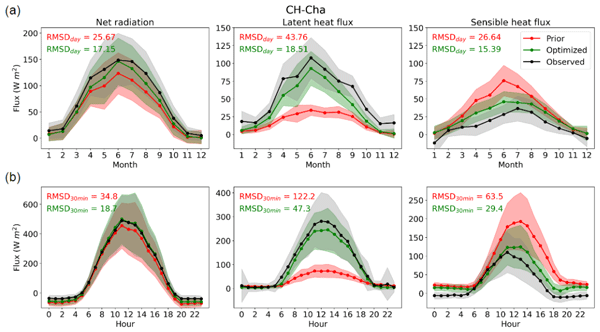
We assimilate the recent ESA-CCI land surface temperature (LST) product to optimize parameters of a land surface model (ORCHIDEE). We test different assimilation strategies to evaluate the best strategy over various in situ stations across Europe. We also provide advice on how to assimilate this LST product to better simulate LST and surface energy fluxes. Finally, we demonstrate the effectiveness of this optimization, which is essential to better simulate future projections.
Guillaume Marie, Jina Jeong, Hervé Jactel, Gunnar Petter, Maxime Cailleret, Matthew J. McGrath, Vladislav Bastrikov, Josefine Ghattas, Bertrand Guenet, Anne Sofie Lansø, Kim Naudts, Aude Valade, Chao Yue, and Sebastiaan Luyssaert
Geosci. Model Dev., 17, 8023–8047, https://doi.org/10.5194/gmd-17-8023-2024, https://doi.org/10.5194/gmd-17-8023-2024, 2024
Short summary
Short summary
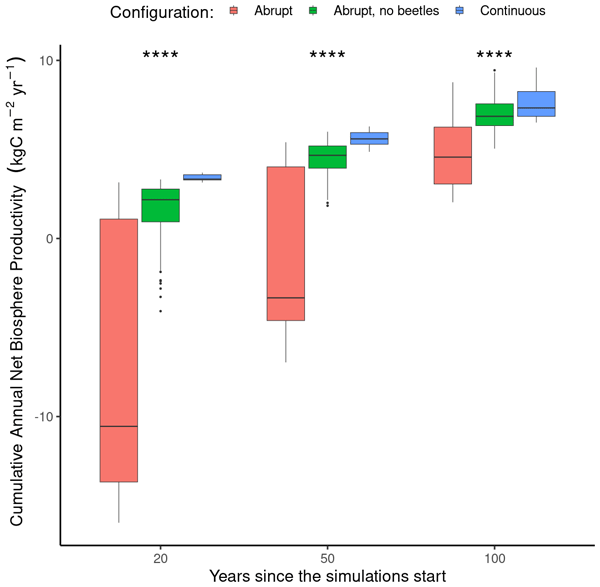
This research looks at how climate change influences forests, and particularly how altered wind and insect activities could make forests emit instead of absorb carbon. We have updated a land surface model called ORCHIDEE to better examine the effect of bark beetles on forest health. Our findings suggest that sudden events, such as insect outbreaks, can dramatically affect carbon storage, offering crucial insights into tackling climate change.
Peng Huang, Agnès Ducharne, Lucia Rinchiuso, Jan Polcher, Laure Baratgin, Vladislav Bastrikov, and Eric Sauquet
Hydrol. Earth Syst. Sci., 28, 4455–4476, https://doi.org/10.5194/hess-28-4455-2024, https://doi.org/10.5194/hess-28-4455-2024, 2024
Short summary
Short summary
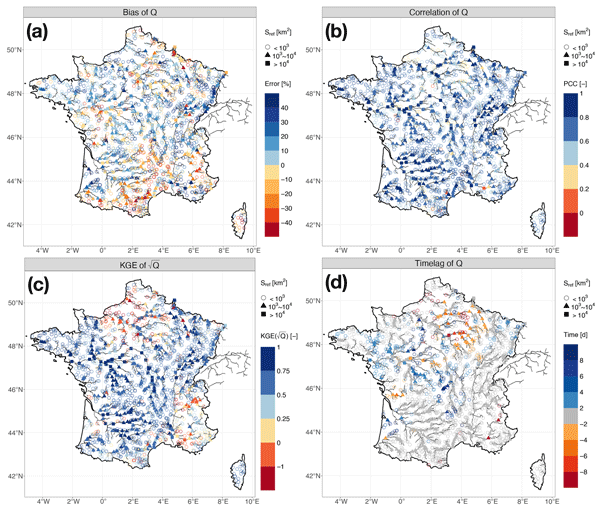
We conducted a high-resolution hydrological simulation from 1959 to 2020 across France. We used a simple trial-and-error calibration to reduce the biases of the simulated water budget compared to observations. The selected simulation satisfactorily reproduces water fluxes, including their spatial contrasts and temporal trends. This work offers a reliable historical overview of water resources and a robust configuration for climate change impact analysis at the nationwide scale of France.
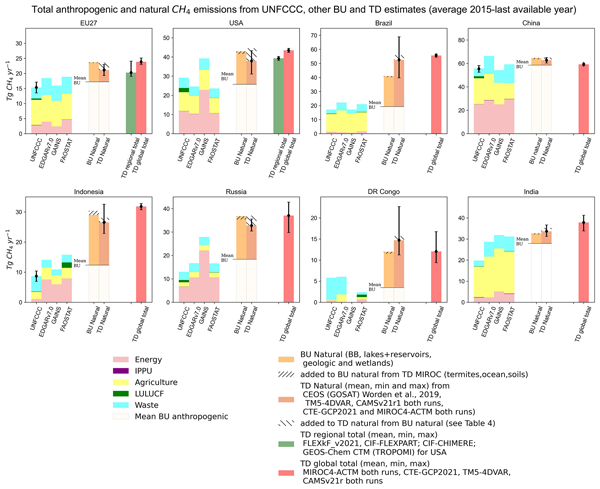
Ana Maria Roxana Petrescu, Glen P. Peters, Richard Engelen, Sander Houweling, Dominik Brunner, Aki Tsuruta, Bradley Matthews, Prabir K. Patra, Dmitry Belikov, Rona L. Thompson, Lena Höglund-Isaksson, Wenxin Zhang, Arjo J. Segers, Giuseppe Etiope, Giancarlo Ciotoli, Philippe Peylin, Frédéric Chevallier, Tuula Aalto, Robbie M. Andrew, David Bastviken, Antoine Berchet, Grégoire Broquet, Giulia Conchedda, Stijn N. C. Dellaert, Hugo Denier van der Gon, Johannes Gütschow, Jean-Matthieu Haussaire, Ronny Lauerwald, Tiina Markkanen, Jacob C. A. van Peet, Isabelle Pison, Pierre Regnier, Espen Solum, Marko Scholze, Maria Tenkanen, Francesco N. Tubiello, Guido R. van der Werf, and John R. Worden
Earth Syst. Sci. Data, 16, 4325–4350, https://doi.org/10.5194/essd-16-4325-2024, https://doi.org/10.5194/essd-16-4325-2024, 2024
Short summary
Short summary
This study provides an overview of data availability from observation- and inventory-based CH4 emission estimates. It systematically compares them and provides recommendations for robust comparisons, aiming to steadily engage more parties in using observational methods to complement their UNFCCC submissions. Anticipating improvements in atmospheric modelling and observations, future developments need to resolve knowledge gaps in both approaches and to better quantify remaining uncertainty.
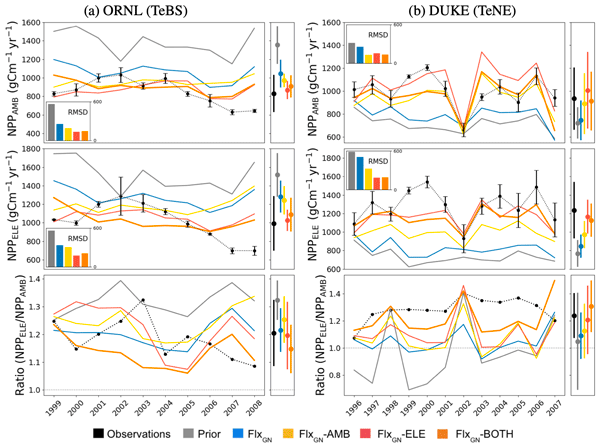
Nina Raoult, Louis-Axel Edouard-Rambaut, Nicolas Vuichard, Vladislav Bastrikov, Anne Sofie Lansø, Bertrand Guenet, and Philippe Peylin
Biogeosciences, 21, 1017–1036, https://doi.org/10.5194/bg-21-1017-2024, https://doi.org/10.5194/bg-21-1017-2024, 2024
Short summary
Short summary
Observations are used to reduce uncertainty in land surface models (LSMs) by optimising poorly constraining parameters. However, optimising against current conditions does not necessarily ensure that the parameters treated as invariant will be robust in a changing climate. Manipulation experiments offer us a unique chance to optimise our models under different (here atmospheric CO2) conditions. By using these data in optimisations, we gain confidence in the future projections of LSMs.
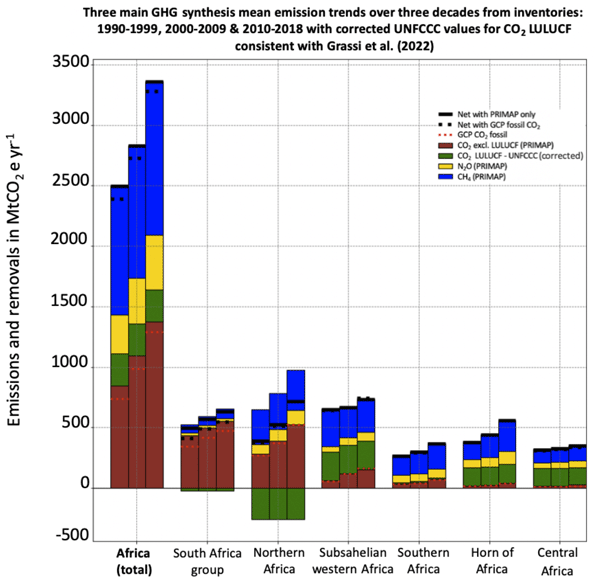
Mounia Mostefaoui, Philippe Ciais, Matthew J. McGrath, Philippe Peylin, Prabir K. Patra, and Yolandi Ernst
Earth Syst. Sci. Data, 16, 245–275, https://doi.org/10.5194/essd-16-245-2024, https://doi.org/10.5194/essd-16-245-2024, 2024
Short summary
Short summary
Our aim is to assess African anthropogenic greenhouse gas emissions and removals by using different data products, including inventories and process-based models, and to compare their relative merits with inversion data coming from satellites. We show a good match among the various estimates in terms of overall trends at a regional level and on a decadal basis, but large differences exist even among similar data types, which is a limit to the possibility of verification of country-reported data.
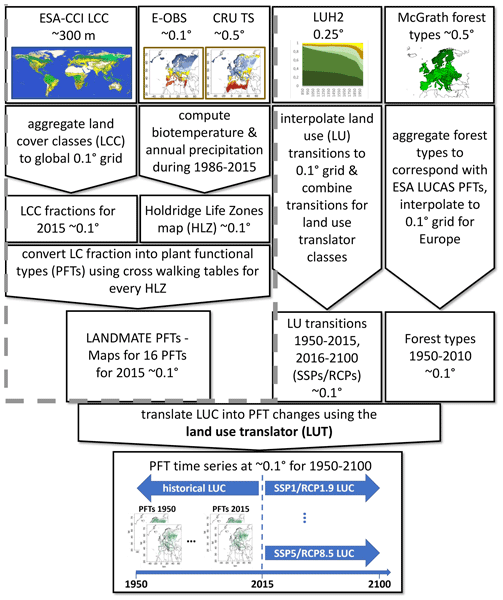
Peter Hoffmann, Vanessa Reinhart, Diana Rechid, Nathalie de Noblet-Ducoudré, Edouard L. Davin, Christina Asmus, Benjamin Bechtel, Jürgen Böhner, Eleni Katragkou, and Sebastiaan Luyssaert
Earth Syst. Sci. Data, 15, 3819–3852, https://doi.org/10.5194/essd-15-3819-2023, https://doi.org/10.5194/essd-15-3819-2023, 2023
Short summary
Short summary
This paper introduces the new high-resolution land use and land cover change dataset LUCAS LUC for Europe (version 1.1), tailored for use in regional climate models. Historical and projected future land use change information from the Land-Use Harmonization 2 (LUH2) dataset is translated into annual plant functional type changes from 1950 to 2015 and 2016 to 2100, respectively, by employing a newly developed land use translator.

Cédric Bacour, Natasha MacBean, Frédéric Chevallier, Sébastien Léonard, Ernest N. Koffi, and Philippe Peylin
Biogeosciences, 20, 1089–1111, https://doi.org/10.5194/bg-20-1089-2023, https://doi.org/10.5194/bg-20-1089-2023, 2023
Short summary
Short summary
The impact of assimilating different dataset combinations on regional to global-scale C budgets is explored with the ORCHIDEE model. Assimilating simultaneously multiple datasets is preferable to optimize the values of the model parameters and avoid model overfitting. The challenges in constraining soil C disequilibrium using atmospheric CO2 data are highlighted for an accurate prediction of the land sink distribution.
Yi-Ying Chen and Sebastiaan Luyssaert
Biogeosciences, 20, 349–363, https://doi.org/10.5194/bg-20-349-2023, https://doi.org/10.5194/bg-20-349-2023, 2023
Short summary
Short summary
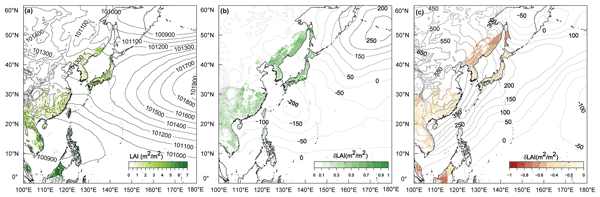
Tropical cyclones are typically assumed to be associated with ecosystem damage. This study challenges this assumption and suggests that instead of reducing leaf area, cyclones in East Asia may increase leaf area by alleviating water stress.
Huanhuan Wang, Chao Yue, and Sebastiaan Luyssaert
Biogeosciences, 20, 75–92, https://doi.org/10.5194/bg-20-75-2023, https://doi.org/10.5194/bg-20-75-2023, 2023
Short summary
Short summary
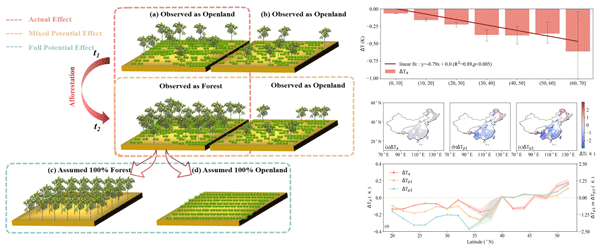
This study provided a synthesis of three influential methods to quantify afforestation impact on surface temperature. Results showed that actual effect following afforestation was highly dependent on afforestation fraction. When full afforestation is assumed, the actual effect approaches the potential effect. We provided evidence the afforestation faction is a key factor in reconciling different methods and emphasized that it should be considered for surface cooling impacts in policy evaluation.

Yitong Yao, Emilie Joetzjer, Philippe Ciais, Nicolas Viovy, Fabio Cresto Aleina, Jerome Chave, Lawren Sack, Megan Bartlett, Patrick Meir, Rosie Fisher, and Sebastiaan Luyssaert
Geosci. Model Dev., 15, 7809–7833, https://doi.org/10.5194/gmd-15-7809-2022, https://doi.org/10.5194/gmd-15-7809-2022, 2022
Short summary
Short summary
To facilitate more mechanistic modeling of drought effects on forest dynamics, our study implements a hydraulic module to simulate the vertical water flow, change in water storage and percentage loss of stem conductance (PLC). With the relationship between PLC and tree mortality, our model can successfully reproduce the large biomass drop observed under throughfall exclusion. Our hydraulic module provides promising avenues benefiting the prediction for mortality under future drought events.
Guillaume Marie, B. Sebastiaan Luyssaert, Cecile Dardel, Thuy Le Toan, Alexandre Bouvet, Stéphane Mermoz, Ludovic Villard, Vladislav Bastrikov, and Philippe Peylin
Geosci. Model Dev., 15, 2599–2617, https://doi.org/10.5194/gmd-15-2599-2022, https://doi.org/10.5194/gmd-15-2599-2022, 2022
Short summary
Short summary
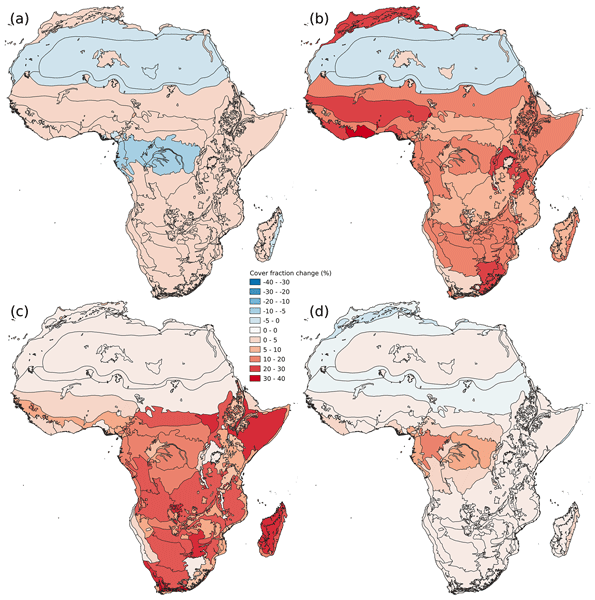
Most Earth system models make use of vegetation maps to initialize a simulation at global scale. Satellite-based biomass map estimates for Africa were used to estimate cover fractions for the 15 land cover classes. This study successfully demonstrates that satellite-based biomass maps can be used to better constrain vegetation maps. Applying this approach at the global scale would increase confidence in assessments of present-day biomass stocks.
Marine Remaud, Frédéric Chevallier, Fabienne Maignan, Sauveur Belviso, Antoine Berchet, Alexandra Parouffe, Camille Abadie, Cédric Bacour, Sinikka Lennartz, and Philippe Peylin
Atmos. Chem. Phys., 22, 2525–2552, https://doi.org/10.5194/acp-22-2525-2022, https://doi.org/10.5194/acp-22-2525-2022, 2022
Short summary
Short summary
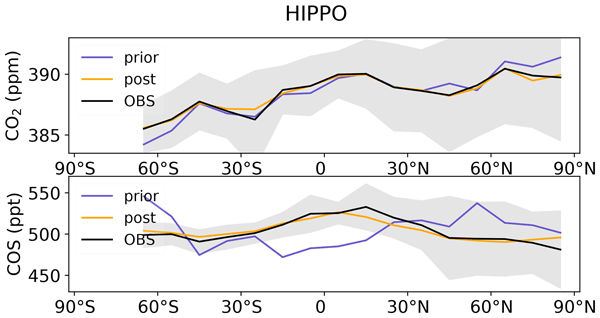
Carbonyl sulfide (COS) has been recognized as a promising indicator of the plant gross primary production (GPP). Here, we assimilate both COS and CO2 measurements into an atmospheric transport model to obtain information on GPP, plant respiration and COS budget. A possible scenario for the period 2008–2019 leads to a global COS biospheric sink of 800 GgS yr−1 and higher oceanic emissions between 400 and 600 GgS yr−1.
Cited articles
Alton, P.: How useful are plant functional types in global simulations of the carbon, water, and energy cycles?, J. Geophys. Res.-Biogeo., 116, https://doi.org/10.1029/2010JG001430, 2011. a, b
AMAP: AMAP Arctic Climate Change Update 2021: Key Trends and Impacts, Arctic Monitoring and Assessment Programme (AMAP), Tromsø, Norway, 2021. a
Ball, J. T., Woodrow, I. E., and Berry, J. A.: A Model Predicting Stomatal Conductance and its Contribution to the Control of Photosynthesis under Different Environmental Conditions, Springer Netherlands, Dordrecht, pp. 221–224, https://doi.org/10.1007/978-94-017-0519-6_48, 1987. a
Bastrikov, V., MacBean, N., Bacour, C., Santaren, D., Kuppel, S., and Peylin, P.: Land surface model parameter optimisation using in situ flux data: comparison of gradient-based versus random search algorithms (a case study using ORCHIDEE v1.9.5.2), Geosci. Model Dev., 11, 4739–4754, https://doi.org/10.5194/gmd-11-4739-2018, 2018. a
Belke-Brea, M., Domine, F., Barrere, M., Picard, G., and Arnaud, L.: Impact of Shrubs on Winter Surface Albedo and Snow Specific Surface Area at a Low Arctic Site: In Situ Measurements and Simulations, J. Climate, 33, 597–609, https://doi.org/10.1175/JCLI-D-19-0318.1, 2020. a
Berner, L., Alexander, H., Loranty, M., Ganzlin, P., Mack, M., Davydov, S., and Goetz, S.: Biomass allometry for alder, dwarf birch, and willow in boreal forest and tundra ecosystems of far northeastern Siberia and north-central Alaska, Forest Ecol. Manag., 337, 110–118, https://doi.org/10.1016/j.foreco.2014.10.027, 2015. a, b, c
Berner, L., Massey, R., Jantz, P., Forbes, B., Macias-Fauria, M., Myers-Smith, I., Kumpula, T., Gauthier, G., Andreu-Hayles, L., Gaglioti, B., Burns, P., Zetterberg, P., D'Arrigo, R., and Goetz, S.: Summer warming explains widespread but not uniform greening in the Arctic tundra biome, Nat. Commun., 11, 4621, https://doi.org/10.1038/s41467-020-18479-5, 2020. a
Berner, L., Orndahl, K., Rose, M., Tamstorf, M., Arndal, M., Alexander, H., Humphreys, E., Loranty, M., Ludwig, S., Nyman, J., Juutinen, S., Aurela, M., Happonen, K., Mikola, J., Mack, M., Vankoughnett, M., Iversen, C., Salmon, V., Yang, D., Kumar, J., Grogan, P., Danby, R., Scott, N., Olofsson, J., Siewert, M., Deschamps, L., Lévesque, E., Maire, V., Morneault, A., Gauthier, G., Gignac, C., Boudreau, S., Gaspard, A., Kholodov, A., Bret-Harte, M., Greaves, H., Walker, D., Gregory, F., Michelsen, A., Kumpula, T., Villoslada, M., Ylänne, H., Luoto, M., Virtanen, T., Forbes, B., Hölzel, N., Epstein, H., Heim, R., Bunn, A., Holmes, R., Hung, J., Natali, S., Virkkala, A.-M., and Goetz, S.: The Arctic Plant Aboveground Biomass Synthesis Dataset, Sci. Data, 11, 305, https://doi.org/10.1038/s41597-024-03139-w, 2024. a, b, c, d, e, f, g, h, i, j, k, l, m
Bodegom, P., Douma, J., Witte, J., Ordóñez, J., Bartholomeus, R., and Aerts, R.: Going beyond limitations of plant functional types when predicting global ecosystem–atmosphere fluxes: exploring the merits of traits-based approaches, Global Ecol. Biogeogr., 21, 625–636, https://doi.org/10.1111/j.1466-8238.2011.00717.x, 2011. a
Bonfils, C., Phillips, T., Lawrence, D., Cameron-Smith, P., Riley, W., and Subin, Z.: On the influence of shrub height and expansion on northern high latitude climate, Environ. Res. Lett., 7, 015503, https://doi.org/10.1088/1748-9326/7/1/015503, 2012. a, b, c
Botta, A., Viovy, N., Ciais, P., Friedlingstein, P., and Monfray, P.: A global prognostic scheme of leaf onset using satellite data, Glob. Change Biol., 6, 709–725, https://doi.org/10.1046/j.1365-2486.2000.00362.x, 2000. a
Boucher, O., Servonnat, J., Albright, A. L., Aumont, O., Balkanski, Y., Bastrikov, V., Bekki, S., Bonnet, R., Bony, S., Bopp, L., Braconnot, P., Brockmann, P., Cadule, P., Caubel, A., Cheruy, F., Codron, F., Cozic, A., Cugnet, D., D'Andrea, F., Davini, P., de Lavergne, C., Denvil, S., Deshayes, J., Devilliers, M., Ducharne, A., Dufresne, J.-L., Dupont, E., Éthé, C., Fairhead, L., Falletti, L., Flavoni, S., Foujols, M.-A., Gardoll, S., Gastineau, G., Ghattas, J., Grandpeix, J.-Y., Guenet, B., Guez, L. E., Guilyardi, E., Guimberteau, M., Hauglustaine, D., Hourdin, F., Idelkadi, A., Joussaume, S., Kageyama, M., Khodri, M., Krinner, G., Lebas, N., Levavasseur, G., Lévy, C., Li, L., Lott, F., Lurton, T., Luyssaert, S., Madec, G., Madeleine, J.-B., Maignan, F., Marchand, M., Marti, O., Mellul, L., Meurdesoif, Y., Mignot, J., Musat, I., Ottlé, C., Peylin, P., Planton, Y., Polcher, J., Rio, C., Rochetin, N., Rousset, C., Sepulchre, P., Sima, A., Swingedouw, D., Thiéblemont, R., Traore, A. K., Vancoppenolle, M., Vial, J., Vialard, J., Viovy, N., and Vuichard, N.: Presentation and Evaluation of the IPSL-CM6A-LR Climate Model, J. Adv. Model. Earth Sy., 12, e2019MS002010, https://doi.org/10.1029/2019MS002010, 2020. a
Box, E. O.: Plant Functional Types and Climate at the Global Scale, J. Veg. Sci., 7, 309–320, https://doi.org/10.2307/3236274, 1996. a
CAVM Team: Raster Circumpolar Arctic Vegetation Map. Scale
Chapin III, F., Bret-Harte, M., Hobbie, S., and Zhong, H.: Plant functional types as predictors of transient responses of arctic vegetation to global change, J. Veg. Sci., 7, 347–358, https://doi.org/10.2307/3236278, 1996. a, b
Chen, Y.-Y., Gardiner, B., Pasztor, F., Blennow, K., Ryder, J., Valade, A., Naudts, K., Otto, J., McGrath, M. J., Planque, C., and Luyssaert, S.: Simulating damage for wind storms in the land surface model ORCHIDEE-CAN (revision 4262), Geosci. Model Dev., 11, 771–791, https://doi.org/10.5194/gmd-11-771-2018, 2018. a
Chu, H., Christianson, D., Cheah, Y.-W., Pastorello, G., O'Brien, F., Geden, J., Ngo, S.-T., Hollowgrass, R., Leibowitz, K., Beekwilder, N., Sandesh, M., Dengel, S., Chan, S., Santos, A., Delwiche, K., Yi, K., Buechner, C., Baldocchi, D., Papale, D., Keenan, T., Biraud, S., Agarwal, D., and Torn, M.: AmeriFlux BASE data pipeline to support network growth and data sharing, Sci. Data, 10, 614, https://doi.org/10.1038/s41597-023-02531-2, 2023. a
Chuine, I.: A unified model for budburst of trees, J. Theor. Biol., 207, 337–347, https://doi.org/10.1006/jtbi.2000.2178, 2000. a
de Rosnay, P. and Polcher, J.: Modelling root water uptake in a complex land surface scheme coupled to a GCM, Hydrol. Earth Syst. Sci., 2, 239–255, https://doi.org/10.5194/hess-2-239-1998, 1998. a
Dinerstein, E., Olson, D., Joshi, A., Vynne, C., Burgess, N., Wikramanayake, E., Hahn, N., Palminteri, S., Hedao, P., Noss, R., Hansen, M., Locke, H., Ellis, E., Jones, B., Barber, C., Hayes, R., Kormos, C., Martin, V., Crist, E., Sechrest, W., Price, L., Baillie, J., Weeden, D., Suckling, K., Davis, C., Sizer, N., Moore, R., Thau, D., Birch, T., Potapov, P., Turubanova, S., Tyukavina, A., de Souza, N., Pintea, L., Brito, J., Llewellyn, O., Miller, A., Patzelt, A., Ghazanfar, S., Timberlake, J., Klöser, H., Shennan-Farpón, Y., Kindt, R., Lillesø, J.-P., van Breugel, P., Graudal, L., Voge, M., Al-Shammari, K., and Saleem, M.: An Ecoregion-Based Approach to Protecting Half the Terrestrial Realm, BioScience, 67, 534–545, https://doi.org/10.1093/biosci/bix014, 2017. a, b, c
Dobbert, S., Pape, R., and Löffler, J.: Contrasting growth response of evergreen and deciduous arctic-alpine shrub species to climate variability, Ecosphere, 12, e03688, https://doi.org/10.1002/ecs2.3688, 2021. a
Domine, F., Barrere, M., and Morin, S.: The growth of shrubs on high Arctic tundra at Bylot Island: impact on snow physical properties and permafrost thermal regime, Biogeosciences, 13, 6471–6486, https://doi.org/10.5194/bg-13-6471-2016, 2016. a
Druel, A., Peylin, P., Krinner, G., Ciais, P., Viovy, N., Peregon, A., Bastrikov, V., Kosykh, N., and Mironycheva-Tokareva, N.: Towards a more detailed representation of high-latitude vegetation in the global land surface model ORCHIDEE (ORC-HL-VEGv1.0), Geosci. Model Dev., 10, 4693–4722, https://doi.org/10.5194/gmd-10-4693-2017, 2017. a, b
Ducoudre, N., Laval, K., and Perrier, A.: SECHIBA, a new set of parameterizations of the hydrologic exchanges at the land-atmosphere interface within the LMD atmospheric general circulation model, J. Climate, 6, 248–273, https://doi.org/10.1175/1520-0442(1993)006<0248:SANSOP>2.0.CO;2, 1993. a
Eldridge, D., Bowker, M., Maestre, F., Roger, E., Reynolds, J., and Whitford, W.: Impacts of shrub encroachment on ecosystem structure and functioning: towards a global synthesis, Ecol. Lett., 14, 709–722, https://doi.org/10.1111/j.1461-0248.2011.01630.x, 2011. a
Elmendorf, S., Henry, G., Hollister, R., Björk, R., Bjorkman, A., Callaghan, T., Collier, L., Cooper, E., Cornelissen, J., Day, T., Fosaa, A., Gould, W., Grétarsdóttir, J., Harte, J., Hermanutz, L., Hik, D., Hofgaard, A., Jarrad, F., Jónsdóttir, I., Keuper, F., Klanderud, K., Klein, J., Koh, S., Kudo, G., Lang, S., Loewen, V., May, J., Mercado, J., Michelsen, A., Molau, U., Myers-Smith, I., Oberbauer, S., Pieper, S., Post, E., Rixen, C., Robinson, C., Schmidt, N., Shaver, G., Stenström, A., Tolvanen, A., Totland, Ø., Troxler, T., Wahren, C.-H., Webber, P., Welker, J., and Wookey, P.: Global assessment of experimental climate warming on tundra vegetation: heterogeneity over space and time, Ecol. Lett., 15, 164–175, https://doi.org/10.1111/j.1461-0248.2011.01716.x, 2012. a, b, c
Farquhar, G. D., von Caemmerer, S., and Berry, J. A.: A biochemical model of photosynthetic CO2 assimilation in leaves of C3 species, Planta, 149, 78–90, https://doi.org/10.1007/BF00386231, 1980. a
Forbes, T., Rossiter, D., and Van Wambeke, A.: Guidelines for evaluating the adequacy of soil resource inventories, vol. 4, Cornell University, Department of Agronomy, 1987. a
Frost, G. V. and Epstein, H. E.: Tall shrub and tree expansion in Siberian tundra ecotones since the 1960s, Glob. Change Biol., 20, 1264–1277, https://doi.org/10.1111/gcb.12406, 2014. a
Goldberg, D.: Genetic Algorithms in Search, Optimization, and Machine Learning, Addison-Wesley, New York, ISBN 978-0-201-15767-3, 1989. a
Götmark, F., Götmark, E., and Jensen, A. M.: Why Be a Shrub? A Basic Model and Hypotheses for the Adaptive Values of a Common Growth Form, Front. Plant Sci., 7, 1095, https://doi.org/10.3389/fpls.2016.01095, 2016. a
Gould, W., Raynolds, M., and Walker, D.: Vegetation, plant biomass, and net primary productivity patterns in the Canadian Arctic, J. Geophys. Res.-Atmos., 108, https://doi.org/10.1029/2001jd000948, 2003. a
Hänninen, H. and Kramer, K.: A framework for modelling the annual cycle of trees in boreal and temperate regions, Silva Fenn., 41, 167–205, https://doi.org/10.14214/sf.313, 2007. a
Harper, A. B., Cox, P. M., Friedlingstein, P., Wiltshire, A. J., Jones, C. D., Sitch, S., Mercado, L. M., Groenendijk, M., Robertson, E., Kattge, J., Bönisch, G., Atkin, O. K., Bahn, M., Cornelissen, J., Niinemets, Ü., Onipchenko, V., Peñuelas, J., Poorter, L., Reich, P. B., Soudzilovskaia, N. A., and Bodegom, P. V.: Improved representation of plant functional types and physiology in the Joint UK Land Environment Simulator (JULES v4.2) using plant trait information, Geosci. Model Dev., 9, 2415–2440, https://doi.org/10.5194/gmd-9-2415-2016, 2016. a
Harper, A. B., Wiltshire, A. J., Cox, P. M., Friedlingstein, P., Jones, C. D., Mercado, L. M., Sitch, S., Williams, K., and Duran-Rojas, C.: Vegetation distribution and terrestrial carbon cycle in a carbon cycle configuration of JULES4.6 with new plant functional types, Geosci. Model Dev., 11, 2857–2873, https://doi.org/10.5194/gmd-11-2857-2018, 2018. a, b
Harper, K. L., Lamarche, C., Hartley, A., Peylin, P., Ottlé, C., Bastrikov, V., San Martín, R., Bohnenstengel, S. I., Kirches, G., Boettcher, M., Shevchuk, R., Brockmann, C., and Defourny, P.: A 29-year time series of annual 300 m resolution plant-functional-type maps for climate models, Earth Syst. Sci. Data, 15, 1465–1499, https://doi.org/10.5194/essd-15-1465-2023, 2023. a, b, c, d, e, f, g, h, i, j, k, l, m
Haverd, V., Smith, B., Nieradzik, L., Briggs, P. R., Woodgate, W., Trudinger, C. M., Canadell, J. G., and Cuntz, M.: A new version of the CABLE land surface model (Subversion revision r4601) incorporating land use and land cover change, woody vegetation demography, and a novel optimisation-based approach to plant coordination of photosynthesis, Geosci. Model Dev., 11, 2995–3026, https://doi.org/10.5194/gmd-11-2995-2018, 2018. a
Heijmans, M., Magnússon, R., Lara, M., Frost, G., Myers-Smith, I., van Huissteden, J., Jorgenson, M., Fedorov, A., Epstein, H., Lawrence, D., and Limpens, J.: Tundra vegetation change and impacts on permafrost, Nat. Rev. Earth Environ., 3, 68–84, https://doi.org/10.1038/s43017-021-00233-0, 2022. a, b
Hugelius, G., Ramage, J., Burke, E., Chatterjee, A., Smallman, T., Aalto, T., Bastos, A., Biasi, C., Canadell, J., Chandra, N., Chevallier, F., Ciais, P., Chang, J., Feng, L., Jones, M., Kleinen, T., Kuhn, M., Lauerwald, R., Liu, J., López-Blanco, E., Luijkx, I., Marushchak, M., Natali, S., Niwa, Y., Olefeldt, D., Palmer, P., Patra, P., Peters, W., Potter, S., Poulter, B., Rogers, B., Riley, W., Saunois, M., Schuur, E., Thompson, R., Treat, C., Tsuruta, A., Turetsky, M., Virkkala, A.-M., Voigt, C., Watts, J., Zhu, Q., and Zheng, B.: Permafrost Region Greenhouse Gas Budgets Suggest a Weak CO2 Sink and CH4 and N2O Sources, But Magnitudes Differ Between Top-Down and Bottom-Up Methods, Global Biogeochem. Cy., 38, e2023GB007969, https://doi.org/10.1029/2023GB007969, 2024. a, b, c, d, e, f, g, h, i, j, k
Hurtt, G., Chini, L., Frolking, S., Betts, R., Feddema, J., Fischer, G., Fisk, J., Hibbard, K., Houghton, R., Janetos, A., Jones, C., Kindermann, G., Kinoshita, T., Klein Goldewijk, K., Riahi, K., Shevliakova, E., Smith, S., Stehfest, E., Thomson, A., Thornton, P., van Vuuren, D., and Wang, Y.: Harmonization of land-use scenarios for the period 1500–2100: 600 years of global gridded annual land-use transitions, wood harvest, and resulting secondary lands, Climatic Change, 109, 117, https://doi.org/10.1007/s10584-011-0153-2, 2011. a
Iturrate-Garcia, M., Heijmans, M. M. P. D., Cornelissen, J. H. C., Schweingruber, F. H., Niklaus, P. A., and Schaepman-Strub, G.: Plant trait response of tundra shrubs to permafrost thaw and nutrient addition, Biogeosciences, 17, 4981–4998, https://doi.org/10.5194/bg-17-4981-2020, 2020. a, b
Iversen, C., Sloan, V., Sullivan, P., Euskirchen, E., McGuire, A., Norby, R., Walker, A., Warren, J., and Wullschleger, S.: The unseen iceberg: plant roots in arctic tundra, New Phytol., 205, 34–58, https://doi.org/10.1111/nph.13003, 2015. a, b, c
Kirchner, A.: Anna-Ida/Introducing-shrubs-in-the-ORCHIDEE-LSM: Analysis code version 1.0.0 accompanying Kirchner et al. (2026) (Version v1.0.0), Zenodo [computer software], https://doi.org/10.5281/zenodo.22283927, 2026. a
Kirchner, A., Lansø, A. S., Bastrikov, V., López-Blanco, E., Luyssaert, S., and Peylin, P.: ORCHIDEE model outputs before and after adding three high-latitude shrub PFTs, Zenodo [data set], https://doi.org/10.5281/zenodo.22284047, 2026. a
Krinner, G., Viovy, N., de Noblet-Ducoudré, N., Ogée, J., Polcher, J., Friedlingstein, P., Ciais, P., Sitch, S., and Prentice, I. C.: A dynamic global vegetation model for studies of the coupled atmosphere-biosphere system, Global Biogeochem. Cy., 19, https://doi.org/10.1029/2003GB002199, 2005. a, b, c
Kuppel, S., Peylin, P., Maignan, F., Chevallier, F., Kiely, G., Montagnani, L., and Cescatti, A.: Model–data fusion across ecosystems: from multisite optimizations to global simulations, Geosci. Model Dev., 7, 2581–2597, https://doi.org/10.5194/gmd-7-2581-2014, 2014. a
Lardy, R., Bellocchi, G., and Soussana, J.-F. J.-F.: A new method to determine soil organic carbon equilibrium, Environ. Model. Softw., 26, 1759 – 1763, https://doi.org/10.1016/j.envsoft.2011.05.016, 2011. a
Lawrence, D. M., Fisher, R. A., Koven, C. D., Oleson, K. W., Swenson, S. C., Bonan, G., Collier, N., Ghimire, B., van Kampenhout, L., Kennedy, D., Kluzek, E., Lawrence, P. J., Li, F., Li, H., Lombardozzi, D., Riley, W. J., Sacks, W. J., Shi, M., Vertenstein, M., Wieder, W. R., Xu, C., Ali, A. A., Badger, A. M., Bisht, G., van den Broeke, M., Brunke, M. A., Burns, S. P., Buzan, J., Clark, M., Craig, A., Dahlin, K., Drewniak, B., Fisher, J. B., Flanner, M., Fox, A. M., Gentine, P., Hoffman, F., Keppel-Aleks, G., Knox, R., Kumar, S., Lenaerts, J., Leung, L. R., Lipscomb, W. H., Lu, Y., Pandey, A., Pelletier, J. D., Perket, J., Randerson, J. T., Ricciuto, D. M., Sanderson, B. M., Slater, A., Subin, Z. M., Tang, J., Thomas, R. Q., Val Martin, M., and Zeng, X.: The Community Land Model Version 5: Description of New Features, Benchmarking, and Impact of Forcing Uncertainty, J. Adv. Model. Earth Sy., 11, 4245–4287, https://doi.org/10.1029/2018MS001583, 2019. a
López-Blanco, E., Lund, M., Christensen, R., Tamstorf, P., Smallman, L., Slevin, D., Westergaard-Nielsen, A., Hansen, U., Abermann, J., and Williams, M.: Plant Traits are Key Determinants in Buffering the Meteorological Sensitivity of Net Carbon Exchanges of Arctic Tundra, J. Geophys. Res.-Biogeo., 123, 2675–2694, https://doi.org/10.1029/2018JG004386, 2018. a
López-Blanco, E., Exbrayat, J.-F., Lund, M., Christensen, T. R., Tamstorf, M. P., Slevin, D., Hugelius, G., Bloom, A. A., and Williams, M.: Evaluation of terrestrial pan-Arctic carbon cycling using a data-assimilation system, Earth Syst. Dynam., 10, 233–255, https://doi.org/10.5194/esd-10-233-2019, 2019. a, b
Loranty, M. and Goetz, S.: Shrub expansion and climate feedbacks in Arctic tundra, Environ. Res. Lett., 7, 011005, https://doi.org/10.1088/1748-9326/7/1/011005, 2012. a
Macander, M., Nelson, P., Nawrocki, T., Frost, G., Orndahl, K., Palm, E., Wells, A., and Goetz, S.: Time-series maps reveal widespread change in plant functional type cover across Arctic and boreal Alaska and Yukon, Environ. Res. Lett., 17, https://doi.org/10.1088/1748-9326/ac6965, 2022. a, b, c
Marie, G., Jeong, J., Jactel, H., Petter, G., Cailleret, M., McGrath, M. J., Bastrikov, V., Ghattas, J., Guenet, B., Lansø, A. S., Naudts, K., Valade, A., Yue, C., and Luyssaert, S.: Simulating Ips typographus L. outbreak dynamics and their influence on carbon balance estimates with ORCHIDEE r8627, Geosci. Model Dev., 17, 8023–8047, https://doi.org/10.5194/gmd-17-8023-2024, 2024. a
Martín Belda, D., Anthoni, P., Wårlind, D., Olin, S., Schurgers, G., Tang, J., Smith, B., and Arneth, A.: LPJ-GUESS/LSMv1.0: a next-generation land surface model with high ecological realism, Geosci. Model Dev., 15, 6709–6745, https://doi.org/10.5194/gmd-15-6709-2022, 2022. a
Mauri, A. and Caudullo, G.: Alnus viridis in Europe: distribution, habitat, usage and threats, in: European Atlas of Forest Tree Species, edited by: San-Miguel-Ayanz, J., de Rigo, D., Caudullo, G., Houston Durrant, T., and Mauri, A., Publication Office of the European Union, Luxembourg, https://doi.org/10.2788/4251, 2016. a
Mekonnen, Z., Riley, W., Berner, L., Bouskill, N., Torn, M., Iwahana, G., Breen, A., Myers-Smith, I., Criado, M., Liu, Y., Euskirchen, E., Goetz, S., Mack, M., and Grant, R.: Arctic tundra shrubification: a review of mechanisms and impacts on ecosystem carbon balance, Environ. Res. Lett., 16, 055003, https://doi.org/10.1088/1748-9326/abf28b, 2021. a, b, c, d, e, f, g, h, i
Meyer, G., Humphreys, E. R., Melton, J. R., Cannon, A. J., and Lafleur, P. M.: Simulating shrubs and their energy and carbon dioxide fluxes in Canada's Low Arctic with the Canadian Land Surface Scheme Including Biogeochemical Cycles (CLASSIC), Biogeosciences, 18, 3263–3283, https://doi.org/10.5194/bg-18-3263-2021, 2021. a, b, c, d, e
Murphy, B. A., Sulman, B. N., Yuan, F., Salmon, V. G., Yang, D., Kumar, J., Dengel, S., Herndon, E., Fettrow, S., Brown, C., Torn, M. S., Chafe, O. E., Pegoraro, E. F., and Iversen, C. M.: Integrating Characteristic Arctic Vegetation in a Land Surface Model Improves Representation of Carbon Dynamics Across a Tundra Landscape, J. Geophys. Res.-Biogeo., 130, e2025JG009039, https://doi.org/10.1029/2025JG009039, 2025. a
Myers-Smith, I., Forbes, B., Wilmking, M., Hallinger, M., Lantz, T., Blok, D., Tape, K., Macias-Fauria, M., Sass-Klaassen, U., Lévesque, E., Boudreau, S., Ropars, P., Hermanutz, L., Trant, A., Collier, L., Weijers, S., Rozema, J., Rayback, S., Schmidt, N., Schaepman-Strub, G., Wipf, S., Rixen, C., Ménard, C., Venn, S., Goetz, S., Andreu-Hayles, L., Elmendorf, S., Ravolainen, V., Welker, J., Grogan, P., Epstein, H., and Hik, D.: Shrub expansion in tundra ecosystems: dynamics, impacts and research priorities, Environ. Res. Lett., 6, 045509, https://doi.org/10.1088/1748-9326/6/4/045509, 2011. a, b, c, d, e, f, g
Myers-Smith, I., Elmendorf, S., Beck, P., Wilmking, M., Hallinger, M., Blok, D., Tape, K., Rayback, S., Macias-Fauria, M., Forbes, B., Speed, J., Boulanger-Lapointe, N., Rixen, C., Lévesque, E., Schmidt, N., Baittinger, C., Trant, A., Hermanutz, L., Collier, L., Dawes, M., Lantz, T., Weijers, S., Jørgensen, R., Buchwal, A., Buras, A., Naito, A., Ravolainen, V., Schaepman-Strub, G., Wheeler, J., Wipf, S., Guay, K., Hik, D., and Vellend, M.: Climate sensitivity of shrub growth across the tundra biome, Nat. Clim. Change, 5, 887–891, https://doi.org/10.1038/nclimate2697, 2015a. a, b
Myers-Smith, I., Hallinger, M., Blok, D., Sass-Klaassen, U., Rayback, S., Weijers, S., J. Trant, A., Tape, K., Naito, A., Wipf, S., Rixen, C., Dawes, M., A. Wheeler, J., Buchwal, A., Baittinger, C., Macias-Fauria, M., Forbes, B., Lévesque, E., Boulanger-Lapointe, N., Beil, I., Ravolainen, V., and Wilmking, M.: Methods for measuring arctic and alpine shrub growth: A review, Earth-Sci. Rev., 140, 1–13, https://doi.org/10.1016/j.earscirev.2014.10.004, 2015b. a, b, c, d, e
Myers-Smith, I., Thomas, H., and Bjorkman, A.: Plant traits inform predictions of tundra responses to global change, New Phytol., 221, 1742–1748, https://doi.org/10.1111/nph.15592, 2019. a, b
Naudts, K., Ryder, J., McGrath, M. J., Otto, J., Chen, Y., Valade, A., Bellasen, V., Berhongaray, G., Bönisch, G., Campioli, M., Ghattas, J., De Groote, T., Haverd, V., Kattge, J., MacBean, N., Maignan, F., Merilä, P., Penuelas, J., Peylin, P., Pinty, B., Pretzsch, H., Schulze, E. D., Solyga, D., Vuichard, N., Yan, Y., and Luyssaert, S.: A vertically discretised canopy description for ORCHIDEE (SVN r2290) and the modifications to the energy, water and carbon fluxes, Geosci. Model Dev., 8, 2035–2065, https://doi.org/10.5194/gmd-8-2035-2015, 2015. a, b, c, d, e
NEON: Field site: Healy NEON, National Ecological Observatory Network, https://www.neonscience.org/field-sites/heal, last access: 16 February 2026. a
Oehri, J., Schaepman-Strub, G., Kim, J.-S., Grysko, R., Kropp, H., Grünberg, I., Zemlianskii, V., Sonnentag, O., Euskirchen, E., Reji Chacko, M., Muscari, G., Blanken, P., Dean, J., di Sarra, A., Harding, R., Sobota, I., Kutzbach, L., Plekhanova, E., Riihelä, A., Boike, J., Miller, N., Beringer, J., López-Blanco, E., Stoy, P., Sullivan, R., Kejna, M., Parmentier, F.-J., Gamon, J., Mastepanov, M., Wille, C., Jackowicz-Korczynski, M., Karger, D., Quinton, W., Putkonen, J., van As, D., Christensen, T., Hakuba, M., Stone, R., Metzger, S., Vandecrux, B., Frost, G., Wild, M., Hansen, B., Meloni, D., Domine, F., te Beest, M., Sachs, T., Kalhori, A., Rocha, A., Williamson, S., Morris, S., Atchley, A., Essery, R., Runkle, B., Holl, D., Riihimaki, L., Iwata, H., Schuur, E., Cox, C., Grachev, A., McFadden, J., Fausto, R., Göckede, M., Ueyama, M., Pirk, N., de Boer, G., Bret-Harte, M., Leppäranta, M., Steffen, K., Friborg, T., Ohmura, A., Edgar, C., Olofsson, J., and Chambers, S.: Vegetation type is an important predictor of the arctic summer land surface energy budget, Nat. Commun., 13, 6379, https://doi.org/10.1038/s41467-022-34049-3, 2022. a
Olefeldt, D., Hovemyr, M., Kuhn, M. A., Bastviken, D., Bohn, T. J., Connolly, J., Crill, P., Euskirchen, E. S., Finkelstein, S. A., Genet, H., Grosse, G., Harris, L. I., Heffernan, L., Helbig, M., Hugelius, G., Hutchins, R., Juutinen, S., Lara, M. J., Malhotra, A., Manies, K., McGuire, A. D., Natali, S. M., O'Donnell, J. A., Parmentier, F.-J. W., Räsänen, A., Schädel, C., Sonnentag, O., Strack, M., Tank, S. E., Treat, C., Varner, R. K., Virtanen, T., Warren, R. K., and Watts, J. D.: The Boreal–Arctic Wetland and Lake Dataset (BAWLD), Earth Syst. Sci. Data, 13, 5127–5149, https://doi.org/10.5194/essd-13-5127-2021, 2021a. a, b
Olefeldt, D., Hovemyr, M., Kuhn, M., Bastviken, D., Bohn, T., Connolly, J., Crill, P., Euskirchen, E., Finkelstein, S., Genet, H., Grosse, G., Harris, L., Heffernan, L., Helbig, M., Hugelius, G., Hutchins, R., Juutinen, S., Lara, M., Malhotra, A., Manies, K., McGuire, D., Natali, S., O'Donnell, J., Parmentier, F.-J., Räsänen, A., Schädel, C., Sonnentag, O., Strack, M., Tank, S., Treat, C., Varner, R., Virtanen, T., Warren, R., and Watts, J.: The Fractional Land Cover Estimates from the Boreal-Arctic Wetland and Lake Dataset (BAWLD), Arctic Data Center, https://doi.org/10.18739/A2C824F9X, 2021b. a
Orlandi, F., Garcia-Mozo, H., Vazquez Ezquerra, L., Romano, B., Dominguez, E., Galan, C., and Fornaciari, M.: Phenological olive chilling requirements in Umbria (Italy) and Andalusia (Spain), Plant Biosyst., 138, 111–116, https://doi.org/10.1080/11263500412331283762, 2004. a
Óskarsdóttir, G., Thórhallsdóttir, T. E., Jónsdóttir, A. H., Birkisdóttir, H. M., and Svavarsdóttir, K.: Establishment of mountain birch (Betula pubescens ssp. tortuosa) on a glacial outwash plain: Spatial patterns and decadal processes, Ecol. Evol., 12, e9430, https://doi.org/10.1002/ece3.9430, 2022. a
Pajunen, A.: Environmental and Biotic Determinants of Growth and Height of Arctic Willow Shrubs along a Latitudinal Gradient, Arct. Antarct. Alp. Res., 41, 478–485, https://doi.org/10.1657/1938-4246-41.4.478, 2009. a
Parmesan, C., Morecroft, M., Trisurat, Y., Adrian, R., Anshari, G., Arneth, A., Gao, Q., Gonzalez, P., Harris, R., Price, J., Stevens, N., and Talukdarr, G.: Terrestrial and Freshwater Ecosystems and Their Services, chap. 2, in: Climate Change 2022: Impacts, Adaptation and Vulnerability. Contribution of Working Group II to the Sixth Assessment Report of the Intergovernmental Panel on Climate Change, edited by: Pörtner, H., Roberts, D., Tignor, M., Poloczanska, E., Mintenbeck, K., Alegría, A., Craig, M., Langsdorf, S., Löschke, S., Möller, V., Okem, A., and Rama, B., Cambridge University Press, https://doi.org/10.1017/9781009325844.004, 2022. a
Pastorello, G., Trotta, C., Canfora, E., Chu, H., Christianson, D., Cheah, Y.-W., Poindexter, C., Chen, J., Elbashandy, A., Humphrey, M., Isaac, P., Polidori, D., Ribeca, A., van Ingen, C., Zhang, L., Amiro, B., Ammann, C., Arain, M., Ardö, J., Arkebauer, T., Arndt, S., Arriga, N., Aubinet, M., Aurela, M., Baldocchi, D., Barr, A., Beamesderfer, E., Marchesini, L., Bergeron, O., Beringer, J., Bernhofer, C., Berveiller, D., Billesbach, D., Black, T., Blanken, P., Bohrer, G., Boike, J., Bolstad, P., Bonal, D., Bonnefond, J.-M., Bowling, D., Bracho, R., Brodeur, J., Brümmer, C., Buchmann, N., Burban, B., Burns, S., Buysse, P., Cale, P., Cavagna, M., Cellier, P., Chen, S., Chini, I., Christensen, T., Cleverly, J., Collalti, A., Consalvo, C., Cook, B., Cook, D., Coursolle, C., Cremonese, E., Curtis, P., D'Andrea, E., da Rocha, H., Dai, X., Davis, K., De Cinti, B., de Grandcourt, A., De Ligne, A., De Oliveira, R., Delpierre, N., Desai, A., Di Bella, C., di Tommasi, P., Dolman, H., Domingo, F., Dong, G., Dore, S., Duce, P., Dufrêne, E., Dunn, A., Dušek, J., Eamus, D., Eichelmann, U., ElKhidir, H., Eugster, W., Ewenz, C., Ewers, B., Famulari, D., Fares, S., Feigenwinter, I., Feitz, A., Fensholt, R., Filippa, G., Fischer, M., Frank, J., Galvagno, M., Gharun, M., Gianelle, D., Gielen, B., Gioli, B., Gitelson, A., Goded, I., Goeckede, M., Goldstein, A., Gough, C., Goulden, M., Graf, A., Griebel, A., Gruening, C., Grünwald, T., Hammerle, A., Han, S., Han, X., Hansen, B., Hanson, C., Hatakka, J., He, Y., Hehn, M., Heinesch, B., Hinko-Najera, N., Hörtnagl, L., Hutley, L., Ibrom, A., Ikawa, H., Jackowicz-Korczynski, M., Janouš, D., Jans, W., Jassal, R., Jiang, S., Kato, T., Khomik, M., Klatt, J., Knohl, A., Knox, S., Kobayashi, H., Koerber, G., Kolle, O., Kosugi, Y., Kotani, A., Kowalski, A., Kruijt, B., Kurbatova, J., Kutsch, W., Kwon, H., Launiainen, S., Laurila, T., Law, B., Leuning, R., Li, Y., Liddell, M., Limousin, J.-M., Lion, M., Liska, A., Lohila, A., López-Ballesteros, A., López-Blanco, E., Loubet, B., Loustau, D., Lucas-Moffat, A., Lüers, J., Ma, S., Macfarlane, C., Magliulo, V., Maier, R., Mammarella, I., Manca, G., Marcolla, B., Margolis, H., Marras, S., Massman, W., Mastepanov, M., Matamala, R., Matthes, J., Mazzenga, F., McCaughey, H., McHugh, I., McMillan, A., Merbold, L., Meyer, W., Meyers, T., Miller, S., Minerbi, S., Moderow, U., Monson, R., Montagnani, L., Moore, C., Moors, E., Moreaux, V., Moureaux, C., Munger, J., Nakai, T., Neirynck, J., Nesic, Z., Nicolini, G., Noormets, A., Northwood, M., Nosetto, M., Nouvellon, Y., Novick, K., Oechel, W., Olesen, J., Ourcival, J.-M., Papuga, S., Parmentier, F.-J., Paul-Limoges, E., Pavelka, M., Peichl, M., Pendall, E., Phillips, R., Pilegaard, K., Pirk, N., Posse, G., Powell, T., Prasse, H., Prober, S., Rambal, S., Rannik, Ø., Raz-Yaseef, N., Reed, D., de Dios, V., Restrepo-Coupe, N., Reverter, B., Roland, M., Sabbatini, S., Sachs, T., Saleska, S., Sánchez-Cañete, E., Sanchez-Mejia, Z., Schmid, H., Schmidt, M., Schneider, K., Schrader, F., Schroder, I., Scott, R., Sedlák, P., Serrano-Ortíz, P., Shao, C., Shi, P., Shironya, I., Siebicke, L., Šigut, L., Silberstein, R., Sirca, C., Spano, D., Steinbrecher, R., Stevens, R., Sturtevant, C., Suyker, A., Tagesson, T., Takanashi, S., Tang, Y., Tapper, N., Thom, J., Tiedemann, F., Tomassucci, M., Tuovinen, J.-P., Urbanski, S., Valentini, R., van der Molen, M., van Gorsel, E., van Huissteden, K., Varlagin, A., Verfaillie, J., Vesala, T., Vincke, C., Vitale, D., Vygodskaya, N., Walker, J., Walter-Shea, E., Wang, H., Weber, R., Westermann, S., Wille, C., Wofsy, S., Wohlfahrt, G., Wolf, S., Woodgate, W., Li, Y., Zampedri, R., Zhang, J., Zhou, G., Zona, D., Agarwal, D., Biraud, S., Torn, M., and Papale, D.: The FLUXNET2015 dataset and the ONEFlux processing pipeline for eddy covariance data, Sci. Data, 7, 225, https://doi.org/10.1038/s41597-020-0534-3, 2020. a
Peylin, P., Abadie, C., Alléon, J., Ardaneh Kazem, B., Jonathan, B. V., Cadule, P., Calix, L.-G., Chaste, E., Cheruy, F., Cuynet, A., Ducharne, A., Dumas, C., Gaillard, R., Ghattas, J., Goll, D. S., Guenet, B., Jeong, J., Kiałka, F., Kirchner, A., Lanet, M., Lansø, A. S., Lathière, J., Lippmann, T. J. R., MacBean, N., McGrath, M. J., Maignan, F., Maugis, P., Marie, G., Naudts, K., Ottlé, C., Polcher, J., Salmon, E., Tartaglione, V., Tiengou, P., Valade, A., Vuichard, N., Viovy, N., Wang, X., Yue, C., Zhang, P., and Luyssaert, S.: Evaluation of the global land surface model ORCHIDEE v4.2, in preparation, 2026. a, b, c, d
Ramage, J., Kuhn, M., Virkkala, A.-M., Voigt, C., Marushchak, M., Bastos, A., Biasi, C., Canadell, J., Ciais, P., López-Blanco, E., Natali, S., Olefeldt, D., Potter, S., Poulter, B., Rogers, B., Schuur, E., Treat, C., Turetsky, M., Watts, J., and Hugelius, G.: The Net GHG Balance and Budget of the Permafrost Region (2000–2020) From Ecosystem Flux Upscaling, Global Biogeochem. Cy., 38, e2023GB007953, https://doi.org/10.1029/2023GB007953, 2024. a, b, c, d
Rantanen, M., Karpechko, A. Y., Lipponen, A., Nordling, K., Hyvärinen, O., Ruosteenoja, K., Vihma, T., and Laaksonen, A.: The Arctic has warmed nearly four times faster than the globe since 1979, Commun. Earth Environ., 3, https://doi.org/10.1038/s43247-022-00498-3, 2022. a
Raynolds, M., Walker, D., Balser, A., Bay, C., Campbell, M., Cherosov, M., Daniëls, F., Eidesen, P., Ermokhina, K., Frost, G., Jedrzejek, B., Jorgenson, M., Kennedy, B., Kholod, S., Lavrinenko, I., Lavrinenko, O., Magnússon, B., Matveyeva, N., Metúsalemsson, S., Nilsen, L., Olthof, I., Pospelov, I., Pospelova, E., Pouliot, D., Razzhivin, V., Schaepman-Strub, G., Šibík, J., Telyatnikov, M., and Troeva, E.: A raster version of the Circumpolar Arctic Vegetation Map (CAVM), Remote Sens. Environ., 232, 111297, https://doi.org/10.1016/j.rse.2019.111297, 2019. a, b, c, d, e, f, g
Reick, C. H., Gayler, V., Goll, D., Hagemann, S., Heidkamp, M., Nabel, J. E. M. S., Raddatz, T., Zaehle, S., Evans, J., Hagemann, S., Huth, R., Kautz, M., Kutsch, W., Lavorel, S., Müller, M., Pihlainen, S., Prestele, R., Rödenbeck, C., Röckmann, M., Stenzel, F., Thonicke, K., van der Laan-Luijkx, I., von Buttlar, J., Zaehle, S., Zietsch, B., Zier, F., Ziemianski, M., and Zscheischler, J.: JSBACH 3 – The land component of the MPI Earth System Model: documentation of version 3.2, Berichte zur Erdsystemforschung 240, Max Planck Institute for Meteorology, https://doi.org/10.17617/2.3279802, 2021. a
Reineke, L.: Perfecting a stand-density index for even-aged forests, J. Agric. Res., 46, 627–638, 1933. a
Rezsöhazy, J., Fisher, R. A., Geange, S. R., Halbritter, A. H., Tang, H., and Vandvik, V.: A new implementation of dwarf-shrub plant functional type within the CLM-FATES land-surface model, EGU General Assembly 2025, Vienna, Austria, 27 Apr–2 May 2025, EGU25-13087, https://doi.org/10.5194/egusphere-egu25-13087, 2025. a
Saccone, P., Hoikka, K., and Virtanen, R.: What if plant functional types conceal species-specific responses to environment? Study on arctic shrub communities, Ecology, 98, 1600–1612, https://doi.org/10.1002/ecy.1817, 2017. a, b
Shuman, I. N. C., Serbin, S. P., Erb, A. M., Schaaf, C. B., and Yang, D.: Fine-scale vegetation composition and structure shape spatiotemporal variation in surface albedo across a low Arctic tundra landscape, Environ. Res.-Ecology, 4, 045001, https://doi.org/10.1088/2752-664X/ae04ef, 2025. a
Sitch, S., O’Sullivan, M., Robertson, E., Friedlingstein, P., Albergel, C., Anthoni, P., Arneth, A., Arora, V. K., Bastos, A., Bastrikov, V., Bellouin, N., Canadell, J. G., Chini, L., Ciais, P., Falk, S., Harris, I., Hurtt, G., Ito, A., Jain, A. K., Jones, M. W., Joos, F., Kato, E., Kennedy, D., Klein Goldewijk, K., Kluzek, E., Knauer, J., Lawrence, P. J., Lombardozzi, D., Melton, J. R., Nabel, J. E. M. S., Pan, N., Peylin, P., Pongratz, J., Poulter, B., Rosan, T. M., Sun, Q., Tian, H., Walker, A. P., Weber, U., Yuan, W., Yue, X., and Zaehle, S.: Trends and Drivers of Terrestrial Sources and Sinks of Carbon Dioxide: An Overview of the TRENDY Project, Glob. Biogeochem. Cy., 38, https://doi.org/10.1029/2024GB008102, 2024. a, b
Sulman, B. N., Salmon, V. G., Iversen, C. M., Breen, A. L., Yuan, F., and Thornton, P. E.: Integrating Arctic Plant Functional Types in a Land Surface Model Using Above- and Belowground Field Observations, J. Adv. Model. Earth Sy., 13, e2020MS002396, https://doi.org/10.1029/2020MS002396, 2021. a, b, c
Sweet, S., Gough, L., Griffin, K., and Boelman, N.: Tall Deciduous Shrubs Offset Delayed Start of Growing Season Through Rapid Leaf Development in the Alaskan Arctic Tundra, Arc. Antarct. Alp. Res., 46, 682–697, https://doi.org/10.1657/1938-4246-46.3.682, 2014. a
Thomas, H., Bjorkman, A., Myers-Smith, I., Elmendorf, S., Kattge, J., Diaz, S., Vellend, M., Blok, D., Cornelissen, J., Forbes, B., Henry, G., Hollister, R., Normand, S., Prevéy, J., Rixen, C., Schaepman-Strub, G., Wilmking, M., Wipf, S., Cornwell, W., Beck, P., Georges, D., Goetz, S., Guay, K., Rüger, N., Soudzilovskaia, N., Spasojevic, M., Alatalo, J., Alexander, H., Anadon-Rosell, A., Angers-Blondin, S., te Beest, M., Berner, L., Björk, R., Buchwal, A., Buras, A., Carbognani, M., Christie, K., Collier, L., Cooper, E., Elberling, B., Eskelinen, A., Frei, E., Grau, O., Grogan, P., Hallinger, M., Heijmans, M., Hermanutz, L., Hudson, J., Johnstone, J., Hülber, K., Iturrate-Garcia, M., Iversen, C., Jaroszynska, F., Kaarlejarvi, E., Kulonen, A., Lamarque, L., Lantz, T., Lévesque, E., Little, C., Michelsen, A., Milbau, A., Nabe-Nielsen, J., Nielsen, S., Ninot, J., Oberbauer, S., Olofsson, J., Onipchenko, V., Petraglia, A., Rumpf, S., Shetti, R., Speed, J., Suding, K., Tape, K., Tomaselli, M., Trant, A., Treier, U., Tremblay, M., Venn, S., Vowles, T., Weijers, S., Wookey, P., Zamin, T., Bahn, M., Blonder, B., van Bodegom, P., Bond-Lamberty, B., Campetella, G., Cerabolini, B., Chapin, F., Craine, J., Dainese, M., Green, W., Jansen, S., Kleyer, M., Manning, P., Niinemets, Ø., Onoda, Y., Ozinga, W., Peñuelas, J., Poschlod, P., Reich, P. B., Sandel, B., Schamp, B. S., Sheremetiev, S. N., and de Vries, F. T.: Global plant trait relationships extend to the climatic extremes of the tundra biome, Nat. Commun., 11, 1351, https://doi.org/10.1038/s41467-020-15014-4, 2020. a
Treml, V., Hejda, T., and Kašpar, J.: Differences in growth between shrubs and trees: How does the stature of woody plants influence their ability to thrive in cold regions?, Agr. Forest Meteorol., 271, 54–63, https://doi.org/10.1016/j.agrformet.2019.02.036, 2019. a
University of East Anglia Climatic Research Unit and Harris, I.: CRU JRA v2.4: A forcings dataset of gridded land surface blend of Climatic Research Unit (CRU) and Japanese reanalysis (JRA) data; January 1901–December 2022, NERC EDS Centre for Environmental Data Analysis, https://catalogue.ceda.ac.uk/uuid/aed8e269513f446fb1b5d2512bb387ad/ (last access: 24 January 2026), 2023. a, b
van der Molen, M. K., van Huissteden, J., Parmentier, F. J. W., Petrescu, A. M. R., Dolman, A. J., Maximov, T. C., Kononov, A. V., Karsanaev, S. V., and Suzdalov, D. A.: The growing season greenhouse gas balance of a continental tundra site in the Indigirka lowlands, NE Siberia, Biogeosciences, 4, 985–1003, https://doi.org/10.5194/bg-4-985-2007, 2007. a
Verheijen, L. M., Brovkin, V., Aerts, R., Bönisch, G., Cornelissen, J. H. C., Kattge, J., Reich, P. B., Wright, I. J., and van Bodegom, P. M.: Impacts of trait variation through observed trait–climate relationships on performance of an Earth system model: a conceptual analysis, Biogeosciences, 10, 5497–5515, https://doi.org/10.5194/bg-10-5497-2013, 2013. a
Virkkala, A.-M., Aalto, J., Rogers, B., Tagesson, T., Treat, C., Natali, S., Watts, J., Potter, S., Lehtonen, A., Mauritz, M., Schuur, E., Kochendorfer, J., Zona, D., Oechel, W., Kobayashi, H., Humphreys, E., Goeckede, M., Iwata, H., Lafleur, P., and Luoto, M.: Statistical upscaling of ecosystem CO2 fluxes across the terrestrial tundra and boreal domain: Regional patterns and uncertainties, Glob. Change Biol., 27, 4040–4059, https://doi.org/10.1111/gcb.15659, 2021. a, b, c, d, e, f, g, h, i, j, k, l, m, n, o, p, q, r, s, t, u, v, w, x, y
Virkkala, A.-M., Natali, S. M., Rogers, B. M., Watts, J. D., Savage, K., Connon, S. J., Mauritz, M., Schuur, E. A. G., Peter, D., Minions, C., Nojeim, J., Commane, R., Emmerton, C. A., Goeckede, M., Helbig, M., Holl, D., Iwata, H., Kobayashi, H., Kolari, P., López-Blanco, E., Marushchak, M. E., Mastepanov, M., Merbold, L., Parmentier, F.-J. W., Peichl, M., Sachs, T., Sonnentag, O., Ueyama, M., Voigt, C., Aurela, M., Boike, J., Celis, G., Chae, N., Christensen, T. R., Bret-Harte, M. S., Dengel, S., Dolman, H., Edgar, C. W., Elberling, B., Euskirchen, E., Grelle, A., Hatakka, J., Humphreys, E., Järveoja, J., Kotani, A., Kutzbach, L., Laurila, T., Lohila, A., Mammarella, I., Matsuura, Y., Meyer, G., Nilsson, M. B., Oberbauer, S. F., Park, S.-J., Petrov, R., Prokushkin, A. S., Schulze, C., St. Louis, V. L., Tuittila, E.-S., Tuovinen, J.-P., Quinton, W., Varlagin, A., Zona, D., and Zyryanov, V. I.: The ABCflux database: Arctic–boreal CO2 flux observations and ancillary information aggregated to monthly time steps across terrestrial ecosystems, Earth Syst. Sci. Data, 14, 179–208, https://doi.org/10.5194/essd-14-179-2022, 2022. a, b, c
Vowles, T. and Björk, R.: Implications of evergreen shrub expansion in the Arctic, J. Ecol., 107, 650–655, https://doi.org/10.1111/1365-2745.13081, 2019. a
Vowles, T., Gunnarsson, B., Molau, U., Hickler, T., Klemedtsson, L., and Björk, R.: Expansion of deciduous tall shrubs but not evergreen dwarf shrubs inhibited by reindeer in Scandes mountain range, J. Ecol., 105, 1547–1561, https://doi.org/10.1111/1365-2745.12753, 2017. a
Vuichard, N., Messina, P., Luyssaert, S., Guenet, B., Zaehle, S., Ghattas, J., Bastrikov, V., and Peylin, P.: Accounting for carbon and nitrogen interactions in the global terrestrial ecosystem model ORCHIDEE (trunk version, rev 4999): multi-scale evaluation of gross primary production, Geosci. Model Dev., 12, 4751–4779, https://doi.org/10.5194/gmd-12-4751-2019, 2019. a, b, c
Walker, D., Raynolds, M., Daniëls, F., Einarsson, E., Elvebakk, A., Gould, W., Katenin, A., Kholod, S., Markon, C., Melnikov, E., Moskalenko, N., Talbot, S., Yurtsev, B., and Team, T.: The Circumpolar Arctic vegetation map, J. Veg. Sci., 16, 267–282, https://doi.org/10.1111/j.1654-1103.2005.tb02365.x, 2005. a
Wang, P., Heijmans, M., Mommer, L., van Ruijven, J., Maximov, T., and Berendse, F.: Belowground plant biomass allocation in tundra ecosystems and its relationship with temperature, Environ. Res. Lett., 11, 055003, https://doi.org/10.1088/1748-9326/11/5/055003, 2016. a, b, c
Wang, T., Ottlé, C., Boone, A., Ciais, P., Brun, E., Morin, S., Krinner, G., Piao, S., and Peng, S.: Evaluation of an improved intermediate complexity snow scheme in the ORCHIDEE land surface model, J. Geophys. Res.-Atmos., 118, 6064–6079, https://doi.org/10.1002/jgrd.50395, 2013. a
Wheeler, J., Hoch, G., Cortés, A., Sedlacek, J., Wipf, S., and Rixen, C.: Increased spring freezing vulnerability for alpine shrubs under early snowmelt, Oecologia, 175, 219–229, https://doi.org/10.1007/s00442-013-2872-8, 2014. a
Wullschleger, S., Epstein, H., Box, E., Euskirchen, E., Goswami, S., Iversen, C., Kattge, J., Norby, R., van Bodegom, P., and Xu, X.: Plant functional types in Earth system models: past experiences and future directions for application of dynamic vegetation models in high-latitude ecosystems, Ann. Bot., 114, 1–16, https://doi.org/10.1093/aob/mcu077, 2014. a, b, c, d, e, f, g, h, i, j, k
Yang, D., Hantson, W., Davidson, K., Lamour, J., Morrison, B., Salmon, V., Zhang, T., Ely, K., Miller, C., Hayes, D., Baines, S., Rogers, A., and Serbin, S.: Topography and functional traits shape the distribution of key shrub plant functional types in low-Arctic tundra, Front. Plant Sci., 16, https://doi.org/10.3389/fpls.2025.1724838, 2026. a
Yang, J., Su, P., Zhou, Z., Shi, R., and Qin, Y.: Shrub Expansion is Mainly Affected by Climate-Dominated Functional Traits in Alpine Meadow, Front. Environ. Sci., 10, https://doi.org/10.3389/fenvs.2022.917597, 2022. a
Yin, X. and Struik, P. C.: C3 and C4 photosynthesis models: An overview from the perspective of crop modelling, NJAS: Wageningen J. Life Sci., 57, 27–38, https://doi.org/10.1016/j.njas.2009.07.001, 2009. a
Yoda, K., Kira, T., Ogawa, H., and Hozumi, K.: Self-thinning in overcrowded pure stands under cultivated and natural conditions, Journal of the Institute of Polytechnics (Osaka University), 14, 107–129, 1963. a
Yue, C., Ciais, P., Cadule, P., Thonicke, K., Archibald, S., Poulter, B., Hao, W. M., Hantson, S., Mouillot, F., Friedlingstein, P., Maignan, F., and Viovy, N.: Modelling the role of fires in the terrestrial carbon balance by incorporating SPITFIRE into the global vegetation model ORCHIDEE – Part 1: simulating historical global burned area and fire regimes, Geosci. Model Dev., 7, 2747–2767, https://doi.org/10.5194/gmd-7-2747-2014, 2014. a
Yue, C., Ciais, P., Luyssaert, S., Li, W., McGrath, M. J., Chang, J., and Peng, S.: Representing anthropogenic gross land use change, wood harvest, and forest age dynamics in a global vegetation model ORCHIDEE-MICT v8.4.2, Geosci. Model Dev., 11, 409–428, https://doi.org/10.5194/gmd-11-409-2018, 2018. a
Zhu, D., Peng, S. S., Ciais, P., Viovy, N., Druel, A., Kageyama, M., Krinner, G., Peylin, P., Ottlé, C., Piao, S. L., Poulter, B., Schepaschenko, D., and Shvidenko, A.: Improving the dynamics of Northern Hemisphere high-latitude vegetation in the ORCHIDEE ecosystem model, Geosci. Model Dev., 8, 2263–2283, https://doi.org/10.5194/gmd-8-2263-2015, 2015. a
Short summary
Shrubs need to be represented in climate models, because they shape the response of high-latitude regions to climate change. We added three shrub types to the ORCHIDEE (Organising Carbon and Hydrology In Dynamic Ecosystems) land surface model using Arctic observations. Including shrubs reduces simulated biomass and carbon uptake, improving model agreement with measurements. This is a simple, observation-based approach and an important step towards better representations of shrubs and their climate change response in models.
Shrubs need to be represented in climate models, because they shape the response of...


Altmetrics
Final-revised paper
Preprint