Banerjee, K., Paneerselvam, A., Ramachandran, P., Ganguly, D., Singh, G., and Ramesh, R.: Seagrass and macrophyte mediated CO2 and CH4 dynamics in shallow coastal waters, PLoS One, 13, e0203922, https://doi.org/10.1371/journal.pone.0203922, 2018.
Camillini, N.: Carbon and Nitrogen Cycling in Seagrass Ecosystems, PhD thesis, Southern Cross University and University of Southern Denmark, https://doi.org/10.25918/thesis.152, 2020.
Chen, J.-J., Wang, S.-L., Chou, W.-C., Shiu, R.-F., Tseng, H.-C., Chen, T.-Y., and Natividad, M. B.: Habitat-specific metabolism, dissolved organic carbon fluxes, and composition in a tropical seagrass meadow, Estuar. Coast. Shelf S., 336, https://doi.org/10.1016/j.ecss.2026.109864, 2026.
Dai, G., Chen, X., Zhuang, G., Zhang, Y., Zhu, P., Ju, F., and Li, L.: High Methane Production and Emission From Tropical Seagrasses Through Methylotrophic Methanogenesis, Geophys. Res. Lett., 52, e2024GL113824, https://doi.org/10.1029/2024GL113824, 2025.
Duarte, C. M., Kennedy, H., Marbà, N., and Hendriks, I.: Assessing the capacity of seagrass meadows for carbon burial: Current limitations and future strategies, Ocean Coast. Manage., 83, 32–38, https://doi.org/10.1016/j.ocecoaman.2011.09.001, 2013.
Eyre, B. D., Camillini, N., Glud, R. N., and Rosentreter, J. A.: The climate benefit of seagrass blue carbon is reduced by methane fluxes and enhanced by nitrous oxide fluxes, Communications Earth & Environment, 4, https://doi.org/10.1038/s43247-023-01022-x, 2023.
Fourqurean, J. W., Duarte, C. M., Kennedy, H., Marbà, N., Holmer, M., Mateo, M. A., Apostolaki, E. T., Kendrick, G. A., Krause-Jensen, D., McGlathery, K. J., and Serrano, O.: Seagrass ecosystems as a globally significant carbon stock, Nat. Geosci., 5, 505–509, https://doi.org/10.1038/ngeo1477, 2012.
George, R., Gullstrom, M., Mtolera, M. S. P., Lyimo, T. J., and Bjork, M.: Methane emission and sulfide levels increase in tropical seagrass sediments during temperature stress: A mesocosm experiment, Ecol. Evol., 10, 1917–1928, https://doi.org/10.1002/ece3.6009, 2020.
Halim, M., Stankovic, M., and Prathep, A.: A preliminary study of carbon dioxide and methane emissions from patchy tropical seagrass meadows in Thailand, PeerJ, 12, e18087, https://doi.org/10.7717/peerj.18087, 2024.
Henriksson, L., Yau, Y. Y. Y., Majtényi-Hill, C., Ljungberg, W., Tomer, A. S., Zhao, S., Wang, F., Cabral, A., Asplund, M., and Santos, I. R.: Drivers of Seasonal and Diel Methane Emissions From a Seagrass Ecosystem, J. Geophys. Res.-Biogeo., 129, https://doi.org/10.1029/2024jg008079, 2024.
Howard, J., Sutton-Grier, A. E., Smart, L. S., Lopes, C. C., Hamilton, J., Kleypas, J., Simpson, S., McGowan, J., Pessarrodona, A., Alleway, H. K., and Landis, E.: Blue carbon pathways for climate mitigation: Known, emerging and unlikely, Mar. Policy, 156, https://doi.org/10.1016/j.marpol.2023.105788, 2023.
IPCC: Changing State of the Climate System, in: Climate Change 2021: The Physical Science Basis. Contribution of Working Group I to the Sixth Assessment Report of the Intergovernmental Panel on Climate Change, Cambridge University Press
, Cambridge, United Kingdom and New York, NY, USA, 287–422, https://doi.org/10.1017/9781009157896.004, 2021.
Kuwae, T., Watanabe, A., Yoshihara, S., Suehiro, F., and Sugimura, Y.: Implementation of blue carbon offset crediting for seagrass meadows, macroalgal beds, and macroalgae farming in Japan, Mar. Policy, 138, https://doi.org/10.1016/j.marpol.2022.104996, 2022.
Lan, X., Thoning, K. W., and Dlugokencky, E. J.: Trends in globally-averaged CH4, N2O, and SF6, NOAA Global Monitoring Laboratory measurements, Version 2026–07, https://doi.org/10.15138/P8XG-AA10, 2026.
Li, L., Jiang, Z., Wu, Y., He, J., Fang, Y., Lin, J., Liu, S., and Huang, X.: Interspecific differences in root exudation for three tropical seagrasses and sediment pore-water dissolved organic carbon beneath them, Mar. Pollut. Bull., 173, 113059, https://doi.org/10.1016/j.marpolbul.2021.113059, 2021.
Lin, H. J., Chen, K. Y., Kao, Y. C., Lin, W. J., Lin, C. W., and Ho, C. W.: Assessing Coastal Blue Carbon Sinks in Taiwan, Marine Research, 3, https://doi.org/10.29677/MR.202312_3(2).0001, 2023.
Liang, T., Dong, J., Zhou, W., Huang, X., Liu, H., Zhang, Y., Yang, Q., Ahmad, M., Chen, L., and Ling, J.: Investigation on the aerobic methanotrophic community and the dominant taxon Methylomarinum in seagrass ecosystem, Environmental Microbiome, 20, 67, https://doi.org/10.1186/s40793-025-00736-z, 2025.
Lyimo, L. D., Gullström, M., Lyimo, T. J., Deyanova, D., Dahl, M., Hamisi, M. I., and Björk, M.: Shading and simulated grazing increase the sulphide pool and methane emission in a tropical seagrass meadow, Mar. Pollut. Bull., 134, 89–93, https://doi.org/10.1016/j.marpolbul.2017.09.005, 2018.
Mallon, J., Banaszak, A. T., Donachie, L., Exton, D., Cyronak, T., Balke, T., and Bass, A. M.: A low-cost benthic incubation chamber for in-situ community metabolism measurements, PeerJ, 10, e13116, https://doi.org/10.7717/peerj.13116, 2022.
Mcleod, E., Chmura, G. L., Bouillon, S., Salm, R., Björk, M., Duarte, C. M., Lovelock, C. E., Schlesinger, W. H., and Silliman, B. R.: A blueprint for blue carbon: toward an improved understanding of the role of vegetated coastal habitats in sequestering CO2, Front. Ecol. Environ., 9, 552–560, https://doi.org/10.1890/110004, 2011.
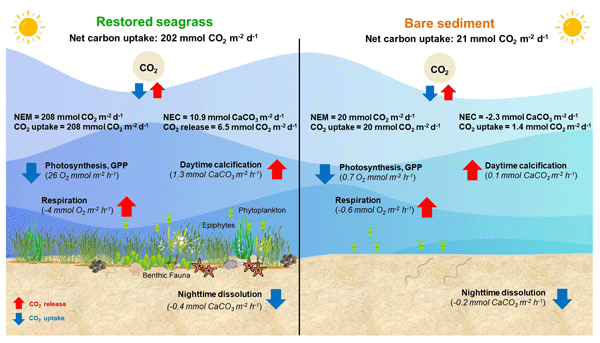
Natividad, M. B., Cai, W.-J., Bednaršek, N., Chen, J.-J., and Chou, W.-C.: Organic–inorganic carbon coupling shapes carbon dioxide fluxes in seagrass ecosystems, Communications Earth & Environment, 7, https://doi.org/10.1038/s43247-026-03805-4, 2026.
Neubauer, S. C. and Megonigal, J. P.: Moving Beyond Global Warming Potentials to Quantify the Climatic Role of Ecosystems, Ecosystems, 18, 1000–1013, https://doi.org/10.1007/s10021-015-9879-4, 2015.
Olivé, I., Silva, J., Costa, M. M., and Santos, R.: Estimating Seagrass Community Metabolism Using Benthic Chambers: The Effect of Incubation Time, Estuar. Coast., 39, 138–144, https://doi.org/10.1007/s12237-015-9973-z, 2016.
Oreska, M. P. J., McGlathery, K. J., Aoki, L. R., Berger, A. C., Berg, P., and Mullins, L.: The greenhouse gas offset potential from seagrass restoration, Sci. Rep., 10, 7325, https://doi.org/10.1038/s41598-020-64094-1, 2020.
Reeburgh, W. S.: Oceanic Methane Biogeochemistry, Chem. Rev., 107, 486–513, https://doi.org/10.1021/cr050362v, 2007.
Rissanen, A. J., Karvinen, A., Nykanen, H., Peura, S., Tiirola, M., Maki, A., and Kankaala, P.: Effects of alternative electron acceptors on the activity and community structure of methane-producing and consuming microbes in the sediments of two shallow boreal lakes, FEMS Microbiol. Ecol., 93, https://doi.org/10.1093/femsec/fix078, 2017.
Rosentreter, J. A., Borges, A. V., Deemer, B. R., Holgerson, M. A., Liu, S., Song, C., Melack, J., Raymond, P. A., Duarte, C. M., Allen, G. H., Olefeldt, D., Poulter, B., Battin, T. I., and Eyre, B. D.: Half of global methane emissions come from highly variable aquatic ecosystem sources, Nat. Geosci., 14, 225–230, https://doi.org/10.1038/s41561-021-00715-2, 2021.
Roth, F., Wild, C., Carvalho, S., Rädecker, N., Voolstra, C. R., Kürten, B., Anlauf, H., El-Khaled, Y. C., Carolan, R., Jones, B. H., and Trueman, C.: An in situ approach for measuring biogeochemical fluxes in structurally complex benthic communities, Methods Ecol. Evol., 10, 712–725, https://doi.org/10.1111/2041-210x.13151, 2019.
Saderne, V., Dunne, A. F., Rich, W. A., Cadiz, R., Carvalho, S., Cúrdia, J., and Kattan, A.: Seasonality of methane and carbon dioxide emissions in tropical seagrass and unvegetated ecosystems, Communications Earth & Environment, 4, https://doi.org/10.1038/s43247-023-00759-9, 2023.
Schorn, S., Ahmerkamp, S., Bullock, E., Weber, M., Lott, C., Liebeke, M., Lavik, G., Kuypers, M. M. M., Graf, J. S., and Milucka, J.: Diverse methylotrophic methanogenic archaea cause high methane emissions from seagrass meadows, P. Natl. Acad. Sci. USA, 119, https://doi.org/10.1073/pnas.2106628119, 2022.
Sogin, E. M., Michellod, D., Gruber-Vodicka, H. R., Bourceau, P., Geier, B., Meier, D. V., Seidel, M., Ahmerkamp, S., Schorn, S., D'Angelo, G., Procaccini, G., Dubilier, N., and Liebeke, M.: Sugars dominate the seagrass rhizosphere, Nat. Ecol. Evol., https://doi.org/10.1038/s41559-022-01740-z, 2022.
Sun, H., Yu, R., Liu, X., Cao, Z., Li, X., Zhang, Z., Wang, J., Zhuang, S., Ge, Z., Zhang, L., Sun, L., Lorke, A., Yang, J., Lu, C., and Lu, X.: Drivers of spatial and seasonal variations of CO2 and CH4 fluxes at the sediment water interface in a shallow eutrophic lake, Water Res., 222, 118916, https://doi.org/10.1016/j.watres.2022.118916, 2022.
Tan, W., Zhong, Z., He, Q., Yun, X., Yang, L., Wang, X., Ji, D., Wang, G., Zhao, J., and Zhang, X.: Methane emission fluxes and associated microbial community characteristics in a temperate seagrass meadow, Sci. Total Environ., 958, 177991, https://doi.org/10.1016/j.scitotenv.2024.177991, 2025.
Tang, Z.-W., Chen, H.-F., Puntu, J. M., Chang, P.-Y., Lo, L., Chen, J.-J., Chou, W.-C., Fan, L.-F., and Chang, Y.-J.: Evaluation of Carbon Sequestration in Seagrass Meadows of Kenting: A Comparative Study with Penghu and Dongsha Island, J. Mar. Sci. Technol., 33, https://doi.org/10.51400/2709-6998.2775, 2025.
Tseng, H.-C.: Data from: Linking Sea–Air and Benthic Methane Fluxes Across Seasons in a Tropical Seagrass Meadow of Taiwan, Zenodo [data set], https://doi.org/10.5281/zenodo.19079212, 2026.
Tseng, H.-C., Lin, C.-C., Pan, H.-J., Han, Y. T. Y., and Gong, G.-C.: Seasonal Distributions of Methane in a Populous Urban Coastal Sea Area, Frontiers in Marine Science, 9, https://doi.org/10.3389/fmars.2022.843549, 2022.
Villnas, A., Norkko, J., Lukkari, K., Hewitt, J., and Norkko, A.: Consequences of increasing hypoxic disturbance on benthic communities and ecosystem functioning, PLoS One, 7, e44920, https://doi.org/10.1371/journal.pone.0044920, 2012.
Wanninkhof, R.: Relationship between wind speed and gas exchange over the ocean revisited, Limnol. Oceanogr.-Meth., 12, 351–362, https://doi.org/10.4319/lom.2014.12.351, 2014.
Webb, A. P. and Eyre, B. D.: Effect of natural populations of burrowing thalassinidean shrimp on sediment irrigation, benthic metabolism, nutrient fluxes and denitrification, Mar. Ecol. Prog. Ser., 268, 205–220, https://doi.org/10.3354/meps268205, 2004.
Weber, T., Wiseman, N. A., and Kock, A.: Global ocean methane emissions dominated by shallow coastal waters, Nat. Commun., 10, 4584, https://doi.org/10.1038/s41467-019-12541-7, 2019.
Weiss, R. F.: Determinations of Carbon Dioxide and Methane by Dual Catalyst Flame lonization Chromatography and Nitrous Oxide by Electron Capture Chromatography, J. Chromatogr. Sci., 19, 611–616, https://doi.org/10.1093/chromsci/19.12.611, 1981.
Wiesenburg, D. A. and Guinasso Jr., N. L.: Equilibrium Solubilities of Methane,Carbon Monoxide, and Hydrogen in Water and Sea Water, J. Chem. Eng. Data, 24, 356–360, https://doi.org/10.1021/je60083a006, 1979.
Yau, Y. Y. Y., Reithmaier, G., Majtényi-Hill, C., Serrano, O., Piñeiro-Juncal, N., Dahl, M., Mateo, M. A., Bonaglia, S., and Santos, I. R.: Methane Emissions in Seagrass Meadows as a Small Offset to Carbon Sequestration, J. Geophys. Res.-Biogeo., 128, https://doi.org/10.1029/2022jg007295, 2023.
Yu, H., Coffin, R., and Organ, H.: Dynamics of methane emissions from northwestern Gulf of Mexico subtropical seagrass meadows, Biogeochemistry, 167, 723–741, https://doi.org/10.1007/s10533-024-01138-y, 2024.