
Articles | Volume 23, issue 20
https://doi.org/10.5194/bg-23-7505-2026
© Author(s) 2026. This work is distributed under
the Creative Commons Attribution 4.0 License.
the Creative Commons Attribution 4.0 License.
https://doi.org/10.5194/bg-23-7505-2026
© Author(s) 2026. This work is distributed under
the Creative Commons Attribution 4.0 License.
the Creative Commons Attribution 4.0 License.
Research article
| 
26 Oct 2026
Research article |
| 26 Oct 2026
| 26 Oct 2026
Biogeochemical controls on the concentrations and stable isotope compositions of sea-ice particulate organic matters in the Southern Ocean
Keigo D. Takahashi
CORRESPONDING AUTHOR

Faculty of Fisheries Sciences, Hokkaido University, Hakodate, 041-8611, Japan
Japan Society for the Promotion of Science, Chiyoda, 102-0083, Japan
Escuela de Ciencias del Mar, Pontificia Universidad Catolica de Valparaiso, Valparaiso, Chile
Ryosuke Makabe
National Institute of Polar Research, Tachikawa, 190-8518, Japan
The Graduate University for Advanced Studies, SOKENDAI, Tachikawa, 190-8518, Japan
Tokyo University of Marine Science and Technology, Minato, 108-8477, Japan
Masayoshi Sano
National Institute of Polar Research, Tachikawa, 190-8518, Japan
Kazuki Nakata
Earth Observation Research Center, Japan Aerospace Exploration Agency, Tsukuba, 305-0047, Japan
Noriaki Kimura
Faculty of Education, Kochi University, Kochi, 780-8520, Japan
Daiki Nomura
Faculty of Fisheries Sciences, Hokkaido University, Hakodate, 041-8611, Japan
Arctic Research Center, Hokkaido University, Sapporo, 001-0021, Japan
Michiyo Yamamoto-Kawai
Tokyo University of Marine Science and Technology, Minato, 108-8477, Japan
Ryo Matsuda
Faculty of Science and Engineering, Soka University, Hachioji, 192-8577, Japan
Natsumi Nojiro
Tokyo University of Marine Science and Technology, Minato, 108-8477, Japan
Masato Ito
Graduate School of Frontier Sciences, The University of Tokyo, Kashiwa, 277-8561, Japan
Shintaro Takao
National Institute for Environmental Studies, Tsukuba, 305-8506, Japan
Naho Horimoto-Miyazaki
Tokyo University of Marine Science and Technology, Minato, 108-8477, Japan
Aiko Tachibana
Japan Fisheries Research and Education Agency, Yokohama, 236-8648, Japan
Norio Kurosawa
Faculty of Science and Engineering, Soka University, Hachioji, 192-8577, Japan
Takeshi Tamura
National Institute of Polar Research, Tachikawa, 190-8518, Japan
The Graduate University for Advanced Studies, SOKENDAI, Tachikawa, 190-8518, Japan
Mizuki Komatsu
Japan Agency for Marine-Earth Science and Technology, Yokohama, 236-0001, Japan
Kay I. Ohshima
Institute of Low Temperature Science, Hokkaido University, Sapporo, 060-0819, Japan
Kohei Mizobata
Tokyo University of Marine Science and Technology, Minato, 108-8477, Japan
Shigeru Aoki
Institute of Low Temperature Science, Hokkaido University, Sapporo, 060-0819, Japan
Masato Moteki
National Institute of Polar Research, Tachikawa, 190-8518, Japan
Tokyo University of Marine Science and Technology, Minato, 108-8477, Japan
Related authors
No articles found.
Céline Heuzé, Polona Itkin, Vladimir Ivanov, G. W. Kent Moore, Kazuki Nakata, Kay I. Ohshima, and Janna Rückert
EGUsphere, https://doi.org/10.5194/egusphere-2026-3855, https://doi.org/10.5194/egusphere-2026-3855, 2026
This preprint is open for discussion and under review for The Cryosphere (TC).
Short summary
Short summary
Polynyas, openings in the sea ice, play a crucial role in the Arctic winter icescape, notably acting as breathing hole for the ecosystem, hunting ground for Indigenous communities, and comparatively safe navigation alternative. The Arctic being the region of the world changing fastest in response to climate change, we here review how polynyas and their impact on the climate have been changing too, and, for lack of adequate long-term observations or models, extrapolate their future.
Pierre Friedlingstein, Michael O'Sullivan, Matthew W. Jones, Robbie M. Andrew, Dorothee C. E. Bakker, Judith Hauck, Peter Landschützer, Corinne Le Quéré, Hongmei Li, Ingrid T. Luijkx, Glen P. Peters, Wouter Peters, Julia Pongratz, Clemens Schwingshackl, Stephen Sitch, Josep G. Canadell, Philippe Ciais, Kjetil Aas, Simone R. Alin, Peter Anthoni, Leticia Barbero, Nicholas R. Bates, Nicolas Bellouin, Alice Benoit-Cattin, Carla F. Berghoff, Raffaele Bernardello, Laurent Bopp, Ida Bagus Mandhara Brasika, Matthew A. Chamberlain, Naveen Chandra, Frédéric Chevallier, Louise P. Chini, Nathan O. Collier, Thomas H. Colligan, Margot Cronin, Laique M. Djeutchouang, Xinyu Dou, Matt P. Enright, Kazutaka Enyo, Michael Erb, Wiley Evans, Richard A. Feely, Liang Feng, Daniel J. Ford, Adrianna Foster, Filippa Fransner, Thomas Gasser, Marion Gehlen, Thanos Gkritzalis, Jefferson Goncalves De Souza, Giacomo Grassi, Luke Gregor, Nicolas Gruber, Bertrand Guenet, Özgür Gürses, Kirsty Harrington, Ian Harris, Jens Heinke, George C. Hurtt, Yosuke Iida, Tatiana Ilyina, Akihiko Ito, Andrew R. Jacobson, Atul K. Jain, Tereza Jarníková, Annika Jersild, Fei Jiang, Steve D. Jones, Etsushi Kato, Ralph F. Keeling, Kees Klein Goldewijk, Jürgen Knauer, Yawen Kong, Jan Ivar Korsbakken, Charles Koven, Taro Kunimitsu, Xin Lan, Junjie Liu, Zhiqiang Liu, Zhu Liu, Claire Lo Monaco, Lei Ma, Gregg Marland, Patrick C. McGuire, Galen A. McKinley, Joe R. Melton, Natalie Monacci, Erwan Monier, Eric J. Morgan, David R. Munro, Jens D. Müller, Shin-Ichiro Nakaoka, Lorna R. Nayagam, Yosuke Niwa, Tobias Nutzel, Are Olsen, Abdirahman M. Omar, Naiqing Pan, Sudhanshu Pandey, Denis Pierrot, Zhangcai Qin, Pierre Regnier, Gregor Rehder, Laure Resplandy, Alizée Roobaert, Thais M. Rosan, Christian Rödenbeck, Jörg Schwinger, Ingunn Skjelvan, T. Luke Smallman, Victoria Spada, Mohanan G. Sreeush, Qing Sun, Adrienne J. Sutton, Colm Sweeney, Didier Swingedouw, Roland Séférian, Shintaro Takao, Hiroaki Tatebe, Hanqin Tian, Xiangjun Tian, Bronte Tilbrook, Hiroyuki Tsujino, Francesco Tubiello, Erik van Ooijen, Guido R. van der Werf, Sebastiaan J. van de Velde, Anthony P. Walker, Rik Wanninkhof, Xiaojuan Yang, Wenping Yuan, Xu Yue, and Jiye Zeng
Earth Syst. Sci. Data, 18, 3211–3288, https://doi.org/10.5194/essd-18-3211-2026, https://doi.org/10.5194/essd-18-3211-2026, 2026
Short summary
Short summary
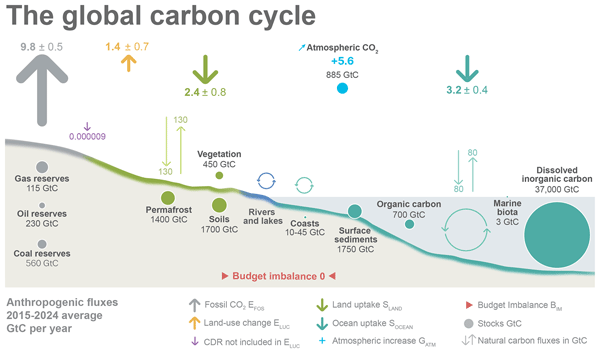
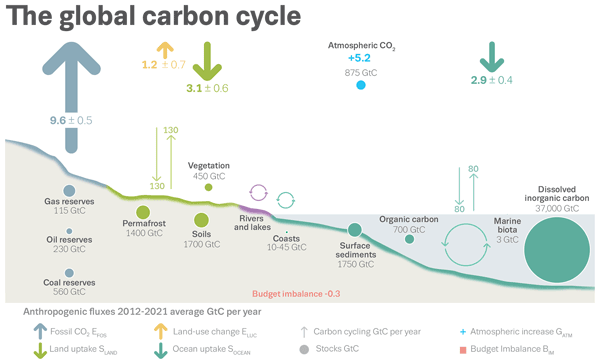
The Global Carbon Budget 2025 describes the methodology, main results, and datasets used to quantify the anthropogenic emissions of carbon dioxide (CO2) and their partitioning among the atmosphere, land ecosystems, and the ocean over the historical period (1750–2025). These living datasets are updated every year to provide the highest transparency and traceability in the reporting of CO2, the key driver of climate change.
Noriaki Kimura and Hiroyasu Hasumi
The Cryosphere, 20, 2331–2349, https://doi.org/10.5194/tc-20-2331-2026, https://doi.org/10.5194/tc-20-2331-2026, 2026
Short summary
Short summary
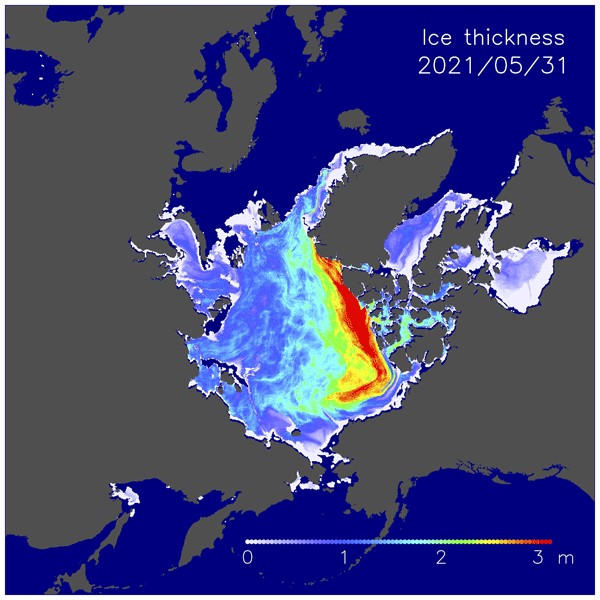
Measuring sea ice thickness is difficult using satellite data, but it is crucial for understanding climate change. This study introduces a new method that estimates ice thickness by tracking where and when sea ice formed and calculating how much it likely grew based on daily weather conditions. The results agreed well with underwater measurements. This method helps map ice thickness across the Arctic and may support estimates of other hard-to-measure sea ice features.
Chengyan Liu, Zhaomin Wang, Dake Chen, Xianxian Han, Hengling Leng, Xi Liang, Liangjun Yan, Xiang Li, Craig Stevens, Andrew McC. Hogg, Kazuya Kusahara, Kaihe Yamazaki, Kay I. Ohshima, Meng Zhou, Xiao Cheng, Dongxiao Wang, Changming Dong, Jiping Liu, Qinghua Yang, Xichen Li, Ruibo Lei, Minghu Ding, Zhaoru Zhang, Dujuan Kang, Di Qi, Tongya Liu, Jihai Dong, Lu An, Ru Chen, Tong Zhang, Xiaoming Hu, Bo Han, Haibo Bi, Qi Shu, Longjiang Mu, Shiming Xu, Hu Yang, Hailong Liu, Tingfeng Dou, Zhixuan Feng, Lei Zheng, Xueyuan Tang, Guitao Shi, Yongqing Cai, Bingrui Li, Yang Wu, Xia Lin, Wenjin Sun, Yu Liu, Kai Yu, Yu Zhang, Weizeng Shao, Xiaoyu Wang, Shaojun Zheng, Chengyi Yuan, Chunxia Zhou, Jian Liu, Yang Liu, Yue Xia, Xiaoyu Pan, Jiabao Zeng, Kechen Liu, Jiahao Fan, Chen Cheng, and Qi Li
Geosci. Model Dev., 19, 2985–3033, https://doi.org/10.5194/gmd-19-2985-2026, https://doi.org/10.5194/gmd-19-2985-2026, 2026
Short summary
Short summary
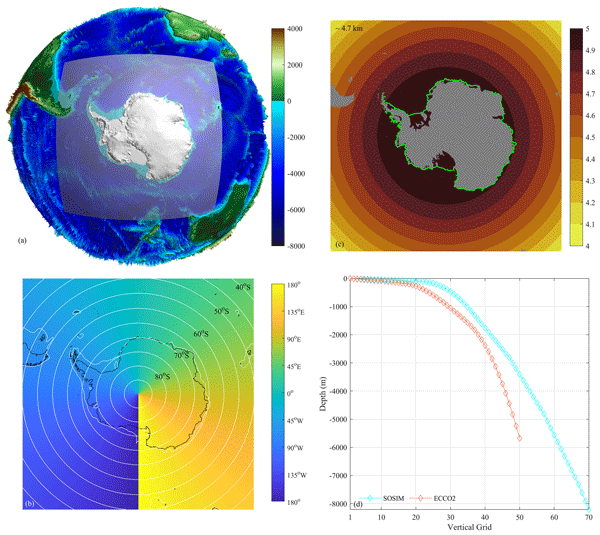
We developed a high-resolution computer model to simulate how the ocean, sea ice, and ice shelves interact around Antarctica. This helps us understand their critical role in global climate and sea-level rise. Our model successfully captures essential features like major currents and seasonal ice changes. Despite some remaining biases, it provides a useful tool for predicting future changes in this vital and rapidly evolving region.
Yoshihiro Nakayama, Shuntaro Hyogo, Yichen Lin, Taewook Park, Jinho Lee, Juistine Caillet, Gobishankar Mohan, Mattia Poinelli, Pierre Dutrieux, Kazuki Nakata, Hong Zhang, Brice Loose, and Lauren Kowalski
EGUsphere, https://doi.org/10.5194/egusphere-2025-5958, https://doi.org/10.5194/egusphere-2025-5958, 2026
Short summary
Short summary
We develop a regional ocean model of the Amundsen and Bellingshausen Seas in Antarctica. Differences in model setups and parameter choices often limit usability and broader scientific application, especially for non-ocean modellers. We carefully evaluate the model outputs and establish a common control experiment that can be shared and applied across studies with tracer and particle applications. This effort aims to support wide community use and improve understanding of ice–ocean interactions.
Tatsuki Tokoro, Shin-Ichiro Nakaoka, Shintaro Takao, Shu Saito, Daisuke Sasano, Kazutaka Enyo, Masao Ishii, Naohiro Kosugi, Tsuneo Ono, Kazuaki Tadokoro, and Yukihiro Nojiri
Biogeosciences, 22, 7709–7724, https://doi.org/10.5194/bg-22-7709-2025, https://doi.org/10.5194/bg-22-7709-2025, 2025
Short summary
Short summary
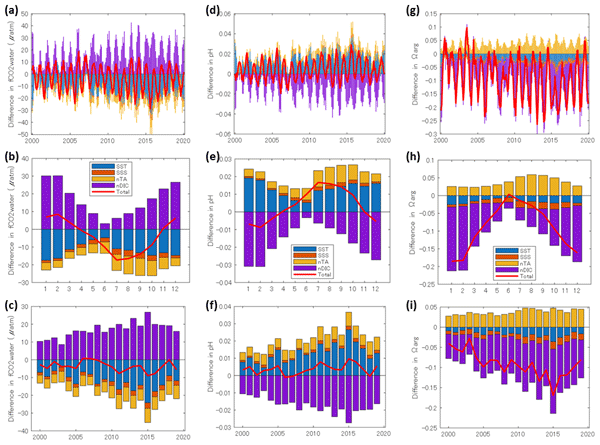
We studied how riverine water from the mainland of Japan affects the ocean's carbon cycle using decades of Total Alkalinity (TA) data from the Northwest Pacific. Statistical analysis revealed riverine water as a major TA source, reducing coastal acidification by 71 %, but with minimal impact on pH and atmospheric CO2 absorption. Future work aims to refine results with depth-specific data and apply findings to global models.
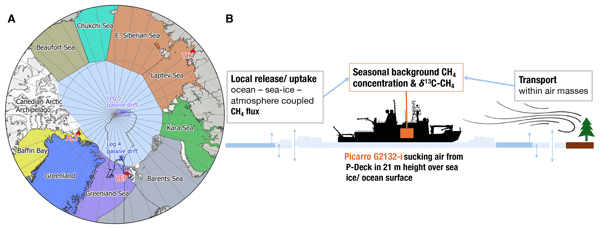
Amanda Sellmaier, Ellen Damm, Torsten Sachs, Benjamin Kirbus, Inge Wiekenkamp, Annette Rinke, Falk Pätzold, Daiki Nomura, Astrid Lampert, and Markus Rex
Atmos. Chem. Phys., 25, 17685–17700, https://doi.org/10.5194/acp-25-17685-2025, https://doi.org/10.5194/acp-25-17685-2025, 2025
Short summary
Short summary
This study presents continuous ship-borne measurements of methane (CH4) concentration and isotopic composition monitored during an ice drift expedition in 2020. Using trajectory analysis, we linked atmospheric CH4 variabilities to air mass pathways transported over open water or sea-ice. The study highlights the potential of ship-borne observations to fill significant data gaps in the high Arctic.
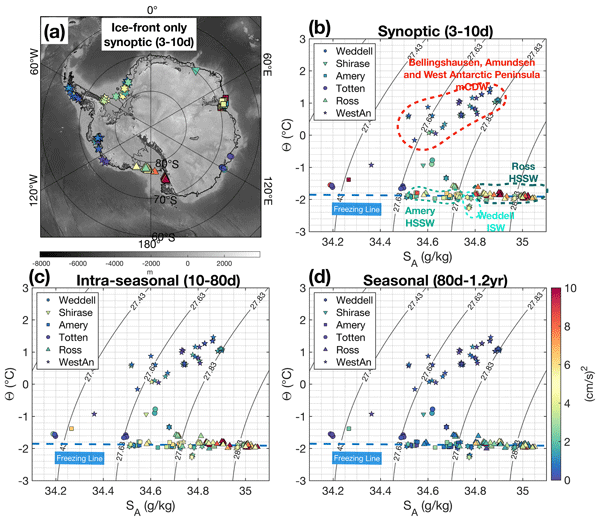
Shenjie Zhou, Pierre Dutrieux, Claudia F. Giulivi, Adrian Jenkins, Alessandro Silvano, Christopher Auckland, E. Povl Abrahamsen, Michael Meredith, Irena Vaňková, Keith Nicholls, Peter E. D. Davis, Svein Østerhus, Arnold L. Gordon, Christopher J. Zappa, Tiago S. Dotto, Ted Scambos, Kathryn L. Gunn, Stephen R. Rintoul, Shigeru Aoki, Craig Stevens, Chengyan Liu, Sukyoung Yun, Tae-Wan Kim, Won Sang Lee, Markus Janout, Tore Hattermann, Julius Lauber, Elin Darelius, Anna Wåhlin, Leo Middleton, Pasquale Castagno, Giorgio Budillon, Karen J. Heywood, Jennifer Graham, Stephen Dye, Daisuke Hirano, and Una Kim Miller
Earth Syst. Sci. Data, 17, 5693–5706, https://doi.org/10.5194/essd-17-5693-2025, https://doi.org/10.5194/essd-17-5693-2025, 2025
Short summary
Short summary
We created the first standardised dataset of in-situ ocean measurements time series from around Antarctica collected since 1970s. This includes temperature, salinity, pressure, and currents recorded by instruments deployed in icy, challenging conditions. Our analysis highlights the dominance of tidal currents and separates these from other patterns to study regional energy distribution. This unique dataset offers a foundation for future research on Antarctic ocean dynamics and ice interactions.
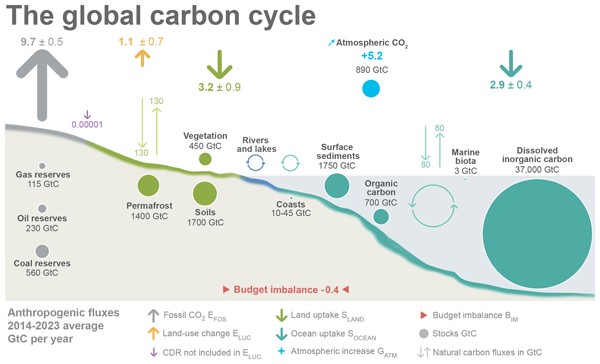
Pierre Friedlingstein, Michael O'Sullivan, Matthew W. Jones, Robbie M. Andrew, Judith Hauck, Peter Landschützer, Corinne Le Quéré, Hongmei Li, Ingrid T. Luijkx, Are Olsen, Glen P. Peters, Wouter Peters, Julia Pongratz, Clemens Schwingshackl, Stephen Sitch, Josep G. Canadell, Philippe Ciais, Robert B. Jackson, Simone R. Alin, Almut Arneth, Vivek Arora, Nicholas R. Bates, Meike Becker, Nicolas Bellouin, Carla F. Berghoff, Henry C. Bittig, Laurent Bopp, Patricia Cadule, Katie Campbell, Matthew A. Chamberlain, Naveen Chandra, Frédéric Chevallier, Louise P. Chini, Thomas Colligan, Jeanne Decayeux, Laique M. Djeutchouang, Xinyu Dou, Carolina Duran Rojas, Kazutaka Enyo, Wiley Evans, Amanda R. Fay, Richard A. Feely, Daniel J. Ford, Adrianna Foster, Thomas Gasser, Marion Gehlen, Thanos Gkritzalis, Giacomo Grassi, Luke Gregor, Nicolas Gruber, Özgür Gürses, Ian Harris, Matthew Hefner, Jens Heinke, George C. Hurtt, Yosuke Iida, Tatiana Ilyina, Andrew R. Jacobson, Atul K. Jain, Tereza Jarníková, Annika Jersild, Fei Jiang, Zhe Jin, Etsushi Kato, Ralph F. Keeling, Kees Klein Goldewijk, Jürgen Knauer, Jan Ivar Korsbakken, Xin Lan, Siv K. Lauvset, Nathalie Lefèvre, Zhu Liu, Junjie Liu, Lei Ma, Shamil Maksyutov, Gregg Marland, Nicolas Mayot, Patrick C. McGuire, Nicolas Metzl, Natalie M. Monacci, Eric J. Morgan, Shin-Ichiro Nakaoka, Craig Neill, Yosuke Niwa, Tobias Nützel, Lea Olivier, Tsuneo Ono, Paul I. Palmer, Denis Pierrot, Zhangcai Qin, Laure Resplandy, Alizée Roobaert, Thais M. Rosan, Christian Rödenbeck, Jörg Schwinger, T. Luke Smallman, Stephen M. Smith, Reinel Sospedra-Alfonso, Tobias Steinhoff, Qing Sun, Adrienne J. Sutton, Roland Séférian, Shintaro Takao, Hiroaki Tatebe, Hanqin Tian, Bronte Tilbrook, Olivier Torres, Etienne Tourigny, Hiroyuki Tsujino, Francesco Tubiello, Guido van der Werf, Rik Wanninkhof, Xuhui Wang, Dongxu Yang, Xiaojuan Yang, Zhen Yu, Wenping Yuan, Xu Yue, Sönke Zaehle, Ning Zeng, and Jiye Zeng
Earth Syst. Sci. Data, 17, 965–1039, https://doi.org/10.5194/essd-17-965-2025, https://doi.org/10.5194/essd-17-965-2025, 2025
Short summary
Short summary
The Global Carbon Budget 2024 describes the methodology, main results, and datasets used to quantify the anthropogenic emissions of carbon dioxide (CO2) and their partitioning among the atmosphere, land ecosystems, and the ocean over the historical period (1750–2024). These living datasets are updated every year to provide the highest transparency and traceability in the reporting of CO2, the key driver of climate change.
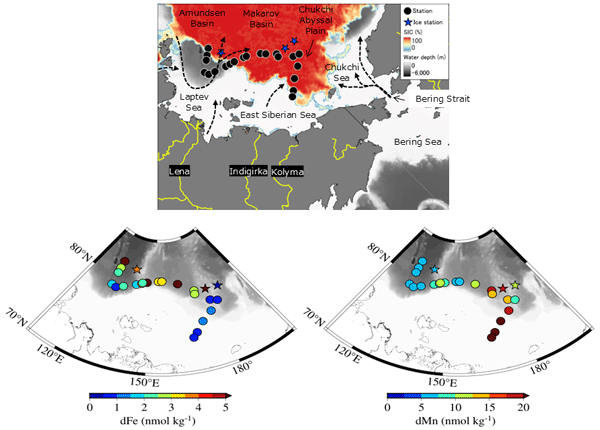
Naoya Kanna, Kazutaka Tateyama, Takuji Waseda, Anna Timofeeva, Maria Papadimitraki, Laura Whitmore, Hajime Obata, Daiki Nomura, Hiroshi Ogawa, Youhei Yamashita, and Igor Polyakov
Biogeosciences, 22, 1057–1076, https://doi.org/10.5194/bg-22-1057-2025, https://doi.org/10.5194/bg-22-1057-2025, 2025
Short summary
Short summary
This article presents data on iron and manganese, essential micronutrients for primary producers in the Arctic Laptev and East Siberian seas (LESS). There, observations were made through international cooperation with the Nansen and Amundsen Basin Observational System expedition during the late summer of 2021. The results from this study indicate that the major sources controlling the iron and manganese distributions on the LESS continental margins are river discharge and shelf sediment input.
Katsuro Katsumata, Shigeru Aoki, Kay I. Ohshima, and Michiyo Yamamoto-Kawai
Ocean Sci., 21, 419–436, https://doi.org/10.5194/os-21-419-2025, https://doi.org/10.5194/os-21-419-2025, 2025
Short summary
Short summary
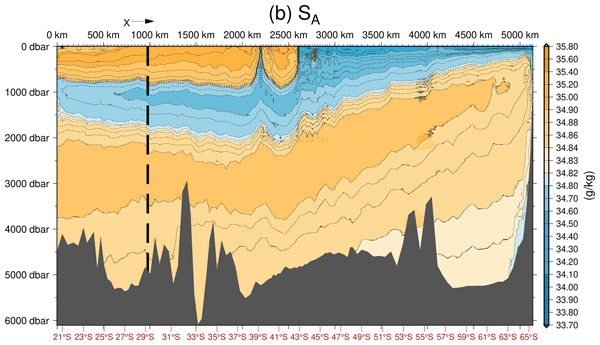
Ship-based observations provide data of seawater properties like temperature, salinity, nutrients, and various gases, but some important world oceans have still not been covered. A voyage in 2019/20 in the southwest Indian Ocean along approximately 55° E from 30° S to Antarctica attempted to fill one such data-sparse region. The measured cross section of the Antarctic Circumpolar Current and accompanying eddies demonstrates various oceanic behaviours including fronts and eddy mixing.
Mutsumi Iizuka, Takuya Itaki, Osamu Seki, Ryosuke Makabe, Motoha Ojima, and Shigeru Aoki
J. Micropalaeontol., 43, 37–53, https://doi.org/10.5194/jm-43-37-2024, https://doi.org/10.5194/jm-43-37-2024, 2024
Short summary
Short summary
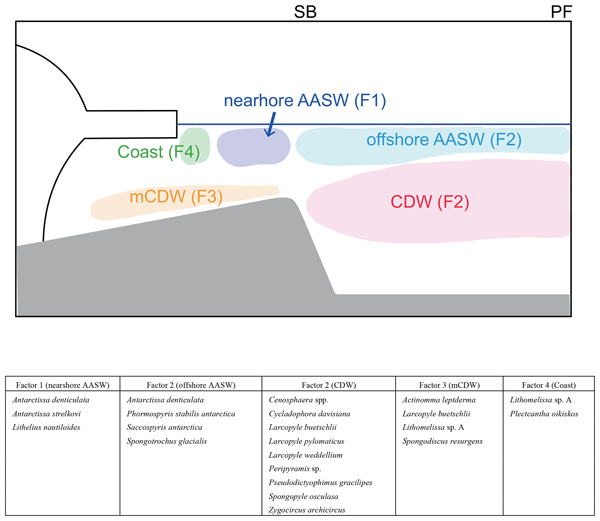
Radiolarian fossils are valuable tools for understanding water mass distribution. However, they have not been used in the high-latitude Southern Ocean due to unclear radiolarian assemblages. Our study identifies four assemblages related to water masses and ice edge environments in the high-latitude Southern Ocean, offering insights for water mass reconstruction in this region.
Kazuya Kusahara, Daisuke Hirano, Masakazu Fujii, Alexander D. Fraser, Takeshi Tamura, Kohei Mizobata, Guy D. Williams, and Shigeru Aoki
The Cryosphere, 18, 43–73, https://doi.org/10.5194/tc-18-43-2024, https://doi.org/10.5194/tc-18-43-2024, 2024
Short summary
Short summary
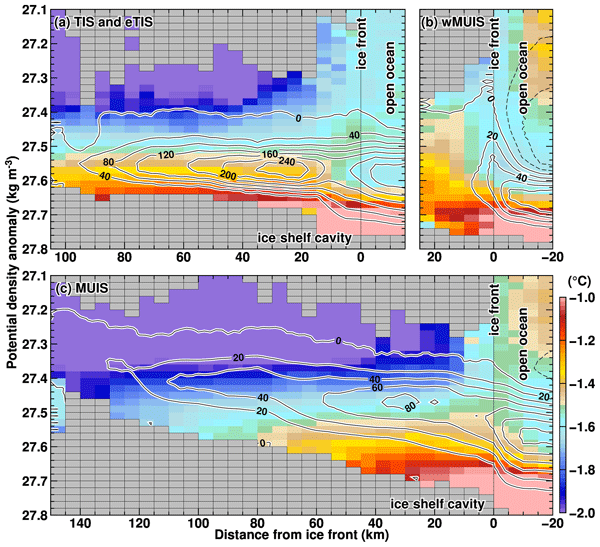
This study focuses on the Totten and Moscow University ice shelves, East Antarctica. We used an ocean–sea ice–ice shelf model to better understand regional interactions between ocean, sea ice, and ice shelf. We found that a combination of warm ocean water and local sea ice production influences the regional ice shelf basal melting. Furthermore, the model reproduced the summertime undercurrent on the upper continental slope, regulating ocean heat transport onto the continental shelf.
Vigan Mensah, Koji Fujita, Stephen Howell, Miho Ikeda, Mizuki Komatsu, and Kay I. Ohshima
EGUsphere, https://doi.org/10.5194/egusphere-2023-2492, https://doi.org/10.5194/egusphere-2023-2492, 2023
Preprint archived
Short summary
Short summary
We estimated the volume of freshwater released by sea ice, glaciers, rivers, and precipitation into Baffin Bay and the Labrador Sea, and their changes over the past 70 years. We found that the freshwater volume has risen in Baffin Bay due to increased glacier melting, and dropped in the Labrador Sea because of the decline in sea ice production. We also infer that freshwater from the Arctic Ocean has been exported to our study region for the past 30 years, possibly as a result of global warming.
Pierre Friedlingstein, Michael O'Sullivan, Matthew W. Jones, Robbie M. Andrew, Dorothee C. E. Bakker, Judith Hauck, Peter Landschützer, Corinne Le Quéré, Ingrid T. Luijkx, Glen P. Peters, Wouter Peters, Julia Pongratz, Clemens Schwingshackl, Stephen Sitch, Josep G. Canadell, Philippe Ciais, Robert B. Jackson, Simone R. Alin, Peter Anthoni, Leticia Barbero, Nicholas R. Bates, Meike Becker, Nicolas Bellouin, Bertrand Decharme, Laurent Bopp, Ida Bagus Mandhara Brasika, Patricia Cadule, Matthew A. Chamberlain, Naveen Chandra, Thi-Tuyet-Trang Chau, Frédéric Chevallier, Louise P. Chini, Margot Cronin, Xinyu Dou, Kazutaka Enyo, Wiley Evans, Stefanie Falk, Richard A. Feely, Liang Feng, Daniel J. Ford, Thomas Gasser, Josefine Ghattas, Thanos Gkritzalis, Giacomo Grassi, Luke Gregor, Nicolas Gruber, Özgür Gürses, Ian Harris, Matthew Hefner, Jens Heinke, Richard A. Houghton, George C. Hurtt, Yosuke Iida, Tatiana Ilyina, Andrew R. Jacobson, Atul Jain, Tereza Jarníková, Annika Jersild, Fei Jiang, Zhe Jin, Fortunat Joos, Etsushi Kato, Ralph F. Keeling, Daniel Kennedy, Kees Klein Goldewijk, Jürgen Knauer, Jan Ivar Korsbakken, Arne Körtzinger, Xin Lan, Nathalie Lefèvre, Hongmei Li, Junjie Liu, Zhiqiang Liu, Lei Ma, Greg Marland, Nicolas Mayot, Patrick C. McGuire, Galen A. McKinley, Gesa Meyer, Eric J. Morgan, David R. Munro, Shin-Ichiro Nakaoka, Yosuke Niwa, Kevin M. O'Brien, Are Olsen, Abdirahman M. Omar, Tsuneo Ono, Melf Paulsen, Denis Pierrot, Katie Pocock, Benjamin Poulter, Carter M. Powis, Gregor Rehder, Laure Resplandy, Eddy Robertson, Christian Rödenbeck, Thais M. Rosan, Jörg Schwinger, Roland Séférian, T. Luke Smallman, Stephen M. Smith, Reinel Sospedra-Alfonso, Qing Sun, Adrienne J. Sutton, Colm Sweeney, Shintaro Takao, Pieter P. Tans, Hanqin Tian, Bronte Tilbrook, Hiroyuki Tsujino, Francesco Tubiello, Guido R. van der Werf, Erik van Ooijen, Rik Wanninkhof, Michio Watanabe, Cathy Wimart-Rousseau, Dongxu Yang, Xiaojuan Yang, Wenping Yuan, Xu Yue, Sönke Zaehle, Jiye Zeng, and Bo Zheng
Earth Syst. Sci. Data, 15, 5301–5369, https://doi.org/10.5194/essd-15-5301-2023, https://doi.org/10.5194/essd-15-5301-2023, 2023
Short summary
Short summary
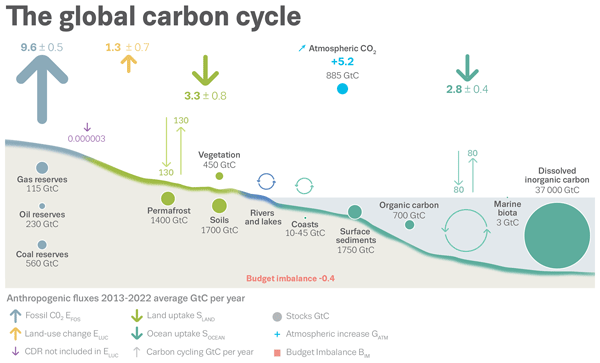
The Global Carbon Budget 2023 describes the methodology, main results, and data sets used to quantify the anthropogenic emissions of carbon dioxide (CO2) and their partitioning among the atmosphere, land ecosystems, and the ocean over the historical period (1750–2023). These living datasets are updated every year to provide the highest transparency and traceability in the reporting of CO2, the key driver of climate change.
Sachi Umezawa, Manami Tozawa, Yuichi Nosaka, Daiki Nomura, Hiroji Onishi, Hiroto Abe, Tetsuya Takatsu, and Atsushi Ooki
Biogeosciences, 20, 421–438, https://doi.org/10.5194/bg-20-421-2023, https://doi.org/10.5194/bg-20-421-2023, 2023
Short summary
Short summary
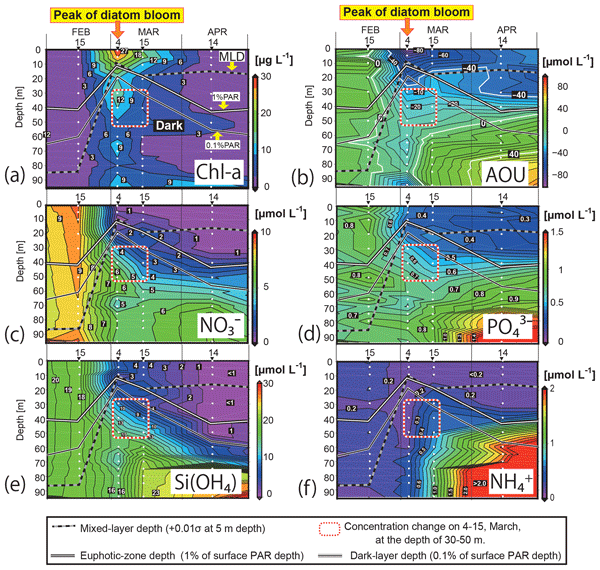
We conducted repetitive observations in Funka Bay, Japan, during the spring bloom 2019. We found nutrient concentration decreases in the dark subsurface layer during the bloom. Incubation experiments confirmed that diatoms could consume nutrients at a substantial rate, even in darkness. We concluded that the nutrient reduction was mainly caused by nutrient consumption by diatoms in the dark.
Pierre Friedlingstein, Michael O'Sullivan, Matthew W. Jones, Robbie M. Andrew, Luke Gregor, Judith Hauck, Corinne Le Quéré, Ingrid T. Luijkx, Are Olsen, Glen P. Peters, Wouter Peters, Julia Pongratz, Clemens Schwingshackl, Stephen Sitch, Josep G. Canadell, Philippe Ciais, Robert B. Jackson, Simone R. Alin, Ramdane Alkama, Almut Arneth, Vivek K. Arora, Nicholas R. Bates, Meike Becker, Nicolas Bellouin, Henry C. Bittig, Laurent Bopp, Frédéric Chevallier, Louise P. Chini, Margot Cronin, Wiley Evans, Stefanie Falk, Richard A. Feely, Thomas Gasser, Marion Gehlen, Thanos Gkritzalis, Lucas Gloege, Giacomo Grassi, Nicolas Gruber, Özgür Gürses, Ian Harris, Matthew Hefner, Richard A. Houghton, George C. Hurtt, Yosuke Iida, Tatiana Ilyina, Atul K. Jain, Annika Jersild, Koji Kadono, Etsushi Kato, Daniel Kennedy, Kees Klein Goldewijk, Jürgen Knauer, Jan Ivar Korsbakken, Peter Landschützer, Nathalie Lefèvre, Keith Lindsay, Junjie Liu, Zhu Liu, Gregg Marland, Nicolas Mayot, Matthew J. McGrath, Nicolas Metzl, Natalie M. Monacci, David R. Munro, Shin-Ichiro Nakaoka, Yosuke Niwa, Kevin O'Brien, Tsuneo Ono, Paul I. Palmer, Naiqing Pan, Denis Pierrot, Katie Pocock, Benjamin Poulter, Laure Resplandy, Eddy Robertson, Christian Rödenbeck, Carmen Rodriguez, Thais M. Rosan, Jörg Schwinger, Roland Séférian, Jamie D. Shutler, Ingunn Skjelvan, Tobias Steinhoff, Qing Sun, Adrienne J. Sutton, Colm Sweeney, Shintaro Takao, Toste Tanhua, Pieter P. Tans, Xiangjun Tian, Hanqin Tian, Bronte Tilbrook, Hiroyuki Tsujino, Francesco Tubiello, Guido R. van der Werf, Anthony P. Walker, Rik Wanninkhof, Chris Whitehead, Anna Willstrand Wranne, Rebecca Wright, Wenping Yuan, Chao Yue, Xu Yue, Sönke Zaehle, Jiye Zeng, and Bo Zheng
Earth Syst. Sci. Data, 14, 4811–4900, https://doi.org/10.5194/essd-14-4811-2022, https://doi.org/10.5194/essd-14-4811-2022, 2022
Short summary
Short summary
The Global Carbon Budget 2022 describes the datasets and methodology used to quantify the anthropogenic emissions of carbon dioxide (CO2) and their partitioning among the atmosphere, the land ecosystems, and the ocean. These living datasets are updated every year to provide the highest transparency and traceability in the reporting of CO2, the key driver of climate change.
Tian R. Tian, Alexander D. Fraser, Noriaki Kimura, Chen Zhao, and Petra Heil
The Cryosphere, 16, 1299–1314, https://doi.org/10.5194/tc-16-1299-2022, https://doi.org/10.5194/tc-16-1299-2022, 2022
Short summary
Short summary
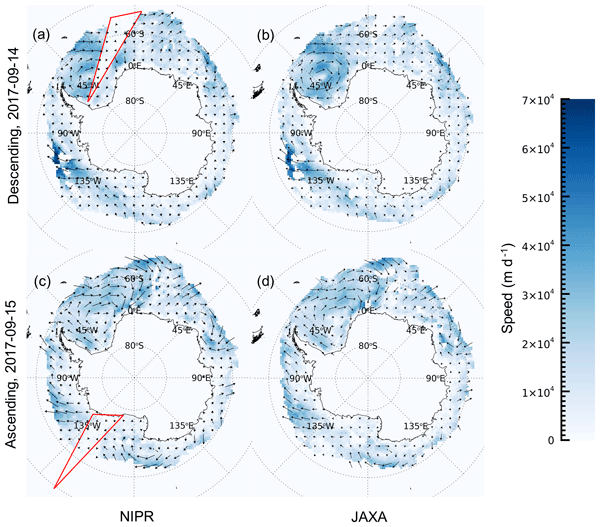
This study presents a comprehensive validation of a satellite observational sea ice motion product in Antarctica by using drifting buoys. Two problems existing in this sea ice motion product have been noticed. After rectifying problems, we use it to investigate the impacts of satellite observational configuration and timescale on Antarctic sea ice kinematics and suggest the future improvement of satellite missions specifically designed for retrieval of sea ice motion.
Alexander D. Fraser, Robert A. Massom, Mark S. Handcock, Phillip Reid, Kay I. Ohshima, Marilyn N. Raphael, Jessica Cartwright, Andrew R. Klekociuk, Zhaohui Wang, and Richard Porter-Smith
The Cryosphere, 15, 5061–5077, https://doi.org/10.5194/tc-15-5061-2021, https://doi.org/10.5194/tc-15-5061-2021, 2021
Short summary
Short summary
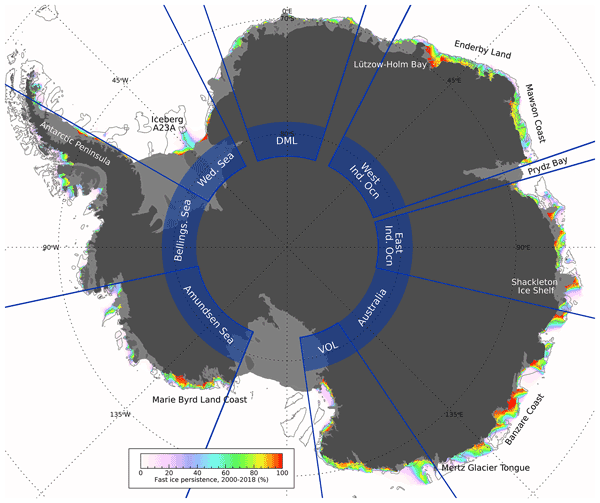
Landfast ice is sea ice that remains stationary by attaching to Antarctica's coastline and grounded icebergs. Although a variable feature, landfast ice exerts influence on key coastal processes involving pack ice, the ice sheet, ocean, and atmosphere and is of ecological importance. We present a first analysis of change in landfast ice over an 18-year period and quantify trends (−0.19 ± 0.18 % yr−1). This analysis forms a reference of landfast-ice extent and variability for use in other studies.
Cited articles
Ackley, S. F., Buck, K. R., and Taguchi, S.: Standing crop of algae in the sea ice of the Weddell Sea region, Deep-Sea Res. Pt. A., 26, 269–281, https://doi.org/10.1016/0198-0149(79)90024-4, 1979.
Akino, R., Nomura, D., Sahashi, R., Tozawa, M., Hatta, M., Matsuno, K., Endo, W., Shiozaki, T., Kawakami, T., Ito, M., Murata, A., and Fujiwara, A.: Characteristics of late summer Arctic brash sea ice and its melting effect on the surface-water biogeochemistry of the Chukchi Shelf and Canada Basin, Elem. Sci. Anth., 12, 00094, https://doi.org/10.1525/elementa.2023.00094, 2024.
Ardyna, M., Claustre, H., Sallée, J. B., D'Ovidio, F., Gentili, B., van Dijken, G., D'Ortenzio, F., and Arrigo, K. R.: Delineating environmental control of phytoplankton biomass and phenology in the Southern Ocean, Geophys. Res. Lett., 44, 5016–5024, https://doi.org/10.1002/2016GL072428, 2017.
Arrigo, K. R., van Dijken, G. L., and Bushinsky, S.: Primary production in the Southern Ocean, 1997–2006, J. Geophys. Res., 113, C08004, https://doi.org/10.1029/2007jc004551, 2008.
Arrigo, K. R., Mills, M. M., Kropuenske, L. R., Van Dijken, G. L., Alderkamp, A.-C., and Robinson, D. H.: Photophysiology in two major Southern Ocean phytoplankton taxa: Photosynthesis and growth of Phaeocystis antarctica and Fragilariopsis cylindrus under different irradiance levels, Integr. Comp. Biol., 50, 950–966, https://doi.org/10.1093/icb/icq021, 2010.
Becquevort, S., Dumont, I., Tison, J. L., Lannuzel, D., Sauvée, M. L., Chou, L., and Schoemann, V.: Biogeochemistry and microbial community composition in sea ice and underlying seawater off East Antarctica during early spring, Polar Biol., 32, 879–895, https://doi.org/10.1007/s00300-009-0589-2, 2009.
Bentaleb, I., Fontugne, M., Descolas-Gros, C., Girardin, C., Mariotti, A., Pierre, C., Brunet, C., and Poisson, A.: Carbon isotopic fractionation by plankton in the Southern Indian Ocean: relationship between δ13C of particulate organic carbon and dissolved carbon dioxide, J. Marine Syst., 17, 39–58, https://doi.org/10.1016/s0924-7963(98)00028-1, 1998.
Bocquet, M., Fleury, S., Rémy, F., and Piras, F.: Arctic and Antarctic sea ice thickness and volume changes from observations between 1994 and 2023, J. Geophys. Res.-Oceans, 129, e2023JC020848, https://doi.org/10.1029/2023JC020848, 2024.
Burkhardt, S., Riebesell, U., and Zondervan, I.: Stable carbon isotope fractionation by marine phytoplankton in response to daylength, growth rate, and CO2 availability, Mar. Ecol. Prog. Ser., 184, 31–41, https://doi.org/10.3354/meps184031, 1999.
Casciotti, K. L.: Inverse kinetic isotope fractionation during bacterial nitrite oxidation, Geochim. Cosmochim. Ac., 73, 2061–2076, https://doi.org/10.1016/j.gca.2008.12.022, 2009.
Casciotti, K. L., Sigman, D. M., and Ward, B. B.: Linking diversity and stable isotope fractionation in ammonia-oxidizing bacteria, Geomicrobiol. J., 20, 335–353, https://doi.org/10.1080/01490450303895, 2003.
Corkill, M., Moreau, S., Janssens, J., Fraser, A. D., Heil, P., Tison, J. L., Cougnon, E. A., Genovese, C., Kimura, N., Meiners, K. M., Wongpan, P., and Lannuzel, D.: Physical and biogeochemical properties of rotten East Antarctic summer sea ice, J. Geophys. Res.-Oceans, 128, e2022JC018875, https://doi.org/10.1029/2022JC018875, 2023.
Daase, M., Søreide, J. E., and Martynova, D.: Effects of food quality on naupliar development in Calanus glacialis at subzero temperatures, Mar. Ecol. Prog. Ser., 429, 111–124, https://doi.org/10.3354/meps09075, 2011.
Dalman, L. A., Meiners, K. M., Thomas, D. N., Deman, F., Bestley, S., Moreau, S., Arrigo, K. R., Campbell, K., Corkill, M., Cozzi, S., Delille, B., Munro, D. R., Nomura, D., Norman, L., Papadimitriou, S., Schallenberg, C., Tison, J.-L., Vancoppenolle, M., van der Merwe, P., and Fripiat, F.: Observation-based estimate of net community production in Antarctic sea ice, Geophys. Res. Lett., 52, e2024GL113717, https://doi.org/10.1029/2024GL113717, 2025.
Dieckmann, G. S., Eicken, H., Haas, C., Garrison, D. L., Gleitz, M., Lange, M., Spindler, M., Sullivan, C. W., Thomas, D. N., Weissenberger, J. N.: A compilation of data on sea ice algal standing crop from the Bellinghausen, Amundsen and Weddell Seas from 1983 to 1994, in: Antarctic sea ice: Biological Processes, Interactions and Variability, edited by: Lizotte, M. P. and Arrigo, K. R., American Geophysical Union, Washington, US, 85–92, https://doi.org/10.1029/AR073p0085, 1998.
Dumont, I., Schoemann, V., Lannuzel, D., Chou, L., Tison, J.-L., and Becquevort, S.: Distribution and characterization of dissolved and particulate organic matter in Antarctic pack ice, Polar Biol., 32, 733–750, https://doi.org/10.1007/s00300-008-0577-y, 2009.
Eicken, H.: Salinity profiles of Antarctic sea ice: Field data and model results, J. Geophys. Res., 97, 15545–15557, https://doi.org/10.1029/92JC01588, 1992.
Espinasse, B., Pakhomov, E. A., Hunt, B. P. V., and Bury, S. J.: Latitudinal gradient consistency in carbon and nitrogen stable isotopes of particulate organic matter in the Southern Ocean, Mar. Ecol. Prog. Ser., 631, 19–30. https://doi.org/10.3354/meps13137, 2019.
Fischer, G.: Stable carbon isotope ratios of plankton carbon and sinking organic matter from the Atlantic sector of the Southern Ocean, Mar. Chem., 35, 581–596, https://doi.org/10.1016/S0304-4203(09)90044-5, 1991.
Fitch, D. T. and Moore J. K.: Wind speed influence on phytoplankton bloom dynamics in the Southern Ocean marginal ice zone, J. Geophys. Res.-Oceans, 1112, C08006, https://doi.org/10.1029/2006JC004061, 2007.
Francois, R., Altabet, M. A., and Burckle, L. H.: Glacial to interglacial changes in surface nitrate utilization in the Indian sector of the Southern Ocean as recorded by sediment δ15N, Paleoceanography, 7, 589–606, https://doi.org/10.1029/92PA01573, 1992.
Fripiat, F., Sigman, D. M., Fawcett, S. E., Rafter, P. A., Weigand, M. A., and Tison, J.-L.: New insights into sea ice nitrogen biogeochemical dynamics from the nitrogen isotopes, Global Biogeochem. Cy., 28, 115–130, https://doi.org/10.1002/2013GB004729, 2014.
Fripiat, F., Meiners, K. M., Vancoppenolle, M., Papadimitriou, S., Thomas, D. N., Ackley, S. F., Arrigo, K. R., Carnat, G., Cozzi, S., Delille, B., Dieckmann, G. S., Dunbar, R. B., Fransson, A., Kattner, G., Kennedy, H., Lannuzel, D., Munro, D. R., Nomura, D., Rintala, J.-M., Schoemann, V., Stefels, J., Steiner, N., and Tison, J.-L.: Macro-nutrient concentrations in Antarctic pack ice: Overall patterns and overlooked processes, Elem. Sci. Anthropocene, 5, 13, https://doi.org/10.1525/elementa.217, 2017.
Frölicher, T. L., Sarmiento, J. L., Paynter, D. J., Dunne, J. P., Krasting, J. P., and Winton, M.: Dominance of the Southern Ocean in anthropogenic carbon and heat uptake in CMIP5 models, J. Climate, 28, 862–886, https://doi.org/10.1175/JCLI-D-14-00117.1, 2015.
Garrison, D. L., Buck, K. R., and Fryxell, G. A.: Algal assemblages in Antarctic pack ice and in ice-edge plankton, J. Phycol., 23, 564–572, https://doi.org/10.1111/j.1529-8817.1987.tb04206.x, 1987.
Geilfus, N.-X., Tison, J.-L., Ackley, S. F., Galley, R. J., Rysgaard, S., Miller, L. A., and Delille, B.: Sea ice pCO2 dynamics and air–ice CO2 fluxes during the Sea Ice Mass Balance in the Antarctic (SIMBA) experiment – Bellingshausen Sea, Antarctica, The Cryosphere, 8, 2395–2407, https://doi.org/10.5194/tc-8-2395-2014, 2014.
Gleitz, M. and Thomas, D. N.: Variation in phytoplankton standing stock, chemical composition and physiology during sea-ice formation in the southeastern Weddell Sea, Antarctica, J. Exp. Mar. Biol. Ecol., 173, 211–230, https://doi.org/10.1016/0022-0981(93)90054-R, 1993.
Golden, K. M., Ackley, S. F., and Lytle, V. I.: The Percolation Phase Transition in Sea Ice, Science, 282, 2238–2241, https://doi.org/10.1126/science.282.5397.2238, 1998.
Gosselin, M., Legendre, L., Therriault, J.-C., and Demers, S.: Light and nutrient limitation of sea-ice microalgae (Hudson Bay, Canadian Arctic), J. Phycol., 26, 220–232, https://doi.org/10.1111/j.0022-3646.1990.00220.x, 1990.
Gradinger, R. and Ikävalko, J.: Organism incorporation into newly forming Arctic sea ice in the Greenland Sea, J. Plankton Res., 20, 871–886, https://doi.org/10.1093/plankt/20.5.871, 1998.
Henley, S. F., Annett, A. L., Ganeshram, R. S., Carson, D. S., Weston, K., Crosta, X., Tait, A., Dougans, J., Fallick, A. E., and Clarke, A.: Factors influencing the stable carbon isotopic composition of suspended and sinking organic matter in the coastal Antarctic sea ice environment, Biogeosciences, 9, 1137–1157, https://doi.org/10.5194/bg-9-1137-2012, 2012.
Henley, S. F., Jones, E. M., Venables, H. J., Meredith, M. P., Firing, Y. L., Dittrich, R., Heiser, S., Stefels, J., and Dougans, J.: Macronutrient and carbon supply, uptake and cycling across the Antarctic Peninsula shelf during summer, Philos. Trans. A, 376, 20170168. https://doi.org/10.1098/rsta.2017.0168, 2018.
Henley, S. F., Cozzi, S., Fripiat, F., Lannuzel, D., Nomura, D., Thomas, D. N., Meiners, K. M., Vancoppenolle, M., Arrigo, K., Stefels, J., van Leeuwe, M., Moreau, S., Jones, E. M., Fransson, A., Chierici, M., and Delille, B.: Macronutrient biogeochemistry in Antarctic land-fast sea ice: Insights from a circumpolar data compilation, Mar. Chem., 257, 104324, https://doi.org/10.1016/j.marchem.2023.104324, 2023.
Hersbach, H., Bell, B., Berrisford, P., Biavati, G., Horányi, A., Muñoz Sabater, J., Nicolas, J., Peubey, C., Radu, R., Rozum, I., Schepers, D., Simmons, A., Soci, C., Dee, D., and Thépaut, J.-N.: ERA5 hourly data on single levels from 1940 to present, Copernicus Climate Change Service (C3S) Climate Data Store (CDS) [data set], https://doi.org/10.24381/cds.adbb2d47, 2018.
Hersbach, H., Bell, B., Berrisford, P., Hirahara, S., Horányi, A., Muñoz-Sabater, J., Nicolas, J., Peubey, C., Radu, R., Schepers, D., Simmons, A., Soci, C., Abdalla, S., Abellan, X., Balsamo, G., Bechtold, P., Biavati, G., Bidlot, J., Bonavita, M., De Chiara, G., Dahlgren, P., Dee, D., Diamantakis, M., Dragani, R., Flemming, J., Forbes, R., Fuentes, M., Geer, A., Haimberger, L., Healy, S., Hogan, R. J., Hólm, E., Janisková, M., Keeley, S., Laloyaux, P., Lopez, P., Lupu, C., Radnoti, G., de Rosnay, P., Rozum, I., Vamborg, F., Villaume, S., and Thépaut, J.-N.: The ERA5 global reanalysis, Q. J. Roy. Meteor. Soc., 146, 1999–2049, https://doi.org/10.1002/qj.3803, 2020.
Ito, M., Takahashi, K. D., Makabe, R., Hirano, D., Ohshima, K. I., Tamura, T., and Aoki, S.: Intense frazil ice production promotes high algal biomass in newly-formed sea ice. J. Geophys. Res.-Oceans, 130, e2024JC021689, https://doi.org/10.1029/2024JC021689, 2025.
Janssens, J., Meiners, K. M., Tison, J.-L., Dieckmann, G., Delille, B., Lannuzel, D., and Miller, L. A.: Incorporation of iron and organic matter into young Antarctic sea ice during its initial growth stages, Elem. Sci. Anthropocene, 4, 000123, https://doi.org/10.12952/journal.elementa.000123, 2016.
JGOFS: Protocols for the Joint Global Ocean Flux Study Core Measurements, International JGOFS Report Series, 19, https://doi.org/10.25607/OBP-1409, 1994
Jia, Z., Swadling, K., Meiners, K., Kawaguchi, S., and Virtue, P.: The zooplankton food web under East Antarctic pack ice – A stable isotope study, Deep-Sea Res. Pt. II, 13, 189–202, https://doi.org/10.1016/j.dsr2.2015.10.010, 2016.
Kennedy, H., Thomas, D. N., Kattner, G., Haas, C., and Dieckmann G. S.: Particulate organic matter in Antarctic summer sea ice: Concentration and stable isotopic composition, Mar. Ecol. Prog. Ser., 238, 1–13, https://doi.org/10.3354/meps238001, 2002.
Kimura, N.: Sea ice motion in response to surface wind and ocean current in the Southern Ocean, J. Meteor. Soc. Jpn. Ser. II, 82, 1223–1231, https://doi.org/10.2151/jmsj.2004.1223, 2004.
Kimura, N. and Sugimura, T.: Daily Polar Gridded Sea Ice Velocity, 1.00, Arctic and Antarctic Data archive System (ADS), Japan [data set], https://doi.org/10.17592/001.2025112601, 2013.
Kohlbach, D., Lange, B. A., Graeve, M., Vortkamp, M., and Flores. H.: Varying dependency of Antarctic euphausiids on ice algae- and phytoplankton-derived carbon during summer, Mar. Biol., 166, https://doi.org/10.1007/s00227-019-3527-z, 2019.
Komatsu, M., Ohshima, K. I., Mensah, V., and Nakata, K.: Mapping of sea-ice melting and net freshwater flux by sea-ice in the Southern Ocean, Commun. Earth Environ., 6, 579, https://doi.org/10.1038/s43247-025-02560-2, 2025.
Liu, Z. and Zhou, M.: Spatial variability of ice krill, Euphausia crystallorophias, diet from the Amundsen Sea to Ross Sea (Antarctica) revealed by stomach content and stable isotope analyses, Polar Biol., 48, 116, https://doi.org/10.1007/s00300-025-03438-x, 2025.
Lourey, M. J., Trull, T. W., and Tilbrook, B.: Sensitivity of delta C-13 of Southern Ocean suspended and sinking organic matter to temperature, nutrient utilization, and atmospheric CO2, Deep-Sea Res. Pt. I, 51, 281–305, https://doi.org/10.1016/j.dsr.2003.10.002, 2004.
Makabe, R., Tanimura, A., Tamura, T., Hirano, D., Shimada, K., Hashihama, F., and Fukuchi, M.: Meso-zooplankton abundance and spatial distribution off Lützow-Holm Bay during austral summer 2007–2008, Polar Sci., 12, 25–33, https://doi.org/10.1016/j.polar.2016.09.002, 2017.
McMinn, A., Skerratt, J., Trull, T., Ashworth, C., and Lizotte, M.: Nutrient stress gradient in the bottom 5 cm of fast ice, McMurdo Sound, Antarctica, Polar Biol., 21, 220–227, https://doi.org/10.1007/s003000050356, 1999.
Meiners, K., Gradinger, R., Fehling, J., Civitarese, G., and Spindler, M.: Vertical distribution of exopolymer particles in sea ice of the Fram Strait (Arctic) during autumn. Mar. Ecol. Prog. Ser., 248, 1–13, https://doi.org/10.3354/meps248001, 2003.
Meiners, K. M., Norman, L., Granskog, M. A., Krell, A., Heil, P., and Thomas, D. N.: Physico-ecobiogeochemistry of East Antarctic pack ice during the winter-spring transition, Deep-Sea Res. Pt. II, 58, 1172–1181, https://doi.org/10.1016/j.dsr2.2010.10.033, 2011.
Meiners, K. M., Vancoppenolle, M., Shanassekos, S., Dieckmann, D. S., Thomas, D. N., Tison, J.-L., Arrigo, K. R., Garrison, D., McMinn, A., Lannuzel, D., van der Merwe, P., Swadling, K. M., Smith Jr., W. O., Melnikov, I., and Raymond, B.: Chlorophyll a in Antarctic sea ice from historical ice core data, Geophys. Res. Lett., 39, 21602–21602, https://doi.org/10.1029/2012GL053478, 2012.
Miller, L. A., Fripiat, F., Else, B. G. T., Bowman, J. S., Brown, K. A., Collins, R. E., Ewert, M, Fransson, A., Gosselin, M., Lannuzel, D., Meiners, K. M., Michel, C., Nishioka, J., Nomura, D., Papadimitriou, S., Russell, L. M., Sørensen, L. L., Thomas, D. N., Tison, J.-L., van Leeuwe, M. A., Vancoppenolle, M., Wolff, E. W., and Zhou J.: Methods for biogeochemical studies of sea ice: The state of the art, caveats, and recommendations, Elem. Sci. Anth., 3, 53, https://doi.org/10.12952/journal.elementa.000038, 2015.
Mincks, S. L., Smith, C. R., Jeffreys, R. M., and Sumida, P. Y. G.: Trophic structure on the West Antarctic Peninsula shelf: Detritivory and benthic inertia revealed by δ13C and δ15N analysis, Deep-Sea Res. Pt. II, 55, 2502–2514, https://doi.org/10.1016/j.dsr2.2008.06.009, 2008.
Moreau, S., Boyd, P. W., and Struttom, P. G.: Remote assessment of the fate of phytoplankton in the Southern Ocean sea-ice zone, Nat. Commun., 11, 3108, https://doi.org/10.1038/s41467-020-16931-0, 2020.
Munro, D. R., Dunbar, R. B., Mucciarone, D. A., Arrigo, K. R., and Long, M. C.: Stable isotope composition of dissolved inorganic carbon and particulate organic carbon in sea ice from the Ross Sea, Antarctica, J. Geophys. Res.-Oceans, 115, C09005, https://doi.org/10.1029/2009JC005661, 2010.
Nakata, K., Ohshima, K. I., and Nihashi, S.: Estimation of thin ice thickness and discrimination of ice type from AMSR-E passive microwave data, IEEE T. Geosci. Remote, 57, 263–276, https://doi.org/10.1109/TGRS.2018.2853590, 2019.
Nakata, K., Ohshima, K. I., and Nihashi, S.: Mapping of active frazil for Antarctic coastal polynyas, with an estimation of sea-ice production, Geophys. Res. Lett., 48, e2020GL091353, https://doi.org/10.1029/2020GL091353, 2021.
Nomura, D., Yoshikawa-Inoue, H., Toyota, T., and Shirasawa, K.: Effects of snow, snowmelting and refreezing processes on air–sea-ice CO2 flux, J. Glaciol., 56, 262–270, https://doi.org/10.3189/002214310791968548, 2010.
Nomura, D., Sahashi, R., Takahashi, K.D., Makabe, R., Ito, M., Tozawa, M., Wongpan, P., Matsuda, R., Sano, M., Yamamoto-Kawai, M., Nojiro, N., Tachibana, A., Kurosawa, N., Moteki, M., Tamura, T., Aoki, S., and Murase, H.: Biogeochemical characteristics of brash sea ice and icebergs during summer and autumn in the Indian sector of the Southern Ocean, Prog. Oceanogr., 214, 103023, https://doi.org/10.1016/j.pocean.2023.103023, 2023.
Parkinson, C. L.: A 40-y record reveals gradual Antarctic sea ice increases followed by decreases at rates far exceeding the rates seen in the Arctic, P. Natl. Acad. Sci. USA, 116, 14414–14423, https://doi.org/10.1073/pnas.1906556116, 2019.
Priscu, J. C., Downes, M. T., Priscu, L. R., Palmisano, A. C., and Sullivan, C. W.: Dynamics of ammonium oxidizer activity and nitrous oxide (N2O) within and beneath Antarctic sea ice, Mar. Ecol. Prog. Ser., 62, 37–46, https://doi.org/10.3354/meps062037, 1990.
Rau, G. H., Takahashi, T., Des Marais, D. J., and Sullivan, C. W.: Particulate organic matter δ13C variations across the Drake Passage, J. Geophys. Res.-Oceans, 96, 15131–15135, https://doi.org/10.1029/91JC01253, 1991.
Riedel, A., Michel, C., Gosselin, M., and LeBlanc, B.: Winter–spring dynamics in sea-ice carbon cycling in the coastal Arctic Ocean, J. Mar. Sys., 74, 918–932, https://doi.org/10.1016/j.jmarsys.2008.01.003, 2008.
Roukaerts, A., Cavagna, A. J., Fripiat, F., Lannuzel, D., Meiners, K. M., and Dehairs, F.: Sea-ice algal primary production and nitrogen uptake rates off East Antarctica, Deep-Sea Res. Pt. II, 131, 140–149. https://doi.org/10.1016/J.DSR2.2015.08.007, 2016.
Roukaerts, A., Nomura, D., Deman, F., Hattori, H., Dehairs, F., and Fripiat, F.: The effect of melting treatments on the assessment of biomass and nutrients in sea ice (Saroma-ko lagoon, Hokkaido, Japan), Polar Biol., 42, 347–356, https://doi.org/10.1007/s00300-018-2426-y, 2019.
Roukaerts, A., Deman, F., der Linden, F. V., Carnat, G., Bratkic, A., Moreau, S., Lannuze, D., Dehairs, F., Delille, B., Tison, J.-L., and Fripiat, F.: The biogeochemical role of a microbial biofilm in sea ice: Antarctic landfast sea ice as a case study, Elem. Sci. Anthropocene, 9, 00134, https://doi.org/10.1525/elementa.2020.00134, 2021.
Sahashi, R., Nomura, D., Toyota, T., Tozawa, M., Ito, M., Wongpan, P., Ono, K., Simizu, D., Naoki, K., Nosaka, Y., Tamura, T., Aoki, S., and Ushio, S.: Effects of snow and remineralization processes on nutrient distributions in multi-year Antarctic landfast sea ice. J. Geophys. Res.-Oceans, 127, e2021JC018371, https://doi.org/10.1029/2021jc018371, 2022.
Saino, T. and Hattori, A.: 15N natural abundance in oceanic suspended particulate matter, Nature, 283, 752–754, https://doi.org/10.1038/283752a0, 1980.
Schmidt, K., Atkinson, A., Stübing, D., McClelland, J. W., Montoya, J. P., and Voss, M.: Trophic relationships among Southern Ocean copepods and krill: Some uses and limitations of a stable isotope approach, Limnol. Oceanogr., 48, 277–289, https://doi.org/10.4319/lo.2003.48.1.0277, 2003.
Schnack-Schiel, S. B., Dieckmann, G. S., Kattner, G., and Thomas, D. N.: Copepods in summer platelet ice in the eastern Weddell Sea, Antarctica, Polar Biol., 27, 502–506, https://doi.org/10.1007/s00300-004-0613-5, 2004.
Sedwick, P. N. and DiTullio, G. R.: Regulation of algal blooms in Antarctic shelf waters by the release of iron from melting sea ice, Geophys. Res. Lett., 24, 2515–2518, https://doi.org/10.1029/97GL02596, 1997.
Shimada, K., Makabe, R., Takao, S., and Odate, T.: Physical and chemical oceanographic data during Umitaka-maru cruise of the 58th Japanese Antarctic Research Expedition in January 2017, Polar Data J., 4, 1–29, https://doi.org/10.20575/00000010, 2020.
Smith, W. O., Marra, J., Hiscock, M. R., and Barber, R. T.: The seasonal cycle of phytoplankton biomass and primary productivity in the Ross Sea, Antarctica, Deep-Sea Res. Pt. II, 47, 3119–3140, https://doi.org/10.1016/S0967-0645(00)00061-8, 2000.
Sommer, U. and Stabel, H. H.: Near surface nutrient and phytoplankton distribution in the Drake Passage during early December, Polar Biol., 6, 107–110, https://doi.org/10.1007/BF00258261, 1986.
Sugioka, R., Matsuno, K., Takahashi, K. D., Makabe, R., Takahashi, K., Moteki, M., Odate, T., and Yamaguchi, A.: North-south changes of zooplankton community and copepods population along the 110° E line in the Indian sector of the Southern Ocean during the austral summer, Bull. Fish. Sci. Hokkaido Univ., 71, 39–50, https://doi.org/10.14943/bull.fish.71.1.39, 2021.
Suzuki, R. and Ishimaru, T.: An improved method for the determination of phytoplankton chlorophyll using N,N-dimethylformamide, J. Oceanogr. Soc. Jpn., 46, 190–194, https://doi.org/10.1007/BF02125580, 1990.
Tachibana, A., Ohkubo, Y., Matsuno, K., Takahashi, K. D., Makabe, R., and Moteki, M.: Interannual and spatial variation in small zooplankton off Vincennes Bay, East Antarctica, Polar Biol., 46, 915–932, https://doi.org/10.1007/s00300-023-03174-0, 2023.
Takahashi, K. T., Hosie, G. W., McLeod, D. J., and Kitchener, J. A.: Surface zooplankton distribution patterns during austral summer in the Indian sector of the Southern Ocean, south of Australia, Polar Sci., 5, 134–145, https://doi.org/10.1016/j.polar.2011.04.003, 2011.
Takahashi, K. D., Makabe, R., Takao, S., Kashiwase, H., and Moteki, M.: Phytoplankton and ice-algal communities in the seasonal ice zone during January (Southern Ocean, Indian sector), J. Oceanogr., 78, 409–424, https://doi.org/10.1007/s10872-022-00649-2, 2022.
Takahashi, K. D., Ito, M., Sano, M., Makabe, R., Yamamoto-Kawai, M., and Ohshima, K. I.: Summer ice-algal blooms by the diatom Fragilariopsis curta (Van Heurck) Hustedt off Cape Darnley, Southern Ocean, Diatom, 39, 12–20, https://doi.org/10.11464/diatom.39.12, 2023.
Takahashi, K. D., Ito, M., Nojiro, N., Nomura, D., Sano, M., Aoki, S., Wongpan, P., Williams, G. D., Yamamoto-Kawai, M., Tamura, T., Moteki, M., Hirawake, T., and Makabe, R.: Algal enrichment process for newly formed sea ice in the Dalton polynya off East Antarctica during the late summer–early autumn, Elem. Sci. Anthropocene, 13, 00038, https://doi.org/10.1525/elementa.2024.00038, 2025.
Takahashi, K. D., Makabe, R., Sano, M., Nakata, K., Kimura, N., Nomura, D., Yamamoto-Kawai, M., Matsuda, R., Nojiro, N., Ito, M., Takao, S., Horimoto-Miyazaki, N., Tachibana, A., Kurosawa, N., Tamura, T., Komatsu, M., Ohshima, K. I., Mizobata, K., Aoki, S., and Moteki, M.: Particulate organic carbon and nitrogen concentrations and other biogeochemical data of brash sea ice and seawater collected in the Indian Sector of the Southern Ocean in the expeditions during 2016 and 2020 summer, 1.00, Arctic Data archive System (ADS), Japan [data set], https://doi.org/10.17592/001.2026050701, 2026.
Thompson, P. A. and Calvert, S. E.: Carbon-isotope fractionation by a marine diatom: The influence of irradiance, daylength, pH, and nitrogen source, Limnol. Oceanogr., 39, 1835–1844, https://doi.org/10.4319/lo.1994.39.8.1835, 1994.
Vancoppenolle, M., Madec, G., Thomas, M., and McDougall, T. J.: Thermodynamics of sea ice phase composition revisited, J. Geophys. Res.-Oceans, 124, 615–634, https://doi.org/10.1029/2018jc014611, 2019.
van der Linden, F. C., Tison, J. L., Champenois, W., Moreau, S., Carnat, G., Kotovitch, M., Fripiat, F., Deman, F., Roukaerts, A., Dehairs, F., Wauthy, S., Lourenço, A., Vivier, F., and Haskell, T., and Delille, B.: Sea ice CO2 dynamics across seasons: Impact of processes at the interfaces, J. Geophys. Res.-Oceans, 125, https://doi.org/10.1029/2019JC015807, 2020.
van Leeuwe, M. A., Fenton, M., Davey, E., Rintala, J.-M., Jones, E. M., Meredith, M. P., and Stefels, J.: On the phenology and seeding potential of sea-ice microalgal species, Elem. Sci. Anthr., 10, 00029, https://doi.org/10.1525/elementa.2021.00029, 2022.
Wada, E. and Hattori, A.: Nitrogen isotope effects in the assimilation of inorganic nitrogenous compounds by marine diatoms, Geomicrobiol. J., 1, 85–101, https://doi.org/10.1080/01490457809377725, 1978.
Wada, E., Terazaki, M., Kabaya, Y., and Nemoto, T.: 15N and 13C abundances in the Antarctic Ocean with emphasis on the biogeochemical structure of the food web, Deep-Sea Res. Pt. A, 34, 829–841, https://doi.org/10.1016/0198-0149(87)90039-2, 1987.
Waser, N., Harrison, P., Nielsen, B., Calvert, S., and Turpin, D.: Nitrogen isotope fractionation during the uptake and assimilation of nitrate, nitrite, ammonium, and urea by a marine diatom, Limnol. Oceanogr., 43, 215–224, https://doi.org/10.4319/lo.1998.43.2.0215, 1998.
Welschmeyer, N. A.: Fluorometric analysis of chlorophyll a in the presence of chlorophyll b and pheopigments, Limnol. Oceanogr., 39, 1985–1992, https://doi.org/10.4319/lo.1994.39.8.1985, 1994.
Whitaker, T. M.: Sea ice habitats of Signy Island (South Orkneys) and their primary productivity, in: Adaptations within Antarctic Ecosystems, edited by: Llano, G. A., Gulf Publ., Houston, US, 75–82, ISBN 0872010007, 1977.
Wilson, D. L., Smith Jr., W. O., and Nelson, D. M.: Phytoplankton bloom dynamics of the western Ross Sea ice edge – I. Primary productivity and species-specific production, Deep-Sea Res. Pt. I, 33, 1375–1387, https://doi.org/10.1016/0198-0149(86)90041-5, 1986.
Wing, S. R., Leichter, J. J., Wing, L. C., Stokes, D., Genovese, S. J., McMullin, R. M., and Shatova, O. A.: Contribution of sea ice microbial production to Antarctic benthic communities is driven by sea ice dynamics and composition of functional guilds, Glob. Change Biol., 24, 3642–3653, https://doi.org/10.1111/gcb.14291, 2018.
Wu, J., Calvert, S. E., and Wong, C. S.: Nitrogen isotope variations in the subarctic northeast Pacific: relationships to nitrate utilization and trophic structure, Deep-Sea Res.-Pt. I, 44, 287–314, https://doi.org/10.1016/S0967-0637(96)00099-4, 1997.
Zúñiga, D., Sanchez-Vidal, A., Flexas, M. D. M., Carroll, D., Rufino, M. M., Spreen, G., Calafat, A., and Abrantes, F.: Sinking diatom assemblages as a key driver for deep carbon and silicon export in the Scotia Sea (Southern Ocean), Front. Earth Sci., 9, 579198, https://doi.org/10.3389/feart.2021.579198, 2021.
Short summary
We collected sea ice and identified factors affecting the particulate organic carbon and nitrogen content and stable isotope ratios. The results suggested nutrient and organic matter influenced the isotope compositions in sea ice. Using the hydrography and sea-ice data, we estimated the particulate organic carbon supply from sea ice. This supply was equivalent to 14.7 % of phytoplankton production near ice edge, highlighting the importance of sea-ice derived materials for Antarctic ecosystems.
We collected sea ice and identified factors affecting the particulate organic carbon and...


Altmetrics
Final-revised paper
Preprint