
the Creative Commons Attribution 4.0 License.
the Creative Commons Attribution 4.0 License.
 | 26 Oct 2026
Macro constraints and local eutrophication shape sediment nitrogen removal in the Eastern China Plain lakes
Jiahao Wei
Ke Yang
Yaru Liu
Yi Yin
Lachun Wang
Enlou Zhang
Zhijun Gong

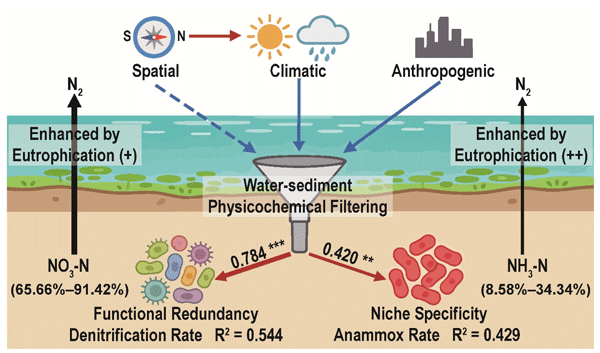
Eutrophication poses a profound threat to the provisioning of ecosystem services in lakes worldwide. Understanding how eutrophication, alongside other biotic and abiotic factors, drives sediment nitrogen removal is essential for maintaining the intrinsic purification capacity of ecosystems and safeguarding water security. To address this, we conducted a systematic investigation of 17 representative lakes across the Eastern China Plain using 15N stable isotope tracing, 16S rRNA amplicon sequencing, and metagenomics profiling. This study aims to quantify the contribution of the anammox to nitrogen removal, elucidate the impacts of eutrophication on overall nitrogen removal, and identify the critical biotic and abiotic factors driving these processes. Results revealed that while denitrification was the dominant process across all lakes, anammox made substantial contributions of up to 34.3 %, exhibiting a distinct environmental dependency. Eutrophication significantly amplified both the overall nitrogen removal capacity and the relative contribution of anammox, with local physicochemical properties and microbial communities demonstrating a pronounced joint driving effect on these processes. Notably, the observed decoupling among microbial community structure, functional gene abundance, and nitrogen removal rates highlights a significant discrepancy between genetic potential and active expression. This discrepancy is further manifested by the superior environmental adaptability of functionally redundant denitrifying bacteria compared to narrow ecological niche anammox bacteria. Furthermore, we demonstrate that macro scale factors, including spatial, climatic, and anthropogenic, indirectly drive nitrogen removal by reshaping local water-sediment physicochemical properties, rather than acting as direct determinants of process rates. Collectively, this study enriches our fundamental understanding of nitrogen removal, particularly the anammox process, and its multidimensional drivers in the Eastern China Plain lakes. We advocate that future lake management strategies must rigorously account for the overarching constraints jointly imposed by trophic status, alongside spatial and climatic gradients, to ensure the sustainability of nitrogen purification ecosystem services.
- Article
(7351 KB) - Full-text XML
-
Supplement
(1794 KB) - BibTeX
- EndNote


Lakes (including reservoirs) constitute critical components of the Earth's surface system, playing irreplaceable roles in regulating global biogeochemical cycles and energy fluxes, as well as maintaining regional ecological security (Mendonça et al., 2017; Woolway et al., 2025). However, since the Industrial Revolution, the dual stressors of climate change and intense anthropogenic activities have severely disrupted the homeostasis of lake ecosystems, precipitating a series of global lake environmental crises (Woolway et al., 2020; IPCC, 2022). Statistics indicate that algal blooms occur in over 20,000 lakes worldwide, covering approximately 2.57 % of the total global lake surface area, with a continuing upward trend in both frequency and intensity (Ho et al., 2019; Hou et al., 2022). The synergistic between climate warming and anthropogenic nitrogen loading is recognized as the core mechanism driving the exacerbation of algal blooms (Huisman et al., 2018; Wang et al., 2025). This not only undermines ecosystem services but also poses severe challenges to global public health security (Dai et al., 2023).
Nitrogen, an essential element for the synthesis of proteins and nucleic acids, undergoes biogeochemical cycling that directly governs the regulation of primary productivity and the maintenance of homeostasis in aquatic ecosystems (Stüeken et al., 2024). When exogenous nitrogen inputs exceed the lake's carrying capacity, disrupted nitrogen cycling can induce ecological disasters such as algal blooms (Ho et al., 2019; Wang et al., 2025). As a primary limiting factor for algal blooms, the spatiotemporal distribution of nitrogen directly determines phytoplankton growth potential (Hutchins and Tagliabue, 2024). The removal of excess reactive nitrogen via microbially mediated pathways is a critical mechanism for maintaining lake health and self-purification capacity (Wang et al., 2024). Sediment nitrogen removal processes – primarily denitrification and anaerobic ammonium oxidation (anammox) – can eliminate 30 % to 50 % of nitrogen from the water column (Kuypers et al., 2018). Therefore, elucidating the spatiotemporal evolution and driving mechanisms of lake nitrogen removal is scientifically critical for controlling eutrophication and mitigating algal blooms (van Helmond et al., 2020; Wu et al., 2026).
In China, driven by rapid socioeconomic development, approximately 69.5 % of lakes face eutrophication, a phenomenon particularly pronounced in the densely populated Eastern Plain Region (Zhou et al., 2022). Ecological degradation resulting from eutrophication causes annual economic losses exceeding USD 10 billion, severely threatening the health of China's lake ecosystems and the realization of national water security strategies (Wang et al., 2025). However, previous studies in this region have predominantly focused on denitrification or dissimilatory nitrate reduction to ammonium (DNRA) (Jiang et al., 2023), often overlooking the potential contribution of anammox. Recent evidence suggests that under specific environmental, the contribution of anammox to nitrogen removal is non-negligible and may even become dominant (Deng et al., 2024). Consequently, the lack of systematic assessment of anammox limits our comprehensive understanding of the nitrogen budget and self-purification mechanisms in the Eastern China Plain lakes.
Therefore, we hypothesized that the lakes across the Eastern China Plain could serve as hotspots for the anammox process, and that eutrophication might induce significant shifts in anammox rates and their relative contribution to nitrogen removal. To test this hypothesis, we investigated 17 representative lakes across the Eastern China Plain, covering both mesotrophic and eutrophic lakes. By integrating 15N stable isotope tracing, 16S rRNA amplicon sequencing, and metagenomics, this study aims to address the following questions: (1) What is the relative contribution of the anammox process to overall nitrogen removal in these lakes? (2) Does eutrophication significantly alter the dynamics of denitrification and anammox processes? (3) What are the relative roles of biotic and abiotic factors in driving these lacustrine nitrogen removal processes?
2.1 Study area and sample collection
The Eastern China Plain lakes region (ECPLR), one of China's five primary lake regions, encompasses the middle and lower reaches of the Yangtze River, the lower Yellow River, the Huai River, and the Eastern Route of the South-to-North Water Diversion Project. With a total surface area exceeding 20 000 km2, the ECPLR accounts for approximately 25.9 % of China's total lake area (Ma et al., 2010). Seventeen representative lakes within this region were selected for this study (Fig. 1, Table S1 in the Supplement). These lakes provide critical ecosystem services and possess significant economic value, including potable water supply, navigation, flood control, fisheries, aquaculture, and biodiversity conservation, among others. Considering the morphological characteristics, hydrological connectivity, and historical monitoring data of each lake, a total of 81 sampling sites were established. Further details regarding the study area are provided in Sect. S1 in the Supplement.
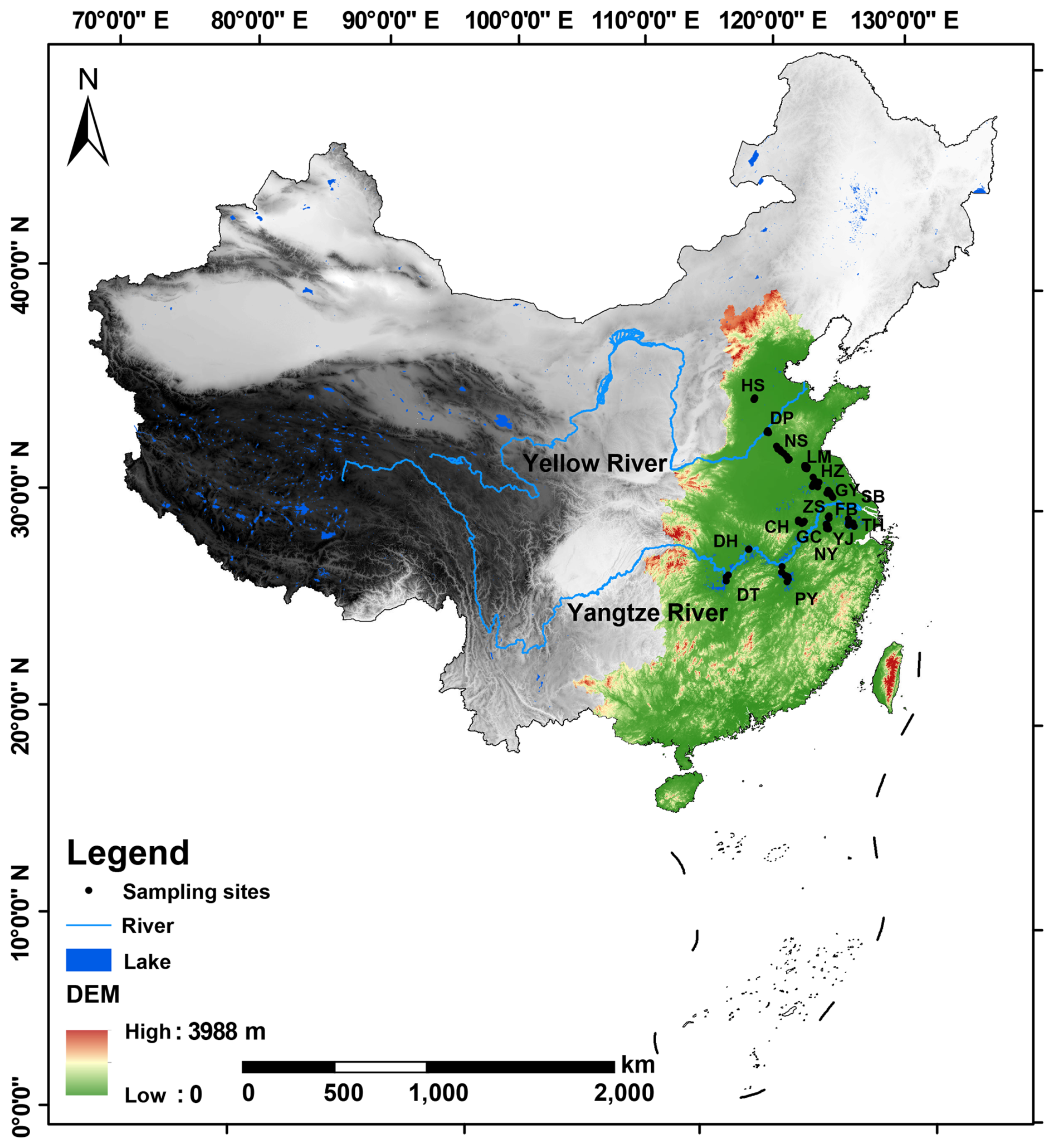
Figure 1Overview of the Eastern China Plain lakes region and distribution of sampling sites. Note: SB, Lake Shaobo; GY, Lake Gaoyou; HZ, Lake Hongze; LM, Lake Luoma; NS, Lake Nansi; DP, Lake Dongping; HS, Lake Hengshui; TH, Lake Taihu; FB, Fangbian reservoir; YJ, Yaojia reservoir; ZS, Zhongshan reservoir; NY, Lake Nanyi; GC, Lake Gucheng; CH, Lake Chaohu; PY, Lake Poyang; DH, Lake Donghu; DT, Lake Dongting.
Field surveys were conducted from August to October 2024. At each site, 2 L of composite water samples were collected for physicochemical analysis and slurry incubation experiments. Concurrently, surface sediment (0–5 cm) was collected for physicochemical analysis and slurry incubation (∼ 500 g), and microbial sequencing (∼ 5 g). All samples were immediately stored at 4 °C in darkness and transported to the laboratory.
2.2 Physicochemical analysis, climate data acquisition, and human activity intensity quantification
Water temperature (WT), electrical conductivity (EC), dissolved oxygen (DO), and pH were measured on-site (YSI Professional Plus, USA). Water depth (WD) and secchi depth (SD) were determined using a Speedtech SM-5 depth sounder and Secchi disk, respectively. To minimize random errors, triplicate measurements were performed, and their average was taken to ensure data reliability. Detailed analytical parameters and methods for water and sediment samples are provided in Table S2. Trophic status of the lake water was evaluated using the Comprehensive Trophic Level Index (TLI) (Sect. S2).
Climate data were obtained from the CRU TS dataset (Harris et al., 2020). Using the “ncdf4” package in R (v4.5.2), the monthly mean precipitation (MP) and mean temperature (MT) were extracted for the sampling months. Additionally, annual-scale climate indices (MAP, MAT, etc., Tab. S3) were calculated. Human Activity Intensity (HAI) was quantified using construction land equivalent conversion coefficients (Tab. S4) (Xu et al., 2016). Detailed procedures regarding land use data sources, preprocessing, and calculations are provided in Sect. S3.
2.3 Nitrogen removal rate determination
Sediment nitrogen removal processes were quantified using 15N isotope tracing slurry incubations (Sect. S4). Dissolved 28N2, 29N2, and 30N2 concentrations were measured using membrane inlet mass spectrometer (MIMS-200, Bay Instruments, USA). Denitrification (Vden) and anammox rates (Vana), and the relative contribution of anammox to nitrogen removal (Ra), were calculated following Thamdrup and Dalsgaard (2002).
2.4 DNA extraction, sequencing, and bioinformatic analyses
Total DNA was extracted using the FastDNA® Spin Kit for Soil (MP Biomedicals, USA). The integrity of genomic DNA was assessed by agarose gel electrophoresis, while the concentration and purity were measured using a Nanodrop 2000 and Qubit 3.0 Spectrophotometer. The 16S rRNA gene V3–V4 region was amplified (primers 338F/806R) (Dai et al., 2022), and sequenced on the Illumina MiSeq platform (Guangdong Magigene Biotechnology Co., Ltd., Guangzhou, China). Bioinformatic processing included quality trimming, paired-end read merging, and chimera removal. Amplicon Sequence Variants (ASVs) were resolved based on 100 % sequence identity and assigned taxonomy using the SILVA database (v138.2).
Metagenomic libraries were constructed using the ALFA-SEQ DNA Library Prep Kit and sequenced on the Illumina NovaSeq 6000 platform (PE150 mode; Guangdong Magigene Biotechnology Co., Ltd., Guangzhou, China). Raw reads were quality-filtered and adapter-trimmed using fastp and Trimmomatic, yielding approximately 12 Gbp of high-quality clean data per sample. Subsequent bioinformatic analyses encompassed de novo assembly, Open Reading Frame (ORF) prediction, the construction of a non-redundant gene catalog (unigenes), and gene abundance quantification (Steinegger and Söding, 2018). Nitrogen-cycling genes and their taxonomic affiliations were annotated using Diamond (v0.9.32) by aligning sequences against the NCycDB (Tu et al., 2019) and the NCBI non-redundant (NR) protein database, respectively. Taxonomic classification was subsequently determined using the Lowest Common Ancestor (LCA) algorithm to generate comprehensive gene abundance profiles. Finally, functional annotation was filtered based on an alignment coverage threshold of >40 %.
2.5 Statistical analyses
All statistical analyses and data visualization were primarily performed using the R (v4.5.2) and ArcMap 10.4. Microbial diversity was calculated using the “vegan” package based on a normalized sequencing depth of 34 235 reads per sample. Linear Discriminant Analysis Effect Size (LEfSe) was conducted using the “microeco” package to identify discriminative taxa between groups (Liu et al., 2022). To quantify spatial structures, Principal Coordinates of Neighbor Matrices (PCNM) analysis was performed using the “SoDA” package to extract spatial eigenvectors of the sampling sites (Borcard and Legendre, 2002). To disentangle the complex relationships driving nitrogen removal, a multi-tiered statistical approach was employed: (1) Spearman's correlations and Mantel tests were performed using the “linkET” package to evaluate the interconnections among different factors. (2) Linear Mixed Models (LMMs) were constructed using the “lme4” package to quantify the effects of geographic location and human activity intensity on nitrogen removal rates. (3) Random Forest (RF) regression models were built using the “randomForest” package to identify key predictors. (4) Partial Least Squares Path Modeling (PLS-PM) was established using the “plspm” package to quantitatively disentangle the direct and indirect causal pathways linking environmental factors, microbial communities, and functional genes to nitrogen removal rates (Breiman, 2001; Yuan et al., 2021; Deng et al., 2024).
3.1 Spatial heterogeneity of nitrogen removal rates
Measurements based on the 15N isotope pairing technique revealed substantial spatial heterogeneity in sediment nitrogen removal rates across the Eastern China Plain lakes (p<0.05; Fig. 2a, Table S5). Mean denitrification rates (Vden) ranged from 26.58 to 117.54 nmol N g−1 h−1. Notably, lakes situated along the Eastern Route of the South-to-North Water Diversion Project (ER-SNWDP) – specifically Lakes Hongze, Chaohu, Nansi, and Luoma – exhibited elevated denitrification activities, with mean Vden values consistently exceeding 100 nmol N g−1 h−1. In contrast, Lake Dongting (26.58 ± 4.84 nmol N g−1 h−1) and certain reservoir-type lakes displayed significantly lower rates. The spatial distribution pattern of anammox rates (Vana) was highly congruent with that of denitrification, with mean values ranging from 2.50 to 34.54 nmol N g−1 h−1. Although Vden consistently exceeded Vana, indicating the predominance of denitrification across all studied lakes, the contribution of anammox was substantial in specific lakes such as Lake Dongping (Table S5), where the maximum relative contribution (Ra) reached 34.34 %. Sampling sites were categorized into eutrophic and mesotrophic groups based on the TLI assessment (Fig. S1o). Comparative analysis demonstrated that Vden, Vana, and Ra were all significantly higher in eutrophic sites compared to mesotrophic ones (p<0.001; Fig. 2).
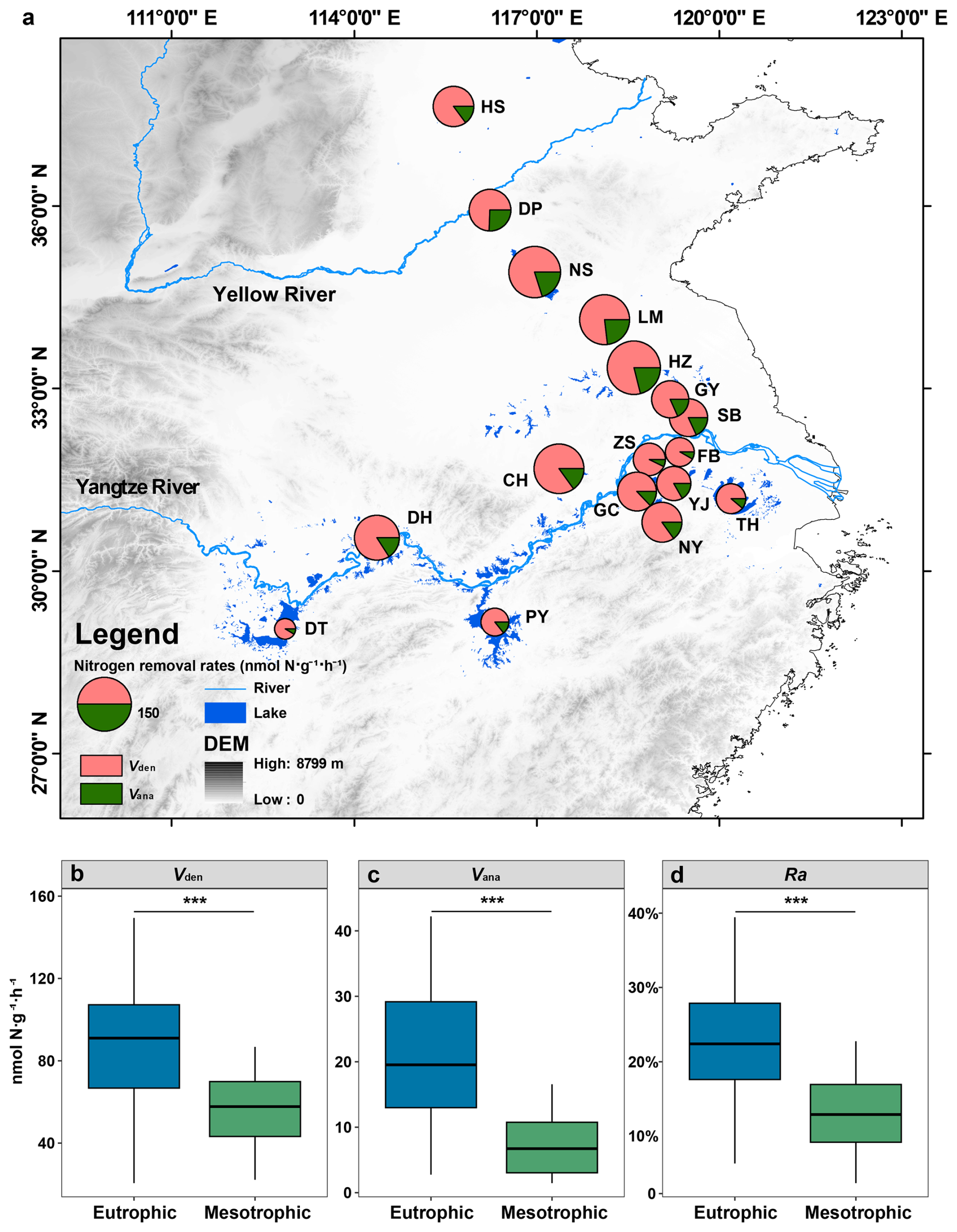
Figure 2Spatial patterns of nitrogen removal rates in the Eastern China Plain lakes (a) and their variations across sites with different trophic states (b–d). Note: (1) The size of the pie charts is proportional to the total nitrogen removal potential (the sum of mean denitrification and anammox rates). (2) Statistical significance was determined using the Mann–Whitney U test with Benjamini-Hochberg correction, indicated by asterisks (***: p<0.001).
3.2 Spatial patterns of nitrogen removal functional gene abundance and diversity
Metagenomic analysis revealed that the key functional genes mediating denitrification and anammox were ubiquitous across all studied lakes, yet their abundances varied substantially (16–910 554 reads; Fig. S2). Denitrification genes overwhelmingly dominated the functional gene pool, with a mean abundance of 1.98 × 10⁶ reads, approximately three orders of magnitude higher than anammox genes (1.33 × 10³ reads). Spatially, the major denitrification genes maintained a consistent abundance hierarchy (nirK > nosZ > nirS) across all lakes (Fig. 3a). For major anammox genes, hzsB exhibited the highest abundance (Fig. 3b). No significant inter-lake differences were found for hzo, hzsB, and hzsC (p>0.05). Conversely, hzsA displayed distinct spatial heterogeneity, with significantly higher abundance in Lake Gaoyou compared to Lakes Poyang, Dongting, and the reservoir-type lakes (p<0.05).
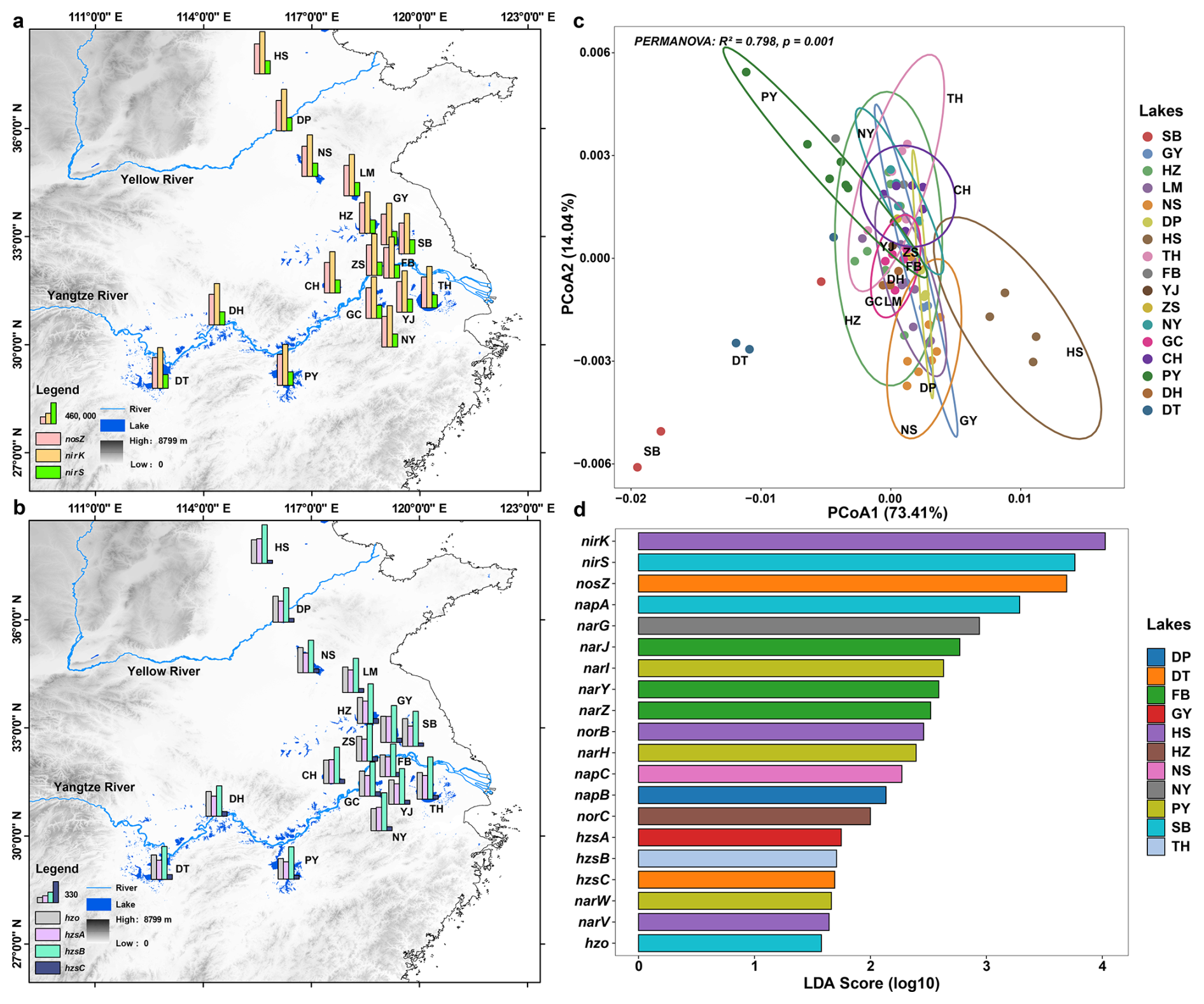
Figure 3Spatial distribution of functional genes associated with sediment denitrification (a) and anammox (b) in the Eastern China Plain lakes. (c) Beta-diversity of functional gene profiles visualized via Principal Coordinates Analysis (PCoA). (d) Linear Discriminant Analysis Effect Size (LEfSe) identifying discriminative functional genes between groups.
Beta-diversity elucidated the spatial patterns of the nitrogen removal functional gene (Fig. 3c). Sampling sites overlapped extensively in the 2-D ordination space, with the first principal coordinate axis (PCoA1) explaining the majority of the variance (73.41%). However, PERMANOVA tests (R2=0.798, p=0.001) indicated that significant differences in functional gene profiles did exist among lakes. Combined with similarity matrices and hierarchical clustering (Fig. S3), these differences were primarily driven by specific sites within Lakes Shaobo, Dongting, and Hengshui. The generally low clustering coefficient (<0.03) suggest that, with the exception of a few specific habitats, the functional gene composition of sediments was highly similar across most lakes. LEfSe analysis further identified denitrification genes as the decisive discriminative features driving the variation in functional gene profiles among lakes (Fig. 3d). These genes consistently showed LDA scores (log10) exceeding 3 and were significantly enriched in Lakes Hengshui, Shaobo, and Dongting (p<0.01). In comparison, although anammox genes were enriched in Lakes Shaobo, Gaoyou, and Taihu, their LDA scores were generally below 2, indicating a minor contribution to inter-group differences compared to denitrification genes.
3.3 Characteristics of microbial community structure
16S rRNA sequencing revealed that sediment microbial communities in the study area were primarily dominated by the phyla Chloroflexi and Proteobacteria, each exceeding 20 % in relative abundance (Fig. 4a). Although taxa such as Desulfobacterota and Firmicutes exhibited lower overall relative abundances, they showed significant enrichment in specific lakes, suggesting that regional environmental strongly influence the proliferation of specific taxa. Cluster analysis indicated that lakes along the ER-SNWDP (e.g., Lakes Hongze and Gaoyou) grouped together, reflecting high community similarity (Fig. S4). In contrast, Lakes Poyang and Dongting formed distinct, independent branches, highlighting the profound influence of regional environmental.
Alpha-diversity (Fig. 4b) indicated that Lakes Gaoyou, Gucheng, and the reservoir-type lakes possessed high species richness (Observed species >1000) and Shannon diversity (>6). The Simpson evenness was generally above 0.95, indicating a high overall community evenness. Conversely, Lake Dongting exhibited relatively lower indices, suggesting a stronger dominance effect by a few specific taxa. This implies that strong environmental filtering within these lakes has selectively enriched taxa equipped with specific adaptive traits. Beta-diversity revealed highly significant differences in community structure among lakes (R2=0.642, p=0.001). Sampling sites appeared highly dispersed in the two-dimensional ordination space (Fig. 4c). Most lake sites formed independent branches with clustering coefficient generally exceeding 0.4 (Fig. S5), indicative of substantial inter-lake variation. LEfSe analysis further identified specific microbial taxa significantly enriched in different lakes, with marked variations in the number of discriminative taxa and LDA scores (Fig. 4d). Collectively, these findings underscore the critical role of regional environmental in driving microbial community.
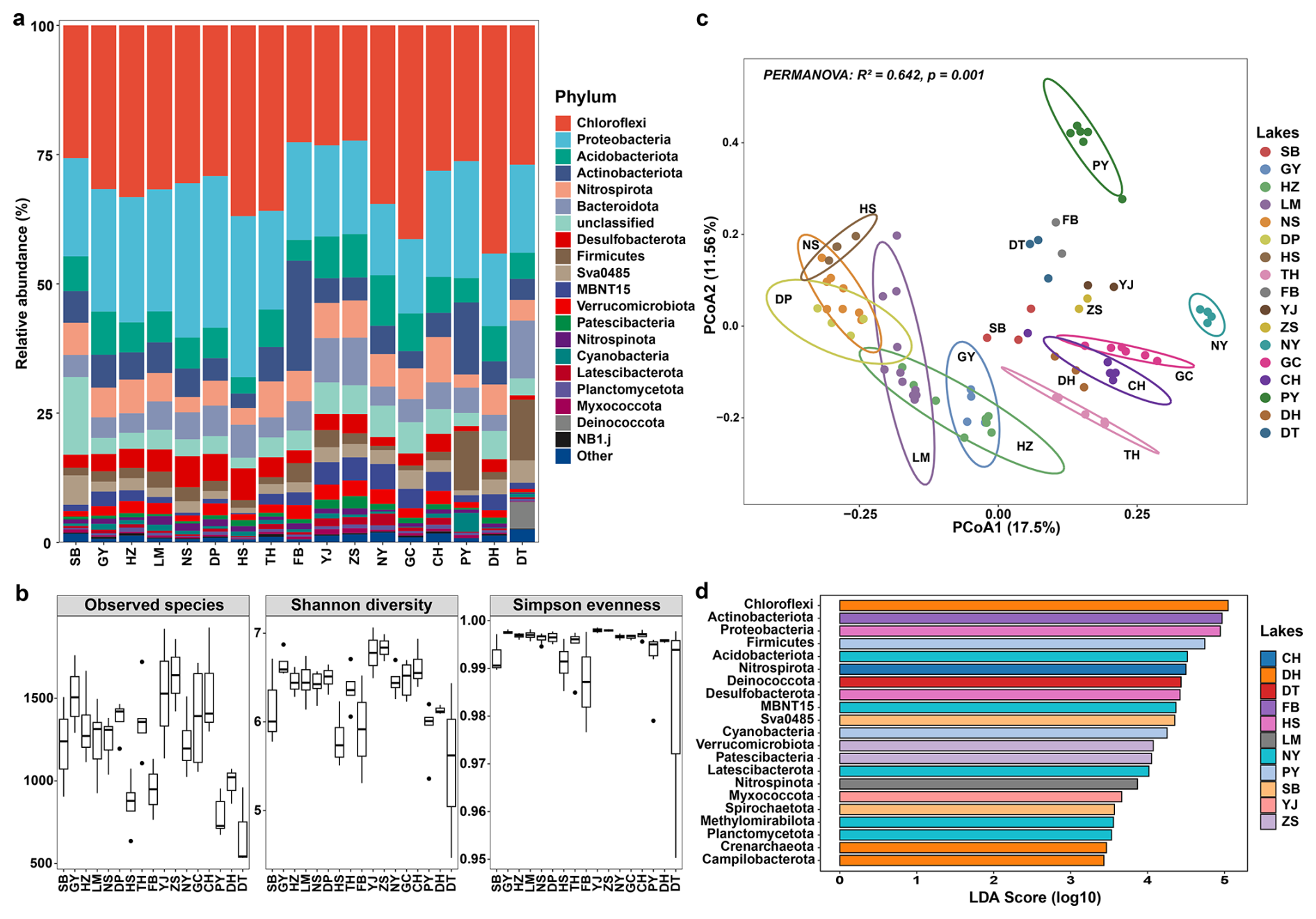
Figure 4Sediment microbial community characteristics in the Eastern China Plain lakes. (a) Taxonomic composition of the top 20 phyla. (b) Alpha-diversity indices, where “Observed species” denotes the number of observed amplicon sequence variants (ASVs). (c) Microbial beta-diversity based on PCoA. (d) LEfSe analysis identifying discriminative taxa at the phylum level between groups.
3.4 Relationships between biotic/abiotic factors and nitrogen removal rates
Spearman's correlations and Mantel tests revealed complex interplay between biotic/abiotic factors and nitrogen removal rates (Fig. S6). Both Vden and Vana rates exhibited significant correlations with multiple physicochemical parameters, spatial structural variables (PCNM), and functional genes (e.g., nirS, napC). However, Vana showed a stronger correlation with microbial community structure (Shannon diversity), whereas Vden was more strongly associated with hydro-chemical parameters. This divergence suggests that the regulatory mechanisms governing these two nitrogen removal processes are not identical.
First, linear regression analysis indicated no significant correlation between Human Activity Intensity (HAI) and nitrogen removal rates across different spatial scales (p>0.05; Fig. 5A, B). In contrast, latitude showed significant positive correlations with both Vden (R2=0.215) and Vana (R2=0.315, p<0.001), and anammox may be subject to stricter latitudinal constraints. Random Forest (RF) models further identified the spatial structural variable PCNM2 as the shared major predictor for both Vden and Vana (Fig. 5c). Organic matter indicators (CODMn and DOC) were identified as key drivers for Vden (Fig. 5i). In contrast, Vana was more significantly influenced by ionic conditions (Cl−) and substrate (NO2-N) (Fig. 5j). Regarding functional genes, major denitrification genes (nirK and nosZ) were jointly regulated by climatic (MAT and MAP) and ionic conditions (Cl− and SO) (Fig. 5k, l). The key anammox gene (hzsB) was primarily driven by PCNM1, DOC, and redox conditions (DO) (Fig. 5m). Additionally, variations in Shannon diversity were dominated by PCNM2, with sediment trophic status (STN, Fig. S8) serving as another crucial predictor (Fig. 5n). Collectively, these results underscore the pivotal role of environmental differences resulting from spatial heterogeneity in shaping nitrogen removal processes.
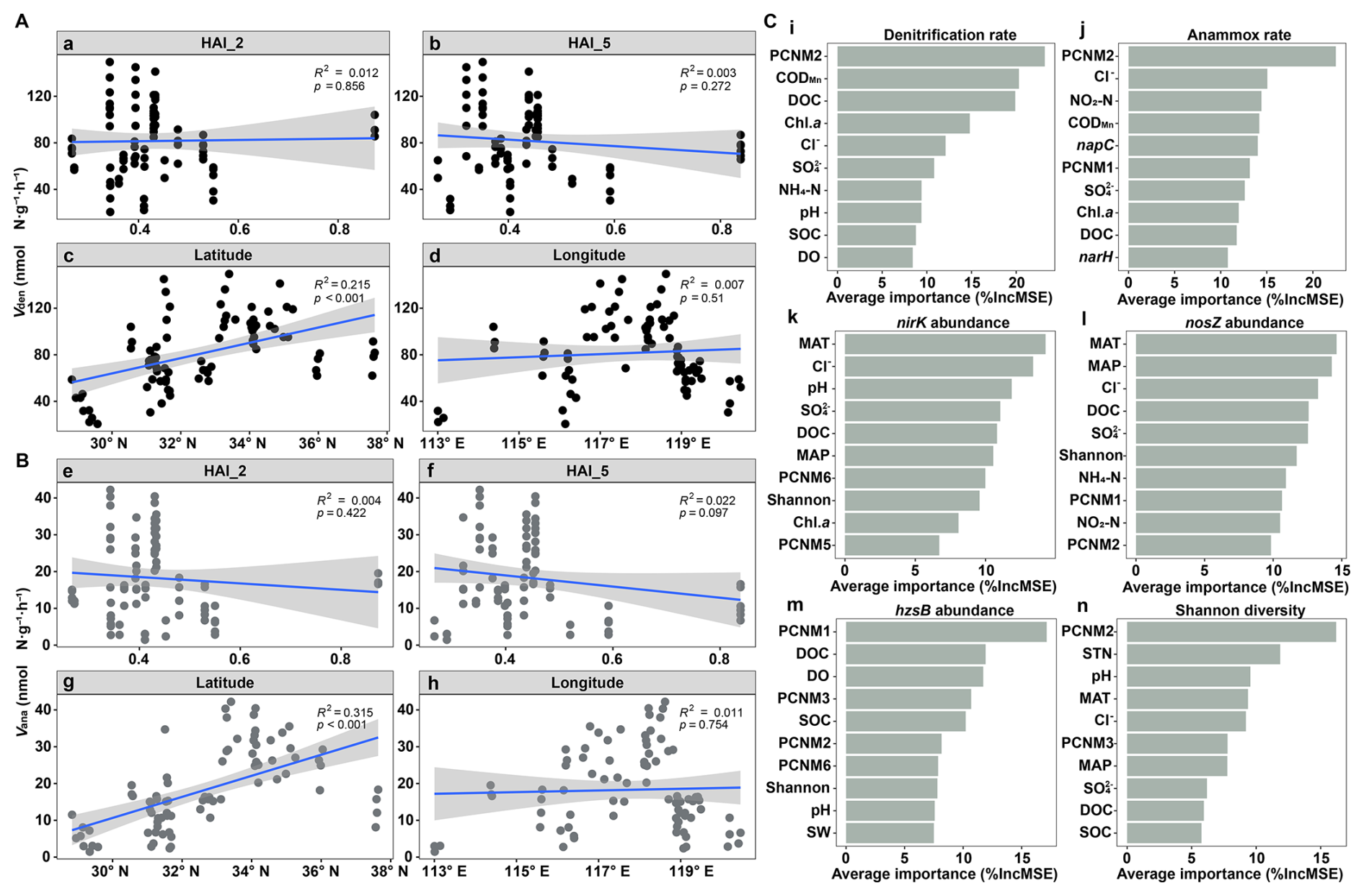
Figure 5Drivers of nitrogen removal processes in the Eastern China Plain lakes. Linear regressions of denitrification (A) and anammox (B) rates against Human Activity Intensity (HAI) and geographic location. The solid lines represent ordinary least squares (OLS) linear regressions, with statistical significance evaluated using two-tailed Student's t-tests. (C) Key predictors of nitrogen removal rates, functional gene abundance, and microbial Shannon diversity identified via Random Forest regression models. Note: PCNM, Principal Coordinates of Neighbor Matrices; DOC, dissolved organic carbon; SOC, sediment organic carbon; DO, dissolved oxygen; MAT, mean annual temperature; MAP, mean annual precipitation; SW, sediment water content; STN, sediment total nitrogen.
To disentangle the causal pathways of these multi-factor interactions, a Partial Least Squares Path Model (PLS-PM) was constructed (Fig. 6). The models exhibited good predictive power, with Goodness of Fit (GoF) values of 0.609 for denitrification and 0.598 for anammox, explaining 54.4 % and 42.9 % of the variance in Vden and Vana, respectively. The results indicated that water-sediment physicochemical properties exerted significant direct driving effects on both Vden (r=0.784, p<0.001) and Vana (r=0.420, p<0.01). Vden was also significantly directly driven by microbial community structure (r=0.206, p<0.05). Crucially, effect decomposition highlighted that while spatial structure had no significant direct effect, it exerted substantial influence via indirect pathways mediated through climate, environmental conditions, and microbial communities (Fig. 6b, d). Overall, the two nitrogen removal processes exhibited distinct sensitivities to different drivers, highlights the complex and hierarchical regulatory patterns underlying nitrogen removal in the Eastern China Plain lakes.
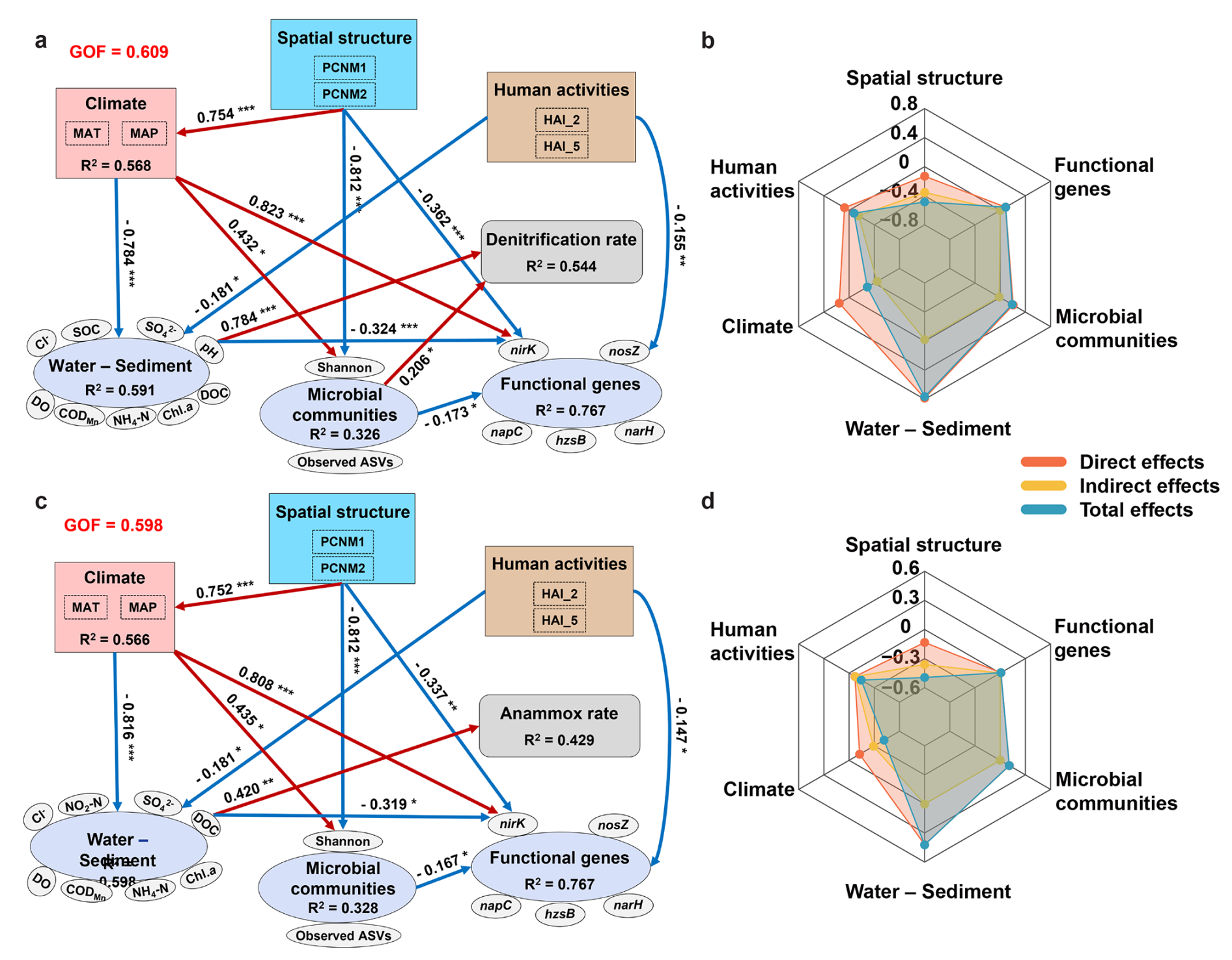
Figure 6Causal mechanisms driving nitrogen removal in the Eastern China Plain lakes. Partial Least Squares Path Modeling (PLS-PM) disentangling the direct and indirect effects of multiple drivers on denitrification (a) and anammox (c) rates, alongside their standardized total effects (b, d). Note: (1) Arrows represent significant unidirectional causal relationships. Red and blue arrows denote positive and negative effects, respectively. Numbers adjacent to arrows indicate standardized path coefficients (*: p<0.05, **: p<0.01, ***: p<0.001), represent standardized regression coefficients that quantify the relative strength and direct/indirect effects of hypothesized causal relationships. (2) R2 values represent the proportion of variance explained for each dependent variable. (3) Goodness of Fit (GoF) is displayed at the top of each model. (4) To ensure model robustness, indicator variables for each latent construct were selected based on ecological relevance and preliminary collinearity screening, with measurement validity confirmed through outer model loadings and cross-loadings (retaining indicators with loadings >0.70 where applicable). (5) PCNM, Principal Coordinates of Neighbor Matrices; DOC, dissolved organic carbon; DO, dissolved oxygen; MAT, mean annual temperature; MAP, mean annual precipitation; HAI, Human Activity Intensity.
4.1 Eutrophication enhances the contribution of anammox to nitrogen removal in the Eastern China Plain lakes
This study systematically characterized the significant spatial heterogeneity of Vden and Vana in the Eastern China Plain lakes (Fig. 2a, Table S5). Although both processes were ubiquitous across all surveyed lakes, distinct variations in rates were evident among individual lakes and lake zones, indicating that lacustrine nitrogen removal capacity is non-uniformly distributed at the regional scale (Jiang et al., 2023). Furthermore, previous studies have highlighted substantial variability in the relative contributions of denitrification and anammox (Deng et al., 2023; Stüeken et al., 2024), our results show that denitrification overwhelmingly dominated in all surveyed lakes (Table S5). However, the contribution of anammox was non-negligible in specific systems (Fig. 2), underscoring its distinct environmental dependency (Zhu et al., 2013). Furthermore, variations in latitudinal gradients among lakes introduce climatic differences such as regional temperature and precipitation. These differences, coupled with variations in geological backgrounds and watershed runoff generation and concentration processes, collectively highlight the critical regulatory role of spatial constraints – exerted by local environments – in shaping nitrogen removal processes.
Nitrogen and dissolved organic carbon (DOC) serve as critical metabolic substrates for nitrogen-removing microorganisms and act as key environmental factors of these processes (Lambert et al., 2024; Pascal et al., 2025). Our results demonstrated that both Vden and Vana were significantly elevated in eutrophic sites compared to mesotrophic ones (Fig. 2b, c). Subjected to prolonged exogenous nutrient loading, the Eastern China Plain lakes generally sustain high substrate availability (Fig. S1) (Zhou et al., 2022). This enrichment likely enhances microbial substrate utilization efficiency, thereby stimulating and accelerating the corresponding nitrogen cycling processes (Zhou et al., 2021). Notably, previous studies have demonstrated potential substrate competition between DNRA and both denitrification and anammox processes. However, the reaction flux of DNRA is typically one to two orders of magnitude lower than that of denitrification. In typical eutrophic lakes, where NO3-N is generally abundant, the impact of this substrate competition on overall nitrogen removal rates remains relatively limited (Jiang et al., 2023). We recommend that future studies incorporate multi-isotope tracing techniques to achieve comprehensive, multi-pathway monitoring of the nitrogen cycle. Furthermore, organic carbon and ionic conditions act as critical electron donors for denitrification (Yoon et al., 2015). The effective supply of electrons (Fig. S1c–f) directly fueled elevated Vden in lakes such as Nansi and Luoma (Fig. 2a, Table S5). However, high concentrations of SO may exert an inhibitory effect on denitrification through competitive inhibition for electron donors or sulfide toxicity (Jiang et al., 2020), which likely accounts for the relatively lower Vden observed in Lake Hengshui (Fig. S1f).
Intriguingly, although denitrification remained dominant under eutrophic conditions, the relative contribution of anammox significantly increased (Fig. 2d). This shift may be attributed to the susceptibility of denitrification to factors such as electron donor (organic carbon) allocation and redox conditions (Carlson et al., 2013). Additionally, given that denitrifying communities possess a broader tolerance range for oxygen compared to anammox communities (Deng et al., 2020), processes such as DOC mineralization (Yang et al., 2025) and variations in sediment water content (Table S6) and oxygen permeability (Sun et al., 2023) can alter local oxygen concentrations. This result creates more intensely anoxic or anaerobic niches, which favor the survival of anammox bacteria (Yang et al., 2026). This process also stimulates heterotrophic denitrification, which in turn supplies crucial intermediate substrates NO2-N for anammox, thereby boosting the contribution of anammox to lacustrine nitrogen removal (Tsementzi et al., 2016).
Collectively, these findings suggest that under specific substrate concentrations and redox conditions, anammox can form a synergistic or complementary relationship with denitrification. This complementarity ultimately enhances both the magnitude and stability of the nitrogen removal function in lake ecosystems (Kuypers et al., 2018), bearing profound ecological significance for facilitating nitrogen cycling and buffering against environmental changes. As ”sinks” within watershed ecosystems, lakes integrate substantial material and energy inputs (Bergström and Karlsson, 2019). This results in a complex scenario where nitrogen cycling is simultaneously regulated by multiple environmental variables, leading to the pronounced spatial heterogeneity observed in lacustrine nitrogen removal capacity.
4.2 Pronounced decoupling among microbial community, functional gene abundance, and nitrogen removal rates
As quintessential microbe-mediated biogeochemical processes, the intensities of denitrification and anammox are fundamentally governed by microbial community structure and the distribution of functional genes (Jiang et al., 2020). Our study revealed a certain degree of coupling between metagenome-derived functional gene abundance/diversity and nitrogen removal rates. Specifically, key denitrification genes (e.g., nirK, nosZ) exhibited significant correlations with nitrogen removal rates (Fig. S6), aligning with previous assertions that gene abundance can serve as a proxy for nitrogen removal potential (Xiong et al., 2017).
However, it is crucial to note that functional gene abundance does not always scale linearly with nitrogen removal rates (Dandie et al., 2011; Ma et al., 2020). We observed a highly consistent functional gene composition across the studied lakes, where diversity variations were dictated by only a few outlier samples (Figs. 3c, S3). This indicates a high similarity in the potential nitrogen removal capacity among lakes, which stands in sharp contrast to the significant spatial heterogeneity observed in the measured rates. Furthermore, the substantial discrepancy – approximately three orders of magnitude – between denitrification and anammox gene abundances (Tab. S5) was not proportionally reflected in their respective rate differences. This non-linear association likely stems from the fact that the presence of genes at the DNA level represents only the genetic potential and does not guarantee their transcription and translation into active proteins (Ma et al., 2020). Path modeling (PLS-PM), which showed no significant direct effect of functional genes on rates, further corroborated this phenomenon (Fig. 6a, c). Consequently, assessing regional nitrogen removal capacity based solely on functional gene abundance may lead to misjudgments of actual rates.
Beyond the genetic level, microbial community structure is also a critical driver of spatial differentiation in nitrogen removal (Fig. 6). Variations in the dominance of functional taxa fundamentally determine the system's potential to execute complete nitrogen removal processes (Sveen et al., 2025). Our results showed that core nitrogen-cycling taxa, such as Proteobacteria and Nitrospirota, exceeded 20 % relative abundance in all lakes (Fig. 4a), with specific dominant taxa significantly enriched in different lakes (Fig. 4d). This reflects a robust potential for nitrogen cycling and organic matter degradation across the Eastern China Plain lakes (Han et al., 2024). However, shifts in the proportions of these dominant taxa may alter community response thresholds to substrates and environmental conditions, thereby driving the spatial divergence of nitrogen removal rates (Cline and Zak, 2015; Egidi et al., 2023).
Notably, Vden responded more significantly to microbial community structure than Vana (Fig. 6a, b). This distinction may be attributed to the modular nature of denitrification, a stepwise process performed by a diverse array of microorganisms (Kuypers et al., 2018; Patchett et al., 2025). The generally high microbial diversity observed in the study area (Fig. 4b, c) implies a high level of functional redundancy (Louca et al., 2018). This taxonomic diversity allows distinct taxa to perform identical or similar metabolic functions, enabling denitrifying communities to occupy broader ecological niches. In contrast, anammox is a specialized, narrow ecological niche process restricted to a limited number of bacteria within the phylum Planctomycetes (Wang et al., 2019), making its rate strictly constrained by the population size and gene expression of key species. Consequently, the differential stability of these functional communities in the face of environmental fluctuations (Hernandez et al., 2023) results in the observed divergence in process rates.
4.3 Multiple driving effects of macro-environmental heterogeneity on nitrogen removal processes
Macro-ecological studies consistently demonstrate that nitrogen cycling is significantly correlated with geographic factors such as latitude, longitude, and altitude (Fuhrman et al., 2008; Tu et al., 2019). Our findings reveal that latitudinal gradients and spatial structural variables (e.g., PCNM2) constitute the primary macro-scale background governing nitrogen removal processes across the Eastern China Plain lakes (Figs. 5, S6). Specifically, latitude acts as a robust proxy for climatic drivers – including temperature, precipitation, and seasonal irradiance (Ding et al., 2025) – consistent with the subtropical to temperate monsoon climate characteristics of this region (Sect. S1, Table S3). Such climatic variations reshape microbial habitat quality by modulating hydraulic residence times, organic matter mineralization pathways, and the thermal, dissolved oxygen, and nutrient stratification regimes (Manzoni et al., 2014; Hu et al., 2020). These shifts subsequently exert profound effects on functional gene abundance, highlighting the critical roles of dispersal limitation and spatial heterogeneity in shaping microbial biogeography (Du et al., 2023). Notably, the response of Vana to latitude was significantly stronger than that of Vden (Fig. 5c, g). This discrepancy is likely attributable to the broader metabolic versatility and phylogenetic distribution of denitrifying communities. Conversely, anammox communities exhibit narrower ecological niche specialization and heightened sensitivity to macro-environmental fluctuations, rendering their spatial distribution subject to stricter geographic constraints (Gao et al., 2018).
Despite the study area being situated in Eastern China – a region characterized by intense anthropogenic disturbance (Fig. S7) – the Human Activity Intensity (HAI) across various buffer zone scales showed no direct, significant effects on nitrogen removal rates (Fig. 5A, B). This decoupling suggests that anthropogenic influences undergo a sequential process of environmental filtering followed by micro-environmental redistribution (Keck et al., 2025). Specifically, while human activities drive external loadings of nitrogen, phosphorus, and organic matter, thereby altering lake trophic states and sediment characteristics (Wei et al., 2024), it is the local water-sediment physicochemical properties that constitute the immediate habitat for microbial metabolism. These local factors directly regulate functional genes and nitrogen removal rates through substrate availability and redox conditions, acting as the primary proximate drivers responsible for the spatial heterogeneity observed in this study (Fig. 6a, c).
It is noteworthy that anthropogenic activities and water-sediment physicochemical properties did not exert significant direct effects on microbial community structure, yet significantly shaped the distribution of functional genes (Fig. 6). This suggests that microbial communities in the Eastern China Plain lakes have achieved high structural stability following long-term environmental filtering. Given the generally high microbial diversity observed (Fig. 4b, c), the system likely possesses a high level of functional redundancy (Louca et al., 2018). When environmental physicochemical properties fluctuate due to anthropogenic or other factors, communities may prioritize regulating functional gene expression to maintain metabolic homeostasis rather than undergoing large-scale taxonomic restructuring. Consequently, the response of community structure to environmental changes exhibits a certain hysteresis or dampening effect (Martiny et al., 2023). Moreover, the robust buffering effects provided by microbial biofilm architectures and community dispersal processes (Yan et al., 2024) also partially explain why physicochemical fluctuations failed to translate directly and linearly into shifts in community structure (Kuypers et al., 2018).
Elucidating the driving mechanisms of sediment nitrogen removal is crucial for understanding the resilience of lacustrine ecosystems to eutrophication. This study reveals that while denitrification dominates nitrogen removal in the Eastern China Plain lakes, anammox serves as a critical, highly environmentally dependent complementary process. Notably, eutrophication significantly amplified both the overall nitrogen removal capacity and the relative contribution of anammox, with local physicochemical properties and microbial communities demonstrating a pronounced joint driving effect on these processes. The observed decoupling among microbial community, functional gene abundance, and nitrogen removal rates highlights the intricate complexity of microbial responses to environmental perturbations. This complexity is further evidenced by the stark contrast between the functional redundancy of denitrifying bacteria and the ecological niche specificity of anammox bacteria. Furthermore, we demonstrate that macro-scale factors (spatial, climatic, and anthropogenic) indirectly drive nitrogen removal by reshaping local water-sediment physicochemical properties, rather than acting as direct determinants of process rates. These findings enrich our fundamental understanding of nitrogen removal, particularly the anammox process, and its multidimensional drivers in the Eastern China Plain lakes. Given the sensitivity of nitrogen removal processes to habitat conditions, we suggest validating driving mechanisms using key enzyme activity assays and targeted controlled experiments. Furthermore, we advocate that future lake management strategies must rigorously account for the overarching constraints jointly imposed by trophic status, alongside spatial and climatic gradients, to ensure the sustainability of nitrogen purification ecosystem services.
All data analyzed in this study are available in figshare (https://doi.org/10.6084/m9.figshare.32005818, Wei, 2026).
The supplement related to this article is available online at https://doi.org/10.5194/bg-23-7545-2026-supplement.
JHW: conceptualization, sampling, data analysis, manuscript preparation. KY: analyzed the samples and original draft preparation. YRL: designed figures and tables, original draft preparation. YY: original draft preparation. LCW: design and guidance of experiments, draft revision. ELZ: draft revision, funding acquisition; ZJG: design and guidance of experiments, draft revision, funding acquisition; YJC: design and guidance of experiments, draft revision, funding acquisition.
The contact author has declared that none of the authors has any competing interests.
Publisher's note: Copernicus Publications remains neutral with regard to jurisdictional claims made in the text, published maps, institutional affiliations, or any other geographical representation in this paper. The authors bear the ultimate responsibility for providing appropriate place names. Views expressed in the text are those of the authors and do not necessarily reflect the views of the publisher.
We thank the Institutional Center for Shared Technologies and Facilities of NIGALS, CAS for technical support with physicochemical analyses. We are also grateful to Jiashuai Wen, Weihan Wang, Chennan Wang, Xin Zhang, Yao Zhang, Ziyang Wang, and Zhen Shen for their assistance during field investigations, and to Prof. Hai Xu, Dr. Xiangming Tang, and Yu Qiu for their experimental guidance.
This work was supported by the National Natural Science Foundation of China (grant nos. U24A20639, 42171119) and the State Key Laboratory of Lake and Watershed Science for Water Security (grant nos. NKL2023-ZD02, NKL2023-KP01).
This paper was edited by Lishan Ran and reviewed by two anonymous referees.
Bergström, A. K. and Karlsson, J.: Light and nutrient control phytoplankton biomass responses to global change in northern lakes, Global Change Biol., 25, 2021–2029, https://doi.org/10.1111/gcb.14623, 2019.
Borcard, D. and Legendre, P.: All-scale spatial analysis of ecological data by means of principal coordinates of neighbour matrices, Ecol. Modell., 153, 51–68, https://doi.org/10.1016/S0304-3800(01)00501-4, 2002.
Breiman, L.: Random forests, Mach. Learn., 45, 5–32, https://doi.org/10.1023/A:1010933404324, 2001.
Carlson, H. K., Clark, I. C., Blazewicz, S. J., Iavarone, A. T., and Coates, J. D.: Fe (II) oxidation is an innate capability of nitrate-reducing bacteria that involves abiotic and biotic reactions, J. Bacteriol., 195, 3260–3268, https://doi.org/10.1128/Jb.00058-13, 2013.
Cline, L. C. and Zak, D. R.: Soil microbial communities are shaped by plant-driven changes in resource availability during secondary succession, Ecology, 96, 3374–3385, https://doi.org/10.1890/15-0184.1, 2015.
Dai, T. J., Wen, D. H., Bates, C. T., Wu, L. W., Guo, X., Liu, S., Su, Y. F., Lei, J. S., Zhou, J. Z., and Yang, Y. F.: Nutrient supply controls the linkage between species abundance and ecological interactions in marine bacterial communities, Nat. Commun., 13, 175, https://doi.org/10.1038/s41467-021-27857-6, 2022.
Dai, Y. H., Yang, S. B., Zhao, D., Hu, C. M., Xu, W., Anderson, D. M., Li, Y., Song, X. P., Boyce, D. G., Gibson, L., Zheng, C. M., and Feng, L.: Coastal phytoplankton blooms expand and intensify in the 21st century, Nature, 615, 280–284, https://doi.org/10.1038/s41586-023-05760-y, 2023.
Dandie, C. E., Wertz, S., Leclair, C. L., Goyer, C., Burton, D. L., Patten, C. L., Zebarth, B. J., and Trevors, J. T.: Abundance, diversity and functional gene expression of denitrifier communities in adjacent riparian and agricultural zones, FEMS Microbiol. Ecol., 77, 69–82, https://doi.org/10.1111/j.1574-6941.2011.01084.x, 2011.
Deng, D. L., Pan, Y. T., Liu, G. H., Liu, W. Z., and Ma, L.: Seeking the hotspots of nitrogen removal: A comparison of sediment denitrification rate and denitrifier abundance among wetland types with different hydrological conditions, Sci. Total Environ., 737, 140253, https://doi.org/10.1016/j.scitotenv.2020.140253, 2020.
Deng, D. L., Ding, B. J., He, G., Ji, M. F., Yang, Y. Y., Liu, G. H., Zhang, Q. F., and Liu, W. Z.: The contribution of anammox to nitrogen removal is greater in bulk soils than in rhizosphere soils in riparian wetlands along the Yangtze River, Global Biogeochem. Cy., 37, e2022GB007576, https://doi.org/10.1029/2022GB007576, 2023.
Deng, D. L., Yang, Z. J., Yang, Y. Y., Wan, W. J., Liu, W. Z., and Xiong, X.: Metagenomic insights into nitrogen-cycling microbial communities and their relationships with nitrogen removal potential in the Yangtze River, Water Rese., 265, 122229, https://doi.org/10.1016/j.watres.2024.122229, 2024.
Ding, D. D., Shi, Z. J., Chen, J. S., Zhang, H., Meng, Q. Q., and Han, W. X.: Solar radiation and water stress are major environmental drivers of the latitudinal pattern of leaf Si concentration in woody plants, Global Ecol. Biogeogr., 34, e70122, https://doi.org/10.1111/geb.70122, 2025.
Du, X. F., Gu, S. S., Zhang, Z., Li, S. Z., Zhou, Y. Q., Zhang, Z. J., Zhang, Q., Wang, L. L., Ju, Z. C., Yan, C. L., Li, T., Wang, D. R., Yang, X. S., Peng, X., and Deng, Y.: Spatial distribution patterns across multiple microbial taxonomic groups, Environ. Res., 223, 115470, https://doi.org/10.1016/j.envres.2023.115470, 2023.
Egidi, E., Coleine, C., Delgado-Baquerizo, M., and Singh, B. K.: Assessing critical thresholds in terrestrial microbiomes, Nat. Microbiol., 8, 2230–2233, https://doi.org/10.1038/s41564-023-01536-2, 2023.
Fuhrman, J. A., Steele, J. A., Hewson, I., Schwalbach, M. S., Brown, M. V., Green, J. L., and Brown, J. H.: A latitudinal diversity gradient in planktonic marine bacteria, P. Natl. Acad. Sci. USA, 105, 7774–7778, https://doi.org/10.1073/pnas.0803070105, 2008.
Gao, D. W., Wang, X. L., Liang, H., Wei, Q. H., Dou, Y., and Li, L. W.: Anaerobic ammonia oxidizing bacteria: ecological distribution, metabolism, and microbial interactions, Front. Environ. Sci. En., 12, 10, https://doi.org/10.1007/s11783-018-1035-x, 2018.
Han, P., Tang, X. F., Koch, H., Dong, X. Y., Hou, L. J., Wang, D. H., Zhao, Q., Li, Z., Liu, M., Lücker, S., and Shi, G. T.: Unveiling unique microbial nitrogen cycling and nitrification driver in coastal Antarctica, Nat. Commun., 15, 3143, https://doi.org/10.1038/s41467-024-47392-4, 2024.
Harris, I., Osborn, T. J., Jones, P., and Lister, D.: Version 4 of the CRU TS monthly high-resolution gridded multivariate climate dataset, Sci. Data, 7, 109, https://doi.org/10.1038/s41597-020-0453-3, 2020.
Hernandez, D. J., Kiesewetter, K. N., Almeida, B. K., Revillini, D., and Afkhami, M. E.: Multidimensional specialization and generalization are pervasive in soil prokaryotes, Nat. Ecol. Evol., 7, 1408–1418, https://doi.org/10.1038/s41559-023-02149-y, 2023.
Ho, J. C., Michalak, A. M., and Pahlevan, N.: Widespread global increase in intense lake phytoplankton blooms since the 1980s, Nature, 574, 667–670, https://doi.org/10.1038/s41586-019-1648-7, 2019.
Hou, X. J., Feng, L., Dai, Y. H., Hu, C. A. M., Gibson, L., Tang, J., Lee, Z. P., Wang, Y., Cai, X. B., Liu, J. G., Zheng, Y., and Zheng, C. M.: Global mapping reveals increase in lacustrine algal blooms over the past decade, Nat. Geosci., 15, 130–134, https://doi.org/10.1038/s41561-021-00887-x, 2022.
Hu, Y. L., Wang, S., Niu, B., Chen, Q. Y., Wang, J., Zhao, J. X., Luo, T. X., and Zhang, G. X.: Effect of increasing precipitation and warming on microbial community in Tibetan alpine steppe, Environ. Res., 189, 109917, https://doi.org/10.1016/j.envres.2020.109917, 2020.
Huisman, J., Codd, G. A., Paerl, H. W., Ibelings, B. W., Verspagen, J. M. H., and Visser, P. M.: Cyanobacterial blooms, Nat. Rev. Microbiol., 16, 471–483, https://doi.org/10.1038/s41579-018-0040-1, 2018.
Hutchins, D. A. and Tagliabue, A.: Feedbacks between phytoplankton and nutrient cycles in a warming ocean, Nat. Geosci., 17, 495–502, https://doi.org/10.1038/s41561-024-01454-w, 2024.
IPCC: Climate change 2022: Impacts, adaptation and vulnerability, p. 3056, Cambridge University Press, Cambridge, UK and New York, USA, https://doi.org/10.1017/9781009325844, 2022.
Jiang, X. Y., Gao, G., Zhang, L., Tang, X. M., Shao, K. Q., and Hu, Y.: Denitrification and dissimilatory nitrate reduction to ammonium in freshwater lakes of the Eastern Plain, China: Influences of organic carbon and algal bloom, Sci. Total Environ., 710, 136303, https://doi.org/10.1016/j.scitotenv.2019.136303, 2020.
Jiang, X. Y., Liu, C. Q., Cai, J., Hu, Y., Shao, K. Q., Tang, X. M., Gong, Y., Yao, X. L., Xu, Q. J., and Gao, G.: Relationships between environmental factors and N-cycling microbes reveal the indirect effect of further eutrophication on denitrification and DNRA in shallow lakes, Water Res., 245, 120572, https://doi.org/10.1016/j.watres.2023.120572, 2023.
Keck, F., Peller, T., Alther, R., Barouillet, C., Blackman, R., Capo, E., Chonova, T., Couton, M., Fehlinger, L., Kirschner, D., Knüsel, M., Muneret, L., Oester, R., Tapolczai, K., Zhang, H., and Altermatt, F.: The global human impact on biodiversity, Nature, 641, 395–400, https://doi.org/10.1038/s41586-025-08752-2, 2025.
Kuypers, M. M. M., Marchant, H. K., and Kartal, B.: The microbial nitrogen-cycling network, Nat. Rev. Microbiol., 16, 263–276, https://doi.org/10.1038/nrmicro.2018.9, 2018.
Lambert, T., Dupas, R., and Durand, P.: The role of nitrogen and iron biogeochemical cycles in the production and export of dissolved organic matter in agricultural headwater catchments, Biogeosciences, 21, 4533–4547, https://doi.org/10.5194/bg-21-4533-2024, 2024.
Liu, C., Li, X. Z., Mansoldo, F. R. P., An, J. X., Kou, Y. P., Zhang, X., Zeng, J. X., Vermelho, A. B., Wang, J. M., and Yao, M. J.: Microbial habitat specificity largely affects microbial co-occurrence patterns and functional profiles in wetland soils, Geoderma, 418, 115866, https://doi.org/10.1016/j.geoderma.2022.115866, 2022.
Louca, S., Polz, M. F., Mazel, F., Albright, M. B. N., Huber, J. A., O'Connor, M. I., Ackermann, M., Hahn, A. S., Srivastava, D. S., Crowe, S. A., Doebeli, M., and Parfrey, L. W.: Function and functional redundancy in microbial systems, Nat. Ecol. Evol., 2, 936–943, https://doi.org/10.1038/s41559-018-0519-1, 2018.
Ma, L., Jiang, X. L., Liu, G. H., Yao, L. G., Liu, W. Z., Pan, Y. T., and Zuo, Y. X.: Environmental factors and microbial diversity and abundance jointly regulate soil nitrogen and carbon biogeochemical processes in Tibetan Wetlands, Environ. Sci. Technol., 54, 3267–3277, https://doi.org/10.1021/acs.est.9b06716, 2020.
Ma, R. H., Duan, H. T., Hu, C. M., Feng, X. Z., Li, A. N., Ju, W. M., Jiang, J. H., and Yang, G. S.: A half-century of changes in China's lakes: Global warming or human influence?, Geophys. Res. Lett., 37, L24106, https://doi.org/10.1029/2010gl045514, 2010.
Manzoni, S., Schaeffer, S. M., Katul, G., Porporato, A., and Schimel, J. P.: A theoretical analysis of microbial eco-physiological and diffusion limitations to carbon cycling in drying soils, Soil Biol. Biochem., 73, 69–83, https://doi.org/10.1016/j.soilbio.2014.02.008, 2014.
Martiny, J. B. H., Martiny, A. C., Brodie, E., Chase, A. B., Rodriguez-Verdugo, A., Treseder, K. K., and Allison, S. D.: Investigating the eco-evolutionary response of microbiomes to environmental change, Ecol. Lett., 26, S81–S90, https://doi.org/10.1111/ele.14209, 2023.
Mendonça, R., Müller, R. A., Clow, D., Verpoorter, C., Raymond, P., Tranvik, L. J., and Sobek, S.: Organic carbon burial in global lakes and reservoirs, Nat. Commun., 8, 1694, https://doi.org/10.1038/s41467-017-01789-6, 2017.
Pascal, L., Cloutier-Artiwat, F., Zanon, A., Wallace, D. W. R., and Chaillou, G.: New Deoxygenation Threshold for N2, and N2O Production in Coastal Waters and Sediments, Global Biogeochem. Cy., 39, e2024GB008218, https://doi.org/10.1029/2024GB008218, 2025.
Patchett, A., Rütting, L., Rütting, T., Bodé, S., Hallin, S., Juhanson, J., Stange, C. F., Björkman, M. P., Boeckx, P., Rosqvist, G., and Björk, R. G.: The role of mycorrhizal type and plant dominance in regulating nitrogen cycling in Oroarctic soils, Biogeosciences, 22, 6841–6860, https://doi.org/10.5194/bg-22-6841-2025, 2025.
Steinegger, M. and Söding, J.: Clustering huge protein sequence sets in linear time, Nat. Commun., 9, 2542, https://doi.org/10.1038/s41467-018-04964-5, 2018.
Stüeken, E. E., Pellerin, A., Thomazo, C., Johnson, B. W., Duncanson, S., and Schoepfer, S. D.: Marine biogeochemical nitrogen cycling through Earth's history, Nat. Rev. Earth Environ., 5, 732–747, https://doi.org/10.1038/s43017-024-00591-5, 2024.
Sun, F. S., Ma, C., Yu, G. H., Kuzyakov, Y., Lang, Y. C., Fu, P. Q., Guo, L. J., Teng, H. H., and Liu, C. Q.: Organic carbon preservation in wetlands: Iron oxide protection vs. thermodynamic limitation, Water Res., 241, 120133, https://doi.org/10.1016/j.watres.2023.120133, 2023.
Sveen, T. R., Viketoft, M., Bengtsson, J., Strengbom, J., Lejoly, J., Buegger, F., Pritsch, K., Fritscher, J., Hildebrand, F., Osburn, E., Hannula, S. E., and Bahram, M.: Functional diversity of soil microbial communities increases with ecosystem development, Nat. Commun., 16, 10408, https://doi.org/10.1038/s41467-025-66544-8, 2025.
Thamdrup, B. and Dalsgaard, T.: Production of N through anaerobic ammonium oxidation coupled to nitrate reduction in marine sediments, Appl. Environ. Microbiol., 68, 1312–1318, https://doi.org/10.1128/Aem.68.3.1312-1318.2002, 2002.
Tsementzi, D., Wu, J. Y., Deutsch, S., Nath, S., Rodriguez, L. M., Burns, A. S., Ranjan, P., Sarode, N., Malmstrom, R. R., Padilla, C. C., Stone, B. K., Bristow, L. A., Larsen, M., Glass, J. B., Thamdrup, B., Woyke, T., Konstantinidis, K. T., and Stewart, F. J.: SAR11 bacteria linked to ocean anoxia and nitrogen loss, Nature, 536, 179–183, https://doi.org/10.1038/nature19068, 2016.
Tu, Q. C., Lin, L., Cheng, L., Deng, Y., and He, Z. L.: NCycDB: a curated integrative database for fast and accurate metagenomic profiling of nitrogen cycling genes, Bioinformatics, 35, 1040–1048, https://doi.org/10.1093/bioinformatics/bty741, 2019.
van Helmond, N. A. G. M., Robertson, E. K., Conley, D. J., Hermans, M., Humborg, C., Kubeneck, L. J., Lenstra, W. K., and Slomp, C. P.: Removal of phosphorus and nitrogen in sediments of the eutrophic Stockholm archipelago, Baltic Sea, Biogeosciences, 17, 2745–2766, https://doi.org/10.5194/bg-17-2745-2020, 2020.
Wang, C. R., He, T. X., Zhang, M. M., Zheng, C. X., Yang, L., and Yang, L.: Review of the mechanisms involved in dissimilatory nitrate reduction to ammonium and the efficacies of these mechanisms in the environment, Environ. Pollut., 345, 123480, https://doi.org/10.1016/j.envpol.2024.123480, 2024.
Wang, S. Y., Liu, W. Y., Zhao, S. Y., Wang, C., Zhuang, L. J., Liu, L., Wang, W. D., Lu, Y. L., Li, F. B., and Zhu, G. B.: Denitrification is the main microbial N loss pathway on the Qinghai-Tibet Plateau above an elevation of 5000 m, Sci. Total Environ., 696, 133852, https://doi.org/10.1016/j.scitotenv.2019.133852, 2019.
Wang, Y., Zhao, D., Woolway, R. I., Yan, H. R., Paerl, H. W., Zheng, Y., Zheng, C. M., and Feng, L.: Global elevation of algal bloom frequency in large lakes over the past two decades, Nat. Sci. Rev., 12, nwaf011, https://doi.org/10.1093/nsr/nwaf011, 2025.
Wei, J. H.: Sediment nitrogen removal in the Eastern China Plain lakes, figshare [data set], https://doi.org/10.6084/m9.figshare.32005818.v1, 2026.
Wei, J. H., Zhang, Q. J., Yin, Y., Peng, K., Wang, L. C., Cai, Y. J., and Gong, Z. J.: Limited impacts of water diversion on micro-eukaryotic community along the Eastern Route of China's South-to-North Water Diversion Project, Water Res., 262, 122109, https://doi.org/10.1016/j.watres.2024.122109, 2024.
Woolway, R. I., Kraemer, B. M., Lenters, J. D., Merchant, C. J., O'Reilly, C. M., and Sharma, S.: Global lake responses to climate change, Nat. Rev. Earth Environ., 1, 388-403, https://doi.org/10.1038/s43017-020-0067-5, 2020.
Woolway, R. I., Zhang, Y. L., Jennings, E., Zohary, T., Jane, S. F., Jansen, J., Weyhenmeyer, G. A., Long, D., Fleischmann, A., Feng, L., Qin, B. Q., Shi, K., Shi, H. R., Wang, W. J., Tong, Y., Zhang, G. Q., Zscheischler, J., Ren, Z., and Jeppesen, E.: Extreme and compound events in lakes, Nat. Rev. Earth Environ., 6, 593–611, https://doi.org/10.1038/s43017-025-00710-w, 2025.
Wu, Z., Guo, X., Shi, J., Ding, X., Nakakuni, M., and Tada, K.: Seasonal variations and controlling factors of nitrogen fluxes at the sediment-water interface in a semi-enclosed inland sea, Biogeosciences, 23, 6053–6072, https://doi.org/10.5194/bg-23-6053-2026, 2026.
Xiong, Z. Q., Guo, L. D., Zhang, Q. F., Liu, G. H., and Liu, W. Z.: Edaphic conditions regulate denitrification directly and indirectly by altering denitrifier abundance in wetlands along the Han River, China, Environ. Sci. Technol., 51, 5483–5491, https://doi.org/10.1021/acs.est.6b06521, 2017.
Xu, Y., Sun, X. Y., and Tang, Q.: Human activity intensity of land surface: Concept, method and application in China, J. Geogr. Sci., 26, 1349–1361, https://doi.org/10.1007/s11442-016-1331-y, 2016.
Yan, P. H., Zhuang, S. Z., Li, M. J., Zhang, J., Wu, S. B., Xie, H. J., and Wu, H. M.: Combined environmental pressure induces unique assembly patterns of micro-plastisphere biofilm microbial communities in constructed wetlands, Water Res., 260, 121958, https://doi.org/10.1016/j.watres.2024.121958, 2024.
Yang, C. H., Zhang, M., Zhang, C. C., Wang, G. X., Yin, H. B., Zhang, L. Y., and Liu, J. A.: Release pattern of internal nutrients after sediment dredging driven by particulate particles deposition in eutrophic lakes, Water Res., 289, 124879, https://doi.org/10.1016/j.watres.2025.124879, 2026.
Yang, L., Zou, Y. C., Jia, Z. J., Luo, Y., Qin, L., Jiang, M., and Yu, Z. C.: Iron reduction promotes carbon mineralization and nutrient release of iron-associated organic matter in anoxic environments, Water Res., 284, 124032, https://doi.org/10.1016/j.watres.2025.124032, 2025.
Yoon, S., Cruz-García, C., Sanford, R., Ritalahti, K. M., and Löffler, F. E.: Denitrification versus respiratory ammonification: environmental controls of two competing dissimilatory NO/NO reduction pathways in Shewanella loihica strain PV-4, The ISME J., 9, 1093–1104, https://doi.org/10.1038/ismej.2014.201, 2015.
Yuan, M. M., Guo, X., Wu, L. W., Zhang, Y., Xiao, N. J., Ning, D. L., Shi, Z., Zhou, X. S., Wu, L. Y., Yang, Y. F., Tiedje, J. M., and Zhou, J. Z.: Climate warming enhances microbial network complexity and stability, Nat. Clim. Change, 11, 343–348, https://doi.org/10.1038/s41558-021-00989-9, 2021.
Zhou, J., Leavitt, P. R., Zhang, Y. B., and Qin, B. Q.: Anthropogenic eutrophication of shallow lakes: Is it occasional?, Water Res., 221, 118728, https://doi.org/10.1016/j.watres.2022.118728, 2022.
Zhou, Y. W., Xu, X. G., Song, K., Yeerken, S., Deng, M., Li, L., Riya, S. H., Wang, Q. L., and Terada, A.: Nonlinear pattern and algal dual-impact in N2O emission with increasing trophic levels in shallow lakes, Water Res., 203, 117489, https://doi.org/10.1016/j.watres.2021.117489, 2021.
Zhu, G. B., Wang, S. Y., Wang, W. D., Wang, Y., Zhou, L. L., Jiang, B., Op den Camp, H. J. M., Risgaard-Petersen, N., Schwark, L., Peng, Y. Z., Hefting, M. M., Jetten, M. S. M., and Yin, C. Q.: Hotspots of anaerobic ammonium oxidation at land-freshwater interfaces, Nat. Geosci., 6, 103–107, https://doi.org/10.1038/Ngeo1683, 2013.