
the Creative Commons Attribution 4.0 License.
the Creative Commons Attribution 4.0 License.
 | 29 Oct 2026
Contribution of fine roots on carbon allocation patterns in Norwegian forests
Andreas Hagenbo

Ryan M. Bright
Christian Wilhelm Mohr
Marius Hauglin
Simon Weldon
Lise Dalsgaard
Boreal forests play a key role in the global carbon (C) cycle, with fine root production and turnover contributing to belowground C fluxes and inputs to soil organic carbon (SOC) stocks. However, fine root biomass and production are difficult to quantify and introduce uncertainty in estimates of net primary production (NPP), limiting the assessment of C allocation patterns in boreal forests.
The objective of the present study was to assess how different fine root modelling approaches influence estimates of NPP, gross primary production (GPP), carbon use efficiency (CUE), and belowground C allocation to fine roots in Norwegian boreal and nemo-boreal forests. Using Norway's national forest resource map together with MODIS remote sensing data, we estimated fine root biomass and production using three approaches that differed in how foliage biomass was derived: two based on leaf area index (from MODIS or the forest resource map) and one based on allometric biomass equations. These approaches were combined with alternative fine root turnover rates and fine-root-to-foliage biomass ratios.
Mean NPP derived from the forest resource map ranged from 318 to 243 g C m−2 yr−1 across young to mature forests. In Norway spruce and Scots pine forests, NPP increased during early stand development, peaked between 50 and 80 years, and declined with increasing age. Comparison against European MODIS NPP revealed that tree growth alone accounted for 16 % of MODIS NPP, while including fine root and understory NPP contributions increased total NPP by roughly 3–5 times, depending on the fine root estimation method. CUE ranged from 0.63 to 0.37, showing age-related declines and species-level variation, with the highest values in deciduous forests and the lowest values in Norway spruce forests.
Our analysis sheds light on the role of fine root biomass and production in forest C budgeting and their influence on NPP, CUE, and belowground C allocation. Excluding fine roots creates a major gap in forest C analyses and we conclude that the choice of method for fine root estimation has a strong impact on regional NPP and its component fluxes. Estimates of forest CUE may guide management by identifying areas with low efficiency, where interventions may enhance forest C uptake.
- Article
(4694 KB) - Full-text XML
-
Supplement
(911 KB) - BibTeX
- EndNote


Forest ecosystems play a pivotal role in carbon (C) storage globally, with boreal forests serving as one of the primary contributors to the global C sink (Pan et al., 2011). Boreal forests' soil organic carbon (SOC) stocks store 3–4 times more C than the above ground biomass (Batjes, 1996), reflecting the long-term balance between organic matter inputs and outputs through processes such as litter production, decomposition, leaching, and erosion. A major portion of this organic matter originates from belowground sources, primarily fine root litter and associated fungal mycelium. For instance, Clemmensen et al. (2013) estimated that root-derived inputs contribute 50 %–70 % of the organic matter in the upper 20 cm of boreal forest soils. Similarly, Kyaschenko et al. (2019) reported that root inputs accounted for 73 %–81 % of total accumulated SOC in the mor (raw humus) layer, rather than from aboveground leaf litter. Plant allocation of C to belowground is supported by photosynthesis, with gross primary production (GPP) representing the total amount of C fixed from the atmosphere through photosynthesis, providing energy for plant metabolism and growth. In boreal forests, approximately 60 % of GPP is allocated to belowground processes (Gill and Finzi, 2016; Litton et al., 2007), supporting root biomass and associated fungal structure.
Roots sized ≤2 mm in diameter are commonly defined as fine roots. Fine roots serve as the foundation of the root network, providing the majority of the surface area and length of root systems (Persson, 1983). Although fine roots represent only a small fraction of belowground C at any given time (Helmisaari et al., 2002; Jackson et al., 1997), their rapid biomass turnover makes them a major source of organic matter inputs to the soil (Gill and Jackson, 2000; Yuan and Chen, 2010). Given their central role in forest C cycling (Finér et al., 2011; Helmisaari et al., 2007; Yuan and Chen, 2010, 2012), quantifying fine root biomass and production is necessary for understanding forest C dynamic, particularly the fluxes between above- and belowground tree parts and between living trees, microbial and fungal intermediates and soil. Such information represents an important component for forest C prediction, e.g. national GHG reporting, and forecasting of forest C dynamics under climate change.
Direct estimation of fine root contributions is challenging, due to difficulties in measuring their activity in situ (Yuan and Chen, 2010). Overall, belowground biomass components are notoriously difficult to accurately determine, opposed to biomass of trees and vegetation. However, models provide solutions for approximating fine root dynamics and incorporating them into ecosystem analyses (Neumann et al., 2020), including national GHG inventories and forest forecasting. In short, fine roots are an integral yet challenging component of the terrestrial biosphere, and without models, researchers would have to exclude fine root processes from ecosystem analyses or rely on the limited studies that quantify all components of the C cycle (Gower et al., 2001).
Fine root dynamics are typically predicted using stand-level variables such as climate, latitude, longitude (Liu et al., 2004), forest structure (e.g., tree stem diameter; Chen et al., 2002), and above-ground biomass (Härkönen et al., 2011). However, the diversity of these approaches highlights the challenges in reliably assessing fine root dynamics, as all models tend to exhibit relatively poor predictive performance (Neumann et al., 2020). The biomass dynamics of fine roots is represented by variation in production and turnover and depends on factors such as forest age, climate, and tree species (Jackson et al., 1997; Kriiska et al., 2019; Lazdiņš et al., 2024; Yuan and Chen, 2010, 2012). Addressing this variability remains challenging and contributes to the inherent uncertainty in fine root models, which represents a limitation when estimating C allocation patterns for quantitative analyses of forest C cycling.
Net primary production (NPP), reflects the difference between C fixed through photosynthesis (GPP) and the C released by autotrophic (plant) respiration (Ra), i.e. (Chapin et al., 2002). NPP thus represents the growth of all plant biomass components, including fine roots and mycorrhizae, and C allocated to root exudates and volatile organic compounds. Global estimates suggest that fine root production contributes roughly one-third of terrestrial NPP (Jackson et al., 1997), though more recent work indicates about 22 % annually (McCormack et al., 2015). Gower et al. (2001) compiled NPP allocation patterns in boreal forests and found that fine roots contributed 7 %–50 % of total NPP, with an average of 29 %. In Finnish Scots pine stands on nutrient-poor podzols, fine root production accounted for 43 %–60 % of total stand biomass production in stands aged 15–100 years (Helmisaari et al., 2002). In contrast, lower contributions have been reported in transitional boreal forests in Estonia, where fine roots in fertile Norway spruce stands contributed 13 % of NPP (Ostonen et al., 2005). Because fine roots can represent a large share of NPP, excluding or inaccurately estimating them can bias interpretations of forest C allocation and storage (Gower et al., 2001).
The relative capacity of forest ecosystems to transfer atmospheric CO2 to plant biomass is referred to as carbon use efficiency (CUE), defined as the ratio of NPP to GPP and informs about ecosystem C cycles and storage. Early studies have broadly concluded that CUE is a fixed value of 0.5, independent of ecosystem type. However, Amthor (2000) concluded the theoretical possibility of CUE vary between about 0.2 to 0.75; lower bound reflecting the minimum C balance needed for a positive C balance, and upper bound reflecting minimum respiratory costs. Gifford (2003) argued that autotrophic respiration and NPP are interdependent because C must be assimilated before it is respired, further supporting variable CUE. Subsequent studies further challenged the assumption of a fixed CUE, demonstrating that it varies with factors such as management practices, site fertility, climate, tree functional type, and forest stand age (Campioli et al., 2015; Collalti et al., 2020; De Lucia et al., 2007; Vicca et al., 2012). For example, De Lucia et al. (2007) reported CUE values from 0.22 to 0.83 across forests, with boreal forests ranging from 0.22 to 0.54. Data from the ForC database on forest C stocks and fluxes (Anderson-Teixeira et al., 2021), reveal that mean CUE in boreal forests is 0.44 in young forest (<100 years old) and 0.36 in mature forests (>100 years).
CUE is an essential parameter in many ecosystem models of C dynamic (He et al., 2018), including Biome-BGC and CENTURY. Growth predictions are sensitive to CUE, for instance a 25 % increase in CUE can lead to a >37 % increase in growth per unit of photosynthesis (De Lucia et al., 2007). Because fine roots contribute a large share of NPP, model assumptions about fine root dynamics likely strongly influence estimates of CUE and conclusions about forest C storage and fluxes. As noted by Neumann et al. (2020), uncertainty in fine root modelling leads to poor predictions of biomass and production, underscoring the need for quantitative analyses of fine root dynamics and their effects on regional NPP and CUE patterns.
Here we examined how varying assumptions about fine root biomass and production influence estimates of NPP and CUE in Norwegian forests. We used two types of NPP estimates: (i) SR16-derived NPP, based on the Norwegian forest resource raster (Hauglin et al., 2021), mapped at 16 m resolution but rescaled to 1 km, and (ii) MODIS NPP from the European dataset of Neumann et al. (2016). For the SR16-derived estimates, we compiled forest structural and compositional data and applied tree-species biomass and yield models (Eid et al., 2016; Maleki et al., 2022). These, combined with the national greenhouse gas (GHG) accounting methodology, were used to quantify NPP from tree biomass, foliage, and understory vegetation. Fine root NPP were estimated from leaf area index and foliage biomass data, building on the assumption of proportionality between above- and belowground compartments (Neumann et al., 2020), with different fine root model parameters considered. Fine root biomass and production estimates were compared with literature values (Yuan and Chen, 2010) and integrated into total NPP estimates for Norwegian forests. These estimates were then compared with the European NPP dataset (Neumann et al., 2016). Using a GPP estimation approach analogous to the MOD17 algorithm, we derived GPP and calculated CUE as . Allocation of C to fine roots was quantified as the sum of fine root production and respiration relative to GPP. Finally, we examined variation in NPP, GPP, and CUE in relation to average forest age derived from the SR16 raster.
We hypothesized that NPP from SR16 data would increase with stand age until about 50 years and then decline, reflecting global age-related NPP patterns (Ryan et al., 1997a), driven by factors including (i) reduced photosynthetic capacity and leaf area, (ii) nutrient limitation, (iii) shifts in respiration and C allocation, and (iv) hydraulic constraints associated with increasing tree height and size. We further hypothesized that forest CUE would decline with stand age, consistent with De Lucia et al. (2007), and that CUE values would fall within the theoretical range of about 0.2–0.75 proposed by Amthor (2000).
2.1 European MODIS NPP and resampling of the SR16 forest resource map
MODIS Euro was obtained from Neumann et al. (2016) and represents European MODIS NPP (g C m−2 yr−1) derived from the MOD17A3 Version 055, recalculated using downscaled European climate data from Moreno and Hasenauer (2016). We used this dataset instead of the global MODIS NPP product because it incorporates regionally downscaled climate inputs and has been validated against European National Forest Inventory (NFI) data, including Norwegian NFI data at the national scale.
The MODIS Euro data has a pixel size of about 30×30 arcsec (0.0083°×0.0083°), with a spatial reference system of WGS 1984, and represents the period 2000–2012. It is based on land cover from the MOD12Q1 product (Type 2), representing conditions in 2001, while Leaf Area Index (LAI) and Fraction of Photosynthetically Active Radiation (FPAR) are derived from the MODIS15 LAI/FPAR Collection 5 product.
We retained MODIS pixels with >90 % forest cover as defined by the SR16 Norwegian Forest Resources map. SR16 provides national-level forest stand structure information at a 16 m resolution, generated from the national airborne laser scanning campaign initiated in 2009 (Hauglin et al., 2021). For each selected MODIS Euro pixel, all corresponding SR16 grid cells were identified, and forest attributes (forest age, site index, dominant tree species, stem volume, stand stem density) were extracted. Within each MODIS pixel, we calculated the proportion of SR16 grid cells classified as spruce-, pine-, or deciduous-dominated. The tree species with the highest proportion was then assigned as the dominant species for that MODIS pixel.
Mean values of these attributes were then calculated for each selected MODIS Euro pixel to enable correlation analyses between the MODIS Euro and SR16 dataset. The resampled SR16 data was used in all further analyses.
2.2 Norwegian tree biomass and growth
Forest growth was estimated using the stand-level growth and yield models developed for the Norwegian National Forest Inventory (NFI) by Maleki et al. (2022). These models predict annual changes in height, volume, stem density, basal area, as well as tree survival and ingrowth. Predictions are based on forest age, the height of the 100 thickest trees per ha, and site index, which is defined as the average height of the 100 thickest trees per ha at a reference age of 40 years. The predicted annual changes in height and volume were then used to calculate biomass increments for different tree components using the Norwegian biomass equations of Eid et al. (2016). These equations combine stand-level stem volume (ha−1) and site index to estimate biomass of stems, bark, branches (living and dead), foliage, stumps, and large roots. In contrast to the single-tree Marklund (1988) models, used in Norwegian GHG accounting, the Eid equations predict stand-level biomass, making them more compatible with the aggregated SR16 data. Summing these components provides the total annual increment in biomass across the stand.
For estimating fine root biomass and production, models typically rely on foliage biomass or leaf area index (LAI) derived from remote sensing (Neumann et al., 2020). To explore and compare both approaches, we used the foliage biomass estimates from the models of Eid et al. (2016) and LAI from MODIS and from SR16, the latter derived from NFI data for 2007–2015 (Majasalmi et al., 2018). LAI from MODIS was obtained from the MCD15A2H 8 d product (Myneni et al., 2021), which was the most recent operational MODIS (combined Aqua + Terra) LAI product available at the time of analysis. We used high-quality observations from the full record overlapping with the MODIS Euro NPP dataset (i.e. 2003–2012). For each of the 45 annual 8 d periods, the maximum LAI value across the 10-year record was extracted for each pixel, and these values were averaged to produce a single annual (MODIS) LAI estimate representing mean seasonal maximum conditions.
Since SR16 LAI is derived from allometric equations (Marklund, 1988), rather than remote sensing observations, we applied quantile mapping to scale SR16 LAI to the distribution of MODIS LAI. Quantile mapping was performed with the Qmap R package (Gudmundsson, 2016), using a quantile step of 0.01 to divide the data into 100 intervals. Quantile mapping was applied separately to each tree type (spruce, pine, and deciduous), harmonizing the LAI data across forest types while preserving original data distributions. After scaling, both SR16 and MODIS LAI values were converted to foliage biomass by dividing LAI by specific leaf area (SLA) values. The SLA were 4.95 m2 kg−1 for Norway spruces (Stenberg et al., 1999), 6.2 m2 kg−1 for Scots pines (Palmroth and Hari, 2001), and 13.55 m2 kg−1 for deciduous (birch) trees (Lintunen et al., 2011). Assuming a foliage C fraction of 0.5, the corresponding SLA values expressed in m2 kg−1 C were 9.9, 12.4, and 27.1 for spruce, pine, and deciduous trees, respectively. These species-specific values differ from the generalized biome-level parameters used in the MOD17 algorithm and were selected to better represent species-level variation in Norwegian forests.
Tree production reflects both the accumulation of new biomass and the intra-annual production and turnover of biomass. Components with rapid turnover rates (<1 year), such as foliage, may not show noticeable changes in biomass from a single year's increment, yet represent a large component of the annual tree growth. To account for this, we multiplied foliage biomass by species-specific turnover rates (yr−1) of 0.14 for spruce, 0.33 for pine, and 1.0 for deciduous trees, following the Norwegian GHG accounting methodology (Dalsgaard et al., 2016). Annual biomass increment and foliage production were then summed, and a C fraction of 0.5 was applied to express tree NPP in g C m−2 yr−1. Ultimately foliage biomass and production, were based on three different approaches: biomass, models by Eid et al. (2016), MODIS-LAI and SR16-LAI, scaled by quantile mapping.
2.3 Estimation of fine root biomass and production
Fine root biomass and production were derived separately for each of the three foliage estimation approaches (i) the Eid et al. (2016) foliage biomass model, (ii) MODIS-based LAI, and (iii) SR16-based LAI scaled by quantile mapping. These are referred to as the foliage-based method, the MODIS-LAI method, and the scaled SR16-LAI method.
Fine root biomass was calculated from foliage biomass estimates using species-specific fine-root-to-foliage biomass ratios from Härkönen et al. (2011), originally sourced from Vanninen and Mäkelä (2005), and Helmisaari et al. (2007). Reported ratios range from 0.2–0.7 for pine, 0.18–0.54 for spruce, and 1.0–2.5 for deciduous trees, depending on vegetation types defined by Cajander (1925). These vegetation types represent a gradient from dry, nutrient-poor sites to moist, nutrient-rich sites and are classified as Calluna type (CT; dry heath forest), Vaccinium type (VT; dryish heath forest), Myrtillus type (MT; resh heath forest), and Oxalis-Myrtillus type (OMT; fresh, nutrient-rich forest). In addition to these ratios we also applied the ratios listed for Evergreen Needle Forest (ENF) and Deciduous Broadleaf Forest (DBF) in the Biome-Property-Look-Up-Table (BPLUT) of MODIS (Table 1). Since our NFI data do not include Cajander vegetation types, we applied the full reported range of fine-root-to-foliage ratios for each species to assess how this variability affects fine root biomass and production. The adopted ranges were 0.18–1.2 for Norway spruce, 0.2–1.2 for Scots pine, and 1.1–2.5 for deciduous forests (Table 1).
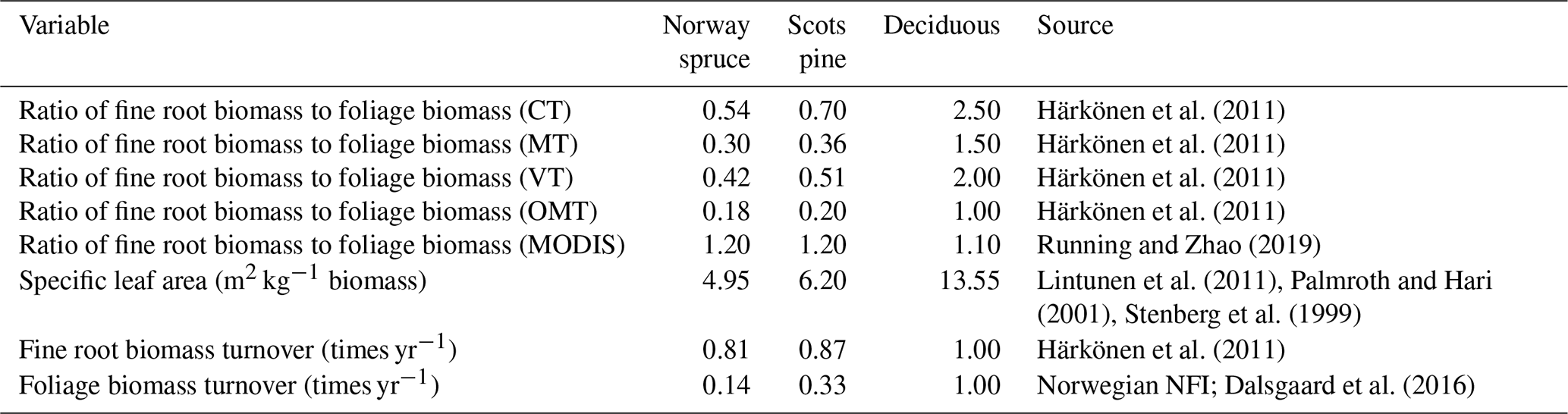
Fine root production was calculated by multiplying fine root biomass with tree species-specific turnover rates (times yr−1) of fine roots from Härkönen et al. (2011). Specifically, 0.81 for spruce, 0.87 for pine, and 1.0 for deciduous trees, independent of vegetation type. We evaluated the reliability of our estimates by comparison with biomass and production values reported in the boreal fine root meta-analysis of Yuan and Chen (2010). Residuals were calculated as the differences between our predicted biomass and production for forests dominated by Norway spruce, Scots pine, and birch, and the corresponding values for Picea, Pinus, and Betula in the meta-analysis. Reported biomass values (g m−2) were 2.78, 2.52, and 4.15 for Picea, Pinus, and Betula, respectively, while reported production values (g m−2 yr−1) were 1.80, 2.80, and 1.85. We assumed a C fraction of 0.5 to express biomass (g C m−2) and production (g C m−2 yr−1) in units of C, in accordance with our data.
To quantify the combined deviation from the meta-analysis by Yuan and Chen (2010), we squared the biomass and production residuals and summed them. Residuals were squared to ensure all values were positive and to reflect a combined measure of deviation across both parameters. A square root transformation was done to rescale the summed residuals to the original units of the respective variables. The fine-root-to-foliage biomass ratios that minimized the combined residuals were used in subsequent NPP calculations: 0.30 for spruce, 0.70 for pine, and 1.10 for deciduous (birch).
2.4 Biomass and production of understory plants
To estimate understory vegetation production, we followed the Norwegian GHG accounting methodology. Specifically, biomass values for understory plant components were sourced from the GHG accounting lookup table (Table S1 in the Supplement). This table provides detailed information on vegetation biomass (kg ha−1) across various understory components (mosses, lichens, herbaceous plant, and shrubs), forest types (spruce, pine, and deciduous-dominated forests) and age classes. To estimate production, we multiplied the biomass values by turnover rates specific to each understory component (Table S2; Dalsgaard et al., 2016). Production was converted to units of C by assuming a biomass C fraction of 0.5. After conversions, the final expressed understory NPP in g C m−2 yr−1.
2.5 Net primary production and gross primary production
The estimated tree NPP, fine root NPP and understory NPP, were summed to represent total NPP (g C m−2 yr−1), hereafter referred to as SR16-based NPP. Both SR16-based NPP and MODIS Euro NPP were used in the calculation of GPP (g C m−2 yr−1), to assess sensitivity to the choice of NPP source. We employed a C balance framework conceptually consistent with the MOD17 algorithm, but with modifications. The MOD17 algorithm estimates GPP using a light-use efficiency model and subsequently derives NPP by subtracting autotrophic respiration (Ra). Ra is estimated using a combination of biome-specific parameters from the Biome Property Look-Up Tables (BPLUT) and temperature- and biomass-dependent functions. In contrast, our approach reconstructs GPP from independently estimated NPP and Ra components. The C balance relationship is expressed as:
where GPP represents the total C captured via photosynthesis and is equal to the sum of NPP and autotrophic respiration (Ra). Autotrophic respiration consists of growth respiration (Rg) and maintenance respiration (Rm), defined as:
Growth respiration (Rg) represents the energy required to synthesize organic compounds during photosynthesis. In the MODIS algorithm, Rg is empirically parameterized as 25 % of NPP (Cannell and Thornley, 2000; Ryan, 1991). We applied this parameterization by setting Rg to 25 % of tree NPP, understory NPP, and fine root NPP, thereby yielding Rg values for each respective component. Maintenance respiration (Rm) represents the energy required to sustain basic cellular functions, such as cell integrity, tissue repair, and essential processes like ion transport, and is calculated as:
where foliage-Rm, f.root-Rm, and wood-Rm represent the maintenance respiration of foliage biomass, fine roots, and living wood, respectively. Each Rm component is calculated as the product of biomass, a base respiration rate per unit biomass (reflecting C maintenance costs), and a Q10 parameter, which adjusts respiration according to temperature (°C). For instance, foliage-Rm can be expressed as:
Maintenance respiration is calculated similarly for foliage, fine roots, and living wood. For living wood, biomass is estimated indirectly based on foliage biomass by applying livewood-to-foliage ratios. For evergreen needleleaf forests (ENF), this ratio is 1.2; for deciduous broadleaf forests (DBF), it is 1.1. Since the equations from Eid et al. (2016) provide estimates of total wood volume rather than living wood, we applied the same ENF and DBF foliage-to-wood ratios to estimate living wood biomass in needle-leaved (spruce and pine) forest and deciduous (birch) forests accordingly. Q10 is set to 2.0 for both living wood and fine roots (adopting Q10 values from BPLUT), while for foliage biomass it is calculated using a temperature-dependent Q10 equation from Tjoelker et al. (2001):
After estimating NPP and Rm, GPP was calculated for the three fine root NPP estimation methods (foliage-based, scaled SR16 LAI, and MODIS LAI) as:
Note that NPP is multiplied by 1.25 to consider Rg in addition to NPP (Cannell and Thornley, 2000; Ryan, 1991). Values of GPP were related to NPP to provide ratios of , also known as carbon use efficiency (CUE). Additionally, the fraction of C allocated to fine roots was calculated as:
Variation in NPP, GPP, and CUE was related to forest age using Locally Estimated Scatterplot Smoothing (LOESS) regression, which was applied to capture non-linear age-related patterns without imposing a predefined functional form. NPP values derived from the SR16 dataset was correlated against MODIS Euro NPP. A flowchart overview of the methodological framework of this study is provided in Fig. S1 in the Supplement.
3.1 Fine root biomass and production
Fine root biomass and production were estimated using two general approaches, for three different methods: (1) the foliage-based method, (2) the MODIS LAI-based method, and (3) the scaled SR16 LAI-based method derived from allometric equations. These estimates were evaluated against values reported in the fine root meta-analysis by Yuan and Chen (2010).
For Norway spruce, the lowest residual biases for both biomass (g C m−2) and production (g C m−2 yr−1) across all three methods, were obtained when applying a fine-root-to-foliage biomass ratio of 0.42, representative of Vaccinium-type vegetation. The average root-mean-squared residuals (RMSRs) were 24.7 for biomass and 10.9 for production (Fig. 1). The combined total residual, calculated as the square root of the sum of squared residuals for biomass and production, was also lowest for Myrtillus-type vegetation.
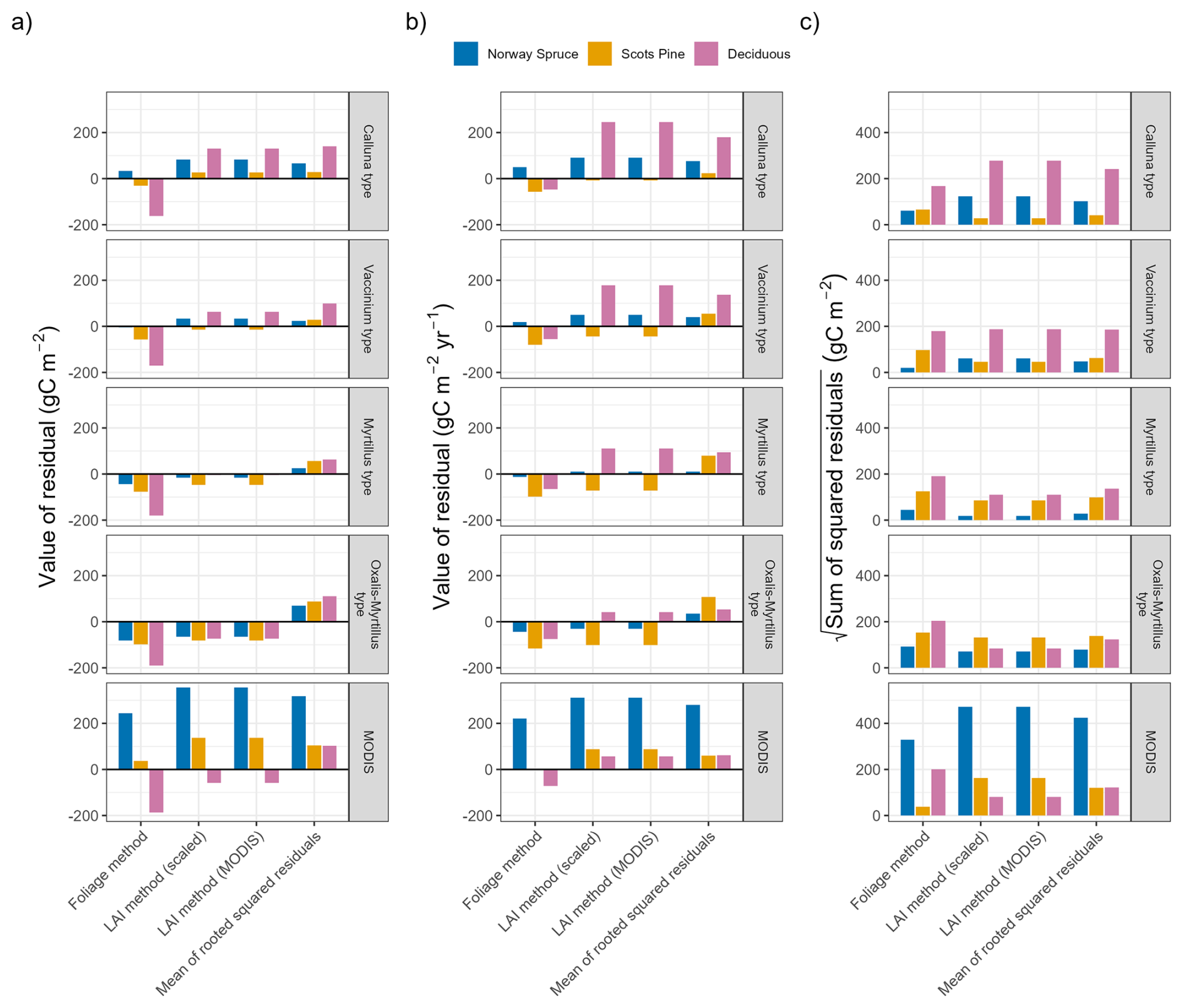
Figure 1Residuals for estimated fine root biomass (a) and production (b), and the combined residuals of biomass and production (c) in Norwegian forests dominated by Norway spruce, Scots pine, or deciduous trees (primarily Betula spp.). Residual are calculated based on the difference between fine root estimates in the meta-analysis by Yuan and Chen (2010) and our values of fine root biomass and production, derived from three different methods for estimating foliage biomass and related fine root biomass and production. The vegetation types represent a gradient from dry, nutrient-poor sites (Calluna type) to moist, nutrient-rich sites (Oxalis-Myrtillus type).
For Scots pine, the lowest residuals were found with a fine-root-to-foliage biomass ratio of 0.7, assumed for Calluna-type vegetation. The RMSRs were 28.4 for biomass and 23.8 for production (Fig. 1), with the combined total residual again being lowest for Calluna-type vegetation.
For deciduous (birch) forest, the lowest biomass residuals (63.4 g C m−2) were obtained with a fine-root-to-foliage biomass ratio of 2.0, assumed for Vaccinium-type vegetation. However, for production, the lowest residual (53.1 g C m−2 yr−1) occurred with a ratio of 1.0, representative of Oxalis-Myrtillus-type vegetation. Despite the lowest residuals being associated with Vaccinium-type and Oxalis-Myrtillus-type vegetation, large discrepancies across methods for estimating fine root biomass and production were observed (Fig. 2). Consequently, the lowest combined total residual for both biomass and production was obtained with a ratio of 1.1, corresponding to the fine-root-to-foliage ratio for DBF listed in the MODIS BPLUT.
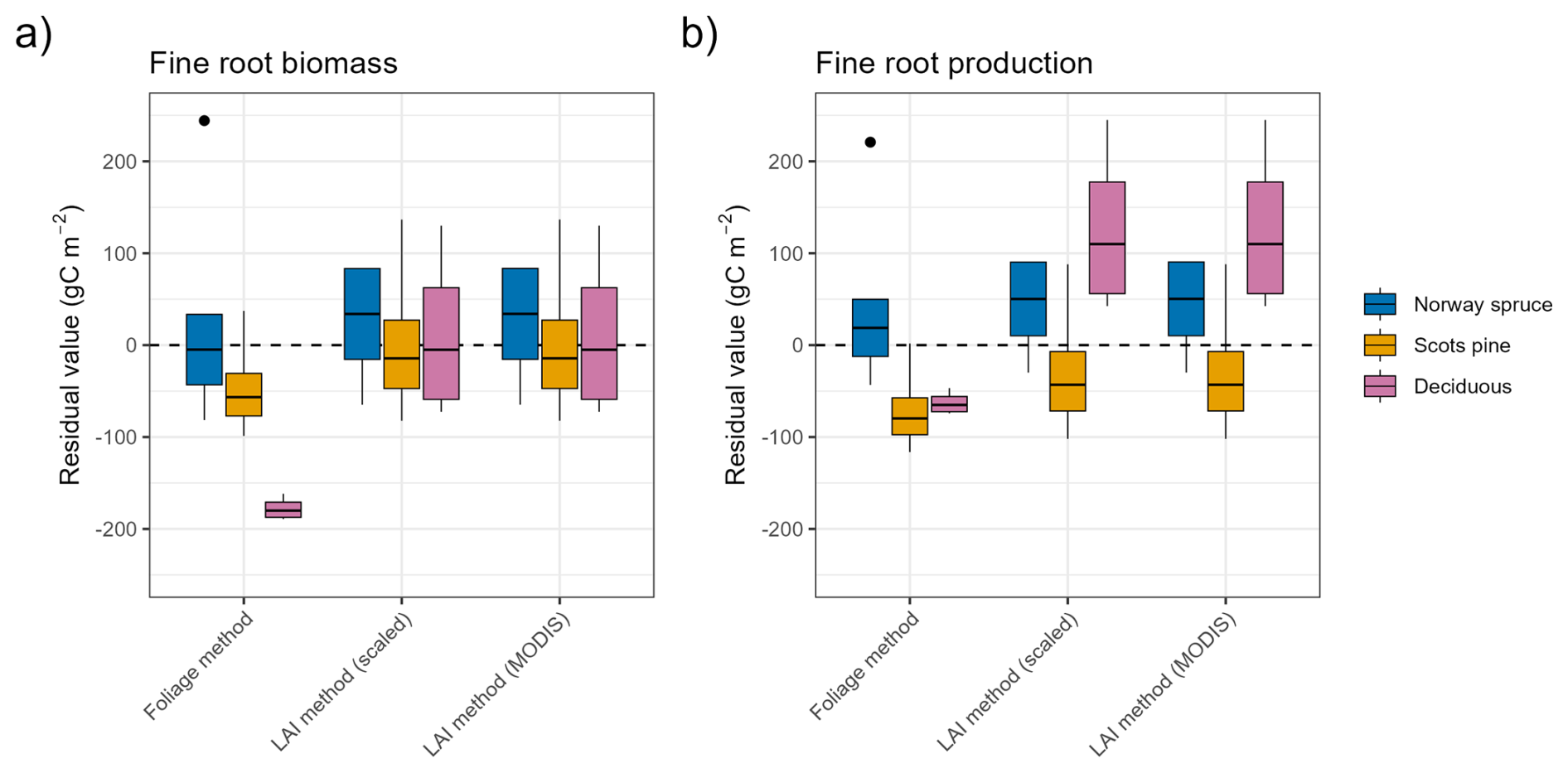
Figure 2Residuals for fine root biomass (a) and annual fine root production (b) across tree species and methods for estimating foliage biomass and related fine root biomass and production. For each species, five fine-root-to-foliage biomass ratios were assumed (Table 1). The foliage-based method used allometric foliage biomass, while the two LAI-based methods estimate foliage biomass from LAU and specific leaf area. LAI data were obtained from MODIS (MODIS LAI) or from optically scaled SR16 values (SR16 LAI). Each boxplot shows the interquartile range (Q1–Q3), with whiskers extending to the smallest and largest values within 1.5 × IQR from Q1 and Q3.
For fine root biomass, the foliage-based method consistently underestimated biomass across all species, with median residuals (g C m−2) of −4.9 for Norway spruce, −56.6 for Scots pine, and −180.0 for deciduous forests. In contrast, the LAI-based methods (MODIS LAI and scaled SR16 LAI) generally overestimated biomass for forests of Norway spruce (+33.9) but underestimated it for Scots pine (−14.4) and deciduous forests (−5.0).
For fine root production, the foliage-based method provided estimates closest to those reported by Yuan and Chen (2010) for spruce, with a median residual of +18.8 (g C m−2 yr−1). However, this method underestimated production for pine and deciduous forests, with median residuals of −79.8 and −65.1, respectively. The LAI-based methods overestimated production for spruce (+50.2) and birch (+110), but underestimated production for pine (−71.6) (Fig. 2).
3.2 SR16-based NPP compared to MODIS Euro NPP
Across all tree species, SR16-based annual tree NPP represented ∼17 % of the total annual MODIS NPP and ranged from 1–200 g C m−2. In comparison, MODIS Euro NPP values ranged from 169–614 g C m−2 for spruce, 89–673 g C m−2 for pine, and 63–635 g C m−2 for deciduous forests. SR16-derived NPP ranged from 40–531 g C m−2 yr−1 for Norway spruce, 57.4–602 g C m−2 yr−1 for Scots pine, and 19.3 to 603 g C m−2 yr−1 for deciduous forests, with means of 278, 311, and 248 g C m−2 yr−1, respectively (Fig. 3). Across all forest types, MODIS annual NPP averaged 428 g C m−2.
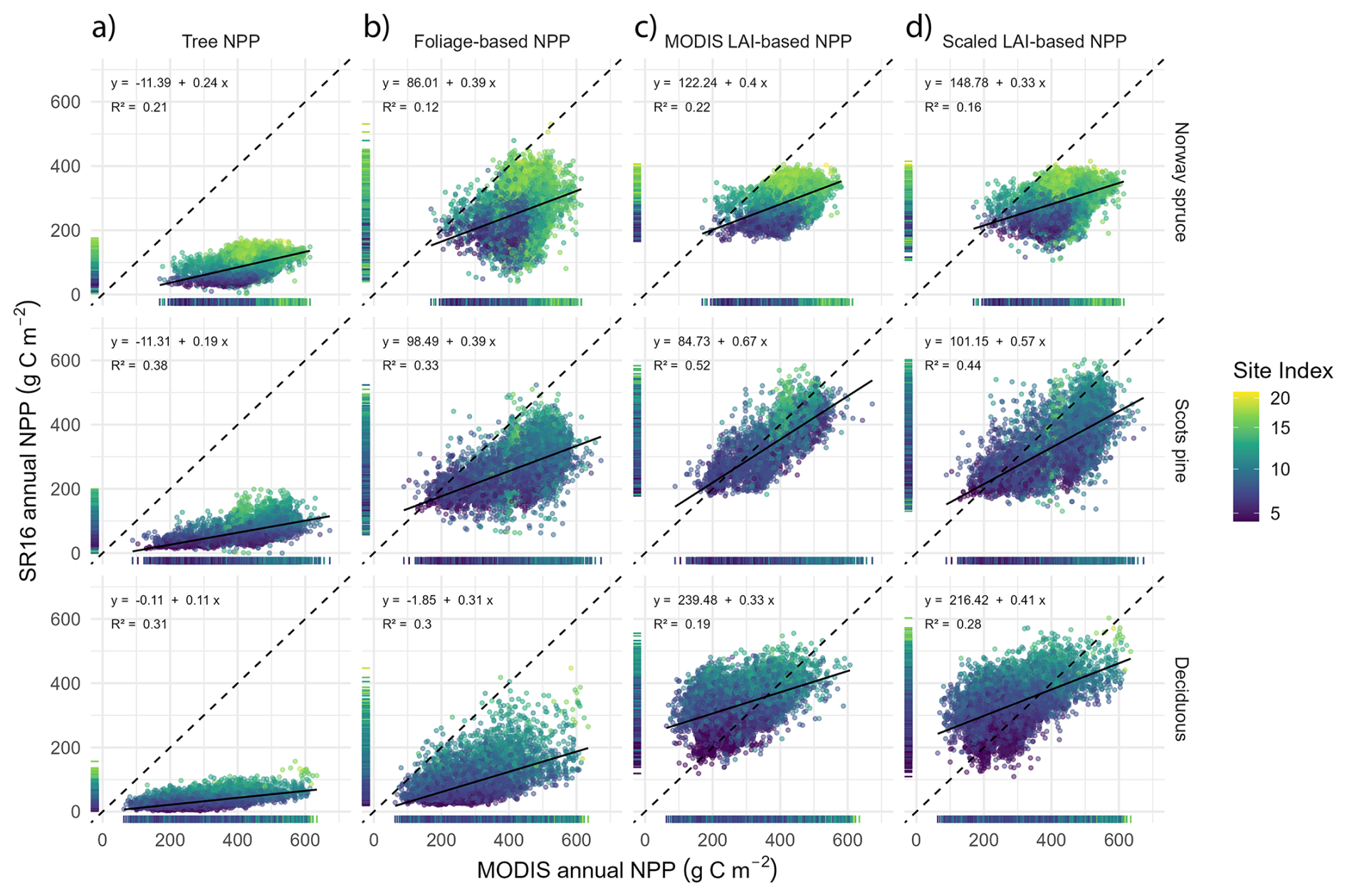
Figure 3Relationships between tree NPP (column a) and total NPP (columns b–d) derived from different methods for estimating foliage biomass, and associated fine root biomass and production, compared with MODIS Euro NPP, for forests dominated by Norway spruce, Scots pine, or deciduous trees (primarily Betula spp.). All values are based on species-specific fine-root-to-foliage biomass ratios. The foliage-based method uses allometric estimates of foliage biomass, while the two LAI-based methods derive biomass from LAI and specific leaf area. Column (c) incorporates LAI from MODIS, and column (d) uses LAI from the Norwegian forest resources map, SR16, scaled using quantile mapping to match MODIS optical LAI. The colour gradient represents site index (a proxy for site fertility). Vertical and horizontal bars along the axes show the distribution of site index values. All site index values are log10-transformed.
Depending on the method used to estimate fine roots, SR16 NPP represented on average 52 % of MODIS NPP for the foliage-based approach and 84 %–86 % for the LAI-based approaches across all forest types (Fig. 3). Linear regressions between total SR16-based NPP and MODIS Euro NPP revealed varying correlations across tree species and methods. For Norway spruce, R2 values ranged from 0.12 (foliage-based method) to 0.22 (MODIS LAI-based method), with slopes between 0.33 to 0.40. The SR16-derived NPP was consistently lower, representing 59 %–68 % of MODIS NPP.
For Scots pine, R2 values ranged from 0.33 (foliage-based) to 0.52 (MODIS LAI-based), with slopes from 0.39–0.67. The MODIS LAI-based method produced the slope closest to 1, indicating the least degree of deviation. As with Norway spruce, SR16-derived NPP for Scots pine was lower than MODIS, accounting for 59 %–68 % of MODIS NPP.
For deciduous forests, R2 values ranged from 0.30 (foliage-based) to 0.19 (MODIS LAI-based), with slopes between 0.31 and 0.41. The SR16-derived NPP exhibited large variability, representing 31 %–117 % of MODIS NPP. This variation was influenced by the fine root estimation method, with the foliage-based approach resulting in lower SR16 NPP, whereas the LAI-based methods yielded higher estimates.
3.3 NPP and GPP relative to forest age
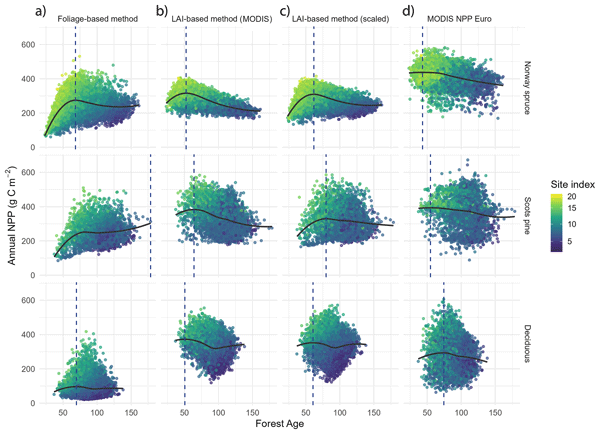
NPP variation across forest age was assessed using LOESS regression, revealing that NPP increased to a peak during mid-succession and then declined. The rate of increase and subsequent decline varied depending on the method used to estimate fine root biomass and production. Peak NPP ages for each species and method are summarized in Table 2. For Norway spruce, peak NPP occurred between 52–68 years, for Scots pine between 64–80 years (LAI-based methods), and for deciduous forests between 51–70 years, with corresponding peak NPP values of 300, 339, and 274 g C m−2 yr−1, respectively. Age-related variation in NPP was strongest in spruce-dominated forests, weaker in pine forests, and not apparent in deciduous stands (Fig. 4). MODIS Euro NPP showed only weak age-related variation, with peak values at 43 years (spruce), 55 years (pine), and 74 years (deciduous), and corresponding NPP values of 437, 394, and 293 g C m−2 yr−1. Large discrepancies in estimated NPP were evident for deciduous forests, with the foliage-based method estimating an average NPP of 87 g C m−2 yr−1, while the two LAI-based methods produced an average NPP of 332 g C m−2 yr−1 (Fig. 4).
Table 2Forest age at maximum NPP and associated values for different species and fine root estimation approaches.
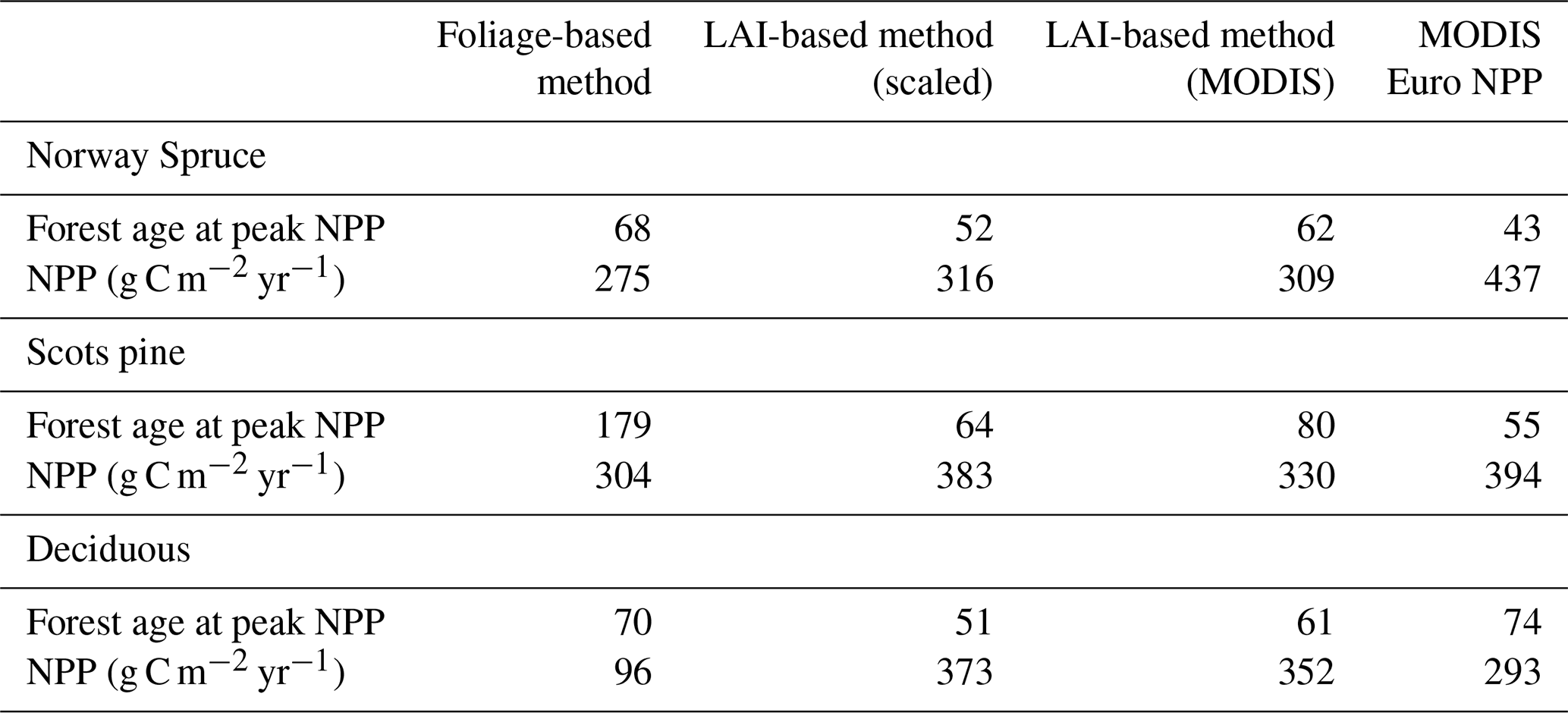
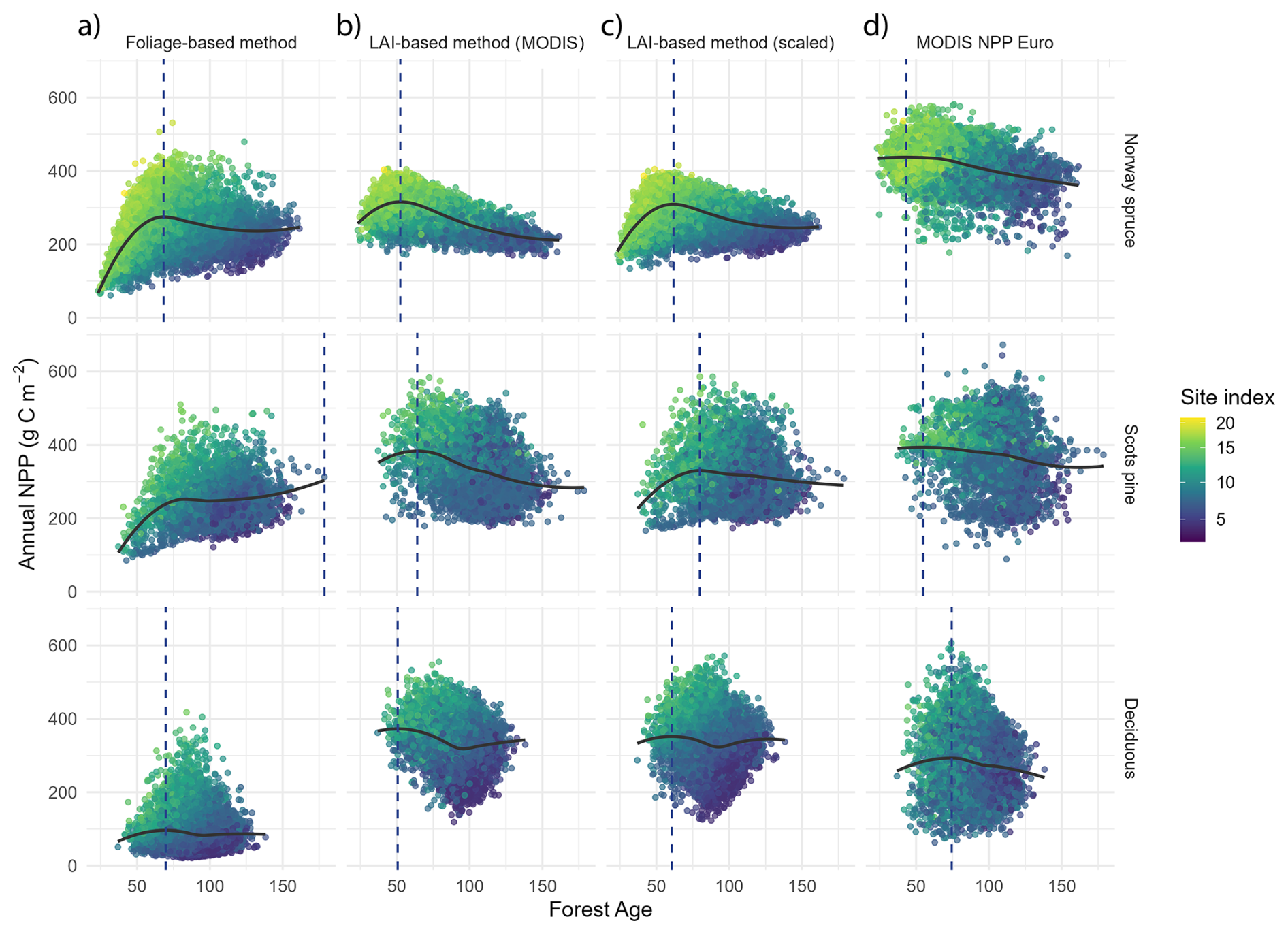
Figure 4Relationships between total annual net primary production (NPP) and forest age across Norwegian forest areas dominated by Norway spruce, Scots pine, or deciduous trees (primarily Betula spp.). Panels (a)–(c) show NPP based on the Norwegian Forest Resources SR16 raster using three fine root estimation approaches: foliage-based method (a; using allometric estimates of foliage biomass) and two LAI-based methods (b; MODIS LAI and c; optically scaled SR16 LAI). Panel (d) shows MODIS Euro NPP as a function of forest age. Solid lines represent LOESS (Locally Estimated Scatterplot Smoothing) regressions of the development of NPP with forest age. Dashed vertical line marks the maximum NPP from the regression fit. The colour gradient reflects site index (fertility), with values log10-transformed.
GPP ranged from 146–1569 g C m−2 yr−1 for Norway spruce, 227–1300 g C m−2 yr−1 for Scots pine, and 60–1054 g C m−2 yr−1 for deciduous forests, with means of 677, 685, and 442 g C m−2 yr−1, respectively (Fig. S2). Similar to NPP, GPP increased with forest age until mid-succession peak (Fig. S2) and then declined (Norway spruce) or stabilised (Scots pine). No clear age-related variation in GPP was observed for deciduous (birch) forests.
3.4 Forest carbon use efficiency
The ratio of NPP to GPP (CUE) decreased with increasing forest age in both Norway spruce and Scots pine forests. According to the power-law fit, CUE declined from a maximum of 0.57 to a minimum of 0.37 in Norway spruce forests, and from a maximum of 0.57 to a minimum of 0.42 in Scots pine forests (Fig. 5). The corresponding CUE values, derived from the median of the density distribution, ranged from 0.43–0.52 for Norway spruce and from 0.44–0.49 for Scots pine, depending on the fine root production estimation method and whether MODIS data were used (Fig. 6). In contrast, the power-law fit for deciduous forests did not indicate an age-related decline in CUE (Fig. 5). However, the variability in CUE estimates for deciduous forests was similar to that observed in Norway spruce and Scots pine forests (Fig. 6). According to the power law fit, CUE in deciduous forests ranged from 0.48–0.62 across various forest ages, generally higher than values estimated for Norway spruce and Scots pine (Figs. 5, 6).
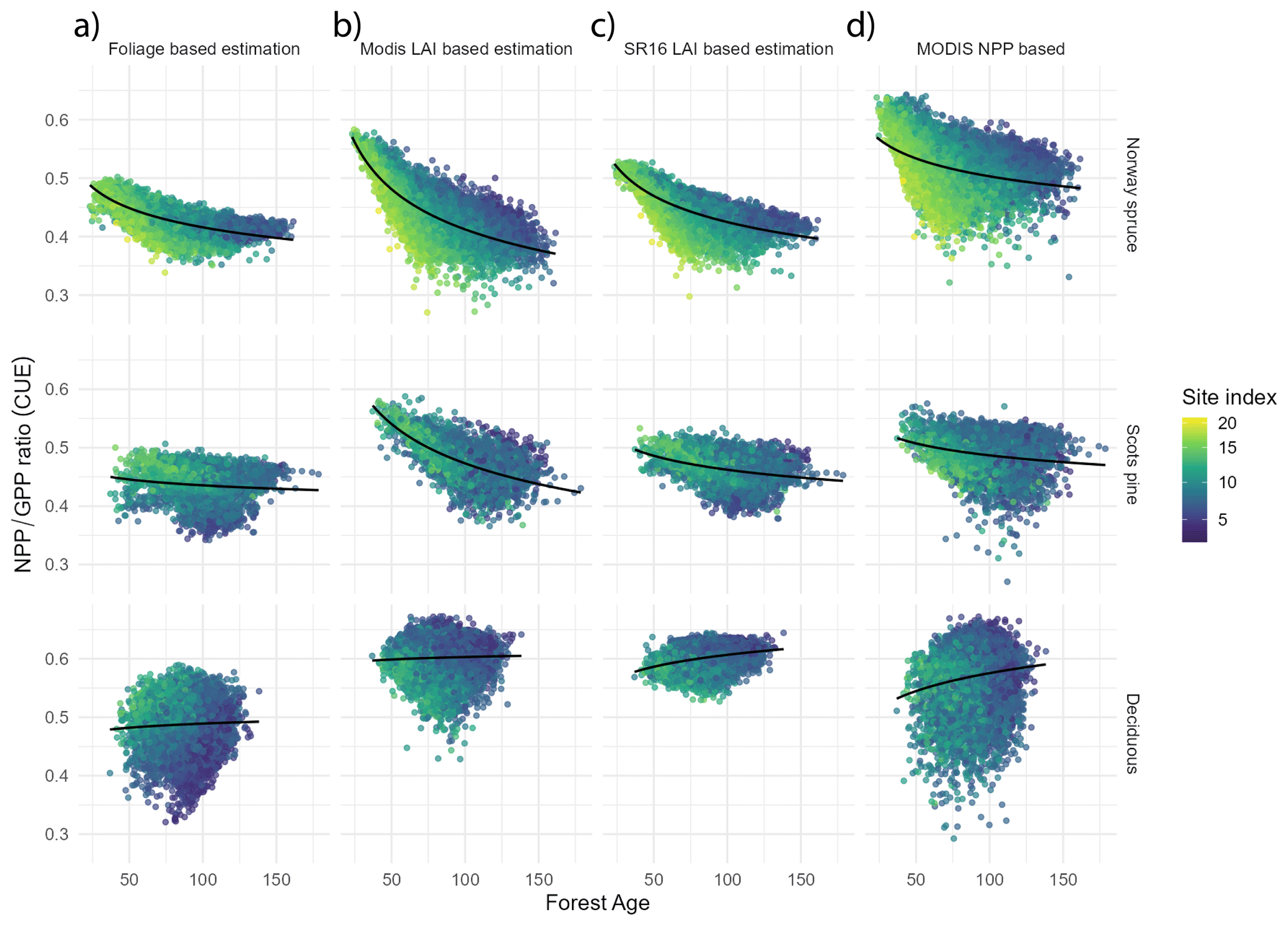
Figure 5Relationships between the ratio of net primary production (NPP) to gross primary production (GPP) and forest age in Norwegian forest areas dominated by Norway spruce, Scots pine, or deciduous trees (primarily Betula spp.). The ratio reflects carbon use efficiency (CUE) of the forest, indicating the proportion of C fixed by photosynthesis that is converted into biomass. Panels (a)–(c) show CUE derived from SR16 NPP, using three fine root estimation methods (foliage-based, MODIS LAI-based, and SR16 LAI-based). Panel (b) uses LAI data from MODIS, while panel (c) uses LAI data from the Norwegian Forest Resources Map SR16 scaled to optical LAI. Column (d) shows MODIS NPP-based CUE estimation, whereas SR16 data is used for biomass estimation in all GPP calculations for ecosystem respiration. Solid lines represent a power-law function fitted to the data, showing CUE development with forest age. Point colours reflect site index (fertility), with site index values log10-transformed.
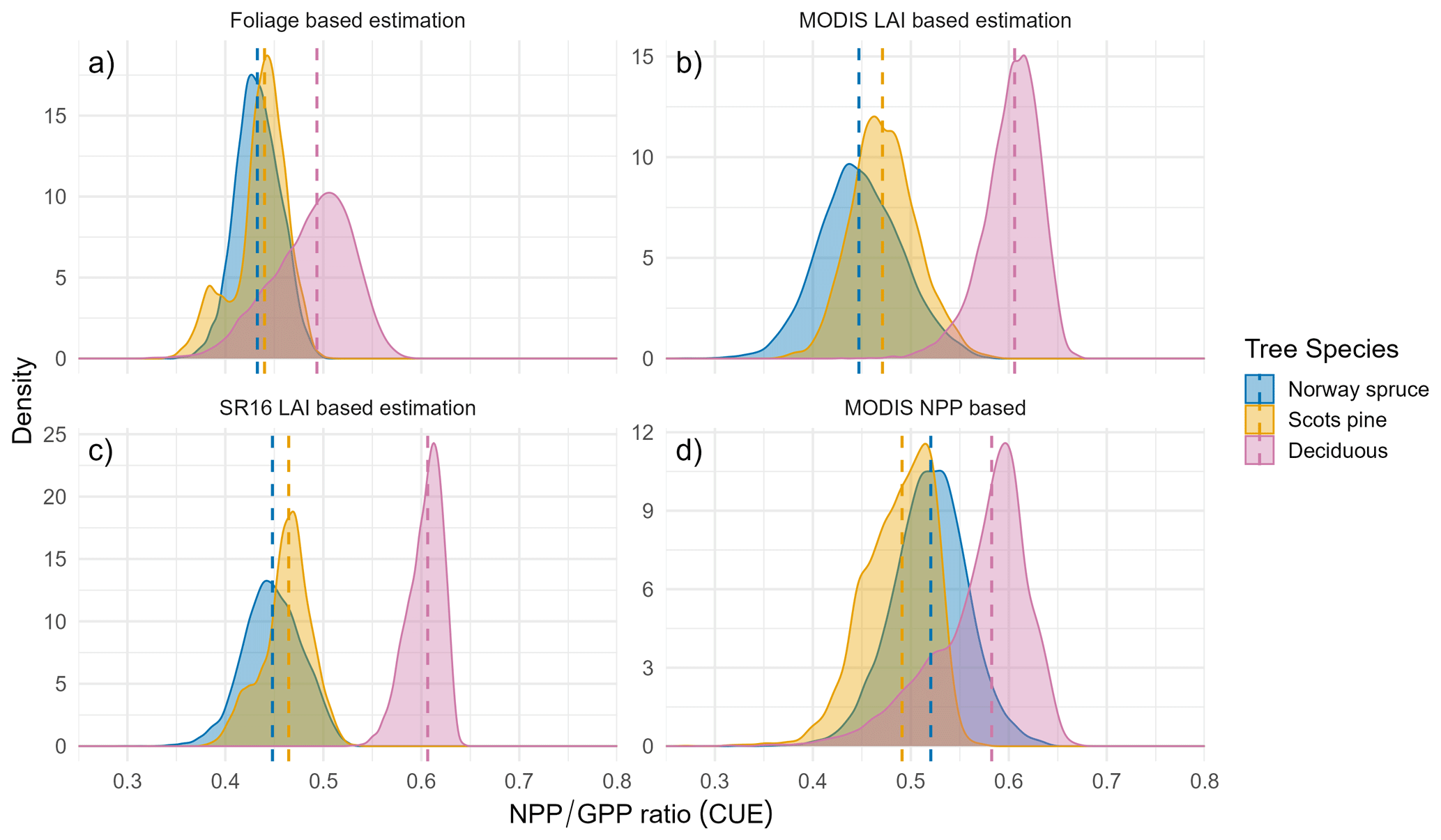
Figure 6Density distribution of the ratio of net primary production (NPP) to gross primary production (GPP), estimated using different methods for determining fine root production. Panel (a) shows CUE based on the foliage-based method using allometric estimates of foliage biomass. Panels (b) and (c) show CUE derived from LAI-based methods, either using LAI from MODIS (b) or SR16 (c) scaled from allometric to optical LAI. Panel (d) represent the CUE distribution adopting European MODIS data but SR16 data for estimating ecosystem respiration in the GPP calculations. Dashed lines represent the medians of the CUE density distributions for the different tree species.
3.5 Allocation of carbon to fine roots
The estimated fraction of GPP allocated to fine roots varied across forests dominated by Norway spruce, Scots pine, and deciduous trees, and was influenced by the method used to assess fine root production (Fig. S3). For Norway spruce, median allocation ranged from 0.25–0.31, for Scots pine from 0.26–0.34, and for deciduous forests from 0.19–0.54. Deciduous forests showed the largest variability and generally higher allocation to fine roots, reflecting their greater estimated fine root production (Figs. 1b, 2b).
Quantifying the contribution of fine roots to the ecosystem C cycle remains a major challenge and a key source of uncertainty in forest C modelling. This study provides a quantitative assessment of how uncertainty in fine root representation propagates into estimates of NPP and CUE by comparing multiple modelling approaches across Norwegian boreal and nemo-boreal forests. When considering only tree growth (annual increment in tree biomass + foliage production), SR16-derived tree NPP represented on average 16 % of MODIS NPP. Including the production of understory vegetation and fine roots increased SR16 total NPP to an average of 52 %–86 % of MODIS NPP, depending on the method used to estimate fine root production, with the two LAI-based approaches yielding the highest NPP contributions. These results demonstrate that regional estimates of forest C fluxes are highly sensitive to assumptions about fine root dynamics, highlighting the need for explicit representation of belowground processes in large-scale forest C assessments.
4.1 NPP and GPP of Norwegian forests
Forest age-related variation in NPP is well documented, and it is a universal phenomenon that NPP rapidly increases until mid-succession and thereafter decreases with increasing forest age (Gower et al., 1996; Ryan et al., 1997a; Tang et al., 2014). The increase in NPP during early stand development is largely driven by enhanced photosynthetic capacity associated with expanding leaf area (Ryan et al., 1997a; Yan et al., 2006). Following mid-succession, declining NPP is commonly attributed to shifts in C allocation and respiratory costs, along with increasing hydraulic constraints and nutrient limitations as stands age (Anderson-Teixeira et al., 2021; Chen et al., 2002; Ryan et al., 1997a; Tang et al., 2014).
In contrast to this expected trajectory, NPP derived from MODIS Euro did not show the initial increase with forest age until mid-succession. Instead, MODIS NPP remained consistently high in young forests and decreased with increasing forest age. When forest NPP was estimated using SR16 data, however, clear age-related patterns emerged, particularly in forests dominated by Norway spruce. Peak NPP occurred between 50 and 70 years of age, with values ranging from 280–320 g C m−2, depending on the method used to assess fine root production.
Scots pine-dominated forests exhibited a similar age-related pattern, although the increase in NPP during early succession was less clear than in Norway spruce forests. Peak NPP was estimated across a broader range of ages (64–109 years), with values between 300 and 380 g C m−2 yr−1. When fine root biomass was estimated using foliage biomass, NPP increased until mid-succession (around 60 years), after which it continued to increase but at a slower rate compared to early succession.
Deciduous forests, in contrast, did not exhibit clear age-related variations in NPP. However, maximum NPP was observed at 50–70 years, similar to Norway spruce and Scots pine forests. Unlike coniferous forests, the method for deciduous used to estimate fine root production had a large impact on the calculated NPP, due to the wide variation in estimated fine root production. Specifically, peak NPP ranged from 96–373 g C m−2 yr−1, with the two LAI-based methods yielding values more than three times higher than those obtained using the foliage-based approach.
According to the meta-analysis by Yuan and Chen (2010), the average fine root production in boreal Betula spp. forests (n=19) is 92.5 g C m−2 yr−1. Based on the foliage-based method for fine root, the residuals ranged from −74.2 to −46.8, corresponding to fine root production estimates of 18–45.7 g C m−2 yr−1. In comparison, using LAI-based methods, residuals ranged from 42.5–245.0, corresponding to annual fine root production estimates of 135.0–337.5 g C m−2 yr−1. This broad range reflects a large uncertainty in fine root estimation for deciduous forests and may partially be attributed to the uncertainty (R2=0.57; Eid et al., 2016) associated with the foliage biomass function for birch dominated forests. However, the estimates from Yuan and Chen (2010), derived from Betulaceae forest are based on a limited number of sites, and fine root dynamics in such forest remains understudied particularly in the hemi-boreal and boreal zone (Finér et al., 2011; Hansson et al., 2013; Ostonen et al., 2017; Varik et al., 2015). Ding et al. (2019) reported that belowground litter C input in northern boreal birch forests was 1.7 times higher than aboveground inputs, suggesting that fine root contributions likely dominate the soil C input in birch stands. The LAI-based method for estimating fine root production appears to align with this observation, in contrast to the foliage-based approach, which yielded lower estimates of fine root production.
4.2 SR16-based NPP relative to external sources
Global estimates of NPP from the ForC database show that young (<100 years) boreal forests have an average NPP of 372 g C m−2 yr−1, while mature (>100 years) forests have a lower values averaging 270 g C m−2 yr−1 (Anderson-Teixeira et al., 2021). In comparison, SR16-derived NPP for young forests averaged 285, 318, and 248 g C m−2 yr−1 for Norway spruce, Scots pine, and deciduous forests, respectively. For mature forests, the corresponding SR16-based NPP values were 243, 306, and 249 g C m−2 yr−1.
Overall, SR16-based NPP followed the same general pattern as the ForC database, with higher NPP in young forests compared to mature forests. However, absolute values were generally lower than the global averages, with the exception of mature Scots pine forests, which exhibited higher average NPP than reported in the ForC dataset.
A similar pattern was observed for GPP. Global ForC estimates indicate average GPP values of 835 g C m−2 yr−1 for young boreal forests and 758 g C m−2 yr−1 for mature forests (Anderson-Teixeira et al., 2021). In comparison, SR16-based GPP estimates for young forests averaged 638, 659 and 429 g C m−2 yr−1 for Norway spruce, Scots pine, and deciduous forests, respectively. For mature forests, mean GPP values were 587, 656 and 422 g C m−2 yr−1. Thus, SR16-based GPP estimates point to similar age-related trends but are consistently lower than the global averages.
Moreover, large discrepancies in NPP and GPP estimates for deciduous forests were observed between the foliage-based and LAI-based approaches. The foliage-based method produced NPP estimates that were, on average, only 26 % of those derived from the LAI-based methods, primarily due to lower estimates of foliage biomass and fine root production. This highlights the sensitivity of NPP estimates to assumptions regarding foliage and fine root allocation in deciduous forests. It is also important to note that NPP values in Nordic forests tend to be at the lower end of the range for global boreal forests (Gower et al., 2001), and that external NPP observations are relatively limited for Nordic forests compared with other boreal and temperate regions (Anderson-Teixeira et al., 2021). However, the lack of a direct 1:1 correlation between MODIS Euro NPP and our SR16-based NPP estimates likely stem from model uncertainties and underestimation of certain NPP component, both yielding prediction biases.
MODIS Euro NPP is derived from the global MODIS NPP product but incorporates downscaled European climate data, providing more realistic NPP estimates that align closely with European NFI data (Neumann et al., 2016), including Norwegian NFI data. Nevertheless, MODIS Euro may overestimate NPP in areas with inherently low NPP (∼400 g C m−2 yr−1), which could partly explain the generally lower SR16-based NPP values.
Despite the generally lower NPP and GPP values in our analysis, the SR16-based NPP and GPP estimates remain of the same order of magnitude as those reported in external datasets (Anderson-Teixeira et al., 2021; Gower et al., 2001). Yet, discrepancies between the SR16-based NPP estimates and global NPP datasets may arise from variations in climate, forest structure (e.g., differences in stand age distributions), and forest management practices. For example, areas with a high frequency of logging or clearcutting could still be present and may potentially contribute to lower SR16-derived NPP estimates compared to MODIS Euro. Finally, while the Eid et al. (2016) model was developed to estimate stand-level biomass of Norwegian forests, it has some predictive biases, particularly in forested areas of western and northern Norway, where it tends to underestimate biomass. This bias may also contribute to explaining the overall low estimated NPP.
4.3 Carbon use efficiency of Norwegian forests
According to the power-law fits, the ratio (CUE) in Norwegian forests ranged from a maximum of 0.63 to a minimum of 0.37, consistent with our hypothesis that CUE falls within the theoretical limits of 0.2–0.75 proposed by Amthor (2000), based on calculations of growth- and maintenance respiration costs. Moreover, CUE declined with increasing forest age, consistent with observations by De Lucia et al. (2007) and Piao et al. (2010), and reflecting that early-succession forests fix more atmospheric CO2 relative to their uptake than late-succession forests. In addition to forest age, CUE variation according to tree species was observed. Scots pine-dominated forests displayed CUE values ranging from 0.42 to 0.57, while Norway spruce forests showed a broader range of 0.37–0.57. The highest CUE was observed in deciduous forests (0.48–0.62), although this result is confounded by large uncertainties related to fine-root production predictions. Additionally, the estimates were consistent with the empirical CUE range of 0.22 to 0.54 derived from boreal forests (Malhi et al., 1999; Ryan et al., 1997b; Turner et al., 2003) and summarized by De Lucia et al. (2007), with an average CUE of 0.32.
Global MODIS-based estimates from Zhang et al. (2014) reported mean CUE values of 0.59 for evergreen needle-leaf forests and 0.47 for deciduous broadleaf forests in the Northern Hemisphere. Expanding beyond MODIS data, Jin et al. (2025) used FLUXNET eddy-covariance measurements and reported a CUE range of 0.46–0.67 for continental evergreen needle-leaf forests across Canada, Finland, and Russia, with an average of 0.57. In comparison, the median of our CUE estimates ranged from 0.43–0.52 for Norway spruce forests, 0.41–0.49 for Scots pine forests, and from 0.49–0.61 for deciduous (birch) forests. When compared with the CUE ranges reported by Zhang et al. (2014) and Jin et al. (2025), our CUE estimates are generally lower, especially for Norway spruce and Scots pine forests.
Norwegian forests span a wide range of ecological conditions, extending from the temperate zone in the south to the Arctic zone in the north, and includes strong gradients in both temperature and precipitation. Previous work highlights large spatial variation on CUE globally and concluded that CUE is largely driven by variations in vegetation type (Bradford and Crowther, 2013; Zhang et al., 2009), soil fertility (Vicca et al., 2012; Zhang et al., 2019), temperature (Piao et al., 2010) and as well as precipitation and hydrology (Chen and Yu, 2019), with Zhang et al. (2009) reporting declining vegetation CUE with increasing annual precipitation until it reaches a threshold of 2000–2500 mm, after which it remains stable.
Global studies have documented a parabolic relationship between precipitation, temperature, and CUE (Chen and Yu, 2019; Jin et al., 2025; Piao et al., 2010). Specifically, CUE increases with air temperature between 5 and 25 °C but declines when precipitation exceeds about 500 mm, possibly attributed to increased cloudiness that leads to reduced solar radiation (Zhang et al., 2009). In this study, the SR16 dataset showed an average annual precipitation of 1092 mm (range: 326–4434 mm, median 983 mm) and a mean temperature of 2.8 °C (range: −2.0 to 8.4 °C, median 2.8 °C), as shown in the precipitation and temperature density distribution plots of the resampled SR16 data (Fig. S4). Potentially, variation in temperature combined with both extreme high and low precipitation contribute to the generally lower CUE estimates observed in this study. However, disentangling these effects is difficult due to the multiple interacting factors influencing CUE (Jin et al., 2025). Additionally, climatic factors also strongly influenced tree species distributions in our analysis. Scots pine and deciduous forests were most prevalent under the driest and wettest conditions, while Norway spruce dominated areas with intermediate precipitation (∼1000 mm). At temperatures below 0 °C, deciduous forests, primarily birch, were most common, followed by Scots pine. As temperatures increased, Norway spruce became more prevalent, while the warmest conditions again favoured deciduous forests and Scots pine and potential confounding factors, such as tree species-specific variations in NPP, makes it challenging to establish the precise drivers of CUE in our study.
4.4 Methodological limitations
Estimates of CUE are often contentious due to the propagation of uncertainties associated with methods for calculating NPP and GPP (De Lucia et al., 2007; Jin et al., 2025; Vicca et al., 2012). GPP, NPP, and autotrophic respiration (Ra) are linked through C balance relationships and are therefore not independent. Consequently, uncertainties or parameter choices affecting one component propagate to the others, influencing derived CUE estimates. This is particularly relevant for satellite-based GPP products, which are typically derived using light-use efficiency approaches driven by fAPAR and meteorological data (Justice et al., 2002; Running et al., 2004).
Alternative GPP products also exist, including GOSIF-GPP derived from Orbiting Carbon Observatory-2 observations of solar-induced chlorophyll fluorescence (Li and Xiao, 2019), NIRv-GPP based on near-infrared reflectance of vegetation (Badgley et al., 2019), and more recently GPP-net, which is a predictive deep-learning model trained on Sentinel-2 data (Wang et al., 2026). These approaches are less dependent on C-balance closure assumptions and may therefore provide more independent estimates of GPP. Combining such GPP products with MODIS Euro NPP could consequently enable more independent calculations of CUE. However, uncertainty related to transferability and model performance in northern ecosystems remains an important consideration for remote-sensing-based GPP products (Li and Xiao, 2019; Marsh and Zhang, 2022). In the present study, we instead retained a MOD17-consistent framework to enable comparison of respiration and belowground C allocation across the different fine root modelling approaches.
To reduce the interdependence between MODIS-derived NPP and GPP, we incorporated external SR16 forest data into the NPP analyses. However, our GPP estimates still rely on the MOD17 framework, which applies generalized parameterizations to estimate autotrophic respiration from biomass, introducing uncertainty into the estimated GPP and CUE. In addition, the biomass models used in this study exhibit known predictive uncertainties, including underestimation biases in western and northern Norway (Eid et al., 2016), further contributing to uncertainty in the estimated NPP.
Another limitation of our approach is the use of fixed turnover rates for fine roots across forest ages. Fine root turnover, along with mycorrhizal mycelial turnover, decreases with forest age (Hagenbo et al., 2017; Yuan and Chen, 2012), but this dynamic was not accounted for in our approach. Instead, we used fixed turnover rates across forest ages, which constrained our estimates of belowground C allocation. As a result, our model predicted lower CUE under conditions of high fertility, as indicated by site index which is likely incorrect.
Forest CUE generally increases with soil nutrient availability (Zhang et al., 2019), with the effect that trees allocate proportionally more C to aboveground parts in nutrient-rich soil (Vicca et al., 2012) because constraints on belowground nutrient acquisition are alleviated. However, assuming fixed turnover rates creates a linear relationship between foliage biomass and fine root biomass. High foliage biomass directly increases fine root biomass, thereby elevating maintenance respiration. This approach implicitly assumes that variation in fine root dynamics is driven solely by foliage biomass, neglecting shifts in nutrient-mediated belowground C allocation (Vicca et al., 2012). Consequently, the use of fixed turnover rates restricts the modelled variability in belowground allocation and likely explains the relatively narrow range of fine root allocation estimated in this study. Specifically, the interquartile range of the estimated fraction of GPP allocated to fine roots was 0.25–0.31 for Norway spruce, 0.27–0.35 for Scots pine, and 0.34–0.51 for deciduous forests. Likely this natural variability in C allocation is greater. Nevertheless, considering that about 60 % of GPP is allocated belowground in boreal forests (Gill and Finzi, 2016; Litton et al., 2007), our estimates of fine root allocation align with this value when considering additional C allocation to mycorrhizal fungi.
Variation in fine-root-to-foliage biomass ratios across vegetation types can be used to represent fertility-related differences in fine root biomass, with vegetation type serving as a proxy for site fertility. However, as vegetation type is not currently available in the SR16 dataset, we were unable to fully integrate site index and fertility into the analyses, and we therefore treat site index as a descriptive variable. As a result, incomplete representation of fertility means that some of the observed forest age-related patterns may also partly reflect variation in site index, which is linked to both site fertility and likely management-driven differences in stand age structure.
A further limitation is that the datasets used in this study are not temporally aligned. The MODIS Euro NPP data used in this study cover the period 2003–2012 and are therefore temporally aligned with the MODIS LAI (MCD15A2H) data, which were derived from observations over 2003–2013 and averaged to produce a single representative estimate. However, the SR16 forest structure data and associated LAI are based on airborne laser scanning campaigns initiated from 2009 onwards, resulting in a temporal discrepancy between the remote sensing and forest inventory datasets. Consequently, the analysis combines information from different time periods and should be interpreted as a structural comparison among alternative approaches to estimating forest C fluxes, rather than as a temporally explicit C budget for a specific year. Despite this temporal mismatch, the similarity between results derived from the two LAI-based approaches (MODIS and SR16) suggests that its influence is limited relative to the differences between the LAI modelling approaches, likely stemming from the quantile mapping applied to align the SR16 LAI distribution with that of MODIS.
While our analyses integrate data from different time periods, they also do not explicitly represent longer-term temporal responses in respiration. Maintenance respiration was primarily calculated using fixed temperature sensitivities (Q10), consistent with the MOD17 framework. However, experimental evidence suggests that plant respiration can acclimate to sustained warming, reducing its temperature sensitivity over time and thereby dampening the temperature-driven increase in respiration (Reich et al., 2016). Accounting for such acclimation could influence estimates of GPP and CUE and may provide insight into potential responses of forest C cycling to climate warming. However, further empirical work on respiration acclimation across boreal tree species, and its scaling from individual trees to stand and regional levels, is needed to better constrain and evaluate such approaches.
Here we evaluated how three approaches for estimating fine root production affect NPP and CUE estimates in Norwegian forests. The results show that the choice of method has a strong impact on both total NPP and its component fluxes. Excluding fine roots creates a major gap and underestimates total NPP. For example, tree growth alone accounted for just 16 % of MODIS NPP, while including understory and fine root production increased NPP to 52 %–86 % of MODIS values, depending on the method used, with LAI-based approaches contributing the most. These findings highlight that estimates of regional C fluxes are sensitive to assumptions about fine root dynamics, underscoring the importance of evaluation of fine root contributions into forest C analyses, such as national C accounting methods.
Mean NPP across young to mature forests ranged from 318–243 g C m−2 yr−1, which are generally lower than NPP values reported in global analyses of boreal forests (typically 372–270 g C m−2 yr−1 for comparable age classes). Nevertheless, NPP patterns for Norway spruce and Scots pine followed expected age-related dynamics, with productivity increasing in young stands, peaking at mid-succession, and declining with advancing age. Forest CUE, derived from estimated NPP and GPP, also decreased with age, ranging from 0.57 in younger stands to 0.37 in older stands, consistent with theoretical CUE limits between 0.6 and 0.2.
Regional estimates of forest CUE may guide management by identifying areas with low efficiency where interventions may enhance C sequestration. The effectiveness of forest-based climate mitigation strategies – such as afforestation, deforestation reduction, and forest restoration – partly depends on site-level CUE. Prioritizing areas with low but improvable CUE could increase C uptake and strengthen the impact of these mitigation efforts. However, strategies targeting improved CUE should also account for broader ecosystem services, including biodiversity and resilience to climate extremes, to ensure that gains in C sequestration do not compromise other key forest functions. Prioritizing areas with low but potentially improvable CUE could increase C uptake and strengthen forest-based climate mitigation outcomes. However, this should be interpreted with caution, as total ecosystem C sequestration is not fully captured here; in particular, soil C sequestration is not considered in this study, although it is a critical component of forest C dynamics. Finally, strategies targeting improved CUE should also account for broader ecosystem services, including biodiversity and resilience to climate extremes, to ensure that gains in C sequestration do not compromise other key forest functions.
Data are available from the corresponding author upon reasonable request.
The supplement related to this article is available online at https://doi.org/10.5194/bg-23-7591-2026-supplement.
AH: conceptualization, data curation, formal analysis, methodology, visualization, writing–original draft, project administration. RMB: data curation, formal analysis, methodology, investigation. CWM: investigation, methodology. MH: data curation, investigation. SW: investigation. LD: conceptualization, formal analysis, methodology, investigation. All authors: writing–review & editing.
The contact author has declared that none of the authors has any competing interests.
Publisher's note: Copernicus Publications remains neutral with regard to jurisdictional claims made in the text, published maps, institutional affiliations, or any other geographical representation in this paper. The authors bear the ultimate responsibility for providing appropriate place names. Views expressed in the text are those of the authors and do not necessarily reflect the views of the publisher.
We sincerely thank Christoph Pucher and an anonymous referee for their valuable comments and feedback on the manuscript. During the preparation of this manuscript, the authors used ChatGPT-4 for suggestions on manuscript structure and text proofing.
The project was supported by the Research Council of Norway (grant nos. 342631 and 352474 (NorSink)).
This paper was edited by Lucia Fuchslueger and reviewed by two anonymous referees.
Amthor, J. S.: The McCree–de Wit–Penning de Vries–Thornley respiration paradigms: 30 years later, Ann. Bot., 86, 1–20, https://doi.org/10.1006/anbo.2000.1175, 2000.
Anderson-Teixeira, K. J., Herrmann, V., Morgan, R. B., Bond-Lamberty, B., Cook-Patton, S. C., Ferson, A. E., Muller-Landau, H. C., and Wang, M. M. H.: Carbon cycling in mature and regrowth forests globally, Environ. Res. Lett., 16, 053009, https://doi.org/10.1088/1748-9326/abed01, 2021.
Badgley, G., Anderegg, L. D. L., Berry, J. A., and Field, C. B.: Terrestrial gross primary production: Using NIRV to scale from site to globe, Glob. Change Biol., 25, 3731–3740, https://doi.org/10.1111/gcb.14729, 2019.
Batjes, N. H.: Total carbon and nitrogen in the soils of the world, Eur. J. Soil Sci., 47, 151–163, https://doi.org/10.1111/j.1365-2389.1996.tb01386.x, 1996.
Bradford, M. A. and Crowther, T. W.: Carbon use efficiency and storage in terrestrial ecosystems, New Phytol., 199, 7–9, https://doi.org/10.1111/nph.12334, 2013.
Cajander, A. K.: The theory of forest types, Acta Forestalia Fennica, 29, 7193, https://doi.org/10.14214/aff.7193, 1926.
Campioli, M., Vicca, S., Luyssaert, S., Bilcke, J., Ceschia, E., Chapin III, F. S., Ciais, P., Fernández-Martínez, M., Malhi, Y., Obersteiner, M., Olefeldt, D., Papale, D., Piao, S. L., Peñuelas, J., Sullivan, P. F., Wang, X., Zenone, T., and Janssens, I. A.: Biomass production efficiency controlled by management in temperate and boreal ecosystems, Nat. Geosci., 8, 843–846, https://doi.org/10.1038/ngeo2553, 2015.
Cannell, M. G. R. and Thornley, J. H. M.: Modelling the components of plant respiration: some guiding principles, Ann. Bot., 85, 45–54, https://doi.org/10.1006/anbo.1999.0996, 2000.
Chapin, F. S., Matson, P. A., and Mooney, H. A.: Principles of terrestrial ecosystem ecology, Springer, New York, NY, https://doi.org/10.1007/b97397, 2002.
Chen, W., Chen, J. M., Price, D. T., and Cihlar, J.: Effects of stand age on net primary productivity of boreal black spruce forests in Ontario, Canada, Can. J. For. Res., 32, 833–842, https://doi.org/10.1139/x01-165, 2002.
Chen, Z. and Yu, G.: Spatial variations and controls of carbon use efficiency in China's terrestrial ecosystems, Sci. Rep., 9, 19516, https://doi.org/10.1038/s41598-019-56115-5, 2019.
Clemmensen, K. E., Bahr, A., Ovaskainen, O., Dahlberg, A., Ekblad, A., Wallander, H., Stenlid, J., Finlay, R. D., Wardle, D. A., and Lindahl, B. D.: Roots and associated fungi drive long-term carbon sequestration in boreal forest, Science, 339, 1615–1618, https://doi.org/10.1126/science.1231923, 2013.
Collalti, A., Ibrom, A., Stockmarr, A., Cescatti, A., Alkama, R., Fernández-Martínez, M., Matteucci, G., Sitch, S., Friedlingstein, P., Ciais, P., Goll, D. S., Nabel, J. E. M. S., Pongratz, J., Arneth, A., Haverd, V., and Prentice, I. C.: Forest production efficiency increases with growth temperature, Nat. Commun., 11, 5322, https://doi.org/10.1038/s41467-020-19187-w, 2020.
Dalsgaard, L., Astrup, R., Antón-Fernández, C., Borgen, S. K., Breidenbach, J., Lange, H., Lehtonen, A., and Liski, J.: Modeling soil carbon dynamics in northern forests: effects of spatial and temporal aggregation of climatic input data, PLOS ONE, 11, e0149902, https://doi.org/10.1371/journal.pone.0149902, 2016.
De Lucia, E. H., Drake, J. E., Thomas, R. B., and Gonzalez-Meler, M.: Forest carbon use efficiency: is respiration a constant fraction of gross primary production?, Glob. Change Biol., 13, 1157–1167, https://doi.org/10.1111/j.1365-2486.2007.01365.x, 2007.
Ding, Y., Leppälammi-Kujansuu, J., and Helmisaari, H.-S.: Fine root longevity and below- and aboveground litter production in a boreal Betula pendula forest, Forest Ecol. Manag., 431, 17–25, https://doi.org/10.1016/j.foreco.2018.02.039, 2019.
Eid, T., Viken, K. O., and Astrup, R.: Models predicting stand level biomass for Norway spruce (Picea spp.), Scots pine (Pinus spp.) and broadleaf dominated forest in Norway, INA fagrapport 37, Norwegian University of Life Sciences, Department of Ecology and Natural Resource Management, Ås, Norway, 31 pp., 2016.
Finér, L., Ohashi, M., Noguchi, K., and Hirano, Y.: Fine root production and turnover in forest ecosystems in relation to stand and environmental characteristics, Forest Ecol. Manag., 262, 2008–2023, https://doi.org/10.1016/j.foreco.2011.08.042, 2011.
Gifford, R. M.: Plant respiration in productivity models: conceptualisation, representation and issues for global terrestrial carbon-cycle research, Funct. Plant Biol., 30, 171–186, https://doi.org/10.1071/FP02083, 2003.
Gill, A. L. and Finzi, A. C.: Belowground carbon flux links biogeochemical cycles and resource-use efficiency at the global scale, Ecol. Lett., 19, 1419–1428, https://doi.org/10.1111/ele.12690, 2016.
Gill, R. A. and Jackson, R. B.: Global patterns of root turnover for terrestrial ecosystems, New Phytol., 147, 13–31, https://doi.org/10.1046/j.1469-8137.2000.00681.x, 2000.
Gower, S. T., McMurtrie, R. E., and Murty, D.: Aboveground net primary production decline with stand age: potential causes, Trends Ecol. Evol., 11, 378–382, https://doi.org/10.1016/0169-5347(96)10042-2, 1996.
Gower, S. T., Krankina, O., Olson, R. J., Apps, M., Linder, S., and Wang, C.: Net primary production and carbon allocation patterns of boreal forest ecosystems, Ecol. Appl., 11, 1395–1411, https://doi.org/10.2307/3060928, 2001.
Gudmundsson, L.: qmap: Statistical transformations for post processing climate model output (R package version 1.0 4), https://cran.r-project.org/web/packages/qmap (last access: 15 November 2024), 2016.
Hagenbo, A., Clemmensen, K. E., Finlay, R. D., Kyaschenko, J., Lindahl, B. D., Fransson, P., and Ekblad, A.: Changes in turnover rather than production regulate biomass of ectomycorrhizal fungal mycelium across a Pinus sylvestris chronosequence, New Phytol., 214, 424–431, https://doi.org/10.1111/nph.14379, 2017.
Hansson, K., Helmisaari, H.-S., Sah, S. P., and Lange, H.: Fine root production and turnover of tree and understorey vegetation in Scots pine, silver birch and Norway spruce stands in SW Sweden, Forest Ecol. Manag., 309, 58–65, https://doi.org/10.1016/j.foreco.2013.01.022, 2013.
Härkönen, S., Lehtonen, A., Eerikäinen, K., Peltoniemi, M., and Mäkelä, A.: Estimating forest carbon fluxes for large regions based on process-based modelling, NFI data and Landsat satellite images, Forest Ecol. Manag., 262, 2364–2377, https://doi.org/10.1016/j.foreco.2011.08.035, 2011.
Hauglin, M., Rahlf, J., Schumacher, J., Astrup, R., and Breidenbach, J.: Large scale mapping of forest attributes using heterogeneous sets of airborne laser scanning and National Forest Inventory data, For. Ecosyst., 8, 65, https://doi.org/10.1186/s40663-021-00338-4, 2021.
He, Y., Piao, S., Li, X., Chen, A., and Qin, D.: Global patterns of vegetation carbon use efficiency and their climate drivers deduced from MODIS satellite data and process-based models, Agric. For. Meteorol., 256–257, 150–158, https://doi.org/10.1016/j.agrformet.2018.03.009, 2018.
Helmisaari, H.-S., Makkonen, K., Kellomäki, S., Valtonen, E., and Mälkönen, E.: Below- and above-ground biomass, production and nitrogen use in Scots pine stands in eastern Finland, Forest Ecol. Manag., 165, 317–326, https://doi.org/10.1016/S0378-1127(01)00648-X, 2002.
Helmisaari, H.-S., Derome, J., Nöjd, P., and Kukkola, M.: Fine root biomass in relation to site and stand characteristics in Norway spruce and Scots pine stands, Tree Physiol., 27, 1493–1504, https://doi.org/10.1093/treephys/27.10.1493, 2007.
Jackson, R. B., Mooney, H. A., and Schulze, E.-D.: A global budget for fine root biomass, surface area, and nutrient contents, P. Natl. Acad. Sci. USA, 94, 7362–7366, https://doi.org/10.1073/pnas.94.14.7362, 1997.
Jin, C., Zha, T., Bourque, C. P.-A., Fan, Z., Zhang, W., Di, K., Jiao, Y., Ma, Q., Yuan, D., Zhao, H., Hao, S., Lu, Y., and Hu, Z.: Spatiotemporal variation in carbon use efficiency derived from eddy-covariance measurement of global terrestrial biomes, Agric. For. Meteorol., 361, 110318, https://doi.org/10.1016/j.agrformet.2024.110318, 2025.
Justice, C. O., Townshend, J. R. G., Vermote, E. F., Masuoka, E., Wolfe, R. E., Saleous, N., Roy, D. P., and Morisette, J. T.: An overview of MODIS Land data processing and product status, Remote Sens. Environ., 83, 3–15, https://doi.org/10.1016/S0034-4257(02)00084-6, 2002.
Kriiska, K., Frey, J., Asi, E., Kabral, N., Uri, V., Aosaar, J., Varik, M., Napa, Ü., Apuhtin, V., Timmusk, T., and Ostonen, I.: Variation in annual carbon fluxes affecting the SOC pool in hemiboreal coniferous forests in Estonia, Forest Ecol. Manag., 433, 419–430, https://doi.org/10.1016/j.foreco.2018.11.026, 2019.
Kyaschenko, J., Ovaskainen, O., Ekblad, A., Hagenbo, A., Karltun, E., Clemmensen, K. E., and Lindahl, B. D.: Soil fertility in boreal forest relates to root-driven nitrogen retention and carbon sequestration in the mor layer, New Phytol., 221, 1492–1502, https://doi.org/10.1111/nph.15454, 2019.
Lazdiņš, A., Petaja, G., Bārdule, A., Polmanis, K., Kalēja, S., Maliarenko, O., and Melnik, N.: Fine roots in hemiboreal forest stands and clearcut areas with nutrient-rich organic soils in Latvia: morphological traits, production and carbon input, Forests, 15, 1500, https://doi.org/10.3390/f15091500, 2024.
Li, X. and Xiao, J.: Mapping photosynthesis solely from solar-induced chlorophyll fluorescence: A global, fine-resolution dataset of gross primary production derived from OCO-2, Remote Sens., 11, 2563, https://doi.org/10.3390/rs11212563, 2019.
Lintunen, A., Sievänen, R., Kaitaniemi, P., and Perttunen, J.: Models of 3D crown structure for Scots pine (Pinus sylvestris) and silver birch (Betula pendula) grown in mixed forest, Can. J. For. Res., 41, 1779–1794, https://doi.org/10.1139/x11-092, 2011.
Litton, C. M., Raich, J. W., and Ryan, M. G.: Carbon allocation in forest ecosystems, Glob. Change Biol., 13, 2089–2109, https://doi.org/10.1111/j.1365-2486.2007.01420.x, 2007.
Liu, C., Westman, C. J., Berg, B., Kutsch, W., Wang, G. Z., Man, R., and Ilvesniemi, H.: Variation in litterfall-climate relationships between coniferous and broadleaf forests in Eurasia, Glob. Ecol. Biogeogr., 13, 105–114, https://doi.org/10.1111/j.1466-882X.2004.00072.x, 2004.
Majasalmi, T., Eisner, S., Astrup, R., Fridman, J., and Bright, R. M.: An enhanced forest classification scheme for modeling vegetation–climate interactions based on national forest inventory data, Biogeosciences, 15, 399–412, https://doi.org/10.5194/bg-15-399-2018, 2018.
Maleki, K., Astrup, R., Kuehne, C., McLean, J. P., and Antón-Fernández, C.: Stand-level growth models for long-term projections of the main species groups in Norway, Scand. J. For. Res., 37, 130–143, https://doi.org/10.1080/02827581.2022.2056632, 2022.
Malhi, Y., Baldocchi, D. D., and Jarvis, P. G.: The carbon balance of tropical, temperate and boreal forests, Plant Cell Environ., 22, 715–740, https://doi.org/10.1046/j.1365-3040.1999.00453.x, 1999.
Marklund, L. G.: Biomass functions for pine, spruce and birch in Sweden, Swed. Univ. Agric. Sci. Dep. For. Surv. Rep., 45, 1988.
Marsh, H. and Zhang, W.: Direct and legacy effects of spring temperature anomalies on seasonal productivity in northern ecosystems, Remote Sens., 14, 2007, https://doi.org/10.3390/rs14092007, 2022.
McCormack, M. L., Dickie, I. A., Eissenstat, D. M., Fahey, T. J., Fernandez, C. W., Guo, D., Helmisaari, H.-S., Hobbie, E. A., Iversen, C. M., Jackson, R. B., Leppälammi-Kujansuu, J., Norby, R. J., Phillips, R. P., Pregitzer, K. S., Pritchard, S. G., Rewald, B., and Zadworny, M.: Redefining fine roots improves understanding of below-ground contributions to terrestrial biosphere processes, New Phytol., 207, 505–518, https://doi.org/10.1111/nph.13363, 2015.
Moreno, A. and Hasenauer, H.: Spatial downscaling of European climate data, Int. J. Climatol., 36, 1444–1458, https://doi.org/10.1002/joc.4436, 2016.
Myneni, R. B., Knyazikhin, Y., and Park, T.: MODIS/Terra Leaf Area Index/FPAR 8-Day L4 Global 500 m SIN Grid V061 (MCD15A2H), NASA Earthdata LP DAAC [data set], https://doi.org/10.5067/MODIS/MCD15A2H.061, 2021.
Neumann, M., Moreno, A., Thurnher, C., Mues, V., Härkönen, S., Mura, M., Bouriaud, O., Lang, M., Cardellini, G., Thivolle-Cazat, A., Bronisz, K., Merganic, J., Alberdi, I., Astrup, R., Mohren, F., Zhao, M., and Hasenauer, H.: Creating a regional MODIS satellite-driven net primary production dataset for European forests, Remote Sens., 8, 554, https://doi.org/10.3390/rs8070554, 2016.
Neumann, M., Godbold, D. L., Hirano, Y., and Finér, L.: Improving models of fine root carbon stocks and fluxes in European forests, J. Ecol., 108, 496–514, https://doi.org/10.1111/1365-2745.13328, 2020.
Ostonen, I., Lõhmus, K., and Pajuste, K.: Fine root biomass, production and its proportion of NPP in a fertile middle-aged Norway spruce forest: Comparison of soil core and ingrowth core methods, Forest Ecol. Manag., 212, 264–277, https://doi.org/10.1016/j.foreco.2005.03.064, 2005.
Ostonen, I., Truu, M., Helmisaari, H.-S., Lukac, M., Borken, W., Vanguelova, E., Godbold, D. L., Lõhmus, K., Zang, U., Tedersoo, L., Preem, J.-K., Rosenvald, K., Aosaar, J., Armolaitis, K., Frey, J., Kabral, N., Kukumägi, M., Leppälammi-Kujansuu, J., Lindroos, A.-J., Merilä, P., Napa, Ü., Nöjd, P., Parts, K., Uri, V., Varik, M., and Truu, J.: Adaptive root foraging strategies along a boreal–temperate forest gradient, New Phytol., 215, 977–991, https://doi.org/10.1111/nph.14643, 2017.
Palmroth, S. and Hari, P.: Evaluation of the importance of acclimation of needle structure, photosynthesis, and respiration to available photosynthetically active radiation in a Scots pine canopy, Can. J. For. Res., 31, 1235–1243, https://doi.org/10.1139/x01-051, 2001.
Pan, Y., Birdsey, R. A., Fang, J., Houghton, R., Kauppi, P. E., Kurz, W. A., Phillips, O. L., Shvidenko, A., Lewis, S. L., Canadell, J. G., Ciais, P., Jackson, R. B., Pacala, S. W., McGuire, A. D., Piao, S., Rautiainen, A., Sitch, S., and Hayes, D.: A large and persistent carbon sink in the world's forests, Science, 333, 988–993, https://doi.org/10.1126/science.1201609, 2011.
Persson, H. Å.: The distribution and productivity of fine roots in boreal forests, Plant Soil, 71, 87–101, https://doi.org/10.1007/BF02182644, 1983.
Piao, S., Luyssaert, S., Ciais, P., Janssens, I. A., Chen, A., Cao, C., Fang, J., Friedlingstein, P., Luo, Y., and Wang, S.: Forest annual carbon cost: a global-scale analysis of autotrophic respiration, Ecology, 91, 652–661, https://doi.org/10.1890/08-2176.1, 2010.
Reich, P. B., Sendall, K. M., Stefanski, A., Wei, X., Rich, R. L., and Montgomery, R. A.: Boreal and temperate trees show strong acclimation of respiration to warming, Nature, 531, 633–636, https://doi.org/10.1038/nature17142, 2016.
Running, S. W. and Zhao, M.: User's guide: Daily GPP and annual NPP (MOD17A2H/A3H) and year-end gap-filled (MOD17A2HGF/A3HGF) products, NASA Earth Observing System MODIS Land Algorithm (for Collection 6), Version 4.2, 2019.
Running, S. W., Nemani, R. R., Heinsch, F. A., Zhao, M., Reeves, M., and Hashimoto, H.: A continuous satellite-derived measure of global terrestrial primary production, BioScience, 54, 547–560, https://doi.org/10.1641/0006-3568(2004)054[0547:ACSMOG]2.0.CO;2, 2004.
Ryan, M. G.: A simple method for estimating gross carbon budgets for vegetation in forest ecosystems, Tree Physiol., 9, 255–266, https://doi.org/10.1093/treephys/9.1-2.255, 1991.
Ryan, M. G., Binkley, D., and Fownes, J. H.: Age-related decline in forest productivity: pattern and process, in: Advances in ecological research, edited by: Begon, M. and Fitter, A. H., Academic Press, 27, 213–262, 1997a.
Ryan, M. G., Lavigne, M. B., and Gower, S. T.: Annual carbon cost of autotrophic respiration in boreal forest ecosystems in relation to species and climate, J. Geophys. Res.-Atmos., 102, 28871–28883, https://doi.org/10.1029/97JD01236, 1997b.
Stenberg, P., Kangas, T., Smolander, H., and Linder, S.: Shoot structure, canopy openness, and light interception in Norway spruce, Plant Cell Environ., 22, 1133–1142, https://doi.org/10.1046/j.1365-3040.1999.00484.x, 1999.
Tang, J., Luyssaert, S., Richardson, A. D., Kutsch, W., and Janssens, I. A.: Steeper declines in forest photosynthesis than respiration explain age-driven decreases in forest growth, P. Natl. Acad. Sci. USA, 111, 8856–8860, https://doi.org/10.1073/pnas.1320761111, 2014.
Tjoelker, M. G., Oleksyn, J., and Reich, P. B.: Modelling respiration of vegetation: evidence for a general temperature-dependent Q10, Glob. Change Biol., 7, 223–230, https://doi.org/10.1046/j.1365-2486.2001.00397.x, 2001.
Turner, D. P., Ritts, W. D., Cohen, W. B., Gower, S. T., Zhao, M., Running, S. W., Wofsy, S. C., Urbanski, S., Dunn, A. L., and Munger, J. W.: Scaling Gross Primary Production (GPP) over boreal and deciduous forest landscapes in support of MODIS GPP product validation, Remote Sens. Environ., 88, 256–270, https://doi.org/10.1016/j.rse.2003.06.005, 2003.
Vanninen, P. and Mäkelä, A.: Carbon budget for Scots pine trees: effects of size, competition and site fertility on growth allocation and production, Tree Physiol., 25, 17–30, https://doi.org/10.1093/treephys/25.1.17, 2005.
Varik, M., Kukumägi, M., Aosaar, J., Becker, H., Ostonen, I., Lõhmus, K., and Uri, V.: Carbon budgets in fertile silver birch (Betula pendula Roth) chronosequence stands, Ecol. Eng., 77, 284–296, https://doi.org/10.1016/j.ecoleng.2015.01.041, 2015.
Vicca, S., Luyssaert, S., Penuelas, J., Campioli, M., Chapin, F. S., Ciais, P., Heinemeyer, A., Hogberg, P., Kutsch, W. L., Law, B. E., Malhi, Y., Papale, D., Piao, S. L., Reichstein, M., Schulze, E. D., and Janssens, I. A.: Fertile forests produce biomass more efficiently, Ecol. Lett., 15, 520–526, https://doi.org/10.1111/j.1461-0248.2012.01775.x, 2012.
Wang, S., Ryu, Y., Dechant, B., Zhang, H., Feng, H., Lee, J., and Choi, C.: GPP-net: a robust high-resolution GPP estimation network for Sentinel-2 using only surface reflectance and photosynthetically active radiation, Remote Sens. Environ., 334, 115198, https://doi.org/10.1016/j.rse.2025.115198, 2026.
Yan, E.-R., Wang, X.-H., and Huang, J.-J.: Shifts in plant nutrient use strategies under secondary forest succession, Plant Soil, 289, 187–197, https://doi.org/10.1007/s11104-006-9128-x, 2006.
Yuan, Z. Y. and Chen, H. Y. H.: Fine root biomass, production, turnover rates, and nutrient contents in boreal forest ecosystems in relation to species, climate, fertility, and stand age: literature review and meta-analyses, Crit. Rev. Plant Sci., 29, 204–221, https://doi.org/10.1080/07352689.2010.483579, 2010.
Yuan, Z. Y. and Chen, H. Y. H.: Fine root dynamics with stand development in the boreal forest, Funct. Ecol., 26, 991–998, https://doi.org/10.1111/j.1365-2435.2012.02007.x, 2012.
Zhang, Y., Xu, M., Chen, H., and Adams, J.: Global pattern of NPP to GPP ratio derived from MODIS data: effects of ecosystem type, geographical location and climate, Glob. Ecol. Biogeogr., 18, 280–290, https://doi.org/10.1111/j.1466-8238.2008.00442.x, 2009.
Zhang, Y., Yu, G., Yang, J., Wimberly, M. C., Zhang, X., Tao, J., Jiang, Y., and Zhu, J.: Climate-driven global changes in carbon use efficiency, Glob. Ecol. Biogeogr., 23, 144–155, https://doi.org/10.1111/geb.12086, 2014.
Zhang, Y., Huang, K., Zhang, T., Zhu, J., and Di, Y.: Soil nutrient availability regulated global carbon use efficiency, Glob. Planet. Change, 173, 47–52, https://doi.org/10.1016/j.gloplacha.2018.12.001, 2019.