
Articles | Volume 22, issue 24
https://doi.org/10.5194/bg-22-7985-2025
© Author(s) 2025. This work is distributed under
the Creative Commons Attribution 4.0 License.
the Creative Commons Attribution 4.0 License.
https://doi.org/10.5194/bg-22-7985-2025
© Author(s) 2025. This work is distributed under
the Creative Commons Attribution 4.0 License.
the Creative Commons Attribution 4.0 License.
Research article
| 
15 Dec 2025
Research article |
| 15 Dec 2025
| 15 Dec 2025
Marine snow surface production and bathypelagic export at the Equatorial Atlantic from an imaging float

Sorbonne Université, CNRS, Laboratoire d'Océanographie de Villefranche, LOV, 06230 Villefranche-sur-Mer, France
Lars Stemmann
Sorbonne Université, CNRS, Laboratoire d'Océanographie de Villefranche, LOV, 06230 Villefranche-sur-Mer, France
Institut Universitaire de France (IUF), Paris, France
Alexandre Accardo
Sorbonne Université, CNRS, Laboratoire d'Océanographie de Villefranche, LOV, 06230 Villefranche-sur-Mer, France
Alberto Baudena
Sorbonne Université, CNRS, Laboratoire d'Océanographie de Villefranche, LOV, 06230 Villefranche-sur-Mer, France
National Research Council, Institute of Marine Sciences (CNR-ISMAR), Lerici (SP), Italy
Franz Philip Tuchen
Cooperative Institute for Marine and Atmospheric Studies, Rosenstiel School of Marine, Atmospheric, and Earth Science, University of Miami, Miami, FL, USA
NOAA/Atlantic Oceanographic and Meteorological Laboratory, Miami, FL, USA
now at: Institute of Environmental Physics, University of Bremen, Bremen, Germany
Peter Brandt
GEOMAR Helmholtz Centre for Ocean Research Kiel, Kiel, Germany
Faculty of Mathematics and Natural Sciences, Kiel University, Kiel, Germany
Sorbonne Université, CNRS, Laboratoire d'Océanographie de Villefranche, LOV, 06230 Villefranche-sur-Mer, France
GEOMAR Helmholtz Centre for Ocean Research Kiel, Kiel, Germany
Faculty of Mathematics and Natural Sciences, Kiel University, Kiel, Germany
Related authors
Hans Segura, Allison A. Wing, Heike Kalesse-Los, Ruben Carrasco, James H. Ruppert Jr., Anna Trosits, Louise Nuijens, Felix Ament, Daniel Blandfort, Michael M. Bell, Pierre Bosser, Delián Colón-Burgos, Geet George, Joelle Habib, Jochen Horstmann, Friedhelm Jansen, Lukas Kluft, Robert Kopte, Klas Ove Möller, Peristera Paschou, Hauke Schmidt, Michael Schlundt, Ilya Serikov, Martin Stelzner, Elizabeth J. Thompson, Werenfrid Wimmer, Marcus Dengler, and Daniel Klocke
Earth Syst. Sci. Data Discuss., https://doi.org/10.5194/essd-2026-343, https://doi.org/10.5194/essd-2026-343, 2026
Revised manuscript under review for ESSD
Short summary
Short summary
BOWTIE (Beobachtung von Ozean und Wolken - Das Trans ITCZ Experiment) was an observational campaign occurring in summer 2024, which intensively took measurements from the upper ocean to the upper troposphere in the wettest region of the tropical Atlantic. Here, we provide an overview of the measurements and instrumentation, including remote sensing and conventional, which targeted small-scale processes under different weather regimes, from calm doldrums to gusty, precipitating events.
Joelle Habib, Caroline Ulses, Claude Estournel, Milad Fakhri, Patrick Marsaleix, Thierry Moutin, Dominique Lefevre, Mireille Pujo-Pay, Marine Fourrier, Laurent Coppola, Cathy Wimart-Rousseau, and Pascal Conan
Biogeosciences, 23, 2939–2958, https://doi.org/10.5194/bg-23-2939-2026, https://doi.org/10.5194/bg-23-2939-2026, 2026
Short summary
Short summary
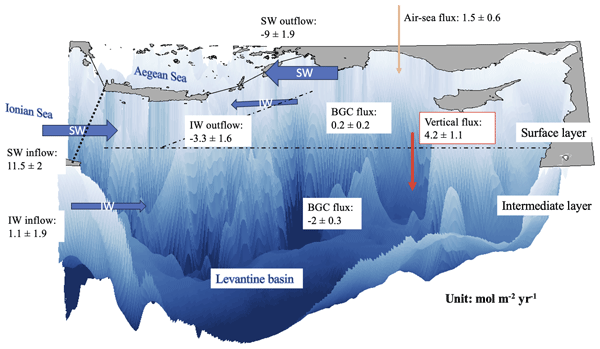
The Levantine Basin in the eastern Mediterranean Sea is one of the most nutrient-poor marine regions on Earth. Using a detailed model and observations, we studied how oxygen changes from 2013 to 2020. We found that winter cooling draws oxygen into the sea and moves it to deeper waters, while warmer months release some back. Overall, the basin absorbs more oxygen than it releases, and winter heat loss and circulation patterns strongly control how oxygen is stored and transported.
Yawouvi Dodji Soviadan, Miriam Beck, Joelle Habib, Alberto Baudena, Laetitia Drago, Alexandre Accardo, Remi Laxenaire, Sabrina Speich, Peter Brandt, Rainer Kiko, and Stemmann Lars
Biogeosciences, 22, 3485–3501, https://doi.org/10.5194/bg-22-3485-2025, https://doi.org/10.5194/bg-22-3485-2025, 2025
Short summary
Short summary
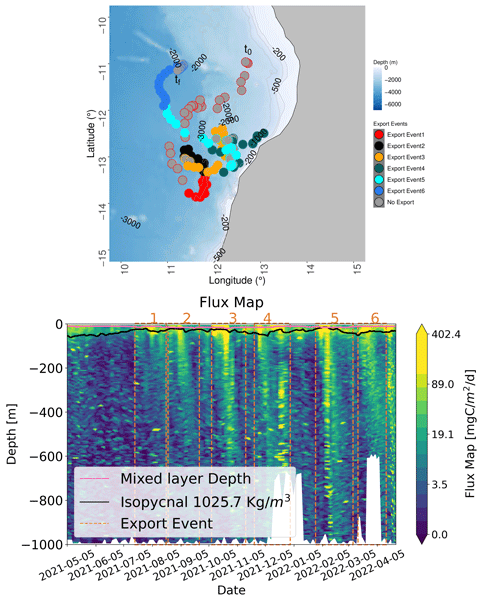
Key parameters representing the gravity flux in global models are sinking speed and vertical attenuation of exported material. We calculate, for the first time, these parameters in situ in the ocean for six intermittent blooms followed by export events using high-resolution (3 d) time series of 0–1000 m depth profiles from imaging sensors mounted on an Argo float. We show that sinking speed depends not only on size but also on the morphology of the particles, with density being an important property.
Joelle Habib, Caroline Ulses, Claude Estournel, Milad Fakhri, Patrick Marsaleix, Mireille Pujo-Pay, Marine Fourrier, Laurent Coppola, Alexandre Mignot, Laurent Mortier, and Pascal Conan
Biogeosciences, 20, 3203–3228, https://doi.org/10.5194/bg-20-3203-2023, https://doi.org/10.5194/bg-20-3203-2023, 2023
Short summary
Short summary
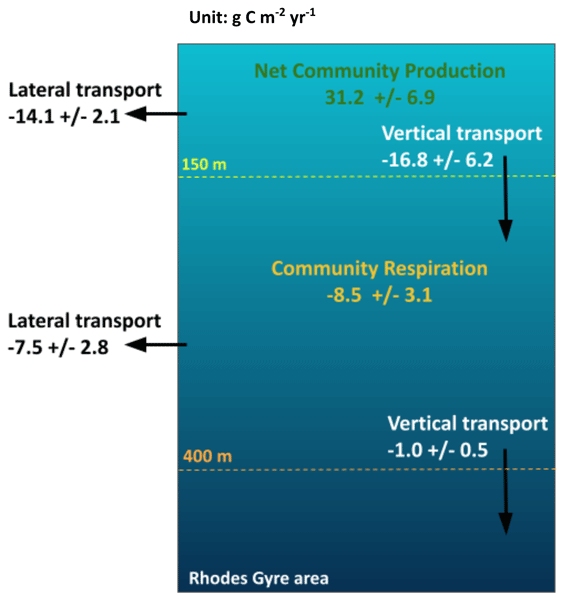
The Rhodes Gyre, eastern Mediterranean Sea, is the main Levantine Intermediate Water formation site. In this study, we use a 3D physical–biogeochemical model to investigate the seasonal and interannual variability of organic carbon dynamics in the gyre. Our results show its autotrophic nature and its high interannual variability, with enhanced primary production, downward exports, and onward exports to the surrounding regions during years marked by intense heat losses and deep mixed layers.
Ariadna C. Nocera, Lars Stemmann, Marcel Babin, Tristan Biard, Julie Coustenoble, François Carlotti, Laurent Coppola, Lucas Courchet, Laetitia Drago, Amanda Elineau, Lionel Guidi, Helena Hauss, Laëtitia Jalabert, Lee Karp-Boss, Rainer Kiko, Manon Laget, Fabien Lombard, Andrew McDonnell, Camille Merland, Solène Motreuil, Thelma Panaïotis, Marc Picheral, Andreas Rogge, Anya Waite, and Jean-Olivier Irisson
Earth Syst. Sci. Data, 18, 7345–7366, https://doi.org/10.5194/essd-18-7345-2026, https://doi.org/10.5194/essd-18-7345-2026, 2026
Short summary
Short summary
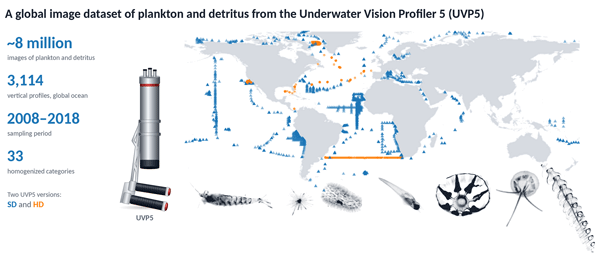
Plankton and sinking organic particles (detritus) shape how the ocean stores carbon, but they are difficult to observe worldwide. We present a global, openly available collection of about 8 million images captured by an underwater camera (UVP5) in 3114 profiles from 2008 to 2018 and sorted into 33 categories. Detritus made up 90 % of the objects and copepods were the most common plankton. The dataset can help train machine learning tools and improve ocean ecosystem and climate models.
Alexandra Andrae, Peter Brandt, Franz Philip Tuchen, Rebecca Hummels, and Joke F. Lübbecke
EGUsphere, https://doi.org/10.5194/egusphere-2026-4390, https://doi.org/10.5194/egusphere-2026-4390, 2026
Short summary
Short summary
Trajectories of surface drifters reveal the presence wind-forced intraseasonal Yanai (mixed Rossby–gravity) waves superimposed on the mean background circulation in the western equatorial Atlantic. Three drifters deployed in May 2023 exhibited circular trajectories centered on the equator, consistent with a 14-day Yanai wave. Numerical experiments reproduce the observation, indicating wave amplitudes of 0.6–0.7 m/s and demonstrating how the North Brazil Current modulates the wave-induced motion.
Hans Segura, Allison A. Wing, Heike Kalesse-Los, Ruben Carrasco, James H. Ruppert Jr., Anna Trosits, Louise Nuijens, Felix Ament, Daniel Blandfort, Michael M. Bell, Pierre Bosser, Delián Colón-Burgos, Geet George, Joelle Habib, Jochen Horstmann, Friedhelm Jansen, Lukas Kluft, Robert Kopte, Klas Ove Möller, Peristera Paschou, Hauke Schmidt, Michael Schlundt, Ilya Serikov, Martin Stelzner, Elizabeth J. Thompson, Werenfrid Wimmer, Marcus Dengler, and Daniel Klocke
Earth Syst. Sci. Data Discuss., https://doi.org/10.5194/essd-2026-343, https://doi.org/10.5194/essd-2026-343, 2026
Revised manuscript under review for ESSD
Short summary
Short summary
BOWTIE (Beobachtung von Ozean und Wolken - Das Trans ITCZ Experiment) was an observational campaign occurring in summer 2024, which intensively took measurements from the upper ocean to the upper troposphere in the wettest region of the tropical Atlantic. Here, we provide an overview of the measurements and instrumentation, including remote sensing and conventional, which targeted small-scale processes under different weather regimes, from calm doldrums to gusty, precipitating events.
Anna Christina Hans, Rebecca Hummels, Peter Brandt, Franziska U. Schwarzkopf, and Stephan Juricke
EGUsphere, https://doi.org/10.5194/egusphere-2026-2983, https://doi.org/10.5194/egusphere-2026-2983, 2026
Short summary
Short summary
We mimic an observational array at 11°S in an ocean model to assess its capability to compute the temporal variability of the Atlantic Meridional Overturning Circulation. The current approaches based on bottom pressure sensors and measurements of the boundary currents explain large parts of the transport variability. Improvements can be achieved by also considering temperature and salinity data, while the potential of self-calibrating pressure sensors and inverted echo sounders is limited.
Joelle Habib, Caroline Ulses, Claude Estournel, Milad Fakhri, Patrick Marsaleix, Thierry Moutin, Dominique Lefevre, Mireille Pujo-Pay, Marine Fourrier, Laurent Coppola, Cathy Wimart-Rousseau, and Pascal Conan
Biogeosciences, 23, 2939–2958, https://doi.org/10.5194/bg-23-2939-2026, https://doi.org/10.5194/bg-23-2939-2026, 2026
Short summary
Short summary
The Levantine Basin in the eastern Mediterranean Sea is one of the most nutrient-poor marine regions on Earth. Using a detailed model and observations, we studied how oxygen changes from 2013 to 2020. We found that winter cooling draws oxygen into the sea and moves it to deeper waters, while warmer months release some back. Overall, the basin absorbs more oxygen than it releases, and winter heat loss and circulation patterns strongly control how oxygen is stored and transported.
Nasrollah Moradi, Lili Hufnagel, Simon Ramondenc, Clara M. Flintrop, Rainer Kiko, Tim Fischer, Helena Hauss, Arne Körtzinger, Gerhard Fischer, and Morten H. Iversen
Biogeosciences, 23, 2179–2203, https://doi.org/10.5194/bg-23-2179-2026, https://doi.org/10.5194/bg-23-2179-2026, 2026
Short summary
Short summary
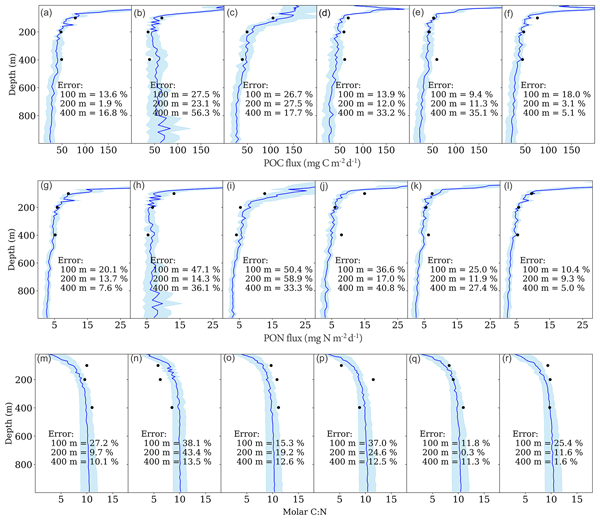
The presented framework advances estimates of particulate organic carbon and nitrogen fluxes in the water column derived from in situ imaging-based particle size distribution data. By accounting for non-sinking particles, depth-dependent degradation, and a dynamic carbon-to-nitrogen ratio that evolves with particle age during settling, it provides a more accurate representation of organic matter export to the deep ocean.
Florian Schütte, Johannes Hahn, Ivy Frenger, Arne Bendinger, Ahmad Fehmi Dilmahamod, Marco Schulz, and Peter Brandt
Ocean Sci., 22, 119–143, https://doi.org/10.5194/os-22-119-2026, https://doi.org/10.5194/os-22-119-2026, 2026
Short summary
Short summary
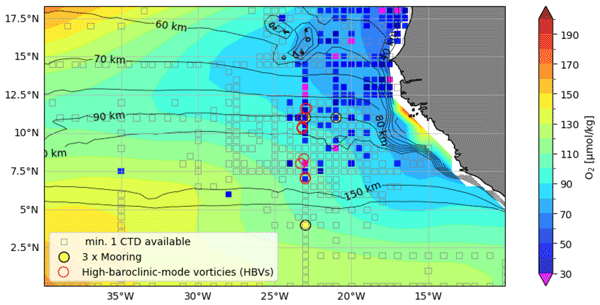
We found extreme drops in oxygen levels in the tropical Atlantic linked to surprisingly long-lived, small subsurface eddies. These eddies are hidden beneath the surface (undetectable by satellites) and are unusually stable, even in the highly dynamic ocean near the equator. Using long-term measurements and computer models, we show that these features can strongly influence oxygen supply and potentially impact marine ecosystems.
Yawouvi Dodji Soviadan, Miriam Beck, Joelle Habib, Alberto Baudena, Laetitia Drago, Alexandre Accardo, Remi Laxenaire, Sabrina Speich, Peter Brandt, Rainer Kiko, and Stemmann Lars
Biogeosciences, 22, 3485–3501, https://doi.org/10.5194/bg-22-3485-2025, https://doi.org/10.5194/bg-22-3485-2025, 2025
Short summary
Short summary
Key parameters representing the gravity flux in global models are sinking speed and vertical attenuation of exported material. We calculate, for the first time, these parameters in situ in the ocean for six intermittent blooms followed by export events using high-resolution (3 d) time series of 0–1000 m depth profiles from imaging sensors mounted on an Argo float. We show that sinking speed depends not only on size but also on the morphology of the particles, with density being an important property.
Léo C. Aroucha, Joke F. Lübbecke, Peter Brandt, Franziska U. Schwarzkopf, and Arne Biastoch
Ocean Sci., 21, 661–678, https://doi.org/10.5194/os-21-661-2025, https://doi.org/10.5194/os-21-661-2025, 2025
Short summary
Short summary
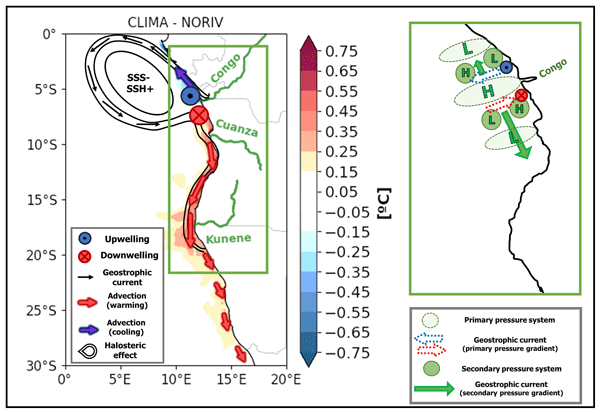
The west African coastal region sustains highly productive fisheries and marine ecosystems influenced by sea surface temperature. We use oceanic models to show that the freshwater input from land to ocean strengthens a surface northward (southward) coastal current north (south) of the Congo River mouth, promoting a transfer of cooler (warmer) waters to north (south) of the Congo discharge location. We highlight the significant impact of river discharge on ocean temperatures and circulation.
Alexandre Accardo, Rémi Laxenaire, Alberto Baudena, Sabrina Speich, Rainer Kiko, and Lars Stemmann
Biogeosciences, 22, 1183–1201, https://doi.org/10.5194/bg-22-1183-2025, https://doi.org/10.5194/bg-22-1183-2025, 2025
Short summary
Short summary
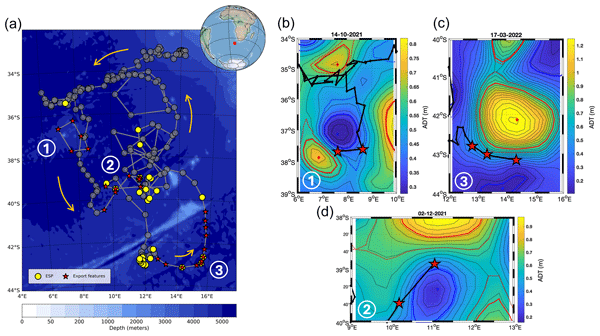
The open ocean helps mitigate climate change by storing CO2 via the biological carbon pump (BCP), which involves processes like organic carbon production at the surface and transferring it to the deep ocean via various pathways. By deploying an autonomous platform, we found significant marine snow accumulation from the surface to the mesopelagic zone in frontal regions between eddies. We suggest that the coupling of hydrodynamics at eddy edges and biological activity may enhance this process.
Eike E. Köhn, Richard J. Greatbatch, Peter Brandt, and Martin Claus
Ocean Sci., 20, 1281–1290, https://doi.org/10.5194/os-20-1281-2024, https://doi.org/10.5194/os-20-1281-2024, 2024
Short summary
Short summary
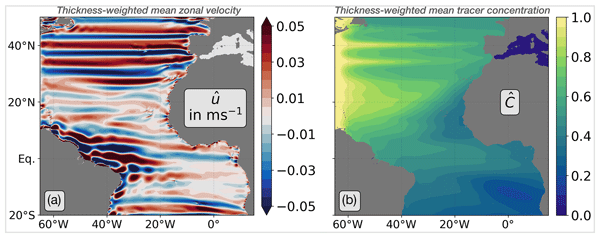
The latitudinally alternating zonal jets are a ubiquitous feature of the ocean. We use a simple model to illustrate the potential role of these jets in the formation, maintenance, and multidecadal variability in the oxygen minimum zones, using the eastern tropical North Atlantic oxygen minimum zone as an example.
Mathilde Dugenne, Marco Corrales-Ugalde, Jessica Y. Luo, Rainer Kiko, Todd D. O'Brien, Jean-Olivier Irisson, Fabien Lombard, Lars Stemmann, Charles Stock, Clarissa R. Anderson, Marcel Babin, Nagib Bhairy, Sophie Bonnet, Francois Carlotti, Astrid Cornils, E. Taylor Crockford, Patrick Daniel, Corinne Desnos, Laetitia Drago, Amanda Elineau, Alexis Fischer, Nina Grandrémy, Pierre-Luc Grondin, Lionel Guidi, Cecile Guieu, Helena Hauss, Kendra Hayashi, Jenny A. Huggett, Laetitia Jalabert, Lee Karp-Boss, Kasia M. Kenitz, Raphael M. Kudela, Magali Lescot, Claudie Marec, Andrew McDonnell, Zoe Mériguet, Barbara Niehoff, Margaux Noyon, Thelma Panaïotis, Emily Peacock, Marc Picheral, Emilie Riquier, Collin Roesler, Jean-Baptiste Romagnan, Heidi M. Sosik, Gretchen Spencer, Jan Taucher, Chloé Tilliette, and Marion Vilain
Earth Syst. Sci. Data, 16, 2971–2999, https://doi.org/10.5194/essd-16-2971-2024, https://doi.org/10.5194/essd-16-2971-2024, 2024
Short summary
Short summary
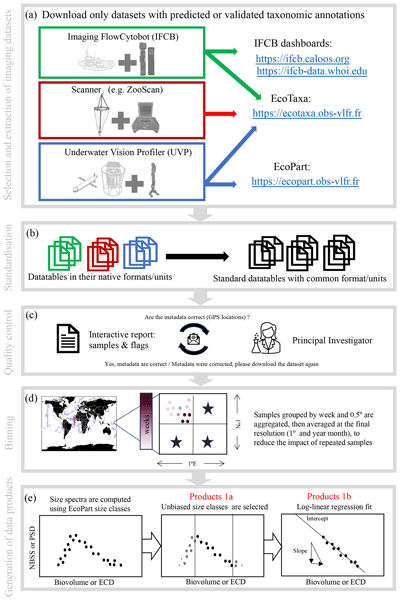
Plankton and particles influence carbon cycling and energy flow in marine ecosystems. We used three types of novel plankton imaging systems to obtain size measurements from a range of plankton and particle sizes and across all major oceans. Data were compiled and cross-calibrated from many thousands of images, showing seasonal and spatial changes in particle size structure in different ocean basins. These datasets form the first release of the Pelagic Size Structure database (PSSdb).
Kristin Burmeister, Franziska U. Schwarzkopf, Willi Rath, Arne Biastoch, Peter Brandt, Joke F. Lübbecke, and Mark Inall
Ocean Sci., 20, 307–339, https://doi.org/10.5194/os-20-307-2024, https://doi.org/10.5194/os-20-307-2024, 2024
Short summary
Short summary
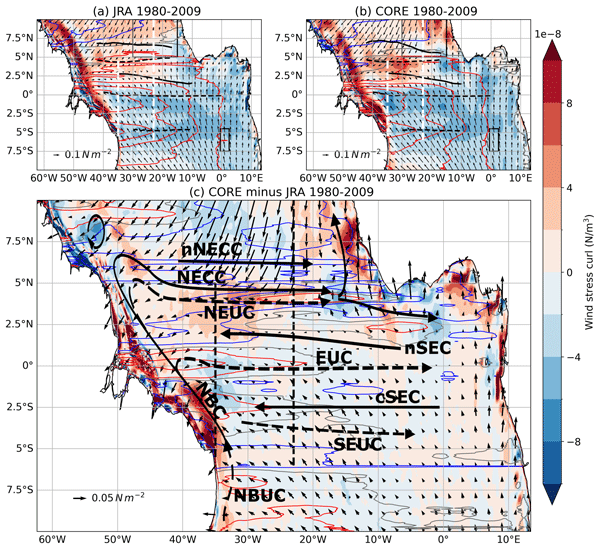
We apply two different forcing products to a high-resolution ocean model to investigate their impact on the simulated upper-current field in the tropical Atlantic. Where possible, we compare the simulated results to long-term observations. We find large discrepancies between the two simulations regarding the wind and current fields. We propose that long-term observations, once they have reached a critical length, need to be used to test the quality of wind-driven simulations.
Joelle Habib, Caroline Ulses, Claude Estournel, Milad Fakhri, Patrick Marsaleix, Mireille Pujo-Pay, Marine Fourrier, Laurent Coppola, Alexandre Mignot, Laurent Mortier, and Pascal Conan
Biogeosciences, 20, 3203–3228, https://doi.org/10.5194/bg-20-3203-2023, https://doi.org/10.5194/bg-20-3203-2023, 2023
Short summary
Short summary
The Rhodes Gyre, eastern Mediterranean Sea, is the main Levantine Intermediate Water formation site. In this study, we use a 3D physical–biogeochemical model to investigate the seasonal and interannual variability of organic carbon dynamics in the gyre. Our results show its autotrophic nature and its high interannual variability, with enhanced primary production, downward exports, and onward exports to the surrounding regions during years marked by intense heat losses and deep mixed layers.
Swantje Bastin, Martin Claus, Richard J. Greatbatch, and Peter Brandt
Ocean Sci., 19, 923–939, https://doi.org/10.5194/os-19-923-2023, https://doi.org/10.5194/os-19-923-2023, 2023
Short summary
Short summary
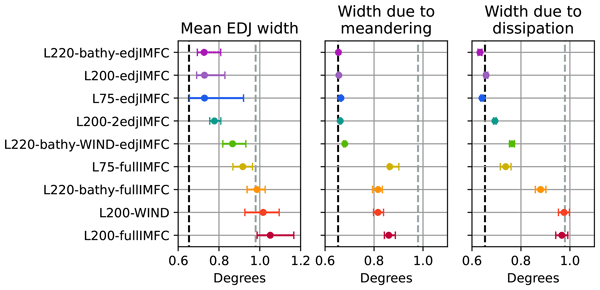
Equatorial deep jets are ocean currents that flow along the Equator in the deep oceans. They are relevant for oxygen transport and tropical surface climate, but their dynamics are not yet entirely understood. We investigate different factors leading to the jets being broader than theory predicts. Mainly using an ocean model, but corroborating the results with shipboard observations, we show that loss of momentum is the main factor for the broadening but that meandering also contributes.
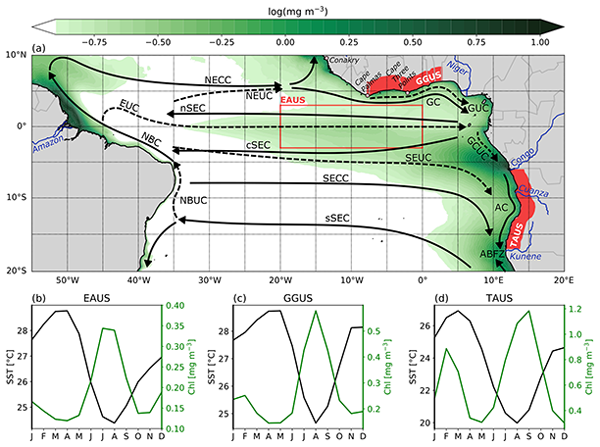
Peter Brandt, Gaël Alory, Founi Mesmin Awo, Marcus Dengler, Sandrine Djakouré, Rodrigue Anicet Imbol Koungue, Julien Jouanno, Mareike Körner, Marisa Roch, and Mathieu Rouault
Ocean Sci., 19, 581–601, https://doi.org/10.5194/os-19-581-2023, https://doi.org/10.5194/os-19-581-2023, 2023
Short summary
Short summary
Tropical upwelling systems are among the most productive ecosystems globally. The tropical Atlantic upwelling undergoes a strong seasonal cycle that is forced by the wind. Local wind-driven upwelling and remote effects, particularly via the propagation of equatorial and coastal trapped waves, lead to an upward and downward movement of the nitracline. Turbulent mixing results in upward supply of nutrients. Here, we review the different physical processes responsible for biological productivity.

Patricia Ayón Dejo, Elda Luz Pinedo Arteaga, Anna Schukat, Jan Taucher, Rainer Kiko, Helena Hauss, Sabrina Dorschner, Wilhelm Hagen, Mariona Segura-Noguera, and Silke Lischka
Biogeosciences, 20, 945–969, https://doi.org/10.5194/bg-20-945-2023, https://doi.org/10.5194/bg-20-945-2023, 2023
Short summary
Short summary
Ocean upwelling regions are highly productive. With ocean warming, severe changes in upwelling frequency and/or intensity and expansion of accompanying oxygen minimum zones are projected. In a field experiment off Peru, we investigated how different upwelling intensities affect the pelagic food web and found failed reproduction of dominant zooplankton. The changes projected could severely impact the reproductive success of zooplankton communities and the pelagic food web in upwelling regions.
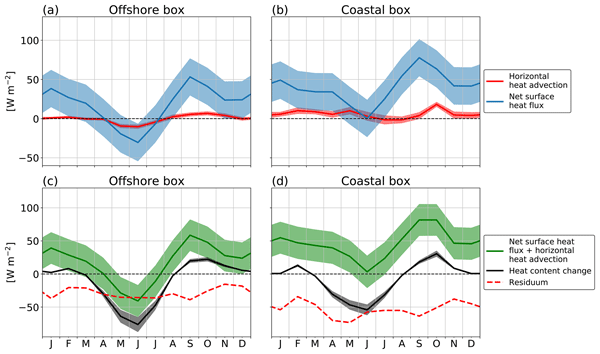
Mareike Körner, Peter Brandt, and Marcus Dengler
Ocean Sci., 19, 121–139, https://doi.org/10.5194/os-19-121-2023, https://doi.org/10.5194/os-19-121-2023, 2023
Short summary
Short summary
The coastal waters off Angola host a productive ecosystem. Surface waters at the coast are colder than further offshore. We find that surface heat fluxes warm the coastal region more strongly than the offshore region and cannot explain the differences. The influence of horizontal heat advection is minor on the surface temperature change. In contrast, ocean turbulence data suggest that cooling associated with vertical mixing is an important mechanism to explain the near-coastal cooling.
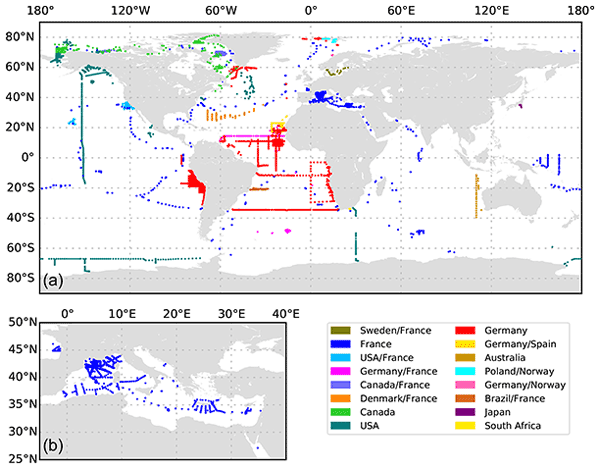
Rainer Kiko, Marc Picheral, David Antoine, Marcel Babin, Léo Berline, Tristan Biard, Emmanuel Boss, Peter Brandt, Francois Carlotti, Svenja Christiansen, Laurent Coppola, Leandro de la Cruz, Emilie Diamond-Riquier, Xavier Durrieu de Madron, Amanda Elineau, Gabriel Gorsky, Lionel Guidi, Helena Hauss, Jean-Olivier Irisson, Lee Karp-Boss, Johannes Karstensen, Dong-gyun Kim, Rachel M. Lekanoff, Fabien Lombard, Rubens M. Lopes, Claudie Marec, Andrew M. P. McDonnell, Daniela Niemeyer, Margaux Noyon, Stephanie H. O'Daly, Mark D. Ohman, Jessica L. Pretty, Andreas Rogge, Sarah Searson, Masashi Shibata, Yuji Tanaka, Toste Tanhua, Jan Taucher, Emilia Trudnowska, Jessica S. Turner, Anya Waite, and Lars Stemmann
Earth Syst. Sci. Data, 14, 4315–4337, https://doi.org/10.5194/essd-14-4315-2022, https://doi.org/10.5194/essd-14-4315-2022, 2022
Short summary
Short summary
The term
marine particlescomprises detrital aggregates; fecal pellets; bacterioplankton, phytoplankton and zooplankton; and even fish. Here, we present a global dataset that contains 8805 vertical particle size distribution profiles obtained with Underwater Vision Profiler 5 (UVP5) camera systems. These data are valuable to the scientific community, as they can be used to constrain important biogeochemical processes in the ocean, such as the flux of carbon to the deep sea.
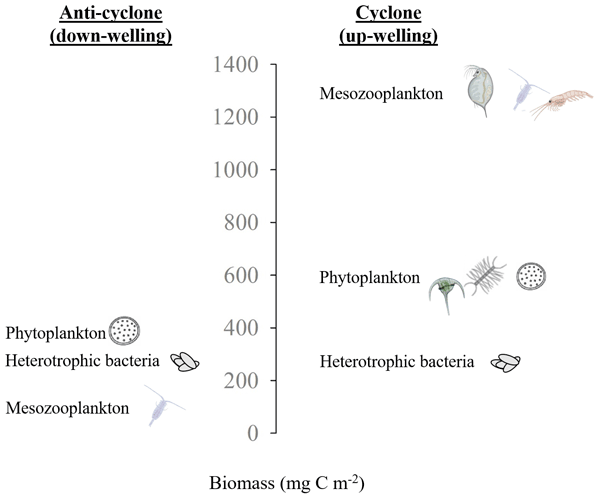
Natalia Belkin, Tamar Guy-Haim, Maxim Rubin-Blum, Ayah Lazar, Guy Sisma-Ventura, Rainer Kiko, Arseniy R. Morov, Tal Ozer, Isaac Gertman, Barak Herut, and Eyal Rahav
Ocean Sci., 18, 693–715, https://doi.org/10.5194/os-18-693-2022, https://doi.org/10.5194/os-18-693-2022, 2022
Short summary
Short summary
We studied how distinct water circulations that elevate (cyclone) or descend (anticyclone) water from the upper ocean affect the biomass, activity and diversity of planktonic microorganisms in the impoverished eastern Mediterranean. We show that cyclonic and anticyclonic eddies differ in their community composition and production. Moreover, the anticyclone may be a potential bio-invasion and dispersal vector, while the cyclone may serve as a thermal refugee for native species.
Cited articles
Accardo, A., Laxenaire, R., Baudena, A., Speich, S., Kiko, R., and Stemmann, L.: Intense and localized export of selected marine snow types at eddy edges in the South Atlantic Ocean, Biogeosciences, 22, 1183–1201, https://doi.org/10.5194/bg-22-1183-2025, 2025.
Alldredge, A. L. and Silver, M. W.: Characteristics, dynamics and significance of marine snow, Prog. Oceanogr., 20, 41–82, https://doi.org/10.1016/0079-6611(88)90053-5, 1988.
Armstrong, R. A., Lee, C., Hedges, J. I., Honjo, S., and Wakeham, S. G.: A new, mechanistic model for organic carbon fluxes in the ocean based on the quantitative association of POC with ballast minerals, Deep Sea Res. Part II Top. Stud. Oceanogr., 49, 219–236, https://doi.org/10.1016/S0967-0645(01)00101-1, 2001.
Athie, G. and Marin, F.: Cross-equatorial structure and temporal modulation of intraseasonal variability at the surface of the Tropical Atlantic Ocean, J. Geophys. Res., 113, C08020, https://doi.org/10.1029/2007JC004332, 2008.
Bach, L. T., Stange, P., Taucher, J., Achterberg, E. P., Algueró-Muñiz, M., Horn, H., Esposito, M., and Riebesell, U.: The Influence of Plankton Community Structure on Sinking Velocity and Remineralization Rate of Marine Aggregates, Glob. Biogeochem. Cycles, 33, 971–994, https://doi.org/10.1029/2019GB006256, 2019.
Bam, W., Gasser, B., Maiti, K., Levy, I., Miquel, J. C., Hansman, R. L., Scholten, J., Xie, R. C., Sommer, S., Kiko, R., and Swarzenski, P. W.: Particulate organic carbon export fluxes estimates by 234Th238U disequilibrium in the oxygen minimum zone off the Peruvian coast, Mar. Chem., 257, 104325, https://doi.org/10.1016/j.marchem.2023.104325, 2023.
Baudena, A., Ser-Giacomi, E., D'Onofrio, D., Capet, X., Cotté, C., Cherel, Y., and D'Ovidio, F.: Fine-scale structures as spots of increased fish concentration in the open ocean, Sci. Rep., 11, 15805, https://doi.org/10.1038/s41598-021-94368-1, 2021.
Baudena, A., Laxenaire, R., Catalano, C., Ioannou, A., Leymarie, E., Picheral, M., Poteau, A., Speich, S., Stemmann, L., and Kiko, R.: A Lagrangian perspective reveals the carbon and oxygen budget of an oceanic eddy, Commun. Earth Environ., 6, 318, https://doi.org/10.1038/s43247-025-02262-9, 2025.
Beaulieu, S. E.: Accumulation and fate of phytodetritus on the sea floor, Oceanogr. Mar. Biol., 40, 179–217, 2002.
Bernardello, R., Marinov, I., Palter, J. B., Sarmiento, J. L., Galbraith, E. D., and Slater, R. D.: Response of the Ocean Natural Carbon Storage to Projected Twenty-First-Century Climate Change, J. Climate, 27, 2033–2053, https://doi.org/10.1175/JCLI-D-13-00343.1, 2014.
Bianchi, D. and Mislan, K. A. S.: Global patterns of diel vertical migration times and velocities from acoustic data, Limnol. Oceanogr., 61, 353–364, https://doi.org/10.1002/lno.10219, 2016.
Bianchi, D., Galbraith, E. D., Carozza, D. A., Mislan, K. A. S., and Stock, C. A.: Intensification of open-ocean oxygen depletion by vertically migrating animals, Nat. Geosci., 6, 545–548, https://doi.org/10.1038/ngeo1837, 2013.
Bianchi, D., Weber, T. S., Kiko, R., and Deutsch, C.: Global niche of marine anaerobic metabolisms expanded by particle microenvironments, Nat. Geosci., 11, 263–268, https://doi.org/10.1038/s41561-018-0081-0, 2018.
Biddanda, B. and Pomeroy, L.: Microbial aggregation and degradation of phytoplankton-derived detritus in seawater. I. Microbial succession, Mar. Ecol. Prog. Ser., 42, 79–88, https://doi.org/10.3354/meps042079, 1988.
Bopp, L., Resplandy, L., Orr, J. C., Doney, S. C., Dunne, J. P., Gehlen, M., Halloran, P., Heinze, C., Ilyina, T., Séférian, R., Tjiputra, J., and Vichi, M.: Multiple stressors of ocean ecosystems in the 21st century: projections with CMIP5 models, Biogeosciences, 10, 6225–6245, https://doi.org/10.5194/bg-10-6225-2013, 2013.
Boyd, P. W., Claustre, H., Levy, M., Siegel, D. A., and Weber, T.: Multi-faceted particle pumps drive carbon sequestration in the ocean, Nature, 568, 327–335, https://doi.org/10.1038/s41586-019-1098-2, 2019.
Brandt, P., Caniaux, G., Bourlès, B., Lazar, A., Dengler, M., Funk, A., Hormann, V., Giordani, H., and Marin, F.: Equatorial upper-ocean dynamics and their interaction with the West African monsoon, Atmospheric Sci. Lett., 12, 24–30, https://doi.org/10.1002/asl.287, 2011.
Brandt, P., Alory, G., Awo, F. M., Dengler, M., Djakouré, S., Imbol Koungue, R. A., Jouanno, J., Körner, M., Roch, M., and Rouault, M.: Physical processes and biological productivity in the upwelling regions of the tropical Atlantic, Ocean Sci., 19, 581–601, https://doi.org/10.5194/os-19-581-2023, 2023.
Brandt, P., Körner, M., Moum, J. N., Roch, M., Subramaniam, A., Czeschel, R., Krahmann, G., Dengler, M., and Kiko, R.: Seasonal productivity of the equatorial Atlantic shaped by distinct wind-driven processes, Nat. Geosci., 18, 84–90, https://doi.org/10.1038/s41561-024-01609-9, 2025.
Briggs, N., Perry, M. J., Cetinić, I., Lee, C., D'Asaro, E., Gray, A. M., and Rehm, E.: High-resolution observations of aggregate flux during a sub-polar North Atlantic spring bloom, Deep Sea Res. Part Oceanogr. Res. Pap., 58, 1031–1039, https://doi.org/10.1016/j.dsr.2011.07.007, 2011.
Briggs, N., Dall'Olmo, G., and Claustre, H.: Major role of particle fragmentation in regulating biological sequestration of CO2 by the oceans, Science, 367, 791–793, https://doi.org/10.1126/science.aay1790, 2020.
Buesseler, K. O., Lamborg, C. H., Boyd, P. W., Lam, P. J., Trull, T. W., Bidigare, R. R., Bishop, J. K. B., Casciotti, K. L., Dehairs, F., Elskens, M., Honda, M., Karl, D. M., Siegel, D. A., Silver, M. W., Steinberg, D. K., Valdes, J., Van Mooy, B., and Wilson, S.: Revisiting Carbon Flux Through the Ocean's Twilight Zone, Science, 316, 567–570, https://doi.org/10.1126/science.1137959, 2007.
Buesseler, K. O., Boyd, P. W., Black, E. E., and Siegel, D. A.: Metrics that matter for assessing the ocean biological carbon pump, Proc. Natl. Acad. Sci. USA, 117, 9679–9687, https://doi.org/10.1073/pnas.1918114117, 2020.
Burd, A. B. and Jackson, G. A.: Particle Aggregation, Annu. Rev. Mar. Sci., 1, 65–90, https://doi.org/10.1146/annurev.marine.010908.163904, 2009.
Cael, B. B., Cavan, E. L., and Britten, G. L.: Reconciling the Size-Dependence of Marine Particle Sinking Speed, Geophys. Res. Lett., 48, e2020GL091771, https://doi.org/10.1029/2020GL091771, 2021.
Claustre, H., Johnson, K. S., and Takeshita, Y.: Observing the Global Ocean with Biogeochemical-Argo, Annu. Rev. Mar. Sci., 12, 23–48, https://doi.org/10.1146/annurev-marine-010419-010956, 2020.
Clements, D. J., Yang, S., Weber, T., McDonnell, A. M. P., Kiko, R., Stemmann, L., and Bianchi, D.: Constraining the Particle Size Distribution of Large Marine Particles in the Global Ocean With In Situ Optical Observations and Supervised Learning, Glob. Biogeochem. Cycles, 36, e2021GB007276, https://doi.org/10.1029/2021GB007276, 2022.
Clements, D. J., Yang, S., Weber, T., McDonnell, A. M. P., Kiko, R., Stemmann, L., and Bianchi, D.: New Estimate of Organic Carbon Export From Optical Measurements Reveals the Role of Particle Size Distribution and Export Horizon, Glob. Biogeochem. Cycles, 37, e2022GB007633, https://doi.org/10.1029/2022GB007633, 2023.
De Boyer Montégut, C., Madec, G., Fischer, A. S., Lazar, A., and Iudicone, D.: Mixed layer depth over the global ocean: An examination of profile data and a profile-based climatology, J. Geophys. Res.-Oceans, 109, 2004JC002378, https://doi.org/10.1029/2004JC002378, 2004.
de La Rocha, C. L. and Passow, U.: The biological pump, in: Treatise on Geochemistry, 2nd Edn., vol. 6, edited by: Holland, H. D. and Turekian, K. K., Elsevier, Amsterdam, 83–111, ISBN 978-0-08-045101-5, 2006.
DeVries, T., Primeau, F., and Deutsch, C.: The sequestration efficiency of the biological pump, Geophys. Res. Lett., 39, 2012GL051963, https://doi.org/10.1029/2012GL051963, 2012.
Dilling, L. and Alldredge, A. L.: Fragmentation of marine snow by swimming macrozooplankton: A new process impacting carbon cycling in the sea, Deep Sea Res. Part Oceanogr. Res. Pap., 47, 1227–1245, https://doi.org/10.1016/S0967-0637(99)00105-3, 2000.
Drago, L.: Analyse globale de la pompe à carbone biologique à partir de données en imagerie quantitative, PhD thesis, Sorbonne Université, Paris, https://theses.hal.science/tel-04483392 (last access: 5 December 2025), 2023.
Dupouy, C., Frouin, R., Tedetti, M., Maillard, M., Rodier, M., Lombard, F., Guidi, L., Picheral, M., Neveux, J., Duhamel, S., Charrière, B., and Sempéré, R.: Diazotrophic Trichodesmium impact on UV–Vis radiance and pigment composition in the western tropical South Pacific, Biogeosciences, 15, 5249–5269, https://doi.org/10.5194/bg-15-5249-2018, 2018.
Engel, A., Cisternas-Novoa, C., Hauss, H., Kiko, R., and Le Moigne, F. A. C.: Hypoxia-tolerant zooplankton may reduce biological carbon pump efficiency in the Humboldt current system off Peru, Commun. Earth Environ., 4, 458, https://doi.org/10.1038/s43247-023-01140-6, 2023.
Fabri-Ruiz, S., Baudena, A., Moullec, F., Lombard, F., Irisson, J.-O., and Pedrotti, M. L.: Mistaking plastic for zooplankton: Risk assessment of plastic ingestion in the Mediterranean sea, Sci. Total Environ., 856, 159011, https://doi.org/10.1016/j.scitotenv.2022.159011, 2023.
Fischer, G., Ratmeyer, V., and Wefer, G.: Organic carbon fluxes in the Atlantic and the Southern Ocean: relationship to primary production compiled from satellite radiometer data, Deep-Sea Res. Pt. II, 47, 1961–1997, https://doi.org/10.1016/S0967-0645(00)00013-8, 2000.
Foltz, G. R., Hummels, R., Dengler, M., Perez, R. C., and Araujo, M.: Vertical Turbulent Cooling of the Mixed Layer in the Atlantic ITCZ and Trade Wind Regions, J. Geophys. Res.-Oceans, 125, e2019JC015529, https://doi.org/10.1029/2019JC015529, 2020.
Forest, A., Babin, M., Stemmann, L., Picheral, M., Sampei, M., Fortier, L., Gratton, Y., Bélanger, S., Devred, E., Sahlin, J., Doxaran, D., Joux, F., Ortega-Retuerta, E., Martín, J., Jeffrey, W. H., Gasser, B., and Carlos Miquel, J.: Ecosystem function and particle flux dynamics across the Mackenzie Shelf (Beaufort Sea, Arctic Ocean): an integrative analysis of spatial variability and biophysical forcings, Biogeosciences, 10, 2833–2866, https://doi.org/10.5194/bg-10-2833-2013, 2013.
Fox, J. E., Behrenfeld, M., Halsey, K. H., and Graff, J.: Global estimates of particulate organic carbon from the surface ocean to the base of the mesopelagic, https://doi.org/10.22541/essoar.171017314.40658424/v1, 11 March 2024.
François, R., Honjo, S., Krishfield, R., and Manganini, S.: Factors controlling the flux of organic carbon to the bathypelagic zone of the ocean, Glob. Biogeochem. Cycles, 16, 1087–1107, https://doi.org/10.1029/2001GB001722, 2002.
Giering, S. L. C., Sanders, R., Lampitt, R. S., Anderson, T. R., Tamburini, C., Boutrif, M., Zubkov, M. V., Marsay, C. M., Henson, S. A., Saw, K., Cook, K., and Mayor, D. J.: Reconciliation of the carbon budget in the ocean's twilight zone, Nature, 507, 480–483, https://doi.org/10.1038/nature13123, 2014.
Gorgues, T., Aumont, O., and Memery, L.: Simulated Changes in the Particulate Carbon Export Efficiency due to Diel Vertical Migration of Zooplankton in the North Atlantic, Geophys. Res. Lett., 46, 5387–5395, https://doi.org/10.1029/2018GL081748, 2019.
Grodsky, S. A., Carton, J. A., and McClain, C. R.: Variability of upwelling and chlorophyll in the equatorial Atlantic, Geophys. Res. Lett., 35, L03610, https://doi.org/10.1029/2007GL032466, 2008.
Guidi, L., Jackson, G. A., Stemmann, L., Miquel, J. C., Picheral, M., and Gorsky, G.: Relationship between particle size distribution and flux in the mesopelagic zone, Deep Sea Res. Part Oceanogr. Res. Pap., 55, 1364–1374, https://doi.org/10.1016/j.dsr.2008.05.014, 2008.
Guidi, L., Stemmann, L., Jackson, G. A., Ibanez, F., Claustre, H., Legendre, L., Picheral, M., and Gorskya, G.: Effects of phytoplankton community on production, size, and export of large aggregates: A world-ocean analysis, Limnol. Oceanogr., 54, 1951–1963, https://doi.org/10.4319/lo.2009.54.6.1951, 2009.
Guidi, L., Legendre, L., Reygondeau, G., Uitz, J., Stemmann, L., and Henson, S. A.: A new look at ocean carbon remineralization for estimating deepwater sequestration, Glob. Biogeochem. Cycles, 29, 1044–1059, https://doi.org/10.1002/2014GB005063, 2015.
Habib, J.: Marine snow surface production and bathypelagic export at the Equatorial Atlantic from an imaging float, Zenodo [code], https://doi.org/10.5281/zenodo.17584543, 2025.
Habib, J., Stemmann, L., Accardo, A., Baudena, A., Tuchen, F. P., Peter, B., and Kiko, R.: Marine snow surface production and bathypelagic export at the Equatorial Atlantic from an imaging float, Zenodo [data set], https://doi.org/10.5281/zenodo.14007570, 2024.
Henson, S., Le Moigne, F., and Giering, S.: Drivers of Carbon Export Efficiency in the Global Ocean, Glob. Biogeochem. Cycles, 33, 891–903, https://doi.org/10.1029/2018GB006158, 2019.
Henson, S. A., Sanders, R., and Madsen, E.: Global patterns in efficiency of particulate organic carbon export and transfer to the deep ocean, Glob. Biogeochem. Cycles, 26, GB1028, https://doi.org/10.1029/2011GB004099, 2012.
Henson, S. A., Yool, A., and Sanders, R.: Variability in efficiency of particulate organic carbon export: A model study, Glob. Biogeochem. Cycles, 29, 33–45, https://doi.org/10.1002/2014GB004965, 2015.
Hernández-Carrasco, I., Orfila, A., Rossi, V., and Garçon, V.: Effect of small scale transport processes on phytoplankton distribution in coastal seas, Sci. Rep., 8, 8613, https://doi.org/10.1038/s41598-018-26857-9, 2018.
Heukamp, F. O., Brandt, P., Dengler, M., Tuchen, F. P., McPhaden, M. J., and Moum, J. N.: Tropical Instability Waves and Wind-Forced Cross-Equatorial Flow in the Central Atlantic Ocean, Geophys. Res. Lett., 49, e2022GL099325, https://doi.org/10.1029/2022GL099325, 2022.
Hidaka, K., Kawaguchi, K., Murakami, M., and Takahashi, M.: Downward transport of organic carbon by diel migratory micronekton in the western equatorial Pacific: its quantitative and qualitative importance, Deep-Sea Res. Pt. I, 48, 1923–1939, https://doi.org/10.1016/S0967-0637(01)00003-6, 2001.
Huang, B., Liu, C., Banzon, V., Freeman, E., Graham, G., Hankins, B., Smith, T., and Zhang, H.-M.: Improvements of the Daily Optimum Interpolation Sea Surface Temperature (DOISST) Version 2.1, J. Climate, 34, 2923–2939, https://doi.org/10.1175/JCLI-D-20-0166.1, 2021.
Hummels, R., Dengler, M., and Bourlès, B.: Seasonal and regional variability of upper ocean diapycnal heat flux in the Atlantic cold tongue, Prog. Oceanogr., 111, 52–74, https://doi.org/10.1016/j.pocean.2012.11.001, 2013.
Inoue, R., Lien, R., Moum, J. N., Perez, R. C., and Gregg, M. C.: Variations of Equatorial Shear, Stratification, and Turbulence Within a Tropical Instability Wave Cycle, J. Geophys. Res.-Oceans, 124, 1858–1875, https://doi.org/10.1029/2018JC014480, 2019.
Irigoien, X., Klevjer, T. A., Røstad, A., Martinez, U., Boyra, G., Acuña, J. L., Bode, A., Echevarria, F., Gonzalez-Gordillo, J. I., Hernandez-Leon, S., Agusti, S., Aksnes, D. L., Duarte, C. M., and Kaartvedt, S.: Large mesopelagic fishes biomass and trophic efficiency in the open ocean, Nat. Commun., 5, 3271, https://doi.org/10.1038/ncomms4271, 2014.
Jackson, G. A.: A model of the formation of marine algal flocs by physical coagulation processes, Deep Sea Res. Part Oceanogr. Res. Pap., 37, 1197–1211, https://doi.org/10.1016/0198-0149(90)90038-W, 1990.
Jouanno, J., Marin, F., Du Penhoat, Y., Sheinbaum, J., and Molines, J.-M.: Seasonal heat balance in the upper 100 m of the equatorial Atlantic Ocean, J. Geophys. Res., 116, C09003, https://doi.org/10.1029/2010JC006912, 2011.
Kiko, R., Biastoch, A., Brandt, P., Cravatte, S., Hauss, H., Hummels, R., Kriest, I., Marin, F., McDonnell, A. M. P., Oschlies, A., Picheral, M., Schwarzkopf, F. U., Thurnherr, A. M., and Stemmann, L.: Biological and physical influences on marine snowfall at the equator, Nat. Geosci., 10, 852–858, https://doi.org/10.1038/ngeo3042, 2017.
Kiko, R., Brandt, P., Christiansen, S., Faustmann, J., Kriest, I., Rodrigues, E., Schütte, F., and Hauss, H.: Zooplankton-Mediated Fluxes in the Eastern Tropical North Atlantic, Front. Mar. Sci., 7, 358, https://doi.org/10.3389/fmars.2020.00358, 2020.
Kiko, R., Picheral, M., Antoine, D., Babin, M., Berline, L., Biard, T., Boss, E., Brandt, P., Carlotti, F., Christiansen, S., Coppola, L., de la Cruz, L., Diamond-Riquier, E., Durrieu de Madron, X., Elineau, A., Gorsky, G., Guidi, L., Hauss, H., Irisson, J.-O., Karp-Boss, L., Karstensen, J., Kim, D., Lekanoff, R. M., Lombard, F., Lopes, R. M., Marec, C., McDonnell, A. M. P., Niemeyer, D., Noyon, M., O'Daly, S. H., Ohman, M. D., Pretty, J. L., Rogge, A., Searson, S., Shibata, M., Tanaka, Y., Tanhua, T., Taucher, J., Trudnowska, E., Turner, J. S., Waite, A., and Stemmann, L.: A global marine particle size distribution dataset obtained with the Underwater Vision Profiler 5, Earth Syst. Sci. Data, 14, 4315–4337, https://doi.org/10.5194/essd-14-4315-2022, 2022.
Klaas, C. and Archer, D. E.: Association of sinking organic matter with various types of mineral ballast in the deep sea: Implications for the rain ratio, Glob. Biogeochem. Cycles, 16, https://doi.org/10.1029/2001gb001765, 2002.
Koestner, D., Stramski, D., and Reynolds, R. A.: A Multivariable Empirical Algorithm for Estimating Particulate Organic Carbon Concentration in Marine Environments From Optical Backscattering and Chlorophyll-a Measurements, Front. Mar. Sci., 9, 941950, https://doi.org/10.3389/fmars.2022.941950, 2022.
Kriest, I.: Different parameterizations of marine snow in a 1D-model and their influence on representation of marine snow, nitrogen budget and sedimentation, Deep Sea Res. Part Oceanogr. Res. Pap., 49, 2133–2162, https://doi.org/10.1016/S0967-0637(02)00127-9, 2002.
Lampitt, R. S., Wishner, K. F., Turley, C. M., and Angel, M. V.: Marine snow studies in the Northeast Atlantic Ocean: distribution, composition and role as a food source for migrating plankton, Mar. Biol., 116, 689–702, https://doi.org/10.1007/BF00355486, 1993.
Lee, S., Lopez, H., Tuchen, F. P., Kim, D., Foltz, G. R., and Wittenberg, A. T.: On the Genesis of the 2021 Atlantic Niño, Geophys. Res. Lett., 50, e2023GL104452, https://doi.org/10.1029/2023GL104452, 2023.
Long, J. S., Takeshita, Y., Plant, J. N., Buzby, N., Fassbender, A. J., and Johnson, K. S.: Seasonal biases in fluorescence-estimated chlorophyll-a derived from biogeochemical profiling floats, Commun. Earth Environ., 5, 598, https://doi.org/10.1038/s43247-024-01762-4, 2024.
Longhurst, A.: Seasonal cooling and blooming in tropical oceans, Deep Sea Res. Part Oceanogr. Res. Pap., 40, 2145–2165, https://doi.org/10.1016/0967-0637(93)90095-K, 1993.
Loukos, H. and Mémery, L.: Simulation of the nitrate seasonal cycle in the equatorial Atlantic Ocean during 1983 and 1984, J. Geophys. Res.-Oceans, 104, 15549–15573, https://doi.org/10.1029/1999JC900084, 1999.
Martin, J. H., Knauer, G. A., Karl, D. M., and Broenkow, W. W.: VERTEX: carbon cycling in the northeast Pacific, Deep Sea Res. Part Oceanogr. Res. Pap., 34, 267–285, https://doi.org/10.1016/0198-0149(87)90086-0, 1987.
Menkes, C. E., Kennan, S., Flament, P., Dandonneau, Y., Masson, S., Biessy, B., Marchal, E., and Eldin, G.: A whirling ecosystem in the equatorial Atlantic, Geophys. Res. Lett., 29, 1553, https://doi.org/10.1029/2001GL014576, 2002.
Moore, C. M., Mills, M. M., Arrigo, K. R., Berman-Frank, I., Bopp, L., Boyd, P. W., Galbraith, E. D., Geider, R. J., Guieu, C., Jaccard, S. L., Jickells, T. D., La Roche, J., Lenton, T. M., Mahowald, N. M., Marañón, E., Marinov, I., Moore, J. K., Nakatsuka, T., Oschlies, A., Saito, M. A., Thingstad, T. F., Tsuda, A., and Ulloa, O.: Processes and patterns of oceanic nutrient limitation, Nat. Geosci., 6, 701–710, https://doi.org/10.1038/ngeo1765, 2013.
Moum, J. N., Lien, R.-C., Perlin, A., Nash, J. D., Gregg, M. C., and Wiles, P. J.: Sea surface cooling at the Equator by subsurface mixing in tropical instability waves, Nat. Geosci., 2, 761–765, https://doi.org/10.1038/ngeo657, 2009.
Okumura, Y. and Xie, S.-P.: Some Overlooked Features of Tropical Atlantic Climate Leading to a New Niño-Like Phenomenon, J. Climate, 19, 5859–5874, https://doi.org/10.1175/JCLI3928.1, 2006.
Olivier, L., Reverdin, G., Hasson, A., and Boutin, J.: Tropical Instability Waves in the Atlantic Ocean: Investigating the Relative Role of Sea Surface Salinity and Temperature From 2010 to 2018, J. Geophys. Res.-Oceans, 125, e2020JC016641, https://doi.org/10.1029/2020JC016641, 2020.
Omand, M. M., D'Asaro, E. A., Lee, C. M., Perry, M. J., Briggs, N., Cetinić, I., and Mahadevan, A.: Eddy-driven subduction exports particulate organic carbon from the spring bloom, Science, 348, 222–225, https://doi.org/10.1126/science.1260062, 2015.
Owens, S. A., Pike, S., and Buesseler, K. O.: Thorium-234 as a tracer of particle dynamics and upper ocean export in the Atlantic Ocean, Deep Sea Res. Part II Top. Stud. Oceanogr., 116, 42–59, https://doi.org/10.1016/j.dsr2.2014.11.010, 2015.
Packard, T. T. and Gómez, M.: Modeling vertical carbon flux from zooplankton respiration, Prog. Oceanogr., 110, 59–68, https://doi.org/10.1016/j.pocean.2013.01.003, 2013.
Picheral, M., Guidi, L., Stemmann, L., Karl, D. M., Iddaoud, G., and Gorsky, G.: The Underwater Vision Profiler 5: An advanced instrument for high spatial resolution studies of particle size spectra and zooplankton, Limnol. Oceanogr. Methods, 8, 462–473, https://doi.org/10.4319/lom.2010.8.462, 2010.
Picheral, M., Colin, S., and Irisson, J.-O.: EcoTaxa: a tool for the taxonomic classification of images, Sorbonne Université, CNRS, Institut de la Mer de Villefranche, https://ecotaxa.obs-vlfr.fr (last access: 2024), 2017.
Picheral, M., Catalano, C., Brousseau, D., Claustre, H., Coppola, L., Leymarie, E., Coindat, J., Dias, F., Fevre, S., Guidi, L., Irisson, J. O., Legendre, L., Lombard, F., Mortier, L., Penkerch, C., Rogge, A., Schmechtig, C., Thibault, S., Tixier, T., Waite, A., and Stemmann, L.: The Underwater Vision Profiler 6: an imaging sensor of particle size spectra and plankton, for autonomous and cabled platforms, Limnol. Oceanogr. Methods, 20, 115–129, https://doi.org/10.1002/lom3.10475, 2022.
Ploug, H. and Grossart, H.: Bacterial growth and grazing on diatom aggregates: Respiratory carbon turnover as a function of aggregate size and sinking velocity, Limnol. Oceanogr., 45, 1467–1475, https://doi.org/10.4319/lo.2000.45.7.1467, 2000.
Radenac, M.-H., Jouanno, J., Tchamabi, C. C., Awo, M., Bourlès, B., Arnault, S., and Aumont, O.: Physical drivers of the nitrate seasonal variability in the Atlantic cold tongue, Biogeosciences, 17, 529–545, https://doi.org/10.5194/bg-17-529-2020, 2020.
Ramondenc, S., Madeleine, G., Lombard, F., Santinelli, C., Stemmann, L., Gorsky, G., and Guidi, L.: An initial carbon export assessment in the Mediterranean Sea based on drifting sediment traps and the Underwater Vision Profiler data sets, Deep Sea Res. Part Oceanogr. Res. Pap., 117, 107–119, https://doi.org/10.1016/j.dsr.2016.08.015, 2016.
Rodionov, S. N.: A sequential algorithm for testing climate regime shifts, Geophys. Res. Lett., 31, 2004GL019448, https://doi.org/10.1029/2004GL019448, 2004.
Rodionov, S. N.: Use of prewhitening in climate regime shift detection, Geophys. Res. Lett., 33, 2006GL025904, https://doi.org/10.1029/2006GL025904, 2006.
Schott, F. A., Fischer, J., and Stramma, L.: Transports and Pathways of the Upper-Layer Circulation in the Western Tropical Atlantic, J. Phys. Oceanogr., 28, 1904–1928, https://doi.org/10.1175/1520-0485(1998)028<1904:TAPOTU>2.0.CO;2, 1998.
Ser-Giacomi, E., Baudena, A., Rossi, V., Follows, M., Clayton, S., Vasile, R., López, C., and Hernández-García, E.: Lagrangian betweenness as a measure of bottlenecks in dynamical systems with oceanographic examples, Nat. Commun., 12, 4935, https://doi.org/10.1038/s41467-021-25155-9, 2021.
Sherman, J., Subramaniam, A., Gorbunov, M. Y., Fernández-Carrera, A., Kiko, R., Brandt, P., and Falkowski, P. G.: The Photophysiological Response of Nitrogen-Limited Phytoplankton to Episodic Nitrogen Supply Associated With Tropical Instability Waves in the Equatorial Atlantic, Front. Mar. Sci., 8, 814663, https://doi.org/10.3389/fmars.2021.814663, 2022.
Shi, W. and Wang, M.: Tropical instability wave modulation of chlorophyll-a in the Equatorial Pacific, Sci. Rep., 11, 22517, https://doi.org/10.1038/s41598-021-01880-5, 2021.
Siegel, D. A., Burd, A. B., Estapa, M. L., Fields, E., Johnson, L., Passow, U., Romanelli, E., Brzezinski, M. A., Buesseler, K. O., Clevenger, S., Cetinić, I., Drago, L., Durkin, C. A., Kiko, R., Kramer, S. J., Maas, A., Omand, M., and Steinberg, D. K.: Assessing marine snow dynamics during the demise of the North Atlantic spring bloom using in situ particle imagery, Global Biogeochem. Cycles, 39, e2025GB008676, https://doi.org/10.1029/2025GB008676, 2025.
Song, Q., Tang, Y., and Aiki, H.: Dual Wave Energy Sources for the Atlantic Niño Events Identified by Wave Energy Flux in Case Studies, J. Geophys. Res.-Oceans, 128, e2023JC019972, https://doi.org/10.1029/2023JC019972, 2023.
Soviadan, Y. D., Beck, M., Habib, J., Baudena, A., Drago, L., Accardo, A., Laxenaire, R., Speich, S., Brandt, P., Kiko, R., and Stemmann, L.: Marine snow morphology drives sinking and attenuation in the ocean interior, EGUsphere [preprint], https://doi.org/10.5194/egusphere-2024-3302, 2024.
Steinberg, D. K. and Landry, M. R.: Zooplankton and the Ocean Carbon Cycle, Annu. Rev. Mar. Sci., 9, 413–444, https://doi.org/10.1146/annurev-marine-010814-015924, 2017.
Stemmann, L. and Boss, E.: Plankton and Particle Size and Packaging: From Determining Optical Properties to Driving the Biological Pump, Annu. Rev. Mar. Sci., 4, 263–290, https://doi.org/10.1146/annurev-marine-120710-100853, 2012.
Stemmann, L., Gorsky, G., Marty, J.-C., Picheral, M., and Miquel, J.-C.: Four-year study of large-particle vertical distribution (0–1000 m) in the NW Mediterranean in relation to hydrology, phytoplankton, and vertical flux, Deep Sea Res. Part II Top. Stud. Oceanogr., 49, 2143–2162, https://doi.org/10.1016/S0967-0645(02)00032-2, 2002.
Stemmann, L., Jackson, G. A., and Ianson, D.: A vertical model of particle size distributions and fluxes in the midwater column that includes biological and physical processes—Part I: model formulation, Deep Sea Res. Part Oceanogr. Res. Pap., 51, 865–884, https://doi.org/10.1016/j.dsr.2004.03.001, 2004a.
Stemmann, L., Jackson, G. A., and Gorsky, G.: A vertical model of particle size distributions and fluxes in the midwater column that includes biological and physical processes—Part II: application to a three year survey in the NW Mediterranean Sea, Deep Sea Res. Part Oceanogr. Res. Pap., 51, 885–908, https://doi.org/10.1016/j.dsr.2004.03.002, 2004b.
Tréguer, P., Bowler, C., Moriceau, B., Dutkiewicz, S., Gehlen, M., Aumont, O., Bittner, L., Dugdale, R., Finkel, Z., Iudicone, D., Jahn, O., Guidi, L., Lasbleiz, M., Leblanc, K., Levy, M., and Pondaven, P.: Influence of diatom diversity on the ocean biological carbon pump, Nat. Geosci., 11, 27–37, https://doi.org/10.1038/s41561-017-0028-x, 2018.
Trudnowska, E., Lacour, L., Ardyna, M., Rogge, A., Irisson, J. O., Waite, A. M., Babin, M., and Stemmann, L.: Marine snow morphology illuminates the evolution of phytoplankton blooms and determines their subsequent vertical export, Nat. Commun., 12, 2816, https://doi.org/10.1038/s41467-021-22994-4, 2021.
Tuchen, F. P., Perez, R. C., Foltz, G. R., Brandt, P., and Lumpkin, R.: Multidecadal Intensification of Atlantic Tropical Instability Waves, Geophys. Res. Lett., 49, e2022GL101073, https://doi.org/10.1029/2022GL101073, 2022.
Tuchen, F. P., Perez, R. C., Foltz, G. R., Brandt, P., Subramaniam, A., Lee, S., Lumpkin, R., and Hummels, R.: Modulation of Equatorial Currents and Tropical Instability Waves During the 2021 Atlantic Niño, J. Geophys. Res.-Oceans, 129, e2023JC020431, https://doi.org/10.1029/2023JC020431, 2024.
Turner, J. T.: Zooplankton fecal pellets, marine snow, phytodetritus and the ocean's biological pump, Prog. Oceanogr., 130, 205–248, https://doi.org/10.1016/j.pocean.2014.08.005, 2015.
Villareal, T. A., Adornato, L., Wilson, C., and Schoenbaechler, C. A.: Summer blooms of diatom-diazotroph assemblages and surface chlorophyll in the North Pacific gyre: A disconnect, J. Geophys. Res., 116, C03001, https://doi.org/10.1029/2010JC006268, 2011.
von Schuckmann, K., Brandt, P., and Eden, C.: Generation of tropical instability waves in the Atlantic Ocean, J. Geophys. Res.-Oceans, 113, https://doi.org/10.1029/2007JC004712, 2008.
Warner, S. J., Holmes, R. M., M. Hawkins, E. H., S. Hoecker-Martínez, M., Savage, A. C., and Moum, J. N.: Buoyant Gravity Currents Released from Tropical Instability Waves, J. Phys. Oceanogr., 48, 361–382, https://doi.org/10.1175/JPO-D-17-0144.1, 2018.
Wefer, G. and Fischer, G.: Seasonal patterns of vertical particle flux in equatorial and coastal upwelling areas of the eastern Atlantic, Deep Sea Res. Part Oceanogr. Res. Pap., 40, 1613–1645, https://doi.org/10.1016/0967-0637(93)90019-Y, 1993.
Yool, A., Popova, E. E., and Anderson, T. R.: MEDUSA-2.0: an intermediate complexity biogeochemical model of the marine carbon cycle for climate change and ocean acidification studies, Geosci. Model Dev., 6, 1767–1811, https://doi.org/10.5194/gmd-6-1767-2013, 2013.
Short summary
This study investigates how carbon moves from the ocean surface to the depths in the equatorial Atlantic, contributing to long-term carbon storage. Using an Argo float equipped with a camera, we captured two periods with major carbon export events. By identifying particle types and their sinking behaviors, we found that smaller, compact particles are key drivers of carbon transport. Our findings underscore the value of using imaging tools on autonomous platforms in tracking carbon sequestration.
This study investigates how carbon moves from the ocean surface to the depths in the equatorial...


Altmetrics
Final-revised paper
Preprint