
Articles | Volume 23, issue 3
https://doi.org/10.5194/bg-23-1279-2026
© Author(s) 2026. This work is distributed under
the Creative Commons Attribution 4.0 License.
the Creative Commons Attribution 4.0 License.
https://doi.org/10.5194/bg-23-1279-2026
© Author(s) 2026. This work is distributed under
the Creative Commons Attribution 4.0 License.
the Creative Commons Attribution 4.0 License.
Research article
| 
13 Feb 2026
Research article |
| 13 Feb 2026
| 13 Feb 2026
Vulnerability of soil organic carbon in Amazonian Podsols to changes in environmental conditions

Institute of Ecology and Environmental Sciences, iEES Paris, Sorbonne Université, CNRS, IRD, INRA, UPEC, Univ Paris Diderot, 4 Place Jussieu, Paris 75005, France
Claire Chenu
UMR Ecosys, Université Paris-Saclay, INRAe, AgroParisTech, Palaiseau, 91120, France
Valérie Pouteau
UMR Ecosys, Université Paris-Saclay, INRAe, AgroParisTech, Palaiseau, 91120, France
André Soro
Institute of Ecology and Environmental Sciences, iEES Paris, Sorbonne Université, CNRS, IRD, INRA, UPEC, Univ Paris Diderot, 4 Place Jussieu, Paris 75005, France
Renewable Materials Research Centre, Department of Wood and Forest Sciences, Université Laval, Québec, QC, Canada
Kevin Potard
Institute of Ecology and Environmental Sciences, iEES Paris, Sorbonne Université, CNRS, IRD, INRA, UPEC, Univ Paris Diderot, 4 Place Jussieu, Paris 75005, France
Célia R. Montes
IEE, LEST, Universidade de São Paulo, São Paulo 05508-010, Brazil
Patricia Merdy
Université de Toulon, Aix Marseille Univ, CNRS, IM2NP, Toulon, France
Adolpho J. Melfi
IEE, LEST, Universidade de São Paulo, São Paulo 05508-010, Brazil
Yves Lucas
Université de Toulon, Aix Marseille Univ, CNRS, IM2NP, Toulon, France
Related authors
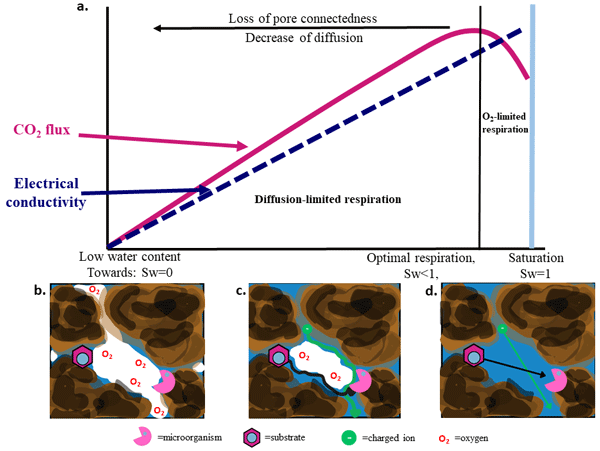
Orsolya Fülöp, Naoise Nunan, Mamadou Gueye, and Damien Jougnot
SOIL, 12, 703–714, https://doi.org/10.5194/soil-12-703-2026, https://doi.org/10.5194/soil-12-703-2026, 2026
Short summary
Short summary
Soil microorganisms play a key role in carbon cycling, yet their activity depends strongly on soil water connectivity. We investigated whether electrical conductivity, a non-destructive geophysical measurement, could provide information about microbial respiration under drying conditions. Our results suggest that electrical conductivity measurements may help better understand diffusion-limited soil respiration.
Julie-Maï Paris, Naoise Nunan, and Xavier Raynaud
EGUsphere, https://doi.org/10.5194/egusphere-2026-1841, https://doi.org/10.5194/egusphere-2026-1841, 2026
Short summary
Short summary
Soil hosts diverse microorganisms forming complex metabolic networks. Their interactions depend on spatial distribution, often overlooked in studies. We propose a new geometric model that show that spatial arrangement affects resource use: density and interaction ranges can alter resource transformations. Spatial structure thus regulates microbial community function and resource transformation in soils.
Maëlle Maestrali, Naoise Nunan, Antsa Sarobidy-Randrianantenaina, Haotian Wu, Steffen A. Schweizer, and Xavier Raynaud
EGUsphere, https://doi.org/10.5194/egusphere-2026-1818, https://doi.org/10.5194/egusphere-2026-1818, 2026
Short summary
Short summary
Soil microorganisms contribute to carbon storage, but their efficacy depends on their environment. We have developed a computer model based on real soil structures to investigate how pore shape, resource location and water content influence microbial behaviour. Small, poorly interconnected pores favour slower but more efficient microorganisms, whilst large, interconnected pores favour fast-growing but less efficient ones, demonstrating that soil structure plays a decisive role in carbon storage.
Orsolya Fülöp, Naoise Nunan, Mamadou Gueye, and Damien Jougnot
SOIL, 12, 703–714, https://doi.org/10.5194/soil-12-703-2026, https://doi.org/10.5194/soil-12-703-2026, 2026
Short summary
Short summary
Soil microorganisms play a key role in carbon cycling, yet their activity depends strongly on soil water connectivity. We investigated whether electrical conductivity, a non-destructive geophysical measurement, could provide information about microbial respiration under drying conditions. Our results suggest that electrical conductivity measurements may help better understand diffusion-limited soil respiration.
Amicie A. Delahaie, Valérie Pouteau, Cédric Plessis, Cyril Girardin, and Claire Chenu
EGUsphere, https://doi.org/10.5194/egusphere-2026-1028, https://doi.org/10.5194/egusphere-2026-1028, 2026
Short summary
Short summary
The Zimmermann fractionation aims at separating soil organic carbon into five fractions. In particular, one fraction (rSOC) is thought to be stable at the millennial scale, but it has never been verified yet, even at shorter timescales. We used a 97-year-old long-term bare fallow experiment to assess the stability of rSOC at the centennial scale. The rSOC content was nearly constant over the 97 years, but did not contain all soil carbon persisting at the centennial scale.
Julie-Maï Paris, Naoise Nunan, and Xavier Raynaud
EGUsphere, https://doi.org/10.5194/egusphere-2026-1841, https://doi.org/10.5194/egusphere-2026-1841, 2026
Short summary
Short summary
Soil hosts diverse microorganisms forming complex metabolic networks. Their interactions depend on spatial distribution, often overlooked in studies. We propose a new geometric model that show that spatial arrangement affects resource use: density and interaction ranges can alter resource transformations. Spatial structure thus regulates microbial community function and resource transformation in soils.
Maëlle Maestrali, Naoise Nunan, Antsa Sarobidy-Randrianantenaina, Haotian Wu, Steffen A. Schweizer, and Xavier Raynaud
EGUsphere, https://doi.org/10.5194/egusphere-2026-1818, https://doi.org/10.5194/egusphere-2026-1818, 2026
Short summary
Short summary
Soil microorganisms contribute to carbon storage, but their efficacy depends on their environment. We have developed a computer model based on real soil structures to investigate how pore shape, resource location and water content influence microbial behaviour. Small, poorly interconnected pores favour slower but more efficient microorganisms, whilst large, interconnected pores favour fast-growing but less efficient ones, demonstrating that soil structure plays a decisive role in carbon storage.
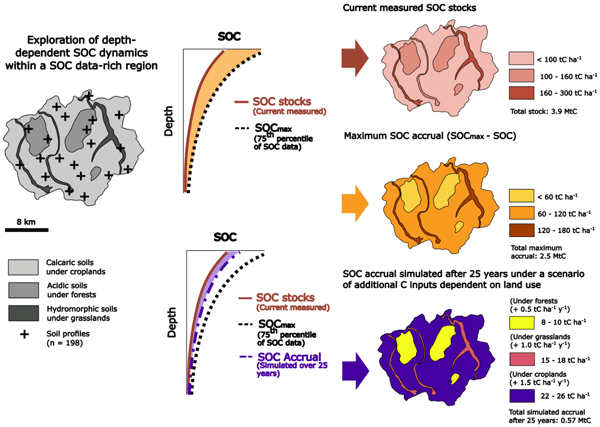
Clémentine Chirol, Geoffroy Séré, Paul-Olivier Redon, Claire Chenu, and Delphine Derrien
SOIL, 11, 149–174, https://doi.org/10.5194/soil-11-149-2025, https://doi.org/10.5194/soil-11-149-2025, 2025
Short summary
Short summary
This work maps both current soil organic carbon (SOC) stocks and the SOC that can be realistically added to soils over 25 years under a scenario of management strategies promoting plant productivity. We consider how soil type influences current and maximum SOC stocks regionally. Over 25 years, land use and management have the strongest influence on SOC accrual, but certain soil types have disproportionate SOC stocks at depths that need to be preserved.
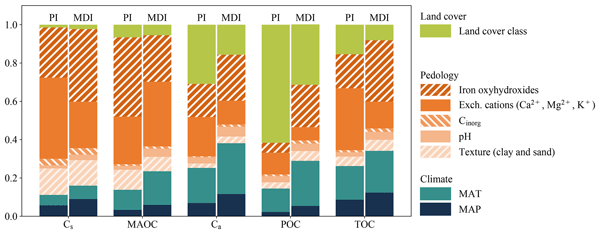
Amicie A. Delahaie, Lauric Cécillon, Marija Stojanova, Samuel Abiven, Pierre Arbelet, Dominique Arrouays, François Baudin, Antonio Bispo, Line Boulonne, Claire Chenu, Jussi Heinonsalo, Claudy Jolivet, Kristiina Karhu, Manuel Martin, Lorenza Pacini, Christopher Poeplau, Céline Ratié, Pierre Roudier, Nicolas P. A. Saby, Florence Savignac, and Pierre Barré
SOIL, 10, 795–812, https://doi.org/10.5194/soil-10-795-2024, https://doi.org/10.5194/soil-10-795-2024, 2024
Short summary
Short summary
This paper compares the soil organic carbon fractions obtained from a new thermal fractionation scheme and a well-known physical fractionation scheme on an unprecedented dataset of French topsoil samples. For each fraction, we use a machine learning model to determine its environmental drivers (pedology, climate, and land cover). Our results suggest that these two fractionation schemes provide different fractions, which means they provide complementary information.
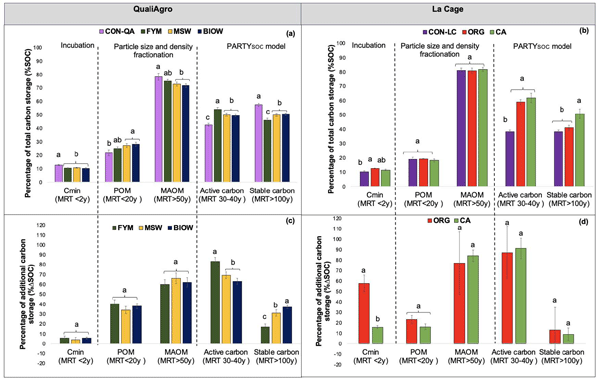
Tchodjowiè P. I. Kpemoua, Pierre Barré, Sabine Houot, François Baudin, Cédric Plessis, and Claire Chenu
SOIL, 10, 533–549, https://doi.org/10.5194/soil-10-533-2024, https://doi.org/10.5194/soil-10-533-2024, 2024
Short summary
Short summary
Several agroecological management options foster soil organic C stock accrual. What is behind the persistence of this "additional" C? We used three different methodological approaches and >20 years of field experiments under temperate conditions to find out. We found that the additional C is less stable at the pluri-decadal scale than the baseline C. This highlights the need to maintain agroecological practices to keep these carbon stocks at a high level over time.
Amicie A. Delahaie, Pierre Barré, François Baudin, Dominique Arrouays, Antonio Bispo, Line Boulonne, Claire Chenu, Claudy Jolivet, Manuel P. Martin, Céline Ratié, Nicolas P. A. Saby, Florence Savignac, and Lauric Cécillon
SOIL, 9, 209–229, https://doi.org/10.5194/soil-9-209-2023, https://doi.org/10.5194/soil-9-209-2023, 2023
Short summary
Short summary
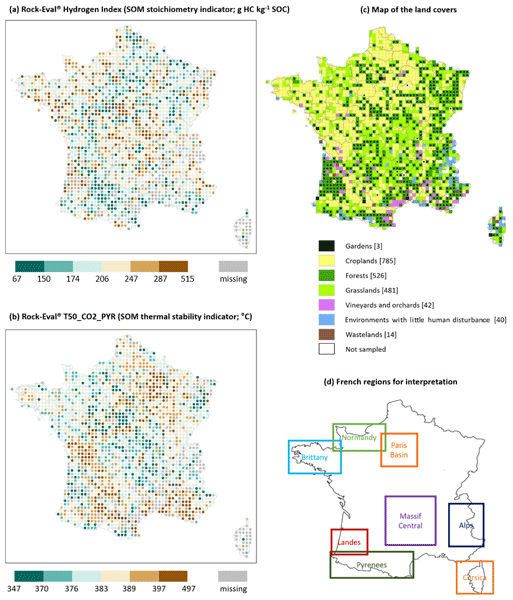
We characterized organic matter in French soils by analysing samples from the French RMQS network using Rock-Eval thermal analysis. We found that thermal analysis is appropriate to characterize large set of samples (ca. 2000) and provides interpretation references for Rock-Eval parameter values. This shows that organic matter in managed soils is on average more oxidized and more thermally stable and that some Rock-Eval parameters are good proxies for organic matter biogeochemical stability.
Eva Kanari, Lauric Cécillon, François Baudin, Hugues Clivot, Fabien Ferchaud, Sabine Houot, Florent Levavasseur, Bruno Mary, Laure Soucémarianadin, Claire Chenu, and Pierre Barré
Biogeosciences, 19, 375–387, https://doi.org/10.5194/bg-19-375-2022, https://doi.org/10.5194/bg-19-375-2022, 2022
Short summary
Short summary
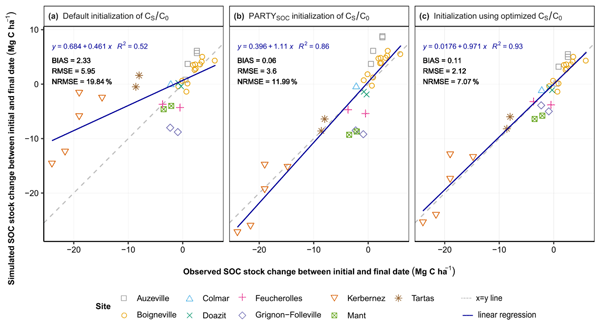
Soil organic carbon (SOC) is crucial for climate regulation, soil quality, and food security. Predicting its evolution over the next decades is key for appropriate land management policies. However, SOC projections lack accuracy. Here we show for the first time that PARTYSOC, an approach combining thermal analysis and machine learning optimizes the accuracy of SOC model simulations at independent sites. This method can be applied at large scales, improving SOC projections on a continental scale.
Cited articles
Autret, B., Guillier, H., Pouteau, V., Mary, B., and Chenu, C.: Similar specific mineralization rates of organic carbon and nitrogen in incubated soils under contrasted arable cropping systems, Soil Tillage Res., 204, 104712, https://doi.org/10.1016/j.still.2020.104712, 2020.
Avila-Diaz, A., Benezoli, V., Justino, F., Torres, R., and Wilson, A.: Assessing current and future trends of climate extremes across Brazil based on reanalyses and earth system model projections, Clim. Dynam., 55, 1403–1426, https://doi.org/10.1007/s00382-020-05333-z, 2020.
Bernoux, M., Da Conceição Santana Carvalho, M., Volkoff, B., and Cerri, C. C.: Brazil's Soil Carbon Stocks, Soil Sci. Soc. Am. J., 66, 888–896, https://doi.org/10.2136/sssaj2002.8880, 2002.
Boulton, C. A., Lenton, T. M., and Boers, N.: Pronounced loss of Amazon rainforest resilience since the early 2000s, Nat. Clim. Change, 12, 271–278, https://doi.org/10.1038/s41558-022-01287-8, 2022.
Chen, L., Liu, L., Qin, S., Yang, G., Fang, K., Zhu, B., Kuzyakov, Y., Chen, P., Xu, Y., and Yang, Y.: Regulation of priming effect by soil organic matter stability over a broad geographic scale, Nat. Commun., 10, 5112, https://doi.org/10.1038/s41467-019-13119-z, 2019.
Chenu, C., Pouteau, V., and Nunan, N.: Pore scale microbial biogeography across different soil types, Soil Biol. Biochem., 109896, https://doi.org/10.1016/j.soilbio.2025.109896, 2025.
Davidson, E. A., Trumbore, S. E., and Amundson, R.: Biogeochemistry – Soil warming and organic carbon content, Nature, 408, 789–790, 2000.
Davidson, E. A., Savage, K. E., and Finzi, A. C.: A big-microsite framework for soil carbon modeling, Glob. Change Biol., 20, 3610–3620, 2014.
Doupoux, C., Merdy, P., Montes, C. R., Nunan, N., Melfi, A. J., Pereira, O. J. R., and Lucas, Y.: Modelling the genesis of equatorial podzols: age and implications for carbon fluxes, Biogeosciences, 14, 2429–2440, https://doi.org/10.5194/bg-14-2429-2017, 2017.
Fairbairn, L., Rezanezhad, F., Gharasoo, M., Parsons, C. T., Macrae, M. L., Slowinski, S., and Van Cappellen, P.: Relationship between soil CO2 fluxes and soil moisture: Anaerobic sources explain fluxes at high water content, Geoderma, 434, 116493, https://doi.org/10.1016/j.geoderma.2023.116493, 2023.
Fierer, N., Allen, A. S., Schimel, J. P., and Holden, P. A.: Controls on microbial CO2 production: a comparison of surface and subsurface soil horizons, Glob. Change Biol., 9, 1322–1332, 2003.
Flores, B. M., Montoya, E., Sakschewski, B., Nascimento, N., Staal, A., Betts, R. A., Levis, C., Lapola, D. M., Esquível-Muelbert, A., Jakovac, C., Nobre, C. A., Oliveira, R. S., Borma, L. S., Nian, D., Boers, N., Hecht, S. B., Ter Steege, H., Arieira, J., Lucas, I. L., Berenguer, E., Marengo, J. A., Gatti, L. V., Mattos, C. R. C., and Hirota, M.: Critical transitions in the Amazon forest system, Nature, 626, 555–564, https://doi.org/10.1038/s41586-023-06970-0, 2024.
Fontaine, S., Barot, S., Barre, P., Bdioui, N., Mary, B., and Rumpel, C.: Stability of organic carbon in deep soil layers controlled by fresh carbon supply, Nature, 450, 277–280, https://doi.org/10.1038/nature06275, 2007.
Galloway, J. N., Dentener, F. J., Capone, D. G., Boyer, E. W., Howarth, R. W., Seitzinger, S. P., Asner, G. P., Cleveland, C. C., Green, P. A., Holland, E. A., Karl, D. M., Michaels, A. F., Porter, J. H., Townsend, A. R., and Vöosmarty, C. J.: Nitrogen Cycles: Past, Present, and Future, Biogeochemistry, 70, 153–226, https://doi.org/10.1007/s10533-004-0370-0, 2004.
Galloway, J. N., Townsend, A. R., Erisman, J. W., Bekunda, M., Cai, Z., Freney, J. R., Martinelli, L. A., Seitzinger, S. P., and Sutton, M. A.: Transformation of the Nitrogen Cycle: Recent Trends, Questions, and Potential Solutions, Science, 320, 889–892, https://doi.org/10.1126/science.1136674, 2008.
Haddix, M. L., Gregorich, E. G., Helgason, B. L., Janzen, H., Ellert, B. H., and Francesca Cotrufo, M.: Climate, carbon content, and soil texture control the independent formation and persistence of particulate and mineral-associated organic matter in soil, Geoderma, 363, 114160, https://doi.org/10.1016/j.geoderma.2019.114160, 2020.
Hamer, U. and Marschner, B.: Priming effects in soils after combined and repeated substrate additions, Geoderma, 128, 38–51. https://doi.org/10.1016/j.geoderma.2004.12.014, 2005.
He, Y., Ding, J., Dorji, T., Wang, T., Li, J., and Smith, P.: Observation-based global soil heterotrophic respiration indicates underestimated turnover and sequestration of soil carbon by terrestrial ecosystem models, Glob. Change Biol., 28, 5547–5559, https://doi.org/10.1111/gcb.16286, 2022.
Juarez, S., Nunan, N., Duday, A.-C., Pouteau, V., Schmidt, S., Hapca, S., Falconer, R., Otten, W., and Chenu, C.: Effects of different soil structures on the decomposition of native and added organic carbon, Eur. J. Soil Biol., 58, 81–90, https://doi.org/10.1016/j.ejsobi.2013.06.005, 2013.
Kaiser, K., Guggenberger, G., Haumaier, L., and Zech, W.: Seasonal variations in the chemical composition of dissolved organic matter in organic forest floor layer leachates of old-growth Scots pine (Pinus sylvestris L.) and European beech (Fagus sylvatica L.) stands in northeastern Bavaria, Germany, Biogeochemistry, 55, 103–143. https://doi.org/10.1023/A:1010694032121, 2001.
Kan, Z.-R., He, C., Liu, Q.-Y., Liu, B.-Y., Virk, A. L., Qi, J.-Y., Zhao, X., and Zhang, H.-L.: Carbon mineralization and its temperature sensitivity under no-till and straw returning in a wheat-maize cropping system, Geoderma, 377, 114610, https://doi.org/10.1016/j.geoderma.2020.114610, 2020.
Karhu, K., Auffret, M. D., Dungait, J. A. J., Hopkins, D. W., Prosser, J. I., Singh, B. K., Subke, J.-A., Wookey, P. A., Ågren, G. I., Sebastià, M.-T., Gouriveau, F., Bergkvist, G., Meir, P., Nottingham, A. T., Salinas, N., and Hartley, I. P.: Temperature sensitivity of soil respiration rates enhanced by microbial community response, Nature, 513, 81–84, https://doi.org/10.1038/nature13604, 2014.
Lin, Y., Campbell, A. N., Bhattacharyya, A., DiDonato, N., Thompson, A. M., Tfaily, M. M., Nico, P. S., Silver, W. L., and Pett-Ridge, J.: Differential effects of redox conditions on the decomposition of litter and soil organic matter, Biogeochemistry, 154, 1–15, https://doi.org/10.1007/s10533-021-00790-y, 2021.
Linn, D. M. and Doran, J. W.: Effect of Water-Filled Pore Space on Carbon Dioxide and Nitrous Oxide Production in Tilled and Nontilled Soils, Soil Sci. Soc. Am. J., 48, 1267–1272, https://doi.org/10.2136/sssaj1984.03615995004800060013x, 1984.
Malhi, Y., Wood, D., Baker, T. R., Wright, J., Phillips, O. L., Cochrane, T., Meir, P., Chave, J., Almeida, S., Arroyo, L., Higuchi, N., Killeen, T. J., Laurance, S. G., Laurance, W. F., Lewis, S. L., Monteagudo, A., Neill, D. A., Vargas, P. N., Pitman, N. C. A., Quesada, C. A., Salomao, R., Silva, J. N. M., Lezama, A. T., Terborgh, J., Martinez, R. V., and Vinceti, B.: The regional variation of aboveground live biomass in old-growth Amazonian forests, Glob. Change Biol., 12, 1107–1138, https://doi.org/10.1111/j.1365-2486.2006.01120.x, 2006.
Manzoni, S., Piñeiro, G., Jackson, R. B., Jobbágy, E. G., Kim, J. H., and Porporato, A.: Analytical models of soil and litter decomposition: Solutions for mass loss and time-dependent decay rates, Soil Biol. Biochem., 50, 66–76, https://doi.org/10.1016/j.soilbio.2012.02.029, 2012.
Marengo, J. A., Cunha, A. P., Espinoza, J. C., Fu, R., Schöngart, J., Jimenez, J. C., Costa M. C., Ribeiro, J. M., Wongchuig, S., and Zhao, S.: The Drought of Amazonia in 2023–2024, Am. J. Climate Change, 13, 567–597, 2024.
Montes, C. R., Lucas, Y., Pereira, O. J. R., Achard, R., Grimaldi, M., and Melfi, A. J.: Deep plant-derived carbon storage in Amazonian podzols, Biogeosciences, 8, 113–120, https://doi.org/10.5194/bg-8-113-2011, 2011.
Montes, C. R., Merdy, P., Da Silva, W. T. L., Ishida, D., Melfi, A. J., Santin, R. C., and Lucas, Y.: Mineralization of soil organic matter from equatorial giant podzols submitted to drier pedoclimate: A drainage topochronosequence study, CATENA, 222, 106837, https://doi.org/10.1016/j.catena.2022.106837, 2023.
Moorhead, D. L. and Sinsabaugh, R. L.: A theoretical model of litter decay and microbial interaction, Ecol. Monogr., 76, 151–174, https://doi.org/10.1890/0012-9615(2006)076[0151:ATMOLD]2.0.CO;2, 2006.
Moyano, F. E., Vasilyeva, N., Bouckaert, L., Cook, F., Craine, J., Curiel Yuste, J., Don, A., Epron, D., Formanek, P., Franzluebbers, A., Ilstedt, U., Kätterer, T., Orchard, V., Reichstein, M., Rey, A., Ruamps, L., Subke, J.-A., Thomsen, I. K., and Chenu, C.: The moisture response of soil heterotrophic respiration: interaction with soil properties, Biogeosciences, 9, 1173–1182, https://doi.org/10.5194/bg-9-1173-2012, 2012.
Nunan, N.: Amazonian Podzols – a carbon time bomb? – dataset, Zenodo [data set], https://doi.org/10.5281/zenodo.15824641, 2025.
Nunan, N., Schmidt, H., and Raynaud, X.: The ecology of heterogeneity: soil bacterial communities and C dynamics, Philos. Trans. R. Soc. B Biol. Sci., 375, 20190249, https://doi.org/10.1098/rstb.2019.0249, 2020.
Quesada, C. A., Lloyd, J., Anderson, L. O., Fyllas, N. M., Schwarz, M., and Czimczik, C. I.: Soils of Amazonia with particular reference to the RAINFOR sites, Biogeosciences, 8, 1415–1440, https://doi.org/10.5194/bg-8-1415-2011, 2011.
R Core Team: R: A language and environment for statistical computing, R Foundation for Statistical Computing, Vienna, Austria, https://www.R-project.org/ (last access: 6 February 2026), 2022.
Rovira, A. and Greacen, E.: The effect of aggregate disruption on the activity of microorganisms in the soil, Aust. J. Agric. Res., 8, 659, https://doi.org/10.1071/AR9570659, 1957.
Ruamps, L. S., Nunan, N., and Chenu, C.: Microbial biogeography at the soil pore scale, Soil Biol. Biochem., 43, 280–286, https://doi.org/10.1016/j.soilbio.2010.10.010, 2011.
Salomé, C., Nunan, N., Pouteau, V., Lerch, T. Z., and Chenu, C.: Carbon dynamics in topsoil and in subsoil may be controlled by different regulatory mechanisms, Glob. Change Biol., 16, 416–426, 2010.
Schmidt, M. W. I., Knicker, H., and Kögel-Knabner, I.: Organic matter accumulating in Aeh and Bh horizons of a Podzol – chemical characterization in primary organo-mineral associations, Org. Geochem., 31, 727–734, https://doi.org/10.1016/S0146-6380(00)00045-0, 2000.
Sierra, C. A., Jiménez, E. M., Reu, B., Peñuela, M. C., Thuille, A., and Quesada, C. A.: Low vertical transfer rates of carbon inferred from radiocarbon analysis in an Amazon Podzol, Biogeosciences, 10, 3455–3464, https://doi.org/10.5194/bg-10-3455-2013, 2013.
Sierra, C. A., Malghani, S., and Loescher, H. W.: Interactions among temperature, moisture, and oxygen concentrations in controlling decomposition rates in a boreal forest soil, Biogeosciences, 14, 703–710, https://doi.org/10.5194/bg-14-703-2017, 2017.
Vaughn, L. J. S. and Torn, M. S.: 14C evidence that millennial and fast-cycling soil carbon are equally sensitive to warming, Nat. Clim. Change, 9, 467–471, https://doi.org/10.1038/s41558-019-0468-y, 2019.
Wang, C. and Kuzyakov, Y.: Soil organic matter priming: The pH effects, Glob. Change Biol., 30, e17349, https://doi.org/10.1111/gcb.17349, 2024.
Xiong, Y., D'Atri, J. J., Fu, S., Xia, H., and Seastedt, T. R.: Rapid soil organic matter loss from forest dieback in a subalpine coniferous ecosystem, Soil Biol. Biochem., 43, 2450–2456, https://doi.org/10.1016/j.soilbio.2011.08.013, 2011.
Short summary
The vulnerability to decomposition of organic C in Amazonian podzols as a result of predicted drier soil moisture regimes was tested: more than four times as much CO2 was released from soils under oxic conditions with the addition of N relative to soils under the prevailing anoxic conditions. An extrapolation of the data to the whole of the Amazonian podzols suggests that this increased C-CO2 flux to the atmosphere could be equivalent to 8 % of the current net global C flux to the atmosphere.
The vulnerability to decomposition of organic C in Amazonian podzols as a result of predicted...


Altmetrics
Final-revised paper
Preprint