
Articles | Volume 23, issue 7
https://doi.org/10.5194/bg-23-2477-2026
© Author(s) 2026. This work is distributed under
the Creative Commons Attribution 4.0 License.
the Creative Commons Attribution 4.0 License.
https://doi.org/10.5194/bg-23-2477-2026
© Author(s) 2026. This work is distributed under
the Creative Commons Attribution 4.0 License.
the Creative Commons Attribution 4.0 License.
Research article
| 
15 Apr 2026
Research article |
| 15 Apr 2026
| 15 Apr 2026
Worms and storms: shedding light on bioturbation and physical mixing on an intertidal flat by combining multiple tracers
Tjitske J. Kooistra
CORRESPONDING AUTHOR

Royal Netherlands Institute for Sea Research, Department of Estuarine and Delta Systems, Korringaweg 7, 4401 NT Yerseke, the Netherlands
Faculty of Geoscience, Utrecht University, Princetonlaan 8a, 3584 CB Utrecht, the Netherlands
Anna-Maartje de Boer
Wageningen University and Research, Soil Geography and Landscape group & Netherlands Centre for Luminescence dating, Droevendaalsesteeg 3, 6708 PB Wageningen, the Netherlands
Tjeerd J. Bouma
Royal Netherlands Institute for Sea Research, Department of Estuarine and Delta Systems, Korringaweg 7, 4401 NT Yerseke, the Netherlands
Faculty of Geoscience, Utrecht University, Princetonlaan 8a, 3584 CB Utrecht, the Netherlands
Natascia Pannozzo
Faculty of Civil Engineering and Geosciences, Delft University of Technology, Stevinweg 1, 2628 CN Delft, the Netherlands
Stuart G. Pearson
Faculty of Civil Engineering and Geosciences, Delft University of Technology, Stevinweg 1, 2628 CN Delft, the Netherlands
Ad van der Spek
Deltares, Boussinesqweg 1, 2629 HV Delft, the Netherlands
Henko de Stigter
Royal Netherlands Institute for Sea Research, Department of Ocean Systems, Landsdiep 4, 1797 SZ 't Horntje, the Netherlands
Jakob Wallinga
Wageningen University and Research, Soil Geography and Landscape group & Netherlands Centre for Luminescence dating, Droevendaalsesteeg 3, 6708 PB Wageningen, the Netherlands
Rob Witbaard
Royal Netherlands Institute for Sea Research, Department of Estuarine and Delta Systems, Korringaweg 7, 4401 NT Yerseke, the Netherlands
Karline Soetaert
Royal Netherlands Institute for Sea Research, Department of Estuarine and Delta Systems, Korringaweg 7, 4401 NT Yerseke, the Netherlands
Faculty of Geoscience, Utrecht University, Princetonlaan 8a, 3584 CB Utrecht, the Netherlands
Related authors
No articles found.
Emil De Borger, Karline Soetaert, Esther Cepeda Gamella, Arthur Capet, Jan Vanaverbeke, and Ulrike Braeckman
EGUsphere, https://doi.org/10.5194/egusphere-2026-3576, https://doi.org/10.5194/egusphere-2026-3576, 2026
This preprint is open for discussion and under review for Biogeosciences (BG).
Short summary
Short summary
We developed a new computer model to better understand how sandy seabed sediments process organic matter. Then, we used field measurements around an offshore wind turbine in the North Sea to guide model simulations. It showed that sediments closest to turbines receive more organic material throughout the year, that is efficiently processed. This modelling approach improves our ability to quantify seabed carbon cycling in dynamic coastal environments.
Qi Liu, Karline Soetaert, Lucille Hoogerdijk, Valle Perez-Rodriguez, and Lubos Polerecky
EGUsphere, https://doi.org/10.5194/egusphere-2026-4452, https://doi.org/10.5194/egusphere-2026-4452, 2026
Short summary
Short summary
Coastal mudflats store carbon and recycle nutrients, but their functioning is strongly affected by changing environmental conditions. We developed a computer model, supported by laboratory measurements, to predict how oxygen changes under different light, temperature, and tidal conditions. Our results identify the main processes controlling oxygen cycling and provide an open-source tool for predicting how coastal ecosystems may respond to environmental change.
Olivier Beauchard and Karline Soetaert
Earth Syst. Sci. Data Discuss., https://doi.org/10.5194/essd-2026-444, https://doi.org/10.5194/essd-2026-444, 2026
Revised manuscript accepted for ESSD
Short summary
Short summary
Biological trait data often represent the bottleneck of biodiversity research. Given the growing demand for such data and the absence of worldwide data standard for the marine benthos, we propose a detailed terminology and provide a corresponding data base that covers the ecology of 1893 marine invertebrate species for 41 traits expressing life history, dwelling mode and ecosystem function.
Kees Nederhoff, Kevin de Bruijn, Carola Seyfert, Li Erikson, Stuart Pearson, Robert McCall, Ferdinand Oberle, and Tom Ravens
EGUsphere, https://doi.org/10.5194/egusphere-2026-2371, https://doi.org/10.5194/egusphere-2026-2371, 2026
Short summary
Short summary
Arctic coastlines are eroding rapidly as the climate warms, with some stretches retreating several metres per year and threatening homes in Alaska. We built Arctic-XBeach, an open-source model linking the thawing of frozen ground to wave-driven coastal change. By updating the coast only during storms, it runs fast enough for multi-year projections. Tested at Barter Island, Alaska, it reproduced ground temperatures and shoreline retreat, offering a tool for Arctic coastal planning.
Marilaure Grégoire, Luc Vandenbulcke, Séverine Chevalier, Mathurin Choblet, Ilya Drozd, Jean-François Grailet, Evgeny Ivanov, Loïc Macé, Polina Verezemskaya, Haolin Yu, Lauranne Alaerts, Ny Riana Randresihaja, Victor Mangeleer, Guillaume Maertens de Noordhout, Arthur Capet, Catherine Meulders, Anne Mouchet, Guy Munhoven, and Karline Soetaert
Geosci. Model Dev., 19, 2137–2175, https://doi.org/10.5194/gmd-19-2137-2026, https://doi.org/10.5194/gmd-19-2137-2026, 2026
Short summary
Short summary
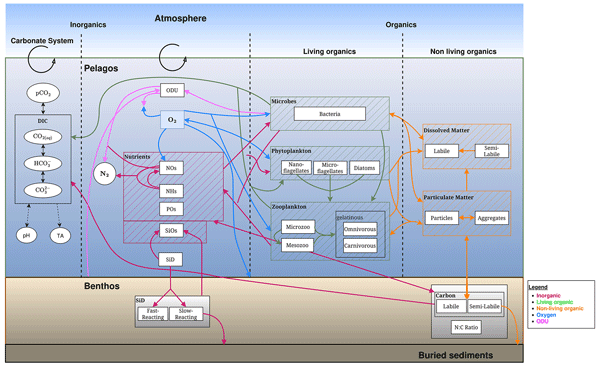
This paper describes the ocean BiogeochemicAl Model for Hypoxic and Benthic Influenced areas (BAMHBI). BAMHBI is a moderate complexity marine biogeochemical model that describes the cycling of carbon, nitrogen, phosphorus, silicon and oxygen through the marine foodweb. BAMHBI is a stand-alone biogeochemical model that can be coupled to any hydrodynamical model and is particularly appropriate for modelling low oxygen environments and the generation of sulfidic waters.
Evert de Froe, Christian Mohn, Karline Soetaert, Anna-Selma van der Kaaden, Gert-Jan Reichart, Laurence H. De Clippele, Sandra R. Maier, and Dick van Oevelen
Ocean Sci., 22, 843–870, https://doi.org/10.5194/os-22-843-2026, https://doi.org/10.5194/os-22-843-2026, 2026
Short summary
Short summary
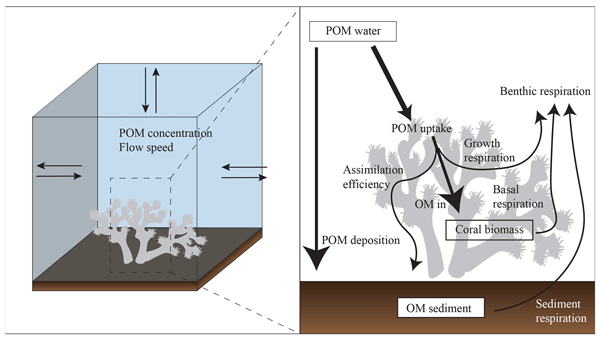
Cold-water corals are important reef-building animals in the deep sea and are distributed globally. Until now, scientists have been mapping and predicting where cold-water corals can be found using video transects and statistical models. This study provides the first process-based model in which corals are predicted based on ocean currents and food particle movement. The results show that resupply of food by tidal currents near the seafloor is crucial for predicting where corals can grow.
Marius Buydens, Emil De Borger, Lorenz Meire, Samuel Bodé, Antonio Schirone, Karline Soetaert, Ann Vanreusel, and Ulrike Braeckman
Biogeosciences, 23, 1159–1179, https://doi.org/10.5194/bg-23-1159-2026, https://doi.org/10.5194/bg-23-1159-2026, 2026
Short summary
Short summary
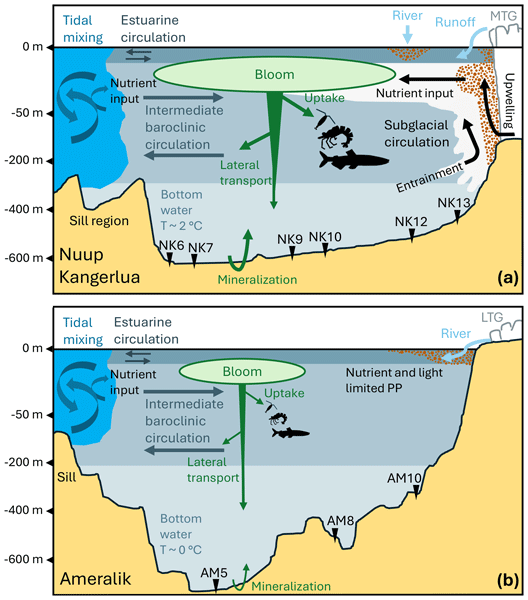
As the Greenland Ice Sheet retreats, it is crucial to understand how this affects carbon burial in fjords. Comparing a fjord influenced by marine-terminating glaciers with one fed by a land-terminating glacier shows that high productivity near marine-terminating glaciers does not necessarily enhance carbon burial. Instead, the complex interplay of physical, biological, and sedimentary processes governs fjord carbon dynamics.
Robert McCall, Curt Storlazzi, Floortje Roelvink, Stuart G. Pearson, Roel de Goede, and José A. Á. Antolínez
Nat. Hazards Earth Syst. Sci., 24, 3597–3625, https://doi.org/10.5194/nhess-24-3597-2024, https://doi.org/10.5194/nhess-24-3597-2024, 2024
Short summary
Short summary
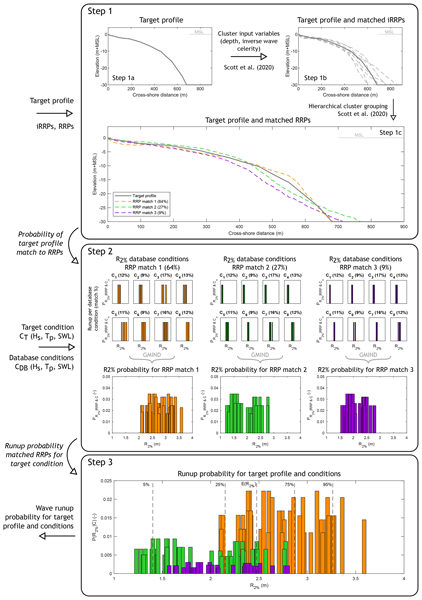
Accurate predictions of wave-driven flooding are essential to manage risk on low-lying, reef-lined coasts. Models to provide this information are, however, computationally expensive. We present and validate a modeling system that simulates flood drivers on diverse and complex reef-lined coasts as competently as a full-physics model but at a fraction of the computational cost to run. This development paves the way for application in large-scale early-warning systems and flood risk assessments.
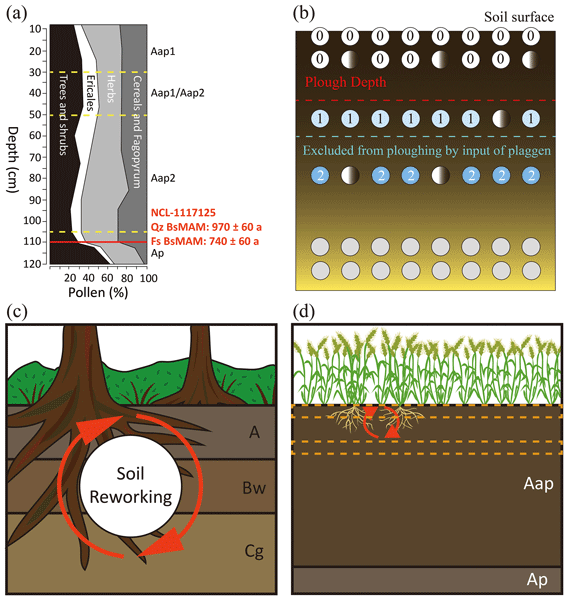
Jungyu Choi, Roy van Beek, Elizabeth L. Chamberlain, Tony Reimann, Harm Smeenge, Annika van Oorschot, and Jakob Wallinga
SOIL, 10, 567–586, https://doi.org/10.5194/soil-10-567-2024, https://doi.org/10.5194/soil-10-567-2024, 2024
Short summary
Short summary
This research applies luminescence dating methods to a plaggic anthrosol in the eastern Netherlands to understand the formation history of the soil. To achieve this, we combined both quartz and feldspar luminescence dating methods. We developed a new method for feldspar to largely avoid the problem occurring from poorly bleached grains by examining two different signals from a single grain. Through our research, we were able to reconstruct the timing and processes of plaggic anthrosol formation.
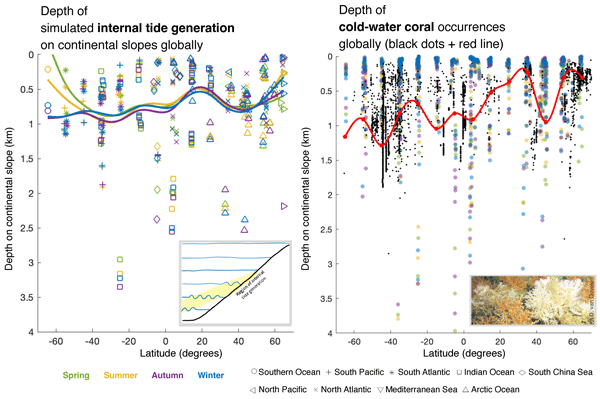
Anna-Selma van der Kaaden, Dick van Oevelen, Christian Mohn, Karline Soetaert, Max Rietkerk, Johan van de Koppel, and Theo Gerkema
Ocean Sci., 20, 569–587, https://doi.org/10.5194/os-20-569-2024, https://doi.org/10.5194/os-20-569-2024, 2024
Short summary
Short summary
Cold-water corals (CWCs) and tidal waves in the interior of the ocean have been connected in case studies. We demonstrate this connection globally using hydrodynamic simulations and a CWC database. Internal-tide generation shows a similar depth pattern with slope steepness and latitude as CWCs. Our results suggest that internal-tide generation can be a useful predictor of CWC habitat and that current CWC habitats might change following climate-change-related shoaling of internal-tide generation.
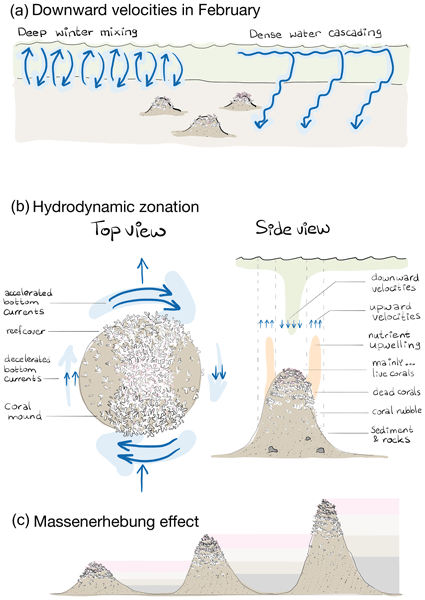
Anna-Selma van der Kaaden, Sandra R. Maier, Siluo Chen, Laurence H. De Clippele, Evert de Froe, Theo Gerkema, Johan van de Koppel, Furu Mienis, Christian Mohn, Max Rietkerk, Karline Soetaert, and Dick van Oevelen
Biogeosciences, 21, 973–992, https://doi.org/10.5194/bg-21-973-2024, https://doi.org/10.5194/bg-21-973-2024, 2024
Short summary
Short summary
Combining hydrodynamic simulations and annotated videos, we separated which hydrodynamic variables that determine reef cover are engineered by cold-water corals and which are not. Around coral mounds, hydrodynamic zones seem to create a typical reef zonation, restricting corals from moving deeper (the expected response to climate warming). But non-engineered downward velocities in winter (e.g. deep winter mixing) seem more important for coral reef growth than coral engineering.
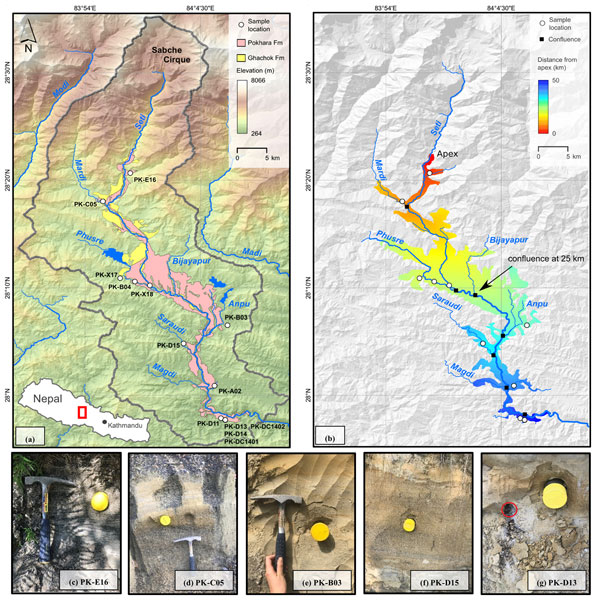
Anna-Maartje de Boer, Wolfgang Schwanghart, Jürgen Mey, Basanta Raj Adhikari, and Tony Reimann
Geochronology, 6, 53–70, https://doi.org/10.5194/gchron-6-53-2024, https://doi.org/10.5194/gchron-6-53-2024, 2024
Short summary
Short summary
This study tested the application of single-grain feldspar luminescence for dating and reconstructing sediment dynamics of an extreme mass movement event in the Himalayan mountain range. Our analysis revealed that feldspar signals can be used to estimate the age range of the deposits if the youngest subpopulation from a sample is retrieved. The absence of clear spatial relationships with our bleaching proxies suggests that sediments were transported under extremely limited light exposure.
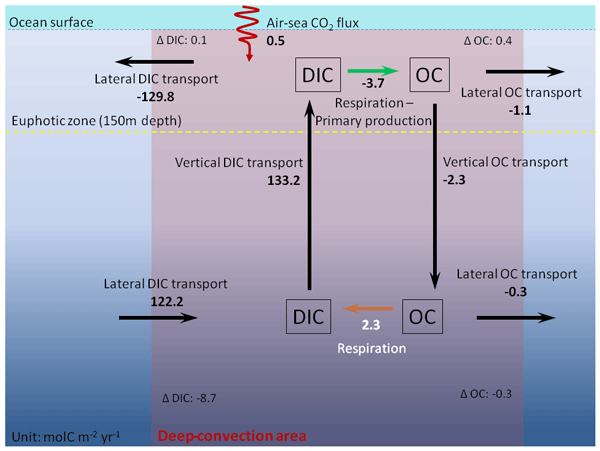
Caroline Ulses, Claude Estournel, Patrick Marsaleix, Karline Soetaert, Marine Fourrier, Laurent Coppola, Dominique Lefèvre, Franck Touratier, Catherine Goyet, Véronique Guglielmi, Fayçal Kessouri, Pierre Testor, and Xavier Durrieu de Madron
Biogeosciences, 20, 4683–4710, https://doi.org/10.5194/bg-20-4683-2023, https://doi.org/10.5194/bg-20-4683-2023, 2023
Short summary
Short summary
Deep convection plays a key role in the circulation, thermodynamics, and biogeochemical cycles in the Mediterranean Sea, considered to be a hotspot of biodiversity and climate change. In this study, we investigate the seasonal and annual budget of dissolved inorganic carbon in the deep-convection area of the northwestern Mediterranean Sea.
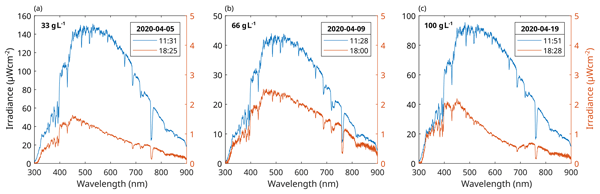
Jürgen Mey, Wolfgang Schwanghart, Anna-Maartje de Boer, and Tony Reimann
Geochronology, 5, 377–389, https://doi.org/10.5194/gchron-5-377-2023, https://doi.org/10.5194/gchron-5-377-2023, 2023
Short summary
Short summary
This study presents the results of an outdoor flume experiment to evaluate the effect of turbidity on the bleaching of fluvially transported sediment. Our main conclusions are that even small amounts of sediment lead to a substantial change in the intensity and frequency distribution of light within the suspension and that flow turbulence is an important prerequisite for bleaching grains during transport.

Cindy Quik, Ype van der Velde, Jasper H. J. Candel, Luc Steinbuch, Roy van Beek, and Jakob Wallinga
Biogeosciences, 20, 695–718, https://doi.org/10.5194/bg-20-695-2023, https://doi.org/10.5194/bg-20-695-2023, 2023
Short summary
Short summary
In NW Europe only parts of former peatlands remain. When these peatlands formed is not well known but relevant for questions on landscape, climate and archaeology. We investigated the age of Fochteloërveen, using radiocarbon dating and modelling. Results show that peat initiated at several sites 11 000–7000 years ago and expanded rapidly 5000 years ago. Our approach may ultimately be applied to model peat ages outside current remnants and provide a view of these lost landscapes.
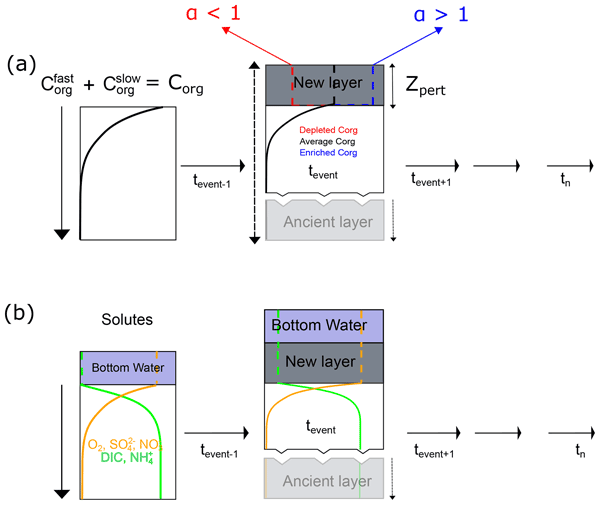
Stanley I. Nmor, Eric Viollier, Lucie Pastor, Bruno Lansard, Christophe Rabouille, and Karline Soetaert
Geosci. Model Dev., 15, 7325–7351, https://doi.org/10.5194/gmd-15-7325-2022, https://doi.org/10.5194/gmd-15-7325-2022, 2022
Short summary
Short summary
The coastal marine environment serves as a transition zone in the land–ocean continuum and is susceptible to episodic phenomena such as flash floods, which cause massive organic matter deposition. Here, we present a model of sediment early diagenesis that explicitly describes this type of deposition while also incorporating unique flood deposit characteristics. This model can be used to investigate the temporal evolution of marine sediments following abrupt changes in environmental conditions.
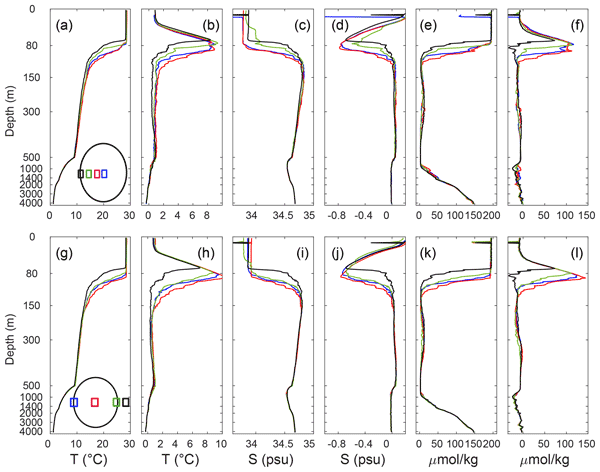
Kaveh Purkiani, Matthias Haeckel, Sabine Haalboom, Katja Schmidt, Peter Urban, Iason-Zois Gazis, Henko de Stigter, André Paul, Maren Walter, and Annemiek Vink
Ocean Sci., 18, 1163–1181, https://doi.org/10.5194/os-18-1163-2022, https://doi.org/10.5194/os-18-1163-2022, 2022
Short summary
Short summary
Based on altimetry data and in situ hydrographic observations, the impacts of an anticyclone mesoscale eddy (large rotating body of water) on the seawater characteristics were investigated during a research campaign. The particular eddy presents significant anomalies on the seawater properties at 1500 m. The potential role of eddies in the seafloor and its consequential effect on the altered dispersion of mining-related sediment plumes are important to assess future mining operations.
Xue Chen, Zeng Zhou, Qiang He, Heyue Zhang, Tjeerd Bouma, Zheng Gong, Ian Townend, and Changkuan Zhang
EGUsphere, https://doi.org/10.5194/egusphere-2022-280, https://doi.org/10.5194/egusphere-2022-280, 2022
Preprint withdrawn
Short summary
Short summary
We carry out a two-year continuous observation in the northern Jiangsu Coast. Our results show that: The distribution of crab burrows was unimodal across the shore in cold seasons, and bimodal in warm seasons. The density of crab burrows was lower in sites with stronger hydrodynamics and lower suspended sediment concentration. The governing factors of crab burrow distribution in cold seasons were organic matter content and soil salinity, while in warm seasons water content also played a role.
Olivier Gourgue, Jim van Belzen, Christian Schwarz, Wouter Vandenbruwaene, Joris Vanlede, Jean-Philippe Belliard, Sergio Fagherazzi, Tjeerd J. Bouma, Johan van de Koppel, and Stijn Temmerman
Earth Surf. Dynam., 10, 531–553, https://doi.org/10.5194/esurf-10-531-2022, https://doi.org/10.5194/esurf-10-531-2022, 2022
Short summary
Short summary
There is an increasing demand for tidal-marsh restoration around the world. We have developed a new modeling approach to reduce the uncertainty associated with this development. Its application to a real tidal-marsh restoration project in northwestern Europe illustrates how the rate of landscape development can be steered by restoration design, with important consequences for restored tidal-marsh resilience to increasing sea level rise and decreasing sediment supply.

Justin C. Tiano, Jochen Depestele, Gert Van Hoey, João Fernandes, Pieter van Rijswijk, and Karline Soetaert
Biogeosciences, 19, 2583–2598, https://doi.org/10.5194/bg-19-2583-2022, https://doi.org/10.5194/bg-19-2583-2022, 2022
Short summary
Short summary
This study gives an assessment of bottom trawling on physical, chemical, and biological characteristics in a location known for its strong currents and variable habitats. Although trawl gears only removed the top 1 cm of the seabed surface, impacts on reef-building tubeworms significantly decreased carbon and nutrient cycling. Lighter trawls slightly reduced the impact on fauna and nutrients. Tubeworms were strongly linked to biogeochemical and faunal aspects before but not after trawling.
Alice E. Webb, Didier M. de Bakker, Karline Soetaert, Tamara da Costa, Steven M. A. C. van Heuven, Fleur C. van Duyl, Gert-Jan Reichart, and Lennart J. de Nooijer
Biogeosciences, 18, 6501–6516, https://doi.org/10.5194/bg-18-6501-2021, https://doi.org/10.5194/bg-18-6501-2021, 2021
Short summary
Short summary
The biogeochemical behaviour of shallow reef communities is quantified to better understand the impact of habitat degradation and species composition shifts on reef functioning. The reef communities investigated barely support reef functions that are usually ascribed to conventional coral reefs, and the overall biogeochemical behaviour is found to be similar regardless of substrate type. This suggests a decrease in functional diversity which may therefore limit services provided by this reef.
Cited articles
Aller, R. C.: The Effects of Macrobenthos on Chemical Properties of Marine Sediment and Overlying Water, in: Animal-sediment relations: the biogenic alteration of sediments, vol. 100, edited by: McCall, P. L. and Tevesz, M. J. S., Springer, Boston, MA, 53–102, https://doi.org/10.1007/978-1-4757-1317-6_2, 1982.
Aller, R. C. and Cochran, J. K.: The Critical Role of Bioturbation for Particle Dynamics, Priming Potential, and Organic C Remineralization in Marine Sediments: Local and Basin Scales, Front. Earth Sci. (Lausanne), 7, 459885, https://doi.org/10.3389/feart.2019.00157, 2019.
Armanini, A.: Non-uniform sediment transport: dynamics of the active layer, J. Hydraul. Res., 33, 611–622, https://doi.org/10.1080/00221689509498560, 1995.
Baumfalk, Y. A.: Heterogeneous grain size distribution in tidal flat sediment caused by bioturbation activity of Arenicola marina (polychaeta), Neth. J. Sea Res., 13, 428–440, https://doi.org/10.1016/0077-7579(79)90016-4, 1979.
Beauchard, O., Bradshaw, C., Bolam, S., Tiano, J., Garcia, C., De Borger, E., Laffargue, P., Blomqvist, M., Tsikopoulou, I., Papadopoulou, N. K., Smith, C. J., Claes, J., Soetaert, K., and Sciberras, M.: Trawling-induced change in benthic effect trait composition – A multiple case study, Front. Mar. Sci., 10, 1303909, https://doi.org/10.3389/fmars.2023.1303909, 2023.
Belliard, J. P., Silinski, A., Meire, D., Kolokythas, G., Levy, Y., Van Braeckel, A., Bouma, T. J., and Temmerman, S.: High-resolution bed level changes in relation to tidal and wave forcing on a narrow fringing macrotidal flat: Bridging intra-tidal, daily and seasonal sediment dynamics, Mar. Geol., 412, 123–138, https://doi.org/10.1016/j.margeo.2019.03.001, 2019.
Benninger, L. K., Aller, R. C., Cochran, J. K., and Turekian, K. K.: Effects of biological sediment mixing on the 210Pb chronology and trace metal distribution in a Long Island Sound sediment core, Earth Planet. Sc. Lett., 43, 241–259, https://doi.org/10.1016/0012-821X(79)90208-5, 1979.
Bentley, S. J. and Nittrouer, C. A.: Accumulation and intense bioturbation of bioclastic muds along a carbonate-platform margin: Dry Tortugas, Florida, Mar. Geol., 315–318, 44–57, https://doi.org/10.1016/j.margeo.2012.05.002, 2012.
Bentley, S. J., Swales, A., Pyenson, B., and Dawe, J.: Sedimentation, bioturbation, and sedimentary fabric evolution on a modern mesotidal mudflat: A multi-tracer study of processes, rates, and scales, Estuar. Coast. Shelf S., 141, 58–68, https://doi.org/10.1016/j.ecss.2014.02.004, 2014.
Bolam, S. G. and Fernandes, T. F.: Dense aggregations of Pygospio elegans (Claparède): Effect on macrofaunal community structure and sediments, J. Sea Res., 49, 171–185, https://doi.org/10.1016/S1385-1101(03)00007-8, 2003.
Brückner, M. Z. M., Schwarz, C., Coco, G., Baar, A., Boechat Albernaz, M., and Kleinhans, M. G.: Benthic species as mud patrol – modelled effects of bioturbators and biofilms on large-scale estuarine mud and morphology, Earth Surf. Proc. Land., 46, 1128–1144, https://doi.org/10.1002/esp.5080, 2021.
Cadee, G. C.: Sediment reworking by Arenicola marina on tidal flats in the Dutch Wadden Sea, Neth. J. Sea Res., 10, 440–460, 1976.
Carey, D. A.: Sedimentological effects and palaeoecological implications of the tube-building polychaete Lanice conchilega Pallas, Sedimentology, 34, 49–66, https://doi.org/10.1111/j.1365-3091.1987.tb00559.x, 1987.
Choi, J., van Beek, R., Chamberlain, E. L., Reimann, T., Smeenge, H., van Oorschot, A., and Wallinga, J.: Luminescence dating approaches to reconstruct the formation of plaggic anthrosols, SOIL, 10, 567–586, https://doi.org/10.5194/soil-10-567-2024, 2024.
Colarossi, D., Duller, G. A. T., Roberts, H. M., Tooth, S., and Lyons, R.: Comparison of paired quartz OSL and feldspar post-IR IRSL dose distributions in poorly bleached fluvial sediments from South Africa, Quat. Geochronol., 30, 233–238, https://doi.org/10.1016/j.quageo.2015.02.015, 2015.
Colosimo, I., van Maren, D. S., de Vet, P. L. M., Winterwerp, J. C., and van Prooijen, B. C.: Winds of opportunity: The effects of wind on intertidal flat accretion, Geomorphology, 439, 108840, https://doi.org/10.1016/j.geomorph.2023.108840, 2023.
Compton, T. J., Holthuijsen, S., Koolhaas, A., Dekinga, A., Smith, J., Galama, Y., Brugge, M., Van Der Wal, D., and Van Der Meer, J.: Distinctly variable mudscapes: Distribution gradients of intertidal macrofauna across the Dutch Wadden Sea, J. Sea Res., 82, 103–116, https://doi.org/10.1016/j.seares.2013.02.002, 2013.
Croudace, I. W., Rindby, A., and Rothwell, R. G.: ITRAX: Description and evaluation of a new multi-function X-ray core scanner, Geol. Soc. Spec. Publ., 267, 51–63, https://doi.org/10.1144/GSL.SP.2006.267.01.04, 2006.
Cunningham, A. C. and Wallinga, J.: Realizing the potential of fluvial archives using robust OSL chronologies, Quat. Geochronol., 12, 98–106, https://doi.org/10.1016/j.quageo.2012.05.007, 2012.
Cunningham, A. C., Buylaert, J.-P., and Murray, A. S.: Attenuation of beta radiation in granular matrices: implications for trapped-charge dating, Geochronology, 4, 517–531, https://doi.org/10.5194/gchron-4-517-2022, 2022.
Davison, C.: IV.—On the amount of sand brought up by Lobworms to the surface, Geol. Mag., 8, 489–493, https://doi.org/10.1017/S0016756800187497, 1891.
de Boer, A. M., Seebregts, M., Wallinga, J., and Chamberlain, E.: A one-day experiment quantifying subaqueous bleaching of K-feldspar luminescence signals in the Wadden Sea, the Netherlands, Neth. J. Geosci., 103, e22, https://doi.org/10.1017/njg.2024.18, 2024a.
de Boer, A. M., Kook, M., and Wallinga, J.: Testing the performance of an EMCCD camera in measuring single-grain feldspar (thermo)luminescence in comparison to a laser-based single-grain system, Radiat. Meas., 175, 107168, https://doi.org/10.1016/j.radmeas.2024.107168, 2024b.
de Boer, A. M., Pearson, S., van der Spek, A., van Prooijen, B., and Wallinga, J.: Luminescence as a tool to reconstruct sediment transport pathways in a tidal inlet, Mar. Geol., 107749, https://doi.org/10.1016/j.margeo.2026.107749, 2026a.
de Boer, A. M., Pannozzo, N., Pearson, S. G., Kooistra, T. J., van Prooijen, B. C., and Wallinga, J.: Resetting of quartz and feldspar luminescence signals under water, Sci. Rep., in press, https://doi.org/10.1038/s41598-026-44245-6, 2026b.
de Stigter, H. C., Jesus, C. C., Boer, W., Richter, T. O., Costa, A., and van Weering, T. C. E.: Recent sediment transport and deposition in the Lisbon-Setúbal and Cascais submarine canyons, Portuguese continental margin, Deep-Sea Res. Pt. II, 58, 2321–2344, https://doi.org/10.1016/j.dsr2.2011.04.001, 2011.
de Vet, P. L. M., van Prooijen, B. C., Schrijvershof, R. A., van der Werf, J. J., Ysebaert, T., Schrijver, M. C., and Wang, Z. B.: The Importance of Combined Tidal and Meteorological Forces for the Flow and Sediment Transport on Intertidal Shoals, J. Geophys. Res.-Earth, 123, 2464–2480, https://doi.org/10.1029/2018JF004605, 2018.
de Vet, P. L. M., van Prooijen, B. C., Colosimo, I., Steiner, N., Ysebaert, T., Herman, P. M. J., and Wang, Z. B.: Variations in storm-induced bed level dynamics across intertidal flats, Sci. Rep., 10, 1–15, https://doi.org/10.1038/s41598-020-69444-7, 2020.
Deloffre, J., Verney, R., Lafite, R., Lesueur, P., Lesourd, S., and Cundy, A. B.: Sedimentation on intertidal mudflats in the lower part of macrotidal estuaries: Sedimentation rhythms and their preservation, Mar. Geol., 241, 19–32, https://doi.org/10.1016/j.margeo.2007.02.011, 2007.
Fan, D., Guo, Y., Wang, P., and Shi, J. Z.: Cross-shore variations in morphodynamic processes of an open-coast mudflat in the Changjiang Delta, China: With an emphasis on storm impacts, Cont. Shelf Res., 26, 517–538, https://doi.org/10.1016/j.csr.2005.12.011, 2006.
Foster-Smith, R. L.: An analysis of water flow in tube-living animals, J. Exp. Mar. Biol. Ecol., 34, 73–95, https://doi.org/10.1016/0022-0981(78)90058-8, 1978.
François, F., Poggiale, J. C., Durbec, J. P., and Stora, G.: A new approach for the modelling of sediment reworking induced by a macrobenthic community, Acta Biotheor., 45, 295–319, https://doi.org/10.1023/a:1000636109604, 1997.
Frithsen, J. B. and Doering, P. H.: Active enhancement of particle removal from the water column by tentaculate benthic polychaetes, Ophelia, 25, 169–182, https://doi.org/10.1080/00785326.1986.10429748, 1986.
Galbraith, R. F., Roberts, R. G., Laslett, G. M., Yoshida, H., and Olley, J. M.: Optical dating of single and multiple grains of quartz form Jinmium Rock Shelter, Northern Australia: Part I, experimental design and statistical models, Archaeometry, 41, 339–364, https://doi.org/10.1111/j.1475-4754.1999.tb00987.x, 1999.
Gao, S.: Geomorphology and sedimentology of tidal flats, in: Coastal Wetlands: An Integrated Ecosystem Approach, Elsevier, 359–381, https://doi.org/10.1016/B978-0-444-63893-9.00010-1, 2018.
Gebhardt, C. and Forster, S.: Size-selective feeding of Arenicola marina promotes long-term burial of microplastic particles in marine sediments, Environ. Pollut., 242, 1777–1786, https://doi.org/10.1016/j.envpol.2018.07.090, 2018.
Gerino, M., Aller, R. C., Lee, C., Cochran, J. K., Aller, J. Y., Green, M. A., and Hirschberg, D.: Comparison of different tracers and methods used to quantify bioturbation during a spring bloom: 234-thorium, luminophores and chlorophyll a, Estuar. Coast. Shelf S., 46, 531–547, https://doi.org/10.1006/ecss.1997.0298, 1998.
Godfrey-Smith, D. I., Huntley, D. J., and Chen, W. H.: Optical dating studies of quartz and feldspar sediment extracts, Quat. Sci. Rev., 7, 373–380, https://doi.org/10.1016/0277-3791(88)90032-7, 1988.
Grandjean, T. J., de Smit, J. C., van Belzen, J., Fivash, G. S., van Dalen, J., Ysebaert, T., and Bouma, T. J.: Morphodynamic signatures derived from daily surface elevation dynamics can explain the morphodynamic development of tidal flats, Water Science and Engineering, 16, 14–25, https://doi.org/10.1016/j.wse.2022.11.003, 2023.
Gray, J. S.: Animal-sediment relationships, Oceanogr. Mar. Biol. Ann. Rev., 12, 223–261, 1974.
Guyard, H., Chapron, E., St-Onge, G., Anselmetti, F. S., Arnaud, F., Magand, O., Francus, P., and Mélières, M. A.: High-altitude varve records of abrupt environmental changes and mining activity over the last 4000 years in the Western French Alps (Lake Bramant, Grandes Rousses Massif), Quat. Sci. Rev., 26, 2644–2660, https://doi.org/10.1016/j.quascirev.2007.07.007, 2007.
Guyez, A., Bonnet, S., Reimann, T., Carretier, S., and Wallinga, J.: A Novel Approach to Quantify Sediment Transfer and Storage in Rivers—Testing Feldspar Single-Grain pIRIR Analysis and Numerical Simulations, J. Geophys. Res.-Earth, 128, e2022JF006727, https://doi.org/10.1029/2022JF006727, 2023.
Heimsath, A. M., Chappell, J., Spooner, N. A., and Questiaux, D. G.: Creeping soil, Geology, 30, 111–114, https://doi.org/10.1130/0091-7613(2002)030<0111:CS>2.0.CO;2, 2002.
Herringshaw, L. G., Sherwood, O. A., and McIlroy, D.: Ecosystem engineering by bioturbating polychaetes in event bed microcosms, Palaios, 25, 46–58, https://doi.org/10.2110/palo.2009.p09-055r, 2010.
Hu, Z., van der Wal, D., Cai, H., van Belzen, J., and Bouma, T. J.: Dynamic equilibrium behaviour observed on two contrasting tidal flats from daily monitoring of bed-level changes, Geomorphology, 311, 114–126, https://doi.org/10.1016/j.geomorph.2018.03.025, 2018.
Huettel, M., Berg, P., and Kostka, J. E.: Benthic exchange and biogeochemical cycling in permeable sediments, Ann. Rev. Mar. Sci., 6, 23–51, https://doi.org/10.1146/annurev-marine-051413-012706, 2014.
Jumars, P. A. and Nowell, A. R. M.: Effects of benthos on sediment transport: difficulties with functional grouping, Cont. Shelf Res., 3, 115–130, https://doi.org/10.1016/0278-4343(84)90002-5, 1984.
Jumars, P. A., Self, R. F. l., and Nowell, A. R. M.: Mechanics of particle selection by tentaculate deposit-feeders, J. Exp. Mar. Biol. Ecol., 64, 47–70, https://doi.org/10.1016/0022-0981(82)90067-3, 1982.
Jumars, P. A., Dorgan, K. M., and Lindsay, S. M.: Diet of worms emended: An update of polychaete feeding guilds, Ann. Rev. Mar. Sci., 7, 497–520, https://doi.org/10.1146/annurev-marine-010814-020007, 2015.
Kars, R. H., Busschers, F. S., and Wallinga, J.: Validating post IR-IRSL dating on K-feldspars through comparison with quartz OSL ages, Quat. Geochronol., 12, 74–86, https://doi.org/10.1016/j.quageo.2012.05.001, 2012.
Kooistra, T. J., Witbaard, R., Bouma, T. J., Pearson, S. G., Bijleveld, A. I., van der Heide, T., Franken, O., and Soetaert, K.: Coarsening coasts: quantifying sensitivity of benthic communities to sandification, Estuar. Coast. Shelf S., 320, 109303, https://doi.org/10.1016/j.ecss.2025.109303, 2025.
Kooistra, T. J., de Boer, A.-M., Bouma, T. J., Pannozzo, N., Pearson, S. G., van der Spek, A., de Stigter, H., Wallinga, J., Witbaard, R., and Soetaert, K.: Worms and storms: shedding light on bioturbation and physical mixing on an intertidal flat by combining multiple tracers, NIOZ dataverse [data and code], 2026.
Kook, M., Lapp, T., Murray, A. S., Thomsen, K. J., and Jain, M.: A luminescence imaging system for the routine measurement of single-grain OSL dose distributions, Radiat. Meas., 81, 171–177, https://doi.org/10.1016/j.radmeas.2015.02.010, 2015.
Kreutzer, S., Burow, C., Dietze, M., Fuchs, M. C., Schmidt, C., Fischer, M., Friedrich, J., Mercier, N., Smedley, R., Christophe, C., Zink, A., Durcan, J. A., King, G. E., Philippe, A., Guérin, G., Riedesel, S., Autzen, M., Guibert, P., Mittelstraß, D., Gray, H. J., Galharret, J. M., and Fuchs, M.: Luminescence 1.X: Comprehensive Luminescence Dating Data Analysis, Zenodo [software], https://doi.org/10.5281/ZENODO.596252, 2025.
Kristensen, E., Penha-Lopes, G., Delefosse, M., Valdemarsen, T., Quintana, C. O., and Banta, G. T.: What is bioturbation? the need for a precise definition for fauna in aquatic sciences, Mar. Ecol. Prog. Ser., 446, 285–302, https://doi.org/10.3354/meps09506, 2012.
Kristensen, J. A., Thomsen, K. J., Murray, A. S., Buylaert, J. P., Jain, M., and Breuning-Madsen, H.: Quantification of termite bioturbation in a savannah ecosystem: Application of OSL dating, Quat. Geochronol., 30, 334–341, https://doi.org/10.1016/j.quageo.2015.02.026, 2015.
Le Hir, P., Monbet, Y., and Orvain, F.: Sediment erodability in sediment transport modelling: Can we account for biota effects?, Cont. Shelf Res., 27, 1116–1142, https://doi.org/10.1016/j.csr.2005.11.016, 2007.
Lecroart, P., Maire, O., Schmidt, S., Grémare, A., Anschutz, P., and Meysman, F. J. R.: Bioturbation, short-lived radioisotopes, and the tracer-dependence of biodiffusion coefficients, Geochim. Cosmochim. Ac., 74, 6049–6063, https://doi.org/10.1016/j.gca.2010.06.010, 2010.
Li, B. and Li, S. H.: Luminescence dating of K-feldspar from sediments: A protocol without anomalous fading correction, Quat. Geochronol., 6, 468–479, https://doi.org/10.1016/j.quageo.2011.05.001, 2011.
Lindvall, A., Stjern, R., and Alexanderson, H.: Bleaching of quartz OSL signals under natural and laboratory light conditions, Ancient TL, 35, 12–20, https://doi.org/10.26034/la.atl.2017.514, 2017.
Longbottom, M. R.: The distribution of Arenicola marina (L.) with particular reference to the effects of particle size and organic matter of the sediments, J. Exp. Mar. Biol. Ecol., 5, 138–157, https://doi.org/10.1016/0022-0981(70)90013-4, 1970.
Madsen, A. T. and Murray, A. S.: Optically stimulated luminescence dating of young sediments: A review, Geomorphology, 109, 3–16, https://doi.org/10.1016/j.geomorph.2008.08.020, 2009.
Madsen, A. T., Murray, A. S., Andersen, T. J., Pejrup, M., and Breuning-Madsen, H.: Optically stimulated luminescence dating of young estuarine sediments: A comparison with 210Pb and 137Cs dating, Mar. Geol., 214, 251–268, https://doi.org/10.1016/j.margeo.2004.10.034, 2005.
Madsen, A. T., Murray, A. S., Andersen, T. J., and Pejrup, M.: Temporal changes of accretion rates on an estuarine salt marsh during the late Holocene – Reflection of local sea level changes? The Wadden Sea, Denmark, Mar. Geol., 242, 221–233, https://doi.org/10.1016/j.margeo.2007.03.001, 2007.
Madsen, A. T., Murray, A. S., Jain, M., Andersen, T. J., and Pejrup, M.: A new method for measuring bioturbation rates in sandy tidal flat sediments based on luminescence dating, Estuar. Coast. Shelf S., 92, 464–471, https://doi.org/10.1016/j.ecss.2011.02.004, 2011.
Maire, O., Lecroart, P., Meysman, F. J. R., Rosenberg, R., Duchêne, J. C., and Grémare, A.: Quantification of sediment reworking rates in bioturbation research: A review, Aquat. Biol., 2, 219–238, https://doi.org/10.3354/ab00053, 2008.
Mauz, B. and Bungenstock, F.: How to reconstruct trends of late Holocene relative sea level: A new approach using tidal flat clastic sediments and optical dating, Mar. Geol., 237, 225–237, https://doi.org/10.1016/j.margeo.2006.12.001, 2007.
Mauz, B., Baeteman, C., Bungenstock, F., and Plater, A. J.: Optical dating of tidal sediments: Potentials and limits inferred from the North Sea coast, Quat. Geochronol., 5, 667–678, https://doi.org/10.1016/j.quageo.2010.05.004, 2010.
Meysman, F. J. R., Boudreau, B., and Middelburg, J.: Relations between local, nonlocal, discrete and continuous models of bioturbation, J. Mar. Res., 61, 391–410, https://elischolar.library.yale.edu/journal_of_marine_research/15/ (last access: 13 April 2026), 2003.
Meysman, F. J. R., Middelburg, J. J., and Heip, C. H. R.: Bioturbation: a fresh look at Darwin's last idea, Trends Ecol. Evol., 21, 688–695, https://doi.org/10.1016/j.tree.2006.08.002, 2006.
Meysman, F. J. R., Malyuga, V. S., Boudreau, B. P., and Middelburg, J. J.: A generalized stochastic approach to particle dispersal in soils and sediments, Geochim. Cosmochim. Ac., 72, 3460–3478, https://doi.org/10.1016/j.gca.2008.04.023, 2008.
Meysman, F. J. R., Boudreau, B., and Middelburg, J.: When and why does bioturbation lead to diffusive mixing?, J. Mar. Res., 68, 881–920, https://elischolar.library.yale.edu/journal_of_marine_research/292/ (last access: 13 April 2026), 2010.
Montserrat, F., Van Colen, C., Provoost, P., Milla, M., Ponti, M., Van den Meersche, K., Ysebaert, T., and Herman, P. M. J.: Sediment segregation by biodiffusing bivalves, Estuar. Coast. Shelf S., 83, 379–391, https://doi.org/10.1016/j.ecss.2009.04.010, 2009.
Montserrat, F., Suykerbuyk, W., Al-Busaidi, R., Bouma, T. J., van der Wal, D., and Herman, P. M. J.: Effects of mud sedimentation on lugworm ecosystem engineering, J. Sea Res., 65, 170–181, https://doi.org/10.1016/j.seares.2010.09.003, 2011.
Morys, C., Powilleit, M., and Forster, S.: Bioturbation in relation to the depth distribution of macrozoobenthos in the southwestern Baltic Sea, Mar. Ecol. Prog. Ser., 579, 19–36, https://doi.org/10.3354/meps12236, 2017.
Ouellette, D., Desrosiers, G., Gagne, J., Gilbert, F., Poggiale, J., Blier, P., and Stora, G.: Effects of temperature on in vitro sediment reworking processes by a gallery biodiffusor, the polychaete Neanthes virens, Mar. Ecol. Prog. Ser., 266, 185–193, https://doi.org/10.3354/meps266185, 2004.
Pannozzo, N., Smedley, R. K., Plater, A. J., Carnacina, I., and Leonardi, N.: Novel luminescence diagnosis of storm deposition across intertidal environments, Sci. Total Environ., 867, 161461, https://doi.org/10.1016/j.scitotenv.2023.161461, 2023.
Porat: Use of magnetic separation for purifying quartz for luminescence dating, Ancient TL, 24, 33–36, 2006.
Prescott, J. R., Fox, P. J., Robertson, G. B., and Hutton, J. T.: Three-dimensional spectral studies of the bleaching of the thermoluminescence of feldspars, Radiat. Meas., 23, 367–375, https://doi.org/10.1016/1350-4487(94)90066-3, 1994.
Queirós, A. M., Birchenough, S. N. R., Bremner, J., Godbold, J. A., Parker, R. E., Romero-Ramirez, A., Reiss, H., Solan, M., Somerfield, P. J., Van Colen, C., Van Hoey, G., and Widdicombe, S.: A bioturbation classification of European marine infaunal invertebrates, Ecol. Evol., 3, 3958–3985, https://doi.org/10.1002/ECE3.769, 2013.
R Core Team: R: A Language and Environment for Statistical Computing, R Foundation for Statistical Computing, Vienna, Austria, 2024.
Reimann, T., Román-Sánchez, A., Vanwalleghem, T., and Wallinga, J.: Getting a grip on soil reworking – Single-grain feldspar luminescence as a novel tool to quantify soil reworking rates, Quat. Geochronol., 42, 1–14, https://doi.org/10.1016/j.quageo.2017.07.002, 2017.
Reise, K.: Sediment mediated species interactions in coastal waters, J. Sea Res., 48, 127–141, https://doi.org/10.1016/S1385-1101(02)00150-8, 2002.
Rhoads, D. C. and Boyer, L. F.: The Effects of Marine Benthos on Physical Properties of Sediments, Springer, Boston, MA, 3–52, https://doi.org/10.1007/978-1-4757-1317-6_1, 1982.
Rhoads, D. C. and Stanley, D. J.: Biogenic Graded Bedding, J. Sediment. Res., 35, 956–963, https://doi.org/10.1306/74d713bb-2b21-11d7-8648000102c1865d, 1965.
Rhodes, E. J.: Optically stimulated luminescence dating of sediments over the past 200,000 years, Annu. Rev. Earth Pl. Sc., 39, 461–488, https://doi.org/10.1146/annurev-earth-040610-133425, 2011.
Richter, R.: Fluidal-Textur in Sediment-Gesteinen und über Sedifluktion überhaupt, Notizbl. Hess. Landesamtes Bodenforsch. Wiesbaden, 6, 67–81, 1952.
Richter, T. O., Van Der Gaast, S., Koster, B., Vaars, A., Gieles, R., De Stigter, H. C., De Haas, H., and Van Weering, T. C. E.: Modeling 210Pb-derived mixing activity in ocean margin sediments: Diffusive versus nonlocal mixing, J. Mar. Res., 54, 1207–1227, https://elischolar.library.yale.edu/journal_of_marine_research/2215/ (last access: 13 April 2026), 1996.
Richter, T. O., Van Der Gaast, S., Koster, B., Vaars, A., Gieles, R., De Stigter, H. C., De Haas, H., and Van Weering, T. C. E.: The Avaatech XRF Core Scanner: Technical description and applications to NE Atlantic sediments, Geol. Soc. Spec. Publ., 267, 39–50, https://doi.org/10.1144/GSL.SP.2006.267.01.03, 2006.
Riisgård, H. U. and Banta, G. T.: Irrigation and deposit feeding by the lugworm Arenicola marina, characteristics and secondary effects on the environment. A review of current knowledge, Vie Milieu, 48, 243–257, 1998.
Ritchie, R. J.: Consistent sets of spectrophotometric chlorophyll equations for acetone, methanol and ethanol solvents, Photosynth. Res., 89, 27–41, https://doi.org/10.1007/s11120-006-9065-9, 2006.
Román-Sánchez, A., Reimann, T., Wallinga, J., and Vanwalleghem, T.: Bioturbation and erosion rates along the soil-hillslope conveyor belt, part 1: Insights from single-grain feldspar luminescence, Earth Surf. Proc. Land., 44, 2051–2065, https://doi.org/10.1002/esp.4628, 2019.
Schneider, C. A., Rasband, W. S., and Eliceiri, K. W.: NIH Image to ImageJ: 25 years of image analysis, Nat. Methods, 9, 671–675, https://doi.org/10.1038/nmeth.2089, 2012.
Self, R. and Jumars, P.: Cross-phyletic patterns of particle selection by deposit feeders, J. Mar. Res., 46, 119–143, https://elischolar.library.yale.edu/journal_of_marine_research/1884/ (last access: 13 April 2026), 1988.
Smedley, R. K., Duller, G. A. T., and Roberts, H. M.: Bleaching of the post-IR IRSL signal from individual grains of K-feldspar: Implications for single-grain dating, Radiat. Meas., 79, 33–42, https://doi.org/10.1016/j.radmeas.2015.06.003, 2015.
Snelgrove, P. V. R., Soetaert, K., Solan, M., Thrush, S., Wei, C. L., Danovaro, R., Fulweiler, R. W., Kitazato, H., Ingole, B., Norkko, A., Parkes, R. J., and Volkenborn, N.: Global Carbon Cycling on a Heterogeneous Seafloor, Trends Ecol. Evol., 33, 96–105, https://doi.org/10.1016/j.tree.2017.11.004, 2018.
Soissons, L. M., Gomes da Conceiçâo, T., Bastiaan, J., van Dalen, J., Ysebaert, T., Herman, P. M. J., Cozzoli, F., and Bouma, T. J.: Sandification vs. muddification of tidal flats by benthic organisms: A flume study, Estuar. Coast. Shelf S., 228, https://doi.org/10.1016/j.ecss.2019.106355, 2019.
Staudt, F., Mullarney, J. C., Pilditch, C. A., and Huhn, K.: Effects of grain-size distribution and shape on sediment bed stability, near-bed flow and bed microstructure, Earth Surf. Proc. Land., 44, 1100–1116, https://doi.org/10.1002/esp.4559, 2019.
Stockmann, U., Minasny, B., Pietsch, T. J., and McBratney, A. B.: Quantifying processes of pedogenesis using optically stimulated luminescence, Eur. J. Soil Sci., 64, 145–160, https://doi.org/10.1111/ejss.12012, 2013.
Sun, M.-Y., Lee, C., and Aller, R. C.: Laboratory studies of oxic and anoxic degradation of chlorophyll-a in Long Island Sound sediments, Geochim. Cosmochim. Ac., 57, 147–157, https://doi.org/10.1016/0016-7037(93)90475-C, 1993.
Taghon, G. L.: Optimal foraging by deposit-feeding invertebrates: Roles of particle size and organic coating, Oecologia, 52, 295–304, https://doi.org/10.1007/BF00367951, 1982.
van der Meij, W. M., Riedesel, S., and Reimann, T.: Mixed Signals: interpreting mixing patterns of different soil bioturbation processes through luminescence and numerical modelling, SOIL, 11, 51–66, https://doi.org/10.5194/soil-11-51-2025, 2025.
van Straaten, L. M. J. U.: Biogene textures and the formation of shell beds in the Dutch Wadden Sea I, Proc. Koninkl. Ned. Akad. Wetenschap, 55, 1952.
Vandenberghe, D., De Corte, F., Buylaert, J. P., Kučera, J., and Van den Haute, P.: On the internal radioactivity in quartz, Radiat. Meas., 43, 771–775, https://doi.org/10.1016/j.radmeas.2008.01.016, 2008.
Volkenborn, N., Polerecky, L., Hedtkamp, S. I. C., van Beusekom, J. E. E., and de Beer, D.: Bioturbation and bioirrigation extend the open exchange regions in permeable sediments, Limnol. Oceanogr., 52, 1898–1909, https://doi.org/10.4319/lo.2007.52.5.1898, 2007a.
Volkenborn, N., Hedtkamp, S. I. C., van Beusekom, J. E. E., and Reise, K.: Effects of bioturbation and bioirrigation by lugworms (Arenicola marina) on physical and chemical sediment properties and implications for intertidal habitat succession, Estuar. Coast. Shelf S., 74, 331–343, https://doi.org/10.1016/j.ecss.2007.05.001, 2007b.
Wallinga, J.: On the detection of OSL age overestimation using single-aliquot techniques, Geochronometria, 21, 17–26, 2002.
Wallinga, J., Hobo, N., Cunningham, A. C., Versendaal, A. J., Makaske, B., and Middelkoop, H.: Sedimentation rates on embanked floodplains determined through quartz optical dating, Quat. Geochronol., 5, 170–175, https://doi.org/10.1016/j.quageo.2009.01.002, 2010.
Wallinga, J., Sevink, J., Van Mourik, J. M., and Reimann, T.: Luminescence dating of soil archives, in: Developments in Quaternary Sciences, Reading the soil archives: unraveling the geoecological code of palaeosols and sediment cores, edited by: van Mourik, J. and van der Meer, J., Elsevier, Amsterdam, 115–162, https://doi.org/10.1016/B978-0-444-64108-3.00004-5, 2019.
Wang, P. and Cheng, J.: Storm Impacts on the Morphology and Sedimentology of Open-Coast Tidal Flats, in: Coastal Storms: Processes and Impacts, Wiley Blackwell, 81–98, https://doi.org/10.1002/9781118937099.ch5, 2016.
Ward, J. E. and Shumway, S. E.: Separating the grain from the chaff: Particle selection in suspension- and deposit-feeding bivalves, J. Exp. Mar. Biol. Ecol., 300, 83–130, https://doi.org/10.1016/j.jembe.2004.03.002, 2004.
Wendelboe, K., Egelund, J. T., Flindt, M. R., and Valdemarsen, T.: Impact of lugworms (Arenicola marina) on mobilization and transport of fine particles and organic matter in marine sediments, J. Sea Res., 76, 31–38, https://doi.org/10.1016/j.seares.2012.10.013, 2013.
Wheatcroft, R. A.: Preservation potential of sedimentary event layers, Geology, 18, 843–845, https://doi.org/10.1130/0091-7613(1990)018<0843:PPOSEL>2.3.CO;2, 1990.
Widdows, J. and Brinsley, M.: Impact of biotic and abiotic processes on sediment dynamics and the consequences to the structure and functioning of the intertidal zone, J. Sea Res., 48, 143–156, https://doi.org/10.1016/S1385-1101(02)00148-X, 2002.
Wintle, A. G.: Luminescence dating: Where it has been and where it is going, Boreas, 37, 471–482, https://doi.org/10.1111/j.1502-3885.2008.00059.x, 2008.
Witbaard, R., Bergman, M. J. N., van Weerlee, E., and Duineveld, G. C. A.: An estimation of the effects of Ensis directus on the transport and burial of silt in the near-shore Dutch coastal zone of the North Sea, J. Sea Res., 127, 95–104, https://doi.org/10.1016/j.seares.2016.12.001, 2017.
Zhang, A., Long, H., Yang, F., Zhang, J., Peng, J., and Zhang, G.: Luminescence dating illuminates soil evolution, Earth. Sci. Rev., 265, 105103, https://doi.org/10.1016/j.earscirev.2025.105103, 2025.
Zhou, Z., Liu, Q., Fan, D., Coco, G., Gong, Z., Möller, I., Xu, F., Townend, I., and Zhang, C.: Simulating the role of tides and sediment characteristics on tidal flat sorting and bedding dynamics, Earth Surf. Proc. Land., 46, 2163–2176, https://doi.org/10.1002/esp.5166, 2021.
Zhou, Z., Wu, Y., Fan, D., Wu, G., Luo, F., Yao, P., Gong, Z., and Coco, G.: Sediment sorting and bedding dynamics of tidal flat wetlands: Modeling the signature of storms, J. Hydrol. (Amst)., 610, 127913, https://doi.org/10.1016/j.jhydrol.2022.127913, 2022.
Ziegler, M., Jilbert, T., de Lange, G. J., Lourens, L. J., and Reichart, G.: Bromine counts from XRF scanning as an estimate of the marine organic carbon content of sediment cores, Geochem. Geophy. Geosy., 9, https://doi.org/10.1029/2007GC001932, 2008.
Short summary
On intertidal flats, it is hard to distinguish sediment mixing by animals from reworking by waves and currents. We combined tracers to identify reworking of grains of different sizes on the short- and long term. Coarse (sand) grains were less mobile than fine (mud) grains, and partly kept their layering after deposition. The luminescence properties of sand grains can be used for sediment dating and can show sediment mixing, but this method needs to be tested more for young, intertidal sediments.
On intertidal flats, it is hard to distinguish sediment mixing by animals from reworking by...


Altmetrics
Final-revised paper
Preprint