
Articles | Volume 23, issue 7
https://doi.org/10.5194/bg-23-2583-2026
© Author(s) 2026. This work is distributed under
the Creative Commons Attribution 4.0 License.
the Creative Commons Attribution 4.0 License.
https://doi.org/10.5194/bg-23-2583-2026
© Author(s) 2026. This work is distributed under
the Creative Commons Attribution 4.0 License.
the Creative Commons Attribution 4.0 License.
Research article
| 
17 Apr 2026
Research article |
| 17 Apr 2026
| 17 Apr 2026
Warmer growing seasons improve cereal yields in Northern Europe only with increasing precipitation
Faranak Tootoonchi
CORRESPONDING AUTHOR
Department of crop production ecology, Swedish University of Agricultural Sciences (SLU), Uppsala, Sweden
Department of Earth and Atmospheric Sciences, Cornell University, Ithaca, NY, USA
Göran Bergkvist
Department of crop production ecology, Swedish University of Agricultural Sciences (SLU), Uppsala, Sweden
Giulia Vico
Department of ecology, Swedish University of Agricultural Sciences (SLU), Uppsala, Sweden
Related authors
Riccardo Biella, Anastasiya Shyrokaya, Ilias Pechlivanidis, Daniela Cid, Maria Carmen Llasat, Faranak Tootoonchi, Marthe Wens, Marleen Lam, Elin Stenfors, Samuel Sutanto, Elena Ridolfi, Serena Ceola, Pedro Alencar, Giuliano Di Baldassarre, Monica Ionita, Mariana Madruga de Brito, Scott J. McGrane, Benedetta Moccia, Viorica Nagavciuc, Fabio Russo, Svitlana Krakovska, Andrijana Todorovic, Patricia Trambauer, Raffaele Vignola, and Claudia Teutschbein
Nat. Hazards Earth Syst. Sci., 26, 955–979, https://doi.org/10.5194/nhess-26-955-2026, https://doi.org/10.5194/nhess-26-955-2026, 2026
Short summary
Short summary
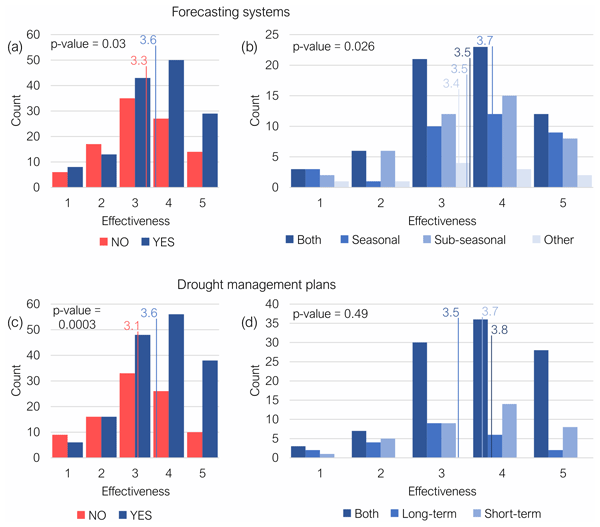
This research by the Drought in the Anthropocene (DitA) network highlights the crucial role of forecasting systems and Drought Management Plans in European drought risk management. Based on a survey of water managers during the 2022 European drought, it underscores the impact of preparedness on response and the evolution of drought management strategies across the continent, showing how organisations with preparedness measures in place responded faster and more effectively.
Riccardo Biella, Anastasiya Shyrokaya, Monica Ionita, Raffaele Vignola, Samuel J. Sutanto, Andrijana Todorovic, Claudia Teutschbein, Daniela Cid, Maria Carmen Llasat, Pedro Alencar, Alessia Matanó, Elena Ridolfi, Benedetta Moccia, Ilias Pechlivanidis, Anne van Loon, Doris E. Wendt, Elin Stenfors, Fabio Russo, Jean-Philippe Vidal, Lucy Barker, Mariana Madruga de Brito, Marleen Lam, Monika Bláhová, Patricia Trambauer, Raed Hamed, Scott J. McGrane, Serena Ceola, Sigrid J. Bakke, Svitlana Krakovska, Viorica Nagavciuc, Faranak Tootoonchi, Giuliano Di Baldassarre, Sandra Hauswirth, Shreedhar Maskey, Svitlana Zubkovych, Marthe Wens, and Lena M. Tallaksen
Nat. Hazards Earth Syst. Sci., 25, 4475–4501, https://doi.org/10.5194/nhess-25-4475-2025, https://doi.org/10.5194/nhess-25-4475-2025, 2025
Short summary
Short summary
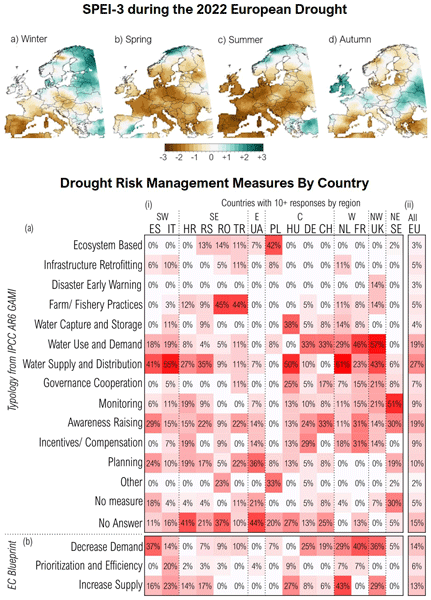
The DitA (Drought in the Anthropocene) network's study on the 2022 European drought reveals growing risks, varied impacts, and fragmented, short-term management. Based on a survey of water managers, it explores risk, impacts, strategies, and their evolution. While challenges persist, signs of improvement show readiness for change. The authors call for a European Drought Directive to unify and guide future drought risk management.
Anne F. Van Loon, Sarra Kchouk, Alessia Matanó, Faranak Tootoonchi, Camila Alvarez-Garreton, Khalid E. A. Hassaballah, Minchao Wu, Marthe L. K. Wens, Anastasiya Shyrokaya, Elena Ridolfi, Riccardo Biella, Viorica Nagavciuc, Marlies H. Barendrecht, Ana Bastos, Louise Cavalcante, Franciska T. de Vries, Margaret Garcia, Johanna Mård, Ileen N. Streefkerk, Claudia Teutschbein, Roshanak Tootoonchi, Ruben Weesie, Valentin Aich, Juan P. Boisier, Giuliano Di Baldassarre, Yiheng Du, Mauricio Galleguillos, René Garreaud, Monica Ionita, Sina Khatami, Johanna K. L. Koehler, Charles H. Luce, Shreedhar Maskey, Heidi D. Mendoza, Moses N. Mwangi, Ilias G. Pechlivanidis, Germano G. Ribeiro Neto, Tirthankar Roy, Robert Stefanski, Patricia Trambauer, Elizabeth A. Koebele, Giulia Vico, and Micha Werner
Nat. Hazards Earth Syst. Sci., 24, 3173–3205, https://doi.org/10.5194/nhess-24-3173-2024, https://doi.org/10.5194/nhess-24-3173-2024, 2024
Short summary
Short summary
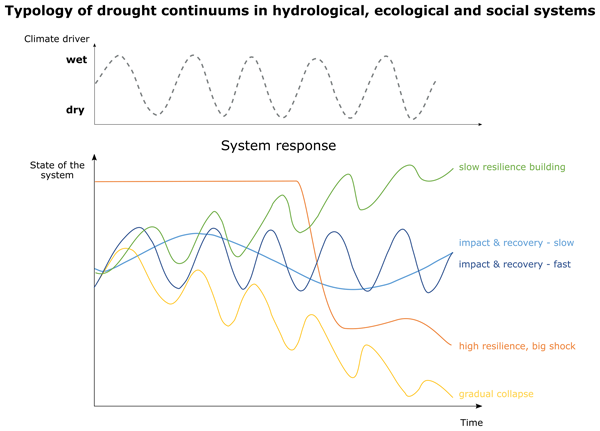
Drought is a creeping phenomenon but is often still analysed and managed like an isolated event, without taking into account what happened before and after. Here, we review the literature and analyse five cases to discuss how droughts and their impacts develop over time. We find that the responses of hydrological, ecological, and social systems can be classified into four types and that the systems interact. We provide suggestions for further research and monitoring, modelling, and management.
Riccardo Biella, Anastasiya Shyrokaya, Ilias Pechlivanidis, Daniela Cid, Maria Carmen Llasat, Faranak Tootoonchi, Marthe Wens, Marleen Lam, Elin Stenfors, Samuel Sutanto, Elena Ridolfi, Serena Ceola, Pedro Alencar, Giuliano Di Baldassarre, Monica Ionita, Mariana Madruga de Brito, Scott J. McGrane, Benedetta Moccia, Viorica Nagavciuc, Fabio Russo, Svitlana Krakovska, Andrijana Todorovic, Patricia Trambauer, Raffaele Vignola, and Claudia Teutschbein
Nat. Hazards Earth Syst. Sci., 26, 955–979, https://doi.org/10.5194/nhess-26-955-2026, https://doi.org/10.5194/nhess-26-955-2026, 2026
Short summary
Short summary
This research by the Drought in the Anthropocene (DitA) network highlights the crucial role of forecasting systems and Drought Management Plans in European drought risk management. Based on a survey of water managers during the 2022 European drought, it underscores the impact of preparedness on response and the evolution of drought management strategies across the continent, showing how organisations with preparedness measures in place responded faster and more effectively.
Riccardo Biella, Anastasiya Shyrokaya, Monica Ionita, Raffaele Vignola, Samuel J. Sutanto, Andrijana Todorovic, Claudia Teutschbein, Daniela Cid, Maria Carmen Llasat, Pedro Alencar, Alessia Matanó, Elena Ridolfi, Benedetta Moccia, Ilias Pechlivanidis, Anne van Loon, Doris E. Wendt, Elin Stenfors, Fabio Russo, Jean-Philippe Vidal, Lucy Barker, Mariana Madruga de Brito, Marleen Lam, Monika Bláhová, Patricia Trambauer, Raed Hamed, Scott J. McGrane, Serena Ceola, Sigrid J. Bakke, Svitlana Krakovska, Viorica Nagavciuc, Faranak Tootoonchi, Giuliano Di Baldassarre, Sandra Hauswirth, Shreedhar Maskey, Svitlana Zubkovych, Marthe Wens, and Lena M. Tallaksen
Nat. Hazards Earth Syst. Sci., 25, 4475–4501, https://doi.org/10.5194/nhess-25-4475-2025, https://doi.org/10.5194/nhess-25-4475-2025, 2025
Short summary
Short summary
The DitA (Drought in the Anthropocene) network's study on the 2022 European drought reveals growing risks, varied impacts, and fragmented, short-term management. Based on a survey of water managers, it explores risk, impacts, strategies, and their evolution. While challenges persist, signs of improvement show readiness for change. The authors call for a European Drought Directive to unify and guide future drought risk management.
Anne F. Van Loon, Sarra Kchouk, Alessia Matanó, Faranak Tootoonchi, Camila Alvarez-Garreton, Khalid E. A. Hassaballah, Minchao Wu, Marthe L. K. Wens, Anastasiya Shyrokaya, Elena Ridolfi, Riccardo Biella, Viorica Nagavciuc, Marlies H. Barendrecht, Ana Bastos, Louise Cavalcante, Franciska T. de Vries, Margaret Garcia, Johanna Mård, Ileen N. Streefkerk, Claudia Teutschbein, Roshanak Tootoonchi, Ruben Weesie, Valentin Aich, Juan P. Boisier, Giuliano Di Baldassarre, Yiheng Du, Mauricio Galleguillos, René Garreaud, Monica Ionita, Sina Khatami, Johanna K. L. Koehler, Charles H. Luce, Shreedhar Maskey, Heidi D. Mendoza, Moses N. Mwangi, Ilias G. Pechlivanidis, Germano G. Ribeiro Neto, Tirthankar Roy, Robert Stefanski, Patricia Trambauer, Elizabeth A. Koebele, Giulia Vico, and Micha Werner
Nat. Hazards Earth Syst. Sci., 24, 3173–3205, https://doi.org/10.5194/nhess-24-3173-2024, https://doi.org/10.5194/nhess-24-3173-2024, 2024
Short summary
Short summary
Drought is a creeping phenomenon but is often still analysed and managed like an isolated event, without taking into account what happened before and after. Here, we review the literature and analyse five cases to discuss how droughts and their impacts develop over time. We find that the responses of hydrological, ecological, and social systems can be classified into four types and that the systems interact. We provide suggestions for further research and monitoring, modelling, and management.

Stefano Manzoni, Simone Fatichi, Xue Feng, Gabriel G. Katul, Danielle Way, and Giulia Vico
Biogeosciences, 19, 4387–4414, https://doi.org/10.5194/bg-19-4387-2022, https://doi.org/10.5194/bg-19-4387-2022, 2022
Short summary
Short summary
Increasing atmospheric carbon dioxide (CO2) causes leaves to close their stomata (through which water evaporates) but also promotes leaf growth. Even if individual leaves save water, how much will be consumed by a whole plant with possibly more leaves? Using different mathematical models, we show that plant stands that are not very dense and can grow more leaves will benefit from higher CO2 by photosynthesizing more while adjusting their stomata to consume similar amounts of water.
Cited articles
Addor, N., Nearing, G., Prieto, C., Newman, A. J., Le Vine, N., and Clark, M. P.: A Ranking of Hydrological Signatures Based on Their Predictability in Space, Water Resour. Res., 54, 8792–8812, https://doi.org/10.1029/2018WR022606, 2018.
Adger, W. N.: Vulnerability, Global Environ. Chang., 16, 268–281, https://doi.org/10.1016/j.gloenvcha.2006.02.006, 2006.
Alizadeh, M. R., Adamowski, J., Nikoo, M. R., AghaKouchak, A., Dennison, P., and Sadegh, M.: A century of observations reveals increasing likelihood of continental-scale compound dry-hot extremes, Sci. Adv., 6, 1–12, https://doi.org/10.1126/sciadv.aaz4571, 2020.
Anand, M., Hamed, R., Linscheid, N., Silva, P. S., Andre, J., Zscheischler, J., Garry, F. K., and Bastos, A.: Winter climate preconditioning of summer vegetation extremes in the Northern Hemisphere, Environ. Res. Lett., 19, 094045, https://doi.org/10.1088/1748-9326/ad627d, 2024.
Andrews, C. J.: How Do Plants Survive Ice?, Ann. Bot., 78, 529–536, https://doi.org/10.1006/anbo.1996.0157, 1996.
Climate indicator – Snow | SMHI: Snow, https://www.smhi.se/en/climate/climate-indicators/climate-indicator-snow-1.188971, last access: 28 December 2023.
Barnabás, B., Jäger, K., and Fehér, A.: The effect of drought and heat stress on reproductive processes in cereals, Plant Cell Environ., 31, 11–38, https://doi.org/10.1111/j.1365-3040.2007.01727.x, 2008.
Barnes, C. J., van der Gast, C. J., McNamara, N. P., Rowe, R., and Bending, G. D.: Extreme rainfall affects assembly of the root-associated fungal community, New Phytol., 220, 1172–1184, https://doi.org/10.1111/nph.14990, 2018.
Barron-Gafford, G. A., Scott, R. L., Jenerette, G. D., Hamerlynck, E. P., and Huxman, T. E.: Temperature and precipitation controls over leaf- and ecosystem-level CO2 flux along a woody plant encroachment gradient, Glob. Change Biol., 18, 1389–1400, https://doi.org/10.1111/j.1365-2486.2011.02599.x, 2012.
Becker, P.: Chapter 4 – Our Disturbances, Disruptions and Disasters in a Dynamic World, in: Sustainability Science, edited by: Becker, P., Elsevier, 57–119, https://doi.org/10.1016/B978-0-444-62709-4.00004-X, 2014.
Beillouin, D., Schauberger, B., Bastos, A., Ciais, P., and Makowski, D.: Impact of extreme weather conditions on European crop production in 2018, Philos. T. R. Soc. B, 375, 1810, https://doi.org/10.1098/rstb.2019.0510, 2020.
Bindi, M. and Olesen, J. E.: The responses of agriculture in Europe to climate change, Reg. Environ. Change, 11, 151–158, https://doi.org/10.1007/s10113-010-0173-x, 2011.
Breinl, K., Di Baldassarre, G., Mazzoleni, M., Lun, D., and Vico, G.: Extreme dry and wet spells face changes in their duration and timing, Environ. Res. Lett., 15, 074040, https://doi.org/10.1088/1748-9326/ab7d05, 2020.
Bürger, J., Günther, A., de Mol, F., and Gerowitt, B.: Analysing the influence of crop management on pesticide use intensity while controlling for external sources of variability with Linear Mixed Effects Models, Agr. Syst., 111, 13–22, https://doi.org/10.1016/j.agsy.2012.05.002, 2012.
Caparros-Santiago, J. A., Rodriguez-Galiano, V., and Dash, J.: Land surface phenology as indicator of global terrestrial ecosystem dynamics: A systematic review, ISPRS J. Photogramm., 171, 330–347, https://doi.org/10.1016/j.isprsjprs.2020.11.019, 2021.
Carter, E. K., Melkonian, J., Steinschneider, S., and Riha, S. J.: Rainfed maize yield response to management and climate covariability at large spatial scales, Agr. Forest Meteorol., 256–257, 242–252, https://doi.org/10.1016/j.agrformet.2018.02.029, 2018.
Copernicus Climate Change Service, Climate Data Store: E-OBS daily gridded meteorological data for Europe from 1950 to present derived from in-situ observations, Copernicus Climate Change Service (C3S) Climate Data Store (CDS) [data set], https://doi.org/10.24381/cds.151d3ec6, 2020.
Copernicus Climate Change Service: Agroclimatic indicators from 1951 to 2099 derived from climate projections, https://doi.org/10.24381/CDS.DAD6E055, 2019.
Cornes, R. C., van der Schrier, G., van den Besselaar, E. J. M., and Jones, P. D.: An Ensemble Version of the E-OBS Temperature and Precipitation Data Sets, J. Geophys. Res.-Atmos., 123, 9391–9409, https://doi.org/10.1029/2017JD028200, 2018.
Costa, A., Bommarco, R., Smith, M. E., Bowles, T., Gaudin, A. C. M., Watson, C. A., Alarcón, R., Berti, A., Blecharczyk, A., Calderon, F. J., Culman, S., Deen, W., Drury, C. F., Garcia y Garcia, A., García-Díaz, A., Hernández Plaza, E., Jonczyk, K., Jäck, O., Navarrete Martínez, L., Montemurro, F., Morari, F., Onofri, A., Osborne, S. L., Tenorio Pasamón, J. L., Sandström, B., Santín-Montanyá, I., Sawinska, Z., Schmer, M. R., Stalenga, J., Strock, J., Tei, F., Topp, C. F. E., Ventrella, D., Walker, R. L., and Vico, G.: Crop rotational diversity can mitigate climate-induced grain yield losses, Glob. Change Biol., 30, e17298, https://doi.org/10.1111/gcb.17298, 2024.
De Toro, A., Eckersten, H., Nkurunziza, L., and Von Rosen, D.: Effects of extreme weather on yield of major arable crops in Sweden, Rapp. För Energi Och Tek. SLU, https://pub.epsilon.slu.se/id/document/11714946 (last access: 10 March 2026), 2015.
Díaz-Torres, J. J., Hernández-Mena, L., Murillo-Tovar, M. A., León-Becerril, E., López-López, A., Suárez-Plascencia, C., Aviña-Rodriguez, E., Barradas-Gimate, A., and Ojeda-Castillo, V.: Assessment of the modulation effect of rainfall on solar radiation availability at the Earth's surface, Meteorol. Appl., 24, 180–190, https://doi.org/10.1002/met.1616, 2017.
Dolferus, R., Ji, X., and Richards, R. A.: Abiotic stress and control of grain number in cereals, Plant Sci. Int. J. Exp. Plant Biol., 181, 331–341, https://doi.org/10.1016/j.plantsci.2011.05.015, 2011.
Elsgaard, L., Børgesen, C. D., Olesen, J. E., Siebert, S., Ewert, F., Peltonen-Sainio, P., Rötter, R. P., and Skjelvåg, A. O.: Shifts in comparative advantages for maize, oat and wheat cropping under climate change in Europe, Food Addit. Contam. A, 29, 1514–1526, https://doi.org/10.1080/19440049.2012.700953, 2012.
European Environment Agency: CORINE Land Cover 2006 (raster 100 m), Europe, 6-yearly – version 2020_20u1, May 2020, https://doi.org/10.2909/08560441-2fd5-4eb9-bf4c-9ef16725726a, 2020.
Ewel, J. J.: Natural systems as models for the design of sustainable systems of land use, Agroforest. Syst., 45, 1–21, https://doi.org/10.1023/A:1006219721151, 1999.
Fischer, R. A.: Number of kernels in wheat crops and the influence of solar radiation and temperature, J. Agr. Sci., 105, 447–461, https://doi.org/10.1017/S0021859600056495, 1985.
Fontrodona-Bach, A., Schaefli, B., Woods, R., Teuling, A. J., and Larsen, J. R.: NH-SWE: Northern Hemisphere Snow Water Equivalent dataset based on in situ snow depth time series, Earth Syst. Sci. Data, 15, 2577–2599, https://doi.org/10.5194/essd-15-2577-2023, 2023.
Foulkes, M. J., Slafer, G. A., Davies, W. J., Berry, P. M., Sylvester-Bradley, R., Martre, P., Calderini, D. F., Griffiths, S., and Reynolds, M. P.: Raising yield potential of wheat. III. Optimizing partitioning to grain while maintaining lodging resistance, J. Exp. Bot., 62, 469–486, https://doi.org/10.1093/jxb/erq300, 2011.
François, B. and Vrac, M.: Time of emergence of compound events: contribution of univariate and dependence properties, Nat. Hazards Earth Syst. Sci., 23, 21–44, https://doi.org/10.5194/nhess-23-21-2023, 2023.
Grusson, Y., Wesström, I., and Joel, A.: Impact of climate change on Swedish agriculture: Growing season rain deficit and irrigation need, Agr. Water Manage., 251, 106858, https://doi.org/10.1016/j.agwat.2021.106858, 2021.
Guo, Z., Zhang, Y., Zhao, J., Shi, Y., and Yu, Z.: Nitrogen use by winter wheat and changes in soil nitrate nitrogen levels with supplemental irrigation based on measurement of moisture content in various soil layers, Field Crop. Res., 164, 117–125, https://doi.org/10.1016/j.fcr.2014.05.016, 2014.
Hakala, K., Jauhiainen, L., Himanen, S. J., Rötter, R., Salo, T., and Kahiluoto, H.: Sensitivity of barley varieties to weather in Finland, J. Agr. Sci., 150, 145–160, https://doi.org/10.1017/S0021859611000694, 2012.
Hakala, K., Jauhiainen, L., Rajala, A. A., Jalli, M., Kujala, M., and Laine, A.: Different responses to weather events may change the cultivation balance of spring barley and oats in the future, Field Crop. Res., 259, 107956, https://doi.org/10.1016/j.fcr.2020.107956, 2020.
Hamed, R., Vijverberg, S., Van Loon, A. F., Aerts, J., and Coumou, D.: Persistent La Niñas drive joint soybean harvest failures in North and South America, Earth Syst. Dynam., 14, 255–272, https://doi.org/10.5194/esd-14-255-2023, 2023.
Hamon, W. R.: Estimating potential evaporation, in: Proceedings of the American Society of Civil Engineers, Division, J.o.H., 107–120, https://doi.org/10.1061/TACEAT.0008673, 1961.
Hatfield, J. L. and Prueger, J. H.: Temperature extremes: Effect on plant growth and development, Weather Clim. Extrem., 10, 4–10, https://doi.org/10.1016/j.wace.2015.08.001, 2015.
He, D., Fang, S., Liang, H., Wang, E., and Wu, D.: Contrasting yield responses of winter and spring wheat to temperature rise in China, Environ. Res. Lett., 15, 124038, https://doi.org/10.1088/1748-9326/abc71a, 2020.
Heikonen, S., Heino, M., Jalava, M., Siebert, S., Viviroli, D., and Kummu, M.: Climate change threatens crop diversity at low latitudes, Nat. Food, 6, 331–342, https://doi.org/10.1038/s43016-025-01135-w, 2025.
Hoffman, A. L., Kemanian, A. R., and Forest, C. E.: The response of maize, sorghum, and soybean yield to growing-phase climate revealed with machine learning, Environ. Res. Lett., 15, 094013, https://doi.org/10.1088/1748-9326/ab7b22, 2020.
Iizumi, T., Iseki, K., Ikazaki, K., Sakai, T., Shiogama, H., Imada, Y., and Batieno, B. J.: Increasing heavy rainfall events and associated excessive soil water threaten a protein-source legume in dry environments of West Africa, Agr. Forest Meteorol., 344, 109783, https://doi.org/10.1016/j.agrformet.2023.109783, 2024.
IPCC: Climate Change 2021: The Physical Science Basis, Contribution of Working Group I to the Sixth Assessment Report of the Intergovernmental Panel on Climate Change, edited by: Masson-Delmotte, V., Zhai, P., Pirani, A., Connors, S. L., Péan, C., Berger, S., Caud, N., and Chen, Y., Camb. Univ. Press, 3949, https://doi.org/10.1017/9781009157896, 2021.
Jackson, E. D., Casolaro, C., Nebeker, R. S., Scott, E. R., Dukes, J. S., Griffin, T. S., and Orians, C. M.: Current and legacy effects of precipitation treatments on growth and nutrition in contrasting crops, Agr. Ecosyst. Environ., 352, 108513, https://doi.org/10.1016/j.agee.2023.108513, 2023.
Juhola, S., Klein, N., Käyhkö, J., and Schmid Neset, T.-S.: Climate change transformations in Nordic agriculture?, J. Rural Stud., 51, 28–36, https://doi.org/10.1016/j.jrurstud.2017.01.013, 2017.
Kaseva, J., Hakala, K., Högnäsbacka, M., Jauhiainen, L., Himanen, S. J., Rötter, R. P., Balek, J., Trnka, M., and Kahiluoto, H.: Assessing climate resilience of barley cultivars in northern conditions during 1980–2020, Field Crop. Res., 293, https://doi.org/10.1016/j.fcr.2023.108856, 2023.
Lesk, C., Coffel, E., and Horton, R.: Net benefits to US soy and maize yields from intensifying hourly rainfall, Nat. Clim. Change, 10, 819–822, https://doi.org/10.1038/s41558-020-0830-0, 2020.
Lesk, C., Anderson, W., Rigden, A., Coast, O., Jägermeyr, J., McDermid, S., Davis, K. F., and Konar, M.: Compound heat and moisture extreme impacts on global crop yields under climate change, Nat. Rev. Earth Environ., 3, 872–889, https://doi.org/10.1038/s43017-022-00368-8, 2022.
Li, Y., Guan, K., Schnitkey, G. D., DeLucia, E., and Peng, B.: Excessive rainfall leads to maize yield loss of a comparable magnitude to extreme drought in the United States, Glob. Change Biol., 25, 2325–2337, https://doi.org/10.1111/gcb.14628, 2019.
Luan, X., Bommarco, R., Scaini, A., and Vico, G.: Combined heat and drought suppress rainfed maize and soybean yields and modify irrigation benefits in the USA, Environ. Res. Lett., 16, 064023, https://doi.org/10.1088/1748-9326/abfc76, 2021.
Luan, X., Bommarco, R., and Vico, G.: Coordinated evaporative demand and precipitation maximize rainfed maize and soybean crop yields in the USA, Ecohydrology, https://doi.org/10.1002/eco.2500, 2022.
Lüttger, A. B. and Feike, T.: Development of heat and drought related extreme weather events and their effect on winter wheat yields in Germany, Theor. Appl. Climatol., 132, 15–29, https://doi.org/10.1007/s00704-017-2076-y, 2018.
Mäkinen, H., Kaseva, J., Trnka, M., Balek, J., Kersebaum, K. C., Nendel, C., Gobin, A., Olesen, J. E., Bindi, M., Ferrise, R., Moriondo, M., Rodríguez, A., Ruiz-Ramos, M., Takáè, J., Bezák, P., Ventrella, D., Ruget, F., Capellades, G., and Kahiluoto, H.: Sensitivity of European wheat to extreme weather, Field Crop. Res., 222, 209–217, https://doi.org/10.1016/j.fcr.2017.11.008, 2018.
Manevska-Tasevska, G., Huang, V. W., Chen, Z., Jäck, O., Adam, N., Ha, T. M., Weih, M., and Hansson, H.: Economic outcomes from adopting cereal-legume intercropping practices in Sweden, Agr. Syst., 220, 104064, https://doi.org/10.1016/j.agsy.2024.104064, 2024.
Manning, C., Widmann, M., Maraun, D., Van Loon, A. F., and Bevacqua, E.: Large spread in the representation of compound long-duration dry and hot spells over Europe in CMIP5, Weather Clim. Dynam., 4, 309–329, https://doi.org/10.5194/wcd-4-309-2023, 2023.
Marini, L., St-Martin, A., Vico, G., Baldoni, G., Berti, A., Blecharczyk, A., Malecka-Jankowiak, I., Morari, F., Sawinska, Z., and Bommarco, R.: Crop rotations sustain cereal yields under a changing climate, Environ. Res. Lett., 15, 124011, https://doi.org/10.1088/1748-9326/abc651, 2020.
Martin, R. J., Jamieson, P. D., Gillespie, R. N., and Maley., S.: Effect of timing and intensity of drought on the yield of Oats (Avena sativa L.), https://www.agronomyaustraliaproceedings.org/images/sampledata/2001/1/b/martin.pdf (last access: 10 March 2026), 2012.
Martyniak, L.: Response of spring cereals to a deficit of atmospheric precipitation in the particular stages of plant growth and development, Agr. Water Manage., 95, 171–178, https://doi.org/10.1016/j.agwat.2007.10.014, 2008.
Masupha, T. E., Moeletsi, M. E., and Tsubo, M.: Dry spells assessment with reference to the maize crop in the Luvuvhu River catchment of South Africa, Phys. Chem. Earth, 92, 99–111, https://doi.org/10.1016/j.pce.2015.10.014, 2016.
Matiu, M., Ankerst, D. P., and Menzel, A.: Interactions between temperature and drought in global and regional crop yield variability during 1961–2014, PLOS ONE, 12, e0178339, https://doi.org/10.1371/journal.pone.0178339, 2017.
McMillan, H. K.: A review of hydrologic signatures and their applications, Wiley Interdiscip. Rev. Water, 8, 1–23, https://doi.org/10.1002/wat2.1499, 2021.
Miedema, P.: The Effects of Low Temperature on Zea mays, in: Advances in Agronomy, 35, edited by: Brady, N. C., Academic Press, 93–128, https://doi.org/10.1016/S0065-2113(08)60322-3, 1982.
Minoli, S., Jägermeyr, J., Asseng, S., Urfels, A., and Müller, C.: Global crop yields can be lifted by timely adaptation of growing periods to climate change, Nat. Commun., 13, 7079, https://doi.org/10.1038/s41467-022-34411-5, 2022.
Mittra, M. K. and Stickler, F. C.: Excess Water Effects on Different Crops, Trans. Kans. Acad. Sci. 1903-, 64, 275–286, https://doi.org/10.2307/3626753, 1961.
Nakagawa, S. and Schielzeth, H.: A general and simple method for obtaining R2 from generalized linear mixed-effects models, Methods Ecol. Evol., 4, 133–142, https://doi.org/10.1111/j.2041-210x.2012.00261.x, 2013.
Olesen, J. E., Trnka, M., Kersebaum, K. C., Skjelvåg, A. O., Seguin, B., Peltonen-Sainio, P., Rossi, F., Kozyra, J., and Micale, F.: Impacts and adaptation of European crop production systems to climate change, Eur. J. Agron., 34, 96–112, https://doi.org/10.1016/j.eja.2010.11.003, 2011.
Olesen, J. E., Børgesen, C. D., Elsgaard, L., Palosuo, T., Rötter, R. P., Skjelvåg, A. O., Peltonen-Sainio, P., Börjesson, T., Trnka, M., Ewert, F., Siebert, S., Brisson, N., Eitzinger, J., van Asselt, E. D., Oberforster, M., and van der Fels-Klerx, H. J.: Changes in time of sowing, flowering and maturity of cereals in Europe under climate change, Food Addit. Contam. A, 29, 1527–1542, https://doi.org/10.1080/19440049.2012.712060, 2012.
Ortiz-Bobea, A., Ault, T. R., Carrillo, C. M., Chambers, R. G., and Lobell, D. B.: Anthropogenic climate change has slowed global agricultural productivity growth, Nat. Clim. Change, 11, 306–312, https://doi.org/10.1038/s41558-021-01000-1, 2021.
Pan, M., Zhao, F., Ma, J., Zhang, L., Qu, J., Xu, L., and Li, Y.: Effect of Snow Cover on Spring Soil Moisture Content in Key Agricultural Areas of Northeast China, Sustainability, 14, 1527, https://doi.org/10.3390/su14031527, 2022.
Peltonen-Sainio, P., Jauhiainen, L., Sorvali, J., Laurila, H., and Rajala, A.: Field characteristics driving farm-scale decision-making on land allocation to primary crops in high latitude conditions, Land Use Policy, 71, 49–59, https://doi.org/10.1016/j.landusepol.2017.11.040, 2018.
Peltonen-Sainio, P., Sorvali, J., and Kaseva, J.: Finnish farmers' views towards fluctuating and changing precipitation patterns pave the way for the future, Agr. Water Manage., 255, 107011, https://doi.org/10.1016/j.agwat.2021.107011, 2021.
Porter, J. R. and Semenov, M. A.: Crop responses to climatic variation, Philos. T. R. Soc. B, 360, 2021–2035, https://doi.org/10.1098/rstb.2005.1752, 2005.
Praba, M. L., Cairns, J. E., Babu, R. C., and Lafitte, H. R.: Identification of Physiological Traits Underlying Cultivar Differences in Drought Tolerance in Rice and Wheat, J. Agron. Crop Sci., 195, 30–46, https://doi.org/10.1111/j.1439-037X.2008.00341.x, 2009.
Ray, D. K., Gerber, J. S., MacDonald, G. K., and West, P. C.: Climate variation explains a third of global crop yield variability, Nat. Commun., 6, 5989, https://doi.org/10.1038/ncomms6989, 2015.
Rezaei, E. E., Webber, H., Asseng, S., Boote, K., Durand, J. L., Ewert, F., Martre, P., and MacCarthy, D. S.: Climate change impacts on crop yields, Nat. Rev. Earth Environ., 4, 831–846, https://doi.org/10.1038/s43017-023-00491-0, 2023.
Riha, S. J., Wilks, D. S., and Simoens, P.: Impact of temperature and precipitation variability on crop model predictions, Clim. Change, 32, 293–311, https://doi.org/10.1007/BF00142466, 1996.
Sadok, W., Wiersma, J. J., Steffenson, B. J., Snapp, S. S., and Smith, K. P.: Improving winter barley adaptation to freezing and heat stresses in the U.S. Midwest: bottlenecks and opportunities, Field Crop. Res., 286, 108635, https://doi.org/10.1016/j.fcr.2022.108635, 2022.
Statistikdatabasen: Yield per hectar and total production in regions/country for different crops, https://www.statistikdatabasen.scb.se/pxweb/sv/ssd/START__JO__JO0601/SkordarL2/, last access: 30 August 2023.
Schauberger, B., Archontoulis, S., Arneth, A., Balkovic, J., Ciais, P., Deryng, D., Elliott, J., Folberth, C., Khabarov, N., Müller, C., Pugh, T. A. M., Rolinski, S., Schaphoff, S., Schmid, E., Wang, X., Schlenker, W., and Frieler, K.: Consistent negative response of US crops to high temperatures in observations and crop models, Nat. Commun., 8, 13931, https://doi.org/10.1038/ncomms13931, 2017.
Schmidt, M. and Felsche, E.: The effect of climate change on crop yield anomaly in Europe, Clim. Resil. Sustain., 3, e261, https://doi.org/10.1002/cli2.61, 2024.
Schneider, D. P., Deser, C., Fasullo, J., and Trenberth, K. E.: Climate Data Guide Spurs Discovery and Understanding, Eos Trans. Am. Geophys. Union, 94, 121–122, https://doi.org/10.1002/2013EO130001, 2013.
Schreiber, J. D.: Nutrient Leaching from Corn Residues under Simulated Rainfall, J. Environ. Qual., 28, 1864–1870, https://doi.org/10.2134/jeq1999.00472425002800060024x, 1999.
Senapati, N., Halford, N. G., and Semenov, M. A.: Vulnerability of European wheat to extreme heat and drought around flowering under future climate, Environ. Res. Lett., 16, 024052, https://doi.org/10.1088/1748-9326/abdcf3, 2021.
Siebert, S., Webber, H., Zhao, G., and Ewert, F.: Heat stress is overestimated in climate impact studies for irrigated agriculture, Environ. Res. Lett., 12, 054023, https://doi.org/10.1088/1748-9326/aa702f, 2017.
Sjulgård, H., Keller, T., Garland, G., and Colombi, T.: Relationships between weather and yield anomalies vary with crop type and latitude in Sweden, Agr. Syst., 211, 103757, https://doi.org/10.1016/j.agsy.2023.103757, 2023.
Skoglund, M. K.: Climate variability and grain production in Scania, 1702–1911, Clim. Past, 18, 405–433, https://doi.org/10.5194/cp-18-405-2022, 2022.
Slafer, G. A., Savin, R., and Sadras, V. O.: Wheat yield is not causally related to the duration of the growing season, Eur. J. Agron., 148, 126885, https://doi.org/10.1016/j.eja.2023.126885, 2023.
Smith, A. B., Cullis, B. R., and Thompson, R.: The analysis of crop cultivar breeding and evaluation trials: an overview of current mixed model approaches, J. Agr. Sci., 143, 449–462, https://doi.org/10.1017/S0021859605005587, 2005.
Sofield, I., Evans, L. T., Cook, M. G., and Wardlaw, I. F.: Factors Influencing the Rate and Duration of Grain Filling in Wheat, Funct. Plant Biol., 4, 785–797, https://doi.org/10.1071/pp9770785, 1977.
Song, B., Niu, S., and Wan, S.: Precipitation regulates plant gas exchange and its long-term response to climate change in a temperate grassland, J. Plant Ecol., 9, 531–541, https://doi.org/10.1093/jpe/rtw010, 2016.
Spearman, C.: The proof and measurement of association between two things, Am. J. Psychol., 15, 72–101, https://doi.org/10.1093/ije/dyq191, 1904.
Statistiska-Meddelanden: Skörd av spannmål, trindsäd, oljeväxter och slåttervall 2018. Sveriges officiella statistik, https://www.statistikdatabasen.scb.se/pxweb/sv/ssd/START__JO__JO0601/SkordarL2/ (last access: 10 March 2026), 2018.
Suliman, M., Scaini, A., Manzoni, S., and Vico, G.: Soil properties modulate actual evapotranspiration and precipitation impacts on crop yields in the USA, Sci. Total Environ., 949, 175172, https://doi.org/10.1016/j.scitotenv.2024.175172, 2024.
Suzuki, N., Rivero, R. M., Shulaev, V., Blumwald, E., and Mittler, R.: Abiotic and biotic stress combinations, New Phytol., 203, 32–43, https://doi.org/10.1111/nph.12797, 2014.
Tack, J., Barkley, A., and Nalley, L. L.: Effect of warming temperatures on US wheat yields, P. Natl. Acad. Sci. USA, 112, 6931–6936, https://doi.org/10.1073/pnas.1415181112, 2015.
Teutschbein, C., Albrecht, F., Blicharska, M., Tootoonchi, F., Stenfors, E., and Grabs, T.: Drought hazards and stakeholder perception: Unraveling the interlinkages between drought severity, perceived impacts, preparedness, and management, Ambio, 52, 1262–1281, https://doi.org/10.1007/s13280-023-01849-w, 2023a.
Teutschbein, C., Jonsson, E., Todoroviæ, A., Tootoonchi, F., Stenfors, E., and Grabs, T.: Future drought propagation through the water-energy-food-ecosystem nexus – A Nordic perspective, J. Hydrol., 617, 128963, https://doi.org/10.1016/j.jhydrol.2022.128963, 2023b.
Thiery, W., Lange, S., Rogelj, J., Schleussner, C.-F., Gudmundsson, L., Seneviratne, S. I., Andrijevic, M., Frieler, K., Emanuel, K., Geiger, T., Bresch, D. N., Zhao, F., Willner, S. N., Büchner, M., Volkholz, J., Bauer, N., Chang, J., Ciais, P., Dury, M., François, L., Grillakis, M., Gosling, S. N., Hanasaki, N., Hickler, T., Huber, V., Ito, A., Jägermeyr, J., Khabarov, N., Koutroulis, A., Liu, W., Lutz, W., Mengel, M., Müller, C., Ostberg, S., Reyer, C. P. O., Stacke, T., and Wada, Y.: Intergenerational inequities in exposure to climate extremes, Science, 374, 158–160, https://doi.org/10.1126/science.abi7339, 2021.
Thorup-Kristensen, K., Halberg, N., Nicolaisen, M., Olesen, J. E., Crews, T. E., Hinsinger, P., Kirkegaard, J., Pierret, A., and Dresbøll, D. B.: Digging Deeper for Agricultural Resources, the Value of Deep Rooting, Trends Plant Sci., 25, 406–417, https://doi.org/10.1016/j.tplants.2019.12.007, 2020.
Tian, L., Zhang, Y., Chen, P., Zhang, F., Li, J., Yan, F., Dong, Y., and Feng, B.: How Does the Waterlogging Regime Affect Crop Yield? A Global Meta-Analysis, Front. Plant Sci., 12, 634898, https://doi.org/10.3389/fpls.2021.634898, 2021.
Todorović, A., Grabs, T., and Teutschbein, C.: Advancing traditional strategies for testing hydrological model fitness in a changing climate, Hydrol. Sci. J., 67, 1790–1811 https://doi.org/10.1080/02626667.2022.2104646, 2022.
Tootoonchi, F., Haerter, J. O., Räty, O., Todorovic, A., Grabs, T., and Teutschbein, C.: Uni- and multivariate bias adjustment methods in Nordic catchments: Complexity and performance in a changing climate, Sci. Total Environ., 853, 158615, https://doi.org/10.1016/j.scitotenv.2022.158615, 2022.
Tootoonchi, F., Todoroviæ, A., Grabs, T., and Teutschbein, C.: Uni- and multivariate bias adjustment of climate model simulations in Nordic catchments: Effects on hydrological signatures relevant for water resources management in a changing climate, J. Hydrol., 129807, https://doi.org/10.1016/j.jhydrol.2023.129807, 2023.
Toreti, A., Belward, A., Perez-Dominguez, I., Naumann, G., Luterbacher, J., Cronie, O., Seguini, L., Manfron, G., Lopez-Lozano, R., Baruth, B., van den Berg, M., Dentener, F., Ceglar, A., Chatzopoulos, T., and Zampieri, M.: The Exceptional 2018 European Water Seesaw Calls for Action on Adaptation, Earths Future, 7, 652–663, https://doi.org/10.1029/2019EF001170, 2019.
Trnka, M., Olesen, J. E., Kersebaum, K. C., Skjelvåg, A. O., Eitzinger, J., Seguin, B., Peltonen-Sainio, P., Rötter, R., Iglesias, A., Orlandini, S., Dubrovský, M., Hlavinka, P., Balek, J., Eckersten, H., Cloppet, E., Calanca, P., Gobin, A., Vuèetiæ, V., Nejedlik, P., Kumar, S., Lalic, B., Mestre, A., Rossi, F., Kozyra, J., Alexandrov, V., Semerádová, D., and Žalud, Z.: Agroclimatic conditions in Europe under climate change, Glob. Change Biol., 17, 2298–2318, https://doi.org/10.1111/j.1365-2486.2011.02396.x, 2011.
Trnka, M., Rötter, R. P., Ruiz-Ramos, M., Kersebaum, K. C., Olesen, J. E., Žalud, Z., and Semenov, M. A.: Adverse weather conditions for European wheat production will become more frequent with climate change, Nat. Clim. Change, 4, 637–643, https://doi.org/10.1038/nclimate2242, 2014.
Trnka, M., Semerádová, D., Novotný, I., Dumbrovský, M., Drbal, K., Pavlík, F., Vopravil, J., Štìpánková, P., Vizina, A., Balek, J., Hlavinka, P., Bartošová, L., and Žalud, Z.: Assessing the combined hazards of drought, soil erosion and local flooding on agricultural land: a Czech case study, Clim. Res., 70, 231–249, 2016.
Troy, T. J., Kipgen, C., and Pal, I.: The impact of climate extremes and irrigation on US crop yields, Environ. Res. Lett., 10, 054013, https://doi.org/10.1088/1748-9326/10/5/054013, 2015.
Vico, G., Hurry, V., and Weih, M.: Snowed in for survival: Quantifying the risk of winter damage to overwintering field crops in northern temperate latitudes, Agr. Forest Meteorol., 197, 65–75, https://doi.org/10.1016/j.agrformet.2014.06.003, 2014.
Vogel, E., Donat, M. G., Alexander, L. V., Meinshausen, M., Ray, D. K., Karoly, D., Meinshausen, N., and Frieler, K.: The effects of climate extremes on global agricultural yields, Environ. Res. Lett., 14, 054010, https://doi.org/10.1088/1748-9326/ab154b, 2019.
Wallén, A.: Sur la corrélation entre les récoltes et les variations de la température et de l'eau tombée en Suède, A & W, Stockholm, https://search.ub.uu.se/discovery/fulldisplay?vid=46LIBRIS_UUB:UUB&docid=alma991017587059707596&lang=en&context=L (last access: 10 March 2026), 1917.
Wang, E., Martre, P., Zhao, Z., Ewert, F., Maiorano, A., Rötter, R. P., Kimball, B. A., Ottman, M. J., Wall, G. W., White, J. W., Reynolds, M. P., Alderman, P. D., Aggarwal, P. K., Anothai, J., Basso, B., Biernath, C., Cammarano, D., Challinor, A. J., De Sanctis, G., Doltra, J., Dumont, B., Fereres, E., Garcia-Vila, M., Gayler, S., Hoogenboom, G., Hunt, L. A., Izaurralde, R. C., Jabloun, M., Jones, C. D., Kersebaum, K. C., Koehler, A.-K., Liu, L., Müller, C., Naresh Kumar, S., Nendel, C., O'Leary, G., Olesen, J. E., Palosuo, T., Priesack, E., Eyshi Rezaei, E., Ripoche, D., Ruane, A. C., Semenov, M. A., Shcherbak, I., Stöckle, C., Stratonovitch, P., Streck, T., Supit, I., Tao, F., Thorburn, P., Waha, K., Wallach, D., Wang, Z., Wolf, J., Zhu, Y., and Asseng, S.: The uncertainty of crop yield projections is reduced by improved temperature response functions, Nat. Plants, 3, 1–13, https://doi.org/10.1038/nplants.2017.102, 2017.
Westra, S., Fowler, H. J., Evans, J. P., Alexander, L. V., Berg, P., Johnson, F., Kendon, E. J., Lenderink, G., and Roberts, N. M.: Future changes to the intensity and frequency of short-duration extreme rainfall, Rev. Geophys., 52, 522–555, https://doi.org/10.1002/2014RG000464, 2014.
Wilcke, R. A. I., Kjellström, E., Lin, C., Matei, D., Moberg, A., and Tyrlis, E.: The extremely warm summer of 2018 in Sweden – set in a historical context, Earth Syst. Dynam., 11, 1107–1121, https://doi.org/10.5194/esd-11-1107-2020, 2020.
Wiréhn, L.: Nordic agriculture under climate change: A systematic review of challenges, opportunities and adaptation strategies for crop production, Land Use Policy, 77, 63–74, https://doi.org/10.1016/j.landusepol.2018.04.059, 2018.
Wiréhn, L.: Climate indices for the tailoring of climate information – A systematic literature review of Swedish forestry and agriculture, Clim. Risk Manag., 34, 100370, https://doi.org/10.1016/j.crm.2021.100370, 2021.
Wiréhn, L., Opach, T., and Neset, T.-S.: Assessing agricultural vulnerability to climate change in the Nordic countries – an interactive geovisualization approach, J. Environ. Plann. Man., 60, 115–134, https://doi.org/10.1080/09640568.2016.1143351, 2017.
Wood, R. R., Janzing, J., van Hamel, A., Götte, J., Schumacher, D. L., and Brunner, M. I.: Comparison of high-resolution climate reanalysis datasets for hydro-climatic impact studies, Hydrol. Earth Syst. Sci., 29, 4153–4178, https://doi.org/10.5194/hess-29-4153-2025, 2025.
Zampieri, M., Ceglar, A., Dentener, F., and Toreti, A.: Wheat yield loss attributable to heat waves, drought and water excess at the global, national and subnational scales, Environ. Res. Lett., 12, 064008, https://doi.org/10.1088/1748-9326/aa723b, 2017.
Zhou, L., Han, X., Yang, Q., Feng, H., and Siddique, K. H. M.: Optimizing sowing date to mitigate loss of growing degree days and enhance crop water productivity of groundwater-irrigated spring maize, Agr. Water Manage., 305, 109097, https://doi.org/10.1016/j.agwat.2024.109097, 2024.
Zhu, P., Kim, T., Jin, Z., Lin, C., Wang, X., Ciais, P., Mueller, N. D., Aghakouchak, A., Huang, J., Mulla, D., and Makowski, D.: The critical benefits of snowpack insulation and snowmelt for winter wheat productivity, Nat. Clim. Change, 12, 485–490, https://doi.org/10.1038/s41558-022-01327-3, 2022.
Zhu, X. and Troy, T. J.: Agriculturally Relevant Climate Extremes and Their Trends in the World's Major Growing Regions, Earths Future, 6, 656–672, https://doi.org/10.1002/2017EF000687, 2018.
Short summary
In Northern Europe, current temperatures limit the time available for soil preparation and crop growth. Warming may extend the growing season and improve growing conditions, but higher temperatures also increase evapotranspiration and raises the risk of water stress. We evaluated the role of various climatic conditions on crop yield fluctuations in Sweden over 1965–2020 and found that unless Sweden receives more rain in the growing season, crop yields will likely decrease with warming climates.
In Northern Europe, current temperatures limit the time available for soil preparation and crop...


Altmetrics
Final-revised paper
Preprint