
Articles | Volume 23, issue 13
https://doi.org/10.5194/bg-23-4735-2026
© Author(s) 2026. This work is distributed under
the Creative Commons Attribution 4.0 License.
the Creative Commons Attribution 4.0 License.
https://doi.org/10.5194/bg-23-4735-2026
© Author(s) 2026. This work is distributed under
the Creative Commons Attribution 4.0 License.
the Creative Commons Attribution 4.0 License.
Research article
| 
09 Jul 2026
Research article |
| 09 Jul 2026
| 09 Jul 2026
Heterogeneous future Arctic Ocean primary productivity changes projected in CMIP6
Léna Champiot-Bayard
CORRESPONDING AUTHOR

LOCEAN Laboratory, Sorbonne Université-CNRS-IRD-MNHN, Paris, 75005, France
Lester Kwiatkowski
LOCEAN Laboratory, Sorbonne Université-CNRS-IRD-MNHN, Paris, 75005, France
Martin Vancoppenolle
LOCEAN Laboratory, Sorbonne Université-CNRS-IRD-MNHN, Paris, 75005, France
Related authors
No articles found.
Alek Aaron Petty, Christopher Cardinale, Madison M. Smith, Edward W. Blockley, Patricia DeRepentigny, Sebastian Gerland, François Massonnet, Benjamin Richaud, Lettie A. Roach, and Martin Vancoppenolle
EGUsphere, https://doi.org/10.5194/egusphere-2026-5596, https://doi.org/10.5194/egusphere-2026-5596, 2026
This preprint is open for discussion and under review for The Cryosphere (TC).
Short summary
Short summary
Sankey diagrams are used to visualize the simulated sea ice and snow-on-ice mass budgets across Arctic and Antarctic sea ice, based on CMIP6-class models and an atmosphere-forced ocean–sea ice simulation. Coupled models and the forced run show a similar relative budget, with more basal growth and surface melt in the Arctic and a larger snow-to-ice contribution in the Southern Ocean. The diagrams are a model-based reference intended to support the upcoming IPCC AR7.
Jens Terhaar, Laurent Bopp, Pierre Friedlingstein, Thomas Frölicher, Helene Hollitzer, Tatiana Ilyina, Lester Kwiatkowski, Paul Lerner, Hongmei Li, Anastasia Romanou, Jörg Schwinger, Roland Séférian, and Aaron Wienkers
EGUsphere, https://doi.org/10.5194/egusphere-2026-5757, https://doi.org/10.5194/egusphere-2026-5757, 2026
This preprint is open for discussion and under review for Biogeosciences (BG).
Short summary
Short summary
The ocean absorbs about 30% of CO2 emissions, but how much it will keep absorbing as CO2 levels rise and the climate warms is highly uncertain. Combining climate models with observations, we show models underestimate both the ocean CO2 uptake with increasing atmospheric CO2 and how strongly this uptake weakens with warming, and that the two are linked. Our tighter estimate reduces uncertainty in how much emitted CO2 stays in the atmosphere, and in the warming caused by future emissions.
Augustin Lambotte, Thierry Fichefet, François Massonnet, Pierre Rampal, Laurent Brodeau, Jean-François Lemieux, Frédéric Dupont, Martin Vancoppenolle, Antoine Barthélemy, and Pierre-Yves Barriat
EGUsphere, https://doi.org/10.5194/egusphere-2026-3861, https://doi.org/10.5194/egusphere-2026-3861, 2026
This preprint is open for discussion and under review for The Cryosphere (TC).
Short summary
Short summary
Arctic fast ice influences the ocean and is important for Arctic communities and animals. Using the ocean and sea ice model NEMO-SI3, we study the interactions between sea ice mechanical formulation and grounding scheme. While the grounding scheme is the most important mechanism, its effect varies with the mechanical formulation. Our results highlight the importance of accurately simulating fast ice thickness and point to future developments for sea ice mechanical frameworks in numerical models.
Erica Cioffi, Laurent Bopp, and Lester Kwiatkowski
Biogeosciences, 23, 6073–6093, https://doi.org/10.5194/bg-23-6073-2026, https://doi.org/10.5194/bg-23-6073-2026, 2026
Short summary
Short summary
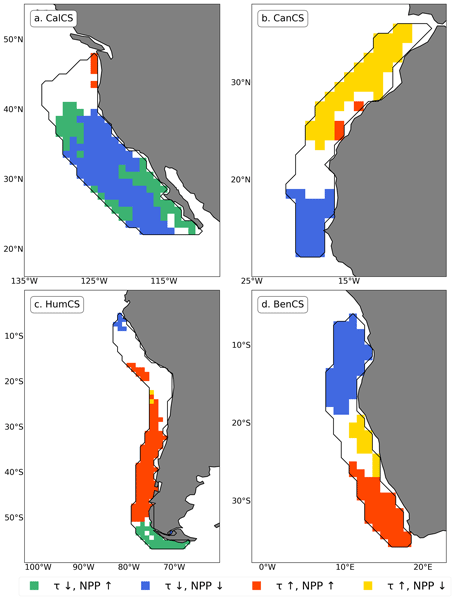
Eastern Boundary Upwelling Systems disproportionately contribute to global productivity and fisheries. Using CMIP6 Earth System Models, we assess response of phytoplankton productivity to climate change in these regions and to what extent it is explained by changes in wind-driven upwelling. While this process drives productivity decline across 25% of upwelling systems area, wind curl, geostrophic transport, stratification and subsurface nutrients changes are needed to explain response elsewhere.
Baylor Fox-Kemper, Patricia DeRepentigny, Anne Marie Treguier, Christian Stepanek, Eleanor O'Rourke, Chloe Mackallah, Alberto Meucci, Yevgeny Aksenov, Paul J. Durack, Nicole Feldl, Oluwayemi Garuba, Vanessa Hernaman, Céline Heuzé, Doroteaciro Iovino, Gaurav Madan, André L. Marquez, François Massonnet, Jenny Mecking, Dhrubajyoti Samanta, Patrick C. Taylor, Wan-Ling Tseng, and Martin Vancoppenolle
Geosci. Model Dev., 19, 6043–6078, https://doi.org/10.5194/gmd-19-6043-2026, https://doi.org/10.5194/gmd-19-6043-2026, 2026
Short summary
Short summary
The ocean and sea ice are central to Earth's climate system, influencing global heat and carbon cycles, weather patterns, and sea level rise. Here the earth system model variables needed for studies of the ocean and sea ice are prioritized and requested. These requested variables were developed through an international, community-based process.
Jeanne Dombret, Hugo Bellenger, Xavier Perrot, Laëtitia Parc, Lester Kwiatkowski, Frédéric Chevallier, Laurent Bopp, Marion Gehlen, Roland Séférian, Sarah Berthet, and James C. Orr
Biogeosciences, 23, 4133–4143, https://doi.org/10.5194/bg-23-4133-2026, https://doi.org/10.5194/bg-23-4133-2026, 2026
Short summary
Short summary
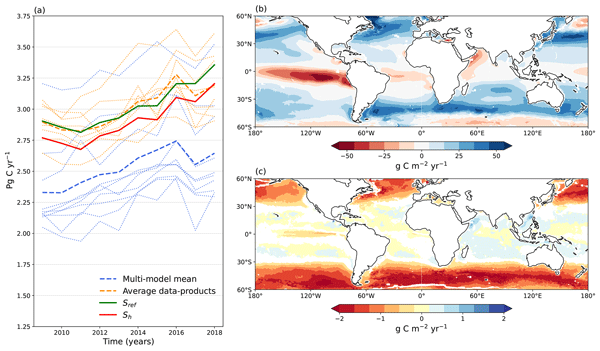
Estimates of ocean CO2 uptake based on atmospheric and oceanic observations typically rely on monthly averages, except for wind speed. Thus they neglect effects of shorter-term events such as storms, which are included in models. Here we account for the effect of this shorter-term variability on ocean carbon uptake and find that it is reduced, mainly because storms lower atmospheric pressure. This refinement closes the gap between data-based and model-based estimates by 25 %.
Hugues Goosse, Cecile Davrinche, Benjamin Richaud, Dániel Topál, Stephy Libera, Alberto C. Naveira Garabato, Alessandro Silvano, Martin Vancoppenolle, and Pablo Ortega
EGUsphere, https://doi.org/10.5194/egusphere-2026-1823, https://doi.org/10.5194/egusphere-2026-1823, 2026
Short summary
Short summary
The variability of the winter sea ice edge is much higher in regions close to the main topographic features of the Southern Ocean than over the smoother abyssal plain. The oceanic bathymetry influences mesoscale eddy activity and the Antarctic Circumpolar Current jets, affecting both oceanic heat transport and sea ice velocity and subsequently sea ice variability.
Letizia Tedesco, Giulia Castellani, Pedro Duarte, Meibing Jin, Sebastien Moreau, Eric Mortenson, Benjamin Tobey Saenz, Nadja Steiner, and Martin Vancoppenolle
The Cryosphere, 20, 723–736, https://doi.org/10.5194/tc-20-723-2026, https://doi.org/10.5194/tc-20-723-2026, 2026
Short summary
Short summary
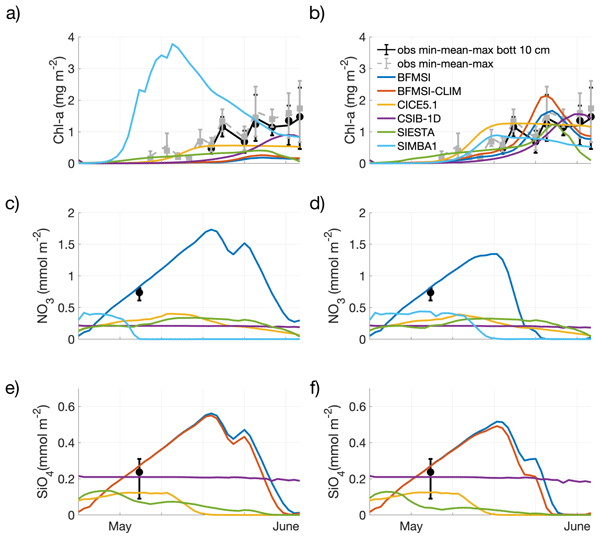
Sea ice hosts tiny algae that support polar marine life, yet their growth remains challenging to simulate. We tested six computer models using data from a 2015 Arctic drifting ice expedition to see how well they reproduced spring algae blooms and nutrient changes. While tuning helped models better match algae growth, nutrients remained difficult to capture. Our results highlight key challenges in representing fragile sea‑ice habitats that are expected to become more common as the Arctic warms.
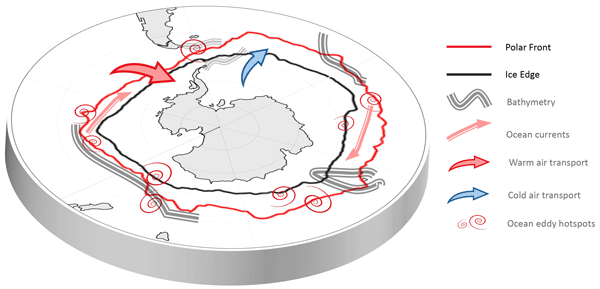
Hugues Goosse, Stephy Libera, Alberto C. Naveira Garabato, Benjamin Richaud, Alessandro Silvano, and Martin Vancoppenolle
The Cryosphere, 19, 5763–5779, https://doi.org/10.5194/tc-19-5763-2025, https://doi.org/10.5194/tc-19-5763-2025, 2025
Short summary
Short summary
The position of the winter sea ice edge in the Southern Ocean is strongly linked to the one of the Antarctic Circumpolar Current and thus to ocean bathymetry. This is due to the influence of the Antarctic Circumpolar Current on the southward heat flux that limits sea ice expansion, directly through oceanic processes and indirectly through its influence on atmospheric heat transport.
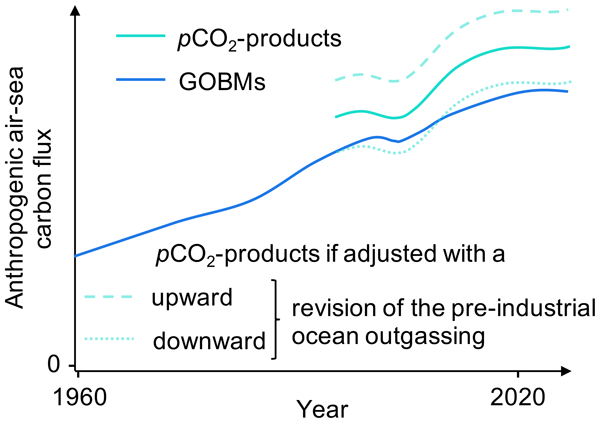
Alban Planchat, Laurent Bopp, and Lester Kwiatkowski
Biogeosciences, 22, 6017–6055, https://doi.org/10.5194/bg-22-6017-2025, https://doi.org/10.5194/bg-22-6017-2025, 2025
Short summary
Short summary
Disparities between observational and model-based estimates of the ocean carbon sink persist, highlighting the need for improved understanding and methodologies to reconcile differences in both magnitude and trends over recent decades. A potential key source of uncertainty lies in the pre-industrial air–sea carbon flux, which is essential for isolating the anthropogenic component from observations. Thus, we take a fresh look at this flux using the alkalinity budget, alongside the carbon budget.
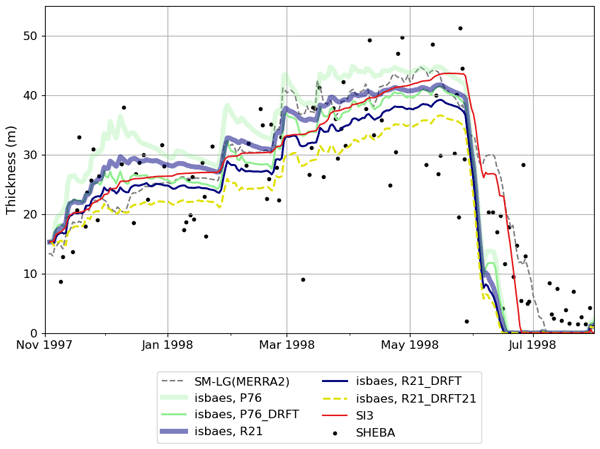
Théo Brivoal, Virginie Guemas, Martin Vancoppenolle, Clément Rousset, and Bertrand Decharme
Geosci. Model Dev., 18, 6885–6902, https://doi.org/10.5194/gmd-18-6885-2025, https://doi.org/10.5194/gmd-18-6885-2025, 2025
Short summary
Short summary
Snow in polar regions is key to sea ice formation and the Earth's climate, but current climate models simplify snow cover on sea ice. This study integrates an intermediate-complexity snow-physics scheme into a sea ice model designed for climate applications. We show that modeling the temporal changes in properties such as the density and thermal conductivity of the snow layers leads to a more accurate representation of heat transfer between the underlying sea ice and the atmosphere.
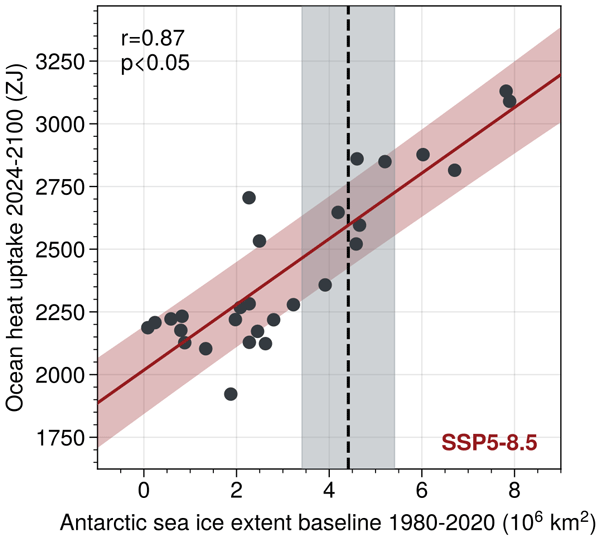
Linus Vogt, Casimir de Lavergne, Jean-Baptiste Sallée, Lester Kwiatkowski, Thomas L. Frölicher, and Jens Terhaar
Earth Syst. Dynam., 16, 1453–1482, https://doi.org/10.5194/esd-16-1453-2025, https://doi.org/10.5194/esd-16-1453-2025, 2025
Short summary
Short summary
Future projections of global ocean heat uptake (OHU) strongly differ between climate models. Here, we reveal an observational constraint on future OHU based on historical Antarctic sea ice extent observations. This emergent constraint is based on a coupling between sea ice, deep- and surface ocean temperatures, and cloud feedback. It implies an upward correction of 2024–2100 global OHU projections by up to 14 % and suggests that previous constraints have underestimated future warming.
Nathaelle Bouttes, Lester Kwiatkowski, Elodie Bougeot, Manon Berger, Victor Brovkin, and Guy Munhoven
Biogeosciences, 22, 4531–4544, https://doi.org/10.5194/bg-22-4531-2025, https://doi.org/10.5194/bg-22-4531-2025, 2025
Short summary
Short summary
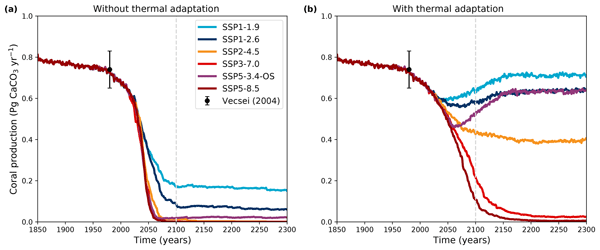
Coral reefs are under threat due to warming and ocean acidification. It is difficult to project future coral reef production due to uncertainties in climate models, socioeconomic scenarios and coral adaptation to warming. Here we have included a coral reef module within a climate model for the first time to evaluate the range of possible futures. We show that coral reef production decreases in most future scenarios, but in some cases coral reef carbonate production can persist.
Madhavan Girijakumari Keerthi, Olivier Aumont, Lester Kwiatkowski, and Marina Levy
Biogeosciences, 22, 2163–2180, https://doi.org/10.5194/bg-22-2163-2025, https://doi.org/10.5194/bg-22-2163-2025, 2025
Short summary
Short summary
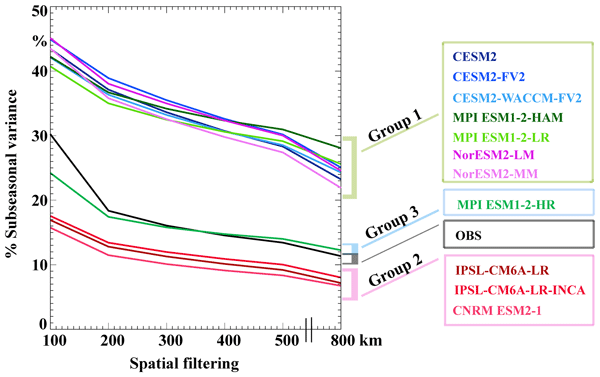
We assessed how well climate models replicate sub-seasonal changes in ocean chlorophyll observed by satellites. Models struggle to capture these variations accurately. Some overestimate fluctuations and their impact on annual chlorophyll variability, while others underestimate them. The underestimation is likely due to limited model resolution, while the overestimation may come from internal model oscillations.

Ed Blockley, Emma Fiedler, Jeff Ridley, Luke Roberts, Alex West, Dan Copsey, Daniel Feltham, Tim Graham, David Livings, Clement Rousset, David Schroeder, and Martin Vancoppenolle
Geosci. Model Dev., 17, 6799–6817, https://doi.org/10.5194/gmd-17-6799-2024, https://doi.org/10.5194/gmd-17-6799-2024, 2024
Short summary
Short summary
This paper documents the sea ice model component of the latest Met Office coupled model configuration, which will be used as the physical basis for UK contributions to CMIP7. Documentation of science options used in the configuration are given along with a brief model evaluation. This is the first UK configuration to use NEMO’s new SI3 sea ice model. We provide details on how SI3 was adapted to work with Met Office coupling methodology and documentation of coupling processes in the model.

Nathaelle Bouttes, Lester Kwiatkowski, Manon Berger, Victor Brovkin, and Guy Munhoven
Geosci. Model Dev., 17, 6513–6528, https://doi.org/10.5194/gmd-17-6513-2024, https://doi.org/10.5194/gmd-17-6513-2024, 2024
Short summary
Short summary
Coral reefs are crucial for biodiversity, but they also play a role in the carbon cycle on long time scales of a few thousand years. To better simulate the future and past evolution of coral reefs and their effect on the global carbon cycle, hence on atmospheric CO2 concentration, it is necessary to include coral reefs within a climate model. Here we describe the inclusion of coral reef carbonate production in a carbon–climate model and its validation in comparison to existing modern data.
Alban Planchat, Laurent Bopp, Lester Kwiatkowski, and Olivier Torres
Earth Syst. Dynam., 15, 565–588, https://doi.org/10.5194/esd-15-565-2024, https://doi.org/10.5194/esd-15-565-2024, 2024
Short summary
Short summary
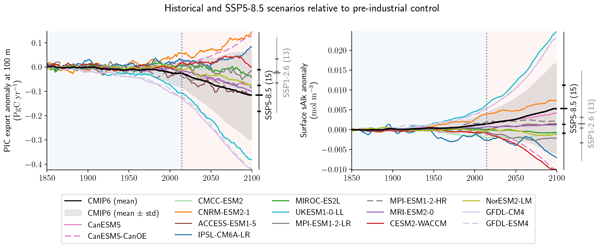
Ocean acidification is likely to impact all stages of the ocean carbonate pump. We show divergent responses of CaCO3 export throughout this century in earth system models, with anomalies by 2100 ranging from −74 % to +23 % under a high-emission scenario. While we confirm the limited impact of carbonate pump anomalies on 21st century ocean carbon uptake and acidification, we highlight a potentially abrupt shift in CaCO3 dissolution from deep to subsurface waters beyond 2100.
Narimane Dorey, Sophie Martin, and Lester Kwiatkowski
Biogeosciences, 20, 4289–4306, https://doi.org/10.5194/bg-20-4289-2023, https://doi.org/10.5194/bg-20-4289-2023, 2023
Short summary
Short summary
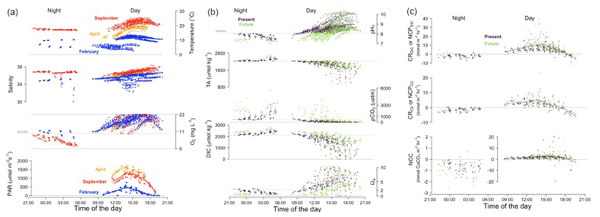
Human CO2 emissions are modifying ocean carbonate chemistry, causing ocean acidification and likely already impacting marine ecosystems. Here, we added CO2 to intertidal pools at the start of emersion to investigate the influence of future ocean acidification on net community production (NCP) and calcification (NCC). By day, adding CO2 fertilized the pools (+20 % NCP). By night, pools experienced net community dissolution, a dissolution that was further increased (+40 %) by the CO2 addition.
Max Thomas, Briana Cate, Jack Garnett, Inga J. Smith, Martin Vancoppenolle, and Crispin Halsall
The Cryosphere, 17, 3193–3201, https://doi.org/10.5194/tc-17-3193-2023, https://doi.org/10.5194/tc-17-3193-2023, 2023
Short summary
Short summary
A recent study showed that pollutants can be enriched in growing sea ice beyond what we would expect from a perfectly dissolved chemical. We hypothesise that this effect is caused by the specific properties of the pollutants working in combination with fluid moving through the sea ice. To test our hypothesis, we replicate this behaviour in a sea-ice model and show that this type of modelling can be applied to predicting the transport of chemicals with complex behaviour in sea ice.
Katherine Hutchinson, Julie Deshayes, Christian Éthé, Clément Rousset, Casimir de Lavergne, Martin Vancoppenolle, Nicolas C. Jourdain, and Pierre Mathiot
Geosci. Model Dev., 16, 3629–3650, https://doi.org/10.5194/gmd-16-3629-2023, https://doi.org/10.5194/gmd-16-3629-2023, 2023
Short summary
Short summary
Bottom Water constitutes the lower half of the ocean’s overturning system and is primarily formed in the Weddell and Ross Sea in the Antarctic due to interactions between the atmosphere, ocean, sea ice and ice shelves. Here we use a global ocean 1° resolution model with explicit representation of the three large ice shelves important for the formation of the parent waters of Bottom Water. We find doing so reduces salt biases, improves water mass realism and gives realistic ice shelf melt rates.
Xia Lin, François Massonnet, Thierry Fichefet, and Martin Vancoppenolle
The Cryosphere, 17, 1935–1965, https://doi.org/10.5194/tc-17-1935-2023, https://doi.org/10.5194/tc-17-1935-2023, 2023
Short summary
Short summary
This study provides clues on how improved atmospheric reanalysis products influence sea ice simulations in ocean–sea ice models. The summer ice concentration simulation in both hemispheres can be improved with changed surface heat fluxes. The winter Antarctic ice concentration and the Arctic drift speed near the ice edge and the ice velocity direction simulations are improved with changed wind stress. The radiation fluxes and winds in atmospheric reanalyses are crucial for sea ice simulations.
Alban Planchat, Lester Kwiatkowski, Laurent Bopp, Olivier Torres, James R. Christian, Momme Butenschön, Tomas Lovato, Roland Séférian, Matthew A. Chamberlain, Olivier Aumont, Michio Watanabe, Akitomo Yamamoto, Andrew Yool, Tatiana Ilyina, Hiroyuki Tsujino, Kristen M. Krumhardt, Jörg Schwinger, Jerry Tjiputra, John P. Dunne, and Charles Stock
Biogeosciences, 20, 1195–1257, https://doi.org/10.5194/bg-20-1195-2023, https://doi.org/10.5194/bg-20-1195-2023, 2023
Short summary
Short summary
Ocean alkalinity is critical to the uptake of atmospheric carbon and acidification in surface waters. We review the representation of alkalinity and the associated calcium carbonate cycle in Earth system models. While many parameterizations remain present in the latest generation of models, there is a general improvement in the simulated alkalinity distribution. This improvement is related to an increase in the export of biotic calcium carbonate, which closer resembles observations.
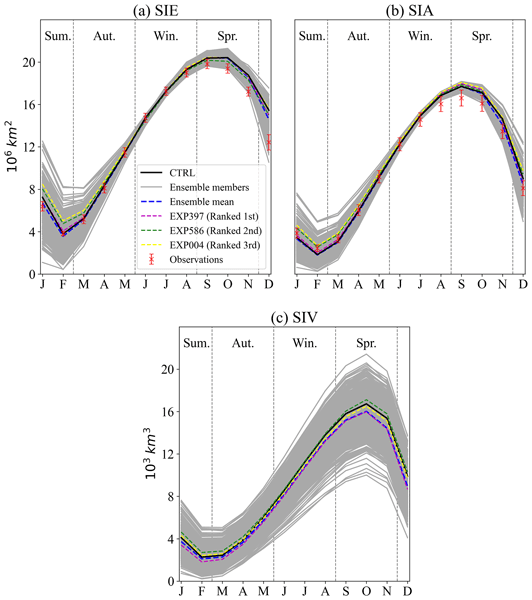
Yafei Nie, Chengkun Li, Martin Vancoppenolle, Bin Cheng, Fabio Boeira Dias, Xianqing Lv, and Petteri Uotila
Geosci. Model Dev., 16, 1395–1425, https://doi.org/10.5194/gmd-16-1395-2023, https://doi.org/10.5194/gmd-16-1395-2023, 2023
Short summary
Short summary
State-of-the-art Earth system models simulate the observed sea ice extent relatively well, but this is often due to errors in the dynamic and other processes in the simulated sea ice changes cancelling each other out. We assessed the sensitivity of these processes simulated by the coupled ocean–sea ice model NEMO4.0-SI3 to 18 parameters. The performance of the model in simulating sea ice change processes was ultimately improved by adjusting the three identified key parameters.
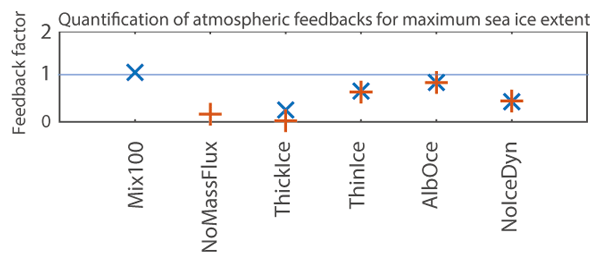
Hugues Goosse, Sofia Allende Contador, Cecilia M. Bitz, Edward Blanchard-Wrigglesworth, Clare Eayrs, Thierry Fichefet, Kenza Himmich, Pierre-Vincent Huot, François Klein, Sylvain Marchi, François Massonnet, Bianca Mezzina, Charles Pelletier, Lettie Roach, Martin Vancoppenolle, and Nicole P. M. van Lipzig
The Cryosphere, 17, 407–425, https://doi.org/10.5194/tc-17-407-2023, https://doi.org/10.5194/tc-17-407-2023, 2023
Short summary
Short summary
Using idealized sensitivity experiments with a regional atmosphere–ocean–sea ice model, we show that sea ice advance is constrained by initial conditions in March and the retreat season is influenced by the magnitude of several physical processes, in particular by the ice–albedo feedback and ice transport. Atmospheric feedbacks amplify the response of the winter ice extent to perturbations, while some negative feedbacks related to heat conduction fluxes act on the ice volume.
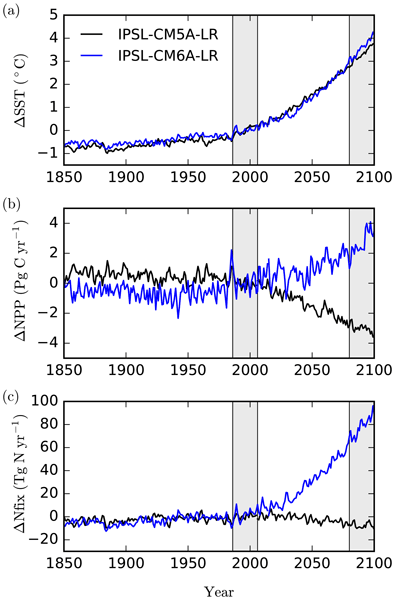
Laurent Bopp, Olivier Aumont, Lester Kwiatkowski, Corentin Clerc, Léonard Dupont, Christian Ethé, Thomas Gorgues, Roland Séférian, and Alessandro Tagliabue
Biogeosciences, 19, 4267–4285, https://doi.org/10.5194/bg-19-4267-2022, https://doi.org/10.5194/bg-19-4267-2022, 2022
Short summary
Short summary
The impact of anthropogenic climate change on the biological production of phytoplankton in the ocean is a cause for concern because its evolution could affect the response of marine ecosystems to climate change. Here, we identify biological N fixation and its response to future climate change as a key process in shaping the future evolution of marine phytoplankton production. Our results show that further study of how this nitrogen fixation responds to environmental change is essential.
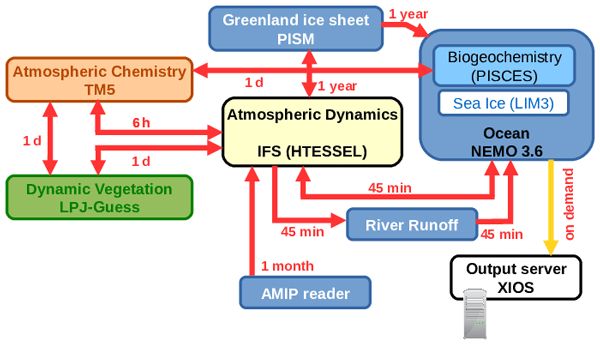
Ralf Döscher, Mario Acosta, Andrea Alessandri, Peter Anthoni, Thomas Arsouze, Tommi Bergman, Raffaele Bernardello, Souhail Boussetta, Louis-Philippe Caron, Glenn Carver, Miguel Castrillo, Franco Catalano, Ivana Cvijanovic, Paolo Davini, Evelien Dekker, Francisco J. Doblas-Reyes, David Docquier, Pablo Echevarria, Uwe Fladrich, Ramon Fuentes-Franco, Matthias Gröger, Jost v. Hardenberg, Jenny Hieronymus, M. Pasha Karami, Jukka-Pekka Keskinen, Torben Koenigk, Risto Makkonen, François Massonnet, Martin Ménégoz, Paul A. Miller, Eduardo Moreno-Chamarro, Lars Nieradzik, Twan van Noije, Paul Nolan, Declan O'Donnell, Pirkka Ollinaho, Gijs van den Oord, Pablo Ortega, Oriol Tintó Prims, Arthur Ramos, Thomas Reerink, Clement Rousset, Yohan Ruprich-Robert, Philippe Le Sager, Torben Schmith, Roland Schrödner, Federico Serva, Valentina Sicardi, Marianne Sloth Madsen, Benjamin Smith, Tian Tian, Etienne Tourigny, Petteri Uotila, Martin Vancoppenolle, Shiyu Wang, David Wårlind, Ulrika Willén, Klaus Wyser, Shuting Yang, Xavier Yepes-Arbós, and Qiong Zhang
Geosci. Model Dev., 15, 2973–3020, https://doi.org/10.5194/gmd-15-2973-2022, https://doi.org/10.5194/gmd-15-2973-2022, 2022
Short summary
Short summary
The Earth system model EC-Earth3 is documented here. Key performance metrics show physical behavior and biases well within the frame known from recent models. With improved physical and dynamic features, new ESM components, community tools, and largely improved physical performance compared to the CMIP5 version, EC-Earth3 represents a clear step forward for the only European community ESM. We demonstrate here that EC-Earth3 is suited for a range of tasks in CMIP6 and beyond.
Xia Lin, François Massonnet, Thierry Fichefet, and Martin Vancoppenolle
Geosci. Model Dev., 14, 6331–6354, https://doi.org/10.5194/gmd-14-6331-2021, https://doi.org/10.5194/gmd-14-6331-2021, 2021
Short summary
Short summary
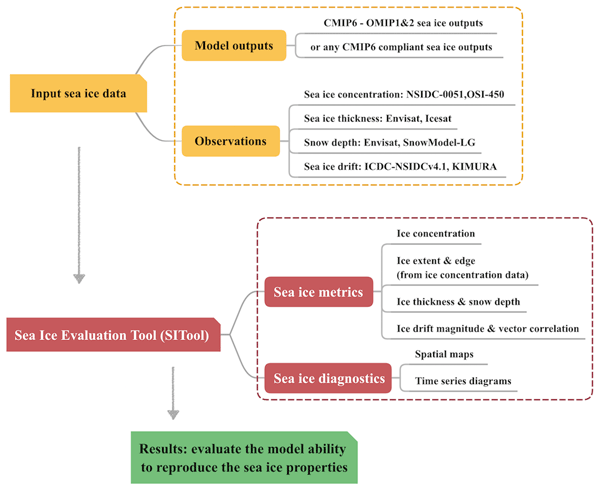
This study introduces a new Sea Ice Evaluation Tool (SITool) to evaluate the model skills on the bipolar sea ice simulations by providing performance metrics and diagnostics. SITool is applied to evaluate the CMIP6 OMIP simulations. By changing the atmospheric forcing from CORE-II to JRA55-do data, many aspects of sea ice simulations are improved. SITool will be useful for helping teams managing various versions of a sea ice model or tracking the time evolution of model performance.
Cited articles
Ardyna, M. and Arrigo, K. R.: Phytoplankton dynamics in a changing Arctic Ocean, Nat. Clim. Change, 10, 892–903, https://doi.org/10.1038/s41558-020-0905-y, 2020.
Ardyna, M., Babin, M., Gosselin, M., Devred, E., Rainville, L., and Tremblay, J.-É.: Recent Arctic Ocean sea ice loss triggers novel fall phytoplankton blooms, Geophys. Res. Lett., 41, 6207–6212, https://doi.org/10.1002/2014GL061047, 2014.
Arrigo, K. R. and van Dijken, G. L.: Secular trends in Arctic Ocean net primary production, J. Geophys. Res.-Oceans, 116, https://doi.org/10.1029/2011JC007151, 2011.
Arrigo, K. R. and van Dijken, G. L.: Continued increases in Arctic Ocean primary production, Prog. Oceanogr., 136, 60–70, https://doi.org/10.1016/j.pocean.2015.05.002, 2015.
Bentsen, M., Bethke, I., Debernard, J. B., Iversen, T., Kirkevåg, A., Seland, Ø., Drange, H., Roelandt, C., Seierstad, I. A., Hoose, C., and Kristjánsson, J. E.: The Norwegian Earth System Model, NorESM1-M – Part 1: Description and basic evaluation of the physical climate, Geosci. Model Dev., 6, 687–720, https://doi.org/10.5194/gmd-6-687-2013, 2013.
Bopp, L., Aumont, O., Cadule, P., Alvain, S., and Gehlen, M.: Response of diatoms distribution to global warming and potential implications: A global model study, Geophys. Res. Lett., 32, https://doi.org/10.1029/2005GL023653, 2005.
Bopp, L., Resplandy, L., Orr, J. C., Doney, S. C., Dunne, J. P., Gehlen, M., Halloran, P., Heinze, C., Ilyina, T., Séférian, R., Tjiputra, J., and Vichi, M.: Multiple stressors of ocean ecosystems in the 21st century: projections with CMIP5 models, Biogeosciences, 10, 6225–6245, https://doi.org/10.5194/bg-10-6225-2013, 2013.
Boucher, O., Servonnat, J., Albright, A. L., Aumont, O., Balkanski, Y., Bastrikov, V., Bekki, S., Bonnet, R., Bony, S., Bopp, L., Braconnot, P., Brockmann, P., Cadule, P., Caubel, A., Cheruy, F., Codron, F., Cozic, A., Cugnet, D., D'Andrea, F., Davini, P., Lavergne, C. de, Denvil, S., Deshayes, J., Devilliers, M., Ducharne, A., Dufresne, J.-L., Dupont, E., Éthé, C., Fairhead, L., Falletti, L., Flavoni, S., Foujols, M.-A., Gardoll, S., Gastineau, G., Ghattas, J., Grandpeix, J.-Y., Guenet, B., Lionel, E. G., Guilyardi, E., Guimberteau, M., Hauglustaine, D., Hourdin, F., Idelkadi, A., Joussaume, S., Kageyama, M., Khodri, M., Krinner, G., Lebas, N., Levavasseur, G., Lévy, C., Li, L., Lott, F., Lurton, T., Luyssaert, S., Madec, G., Madeleine, J.-B., Maignan, F., Marchand, M., Marti, O., Mellul, L., Meurdesoif, Y., Mignot, J., Musat, I., Ottlé, C., Peylin, P., Planton, Y., Polcher, J., Rio, C., Rochetin, N., Rousset, C., Sepulchre, P., Sima, A., Swingedouw, D., Thiéblemont, R., Traore, A. K., Vancoppenolle, M., Vial, J., Vialard, J., Viovy, N., and Vuichard, N.: Presentation and Evaluation of the IPSL-CM6A-LR Climate Model, J. Adv. Model. Earth Syst., 12, e2019MS002010, https://doi.org/10.1029/2019MS002010, 2020.
Browning, T. J. and Moore, C. M.: Global analysis of ocean phytoplankton nutrient limitation reveals high prevalence of co-limitation, Nat. Commun., 14, 5014, https://doi.org/10.1038/s41467-023-40774-0, 2023.
Christian, J. R., Denman, K. L., Hayashida, H., Holdsworth, A. M., Lee, W. G., Riche, O. G. J., Shao, A. E., Steiner, N., and Swart, N. C.: Ocean biogeochemistry in the Canadian Earth System Model version 5.0.3: CanESM5 and CanESM5-CanOE, Geosci. Model Dev., 15, 4393–4424, https://doi.org/10.5194/gmd-15-4393-2022, 2022.
Collins, W. J., Bellouin, N., Doutriaux-Boucher, M., Gedney, N., Halloran, P., Hinton, T., Hughes, J., Jones, C. D., Joshi, M., Liddicoat, S., Martin, G., O'Connor, F., Rae, J., Senior, C., Sitch, S., Totterdell, I., Wiltshire, A., and Woodward, S.: Development and evaluation of an Earth-System model – HadGEM2, Geosci. Model Dev., 4, 1051–1075, https://doi.org/10.5194/gmd-4-1051-2011, 2011.
Danabasoglu, G., Lamarque, J.-F., Bacmeister, J., Bailey, D. A., DuVivier, A. K., Edwards, J., Emmons, L. K., Fasullo, J., Garcia, R., Gettelman, A., Hannay, C., Holland, M. M., Large, W. G., Lauritzen, P. H., Lawrence, D. M., Lenaerts, J. T. M., Lindsay, K., Lipscomb, W. H., Mills, M. J., Neale, R., Oleson, K. W., Otto-Bliesner, B., Phillips, A. S., Sacks, W., Tilmes, S., van Kampenhout, L., Vertenstein, M., Bertini, A., Dennis, J., Deser, C., Fischer, C., Fox-Kemper, B., Kay, J. E., Kinnison, D., Kushner, P. J., Larson, V. E., Long, M. C., Mickelson, S., Moore, J. K., Nienhouse, E., Polvani, L., Rasch, P. J., and Strand, W. G.: The Community Earth System Model Version 2 (CESM2), J. Adv. Model. Earth Syst., 12, e2019MS001916, https://doi.org/10.1029/2019MS001916, 2020.
Doney, S. C.: Phytoplankton in a warmer world, Nature, 444, 695–696, 2006.
Dufresne, J.-L., Foujols, M.-A., Denvil, S., Caubel, A., Marti, O., Aumont, O., Balkanski, Y., Bekki, S., Bellenger, H., Benshila, R., Bony, S., Bopp, L., Braconnot, P., Brockmann, P., Cadule, P., Cheruy, F., Codron, F., Cozic, A., Cugnet, D., de Noblet, N., Duvel, J.-P., Ethé, C., Fairhead, L., Fichefet, T., Flavoni, S., Friedlingstein, P., Grandpeix, J.-Y., Guez, L., Guilyardi, E., Hauglustaine, D., Hourdin, F., Idelkadi, A., Ghattas, J., Joussaume, S., Kageyama, M., Krinner, G., Labetoulle, S., Lahellec, A., Lefebvre, M.-P., Lefevre, F., Levy, C., Li, Z. X., Lloyd, J., Lott, F., Madec, G., Mancip, M., Marchand, M., Masson, S., Meurdesoif, Y., Mignot, J., Musat, I., Parouty, S., Polcher, J., Rio, C., Schulz, M., Swingedouw, D., Szopa, S., Talandier, C., Terray, P., Viovy, N., and Vuichard, N.: Climate change projections using the IPSL-CM5 Earth System Model: from CMIP3 to CMIP5, Clim. Dynam., 40, 2123–2165, https://doi.org/10.1007/s00382-012-1636-1, 2013.
Dunne, J. P., John, J. G., Adcroft, A. J., Griffies, S. M., Hallberg, R. W., Shevliakova, E., Stouffer, R. J., Cooke, W., Dunne, K. A., Harrison, M. J., Krasting, J. P., Malyshev, S. L., Milly, P. C. D., Phillipps, P. J., Sentman, L. T., Samuels, B. L., Spelman, M. J., Winton, M., Wittenberg, A. T., and Zadeh, N.: GFDL's ESM2 Global Coupled Climate–Carbon Earth System Models. Part I: Physical Formulation and Baseline Simulation Characteristics, J. Climate, https://doi.org/10.1175/JCLI-D-11-00560.1, 2012.
Dunne, J. P., Horowitz, L. W., Adcroft, A. J., Ginoux, P., Held, I. M., John, J. G., Krasting, J. P., Malyshev, S., Naik, V., Paulot, F., Shevliakova, E., Stock, C. A., Zadeh, N., Balaji, V., Blanton, C., Dunne, K. A., Dupuis, C., Durachta, J., Dussin, R., Gauthier, P. P. G., Griffies, S. M., Guo, H., Hallberg, R. W., Harrison, M., He, J., Hurlin, W., McHugh, C., Menzel, R., Milly, P. C. D., Nikonov, S., Paynter, D. J., Ploshay, J., Radhakrishnan, A., Rand, K., Reichl, B. G., Robinson, T., Schwarzkopf, D. M., Sentman, L. T., Underwood, S., Vahlenkamp, H., Winton, M., Wittenberg, A. T., Wyman, B., Zeng, Y., and Zhao, M.: The GFDL Earth System Model Version 4.1 (GFDL-ESM 4.1): Overall Coupled Model Description and Simulation Characteristics, J. Adv. Model. Earth Syst., 12, e2019MS002015, https://doi.org/10.1029/2019MS002015, 2020.
Earth System Grid Federation (ESGF): https://esgf.llnl.gov/, last access: December 2025.
Embury, O. and Good, S. A.: ESA Sea Surface Temperature Climate Change Initiative (SST_cci): Climatology product, version 3.0, CEDA [data set], https://doi.org/10.5285/62800d3d2227449085b430b503d36b01, 2024.
EUMETSAT OSI SAF: Global Sea Ice Concentration Climate Data Record v3.0 – Multimission, V.3., EUMETSAT [data set], https://doi.org/10.15770/EUM_SAF_OSI_0013, 2022.
Eyring, V., Bony, S., Meehl, G. A., Senior, C. A., Stevens, B., Stouffer, R. J., and Taylor, K. E.: Overview of the Coupled Model Intercomparison Project Phase 6 (CMIP6) experimental design and organization, Geosci. Model Dev., 9, 1937–1958, https://doi.org/10.5194/gmd-9-1937-2016, 2016.
Fogli, P. G. and Iovino, D.: CMCC–CESM–NEMO: Toward the New CMCC Earth System Model, CMCC Research Paper No. 248, https://doi.org/10.2139/ssrn.2603176, 2014.
Fu, W., Randerson, J. T., and Moore, J. K.: Climate change impacts on net primary production (NPP) and export production (EP) regulated by increasing stratification and phytoplankton community structure in the CMIP5 models, Biogeosciences, 13, 5151–5170, https://doi.org/10.5194/bg-13-5151-2016, 2016.
Garcia, H. E., Boyer, T. P., Baranova, O. K., Locarnini, R. A., Mishonov, A. V., Grodsky, A., Paver, C. R., Weathers, K. W., Smolyar, I. V., Reagan, J. R., Seidov, D., and Zveng, M. M.: World Ocean Atlas 2018: Product Documentation, NOAA National Centers for Environmental Information, https://doi.org/10.25923/tzyw-rp36, 2019.
Gettelman, A., Mills, M. J., Kinnison, D. E., Garcia, R. R., Smith, A. K., Marsh, D. R., Tilmes, S., Vitt, F., Bardeen, C. G., McInerny, J., Liu, H.-L., Solomon, S. C., Polvani, L. M., Emmons, L. K., Lamarque, J.-F., Richter, J. H., Glanville, A. S., Bacmeister, J. T., Phillips, A. S., Neale, R. B., Simpson, I. R., DuVivier, A. K., Hodzic, A., and Randel, W. J.: The whole atmosphere community climate model version 6 (WACCM6), J. Geophys. Res.-Atmos., 124, 12380–12403, https://doi.org/10.1029/2019JD030943, 2019.
Gibson, G., Weijer, W., Jeffery, N., and Wang, S.: Relative Impact of Sea Ice and Temperature Changes on Arctic Marine Production, J. Geophys. Res.-Biogeo., 125, e2019JG005343, https://doi.org/10.1029/2019JG005343, 2020.
Grebmeier, J. M., Moore, S. E., Overland, J. E., Frey, K. E., and Gradinger, R.: Biological Response to Recent Pacific Arctic Sea Ice Retreats, Eos Trans. Am. Geophys. Union, 91, 161–162, https://doi.org/10.1029/2010EO180001, 2010.
Gregg, W. W. and Rousseaux, C. S.: Global ocean primary production trends in the modern ocean color satellite record (1998–2015), Environ. Res. Lett., 14, 124011, https://doi.org/10.1088/1748-9326/ab4667, 2019.
Hahn, L. C., Armour, K. C., Zelinka, M. D., Bitz, C. M., and Donohoe, A.: Contributions to Polar Amplification in CMIP5 and CMIP6 Models, Front. Earth Sci., 9, https://doi.org/10.3389/feart.2021.710036, 2021.
Hajima, T., Watanabe, M., Yamamoto, A., Tatebe, H., Noguchi, M. A., Abe, M., Ohgaito, R., Ito, A., Yamazaki, D., Okajima, H., Ito, A., Takata, K., Ogochi, K., Watanabe, S., and Kawamiya, M.: Development of the MIROC-ES2L Earth system model and the evaluation of biogeochemical processes and feedbacks, Geosci. Model Dev., 13, 2197–2244, https://doi.org/10.5194/gmd-13-2197-2020, 2020.
Haug, T., Bogstad, B., Chierici, M., Gjøsæter, H., Hallfredsson, E., Høines, Å., Hoel, A. H., Ingvaldsen, R., Jørgensen, L., Knutsen, T., Loeng, H., Naustvoll, L., Røttingen, I., and Sunnanå, K.: Future harvest of living resources in the Arctic Ocean north of the Nordic and Barents Seas: A review of possibilities and constraints, Fish. Res., 188, 38–57, https://doi.org/10.1016/j.fishres.2016.12.002, 2017.
Hegseth, E. N. and Sundfjord, A.: Intrusion and blooming of Atlantic phytoplankton species in the high Arctic, J. Mar. Syst., 74, 108–119, https://doi.org/10.1016/j.jmarsys.2007.11.011, 2008.
Ilyina, T., Six, K. D., Segschneider, J., Maier-Reimer, E., Li, H., and Núñez-Riboni, I.: Global ocean biogeochemistry model HAMOCC: Model architecture and performance as component of the MPI-Earth system model in different CMIP5 experimental realizations, J. Adv. Model. Earth Sy., 5, 287–315, https://doi.org/10.1029/2012MS000178, 2013.
Kwiatkowski, L., Torres, O., Bopp, L., Aumont, O., Chamberlain, M., Christian, J. R., Dunne, J. P., Gehlen, M., Ilyina, T., John, J. G., Lenton, A., Li, H., Lovenduski, N. S., Orr, J. C., Palmieri, J., Santana-Falcón, Y., Schwinger, J., Séférian, R., Stock, C. A., Tagliabue, A., Takano, Y., Tjiputra, J., Toyama, K., Tsujino, H., Watanabe, M., Yamamoto, A., Yool, A., and Ziehn, T.: Twenty-first century ocean warming, acidification, deoxygenation, and upper-ocean nutrient and primary production decline from CMIP6 model projections, Biogeosciences, 17, 3439–3470, https://doi.org/10.5194/bg-17-3439-2020, 2020.
Lannuzel, D., Tedesco, L., van Leeuwe, M., Campbell, K., Flores, H., Delille, B., Miller, L., Stefels, J., Assmy, P., Bowman, J., Brown, K., Castellani, G., Chierici, M., Crabeck, O., Damm, E., Else, B., Fransson, A., Fripiat, F., Geilfus, N.-X., Jacques, C., Jones, E., Kaartokallio, H., Kotovitch, M., Meiners, K., Moreau, S., Nomura, D., Peeken, I., Rintala, J.-M., Steiner, N., Tison, J.-L., Vancoppenolle, M., Van der Linden, F., Vichi, M., and Wongpan, P.: The future of Arctic sea-ice biogeochemistry and ice-associated ecosystems, Nat. Clim. Change, 10, 983–992, https://doi.org/10.1038/s41558-020-00940-4, 2020.
Laufkötter, C., Vogt, M., Gruber, N., Aita-Noguchi, M., Aumont, O., Bopp, L., Buitenhuis, E., Doney, S. C., Dunne, J., Hashioka, T., Hauck, J., Hirata, T., John, J., Le Quéré, C., Lima, I. D., Nakano, H., Seferian, R., Totterdell, I., Vichi, M., and Völker, C.: Drivers and uncertainties of future global marine primary production in marine ecosystem models, Biogeosciences, 12, 6955–6984, https://doi.org/10.5194/bg-12-6955-2015, 2015.
Lebrun, M., Vancoppenolle, M., Madec, G., and Massonnet, F.: Arctic sea-ice-free season projected to extend into autumn, The Cryosphere, 13, 79–96, https://doi.org/10.5194/tc-13-79-2019, 2019.
Lebrun, M., Vancoppenolle, M., Madec, G., Babin, M., Becu, G., Lourenço, A., Nomura, D., Vivier, F., and Delille, B.: Light Under Arctic Sea Ice in Observations and Earth System Models, J. Geophys. Res.-Oceans, 128, e2021JC018161, https://doi.org/10.1029/2021JC018161, 2023.
Leu, E., Søreide, J. E., Hessen, D. O., Falk-Petersen, S., and Berge, J.: Consequences of changing sea-ice cover for primary and secondary producers in the European Arctic shelf seas: Timing, quantity, and quality, Prog. Oceanogr., 90, 18–32, https://doi.org/10.1016/j.pocean.2011.02.004, 2011.
Lewis, K. M., van Dijken, G. L., and Arrigo, K. R.: Changes in phytoplankton concentration now drive increased Arctic Ocean primary production, Science, 369, 198–202, https://doi.org/10.1126/science.aay8380, 2020.
Malik, I. H. and Ford, J. D.: Understanding the Impacts of Arctic Climate Change Through the Lens of Political Ecology, WIREs Clim. Change, 16, e927, https://doi.org/10.1002/wcc.927, 2025.
Manizza, M., Carroll, D., Menemenlis, D., Zhang, H., and Miller, C. E.: Modeling the Recent Changes of Phytoplankton Blooms Dynamics in the Arctic Ocean, J. Geophys. Res.-Oceans, 128, e2022JC019152, https://doi.org/10.1029/2022JC019152, 2023.
Marinov, I., Doney, S. C., and Lima, I. D.: Response of ocean phytoplankton community structure to climate change over the 21st century: partitioning the effects of nutrients, temperature and light, Biogeosciences, 7, 3941–3959, https://doi.org/10.5194/bg-7-3941-2010, 2010.
Mauritsen, T., Bader, J., Becker, T., Behrens, J., Bittner, M., Brokopf, R., Brovkin, V., Claussen, M., Crueger, T., Esch, M., Fast, I., Fiedler, S., Fläschner, D., Gayler, V., Giorgetta, M., Goll, D. S., Haak, H., Hagemann, S., Hedemann, C., Hohenegger, C., Ilyina, T., Jahns, T., Jimenéz-de-la-Cuesta, D., Jungclaus, J., Kleinen, T., Kloster, S., Kracher, D., Kinne, S., Kleberg, D., Lasslop, G., Kornblueh, L., Marotzke, J., Matei, D., Meraner, K., Mikolajewicz, U., Modali, K., Möbis, B., Müller, W. A., Nabel, J. E. M. S., Nam, C. C. W., Notz, D., Nyawira, S.-S., Paulsen, H., Peters, K., Pincus, R., Pohlmann, H., Pongratz, J., Popp, M., Raddatz, T. J., Rast, S., Redler, R., Reick, C. H., Rohrschneider, T., Schemann, V., Schmidt, H., Schnur, R., Schulzweida, U., Six, K. D., Stein, L., Stemmler, I., Stevens, B., von Storch, J.-S., Tian, F., Voigt, A., Vrese, P., Wieners, K.-H., Wilkenskjeld, S., Winkler, A., and Roeckner, E.: Developments in the MPI-M Earth System Model version 1.2 (MPI-ESM1.2) and Its Response to Increasing CO2, J. Adv. Model. Earth Syst., 11, 998–1038, https://doi.org/10.1029/2018MS001400, 2019.
McCrystall, M. R., Stroeve, J., Serreze, M., Forbes, B. C., and Screen, J. A.: New climate models reveal faster and larger increases in Arctic precipitation than previously projected, Nat. Commun., 12, 6765, https://doi.org/10.1038/s41467-021-27031-y, 2021.
Meinshausen, M., Nicholls, Z. R. J., Lewis, J., Gidden, M. J., Vogel, E., Freund, M., Beyerle, U., Gessner, C., Nauels, A., Bauer, N., Canadell, J. G., Daniel, J. S., John, A., Krummel, P. B., Luderer, G., Meinshausen, N., Montzka, S. A., Rayner, P. J., Reimann, S., Smith, S. J., van den Berg, M., Velders, G. J. M., Vollmer, M. K., and Wang, R. H. J.: The shared socio-economic pathway (SSP) greenhouse gas concentrations and their extensions to 2500, Geosci. Model Dev., 13, 3571–3605, https://doi.org/10.5194/gmd-13-3571-2020, 2020.
Moore, J. K., Lindsay, K., Doney, S. C., Long, M. C., and Misumi, K.: Marine Ecosystem Dynamics and Biogeochemical Cycling in the Community Earth System Model [CESM1(BGC)]: Comparison of the 1990s with the 2090s under the RCP4.5 and RCP8.5 Scenarios, J. Climate, https://doi.org/10.1175/JCLI-D-12-00566.1, 2013.
Mudryk, L. R., Dawson, J., Howell, S. E. L., Derksen, C., Zagon, T. A., and Brady, M.: Impact of 1, 2 and 4 °C of global warming on ship navigation in the Canadian Arctic, Nat. Clim. Change, 11, 673–679, https://doi.org/10.1038/s41558-021-01087-6, 2021.
Nakamura, Y. and Oka, A.: CMIP5 model analysis of future changes in ocean net primary production focusing on differences among individual oceans and models, J. Oceanogr., 75, 441–462, https://doi.org/10.1007/s10872-019-00513-w, 2019.
Neukermans, G., Oziel, L., and Babin, M.: Increased intrusion of warming Atlantic water leads to rapid expansion of temperate phytoplankton in the Arctic, Glob. Change Biol., 24, 2545–2553, https://doi.org/10.1111/gcb.14075, 2018.
Notz, D. and Community, S.: Arctic Sea Ice in CMIP6, Geophys. Res. Lett., 47, e2019GL086749, https://doi.org/10.1029/2019GL086749, 2020.
Oziel, L., Gürses, Ö., Torres-Valdés, S., Hoppe, C. J. M., Rost, B., Karakuş, O., Danek, C., Koch, B. P., Nissen, C., Koldunov, N., Wang, Q., Völker, C., Iversen, M., Juhls, B., and Hauck, J.: Climate change and terrigenous inputs decrease the efficiency of the future Arctic Ocean's biological carbon pump, Nat. Clim. Change, 15, 171–179, https://doi.org/10.1038/s41558-024-02233-6, 2025.
Pabi, S., van Dijken, G. L., and Arrigo, K. R.: Primary production in the Arctic Ocean, 1998–2006, J. Geophys. Res.-Oceans, 113, https://doi.org/10.1029/2007JC004578, 2008.
Popova, E. E., Yool, A., Coward, A. C., Aksenov, Y. K., Alderson, S. G., de Cuevas, B. A., and Anderson, T. R.: Control of primary production in the Arctic by nutrients and light: insights from a high resolution ocean general circulation model, Biogeosciences, 7, 3569–3591, https://doi.org/10.5194/bg-7-3569-2010, 2010.
Randelhoff, A., Holding, J., Janout, M., Sejr, M. K., Babin, M., Tremblay, J.-É., and Alkire, M. B.: Pan-Arctic Ocean Primary Production Constrained by Turbulent Nitrate Fluxes, Front. Mar. Sci., 7, https://doi.org/10.3389/fmars.2020.00150, 2020.
Rantanen, M., Karpechko, A. Y., Lipponen, A., Nordling, K., Hyvärinen, O., Ruosteenoja, K., Vihma, T., and Laaksonen, A.: The Arctic has warmed nearly four times faster than the globe since 1979, Commun. Earth Environ., 3, 168, https://doi.org/10.1038/s43247-022-00498-3, 2022.
Rohr, T., Richardson, A. J., Lenton, A., Chamberlain, M. A., and Shadwick, E. H.: Zooplankton grazing is the largest source of uncertainty for marine carbon cycling in CMIP6 models, Commun. Earth Environ., 4, 212, https://doi.org/10.1038/s43247-023-00871-w, 2023.
Sarmiento, J. L.: Ocean Biogeochemical Dynamics, in: Ocean Biogeochemical Dynamics, Princeton University Press, https://doi.org/10.1515/9781400849079, 2013.
Sarthou, G., Timmermans, K. R., Blain, S., and Tréguer, P.: Growth physiology and fate of diatoms in the ocean: a review, J. Sea Res., 53, 25–42, https://doi.org/10.1016/j.seares.2004.01.007, 2005.
Schulzweida, U.: CDO User Guide, Zenodo, https://doi.org/10.5281/zenodo.10020800, 2023.
Séférian, R., Nabat, P., Michou, M., Saint-Martin, D., Voldoire, A., Colin, J., Decharme, B., Delire, C., Berthet, S., Chevallier, M., Sénési, S., Franchisteguy, L., Vial, J., Mallet, M., Joetzjer, E., Geoffroy, O., Guérémy, J.-F., Moine, M.-P., Msadek, R., Ribes, A., Rocher, M., Roehrig, R., Salas-y-Mélia, D., Sanchez, E., Terray, L., Valcke, S., Waldman, R., Aumont, O., Bopp, L., Deshayes, J., Éthé, C., and Madec, G.: Evaluation of CNRM Earth System Model, CNRM-ESM2-1: Role of Earth System Processes in Present-Day and Future Climate, J. Adv. Model. Earth Syst., 11, 4182–4227, https://doi.org/10.1029/2019MS001791, 2019.
Sellar, A. A., Jones, C. G., Mulcahy, J. P., Tang, Y., Yool, A., Wiltshire, A., O'Connor, F. M., Stringer, M., Hill, R., Palmieri, J., Woodward, S., de Mora, L., Kuhlbrodt, T., Rumbold, S. T., Kelley, D. I., Ellis, R., Johnson, C. E., Walton, J., Abraham, N. L., Andrews, M. B., Andrews, T., Archibald, A. T., Berthou, S., Burke, E., Blockley, E., Carslaw, K., Dalvi, M., Edwards, J., Folberth, G. A., Gedney, N., Griffiths, P. T., Harper, A. B., Hendry, M. A., Hewitt, A. J., Johnson, B., Jones, A., Jones, C. D., Keeble, J., Liddicoat, S., Morgenstern, O., Parker, R. J., Predoi, V., Robertson, E., Siahaan, A., Smith, R. S., Swaminathan, R., Woodhouse, M. T., Zeng, G., and Zerroukat, M.: UKESM1: Description and Evaluation of the U.K. Earth System Model, J. Adv. Model. Earth Syst., 11, 4513–4558, https://doi.org/10.1029/2019MS001739, 2019.
Shu, Q., Qiao, F., Song, Z., Zhao, J., and Li, X.: Projected Freshening of the Arctic Ocean in the 21st Century, J. Geophys. Res.-Oceans, 123, 9232–9244, https://doi.org/10.1029/2018JC014036, 2018.
Steiner, N. S., Sou, T., Deal, C., Jackson, J. M., Jin, M., Popova, E., Williams, W., and Yool, A.: The future of the subsurface chlorophyll-a maximum in the Canada Basin–A model intercomparison, J. Geophys. Res.-Oceans, 121, 387–409, https://doi.org/10.1002/2015JC011232, 2016.
Swart, N. C., Cole, J. N. S., Kharin, V. V., Lazare, M., Scinocca, J. F., Gillett, N. P., Anstey, J., Arora, V., Christian, J. R., Hanna, S., Jiao, Y., Lee, W. G., Majaess, F., Saenko, O. A., Seiler, C., Seinen, C., Shao, A., Sigmond, M., Solheim, L., von Salzen, K., Yang, D., and Winter, B.: The Canadian Earth System Model version 5 (CanESM5.0.3), Geosci. Model Dev., 12, 4823–4873, https://doi.org/10.5194/gmd-12-4823-2019, 2019.
Tagliabue, A., Kwiatkowski, L., Bopp, L., Butenschön, M., Cheung, W., Lengaigne, M., and Vialard, J.: Persistent Uncertainties in Ocean Net Primary Production Climate Change Projections at Regional Scales Raise Challenges for Assessing Impacts on Ecosystem Services, Front. Clim., 3, https://doi.org/10.3389/fclim.2021.738224, 2021.
Taylor, K. E., Stouffer, R. J., and Meehl, G. A.: An Overview of CMIP5 and the Experiment Design, Bull. Am. Meteorol. Soc., 93, https://doi.org/10.1175/BAMS-D-11-00094.1, 2012.
Terhaar, J., Lauerwald, R., Regnier, P., Gruber, N., and Bopp, L.: Around one third of current Arctic Ocean primary production sustained by rivers and coastal erosion, Nat. Commun., 12, 169, https://doi.org/10.1038/s41467-020-20470-z, 2021.
Timmermans, M.-L. and Marshall, J.: Understanding Arctic Ocean Circulation: A Review of Ocean Dynamics in a Changing Climate, J. Geophys. Res.-Oceans, 125, e2018JC014378, https://doi.org/10.1029/2018JC014378, 2020.
Tjiputra, J. F., Schwinger, J., Bentsen, M., Morée, A. L., Gao, S., Bethke, I., Heinze, C., Goris, N., Gupta, A., He, Y.-C., Olivié, D., Seland, Ø., and Schulz, M.: Ocean biogeochemistry in the Norwegian Earth System Model version 2 (NorESM2), Geosci. Model Dev., 13, 2393–2431, https://doi.org/10.5194/gmd-13-2393-2020, 2020.
Tremblay, J.-E. and Gagnon, J.: The effects of irradiance and nutrient supply on the productivity of Arctic waters: A perspective on climate change, in: Influence of Climate Change on the Changing Arctic and Sub-Arctic Conditions, 73–93, https://doi.org/10.1007/978-1-4020-9460-6_7, 2009.
Vancoppenolle, M., Bopp, L., Madec, G., Dunne, J., Ilyina, T., Halloran, P. R., and Steiner, N.: Future Arctic Ocean primary productivity from CMIP5 simulations: Uncertain outcome, but consistent mechanisms, Global Biogeochem. Cy., 27, 605–619, https://doi.org/10.1002/gbc.20055, 2013.
Vincent, W. F. and Laybourn-Parry, J.: Polar Lakes and Rivers: Limnology of Arctic and Antarctic Aquatic Ecosystems, Oxford University Press, 363 pp., 2008.
Ward, B. A., Dutkiewicz, S., Jahn, O., and Follows, M. J.: A size-structured food-web model for the global ocean, Limnol. Oceanogr., 57, 1877–1891, https://doi.org/10.4319/lo.2012.57.6.1877, 2012.
Wassmann, P.: Arctic marine ecosystems in an era of rapid climate change, Prog. Oceanogr., 90, 1–17, https://doi.org/10.1016/j.pocean.2011.02.002, 2011.
Wassmann, P., Reigstad, M., Haug, T., Rudels, B., Carroll, M. L., Hop, H., Gabrielsen, G. W., Falk-Petersen, S., Denisenko, S. G., Arashkevich, E., Slagstad, D., and Pavlova, O.: Food webs and carbon flux in the Barents Sea, Prog. Oceanogr., 71, 232–287, https://doi.org/10.1016/j.pocean.2006.10.003, 2006.
Watanabe, S., Hajima, T., Sudo, K., Nagashima, T., Takemura, T., Okajima, H., Nozawa, T., Kawase, H., Abe, M., Yokohata, T., Ise, T., Sato, H., Kato, E., Takata, K., Emori, S., and Kawamiya, M.: MIROC-ESM 2010: model description and basic results of CMIP5-20c3m experiments, Geosci. Model Dev., 4, 845–872, https://doi.org/10.5194/gmd-4-845-2011, 2011.
Weijer, W., Cheng, W., Garuba, O. A., Hu, A., and Nadiga, B. T.: CMIP6 Models Predict Significant 21st Century Decline of the Atlantic Meridional Overturning Circulation, Geophys. Res. Lett., 47, e2019GL086075, https://doi.org/10.1029/2019GL086075, 2020.
Yukimoto, S., Kawai, H., Koshiro, T., Oshima, N., Yoshida, K., Urakawa, S., Tsujino, H., Deushi, M., Tanaka, T., Hosaka, M., Yabu, S., Yoshimura, H., Shindo, E., Mizuta, R., Obata, A., Adachi, Y., and Ishii, M.: The Meteorological Research Institute Earth System Model Version 2.0, MRI-ESM2.0: Description and Basic Evaluation of the Physical Component, J. Meteorol. Soc. Jpn. Ser. II, 97, 931–965, https://doi.org/10.2151/jmsj.2019-051, 2019.
Zelinka, M. D., Myers, T. A., McCoy, D. T., Po-Chedley, S., Caldwell, P. M., Ceppi, P., Klein, S. A., and Taylor, K. E.: Causes of Higher Climate Sensitivity in CMIP6 Models, Geophys. Res. Lett., 47, e2019GL085782, https://doi.org/10.1029/2019GL085782, 2020.
Short summary
To investigate the future of primary production, we analyzed outputs from several climate models. Changes vary greatly from one region to another: some areas show large increases, while others experience little change or even declines. These differences reflect the balance between water temperature, light availability, and nutrient supply. We also found that the newer generation of climate models projects a much stronger increase than previous models, but with greater uncertainty.
To investigate the future of primary production, we analyzed outputs from several climate...


Altmetrics
Final-revised paper
Preprint