
the Creative Commons Attribution 4.0 License.
the Creative Commons Attribution 4.0 License.
 | 30 Jul 2026
Ideas and perspectives: Using meta-omics to unravel biogeochemical changes from cell to planetary scales
Christoph Keuschnig
Pierre Amato
Chris Bowler
Eric Capo
Alexander B. Chase
Luciana Chavez Rodriguez
Abraham N. Dabengwa
Thomas Dussarrat
Thomas Guzman
Linnea K. Hernandez
Jenni Hultman
Kirsten Küsel
Zhen Li
Anna Mankowski
William J. Riley
Scott R. Saleska
Lisa Wingate
Increased human impacts on Earth systems are radically altering biogeochemical cycles. While long-term environmental observatories and Earth System Models (ESMs) provide valuable insights into the mechanisms of nutrient dynamics, their performance is limited at the fine spatial scales controlled by the functional diversity of plant and microbial communities. This gap in our understanding concerning the roles of microbial diversity and plant-microbial interactions in decomposition and nutrient dynamics extends across many global ecosystems. Recent advances in meta-omics technologies, including metagenomics, metatranscriptomics, metaproteomics, and metabolomics, offer a wide array of tools for assessing metabolic to genetic to evolutionary drivers of ecosystem functioning. Here, we explore the integration of meta-omics with traditional ecological approaches to examine responses to global environmental changes. We present case studies from diverse environments – soils, aquatic systems, clouds, and paleoarchives – demonstrating how meta-omics can unravel the roles of microbial diversity, metabolic pathways, and trait distributions critical to understanding greenhouse gas fluxes, nutrient cycling, and biogeochemistry. Although meta-omics is still beset with challenges including data heterogeneity arising from wide-ranging methods, omics-derived traits, kinetic parameters, and machine learning tools can be used to enhance ESM predictive capability. For example, emerging applications of meta-omics to ancient environmental DNA are extending our capacity to link historical patterns with future projections, offering a long-term perspective on ecosystem dynamics. This review highlights the potential of integrating omics with experimental manipulations alongside existing monitoring and modelling efforts to refine predictions of ecosystem responses to natural and anthropogenic-driven environmental changes. Because omics approaches cross a range of scientific domains, they could be used to foster collaboration and even integration within existing models, thus laying the foundation for informed conservation and ecosystem management strategies from local to global scales.
- Article
(7628 KB) - Full-text XML
- BibTeX
- EndNote


Over the last century, the over-exploitation of natural resources through farming, mining, construction, and other industrial practices has intensified pressure on the biosphere, hydrosphere, and atmosphere (Rockström et al., 2023). The resulting losses of natural habitats have driven rapid shifts in the biogeochemical properties of ecosystems (Lewis and Maslin, 2015; Waters et al., 2016). These human-induced changes in global biogeochemical cycles alter energy fluxes that contribute to our current climate and biodiversity crises. The resulting pollution and environmental degradation that have been measured and communicated for decades by geoscientists and biologists necessitate continued biogeoscience research internationally (reports of the Intergovernmental Panel on Climate Change).
To understand the impacts on biogeochemical processes, long-term observatory studies with large-scale ground-based or ocean-based infrastructures – such as LTER (terrestrial and aquatic systems across the USA), NEON (diverse U.S. ecosystems), ICOS (European forests, wetlands, and grasslands), ITEX (Arctic tundra), BATS and SPOT (Atlantic and Pacific oceanic waters), and HOT (subtropical North Pacific Ocean) – were established to document the dynamic responses of ecosystems to changes in climate, species invasions, and management impacts (Franz et al., 2018; Trowbridge et al., 2019; Thibault et al., 2023). These local scale observatories are often equipped with instruments to measure the water, energy and greenhouse gas (GHGs) fluxes (CO2, CH4, N2O) at the interface between surface ecosystems (soil, plant canopies, water bodies) and the atmosphere, providing valuable insights on the response of ecosystem processes, that underpin GHG budgets, to short (extreme and seasonal weather systems) and long term changes in climate and management. When these local scale measurements are coordinated across networks, the spatial and temporal variations in GHG budgets and ecological processes can be assessed over larger scales and used to generate predictive models, which in turn can be confronted at large scale by satellite and atmospheric station observations.
In addition to modern-day monitoring, the information preserved in sedimentary archives provides knowledge about past environmental changes and their potential consequences on biodiversity (Gregory-Eaves and Smol, 2024). The use of organic climate proxies (contained in tree rings, pollen, charcoal, corals, diatoms and foraminifera) and inorganic proxies (contained in varves, stalagmites, sediments and ice cores) provide a direct link to the effects of environmental change on ecosystem properties, such as changes in functional diversity, species abundances, and biogeographic distributions. For example, by identifying traits linked to present-day climate niches, researchers can extrapolate to past and future scenarios, using geological climate parallels to anticipate ecosystem responses (McElwain et al., 2024).
To date, most large-scale and long-term infrastructures have shown that representing a certain level of plant functional diversity can improve the predictive accuracy of Earth System Models (ESMs), particularly in simulating interactions among carbon, water, and nutrient cycles (Wullschleger et al., 2014; Anderegg et al., 2022). However, ESMs still face considerable limitations in capturing the full complexity of biogeochemical processes and energy fluxes, especially those mediated by microbial communities. These models often underrepresent key microbial functions that influence decomposition, nutrient cycling, and GHG fluxes. While primary production by higher plants is relatively well parameterized in many land surface models, the roles of microbial primary producers, heterotrophic decomposers, and organisms involved in secondary metabolism remain poorly understood and largely absent from ESM formulations. This gap includes processes such as microbial biomass growth, litter degradation, and the regulation of carbon use efficiency, which all influence the fate of organic matter and the balance between carbon storage and release (He et al., 2024b, 2026). The ecophysiology of these microbial communities has a direct feedback on the chemistry of the atmosphere and consequently climate (Lovelock and Margulis, 1974; Conrad, 1994; Monson and Holland, 2001). Yet, integrating mechanistic representations of microbial abundance, diversity, and function into ESMs remains incomplete, due to uncertainty about which processes are most critical, how to describe them mathematically, and how to scale them appropriately across spatial and temporal dimensions.
Meta-omics data, which encompass the comprehensive analyses of genes, transcripts, proteins, and metabolites of communities, provide powerful insights to bridge this knowledge gap. For example, molecular ecology techniques (e.g., metabarcoding, metagenomics, metatranscriptomics, metaproteomics, and metabolomics) used to study functional microbial ecology provide new ways to quantify and identify GHG production hotspots with novel metrics based on key traits (Frostegård et al., 2022). If implemented across networks that monitor large-scale and long-term changes in ecology and function (e.g., flux measurement sites) or through paleoecological archives, an omics framework could provide an important bridge between disciplines (Fig. 1). For example, microbial ecologists could then help identify “keystone” organisms that disproportionately impact ecosystem functioning, such as regulating GHG flux rates or those responding to climate variations.
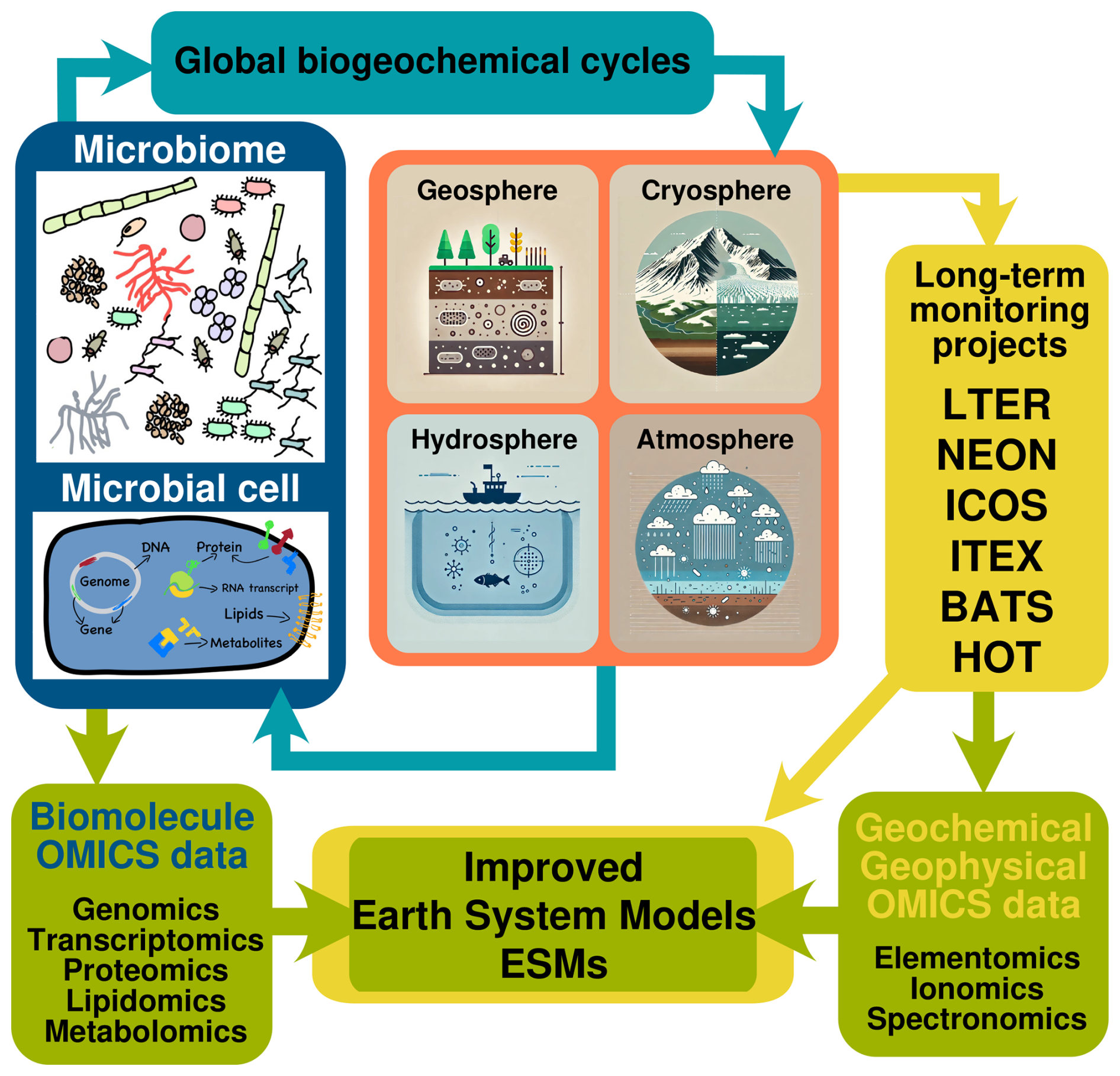
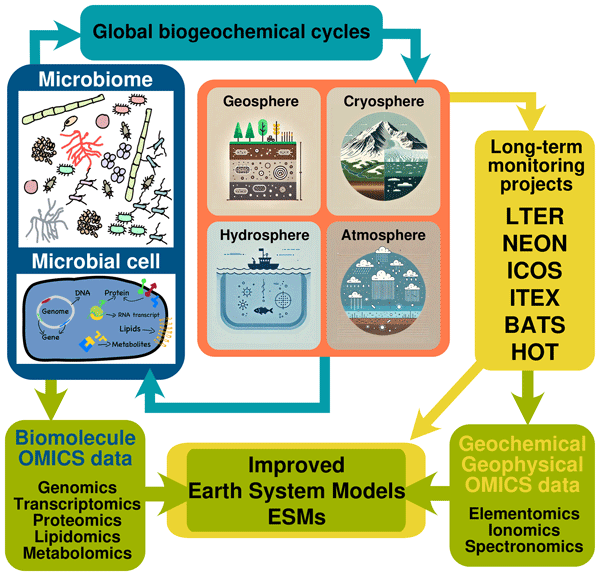
Figure 1Conceptual framework for advancing our understanding and prediction of Earth's biogeochemical cycles under environmental change, by integrating omics data into long-term monitoring and modelling efforts. Red: Earth environmental spheres and ecosystems; blue: microbial cells and microbiomes interacting with biogeochemical processes critical in global biogeochemical cycles; yellow: long-term monitoring actions that supply key knowledge and response variables for biogeochemical models; green: integration of different levels of functional omics data to complement the environmental datasets used to advance Earth system models.
In this perspective, we highlight the immense potential of omics data to advance our understanding of global biogeochemical cycles by showcasing key insights gained across diverse systems – from land to ocean to atmosphere – and addressing the remaining challenges and future opportunities. The examples are deliberately presented as standalone Boxes, one per Earth system (air, cryosphere, soil, plant, ocean), each serving as a self-contained entry point for readers working in that system.
2.1 Global distribution of biodiversity
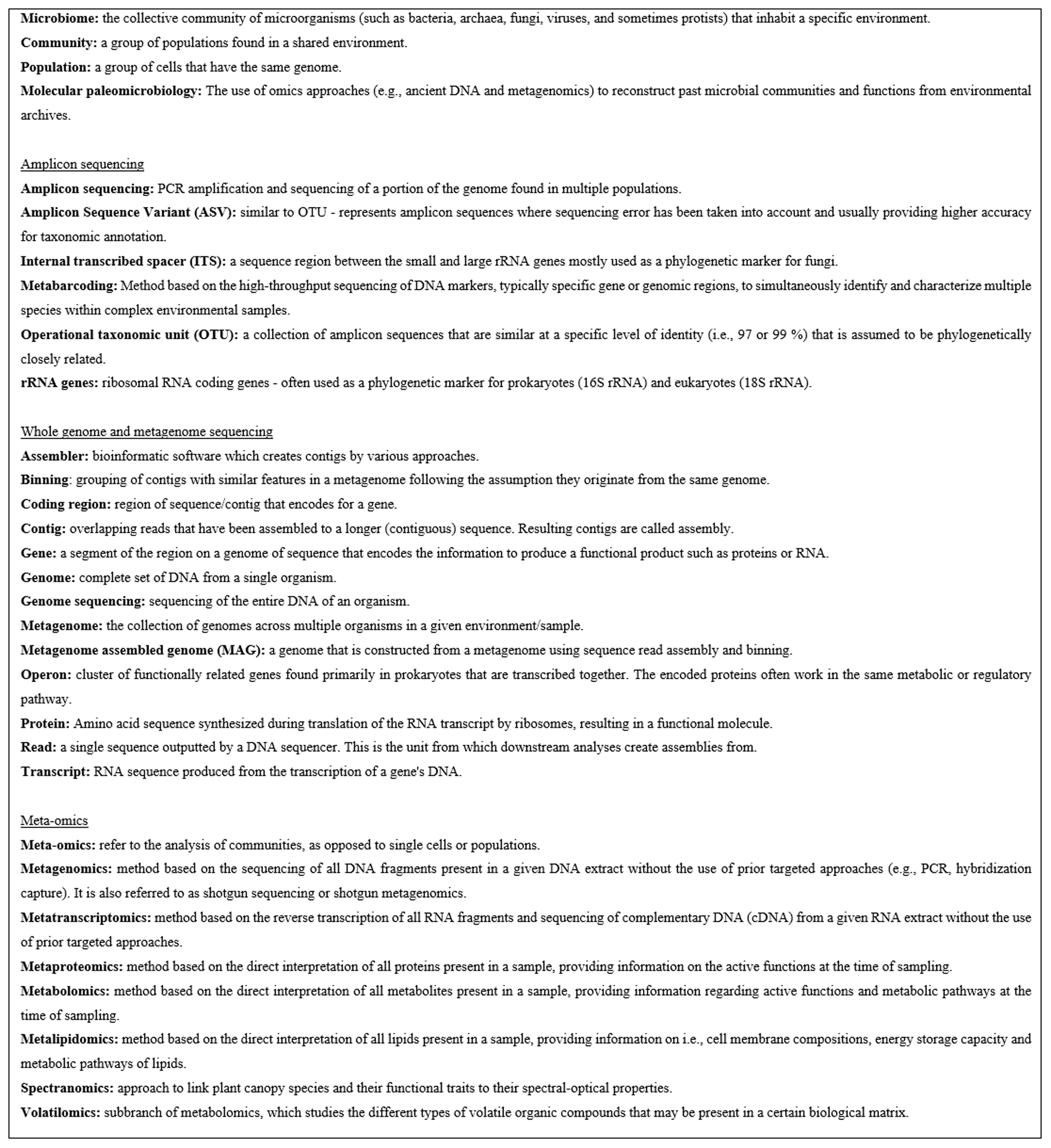
While around 1.5 million species have formally been catalogued to date, these estimates largely ignore microbes (both prokaryotes and eukaryotes, as well as viruses) that are estimated to encompass as many as a trillion species (Tara Ocean Foundation et al., 2022). The inability to characterize this dark matter of life is highly problematic, given microbes regulate and maintain all of Earth's biogeochemical processes including carbon (primary production in the ocean is performed almost entirely by microbes, and is comparable to all photosynthetic activity by plants on land), and nitrogen (e.g., nitrogen fixation and denitrification). Even viruses, generally not considered living organisms, are now recognized for playing major roles in nutrient recycling, e.g., carbon and iron cycles (Twining and Baines, 2013). Not only does much of the Earth's biodiversity reside in microorganisms, microbes are highly abundant (est. 1030 cells on Earth) and, together, represent the second largest contributor to Earth's biomass despite their microscopic size (Bar-On et al., 2018; Bar-On and Milo, 2019). The immense amount of microbial abundance and diversity reflects billions of years of metabolic innovation and evolution to exploit nearly every resource on Earth. These key contributions of microbes as the engines of Earth's biogeochemical cycles and for assuring the survival of Earth's life are grossly neglected by most people, including by the majority of scientists, although efforts are now afoot to give a voice to this unseen majority (Falkowski and Knoll, 2007; Doumeizel and Dolan, 2024; Tara Ocean Foundation et al., 2022).
Thanks to multiple international efforts, a comprehensive picture of microbial diversity is emerging. Notable examples are the Earth Microbiome Project (Thompson et al., 2017), soil microbiome and fungal projects like SPUN (Sanchez-Tello and Corrales, 2024), and Tara Oceans (Sunagawa et al., 2020). These datasets allow us to build genomic catalogues (e.g., Nayfach et al., 2021; Paoli et al., 2022; Ma et al., 2023; Schmidt et al., 2024; Maeke et al., 2025) to characterize the patterns and processes governing microbial distributions. Gene atlases of these organisms could also be used to infer functions related to biogeochemical cycles and thus start to define who does what, how they interact with their environment, and how they impact ecosystem functioning (e.g., Guidi et al., 2016). As illustrated in the next section, such blueprints from multiple microbes provide multiple hypotheses to test the origins, current status, and future of life on Earth.
2.2 Using omics to link diversity to biogeochemical functions: a conceptual foundation
“We can say something about the community by giving a list of its species composition, but a community is poorly described by such a list alone.” (Whittaker, 1975).
Ecosystem ecology sits at the nexus of understanding the flow of energy and materials through the biosphere and other abiotic pools. Many of the biological controls on these fluxes (e.g., reaction rates, substrate affinities, and temperature sensitivities) are governed by functional traits that vary at finer genetic scales than are typically resolved in ecosystem studies, such that aggregation into coarse taxonomic units obscures functionally relevant diversity and propagates uncertainty into predictions of biogeochemical fluxes. Ecosystem ecologists have focused on the role of species variation across environmental gradients to predict ecosystem functions; for example, correlating plant species diversity with an ecosystem's measure of productivity. However, for microorganisms, we have limited knowledge of how microbial diversity translates to functional variation. For one, most microorganisms are uncultured and, therefore, remain unknown and uncharacterized (Steen et al., 2019). Second, the equivalent of the biological species concept does not apply to microorganisms, as there are ambiguities in what constitutes a microbial population, or genetic units belonging to the same species (Shapiro et al., 2016; Chase et al., 2019). Therefore, microbiome analyses typically rely on extracting all the genetic information from an environmental sample for microbial classifications, as this circumvents the need to culture and identify individual microbes. Generally, microbiome scientists cluster and collapse the immense genetic diversity within microbiomes into taxonomic units based on genetic relatedness, such as operational taxonomic units (OTUs) or metagenome assembled genomes (MAGs), which can then be compared to reference databases. However, these taxonomic groupings are defined largely by computational convenience and may not reflect biological organization, as they can represent anything from a family or species to a mosaic genome composed of multiple strains (Tyson et al., 2004; Meziti et al., 2021). Therefore, microbiome-focused ecosystem assessments are inherently forced to move away from the rich literature and theory developed for species to a broader view centered on community-wide metrics such as alpha- and beta-diversity metrics, community-level traits, or interaction metrics, e.g., with co-occurrence networks (Chase and Martiny, 2018).
This community-wide approach has several advantages, such as compiling global catalogs of microbial diversity across geographic scales that reveal biogeographic processes structuring environmental microbiomes (Fierer, 2014) and understanding potential metabolic interactions across various trophic levels encoded within the genetic makeup (Shaffer et al., 2022). Yet, these broad approaches mask intra-community functional trait variation that contributes to ecosystem functioning (Larkin and Martiny, 2017), especially in the context of environmental change (Scales et al., 2022). To illustrate this point, a bacterial OTU is assigned by clustering related genetic sequences of the conserved 16S rRNA gene region at varying thresholds. Depending on the genetic resolution used (ranging from amplicon sequence variants (ASVs) or 1 %–3 % genetic divergence), these OTUs are estimated to represent 50–150 Myr of evolutionary time, or roughly equivalent to when all modern bird species evolved from a common ancestor (Martiny et al., 2023). Given the well-established trait and physiological variation among bird species and their contributions to geographic distributions, no ornithologist would collapse all birds into a single OTU to study ecosystem dynamics. From a biogeochemical perspective, doing so would implicitly assume uniform kinetics and environmental sensitivities, an assumption rarely justified for processes such as decomposition, respiration, or primary production. As such, microbial community analyses should understand the degree of trait variation within their taxonomic designations and determine whether that functional variation is relevant to biogeochemical fluxes (Abs et al., 2023; Defrenne et al., 2021).
Given that microbiome assessments rely on genetic material, we can also utilize that genomic information to infer functional traits at multiple biological levels. All functional traits, to some degree, are phylogenetically conserved. Some, such as pH or salinity responses, are broadly conserved at higher taxonomic levels while others, such as the responses to predicted anthropogenic factors (i.e., added nitrogen or drought) (Chase et al., 2017), exhibit fine-scale genetic variation at the genus, species, or even population levels (Martiny et al., 2015). Therefore, microbiome assessments of functional consequences need to prioritize and identify their functional trait of interest and understand the system's diversity accordingly (McLaren and Callahan, 2018). For example, the globally distributed marine phototroph Prochlorococcus (Cyanobacteriota) is estimated to produce ∼20 % of the oxygen generated each year by photosynthesis on the planet and is predicted to be highly sensitive to changes in surface ocean temperatures (Flombaum et al., 2013). Prochlorococcus is composed of several ecotypes, or highly clustered strains occupying similar ecological niches but differing in key functional traits (Cohan, 2002). These ecotypes are geographically and vertically distributed in the water column through their partitioning of resources, including light, iron, and temperature, with closely related ecotypes differing in their thermal tolerance (ranging from ∼15–30 °C based on cultured isolates) and persistence across surface and subsurface waters (Johnson et al., 2006). Therefore, an understanding of how oxygen production may shift under future climate scenarios will be dependent on the individual responses of each ecotype and their functional differences (Ustick et al., 2023). These patterns aren't unique to Prochlorococcus and have been increasingly observed in abundant soil taxa driving leaf litter degradation and carbon turnover (Chase et al., 2018), glacier-fed streams (Fodelianakis et al., 2022), marine sediments (Chase et al., 2021a), and bogs (García-García et al., 2019).
Given the current limitations in relating functional and taxonomic diversity, metagenomic (DNA-based) and/or metatranscriptomic (RNA-based) assessments of microbiomes can provide direct information on the functional genes present in a community. These functional approaches provide crucial insights into how the metabolic potential of communities may be used to predict responses to environmental change (Piton et al., 2023). These data reflect genomic potential rather than realized activity unless paired with proteomics or metabolomics; however, even with such paired datasets, sparse reference databases (e.g., 90 %–99 % of environmental genes (Nayfach et al., 2016) and >95 %of metabolites are unannotated (Bouslimani et al., 2014)) can bias trait interpretations and their links to environmental variables (Osburn et al., 2024). Ultimately, scaling from traits to ecosystem processes requires understanding how variation in microbial traits – and the genetic scales at which they are conserved – links to environmental gradients and biogeochemical rates (Abs et al., 2024a, b, 2020), as ecosystem ecologists have long done for macro-organisms. While physical state variables like temperature and pH are easily monitored, they represent the environment rather than the biological response to it. Meta-omics provides the link between these abiotic drivers and the internal biological “volume knobs”, such as Vmax and Km, that determine the actual rate of biogeochemical flux.
2.3 Using omics to predict biogeochemical functions at the site scale
2.3.1 Example from a subsurface system
We define the terrestrial subsurface to begin below the depth of greatest plant root density and extend into deeper aquifers. Life in the subsurface influences the composition of gases and liquids moving through it, acting as an open biogeoreactor driven by surface-derived organic matter, nutrient inputs, and a process known as dark carbon fixation (Küsel et al., 2016). In environments lacking sunlight, dark carbon fixation refers to the ability of chemolithoautotrophic microbes to use energy from reduced compounds (e.g., sulfur, nitrogen, hydrogen) to fix inorganic carbon into organic matter, thereby generating a self-sustaining energy source. This process is particularly significant in groundwater ecosystems, where reduced inorganic electron donors fuel primary production, replacing the role of photosynthesis at the surface.
Omics approaches, such as metagenomics, are invaluable for unravelling the metabolic capacities of these microbial communities, offering insights into the dynamic and complex biogeochemical processes that drive subsurface life. Metagenomic studies have revealed a high abundance of chemolithoautotrophs in groundwater, accounting for 12 % to 47 % of the microbial community, suggesting that dark carbon fixation is central to subsurface trophic webs (Overholt et al., 2022). This process might also have global significance, as the subsurface and surface biospheres are tightly linked through the exchange of energy and matter. Overholt et al. (2022) estimated that dark carbon fixation in deep subsurface environments could contribute between 1.4 and 2.5 Tg of CO2 per year to the atmosphere globally.
2.3.2 Example from the global ocean
Meta-omic data provide powerful tools for understanding the key role of microorganisms and in carbon sequestration, biogeochemical cycles of the global ocean including data generated by the GOS (Yooseph et al., 2010), GEOTRACES (Biller et al., 2018), Malaspina (Acinas et al., 2021) and Tara Oceans (Sunagawa et al., 2020) expeditions. Among other forcings, human-induced deoxygenation of marinel water columns is altering microbial metabolisms and their contributions to global biogeochemical cycles. Oxygen levels in marine waters are declining due to global warming and increased anthropogenic nutrient loading (Doney et al., 2012). This deoxygenation is expanding oxygen-minimum zones and creating so-called dead zones in near-shore ecosystems (Breitburg et al., 2018), with profound implications for ecosystem functioning. These changes reduce habitats and resources for organisms like fish and cause significant shifts in carbon, nitrogen, and sulfur fluxes between the sea and atmosphere (Wakeham, 2020). Future deoxygenation due to climate change may expand the extent of oxygen-minimum zones with unknown consequences such as potential increase of emissions of greenhouse gazes such as nitrous oxide (Canadell et al., 2021).
Microbial metabolisms are particularly affected, as anaerobic respiration processes become dominant in oxygen-depleted environments. These metabolisms include the use of nitrogen, sulfur, carbon compounds, and trace elements as alternative energy sources. Other processes, such as anoxygenic anaerobic photosynthesis (the use of light to produce organic matter in sunlit anoxic environments) and the microbial transformation of mercury into the neurotoxin methylmercury, are also induced (Bravo and Cosio, 2020). Thanks to meta-omic data, we can now study present-day microbial ecology and biogeochemical processes associated with oxygen depletion. For example, Capo et al. (2022a) demonstrated through environmental chemistry, metagenomics, and metatranscriptomics that microbial production of methylmercury is prevalent in oxygen-deficient water layers of two basins in the Baltic Sea. Combining such contemporary meta-omic analyses with historical DNA data from sedimentary archives offers a unique opportunity to explore the links between increasing anoxia in water columns and shifts in microbial metabolisms as recently done in the Black Sea (Zhong et al., 2025).
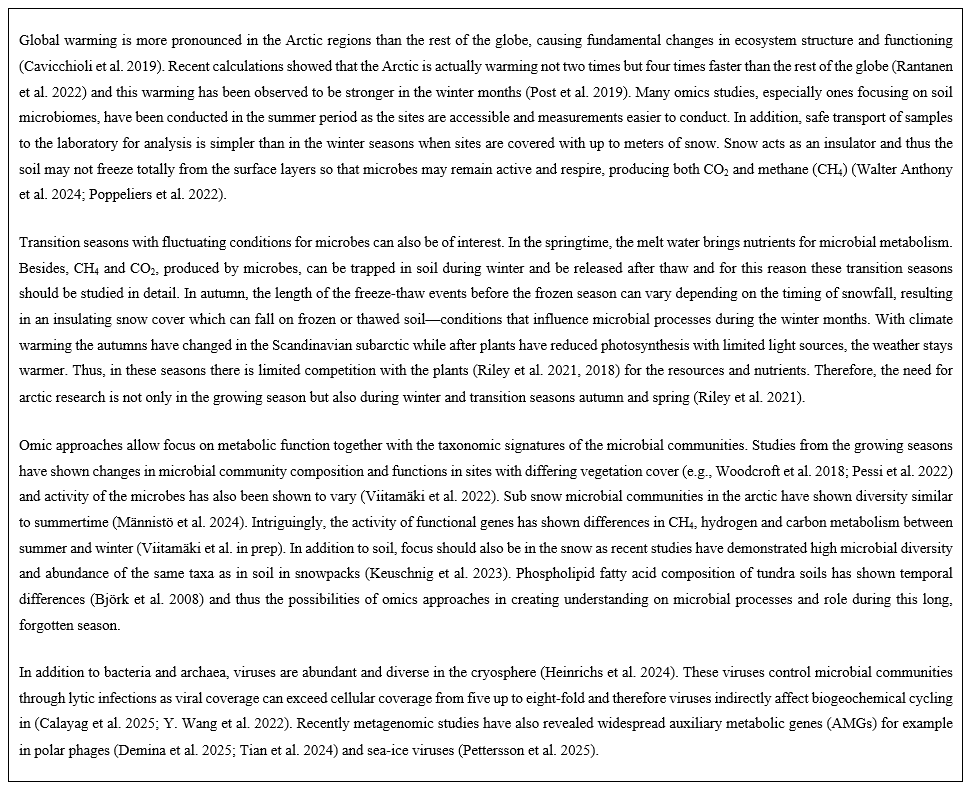
Box 3Example from the cryosphere.
2.3.3 Example from a terrestrial plant system
Metabolomics is also a tool to better predict the influence of climate change on ecosystem dynamics. Chemical ecologists recently included phytochemical traits as niche dimensions based on their central functions in plant responses to their environment (Müller and Junker, 2022). For instance, the so-called “predictive metabolomics” approach can be used to predict patterns of phytochemical diversity in Alpine regions independently of plant lineage (Defossez et al., 2021). Similarly, modelling was used to predict the environment of multiple plant species from the Atacama Desert using their metabolism (Dussarrat et al., 2022). Metabolomics was also used to analyse changes in soil microbial function in response to drought (Brown et al., 2021). Overall, predictive metabolomics peaks as an ideal tool to predict and anticipate losses or modifications of chemical and functional diversity in response to climate change (Dussarrat et al., 2025; Frugone-Álvarez et al., 2023; Dussarrat et al., 2022).
2.4 Using omics to predict biogeochemical functions at the global scale
2.4.1 Large-scale metagenomics
The examples in Sect. 2.2 illustrate how omics approaches can help identify the drivers of biogeochemical processes. Large-scale metagenomic analyses offer a powerful tool to extend findings from individual studies to a global scale. A variety of large-scale metagenomic datasets from diverse ecosystems are now available (Bahram et al., 2018; Sunagawa et al., 2020; Duarte, 2015; Schmidt et al., 2024; Maeke et al., 2025), allowing researchers to screen for the presence of pathways of interest at genome resolution thanks to the large numbers of MAGs that have been generated. These resources also enable us to explore global distributions, and assess community susceptibility to environmental conditions (Chaffron et al., 2021). This, in turn, helps to predict their potential impact on biogeochemical cycling at a planetary level (Fig. 2).
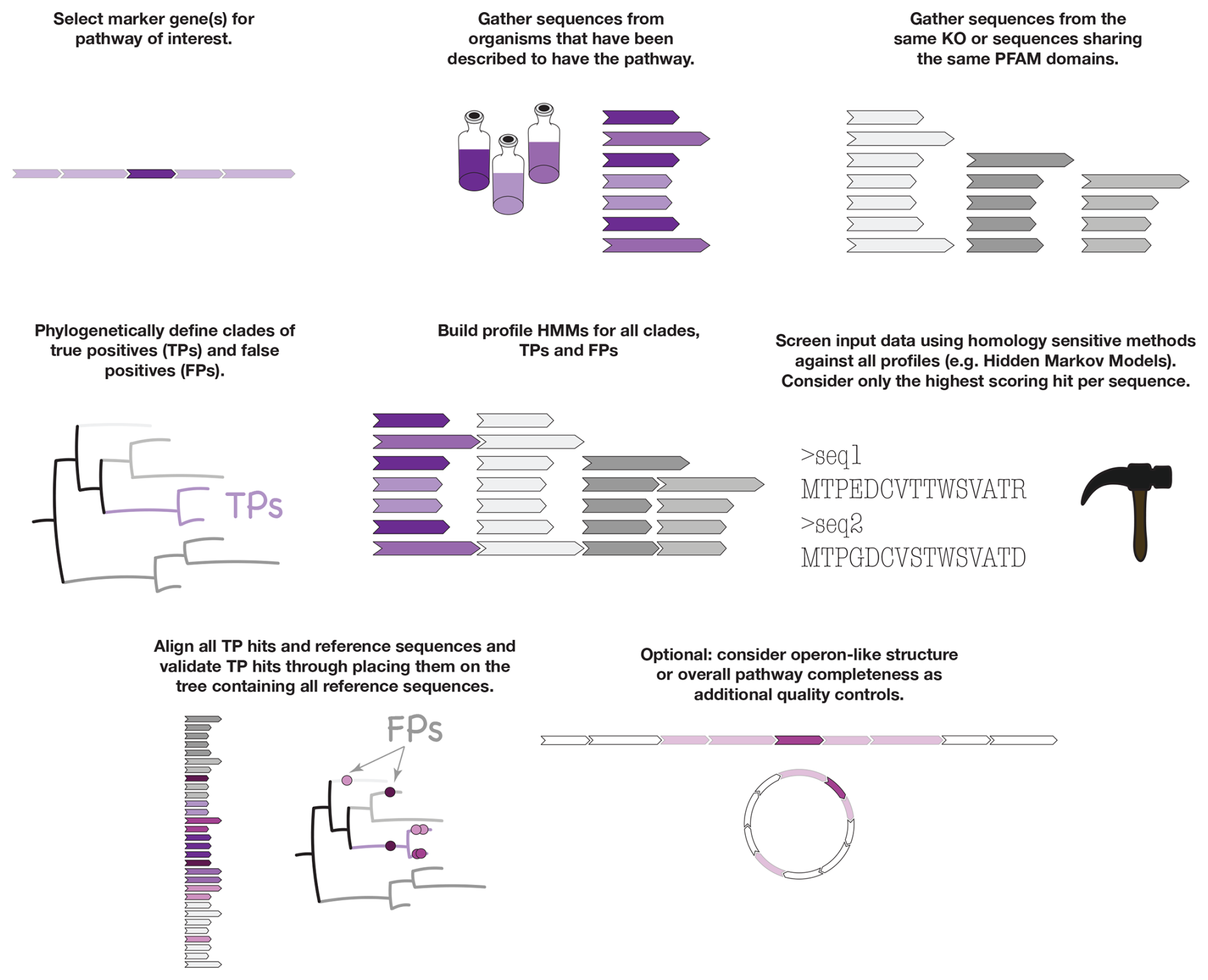
Figure 2Methodological workflow for the robust screening and functional annotation of biogeochemically relevant pathways in large-scale metagenomic data. The strategy utilizes a multi-stage verification process to ensure high-specificity annotations, starting with the selection of specific marker genes and the gathering of reference sequences from known organisms and shared protein domains, such as PFAM. These reference sequences are used to phylogenetically define clades of true positives (TPs) and false positives (FPs) to build profile Hidden Markov Models (HMMs) for precise screening. Input metagenomic sequences are then screened using homology-sensitive methods, with potential hits validated by placement onto the reference phylogenetic tree to confirm their functional identity. To further handle technical uncertainty and ensure metabolic functionality, an optional final step evaluates the genomic context for operon-like organization or overall pathway completeness within the reconstructed Metagenome-Assembled Genome (MAG).
However, large-scale metagenomics presents several challenges, foremost among them being the accuracy of pathway annotations. Standard workflows rely on automated annotation pipelines, followed by manual curation to correct issues like spurious annotations. As data volume increases, however, manual curation becomes impractical. To overcome this, we propose several steps to enhance the accuracy of pathway predictions from large-scale metagenomic data. These steps include defining marker genes uniquely associated with specific pathways to serve as reliable indicators of their presence. Annotation of these genes should utilize methods sensitive to remote homology and be validated through phylogenetic approaches. Furthermore, pathway completeness should be assessed by identifying other related genes within the MAG of interest. In some cases, the operon-like organization of the genes involved in a pathway can also indicate its functionality, increasing annotation reliability (Bratlie et al., 2010). This property has been used to explore the biosynthetic potential of MAGs generated from Tara Oceans, leading to the discovery of a particularly talented group of formerly unknown bacteria able to generate multiple compounds of interest in biotechnology (Paoli et al., 2022).
Large-scale metagenomic screenings provide a comprehensive view of microbial processes across diverse ecosystems and under varying environmental conditions, thus enhancing our understanding of the phylogenetic and ecological distribution of biogeochemical cycles. Combining these with contextual data (i.e., physical, chemical and biological parameters) can help to predict the link between environmental conditions and a respective biogeochemical pathway. Furthermore, understanding the link between pathways and the environmental conditions in which they occur allows predicting the sensitivity of biogeochemical cycles in a changing environment.
In summary, we can leverage large-scale metagenomics to study the distribution of biogeochemical pathways in diverse environments and make predictions of how their distribution might change under changing environmental conditions. The results from such analyses provide the foundation for new hypotheses and experimental research (e.g., isolation of organisms or studying pathway activity in different conditions).
2.4.2 Combining meta-omics to infer large scale biogeochemistry
In most Land Surface Models (LSMs), vegetation and soil attributes are often prescribed in parameter lists and used to describe how biogeochemical processes vary over the land surface. For example, the representation of vegetation is distilled in a variety of plant functional types (PFTs), with each representing a prescribed range of anatomical and physiological parameter values such as leaf mass area, carboxylation rates, or leaf respiration (Duckworth et al., 2000; Woodward and Cramer, 1996). These PFTs can co-vary with certain soil chemical and physical characteristics that are often prescribed, assimilated and/or predicted after some model initialisation and predetermined spin up procedure that drives the vegetation, soil, and atmosphere into some quasi-steady-state to explore feedbacks on biogeochemical cycles (Friend et al., 2014; Matthaeus et al., 2021; Taylor et al., 2011).
A growing number of databases and maps detailing key soil characteristics – such as soil bulk density, pH, carbon (C), nitrogen (N) and phosphorus (P) content – combined with climate forcing, are now openly available. These resources can support LSM numerical simulations, machine learning models, or hybrid approaches, to predict how soil properties, such as microbial C, N and P biomass, vary across the land surface. These soil characteristics are increasingly being linked to variations in soil microbial community structure and diversity. For example, Delgado-Baquerizo et al. (2016) found that certain microbial groups thrive in high-pH soils, itself shaped by vegetation and climate. Similarly, fungal communities can be mapped to how soil mycorrhizal fungal guilds will vary across the land surface, with implications for soil C storage and nutrient acquisition by vegetation (Kivlin, 2020).
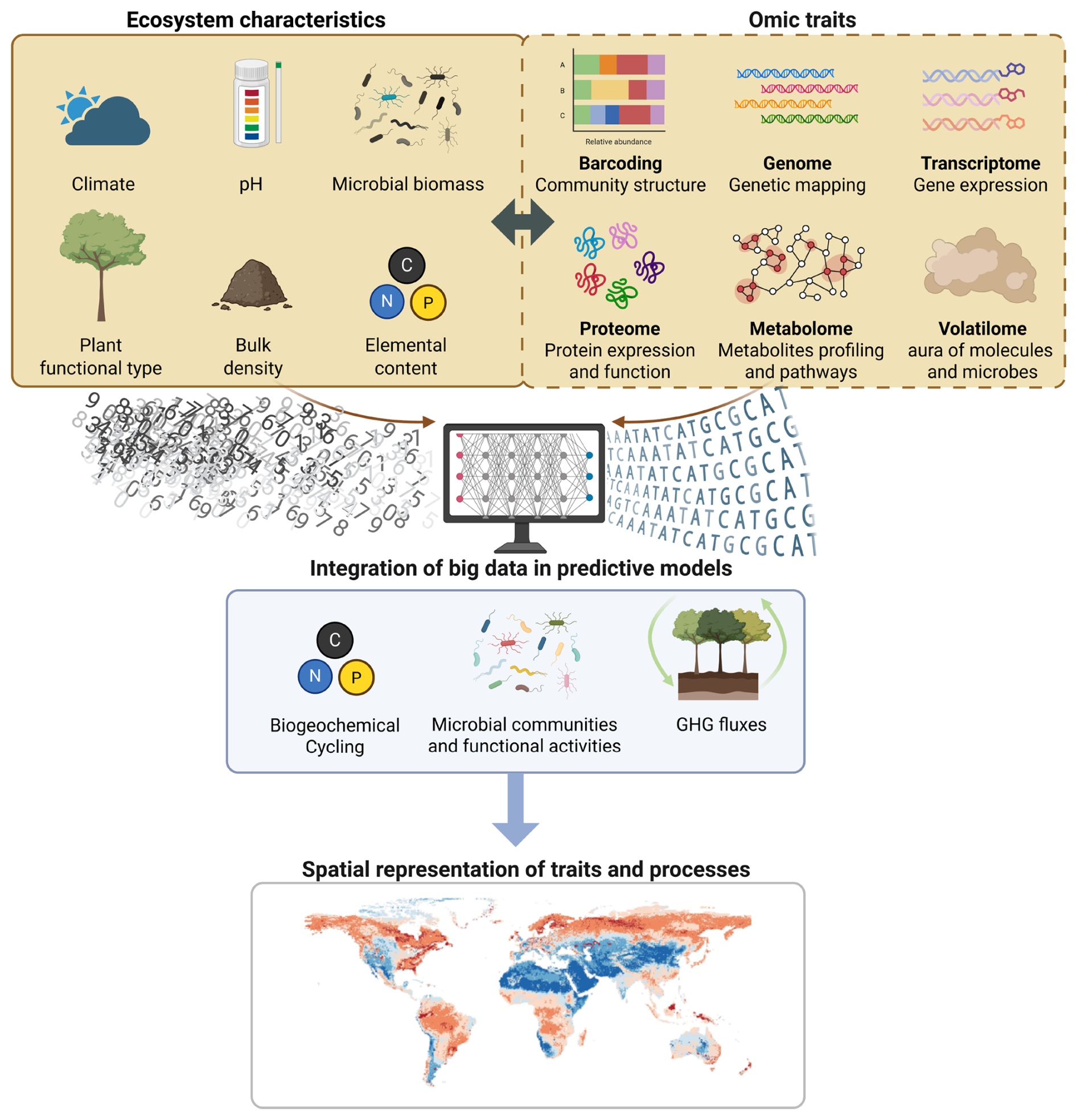
Figure 3Conceptual figure of a bottom-up system approach using meta-omics. The integration and combination of omic datasets with key vegetation and soil attributes through machine learning models present a great opportunity to enhance our understanding of the genes, pathways and mechanisms underlying biogeochemical cycling and functional activity of soil microbial communities and associated processes such as soil gas exchange for their representation at larger scales. Created with BioRender (https://BioRender.com/9p03o4f, last access: 29 July 2026).
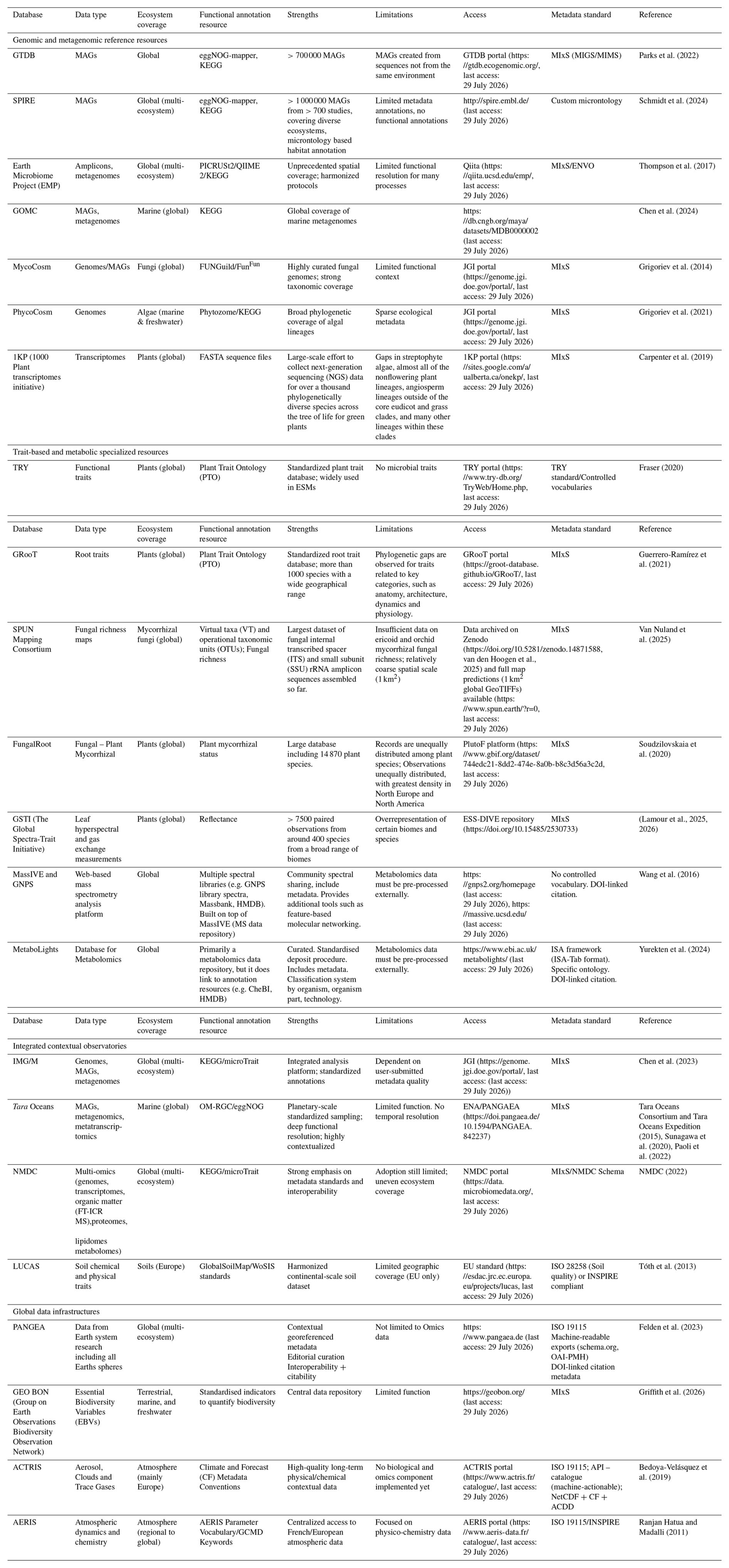
More recently, these databases have been extended to include metagenomic data to show how genes linked to C storage vary across the global land surface (Piton et al., 2023) (Table 1). Linking metagenomic data with measurements of soil GHG fluxes or profiles of soil volatilomes could provide mechanistic insight into the metabolic characteristics of soil communities that control GHG and VOC fluxes with the atmosphere. These, in turn, could offer predictive tools for understanding how GHG and VOC fluxes might change with climate or disturbance (Fig. 3). Likewise, other omic datasets, such as soil proteomes or metabolomes, may provide additional insights into the realized and functional activity of soil microbial communities. For example, examining how soil GHG fluxes and gridded soil characteristics vary with soil metabolomes, proteomes, and community structure could pave the way for predicting soil C storage and GHG variability across large scales and over time, even from discrete soil samples.
Beyond direct parameterization, emerging machine-learning (ML) and AI-based models provide a powerful bridge between microbial community structure and ecosystem functions. For example, ML frameworks have been successfully used to map bacterial communities to physicochemical variables and soil quality indicators, allowing for the prediction of ecosystem-level states from sequence data (Hermans et al., 2020). These predictive models can be further expanded to forecast environmental shifts, such as changes in soil pH in response to global warming, by training models on large-scale longitudinal datasets (Feng et al., 2024). Complementary to ML, genome-informed approaches allow for the inference of specific environmental preferences, such as microbial pH optima, directly from genomic traits (Ramoneda et al., 2023). By linking these inferred traits to functional outcomes, researchers can move beyond taxonomic lists to mechanistic representations of how microbial “niche breadths” influence biogeochemical stability.
Table 1Databases and resources for linking omics data to ecosystem processes. The table provides an illustrative, non-exhaustive overview of widely used resources across ecosystems, including data type, ecosystem coverage, strengths and limitations, access standards, and references where applicable.
2.4.3 Integrating omics data into biogeochemical models
Traditional biogeochemical models often apply simplified representation of microbial processes, relying on parameters derived from cultivated microorganisms, which may not accurately capture the complexity and diversity of natural ecosystems (Steen et al., 2019). The increasing availability of metagenomics data presents an opportunity to integrate those microbial traits from genomes into mechanistic ecosystem models, potentially enhancing their predictive capabilities (Woodcroft et al., 2018; Bahram et al., 2018). By inferring microbial traits from genomes obtained in-situ, the metabolic potential of the microbial communities would be better represented, thereby providing more accurate and robust prediction of ecosystem functioning.
Incorporating genomic information into biogeochemical models requires a structured approach. Here, we review two groups of models: soil biogeochemical models, and full ecosystem-level models, each with distinct capabilities and approaches leveraging omics data. Soil biogeochemical models are designed to simulate detailed soil processes, and are typically driven by diagnostic inputs, such as prescribed litter, soil moisture, and temperature data. Some of these models have explicit representations of microbial processes, including the Microbial-Enzyme Decomposition (MEND) Model, MIcrobial-MIneral Carbon Stabilization (MIMICS), and CORPSE; see Chandel et al. (2023) for a full review. For example, MEND has been constrained and validated using GeoChip-based gene abundance measurements, which provides a basic platform for testing hypotheses about microbially-mediated biogeochemical processes (Wang et al., 2022a; Gao et al., 2020). In contrast to soil biogeochemical models, full ecosystem models simulate the coupled dynamics of water, energy, plants, and soil processes driven by climate forcing. Such coupled models are valuable for projection or spatial extrapolation because many of the emergent properties of primary scientific and societal concern, such as net ecosystem exchanges of CO2 and CH4, are strongly regulated by interactions between these interconnected systems. One example of such a model that integrates microbial genomics data is the genome-to-ecosystem (G2E) framework proposed in Li et al. (2025) (Box 4).
Box 4A worked example: genome-to-ecosystem (G2E) framework.
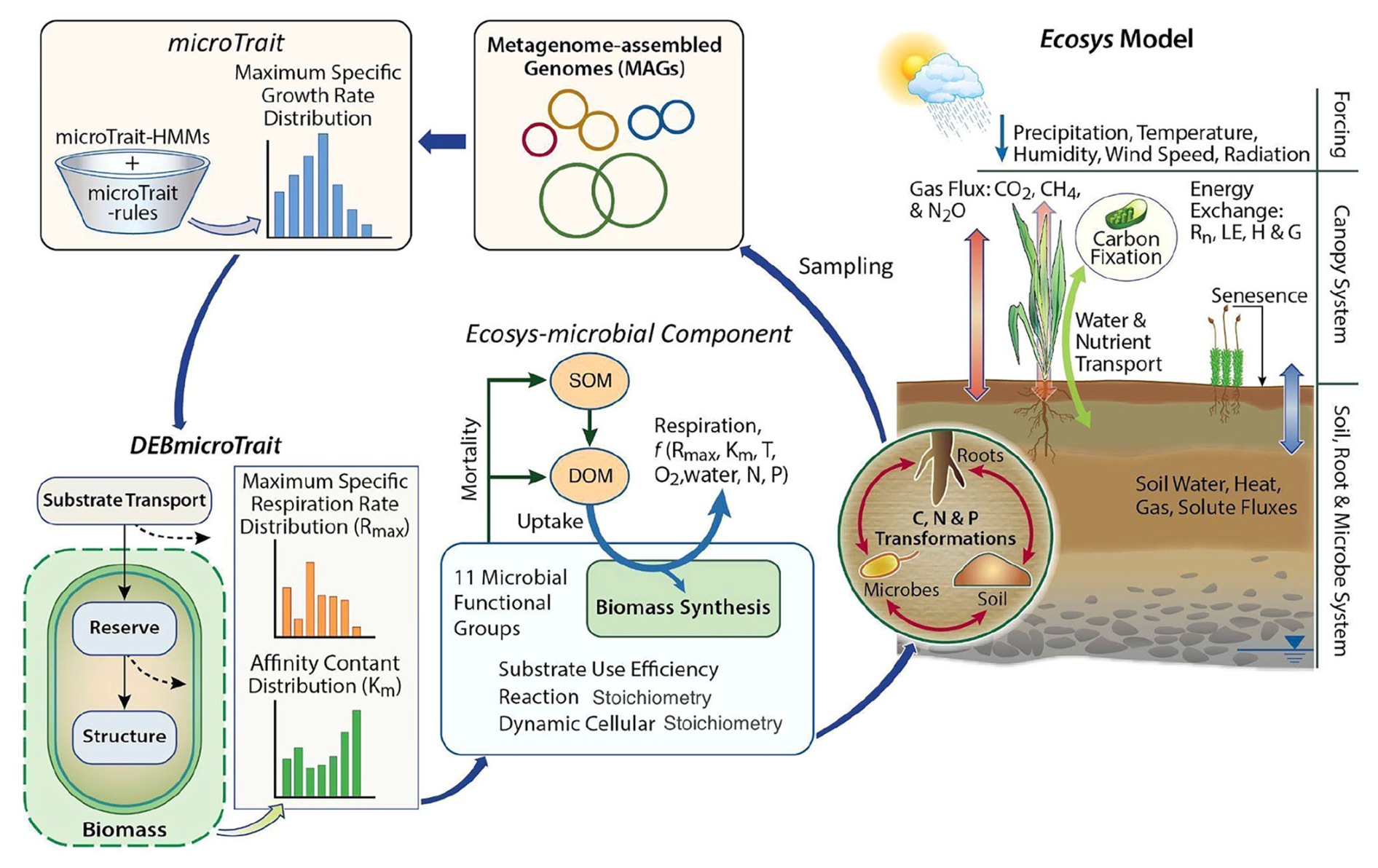
Figure 4Genome-to-ecosystem (G2E) conceptual framework integrating genomic information, site characterization, and ecosys. Reproduced from Li et al. (2025).
2.5 Using omics to reconstruct past and forecast future environments
2.5.1 Past
Omics methodologies in paleo-ecological reconstructions have advanced from mere novelty to producing new ways of understanding ecosystem functions. Compared with traditional palynology techniques, such as pollen, fungal spores, and bacteria microfossils, metagenomics for instance captures changing trophic relationships among primary producers, consumers, and decomposers albeit at limited spatial scales (Jia et al., 2022). Still, omics and conventional proxies can be successfully combined despite the variations in spatial scale of processes and taxonomic resolution. For example, omics have been utilized to differentiate past ecosystem drivers and expand assessments of vegetation changes in rangeland ecosystems (Box 5). However, combining traditional and omics evidence in palaeo-ecology is still in its infancy because there are few epistemically independent models (Jones and Bösl, 2021; Edwards, 2020).
Molecular paleomicrobiology is an emerging field that leverages ancient and/or historical DNA (aDNA) technologies to uncover how microbial genomes and communities have evolved over time in response to environmental changes (Grasso et al., 2024). By studying ancient microbial remains preserved in dental calculus, paleofeces, archaeological sediments, and even environmental samples like permafrost, aquatic sediments and ice cores, scientists gain insights into historical human-microbe interactions and environmental adaptations (Warinner et al., 2014, 2017; Warinner, 2022; Capo et al., 2022b). Remarkably well-preserved microbial aDNA from stable environments, such as permafrost, allows us to track the evolutionary history of microbial taxa and understand ecosystem responses to past climate shifts. For instance, DNA from two-million-year-old Greenland permafrost has revealed how plant and animal communities from the Middle Pleistocene adapted to environmental changes. However, the complex mixture of DNA from ancient and more recent microbial populations still complicates efforts to disentangle the signals from pioneering microbes and those deposited at a later time (Fernandez-Guerra et al., 2023; Kjær et al., 2022).
While post-mortem DNA degradation complicates the analysis, predictable damage patterns, such as fragmentation and specific base modifications, offer clues to the age of the samples (Briggs et al., 2007). This information is crucial as we work to reconstruct microbial genomes from diverse environments, which might contain amounts of aDNA that may reflect past ecosystems. Recently, DNA could be even extracted from low-biomass containing carbonate rocks with distinct DNA fragmentation patterns allowing us to separate ancient from modern communities (Wegner et al., 2023). Thus, these rock formations might act as potential archives of ancient microbial records. However, MAGs have to be reconstructed from these challenging environments to deepen our understanding of subsurface microbial life and its long-term changes, ultimately refining estimates of microbial populations in the Earth's crust.
Long-term records of aquatic biota are still scarce as monitoring using DNA approaches started about two decades ago. Fortunately, the extraction and sequencing of environmental DNA preserved in sedimentary archives has shown its potential to reconstruct past environmental changes and their impact on aquatic microbial diversity (Nguyen et al., 2023; Capo and Barouillet, 2023). In a recent review, Barouillet et al. (2022) highlighted how molecular paleoecology research augments knowledge about the effects of anthropogenic stressors on past aquatic biota. On a longer time scale, Armbrecht et al. (2022) show that photosynthetic genes dated back to 540 000 years ago can be detected from Southern Ocean sedimentary archives. Overall, past DNA data is foreseen to be a valuable proxy for projecting the impacts of near-future environmental changes on microbial diversity across both aquatic and terrestrial systems.
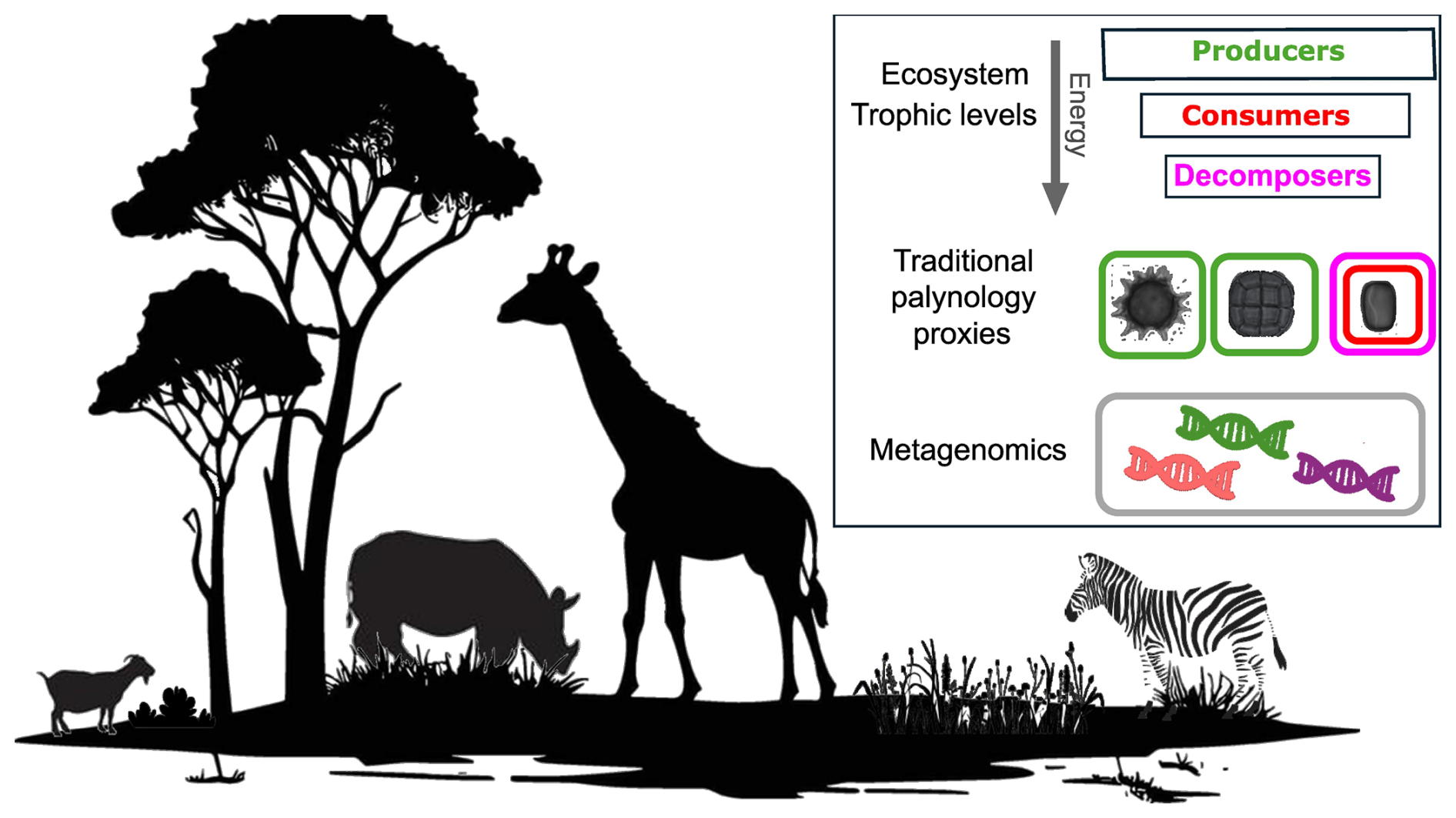
Figure 5A graphical representation of trophic energy flow in African savanna rangelands featuring producers, consumers, and decomposers. The gray arrow indicates the flow of energy while the colour-coded trophic level boxes represent trophic biomass (not to scale) across the chain. Vegetation dynamics of this system can be reconstructed from fossil pollen, which can be related to herbivore grazing pressure and nutrient cycling via coprophilous fungal spores. Metagenomics, in contrast, is useful for resolving protein and genetic sequences, simultaneously tracing multiple trophic interactions. However, since preservation and strengths of trophic relationships may vary within ecosystems, combining palynology and omics produces better results (e.g., Tabares et al., 2020).
2.5.2 Future
Experimental approaches to studying microbial evolution and its role in biogeochemistry
Geological and paleoclimate records provide environmental analogs to how ecosystems may respond to future climate scenarios. However, such studies are typically limited in their scope by generalizing at the ecosystem-level without insights into the processes and mechanisms driving individual species responses. One such response is local adaptation to changing environmental conditions, where species may disperse to new favourable conditions and expand their geographic ranges or evolve adaptive traits over evolutionary time through gene flow with neighbouring populations and/or emergence of advantageous de novo mutations. Given the long timescales to observe adaptive traits, reciprocal transplant experiments have provided direct insights into the ecological and evolutionary responses to predicted climate conditions. For example, plant communities, given their importance in terrestrial ecosystems, have long been studied demonstrating plant species are locally adapted to current environmental conditions. Such studies highlight differential survival and fecundity (i.e., flowering time) to changing conditions, highlighting phenological traits that may contribute to adaptive differentiation and possible evolutionary responses (Ågren et al., 2012). In other words, past evolutionary divergence caused by local adaptation can restrict and influence contemporary ecological patterns and processes (Urban et al., 2020). Extending these approaches to explicitly test how microbial ecological and evolutionary responses alter biogeochemical rates represent a critical next step for predicting ecosystem responses to future climate change (Box 6).
Numerous microbial studies have demonstrated, through reciprocal transplant experiments or environmental manipulations (e.g., drought or temperature), that microbial communities can rapidly respond through the ecological process such as species sorting, defined by the differential survival and reproduction of locally adapted taxa (e.g., DeAngelis et al., 2015; Finks et al., 2021). These taxonomic shifts can have direct implications for ecosystem function, including changes in decomposition rates (Glassman et al., 2018) and reductions in carbon use efficiency under long-term soil warming (Li et al., 2019). In addition, dispersal can play a significant role in microbiome recovery and successional dynamics following large-scale disturbances (i.e., wildfires; Barbour et al., 2023), which are expected to increase in frequency and intensity under future climate scenarios.
However, microbes are distinct in that their generation times, and thus capacity for adaptation, operate on much faster timelines. Combined with large population sizes and their capacity to exchange DNA within and across lineages, microbes are exposed to a vast reservoir of genetic diversity within microbial communities that may contribute to rapid adaptive responses to environmental change. Certainly, lab-based experimental evolutionary studies that manipulate a selective pressure (e.g., heat) have repeatedly demonstrated that microbes can rapidly evolve and adapt over weeks to months (Tenaillon et al., 2012; Kent et al., 2018), although it's unclear how these artificial laboratory conditions translate to natural populations. In contrast to species sorting, which alters the relative abundances of existing trait variants, evolutionary responses modify trait values themselves, potentially changing microbial reaction norms and longer-term sensitivities to environmental change. Recently, natural experiments using a reciprocal transplant approach across a regional climate gradient demonstrated that microbes, as observed in lab-based experiments, can rapidly adapt through de novo mutations in response to predicted climate scenarios (Chase et al., 2021b). However, such adaptive responses under natural conditions are likely operating under reduced selective pressures on monthly and annual timescales and, thus, may have a reduced role compared to rapid ecological responses (Chase et al., 2021b). Nonetheless, a shift in the microbiome under changing climate conditions is dependent on the continuum of ecological and evolutionary processes that operate at the same time. It is therefore the consideration of the relative influence of ecological and evolutionary processes – and the timescales over which they interact – that will be necessary to predict how microbial communities regulate biogeochemical rates and ecosystem functioning under environmental change (Martiny et al., 2023; Abs et al., 2024b, c).
Predicting long-term ecosystem responses using omics-parameterized models
Using microbial kinetic traits inferred from multi-year omics data, ecosys can be used to predict future ecosystem dynamics. Specifically, ecosys was employed to predict ecosystem dynamics in an Arctic wetland under the RCP8.5 scenario (RCP: Representative Concentration Pathway) through the year 2100 (Li et al., 2025). That ecosys simulation incorporated genome-inferred microbial traits (i.e., community-aggregated traits weighted by genome relative abundance) and baseline microbial traits. The model results show reasonable seasonal cycles of methane and net ecosystem exchange (NEE) during the late 21st century, and have about 18 % and 21 % difference in annual methane emissions and NEE, respectively. The differences were mediated by shifts in the overall carbon cycle, largely due to microbial activity, belowground nutrient transformations, and vegetation dynamics (Bouskill et al., 2020). We highlight some caveats to these results. First, the microbial traits inferred from omics that we applied are constants based on current life-history traits (e.g., growth rate, resources utilization, and stress tolerance); however, those traits may adapt to changing environmental conditions (Sokol et al., 2022). Work is underway to develop models of how adaptation may occur, and to integrate those approaches with ecosystem models (Abs et al., 2024b, 2025; Abs and Ferrière, 2020; Schwarz et al., 2025). Second, the genome-inferred microbial traits we determined span ranges within each microbial functional group, reflecting the multiple genomes that perform the same metabolic functions (Li et al., 2025). However, our application of these traits described here considered only a single value for each trait in each microbial group. Ongoing work in ecosys will allow for trait diversity within microbial functional groups, thereby allowing prediction of dynamic community assembly under dynamic and competitive environmental conditions.
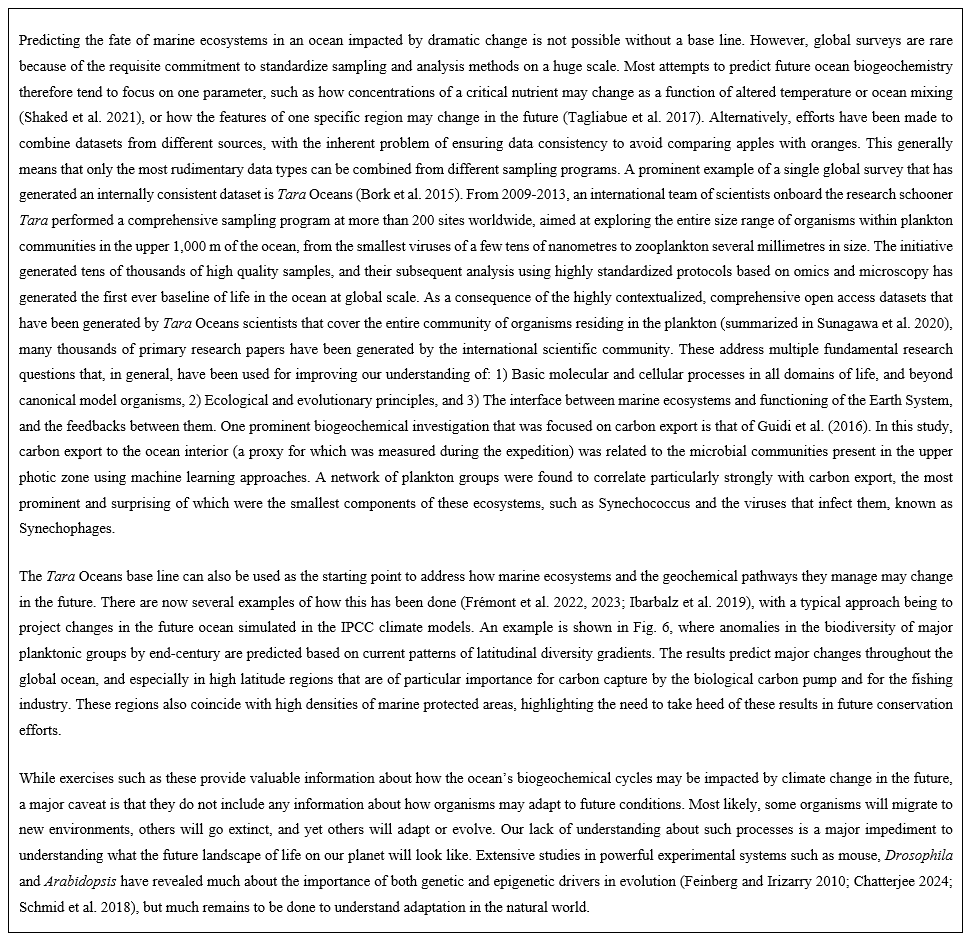
Box 6Predicting future ocean biogeochemistry.
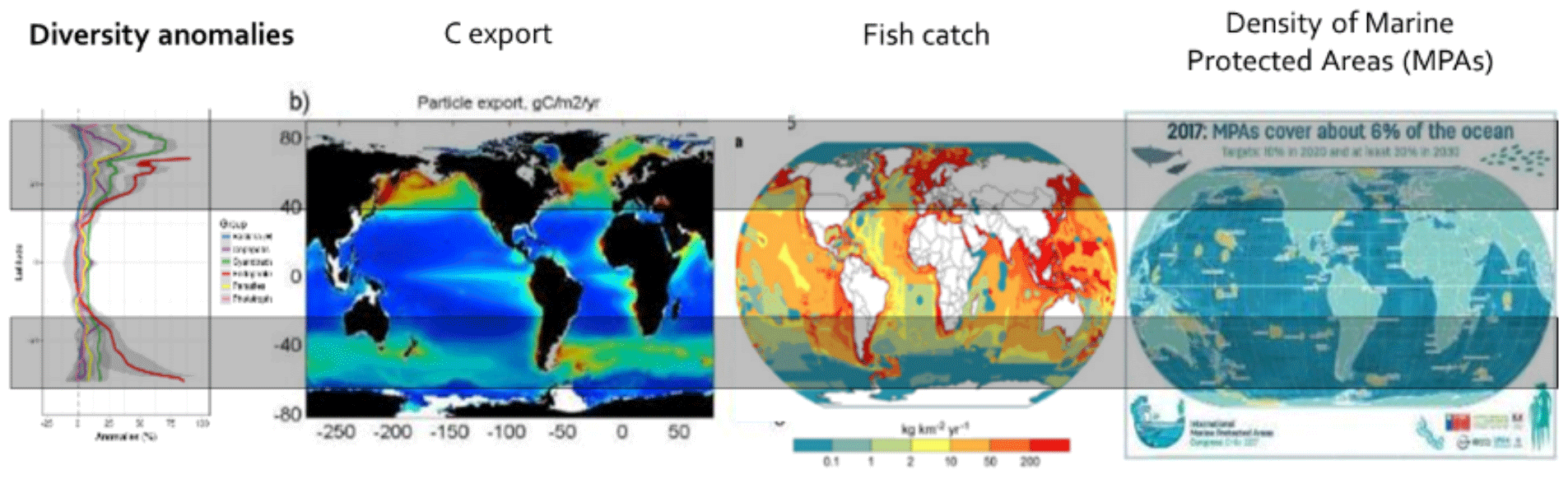
Figure 6Projected effects of diversity changes within plankton communities on marine ecosystems, fisheries, and biogeochemical cycles (adapted from Ibarbalz et al., 2019). The panel in (a) summarizes the biodiversity anomalies projected by end-century from Tara Oceans data for a range of different plankton groups (indicated by the different colours), and emphasizes that these projections indicate major changes at mid- to high latitudes (grey bars). The global maps in panel (b) indicate estimates of carbon export in different oceanic regions (left), fish landings (centre), and the locations of Marine Protected Areas (right), all of which are likely to be impacted significantly by the projected biodiversity anomalies shown in a (grey bars). Figure adapted from Ibarbalz et al. (2019), Tara Ocean Foundation et al. (2022).
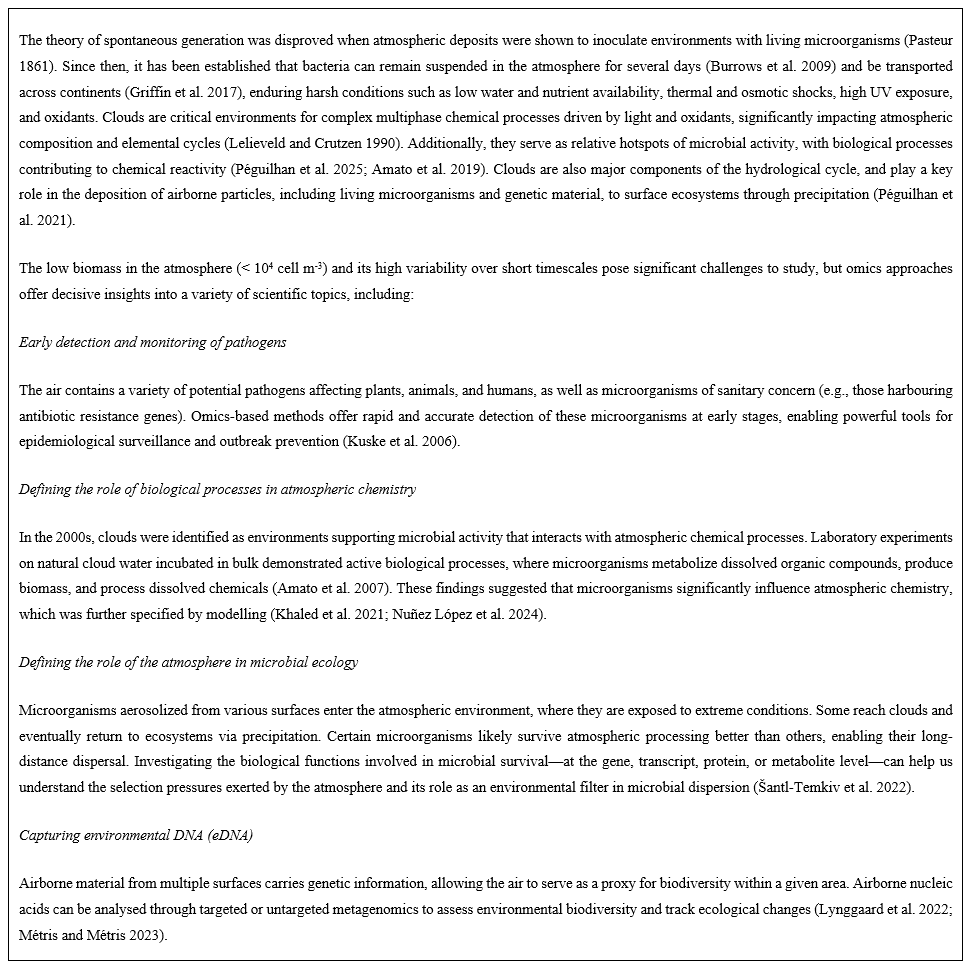
Long-term Earth system monitoring programs, along with preserved sample archives, present a valuable opportunity to enhance Earth System Models (ESMs) by providing insights into climate-driven ecosystem transformations. The recent surge in omics-based technologies has catalysed untargeted measurements across diverse environments, as highlighted in this paper with examples from deep-sea sediments, plant canopies, the atmosphere, cryospheric regions and marine ecosystems. However, the proposed implementation of omics driven data into modelling efforts faces challenges outlined in the following.
3.1 Data integration and interpretation
Integration of omics data into ESMs is complex due to the sheer diversity, scale, and volume of data these approaches generate. Multi-omics datasets capture different biological layers, often involving vast amounts of heterogeneous data. This heterogeneity arises because each of these layers represents different types of biological information, from genetic sequences to metabolite profiles and often vary in data structure, format, and the presence of missing information due to limitations inherent in omics technologies (Ramirez Flores et al., 2023).
Connecting these diverse datasets to critical ESM response variables – such as GHG emissions, soil carbon stocks, or other processes relevant to predicting human-induced climate change – is challenging. For instance, microbial-driven methane production is well characterized: its defined enzymatic pathways and environmental controls might enable more straightforward integration of omics data. In contrast, turnover of soil organic carbon is driven by a highly diverse array of microbes operating under variable conditions. This complexity might make it much harder to translate omics-based measurements into accurate process rates for ESM incorporation (He et al., 2024a).
Recent advances in deducing microbial traits from metagenomic data show great promise for integrating omics information into biogeochemical models by linking these data with kinetic parameters (Karaoz and Brodie, 2022). By identifying functional traits from metagenomes, researchers can begin to quantify the roles of various microbes in processes like nutrient cycling or carbon turnover, which holds the potential to enhance the predictive power of ESMs. Extending this approach to other types of omics data could lead to more comprehensive ESMs that incorporate detailed biotransformation kinetics, ultimately resulting in more accurate climate-related predictions. The trade-off between the speed of direct observation and the depth of omics sequencing is a matter of descriptive vs. predictive capacity. Direct measurements are essential for tracking current budgets, but physical state changes often lag behind the microbial shifts that drive them. In contrast, characterizing functional potential allows models to account for the “legacy effects” and “lagged responses” of communities, ensuring that projections remain accurate even as historical environmental correlations break down.
To navigate these complexities and ensure data reliability, researchers employ a standardized toolkit and validation strategy:
-
Quality Control & Assembly. Raw sequences are processed to remove noise (QC) before being assembled into contiguous sequences (contigs).
-
Genome Reconstruction & Binning. Contigs are grouped into Metagenome-Assembled Genomes (MAGs) and evaluated for completeness and contamination using tools like CheckM.
-
Trait Inference. Bioinformatic pipelines like microTrait or DRAM are used to distill genomic potential into fitness traits and metabolic parameters (Vmax, Km).
-
Validation & Uncertainty. Model results are confronted with in-situ flux measurements (e.g., from NEON or ICOS) to quantify the accuracy of microbial process representations.
-
aDNA Authenticity. In molecular paleomicrobiology, specific damage patterns (e.g., fragmentation and base modifications) are used to discriminate ancient genetic signals from modern contamination.
3.2 Data accessibility and standardization
Ensuring accessibility to omics data and establishing robust community standards constitute essential steps to advance the integration of omics data into ESMs. Initiatives like the National Microbiome Data Collaborative (NMDC) (NMDC, 2022) and Integrated Microbial Genomes & Microbiomes (IMG/M) (Chen et al., 2024) created frameworks that promote data sharing and enforce metadata standardization. These frameworks provide structured approaches for documenting and sharing omics data, ensuring that researchers follow uniform guidelines when collecting, annotating, and storing data. The interoperability they promote relies on community-agreed reporting standards and controlled vocabularies. The most widely adopted is the Minimum Information about any (x) Sequence (MIxS) standard, developed by the Genomic Standards Consortium, which specifies the minimum contextual metadata (habitat, geolocation, and sequencing methodology) required to describe genomes, metagenomes, and marker gene sequences through its associated checklists (e.g., MIGS for genomes, MIMS for metagenomes) (Yilmaz et al., 2011). MIxS is frequently paired with the Environment Ontology (ENVO), which provides a controlled vocabulary for the consistent annotation of biomes, environmental features, and materials such as soil, water, and air (Buttigieg et al., 2013). Other domains rely on complementary standards, such as the ISA framework (ISA-Tab) for metabolomics and the ISO 19115 and Climate and Forecast (CF) conventions for geospatial and atmospheric data, reflecting the heterogeneity of standards that a unified cross-ecosystem framework would need to reconcile. However, the adoption of these standards across the global scientific community has been limited so far. Such a globally implemented and executed framework would help address questions on large scales, as it would enable the aggregation and cross-referencing of omics data from diverse ecosystems worldwide. Additionally, standardized data formats would also facilitate data access to emerging AI-driven tools which hold the potential to play a key role in identifying yet unseen barriers in improvements of ESMs and might also help to overcome those.
3.3 Emerging technologies
Technological advances, particularly in ancient/historical DNA (aDNA) analysis, have opened new pathways for studying long-term ecological responses to environmental changes. aDNA analysis enables scientists to retrieve genetic information from organisms preserved in ancient samples, such as ice cores (Zhong et al., 2021) and up to 2 million year old sediment layers (Nguyen et al., 2023; Kjær et al., 2022; Fernandez-Guerra et al., 2023). By integrating biological data with chemical signatures found in these preserved samples, we can reconstruct ecosystem dynamics over extended historical periods, offering valuable insights into how biomes have responded to past climate variations. Such and other omics data will become increasingly available now as ongoing advancements in omics technology have gradually reduced the amount of analyte required for analysis, making it feasible to use small or degraded samples from ancient archives.
Incorporating these ancient biological signatures into ESMs has the potential to enhance model accuracy significantly. By cross-validating current ESM data with insights from historical records, scientists can better understand the relationships between abiotic factors and biotic responses over time. This integrative approach could improve the models' capacity to predict ecological responses to future climate changes by anchoring them in real historical data, providing a long-term perspective that modern data alone cannot offer.
3.4 The necessity of interdisciplinary collaboration
Unsurprisingly, integrating omics data into ESMs demands collaboration across disciplines like ecology, geochemistry, bioinformatics, modelling, and data science. Each field brings crucial expertise: ecologists and geochemists link biological and chemical processes, bioinformaticians manage complex omics data, modelers translate findings into model parameters, and data scientists develop frameworks to address challenges in data integration and accessibility. Environmental scientists play a key role in identifying biochemical pathways and traits essential for model parameterization, thereby improving the accuracy of ESMs in simulating ecosystem functions.
Collaborative efforts like these would produce enhanced ESMs that incorporate omics data, rooted in comprehensive, relevant datasets and overcoming the barriers of data integration and accessibility. We believe that the EGU community offers an ideal platform for such interdisciplinary initiatives. Leveraging existing long-term ecological monitoring projects through collaborative projects generating omics data aimed for model integration, would be a logical first step in these efforts, and we encourage all stakeholders to use this opportunity and actively participate.
No data sets were used in this article.
EA led the writing, EA, CK and LW initiated the design and writing of the article. All co-authors wrote at least one subsection and provided input on the manuscript text, table, figures and discussion of scientific content.
The contact author has declared that none of the authors has any competing interests.
Views and opinions expressed are those of the author(s) only and do not necessarily reflect those of the EU or the ERC Executive Agency. Neither the EU nor the granting authority can be held responsible for them.
Publisher's note: Copernicus Publications remains neutral with regard to jurisdictional claims made in the text, published maps, institutional affiliations, or any other geographical representation in this paper. The authors bear the ultimate responsibility for providing appropriate place names. Views expressed in the text are those of the authors and do not necessarily reflect the views of the publisher.
Funding to EA was provided by the European Research Council (ERC) under the EU's Horizon Europe Programme (project GAMEchange, grant agreement 10116464) and by Schmidt Sciences, LLC (project Carbon Loss in Plant Soils and Oceans (CALIPSO)). LW has received fund25 ing from the European Research Council (ERC) under the European Union's Horizon 2020 research and innovation programme (grant no. 101003125) and the French Govt in the framework of the IdEX Bordeaux University “Investments for the Future” program/GPR Bordeaux Plant Sciences. CB has received funding from the European Research Council (ERC) under the European Union's Horizon 2020 research and innovation program (Diatomic; grant no. 835067) and Horizon Europe BlueRemediomics (grant no. 101082304) and Marco-Bolo (grant no. 101082021). KK has received funding from the Deutsche Forschungsgemeinschaft (DFG, German Research Foundation) – project number 218627073: CRC1076 AquaDiva. JH has received funding from the Research Council of Finland (grant no. 354462) and the Kone Foundation. EC has received funding from the Swedish Research Council VR (VR starting grant no. 2023-03504). ZL was supported at Lawrence Livermore National Laboratory (LLNL) by the LLNL-LDRD Program under Project No. 24-SI-002 and by the U.S. Department of Energy (DOE) Office of Science, Energy Earthshot Initiative, as part of the LLNL Terraforming Soils EERC under Award # SCW1841. Work at LLNL was conducted under the auspices of DOE Contract DE-AC52-07NA27344. WJR was supported by the U.S. Department of Energy, Office of Science, Office of Biological and Environmental Research, Terrestrial Ecosystem Science Program, in the Belowground Biogeochemistry Scientific Focus Area, under Award Number DE-AC02-05CH11231. SRS and ZL were supported by the EMERGE Biology Integration Institute (US NSF Award #2022070). CK has received funding from the European Union's Horizon 2020 research and innovation programme under the Marie Skłodowska-Curie grant (grant no. 101108340).
This paper was edited by Mark Lever and reviewed by Wang Minxiao and two anonymous referees.
Abs, E. and Ferrière, R.: Modeling microbial dynamics and heterotrophic soil respiration: Effect of climate change, in: Biogeochemical Cycles, John Wiley & Sons, Inc., Hoboken, NJ, USA, 103–129, https://doi.org/10.1002/9781119413332.ch5, 2020.
Abs, E., Leman, H., and Ferrière, R.: A multi-scale eco-evolutionary model of cooperation reveals how microbial adaptation influences soil decomposition, Commun. Biol., 3, 520, https://doi.org/10.1038/s42003-020-01198-4, 2020.
Abs, E., Chase, A. B., and Allison, S. D.: How do soil microbes shape ecosystem biogeochemistry in the context of global change?, Environ. Microbiol., 25, 780–785, https://doi.org/10.1111/1462-2920.16331, 2023.
Abs, E., Albright, M. B. N., and Allison, S. D.: Invasions eliminate the legacy effects of substrate history on microbial nitrogen cycling, Ecosphere, 15, https://doi.org/10.1002/ecs2.4754, 2024a.
Abs, E., Chase, A. B., Manzoni, S., Ciais, P., and Allison, S. D.: Microbial evolution-An under-appreciated driver of soil carbon cycling, Glob. Chang. Biol., 30, e17268, https://doi.org/10.1111/gcb.17268, 2024b.
Abs, E., Coulette, D., Ciais, P., and Allison, S. D.: Microbial evolution drives adaptation of substrate degradation on decadal to centennial time scales relevant to global change, Ecol. Lett., 27, e14530, https://doi.org/10.1111/ele.14530, 2024c.
Abs, E., Saleska, S. R., Allison, S. D., Ciais, P., Song, Y., Weintraub, M. N., and Ferriere, R.: Microbiome adaptation could amplify modeled projections of global soil carbon loss with climate warming, Glob. Chang. Biol., 31, e70301, https://doi.org/10.1111/gcb.70301, 2025.
Acinas, S. G., Sánchez, P., Salazar, G., Cornejo-Castillo, F. M., Sebastián, M., Logares, R., Royo-Llonch, M., Paoli, L., Sunagawa, S., Hingamp, P., Ogata, H., Lima-Mendez, G., Roux, S., González, J. M., Arrieta, J. M., Alam, I. S., Kamau, A., Bowler, C., Raes, J., Pesant, S., Bork, P., Agustí, S., Gojobori, T., Vaqué, D., Sullivan, M. B., Pedrós-Alió, C., Massana, R., Duarte, C. M., and Gasol, J. M.: Deep ocean metagenomes provide insight into the metabolic architecture of bathypelagic microbial communities, Commun. Biol., 4, 604, https://doi.org/10.1038/s42003-021-02112-2, 2021.
Ågren, G. I., Wetterstedt, J. Å. M., and Billberger, M. F. K.: Nutrient limitation on terrestrial plant growth–modeling the interaction between nitrogen and phosphorus, New Phytol., 194, 953–960, https://doi.org/10.1111/j.1469-8137.2012.04116.x, 2012.
Amato, P., Parazols, M., Sancelme, M., Laj, P., Mailhot, G., and Delort, A.-M.: Microorganisms isolated from the water phase of tropospheric clouds at the Puy de Dôme: major groups and growth abilities at low temperatures: Microorganisms from the water phase of tropospheric clouds, FEMS Microbiol. Ecol., 59, 242–254, https://doi.org/10.1111/j.1574-6941.2006.00199.x, 2007.
Amato, P., Besaury, L., Joly, M., Penaud, B., Deguillaume, L., and Delort, A.-M.: Metatranscriptomic exploration of microbial functioning in clouds, Sci. Rep., 9, 4383, https://doi.org/10.1038/s41598-019-41032-4, 2019.
Anderegg, L. D. L., Griffith, D. M., Cavender-Bares, J., Riley, W. J., Berry, J. A., Dawson, T. E., and Still, C. J.: Representing plant diversity in land models: An evolutionary approach to make “Functional Types” more functional, Glob. Change Biol., 28, 2541–2554, https://doi.org/10.1111/gcb.16040, 2022.
Armbrecht, L., Weber, M. E., Raymo, M. E., Peck, V. L., Williams, T., Warnock, J., Kato, Y., Hernández-Almeida, I., Hoem, F., Reilly, B., Hemming, S., Bailey, I., Martos, Y. M., Gutjahr, M., Percuoco, V., Allen, C., Brachfeld, S., Cardillo, F. G., Du, Z., Fauth, G., Fogwill, C., Garcia, M., Glüder, A., Guitard, M., Hwang, J.-H., Iizuka, M., Kenlee, B., O'Connell, S., Pérez, L. F., Ronge, T. A., Seki, O., Tauxe, L., Tripathi, S., and Zheng, X.: Ancient marine sediment DNA reveals diatom transition in Antarctica, Nat. Commun., 13, 5787, https://doi.org/10.1038/s41467-022-33494-4, 2022.
Bahram, M., Hildebrand, F., Forslund, S. K., Anderson, J. L., Soudzilovskaia, N. A., Bodegom, P. M., Bengtsson-Palme, J., Anslan, S., Coelho, L. P., Harend, H., Huerta-Cepas, J., Medema, M. H., Maltz, M. R., Mundra, S., Olsson, P. A., Pent, M., Põlme, S., Sunagawa, S., Ryberg, M., Tedersoo, L., and Bork, P.: Structure and function of the global topsoil microbiome, Nature, 560, 233–237, https://doi.org/10.1038/s41586-018-0386-6, 2018.
Barbour, K. M., Barrón-Sandoval, A., Walters, K. E., and Martiny, J. B. H.: Towards quantifying microbial dispersal in the environment, Environ. Microbiol., 25, 137–142, https://doi.org/10.1111/1462-2920.16270, 2023.
Bar-On, Y. M. and Milo, R.: Towards a quantitative view of the global ubiquity of biofilms, Nat. Rev. Microbiol., 17, 199–200, https://doi.org/10.1038/s41579-019-0162-0, 2019.
Bar-On, Y. M., Phillips, R., and Milo, R.: The biomass distribution on Earth, P. Natl. Acad. Sci. USA, 115, 6506–6511, https://doi.org/10.1073/pnas.1711842115, 2018.
Barouillet, C., Monchamp, M.-E., Bertilsson, S., Brasell, K., Domaizon, I., Epp, L. S., Ibrahim, A., Mejbel, H., Nwosu, E. C., Pearman, J. K., Picard, M., Thomson-Laing, G., Tsugeki, N., Von Eggers, J., Gregory-Eaves, I., Pick, F., Wood, S. A., and Capo, E.: Investigating the effects of anthropogenic stressors on lake biota using sedimentary DNA, Freshw. Biol., 68, 1799–1817, https://doi.org/10.1111/fwb.14027, 2022.
Bedoya-Velásquez, A. E., Titos, G., Bravo-Aranda, J. A., Haeffelin, M., Favez, O., Petit, J.-E., Casquero-Vera, J. A., Olmo-Reyes, F. J., Montilla-Rosero, E., Hoyos, C. D., Alados-Arboledas, L., and Guerrero-Rascado, J. L.: Long-term aerosol optical hygroscopicity study at the ACTRIS SIRTA observatory: synergy between ceilometer and in situ measurements, Atmos. Chem. Phys., 19, 7883–7896, https://doi.org/10.5194/acp-19-7883-2019, 2019.
Biller, S. J., Berube, P. M., Dooley, K., Williams, M., Satinsky, B. M., Hackl, T., Hogle, S. L., Coe, A., Bergauer, K., Bouman, H. A., Browning, T. J., De Corte, D., Hassler, C., Hulston, D., Jacquot, J. E., Maas, E. W., Reinthaler, T., Sintes, E., Yokokawa, T., and Chisholm, S. W.: Marine microbial metagenomes sampled across space and time, Sci. Data, 5, 180176, https://doi.org/10.1038/sdata.2018.176, 2018.
Björk, R. G., Björkman, M. P., Andersson, M. X., and Klemedtsson, L.: Temporal variation in soil microbial communities in Alpine tundra, Soil Biol. Biochem., 40, 266–268, https://doi.org/10.1016/j.soilbio.2007.07.017, 2008.
Bork, P., Bowler, C., de Vargas, C., Gorsky, G., Karsenti, E., and Wincker, P.: Tara Oceans. Tara Oceans studies plankton at planetary scale. Introduction, Science, 348, 873, https://doi.org/10.1126/science.aac5605, 2015.
Bouskill, N. J., Riley, W. J., Zhu, Q., Mekonnen, Z. A., and Grant, R. F.: Alaskan carbon-climate feedbacks will be weaker than inferred from short-term experiments, Nat. Commun., 11, 5798, https://doi.org/10.1038/s41467-020-19574-3, 2020.
Bouslimani, A., Sanchez, L. M., Garg, N., and Dorrestein, P. C.: Mass spectrometry of natural products: current, emerging and future technologies, Nat. Prod. Rep., 31, 718–729, https://doi.org/10.1039/c4np00044g, 2014.
Bratlie, M. S., Johansen, J., and Drabløs, F.: Relationship between operon preference and functional properties of persistent genes in bacterial genomes, BMC Genomics, 11, 71, https://doi.org/10.1186/1471-2164-11-71, 2010.
Bravo, A. G. and Cosio, C.: Biotic formation of methylmercury: A bio-physico-chemical conundrum, Limnol. Oceanogr., 65, 1010–1027, https://doi.org/10.1002/lno.11366, 2020.
Breitburg, D., Levin, L. A., Oschlies, A., Grégoire, M., Chavez, F. P., Conley, D. J., Garçon, V., Gilbert, D., Gutiérrez, D., Isensee, K., Jacinto, G. S., Limburg, K. E., Montes, I., Naqvi, S. W. A., Pitcher, G. C., Rabalais, N. N., Roman, M. R., Rose, K. A., Seibel, B. A., Telszewski, M., Yasuhara, M., and Zhang, J.: Declining oxygen in the global ocean and coastal waters, Science, 359, https://doi.org/10.1126/science.aam7240, 2018.
Briggs, A. W., Stenzel, U., Johnson, P. L. F., Green, R. E., Kelso, J., Prüfer, K., Meyer, M., Krause, J., Ronan, M. T., Lachmann, M., and Pääbo, S.: Patterns of damage in genomic DNA sequences from a Neandertal, P. Natl. Acad. Sci. USA, 104, 14616–14621, https://doi.org/10.1073/pnas.0704665104, 2007.
Brown, R. W., Chadwick, D. R., Zang, H., and Jones, D. L.: Use of metabolomics to quantify changes in soil microbial function in response to fertiliser nitrogen supply and extreme drought, Soil Biol. Biochem., 160, 108351, https://doi.org/10.1016/j.soilbio.2021.108351, 2021.
Burrows, S. M., Butler, T., Jöckel, P., Tost, H., Kerkweg, A., Pöschl, U., and Lawrence, M. G.: Bacteria in the global atmosphere – Part 2: Modeling of emissions and transport between different ecosystems, Atmos. Chem. Phys., 9, 9281–9297, https://doi.org/10.5194/acp-9-9281-2009, 2009.
Buttigieg, P. L., Morrison, N., Smith, B., Mungall, C. J., Lewis, S. E., and ENVO Consortium: The environment ontology: contextualising biological and biomedical entities, J. Biomed. Semantics, 4, 43, https://doi.org/10.1186/2041-1480-4-43, 2013.
Calayag, A. M., Priest, T., Oldenburg, E., Muschiol, J., Popa, O., Wietz, M., and Needham, D. M.: Arctic Ocean virus communities and their seasonality, bipolarity, and prokaryotic associations, Nat. Commun., 16, 6427, https://doi.org/10.1038/s41467-025-61568-6, 2025.
Canadell, J. G., Monteiro, P. M. S., Costa, M. H., Cotrim da Cunha, L., Cox, P. M., Eliseev, A. V., Henson, S., Ishii, M., Jaccard, S., Koven, C., Lohila, A., Patra, P. K., Piao, S., Rogelj, J., Syampungani, S., Zaehle, S., and Zickfeld, K.: Global Carbon and other Biogeochemical Cycles and Feedbacks, in: Climate Change 2021: The Physical Science Basis. Contribution of Working Group I to the Sixth Assessment Report of the Intergovernmental Panel on Climate Change, edited by: Masson-Delmotte, V., Zhai, P., Pirani, A., Connors, S. L., Péan, C., Berger, S., Caud, N., Chen, Y., Goldfarb, L., Gomis, M. I., Huang, M., Leitzell, K., Lonnoy, E., Matthews, J. B. R., Maycock, T. K., Waterfield, T., Yelekçi, O., Yu, R., and Zhou, B., Cambridge University Press, Cambridge, UK and New York, NY, USA, 673–816, https://doi.org/10.1017/9781009157896.007, 2021.
Capo, E. and Barouillet, C.: Tracking environmental change using lake sediments, in: Sedimentary DNA, vol. 6, Springer Nature, https://doi.org/10.1007/978-3-031-43799-1, 2023.
Capo, E., Feng, C., Bravo, A. G., Bertilsson, S., Soerensen, A. L., Pinhassi, J., Buck, M., Karlsson, C., Hawkes, J., and Björn, E.: Expression Levels of hgcAB Genes and Mercury Availability Jointly Explain Methylmercury Formation in Stratified Brackish Waters, Environ. Sci. Technol., 56, 13119–13130, https://doi.org/10.1021/acs.est.2c03784, 2022a.
Capo, E., Monchamp, M.-E., Coolen, M. J. L., Domaizon, I., Armbrecht, L., and Bertilsson, S.: Environmental paleomicrobiology: using DNA preserved in aquatic sediments to its full potential, Environ. Microbiol., 24, 2201–2209, https://doi.org/10.1111/1462-2920.15913, 2022b.
Carpenter, E. J., Matasci, N., Ayyampalayam, S., Wu, S., Sun, J., Yu, J., Jimenez Vieira, F. R., Bowler, C., Dorrell, R. G., Gitzendanner, M. A., Li, L., Du, W., K Ullrich, K., Wickett, N. J., Barkmann, T. J., Barker, M. S., Leebens-Mack, J. H., and Wong, G. K.-S.: Access to RNA-sequencing data from 1,173 plant species: The 1000 Plant transcriptomes initiative (1KP), Gigascience, 8, https://doi.org/10.1093/gigascience/giz126, 2019.
Cavicchioli, R., Ripple, W. J., Timmis, K. N., Azam, F., Bakken, L. R., Baylis, M., Behrenfeld, M. J., Boetius, A., Boyd, P. W., Classen, A. T., Crowther, T. W., Danovaro, R., Foreman, C. M., Huisman, J., Hutchins, D. A., Jansson, J. K., Karl, D. M., Koskella, B., Mark Welch, D. B., Martiny, J. B. H., Moran, M. A., Orphan, V. J., Reay, D. S., Remais, J. V., Rich, V. I., Singh, B. K., Stein, L. Y., Stewart, F. J., Sullivan, M. B., van Oppen, M. J. H., Weaver, S. C., Webb, E. A., and Webster, N. S.: Scientists' warning to humanity: microorganisms and climate change, Nat. Rev. Microbiol., 17, 569–586, https://doi.org/10.1038/s41579-019-0222-5, 2019.
Chaffron, S., Delage, E., Budinich, M., Vintache, D., Henry, N., Nef, C., Ardyna, M., Zayed, A. A., Junger, P. C., Galand, P. E., Lovejoy, C., Murray, A. E., Sarmento, H., Tara Oceans coordinators, Acinas, S. G., Babin, M., Iudicone, D., Jaillon, O., Karsenti, E., Wincker, P., Karp-Boss, L., Sullivan, M. B., Bowler, C., de Vargas, C., and Eveillard, D.: Environmental vulnerability of the global ocean epipelagic plankton community interactome, Sci. Adv., 7, eabg1921, https://doi.org/10.1126/sciadv.abg1921, 2021.
Chandel, A. K., Jiang, L., and Luo, Y.: Microbial models for simulating soil carbon dynamics: A review, J. Geophys. Res.-Biogeo., 128, e2023JG007436, https://doi.org/10.1029/2023jg007436, 2023.
Chase, A. B. and Martiny, J. B. H.: The importance of resolving biogeographic patterns of microbial microdiversity, Microbiol. Aust., 39, 5, https://doi.org/10.1071/ma18003, 2018.
Chase, A. B., Karaoz, U., Brodie, E. L., Gomez-Lunar, Z., Martiny, A. C., and Martiny, J. B. H.: Microdiversity of an Abundant Terrestrial Bacterium Encompasses Extensive Variation in Ecologically Relevant Traits, MBio, 8, https://doi.org/10.1128/mBio.01809-17, 2017.
Chase, A. B., Gomez-Lunar, Z., Lopez, A. E., Li, J., Allison, S. D., Martiny, A. C., and Martiny, J. B. H.: Emergence of soil bacterial ecotypes along a climate gradient, Environ. Microbiol., 20, 4112–4126, https://doi.org/10.1111/1462-2920.14405, 2018.
Chase, A. B., Arevalo, P., Brodie, E. L., Polz, M. F., Karaoz, U., and Martiny, J. B. H.: Maintenance of Sympatric and Allopatric Populations in Free-Living Terrestrial Bacteria, MBio, 10, https://doi.org/10.1128/mBio.02361-19, 2019.
Chase, A. B., Sweeney, D., Muskat, M. N., Guillén-Matus, D. G., and Jensen, P. R.: Vertical inheritance facilitates interspecies diversification in biosynthetic gene clusters and specialized metabolites, MBio, 12, e0270021, https://doi.org/10.1128/mbio.02700-21, 2021a.
Chase, A. B., Weihe, C., and Martiny, J. B. H.: Adaptive differentiation and rapid evolution of a soil bacterium along a climate gradient, P. Natl. Acad. Sci. USA, 118, https://doi.org/10.1073/pnas.2101254118, 2021b.
Chatterjee, R. N.: The role of epigenetics in phenotypic evolution: lessons from the genomic response to stresses, genetic conflicts and developmental plasticity in Drosophila, Nucleus (Calcutta), 67, 675–688, https://doi.org/10.1007/s13237-024-00520-3, 2024.
Chen, I.-M. A., Chu, K., Palaniappan, K., Ratner, A., Huang, J., Huntemann, M., Hajek, P., Ritter, S. J., Webb, C., Wu, D., Varghese, N. J., Reddy, T. B. K., Mukherjee, S., Ovchinnikova, G., Nolan, M., Seshadri, R., Roux, S., Visel, A., Woyke, T., Eloe-Fadrosh, E. A., Kyrpides, N. C., and Ivanova, N. N.: The IMG/M data management and analysis system v.7: content updates and new features, Nucleic Acids Res., 51, D723–D732, https://doi.org/10.1093/nar/gkac976, 2023.
Chen, J., Jia, Y., Sun, Y., Liu, K., Zhou, C., Liu, C., Li, D., Liu, G., Zhang, C., Yang, T., Huang, L., Zhuang, Y., Wang, D., Xu, D., Zhong, Q., Guo, Y., Li, A., Seim, I., Jiang, L., Wang, L., Lee, S. M. Y., Liu, Y., Wang, D., Zhang, G., Liu, S., Wei, X., Yue, Z., Zheng, S., Shen, X., Wang, S., Qi, C., Chen, J., Ye, C., Zhao, F., Wang, J., Fan, J., Li, B., Sun, J., Jia, X., Xia, Z., Zhang, H., Liu, J., Zheng, Y., Liu, X., Wang, J., Yang, H., Kristiansen, K., Xu, X., Mock, T., Li, S., Zhang, W., and Fan, G.: Global marine microbial diversity and its potential in bioprospecting, Nature, 633, 371–379, https://doi.org/10.1038/s41586-024-07891-2, 2024.
Cohan, F. M.: What are bacterial species?, Annu. Rev. Microbiol., 56, 457–487, https://doi.org/10.1146/annurev.micro.56.012302.160634, 2002.
Conrad, R.: Compensation concentration as critical variable for regulating the flux of trace gases between soil and atmosphere, Biogeochemistry, 27, https://doi.org/10.1007/bf00000582, 1994.
DeAngelis, K. M., Pold, G., Topçuoğlu, B. D., van Diepen, L. T. A., Varney, R. M., Blanchard, J. L., Melillo, J., and Frey, S. D.: Long-term forest soil warming alters microbial communities in temperate forest soils, Front. Microbiol., 6, 104, https://doi.org/10.3389/fmicb.2015.00104, 2015.
Defossez, E., Pitteloud, C., Descombes, P., Glauser, G., Allard, P.-M., Walker, T. W. N., Fernandez-Conradi, P., Wolfender, J.-L., Pellissier, L., and Rasmann, S.: Spatial and evolutionary predictability of phytochemical diversity, P. Natl. Acad. Sci. USA, 118, https://doi.org/10.1073/pnas.2013344118, 2021.
Defrenne, C. E., Abs, E., Longhi Cordeiro, A., Dietterich, L., Hough, M., Jones, J. M., Kivlin, S. N., Chen, W., Cusack, D., Franco, A. L. C., Khasanova, A., Stover, D., and Romero-Olivares, A. L.: The Ecology Underground coalition: building a collaborative future of belowground ecology and ecologists, New Phytol., 229, 3058–3064, https://doi.org/10.1111/nph.17163, 2021.
Delgado-Baquerizo, M., Maestre, F. T., Reich, P. B., Trivedi, P., Osanai, Y., Liu, Y.-R., Hamonts, K., Jeffries, T. C., and Singh, B. K.: Carbon content and climate variability drive global soil bacterial diversity patterns, Ecol. Monogr., 86, 373–390, https://doi.org/10.1002/ecm.1216, 2016.
Demina, T., Marttila, H., Pessi, I. S., Männistö, M. K., Dutilh, B. E., Roux, S., and Hultman, J.: Tunturi virus isolates and metagenome-assembled viral genomes provide insights into the virome of Acidobacteriota in Arctic tundra soils, Microbiome, 13, 79, https://doi.org/10.1186/s40168-025-02053-6, 2025.
Doney, S. C., Ruckelshaus, M., Duffy, J. E., Barry, J. P., Chan, F., English, C. A., Galindo, H. M., Grebmeier, J. M., Hollowed, A. B., Knowlton, N., Polovina, J., Rabalais, N. N., Sydeman, W. J., and Talley, L. D.: Climate change impacts on marine ecosystems, Ann. Rev. Mar. Sci., 4, 11–37, https://doi.org/10.1146/annurev-marine-041911-111611, 2012.
Doumeizel, V. and Dolan, J. R.: The launch of The Plankton Manifesto in September 2024, J. Plankton Res., 46, https://doi.org/10.1093/plankt/fbae061, 2024.
Duarte, C. M.: Seafaring in the 21St century: The Malaspina 2010 circumnavigation expedition, Limnol. Oceanog. Bull., 24, 11–14, https://doi.org/10.1002/lob.10008, 2015.
Duckworth, J. C., Kent, M., and Ramsay, P. M.: Plant functional types: an alternative to taxonomic plant community description in biogeography?, Prog. Phys. Geogr., 24, 515–542, https://doi.org/10.1191/030913300701542778, 2000.
Dussarrat, T., Prigent, S., Latorre, C., Bernillon, S., Flandin, A., Díaz, F. P., Cassan, C., Van Delft, P., Jacob, D., Varala, K., Joubes, J., Gibon, Y., Rolin, D., Gutiérrez, R. A., and Pétriacq, P.: Predictive metabolomics of multiple Atacama plant species unveils a core set of generic metabolites for extreme climate resilience, New Phytol., 234, 1614–1628, https://doi.org/10.1111/nph.18095, 2022.
Dussarrat, T., Latorre, C., Barros Santos, M. C., Aguado-Norese, C., Prigent, S., Díaz, F. P., Rolin, D., González, M., Müller, C., Gutiérrez, R. A., and Pétriacq, P.: Rhizochemistry and soil bacterial community are tailored to natural stress gradients, Soil Biol. Biochem., 202, 109662, https://doi.org/10.1016/j.soilbio.2024.109662, 2025.
Edwards, M. E.: The maturing relationship between Quaternary paleoecology and ancient sedimentary DNA, Quat. Res., 96, 39–47, https://doi.org/10.1017/qua.2020.52, 2020.
Falkowski, P. G. and Knoll, A. H. (Eds.): Evolution of primary producers in the sea, Academic Press, San Diego, CA, 456 pp., https://doi.org/10.1016/b978-0-12-370518-1.x5000-0, 2007.
Feinberg, A. P. and Irizarry, R. A.: Evolution in health and medicine Sackler colloquium: Stochastic epigenetic variation as a driving force of development, evolutionary adaptation, and disease, P. Natl. Acad. Sci. USA, 107, 1757–1764, https://doi.org/10.1073/pnas.0906183107, 2010.
Felden, J., Möller, L., Schindler, U., Huber, R., Schumacher, S., Koppe, R., Diepenbroek, M., and Glöckner, F. O.: PANGAEA – data publisher for earth & environmental science, Sci. Data, 10, 347, https://doi.org/10.1038/s41597-023-02269-x, 2023.
Feng, K., Wang, S., He, Q., Bonkowski, M., Bahram, M., Yergeau, E., Wang, Z., Peng, X., Wang, D., Li, S., Wang, Y., Ju, Z., Du, X., Yan, C., Gu, S., Li, T., Yang, X., Shen, W., Wei, Z., Hu, Q., Li, P., Zhu, Y., Lu, G., Qin, C., Zhang, G., Xiao, C., Yang, Y., Zhou, J., and Deng, Y.: CoBacFM: Core bacteria forecast model for global grassland pH dynamics under future climate warming scenarios, One Earth, 7, 1275–1287, https://doi.org/10.1016/j.oneear.2024.06.002, 2024.
Fernandez-Guerra, A., Wörmer, L., Borrel, G., Delmont, T. O., Elberling, B., Elvert, M., Eren, A. M., Gribaldo, S., Henriksen, R. A., Hinrichs, K.-U., Jochheim, A., Korneliussen, T. S., Krupovic, M., Larsen, N. K., Perez-Laso, R., Pedersen, M. W., Pedersen, V. K., Ruter, A. H., Sand, K. K., Sikora, M., Steinegger, M., Veseli, I., Wang, Y., Zhao, L., Žure, M., Kjær, K. H., and Willerslev, E.: Two-million-year-old microbial communities from the Kap København Formation in North Greenland, bioRxiv [preprint], https://doi.org/10.1101/2023.06.10.544454, 2023.
Fierer, N.: Microbial biogeography: Patterns in microbial diversity across space and time, in: Accessing Uncultivated Microorganisms, ASM Press, Washington, DC, USA, 95–115, https://doi.org/10.1128/9781555815509.ch6, 2014.
Finks, S. S., Weihe, C., Kimball, S., Allison, S. D., Martiny, A. C., Treseder, K. K., and Martiny, J. B. H.: Microbial community response to a decade of simulated global changes depends on the plant community, Elementa (Wash., DC), 9, https://doi.org/10.1525/elementa.2021.00124, 2021.
Flombaum, P., Gallegos, J. L., Gordillo, R. A., Rincón, J., Zabala, L. L., Jiao, N., Karl, D. M., Li, W. K. W., Lomas, M. W., Veneziano, D., Vera, C. S., Vrugt, J. A., and Martiny, A. C.: Present and future global distributions of the marine Cyanobacteria Prochlorococcus and Synechococcus, P. Natl. Acad. Sci. USA, 110, 9824–9829, https://doi.org/10.1073/pnas.1307701110, 2013.
Fodelianakis, S., Washburne, A. D., Bourquin, M., Pramateftaki, P., Kohler, T. J., Styllas, M., Tolosano, M., De Staercke, V., Schön, M., Busi, S. B., Brandani, J., Wilmes, P., Peter, H., and Battin, T. J.: Microdiversity characterizes prevalent phylogenetic clades in the glacier-fed stream microbiome, ISME J., 16, 666–675, https://doi.org/10.1038/s41396-021-01106-6, 2022.
Franz, D., Acosta, M., Altimir, N., Arriga, N., Arrouays, D., Aubinet, M., Aurela, M., Ayres, E., López-Ballesteros, A., Barbaste, M., Berveiller, D., Biraud, S., Boukir, H., Brown, T., Brümmer, C., Buchmann, N., Burba, G., Carrara, A., Cescatti, A., Ceschia, E., Clement, R., Cremonese, E., Crill, P., Darenova, E., Dengel, S., D'Odorico, P., Filippa, G., Fleck, S., Fratini, G., Fuß, R., Gielen, B., Gogo, S., Grace, J., Graf, A., Grelle, A., Gross, P., Grünwald, T., Haapanala, S., Hehn, M., Heinesch, B., Heiskanen, J., Herbst, M., Herschlein, C., Hörtnagl, L., Hufkens, K., Ibrom, A., Jolivet, C., Joly, L., Jones, M., Kiese, R., Klemedtsson, L., Kljun, N., Klumpp, K., Kolari, P., Kolle, O., Kowalski, A., Kutsch, W., Laurila, T., de Ligne, A., Linder, S., Lindroth, A., Lohila, A., Longdoz, B., Mammarella, I., Manise, T., Marañón-Jiménez, S., Matteucci, G., Mauder, M., Meier, P., Merbold, L., Mereu, S., Metzger, S., Migliavacca, M., Mölder, M., Montagnani, L., Moureaux, C., Nelson, D., Nemitz, E., Nicolini, G., Nilsson, M. B., Op de Beeck, M., Osborne, B., Ottosson Löfvenius, M., Pavelka, M., Peichl, M., Peltola, O., Pihlatie, M., Pitacco, A., Pokorný, R., Pumpanen, J., Ratié, C., Rebmann, C., Roland, M., Sabbatini, S., Saby, N. P. A., Saunders, M., Schmid, H. P., Schrumpf, M., Sedlák, P., Serrano-Ortiz, P., Siebicke, L., Šigut, L., Silvennoinen, H., Simioni, G., Skiba, U., Sonnentag, O., Soudani, K., Soulé, P., Steinbrecher, R., Tallec, T., Thimonier, A., Tuittila, E.-S., Tuovinen, J.-P., Vestin, P., Vincent, G., Vincke, C., Vitale, D., Waldner, P., Weslien, P., Wingate, L., Wohlfahrt, G., Zahniser, M., and Vesala, T.: Towards long-term standardised carbon and greenhouse gas observations for monitoring Europe's terrestrial ecosystems: a review, Int. Agrophys., 32, 439–455, https://doi.org/10.1515/intag-2017-0039, 2018.
Fraser, L. H.: TRY-A plant trait database of databases, Glob. Chang. Biol., 26, 189–190, https://doi.org/10.1111/gcb.14869, 2020.
Frémont, P., Gehlen, M., Vrac, M., Leconte, J., Delmont, T. O., Wincker, P., Iudicone, D., and Jaillon, O.: Restructuring of plankton genomic biogeography in the surface ocean under climate change, Nat. Clim. Chang., 12, 393–401, https://doi.org/10.1038/s41558-022-01314-8, 2022.
Frémont, P., Gehlen, M., and Jaillon, O.: Plankton biogeography in the 21st century and impacts of climate change: advances through genomics, C. R. Biol., 346, 13–24, https://doi.org/10.5802/crbiol.107, 2023.
Friend, A. D., Lucht, W., Rademacher, T. T., Keribin, R., Betts, R., Cadule, P., Ciais, P., Clark, D. B., Dankers, R., Falloon, P. D., Ito, A., Kahana, R., Kleidon, A., Lomas, M. R., Nishina, K., Ostberg, S., Pavlick, R., Peylin, P., Schaphoff, S., Vuichard, N., Warszawski, L., Wiltshire, A., and Woodward, F. I.: Carbon residence time dominates uncertainty in terrestrial vegetation responses to future climate and atmospheric CO2, P. Natl. Acad. Sci. USA, 111, 3280–3285, https://doi.org/10.1073/pnas.1222477110, 2014.
Frostegård, Å., Vick, S. H. W., Lim, N. Y. N., Bakken, L. R., and Shapleigh, J. P.: Linking meta-omics to the kinetics of denitrification intermediates reveals pH-dependent causes of N2O emissions and nitrite accumulation in soil, ISME J., 16, 26–37, https://doi.org/10.1038/s41396-021-01045-2, 2022.
Frugone-Álvarez, M., Contreras, S., Meseguer-Ruiz, O., Tejos, E., Delgado-Huertas, A., Valero-Garcés, B., Díaz, F. P., Briceño, M., Bustos-Morales, M., and Latorre, C.: Hydroclimate variations over the last 17,000 years as estimated by leaf waxes in rodent middens from the south-central Atacama Desert, Chile, Quat. Sci. Rev., 311, 108084, https://doi.org/10.1016/j.quascirev.2023.108084, 2023.
Gao, Q., Wang, G., Xue, K., Yang, Y., Xie, J., Yu, H., Bai, S., Liu, F., He, Z., Ning, D., Hobbie, S. E., Reich, P. B., and Zhou, J.: Stimulation of soil respiration by elevated CO2 is enhanced under nitrogen limitation in a decade-long grassland study, P. Natl. Acad. Sci. USA, 117, 33317–33324, https://doi.org/10.1073/pnas.2002780117, 2020.
García-García, N., Tamames, J., Linz, A. M., Pedrós-Alió, C., and Puente-Sánchez, F.: Microdiversity ensures the maintenance of functional microbial communities under changing environmental conditions, ISME J., 13, 2969–2983, https://doi.org/10.1038/s41396-019-0487-8, 2019.
Giguet-Covex, C., Pansu, J., Arnaud, F., Rey, P.-J., Griggo, C., Gielly, L., Domaizon, I., Coissac, E., David, F., Choler, P., Poulenard, J., and Taberlet, P.: Long livestock farming history and human landscape shaping revealed by lake sediment DNA, Nat. Commun., 5, 3211, https://doi.org/10.1038/ncomms4211, 2014.
Glassman, S. I., Weihe, C., Li, J., Albright, M. B. N., Looby, C. I., Martiny, A. C., Treseder, K. K., Allison, S. D., and Martiny, J. B. H.: Decomposition responses to climate depend on microbial community composition, P. Natl. Acad. Sci. USA, 115, 11994–11999, https://doi.org/10.1073/pnas.1811269115, 2018.
Grant, R. F.: Simulation of methanogenesis in the mathematical model ecosys, Soil Biol. Biochem., 30, 883–896, https://doi.org/10.1016/s0038-0717(97)00218-6, 1998.
Grasso, G., Bianciotto, V., and Marmeisse, R.: Paleomicrobiology: Tracking the past microbial life from single species to entire microbial communities, Microb. Biotechnol., 17, e14390, https://doi.org/10.1111/1751-7915.14390, 2024.
Gregory-Eaves, I. and Smol, J. P.: Paleolimnology: Approaches and applications, in: Wetzel's Limnology, edited by: Jones, I. D. and Smol, J. P., Elsevier, 1015–1043, https://doi.org/10.1016/b978-0-12-822701-5.00030-6, 2024.
Griffin, D. W., Gonzalez-Martin, C., Hoose, C., and Smith, D. J.: Global-scale atmospheric dispersion of microorganisms, in: Microbiology of Aerosols, John Wiley & Sons, Inc., Hoboken, NJ, USA, 155–194, https://doi.org/10.1002/9781119132318.ch2c, 2017.
Griffith, J., Lord, J.-M., Catchen, M. D., Arce-Plata, M. I., Blanchet, F. G., Chandramohan, M., Diaz-Corzo, M. C., Gravel, D., Gutiérrez, C., Helfenstein, I. S., Hoban, S., Kass, J. M., Laikre, L., Larocque, G., Leigh, D. M., Leung, B., Mastretta-Yanes, A., Millette, K. L., Berbeo, M. A. M., Nguyen, D., Norman, K. E., Olaya-Rodríguez, M. H., Pahls, S., Pereira, K., Peres-Neto, P. R., Poisot, T., Pollock, L. J., Rey-Velasco, J. C., Rincon-Parra, V. J., Roeoesli, C., Rousseu, F., Sánchez-Clavijo, L. M., Schuman, M. C., Selmoni, O., da Silva, J. M., Suarez-Valencia, E., Surasinghe, T. D., Turak, E., Urbina, L. F., Valentin, S., Wightman, N., Zuloaga, J., Londoño, M. C., and Gonzalez, A.: BON in a Box: An open and collaborative platform for biodiversity monitoring, indicator calculation, and reporting, Bioscience, https://doi.org/10.1093/biosci/biaf189, 2026.
Grigoriev, I. V., Nikitin, R., Haridas, S., Kuo, A., Ohm, R., Otillar, R., Riley, R., Salamov, A., Zhao, X., Korzeniewski, F., Smirnova, T., Nordberg, H., Dubchak, I., and Shabalov, I.: MycoCosm portal: gearing up for 1000 fungal genomes, Nucleic Acids Res., 42, D699–704, https://doi.org/10.1093/nar/gkt1183, 2014.
Grigoriev, I. V., Hayes, R. D., Calhoun, S., Kamel, B., Wang, A., Ahrendt, S., Dusheyko, S., Nikitin, R., Mondo, S. J., Salamov, A., Shabalov, I., and Kuo, A.: PhycoCosm, a comparative algal genomics resource, Nucleic Acids Res., 49, D1004–D1011, https://doi.org/10.1093/nar/gkaa898, 2021.
Guerrero-Ramírez, N. R., Mommer, L., Freschet, G. T., Iversen, C. M., McCormack, M. L., Kattge, J., Poorter, H., van der Plas, F., Bergmann, J., Kuyper, T. W., York, L. M., Bruelheide, H., Laughlin, D. C., Meier, I. C., Roumet, C., Semchenko, M., Sweeney, C. J., van Ruijven, J., Valverde-Barrantes, O. J., Aubin, I., Catford, J. A., Manning, P., Martin, A., Milla, R., Minden, V., Pausas, J. G., Smith, S. W., Soudzilovskaia, N. A., Ammer, C., Butterfield, B., Craine, J., Cornelissen, J. H. C., de Vries, F. T., Isaac, M. E., Kramer, K., König, C., Lamb, E. G., Onipchenko, V. G., Peñuelas, J., Reich, P. B., Rillig, M. C., Sack, L., Shipley, B., Tedersoo, L., Valladares, F., van Bodegom, P., Weigelt, P., Wright, J. P., and Weigelt, A.: Global root traits (GRooT) database, Glob. Ecol. Biogeogr., 30, 25–37, https://doi.org/10.1111/geb.13179, 2021.
Guidi, L., Chaffron, S., Bittner, L., Eveillard, D., Larhlimi, A., Roux, S., Darzi, Y., Audic, S., Berline, L., Brum, J., Coelho, L. P., Espinoza, J. C. I., Malviya, S., Sunagawa, S., Dimier, C., Kandels-Lewis, S., Picheral, M., Poulain, J., Searson, S., Tara Oceans coordinators, Stemmann, L., Not, F., Hingamp, P., Speich, S., Follows, M., Karp-Boss, L., Boss, E., Ogata, H., Pesant, S., Weissenbach, J., Wincker, P., Acinas, S. G., Bork, P., de Vargas, C., Iudicone, D., Sullivan, M. B., Raes, J., Karsenti, E., Bowler, C., and Gorsky, G.: Plankton networks driving carbon export in the oligotrophic ocean, Nature, 532, 465–470, https://doi.org/10.1038/nature16942, 2016.
He, X., Abramoff, R. Z., Abs, E., Georgiou, K., Zhang, H., and Goll, D. S.: Model uncertainty obscures major driver of soil carbon, Nature, 627, E1–E3, https://doi.org/10.1038/s41586-023-06999-1, 2024a.
He, X., Abs, E., Allison, S. D., Tao, F., Huang, Y., Manzoni, S., Abramoff, R., Bruni, E., Bowring, S. P. K., Chakrawal, A., Ciais, P., Elsgaard, L., Friedlingstein, P., Georgiou, K., Hugelius, G., Holm, L. B., Li, W., Luo, Y., Marmasse, G., Nunan, N., Qiu, C., Sitch, S., Wang, Y.-P., and Goll, D. S.: Emerging multiscale insights on microbial carbon use efficiency in the land carbon cycle, Nat. Commun., 15, 8010, https://doi.org/10.1038/s41467-024-52160-5, 2024b.
He, X., Marmasse, G., Hu, J., Varney, R. M., Manzoni, S., Ciais, P., Wang, Y.-P., Cui, Y., Bai, E., Abramoff, R. Z., Abs, E., Schwarz, E., Zhang, H., and Goll, D. S.: Microbial growth rate is a stronger predictor of soil organic carbon than carbon use efficiency, Nat. Ecol. Evol., 10, 372–381, https://doi.org/10.1038/s41559-025-02961-8, 2026.
Heinrichs, M. E., Piedade, G. J., Popa, O., Sommers, P., Trubl, G., Weissenbach, J., and Rahlff, J.: Breaking the ice: A review of phages in polar ecosystems, Methods Mol. Biol., 2738, 31–71, https://doi.org/10.1007/978-1-0716-3549-0_3, 2024.
Heinze, B. M., Schwab, V. F., Küsel, K., Schloemer, S., Roskam, A., Xu, X., and Trumbore, S.: Microbial oxidation significantly reduces methane export from global groundwaters, P. Natl. Acad. Sci. USA, 122, e2508773122, https://doi.org/10.1073/pnas.2508773122, 2025.
Hermans, S. M., Buckley, H. L., Case, B. S., Curran-Cournane, F., Taylor, M., and Lear, G.: Using soil bacterial communities to predict physico-chemical variables and soil quality, Microbiome, 8, 79, https://doi.org/10.1186/s40168-020-00858-1, 2020.
Ibarbalz, F. M., Henry, N., Brandão, M. C., Martini, S., Busseni, G., Byrne, H., Coelho, L. P., Endo, H., Gasol, J. M., Gregory, A. C., Mahé, F., Rigonato, J., Royo-Llonch, M., Salazar, G., Sanz-Sáez, I., Scalco, E., Soviadan, D., Zayed, A. A., Zingone, A., Labadie, K., Ferland, J., Marec, C., Kandels, S., Picheral, M., Dimier, C., Poulain, J., Pisarev, S., Carmichael, M., Pesant, S., Tara Oceans Coordinators, Babin, M., Boss, E., Iudicone, D., Jaillon, O., Acinas, S. G., Ogata, H., Pelletier, E., Stemmann, L., Sullivan, M. B., Sunagawa, S., Bopp, L., de Vargas, C., Karp-Boss, L., Wincker, P., Lombard, F., Bowler, C., and Zinger, L.: Global trends in marine plankton diversity across kingdoms of life, Cell, 179, 1084–1097.e21, https://doi.org/10.1016/j.cell.2019.10.008, 2019.
Jia, W., Anslan, S., Chen, F., Cao, X., Dong, H., Dulias, K., Gu, Z., Heinecke, L., Jiang, H., Kruse, S., Kang, W., Li, K., Liu, S., Liu, X., Liu, Y., Ni, J., Schwalb, A., Stoof-Leichsenring, K. R., Shen, W., Tian, F., Wang, J., Wang, Y., Wang, Y., Xu, H., Yang, X., Zhang, D., and Herzschuh, U.: Sedimentary ancient DNA reveals past ecosystem and biodiversity changes on the Tibetan Plateau: Overview and prospects, Quat. Sci. Rev., 293, 107703, https://doi.org/10.1016/j.quascirev.2022.107703, 2022.
Johnson, Z. I., Zinser, E. R., Coe, A., McNulty, N. P., Woodward, E. M. S., and Chisholm, S. W.: Niche partitioning among Prochlorococcus ecotypes along ocean-scale environmental gradients, Science, 311, 1737–1740, https://doi.org/10.1126/science.1118052, 2006.
Jones, E. D. and Bösl, E.: Ancient human DNA: A history of hype (then and now), J. Soc. Archaeol., 21, 236–255, https://doi.org/10.1177/1469605321990115, 2021.
Karaoz, U. and Brodie, E. L.: MicroTrait: A toolset for a trait-based representation of microbial genomes, Front. Bioinform., 2, 918853, https://doi.org/10.3389/fbinf.2022.918853, 2022.
Kent, A. G., Garcia, C. A., and Martiny, A. C.: Increased biofilm formation due to high-temperature adaptation in marine Roseobacter, Nature Microbiology, 3, 989–995, https://doi.org/10.1038/s41564-018-0213-8, 2018.
Keuschnig, C., Vogel, T. M., Barbaro, E., Spolaor, A., Koziol, K., Björkman, M. P., Zdanowicz, C., Gallet, J.-C., Luks, B., Layton, R., and Larose, C.: Selection processes of Arctic seasonal glacier snowpack bacterial communities, Microbiome, 11, 35, https://doi.org/10.1186/s40168-023-01473-6, 2023.
Khaled, A., Zhang, M., Amato, P., Delort, A.-M., and Ervens, B.: Biodegradation by bacteria in clouds: an underestimated sink for some organics in the atmospheric multiphase system, Atmos. Chem. Phys., 21, 3123–3141, https://doi.org/10.5194/acp-21-3123-2021, 2021.
Kivlin, S. N.: Global mycorrhizal fungal range sizes vary within and among mycorrhizal guilds but are not correlated with dispersal traits, J. Biogeogr., 47, 1994–2001, https://doi.org/10.1111/jbi.13866, 2020.
Kjær, K. H., Winther Pedersen, M., De Sanctis, B., De Cahsan, B., Korneliussen, T. S., Michelsen, C. S., Sand, K. K., Jelavić, S., Ruter, A. H., Schmidt, A. M. A., Kjeldsen, K. K., Tesakov, A. S., Snowball, I., Gosse, J. C., Alsos, I. G., Wang, Y., Dockter, C., Rasmussen, M., Jørgensen, M. E., Skadhauge, B., Prohaska, A., Kristensen, J. Å., Bjerager, M., Allentoft, M. E., Coissac, E., PhyloNorway Consortium, Rouillard, A., Simakova, A., Fernandez-Guerra, A., Bowler, C., Macias-Fauria, M., Vinner, L., Welch, J. J., Hidy, A. J., Sikora, M., Collins, M. J., Durbin, R., Larsen, N. K., and Willerslev, E.: A 2-million-year-old ecosystem in Greenland uncovered by environmental DNA, Nature, 612, 283–291, https://doi.org/10.1038/s41586-022-05453-y, 2022.
Kumar, M., Ji, B., Zengler, K., and Nielsen, J.: Modelling approaches for studying the microbiome, Nat. Microbiol., 4, 1253–1267, https://doi.org/10.1038/s41564-019-0491-9, 2019.
Küsel, K., Totsche, K. U., Trumbore, S. E., Lehmann, R., Steinhäuser, C., and Herrmann, M.: How deep can surface signals be traced in the critical zone? Merging biodiversity with biogeochemistry research in a central German muschelkalk landscape, Front. Earth Sci., 4, https://doi.org/10.3389/feart.2016.00032, 2016.
Kuske, C. R., Barns, S. M., Grow, C. C., Merrill, L., and Dunbar, J.: Environmental survey for four pathogenic bacteria and closely related species using phylogenetic and functional genes, J. Forensic Sci., 51, 548–558, https://doi.org/10.1111/j.1556-4029.2006.00131.x, 2006.
Lamour, J., Serbin, S., Rogers, A., Ely, K., Acebron, K. T., Ainsworth, E., Albert, L. P., Alonzo, M., Anderson, J., Atkin, O. K., Barbier, N., Barnes, M. L., Bernacchi, C. J., Besson, N., Burnett, A. C., Caplan, J. S., Chave, J., Cheesman, A. W., Clocher, I., Coast, O., Coste, S., Croft, H., Cui, B., Dauvissat, C., Davidson, K. J., Doughty, C., Evans, J., Feret, J., Filella, I., Fortunel, C., Fu, P., Furbank, R., Garcia, M., Gimenez, B. O., Guan, K., Guo, Z., Heckman, D., Heuret, P., Marney, I., Kothari, S., Kumagai, E., Kyaw, T. Y., Liu, L., Liu, L., Liu, S., Llusià, J., Magney, T., Maréchaux, I., Martin, A. R., Meacham-Hensold, K., Montes, C. M., Ogaya, R., Ojo, J., Oliveira, R., Paquette, A., Peñuelas, J., Placido, A. D., Posada, J. M., Qian, X., Renninger, H. J., Rodriguez-Caton, M., Rojas-González, A., Schlüter, U., Sellan, G., Siegert, C. M., Silva Pérez, V., Song, G., Southwick, C. D., Souza, D. C., Stahl, C., Su, Y., Sujeeun, L., Ting, T., Vasquez, V., Vijayakumar, V., Vilas-Boas, M., Wang, D. R., Wang, S., Wang, H., Wang, J., Wang, X., Weber, A. P., Wong, C. Y., Wu, J., Wu, F., Wu, S., Yan, Z., Yang, D., and Zhao, Y.: The Global Spectra-Trait Initiative: A database of paired leaf spectroscopy and functional traits associated with leaf photosynthetic capacity (v1.0.0), Next-Generation Ecosystem Experiments (NGEE) Tropics, ESS-DIVE repository [data set], https://doi.org/10.15485/2530733, 2025.
Lamour, J., Serbin, S. P., Rogers, A., Acebron, K. T., Ainsworth, E., Albert, L. P., Alonzo, M., Anderson, J., Atkin, O. K., Barbier, N., Barnes, M. L., Bernacchi, C. J., Besson, N., Burnett, A. C., Caplan, J. S., Chave, J., Cheesman, A. W., Clocher, I., Coast, O., Coste, S., Croft, H., Cui, B., Dauvissat, C., Davidson, K. J., Doughty, C., Ely, K. S., Evans, J. R., Féret, J.-B., Filella, I., Fortunel, C., Fu, P., Furbank, R. T., Garcia, M., Gimenez, B. O., Guan, K., Guo, Z., Heckmann, D., Heuret, P., Isaac, M., Kothari, S., Kumagai, E., Kyaw, T. Y., Liu, L., Liu, L., Liu, S., Llusià, J., Magney, T., Maréchaux, I., Martin, A. R., Meacham-Hensold, K., Montes, C. M., Ogaya, R., Ojo, J., Oliveira, R., Paquette, A., Peñuelas, J., Placido, A. D., Posada, J. M., Qian, X., Renninger, H. J., Rodriguez-Caton, M., Rojas-González, A., Schlüter, U., Sellan, G., Siegert, C. M., Silva-Perez, V., Song, G., Southwick, C. D., Souza, D. C., Stahl, C., Su, Y., Sujeeun, L., Ting, T.-C., Vasquez, V., Vijayakumar, A., Vilas-Boas, M., Wang, D. R., Wang, S., Wang, H., Wang, J., Wang, X., Weber, A. P. M., Wong, C. Y. S., Wu, J., Wu, F., Wu, S., Yan, Z., Yang, D., and Zhao, Y.: The Global Spectra-Trait Initiative: A database of paired leaf spectroscopy and functional traits associated with leaf photosynthetic capacity, Earth Syst. Sci. Data, 18, 245–265, https://doi.org/10.5194/essd-18-245-2026, 2026.
Larkin, A. A. and Martiny, A. C.: Microdiversity shapes the traits, niche space, and biogeography of microbial taxa, Environ. Microbiol. Rep., 9, 55–70, https://doi.org/10.1111/1758-2229.12523, 2017.
Lelieveld, J. and Crutzen, P. J.: Influences of cloud photochemical processes on tropospheric ozone, Nature, 343, 227–233, https://doi.org/10.1038/343227a0, 1990.
Lewis, S. L. and Maslin, M. A.: A transparent framework for defining the Anthropocene Epoch, Anthr. Rev., 2, 128–146, https://doi.org/10.1177/2053019615588792, 2015.
Li, J., Wang, G., Mayes, M. A., Allison, S. D., Frey, S. D., Shi, Z., Hu, X.-M., Luo, Y., and Melillo, J. M.: Reduced carbon use efficiency and increased microbial turnover with soil warming, Glob. Chang. Biol., 25, 900–910, https://doi.org/10.1111/gcb.14517, 2019.
Li, Z., Riley, W. J., Marschmann, G. L., Karaoz, U., Shirley, I. A., Wu, Q., Bouskill, N. J., Chang, K.-Y., Crill, P. M., Grant, R. F., King, E., Saleska, S. R., Sullivan, M. B., Tang, J., Varner, R. K., Woodcroft, B. J., Wrighton, K. C., EMERGE Biology Integration Institute Coordinators, and Brodie, E. L.: A framework for integrating genomics, microbial traits, and ecosystem biogeochemistry, Nat. Commun., 16, 2186, https://doi.org/10.1038/s41467-025-57386-5, 2025.
Lovelock, J. E. and Margulis, L.: Atmospheric homeostasis by and for the biosphere: the gaia hypothesis, Tellus A, 26, 2, https://doi.org/10.1111/j.2153-3490.1974.tb01946.x, 1974.
Lynggaard, C., Bertelsen, M. F., Jensen, C. V., Johnson, M. S., Frøslev, T. G., Olsen, M. T., and Bohmann, K.: Airborne environmental DNA for terrestrial vertebrate community monitoring, Curr. Biol., 32, 701–707, https://doi.org/10.1016/j.cub.2021.12.014, 2022.
Ma, B., Lu, C., Wang, Y., Yu, J., Zhao, K., Xue, R., Ren, H., Lv, X., Pan, R., Zhang, J., Zhu, Y., and Xu, J.: A genomic catalogue of soil microbiomes boosts mining of biodiversity and genetic resources, Nat. Commun., 14, 7318, https://doi.org/10.1038/s41467-023-43000-z, 2023.
Maeke, M. D., Yin, X., Wunder, L. C., Vanni, C., Richter-Heitmann, T., Miravet-Verde, S., Ruscheweyh, H.-J., Sunagawa, S., Fabian, J., Piontek, J., Friedrich, M. W., and Hassenrück, C.: Extensive data mining uncovers novel diversity among members of the rare biosphere within the Thermoplasmatota, Microbiome, 13, 155, https://doi.org/10.1186/s40168-025-02140-8, 2025.
Männistö, M. K., Ahonen, S. H. K., Ganzert, L., Tiirola, M., Stark, S., and Häggblom, M. M.: Bacterial and fungal communities in sub-Arctic tundra heaths are shaped by contrasting snow accumulation and nutrient availability, FEMS Microbiol. Ecol., 100, https://doi.org/10.1093/femsec/fiae036, 2024.
Marschmann, G. L., Tang, J., Zhalnina, K., Karaoz, U., Cho, H., Le, B., Pett-Ridge, J., and Brodie, E. L.: Predictions of rhizosphere microbiome dynamics with a genome-informed and trait-based energy budget model, Nat. Microbiol., 9, 421–433, https://doi.org/10.1038/s41564-023-01582-w, 2024.
Martiny, J. B. H., Jones, S. E., Lennon, J. T., and Martiny, A. C.: Microbiomes in light of traits: A phylogenetic perspective, Science, 350, aac9323, https://doi.org/10.1126/science.aac9323, 2015.
Martiny, J. B. H., Martiny, A. C., Brodie, E., Chase, A. B., Rodríguez-Verdugo, A., Treseder, K. K., and Allison, S. D.: Investigating the eco-evolutionary response of microbiomes to environmental change, Ecol. Lett., 26, S81–S90, https://doi.org/10.1111/ele.14209, 2023.
Matthaeus, W. J., Macarewich, S. I., Richey, J. D., Wilson, J. P., McElwain, J. C., Montañez, I. P., DiMichele, W. A., Hren, M. T., Poulsen, C. J., and White, J. D.: Freeze tolerance influenced forest cover and hydrology during the Pennsylvanian, P. Natl. Acad. Sci. USA, 118, e2025227118, https://doi.org/10.1073/pnas.2025227118, 2021.
McCalley, C. K., Woodcroft, B. J., Hodgkins, S. B., Wehr, R. A., Kim, E.-H., Mondav, R., Crill, P. M., Chanton, J. P., Rich, V. I., Tyson, G. W., and Saleska, S. R.: Methane dynamics regulated by microbial community response to permafrost thaw, Nature, 514, 478–481, https://doi.org/10.1038/nature13798, 2014.
McElwain, J. C., Matthaeus, W. J., Barbosa, C., Chondrogiannis, C., O' Dea, K., Jackson, B., Knetge, A. B., Kwasniewska, K., Nair, R., White, J. D., Wilson, J. P., Montañez, I. P., Buckley, Y. M., Belcher, C. M., and Nogué, S.: Functional traits of fossil plants, New Phytol., 242, 392–423, https://doi.org/10.1111/nph.19622, 2024.
McLaren, M. R. and Callahan, B. J.: In nature, there is only diversity, MBio, 9, https://doi.org/10.1128/mBio.02149-17, 2018.
Métris, K. L. and Métris, J.: Aircraft surveys for air eDNA: probing biodiversity in the sky, PeerJ, 11, e15171, https://doi.org/10.7717/peerj.15171, 2023.
Meziti, A., Rodriguez-R, L. M., Hatt, J. K., Peña-Gonzalez, A., Levy, K., and Konstantinidis, K. T.: The Reliability of Metagenome-Assembled Genomes (MAGs) in Representing Natural Populations: Insights from Comparing MAGs against Isolate Genomes Derived from the Same Fecal Sample, Appl. Environ. Microbiol., 87, https://doi.org/10.1128/AEM.02593-20, 2021.
Monson, R. K. and Holland, E. A.: Biospheric trace gas fluxes and their control over tropospheric chemistry, Annu. Rev. Ecol. Syst., 32, 547–576, https://doi.org/10.1146/annurev.ecolsys.32.081501.114136, 2001.
Müller, C. and Junker, R. R.: Chemical phenotype as important and dynamic niche dimension of plants, New Phytol., 234, 1168–1174, https://doi.org/10.1111/nph.18075, 2022.
Nayfach, S., Rodriguez-Mueller, B., Garud, N., and Pollard, K. S.: An integrated metagenomics pipeline for strain profiling reveals novel patterns of bacterial transmission and biogeography, Genome Res., 26, 1612–1625, https://doi.org/10.1101/gr.201863.115, 2016.
Nayfach, S., Roux, S., Seshadri, R., Udwary, D., Varghese, N., Schulz, F., Wu, D., Paez-Espino, D., Chen, I.-M., Huntemann, M., Palaniappan, K., Ladau, J., Mukherjee, S., Reddy, T. B. K., Nielsen, T., Kirton, E., Faria, J. P., Edirisinghe, J. N., Henry, C. S., Jungbluth, S. P., Chivian, D., Dehal, P., Wood-Charlson, E. M., Arkin, A. P., Tringe, S. G., Visel, A., IMG/M Data Consortium, Woyke, T., Mouncey, N. J., Ivanova, N. N., Kyrpides, N. C., and Eloe-Fadrosh, E. A.: A genomic catalog of Earth's microbiomes, Nat. Biotechnol., 39, 499–509, https://doi.org/10.1038/s41587-020-0718-6, 2021.
Nguyen, N.-L., Devendra, D., Szymańska, N., Greco, M., Angeles, I. B., Weiner, A. K. M., Ray, J. L., Cordier, T., De Schepper, S., Pawłowski, J., and Pawłowska, J.: Sedimentary ancient DNA: a new paleogenomic tool for reconstructing the history of marine ecosystems, Front. Mar. Sci., 10, https://doi.org/10.3389/fmars.2023.1185435, 2023.
NMDC: The National Microbiome Data Collaborative Data Portal: an integrated multi-omics microbiome data resource, Nucleic Acids Res., 50, https://doi.org/10.1093/nar/gkab990, 2022.
Nuñez López, L., Amato, P., and Ervens, B.: Bacteria in clouds biodegrade atmospheric formic and acetic acids, Atmos. Chem. Phys., 24, 5181–5198, https://doi.org/10.5194/acp-24-5181-2024, 2024.
Osburn, E. D., McBride, S. G., and Strickland, M. S.: Microbial dark matter could add uncertainties to metagenomic trait estimations, Nat. Microbiol., 9, 1427–1430, https://doi.org/10.1038/s41564-024-01687-w, 2024.
Overholt, W. A., Trumbore, S., Xu, X., Bornemann, T. L. V., Probst, A. J., Krüger, M., Herrmann, M., Thamdrup, B., Bristow, L. A., Taubert, M., Schwab, V. F., Hölzer, M., Marz, M., and Küsel, K.: Carbon fixation rates in groundwater similar to those in oligotrophic marine systems, Nat. Geosci., 15, 561–567, https://doi.org/10.1038/s41561-022-00968-5, 2022.
Paoli, L., Ruscheweyh, H.-J., Forneris, C. C., Hubrich, F., Kautsar, S., Bhushan, A., Lotti, A., Clayssen, Q., Salazar, G., Milanese, A., Carlström, C. I., Papadopoulou, C., Gehrig, D., Karasikov, M., Mustafa, H., Larralde, M., Carroll, L. M., Sánchez, P., Zayed, A. A., Cronin, D. R., Acinas, S. G., Bork, P., Bowler, C., Delmont, T. O., Gasol, J. M., Gossert, A. D., Kahles, A., Sullivan, M. B., Wincker, P., Zeller, G., Robinson, S. L., Piel, J., and Sunagawa, S.: Biosynthetic potential of the global ocean microbiome, Nature, 607, 111–118, https://doi.org/10.1038/s41586-022-04862-3, 2022.
Parks, D. H., Chuvochina, M., Rinke, C., Mussig, A. J., Chaumeil, P.-A., and Hugenholtz, P.: GTDB: an ongoing census of bacterial and archaeal diversity through a phylogenetically consistent, rank normalized and complete genome-based taxonomy, Nucleic Acids Res., 50, D785–D794, https://doi.org/10.1093/nar/gkab776, 2022.
Pasteur, L.: Mémoire sur les corpuscules organisés qui existent dans l'atmosphère: examen de la doctrine des générations spontanées, Ann. Chim. Phys., 3rd Ser., 64, 5–110, https://gallica.bnf.fr/ark:/12148/bpt6k6560043f (last access: 29 July 2026), 1861.
Péguilhan, R., Besaury, L., Rossi, F., Enault, F., Baray, J.-L., Deguillaume, L., and Amato, P.: Rainfalls sprinkle cloud bacterial diversity while scavenging biomass, FEMS Microbiol. Ecol., 97, https://doi.org/10.1093/femsec/fiab144, 2021.
Péguilhan, R., Rossi, F., Joly, M., Nasr, E., Batut, B., Enault, F., Ervens, B., and Amato, P.: Clouds influence the functioning of airborne microorganisms, Biogeosciences, 22, 1257–1275, https://doi.org/10.5194/bg-22-1257-2025, 2025.
Pessi, I. S., Viitamäki, S., Virkkala, A.-M., Eronen-Rasimus, E., Delmont, T. O., Marushchak, M. E., Luoto, M., and Hultman, J.: In-depth characterization of denitrifier communities across different soil ecosystems in the tundra, Environ. Microbiome, 17, 30, https://doi.org/10.1186/s40793-022-00424-2, 2022.
Pettersson, K. J., Demina, T., Eronen-Rasimus, E., Roux, S., Viitamäki, S., Pessi, I. S., Oksanen, H. M., Assmy, P., Kaartokallio, H., and Hultman, J.: Viral genetic diversity and functional potential in polar and subarctic sea ice, bioRxiv, 2025.12.12.693969, https://doi.org/10.64898/2025.12.12.693969, 2025.
Piton, G., Allison, S. D., Bahram, M., Hildebrand, F., Martiny, J. B. H., Treseder, K. K., and Martiny, A. C.: Life history strategies of soil bacterial communities across global terrestrial biomes, Nat. Microbiol., 8, 2093–2102, https://doi.org/10.1038/s41564-023-01465-0, 2023.
Poppeliers, S. W. M., Hefting, M., Dorrepaal, E., and Weedon, J. T.: Functional microbial ecology in arctic soils: the need for a year-round perspective, FEMS Microbiol. Ecol., 98, https://doi.org/10.1093/femsec/fiac134, 2022.
Post, E., Alley, R. B., Christensen, T. R., Macias-Fauria, M., Forbes, B. C., Gooseff, M. N., Iler, A., Kerby, J. T., Laidre, K. L., Mann, M. E., Olofsson, J., Stroeve, J. C., Ulmer, F., Virginia, R. A., and Wang, M.: The polar regions in a 2 °C warmer world, Sci. Adv., 5, eaaw9883, https://doi.org/10.1126/sciadv.aaw9883, 2019.
Ramirez Flores, R. O., Lanzer, J. D., Dimitrov, D., Velten, B., and Saez-Rodriguez, J.: Multicellular factor analysis of single-cell data for a tissue-centric understanding of disease, Elife, 12, https://doi.org/10.7554/eLife.93161, 2023.
Ramoneda, J., Stallard-Olivera, E., Hoffert, M., Winfrey, C. C., Stadler, M., Niño-García, J. P., and Fierer, N.: Building a genome-based understanding of bacterial pH preferences, Sci. Adv., 9, eadf8998, https://doi.org/10.1126/sciadv.adf8998, 2023.
Ranjan Hatua, S. and Madalli, D. P.: AERIS: an integrated domain information system for aerospace science and technology, Program, 45, 199–212, https://doi.org/10.1108/00330331111129732, 2011.
Rantanen, M., Karpechko, A. Y., Lipponen, A., Nordling, K., Hyvärinen, O., Ruosteenoja, K., Vihma, T., and Laaksonen, A.: The Arctic has warmed nearly four times faster than the globe since 1979, Commun. Earth Environ., 3, https://doi.org/10.1038/s43247-022-00498-3, 2022.
Riley, W. J., Zhu, Q., and Tang, J. Y.: Weaker land–climate feedbacks from nutrient uptake during photosynthesis-inactive periods, Nat. Clim. Chang., 8, 1002–1006, https://doi.org/10.1038/s41558-018-0325-4, 2018.
Riley, W. J., Mekonnen, Z. A., Tang, J., Zhu, Q., Bouskill, N. J., and Grant, R. F.: Non-growing season plant nutrient uptake controls Arctic tundra vegetation composition under future climate, Environ. Res. Lett., 16, 074047, https://doi.org/10.1088/1748-9326/ac0e63, 2021.
Rockström, J., Gupta, J., Qin, D., Lade, S. J., Abrams, J. F., Andersen, L. S., Armstrong McKay, D. I., Bai, X., Bala, G., Bunn, S. E., Ciobanu, D., DeClerck, F., Ebi, K., Gifford, L., Gordon, C., Hasan, S., Kanie, N., Lenton, T. M., Loriani, S., Liverman, D. M., Mohamed, A., Nakicenovic, N., Obura, D., Ospina, D., Prodani, K., Rammelt, C., Sakschewski, B., Scholtens, J., Stewart-Koster, B., Tharammal, T., van Vuuren, D., Verburg, P. H., Winkelmann, R., Zimm, C., Bennett, E. M., Bringezu, S., Broadgate, W., Green, P. A., Huang, L., Jacobson, L., Ndehedehe, C., Pedde, S., Rocha, J., Scheffer, M., Schulte-Uebbing, L., de Vries, W., Xiao, C., Xu, C., Xu, X., Zafra-Calvo, N., and Zhang, X.: Safe and just Earth system boundaries, Nature, 619, 102–111, https://doi.org/10.1038/s41586-023-06083-8, 2023.
Sanchez-Tello, J. D. and Corrales, A.: Ectomycorrhizal fungal communities in natural and urban ecosystems: Quercus humboldtii as a study case in the tropical Andes, Mycorrhiza, 34, 45–55, https://doi.org/10.1007/s00572-024-01140-0, 2024.
Šantl-Temkiv, T., Amato, P., Casamayor, E. O., Lee, P. K. H., and Pointing, S. B.: Microbial ecology of the atmosphere, FEMS Microbiol. Rev., 46, https://doi.org/10.1093/femsre/fuac009, 2022.
Scales, N. C., Chase, A. B., Finks, S. S., Malik, A. A., Weihe, C., Allison, S. D., Martiny, A. C., and Martiny, J. B. H.: Differential response of bacterial microdiversity to simulated global change, Appl. Environ. Microbiol., 88, e0242921, https://doi.org/10.1128/aem.02429-21, 2022.
Schmid, M. W., Heichinger, C., Coman Schmid, D., Guthörl, D., Gagliardini, V., Bruggmann, R., Aluri, S., Aquino, C., Schmid, B., Turnbull, L. A., and Grossniklaus, U.: Contribution of epigenetic variation to adaptation in Arabidopsis, Nat. Commun., 9, 4446, https://doi.org/10.1038/s41467-018-06932-5, 2018.
Schmidt, T. S. B., Fullam, A., Ferretti, P., Orakov, A., Maistrenko, O. M., Ruscheweyh, H.-J., Letunic, I., Duan, Y., Van Rossum, T., Sunagawa, S., Mende, D. R., Finn, R. D., Kuhn, M., Pedro Coelho, L., and Bork, P.: SPIRE: A Searchable, Planetary-scale mIcrobiome REsource, Nucleic Acids Res., 52, D777–D783, https://doi.org/10.1093/nar/gkad943, 2024.
Schwarz, E., Abs, E., Chakrawal, A., Chavez Rodriguez, L., Quévreux, P., and Manzoni, S.: Eco-evolutionary optimality in soil organic matter models, Ecol. Lett., 28, e70278, https://doi.org/10.1111/ele.70278, 2025.
Shaffer, J. P., Nothias, L.-F., Thompson, L. R., Sanders, J. G., Salido, R. A., Couvillion, S. P., Brejnrod, A. D., Lejzerowicz, F., Haiminen, N., Huang, S., Lutz, H. L., Zhu, Q., Martino, C., Morton, J. T., Karthikeyan, S., Nothias-Esposito, M., Dührkop, K., Böcker, S., Kim, H. W., Aksenov, A. A., Bittremieux, W., Minich, J. J., Marotz, C., Bryant, M. M., Sanders, K., Schwartz, T., Humphrey, G., Vásquez-Baeza, Y., Tripathi, A., Parida, L., Carrieri, A. P., Beck, K. L., Das, P., González, A., McDonald, D., Ladau, J., Karst, S. M., Albertsen, M., Ackermann, G., DeReus, J., Thomas, T., Petras, D., Shade, A., Stegen, J., Song, S. J., Metz, T. O., Swafford, A. D., Dorrestein, P. C., Jansson, J. K., Gilbert, J. A., Knight, R., and Earth Microbiome Project 500 (EMP500) Consortium: Standardized multi-omics of Earth's microbiomes reveals microbial and metabolite diversity, Nat. Microbiol., 7, 2128–2150, https://doi.org/10.1038/s41564-022-01266-x, 2022.
Shaffer, M., Borton, M. A., McGivern, B. B., Zayed, A. A., La Rosa, S. L., Solden, L. M., Liu, P., Narrowe, A. B., Rodríguez-Ramos, J., Bolduc, B., Gazitúa, M. C., Daly, R. A., Smith, G. J., Vik, D. R., Pope, P. B., Sullivan, M. B., Roux, S., and Wrighton, K. C.: DRAM for distilling microbial metabolism to automate the curation of microbiome function, Nucleic Acids Res., 48, 8883–8900, https://doi.org/10.1093/nar/gkaa621, 2020.
Shaked, Y., Twining, B. S., Tagliabue, A., and Maldonado, M. T.: Probing the bioavailability of dissolved iron to marine eukaryotic phytoplankton using in situ single cell iron quotas, Global Biogeochem. Cycles, 35, e2021GB006979, https://doi.org/10.1029/2021gb006979, 2021.
Shapiro, B. J., Leducq, J.-B., and Mallet, J.: What is speciation?, PLoS Genet., 12, e1005860, https://doi.org/10.1371/journal.pgen.1005860, 2016.
Sokol, N. W., Slessarev, E., Marschmann, G. L., Nicolas, A., Blazewicz, S. J., Brodie, E. L., Firestone, M. K., Foley, M. M., Hestrin, R., Hungate, B. A., Koch, B. J., Stone, B. W., Sullivan, M. B., Zablocki, O., LLNL Soil Microbiome Consortium, and Pett-Ridge, J.: Life and death in the soil microbiome: how ecological processes influence biogeochemistry, Nat. Rev. Microbiol., 20, 415–430, https://doi.org/10.1038/s41579-022-00695-z, 2022.
Soudzilovskaia, N. A., Vaessen, S., Barcelo, M., He, J., Rahimlou, S., Abarenkov, K., Brundrett, M. C., Gomes, S. I. F., Merckx, V., and Tedersoo, L.: FungalRoot: global online database of plant mycorrhizal associations, New Phytol., 227, 955–966, https://doi.org/10.1111/nph.16569, 2020.
Steen, A. D., Crits-Christoph, A., Carini, P., DeAngelis, K. M., Fierer, N., Lloyd, K. G., and Cameron Thrash, J.: High proportions of bacteria and archaea across most biomes remain uncultured, ISME J., 13, 3126–3130, https://doi.org/10.1038/s41396-019-0484-y, 2019.
Sunagawa, S., Acinas, S. G., Bork, P., Bowler, C., Tara Oceans Coordinators, Eveillard, D., Gorsky, G., Guidi, L., Iudicone, D., Karsenti, E., Lombard, F., Ogata, H., Pesant, S., Sullivan, M. B., Wincker, P., and de Vargas, C.: Tara Oceans: towards global ocean ecosystems biology, Nat. Rev. Microbiol., 18, 428–445, https://doi.org/10.1038/s41579-020-0364-5, 2020.
Tabares, X., Zimmermann, H., Dietze, E., Ratzmann, G., Belz, L., Vieth-Hillebrand, A., Dupont, L., Wilkes, H., Mapani, B., and Herzschuh, U.: Vegetation state changes in the course of shrub encroachment in an African savanna since about 1850 CE and their potential drivers, Ecol. Evol., 10, 962–979, https://doi.org/10.1002/ece3.5955, 2020.
Tagliabue, A., Bowie, A. R., Boyd, P. W., Buck, K. N., Johnson, K. S., and Saito, M. A.: The integral role of iron in ocean biogeochemistry, Nature, 543, 51–59, https://doi.org/10.1038/nature21058, 2017.
Tara Oceans Consortium and Tara Oceans Expedition: Registry of all stations from the Tara Oceans Expedition (2009–2013), PANGAEA [data set], https://doi.org/10.1594/PANGAEA.842237, 2015.
Tara Ocean Foundation, Tara Oceans, European Molecular Biology Laboratory (EMBL), and European Marine Biological Resource Centre – European Research Infrastructure Consortium (EMBRC-ERIC): Priorities for ocean microbiome research, Nat. Microbiol., 7, 937–947, https://doi.org/10.1038/s41564-022-01145-5, 2022.
Taylor, L., Banwart, S., Leake, J., and Beerling, D. J.: Modeling the evolutionary rise of ectomycorrhiza on sub-surface weathering environments and the geochemical carbon cycle, Am. J. Sci., 311, 369–403, https://doi.org/10.2475/05.2011.01, 2011.
Tenaillon, O., Rodríguez-Verdugo, A., Gaut, R. L., McDonald, P., Bennett, A. F., Long, A. D., and Gaut, B. S.: The molecular diversity of adaptive convergence, Science, 335, 457–461, https://doi.org/10.1126/science.1212986, 2012.
Thibault, K. M., Laney, C. M., Yule, K. M., Franz, N. M., and Mabee, P. M.: The US National Ecological Observatory Network and the Global Biodiversity Framework: national research infrastructure with a global reach, J. Ecol. Environ., 47, https://doi.org/10.5141/jee.23.076, 2023.
Thompson, L. R., Sanders, J. G., McDonald, D., Amir, A., Ladau, J., Locey, K. J., Prill, R. J., Tripathi, A., Gibbons, S. M., Ackermann, G., Navas-Molina, J. A., Janssen, S., Kopylova, E., Vázquez-Baeza, Y., González, A., Morton, J. T., Mirarab, S., Zech Xu, Z., Jiang, L., Haroon, M. F., Kanbar, J., Zhu, Q., Jin Song, S., Kosciolek, T., Bokulich, N. A., Lefler, J., Brislawn, C. J., Humphrey, G., Owens, S. M., Hampton-Marcell, J., Berg-Lyons, D., McKenzie, V., Fierer, N., Fuhrman, J. A., Clauset, A., Stevens, R. L., Shade, A., Pollard, K. S., Goodwin, K. D., Jansson, J. K., Gilbert, J. A., Knight, R., and Earth Microbiome Project Consortium: A communal catalogue reveals Earth's multiscale microbial diversity, Nature, 551, 457–463, https://doi.org/10.1038/nature24621, 2017.
Tian, F., Wainaina, J. M., Howard-Varona, C., Domínguez-Huerta, G., Bolduc, B., Gazitúa, M. C., Smith, G., Gittrich, M. R., Zablocki, O., Cronin, D. R., Eveillard, D., Hallam, S. J., and Sullivan, M. B.: Prokaryotic-virus-encoded auxiliary metabolic genes throughout the global oceans, Microbiome, 12, 159, https://doi.org/10.1186/s40168-024-01876-z, 2024.
Tóth, G., Jones, A., and Montanarella, L.: The LUCAS topsoil database and derived information on the regional variability of cropland topsoil properties in the European Union, Environ. Monit. Assess., 185, 7409–7425, https://doi.org/10.1007/s10661-013-3109-3, 2013.
Trowbridge, J., Weller, R., Kelley, D., Dever, E., Plueddemann, A., Barth, J. A., and Kawka, O.: The ocean observatories initiative, Front. Mar. Sci., 6, https://doi.org/10.3389/fmars.2019.00074, 2019.
Twining, B. S. and Baines, S. B.: The trace metal composition of marine phytoplankton, Ann. Rev. Mar. Sci., 5, 191–215, https://doi.org/10.1146/annurev-marine-121211-172322, 2013.
Tyson, G. W., Chapman, J., Hugenholtz, P., Allen, E. E., Ram, R. J., Richardson, P. M., Solovyev, V. V., Rubin, E. M., Rokhsar, D. S., and Banfield, J. F.: Community structure and metabolism through reconstruction of microbial genomes from the environment, Nature, 428, 37–43, https://doi.org/10.1038/nature02340, 2004.
Urban, M. C., Strauss, S. Y., Pelletier, F., Palkovacs, E. P., Leibold, M. A., Hendry, A. P., De Meester, L., Carlson, S. M., Angert, A. L., and Giery, S. T.: Evolutionary origins for ecological patterns in space, P. Natl. Acad. Sci. USA, 117, 17482–17490, https://doi.org/10.1073/pnas.1918960117, 2020.
Ustick, L. J., Larkin, A. A., and Martiny, A. C.: Global scale phylogeography of functional traits and microdiversity in Prochlorococcus, ISME J., 17, 1671–1679, https://doi.org/10.1038/s41396-023-01469-y, 2023.
van den Hoogen, J., Van Nuland, M., and Kumar, S.: Data and code for: Global Hotspots of Mycorrhizal Fungal Richness are Poorly Protected, Zenodo https://doi.org/10.5281/zenodo.14871588, 2025.
Van Nuland, M. E., Averill, C., Stewart, J. D., Prylutskyi, O., Corrales, A., van Galen, L. G., Manley, B. F., Qin, C., Lauber, T., Mikryukov, V., Dulia, O., Furci, G., Marín, C., Sheldrake, M., Weedon, J. T., Peay, K. G., Cornwallis, C. K., Větrovský, T., Kohout, P., Baldrian, P., Tedersoo, L., West, S. A., Crowther, T. W., Kiers, E. T., SPUN Mapping Consortium, and van den Hoogen, J.: Global hotspots of mycorrhizal fungal richness are poorly protected, Nature, 645, 414–422, https://doi.org/10.1038/s41586-025-09277-4, 2025.
Viitamäki, S., Pessi, I. S., Virkkala, A.-M., Niittynen, P., Kemppinen, J., Eronen-Rasimus, E., Luoto, M., and Hultman, J.: The activity and functions of soil microbial communities in the Finnish sub-Arctic vary across vegetation types, FEMS Microbiol. Ecol., 98, https://doi.org/10.1093/femsec/fiac079, 2022.
Wakeham, S. G.: Organic biogeochemistry in the oxygen-deficient ocean: A review, Org. Geochem., 149, 104096, https://doi.org/10.1016/j.orggeochem.2020.104096, 2020.
Walter Anthony, K. M., Anthony, P., Hasson, N., Edgar, C., Sivan, O., Eliani-Russak, E., Bergman, O., Minsley, B. J., James, S. R., Pastick, N. J., Kholodov, A., Zimov, S., Euskirchen, E., Bret-Harte, M. S., Grosse, G., Langer, M., and Nitzbon, J.: Upland Yedoma taliks are an unpredicted source of atmospheric methane, Nat. Commun., 15, 6056, https://doi.org/10.1038/s41467-024-50346-5, 2024.
Wang, G., Gao, Q., Yang, Y., Hobbie, S. E., Reich, P. B., and Zhou, J.: Soil enzymes as indicators of soil function: A step toward greater realism in microbial ecological modeling, Glob. Chang. Biol., 28, 1935–1950, https://doi.org/10.1111/gcb.16036, 2022a.
Wang, M., Carver, J. J., Phelan, V. V., Sanchez, L. M., Garg, N., Peng, Y., Nguyen, D. D., Watrous, J., Kapono, C. A., Luzzatto-Knaan, T., Porto, C., Bouslimani, A., Melnik, A. V., Meehan, M. J., Liu, W.-T., Crüsemann, M., Boudreau, P. D., Esquenazi, E., Sandoval-Calderón, M., Kersten, R. D., Pace, L. A., Quinn, R. A., Duncan, K. R., Hsu, C.-C., Floros, D. J., Gavilan, R. G., Kleigrewe, K., Northen, T., Dutton, R. J., Parrot, D., Carlson, E. E., Aigle, B., Michelsen, C. F., Jelsbak, L., Sohlenkamp, C., Pevzner, P., Edlund, A., McLean, J., Piel, J., Murphy, B. T., Gerwick, L., Liaw, C.-C., Yang, Y.-L., Humpf, H.-U., Maansson, M., Keyzers, R. A., Sims, A. C., Johnson, A. R., Sidebottom, A. M., Sedio, B. E., Klitgaard, A., Larson, C. B., Boya P., C. A., Torres-Mendoza, D., Gonzalez, D. J., Silva, D. B., Marques, L. M., Demarque, D. P., Pociute, E., O'Neill, E. C., Briand, E., Helfrich, E. J. N., Granatosky, E. A., Glukhov, E., Ryffel, F., Houson, H., Mohimani, H., Kharbush, J. J., Zeng, Y., Vorholt, J. A., Kurita, K. L., Charusanti, P., McPhail, K. L., Nielsen, K. F., Vuong, L., Elfeki, M., Traxler, M. F., Engene, N., Koyama, N., Vining, O. B., Baric, R., Silva, R. R., Mascuch, S. J., Tomasi, S., Jenkins, S., Macherla, V., Hoffman, T., Agarwal, V., Williams, P. G., Dai, J., Neupane, R., Gurr, J., Rodríguez, A. M. C., Lamsa, A., Zhang, C., Dorrestein, K., Duggan, B. M., Almaliti, J., Allard, P.-M.. Phapale, P., Nothias, L.-F., Alexandrov, T., Litaudon, M., Wolfender, J.-L., Kyle, J. E., Metz, T. O., Peryea, T., Nguyen, D.-T., VanLeer, D., Shinn, P., Jadhav, A., Müller, R., Waters, K. M., Shi, W., Liu, X., Zhang, L., Knight, R., Jensen, P. R., Palsson, B. Ø., Pogliano, K., Linington, R. G., Gutiérrez, M., Lopes, N. P., Gerwick, W. H., Moore, B. S., Dorrestein, P. C., and Bandeira, N.: Sharing and community curation of mass spectrometry data with Global Natural Products Social Molecular Networking, Nat. Biotechnol., 34, 828–837, https://doi.org/10.1038/nbt.3597, 2016.
Wang, Y., Liu, Y., Wu, Y., Wu, N., Liu, W., and Wang, X.: Heterogeneity of soil bacterial and bacteriophage communities in three rice agroecosystems and potential impacts of bacteriophage on nutrient cycling, Environ. Microbiome, 17, 17, https://doi.org/10.1186/s40793-022-00410-8, 2022b.
Warinner, C.: An archaeology of microbes, J. Anthropol. Res., 78, https://doi.org/10.1086/721976, 2022.
Warinner, C., Rodrigues, J. F. M., Vyas, R., Trachsel, C., Shved, N., Grossmann, J., Radini, A., Hancock, Y., Tito, R. Y., Fiddyment, S., Speller, C., Hendy, J., Charlton, S., Luder, H. U., Salazar-García, D. C., Eppler, E., Seiler, R., Hansen, L. H., Castruita, J. A. S., Barkow-Oesterreicher, S., Teoh, K. Y., Kelstrup, C. D., Olsen, J. V., Nanni, P., Kawai, T., Willerslev, E., von Mering, C., Lewis, C. M., Jr, Collins, M. J., Gilbert, M. T. P., Rühli, F., and Cappellini, E.: Pathogens and host immunity in the ancient human oral cavity, Nat. Genet., 46, 336–344, https://doi.org/10.1038/ng.2906, 2014.
Warinner, C., Herbig, A., Mann, A., Fellows Yates, J. A., Weiß, C. L., Burbano, H. A., Orlando, L., and Krause, J.: A robust framework for microbial archaeology, Annu. Rev. Genomics Hum. Genet., 18, 321–356, https://doi.org/10.1146/annurev-genom-091416-035526, 2017.
Waters, C. N., Zalasiewicz, J., Summerhayes, C., Barnosky, A. D., Poirier, C., Gałuszka, A., Cearreta, A., Edgeworth, M., Ellis, E. C., Ellis, M., Jeandel, C., Leinfelder, R., McNeill, J. R., Richter, D. D., Steffen, W., Syvitski, J., Vidas, D., Wagreich, M., Williams, M., Zhisheng, A., Grinevald, J., Odada, E., Oreskes, N., and Wolfe, A. P.: The Anthropocene is functionally and stratigraphically distinct from the Holocene, Science, 351, aad2622, https://doi.org/10.1126/science.aad2622, 2016.
Wegner, C.-E., Stahl, R., Velsko, I., Hübner, A., Fagernäs, Z., Warinner, C., Lehmann, R., Ritschel, T., Totsche, K. U., and Küsel, K.: A glimpse of the paleome in endolithic microbial communities, Microbiome, 11, 210, https://doi.org/10.1186/s40168-023-01647-2, 2023.
Whittaker, R. H.: Communities and Ecosystems, 2nd edn., Macmillan, New York, 385 pp., ISBN 978-0-02-427390-1, 1975.
Woodcroft, B. J., Singleton, C. M., Boyd, J. A., Evans, P. N., Emerson, J. B., Zayed, A. A. F., Hoelzle, R. D., Lamberton, T. O., McCalley, C. K., Hodgkins, S. B., Wilson, R. M., Purvine, S. O., Nicora, C. D., Li, C., Frolking, S., Chanton, J. P., Crill, P. M., Saleska, S. R., Rich, V. I., and Tyson, G. W.: Genome-centric view of carbon processing in thawing permafrost, Nature, 560, 49–54, https://doi.org/10.1038/s41586-018-0338-1, 2018.
Woodward, F. I. and Cramer, W.: Plant functional types and climatic change: Introduction, J. Veg. Sci., 7, 306–308, https://doi.org/10.1111/j.1654-1103.1996.tb00489.x, 1996.
Wullschleger, S. D., Epstein, H. E., Box, E. O., Euskirchen, E. S., Goswami, S., Iversen, C. M., Kattge, J., Norby, R. J., van Bodegom, P. M., and Xu, X.: Plant functional types in Earth system models: past experiences and future directions for application of dynamic vegetation models in high-latitude ecosystems, Ann. Bot., 114, 1–16, https://doi.org/10.1093/aob/mcu077, 2014.
Yilmaz, P., Kottmann, R., Field, D., Knight, R., Cole, J. R., Amaral-Zettler, L., Gilbert, J. A., Karsch-Mizrachi, I., Johnston, A., Cochrane, G., Vaughan, R., Hunter, C., Park, J., Morrison, N., Rocca-Serra, P., Sterk, P., Arumugam, M., Bailey, M., Baumgartner, L., Birren, B. W., Blaser, M. J., Bonazzi, V., Booth, T., Bork, P., Bushman, F. D., Buttigieg, P. L., Chain, P. S. G., Charlson, E., Costello, E. K., Huot-Creasy, H., Dawyndt, P., DeSantis, T., Fierer, N., Fuhrman, J. A., Gallery, R. E., Gevers, D., Gibbs, R. A., San Gil, I., Gonzalez, A., Gordon, J. I., Guralnick, R., Hankeln, W., Highlander, S., Hugenholtz, P., Jansson, J., Kau, A. L., Kelley, S. T., Kennedy, J., Knights, D., Koren, O., Kuczynski, J., Kyrpides, N., Larsen, R., Lauber, C. L., Legg, T., Ley, R. E., Lozupone, C. A., Ludwig, W., Lyons, D., Maguire, E., Methé, B. A., Meyer, F., Muegge, B., Nakielny, S., Nelson, K. E., Nemergut, D., Neufeld, J. D., Newbold, L. K., Oliver, A. E., Pace, N. R., Palanisamy, G., Peplies, J., Petrosino, J., Proctor, L., Pruesse, E., Quast, C., Raes, J., Ratnasingham, S., Ravel, J., Relman, D. A., Assunta-Sansone, S., Schloss, P. D., Schriml, L., Sinha, R., Smith, M. I., Sodergren, E., Spo, A., Stombaugh, J., Tiedje, J. M., Ward, D. V., Weinstock, G. M., Wendel, D., White, O., Whiteley, A., Wilke, A., Wortman, J. R., Yatsunenko, T., and Glöckner, F. O.: Minimum information about a marker gene sequence (MIMARKS) and minimum information about any (x) sequence (MIxS) specifications, Nat. Biotechnol., 29, 415–420, https://doi.org/10.1038/nbt.1823, 2011.
Yooseph, S., Nealson, K. H., Rusch, D. B., McCrow, J. P., Dupont, C. L., Kim, M., Johnson, J., Montgomery, R., Ferriera, S., Beeson, K., Williamson, S. J., Tovchigrechko, A., Allen, A. E., Zeigler, L. A., Sutton, G., Eisenstadt, E., Rogers, Y.-H., Friedman, R., Frazier, M., and Venter, J. C.: Genomic and functional adaptation in surface ocean planktonic prokaryotes, Nature, 468, 60–66, https://doi.org/10.1038/nature09530, 2010.
Yurekten, O., Payne, T., Tejera, N., Amaladoss, F. X., Martin, C., Williams, M., and O'Donovan, C.: MetaboLights: open data repository for metabolomics, Nucleic Acids Res., 52, D640–D646, https://doi.org/10.1093/nar/gkad1045, 2024.
Zhong, M., Barrenechea Angeles, I., More, K. D., Picard, M., Bertilsson, S., Bravo, A. G., Björn, E., Coolen, M. J. L., and Capo, E.: Climate-driven deoxygenation promoted potential mercury methylators in the past Black Sea water column, Nat. Water, 3, 1389–1396, https://doi.org/10.1038/s44221-025-00526-4, 2025.
Zhong, Z.-P., Tian, F., Roux, S., Gazitúa, M. C., Solonenko, N. E., Li, Y.-F., Davis, M. E., Van Etten, J. L., Mosley-Thompson, E., Rich, V. I., Sullivan, M. B., and Thompson, L. G.: Glacier ice archives nearly 15,000-year-old microbes and phages, Microbiome, 9, 160, https://doi.org/10.1186/s40168-021-01106-w, 2021.