Articles | Volume 23, issue 15
https://doi.org/10.5194/bg-23-5419-2026
© Author(s) 2026. This work is distributed under
the Creative Commons Attribution 4.0 License.
https://doi.org/10.5194/bg-23-5419-2026
© Author(s) 2026. This work is distributed under
the Creative Commons Attribution 4.0 License.
Diatom community assemblages and microbial degradation resistance modulate local heterogeneity in diatom contribution to carbon export in the western North Pacific Subtropical Gyre
Feng Li
School of Life Sciences, Key Laboratory of Ministry of Education for Coastal and Wetland Ecosystems, Xiamen Key Laboratory of Plant Genetics, Xiamen University, Xiamen 361102, Fujian, China
Hongzhen Jiang
School of Life Sciences, Key Laboratory of Ministry of Education for Coastal and Wetland Ecosystems, Xiamen Key Laboratory of Plant Genetics, Xiamen University, Xiamen 361102, Fujian, China
Linwei Liu
School of Life Sciences, Key Laboratory of Ministry of Education for Coastal and Wetland Ecosystems, Xiamen Key Laboratory of Plant Genetics, Xiamen University, Xiamen 361102, Fujian, China
Zhouyi Jiang
School of Life Sciences, Key Laboratory of Ministry of Education for Coastal and Wetland Ecosystems, Xiamen Key Laboratory of Plant Genetics, Xiamen University, Xiamen 361102, Fujian, China
Lu Huang
School of Life Sciences, Key Laboratory of Ministry of Education for Coastal and Wetland Ecosystems, Xiamen Key Laboratory of Plant Genetics, Xiamen University, Xiamen 361102, Fujian, China
Kehui Feng
School of Life Sciences, Key Laboratory of Ministry of Education for Coastal and Wetland Ecosystems, Xiamen Key Laboratory of Plant Genetics, Xiamen University, Xiamen 361102, Fujian, China
Zuozhu Wen
State Key Laboratory of Marine Environment Science, Xiamen University, Xiamen 361102, Fujian, China
College of Ocean and Earth Sciences, Xiamen University, Xiamen 361102, Fujian, China
Xin Liu
State Key Laboratory of Marine Environment Science, Xiamen University, Xiamen 361102, Fujian, China
College of the Environment & Ecology, Xiamen University, Xiamen 36102, Fujian, China
Changping Chen
School of Life Sciences, Key Laboratory of Ministry of Education for Coastal and Wetland Ecosystems, Xiamen Key Laboratory of Plant Genetics, Xiamen University, Xiamen 361102, Fujian, China
Kuanbo Zhou
CORRESPONDING AUTHOR
State Key Laboratory of Marine Environment Science, Xiamen University, Xiamen 361102, Fujian, China
College of Ocean and Earth Sciences, Xiamen University, Xiamen 361102, Fujian, China
School of Life Sciences, Key Laboratory of Ministry of Education for Coastal and Wetland Ecosystems, Xiamen Key Laboratory of Plant Genetics, Xiamen University, Xiamen 361102, Fujian, China
Related authors
No articles found.
Zuozhu Wen, Ruotong Jiang, Tianli He, Thomas Browning, Haizheng Hong, and Dalin Shi
EGUsphere, https://doi.org/10.5194/egusphere-2024-775, https://doi.org/10.5194/egusphere-2024-775, 2024
Preprint withdrawn
Short summary
Short summary
The isotope effect of biological N2 fixation is a key parameter for understanding the nitrogen cycle, however, little is known about its regulatory mechanisms. Here we show for the first time that CO2 exerts important controls on the N isotopic composition in diazotrophic cyanobacteria Trichodesmium and Crocosphaera, through the controls on nitrogenase enzyme efficiency. This study provides insights into understanding the fluctuations of δ15N records, and thus the past nitrogen cycle.
Zhibo Shao, Yangchun Xu, Hua Wang, Weicheng Luo, Lice Wang, Yuhong Huang, Nona Sheila R. Agawin, Ayaz Ahmed, Mar Benavides, Mikkel Bentzon-Tilia, Ilana Berman-Frank, Hugo Berthelot, Isabelle C. Biegala, Mariana B. Bif, Antonio Bode, Sophie Bonnet, Deborah A. Bronk, Mark V. Brown, Lisa Campbell, Douglas G. Capone, Edward J. Carpenter, Nicolas Cassar, Bonnie X. Chang, Dreux Chappell, Yuh-ling Lee Chen, Matthew J. Church, Francisco M. Cornejo-Castillo, Amália Maria Sacilotto Detoni, Scott C. Doney, Cecile Dupouy, Marta Estrada, Camila Fernandez, Bieito Fernández-Castro, Debany Fonseca-Batista, Rachel A. Foster, Ken Furuya, Nicole Garcia, Kanji Goto, Jesús Gago, Mary R. Gradoville, M. Robert Hamersley, Britt A. Henke, Cora Hörstmann, Amal Jayakumar, Zhibing Jiang, Shuh-Ji Kao, David M. Karl, Leila R. Kittu, Angela N. Knapp, Sanjeev Kumar, Julie LaRoche, Hongbin Liu, Jiaxing Liu, Caroline Lory, Carolin R. Löscher, Emilio Marañón, Lauren F. Messer, Matthew M. Mills, Wiebke Mohr, Pia H. Moisander, Claire Mahaffey, Robert Moore, Beatriz Mouriño-Carballido, Margaret R. Mulholland, Shin-ichiro Nakaoka, Joseph A. Needoba, Eric J. Raes, Eyal Rahav, Teodoro Ramírez-Cárdenas, Christian Furbo Reeder, Lasse Riemann, Virginie Riou, Julie C. Robidart, Vedula V. S. S. Sarma, Takuya Sato, Himanshu Saxena, Corday Selden, Justin R. Seymour, Dalin Shi, Takuhei Shiozaki, Arvind Singh, Rachel E. Sipler, Jun Sun, Koji Suzuki, Kazutaka Takahashi, Yehui Tan, Weiyi Tang, Jean-Éric Tremblay, Kendra Turk-Kubo, Zuozhu Wen, Angelicque E. White, Samuel T. Wilson, Takashi Yoshida, Jonathan P. Zehr, Run Zhang, Yao Zhang, and Ya-Wei Luo
Earth Syst. Sci. Data, 15, 3673–3709, https://doi.org/10.5194/essd-15-3673-2023, https://doi.org/10.5194/essd-15-3673-2023, 2023
Short summary
Short summary
N2 fixation by marine diazotrophs is an important bioavailable N source to the global ocean. This updated global oceanic diazotroph database increases the number of in situ measurements of N2 fixation rates, diazotrophic cell abundances, and nifH gene copy abundances by 184 %, 86 %, and 809 %, respectively. Using the updated database, the global marine N2 fixation rate is estimated at 223 ± 30 Tg N yr−1, which triplicates that using the original database.
Yifan Ma, Kuanbo Zhou, Weifang Chen, Junhui Chen, Jin-Yu Terence Yang, and Minhan Dai
Biogeosciences, 20, 2013–2030, https://doi.org/10.5194/bg-20-2013-2023, https://doi.org/10.5194/bg-20-2013-2023, 2023
Short summary
Short summary
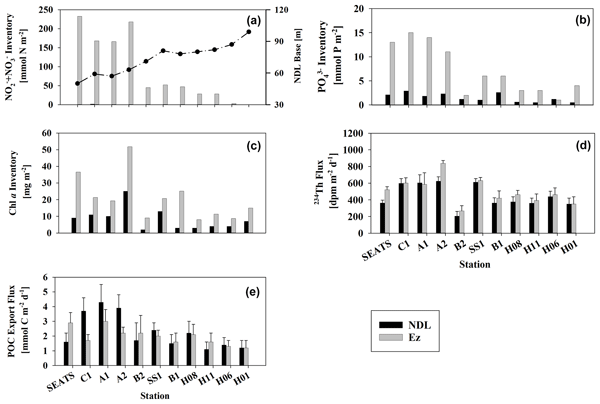
We distinguished particulate organic carbon (POC) export fluxes out of the nutrient-depleted layer (NDL) and the euphotic zone. The amount of POC export flux at the NDL base suggests that the NDL could be a hotspot of particle export. The substantial POC export flux at the NDL base challenges traditional concepts that the NDL was limited in terms of POC export. The dominant nutrient source for POC export fluxes should be subsurface nutrients, which was determined by 15N isotopic mass balance.
Zuozhu Wen, Thomas J. Browning, Rongbo Dai, Wenwei Wu, Weiying Li, Xiaohua Hu, Wenfang Lin, Lifang Wang, Xin Liu, Zhimian Cao, Haizheng Hong, and Dalin Shi
Biogeosciences, 19, 5237–5250, https://doi.org/10.5194/bg-19-5237-2022, https://doi.org/10.5194/bg-19-5237-2022, 2022
Short summary
Short summary
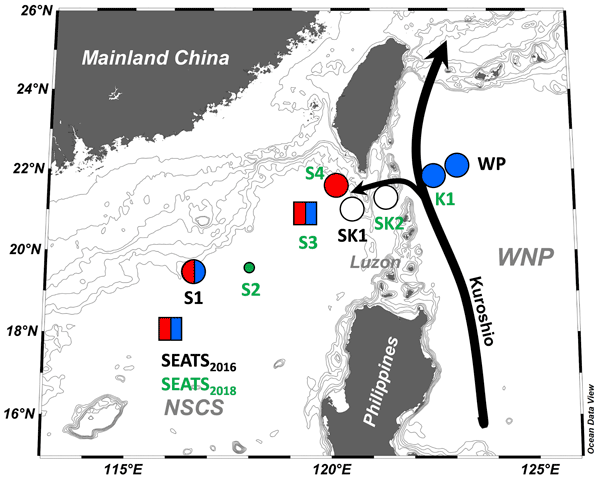
Fe and P are key factors controlling the biogeography and activity of marine N2-fixing microorganisms. We found lower abundance and activity of N2 fixers in the northern South China Sea than around the western boundary of the North Pacific, and N2 fixation rates switched from Fe–P co-limitation to P limitation. We hypothesize the Fe supply rates and Fe utilization strategies of each N2 fixer are important in regulating spatial variability in community structure across the study area.
Cited articles
Agusti, S., González-Gordillo, J. I., Vaqué, D., Estrada, M., Cerezo, M. I., Salazar, G., Gasol, J. M., and Duarte, C. M.: Ubiquitous healthy diatoms in the deep sea confirm deep carbon injection by the biological pump, Nat. Commun., 6, 7608, https://doi.org/10.1038/ncomms8608, 2015.
Belcher, A., Henley, S. F., Hendry, K., Wootton, M., Friberg, L., Dallman, U., Wang, T., Coath, C., and Manno, C.: Seasonal cycles of biogeochemical fluxes in the Scotia Sea, Southern Ocean: a stable isotope approach, Biogeosciences, 20, 3573–3591, https://doi.org/10.5194/bg-20-3573-2023, 2023.
Brzezinski, M. A.: The Si:C:N ratio of marine diatoms: interspecific variability and the effect of some environmental variables, J. Phycol., 21, 347–357, https://doi.org/10.1111/j.0022-3646.1985.00347.x, 1985.
Buzas, M. A. and Hayek, L.-A. C.: On richness and evenness within and between communities, Paleobiology, 31, 199–220, http://www.jstor.org/stable/4096804 (last access: 20 December 2025), 2005.
Cao, Z., Wang, D., Zhang, Z., Zhou, K., Liu, X., Wang, L., Huang, B., Cai, P., and Dai, M.: Seasonal dynamics and export of biogenic silica in the upper water column of a large marginal sea, the northern South China Sea, Prog. Oceanogr., 188, 102421, https://doi.org/10.1016/j.pocean.2020.102421, 2020.
Chen, D., Shi, Z., Li, R., Li, X., Cheng, Y., and Xu, J.: Hydrodynamics drives shifts in phytoplankton community composition and carbon-to-chlorophyll a ratio in the northern South China Sea, Front. Mar. Sci., 10, 1293354, https://doi.org/10.3389/fmars.2023.1293354, 2023.
Chitari, R. R. and Anil, A. C.: Estimation of diatom and dinoflagellate cell volumes from surface waters of the Northern Indian Ocean, Oceanologia, 59, 389–395, https://doi.org/10.1016/j.oceano.2017.03.001, 2017.
Dai, M., Luo, Y., Achterberg, E. P., Browning, T. J., Cai, Y., Cao, Z., Chai, F., Chen, B., Church, M. J., Ci, D., Du, C., Gao, K., Guo, X., Hu, Z., Kao, S., Laws, E. A., Lee, Z., Lin, H., Liu, Q., Liu, X., Luo, W., Meng, F., Shang, S., Shi, D., Saito, H., Song, L., Wan, X. S., Wang, Y., Wang, W., Wen, Z., Xiu, P., Zhang, J., Zhang, R., and Zhou, K.: Upper Ocean Biogeochemistry of the Oligotrophic North Pacific Subtropical Gyre: From Nutrient Sources to Carbon Export, Rev. Geophys., 61, e2022RG000800, https://doi.org/10.1029/2022RG000800, 2023.
Dixon, P.: VEGAN, a package of R functions for community ecology, J. Vegetation Sci., 14, 927–930, https://doi.org/10.1111/j.1654-1103.2003.tb02228.x, 2003.
Dore, J. E., Letelier, R. M., Church, M. J., Lukas, R., and Karl, D. M.: Summer phytoplankton blooms in the oligotrophic North Pacific Subtropical Gyre: Historical perspective and recent observations, Prog. Oceanogr., 76, 2–38, https://doi.org/10.1016/j.pocean.2007.10.002, 2008.
Du, C., Dai, M., Liu, Z., Hu, Z., Yang, J.-Y. T., Zhou, K., Lin, H., Yuan, Z., Wang, L., Huang, T., Guo, L., Wang, Z., and Kao, S.-J.: Diapycnal fluxes of nutrients in the North Pacific Subtropical Gyre, Global Planet. Change, 253, 104973, https://doi.org/10.1016/j.gloplacha.2025.104973, 2025.
Eppley, R. W., Reid, F., and Strickland, J.: Estimates of phytoplankton crop size, growth rate, and primary production, Calif. Univ. Scripps Inst. Oceanogr. Bull., 17, 33–42, ISBN 0520093623, 1970.
Foreman, R. K., Barone, B., Grabowski, E., Bjorkman, K. M., HenderikxFreitas, F., Garcia, C. A., Manck, L. E., White, A. E., Church, M. J., and Karl, D. M.: Biogeochemical anatomy and ecosystem dynamics of a large phytoplankton bloom north of the Hawaiian Islands, Prog. Oceanogr., 241, 103620, https://doi.org/10.1016/j.pocean.2025.103620, 2026.
Fu, L., Niu, B., Zhu, Z., Wu, S., and Li, W.: CD-HIT: accelerated for clustering the next-generation sequencing data, Bioinformatics, 28, 3150–3152, https://doi.org/10.1093/bioinformatics/bts565, 2012.
Guidi, L., Chaffron, S., Bittner, L., Eveillard, D., Larhlimi, A., Roux, S., Darzi, Y., Audic, S., Berline, L., Brum, J. R., Coelho, L. P., Espinoza, J. C. I., Malviya, S., Sunagawa, S., Dimier, C., Kandels-Lewis, S., Picheral, M., Poulain, J., Searson, S., Tara Oceans Consortium Coordinators, Stemmann, L., Not, F., Hingamp, P., Speich, S., Follows, M., Karp-Boss, L., Boss, E., Ogata, H., Pesant, S., Weissenbach, J., Wincker, P., Acinas, S. G., Bork, P., De Vargas, C., Iudicone, D., Sullivan, M. B., Raes, J., Karsenti, E., Bowler, C., and Gorsky, G.: Plankton networks driving carbon export in the oligotrophic ocean, Nature, 532, 465–470, https://doi.org/10.1038/nature16942, 2016.
Harrison, P. J., Zingone, A., Mickelson, M. J., Lehtinen, S., Ramaiah, N., Kraberg, A. C., Sun, J., McQuatters-Gollop, A., and Jakobsen, H. H.: Cell volumes of marine phytoplankton from globally distributed coastal data sets, Estuar. Coast Shelf S., 162, 130–142, https://doi.org/10.1016/j.ecss.2015.05.026, 2015.
Henson, S., Le Moigne, F., and Giering, S.: Drivers of Carbon Export Efficiency in the Global Ocean, Global Biogeochem. Cy., 33, 891–903, https://doi.org/10.1029/2018GB006158, 2019.
Huang, B., Hu, J., Xu, H., Cao, Z., and Wang, D.: Phytoplankton community at warm eddies in the northern South China Sea in winter 2003/2004, Deep-Sea Res. Pt. II., 57, 1792–1798, https://doi.org/10.1016/j.dsr2.2010.04.005, 2010.
Huang, G., Vidal-Melgosa, S., Sichert, A., Becker, S., Fang, Y., Niggemann, J., Iversen, M. H., Cao, Y., and Hehemann, J.: Secretion of sulfated fucans by diatoms may contribute to marine aggregate formation, Limnol. Oceanogr., 66, 3768–3782, https://doi.org/10.1002/lno.11917, 2021.
Jiang, Z., Gao, Y., Chen, Y., Du, P., Zhu, X., Liao, Y., Liu, X., and Zeng, J.: Spatial heterogeneity of phytoplankton community shaped by a combination of anthropogenic and natural forcings in a long narrow bay in the East China Sea, Estuar. Coast Shelf S., 217, 250–261, https://doi.org/10.1016/j.ecss.2018.11.028, 2019.
Kappelmann, L., Krüger, K., Hehemann, J.-H., Harder, J., Markert, S., Unfried, F., Becher, D., Shapiro, N., Schweder, T., Amann, R. I., and Teeling, H.: Polysaccharide utilization loci of North Sea Flavobacteriia as basis for using SusC/D-protein expression for predicting major phytoplankton glycans, ISME J., 13, 76–91, https://doi.org/10.1038/s41396-018-0242-6, 2019.
Karl, D. M., Church, M. J., Dore, J. E., Letelier, R. M., and Mahaffey, C.: Predictable and efficient carbon sequestration in the North Pacific Ocean supported by symbiotic nitrogen fixation, P. Natl. Acad. Sci. USA, 109, 1842–1849, https://doi.org/10.1073/pnas.1120312109, 2012.
Kieser, S., Brown, J., Zdobnov, E. M., Trajkovski, M., and McCue, L. A.: ATLAS: a Snakemake workflow for assembly, annotation, and genomic binning of metagenome sequence data, BMC Bioinf., 21, 257, https://doi.org/10.1186/s12859-020-03585-4, 2020.
Krause, J. W., Brzezinski, M. A., Villareal, T. A., and Wilson, C.: Biogenic silica cycling during summer phytoplankton blooms in the North Pacific subtropical gyre, Deep-Sea Res. Pt. I, 71, 49–60, 2013.
Kunakh, O. M., Volkova, A. M., Tutova, G. F., and Zhukov, O. V.: Diversity of diversity indices: Which diversity measure is better, Biosys. Divers., 31, 131–146, https://doi.org/10.15421/012314, 2023.
Kwon, E. Y., Primeau, F., and Sarmiento, J. L.: The impact of remineralization depth on the air–sea carbon balance, Nat. Geosci., 2, 630–635, https://doi.org/10.1038/ngeo612, 2009.
Lam, P. J., Lee, J.-M., Heller, M. I., Mehic, S., Xiang, Y., and Bates, N. R.: Size-fractionated distributions of suspended particle concentration and major phase composition from the U.S. GEOTRACES Eastern Pacific Zonal Transect (GP16), Mar. Chem., 201, 90–107, https://doi.org/10.1016/j.marchem.2017.08.013, 2018.
Letscher, R. T., Primeau, F., and Moore, J. K.: Nutrient budgets in the subtropical ocean gyres dominated by lateral transport, Nat. Geosci., 9, 815–819, https://doi.org/10.1038/ngeo2812, 2016.
Li, C., Tan, L., Gao, Y., Li, X., Sun, L., Liang, J., Zhang, J., Huang, L. and Chen, C.:Morphology of Amphora lunulata AH Wachnicka & EE Gaiser and its transfer to Seminavis DG Mann, Diatom Res., 37, 63–69, https://doi.org/10.1080/0269249X.2022.2041490, 2022.
Li, D., Wang, H., Li, Y., Cao, Y., Wu, K., and Wang, Q.: Current trends and hotspots of etiology of auditory neuropathy in the past 30 years: A bibliometric analysis, J. Otol., 19, 113–119, https://doi.org/10.1016/j.joto.2024.07.003, 2024.
Liu, X., Xiao, W., Landry, M. R., Chiang, K.-P., Wang, L., and Huang, B.: Responses of Phytoplankton Communities to Environmental Variability in the East China Sea, Ecosystems, 19, 832–849, https://doi.org/10.1007/s10021-016-9970-5, 2016.
Menden-Deuer, S. and Lessard, E. J.: Carbon to volume relationships for dinoflagellates, diatoms, and other protist plankton, Limnol. Oceanogr., 45, 569–579, https://doi.org/10.4319/lo.2000.45.3.0569, 2000.
McDonnell, A. M. P., Boyd, P. W., and Buesseler, K. O.: Effects of sinking velocities and microbial respiration rates on the attenuation of particulate carbon fluxes through the mesopelagic zone, GBC, 29, 175–193, https://doi.org/10.1002/2014GB004935, 2015.
Nagao, T., Kumabe, A., Komatsu, F., Yagi, H., Suzuki, H., and Ohshiro, T.: Gene identification and characterization of fucoidan deacetylase for potential application to fucoidan degradation and diversification, J. Biosci. Bioeng., 124, 277–282, https://doi.org/10.1016/j.jbiosc.2017.04.002, 2017.
Noguchi, H., Park, J., and Takagi, T.: MetaGene: prokaryotic gene finding from environmental genome shotgun sequences, Nucleic Acids Res., 34, 5623–5630, https://doi.org/10.1093/nar/gkl723, 2006.
Pielou, E. C.: The measurement of diversity in different types of biological collections, J. Theor. Biol., 13, 131–144, https://doi.org/10.1016/0022-5193(66)90013-0, 1966.
Ran, L., Chen, J., Wiesner, M. G., Ling, Z., Lahajnar, N., Yang, Z., Li, H., Hao, Q., and Wang, K.: Variability in the abundance and species composition of diatoms in sinking particles in the northern South China Sea: Results from time-series moored sediment traps, Deep-Sea Res. Pt. II, 122, 15–24, https://doi.org/10.1016/j.dsr2.2015.07.004, 2015.
Rath, A. R. and Mitbavkar, S.: Diatom community dynamics in a tropical brackish coastal ecosystem from an ecological and biogeochemical perspective: A size-fractionated approach, Cont. Shelf Res., 263, 105039, https://doi.org/10.1016/j.csr.2023.105039, 2023.
Rembauville, M., Manno, C., Tarling, G.A., Blain, S., and Salter, I.: Strong contribution of diatom resting spores to deep-sea carbon transfer in naturally iron-fertilized waters downstream of South Georgia, Deep-Sea Res. Pt. I, 115, 22–35, https://doi.org/10.1016/j.dsr.2016.05.002, 2016.
Sabine, C. L., Feely, R. A., Gruber, N., Key, R. M., Lee, K., Bullister, J. L., Wanninkhof, R., Wong, C. S., Wallace, D. W. R., Tilbrook, B., Millero, F. J., Peng, T.-H., Kozyr, A., Ono, T., and Rios, A. F.: The Oceanic Sink for Anthropogenic CO2, Science, 305, 367–371, https://doi.org/10.1126/science.1097403, 2004.
Scharek, R., Tupas, L., and Karl, D.: Diatom fluxes to the deep sea in the oligotrophic North Pacific gyre at Station ALOHA, Mar. Ecol. Prog. Ser., 182, 55–67, https://doi.org/10.3354/meps182055, 1999a.
Scharek, R., Latasa, M., Karl, D. M., and Bidigare, R. R.: Temporal variations in diatom abundance and downward vertical flux in the oligotrophic North Pacific gyre, Deep-Sea Res. Pt. I., 46, 1051–1075, https://doi.org/10.1016/S0967-0637(98)00102-2, 1999b.
Schreiber, F., Littmann, S., Lavik, G., Escrig, S., Meibom, A., Kuypers, M. M. M., and Ackermann, M.: Phenotypic heterogeneity driven by nutrient limitation promotes growth in fluctuating environments, Nat. Microbiol., 1, 16055, https://doi.org/10.1038/nmicrobiol.2016.55, 2016.
Shen, H., Wan, X. S., Zou, W., Dai, M., Xu, M. N., and Kao, S.-J.: Light-driven integration of diazotroph-derived nitrogen in euphotic nitrogen cycle, Nat. Commun., 15, 9193, https://doi.org/10.1038/s41467-024-53067-x, 2024.
Simon, E., Lacour, L., Claustre, H., Bock, N., Cornec, M., Sauzède, R., Schmechtig, C., and Coppola, L.: Linking Surface Phytoplankton Dynamics to Small-Particle Fluxes in the Mesopelagic Zone: Insights From High Latitude Bioregions Using BGC-Argo Floats, GBC, 39, e2024GB008447, https://doi.org/10.1029/2024GB008447, 2025.
Siqueiros Beltrones, D. A., Echevarría Herrera, E., López-Fuerte, F. O., and Martínez, Y. J.: Species Diversity of Benthic Marine Diatoms from a Natural Protected Area in Cuba, Diversity, 17, 181, https://doi.org/10.3390/d17030181, 2025.
Student: The Probable Error of a Mean, Biometrika, 6, 1, https://doi.org/10.2307/2331554, 1908.
Stukel, M. R., Irving, J. P., Kelly, T. B., Ohman, M. D., Fender, C. K., and Yingling, N.: Carbon sequestration by multiple biological pump pathways in a coastal upwelling biome, Nat. Commun., 14, 2024, https://doi.org/10.1038/s41467-023-37771-8, 2023.
Sun, J. and Liu, D.: Geometric models for calculating cell biovolume and surface area for phytoplankton, J. Plankton Res., 25, 1331–1346, https://doi.org/10.1093/plankt/fbg096, 2003.
Taurozzi, D. and Scalici, M.: Climbing the elevational gradient: Diatom diversity patterns across temporary ponds, Environ. Res., 285, 122630, https://doi.org/10.1016/j.envres.2025.122630, 2025.
Tréguer, P., Bowler, C., Moriceau, B., Dutkiewicz, S., Gehlen, M., Aumont, O., Bittner, L., Dugdale, R., Finkel, Z., Iudicone, D., Jahn, O., Guidi, L., Lasbleiz, M., Leblanc, K., Levy, M., and Pondaven, P.: Influence of diatom diversity on the ocean biological carbon pump, Nat. Geosci., 11, 27–37, https://doi.org/10.1038/s41561-017-0028-x, 2018.
Unfried, F., Becker, S., Robb, C. S., Hehemann, J.-H., Markert, S., Heiden, S. E., Hinzke, T., Becher, D., Reintjes, G., Krüger, K., Avcı, B., Kappelmann, L., Hahnke, R. L., Fischer, T., Harder, J., Teeling, H., Fuchs, B., Barbeyron, T., Amann, R. I., and Schweder, T.: Adaptive mechanisms that provide competitive advantages to marine bacteroidetes during microalgal blooms, ISME J., 12, 2894–2906, https://doi.org/10.1038/s41396-018-0243-5, 2018.
Utermöhl, H.: Zur Vervollkommnung der quantitativen Phytoplankton-Methodik: Mit 1 Tabelle und 15 abbildungen im Text und auf 1 Tafel, SIL Communications, 1953–1996, 9, 1–38, https://doi.org/10.1080/05384680.1958.11904091, 1958.
Vidal-Melgosa, S., Sichert, A., Francis, T. B., Bartosik, D., Niggemann, J., Wichels, A., Willats, W. G. T., Fuchs, B. M., Teeling, H., Becher, D., Schweder, T., Amann, R., and Hehemann, J.-H.: Diatom fucan polysaccharide precipitates carbon during algal blooms, Nat. Commun., 12, 1150, https://doi.org/10.1038/s41467-021-21009-6, 2021.
Wang, C., Zhang, K., Cao, Z., Zhou, K., Yuan, Z., Chen, J., Ma, Y., Zhou, B., Liu, X., Cai, Y., Shi, D., and Dai, M.: Size-fractionated C:N:P:Si stoichiometry of particulate matter in the subtropical Western North Pacific, Global Planet. Change, 246, 104732, https://doi.org/10.1016/j.gloplacha.2025.104732, 2025.
Wang, L., Huang, B., Liu, X., and Xiao, W.: The modification and optimizing of the CHEMTAX running in the South China Sea, Acta Oceanol. Sin., 34, 124–131, https://doi.org/10.1007/s13131-015-0621-z, 2015.
Wiedmann, I., Ceballos-Romero, E., Villa-Alfageme, M., Renner, A. H. H., Dybwad, C., van der Jagt, H., Svensen, C., Assmy, P., Wiktor, J. M., Tatarek, A., Rozanska-Pluta, D. M., and Iversen, M. H.: Arctic Observations Identify Phytoplankton Community Composition as Driver of Carbon Flux Attenuation, Geophys. Res. Lett., 47, e2020GL087465, https://doi.org/10.1029/2020GL087465, 2020.
Wong Chin, J. M., Puchooa, D., Bahorun, T., Neergheen, V. S., Aullybux, A. A., Beedessee, G., Nazurally, N., Alrefaei, A. F., and Jeewon, R.: Metabarcoding assessment of fungal diversity in brown algae and sponges of Mauritius, Front. Microbiol., 13, 1003790, https://doi.org/10.3389/fmicb.2022.1003790, 2022.
Xiu, P. and Chai, F.: Eddies Affect Subsurface Phytoplankton and Oxygen Distributions in the North Pacific Subtropical Gyre, Geophys. Res. Lett., 47, e2020GL087037, https://doi.org/10.1029/2020GL087037, 2020.
Yang, Q. and Lin, G.: Species Diversity of Phytoplankton in the Western Pacific, Beijing, Ocean Press, ISBN 9787030635914, 2021 (in Chinese).
Yang, S. and Dong, S.: Atlas of Common Marine Planktonic Diatoms in Chinese Seas, Qingdao, Ocean University of China Press, 2006 (in Chinese).
Zhang, A., Liu, H., Li, C., Chen, C., Liang, J., Sun, L., and Gao, Y.: Relationship between toxic and harmful microalgae and environmental factors in typical mariculture areas of East China Sea, J. Ocean. Limnol., 40, 2401–2415, https://doi.org/10.1007/s00343-022-2125-y, 2022.
Zhang, C., Dang, H., Azam, F., Benner, R., Legendre, L., Passow, U., Polimene, L., Robinson, C., Suttle, C. A., and Jiao, N.: Evolving paradigms in biological carbon cycling in the ocean, Nat. Sci. Rev., 5, 481–499, https://doi.org/10.1093/nsr/nwy074, 2018.
Zhang, L., Wen, Z., Hong, H., Kang, S., Jiang, P., Lin, S. Shi, D., and Li, X. Seasonal shift of dissolved organic matter stoichiometry in the surface North Pacific subtropical gyre: Regulation by enhanced N2 fixation and DOP utilization. Geophys. Res. Lett., 53, e2025GL120193, https://doi.org/10.1029/2025GL120193, 2026.
Short summary
In nutrient‑poor open ocean, scarce diatoms still remove CO₂. In the western North Pacific Subtropical Gyre (NPSG), we found different diatoms live at different depths. Where a warm current (Kuroshio) flows, large diatoms carry more carbon to deep water; elsewhere their contribution is lower. Microbes lack genes to digest protective polymers made by diatoms, which may help carbon sink efficiently. To predict ocean climate role, we must know not only which algae are present but also how well their organic matter resists decay.
In nutrient‑poor open ocean, scarce diatoms still remove CO₂. In the western North Pacific...
Altmetrics
Final-revised paper
Preprint